
 Who dares to clean the Atlantic goliath grouper? Ecological relationships involving Epinephelus itajara
Abstract
Cleaning activity is an important interaction that increases the health and survival of species worldwide. While most studies have focused on identifying cleaner and client species, studies focused on cleaning activity patterns on endangered species are still scarce. We investigated the cleaners of the Atlantic goliath grouper (AGG) Epinephelus itajara by literature review, search from social media sources and consulting the major database regarding AGG studies. Search on social media provided most records. We found nine reef fishes acting as cleaners exploring different parts of the AGG body, mostly the sharksucker Echeneis naucrates and the spanish hogfish Bodianus rufus. Most records involved AGG adults and were registered on shipwrecks. We believe that the rare nature of the records involving AGG in cleaning activities is due to the low population density of the species along its distribution (due to overfishing and habitat destruction), and through chafing behavior, but also the presence of a cleaner (Echeneis naucrates) attached to the body. The cleaning provided by remoras is discreet and difficult to perceive when the focus is on the AGG from a wider angle. In order to recover threatened species, a greater understanding of positive relationships, such as cleaning activities, is necessary.
Keywords:
Cleaning behavior; Cleaning of groupers; Cleaning symbiosis; Endangered species; Reef fishes
Resumo
A atividade de limpeza é uma interação importante que aumenta a saúde e a sobrevivência das espécies. Embora a maioria dos estudos tenha se concentrado na identificação de espécies limpadoras e clientes, os estudos focados nos padrões de atividades de limpeza em espécies ameaçadas ainda são escassos. Nós investigamos os limpadores do mero Epinephelus itajara por meio de revisão de literatura, busca em mídia social e consulta ao principal banco de dados sobre estudos de meros. A busca nas redes sociais forneceu a maioria dos registros. Encontramos nove espécies de peixes recifais atuando como limpadores que exploraram diferentes partes do corpo dos meros, principalmente a rêmora Echeneis naucrates e o bodião-papagaio Bodianus rufus. A maioria dos registros envolveu meros adultos e foram registrados em naufrágios. Acreditamos que a raridade dos registos envolvendo meros em atividades de limpeza se deve à baixa densidade populacional da espécie ao longo da sua distribuição (devido à sobrepesca e destruição do habitat), ao comportamento de atrito, e também à presença de um limpador (Echeneis naucrates) ligado ao corpo. A limpeza proporcionada pelas rêmoras é discreta e difícil de perceber quando o foco está no mero e de um ângulo mais amplo. Para recuperar espécies ameaçadas é necessária uma maior compreensão das relações positivas, como as atividades de limpeza.
Palavras-chave:
Comportamento de limpeza; Espécies ameaçadas; Limpeza de garoupas; Peixes recifais; Simbiose de limpeza
INTRODUCTION
To understand the role of ecological communities, it is important to recognize the significance of positive interactions, such as mutualism and commensalism, as they mitigate physical and biotic stresses and can increase the fitness of interacting individuals (Stachowicz, 2001; Bronstein et al., 2004; Narvaez et al., 2015). One example of positive interspecific communication among reef fish is the cleaning behavior, which plays a crucial role in maintaining mutualistic associations between cleaners and clients (Grutter, 1999; Sazima et al., 2000). During this interaction, cleaners remove and usually consume parasites, dead tissue, and mucus excess from their clients, resulting in the clients being freed of parasitic cargo and unwanted materials, thus providing mutual benefits (Losey, 1971, 1987).
Several interaction mechanisms are involved in this mutualistic association between cleaners and clients (Losey, 1971). Although cleaning symbiosis has been extensively studied in the reefs of the Indo-Pacific, of the Caribbean (Losey, 1974; Côté et al., 1998; Grutter, Poulin, 1998), and in the south-western Atlantic the number of studies has increased since the 1990s (Sazima et al., 1998, 1999a,b, 2005; Francini-Filho et al., 2000; Sazima, Sazima, 2001; Feitosa et al., 2003; Francini-Filho, Sazima, 2008; Coni et al., 2008; Quimbayo et al., 2017a,b).
According to Côte (2000), many reef fishes frequent cleaning stations where cleaners (fish or shrimp) pick ectoparasites from the body of clients, providing a source of food for themselves while also benefiting clients by removing ectoparasites. These cleaning interactions not only increase fish diversity on coral reefs but also benefit fish health by removing parasites from clients (Grutter, 1999). However, there are evidences indicating that cleaner fish may sometimes act non-mutualistically, eating scales or mucus rather than ectoparasites (e.g., Gorlick, 1980; Grutter, 1997). Additionally, tactile stimulation from cleaners may reduce cortisol levels (Soares et al., 2011), and this may have negative consequences for clients as it may decrease their ability to respond to disturbances like predators (Schirmer et al., 2013). Despite this potential drawback, which indicates that this interaction dynamic can be highly complex, the mutualistic relationship between cleaners and clients remains important for maintaining the health and diversity of reef fish communities (Côte, 2000).
While many studies have focused on identifying cleaner and client species, studies focused on cleaning activity patterns on endangered species are still scarce, including large groupers. According to Sazima et al. (1999b), the cleaning of large predators may also represent an additional sign of the specialization of a given cleaner (Losey, 1971), dedicated cleaners such as gobies spp. routinely clean groupers (Sazima et al., 1999b; Vaughan, 2017), whereas less specialized cleaners, such as the bluehead wrasse, rarely clean piscivorous clients (Darcy et al., 1974).
The Atlantic goliath grouper (AGG), Epinephelus itajara, is sensitive to fishing pressure due to intrinsic characteristics such as late maturation, slow growth, lack of fear of humans, and the formation of predictable spawning aggregations in space and time, as well as habitat degradation (Sadovy, Eklund, 1999; Ferreira et al., 2014; Bertoncini et al., 2018). As a result, the species is classified as vulnerable on the IUCN Red List (Bertoncini et al., 2018). However, in Brazil, the species is considered critically endangered (Hostim-Silva et al., 2005; Ferreira et al., 2018) and overfishing and habitat degradation are thought to be responsible for the decline of its populations and local disappearance throughout its distribution range, specifically in some areas of the Brazilian coast (Gerhardinger et al., 2009; Bertoncini et al., 2018; Ferreira et al., 2018). Although our knowledge about this iconic species has grown in some areas (Locatelli et al., 2023), we know very little about the involvement of the AGG on cleaning stations and who their cleaners are. By compiling this information, we will have an indication with which species the AGG directly interacts in the quest to maintain body health by reducing parasites or dead tissue.
We reviewed records involving the AGGbeing cleaned by reef species, searching for the identity of the cleaner species, distribution of the records, number of cleaners, AGG life phase, time of cleaning, and body parts that received more attention by cleaners.
MATERIAL AND METHODS
Literature review. We used the keywords involving cleaning behavior and Atlantic goliath grouper to search published peer-reviewed papers (written in English) on Web of Science and Scopus databases: cleaning symbiosis and Epinephelus itajara; reef fishes cleaning behavior; atlantic goliath grouper cleaning; goliath grouper at cleaning station; atlantic goliath grouper as client; grouper in cleaning station; atlantic goliath grouper being cleaned; cleaning behavior involving atlantic goliath grouper; goliath grouper in cleaning stations; goliath grouper cleaning; cleaning behavior involving Epinephelus itajara. We identified and retrieved a total of 222 papers based on queries of the two databases on 31 July 2023 (see diagram referring to the Preferred Reporting Items for systematic Reviews and Meta Analyses, PRISMA, in Fig. S1). After a first screening of titles and abstracts, we excluded 200 papers mainly because they were not related to cleaning of groupers (Epinephelidae). We accessed the full-text version of the remaining papers (22) and excluded 18 of them because they did not register AGG. After these screenings, we retained 2 papers which registered AGG being cleaned (Fig. S1). Analyzing these published papers, we searched for the name of the cleaner species, location of the record, number of cleaners, AGG life phase, and time of cleaning.
Search on social media. We search for cleaning interactions involving AGG using YouTube and Vimeo social media networks from the 1st of July to the 31st of August 2023. Searches were carried out with the aid of scientific and popular names of AGG and combinations of words related to cleaning symbiosis (see topic above). When a potential video containing AGG and cleaner fishes was found, the electronic address of the video was noted for later analysis to confirm cleaning activities on AGG and to obtain the same information as the literature review analysis (see topic above). Because some cleaners are small, while others have very discreet cleaning activity, each video was watched five times by the same researcher (JACCN) and cleaning described. A total of 80 videos were watched.
Projeto Meros do Brasil database. We compiled information from the Projeto Meros do Brasil database, which contains 20 years of research, with information collected throughout scientific diving, underwater visual censuses (Bueno et al., 2016), capture and release for telemetry and habitat use studies using cage and hooks (Condini et al., 2024), and citizen science involving SCUBA divers (Giglio et al., 2014), artisanal and angler fishers (Lima-Júnior et al., 2022), and an image bank from project researchers and underwater photographers that houses photography and video files.
Records of AGG being cleaned occurred opportunistically during scientific dives on natural or artificial reefs, which had as goals mapping AGG distribution, photo-identification or application of Rover Diving Census during reproductive aggregation. Although the database has more than 1,000 hours of scientific diving for prospecting the AGG, only four records of cleaning with AGG were found. When possible, ‘Focal’ groups were used and all occurrences were recorded (Altmann, 1974). Individuals were identified at the species level based using pertinent literature (Sampaio, Nottingham, 2008; Bertoncini et al., 2019). The total length (TL) of individuals was estimated to classify AGG in the following categories: juvenile (total length: TL <50 cm), subadult (TL = 50–100 cm), adult (TL = 101–150 cm), and large adult (TL > 151 cm) following Giglio et al. (2014).
Data analyses. We describe the cleaning interactions between AGG and cleaner species as a weighted matrix A in which aij is the frequency with which a cleaner j interacts with AGGi, and aij = 0 otherwise. The matrix A defines a bipartite network in which one set of nodes is represented by adults or sub-adults of AGG and the other set of nodes by cleaner species; the links describe cleaning interactions between them. A two-way Permutational Multivariate Analysis of Variance (PERMANOVA) was performed with 9999 permutations with Euclidean distance to test variation in the number of bites by cleaners on different body parts of AGG. Network structure was drawn using the bipartite “plotweb” within the package “bipartite” and PERMANOVA was done using the “vegan” package in R v. 4.2.1 (R Development Core Team, 2020).
RESULTS
Search on social media revealed most of the records (n = 15), followed by Projeto Meros database (n = 4) and literature review (n = 2, see Sadovy, Eklund, 1999 and Sazima, Grossman, 2006) (Tab. S2; Figs. S3–S4; Tab. S5). Most records occurred in United States (Florida) and Brazil, few records in the Caribbean reefs and no records in Central America (Fig. 1). Shipwrecks were the environment with the highest number of records where the cleaning activities happened (n = 14) compared with natural reefs (n = 3).

Distribution map of records involving the Atlantic goliath grouper cleaning. Distinct colors represent different species of cleaners, while the size of the circles represents the number of records. Records of Parablennius spp. cleaning AGG occurred simultaneously at the same site.
While nine species of reef fish were observed cleaning the AGG, two species were most commonly observed: the remora Echeneis naucrates (sharksucker) and the labrid Bodianus rufus (Spanish hogfish) (Figs. 2–3). Although we found E. naucrates in almost all confirmed images (>59 remoras, Fig. 4), varying from 1 to 6 individuals per AGG), only in a few (n = 13) the cleaning activity was observed.
Most of the records involved adult AGG, while only three cleaner species were recorded cleaning sub-adults. Most recorded cleaner species are facultative (6 species, corresponding to 67% of species), while only three are dedicated cleaners (3 species, 33%, all Elacatinus spp.).
The maximum number of fish cleaning an AGG at the same time was seven, however most observations consisted of just a single cleaner. Four was the maximum number of species of cleaners acting at the same time, but this occurred only once, with most records with a single species (Fig. 4A). We found differences in the number of bites per time spent on each cleaning event by cleaners (Df = 6, F = 14.03; p = 0.0001) and body parts (Df = 3, F = 4.20; p = 0.01), the flank and fins were the parts most sought after by cleaners (Fig. 3).

Network describing interactions (lines) between adults and sub-adults (orange circles) of Atlantic goliath grouper (AGG) and their cleaner species (colored circles). Thicker lines represent more frequent interactions. Left side: sub-adult (top) and adult (bottom) AGG. Right side, cleaners, from top to bottom: Echeneis naucrates, Bodianus pulchellus, Bodianus rufus, Elacatinus sp., Elacatinus oceanops, Elacatinus figaro, Anisotremus virginicus, Parablennius marmoreus and P. pilicornis.
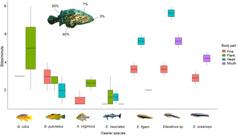
Cleaning (bites/minute) for body parts by cleaner species. Around the Atlantic goliath grouper figure, percentage of bites for all cleaners by body parts. The boxplot lines are the median for the measured parameters; the boxes range from the 25th to the 75th percentile. From left to right: Bodianus rufus, Bodianus pulchellus, Anisotremus virginicus, Echeneis naucrates,Elacatinus figaro, Elacatinus sp., and Elacatinus oceanops. Bites were not counted for records of Parablennius spp.
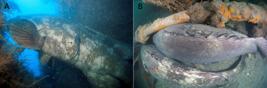
Atlantic goliath grouper (AGG) Epinephelus itajara with Echeneis naucrates (A) and unusual cleaning event involving Parablennius pilicornis (orange, below) and P. marmoreus cleaning two AGG (B). Photos by Áthila A. Bertoncini.
DISCUSSION
Among the functions observed in fish behavior, one of them is body maintenance. Cleaning is a body maintenance function, and most fishes make use of cleaning stations where they pick parasites and unwanted material from other fishes, a mutualistic interaction (Shukla, 2009). We investigated the cleaners of the Atlantic goliath grouper (AGG) Epinephelus itajara using literature review, search on social media and exploring a specific database about the AGG (Projeto Meros do Brasil database). In general, we found that studies on the AGG being cleaned are rare. However, by combining published literature with an examination of social media and a specific database on AGG, we identified varied cleaners for AGG adults. AGG juveniles are found mainly on estuaries/mangroves areas, where the visibility is limited and makes it difficult to observe cleaning interactions.
The main AGG cleaners were the sharksucker Echeneis naucrates (a remora) and the
Spanish hogfish Bodianus rufus (a labrid). Interestingly, most records involving B. rufus did not have remora associated with AGG. It is known that young B. rufus tends to form temporary and mobile cleaning stations (Coni et al., 2010). On the other hand, it is possible that the AGG that has an attached remora do not seek cleaning stations. Nevertheless, these mobile stations can find/receive clients regardless of whether or not they are looking for cleaning (Coni et al., 2010). Echeneis naucrates and Bodianus rufus cleaned mainly the flanks and fins, while Elacatinus species cleaned more the head and mouth. This difference is known for dedicated and facultative cleaners (e.g., Sazima et al., 1999b), Elacatinus spp. being dedicated cleaners and Bodianus spp. and remoras being facultative ones (Quimbayo et al., 2021).
We also found records of the gobies Elacatinus spp. cleaning AGG. These species are more common on reef environments, while the AGG can inhabit different environments (estuaries, reefs, rhodolith beds, shipwrecks and mesophotic reefs). Like the AGG, E. naucrates is also found in other environments, from estuaries to deeper environments, and is known to follow and attach to several types of marine vertebrates, including fishes, turtles, and mammals (review in O’Toole, 2002). Being associated with large species, including AGGs, remoras may benefit from this association in several ways, including transport, feeding opportunities, and protection from predators (O’Toole, 2002). Besides feeding while cleaning the hosts on occasion, remoras are known to forage on the hosts’ feces and/or regurgitated food, food scraps of their hosts, and ram-feeding on plankton while attached to the moving host (Sazima et al., 1999a, 2003; O’Toole, 2002; Williams et al., 2003; Silva et al., 2005), and also foraging on stirred particles (Sazima et al., 2004).
The difficulty in observing the cleaning by E. naucrates reflects the fact that the behavior is quick and fortuitous and can occur throughout the day without a specific location or even time, as it usually occurs between cleaners and clients at cleaning stations. However, juvenile E. naucrates may tend cleaning stations on shipwrecks (Sazima et al., 1999a), and there is an illustration in Sazima, Grossman (2006) of a shipwreck station and the AGG cleaned by the attending remora. In two videos it was possible to see night cleaning by E. naucrates, when the AGG are active. Determining whether this is a common event requires further study.
Although remoras can cause discomfort in some species (e.g., cetaceans; Silva-Jr, Sazima, 2008), the AGG do not seem to be bothered by remoras. The large scales possibly protect the AGG from the injuries caused by the remora’s suction discs. Further studies of the remoras-host association may aim at quantifying costs that would result from remoras’ attachment to AGG.
The suction disc allows hitch-hiking behavior that benefits remoras with reduced costs of transportation and expenditure of energy (Strasburg, 1957; Steffensen, Lomholt, 1983; Alling, 1985), access to food resources (Sazima et al., 2003; Sazima, Grossman, 2006), protection from predators (Silva-Jr et al., 2005), and even presumably increased mating opportunities (Silva-Jr, Sazima, 2003). Additional studies focusing on this cleaner on AGG will further clarify the importance of the association between these species.
We believe that the rare nature of the records involving AGGs in cleaning activities is due to the low density of the species, due to overfishing and habitat destruction (see Coleman et al., 2023). Here we presented the first steps on understanding cleaning interactions involving the endangered AGG, but many gaps remain. A fundamental step towards recovering and conserving threatened species is to understand their ecological interactions, which represent a key aspect of biodiversity (Abrams, 1987). Thus, since positive interactions, such as cleaning activities, can result in increased individual fitness, studies that understand how the ecological aspects of these interactions affect the lives of interacting species are essential.
ACKNOWLEDGEMENTS
We thank our home institutions. We also thank professor Daniel T. Blumstein (UCLA) for comments on a previous version of this manuscript. JACCN is grateful for the encouragement of the professor Vinicius Giglio (UFOPA).
REFERENCES
-
Abrams PA. On classifying interactions between populations. Oecologia. 1987; 73(2):272–81. https://doi.org/10.1007/BF00377518
» https://doi.org/10.1007/BF00377518 - Alling A. Remoras and blue whales: a commensal or mutual interaction? J A Cetac Soc. 1985; 19(1):16–19.
-
Altmann J. Observational study of behavior: sampling methods. Behaviour. 1974; 49(3–4):227–66. https://www.jstor.org/stable/4533591
» https://www.jstor.org/stable/4533591 -
Bertoncini AA, Aguilar-Perera A, Barreiros J, Craig MT, Ferreira BP, Koenig CC Epinephelus itajara (errata version published in 2019). The IUCN Red List of Threatened Species. 2018; 2018:e.T195409A145206345. https://doi.org/10.2305/IUCN.UK.2018-2.RLTS.T195409A145206345.en
» https://doi.org/10.2305/IUCN.UK.2018-2.RLTS.T195409A145206345.en - Bertoncini AA, Moraes F, Borgonha M, Aguiar AA. Marine biodiversity and diving guide to the islands of Rio. Rio de Janeiro: Museu Nacional; 2019.
- Bronstein JL, Dieckmann U, Ferrière R. Coevolutionary dynamics and the conservation of mutualisms. In: Ferrière R, Dieckmann U, Couvet D, editors. Evolutionary conservation biology. Cambridge: Cambridge University Press & Assessment; 2004. p.305–26.
-
Bueno LS, Bertoncini AA, Koenig CC, Coleman FC, Freitas MO, Leite JR et al. Evidence for spawning aggregations of the endangered Atlantic goliath grouper Epinephelus itajara in southern Brazil. J Fish Biol. 2016; 89(1):76–89. https://doi.org/10.1111/jfb.13028
» https://doi.org/10.1111/jfb.13028 -
Coleman FC, Nunes JACC, Bertoncini AA, Bueno LS, Freitas MO, Borgonha M et al. Controversial opening of a limited fishery for Atlantic Goliath Grouper in the United States: implications for population recovery. Mar Policy. 2023; 155:105752. https://doi.org/10.1016/j.marpol.2023.105752
» https://doi.org/10.1016/j.marpol.2023.105752 -
Condini MV, Oliveira RL, Almeida LL, Barbosa EF, Martins AC, Bertoncini AA et al. Physicochemical variables influencing the abundance of Atlantic goliath grouper juveniles (Epinephelus itajara) in a tropical Brazilian mangrove habitat. Mar Environ Res. 2024; 197:106465. https://doi.org/10.1016/j.marenvres.2024.106465
» https://doi.org/10.1016/j.marenvres.2024.106465 -
Coni EOC, Nunes JACC, Ferreira CM, Maia-Nogueira R, Medeiros DV, Sampaio CLS. The Spanish hogfish Bodianus rufus (Labridae) acting as cleaner of nocturnal fish in the northeast of Brazil. Mar Biodivers Rec. 2010; 3:e23. https://doi.org/10.1017/S1755267210000187
» https://doi.org/10.1017/S1755267210000187 -
Coni EOC, Nunes JACC, Sampaio CLS Halichoeres penrosei (Labridae), a sporadic cleaner wrasse. Mar Biodivers Rec. 2008; 1:e82. https://doi.org/10.1017/S1755267207008494
» https://doi.org/10.1017/S1755267207008494 - Côté IM. Evolution and ecology of cleaning symbioses in the sea. Oceanogr Mar Biol. 2000; 38(1):311–55.
-
Côté IM, Arnal C, Reynolds JD. Variation in posing behaviour among fish species visiting cleaning stations. J Fish Biol. 1998; 53(1):256–66. https://doi.org/10.1111/j.1095-8649.1998.tb01031.x
» https://doi.org/10.1111/j.1095-8649.1998.tb01031.x -
Darcy GH, Maisel E, Ogden JC. Cleaning preferences of the gobies Gobiosoma evelynae and G. prochilos and the juvenile wrasse Thalassoma bifasciatum Copeia. 1974(2):375–79. https://doi.org/10.2307/1442531
» https://doi.org/10.2307/1442531 -
Feitosa CV, Araújo ME, Correa LB. Cleaning activity of Bodianus rufus on Clepticus brasiliensis (Actinopterygii–Perciformes). Coral Reefs. 2003; 22:10. https://doi.org/10.1007/s00338-003-0280-y
» https://doi.org/10.1007/s00338-003-0280-y - Ferreira BP, Freitas MO, Bertoncini AA, Hostim-Silva M, Gerhardingher L, Nunes ZMP et al. Epinephelus itajara (Lichtenstein, 1822). In: Instituto Chico Mendes de Conservação da Biodiversidade – ICMBio, editors. Livro vermelho da fauna brasileira ameaçada de extinção: volume VI - Peixes. Brasília: ICMBio/MMA; 2018. p.805–12.
-
Ferreira HM, Reuss-Strenzel GM, Alves JA, Schiavetti A. Local ecological knowledge of the artisanal fishers on Epinephelus itajara (Lichtenstein, 1822) (Teleostei: Epinephelidae) on Ilhéus coast – Bahia State, Brazil. J Ethnobiol Ethnomed. 2014; 10:51. https://doi.org/10.1186/1746-4269-10-51
» https://doi.org/10.1186/1746-4269-10-51 -
Francini–Filho RB, Moura RL, Sazima I. Cleaning by the wrasse Thalassoma noronhanum, with two records of predation by its grouper client Cephalopholis fulva J Fish Biol. 2000; 56(4):802–09. https://doi.org/10.1111/j.1095-8649.2000.tb00873.x
» https://doi.org/10.1111/j.1095-8649.2000.tb00873.x -
Francini-Filho RB, Sazima I. A comparative study of cleaning activity of two reef fishes at Fernando de Noronha Archipelago, tropical West Atlantic. Environ Biol Fishes. 2008; 83(2):213–20. https://doi.org/10.1007/s10641-007-9322-6
» https://doi.org/10.1007/s10641-007-9322-6 -
Gerhardinger LC, Hostim-Silva M, Medeiros RP, Matarezi J, Bertoncini AA, Freitas MO et al. Fishers’ resource mapping and goliath grouper Epinephelus itajara (Serranidae) conservation in Brazil. Neotrop Ichthyol. 2009; 7(1):93–102. https://doi.org/10.1590/S1679-62252009000100012
» https://doi.org/10.1590/S1679-62252009000100012 -
Giglio VJ, Adelir-Alves J, Gerhardinger LC, Grecco FC, Daros FA, Bertoncini AA. Habitat use and abundance of goliath grouper Epinephelus itajara in Brazil: a participative survey. Neotrop Ichthyol. 2014; 12(4):803–10. https://doi.org/10.1590/1982-0224-20130166
» https://doi.org/10.1590/1982-0224-20130166 -
Gorlick DL. Ingestion of host fish surface mucus by the Hawaiian cleaning wrasse, Labroides phthirophagus (Labridae), and its effect on host species preference. Copeia. 1980; 1980(4):863–68. https://doi.org/10.2307/1444466
» https://doi.org/10.2307/1444466 -
Grutter AS. Size-selective predation by the cleaner fish Labroides dimidiatus J Fish Biol. 1997; 50(6):1303–08. https://doi.org/10.1111/j.1095-8649.1997.tb01654.x
» https://doi.org/10.1111/j.1095-8649.1997.tb01654.x -
Grutter AS. Cleaner fish really do clean. Nature. 1999; 398(6729):672–73. https://doi.org/10.1038/19443
» https://doi.org/10.1038/19443 -
Grutter AS, Poulin R. Cleaning of coral reef fishes by the wrasse Labroides dimidiatus: influence of client body size and phylogeny. Copeia. 1998; 1998(1):120–27. https://doi.org/10.2307/1447707
» https://doi.org/10.2307/1447707 -
Hostim-Silva M, Bertoncini AA, Gerhardinger LC, Machado LF. The “Lord of the Rock’s” conservation program in Brazil: the need for a new perception of marine fishes. Coral Reefs. 2005; 24(1):74. https://doi.org/10.1007/s00338-004-0437-3
» https://doi.org/10.1007/s00338-004-0437-3 -
Lima-Júnior MJCA, Nunes JACC, Albuquerque T, Sampaio CLS. Knowledge connections for conservation of the Atlantic Goliath Grouper, Epinephelus itajara: records of tropical Brazilian coast. Neotrop Ichthyol. 2022; 20(4):e220021. https://doi.org/10.1590/1982-0224-2022-0021
» https://doi.org/10.1590/1982-0224-2022-0021 -
Locatelli ACP, Bastos RF, Oliveira MA, Ferreira BP. Scientometric analysis and literature synthesis of 60 years of science on the Atlantic goliath grouper (Epinephelus itajara). J Fish Biol. 2023; 102(4):740–56. https://doi.org/10.1111/jfb.15312
» https://doi.org/10.1111/jfb.15312 - Losey GS. Communication between fishes in cleaning symbiosis. In: Cheng TC, editor. Aspects of the biology of symbiosis. Baltimore: University Park Press; 1971. p.45–76.
-
Losey GS. Cleaning symbiosis in Puerto Rico with comparison to the tropical Pacific. Copeia. 1974; 1974(4):960–70. https://doi.org/10.2307/1442596
» https://doi.org/10.2307/1442596 - Losey GS. Cleaning symbiosis. Symbiosis. 1987(4):229–58.
-
Narvaez P, Furtado M, Neto A, Moniz I, Azevedo J, Soares M. Temperate facultative cleaner wrasses selectively remove ectoparasites from their client-fish in the Azores. Mar Ecol Prog Ser. 2015; 540:217–26. https://doi.org/10.3354/meps11522
» https://doi.org/10.3354/meps11522 -
O’Toole B. Phylogeny of the species of the superfamily Echeneoidea (Perciformes: Carangoidei: Echeneidae, Rachycentridae, and Coryphaenidae), with an interpretation of echeneid hitchhiking behaviour. Can J Zool. 2002; 80(4):596–623. https://doi.org/10.1139/z02-031
» https://doi.org/10.1139/z02-031 -
Quimbayo JP, Dias MS, Schlickmann ORC, Mendes TC. Fish cleaning interactions on a remote island in the Tropical Eastern Pacific. Mar Biodivers. 2017a; 47(2):603–08. https://doi.org/10.1007/s12526-016-0493-2
» https://doi.org/10.1007/s12526-016-0493-2 -
Quimbayo JP, Mendes TC, Barneche DR, Dias MS, Grutter AM, Furtado M et al. Patterns of taxonomic and functional diversity in the global cleaner reef fish fauna. J Biogeogr. 2021; 48(10):2469–85. https://doi.org/10.1111/jbi.14214
» https://doi.org/10.1111/jbi.14214 -
Quimbayo JP, Nunes LT, Ozekoski R, Floeter SR, Morais RA, Fontoura L et al. Cleaning interactions at the only atoll in the South Atlantic. Environ Biol Fishes. 2017b; 100(7):865–75. https://doi.org/10.1007/s10641-017-0612-3
» https://doi.org/10.1007/s10641-017-0612-3 -
R Development Core Team. A language and environment for statistical computing. Vienna: R Foundation for Statistical Computing; 2018. https://www.r-project.org/
» https://www.r-project.org/ -
Sadovy Y, Eklund A-M. Synopsis of biological information on the Nassau grouper, Epinephelus striatus (Bloch 1792), and the jewfish, E. itajara (Lichtenstein 1822). NOAA Technical Report, NMFS 146, and FAO Fisheries Synopsis. 1999; 157:65. Available from: https://repository.library.noaa.gov/view/noaa/3090
» https://repository.library.noaa.gov/view/noaa/3090 - Sampaio CLS, Nottingham MC. Guia para identificação de peixes ornamentais – volume I: espécies marinhas. Brasília: IBAMA; 2008.
-
Sazima C, Krajewski JP, Bonaldo RM, Sazima I. The glassy sweepers’ way: seeking a versatile wrasse to be cleaned. Neotrop Ichthyol. 2005; 3(1):119–22. https://doi.org/10.1590/S1679-62252005000100008
» https://doi.org/10.1590/S1679-62252005000100008 -
Sazima C, Sazima I. Plankton-feeding aggregation and occasional cleaning by adult butterflyfish, Chaetodon striatus (Chaetodontidae), in southwestern Atlantic. Cybium. 2001; 25(1):145–51. https://doi.org/10.26028/cybium/2001-252-003
» https://doi.org/10.26028/cybium/2001-252-003 - Sazima I, Gasparini JL, Moura RL. The wrasse Halichoeres cyanocephalus (Labridae) as a specialized cleaner. Bull Mar Sci. 1998; 63(1):605–10.
-
Sazima I, Grossman A. Turtle riders: remoras on marine turtles in Southwest Atlantic. Neotrop Ichthyol. 2006; 4(1):123–26. https://doi.org/10.1590/S1679-62252006000100014
» https://doi.org/10.1590/S1679-62252006000100014 - Sazima I, Moura RL, Rodrigues MCM. Juvenile sharksucker, Echeneis naucrates (Echeneidae), acting as a station-based cleaner fish. Cybium. 1999a; 23:377–80.
-
Sazima I, Moura RL, Sazima C. Cleaning activity of juvenile angelfish, Pomacanthus paru, on the reefs of the Abrolhos Archipelago, Western South Atlantic. Environ Biol Fishes. 1999b; 56(4):399–407. https://doi.org/10.1023/A:1007531925845
» https://doi.org/10.1023/A:1007531925845 -
Sazima I, Sazima C, Francini-Filho RB, Moura RL. Daily cleaning activity and diversity of clients of the barber goby, Elacatinus figaro, on rocky reefs in southeastern Brazil. Environ Biol Fishes. 2000; 59(1):69–77. https://doi.org/10.1023/A:1007655819374
» https://doi.org/10.1023/A:1007655819374 - Sazima I, Sazima C, Silva-Jr JM. The cetacean offal connection: feces and vomits of spinner dolphins as a food source for reef fishes. Bull Mar Sci. 2003; 72(1):151–60.
-
Schirmer A, Jesuthasan S, Mathuru AS. Tactile stimulation reduces fear in fish. Front Behav Neurosci. 2013; 7(1):167. https://doi.org/10.3389/fnbeh.2013.00167
» https://doi.org/10.3389/fnbeh.2013.00167 - Shukla AN. Physiology of fishes. New Delhi: Discovery Publishing House; 2009.
-
Silva-Jr JM, Sazima I. Whalesuckers and a spinner dolphin bonded for weeks: does host fidelity pay off? Biota Neotrop. 2003; 3(2):1–05. https://doi.org/10.1590/S1676-06032003000200012
» https://doi.org/10.1590/S1676-06032003000200012 -
Silva-Jr JM, Sazima I. Whalesuckers on spinner dolphins: an underwater view. Mar Biodivers Rec. 2008; 1:e22. https://doi.org/10.1017/S1755267206002016
» https://doi.org/10.1017/S1755267206002016 - Silva-Jr JM, Silva FJL, Sazima I. Rest, nurture, sex, release, and play: diurnal underwater behaviour of the spinner dolphin at Fernando de Noronha Archipelago, SW Atlantic. Aqua. 2005; 9(1):161–76.
-
Soares MC, Oliveira RF, Ros AFH, Grutter AS, Bshary R. Tactile stimulation lowers stress in fish. Nat Commun. 2011; 2:534. https://doi.org/10.1038/ncomms1547
» https://doi.org/10.1038/ncomms1547 -
Stachowicz JJ. Mutualisms, positive interactions, and the structure of ecological communities. BioScience. 2001; 51(3):235–46. https://doi.org/10.1641/0006-3568(2001)051[0235:MFATSO]2.0.CO;2
» https://doi.org/10.1641/0006-3568(2001)051[0235:MFATSO]2.0.CO;2 -
Steffensen JF, Lomholt JP. Energetic cost of active branchial ventilation in the sharksucker, Echeneis naucrates J Exp Biol. 1983; 103(1):185–92. https://doi.org/10.1242/jeb.103.1.185
» https://doi.org/10.1242/jeb.103.1.185 -
Strasburg DW. Notes on the Respiration of Small Remora remora Copeia. 1957; 1957(1):58–60. https://doi.org/10.2307/1440529
» https://doi.org/10.2307/1440529 -
Vaughan DB, Grutter AS, Costello MJ, Hutson KS. Cleaner fishes and shrimp diversity and a re-evaluation of cleaning symbioses. Fish Fish. 2017; 18(4):698–716. https://doi.org/10.1111/faf.12198
» https://doi.org/10.1111/faf.12198 -
Williams EH, Mignucci-Giannoni AA, Bunkley-Williams L, Bonde RK, Self-Sullivan C, Preen A et al. Echeneid–sirenian associations, with information on sharksucker diet. J Fish Biol. 2003; 63(5):1176–83. https://doi.org/10.1046/j.1095-8649.2003.00236.x
» https://doi.org/10.1046/j.1095-8649.2003.00236.x
Data Availability Statement
The data supporting the findings of this study are available from the corresponding author upon reasonable request.
Supplementary Materials
Supplementary material 1
Supplementary material 2
Supplementary material 3
Supplementary material 4
Supplementary material 5
ADDITIONAL NOTES
-
FUNDING
Meros do Brasil Project is sponsored by Petrobras.
-
Ethical Statement
Not applicable.
-
HOW TO CITE THIS ARTICLE
Nunes JACC, Bertoncini AA, Coelho DP, Costa Y, Bueno LS, Lima-Jr MJCA, Adelir-Alves J, Leite JR, Borgonha M, Leitão M, Pinheiro IEG, Palma SS, Ribeiro LC, Kennedy SB, Freitas MO, Hostim-Silva M, Sampaio CLS. Who dares to clean the Atlantic goliath grouper? Ecological relationships involving the Epinephelus itajara. Neotrop Ichthyol. 2025; 23(3):e250064. https://doi.org/10.1590/1982-0224-2025-0064
-
Associate Editor:
Osmar Luiz https://orcid.org/0000-0002-6995-6524
-
Section Editor:
Osmar Luiz https://orcid.org/0000-0002-6995-6524
-
Editor-in-chief:
José Birindelli https://orcid.org/0000-0001-9646-9636


