 Comparative cytotaxonomic studies in the Alstroemeria werdermannii Bayer complex (Alstroemeriaceae), endemic to northern Chile.
Abstract
Alstroemeria is a genus endemic to South America, with a wide distribution in Brazil and Chile. There are many taxonomic uncertainties or species complexes that make its taxonomy complicated. This is a genus of enormous importance in ornamental horticulture and one of the most important as cultivation and cutting plants. In Chile, there are 39 species and 11 complexes, being one of them Alstroemeria werdermannii, which presents two geographically separated varieties recognized for their distinct flower morphology and coloration differences. The chromosomes from both varieties (var. werdermannii and var. flavicans) were compared. Chromosomes were measured with the assistance of the software MicroMeasure 3.3. For each population analyzed (10 metaphase plates), the intrachromosomal asymmetry index MCA and the interchromosomal asymmetry index CVCL were used. The data obtained in this investigation indicate that the three analyzed populations of A. werdermannii have the same karyotype, i.e. 2m + 2sm + 2st-sat + 2t-sat. No differences in chromosome architecture were found among the varieties. This means that the chromosome set of all analyzed populations is identical, independent of the variety; yet, their different distribution and flower coloration makes it possible to recognize them as varieties.
Keywords:
Alstroemeria
; chromosomes; karyotype; endemic; ornamental cultivar
Resumo
Alstroemeria é um gênero endêmico da América do Sul, com ampla distribuição no Brasil e no Chile. Existem diversas incertezas taxonômicas e complexos de espécies que dificultam a definição taxonômica. Trata-se de um gênero de grande importância na horticultura, sendo um dos mais relevantes para cultivo e comercialização de flores de corte. No Chile, são reconhecidas 39 espécies e 11 complexos, sendo um deles a Alstroemeria werdermannii, que inclui duas variedades com distribuições geográficas distintas, além de diferenças morfológicas e cromáticas. Os cromossomos de ambas as variedades (var. werdermannii e var. flavicans) foram comparados. As medições cromossômicas foram realizadas com o auxílio do software MicroMeasure 3.3. Para cada população analisada (10 placas metafásicas), foram calculados o índice de assimetria intracromossômica (MCA) e o índice de assimetria intercromossômica (CVCL). Os dados obtidos indicam que as três populações de A. werdermannii analisadas apresentam o mesmo cariótipo, ou seja, 2m + 2sm + 2st-sat + 2t-sat. Não foram observadas diferenças na arquitetura cromossômica entre as variedades, o que indica que o conjunto cromossômico das populações analisadas, independentemente da variedade, é idêntico. No entanto, as diferenças na distribuição geográfica e na coloração das flores permitem a reconhecê-las com variedades.
Palavras-chave:
Alstroemeria
; cromossomos; cariótipo; endêmica; cultivar ornamental
Introduction
Alstroemeria is a genus endemic to South America comprising about 82 taxa distributed from Venezuela (3°N) to Tierra del Fuego (53°S) (Villalobos et al., 2023; Muñoz and Moreira, 2003). The main areas of their species distribution are found in Central Chile and Eastern Brazil (Muñoz and Moreira, 2003; Ribeiro et al., 2021, 2022; Guerra et al., 2022 ; Aros et al., 2024; Kumara et al., 2024). The genus is widely represented in the Chilean hotspot of biodiversity, having considerable floral trait diversity. Alstroemeria in Chile is one of the most diverse genera of vascular plants, comprising 49 recognized taxa (33 species, 8 varieties, and 8 subspecies), of which 40 (81.6%) are endemic (Villalobos et al. 2024; Muñoz and Moreira, 2003). In central Chile, Alstroemeria is mainly distributed from 28º to 37ºS, with only three species in the northernmost (up to 20°S) and four in the southernmost limits of distribution (up to 53°S). The altitudinal ranges vary from sea level to 2.000 meters, with only one species (Alstroemeria andina Phil.) reaching to 3.700 m. Species occur in a diverse array of environments, such as sand dunes, coastal rocks, across bluffs and beaches, xerophytic matorral, prairies, forests, steppes, and mountain slopes and gullies (Muñoz and Moreira, 2003). The morphological variability of Alstroemeria, including the broad range of colors of the flowers, and the excellent post-harvest durability (Baeza et al., 2023a), have resulted in many species having a high commercial value, with worldwide relevance as cultivated ornamentals and cut flowers (Baeza et al., 2023a; Villalobos et al., 2024). Cultivation of Alstroemeria in greenhouses, therefore, has become big business in regions such as the Netherlands, Great Britain, Japan, and North America (Bouwen and Van Der Vlugt, 1996; Muñoz and Moreira, 2003). All these positive economic aspects suggest potentials for successful commercialization of other floral varieties of Chilean species, both within and outside the country, through programs of genetic improvement or vegetative propagation (Finot et al., 2018).
A complete understanding of the biology and systematics of native populations of Alstroemeria is essential for the development of new varieties and the economics of the ornamental plant sector. While morphological features remain significant in this regard as they relate to floral attractiveness for consumers; yet, other characters like cytogenetics of populations might provide additional clues of inheritance to possible breeding programs through successful hybridization.
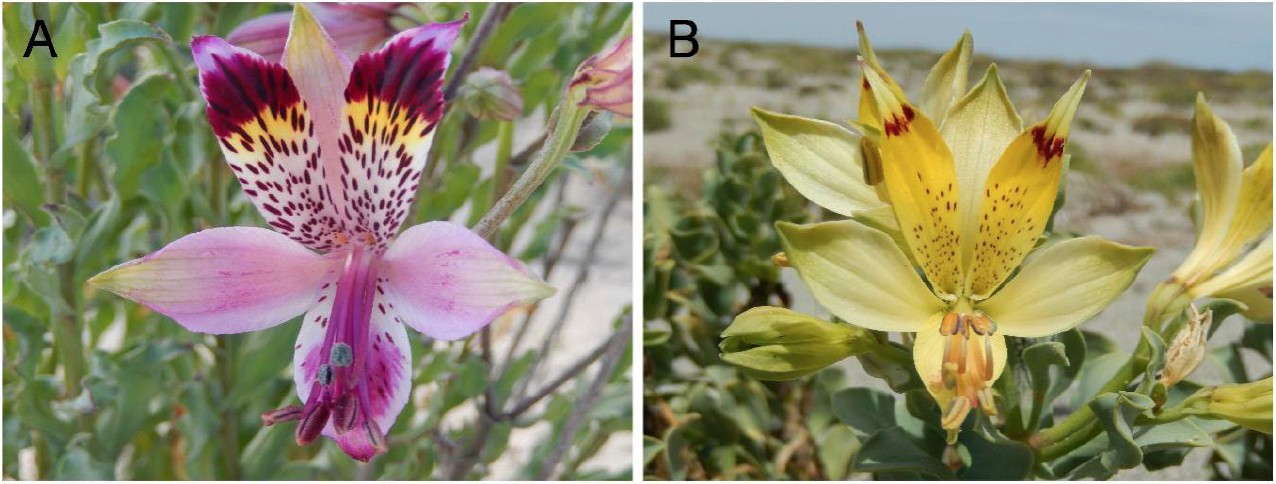
An important endemic species in Chile is Alstroemeria werdermanniiBayer, in which two varieties are recognized (Bayer, 1987; Muñoz and Moreira, 2003; Finot et al., 2018): A. werdermannii Bayer var. werdermannii and A. werdermannii Bayer var. flavicans M. Muñoz. These two varieties are distinct in floral morphology and with restricted distributions. A.werdermanii var. werdermannii is distributed only in sandy soil in the coastal zone in the Region of Atacama from Totoral (27°13’S) to Vallenar (28°30’S) in the Province of Huasco (Muñoz and Moreira, 2003). Its flowers are variable in color, with pink, red, or white being most common (Fig. 1A). A werdermanii var. flavicans is also growing on sandy soil in the Region of Atacama, between Carrizalillo (29°07’S) to Choros Bajos (29º20’S) in the Province of Huasco. Its flowers are yellow (Fig.1B).

Habit and flowers of Alstroemeria werdermannii var. werdermannii (A), and A. werdermannii var. flavicans (B).
Chromosome studies in Alstroemeria began in 1882, leading to the description of the fundamental karyotypes for about 30 taxa, 22 of them from Chile (Finot et al., 2018). As a result, it is possible to distinguish a stable chromosome number of 2n = 16 for the genus, configured with an asymmetric and bimodal karyotype. Three or four chromosome pairs are acrocentric and four or five are metacentric, submetacentric or subtelocentric (Baeza et al., 2022). No polyploidy is known in natural conditions for this genus (Baeza et al., 2020). Cytogenetic studies in Alstroemeria have been useful in delimiting species, in which each taxon has a different karyotype. Such an approach has contributed not only to the delimitation of different taxa, but also for providing insights into the processes that govern the divergence among chromosome patterns. Recent intraspecific studies have been useful in solving taxonomic recognition of taxa within taxonomic complexes, either for differences in chromosome architecture or asymmetry patterns in chromosomes (Baeza et al., 2021; 2016a; 2016b; 2018; Rojas and Baeza 2023).
The objective of this investigation was to characterize the karyotypes of the two infraspecific taxa of Alstroemeria werdermannii complex from populations across its range, and to clarify their taxonomic status. This will contribute to providing additional evidence of phenotype variation, which can provide the basis for future research in conservation strategies, genetic improvement, and ornamental horticulture.
Materials and Methods
Plant Material
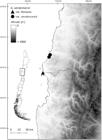
Three populations of Alstroemeria werdermannii were collected throughout its distributional range (Fig. 2). Vouchers of these collections have been deposited in the herbarium of the University of Concepción (CONC). The location of the analyzed material is given in Table 1. Ten individuals were collected per population, separated by at least 5 meters. Populations had more than 50 individuals and were collected between 17 and 19 September 2017.
The samples were collected from their natural habitat during the flowering period (spring) and were subsequently transferred to a greenhouse, where they completed their flowering and then entered dormancy. The individuals were placed in 7 L containers, in a mixture of sand from the original site, with the addition of coconut fiber and perlite. The plants were kept without irrigation for five months after being established in the greenhouse (summer period), simulating the natural conditions of the desert Mediterranean climate of their native habitat. Irrigation resumed in mid-autumn of the following year, once the average daily temperatures reached approximately 14 °C. During the growth period, the samples were kept under indirect sunlight throughout the day and were fertilized with slow-release fertilizer. The plants underwent vegetative growth for at least five months before root-tip extractions began.
Karyotype characteristics
Roots (1 cm long) obtained from material cultured in the greenhouse were cut and pre-treated with a solution of hydroxyquinoline (2 mM) for 24 hours at 5 °C. Later, they were fixed in a mixture of acetic acid/ethanol (1:3) for 24 hours. Root tips were then squashed in an acid hydrolysis of HCl 0.5 M for 16 minutes at 45 °C, followed by washing and staining with 1% orcein. Metaphase plates were photographed with a Zeiss Axioskop microscope with digital camera, and the pictures were analyzed with Paint Shop Pro Photo X2. Chromosomes were measured with the assistance of the software MicroMeasure 3.3 (Reeves, 2001) and classified according to arm ratios, categorized by position of the centromere (long arm/short arm; modified from Levan et al. (1964). A minimum of two roots per individual were collected and the temperature was kept constant at 5 °C for 24 hours. For each population analyzed (10 metaphase plates), the intrachromosomal asymmetry index MCA and the interchromosomal asymmetry index CVCL were used (Peruzzi & Eroglu, 2013). The Chromindex-UDEC program was used to calculate the asymmetry indexes (Baeza et al., 2023b). Statistical differences of each index, given the taxa name as factor, was estimated by using a Wilcoxon rank sum test (Sokal & Rolf, 1995), as the grouped data did not follow the required assumption of variance homogeneity for conducting a parametric test (e.g., t-test for means). All visualizations were created using the packages ggplot2 (Wickham, 2016) and ggExtra (Atali & Backer, 2023) in the statistical platform R v.4.4.1 (R Core Team, 2024).
Results
All analyzed populations of A. werdermannii revealed 2n = 2x = 16. A. werdermanni var. werdermannii and A. werdermannii var. flavicans presented the same haploid formula: two metacentric, two submetacentric, two subtelocentric with satellite, and two telocentric pairs with satellite (2m + 2sm + 2st-sat + 2t-sat; Fig. 3A-D). The Fig. 4 represents the scatter plot of LTC, CVCL and MCA indices. The values of CVCL, MCA and TCL (µm) per population are summarized in Table 2. The Wilcoxon test conducted for both varieties did not reported significant differences between their rank sums for any index (LTC, W = 87, p-value = 0.5822; for CVCL,; W = 69.5, p-value = 0.1867; for MCA, W = 62, p-value = 0.09854).

Metaphase plates of analyzed populations: A. A. werdermannii var. flavicans (Baeza 4421), B. A. werdermannii var. werdermannii (Baeza 4427), C. A. werdermannii var. werdermannii (Baeza 4425). D. Karyotype of A. werdermannii. The numbers refer to chromosome pairs. The bar represents 10 μm.
Karyotype features of the varieties of Alstroemeria werdermannii. CVCL = Coefficient of variation of chromosome length; MCA = Mean centromeric asymmetry index according to Peruzzi and Erôglu (2013); SD = Standard deviation; TLC = Total length in diploid chromosomes.

Scatter plot among populations of Alstroemeria werdermannii varieties using values of CVCL vs. MCA, CVCL vs. LTC, and MCA vs. TLC. Convex polygons represent the different varieties (blue circles: var. werdermanii; light blue squares; var. flavicans) and each individual is identified with their respective population through the issued collecting numbers. Marginal boxplots represent the values distribution for their respective karyotypic index in each subspecies.
Discussion
Alstroemeria werdermannii was described as a rare species in the north of Chile by Bayer (1987), based on a material collected by Werdermann in the Atacama Region (Province of Huasco). Within this species, Muñoz (2000) described var. flavicans, based on material also collected in the Province of Huasco, but further south in Carrizalillo beach. Hoffmann et al. (2015) recognized the same two taxa within A. werdermannii, but they treated them assubspecies rather than varieties and distinguished subsp. flavicans by an inflorescence with only 1 - 2 rays and yellow flowers. Both taxa grow on sandy soils, in dunes, and coastal terraces, and are considered Vulnerable (Finot et al., 2018).
The data obtained in this investigation indicate that the three analyzed populations of A. werdermannii have the same karyotype, that is 2m + 2sm + 2st-sat + 2t-sat. No differences were found in chromosome architecture between varieties (Fig. 3). This means that the sets of chromosomes of all analyzed populations, regardless of variety, are identical. This has also been found in the A. diluta complex (Baeza et al., 2016a) and in the A. magnifica complex (Baeza et al., 2018). When making a scatter plot of the three populations there is no tendency to form clusters among the recognized varieties (Fig. 4). There is a slight tendency in the case of A. wedermanni var. flavicans grouped around the intrachromosomal index of MCA asymmetry, because the standard deviation of these values is smaller than the other two populations (Table 2). However, this does not happen with the CVCL interchromosomal index, where the highest standard deviation values are in the flavicans variety. In relation to the TCL (µm), the values are very similar in the three populations studied, so that this cytotaxonomic character is not decisive as a predictor to recognize varieties (Table 2). In conclusion, there are no cytotaxonomic differences between the varieties recognized in A. werdermannii, but the color of the flowers and differences in number of rays of the inflorescence, in addition to presenting well-defined distributions, allow for the maintenance of two varieties as recognized by Muñoz (2000) and for the rejection of the proposal by Hoffmann (2015) to elevate the varieties to subspecies.
The existence of a karyotype and asymmetry differentiation within species complexes has been recurrently documented, which has supported corrections in the current proposed taxonomy of these groups. In A. hookeri (Baeza et al., 2010), where four subspecies have been recognized within the complex, all of them have differences in the morphology of the karyotypes. In A. presliana (Baeza et al., 2015), two subspecies have very different karyotypes and very different distributions. In A. ligtu (Baeza et al., 2016b), four different karyotypes were observed for each subspecies, and finally in A. magnifica (Baeza et al., 2018), identical karyotypes were found in two varieties (vars. magnifica and sierrae), but with very different TLC values. Instead, the results observed in A. werdermanii might represent the very first case where lineages with striking phenotypic differences do not correlate with karyotype differentiation, which brings questions about what is the genetic dynamics governing this pattern of variation. Such statements should be carefully reviewed by conducting genetic studies at population level.
These studies, and the present observations, reinforce the importance of understanding karyotypic variation, in combination with morphological distinctions, for the recognition of infraspecific taxa within species of Alstroemeria. Because of the commercial value of species and cultivars of the genus, it is important to document cytogenetic differences within and among populations, which can provide avenues for identification of these populations as well as for development of additional successful introductions into the cultivated trade.
Conclusions
This study provides the first detailed cytotaxonomic characterization of the Alstroemeria werdermannii complex, revealing a remarkable karyotypic uniformity (2n = 2x = 16; 2m + 2sm + 2st-sat + 2t-sat) between the werdermannii and flavicans varieties. Despite their lack of karyotype differences, morphological differences and distinct geographic distributions mark clear differences among their varieties. This chromosomal similarity supports the current taxonomic classification at the variety level and suggests a high potential for crossbreeding in breeding programs, as well as a genetic resource for conservation.
Acknowledgments
This work was supported by VRID N° 318/17 (Code 217.111.063-1.0) University of Concepcion, Chile, and FONDECYT de Iniciación 11220556 (ANID). We are deeply grateful for the critical reading of Dr. Tod Stuessy
Data availability statement
Data will be made available upon request to the authors.
References
-
AROS, D.; BARRAZA, P.; PEÑA-NEIRA, A.; MITSI, C.; PERTUZÉ, R. Seed Characterization and evaluation of pre-germinative barriers in the genus Alstroemeria (Alstroemeriaceae). Seeds, v.2, p.474-495, 2023. https://doi.org/10.3390/seeds2040035
» https://doi.org/10.3390/seeds2040035 -
ATTALI, D.; BAKER, C. 2023. ggExtra: Add Marginal Histograms to ‘ggplot2’, and More ‘ggplot2’ Enhancements_. R package version 0.10.1 Available at: Available at: https://CRAN.R-project.org/package=ggExtra , Accessed on: 28 Mar 2025.
» https://CRAN.R-project.org/package=ggExtra - BAEZA C.; ROJAS, G.; TORO-NÚÑEZ O., RUIZ-PONCE, E. The fundamental karyotype and plastid DNA of Alstroemeria piperata (Liliales, Alstroemeriaceae), a species endemic to the Valparaíso Region, Chile. Phytotaxa, v.629, n.2, p.139-146, 2023a.
- BAEZA, C.: CARRASCO, P.; VILLALOBOS, N. The chromosomal number of a population of Alstroemeria pelegrina L. (Alstroemeriaceae), endemic species of Chile. Chilean Journal of Agricultural and Animal Science, v.36, n.2, p.117-120, 2020.
- BAEZA, C.; FINOT, V.; RUIZ, E.; CARRASCO, P.; NOVOA, P.; ROSAS, M. Análisis citotaxonómico del complejo Alstroemeria diluta E. Bayer (Alstroemeriaceae) de Chile. Gayana Botanica, v.73, n.2, p.220-225, 2016a.
- BAEZA, C.; FINOT, V.; RUIZ, E.; CARRASCO, P.; NOVOA, P.; ROSAS, M.; TORO-NÚÑEZ, O. Cytotaxonomic study of the Chilean endemic complex Alstroemeria magnifica Herb. (Alstroemeriaceae). Genetics and Molecular Biology, v.41, n.2, p.434-441, 2018.
-
BAEZA, C.; FINOT, V.; RUIZ, E.; CARRASCO, P.; NOVOA, P.; STUESSY, T.; GONZÁLEZ, A. Comparative karyotypic analysis and cytotaxonomy in the Alstroemeria ligtu L. (Alstroemeriaceae) complex of Chile. Brazilian Journal of Botany, v.39, n.1, p.305-313, 2016b. https://doi.org 10.1007/s40415-015-0220-4
» https://doi.org 10.1007/s40415-015-0220-4 - BAEZA, C.; GUZMÁN, A.; PINACHO-DAVIDSON, P. Chromindex-UdeC, a simple method for calculating karyotypic asymmetry indices from Excel tables generated by the MicroMeasure program. Gayana Botánica, v.80, n.1, p.65-70, 2023b.
-
BAEZA, C.; RUIZ, E.; NEGRITTO, M. Comparative karyotypic analysis in the Alstroemeria hookeri Lodd. (Alstroemeriaceae) complex sensu Bayer (1987). Genetics and Molecular Biology, v.33, n.1, p.119-124, 2010. https://doi.org 10.1590/S1415-47572010005000012
» https://doi.org 10.1590/S1415-47572010005000012 -
BAEZA, C.; TORO-NÚÑEZ, O. The fundamental karyotype of Alstroemeria violacea Phil. (Alstroemeriaceae). Gayana Botánica, v.78, n.2. p.196-199, 2021. http://dx.doi.org/10.4067/S0717-66432021000200196
» http://dx.doi.org/10.4067/S0717-66432021000200196 -
BAEZA, C.; TORO-NUÑEZ, O.; RUIZ, E.; SANTOS, D.; SALVATIERRA, A.; THIELEMANN, E. Divergence among the subspecies of Alstroemeria garaventae Ehr. Bayer (Alstroemeriaceae) on fundamental karyotype and chloroplast DNA data. Gayana Botánica, v.79, n.2, p.140-146, 2022. https://doi.org/10.4067/S0717-66432022000200140
» https://doi.org/10.4067/S0717-66432022000200140 - BAYER, E. Die Gattung Alstroemeria in Chile. Mitteilungen der Botanischen Staatsammlung Munchen, v.24, p.1-362, 1987.
- BOUWEN. L.; VAN DER VLUGT, R. Identification and characterization of potyviruses of Alstroemeria spp. Acta Horticulturae, v.432, p.72-74, 1996.
- FINOT, V.; BAEZA, C.; MUÑOZ-SCHICK, M.; RUIZ, E.; ESPEJO, J.; ALARCÓN, D.; CARRASCO, P.; NOVOA, P.; EYZAGUIRRE, M.T. Guía de campo de las Alstroemerias Chilenas. Concepción: Ed. Corporación Chilena de la Madera, 2018. 295p.
-
GUERRA, F.; CAUTÍN, R.; MÓNICA CAST, K. In vitro micropropagation of the vulnerable chilean endemic Alstroemeria pelegrina L. Horticulturae, v.10, n. 674, 2024. https://doi.org/10.3390/horticulturae10070674
» https://doi.org/10.3390/horticulturae10070674 -
GUERRA, F.; PEÑALOZA, P.; VIDAL, A.; CAUTÍN, R.; CASTRO, M. Seed maturity and its in vitro initiation of chilean endemic geophyte Alstroemeria pelegrina L. Horticulturae, v.8, n.464, 2022. https://www.mdpi.com/2311-7524/8/5/464
» https://www.mdpi.com/2311-7524/8/5/464 - HOFFMANN, A.; WATSON, J.; FLORES, A. Flora silvestre de Chile. Cuando el desierto florece. Monocotiledóneas y otros taxones. Vol.1. Santiago, Chile: Ediciones Fundación Claudio Gay, 2015. 263p.
-
KUMARA, A.; KASHYAPA, B.; DHIMANA, S.; PATHANIAA, S.; HASHEMB, A.; FATHI ABD-ALLAHC, E.; SHARMAD, U. Impact of planting density and shoot thinning on alstroemeria flowering, soil attributes and cost economics. Heliyon v.10, n.18, 2024. https://doi.org/10.1016/j.heliyon.2024.e38158
» https://doi.org/10.1016/j.heliyon.2024.e38158 -
LEVAN, A.; FREDGA, K.; SANDBER. A. Nomenclature for centromeric position on chromosomes. Hereditas, v.52, p.201-220, 1964. https://doi.org: 10.1111/j.1601-223.1964.tb01953.x
» https://doi.org: 10.1111/j.1601-223.1964.tb01953.x - MUÑOZ, M. Novedades en la familia Alstroemeriaceae. Gayana Botanica, v.57, n.1, p.55-59, 2000.
- MUÑOZ, M.; MOREIRA, A. Alstroemerias de Chile. Diversidad, distribución y conservación. Santiago: Taller La Era, 2003. 139p.
-
PERUZZI, L.; EROGLU, H. Karyotype asymmetry: again, how to measure and what to measure? Comparative Cytogenetics, v.7, p.1-9, 2013. https://doi.org 10.3897/compcytogen.v7i1.4431
» https://doi.org 10.3897/compcytogen.v7i1.4431 -
R CORE TEAM. 2024. Language and Environment for Statistical Computing. R Foundation for Statistical Computing. Available at: <Available at: https://www.R-project.org/ >, Accessed on: 28 Mar 2025.
» https://www.R-project.org/ -
REEVES, A. MicroMeasure: a new computer program for the collection and analysis of cytogenetic data. Genome, v.44, p.439-443, 2001. https://doi.org 10.1139/gen-44-3-439
» https://doi.org 10.1139/gen-44-3-439 -
RIBEIRO, T.; NASCIMENTO, J.; SANTOS, A.; FÉLIX, L.; GUERRA, M. Origin and evolution of highly polymorphic rDNA sites in Alstroemeria longistaminea (Alstroemeriaceae) and related species. Genome v.64, p.833-845. 2021. https://dx.doi.org/10.1139/gen-2020-0159
» https://dx.doi.org/10.1139/gen-2020-0159 -
RIBEIRO, T.; VAIO, M.; FÉLIX, L.; GUERRA, M. Satellite DNA probes of Alstroemeria longistaminea (Alstroemeriaceae) paint the heterochromatin and the B chromosome, reveal a G-like banding pattern, and point to a strong structural karyotype conservation. Protoplasma, v.259, p.413-426. 2022. https://doi.org/10.1007/s00709-021-01681-7
» https://doi.org/10.1007/s00709-021-01681-7 - ROJAS, G.; BAEZA, C. Alstroemeria esteparica (Alstroemeriaceae) a new species to Southern Cone of South America. Gayana Botánica, v.78, n.1, p.77-85, 2021.
- SOKAL, R.; ROHLF, F. Biometry: the principles and practice of statistics in biological research. 3rd Edition. New York: W.H. Freeman and Co., 1995.
- VILLALOBOS, N.; FINOT, V.; TORO-NÚÑEZ, O.; RUIZ, E.; BAEZA, C.; CARRASCO, P.; CAMPOS, J.; MELÍN, P. Morpho-colorimetric characterization of the perigonium of the Alstroemeria pulchra complex (Alstroemeriaceae, Alstroemerieae) to delimit its infraspecific taxa. Phytotaxa, v.622, n.3, p. 173-190. 2023.
-
VILLALOBOS, N.; FINOT, V.; TORO-NÚÑEZ, O.; RUIZ-PONCE, E.; TAKAYAMA, K.; COLLADO, G.; BAEZA, C. Alstroemeria maxima (Alstroemeriaceae, Alstroemerieae) a “giant” revealed through integrative taxonomy. Brasilian Journal of Botany, v.47, p.649-669, 2024. https://doi.org/10.1007/s40415-024-01017-8. 2024
» https://doi.org/10.1007/s40415-024-01017-8. 2024 -
WICKHAM, H. ggplot2: Elegant Graphics for Data Analysis. New York: Springer-Verlag, 2016. https://doi.org/10.1007/978-3-319-24277-4_9
» https://doi.org/10.1007/978-3-319-24277-4_9
Edited by
-
Editor:
Carmen Silvia Zickel (Universidade Federal Rural de Pernambuco, Brasil)