 Heliconia: diseases and integrated management
Abstract
Heliconia cultivation faces challenges due to diseases that lead to depreciation in flower quality, decrease in yield, and increase in management costs. Quality standards require heliconias to be visually attractive and healthy. The primary causes of these diseases include fungi, nematodes, bacteria, and viruses. Fungal diseases are the most prevalent, causing damage to leaves, bracts, and rhizomes. Nematode-induced diseases affect both underground and above-ground plant organs. Among bacterial diseases, wilt caused by Ralstonia solanacearum is the most damaging to the crop, while viral diseases are relatively rare. Integrated disease management is the best strategy to control diseases in heliconias. This strategy combines preventive, curative, and eradication measures. This study describes the main diseases affecting heliconias, highlighting their primary occurrence sites, host range, as well as the description of disease symptoms and pathogens. Additionally, information on the cycle, epidemiology, and management of the major diseases is provided. The aim is to contribute to the sustainability and efficiency of heliconia cultivation.
Keywords:
leaf spots; phytopathogens; rot; tropical flowers; wilt
Resumo
O cultivo de helicônias enfrenta desafios devido a doenças que causam depreciação na qualidade das flores, redução na produção e aumento de custos de manejo. As principais causas dessas enfermidades são fungos, nematoides, bactérias e vírus. As doenças fúngicas são as mais prevalentes, causando danos nas folhas, brácteas e nos rizomas. As doenças causadas por nematoides afetam os órgãos subterrâneos e a parte aérea das plantas. Entre as bacterioses, a murcha bacteriana, causada pela Ralstonia solanacearum, é a doença que causa os maiores danos à cultura, já as doenças virais são relativamente raras. Para atender aos padrões de qualidade do mercado, é essencial que as helicônias sejam visualmente atraentes e saudáveis. O manejo integrado de doenças é a melhor estratégia para controlar as doenças em helicônias. Essa estratégia combina medidas preventivas, curativas e de erradicação. Neste trabalho estão descritas as principais doenças incidentes nas helicônias, ressaltando os principais locais de ocorrência, a gama de hospedeiros, bem como a descrição das enfermidades e dos patógenos, além de informações sobre o ciclo, a epidemiologia e o manejo das principais doenças.
Palavras-chave:
flores tropicais; fitopatógenos; manchas foliares; murchas; podridões
Introduction
In the cultivation of heliconias (Heliconia spp.), the conditions that favor their development, such as warm, humid and shaded environments with organic matter-rich soils, also favor the emergence of phytopathogens (López-Vásquez et al., 2013). Diseases cause spots, rot and wilt, and the main causal agents are fungi, nematodes, bacteria and viruses (Cardona and Zapata, 2012).
Fungi cause the most significant damage to heliconias, mainly on leaves (73.46%) and bracts (22.37%), which are more susceptible to anthracnose, rust, powdery mildew and leaf spots. Damage to rhizomes (4.17%) is more caused by rots (Bedendo, 1995, Mattos Sobrinho et al., 2015).
About 10 genera of phytonematodes have been reported in association with heliconias, although the pathogenicity of some has not been proven (Cardona and Zapata, 2012, Sardinha et al., 2012). Nematodes mainly parasitize roots and rhizomes, also affecting shoots, which results in reduced quality and production, in addition to increased costs with phytosanitary control (Mattos Sobrinho et al., 2013).
Bacterial wilt caused by Ralstonia solanacearum is the most prevalent bacteriosis in heliconia plantations in Brazil (Warumby et al., 2004). This bacterium causes damage such as wilting, yellowing and drying of plants and, for being present in the soil, its management is very complex, highlighting the importance of preventive measures.
In the production of heliconias, it is crucial to ensure good appearance and health of the product. To achieve this goal, it is essential to adopt integrated disease management tactics and sustainable control measures. Next, we will discuss the main diseases and occurrences, hosts, symptoms of these diseases, as well as information about their cycle, epidemiology and management.
1. Fungal diseases
2. Diseases caused by nematodes
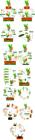
Disease cycles in heliconias. (A) Rhizoctonia Rot, (B) Cylindrocladium Rot, (C) Anthracnose, (D) Rust, (E) Oomycete Rot, (F) Powdery mildew, (G) Leaf spots, (H) Panama Disease, (I) Moko, (J) Root knot, (L) Burrowing Nematode, (M) Spiral nematode, and (N) Dagger nematode. Arts: Paulo R. V. S. Pereira.
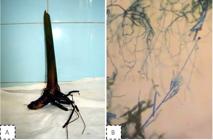
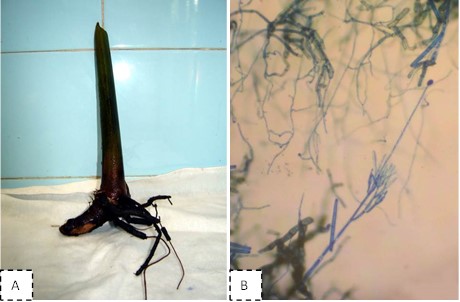
Symptoms of Cylindrocladium rot in heliconia rhizome (A) and conidiophores, phialides and conidia of Cylindrocladium spathiphylli f. sp. heliconiae (B). Photos: Tereza Cristina de Assis.

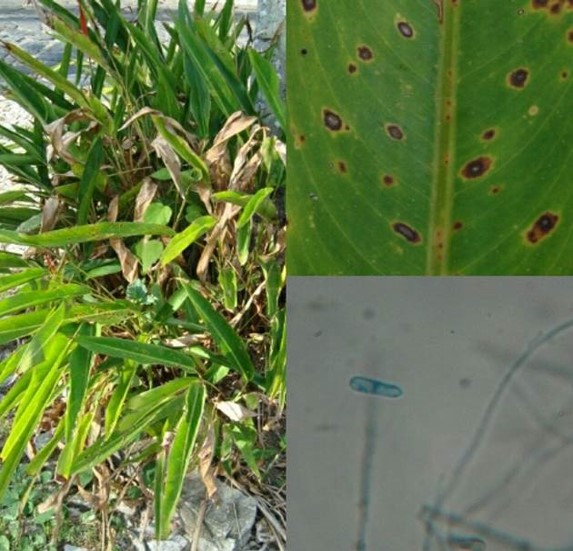
Symptoms of anthracnose in heliconia leaves (A, B) and conidia of Colletotrichum gloeosporioides (C). Photos: Regina Ceres Torres Rosa.
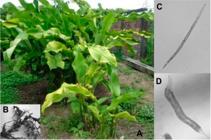
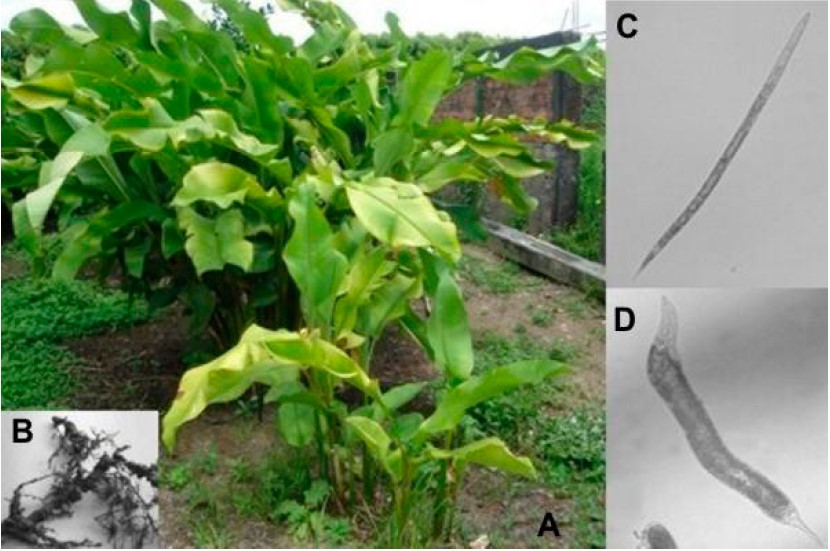
Symptomatology of root knot in heliconia causing symptoms in patches, with underdeveloped plants (A) and galls in the root system (B) and the forms shown by Meloidogyne spp., juvenile (C) and female (D). Photos: Regina Ceres Torres Rosa.
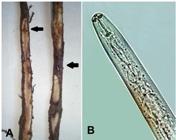
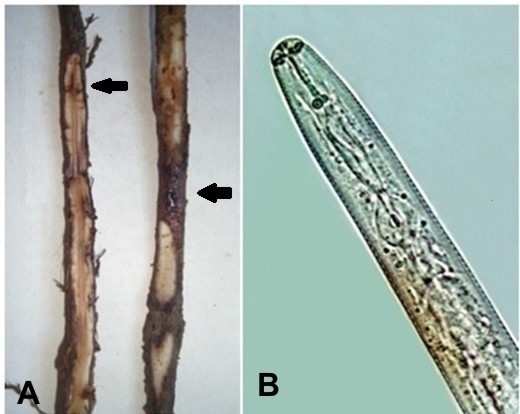
Symptoms of burrowing nematode infestation in heliconia, (A) reddish necrotic lesions on the roots, and (B) cephalic region of Radopholus similis. Photos: (A) Regina Ceres Torres Rosa, (B) Graham and Jackson.
3. Bacterial disease
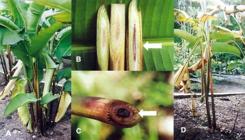
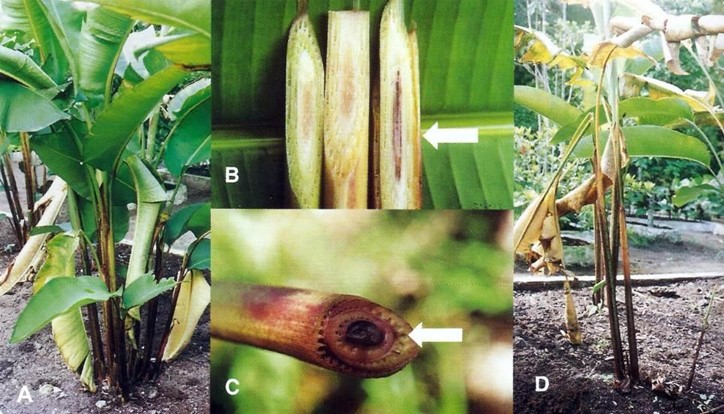
Symptoms of bacterial wilt in heliconia, (A) plant showing yellowing, wilting, and drying; (B) pseudostem with darkening in the central part; (C) bacterial exudation; (D) Plant collapse and death. Photos: Sayonara M. P. Assis.
4. Viral diseases
In tropical ornamental flowers, especially those of the order Zingiberales, few occurrences of viral diseases have been observed. However, the viruses that stand out in prevalence are the Cucumber Mosaic Virus - CMV and the Banana Streak Virus - BSV (CABI, 2020, Muhammad et al., 2021). These viruses have been reported in Colombia and the United States infecting H. bihai ‘Orange’ and H. psittacorum cultivars ‘Andromeda’ and ‘Golden Torch’, respectively (Warumby et al., 2004; Cardona and Zapata, 2012). The Banana Bunchy Top Virus (BBTV) has been detected in Heliconia spp. in the United States and Indonesia, a worrying fact for banana growers because the disease caused by this virus is a threat to the banana crop and heliconia would be a host plant (Hamim et al., 2017, Arimbawa et al., 2022).
The first occurrence of virus in the genus Heliconia was described in Brazil in 2013, being detected in the State of São Paulo in H. stricta plants, caused by the genus Potyvirus. The plants showed symptoms of chlorotic ‘pin points’ between the veins and yellowish spots with reddish necrotic areas (Rivas et al., 2013). The genus Potyvirus is the most studied among those in the family Potyviridae, with 146 species already characterized. They are viruses composed of positive-sense single-stranded RNA that, when translated, generates a polyprotein that self-cleaves into 10 mature proteins (King et al., 2012). Due to the recent detection of this virus, further studies are needed on its etiology, epidemiology (type of virus, source of inoculum, vector, virus-vector relationship, vector population fluctuation etc.), symptoms and cycle, as well as evaluations of the economic damage of the disease to the crop. Identification of new viruses, even if they do not cause economic damage to agriculture, is important due to the increasing presence of emerging virus populations.
5. Disease management in heliconias
Acknowledgements
The authors wish to thank the Embrapa and Conselho Nacional de Desenvolvimento Científico e Tecnológico (CNPq) (C. F. B. Silva thanks proc. 304901/2022-9) for funding this research
Data availability statement
Data will be available upon request.
References
- ALBUQUERQUE, G.M.R. Diversidade de isolados brasileiros de Ralstonia solanacearum raça 2. Dissertação de mestrado, Universidade Federal Rural de Pernambuco, Recife. 63p. 2013.
-
ALVES, J.V.S.; COELHO, M.P.; BERTAN, F.L.; SILVA, D.C.; SILVA, V.C.; CHIAMULERA, M.T.; CARVALHO, I.F.; SILVA, C.A.; ARAÚJO, D.V. Induction of resistance to Colletotrichum sp. in Heliconia psittacorum x sparthocircinata cv. Golden Torch grown in shade and full-sun environment. Summa Phytopathologica, v.46, n.4, p.320-326, 2020. https://doi.org/10.1590/0100-5405/238457
» https://doi.org/10.1590/0100-5405/238457 - AMORIM, L.; REZENDE, M.A.J.; BERGAMIN FILHO, A. Manual de fitopatologia: princípios e conceitos. v.1, Lavras: Agronômica Ceres, 2011. 704 p.
-
ARIMBAWA, I.M.; GUSTI NGURAH ALIT SUSANTA WIRYA, G.N.A.S.; SUDIARTA, I.P. First Report of Banana bunch top virus on Heliconia (Heliconia spp.). Journal of Tropical Plant Pests and Diseases, v.22, n.1, p.77-82, 2022. http://dx.doi.org/10.23960/jhptt.12277-82
» http://dx.doi.org/10.23960/jhptt.12277-82 - ASSIS T.C.; ANDRADE, D.E.G.T. Fitonematoses em zingiberales ornamentais no estado de Pernambuco. Anais da Academia Pernambucana de Ciência Agronômica, v.4, p.185-198, 2007.
- ASSIS, S.M.P.; MARIANO, R.L.R.; GONDIM JR., M.G.C.; MENEZES, M.; ROSA, R.C.T. Doenças e Pragas das Helicônias. Recife: Universidade Federal Rural de Pernambuco (UFRPE), 2002. 102p.
- ASSIS, T.C. Fitonematóides associados a zingiberales ornamentais em Pernambuco: estimativa do número de amostras para monitoramento, efeito de indutores de resistência e avaliação de mecanismos envolvidos. (Tese de Doutorado). Recife. Universidade Federal Rural de Pernambuco. 2006.
- BARGUIL, B.M.; OLIVEIRA, S.M.A.; COELHO, R.S.B.; BESERRA JUNIOR, J.E.A. Identificação e variabilidade genética de isolados de Colletotrichum causando antracnose em inflorescências de plantas ornamentais tropicais. Ciência Rural, v.39, n.6, p.1639-1649, 2009.
- BEDENDO, I. Classificação de doenças. IN: BERGAMIN FILHO, A.; KIMATI, H.; AMORIM, L. Manual de Fitopatologia. 3ed. São Paulo: Agronômica Ceres, p.805-809, 1995.
- BENCHIMOL, R.L.; VERZIGNASSI, J.R.; POLTRONIERI, S.L.; PEREIRA, E.C.S.; RODRIGUES, E.S.F. Mancha de Curvulária em Heliconia psittacorum cv. Golden Torch no Nordeste Paraense. (Comunicado Técnico 143). Belém: Embrapa Amazônia Oriental, 2005. 2p.
- CABI - Commonwealth Agricultural Bureaux International. CABI compendium 2020. Banana streak disease. Londres: CABI, 2020.
- CARDONA, N.L.; ZAPATA, J.C. Characterization of phytopathogenic fungi, bacteria, nematodes and viruses in four commercial varieties of heliconia (Heliconia sp.). Revista da Facultad Nacional de Agronomía, v.65, n.2, p.6697-6710, 2012.
- CASTRO, N.R.; COÊLHO, R.S.B.; LARANJEIRA, D.; PIMENTEL, R.M.M.; FERREIRA, C.P. Murcha de fusário em helicônia: fontes de resistência, método alternativo de detecção e defesa estrutural. Summa Phytopathologica, v.36, n.1, p.30-34, 2010.
- CASTRO, N.R.; COELHO, R.S.B; LARANJEIRA, D.; COUTO, E.F.; SOUZA, M.B.R. Ocorrência, métodos de inoculação e agressividade de Fusarium oxysporum f.sp. cubense em Heliconia spp. Summa Phytopathologica, v.34, n.2, p.127-130, 2008.
- CONABAN - Confederação Nacional dos Bananicultores. Ponderações técnicas sobre a importação de bananas do Equador. São Paulo: Conaban, 2012. 46p.
- CORDEIRO, Z.J.M.; MATOS, A.P.; KIMATI, H. Doenças da bananeira. In: KIMATI, H.; AMORIM, L.; REZENDA, J.A.M.; BERGAMIN FILHO, A.; CAMARGO, L.E.A. Manual de Fitopatologia. 4. ed., Piracicaba: Agronômica Ceres, 2005. v.2, p.99-117.
- COSTA, C.R. Fungos associados às plantas ornamentais tropicais no Distrito Federal. (Mestrado em Fitopatologia). Brasília (DF): Universidade Federal de Brasília (UnB), 2007. 114p.
- COUTINHO, L.N. Aspectos de fungos fitopatogênicos em plantas ornamentais e seu controle. Pariquera-Açu, São Paulo: Anais da XIV Reunião Itinerante de Fitossanidade do Instituto Biológico, p. 13-20, 2006.
- FERREIRA, C.S.; JUNIOR, J.M.D.L.S.; PINHEIRO, V.J.F.; SANTOS, M.D.C.; NETO, V.D.C.R.; COSTA PANTOJA, M.V.; GALVÃO, J.R. Efeitos de diferentes extratos na inibição do crescimento micelial de Colletotrichum gloeosporioides Penz. (Sacc.) em Heliconia psittacorum in vitro. IN: Open Science Research II, 2022. p. 21-32.
-
FREIRE, F.C.O.F.; MOSCA, J.L. Patógenos associados a doenças de plantas ornamentais no Estado do Ceará. Ornamental Horticulture, v.15, n.1, p.83-89, 2009. https://doi.org/10.14295/rbho.v15i1.439
» https://doi.org/10.14295/rbho.v15i1.439 - GURGEL, L.M.S.; COÊLHO, R.S.B.; SILVA, R.L.X.; OLIVEIRA, S.M.A.; ROSA, R.C.T.; ASSIS, T.C.; ANDRADE, D.E.G.T. Metodologia alternativa no manejo da antracnose pós-colheita em Heliconia rostrata Pesquisa Agropecuária Pernambucana, v.19, n.1, p.20-24, 2014.
-
GUSMÃO, J.R.; RODRIGUES, A.A.C.; LIMA MELO, L.G.; SILVA, E.K.C.; OLIVEIRA, A.C.S.; SANAZÃ, A.C.; BRAUN, H. The use of plant extracts in anthracnose control in species of Heliconia (Heliconia psittacorum cv. Golden Torch and Heliconia rostrata). African Journal of Agricultural Research, v.13, n.48, p.2763-2770, 2018. http://dx.doi.org/10.5897/AJAR2018.13385
» http://dx.doi.org/10.5897/AJAR2018.13385 -
HAMIM, I.; GREEN, J.C.; BORTH, W.B.; MELZER, M.J.; WANG, Y.N.; HU, J.S. First Report of Banana bunchy top virus in Heliconia spp. on Hawaii. Plant Disease, v.101, n.1211, p.2153, 2017. http://dx.doi.org/10.1094/PDIS-02-17-0205-PDN
» http://dx.doi.org/10.1094/PDIS-02-17-0205-PDN -
HIKICHI, Y.; YOSHIMOCHI, T.; TSUJIMOTO, S.; SHINOHARA, R.; NAKAHO K.; KANDA, A.; KIBA, A.; OHNISHI, K. Global regulation of pathogenicity mechanism of Ralstonia solanacearum Plant Biotechnology, v.24, n.1, p.149-154, 2007. http://dx.doi.org/10.5511/plantbiotechnology.24.149
» http://dx.doi.org/10.5511/plantbiotechnology.24.149 - JABUONSKI, R.E.; HIDALGO, O.A. Doenças bacterianas. In: REIFSCHNEIDER, F.J.B. (Coord.) Produção de batata. Brasília: Linha Gráfica, 1987. p. 85-93.
- KELMAN, A., HARTMAN, G.L.; HAYWARD, A.C. Introduction. In: HAYWARD, A.C.; HARTMAN, G.L. (Eds.) Bacterial wilt-the disease and its causative agent, Pseudomonas solanacearum Wallingford: CAB International, 1994. p. 1-7.
- KING, A.M.Q., LEFKOWITZ, E., ADAMS, J.M., CARSTENS, E.B. Virus Taxonomy, Ninth Report of the International Committee on Taxonomy of Viruses, 2012. 1327p.
- LAUGHLIN, C.W., LORDELLO, L.G. Sistemas de manejo de nematoides: Relações entre a densidade de população e os danos à planta. II Reunião de Nematologia, 15-24, 1977.
-
LINS, S.R.O.; COELHO, R.S.B. Ocorrência de doenças em plantas ornamentais tropicais no Estado de Pernambuco. Fitopatologia Brasileira, v.29, p.332-335, 2004. https://doi.org/10.1590/S0100-41582004000300019
» https://doi.org/10.1590/S0100-41582004000300019 - LÓPEZ-VÁSQUEZ, J.M.; ÁNGEL, M.L.M.; GUTIÉRREZ, A.M.L. Factores climáticos y su influencia en la expresión de enfermedades fúngicas en cultivares de Heliconias. Universitas Scientiarum, v.18, n.3, p.331-344, 2013.
- LORDELLO, L.G.E. Nematóides das plantas cultivadas. 8.ED. São Paulo: NOBEL, 1994. 314p.
- LUC, M.; SIKORA, R.A.; BRIDGE, J. (Eds.). Plant parasitic nematodes in subtropical and tropical agriculture. Wallingford, UK. CAB International, 1990. p.372-373, 380-381.
- MATTOS SOBRINHO, C.C.; A.J.SILVEIRA, F.B.C.; CÉSAR, C.M.G.; OLIVEIRA, M.A.L. Phytonematodes associated with Heliconia spp. in commercial crops in the South coast of Bahia, Brazil. Nematropica, v.42, p.351-355, 2013.
- MATTOS SOBRINHO, C.C.; BEZERRA, J.L.; SILVEIRA, A.J.; BITTENCOURT, M.A.L. Fitopatógenos associados às doenças de Heliconia spp., em cultivos comerciais no Litoral Sul da Bahia. Agrotrópica, v.27, n.1, p.25-32, 2015.
- MCSORLEY, R. Adaptations of nematodes to environmental extremes. Florida Entomologist, v.86, n.2, p.138-142, 2003.
- MUHAMMAD, B.; LING, K.L.; HONG, L.W.; VADAMALAI, G. Detection and Characterization of Cucumber mosaic virus Infecting Ginger (Zingiber officinale Roscoe) in Malaysia. International Journal of Sciences: Basic and Applied Research (IJSBAR), v.57, n.1, p.9-15, 2021.
- NASCIMENTO, T.O.; CARDOSO, V.L.L.; SILVA, P.C.; SILVA, C.G.; DALBOSCO, E.Z.; HIEGA, K.M.R.; ARAÚJO, D.V. Doenças fúngicas em helicônia no município de Tangará da Serra - MT. Revista MT Horticultura, v.1, n.2, p.8-11, 2015.
-
OLIVEIRA, C.M.G.; KUBO, R.K.; ANTEDOMENICO, S.R.; MONTEIRO, A.R.; INOMOTO, M.M. Ocorrência de nematóides fitoparasitos em plantas ornamentais nos Estados de São Paulo e Minas Gerais. Ornamental Horticulture, v.13, n.2, p.135-141, 2007. https://doi.org/10.14295/rbho.v13i2.217
» https://doi.org/10.14295/rbho.v13i2.217 -
PEREIRA, J.C.R.; PEREIRA, J.R.; CASTRO, M.E.A.; GASPAROTTO, L. Ocorrência do Mal-do-Panamá em bananeira do subgrupo Figo, em Piau, Minas Gerais. Fitopatologia Brasileira, v.30, p.554, 2005. http://dx.doi.org/10.1590/S0100-41582005000500022
» http://dx.doi.org/10.1590/S0100-41582005000500022 - PITTA, G.P.B. Plantas ornamentais para exportação: aspectos fitossanitários. Brasília: EMBRAPA-SPI, 1995. (Série Publicações Técnicas FRUPEX, 17). 95p.
-
POLTRONIERI, L.S.; VERZIGNASSI, J.R.; BENCHIMOL, L.R. Puccinia heliconiae: agente causal da ferrugem em helicônia cv. Golden Torch no Pará. Summa Phytopathologica, v.39, n.3, p.213, 2013. https://doi.org/10.1590/S0100-54052013000300013
» https://doi.org/10.1590/S0100-54052013000300013 - RIVAS, E.B.; HARAKAVA, R.; MORAES, W.S.; A. COLARICCIO, A. Detecção de Potyvirus em Heliconia strict. In: Anais... XXXVI Congresso Paulista de Fitopatologia. São Paulo- SP. 2013. Summa Phytopathologica, v.39, p.210-210, 2013.
- SANTANA, C.V.S.; SANTOS, A.S.; ALMEIDA, A.C.; NASCIMENTO, A.R.P.; FRANÇA, F.S. Mancha de Bipolaris em helicônias (Heliconia spp.) no Submédio São Francisco. Revista Verde, v.4, n.2, p.5-8, 2009a.
- SANTANA, C.V.S.; SANTOS, A.S.; ALMEIDA, A.C.; NASCIMENTO, A.R.P.; FRANÇA, F.S.; Mancha de Alternaria em helicônias (Heliconia spp.) no Submédio São Francisco. Revista Verde, v.4, n.2, p.9-12, 2009b.
- SANTOS, A.S.; SANTANA, C.V.S.; ALMEIDA, A.C.; NASCIMENTO, A.R.P.; FRANÇA, F.S. Fungos associados a manchas foliares em Heliconia psittacorum cv. Golden Torch, no Submédio São Francisco. Revista Verde, v.4, n.4, p.1-4, 2009.
- SARDINHA, D.H.S.; RODRIGUES, A.A.C.; DINIZ, N.B.; LEMOS, R.N.S.; SILVA, G.S. Fungos e nematóides fitopatogênicos associados ao cultivo de flores tropicais em São Luís - MA. Summa Phytopathologica, v.38, n.2, p.159-162, 2012.
- SERRA, I.M.R.S.; COELHO, R.S.B. Mancha de Pestalotiopsis em helicônia: caracterização da doença e potenciais fontes de resistência. Fitopatologia Brasileira, v.32, p.44-49, 2007.
- SEWAKE, K.T.; UCHIDA, J.Y. Diseases of Heliconia in Hawaii. Research Extension Series, v.159, 1995. 24p.
- SILVA, C.G.; HIEGA, K.M.R.; DALBOSCO, E.Z.; SILVA, C.A.; ARAÚJO, D.V. Fitossanidade em plantas tropicais no Estado de Mato Grosso. Enciclopédia Biosfera, v.11, n.22, p.159-162, 2015.
- SIPES, B.S.; SCHMITT, D.P.; NELSON, S.C. Burrowing Nematode, a Major Pest in the Tropics. CTAHR - April 2001 PD-21. 3p.
- SOLOGUREN, F.J.; JULIATTI, F.C. Doenças fúngicas em plantas ornamentais em Uberlândia-MG. Bioscience Journal, v.23, n.2, p.1289-1295, 2007.
- TENENTE, R.C.V.; ABRANTES, I.M.O.; TENENTE, G.C.M.V. Nematóide - o gênero Xiphinema RAPP, v.10, p.111-153, 2002.
- WARUMBY, J.F.; COELHO, R.S.B.; LINS, S.R.O. Principais doenças e pragas em flores tropicais no estado de Pernambuco. Recife: SEBRAE, 2004. 98p.
- ZEM, A.C.; LORDELLO, L.G.E. Estudos sobre hospedeiros de Radopholus similis e Helicotylenchus multicinctus Sociedade Brasileira de Nematologia, v.7, p.175-88, 1983.
- ZOCCOLI, D.M.; TOMITA, C.K.; UESUGI, C.H. Ocorrência de murcha bacteriana em helicônias e musácea ornamental no Distrito Federal. Tropical Plant Pathology, v.34, n.1, p.045-046, 2009
Edited by
-
Editor:
Gilmar Schafer (Universidade Federal do Rio Grande do Sul, Brasil)