 Effect of cryoprotectants on the cryopreservation of Oncidium baueri lindl. Pollinia in liquid nitrogen
Abstract
The genus Oncidium Sw., one of the largest in the Orchidaceae family, comprises 315 species, 94 of which are native to Brazil. The trade of native orchids through extractivism, combined with habitat destruction, poses a significant threat to biodiversity and has led to the extinction of several species. Cryotechnology has emerged as a crucial tool in the conservation of plant genetic resources, particularly through cryopreservation. This study aimed to evaluate the effects of different cryoprotectant solutions on the viability of Oncidium baueri Lindley pollinia after cryopreservation in liquid nitrogen. Two control groups and seven treatments were tested: C1 - freshly collected pollinia used immediately for pollination; C2 - pollinia cryopreserved without cryoprotectants; T1 - 2 M glycerol; T2 - 2 M glycerol + 0.4 M sucrose; T3 - 0.4 M sucrose; T4 - PVS1; T5 - PVS2; T6 - PVS2 + 1% phloroglucinol; and T7 - PVS3. The experimental design was completely randomized, with 10 repetitions of 10 pollinated flowers per treatment. Pollinia used immediately (C1) achieved 83% capsule formation. PVS2 (T5) demonstrated the highest recovery rate (82%), significantly outperforming C2, T1, T4, T6, and T7, which formed capsules at rates of 11%, 3%, 63%, 62%, and 63%, respectively. Pollinia in T2 and T3 did not survive. These findings suggest that PVS2 is the most effective cryoprotectant for the conservation of O. baueri pollinia, contributing to improved strategies for orchid preservation
Keywords:
cryotechnology; Orchidaceae; pollen; vitrification
Resumo
O gênero Oncidium Sw., um dos maiores da família Orchidaceae, compreende 315 espécies, das quais 94 são nativas do Brasil. As orquídeas nativas são frequentemente comercializadas por meio do extrativismo, o que, combinado com a destruição de habitats, ameaça a biodiversidade e já levou à extinção de algumas espécies. A criotecnologia surgiu como uma ferramenta vital para a conservação de recursos genéticos vegetais por meio da criopreservação. Este estudo avaliou o efeito de diferentes soluções crioprotetoras na viabilidade de polínos de Oncidium baueri Lindley após imersão em nitrogênio líquido. Foram testados dois controles e sete tratamentos: C1 - polínos coletados e usados imediatamente para polinização; C2 - polínos criopreservados sem crioprotetores; T1 - 2 M de glicerol; T2 - 2 M de glicerol + 0,4 M de sacarose; T3 - 0,4 M de sacarose; T4 - PVS1; T5 - PVS2; T6 - PVS2 + 1% de floroglucinol; e T7 - PVS3. O delineamento experimental foi inteiramente randomizado, com 10 repetições de 10 flores polinizadas por tratamento. Polínos usados imediatamente (C1) atingiram 83% de formação de cápsulas. PVS2 (T5) apresentou a melhor taxa de recuperação (82%), superando significativamente C2, T1, T4, T6 e T7, que formaram cápsulas em taxas de 11%, 3%, 63%, 62% e 63%, respectivamente. Polínos nos tratamentos T2 e T3 não sobreviveram. Estes resultados destacam o PVS2 como a solução crioprotetora mais eficaz para a conservação de polínos de O. baueri, contribuindo para estratégias aprimoradas de preservação de orquídeas.
Palavras-chave:
criotecnologia; Orchidaceae; pólen; vitrificação.
Introduction
The Orchidaceae family is one of the largest plant families in terms of species diversity, with a global distribution that makes it the largest group among angiosperms, encompassing an estimated 20,000 to 35,000 species (Timsina et al., 2021; Wang et al., 2024). Orchids occur in nearly all ecosystems, except in polar regions, with their greatest diversity found in tropical and subtropical zones. In Brazil, approximately 10% of orchid species are recorded (Besi et al., 2019). This wide geographical distribution is likely facilitated by the dispersal of their small seeds over long distances (Hedrén et al., 2021).
The genus Oncidium Sw., one of the largest in the Orchidaceae family, comprises 315 species, 94 of which are native to Brazil. Among these, Oncidium baueri is notable for its significant ornamental potential in landscaping and the cut flower industry. The trade in native orchids initially relied on extractive practices, which, combined with habitat destruction driven by urbanization and agricultural expansion, led many species to the brink of extinction (Hussain Mir et al., 2020). Furthermore, Oncidium baueri is classified as a threatened species, which further underscores the urgent need for conservation strategies (Khapugin, 2020).
In recent years, cryotechnology has gained prominence as an alternative for preserving plant species, particularly through the cryopreservation of seeds and other plant materials, such as embryos, pollen, tissues, and cells. This technique involves storing plant structures at ultra-low temperatures, significantly reducing cellular metabolism, thus enabling the indefinite preservation of these structures and facilitating their recovery upon thawing, typically using liquid nitrogen at -196 °C (De Paula et al., 2020; Dinato et al., 2020).
Among the techniques employed in plant cryopreservation, controlled cooling rates, vitrification, encapsulation, dehydration, and dormant bud preservation stand out. Vitrification, in particular, has shown considerable promise in mitigating the stress caused by cryopreservation, especially for seeds (Azad et al., 2024; Hagedorn et al., 2023).
Cryoprotectants play a crucial role in protecting cells and tissues during the cooling process, preventing damage during freezing and thawing. These compounds, known as cryoprotective agents (CPAs), are essential for successful cryopreservation. Nevertheless, despite their widespread use, the mechanisms underlying their protective effects, toxicity, and influence on cellular metabolism remain insufficiently understood, particularly in orchids (Jaiswal and Vagga, 2022; Ferrari et al., 2020).
Recent studies have explored various cryopreservation techniques for orchids, including species from the Oncidium genus. Galdiano Junior et al. (2013) reported the successful cryopreservation of Oncidium flexuosum seeds, emphasizing the importance of vitrification protocols for seed conservation. More recently, Linjikao et al. (2024) investigated the cryopreservation of Epipactis flava seeds, testing different cryoprotectants and finding that PVS2 significantly improved post-thaw viability.
Pollen storage in liquid nitrogen has been considered a valuable tool for plant breeders, facilitating genetic improvement and conservation. Pollen storage enables genetic crosses between plants that flower in different seasons. Germplasm banks offer significant advantages, such as simplifying the search for materials for new crossings, conserving genetic diversity in a compact space, and reducing costs. Additionally, this approach allows for crosses between plants flowering at different times or growing in geographically distant locations (Dinato et al., 2020).
The aim of this study is to evaluate the effectiveness of cryoprotectants in the cryopreservation of pollinia from the Brazilian orchid Oncidium baueri Lindley in liquid nitrogen, focusing on capsule formation and seed viability post-thaw.
Material and Methods
The experiment was carried out at the Center for Agricultural Sciences of Londrina State University (Universidade Estadual de Londrina - UEL), Paraná, Brazil (23° 23’ S, 51° 11’ W), at an average altitude of 566 meters, between November 2020 and May 2021. The region’s climate is classified as Cfa (humid subtropical) according to the Köppen climate classification.
The experiment was conducted on a suspended bench in a nursery, covered with a black polypropylene mesh that filtered 70% of the light intensity. Irrigation was performed once daily in the afternoon for 10 minutes. The orchid species used in the study was Oncidium baueri Lindl., which was obtained via in vitro cloning. Flowering plants were selected, and pollinia were collected from fully opened flowers for immediate use in the experimental setup. Ten pollinia were desiccated in a greenhouse at 105 °C for 24 hours to determine the moisture content, according to the methods outlined by BRASIL (2009).
The study included two control groups and seven experimental treatments. For each group or treatment, 10 replicates were established, with each replicate defined as one pot. Within each pot, 10 flowers were pollinated, resulting in a total of 100 pollinated flowers per treatment. In control group 1 (C1), pollinia were collected and immediately used to pollinate another flower. In control group 2 (C2), pollinia were immersed in liquid nitrogen without the addition of cryoprotectants. The treatments involved exposing pollinia to various cryoprotectant solutions before immersion in liquid nitrogen: T1 - 2 M glycerol; T2 - 2 M glycerol + 0.4 M sucrose; T3 - 0.4 M sucrose; T4 - PVS1 (Plant Vitrification Solution 1); T5 - PVS2 (Plant Vitrification Solution 2); T6 - PVS2 + 1% phloroglucinol; and T7 - PVS3 (Plant Vitrification Solution 3). For each treatment, pollinia were placed in cryotubes with 2 mL of the corresponding solution. The solutions for T1, T2, and T3 were maintained at 25° C for 20 minutes, while T4, T5, T6, and T7 were exposed to an ice bath at 0 °C for 10 minutes.
The PSV for cryoprotectant solutions were prepared as follows: PVS1 contained 19% glycerol (v/v), 13% ethylene glycol (v/v), 6% dimethyl sulfoxide (DMSO) (v/v), and 0.5M sorbitol in MS medium. PVS2 contained 30% glycerol (v/v), 15% ethylene glycol (v/v), and 15% DMSO (v/v) in a half-strength MS medium with 0.4 M sucrose (pH 5.7) (Sakai et al., 1990). PVS3 was composed of 50% glycerol (v/v) and 50% sucrose (v/v) in distilled water (Nishizawa et al., 1993).
After treatment, the cryotubes were stored in liquid nitrogen at -196 °C for 48 hours. Pollinia were then thawed in a water bath at 40 °C for 90 seconds. The cryoprotectant solutions were removed, and the pollinia were washed three times with autoclaved water under laminar flow. Each pollinium was then used to pollinate a single flower. Anthesis-stage plants were emasculated prior to artificial pollination, as described by Faria et al. (2015). Capsule formation and seed viability were evaluated 180 days after pollination, with all plants kept in a greenhouse during the experiment.
Seed viability was assessed using the tetrazolium test. Seeds were hydrated in distilled water for 24 hours at 25 °C, followed by immersion in a 1% tetrazolium solution for 24 hours at 30 °C. Viability was determined using a stereoscopic magnifying glass and Motic Images Plus 2.0ML software. Seed moisture content was measured as described previously.
The experimental design was completely randomized with two control groups, seven treatments, and ten replicates, each consisting of ten randomly pollinated flowers. Capsule formation data were analyzed using general linear models with a binomial distribution. Analysis of variance (ANOVA) was performed, followed by Tukey’s test for mean comparisons. Seed viability percentages were analyzed using Tukey’s variance test
Results and Discussion
The O. baueri pollinia exhibited an initial moisture content of 9.8% prior to treatment with cryoprotectants. Survival of the pollinia was assessed through stigma closure and withering observed three days after pollination. Pollinia treated with the PVS2 solution (T5) demonstrated the highest success rate in capsule formation, achieving a survival rate of 82.0% (82 capsules), which was statistically comparable to Control 1 (C1), with a survival rate of 83.0% (83 capsules) (Fig. 1).
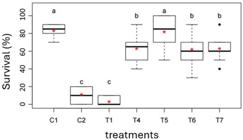
Pollinia Oncidium baueri survival level determined through the formation of capsules after the pollination with pollinia treated with cryoprotectant solutions 180 days after pollination. C1 - pollinia used immediately to pollinate another flower; C2 - without cryoprotectant; T1 - glycerol 2 M; T4 - PVS1; T5 - PVS2; T6 - PVS2 + 1% of phloroglucinol; T7 - PVS3. The treatments T2 glycerol 2 M + sucrose 0.4 M and T3 - sucrose 0.4 M, did not survive. Average followed by the same letters did not differ among themselves by the Tukey test.
The survival percentages of pollinia treated with T4, T6, and T7 differed statistically from Control 1 (C1), showing survival rates of 63.0% (63 capsules), 62.0% (62 capsules), and 63.0% (63 capsules), respectively. These treatments exhibited higher survival rates compared to C2, T1, T2, and T3, which demonstrated survival percentages of 11.0%, 3.0%, 0.0%, and 0.0%, respectively. Notably, pollinia subjected to T2 and T3 did not survive the cryopreservation process. For O. baueri, the highest viability of pollinia was observed in T5 (PVS2), which significantly outperformed all other tested solutions.
Treatments containing PVS solutions (T4, T5, T6, and T7) achieved greater pollinia survival rates post-thaw compared to treatments lacking PVS-based cryoprotectants. In commercial D. nobile cultivation, germination rates of approximately 75% are considered satisfactory, regardless of the cultivar or type of pollination used (Sorgato et al., 2015).
More recent studies have provided insights into the protective mechanisms of cryoprotectants. For example, Nagel et al. (2024) demonstrated that the combination of intracellular and extracellular cryoprotectants significantly reduced ice formation and preserved cellular integrity during cryopreservation. Common examples include glycerol, DMSO, and ethylene glycol. Extracellular cryoprotectants, such as sucrose and other macromolecules, reduce ice formation, facilitate cellular dehydration, and protect cell membranes.
The PVS2 solution has continued to be a critical component in cryopreservation techniques. Recent studies by Linjikao et al. (2024) confirm that PVS2’s combination of glycerol, sucrose, and other cryoprotectants leads to improved survival rates across a variety of plant species, including orchids. This mixture has been widely reported as effective for seed cryopreservation.
Recent review Kaur (2019) highlights that combining intracellular and extracellular cryoprotectants enhances dehydration tolerance and minimizes cell damage during cryopreservation of plant tissues PVS2 is a key component in vitrification protocols, transitioning water from a liquid to an amorphous solid state, thereby preventing the formation of ice crystals that can disrupt cellular membranes during thawing.
For O. baueri, the concentrations of components used in the cryoprotectant solutions were critical to the observed outcomes. Treatments T1, T2, and T3, containing 2 M glycerol and 0.4 M sucrose, were unsuccessful in recovering seeds post-thaw. Conversely, treatment T7 (PVS3), with higher concentrations of 5.4M glycerol and 1.5M sucrose, resulted in significantly higher germination percentages compared to T1, T2, and T3. Sakai et al. (1996) highlighted the lower toxicity of glycerol and sucrose, which negates the possibility of cryoprotectant-induced toxicity in pollinia and supports the notion that lower concentrations may have prevented adequate cellular dehydration.
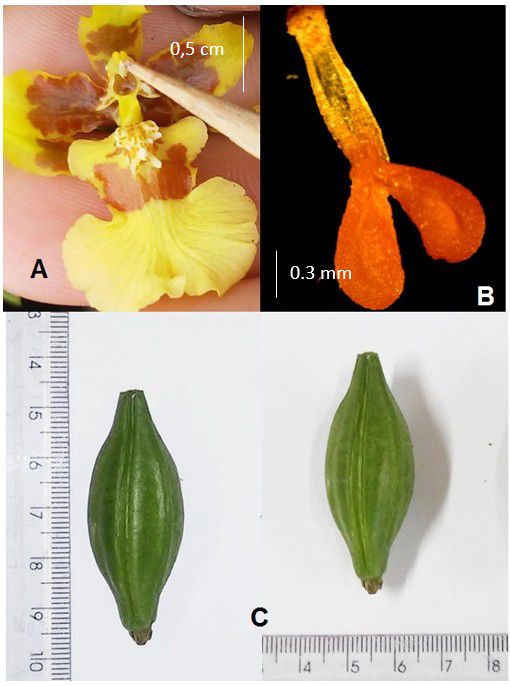
All capsules were collected at the same time (Fig. 2). The capsules formed by O. baueri were oval, free of diseases or pest damage, and exhibited a homogeneous light-green color. They were fully intact, measuring 5.2 ± 0.3 cm in length and 1.9 ± 0.2 cm in diameter.

A - Detail of the flower and of pollinia of Oncidium baueri; B - Photo with a stereoscopic magnifying glass of pollinia from O. baueri orchid; C - Capsules formed after the pollination with cryopreserved pollinia after 180 days.
The seeds from capsules formed from pollinated flowers with pollinia treated with different cryoprotectants solutions did not show significant statically difference among themselves about their viability. The capsules formed in treatment T1 were aborted by the plants (Fig. 3).

Viability of seeds from capsules formed by artificial pollination using Oncidium baueri pollinia treated with different cryoprotectant solutions. * C1 - pollinia used immediately to pollinate another flower; C2 - without cryoprotectant; T4 - PVS1; T5 - PVS2; T6 - PVS2 + 1% of phloroglucinol; T7 - PVS3. The treatments T1 - glycerol 2 M; T2 - glycerol 2 M + sucrose 0.4 M; T3 - sucrose 0.4 M; did not survive. The average followed by the same letters did not differ among themselves by the Tukey test. Source: the author.
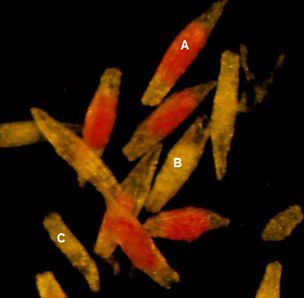
The seeds, when observed by the stereoscopic magnifying glass, contained well-formed embryos and was possible analyzed the viability by the red color obtained through the test of tetrazolium (Fig. 4). The humidity level was 5.12% previously to the test.

Survived embryos from Oncidium baueri seeds of capsules formed by pollinia treated with PVS2 submitted to the cryopreservation determined through the tetrazolium test. A - Viable embryos. B - Unviable embryos. C - Empty seeds.
Conclusions
The cryopreservation of O. baueri pollinia in liquid nitrogen is not viable without the use of cryoprotectant solutions, as there is no survival of the pollinia. The use of the PVS2 solution alone resulted in a survival rate of 82.0%, demonstrating its effectiveness for the conservation of this species
Acknowledgments
We thank UEL, CAPES and CNPq (308788/2021-4) for providing the funding necessary for the execution of this project.
Data availability statement
All the research data is contained in the manuscript.
References
-
AZAD, M.; KAVIANI, B.; SEDAGHATHOOR, S. Cold storage and cryopreservation by encapsulation-dehydration of Cephalanthera rubra (L.) Rich., a threatened orchid species. Acta Agrobotanica. v.77, 189312, 2024. https://doi.org/10.5586/aa/189312
» https://doi.org/10.5586/aa/189312 -
BESI, E.E.; NIKONG, D.; MUSTAFA, M.; GO, R. Orchid diversity in anthropogenic-induced degraded tropical rainforest, an extrapolation towards conservation. Lankesteriana: International Journal on Orchidology, v.19, n.2, p.107-124, 2019. https://dx.doi.org/10.15517/lank.v19i2.38775
» https://dx.doi.org/10.15517/lank.v19i2.38775 - BRASIL. Ministério da Agricultura, Pecuária e Abastecimento. Regras para Análise de Sementes. Brasília: MAPA/ACS, 2009.
-
DE PAULA, J.; JÚNIOR, W.; SHIMIZU, G.; MEN, G.; DE FARIA, R. Cryopreservation in liquid nitrogen of Brazilian orchid seeds Miltonia flavescens Lindl. Revista Agro@mbiente On-line. 2020. https://doi.org/10.18227/1982-8470RAGRO.V14I0.6388
» https://doi.org/10.18227/1982-8470RAGRO.V14I0.6388 - DINATO, N.B.; SANTOS, I.R.I.; VIGNA, B.B.Z; FERREIRA DE PAULA, A.; FAVERO, A.P. Perspective: Pollen cryopreservation for plant breeding and genetic resources conservation. CryoLetters, v.41, n.3, p.115-127, 2020 PMID: 33988640
-
FARIA, R.T.; COLOMBO, R.C. Oncidium: a orquídea em expansão no cenário florícola. Horticultura Brasileira, v.33, p.1-2, 2015. https://doi.org/10.1590/S0102-053620150000400022
» https://doi.org/10.1590/S0102-053620150000400022 -
FERRARI, E.A.P.; COLOMBO, R.C.; FARIA, R.T.D.; NEVES, C.S.V.J.; VERO, F.D.S. Degree of moisture in seeds for the cryopreservation of orchids native to Brazil. Ciência Rural, v.50, e20180498, 2020. https://doi.org/10.1590/0103-8478cr20180498
» https://doi.org/10.1590/0103-8478cr20180498 -
GALDIANO JUNIOR, R. F.; LEMOS, E. G. M.; VENDRAME, W. A. Cryopreservation, early seedling development, and genetic stability of Oncidium flexuosum Sims. Plant Cell, Tissue and Organ Culture, v. 114, p. 139-148, 2013. https://doi.org/10.1007/s11240-013-0304-4
» https://doi.org/10.1007/s11240-013-0304-4 -
HAGEDORN, J.; ALKURDI, G.; BARKER, S.A.; BRUNOTTE, R.; DEEB, T.; HUBENIA, O.; KHAYYAT, D.; LEAL-MARIN, S.; RITTINGHAUS, T.; GLASMACHER, B. The technology in cryotechnology. CryoLetters, v.44, n.6, p.314-326, 2023. https://doi.org/10.54680/fr23610110112
» https://doi.org/10.54680/fr23610110112 -
HEDRÉN, M.; BIRKEDAL, S.; DE BOER, H.; GHORBANI, A.; GRAVENDEEL, B.; HANSSON, S.; SVENSSON, Å.; ZARRE, S. Asymmetric contributions of seed and pollen to gene dispersal in the marsh orchid Dactylorhiza umbrosa in Asia Minor. Molecular Ecology, v.30, n.8, p.1791-1805, 2021. https://doi.org/10.1111/mec.15848
» https://doi.org/10.1111/mec.15848 -
HUSSAIN MIR, A.; TYUB, S.; KAMILI, A.N. Ecology, distribution mapping and conservation implications of four critically endangered endemic plants of Kashmir Himalaya. Saudi Journal of Biological Sciences, v.27, n.9, p.2380-2389, 2020. https://doi.org/10.1016/j.sjbs.2020.05.006
» https://doi.org/10.1016/j.sjbs.2020.05.006 -
JAISWAL, A.N.; VAGGA, A. Cryopreservation: A review article. Cureus, v.14, n.11, e31564, 2022. https://doi.org/10.7759/cureus.31564
» https://doi.org/10.7759/cureus.31564 -
KAUR, S. Cryopreservation of Orchids-A Review. Recent Patents on Biotechnology, v.13, n.2, p.114-123, 2019. https://doi.org/10.2174/1872208313666181127143058
» https://doi.org/10.2174/1872208313666181127143058 -
KHAPUGIN, А.А. A global systematic review on orchid data in protected areas. Nature Conservation Research, v.5, n.S1, p.19-33, 2020. https://dx.doi.org/10.24189/ncr.2020.019
» https://dx.doi.org/10.24189/ncr.2020.019 -
LINJIKAO, J.; INTHIMA, P.; LIMMONGKON, A.; KONGBANGKERD, A. Optimising the PVS2 treatment duration for cryopreserving seeds of the endangered rheophytic orchid Epipactis flava Seidenf. The Journal of Horticultural Science and Biotechnology, p.1-15, 2024. https://doi.org/10.1080/14620316.2024.2438660
» https://doi.org/10.1080/14620316.2024.2438660 -
NAGEL, M.; PENCE, V.; BALLESTEROS, D.; LAMBARDI, M.; POPOVA, E.; PANIS, B. Plant cryopreservation: Principles, applications, and challenges of banking plant diversity at ultralow temperatures. Annual Review of Plant Biology, v.75, n.1, p.797-824, 2024. https://doi.org/10.1146/annurev-arplant-070623-103551
» https://doi.org/10.1146/annurev-arplant-070623-103551 -
NISHIZAWA, S.; SAKAI, A.; AMANO, Y.; MATSUZAWA, T. Cryopreservation of asparagus (Asparagus officinalis L.) embryogenic suspension cells and subsequent plant regeneration by vitrification. Plant Science, p.67-73, 1993. https://doi.org/10.1016/0168-9452(93)90189-7
» https://doi.org/10.1016/0168-9452(93)90189-7 -
SAKAI, A. Cryopreservation of cultured plant cells and meristems. Plant Tissue Culture Letters, v.13, n.1, p.1-6, 1996. https://doi.org/10.5511/plantbiotechnology1984.13.1
» https://doi.org/10.5511/plantbiotechnology1984.13.1 -
SAKAI, A.; KOBAYASHI, S.; OIYAMA, I. Cryopreservation of nuclear cells of navel orange (Citrus sinensis Osb. var. brasiliensis Tanaka) by vitrification. Plant Cell Report, v.9, p.30-33, 1990. https://doi.org/10.1007/BF00232130
» https://doi.org/10.1007/BF00232130 -
SORGATO, J.C.; SOARES, J.S.; PINTO, J.V.C.; ROSA, Y.B.C. Germination potential of seeds and keikis quality of Dendrobium nobile at different fruit development stages. Ciência Rural, v.45, n.11, p.1965-1971, 2015. https://doi.org/10.1590/0103-8478cr20141129
» https://doi.org/10.1590/0103-8478cr20141129 -
TIMSINA, B.; KINDLMANN, P.; SUBEDI, S.; KHATRI, S.; ROKAYA, M. B. Epiphytic orchid diversity along an altitudinal gradient in Central Nepal. Plants (Basel), v.10, n.7, p.1381, 2021. https://doi.org/10.3390/plants10071381
» https://doi.org/10.3390/plants10071381 -
WANG, Y.; WANG, H.; YE, C.; WANG, Z.; MA, C.; LIN, D.; JIN, X. Progress in systematics and biogeography of Orchidaceae. Plant Diversity, v.46, n.4, p.425-434, 2024. https://doi.org/10.1016/j.pld.2024.05.002
» https://doi.org/10.1016/j.pld.2024.05.002
Edited by
-
Editor:
José Carlos Sorgato (Universidade Federal da Grande Dourados, Brasil)