 Social learning model of ornamental plant farmers in using social media for marketing
Abstract
Ornamental plant farmers have gained substantial benefits and experience in online sales, even expanding into export markets since the COVID-19 pandemic. However, not all farmers possess the same capacity to keep pace with information technology trends. This study develops a social learning model aimed at addressing the digital literacy challenges faced by ornamental plant farmers in Bogor regency. A sample of 210 ornamental plant farmers was selected through simple random sampling. Data was gathered through questionnaires and analyzed using PLS-SEM 3.0 to examine the impact of environmental factors on farmer behaviors in using social media for digital marketing. The social learning model included direct channels, social mediated channels, and self-efficacy. Findings revealed that integrating social media into social systems significantly enhanced self-efficacy and directly influenced farmers’ engagement in using such e-commerce platforms. The study concluded that utilizing social media within community structures, especially through a group oriented approach, proves to be more effective than individual efforts in motivating ornamental plant farmers to adopt digital marketing through social media platforms.
Keywords:
Bandura’s theory; digital divide; digital marketing; ICT for farmers; self-efficacy
Resumo
Os produtores de plantas ornamentais ganharam benefícios e experiência substanciais em vendas on-line, expandindo seus negócios até mesmo para mercados de exportação, desde a pandemia da COVID-19. No entanto, nem todos os produtores possuem a mesma capacidade de acompanhar as tendências da tecnologia da informação. Este estudo desenvolveu um modelo de aprendizagem social com o objetivo de abordar os desafios de alfabetização digital enfrentados pelos produtores de plantas ornamentais na região de Bogor. Uma amostra de 210 produtores de plantas ornamentais foi selecionada por amostragem aleatória simples. Os dados foram coletados por meio de questionários e analisados usando PLS-SEM 3.0 para examinar o impacto de fatores ambientais nos comportamentos dos produtores no uso de mídias sociais para marketing digital. O modelo de aprendizagem social incluiu canais diretos, canais mediados socialmente e autoeficácia. As descobertas revelaram que a integração de mídias sociais em sistemas sociais aumentou significativamente a autoeficácia e influenciou diretamente o engajamento dos produtores no uso de tais plataformas de comércio eletrônico. O estudo concluiu que utilizar mídias sociais dentro de estruturas comunitárias, especialmente por meio de uma abordagem orientada para o grupo, prova ser mais eficaz do que esforços individuais para motivar produtores de plantas ornamentais a adotar o marketing digital por meio de plataformas de mídia social.
Palavras-chave:
Teoria de Bandura; exclusão digital; marketing digital; TIC para agricultores; autoeficácia
Introduction
The COVID-19 pandemic, which began in early 2020, impacted public health and Indonesia’s ornamental plant industry. Farmers benefited from online sales and expanded into export markets as restrictions on outdoor activities increased demand for home gardening, especially for foliage plants. This trend persisted post-pandemic due to gardening’s psychological benefits and social media influence. Consumer behavior shifted, prompting the government to enhance industry competitiveness and sustainability. Businesses adopted digital marketing strategies, leveraging social media for entertainment, customization, interaction, and electronic word of mouth (EWOM) (Mubarok et al., 2021). Ornamental plants are a growing sector in agriculture and a valuable international commodity, enhancing quality of life and offering strong business potential (Lorenta, 2024). Indonesia, along with Thailand, China, and Japan, plays a key role in the global ornamental plant market, serving high-income consumers domestically and internationally (Manikas, 2019). High-value plants like orchids, adenium, aglaonema, anthurium, and palm offer economic stability due to their low price volatility. Indonesia’s ornamental plant trade presents strong commercial prospects and provides alternative employment and income opportunities, especially in rural areas (Scholz and Methner, 2020).
The digital literacy gap in developing countries hinders farmers’ ability to exchange knowledge and improve social media skills, exacerbated by low formal education levels (Zondo and Ndoro, 2023). In South Africa, limited knowledge and education reduce farmers’ social media engagement, while in Brazil, adoption depends on its integration into production planning (Mendes et al., 2023). In contrast, European farmers effectively use social media for knowledge exchange with experts, benefiting from networking and link-sharing (Doanh, 2024). Enhanced digital skills empower farmers in e-commerce and economic development, making digital literacy support crucial for adopting digital technologies (Hendricks and Mwapwele, 2023).
Bridging the digital literacy gap among ornamental plant farmers in social media marketing can be achieved through social learning, which effectively fosters knowledge exchange and adoption. Key factors influencing farmers’ decisions include outcome expectations, observational learning, and self-efficacy, while farmers in developing countries hesitate to adopt ICT for agriculture (Doanh et al., 2022). They are more likely to follow peers who lead by example. Early adopters play a vital role as role models, demonstrating social media’s benefits and encouraging adoption (Ataei et al., 2020). Effective social learning requires tailored models and communication strategies, as collaborative learning and behavioral modeling enhance skills, engagement, and marketing communication (Dooley, 2020).
A study on systematic literature review (SLR) using the PRISMA protocol (Hendricks and Mwapwele, 2023) shows that most studies on social learning theory focus on education and health, improving learning and patient recovery. However, few studies address the digital literacy gap among ornamental plant farmers, which is essential for effective social media and e-commerce use. Limited digital literacy restricts access to agricultural knowledge, online markets, and digital marketing, reducing farmers’ competitiveness. To address this, the study develops a social learning model using social modeling in farming communities. While prior research explores social-based e-commerce as an emerging model, it lacks effective approaches to enhance adoption through social learning theory, which emphasizes behavioral change via modeling. More research is needed on observational learning, self-efficacy, imitation, and reinforcement to improve digital engagement by integrating peer influence, social validation, and community support. This study examines how environmental factors shape digital marketing behavior through direct and socially mediated social media use, self-efficacy, and e-commerce engagement, forming a structured framework to empower farmers. Additionally, it develops a social learning model to bridge the digital literacy gap among ornamental plant farmers.
Literature review and development of hypotheses
Direct social media pathway
Social media fosters dialogue between farmers and agricultural experts, enabling farmers to share experiences while receiving supportive responses from experts. This interaction raises awareness of social media’s potential for knowledge exchange, encouraging technology adoption (Doanh, 2023). The direct social media channel serves as an information source, facilitator, motivator, and guide (Bandura, 2004). Additionally, exposure to success stories on social media significantly shapes farmers’ attitudes and intentions to adopt conservation practices by highlighting practical benefits and real-life applications (Hamann et al., 2024).
Socially mediated pathway
Social media transcends physical and traditional media limitations, connecting individuals with experts, farmers, researchers, and mentors. It enhances skill development through engagement and knowledge acquisition and fosters collaborative learning via discussions (Feroz et al., 2021). Additionally, formation of interest-based groups, improves entrepreneurship, agricultural knowledge, and farming practices. Information sharing supports learning, innovation, and farm performance (Carrer et al., 2022).
Self-efficacy
Self-efficacy as a moderating factor between source credibility and interactivity, which significantly influences knowledge satisfaction (Sereenonchai and Arunrat, 2024). In addition, McKim and Velez (2016) explained that self-efficacy and interactivity can enhance engagement in agricultural education, encouraging individuals to participate in discussions and interact with relevant social media content. Meanwhile, greater interactivity further strengthens self-efficacy, creating a reinforcing cycle.
Behavior using social media for e-commerce
The influence of the environment, network communication, and network participation on social media can enhance farmers’ participation in using social media for e-commerce (Wang et al., 2023). The behavior of using social media for e-commerce is influenced by the behavior of people nearby through participatory development with stakeholders (Adla et al., 2025). Furthermore, social media influence directly or indirectly moderate this relationship to achieve sustainable behavior (Farina et al., 2025).
Data and Methods
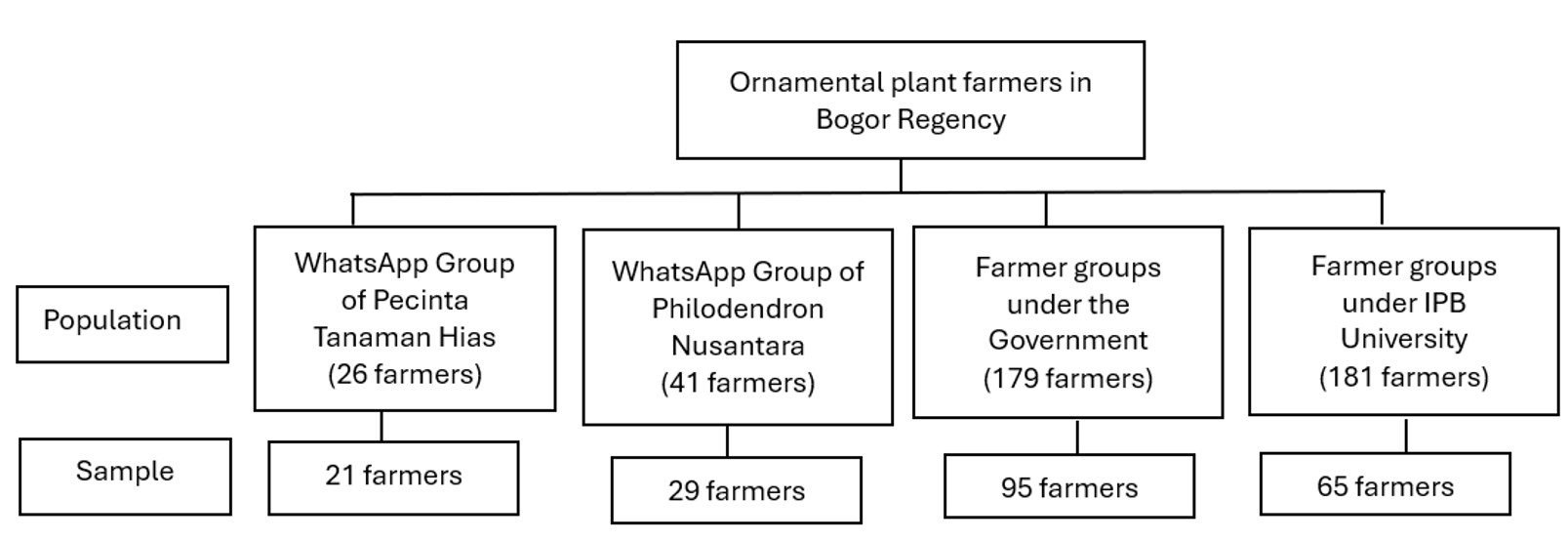
This study focused on ornamental plant farmers in Bogor Regency, Indonesia, who were supported by local institutions such as the Department of Agriculture, IPB University, and the Philodendron Nusantara WhatsApp Group. The research involved 427 farmers who utilized Android smartphones to engage in social media-based digital marketing strategies. A sample of 210 respondents was selected using the Slovin formula and simple random sampling via Microsoft Excel. Data analysis utilized the PLS-SEM technique to assess individual and combined variable relationships and estimate model pathways (Ghozali and Latan, 2014). Figure 1 illustrates the sample selection process.
The questionnaire’s reliability and validity were assessed with a group of 30 ornamental plant farmers in Cianjur Regency. The respondent distribution map can be seen in Fig. 2.

This research was a quantitative explanatory study, carried out within the framework of the positivist paradigm. The approach adopted was a cross-sectional design. The study utilized a survey method, employing questionnaires to examine the relationships between the variables through hypothesis testing. Primary data gathered through interviews are ordinal, measured on a 1 to 5 scale, where one indicates the lowest value and five represents the highest value, according to predetermined criteria. The data analyzed using correlation and model estimation to estimate the effects between independent variables and dependent variables in Fig. 3. Correlation analysis was conducted to evaluate the association between variables, while model estimation analysis aimed to develop a predictive model for the variables examined in this study. It involved the use of Partial Least Squares Structural Equation Model (PLS-SEM) version 3.0. The PLS-SEM analysis is divided into two sections: the outer model evaluation and the inner model evaluation. In the evaluation section, the analysis based on each model is explained. The validity and reliability of the questionnaire were tested before it was used in actual research. The validity test used Pearson’s product moment, whereas Cronbach’s alpha was used for the reliability test. The test results are considered reliable if Cronbach’s alpha value is greater than 0.5 (Hair, 2014). The outer model evaluation is based on the outer loading values of each indicator, as well as the validity and reliability of the variables (Table 2).
The independent variables include the direct pathway (X1) and socially mediated pathway of social media (X2). The dependent variables consist of self-efficacy (Y1), acting as a mediating variable, and behavior of using social media for e-commerce (Y2). The variables, operational definitions, and indicators are presented in Table 1. In this study, the selection of path directions and variable relationships was based on Bandura’s Social Learning theory, which emphasizes the role of environmental factors in shaping self-efficacy and behavior. The analytical framework was developed using the Partial Least Squares Structural Equation Model (PLS-SEM), with path directions determined through theoretical justifications and empirical findings are listed in Fig. 3.
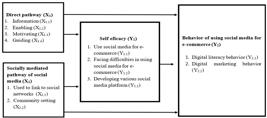
Figure 3 presents the conceptual framework based on Bandura’s Social Learning Theory (2004), which explains that individuals learn not only through direct experience but also by observing others. This study examines key variables: Direct use of social media (X1), Socially mediated use of social media (X2), Self-efficacy (Y1), and Behavior in using social media for e-commerce (Y2). The framework defines causal relationships, where X1 and X2 serve as independent variables, while self-efficacy (Y1) mediates their influence on social media behavior for e-commerce (Y2). Direct use of social media (X1) includes its role as an information source, facilitator, motivator, and guide. Socially mediated use (X2) involves social media as a connector to social networks (X2.1) and community settings (X2.2). Self-efficacy (Y1) is assessed through confidence in using social media for e-commerce (Y1.1), overcoming difficulties (Y1.2), and developing various platforms (Y1.3). Social media behavior for e-commerce (Y2) is categorized into digital literacy behavior (Y2.1) and digital marketing behavior (Y2.2).
The research questionnaire is divided into two sections. The first section gathers demographic data, including age, gender, education, e-commerce training participation, farming and selling experience, social media usage, and sources of learning. The second section consists of questions adapted from Bandura’s social learning theory, examining how environmental factors direct (X1) and socially mediated (X2) social media use influence self-efficacy (Y1) and social media usage behavior for e-commerce (Y2). The questionnaire integrates digital literacy, entrepreneurship, and digital marketing concepts, analyzing relationships between these variables. Marketing strategy-related questions align with Kotler and Keller’s (2016) 4Ps framework (Product, Price, Place, Promotion) and Schumpeter’s entrepreneurship theory, emphasizing innovation’s role in economic growth (Śledzik, 2013).
The PLS-SEM analysis consists of two sections: the outer model evaluation and the inner model evaluation. The validity and reliability of the questionnaire were tested before its use in the actual research. Pearson’s product moment was applied for the validity test, while Cronbach’s alpha assessed reliability, with a threshold of 0.5 for reliability. The outer model evaluation examines outer loading values for each indicator and assesses the validity and reliability of variables (Table 2).
Results and Discussion
Descriptive statistical analysis shows that most respondents are male (195 people, 92.86%), while female respondents account for 7.3% (15 people). The majority are aged 31 - 41 years (83 people, 39.5%), with most having a high school education (145 respondents, 69%). Respondents exhibit diverse digital marketing skills, with 52.38% (110 people) actively using Facebook, Instagram, and WhatsApp for e-commerce. This platform convergence enhances information sharing, customer interaction, and product promotion, expanding market reach. Each platform’s unique features Facebook Marketplace, Instagram’s visual appeal, and WhatsApp’s direct communication support an integrated digital marketing strategy. Table 3 details the respondents’ demographics.
The reliability values of latent variables, evaluated using Composite Reliability (CR) and Cronbach’s Alpha. Values above 0.7 for CR and Cronbach’s Alpha signify good reliability, while an AVE (Average Variance Extracted) value above 0.5 indicates that these variables hold both validity and reliability. According to (Ghozali and Latan, 2014), an AVE value above 0.5 reflects good validity, showing that more than 50% of indicator variance is explained by the construct, with the remainder attributed to error. Overall, high CR or Cronbach’s Alpha values (> 0.7) reflect strong internal reliability across indicators, while an AVE above 0.5 suggests that the measurement model is reliable and consistent. Hypothesis testing is conducted to assess potential relationships between variables, as shown in Table 4.
The reliability of the latent variable is assessed using Composite Reliability (CR) and Cronbach’s Alpha values, both of which must exceed 0.7 to indicate strong reliability. An AVE value greater than 0.5 demonstrates that the variable possesses both validity and reliability, meaning the model accurately and consistently explains the relationship between the indicator and the latent construct. An AVE value exceeding 0.5 also signifies substantial validity of the latent variable, as more than 50 percent of the variance in the indicator is explained by the construct, with the remainder attributed to errors (Ghozali and Latan, 2014). The reliability of the latent variable is measured through CR or Cronbach’s Alpha values exceeding 0.7, confirming strong reliability. Additionally, an AVE value greater than 0.5 indicates sufficient validity of the questionnaire, affirming that the internal reliability of the indicator is consistent.
Hypothesis testing is conducted to evaluate the potential relationships between variables by analyzing the proposed research hypotheses, as outlined in Table 5. It shows that H1 is rejected because it has a significance of 0.647 > 0.05, meaning that social media does not directly have a significant effect on e-commerce usage behavior. Some relevant studies that discuss the use of social media by vegetable farmers. One study explores the role of social media in commercial vegetable farming for rural development, highlighting how farmers use social media to gather information on market prices and avoid lower prices from middlemen (Gyawali, 2022). Another study investigates knowledge dissemination and social media use in the farming network, emphasizing the importance of social media in building trust and sharing information among farmers. These studies show that social media plays a crucial role in helping farmers gather information and make informed decisions.
Social media is a vital marketing channel for farmers’ markets, allowing small-scale farmers to sell products directly. However, many farmers lack the technical skills for effective digital marketing. While younger farmers are more adept at using social media for business, older farmers often have limited experience. Engaging older farmers in groups with younger, tech-savvy farmers can help bridge this gap. Studies highlight how younger farmers successfully integrate social media into marketing (Ortiz et al., 2021) and sharing their success stories can enhance digital literacy among farmers (Uy et al., 2024).
The next result is that social media directly influences self-efficacy as shown by its significance value of 0.008 < 0.05. Social media through the social system significantly influences the behavior of using digital marketing via social platforms as indicated from its significance value of 0.023 < 0.05. The results explain that the usage of social media has an influence on youth attitudes and youth self-efficacy. Improving self-efficacy and attitudes in the agricultural sector by enhancing the use of social media to obtain information in the agricultural sector. Socially mediated pathway social media use significantly influences self-efficacy in using digital marketing via social platforms as indicated by its significance value of 0.001 < 0.05. The results of this study are in accordance with the findings of Nurlela et al. (2020) that the use of social media influences self-efficacy in behavior among young farmers. Poverty and low motivation slow down the process of farmer regeneration, making self-confidence and strong self-belief crucial in shaping farmers’ entrepreneurial behavior.
Behavior is shaped by self-efficacy, which is influenced by environmental factors, significantly impacting farmers’ adoption of social media for knowledge exchange. Outcome expectations, observational learning, and self-efficacy play a crucial role in farmers’ decision-making regarding social media use in Vietnam (Doanh et al., 2024). The study shows that self-efficacy significantly influences digital marketing behavior, with a significance value of 0.001 < 0.05. Comparing these results with Nurfathiyah and Rendra’s (2020) findings, self-efficacy among young horticultural farmers in West Java, Indonesia, also drives entrepreneurial actions and risk-taking in digital marketing. These findings highlight that higher self-efficacy increases farmers’ likelihood of using social media as a marketing tool.
Table 6 confirms that self-efficacy mediates the effect of direct and socially mediated social media use on farmers’ digital marketing behavior. Frequent social media use for social learning enhances self-efficacy, leading to more active engagement in e-commerce. The significant value for direct social media use (0.028 < 0.05) supports H6, indicating that direct social media use positively influences digital marketing behavior through self-efficacy. Similarly, the significant value for social media use through social systems (0.032 < 0.05) supports H7, confirming its mediated impact on farmers’ e-commerce behavior via self-efficacy. This suggests that social media not only facilitates communication and information exchange but also strengthens farmers’ confidence in using digital marketing. These findings align with Bandura (2004), who emphasized the positive role of self-efficacy in entrepreneurial behavior. Additionally, Nurfathiyah and Rendra (2020) highlight that self-efficacy is developed through social learning from peer groups and extension workers. Engaging with experienced agricultural professionals helps young farmers expand their knowledge and entrepreneurial skills by connecting with seasoned farmers and participating in farming communities. Successful farmers serve as role models, inspiring business development and strengthening networks. Social media groups facilitate these connections, offer continuous guidance and support, and incentives for community growth, and bridge the digital divide among farmers.

Structural model of social learning communication of ornamental plant farmers in using digital marketing via social platforms
Figure 4 shows the total influence of the path coefficient of the social learning model, and it indicates that the variable that has a large influence on farmers’ behavior in using social media is socially mediated pathway of social media, which is 0.293. The structural equation of the model is as follows:
Y2 = Farmers’ behavior using digital marketing through social media platforms
X1 = Direct pathway
X2 = Socially mediated pathway
Y1 = Self-efficacy
Based on the equation (Y2), the coefficient for the direct social media variable is 0.068 which indicates that a 1-unit increase in the social media pathway will directly boost the behavior of using digital marketing via social platforms by 0.068. Similarly, the coefficient for the social media pathway through the social system is 0.293, meaning that a 1-unit increase in this pathway will enhance the behavior of using digital marketing via social platforms by 0.293. The coefficient for the self-efficacy variable is (-0.244), which implies that a 1-unit decrease in self-efficacy will reduce the behavior of ornamental plant farmers in using digital marketing via social platforms by 0.244, or conversely, a 1-unit increase in self-efficacy will increase their behavior by 0.244. The negative coefficient indicates an inverse relationship between self-efficacy and behavior. This study suggests that higher self-efficacy does not necessarily lead to increased use of digital marketing via social platforms by farmers. This suggests that self-efficacy is not a key driver of social media adoption for e-commerce, instead, farmers rely more on their social environment and collective belief. Interviews reveal that farmers’ confidence in using social media depends on group efficacy, especially in setting plant types and prices. Since ornamental plant prices fluctuate with market conditions and are not government-regulated, farmers establish price agreements to maintain competitiveness and prevent unhealthy competition. Group efficacy enhances farmers’ confidence by leveraging collective strength rather than individual ability. These findings align with Liu and Hu (2024), who state that social media exposure enhances group efficacy and social confidence, particularly in highly cohesive groups. In technology-mediated environments, collective efficacy plays a crucial role in improving team effectiveness and is a strong predictor of success in virtual teams (Hardin et al., 2024).
Despite actively using digital marketing on social platforms, farmers with low self-efficacy recognize their limited knowledge as a barrier. To overcome this, they seek information, guidance, and support through social media, using it as a learning resource to build confidence. Their motivation to improve their standard of living and expand their market through e-commerce drives them to persist and innovate despite technological challenges. Farmers explore new ways to enhance social media use, whether through self-learning, sharing experiences, or participating in training, aiming for success in their digital marketing efforts.
Ornamental plant farmers’ confidence in digital marketing via social platforms is shaped by personal experience and group self-efficacy. Support and motivation from fellow farmers enhance self-efficacy, influencing their digital marketing behavior. Social interaction creates a collaborative environment where farmers exchange knowledge, strategies, and successes, strengthening their online selling skills. Zhang and Zhang (2024) found that social learning enhances self-efficacy when individuals engage in cohesive communities, unlike traditional classes lacking expert interaction. Social media expands farmers’ access to expertise, enabling discussions, feedback, and validation through online and offline networks. This integration reinforces learning, boosts confidence, and encourages farmers to adopt and refine e-commerce strategies. Additionally, in rural China, social media-based e-commerce fosters stable producer-consumer connections through interactive and communicative networks (Nurlaela et al., 2020).
Social media fosters cohesive friendship circles that support social learning (Figeac and Favre, 2023). It can support learning with the suitability of time, place, and speed and better accommodate the needs of the learner and their learning style. This blend of engagement and knowledge acquisition makes social media an effective platform for learning new skills (Feroz et al., 2022). Additionally, it promotes active, collaborative learning through participatory group discussions, enriching individual experiences (Aminoto et al., 2021).
Generational differences can influence self-efficacy and behavior in utilizing digital marketing through social platforms, as each generation grows and develops within different technological and social contexts. Farmers over the age of 40 belong to a generation that did not grow up with digital technology, making them less familiar with social media and e-commerce technologies. Meanwhile, millennials farmers under the age of 40 are more accustomed to digital technology, having interacted with digital devices from an early age. Millennial farmers tend to have low self-efficacy due to the challenges they anticipate in the future, which drives them to continuously learn and adapt to digital technology. This is reflected in their active use of digital marketing via social platforms. This finding also aligns with the previous research, which revealed that the average self-efficacy of farmers in developing countries is relatively low (Sanborn, 2022). Building a community of farmers on social media is essential for boosting self-efficacy through shared experiences, information exchange, and knowledge sharing. Hence, it can accelerate social change, shifting farmers’ behavior from not using digital marketing via social platforms to becoming more accustomed to it. To enhance self-efficacy, collective efficacy is essential this refers to an individual’s perception of their group’s ability to take collective action to achieve desired social outcomes. These findings align with previous research, which indicates that improving farmers’ self-efficacy requires collective efficacy, fostering group cohesion by involving farmers across different generations (Gao and Arbuckle, 2022).
One potential approach to engaging older adults unfamiliar with social media for marketing is to use success stories as shared examples, along with clear information on the benefits and methods of utilizing social media for e-commerce. Older farmers may possess expertise that younger farmers seek, and a program incorporating cross-age teaching could be well received by all audiences. There is strong evidence that intergenerational support among farmers is crucial for their involvement in using ICT for e-commerce (Huang et al., 2023).
Intergenerational learning strengthens both self-efficacy and collective efficacy, enhancing group cohesion. Collective efficacy mediates the relationship between social media exposure and social confidence by fostering continuous, open discussions and collaboration. High social interaction on digital platforms builds collective efficacy by enabling self-presentation, learning, and resource sharing, which promotes resilience and problem-solving within communities. Greater engagement in social issues can also shape supportive attitudes toward governance and public policies. In agriculture, social media participation positively impacts farm income (Mendes et al., 2023). While self-efficacy influences individual effort (Bandura, 1995), this study suggests that collective efficacy plays a more significant role in shaping farmers’ digital marketing behavior. Excessive self-efficacy can hinder learning, highlighting the need for a balanced confidence level. Social support, rather than individual belief, drives digital adoption, underscoring the importance of government policies that integrate community-based learning initiatives.
Limitation and future research
Our study was conducted on ornamental plant farmers in Bogor Regency who use social media for e-commerce. Therefore, future research should consider a more diverse sample to enhance external validity. This study employed a cross-sectional approach with field surveys; however, this method has limitations in establishing causal relationships. Thus, qualitative research is needed to validate the relationships between variables, particularly collective efficacy, which, based on interview findings, influences farmers’ behavior. This approach could provide deeper insights into the adoption of social media for e-commerce.
Conclusions
This study identified a social learning model for digital marketing via social media, shaped by direct social media use (X1), social media through social systems (X2), and self-efficacy (Y1). Hypothesis testing showed that direct social media use influences behavior indirectly through self-efficacy, while social media through social systems directly affects both behavior and self-efficacy. Self-efficacy moderates the relationship between social media through social systems and behavior. Group-based social media use is more effective than individual approaches in closing the digital literacy gap among farmers. The study highlights the role of collective efficacy in boosting farmers’ confidence and motivation in adopting digital marketing. Future research should examine how collective efficacy influences the long-term adoption of digital marketing and its role as a mediating variable linking environmental factors to farmers’ social media behavior for e-commerce.
Acknowledgements
The author wishes to convey sincere appreciation to the Lembaga Pengelolaan Dana Pendidikan (LPDP Indonesia Endowment Fund for Education) under the Ministry of Finance of the Republic of Indonesia for providing financial support.
Data availability statement
Data will be made available upon request to the authors.
References
-
ADLA, S.; ARAVINDAKSHAN, A.; TYAGI, A.; GUNTHA, R.; PACHECO, MA.; NAGI, A.; PASTORE, P.; PANDE, S. Participatory development of mobile agricultural advisory driven by behavioural determinants of adoption. Journal of Environmental Management, v.374, n.3, p.124140, 2025. https://doi.org/10.1016/J.JENVMAN.2025.124140
» https://doi.org/10.1016/J.JENVMAN.2025.124140 -
AMINOTO, T.; PUJANINGSIH, F.B.; DANI, R.; RIANTONI, C. Assessing pre-service physics teachers’ competencies in designing photo-electric effect experiment using PhET simulation. Journal of Physics: Conference Series, v.1876, n.0120, p.1-10, 2021. http://doi.org/10.1088/1742-6596/1876/1/012065
» http://doi.org/10.1088/1742-6596/1876/1/012065 -
ATAEI, P.; SADIGHI, H.; CHIZARI, M.; ABBASI, E. Analysis of farmers’ social interactions to apply principles of conservation agriculture in Iran: application of social network analysis. Journal of Agricultural Science and Technology, v.1 , n.7, p.1657-1671, 2020. https://jast.modares.ac.ir/article-23-21426-en.pdf
» https://jast.modares.ac.ir/article-23-21426-en.pdf - BANDURA, A. Entertainment-education and social change: history, research, and practice. social cognitive theory for personal and social change by enabling media. London: Lawrence Erlbaum. (LEA’s communication series), 2004.
-
BANDURA, A. Self-Efficacy In Changing Societies. Cambridge University Press. 1995. DOI: https://doi.org/10.1017/CBO9780511527692
» https://doi.org/10.1017/CBO9780511527692 -
CARRER, M.J.; DE SOUZA FILHO, H.M.; VINHOLIS, M.D.M.B.; MOZAMBANI, C.I. Precision Agriculture adoption and technical efficiency: an analysis of sugarcane farms in Brazil. Technological Forecasting and Social Change, v.177, 121510, 2022. https://doi.org/10.1016/j.techfore.2022.121510
» https://doi.org/10.1016/j.techfore.2022.121510 -
CHORUMA, D.J.; DIRWAI, T.L.; MUTENJE, M.J.; MUSTAFA, M.; CHIMONYO, V.G.P.; JACOBS-MATA, I.; MABHAUDHI, T. Digitalization in agriculture: A scoping review of technologies in practice, challenges, and opportunities for smallholder farmers in sub-Saharan Africa. Journal of Agriculture and Food Research, v.18, e.101286, 2024. https://doi.org/10.1016/j.jafr.2024.101286
» https://doi.org/10.1016/j.jafr.2024.101286 -
DOANH, N.K.; QUYNH, N.N.; PHAM, T.T.L. Going organic or staying traditionalistic? The role of agriculture information system. International Journal of Social Economics, v.49, n.10, p.1458-1478, 2022. https://doi.org/10.1108/ijse-11-2021-0720
» https://doi.org/10.1108/ijse-11-2021-0720 -
DOOLEY E. An Ethnographic look into farmer discussion groups through the lens of social learning theory. Sustainability, v.12, e7808, 2020. https://doorg/10.3390/su12187808
» https://doorg/10.3390/su12187808 -
FARINA, K.; KASHIF, A.; WU, Q.; OKSANA, G. Moderating role of digital media on environmental awareness and environmental beliefs to shape farmers’ behavioral intentions towards sustainable agricultural land conservation practices. Journal of Environmental Management, v.373, p.123745, 2025. http://doi 10.1016/j.jenvman.2024.123745
» http://doi 10.1016/j.jenvman.2024.123745 -
FEROZ, H.M.B.; ZULFIQAR, S.; NOOR, S.; HUO, C. Examining multiple engagements and their impact on students’ knowledge acquisition: the moderating role of information overload. Journal of Applied Research in Higher Education, v.14, n.1, p.366-393, 2021. https://doi.org/10.1108/JARHE-11-2020-0422
» https://doi.org/10.1108/JARHE-11-2020-0422 -
FIGEAC, J.; FAVRE, G. How behavioral homophily on social media influences the perception of tie-strengthening within young adults’ personal networks. New Media and society, v.25, n. 8, p.1971-1990, 2023. http://doi.org/10.1177/14614448211020691
» http://doi.org/10.1177/14614448211020691 -
GAO, L.; ARBUCKLE, J.R. Examining farmers’ adoption of nutrient management best management practices: a social cognitive framework. Agriculture and Human Values, v.39, p.535-553, 2022. https://doi.org/10.1007/s10460-021-10266-2
» https://doi.org/10.1007/s10460-021-10266-2 - GHOZALI, I.; LATAN, H. Partial Least Squares. Concepts, techniques and applications using the Smart PLS 3.0 program for empirical research. Surabaya: Diponegoro University Publishing Agency, 2014.
-
GYAWALI, K. Role of social media in commercial vegetable farming for rural development. Saptagandaki Journal, 13(1), 101-115. 2022. DOI:https://doi.org/10.3126/sj.v13i1.54949
» https://doi.org/10.3126/sj.v13i1.54949 -
HAMANN, R.; NILSSON, W.; DRIMIE, S. Testing chatgpt’s capabilities for social media content analysis. Aesthetic plastic surgery journal, v.48, n.13, p.2602-2604, 2024. https://doi.org/10.1007/s00266-023-03607-5
» https://doi.org/10.1007/s00266-023-03607-5 -
HARDIN, A.; DAVISON, R.M.; SCHNEIDER, C.; LOONEY, C.A.; SARKER, S. Contextualising collective efficacy in virtual team research: the essential role of collaborative technologies in the virtual team efficacy conceptual framework. Information Systems Journal, v.34, n.2, p.469-498, 2024. https://doi.org/10.1111/isj.12484
» https://doi.org/10.1111/isj.12484 -
HAIR JR., J.F.; MARKO SARSTEDT; LUCAS HOPKINS; VOLKER G. KUPPELWIESER. Partial Least Squares Structural Equation Modeling (Pls-Sem): An Emerging Tool In Business Research. European Business Review. v.26(2). p.106-121. 2014. DOI: https://doi.org/10.1108/EBR-10-2013-0128
» https://doi.org/10.1108/EBR-10-2013-0128 -
HENDRICKS, S.; MWAPWELE, S.D. A systematic literature review on the factors influencing e-commerce adoption in developing countries. Data Information Management, v.8, n.1, p.1-14, 2023. https://doi.org/10.1016/j.dim.2023.100045
» https://doi.org/10.1016/j.dim.2023.100045 - HUANG, J.; SU, L.; LIU, X. Facilitating inclusive Use of ICTs in rural China. In: Agricultural Development in Asia and Africa: Essays in Honor of Keijiro Otsuka. Singapore: Springer Nature Singapore, 2023. p.197-211.
- KOTLER, P.; KELLER, K.L. A Framework For Marketing Management. Sixth edition. London: Pearson Education Limited, 2016. 360p.
-
LIU, Y.; HU, K. How social media exposure constructs social confidence: An empirical study on impact, mechanisms, and multilateral relationships. Plos One, v.19, p.9, 2024. https://doi.org/10.1371/journal.pone.0308745
» https://doi.org/10.1371/journal.pone.0308745 -
LORENTA, H. The competitive and comparative advantages of aglaonema farming in Depok City, Indonesia. Ornamental Horticulture, v.30, e.242657, p.1-7. 2024. https://doi.org/10.1590/2447-536X.v30.e242657
» https://doi.org/10.1590/2447-536X.v30.e242657 -
MANIKAS, I.; MALINDRETOS, G.; ABELIOTIS, K. Sustainable cities through alternative urban farming: The case of 365 floriculture. Journal of International Food and Agribusiness Marketing, v.32, n.1, p.1-17, 2019. https://doi.org/10.1080/08974438.2019.1599762
» https://doi.org/10.1080/08974438.2019.1599762 -
McKIM, A.J.; VELEZ, J.J. An evaluation of the Self-Efficacy Theory in Agricultural Education. Journal of Agricultural Education. v.57, 73-90. 2016. https://doi.org/10.5032/jae.2016.01073
» https://doi.org/10.5032/jae.2016.01073 -
MENDES, J.J.; CARRER M.J.; VINHOLIS, BRANDAO; VINHOLIS, M.M.; FILHO, H.M. Adoption and impacts of messaging applications and participation in agricultural information-sharing groups: an empirical analysis with brazilian farmer. Journal of Agribusiness in Developing and Emerging Economies, v.14, n.4, p.18, 2023. https://doi.org/10.1108/JADEE-09-2022-0194
» https://doi.org/10.1108/JADEE-09-2022-0194 -
MUBAROK, S.; SUMINAR, E.; KARYANI, T.; RUFAIDAH, F.; NOVANDA, S.; NUR RAHMAT, B.P. An overview of the increasing ornamental plant business in Indonesia post-COVID-19 as a result of social media and its future perspective. Sustainability, v.15, n.19, p.14211, 2023. https://10.3390/su151914211
» https://10.3390/su151914211 -
NURFATHIYAH, P.; RENDRA. Effectiveness of media and extension materials in the implementation of the legowo row planting system in Sakernan district, Muaro Jambi Regency. Jurnal Ilmiah Ilmu Terapan Universitas Jambi, v.4, n.1, p.93-110, 2020. https://doi.org/10.22437/jiituj.v4i1.9850
» https://doi.org/10.22437/jiituj.v4i1.9850 -
NURLAELA, S.; HARIADI, S.S.; RAYA, A.B. Self-efficacy and entrepreneurial behavior of horticultural young farmers in the special region of Yogyakarta Indonesia. International Journal of Psychosocial Rehabilitation, v.24, n.6, p.14029-14035, 2020. https://www.researchgate.net/publication/342439362
» https://www.researchgate.net/publication/342439362 -
ORTIZ, C.; PETERSON, D.; COLLART A.; DOWNEY, L.; SEAL, S.; GALLARDO, R. Small farmers’ use of social media and other channels for marketing their agricultural products. Journal of Extension, v.49, n.4, 19, 2021. http://doi.org/10.34068/joe.59.04.19
» http://doi.org/10.34068/joe.59.04.19 - SANBORN, F. A cognitive psychology of mass communication. Abingdon: Routledge. 2022. 568p.
-
ŚLEDZIK, K. Schumpeter’s View on Innovation and Entrepreneurship. SSRN Electronic Journal. 2013. DOI:http://doi.org/10.2139/ssrn.2257783.
» http://doi.org/10.2139/ssrn.2257783. -
SCHOLZ, M. Social learning and transition perspective on a climate change project in South Africa. Environmental Innovation and Societal Transitions, v.34, p.322-335, 2020. https://doi.org/10.1016/j.eist.2019.10.011
» https://doi.org/10.1016/j.eist.2019.10.011 -
SEREENONCHAI, S.; ARUNRAT, N. Communication strategies for sustainable urban agriculture in Thailand. Sustainability, v.16, n.24, 10898, 2024. https://doi.org/10.3390/su162410898
» https://doi.org/10.3390/su162410898 -
UY, T. C., LIMNIRANKUL, B., KRAMOL, P., SEN, L. T. H., HUNG, H. G., KANJINA, S., & SIRISUNYALUCK, R. Social Media adoption for agricultural development: Insights from smallholders in central Vietnam. Information Development. 2024 https://doi.org/10.1177/02666669241261355
» https://doi.org/10.1177/02666669241261355 -
WANG, F.; WANG, M.; WAN, Y.; JIN, J.; PAN, Y. The power of social learning: how do observational and word-of-mouth learning influence online consumer decision processes?. Information Processing and Management, v.58, n.5, 102632, 2021. https://doi.org/10.1016/j.ipm.2021.102632
» https://doi.org/10.1016/j.ipm.2021.102632 -
ZHANG, Y.; ZHANG, Y. The influence of digital literacy on the phenomenon of deviation between farmers’ e-commerce sales willingness and behavior: evidence from rural China. Sustainability, v.16, n.7, 3000, 2024. https://10.3390/su16073000
» https://10.3390/su16073000 -
ZONDO, W.N.S.; NDORO, J.T. Attributes of diffusion of innovation’s influence on smallholder farmers’ social media adoption in Mpumalanga province, South Africa. Sustainability, v.15 n.5, p.4017, 2023. https://doi.org/10.3390/su15054017
» https://doi.org/10.3390/su15054017
Edited by
-
Editor:
Paulo Rodrigo Ramos Xavier Pereira (Universidade Federal do Piauí, Brasil)