
 Influence of Pseudomonas fluorescens x Azospirillum brasilense and Prohexadion-Ca on Poa annua L. growth and spreading in turfgrasses
Abstract
This study addresses the challenge of managing Poa annua (annual bluegrass), a problematic weed in turfgrass systems such as athletic fields, golf courses, and ornamental lawns. Traditional control methods provide only temporary relief, and chemical controls have led to herbicide-resistant biotypes and environmental concerns. The research explores alternative strategies using Prohexadion-Ca (Regalis®) and Pseudomonas fluorescens x Azospirillum brasilense (Rhizoflo Premium®). A field trial was conducted with different seed mixtures, Poa annua seeding rates, and treatment regimens to evaluate the combined efficacy of these substances. Data on Poa annua ratio and overall grass growth were recorded and analysed. Results indicated that Regalis® significantly reduced Poa annua and overall grass growth, while Rhizoflo Premium® promoted turfgrass growth without specifically targeting Poa annua. Both treatments were effective regardless of initial Poa annua seeding rates, and seasonal temperature stress also played a role in reducing Poa annua populations. The study underscores the importance of integrated turfgrass management practices that consider treatments, seed mixtures, and environmental conditions to optimise turf health and reduce reliance on traditional herbicides. These findings provide valuable insights for developing more sustainable and environmentally friendly turfgrass management practices.
Keywords:
Turfgrass management; annual bluegrass; growth inhibitors; growth promoters; integrated weed management
Resumo
Este estudo aborda o desafio de manejar a Poa annua (grama azul anual), uma planta daninha problemática em áreas de gramados, como campos esportivos, campos de golfe e jardins ornamentais. Os métodos tradicionais de controle oferecem apenas o controle temporário, e o uso de herbicidas levou ao desenvolvimento de biotipos resistentes e preocupações ambientais. Assim, esta pesquisa explora estratégias alternativas utilizando Prohexadion-Ca (Regalis®) e Pseudomonas fluorescens x Azospirillum brasilense (Rhizoflo Premium®). Um experimento foi realizado com diferentes misturas de sementes, taxas de semeadura de Poa annua e regimes de tratamento para avaliar a eficácia da combinação dessas substâncias. Dados sobre a proporção de Poa annua e o crescimento geral das gramíneas foram registrados e analisados. Os resultados indicaram que o Regalis® reduziu significativamente a Poa annua e o crescimento geral das gramíneas, enquanto o Rhizoflo Premium® promoveu o crescimento do gramado sem atingir especificamente a Poa annua. Ambos os tratamentos foram eficazes independentemente das taxas iniciais de semeadura de Poa annua, e o estresse térmico sazonal também desempenhou um papel na redução das populações de Poa annua. O estudo destaca a importância de práticas integradas de manejo de gramados que considerem tratamentos, misturas de sementes e condições ambientais para otimizar a saúde do gramado e reduzir a dependência dos herbicidas tradicionais. Esses resultados fornecem valiosas informações para o desenvolvimento de práticas de manejo de gramados mais sustentáveis e ambientalmente corretos.
Palavras-chave:
grama azul anual; inibidores de crescimento; manejo integrado de plantas daninhas; manejo de gramados; promotores de crescimento
Introduction
Turfgrass management is a critical aspect of maintaining high-quality athletic fields, golf courses, and ornamental lawns (Curk et al., 2017; Santos et al., 2020). One of the most persistent challenges in turfgrass management is the control of unwanted weed species, particularly Poa annua L. (annual bluegrass). P. annua is a problematic winter annual weed that competes aggressively with desirable turfgrass species, leading to uneven turf density, poor aesthetics, and reduced playability on sports surfaces. In recent years, we have noticed a greater occurrence of P. annua also on European football pitches, and for its effective control, which would reduce the appearance of light green to yellow circles on dark green grass, we do not yet have an effective answer (Curk et al., 2017; Neal, 2024). Effective management of P. annua is essential for maintaining the integrity and visual appeal of turfgrass areas (Carroll et al., 2021a). P. annua is known for its prolific seed production, rapid germination, and ability to adapt to a wide range of environmental conditions. These characteristics make it a formidable competitor in turfgrass systems. Despite numerous management strategies, control-ling P. annua remains a significant challenge. Traditional methods, such as cultural practices and mechanical removal, often provide only temporary relief and can be labour-intensive and costly. In heavily infested turfs completely terminating and reseeding them is usually the only option for P. annua control (Curk et al., 2017; McCurdy et al., 2023).
Chemical control remains a cornerstone of P. annua management in turfgrass systems. Herbicides, both pre-emergent and post-emergent, have been extensively used to manage this weed (Woosley et al., 2003). However, the reliance on chemical control has led to the development of herbicide-resistant P. annua biotypes, reducing the efficacy of conventional herbicides (Carroll et al., 2021b). Additionally, there are growing concerns over the pesticide resistance of P. annua (Barua et al., 2021) and the broader environmental impact and regulatory restrictions associated with herbicide use (Cain, 2020; Carroll et al., 2021b). In light of these challenges, there has been increased interest in exploring alternative chemical strategies, including the use of growth inhibitors and promoters (Głąb et al., 2020). Growth inhibitors, such as plant growth regulators, have been employed to suppress the growth of un-desirable species by altering physiological processes such as cell division, elongation, and differentiation. These inhibitors can be selective, targeting specific weeds like P. annua while minimizing damage to desirable turfgrass species. Conversely, growth promoters, which include a range of biostimulants and hormones, can enhance the growth and stress tolerance of turfgrass, potentially outcompeting P. annua. These substances may improve turfgrass health and resilience, making it less susceptible to weed invasion and more capable of maintaining dominance over P. annua.
Despite the potential of growth inhibitors and promoters in turfgrass management, there is a paucity of research directly comparing their effects on P. annua suppression and turfgrass performance. Most existing studies have focused on the application of single agents rather than integrated approaches that combine growth inhibitors and promoters. Kennedy (2016) examined the effects of Pseudomonas fluorescens Migula on selectively inhibiting P. annua growth, while a previous study (Bohinc et al., 2021) addressed the combined effect of P. fluorescens and Prohexadion-Ca, but only in a greenhouse pot trial. While the first study did study the effects in the field, the precipitation amount in the area was nearly half the amount in the area of our study, raising a question of possible better competitiveness of P. annua in our environment. Therefore, the study aims to fill the knowledge gaps by conducting a field trial that evaluates the combined efficacy of a Prohexadion-Ca (Regalis®) and P. fluorescens x Azospirillum brasilense Tarrand, Krieg & Döbereiner (Rhizoflo Premium®) on P. annua growth inhibition in turfgrass systems. Hints from extant research articles lead us into forming three research questions:
1. Did the use of substances inhibit the growth of grasses, specifically of P. annua, and which regime is better in terms of inhibiting its growth?
2. Did the two substances react differently at different P. annua seeding rates?
3. What was the influence of seasons on the substances effectiveness and did the two of them influence the grasses growth curve?
The findings from this study are expected to provide valuable insights into the relative efficacy of growth inhibitors and promoters in managing P. annua in turfgrass systems. Studies investigating non-conventional methods for weed control are rare but would be highly appreciated by turfgrass managers, since there are no registered plant protection products for turfgrass applications in Slovenia (Curk et al., 2017). In the broader EU, there are strong political pressures to limit their use as well, as the recently proposed Regulation on the Sustainable Use of Plant Protection Products showcased (though it was recently withdrawn). By identifying effective strategies for suppressing P. annua while promoting turfgrass health, this research could lead to more sustainable and environmentally friendly turf management practices. Ultimately, this research aims to enhance the ability of turfgrass managers to maintain high-quality turf areas, reduce the reliance on traditional herbicides, and promote more sustainable and resilient turfgrass ecosystems. The practical recommendations derived from this study will be directly applicable to a wide range of turfgrass settings, including sports fields, golf courses, and ornamental lawns, thereby benefiting both the turfgrass industry and the broader community.
Materials and Methods
The research plot was initiated in the fall of 2021 when it was sprayed with herbicide, plowed, and raked before being distributed into three blocks with 12 trial plots (each 70 m2 in size). In September of 2021, three different grass seed mixtures (Table 1) were sown onto four parcels each. Sowing was done by hand with several passes in different directions to ensure uniform coverage. Each parcel received 3.000 g of the three mixtures of seed and additionally either 0 g, 150 g, 300 g, or 600 g (0%, 5%, 10%, or 20%) of P. annua seed.
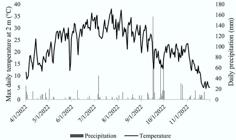
After seeding, the seeds were rolled with a Cambridge roller to ensure better ground contact and covered with a white garden fabric to retain moisture and protect the seeds from birds. During the growing season, the field was irrigated daily, to exclude the influence of drought. Each of the 12 parcels was further divided into three treatment plots where Rhizoflo Premium® (producer: CKC Argentina s.a.) and Regalis® Plus (producer: BASF SE) were applied at different rates (treatment 1: 2-times Rhizoflo Premium® + 1-time Regalis® Plus; treatment 2: 1-time Rhizoflo Premium® + 1-time Regalis® Plus; treatment 3: control - no Rhizoflo Premium® or Regalis® Plus). Treatments were designed to show how both substances affect the growth of grasses, specifically of P. annua. Both substances were applied as a foliar application, Rhizoflo Premium® at 2.5 % and Regalis® Plus at 3 % concentration. The table with application dates and the dates of mowing and other management of the turf is appended (Table 2). Daily precipitation and temperatures during the experimental growing season are presented in Fig. 1.
Results and Discussion
Turfgrass growth
Data on grass growth and the proportion of P. annua in the turf was analyzed and compiled as individual and yearly values. The average weights of the grass clippings for the different mowing dates are presented in Fig. 2. The first mowing was executed almost two months after the start of the growing season (on May 4th), so the weight of the clip-pings was the greatest then. Over the next weeks, the amount of grass clippings seems to nicely match the “two peaks” growth curve of the cool-season grass species. This pattern is characterized by vigorous growth in the spring and autumn, with a slowdown during the hotter summer months. This observation is in accordance with the commonly observed sensitivity of cool-season grasses to temperature fluctuations, influencing their growth rates.

To determine which of the contributing factors (treatment, initial proportion of P. annua, seed mixture) was influential on the results, yearly data were analyzed with ANOVA. The analysis showed that all three were significantly influential on both yearly (p-value < 0.000), but also daily basis (p-value < 0.000). Comparisons between the three contributing factors are presented in Fig. 3.

The influence of treatments is statistically significant and in accordance with our initial expectations. Untreated control yielded the highest amount of grass clippings as the growth of the grasses was not inhibited by any of the substances. Both other treatments showed a significant reduction in yield, indicating their effectiveness. Regalis® significantly decreased the growth of turfgrasses, as its active ingredient Prohexadion-Ca is known to effectively suppress the growth of common turfgrass species, including Kentucky blue-grass (Poa pratensis L.) and perennial ryegrass (Beam, 2004), but also P. annua (Bohinc et al., 2021). The higher 2:1 ratio of Rhizoflo Premium® was also influential. Its active ingredient, Pseudomonas fluorescens, can act as a growth promoter (Beam and Askew, 2007; Trdan et al., 2019), while also reducing the number of grass tillers. On the other hand, Azospirillum brasilense, the other ingredient, facilitates the optimal solubilization of phosphorus and provides bioavailable nitrogen (Dudutech, 2024). The results show that the 2:1 ratio increased the grass growth relative to the 1:1 ratio treatment. The effect of commercial products combination has ultimately reduced the growth of turfgrass on a yearly level. Despite the use of growth promoting bacteria, the effect of Prohexadion-Ca was greater. In terms of fodder production, this effect would be negative, but in terms of turfgrass management, the reduction of the need to mow could be viewed as positive. How these dynamics influenced the growth of P. annua compared to other preferred grass species will be discussed in a different sub-section.
Though visually more growth seems to come from seed mixtures with added P. annua seeds, a statistical difference was not confirmed, suggesting that P. annua proportion in sward does not contribute greatly to the grass clippings biomass when mowing. The reason could be that P. annua seedlings are smaller than those of other grasses. This observation aligns with previous studies (Caroll et al., 2021b), discussing the characteristics of P. annua that allow it to thrive in low mowing conditions often seen in managed turfgrass environments. P. annua has a growth habit that enables it to produce seed heads at very low heights, often below the mowing level. This means that while it spreads prolifically through seed production, it does not contribute much to the biomass collected during mowing. What this means in terms of the species coverage expansion will also be discussed in the next subsection.
Seed mixtures composition also had some effect on the amount of grass clippings, indicating the importance of choosing the right grass varieties or their percentages. Both Masterline Sport and Sport Green 21 are mixtures of only Lolium perenne and Poa pratensis, while BAR Power RPR also consists of 30% of Festuca rubra varieties. F. rubra, having much finer leaf surfaces, could be a reason for smaller grass clippings yield in this case, which is in line with previous findings (Akdeniz, 2019), although there may be some variation in leaf structure of the turf varieties used in our study and the forage varieties used in the cited work.
Proportion of Poa annua
After seeding, P. annua seedlings sprouted and their average proportion increased to over 50% in the beginning of May. In just two months though, its proportion in the sward dropped to almost 0% (Fig 4). Possible reasons include competition from other grass species, unsuitable weather conditions, or the different treatments. The first Regalis® applications happened in the first half of May, so this could be the reason, but it can’t be confirmed without a more detailed examination. The absence of P. annua during the summer months might suggest that further management might not be necessary, but one should keep in mind that the grass species has a very good seed generation and can reseed from year to year.
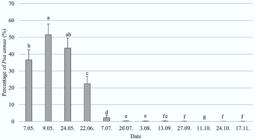
Average proportion of P. annua in turfgrass on different dates throughout the 2022 growing season.
Figure 5 shows the influence of the different factors. In all three cases, the differences among groups were significant (p-value < 0.0001). The influence of treatments revealed a similar picture as in the case of total clippings yield: untreated control showed the largest percentage, while at least one treatment showed significantly different results. Regalis® significantly reduced the spreading of P. annua, and the more frequent applications of Rhizoflo Premium® promoted the growth more intensively.

Comparison of the average annual proportion of P. annua based on its different initial seeding rates underscored the importance of reducing the underground seed bank before re-establishing a new turf, as the larger initial P. annua seeding rates significantly increased its percentage in the turf.
The influence of different seed mixtures was somewhat different as with the grass clip-pings yield - the Masterline Sport mixture allowed for the largest P. annua establishment, while Sport Green 21 and BAR Power RPR percentages were lower. This outcome might be connected to different potential for competitiveness among the grass species or varieties used, as suggested by another research (Masin and Macolino, 2016). There, the creeping cultivars of L. perenne were reported to be significantly more competitive against P. annua. Based on our own results and the product specifications (Table 2) this also seems to be the reason for the differences in our case. We were able to confirm that for the Sport Green 21 mix all three varieties had the creeping ability. For BAR Power RPR mix one of the varieties had this ability, while the other didn’t. For the Masterline Sport mix though, the product specification didn’t specify the information on growth type. However, since the creeping ability is preferred as it makes the plants more competitive (Masin and Macolino, 2016), it was assumed that such a trait would be pointed out in the specification, should the varieties actually exhibit it.
Seasonal influence of treatments
Since several different factors could influence the outcomes, a more detailed illustration of the seasonal behaviour of P. annua under the different treatments is presented in Fig. 6. Results suggest that the almost total disappearance of P. annua from turf plots from July onward was not connected to the use of either treatment. Rather, it is most likely connected to temperature stress, as previous studies have emphasized the susceptibility of the species to high temperatures because of the shallow root system (Beard, 1969; Li et al, 2023; McNally et al., 2022). The year 2022 certainly had a hot summer, as can be seen in Figure 1. Among the treatments, the season didn’t influence them in a very clear way. This signal could probably be improved by following the experiment over several years.

Average proportion of P. annua in turfgrass influenced by the three treatments on different dates throughout the 2022 growing season.
The lack of seasonal influence on treatments highlights the significant influence of the treatments themselves. Based on the statistical analysis we can conclude that both treatments (Rhizoflo Premium®:Regalis® - 2:1 and Rhizoflo Premium®:Regalis® - 1:1) were effective at significantly reducing the grass clippings yield. Rhizoflo Premium®:Regalis® - 1:1 was also effective at reducing the percentage of P. annua compared to untreated control, while for the other treatment, the difference was not significant.
Based on the different pattern in P. annua percentages among treatments, an additional analysis was performed, showcasing the effect of individual treatments timing on the results (Fig. 7).

Average proportion of P. annua in turfgrass influenced by the three treatments, with indication about which substance was last used before evaluation.
Interestingly, the performance of P. annua in each of the treatments seems to match very well with the substance last used in the days before evaluation. The general curvature of all three treatments is characteristic of the spring and early summer growth of grasses, but the differences between treatments show that the use of Prohexadion-Ca (Regalis®) corresponds to a lower percentage of P. annua than the use of P. fluorescens (Rhizoflo Premium®). Other studies report that P. fluorescens is known to decrease the number of tillers (Beam and Askew, 2007; Bohinc et al., 2021), but based on our data we can’t confirm that, as the percentage of P. annua was higher after Rhizoflo Premium® treatments. This could be because Rhizoflo Premium® also contains another rhizobium bacterium - Azospirillum brasilense - which facilitates the optimal solubilization of phosphorus and provides bioavailable nitrogen (Dudutech, 2024). The use of Prohexadion-Ca did, however, result in P. annua growth inhibition, as reported by other studies (Beam and Askew, 2007; Bohinc et al., 2021).
To answer the three initial research questions, the use of Prohexadion-Ca (Regalis®) significantly inhibited the growth of P. annua, making it the more effective regime for suppressing this weed. RhizoFlo® promoted overall turfgrass growth but did not specifically target P. annua. The effectiveness of Regalis® and RhizoFlo® did not vary significantly with different initial P. annua seeding rates. However, higher initial seeding rates of P. annua naturally resulted in a greater presence of the weed in the turf, regardless of the treatment applied. Seasonal temperature stress, particularly during the hot summer months, independently contributed to the reduction of P. annua populations. Regalis® consistently reduced P. annua growth across all seasons, while RhizoFlo® influenced the typical «two peaks» growth curve of cool-season grasses, promoting growth more intensively during the favourable spring and autumn periods. This indicates that environmental factors play a crucial role in the substances’ overall effectiveness.
The practical implications of this study are significant for the future of turfgrass management. By demonstrating the effectiveness of Regalis® in inhibiting P. annua growth and the ability of Rhizoflo Premium® to promote turfgrass health, this research provides viable alternatives to conventional management practices like the use of herbicides, which face growing resistance and environmental scrutiny. The findings suggest that integrating these substances into turf management practices can lead to more sustainable approaches, reducing the need for repeated chemical applications and enhancing the resilience of turfgrass ecosystems. Future research should focus on refining the application rates and combinations of growth inhibitors and promoters to optimize their effectiveness under various environmental conditions. Additionally, long-term studies could provide deeper insights into the cumulative effects of these treatments on turf health and weed suppression. By continuing to explore and validate these integrated strategies, turfgrass managers can develop more adaptive and eco-friendly management practices that ensure high-quality turfgrass areas with reduced environmental impact.
Conclusions
This study effectively addressed the main questions regarding the use of Prohexadion-Ca (Regalis®) and Pseudomonas fluorescens (Rhizoflo Premium®) for managing Poa annua in turfgrass systems. Firstly, the use of Regalis® was found to significantly inhibit the growth of P. annua, while Rhizoflo Premium® promoted overall turfgrass growth without specifically targeting P. annua. Secondly, the effectiveness of these substances did not vary significantly with different initial P. annua seeding rates, although higher initial seeding rates naturally resulted in a greater presence of P. annua. Lastly, seasonal variations, particularly temperature stress during hot summer months, independently contributed to the reduction of P. annua populations. While this summer disappearance of P. annua from the turfgrass seems to have made the management through growth inhibitors and promotors obsolete, P. annua is capable to reseed and re-establish very quickly in favourable conditions. These findings highlight the potential of integrated management practices combining growth inhibitors and promoters to achieve more sustainable and effective turfgrass management.
Acknowledgements
This research was conducted within Horticulture No. P4-0013-0481, a programme funded by the Slovenian Research and Innovation Agency. Jaka Rupnik, Luka Batistič and Boštjan Medved Karničar are acknowledged for their technical assistance. We would like to thank Metrob Ltd. for the product Regalis® Plus, and Mr Andrej Kocmur from CKC (Buenos Aires, Argentina) for the product Rhizoflo Premium®. The study was performed at Development and Research Centre for Studying the Growth and Development of Agricultural Crops in Ljubljana (IC RRC-AG [IO-0022-0481-001])
Data availability statement
Data will be made available upon request to the authors.
References
-
AKDENIZ, H. Evaluation of herbage yield and nutritive value of eight forage crop species. Applied Ecology and Environmental Research, v.17, n.3, 2019. https://doi.org/10.15666/aeer/1703_55715581
» https://doi.org/10.15666/aeer/1703_55715581 -
BARUA, R.; BOUTSALIS, P.; KLEEEMANN, S.; MALONE, J.; GILL, G.; PRESTON, C. alternative herbicides for controlling herbicide-resistant annual bluegrass (Poa annua L.) in Turf. Agronomy, 11: 2148, 2021. https://doi.org/10.3390/agronomy11112148
» https://doi.org/10.3390/agronomy11112148 -
BEAM, J. B.; ASKEW, S.D. Fate of Prohexadione Calcium in Annual Bluegrass (Poa annua) and Three Turfgrasses. Weed Science, v.55, n. 6: 541-545, 2007. https://doi.org/10.1614/WS-07-041.1
» https://doi.org/10.1614/WS-07-041.1 - BEARD J.B. Effect of Temperature Stress on Poa annua California Turfgrass Culture, v.19, n. 1, p: 1-8, 1969.
-
BOHINC, T.; ZANELLI, B.; VIDRIH, M.; TRDAN, S. Are prohexadione calcium and a solution to limit the spread of annual bluegrass (L.) on football pitches? Folia Horticulturae, v.33, n.2, p.275-292, 2021. https://doi.org/10.2478/fhort-2021-0021
» https://doi.org/10.2478/fhort-2021-0021 -
CAIN A.B. Non-Chemical approaches to managing annual bluegrass (Poa annua L.). Corvallis, Oregon State University. 2020. Available at https://ir.library.oregonstate.edu/concern/parent/2227mx01b/file_sets/gf06g9463
» https://ir.library.oregonstate.edu/concern/parent/2227mx01b/file_sets/gf06g9463 -
CAROLL, D.E.; BROSNAN, J.T.; TRIGIANO, R.N.; HORVATH, B.J.; SHEKOOFA, A.; MUELLER, T.C. Current understanding of the Poa annua life cycle. Crop Science. v. 61, n. 3, p.1527-1537, 2021a. https://doi.org/10.1002/csc2.20441
» https://doi.org/10.1002/csc2.20441 -
CARROLL, D.E.; BROSNAN, J.T.; UNRUH, J.B.; STEPHENS, C.A.; McKEITHEN, C.; BOERI, P.A. Non-Chemical control of annual bluegrass (Poa annua) in bermudagrass (Cynodon spp.) via Fraise Mowing: Efficacy and barriers to adoption. Sustainability, v.13, n. 15, 8124, 2021b. https://doi.org/10.3390/su13158124
» https://doi.org/10.3390/su13158124 -
CURK, M.; VIDRIH, M.; LAZNIK, Z.; TRDAN, S. Turfgrass maintenance and management in soccer fields in Slovenia. Urban Forestry and Urban Greening, v.26, 2017. https://doi.org/10.1016/j.ufug.2016.08.003
» https://doi.org/10.1016/j.ufug.2016.08.003 -
DUDUTECH 2024 CKC Rhizoflo. Available at Available at https://www.dudutech.com/products/ckc-rhizoflo/ Accessed on July 25th, 2024).
» https://www.dudutech.com/products/ckc-rhizoflo/ -
GŁĄB, T.; SZEWCZYK, W.; GONDEK, K.; KNAGA, J.; TOMASIK, M.; KOWALIK, K.. Effect of plant growth regulators on visual quality of turfgrass. Scientia Horticulturae, 267, 109314, 2020. https://doi.org/10.1016/j.scienta.2020.109314
» https://doi.org/10.1016/j.scienta.2020.109314 -
KENNEDY, A.C.C. Pseudomonas fluorescens strains selectively suppress annual bluegrass (Poa annua L.). Biological Control, v.103, p. 210-217, 2016. https://doi.org/10.1016/j.biocontrol.2016.09.012
» https://doi.org/10.1016/j.biocontrol.2016.09.012 - LI, J.; BAI, X.; RAN, F.; LI, P.; SADIQ, M.; CHEN, H. Photosynthetic and physiological responses to combined drought and low-temperature stress in Poa annua Seedlings from different provenances. Agriculture, v.13, n.9, p.1781, 2023.
-
MASIN, R.; MACOLINO, S. Seedling emergence and establishment of annual bluegrass (Poa annua) in turfgrasses of traditional and creeping perennial ryegrass cultivars. Weed Technology, v.30, n.1, p.238-245, 2016. https://doi.org/10.1614/WT-D-15-00070.1
» https://doi.org/10.1614/WT-D-15-00070.1 -
MCCURDY, J.D.; BOWLING, R.G.; CASTRO, E.B.; PATTON, A.J.; KOWALEWSKI, A.R.; MATTOX, C.M.; BROSNAN, J.T.; ERVIN, D.E.; ASKEW, S.D.; GONCALVES, C.G.; ELMORE, M.T.; MCELROY, J.S.; MCNALLY, B.C.; PRITCHARD, B.D.; KAMINSKI, J.E.; BAGAVATHIANNAN, M.V. Developing and implementing a sustainable, integrated weed management program for herbicide-resistant Poa annua in turfgrass. Crop, Forage & Turfgrass Management, v.9, n.1, e20225, 2023. https://doi.org/10.1002/cft2.20225
» https://doi.org/10.1002/cft2.20225 -
MCNALLY, B.C.; ELMORE, M.T.; KOWALEWSKI, A.R.; CAIN, A.B. Phosphorus influences annual bluegrass competitiveness at seeding in perennial ryegrass and creeping bentgrass. Agrosystems, Geosciences & Environment, v.5, p.4, e20321. 2021. https://doi.org/ 10.1002/agg2.20321
» https://doi.org/ 10.1002/agg2.20321 -
NEAL, J.C. Biological control of weeds in turfgrass: Opportunities and misconceptions. Pest Management Science, v.80, n.1, 40-48, 2024. https://doi.org/10.1002/ps.7436
» https://doi.org/10.1002/ps.7436 -
SANTOS, P.L.F.; NASCIMENTO, M.V.L.; COSTA, J.V.; BÔAS, R.L.V. Revitalization of an amateur sports field with emerald grass. Ornamental Horticulture, v. 26, n. 4, p.647-657, 2020. https://doi.org/10.1590/2447-536X.v26i4.2212
» https://doi.org/10.1590/2447-536X.v26i4.2212 -
TRDAN, S.; VUČAJNK, F.; BOHINC, T.; VIDRIH, M. The effect of a mixture of two plant growth-promoting bacteria from Argentina on the yield of potato, and occurrence of primary potato diseases and pest - short communication. Acta Agriculturae Scandinavica, Section B - Soil & Plant Science, v. 69, n.1, p.89-94, 2019. https://doi.org/10.1080/09064710.2018.1492628
» https://doi.org/10.1080/09064710.2018.1492628 -
WOOSLEY, P.B.; WILLIAMS, D.W.; POWELL, A.J. Postemergence Control of Annual Bluegrass (Poa annua spp. reptans) in Creeping Bentgrass (Agrostis stolonifera) Turf. Weed Technology, v.17, n.4, p.770-776, 2003. https://doi.org/10.1614/WT02-153
» https://doi.org/10.1614/WT02-153
Edited by
-
Editor:
Chao Yu (Beijing Forestry University, China)


