
 Photosynthetic responses and protective mechanisms under prolonged drought stress in cocoa
Abstract
The objective of this work was to evaluate the impact of a prolonged period of moderate and severe drought on the growth and photosynthetic capacity of seminal cocoa seedlings of the IMC-67 genotype under tropical nursery conditions. Under conditions of humidity of 84–90%, temperature of 25–28°C, and radiation of 600–900 µmol m−2 s−1, the seedlings were subjected to the following treatments: moderate (−1.68±0.05 MPa) and severe (−2.68±0.05 MPa) water stress; and a control, without stress (−0.92±0.02 MPa). Photosynthetic light response curves, chlorophyll a and b fluorescence parameters, and content of proline and photosynthetic pigments were evaluated. Cocoa seedlings subjected to prolonged drought stress show a reduced photosynthetic capacity and growth, which highlights their sensitivity to water scarcity. Adaptive growth responses are evident as seedlings adjust their height and leaf production to available water, showing their resilience to environmental stress. The seedlings activate protective mechanisms, such as increased non-photochemical quenching and elevated carotenoid and proline levels, which help mitigate the effects of a decreased stomatal conductance and photosynthetic pigment content under drought conditions.
Index terms:
Theobroma cacao
; drought tolerance; physiological responses; soil water; stomatal conductance
Resumo
O objetivo deste trabalho foi avaliar o impacto de períodos prolongados de seca moderada e severa no crescimento e na capacidade fotossintética de mudas de cacau seminais do genótipo IMC-67, em condições de viveiro tropical. Sob condições de umidade de 84–90%, temperatura de 25–28°C e radiação de 600–900 µmol m−2 s−1, as mudas foram submetidas aos seguintes tratamentos: estresse hídrico moderado (−1,68±0,05 MPa) e severo (−2,68±0,05 MPa); e controle, sem estresse (−0.92±0.02 MPa). Curvas de resposta à luz fotossintética, parâmetros de fluorescência da clorofila a e b, e conteúdo de prolina e pigmentos fotossintéticos foram avaliados. Mudas de cacau submetidas à seca prolongada apresentam capacidade fotossintética e crescimento reduzidos, o que evidencia sua sensibilidade à escassez hídrica. As respostas do crescimento adaptativo são evidentes à medida que as mudas ajustam a sua altura e a sua produção de folhas à água disponível, o que mostra a sua resiliência ao stress ambiental. As mudas ativam mecanismos de proteção, como aumento do quenching não fotoquímico e dos níveis elevados de carotenoides e prolina, que ajudam a mitigar os efeitos da diminuição da condutância estomática e do teor de pigmentos fotossintéticos em condições de seca.
Termos para indexação:
Theobroma cacao
; tolerância à seca; respostas fisiológicas; água do solo; condutância estomática
Introduction
Cacao (Theobroma cacao L.), whose origin is the Amazon basin (Motamayor et al., 2008), is one of the most important tree crops in many tropical countries (ICCO, 2020), having its cultivation been extended to different humid and intertropical areas in Africa, Asia, Central and South Americas, where small-scale farmers play a pivotal role in its production (ICCO, 2020).
Cacao crops typically grow in areas with annual precipitations above 1,500 mm (Araque et al., 2012; Suárez Salazar et al., 2018). The amount, duration, and distribution of rainfall regulate the growth and development of this crop (Araque et al., 2012), which has been reported as highly sensitive to soil water changes, principally during nursery and field establishment (Almeida et al., 2016; Santos et al., 2016; Zakariyya & Indradewa, 2018). However, global climate change is affecting precipitation patterns, causing uneven distribution of rainfalls with prolonged periods of drought, which is a growing concern for farmers from regions where cacao is cultivated (Farrell et al., 2018).
In the last decades, an increasing number of studies have assessed the physiological responses of different cacao genotypes under drought stress, mostly to identify those that present adapted survival mechanisms and high yield when exposed to water deficit. These works have reported drought-induced adverse effects on net carbon assimilation rate, stomatal conductance, and growth parameters of cacao trees (Araque et al., 2012; Almeida et al., 2016; Santos et al., 2016). However, when compared to other economically important crops, there is poor literature on how the cacao photosynthetic apparatus responds to prolonged severe water deficit conditions and its protective mechanisms to prevent drought-induced photodamage.
Drought generates a photostasis imbalance due to active electron transport chain but closed stomatal, which favors oxidative stress and, ultimately, photodamage of photosystem II (PSII). Therefore, although PSII is monitored for strength or response to drought, photodamage is not the main condition of the photosynthetic apparatus (Suárez Salazar et al., 2018). Photosynthesis reactions to light of different species under drought conditions have been monitored through measurements of chlorophyll a (Chla) fluorescence (Falqueto et al., 2017; Sadeghi et al., 2020), and recently this approach has been used to determine the photosynthesis limitations in cacao leaves under different light conditions (Suárez Salazar et al., 2018; Suárez et al., 2021).
Plant photosynthetic apparatus exhibit a set of protective responses to survive under conditions of low soil water availability, which may vary according to the duration and intensity of the stress and the genetic background of the species (Chaves et al., 2002; Falqueto et al., 2017). Protective mechanisms include the induction of non-photochemical quenching (NPQ) that mediates the thermal dissipation of excess light energy absorbed by the light-harvesting antenna complex (LHC) of PSII (Brooks & Niyogi, 2011) and modulation of the content of photosynthetic pigments as carotenoids, which play roles in light-harvesting and protection from oxidative damage (Jaleel et al., 2009). Accumulating the amino acid proline is also associated with offsetting cellular imbalances caused by drought, attributed mainly to its function as an osmolyte and maintenance of the redox balance (Hayat et al., 2012).
Therefore, understanding cacao seedling photosynthesis performance and the protective mechanisms of its photosynthetic apparatus against prolonged drought stress would help scientists and producers cultivate it successfully in drought-stress-prone areas, mainly during the early stages of development and field establishment.
The objective of this work was to evaluate the impact of a prolonged period of moderate and severe drought on the growth and photosynthetic capacity of seminal cocoa seedlings of the IMC-67 genotype under tropical nursery conditions.
Materials and Methods
The experiment was conducted at Centro de Investigaciones Amazonicas (CIMAZ), in the municipality of Florencia, Caquetá, Colombia (1°37'N, 75°36'W, at 360 m of altitude) under tropical nursery conditions, with humidity 84-90%, temperature 25–28°C, and radiation 600-900 µmol m−2 s−1.
The cacao accession chosen for this study was IMC 67, traditionally used as rootstock in the grafting process in cacao-producing countries. Moreover, it is employed in breeding programs as parental material for the development of drought-tolerant cacao genotypes (Santos et al., 2016). Seeds from open-pollinated T. cacao mother trees were germinated in polybags with 20 cm diameter and 40 cm height, filled with 6 kg soil, a 3:1:1 mixture of clay-rich soil, sand, and organic substrate.
After 60 days, homogeneous plants with approximately six leaves were chosen and divided into three groups. Group 1 and Group 2 were subjected to drought stress by reducing the volumetric water content until they reached a soil water potential of −1.68±0.05 MPa (moderate stress treatment, Group 1) and −2.68±0.05 MPa (severe stress treatment, Group 2), respectively, within a period of 10 days. Subsequently, these plants were maintained under these stress conditions for an additional period of 50 days.
Group 3 was used as control, so it was irrigated to maintain a soil water potential of −0.92±0.02 MPa. For all three treatments, and if required, water was added to the soil to maintain constant soil water potential values, a condition that was monitored using the MPS-2 soil water potential sensor (Decagon Devices Inc., Pullman, WA, USA) (Figure 1A). Soil water potential values were selected due to the contrasting behavior of cocoa plants to different levels of water deficit reported by Almeida et al. (2019) and Tezara et al. (2020). Stomatal conductance was monitored during the experiment as an indicator of the plant water status using an SC-1 leaf porometer (Decagon Devices Inc., Pullman, WA, USA) (Figure 1B).

Soil water potential average (A) and stomatal conductance (B) of each treatment during the experiment. Data are means of 15 replicates. Vertical bars indicate the standard error.
A randomized block design with three blocks (b=3) was used, with each block containing all treatments. The treatments consisted of three levels of drought stress (t=3): no drought (control), moderate, and severe, with five plants submitted to each, resulting in 15 individuals per block, totalizing 45 plants (n=45). The experimental unit had one cocoa plant.
Plant height (PH) and the number of leaves per plant (NLP) were monitored once a week for eight weeks in cacao seedlings in all treatments. The PH measurement was carried out measuring the plant from its base to the highest point with a ruler.
Physiological parameters were assessed 48 days after the drought stress beginning. At this stage, a clear differentiation of growth parameters among treatments was evident (Figure 2). Data were recorded from the fourth fully developed leaf of each seedling. Measurements were made using an infrared gas analyzer CIRAS-3 portable photosynthesis system (PP Systems, Amesbury, MA, USA) as described by Suárez Salazar et al. (2018). The photosynthetic response (A) curves to photosynthetic active radiation (PAR) intensity (A/PAR) were generated by increasing PAR in ten steps from 2,100 to 0 µmol m−2 s−1, a process similar to the target cacao plants under different levels of drought stress, with exposure periods at each light level before measurement of 5 min.

Effect of drought stress on plant growth of cacao seedlings. Changes in plant height (A) and the number of leaves per plant (B) during the experiment period. Changes are shown as delta (Δ) representing the difference in growth from the initial measurement at the onset of drought treatments. Data are the means of 15 replicates. Vertical bars indicate the standard error values. All models were significant (p<0.001).
For each treatment in each block, A/PARs per plant were calculated. Initially, in order to allow the stomata to open, leaves were put for 5 min in a chamber with controlled environment. They were submitted to a vapor pressure deficit (VPD) between 1.0 and 1.5 kPa, with leaf temperature at 25°C, and partial CO2 concentration of 50 ppm. The ambient light during the development of the light curves ranged between 900 to 1,200 µmol m−2 s−1. Following this, the environmental conditions in the cuvette were modified to perform the leaf A/PAR curves, with VPD ranging from 1.0 to 1.5 kPa at 25°C, partial CO2 concentration of 400 ppm, and under artificial PAR provided by LED light source. These measurements were performed at local time between 7h and 9h in the morning.
Moreover, light-saturated A (Amax), light compensation point (LCP), dark respiration rates (Rd), and apparent quantum efficiency (Φ) were determined from the slope of the initial linear portion of the A/PAR curve (Bauerle et al., 2006). Additionally, stomatal conductance (gs, mol [H2O] m−2 s−1), transpiration, (E, mmol [H2O] m−2 s−1), water use efficiency (WUE=A/E, µmol [CO2] mmol−1 [H2O]), intracellular CO2 concentration (Ci, µmol mol−1) and leaf temperature difference (LTD, °C) were also assessed under natural light conditions. These measurements were carried out between 7h and 9h in the morning at local time at a VPD between 1.0 and 1.5 kPa, leaf temperature of 25°C, and 400 ppm of CO2. LTD was calculated as the difference between the leaf and environment temperatures.
Measurements of Chla were performed on the same leaves and time used to measure gas exchanges. This study used the chlorophyll fluorescence module (CFM-3) adapted for the CIRAS-3 infrared gas analyzer (PP Systems, Amesbury, MA, USA), which provides chlorophyll fluorescence measurements using the pulse-amplitude modulation (PAM) technique. The actual PSII quantum yield (ΦPSII) was determined in the light-adapted state as follows: ΦPSII = (Fm’ - Fs)/ Fm’, where Fm’ is the maximal fluorescence during illumination and Fs is the fluorescence that was measured immediately before the application of pulses of light.
Afterwards, leaves were subjected to a 30-minute dark adaptation process, covering them with paper bags to ensure the absence of light. The ΦPSII was calculated, and the electron transport rate (ETR) was determined as follows: ETR = PAR × 0.84 × 0.5 × where 0.5 is a multiplication factor because transport of a single electron requires the absorption of 2 quanta, and 0.84 is the species-specific fraction of incident quanta absorbed by the leaf (Brooks & Niyogi, 2011). The photochemical quenching coefficient (qL) was obtained by qL = qP × (F0’ / Fs), where qP [qP=(Fm’ − Fs)/(Fm’ − F0’)] is photochemical quenching coefficient, F0’ parameter is measured after an introduction of far-red illumination on light-adapted leaves when all of the PSII reaction centers and electron acceptors are once again oxidized using a far-red light lighting (Falqueto et al., 2017), and Fs is steady-state fluorescence yield during illumination.
Finally, the non-photochemical quenching (NPQ) was estimated using NPQ=(Fm - Fm’)/ Fm (Falqueto et al., 2017), where Fm is the maximal fluorescence in the dark. At the end of the experiment, the contents of total chlorophyll (Chlt), chlorophyll a (Chla), chlorophyl b (Chlb), and carotenoids were determined in the fourth full developed leaf, using six discs of 3.14 cm2 for each plant, following the protocol described by Lichtenthaler (1987). Proline was estimated according to the method described by Bates et al. (1973).
The Michaelis-Menten hyperbolic constant was used to adjust the A/PAR curves. The Amax, LSP, LCP, Rd, and ΦPAR were calculated following the equations described by Lobo et al. (2013). A Mixed Linear Model (MLM) was adjusted for the parameters derived from the A/PAR curves, photosynthetic pigments, and proline concentration under different levels of drought stress, which is a fixed factor, whereas plants and leaves were considered random factors. The assumptions of normality and homogeneity of variance were evaluated using an exploratory residual analysis. Differences between mean cacao plant responses in a certain level of drought, fixed factor, were analyzed with the Fisher’s LSD post-hoc test at a significance of α = 0.05. Analyses were performed in R software, version 3.4.4 (R Core Team, 2023).
Results and Discussion
Plant height (PH) and number of leaves per plant (NLP) presented a quadratic trend, with R2 values above 0.98 and 0.95, respectively, regardless of the water stress level. Figure 2 shows the equation for each growth variable. A relationship of 0.98 (p<0.05) was exhibited between growth as a function of PH and the NLP, independent of the drought level. However, despite this similar plant growth trend for all treatments, the plant growth rate was significantly affected by drought in an intensity-dependent manner (Figure 2). After 20 days of drought treatments, the effect was noticed, being more evident in the subsequent days (Figure 2). The growth reduction is not a mechanistic active adjustment but a consequence of reducing stomatal conductance, photosynthesis, and increasing photoinhibition.
Based on growth performance during a prolonged drought, a significant decline in PH and NLP proportional to the water availability conditions was observed, confirming that cacao trees are sensitive to soil moisture (Santos et al., 2016; Lahive et al., 2018; Zakariyya & Indradewa, 2019; Hebbar et al., 2020). Nonetheless, cacao seedlings were able to grow independently of the intensity of the water stress, showing a positive correlation between PH and NLP This resilience suggests that, regardless of whether it reduces evapotranspiration, the observed decrease in PH and NLP primarily results from diminished stomatal conductance and photosynthesis, restricting the availability of carbohydrates for new cell wall and tissue formation. Moreover, other factors, such as elevated respiration rates and increased production of root exudates, may exacerbate this phenomenon.
Carbon allocation dynamics can shift under drought conditions, with more carbon potentially being directed toward root development to enhance water absorption, which may reduce the substrates available for leaf formation. The decrease in the number of leaves implicates lower photosynthesizing leaf area and, therefore, a reduced growth rate; however, this can be beneficial for reducing the transpiration rate when water availability is limited (Zlatev & Lidon, 2012).
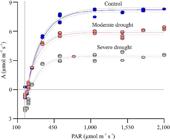
The light-saturated photosynthetic response (Amax), found under control conditions, reduced by 27% under moderate drought and 56% under severe drought (Figure 3 and Table 1). The opposite was found for dark respiration rates (Rd), light compensation point (LCP), and quantum yield at a given photosynthetic active radiation intensity (ΦPAR), which presented higher values in the leaves of cacao seedlings under severe drought (Table 1). Regarding the efficiency of carbon fixation in relation to water use efficiency (WUE), plants under control condition exhibited the highest values, followed by plants under moderate and severe drought conditions (Table 1). The same trend was observed for stomatal conductance (gs), transpiration (E), and intracellular CO2 concentration (Ci). The leaf temperature of cacao seedlings also responded to drought, with seedling leaves under severe stress exhibiting the highest LTD.
Means and standard error of the photosynthetic and functional traits of cacao plants under different drought levels of water stress(1).
The exhibited growth rate reduction in the plants subjected to drought treatments was accompanied by decreased photosynthetic capacity and increased stomatal limitations in response to limited water availability. Both photosynthetic capacity and stomatal limitations contribute to a reduction in photosynthesis rates, yet the relative impact of each factor varies significantly (Zlatev & Lidon, 2012). This study showed significantly reduced gs in drought-stressed plants, probably to cease evapotranspiration, which may inhibit carbon dioxide entry, thus decreasing the Ci and consequently limiting photosynthetic response (A); however, this data needs to be cautiously interpreted since the significant decrease of gs in stressed plants could be a passive outcome of drought stress in which stomatal closure occurs as a direct consequence of hydraulic stress, thereby inadvertently impacting the CO2 uptake and, consequently, affecting significantly A (Araque et al., 2012).
In this sense, stomatal closure seems effective in maintaining adequate WUE values, as reported WUE values are considerably higher in seedlings under severe stress than in moderate stress and control conditions. The high WUE observed under severe drought indicated a great capacity of cacao seedlings to maximize the water use for biomass production under water limitations. Since water consumption is a growing concern for farming systems worldwide, future studies on understanding how cacao can reach high WUE will benefit the development of strategies to grow this crop efficiently in a changing climate scenario.
In contrast, some works have shown that the A reduction in leaves under stress conditions was associated with increased Ci, which causes stomatal closure (Proietti et al., 2012; Regni et al., 2019). In this study, the reduced levels of Ci on leaf seedlings under reduced water availability could have been the consequence of the prolonged drought employed in the experimental design that may have led to long-term reduced gs. The role of Ci on stomatal closure under soil water restrictions is still controversial, since there are studies reporting its increase, decrease, or invariable level under drought stress (Tezara et al., 2002; Liu et al., 2012; Proietti et al., 2012), which could be due to the experimental conditions and plant species evaluated in each experiment. The prolonged reduction of gs may also have compromised the capacity of the leaves to cool, since the leaf temperature of seedlings under drought stress was significantly higher than the control ones. A prolonged stomatal closure is expected to cease evapotranspiration, leading to a rise in leaf temperature (Liu et al., 2011). This increase in leaf temperature may further exacerbate the detrimental effects of drought by enhancing the thermal stress on the photosynthetic apparatus.
Non-stomatal limitations are indicated by the significantly reduced efficiency at which light absorbed by PSII is used for photochemistry in light-adapted cacao seedlings (ΦPSII) and photochemical quenching coefficient (qL) in plants under limitations of water availability compared to the control. Lower values of photosynthetic electron transport through PSII in a photosynthetic active radiation (PAR) intensity superior to 400 µmol m−2 s−1 were also observed in cacao seedlings under drought stress compared with no-stressed plants. All results suggest that the photosynthetic apparatus responses of cacao seedlings are compromised under drought conditions.
The PSII response was assessed to understand better the physiological behavior of cacao seedlings under prolonged drought stress, monitoring the chlorophyll a (Chla) fluorescence parameters with different PAR levels (Figure 4). Plants under control treatment exhibited a maximum quantum yield (Fv/Fm) of 0.82, while plants under moderate and severe drought treatments presented values of 0.79 and 0.75, respectively. For all treatments, ETR exhibited a progressive trend as the intensity of PAR increased. Under the radiation of 1,000 µmol m−2 s−1, the ETR in leaves of cacao seedlings grown under control treatment was 20% and 45% higher than in leaves of plants grown under moderate and severe drought treatments, respectively (Figure 4 A). In contrast, ΦPSII and the qL gradually decreased as the PAR and water stress levels increased (Figure 4 B and C). Plants under severe drought exhibited the highest thermal energy dissipation; however, for all treatments, NPQ reached a stationary phase near 400 PAR (Figure 4 D).

Chla fluorescence parameters as a function of PAR in cacao leaves: electron transport rate (ETR) (A); actual PSII quantum yield (ΦPSII) (B); photochemical quenching coefficient (qL) (C); non-photochemical quenching (NPQ) (D). Each level of drought stress is depicted by one curve (continuous line) in conjunction with confidence levels (shaded). PAR = photosynthetically active radiation.
Additionally, seedlings under drought treatments presented Fv/Fm values lower than 0.8, indicating a decrease in the photosynthetic potential (Lahive et al., 2018; Hebbar et al., 2020). The abovementioned changes were accompanied by an increase in NPQ and carotenoid content and a decrease in Chla, Chlb, and chlorophyll/carotenoid (Chl/Car) caused by drought stress (Table 1). These changes may represent a strategy to protect the photosynthetic apparatus from light energy not used in photosynthesis (Araque et al., 2012; Zakariyya & Indradewa, 2019). Reduction of Chla, and Chlb contents are expected to minimize the light absorption by chloroplasts and increase carotenoid concentration to play a role in photoprotection due to its antioxidant capacity (Ghobadi et al., 2013).
Interestingly, despite lower values of Amax, drought-stressed plants exhibited the highest response curve slope at low light levels, indicating higher quantum efficiency that can be interpreted as a strategy for survival, maximizing the effectiveness of light use for carbon fixation under low PAR. This situation was also reported by Suárez Salazar et al. (2018) in cacao plants under a low level of radiation. The highest values of LCP were observed in plants subjected to drought stress, probably as a response mechanism to compensate for respiratory carbon loss due to the elevated Rd and photorespiration that are not sufficiently compensated by the fixation of CO2 in photosynthesis (Lambers et al., 2008).
The content of photosynthetic pigments and proline was determined, whose results showed that water stress had a general effect on those pigments. The leaves from cacao seedlings under moderate and severe drought stress significantly reduced the Chla and Chlb (Table 1). Compared to the control treatment, the reduction in total chlorophyll (Chlt) was 15% in moderate drought and 40% in severe drought (Table 1), and the same behavior was observed for Chlt/Carotenoids, in which plants under severe drought exhibited a ratio 76% lower than control plants (Table 1). In contrast, Chla/Chlb ratio and the content of carotenoids and proline increased proportionally to the level of drought stress (Table 1).
Additionally, a high accumulation of proline content in leaves of cacao seedlings under lower water availability was found, probably playing a role in cytoplasmic osmotic adjustment. Experiments with different plant species have shown that proline accumulation facilitated water retention in the cytoplasm, maintaining cell turgor and stabilizing membranes, thereby preventing electrolyte leakage, and its concentration is often considered an indicator of saline and drought stress (Hayat et al., 2012; Dossa et al., 2017; Zakariyya & Indradewa, 2018 ; Regni et al., 2019). The high accumulation of proline may also stabilize proteins and protein complexes, scavenging ROS and balancing intracellular redox homeostasis, contributing jointly to the survival of cacao seedlings under drought conditions (Hayat et al., 2012). Consequently, the insights and the methodological framework established in this study might be the base for future researches and breeding programs.
Conclusions
1. Cocoa seedlings subjected to prolonged drought stress demonstrate reduced photosynthetic capacity and growth, which highlightes their sensitivity to water scarcity.
2. Adaptive growth responses are evident as seedlings adjust their height and leaf production to available water, displaying their resilience to environmental stress.
3. Seedlings activate protective mechanisms, such as increased non-photochemical quenching and elevated carotenoid and proline levels, which help mitigate the effects of decreased stomatal conductance and photosynthetic pigment content under drought conditions.
References
-
ALMEIDA, J. de; HERRERA, A.; TEZARA. W. Phenotypic plasticity to photon flux density of physiological, anatomical and growth traits in a modern Criollo cocoa clone. Physiologia Plantarum, v.166, p.821-832, 2019. DOI: https://doi.org/10.1111/ppl.12840.
» https://doi.org/10.1111/ppl.12840. -
ALMEIDA, J. de; TEZARA, W.; HERRERA, A. Physiological responses to drought and experimental water deficit and waterlogging of four clones of cacao (Theobroma cacao L.) selected for cultivation in Venezuela. Agricultural Water Management, v. 171, p.80-88, 2016. DOI: https://doi.org/10.1016/j.agwat.2016.03.012.
» https://doi.org/10.1016/j.agwat.2016.03.012. -
ARAQUE, O.; JAIMEZ, R.E.; TEZARA, W.; CORONEL, I.; URICH, R.; ESPINOZA, W. Comparative photosynthesis, water relations, growth and survival rates in juvenile criollo cacao cultivars (Theobroma cacao) during dry and wet seasons. Experimental Agriculture, v.48, p.513-522, 2012. DOI: https://doi.org/10.1017/S0014479712000427.
» https://doi.org/10.1017/S0014479712000427. -
BATES, L.S.; WALDREN, R.P.; TEARE, I.D. Rapid determination of free proline for water-stress studies. Plant and Soil, v.39, p.205-207, 1973. DOI: https://doi.org/10.1007/BF00018060.
» https://doi.org/10.1007/BF00018060. -
BAUERLE, W.L.; WANG, G.G.; BOWDEN, J.D.; HONG, C.M. An analysis of ecophysiological responses to drought in American Chestnut. Annals of Forest Science, v.63, p.833-842, 2006. DOI: https://doi.org/10.1051/forest2006066.
» https://doi.org/10.1051/forest2006066. -
BROOKS, M.D.; NIYOGI, K.K. Use of a pulse-amplitude modulated chlorophyll fluorometer to study the efficiency of photosynthesis in Arabidopsis plants. In: JARVIS, R. (Ed.). Chloroplast Research in Arabidopsis. New York: Springer, 2011. v.2, p.299-310. (Methods in Molecular Biology, 775). DOI: https://doi.org/10.1007/978-1-61779-237-3_16.
» https://doi.org/10.1007/978-1-61779-237-3_16. -
CHAVES, M.M.; PEREIRA, J.S.; MAROCO, J.; RODRIGUES, M.L.; RICARDO, C.P.P.; OSÓRIO, M.L.; CARVALHO, I.; FARIA, T.; PINHEIRO, C. How plants cope with water stress in the field. Photosynthesis and growth. Annals of Botany, v.89, p.907-916, 2002. DOI: https://doi.org/10.1093/aob/mcf105.
» https://doi.org/10.1093/aob/mcf105. -
DOSSA, K.; LI, D.; WANG, L.; ZHENG, X.; LIU, A.; YU, J.; WEI, X.; ZHOU, R.; FONCEKA, D.; DIOUF, D.; LIAO, B.; CISSÉ, N.; ZHANG, X. Transcriptomic, biochemical and physio-anatomical investigations shed more light on responses to drought stress in two contrasting sesame genotypes. Scientific Reports, v.7, art.8755, 2017. DOI: https://doi.org/10.1038/s41598-017-09397-6.
» https://doi.org/10.1038/s41598-017-09397-6. -
FALQUETO, A.R.; SILVA JÚNIOR, R.A. da; GOMES, M.T.G.; MARTINS, J.P.R.; SILVA, D.M.; PARTELLI, F.L. Effects of drought stress on chlorophyll a fluorescence in two rubber tree clones. Scientia Horticulturae, v.224, p.238-243, 2017. DOI: https://doi.org/10.1016/j.scienta.2017.06.019.
» https://doi.org/10.1016/j.scienta.2017.06.019. -
FARRELL, A.D.; RHINEY, K.; EITZINGER, A.; UMAHARAN, P. Climate adaptation in a minor crop species: is the cocoa breeding network prepared for climate change? Agroecology and Sustainable Food Systems, v.42, p.812-833, 2018. DOI: https://doi.org/10.1080/21683565.2018.1448924.
» https://doi.org/10.1080/21683565.2018.1448924. -
GHOBADI, M.; TAHERABADI, S.; GHOBADI, M.-E.; MOHAMMADI, G.-R.; JALALI-HONARMAND, S. Antioxidant capacity, photosynthetic characteristics and water relations of sunflower (Helianthus annuus L.) cultivars in response to drought stress. Industrial Crops and Products, v.50, p.29-38, 2013. DOI: https://doi.org/10.1016/j.indcrop.2013.07.009.
» https://doi.org/10.1016/j.indcrop.2013.07.009. -
HAYAT, S.; HAYAT, Q.; ALYEMENI, M.N.; WANI, A.S.; PICHTEL, J.; AHMAD, A. Role of proline under changing environments: a review. Plant Signaling and Behavior, v.7, p.1456-1466, 2012. DOI: https://doi.org/10.4161/psb.21949.
» https://doi.org/10.4161/psb.21949. -
HEBBAR, K.B.; APSHARA, E.; CHANDRAN, K.P.; VARA PRASAD, P.V. Effect of elevated CO2, high temperature, and water deficit on growth, photosynthesis, and whole plant water use efficiency of cocoa (Theobroma cacao L.). International Journal of Biometeorology, v.64, p.47-57, 2020. DOI: https://doi.org/10.1007/s00484-019-01792-0.
» https://doi.org/10.1007/s00484-019-01792-0. - ICCO. International Cocoa Organization. ICCO quarterly bulletin of cocoa statistics. Cocoa Producing and Cocoa Consuming Countries. Côte d’Ivoire, 2020.
-
JALEEL, C.A.; MANIVANNAN, P.; WAHID, A.; FAROOQ, M.; AL-JUBURI, H.J.; SOMASUNDARAM, R.; PANNEERSELVAM, R. Drought stress in plants: a review on morphological characteristics and pigments composition. International Journal of Agriculture and Biology, v.11, p.100-105, 2009. Available at: <https://www.academia.edu/download/47417656/Drought_Stress_in_Plants_A_Review_on_Mor20160721-5525-1po9ul1.pdf>. Accessed on: Dec. 16 2020.
» https://www.academia.edu/download/47417656/Drought_Stress_in_Plants_A_Review_on_Mor20160721-5525-1po9ul1.pdf -
LAHIVE, F.; HADLEY, P.; DAYMOND, A.J. The impact of elevated CO2 and water deficit stress on growth and photosynthesis of juvenile cacao (Theobroma cacao L.). Photosynthetica, v.56, p.911-920, 2018. DOI: https://doi.org/10.1007/s11099-017-0743-y.
» https://doi.org/10.1007/s11099-017-0743-y. -
LAMBERS, H.; CHAPIN III, F.S.; PONS, T.L. Respiration. In: LAMBERS, H.; CHAPIN III, F.S.; PONS, T.L. Plant physiological ecology. 2nd ed. New York: Springer, 2008. p.101-150. DOI: https://doi.org/10.1007/978-0-387-78341-3_3.
» https://doi.org/10.1007/978-0-387-78341-3_3. -
LICHTENTHALER, H.K. Chlorophylls and carotenoids: pigments of photosynthetic membranes. Methods in Enzymology, v.148, p.350-382, 1987. DOI: https://doi.org/10.1016/0076-6879(87)48036-1.
» https://doi.org/10.1016/0076-6879(87)48036-1. -
LIU, C.; DU, T.; LI, F.; KANG, S.; LI, S.; TONG, L. Trunk sap flow characteristics during two growth stages of apple tree and its relationships with affecting factors in an arid region of northwest China. Agricultural Water Management, v.104, p.193-202, 2012. DOI: https://doi.org/10.1016/j.agwat.2011.12.014.
» https://doi.org/10.1016/j.agwat.2011.12.014. -
LIU, Y.; SUBHASH, C.; YAN, J.; SONG, C.; ZHAO, J.; LI, J. Maize leaf temperature responses to drought: Thermal imaging and quantitative trait loci (QTL) mapping. Environmental and Experimental Botany, v.71, p.158-165, 2011. DOI: https://doi.org/10.1016/j.envexpbot.2010.11.010.
» https://doi.org/10.1016/j.envexpbot.2010.11.010. -
LOBO, F. de A.; BARROS, M.P. de; DALMAGRO, H.J.; DALMOLIN, Â.C.; PEREIRA, W.E.; SOUZA, É.C. de; VOURLITIS, G.L.; RODRÍGUEZ ORTÍZ, C.E. Fitting net photosynthetic light-response curves with Microsoft Excel - a critical look at the models. Photosynthetica, v.51, p.445-456, 2013. DOI: https://doi.org/10.1007/s11099-013-0045-y.
» https://doi.org/10.1007/s11099-013-0045-y. -
MOTAMAYOR, J.C.; LACHENAUD, P.; MOTA, J.W. da S. e; LOOR, R.; KUHN, D.N.; BROWN, J.S.; SCHNELL, R.J. Geographic and genetic population differentiation of the Amazonian chocolate tree (Theobroma cacao L). PLoS ONE, v.3, e3311, 2008. DOI: https://doi.org/10.1371/journal.pone.0003311.
» https://doi.org/10.1371/journal.pone.0003311. -
PROIETTI, P.; NASINI, L.; ILARIONI, L. Photosynthetic behavior of Spanish Arbequina and Italian Maurino olive (Olea europaea L.) cultivars under super-intensive grove conditions. Photosynthetica, v.50, p.239-246, 2012. DOI: https://doi.org/10.1007/s11099-012-0025-7.
» https://doi.org/10.1007/s11099-012-0025-7. - R CORE TEAM. Version 4.2.0 (2022-04-22): “Vigorous Calisthenics”. Vienna: R Foundation for Statistical Computing, 2023. Platform: x86_64-apple-darwin17.0 (64-bit).
-
REGNI, L.; DEL PINO, A.M.; MOUSAVI, S.; PALMERINI, C.A.; BALDONI, L.; MARIOTTI, R.; MAIRECH, H.; GARDI, T.; D’AMATO, R.; PROIETTI, P. Behavior of four olive cultivars during salt stress. Frontiers in Plant Science, v.10, art.867, 2019. DOI: https://doi.org/10.3389/fpls.2019.00867.
» https://doi.org/10.3389/fpls.2019.00867. -
SADEGHI, F.; SAMSAMPOUR, D.; ASKARI SEYAHOOEI, M.; BAGHERI, A.; SOLTANI, J. Fungal endophytes alleviate drought-induced oxidative stress in mandarin (Citrus reticulata L.): Toward regulating the ascorbate-glutathione cycle. Scientia Horticulturae, v.261, art.108991, 2020. DOI: https://doi.org/10.1016/j.scienta.2019.108991.
» https://doi.org/10.1016/j.scienta.2019.108991. -
SANTOS, E.A. dos; ALMEIDA, A.-A. F. de; AHNERT, D.; BRANCO, M.C. da S.; VALLE, R.R.; BALIGAR, V.C. Diallel analysis and growth parameters as selection tools for drought tolerance in young Theobroma cacao plants. PLoS ONE, v.11, e0160647, 2016. DOI: https://doi.org/10.1371/journal.pone.0160647.
» https://doi.org/10.1371/journal.pone.0160647. -
SUÁREZ SALAZAR, J.C.; MELGAREJO, L.M.; CASANOVES, F.; Di RIENZO, J.A.; DAMATTA, F.M.; ARMAS, C. Photosynthesis limitations in cacao leaves under different agroforestry systems in the Colombian Amazon. PLoS ONE, v.13, e0206149, 2018. DOI: https://doi.org/10.1371/journal.pone.0206149.
» https://doi.org/10.1371/journal.pone.0206149. -
SUÁREZ, J.C.; GELPUD, C.; NORIEGA, J.E.; ORTIZ-MOREA, F.A. How do different cocoa genotypes deal with increased radiation? An analysis of water relation, diffusive and biochemical components at the leaf level. Agronomy, v.11, art.1422, 2021. DOI: https://doi.org/10.3390/agronomy11071422.
» https://doi.org/10.3390/agronomy11071422. -
TEZARA, W.; MITCHELL, V.; DRISCOLL, S.P.; LAWLOR, D.W. Effects of water deficit and its interaction with CO2 supply on the biochemistry and physiology of photosynthesis in sunflower. Journal of Experimental Botany, v.53, p.1781-1791, 2002. DOI: https://doi.org/10.1093/jxb/erf021.
» https://doi.org/10.1093/jxb/erf021. -
TEZARA, W.; PEREYRA, G.; ÁVILA-LOVERA, E.; HERRERA, A. Variability in physiological responses of Venezuelan cacao to drought. Experimental Agriculture, v. 56, p.407-421, 2020. DOI: https://doi.org/10.1017/S0014479720000058.
» https://doi.org/10.1017/S0014479720000058. -
ZAKARIYYA, F.; INDRADEWA, D. Drought Stress Affecting Growth and Some Physiological Characters of Three Cocoa Clones at Seedling Phase. Pelita Perkebunan, v.34, p.156-165, 2018. DOI: https://doi.org/10.22302/iccri.jur.pelitaperkebunan.v34i3.330.
» https://doi.org/10.22302/iccri.jur.pelitaperkebunan.v34i3.330. -
ZLATEV, Z.; LIDON, F.C. An overview on drought induced changes in plant growth, water relations and photosynthesis. Emirates Journal of Food and Agriculture, v.24, p.57-72, 2012. DOI: https://doi.org/10.9755/ejfa.v24i1.10599.
» https://doi.org/10.9755/ejfa.v24i1.10599.


