 Macaúba palm as a promising resource for biodiversity-based bioeconomy and climate solutions in the tropics
Abstract
The global transition to a low-carbon economy requires scalable and inclusive solutions rooted in tropical biodiversity. In this context, macaúba palm (Acrocomia aculeata), a native palm species widely distributed across America, stands out as a promising biomass crop for renewable bioenergy production, bioproduct development, and climate change mitigation. The objective of this review was to examine the current state of research and innovation on the macaúba palm and to explore its potential as a model species for a biodiversity-based bioeconomy and climate solutions in the tropics. For this, the current state of knowledge on its ecological distribution, genetic diversity, domestication status, agronomic traits, and breeding strategies were synthesized. Advances in biomass valorization were also discussed, including pulp and kernel oil, protein-rich cakes, and co-products for bioenergy, biochar, and novel materials. Special attention was given to sustainability assessments (carbon balance and life-cycle analysis) and to the role of macaúba palm in integrated production systems and socioeconomic inclusion, particularly of smallholders. The review identifies major challenges for scaling-up the crop, including gaps in reproductive biology, lack of genotype-environment interaction data, and the need for public policies and decentralized value chains. Macaúba palm emerges as a strategic resource to promote regenerative land use, carbon sequestration, and circular bioeconomy models in tropical regions. Advancing its development requires integrated efforts in research, innovation, and governance.
Index terms:
Acrocomia aculeata, decarbonization; native palm tree; renewable energy; tropical sustainability; vegetable oil.
Resumo
A transição global para uma economia de baixo carbono exige soluções escaláveis e inclusivas, ancoradas na biodiversidade tropical. Nesse contexto, a macaúba (Acrocomia aculeata), palmeira nativa amplamente distribuída na América, destaca-se como cultura promissora para produção de bioenergia renovável, desenvolvimento de bioprodutos e mitigação de mudanças climáticas. O objetivo desta revisão foi examinar o estado atual da pesquisa e da inovação sobre a palmeira macaúba e explorar seu potencial como espécie-modelo para uma bioeconomia baseada em biodiversidade e soluções climáticas nos trópicos. Para tanto, foram sintetizados o conhecimento atual sobre sua distribuição ecológica, diversidade genética, estado de domesticação, características agronômicas e estratégias de melhoramento. Discutiram-se avanços quanto à valorização da biomassa, que incluem óleos de polpa e amêndoa, tortas proteicas e coprodutos para bioenergia, biochar e novos materiais. Houve destaque para avaliações de sustentabilidade (balanço de carbono e análise do ciclo de vida) e o papel da macaúba em sistemas integrados de produção e inclusão socioprodutiva, com ênfase em agricultores familiares. A revisão identifica os principais desafios para o escalonamento da cultura, como lacunas na biologia reprodutiva, escassez de dados sobre interação genótipo-ambiente e a necessidade de políticas públicas e cadeias de valor descentralizadas. A macaúba desponta como recurso estratégico para promover o uso regenerativo do solo, o sequestro de CO2 e modelos de bioeconomia circular nos trópicos. Seu avanço depende de esforços integrados em pesquisa, inovação e governança.
Termos para indexação:
Acrocomia aculeata; descarbonização; palmeira nativa; energia renovável; sustentabilidade tropical; óleo vegetal.
Introduction
Climate change poses an unprecedented threat to the stability of natural and human systems (IPCC, 2022). The intensification of extreme weather events, ocean acidification, and biodiversity loss are direct consequences of the rising of atmospheric greenhouse gases concentrations, particularly CO2 emissions derived from fossil fuel (Rockström et al., 2009). In this context, decarbonizing the economy emerges as a central strategy to limit global warming to 1.5°C, in accordance with the Paris Agreement (Sachs et al., 2019).
The energy transition - characterized by the replacement of fossil energy sources with renewable energies and improvements in energy efficiency - is recognized as a key vector for mitigation. The pace of this transition may be accelerated by various interrelated factors, including technological advancements, socioeconomic drivers, institutional support, and different financing mechanisms (Asmelash et al., 2020).
Simultaneously, nature-based solutions such as ecosystem restoration and regenerative agricultural practices contribute significantly to atmospheric carbon removal (Griscom et al., 2017). The economic transformation required for effective decarbonization demands substantial investments in innovation, strong public policies, and robust international cooperation (Sachs et al., 2019). Thus, decarbonization not only addresses the climate emergency, but also offers an opportunity to promote more inclusive and resilient development models (Raworth, 2018), which are essential for safeguarding the well-being of future generations.
Biofuels currently represent one of the most impactful strategies to address carbon emissions resulting from fossil fuel usage. In fact, aviation companies have committed to consume approximately 450 billions of liters of vegetable oil to achieve net-zero CO2 emissions in the sector (IATA, 2021). However, according to a report commissioned by the Rainforest Foundation Norway, achieving these targets may significantly increase the demand for palm and soybean oils, potentially leading to the deforestation of about 3.2 million hectares of tropical forests (Bioenergia Internacional, 2019). Thus, achieving the desired oil volume in 2050 will require the search for more sustainable alternatives. Diversification and innovative solutions are imperative, as no currently available raw material can fully meet this anticipated demand.
Among the available alternatives to support the biofuel-driven decarbonization agenda, macaúba palm has shown considerable promise. This palm species, that is typical of Brazilian Cerrado, can be cultivated across most of the Center-West, North, and Northeast Brazilian regions, with the primary constraint being low-temperature tolerance, as outlined in its climatic zoning study (Brasil, 2024).
Macaúba palm exhibits a productive potential six times higher than soybean and comparable to that of oil palm (Brasil, 2015; Jazayeri, 2015; Evaristo et al., 2016a; Colombo et al., 2018; Abubakar & Ishak, 2022; Our World in Data, 2022). It provides two types of oil along with several co-products that are suitable for food and energy applications. When cultivated in integrated production systems, macaúba palm also contributes to ecosystem restoration and regenerative agriculture practices, enhancing atmospheric carbon removal and making a significant contribution to climate change mitigation, energy security, and socio-economic inclusion.
This review aims to synthesize current scientific and technological knowledge on macaúba palm, addressing its botanical characteristics, geographical distribution, ecological adaptability, genetic resources, production systems, biomass valorization, and sustainability metrics. It examines the species’ agronomic potential and the current state-of-the-art regarding its domestication, while also highlighting its role in promoting socioeconomic inclusion. Based on this synthesis, we identify existing knowledge gaps and propose strategic approaches to overcome the scientific and technological barriers that currently constrain macaúba palm development. These strategies aim to accelerate the domestication and sustainable utilization of the species, positioning it as a key component of biodiversity-based bioeconomies focused on decarbonizing tropical regions.
Natural distribution and ecological resilience
Arecaceae family is highly diverse in the Americas with 65 genera and 730 species (Dransfield et al., 2008). Acrocomia aculeata stands out as the most widespread palm species across tropical and subtropical regions, from Mexico (24° N) to Brazil (23° S) (Henderson et al., 1995; Lorenzi et al., 2010; GBIF, 2023) (Figure 1). As a heliophilous and hemerophilous species, its occurrence is strongly associated with open and disturbed areas, pastures, tilled land and along roads. In Brazil, it is distributed primarily in the Cerrado biome and open forests of the Atlantic forest under tropical climates, across the states of Pará, Maranhão, Ceará, Minas Gerais, Goiás, Mato Grosso and São Paulo, with possible occurrences in the states of Mato Grosso do Sul, Paraná, Tocantins, Rondônia, Roraima, Espírito Santo, and Pernambuco (Henderson et al., 1995; Lorenzi et al., 2010; Borges et al., 2021; GBIF, 2023). However, occurrence in Tropical and Subtropical Forests, as well as in the Caatinga, in both highland areas and at sea level.

Distribution of macaúba palm (Acrocomia aculeata). Blue points represent occurrence records obtained from the Global Biodiversity Information Facility (GBIF, 2023) database. Colored areas correspond to the distribution limits of Acrocomia aculeata and oil palm (Elaeis guineensis) for cultivation.
According to Motoike et al. (2013), its natural occurrence in certain Brazilian regions is associated with eutrophic soils (high fertility), with 5.5 average pH, and medium to clayey textures. Bhering et al. (2010) identified the presence of A. aculeata in the states of Goiás and Minas Gerais, typically in Latosols under semi-humid climatic conditions, often near drainage networks. Motta et al. (2002) reported that its natural distribution is restricted to elevations between 150 and 1000 meters, with temperatures from 15 to 35 °C, and annual precipitation between 1000 and 1900 mm. Soil chemical fertility, particle size distribution, drainage capacity, and atmospheric climate are the main abiotic factors influencing the environmental stratification of A. aculeata (Coelho et al., 2019).
Acrocomia species originated approximately 18 million years ago (Eiserhardt et al., 2011) and have since undergone several climatic changes, which may have driven the evolution of its water-deficit response mechanisms, such as efficient stomatal regulation, increased water-use efficiency, and rapid recovery after rehydration (Mota & Cano, 2016). In addition, macaúba palm exhibit resilience to fire and photosynthetic adaptations to varying light conditions (Dias et al., 2018). These traits confer adaptability to dry environments and promote phenotypic plasticity, making macaúba palm suitable for cultivation under a wide range of environmental conditions. According to a study of climatic zoning for the species, the main limitation for the crop would be its intolerance to low temperatures (Brasil, 2024).
With global warming, the natural occurrence of macaúba palm within tropical climates with a dry season, which predominates in savannas, will expand the potential cultivation area in the Americas. However, suitable regions for macaúba palm cultivation are also found in Africa, Asia, and Australia (Borges et al., 2021; Duque et al., 2025). Between 2051 and 2075, predictions include Europe within the potential suitable zones for macaúba palm cultivation (Borges et al., 2021). Nevertheless, the introduction of macaúba palm beyond its native neotropical range demands careful attention to legal frameworks and national biodiversity regulations, as well as consideration of social and ecological challenges, such as land tenure conflicts, cold temperature tolerance, and ecological constraints that may limit plantation feasibility. The potential areas for cultivation will increase mainly in savanna climates, by 2020 and 2050 decades, however, they will decrease by 2080, when 59% of the potential cultivation area in present conditions will be lost (Plath et al., 2016). Thus, macaúba palm adaptability and resilience will be paramount for successful cultivation within these new environments.
Genetic diversity and reproductive biology
Understanding the genetic diversity within species is essential for their efficient economic utilization, particularly in emerging crops such as macaúba palm. As a key component of biodiversity, genetic diversity underpins species adaptation and survival. In the current context of climate change, the knowledge about genetic variability is crucial not only to guide the selection and development of genotypes with specific agronomic traits, to meet the demands of different markets, but also to ensure the adaptation of the species and persistence under changing environmental conditions.
In macaúba palm, various molecular markers have been employed to investigate its genetic diversity and population genetic structure in natural populations and germplasm banks (Nucci et al., 2008; Abreu et al., 2012; Lanes et al., 2015; Mengistu et al., 2016; Díaz et al., 2021; Laviola et al., 2022; Morales-Marroquín et al., 2025). These studies have predominantly focused on Brazilian genotypes (Nucci et al., 2008; Abreu et al., 2012; Mengistu et al., 2016; Coelho et al., 2018; Lima et al., 2020), with relatively few efforts directed toward assessing genetic diversity in populations from other countries (Díaz et al., 2021; Navarro-Cascante et al., 2023).
Additionally, several studies have characterized the genetic variability of macaúba palm based on morphological data, particularly for traits of agronomic interest, in Brazil (Domiciano et al., 2015; Reis et al., 2019; Lustri et al., 2021) and other American countries (Díaz-Fuentes et al., 2019; Alfaro-Solís et al., 2020). Overall, these studies report high-levels of genetic diversity, whether molecular, characterized by highly expected heterozygosity, or morphological characteristics, as observed for most of the analyzed ones. At the intraspecific level, Brazil stands out as the center of greatest genetic diversity for the species, particularly in the states of Minas Gerais and São Paulo, which exhibit the highest diversity values (Lanes et al., 2015; Díaz et al., 2021; Díaz-Hernández et al., 2024). This genetic richness is higher than observed ones in other countries, such as Mexico, even considering the broad geographic distribution of macaúba palm across this country. The lower genetic diversity recorded in Mexico and Central America is likely attributable to founder effects, or to a genetic drift associated with the establishment of populations from a limited number of individuals, and the selective pressures exerted over time in these regions (Díaz et al., 2021; Navarro-Cascante et al., 2023).
The high levels of genetic diversity observed in macaúba palm are consistent with its wide geographic distribution. Several studies have documented a positive correlation between genetic diversity and environmental heterogeneity. Species with broad geographic ranges tend to exhibit strong genetic structuring across their distribution areas (Sexton et al., 2014). In Acrocomia aculeata, genetic structure analyses conducted by Díaz et al. (2021) identified, for the first time, two distinct continental-scale genetic pools- northern and southern ones-, separated by the Amazon Rainforest. This genetic differentiation is likely the result of a combination of distinct natural and anthropogenic selective pressures operating across the species’ range.
In general, breeding programs prioritize the selection of desirable agronomic traits, while often reducing overall phenotypic variability. However, sustained directional selection can inadvertently erode the genetic diversity, including both adaptive and neutral alleles, thereby increasing the species vulnerability to biotic and abiotic stresses. A comprehensive understanding of the impacts of artificial selection on genetic diversity is, therefore, critical to safeguarding the long-term resilience of A. aculeata, particularly in the face of climate change and escalating environmental extremes. Conserving genetic diversity is, thus, a fundamental strategy not only to support the development of novel traits linked to enhanced economic productivity, but also to ensure sustained resilience to diverse environmental challenges.
To date, the only study assessing the impacts of artificial selection on the macaúba palm genetic diversity was conducted by Díaz-Hernández et al. (2024); they report no immediate risk of genetic vulnerability, despite the high early-phase selection intensities. However, a deeper understanding of diversity dynamics during the breeding process remains essential. For instance, inbreeding depression has not been fully elucidated. The few available studies are inconclusive, as they did not directly link inbreeding rates to deleterious traits. Lanes et al. (2016) observed a higher heterozygosity in adult plants compared with juveniles, suggesting that inbreeding may increase homozygosity and reduce competitiveness. Likewise, Simiqueli et al. (2018) associated inbreeding with reduced fruit set and increased fruit abortion. Consistent with Winn et al. (2011), our field observations suggest that deleterious alleles may have been purged by natural selection or domestication, given the low frequency of individuals expressing deleterious traits in natural populations. Nonetheless, further studies are essential to fully understand genetic diversity dynamics throughout the breeding process.
The mating system constitutes a fundamental biological mechanism that shapes patterns of genetic diversity within species. In macaúba palm, the high-genetic diversity is expected due to protogyny (female anthesis occurring before male anthesis) (Scariot et al., 1995) and, consequently, high-outcrossing rates. In addition, factors such as self-incompatibility (Simiqueli et al., 2018) and multiple pollen donor participation in reproductive events contribute to maintaining high-genetic variability (Abreu et al., 2012; Lanes et al., 2016; Díaz-Hernández et al., 2024).
In the context of climate change, the high-genetic variability observed in macaúba palm, combined with its diverse adaptive responses, can serve as a buffer against ongoing environmental changes. This genetic and adaptive breadth is likely to contribute significantly to the ecological and agronomic resilience of the species.
Pollination also plays a significant role in shaping the spatial patterns of genetic diversity by influencing gene flow within and between populations (Dellinger et al., 2022). In macaúba palm, pollination is predominantly cantharophilous, with 90-95% of effective fertilization mediated by two small coleopteran species, Andranthobius spp. and Mystrops spp. (Carreño-Barrera et al., 2021). These beetles are attracted by floral semiochemicals volatilized from specialized osmophores (Maia et al., 2020), which play a key role in driving their pollination activity.
Despite the significant knowledge about A. aculeata pollinators, further research is needed to understand the geographic and temporal dynamics of pollination, across different habitats and environmental gradients. This understanding is crucial for developing optimized agricultural management strategies, to enhance and stabilize fruit productivity at an industrial scale. These research efforts have been particularly relevant for the cultivation of Elaeis guineensis (oil palm), where improved understanding of pollination ecology has significantly contributed to productivity optimization (Li et al., 2019).
Botanical and agronomic traits and challenges of domestication
The perennial palm A. aculeata shows a solitary, cylindrical stipe, ranging from 4 to 24 m in height, covered with dark spines and leaf sheath remnants. This stipe reported height, based on botanical descriptions from the literature (Henderson et al., 1995; Lorenzi et al., 2010), considers the natural variation observed across different environments and developmental stages. Its crown comprises 20 to 30 leaves, each one measuring 3 to 5 m length, characterized by spiny rachises and dark green leaflets that are pubescent on the abaxial surface. Canopy diameter varies from 6 to 10 m, allowing of planting densities of up to 460 plants per hectare, in a quincunx arrangement, which allows of better use of the planting area. The inflorescence measuring 45 to 100 cm or longer is a pendulous, yellow-cream panicle emerging from the leaf axil, facilitating harvesting. It bears from50 to 150 rachillae with a few sessile female flowers at the anterior portion, flanked by two male flowers (forming triads), and numerous sessile male flowers with six stamens clustered in the posterior portion The fruit is a globose to ovoid drupe, of 2.5 to 5.0 cm diameter, with a smooth husk that changes color as it ripens. Inside, the white-yellowish fibrous pulp surrounds a hard, bony endocarp that encloses a single, oval-conical, hard, milky white, oily seed (Jacquin Freiherr von et al., 1763; Henderson et al., 1995; Lorenzi et al., 2010).
Macaúba palm fruit pulp can contain up to 75% lipids, while its almond can contain up to 65% lipids (dry basis) (Berton et al., 2013; Ciconini et al., 2013). Oil content from the pulp shows 70% oleic acid, with (Navarro-Díaz et al., 2014), followed by palmitic and linoleic acids (Berton et al., 2013; Lescano et al., 2015). Oil from the endosperm is rich in short-chain saturated fatty acids and lauric acid (Coimbra & Jorge, 2011; Berton et al., 2013).
The initial growth of macaúba palm is slow, as its stem development is typically absent during the first three years after planting. The juvenile phase ranges from 4 to 8 years, while the productive lifespan following the onset of reproductive maturity can extend to 40 years in commercial cultivation (Colombo et al., 2018). Fruit abscise naturally about 12 to 14 months after pollination (Mazzottini-dos-Santos et al., 2015; Montoya et al., 2016; Colombo et al., 2018).
The seed exhibit both physical and chemical dormancy, which can result in prolonged germination periods lasting several years under natural conditions. However, effective protocols for dormancy breaking and seed germination have been well established (Ribeiro et al., 2011; Berton et al., 2013), ensuring that seed dormancy does not represent a constraint for large-scale seedling production. The main bottleneck for scaling plantings is the low degree of domestication of the species or the lack of commercial cultivars.
Macaúba palm is predominantly allogamous, and, as observed in most cross-pollinated tropical tree species, genetic diversity within populations is substantially higher than that observed between populations (Kageyama et al., 2003). Extensive genetic variability has been documented for nearly all agronomic traits of the species (Manfio et al., 2012; Berton et al., 2013; Domiciano et al., 2015); however, heritability estimates for polygenic traits related to fruit production remain low. Additionally, the species exhibits high levels of heterozygosity across its loci (Díaz et al., 2021; Díaz-Hernández et al., 2024). Consequently, a single individual can generate thousands of genetically distinct progenies within a single reproductive cycle. These characteristics highlight the necessity of developing genetically improved materials that combine desirable agronomic traits with enhanced uniformity, thereby facilitating more predictable and efficient cultivation systems.
Macaúba palm is primarily considered an industrial crop, and the staggered planting systems should align with the processing demands typical of such crops. Specifically, the sector requires consistent production volumes, year-round raw material supply, and the maintenance of quality standards. These factors are essential for the sustainability and efficiency of macaúba palm cultivation. Although challenges remain due to the current stage of development of the crop, these obstacles are gradually being addressed. Soon, more uniform staggered plantings, whether from seed or clonal materials, are expected to become a reality, facilitating more efficient production and meeting the sector’s operational needs.
Advances in genetic improvement and propagation technologies
The early selection of juvenile traits that exhibit strong associations with productive traits is particularly valuable for long-cycle species, such as rubber tree (Hevea brasiliensis), in which latex yield potential can be predicted within the first two years after planting (Gonçalves et al., 1984). In A. aculeata, this strategy has been explored through field evaluations of open-pollinated progenies. Coser et al. (2016) identified a positive and significant correlation between precocity and the number of floral spathes. Similarly, Lustri et al. (2021) reported positive and significant correlations between stem diameter and both leaf length and leaf number, indicating overall plant vigor. Genetic parameters for vegetative and reproductive traits in macaúba palm have been estimated by various authors. Positive genetic correlations and high-heritability values were observed for all traits related to seed germination, (Berton et al., 2013), as well as for other structural traits and rachis characteristics (Coser et al., 2016; Rosado et al., 2019; Lustri et al., 2021), indicating substantial additive genetic variation, which supports the selection of promising genotypes in breeding programs. Nevertheless, heritability estimates for key agronomic traits remain scarce, with only one study based on adult plants and fruit yield (Rosado et al., 2019), highlighting the need for further research in this area.
Molecular markers, including microsatellites and single nucleotide polymorphisms (SNPs), have been used to elucidating the genetic diversity, population structure, and mating systems of natural populations and germplasm collections of A. aculeata (Abreu et al., 2012; Lanes et al., 2015; Mengistu et al., 2016; Silva et al., 2017; Coelho et al., 2018; Lima et al., 2020; Díaz et al., 2021; Laviola et al., 2022; Navarro-Cascante et al., 2023; Díaz-Hernández et al., 2024). These insights are fundamental for informing the design of effective breeding strategies aimed at optimizing genetic gains and ensuring the sustainable use of the species’ genetic resources.
The most direct pathway for developing a commercial cultivar is through the genetic improvement of natural populations exhibiting superior agronomic performance. Despite the limited number of published studies on the agronomic potential of these populations, such as those by Alves (2022) and Rodrigues (2021), in recent years, significant progress has been made in the characterization of natural populations by public and private Brazilian institutes. The integration of these agronomic performance data with corresponding estimates of genetic parameters is expected to facilitate the identification of the most promising populations for targeted breeding and genetic improvement.
Directed crosses aimed at developing hybrid varieties, through the recombination of favorable alleles to exploit heterosis, represent a well-established and effective strategy for both annual and perennial crops (Fu et al., 2014). Nevertheless, hybrid breeding programs typically demand greater time, more resources, and technical investment than population improvement approaches (Longin et al., 2014). In the case of macaúba palm, the genetic recombination through biparental crosses involving genetically divergent individuals, as a strategy to achieve greater selection gains, results in the generation of increased genetic variability, which will require several recombination cycles to be minimized for cultivar release purposes. The outcome of this strategy is certainly more sustainable, although associated with higher costs.
The efficiency of hybrid breeding can be enhanced through genomic selection, in which marker information partially replaces phenotypic data to predict genetic values (Resende, 2024). The genomic selection can shorten the breeding cycle, reduce phenotyping costs, and improve selection accuracy (Lorenz et al., 2011; Zhao et al., 2015). Moreover, genomic selection represents a major innovation successfully adopted in recurrent selection programs for outcrossing species, characterized by high genomic heterozygosity and, in some cases, extended selection cycles (Grattapaglia, 2022). The genomic selection approach for A. aculeata, has been applied to a natural population from the state of São Paulo (Couto et al., 2024a, 2024b).
Currently, commercial macaúba palm plantations cover about 4,000 hectares, mainly in Minas Gerais, with smaller areas in Pará and São Paulo. Due to the absence of commercial cultivars, all plantations originate from seed of natural populations. Consequently, a substantial phenotypic variability has been observed in traits such as plant height, juvenile period, fruit yield, and pulp oil content.
In this context, alongside ongoing efforts to develop cultivars through population improvement and controlled hybridization, at institutions such as Instituto Agronômico (IAC) and Universidade Federal de Viçosa (UFV), tissue culture has emerged as a strategic tool for the clonal propagation of superior genotypes. Somatic embryogenesis-based cloning technology has been known for nearly 70 years and was first applied to A. aculeata by Tabai (1992). Years later, this approach was revisited, to enhance regeneration protocols using zygotic embryos (Moura et al., 2008; Ribeiro et al., 2012; Luis & Scherwinski-Pereira, 2014; Padilha et al., 2015).
However, the regeneration from zygotic embryos in an outcrossing species does not allow of the cloning of elite mother plants, which highlights the need to use sporophytic rather than gametophytic tissues. Nevertheless, as reported by (Granja et al., 2018), this approach is more complex, as factors such as genotype and explant tissue age can greatly affect the success of regeneration of A. aculeata. Despite these challenges, the regeneration from maternal tissues such as leaves and inflorescences, at early developmental stages, has been the focus of several research groups (Meira et al., 2019; Andrade et al., 2024), achieving relative success. Meira et al. (2019) addressed the differential expression of key genes involved in the callus formation from leaf tissues of macaw palm, and emphasized the expression of the SERK gene, originally identified as a marker of embryogenic competence in carrot cell cultures (Schmidt et al., 1997).
Production potential and value-added applications of macaúba palm fruit
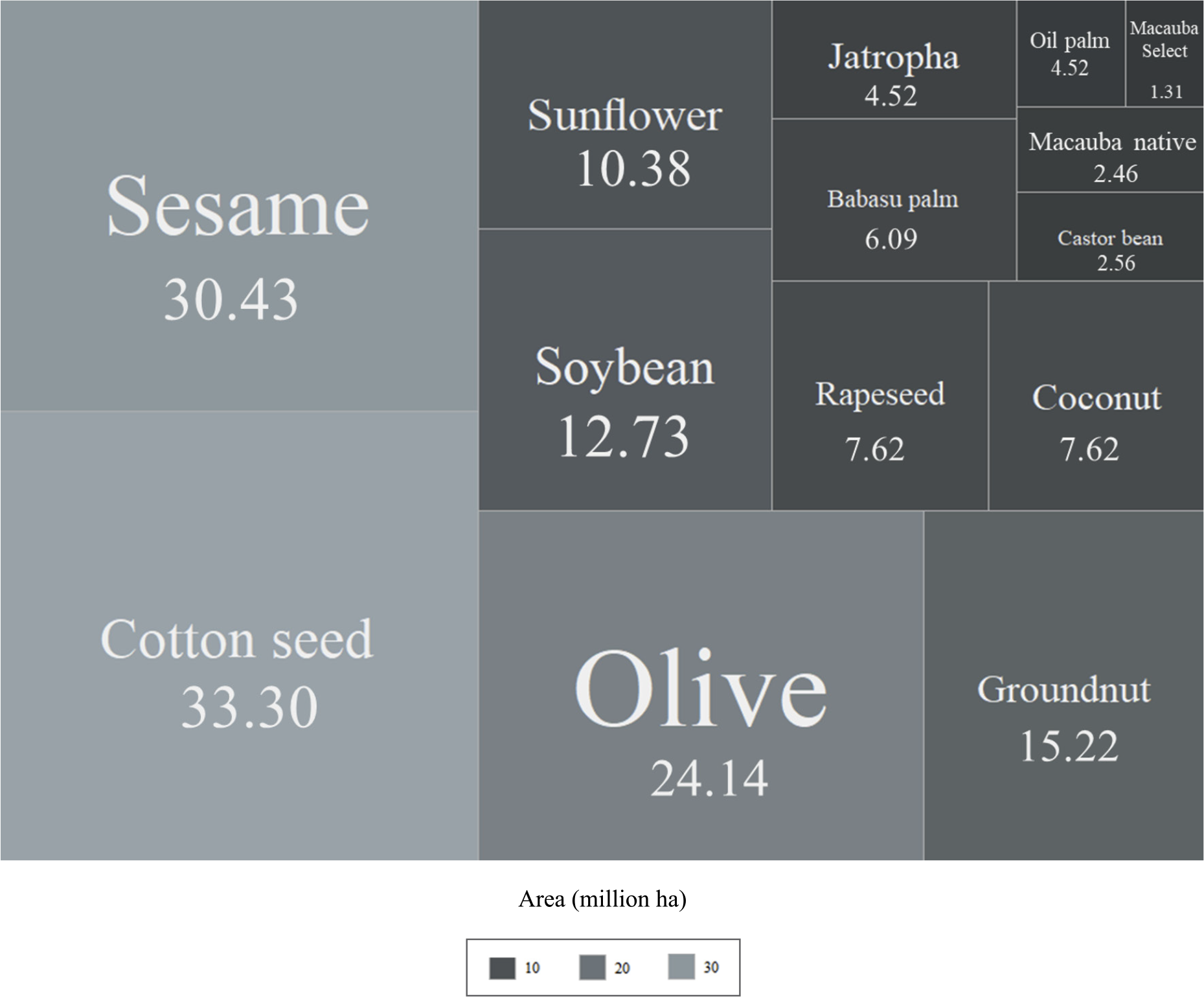
The average oil yield in native populations of A. aculeata is substantially higher than that of most conventional oilseed crops, and it is comparable to that of oil palm (Elaeis guineensis), despite the considerable variation of yield levels observed among different populations. The potential productivity could double with selection, and even surpass E. guineensis yields (Figure 2).

Comparison of the area (billion hectares) required between macaúba palm (Acrocomia aculeata) and other oilseed crops, to produce 7 billion tonnes (t ha-1) of oil per year. The values are based on the average oil production (t ha-1) of the species, obtained from the following sources: Laviola et al. (2010), Brasil (2015), Evaristo et al. (2016b), Jazayeri (2015), Colombo et al. (2018), Meijaard et al. (2020), Abubakar & Ishak (2022), Alves (2022), and Our World in Data (2022).
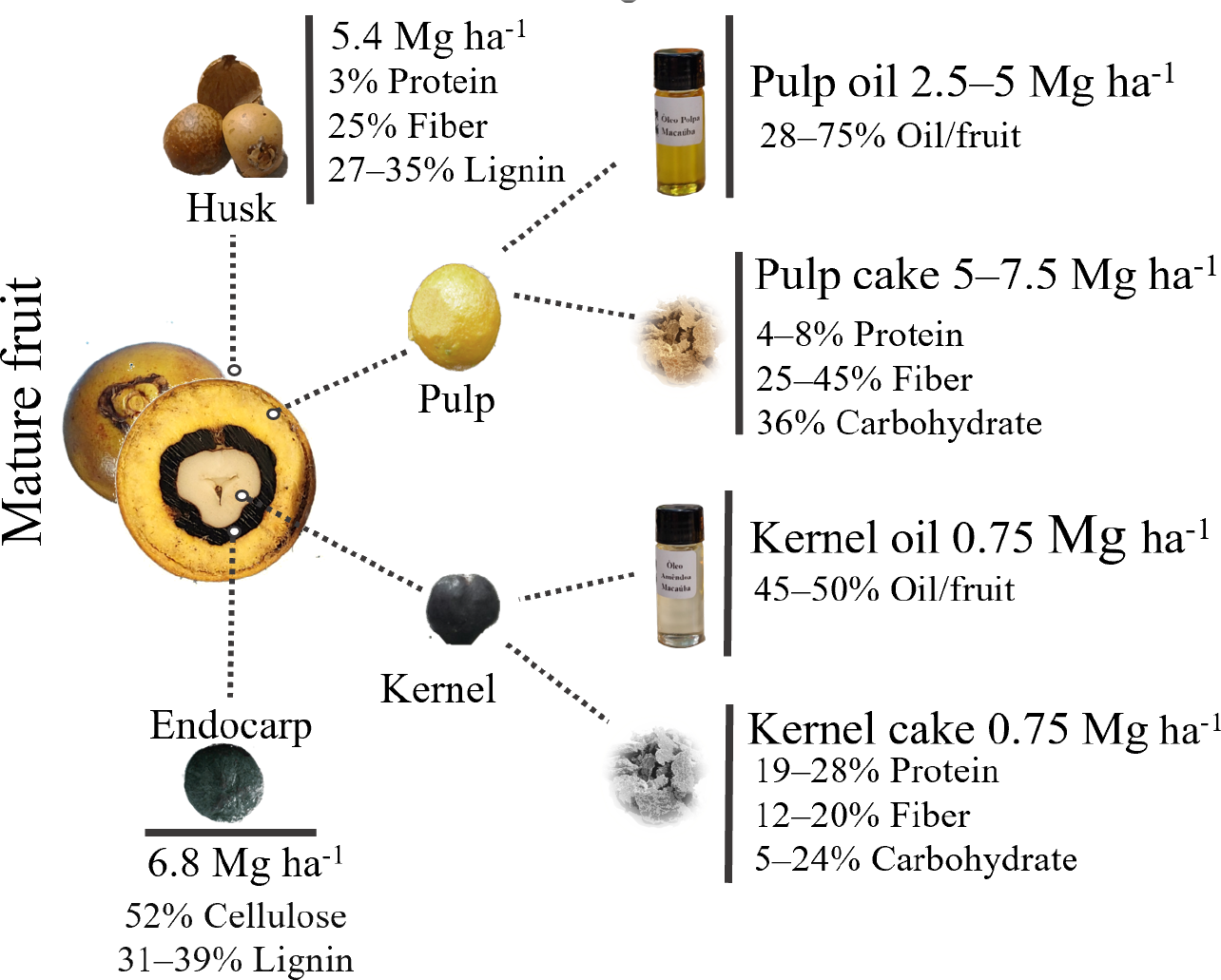
Based on the planting density of 400 plants ha 1, and on productivity from 100 randomly sampled individuals, in a native population from Minas Gerais state, the average yields were estimated at 23 Mg ha 1 of fruit, 2.9 Mg ha 1 of pulp oil (with 42% average pulp oil content), 0.5 Mg ha 1 of kernel oil, 4.0 Mg ha 1 of pulp cake, 0.3 Mg ha 1 of kernel cake, 4.0 Mg ha 1 of husk, and 3.0 Mg ha 1 of endocarp (Evaristo et al., 2016a). Yield estimates from the top 10% most productive individuals, within the same population, reached 46 Mg ha 1 of fruit, 5.7 Mg ha 1 of pulp oil, 1.0 Mg ha 1 of kernel oil, 7.9 Mg ha 1 of pulp cake, 0.6 Mg ha 1 of kernel cake, 7.9 Mg ha 1 of husk, and 6.0 Mg ha 1 of endocarp. In a different population from Minas Gerais, yield estimates based on 80 selected high-yielding individuals (56% average content of pulp oil) were 35 Mg ha 1 of fruit, 4.2 Mg ha 1 of pulp oil, 4.8 Mg ha 1 of husk, and 8.3 Mg ha 1 of endocarp. Similarly, in a population from São Paulo, yields from 110 individuals (36% average content of pulp oil) were estimated at 20 Mg ha 1 of fruit, 2.0·Mg ha 1 of pulp oil, 2.7 Mg ha 1 of husk, and 3.3 Mg ha 1 of endocarp (Alves, 2022). No official data are available on oil yields or other fruit fractions from extractivism or cultivated systems.
Approximately 80% of macaúba palm fruit biomass consists of non-oil fractions that can be valorized as co-products for value chains, energy cogeneration (Teixeira et al., 2018), or biofuel production. Its husk contributes 36% of the residual energy content, followed by the endocarp. In improved cultivation scenarios, the energy potential of macaúba palm residual biomass (44.39 TJ km-2) surpasses that of sugarcane (42.59 TJ km-2) (Evaristo et al., 2016a).
The high-energy content of macaúba palm fruit biomass enables the production of various biofuels, including biodiesel and sustainable aviation fuel (SAF). Residual biomass can be converted into bio-oil and bio-crude through pyrolysis and hydrothermal liquefaction, respectively (Mishra et al., 2022). Additionally, fruit co-products (husk, endocarp, pulp, and kernel press cakes) offer opportunities for producing biochemicals and novel materials for multiple industries (Magosso et al., 2016; Costa et al., 2019, 2020; Calvani et al., 2020; Monteiro-Alfredo et al., 2020, 2021; Manoel et al., 2022; Brito et al., 2023; Denagbe et al., 2024). Advancements in research and technology continue to broaden the range of potential applications of these co-products.
The endocarp of macaúba palm can account for 20% to 40% of the fruit total biomass (Sant’Ana et al., 2025). It is a unique structure, exhibiting hardness and toughness comparable to those of hard ceramics (Flores-Johnson et al., 2018), with promising applications in the industries of building and composite materials. Trials have shown its potential for bio-timber production, such as in particleboard panels (Menali et al., 2024), and as crushed aggregate in bio-concrete bricks, improving thermal insulation properties (Andrade et al., 2024). High-quality activated charcoal can be produced from the macaúba palm endocarp, with a surface area surpassing that of eucalyptus charcoal (Barbosa et al., 2022). The resulting biochar has shown significant effectiveness in enhancing soil fertility, and in the treatment of residue (Barbosa et al., 2024). Likewise, the inflorescence stalk is a source of nanocellulose for biopolymer manufacturing, offering a more valuable destination than industrial furnaces (Manoel et al., 2022).
Macaúba palm is a source of both medicinal and nutritional biochemicals. Its pulp oil is naturally highly oleic (up to 50% of oleic acid) with a fatty acid profile compared to that of olive oil (Aoqui, 2012). Protein and fiber concentrates can be obtained from pulp and kernel cakes, respectively, generating high-value co-products that are increasingly sought after by plant-based industries (Silva et al., 2021, 2022). As a functional food, it is rich in soluble fibers, carotenoids, tocopherols, phenolics, and other bioactive compounds, which are not only present in the fruit, but also in the leaves and spines, exhibiting antidiabetic, antioxidant, antitumor, antiparasitic, and anti-inflammatory properties (Souza et al., 2017, 2021; Costa et al., 2020; Monteiro-Alfredo et al., 2021).
Value-adding strategies are essential for a circular bioeconomy model. The macaúba palm value chain offers numerous opportunities to enhance the value of its products and co-products (Figure 3). Improving its oil quality should be a primary objective. Harvesting and postharvest processes are critical for oil quality, as are extraction methods (Evaristo et al., 2016b). Its pulp oil content increases substantially in the last month of maturation. Once mature, acidity rises rapidly, although oil content continues to increase (Montoya et al., 2016; Sá et al., 2022). Harvest and postharvest techniques for macaúba palm to optimize oil yield and quality are still to be determined. Wet enzymatic extraction yields higher-quality oil, but it has limitations in comparison with dry pressing (Favaro et al., 2022; Tilahun et al., 2022; Sorita et al., 2024). Methods to preserve the oil quality in stored fruit have been proposed, relying on inhibiting the microbial activity, since macaúba palm fruit lacks endogenous lipases like those in oil palm fruit (Cavalcanti-Oliveira et al., 2015). Autoclaving followed by drying is effective for up to 180 days. Nevertheless, the biofuel production technologies that process acidic oils, such as hydrotreated vegetable oil (HVO), fatty acid methyl esters (FAME), and supercritical, enzyme, and microwave catalyses may help overcome this issue (Pereira et al., 2016; Ershov et al., 2023).

Derived products from macaúba palm (Acrocomia aculeata) fruit fractions and their corresponding chemical properties. The values were obtained from the following sources: Coimbra & Jorge, 2011; Evaristo et al., 2016a; Queiroz & Andrade, 2016; Colombo et al., 2018; Teixeira et al., 2018; Alfaro-Solís et al., 2020; Dias et al., 2021; Alves, 2022; Menali et al., 2024; Sant’Ana et al., 2025. The yield values of the fruit fractions are based on 400 plants per hectare.
There are no health restrictions regarding fruit products and co-products. Pulp and kernel press cakes are nutritious and suitable for both human and livestock consumption. Pulp cake contains approximately 3% protein (dry basis) and 28% oil, while kernel cake contains 28% protein and 28% oil (Andrade et al., 2020). The globulin proteins in the kernel, combined with the absence of protease inhibitors commonly found in legume grains, confer high digestibility. The use of these cakes for animal feed has been successfully validated, and it represents a straightforward strategy for adding value to these co-products (Ferreira et al., 2019; Dias et al., 2021).
The diversity of applications and valorization opportunities for products and co-products can be more efficiently harnessed through small-scale value chains adapted to local conditions of raw material supply and consumer markets. In this model, biorefineries would operate in close association with local industrial and market sectors, aligning with feedstock availability and processing scale. This approach would enhance economic feasibility and promote the decentralization of macaúba palm value chains (Vargas-Carpintero et al., 2022). Although expenditures for small-scale biorefineries may be up to four times higher than those for large-scale operations, the co-products, tax incentives for family farmers, and carbon credits could sustain the small-scale production. Decentralized biorefineries would promote local cultivation and reduce land-use impact (Salvador et al., 2022). Thus, a co-product value-adding chain is essential to support small-scale production systems and promote the socioeconomic inclusion of family farmers.
Decarbonization alternative for climate change mitigation
The 2030 Agenda for Sustainable Development (United Nations, 2015) and the Paris Agreement (IPCC, 2022) represent key international frameworks for climate change mitigation, particularly through the SDG 13. In this context, the IPCC’s (2022) Sixth Assessment Report (AR6) highlights carbon dioxide removal (CDR) as a critical strategy to meet the global climate targets.
Global emissions of carbon dioxide (CO2) and other greenhouse gases have increased significantly in recent decades, reaching approximately 50 Gt CO2 equivalent per year during the 2010s (Smith et al., 2016). In response to this trend, negative emissions technologies (NETs) have gained global relevance. Afforestation and reforestation (AR) and bioenergy with carbon capture and storage (BECCS) have emerged as key strategies for climate mitigation and decarbonization, in contrast to fossil fuels (Tanzer et al., 2020; Cho et al., 2025). In Brazil, the Plan for Adaptation and Low Carbon Emissions in Agriculture (ABC+ Plan) (Brazil, 2022) aims to reduce CO2-equivalent emissions in the agricultural sector, through strategies focused on degraded pasture recovery, environmental sustainability, and economic development.
Oilseed and bioenergy crops are essential for global decarbonization efforts and the achievement of climate targets. However, oil palm and soybean, the primary sources of vegetable oil globally, have faced considerable scrutiny, due to their environmental impacts, particularly the deforestation linked to agricultural expansion in Southeast Asia and South America (Goldman et al., 2020). In this context, A. aculeata emerges as a promising biomass resource, with potential for integration into international carbon markets and decarbonization initiatives across tropical and subtropical regions. As a perennial species, macaúba palm sequesters a significant portion of photosynthetically fixed carbon in its structural biomass over a cultivation period of about 40 years. In addition, the species is well adapted to drier environments, thereby reducing pressure on tropical rainforests, in comparison with other oil crops such as oil palm. Furthermore, it can be cultivated on degraded pasturelands, creating a win-win scenario for both production and ecosystem restoration.
Brazilian biodiesel policy established in 2005, by the National Biodiesel Production And Use Program (Programa Nacional de Produção e Uso de Biodiesel - PNPB) aims to partially replace fossil fuels with renewable sources, while advancing environmental sustainability, social inclusion, and regional development. The use of renewable feedstock has been crucial to meeting mandatory blending targets. In 2023, the biodiesel consumption reached about 7 billion liters, according to the Association of Biodiesel Producers of Brazil (Associação de Produção de Biodiesel do Brasil - APROBIO).
Expanding the diversity of feedstocks remains a key challenge to optimize production logistics and improve the efficiency and sustainability of the supply chain, especially given the land requirements for large-scale production (Souza et al., 2018). In this context, oil yield per hectare is a critical factor, for which A. aculeata shows a significant advantage over other crops (Figure 2).
Although carbon sequestration in macaúba palm remains underquantified, some studies have highlighted the significant potential of the species for carbon accumulation in both its natural habitats and cultivated systems. Toledo (2010) estimated a carbon stock of 33.85 Mg C ha 1 in a natural regeneration area with macaúba palm presence, corresponding to 12.41 Mg CO2 eq ha 1. Similarly, Ferreira et al. (2013) assessed natural populations and reported a carbon accumulation of 19.51 Mg C ha 1, considering 89 plants ha-1 as average density. In cultivated systems, carbon sequestration values tend to be higher. Moreira et al. (2020) evaluated a monoculture system with the density of 400 palms ha-1, estimating a total accumulation of 61.6 Mg C ha 1, equivalent to 226.17 Mg CO2 eq ha 1, in nine-year-old plants, considering both aboveground and belowground biomass. The authors also observed a progressive increase in aboveground biomass carbon accumulation over the plant development cycle.
Projections by Moreira et al. (2025), using allometric equations developed for macaúba palm, indicate that over a 30-year cycle, carbon accumulation could reach approximately 415.84 kg per plant. With a planting density of 400 plants ha-1, this corresponds to an estimated stock of 166.34 Mg C ha 1 at the end of the production cycle.
Compared to other perennial energy crops, macaúba palm exhibits a notably higher aboveground carbon storage. Jatropha curcas accumulates between 4.18 and 6.89 Mg C ha 1 in early-stage plantations (Toledo, 2010; Torres et al., 2011), while Pongamia pinnata stores 15-25 Mg C ha 1 (Degani et al., 2022). African oil palm shows similar values to those of macaúba palm, ranging from 37.8 to 42.1 Mg C ha 1 (Khasanah et al., 2015). These comparisons highlight the superior potential carbon sequestration of macaúba palm, among tropical oilseed species.
Soil organic carbon (SOC) stocks vary considerably across land-use systems involving macaúba palm. In natural areas, SOC up to 30 cm soil depth averages 89.6 Mg ha 1, with higher levels near macaúba palm plants (Diniz et al., 2014). Monoculture systems show lower stocks, about 53.9 Mg ha 1 at 60 cm soil depth (Leite et al., 2013). Recent findings by Moreira et al. (2024) indicate significantly elevated soil organic carbon (SOC) stocks, with average values of 192.9 Mg ha 1. In integrated macaúba palm-pasture systems, SOC stocks reached 65.3 Mg ha 1, exceeding those in pasture-only areas (48.8 Mg ha 1). In silvopastoral contexts, it enhances pasture quality, regulates microclimate, and increases cattle welfare (Cardoso et al., 2017), with carbon fixation 1.6 times higher than that in conventional pastures (Montoya et al., 2021).
Macaúba palm cultivation offers environmental benefits through carbon sequestration, but further evaluation is necessary to assess its potential as a bioenergy and decarbonization crop, as strategies allow quantifying their environmental impacts, throughout their entire life cycle. Current estimates indicate that the total energy demand throughout the life cycle of monoculture macaúba palm production is 1,810.21 MJ Mg-1 of fruit. The agricultural phase accounts for the largest share of energy consumption, particularly during planting (33.61 MJ) and chemical fertilization (508 MJ). In contrast, the maintenance and harvesting phases exhibit significantly lower energy requirements (Fernández-Coppel et al., 2018).
Greenhouse gas (GHG) emissions associated with macaúba palm cultivation have been estimated at 147.38 kg CO2-eq and 140.04 kg CO2-eq per megagram of fruit over 20- and 100-year time horizons, respectively. Notably, fertilizer application accounts for about 92% of the total emissions within these estimates (Fernández-Coppel et al., 2018). Furthermore, Barbosa-Evaristo et al. (2018) also reported a positive carbon balance over 30 years of cultivation, with accumulated emissions of 180 Mg CO2-eq ha 1 and carbon sequestration ranging between 796 and 1137 Mg CO2-eq ha 1.
Despite the limitations in direct comparisons with other bioenergy crops, primarily due to life-cycle assessment (LCA) system boundaries, macaúba palm shows a climatic performance like that of African oil palm. Fernández-Coppel et al. (2018) estimated that, based on the production yield of 200 L biodiesel Mg-1 of macaúba palm fruit, the associated greenhouse gas emissions would amount to 23.34 g CO2-eq MJ 1, which is comparable to the average of 25 g CO2-eq MJ-1 reported for oil palm by Shonnard et al. (2015).
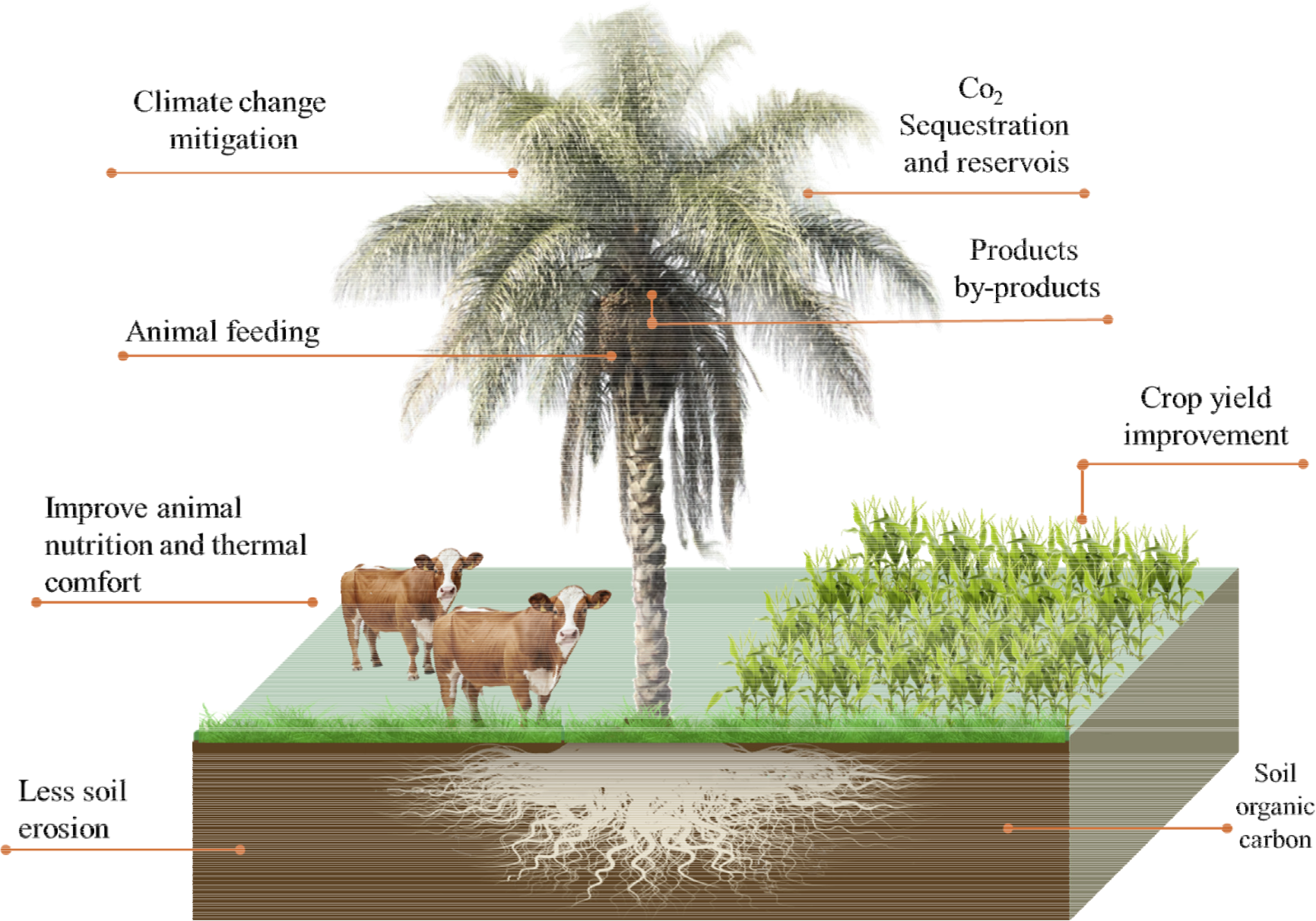
Research on macaúba palm for carbon sequestration and LCA remains limited, but existing studies highlight its potential as a sustainable option for climate change mitigation, particularly in low-carbon bioenergy agro-industrial systems. Most studies focus on monoculture and crop-livestock systems; however, further research is necessary on more diverse land-use arrangements, such as livestock-forest (LF) and crop-livestock-forest integration (CLFI). Expanding studies on various edaphoclimatic conditions are essential to refine current estimates. Additionally, optimizing macaúba palm biomass and co-product utilization can reduce environmental impacts and enhance energy efficiency, fostering a low-carbon economy (Figure 4).

Diagrammatic representation of the main components of the macaúba palm (Acrocomia aculeata) production system, and the associated ecosystem services that contribute to the decarbonization of tropical regions. Illustration by Brenda Gabriela Díaz-Hernández.
Sustainable regional growth through socioeconomic inclusion
Macaúba palm is particularly well suited for small-scale agricultural systems that rely on family labor, offering high-biomass yields for multiple applications and delivering a range of ecosystem services. In Brazil, smallholders are predominantly family farmers, who own 77% of all rural properties and represent 67% of the rural labor force, although they occupy only 23% of the total agricultural area. The average size of these properties is about 20 hectares. Out of the 480 smallholder farms involved in agroextractivism, 340 are classified as family farms. According to the 2017 Brazilian agricultural census on macaúba palm extractivism, total production reached 133 Mg, out of which 104 Mg originated from family farmers (IBGE, 2022). In northern Minas Gerais state, 400 families gather approximately 450 Mg of macaúba palm fruit annually (Cooper-Riachão, 2025). In this state, the “Pro-macaúba palm” law, enacted in 2011, encourages extractivism and collaboration between family farmers and industry.
The first governmental initiative to integrate smallholders into the biodiesel value chain was the Social Fuel Seal (SFS), launched in 2004 under the National Program for Biodiesel Production and Use (PNPB). However, smallholder participation fell short of expectations, and additional challenges limited the program’s effectiveness. Despite these shortcomings, the experience underscored the critical role of technical assistance and farmer cooperatives in facilitating smalholders inclusion (Marcossi & Moreno-Pérez, 2018). The limited success of the program was reflected in the modest participation of smallholders in the 2,000 hectares established under silvopastoral systems between 2018 and 2022 (Vargas-Carpintero et al., 2022).
Smallholder inclusion would be readily feasible if it departs from the already existing agroextractivism toward a supported transition to commercial cultivation. This transition is challenging for smallholders. The main constraints are the land size, extended time to first harvest and skepticism stemming from past negative experiences (Benatti et al., 2025). Many smallholder farmers operate under low-income conditions, and nontimber extractivism offers an important source of supplementary income. In several cases, the revenues derived from extractive activities can surpass the minimum wage levels associated with alternative rural occupations, while requiring minimal or no additional production costs (Medeiros & Silva, 2025). In contrast, cultivation requires upfront investment and changes to both infrastructure and management, which may be prohibitive without external support. The challenge is greater for owners of small properties who rely exclusively on feedstock. When integrated with pastures, an initial isolation of the crop area is necessary to prevent cattle herbivory during the early years (Benatti et al., 2025). Regardless of the inclusion strategy, strong governmental support is essential and must be closely aligned with both investors and smallholders (Millard, 2017). In Brazil, the National Program for Strengthening Family Farming (Programa Nacional de Fortalecimento da Agricultura Familiar - PRONAF), and the PNPB could foster dialogues and facilitate the inclusion of agroextractivist smallholders. However, this objective is currently absent from the government’s agenda, and exclusion continues to prevail (Benatti et al., 2025).
For successful social inclusion in the macaúba palm value chain, it is crucial to avoid the failures that hindered previous initiatives with castor oil and physic nut in Brazil’s North and Northeast. Although macaúba palm does not face the low-productivity issues of these species, its development remains vulnerable without institutional support, policy incentives, and regulatory protections. Market pressures, especially from soybean cultivation, further constrained alternative crops. Therefore, coherent agricultural policies and targeted support mechanisms are essential to enable the sustainable development and adoption of high-potential perennial crops in diversified and resilient systems (Conejero et al., 2017).
Agro-industrial systems hold substantial potential to promote social inclusion and support the transition to macaúba palm cultivation. They can act as regional hubs for technical assistance, market access, and credit facilitation, especially through partnerships with R&D institutions. Furthermore, leveraging existing public policies for smallholder land use can strengthen the macaúba palm value chain. Successful agro-industries serve as demonstrative models, encouraging wider farmer participation (Pires et al., 2023).
Successful examples of agro-industrial development with macaúba palm managed by family farmers have emerged in Brazil. Cooper-Riachão (Minas Gerais) coordinates value chains producing macaúba palm oil, soap, and pulp meal (Cooper-Riachão, 2025). In the Pantanal, the Antônio Maria Coelho Community and Cooperativa Mista dos Produtores Rurais de Poconé produce pulp flour from A. totai (Reis et al., 2012; Vianna et al., 2021). In Ceará, the Boa Esperança Association extracts oil from A. intumescens fruit. In both regions, women lead fruit collection and processing. Embrapa supports these associations with knowledge transfer and technological assistance, strengthening their production capacity (Favaro & Guiducci, 2023).
The long-standing experience with A. totai (bocaiúva) extractivism in Paraguay, where 90% of suppliers are smallholder farmers, offers valuable lessons. Historically, numerous oil industries thrived in the 1940s (Markley, 1956), but by 2016, despite harvesting 50,000 tonnes of fruit, industries operated below their capacity, due to competition from soybean and palm oil (Vargas-Carpintero, 2018). Early cultivation initiatives (1960) failed, mainly due to insufficient technical knowledge. Kernel oil remains the most valued product, as pulp oil lacks market quality (Markley, 1956; McDonald, 2007). Key challenges include harvest inefficiencies, weak stakeholder linkages, and market competition, which require domestication and governmental support to overcome (Vargas-Carpintero, 2018).
Similar challenges are being faced, or will be, by the R&D of the Acrocomia value webs. Strategies to overcome them should be oriented by a sustainable vision shared by all stakeholders involved. The multipurpose character of the plant requires collaborative multidimensional interactions among research organizations, farmers, the public and private sector, and civil society, in system approaches. The principles of “biodiversity, climate protection, social inclusiveness, carbon neutrality, and human wellbeing” are essential to avoid failure on the road to Acrocomia cultivation, which is now transiting from applied research to development conducted by science, interest from public sector, and entrepreneurs (Vargas-Carpintero et al., 2022).
Concluding Remarks
Macaúba palm emerges as a promising species for the sustainable intensification and diversification of tropical agriculture, serving as a strategic component of biodiversity-based bioeconomies aimed at decarbonizing tropical regions. However, several knowledge gaps and challenges still limit the large-scale deployment and full potential of macaúba palm as a strategic biomass crop for the tropics.
Knowledge related to the reproductive biology and genetic base of cultivated materials such as pollen flow patterns, pollinator behavior under cultivation, and inbreeding risks in commercial plantations. In parallel, most plantations use seeds from wild populations, raising concerns about founder effects and genetic bottlenecks. A better characterization of the genetic base and strategies to prevent genetic erosion are priorities.
Although macaúba palm exhibits high ecological plasticity, data on genotype performance across distinct edaphoclimatic zones remain scarce. Multi-site field trials and long-term studies are necessary to assess the species’ adaptive capacity, under changing climate conditions, and to support regional zoning and site-specific cultivar recommendations.
Breeding programs remain in their early stages and are challenged by extended juvenile periods and high levels of genetic heterozygosity. Priorities include advancing genomic selection methods, expanding the use of tissue culture techniques for clonal propagation, and accelerating cultivar development with improved yield, oil quality, and uniformity.
The land-use diversification with minimal environmental impact can be effectively achieved through intercropping, agroforestry, and agrosilvopastoral systems, representing a promising pathway for sustainable agricultural development. In this context, the development and standardization of agronomic practices for macaúba palm cultivation - particularly within integrated systems such as agroforestry and silvopastoral models - should be prioritized. Research efforts focused on best practices for planting, fertilization, pest, and disease management, pruning, and intercropping are essential to optimize both productivity and the delivery of ecosystem services.
The valorization of macaúba palm co products - including biochemicals, ingredients, biochar, and materials - offers opportunities for innovation, but it remains underexplored. Research and development efforts should prioritize applications with higher-added value and compatibility with circular economy principles.
Simultaneously, advancing the knowledge on harvesting, post-harvest handling, and oil quality preservation is critical to support the scalable expansion of the crop and, particularly, under decentralized value chain models. Strategies to prevent acidity buildup and microbial contamination during the post-harvest stages are still under development.
Although initial studies show favorable carbon balance and energy efficiency, a broader assessment of macaúba palm’s environmental impacts - including soil, water, biodiversity, and social dimensions - is needed. The development of robust, region-specific life-cycle assessments (LCAs) is critical to establish scientifically grounded metrics that validate the sustainability performance of macaúba palm, thereby enhancing its competitiveness in emerging green markets and ensuring its eligibility for future climate financing mechanisms.
The successful inclusion of family farmers and smallholders is strategic and depends on institutional support and innovative governance models. Lessons from past failures with other oil crops highlight the need for inclusive public policies, access to credit, technical assistance, cooperative structures, and clearer regulatory frameworks for biomass-based value chains.
In conclusion, macaúba palm possesses a unique combination of attributes that position it as a highly relevant feedstock for tropical regions, offering significant potential to address current challenges in decarbonizing the economy by reducing, or eliminating carbon dioxide emissions, particularly those arising from fossil fuel combustion and land use change. However, its successful scale-up will depend on targeted research, coordinated innovation efforts, and supportive public-private partnerships. A transdisciplinary research agenda, aligned with the Sustainable Development Goals and the priorities of COP30, can help position macaúba palm as a key species in the transition to inclusive and low-carbon bioeconomies.
Declaration of use of AI technologies
During the preparation of this work, the authors used ChatGPT (developed by OpenAI) for English language grammar revision. After this use, the authors reviewed and edited the content as needed and take(s) full responsibility for it.
Acknowledgments
To Financiadora de Estudos e Projetos (FINEP), for a postdoctoral fellowship awarded to author Brenda Gabriela Díaz-Hernández (project number 01.21.0177.00, Acroalliance Project).
Disclaimer/Publisher’s note:
The statements, opinions, and data contained in all publications are solely those of the individual author(s) and not of Pesquisa Agropecuária Brasileira (PAB) and its editorial team. PAB and its editorial team disclaim responsibility for any injury to people or property resulting from any ideas, methods, instructions, or products referred to in the article.
Data availability statement
Uninformed: research data was not used.
References
-
ABREU, A.G.; PRIOLLI, R.H.G.; AZEVEDO-FILHO, J.A.; NUCCI, S.M.; ZUCCHI, M.I.; COELHO, R.M.; COLOMBO, C.A. The genetic structure and mating system of Acrocomia aculeata (Arecaceae). Genetics and Molecular Biology, v.35, p.116-121, 2012. DOI: https://doi.org/10.1590/S1415-47572012005000002
» https://doi.org/10.1590/S1415-47572012005000002 -
ABUBAKAR, A.; ISHAK, M.Y. An overview of the role of smallholders in oil palm production systems in changing climate. Nature Environment and Pollution Technology, v.21, p.2055-2071, 2022. DOI: https://doi.org/10.46488/NEPT.2022.v21i05.004
» https://doi.org/10.46488/NEPT.2022.v21i05.004 -
ALFARO-SOLÍS, J.D.; MONTOYA-ARROYO, A.; JIMÉNEZ, V.M.; ARNÁEZ-SERRANO, E.; PÉREZ, J.; VETTER, W.; FRANK, J.; LEWANDOWSKI, I. Acrocomia aculeata fruits from three regions in Costa Rica: an assessment of biometric parameters, oil content and oil fatty acid composition to evaluate industrial potential. Agroforestry Systems, v.94, p.1913-1927, 2020. DOI: https://doi.org/10.1007/s10457-020-00511-8
» https://doi.org/10.1007/s10457-020-00511-8 - ALVES, G. de C. Caracterização morfo-agronômica de maciços naturais das palmeiras macaúba (Acrocomia aculeata (Jacq) Lodd. ex Mart.) e bocaiúva (Acrocomia totai Mart.) 2022. 51p. Dissertação (Mestrado) - Instituto Agronômico, Campinas.
-
ANDRADE, A.C.; MARINHO, J.F.U.; SOUZA, A.C. de; TAVARES, T. de; DIAS, D.R.; SCHWAN, R.F.; NUNES, C.A.; BASTOS, S.C. Prebiotic potential of pulp and kernel cake from Jerivá (Syagrus romanzoffiana) and Macaúba palm fruits (Acrocomia aculeata). Food Research International, v.136, art.109595, 2020. DOI: https://doi.org/10.1016/j.foodres.2020.109595
» https://doi.org/10.1016/j.foodres.2020.109595 -
ANDRADE, G.M. de; ANDRADE, R.G.M. de; ARAUJO, O.M.O. de; LOPES, R.T.; GUIMARAES, T.C.; FERREIRA, S.R. Macauba (Acrocomia aculeata) endocarp as a coarse aggregate for bio-concretes. Construction and Building Materials, v.451, art.138667, 2024. DOI: https://doi.org/10.1016/j.conbuildmat.2024.138667
» https://doi.org/10.1016/j.conbuildmat.2024.138667 - AOQUI, M. Caracterização do óleo da polpa de macaúba (Acrocomia aculeata (Jacq.) Lodd. ex Mart.) e azeite de oliva (Olea europaea L.) virgem extra e seus efeitos sobre dislipidemia e outros parâmetros sanguíneos, tecido hepático e mutagênese em ratos wistar 2012. 122p. Dissertação (Mestrado) - Universidade Católica Dom Bosco, Campo Grande.
-
ASMELASH, E.; PRAKASH, G.; GORINI, R.; GIELEN, D. Role of IRENA for global transition to 100% renewable energy. In: UYAR, T.S. (Ed.). Accelerating the transition to a 100% renewable energy era Cham: Springer, 2020. p.51-71. DOI: https://doi.org/10.1007/978-3-030-40738-4_2
» https://doi.org/10.1007/978-3-030-40738-4_2 -
BARBOSA, M.A.M.; ATANES, T.E.; RODRIGUES, F.M.; FREITAS, H.U. de; MORAES, M.D. de; MARTINS FILHO, A.P. Caracterização do biochar proveniente do endocarpo da macaúba (Acrocomia aculeata) e seu uso para melhoria na fertilidade do solo. Cadernos de Agroecologia, v.19, 2024. Anais do XII Congresso Brasileiro de Agroecologia, Rio de Janeiro. Available at: <https://cadernos.aba-agroecologia.org.br/cadernos/article/view/7989/5805>. Accessed on: Sept. 17 2025.
» https://cadernos.aba-agroecologia.org.br/cadernos/article/view/7989/5805 -
BARBOSA, S.L.; FREITAS, M.S. de; SANTOS, W.T.P. dos; NELSON, D.L.; MARQUES, M.B. de F.; KLEIN, S.I.; CLOSOSKI, G.C.; CAIRES, F.J.; NASSAR, E.J.; ZANATTA, L.D.; AGBLEVOR, F.A.; AFONSO, C.A.M.; BARONI, A.C.M. Preparation of activated charcoal from Acrocomia aculeata for purification of pretreated crude glycerol. Biomass Conversion and Biorefinery, v.12, p.2441-2449, 2022. DOI: https://doi.org/10.1007/s13399-020-00745-7
» https://doi.org/10.1007/s13399-020-00745-7 -
BARBOSA-EVARISTO, A.; FERNÁNDEZ-COPPEL, I.A.; CORRÊA-GUIMARÃES, A.; MARTÍN-GIL, J.; DUARTE-PIMENTEL, L.; SARAIVA-GROSSI, J.A.; NAVAS-GRACIA, L.M.; MARTÍN-RAMOS, P. Simulation of macauba palm cultivation: an energy-balance and greenhouse gas emissions analysis. Carbon Management, v.9, p.243-254, 2018. DOI: https://doi.org/10.1080/17583004.2018.1463783
» https://doi.org/10.1080/17583004.2018.1463783 -
BENATTI, G.S. de S.; BUAINAIN, A.M.; CAVALCANTE FILHO, P.G.; VARGAS-CARPINTERO, R.; ASVELD, L.; OSSEWEIJER, P. Macaw palm (Acrocomia spp.): an opportunity for including smallholders in Brazil’s biodiesel production. Cleaner and Circular Bioeconomy, v.10, art.100134, 2025. DOI: https://doi.org/10.1016/j.clcb.2025.100134
» https://doi.org/10.1016/j.clcb.2025.100134 -
BERTON, L.H.C.; AZEVEDO FILHO, J.A. de; SIQUEIRA, W.J.; COLOMBO, C.A. Seed germination and estimates of genetic parameters of promising macaw palm (Acrocomia aculeata) progenies for biofuel production. Industrial Crops and Products, v.51, p.258-266, 2013. DOI: https://doi.org/10.1016/j.indcrop.2013.09.012
» https://doi.org/10.1016/j.indcrop.2013.09.012 - BHERING, L.L.; VILELA, M. de F.; AQUINO, F. de G.; LAVIOLA, B.G.; JUNQUEIRA, N.T.V.; CARGNIN, A. Mapeamento de maciços naturais de ocorrência de macauba (Acrocomia aculeata) visando à exploração sustentável. In: CONGRESSO BRASILEIRO DE MAMONA, 4.; SIMPÓSIO INTERNACIONAL DE OLEAGINOSAS ENERGÉTICAS, 1., 2010, João Pessoa. Inclusão social e energia: anais. Campina Grande: Embrapa Algodão, 2010.
-
BIOENERGIA INTERNACIONAL. Global aviation climate goals could drive 3 million ha of deforestation, report warns 2019. Available at: <https://bioenergyinternational.com/global-aviation-climate-targets-could-drive-3-million-ha-of-deforestation-report-warns/>. Accessed on: Apr. 27 2025.
» https://bioenergyinternational.com/global-aviation-climate-targets-could-drive-3-million-ha-of-deforestation-report-warns/ -
BORGES, C.E.; SANTOS, J.C.B. dos; EVARISTO, A.B.; CUNHA, T.G. da; VELOSO, R.V. dos S.; BARROSO, G.M.; SOUZA, P.G.C.; SILVA, R.S. da. Distribution and future projection of potential cultivation areas for Acrocomia aculeata (Arecaceae) worldwide: the emerging energy culture of the tropics. Theoretical and Applied Climatology, v.146, p.1069-1078, 2021. DOI: https://doi.org/10.1007/s00704-021-03788-6
» https://doi.org/10.1007/s00704-021-03788-6 -
BRASIL. Ministério da Agricultura, Pecuária e Abastecimento. Anuário estatístico da agroenergia 2014: statistical yearbook of agrienergy 2014. Brasília, 2015. Available at: <https://www.gov.br/agricultura/pt-br/assuntos/sustentabilidade/agroenergia/arquivos-publicacoes-agroenergia/anuario-estatistico-da-agroenergia-2014.pdf>. Accessed on: Sept. 17 2025.
» https://www.gov.br/agricultura/pt-br/assuntos/sustentabilidade/agroenergia/arquivos-publicacoes-agroenergia/anuario-estatistico-da-agroenergia-2014.pdf -
BRASIL. Ministério da Agricultura e Pecuária. Nota Técnica nº 1/2024/CGRA/DEGER/SPA/MAPA Brasília, 2024. Available at: <https://www.gov.br/agricultura/pt-br/assuntos/riscos-seguro/programa-nacional-de-zoneamento-agricola-de-risco-climatico/notas-tecnicas-air/notas-tecnicas-2024/NotaTcnica1Macaba.pdf/view>. Accessed on: Sept. 17 2025.
» https://www.gov.br/agricultura/pt-br/assuntos/riscos-seguro/programa-nacional-de-zoneamento-agricola-de-risco-climatico/notas-tecnicas-air/notas-tecnicas-2024/NotaTcnica1Macaba.pdf/view - BRAZIL. Ministry of Agriculture, Livestock and Food Supply. Brazilian agricultural policy for climate adaptation and low carbon emission: executive summary 2020-2030. Brasília: Mapa, 2022. 36p.
-
BRITO, I.S.S. de; NASCENTES, C.C.; PINTO, P.S.; PAULA, F.G.F. de; TEIXEIRA, A.P. de C. Low temperature sulfonated biochar from Macauba’s endocarp for lead adsorption from wastewater. Next Materials, v.1, art.100028, 2023. DOI: https://doi.org/10.1016/j.nxmate.2023.100028
» https://doi.org/10.1016/j.nxmate.2023.100028 -
CALVANI, C.C.; GONCALVES, A.-M.B.; SILVA, M.J.; OLIVEIRA, S.L.; MARANGONI, B.S.; REIS, D.D. dos; CENA, C. Portland Cement/Acrocomia Aculeata endocarp bricks: thermal insulation and mechanical properties. Materials, v.13, art.2081, 2020. DOI: https://doi.org/10.3390/ma13092081
» https://doi.org/10.3390/ma13092081 -
CARDOSO, A.; LAVIOLA, B.G.; SANTOS, G.S.; SOUSA, H.U. de; OLIVEIRA, H.B. de; VERAS, L.C.; CIANNELLA, R.; FAVARO, S.P. Opportunities and challenges for sustainable production of A. aculeata through agroforestry systems. Industrial Crops and Products, v.107, p.573-580, 2017. DOI: https://doi.org/10.1016/j.indcrop.2017.04.023
» https://doi.org/10.1016/j.indcrop.2017.04.023 -
CARREÑO-BARRERA, J.; MAIA, A.C.D.; COLOMBO, C.A.; NÚÑEZ-AVELLANEDA, L.A. Co-pollination, constancy, and efficiency over time: small beetles and the reproductive success of Acrocomia aculeata (Arecaceae) in the Colombian Orinoquia. Botany Letters, v.168, p.395-407, 2021. DOI: https://doi.org/10.1080/23818107.2021.1893215
» https://doi.org/10.1080/23818107.2021.1893215 -
CAVALCANTI-OLIVEIRA, E.D.; SILVA, P.R.; ROSA, T.S.; MOURA, N.M.L.; SANTOS, B.C.P.; CARVALHO, D.B.; SOUSA, J.S.; CARVALHINHO, M.T.J.E.; CASTRO, A.M.; FREIRE, D.M.G. Methods to prevent acidification of Macaúba (Acrocomia aculeata) fruit pulp oil: A promising oil for producing biodiesel. Industrial Crops and Products, v.77, p.703-707, 2015. DOI: https://doi.org/10.1016/j.indcrop.2015.09.022
» https://doi.org/10.1016/j.indcrop.2015.09.022 -
CHO, F.H.T.; AGLONUCCI, P.; BATEMAN, I.J.; LEE, C.F.; LOVETT, A.; MANCINI, M.C.; RAPTI, C.; DAY, B.H. Resilient tree-planting strategies for carbon dioxide removal under compounding climate and economic uncertainties. PNAS, v.122, e2320961122, 2025. DOI: https://doi.org/10.1073/pnas.2320961122
» https://doi.org/10.1073/pnas.2320961122 -
CICONINI, G.; FAVARO, S.P.; ROSCOE, R.; MIRANDA, C.H.B.; TAPETI, C.F.; MIYAHIRA, M.A.M.; BEARARI, L.; GALVANI, F.; BORSATO, A.V.; COLNAGO, L.A.; NAKA, M.H. Biometry and oil contents of Acrocomia aculeata fruits from the Cerrados and Pantanal biomes in Mato Grosso do Sul, Brazil. Industrial Crops and Products, v.45, p.208-214, 2013. DOI: https://doi.org/10.1016/j.indcrop.2012.12.008
» https://doi.org/10.1016/j.indcrop.2012.12.008 -
COELHO, N.H.P.; TAMBARUSSI, E.V.; AGUIAR, B.I.; ROQUE, R.H.; PORTELA, R.M.; BRAGA, R.C.; SANSON, D.; SILVA, R.A.R.; FERRAZ, E.M.; MORENO, M.A.; KAGEYAMA, P.Y.; GANDARA, F.B. Understanding genetic diversity, spatial genetic structure, and mating system through microsatellite markers for the conservation and sustainable use of Acrocomia aculeata (Jacq.) Lodd. Ex Mart. Conservation Genetics, v.19, p.879-891, 2018. DOI: https://doi.org/10.1007/s10592-018-1061-z
» https://doi.org/10.1007/s10592-018-1061-z -
COELHO, R.M.; COSTA, C.F. da; AZEVEDO FILHO, J.A. de; BERTON, L.H.C.; COLOMBO, C.A. Non-biotic factors determining plasticity of the prospective oil-rich macauba palm (Acrocomia aculeata). Agroforestry Systems, v.93, p.771-782, 2019. DOI: https://doi.org/10.1007/s10457-017-0173-7
» https://doi.org/10.1007/s10457-017-0173-7 -
COIMBRA, M.C.; JORGE, N. Characterization of the pulp and kernel oils from Syagrus oleracea, Syagrus romanzoffiana, and Acrocomia aculeata Journal of Food Science, v.76, p.C1156-C1161, 2011. DOI: https://doi.org/10.1111/j.1750-3841.2011.02358.x
» https://doi.org/10.1111/j.1750-3841.2011.02358.x -
COLOMBO, C.A.; BERTON, L.H.C.; DIAZ, B.G.; FERRARI, R.A. Macauba: a promising tropical palm for the production of vegetable oil. OCL, v.25, D108, 2018. DOI: https://doi.org/10.1051/ocl/2017038
» https://doi.org/10.1051/ocl/2017038 -
CONEJERO, M.A.; CÉSAR, A. da S.; BATISTA, A.P. The organizational arrangement of castor bean family farmers promoted by the Brazilian Biodiesel Program: a competitiveness analysis. Energy Policy, v.110, p.461-470, 2017. DOI: https://doi.org/10.1016/j.enpol.2017.08.036
» https://doi.org/10.1016/j.enpol.2017.08.036 -
COOPER-RIACHÃO. Cooperativa de Agricultores Familiares e Agroextrativista Ambiental do Vale do Riachão Ltda Avacailable at: <https://www.nucleodopequi.com.br/cooper-riachao>. Accessed on: Apr. 14 2025.
» https://www.nucleodopequi.com.br/cooper-riachao -
COSER, S.M.; MOTOIKE, S.Y.; CORRÊA, T.R.; PIRES, T.P.; RESENDE, M.D.V. Breeding of Acrocomia aculeata using genetic diversity parameters and correlations to select accessions based on vegetative, phenological, and reproductive characteristics. Genetics and Molecular Research, v.15, gmr15048820, 2016. DOI: https://doi.org/10.4238/gmr15048820
» https://doi.org/10.4238/gmr15048820 -
COSTA, G.L.A.; BUCCINI, D.F.; AARRUDA, A.L.A.; FAVARO, S.P.; MORENO, S.E. Phytochemical profile, anti-inflammatory, antimutagenic and antioxidant properties of Acrocomia aculeata (Jacq.) Lodd. pulp oil. Food Science and Technology, v.40, p.963-971, 2020. DOI: https://doi.org/10.1590/fst.25319
» https://doi.org/10.1590/fst.25319 -
COSTA, S.E. de L.; SANTOS, R.C. dos; CASTRO, R.V.O.; CASTRO, A.F.N.M.; MAGALHÃES, M.A. de; CARNEIRO, A. de C.O.; SANTOS, C.P. de S.; GOMES, I.R.F.; ROCHA, S.M.G. Briquettes quality produced with the macauba epicarp (Acrocomia aculeata) and Pinus sp. wood. Revista Árvore, v.43, e430501, 2019. DOI: https://doi.org/10.1590/1806-90882019000500001
» https://doi.org/10.1590/1806-90882019000500001 -
COUTO, E.G.O.; CHAVES, S.F.S.; DIAS, K.O.G.; MORALES-MARROQUÍN, J.A.; ALVES-PEREIRA, A.; MOTOIKE, S.Y.; COLOMBO, C.A.; ZUCCHI, M.I. Training set optimization is a feasible alternative for perennial orphan crop domestication and germplasm management: an Acrocomia aculeata example. Frontiers in Plant Science, v.15, art.1441683, 2024a. DOI: https://doi.org/10.3389/fpls.2024.1441683
» https://doi.org/10.3389/fpls.2024.1441683 -
COUTO, E.G.O.; MORALES-MARROQUÍN, J.A.; ALVES-PEREIRA, A.; FERNANDES, S.B.; COLOMBO, C.A.; AZEVEDO-FILHO, J.A. de; CARVALHO, C.R.L.; ZUCCHI, M.I. Genome-wide association insights into the genomic regions controlling vegetative and oil production traits in Acrocomia aculeata BMC Plant Biology, v.24, art.1125, 2024b. DOI: https://doi.org/10.1186/s12870-024-05805-y
» https://doi.org/10.1186/s12870-024-05805-y -
DEGANI, E.; PRASAD, M.V.R.; PARADKAR, A.; PENA, R.; SOLTANGHEISI, A.; ULLAH, I.; WARR, B.; TIBBETT, M. A critical review of Pongamia pinnata multiple applications: from land remediation and carbon sequestration to socioeconomic benefits. Journal of Environmental Management, v.324, art.116297, 2022. DOI: https://doi.org/10.1016/j.jenvman.2022.116297
» https://doi.org/10.1016/j.jenvman.2022.116297 -
DELLINGER, A.S.; PAUN, O.; BAAR, J.; TEMSCH, E.M.; FERNÁNDEZ-FERNÁNDEZ, D.; SCHÖNENBERGER, J. Population structure in Neotropical plants: integrating pollination biology, topography and climatic niches. Molecular Ecology, v.31, p.2264-2280, 2022. DOI: https://doi.org/10.1111/mec.16403
» https://doi.org/10.1111/mec.16403 -
DENAGBE, W.; COVIS, R.; GUEGAN, J.-P.; ROBINSON, J.-C.; BEREAU, D.; BENVEGNU, T. Structure and emulsifying properties of unprecedent glucomannan oligoand polysaccharides from Amazonia Acrocomia aculeata palm fruit. Carbohydrate Polymers, v.324, art.121510, 2024. DOI: https://doi.org/10.1016/j.carbpol.2023.121510
» https://doi.org/10.1016/j.carbpol.2023.121510 -
DIAS, A.N.; SIQUEIRA-SILVA, A.I.; SOUZA, J.P.; KUKI, K.N.; PEREIRA, E.G. Acclimation responses of macaw palm seedlings to contrasting light environments. Scientific Reports, v.8, art.15300, 2018. DOI: https://doi.org/10.1038/s41598-018-33553-1
» https://doi.org/10.1038/s41598-018-33553-1 -
DIAS, E.F.; HAUSCHILD, L.; MOREIRA, V.E.; CAETANO, R.P.; VEIRA, A.M.; LOPES, M.S.; GUIMARÃES, S.E.F.; BASTIAANSEN, J.; CAMPOS, P.H.R.F. Macauba (Acrocomia aculeata) pulp meal as alternative raw material for growing-pigs. Livestock Science, v.252, art.104675, 2021. DOI: https://doi.org/10.1016/j.livsci.2021.104675
» https://doi.org/10.1016/j.livsci.2021.104675 -
DÍAZ, B.G.; ZUCCHI, M.I.; ALVES-PEREIRA, A.; ALMEIDA, C.P. de; MORAES, A.C.L.; VIANNA, S.A.; AZEVEDO-FILHO, J.; COLOMBO, C.A. Genome-wide SNP analysis to assess the genetic population structure and diversity of Acrocomia species. PLoS ONE, v.16, e0241025, 2021. DOI: https://doi.org/10.1371/journal.pone.0241025
» https://doi.org/10.1371/journal.pone.0241025 -
DÍAZ-FUENTES, V.H.; AVENDAÑO-ARRAZATE, C.H.; GÁLVEZ-MARROQUÍN, L.A.; RUÍZ-CRUZ, P.A.; IRACHETA-DONJUÁN, L.; NÁJERA-DOMÍNGUEZ, W.; MARTÍNEZ-VALENCIA, B.B. Caracterización morfoagronómica de coyol (Acrocomia aculeata Jacq.) para determinar su potencial productivo de aceite para biodiesel. Agro Productividad, v.12, p.97-104, 2019. DOI: https://doi.org/10.32854/agrop.v0i0.1323
» https://doi.org/10.32854/agrop.v0i0.1323 -
DÍAZ-HERNÁNDEZ, B.G.; COLOMBO, C.A.; MORALES-MARROQUÍN, J.A.; SANITÁ-RODRIGUES, M.; AZEVEDO-FILHO, J.A.; ZUCCHI, M.I. Assessing the genetic vulnerability of Macaúba palm [Acrocomia aculeata (Jacq.) Lodd. ex Mart.] through the mating system and genetic diversity of open-pollinated progenies. Annals of Applied Biology, v.184, p.238-249, 2024. DOI: https://doi.org/10.1111/aab.12879
» https://doi.org/10.1111/aab.12879 - DINIZ, L.T.; RAMOS, M.L.G.; VIVALDI, L.J.; ALENCAR, C.M. de; JUNQUEIRA, N.T.V. Alterações microbianas e químicas de um gleissolo sob macaubeiras nativas em função da variação sazonal e espacial. Bioscience Journal, v.30, p.750-762, 2014.
-
DOMICIANO, G.P.; ALVES, A.A.; LAVIOLA, B.G.; CONCEIÇÃO, L.D.H.C.S. da. Parâmetros genéticos e diversidade em progênies de Macaúba com base em características morfológicas e fisiológicas. Ciência Rural, v.45, p.1599-1605, 2015. DOI: https://doi.org/10.1590/0103-8478cr20140909
» https://doi.org/10.1590/0103-8478cr20140909 - DRANSFIELD, J.; UHL, N.W.; ASMUSSEN, C.B.; BAKER, W.J.; HARLEY, M.M.; LEWIS, C.E. Genera Palmarum: the evolution and classification of palms. Kew: Royal Botanic Gardens, 2008. 732p.
-
DUQUE, T.S.; BARROSO, G.M.; BORGES, C.E.; MENDES, D.S.; SILVA, R.S. da; EVARISTO, A.B.; SANTOS, J.B. dos. Current and future development of Acrocomia aculeata focused on biofuel potential and climate change challenges. Scientific Reports, v.15, art.8120, 2025. DOI: https://doi.org/10.1038/s41598-025-92681-7
» https://doi.org/10.1038/s41598-025-92681-7 -
EISERHARDT, W.L.; PINTAUD, J.-C.; ASMUSSEN-LANGE, C.; HAHN, W.J.; BERNAL, R.; BALSLEV, H.; BORCHSENIUS, F. Phylogeny and divergence times of Bactridinae (Arecaceae, Palmae) based on plastid and nuclear DNA sequences. TAXON, v.60, p.485-498, 2011. DOI: https://doi.org/10.1002/tax.602016
» https://doi.org/10.1002/tax.602016 -
ERSHOV, M.A.; SAVELENKO, V.D.; MAKHOVA, U.A.; MAKHMUDOVA, A.E.; ZUIKOV, A.V.; KAPUSTIN, V.M.; ABDELLATIEF, T.M.M.; BUROV, N.O.; GENG, T.; ABDELKAREEM, M.A.; OLABI, A.G. Current challenge and innovative progress for producing HVO and FAME biodiesel fuels and their applications. Waste and Biomass Valorization, v.14, p.505-521, 2023. DOI: https://doi.org/10.1007/s12649-022-01880-0
» https://doi.org/10.1007/s12649-022-01880-0 -
EVARISTO, A.B.; GROSSI, J.A.S.; CARNEIRO, A. de C.O.; PIMENTEL, L.D.; MOTOIKE, S.Y.; KUKI, K.N. Actual and putative potentials of macauba palm as feedstock for solid biofuel production from residues. Biomass and Bioenergy, v.85, p.18-24, 2016a. DOI: https://doi.org/10.1016/j.biombioe.2015.11.024
» https://doi.org/10.1016/j.biombioe.2015.11.024 -
EVARISTO, A.B.; GROSSI, J.A.S.; PIMENTEL, L.D.; GOULART, S. de M.; MARTINS, A.D.; SANTOS, V.L. dos: MOTOIKE, S. Harvest and post-harvest conditions influencing macauba (Acrocomia aculeata) oil quality attributes. Industrial Crops and Products, v.85, p.63-73, 2016b. DOI: https://doi.org/10.1016/j.indcrop.2016.02.052
» https://doi.org/10.1016/j.indcrop.2016.02.052 - FAVARO, S.P.; GUIDUCCI, R. do C.N. Mulheres na cadeia produtiva da macaúba Brasília: Embrapa, 2023. 42p. (Coleção Mulheres Rurais no Brasil).
-
FAVARO, S.P.; SMIDT, M.A.; MIRANDA, C.H.B.; LEAL, W.G. de O.; CARVALHO, F.B. de P.; RIVALDI, J.D. Aqueous extraction to high yield and quality of macauba (Acrocomia aculeata) pulp oil. Applied Food Research, v.2, art.100060, 2022. DOI: https://doi.org/10.1016/j.afres.2022.100060
» https://doi.org/10.1016/j.afres.2022.100060 -
FERNÁNDEZ-COPPEL, I.A.; BARBOSA-EVARISTO, A.; CORRÊA-GUIMARÃES, A.; MARTÍN-GIL, J.; NAVAS-GRACIA, L.M.; MARTÍN-RAMOS, P. Life cycle analysis of macauba palm cultivation: a promising crop for biofuel production. Industrial Crops and Products, v.125, p.556-566, 2018. DOI: https://doi.org/10.1016/j.indcrop.2018.09.036
» https://doi.org/10.1016/j.indcrop.2018.09.036 - FERREIRA, E.A.B.; SÁ, M.A.C. de; SANTOS JUNIOR, J. de D.G. dos; MEIRELLES, M.L.; CARVALHO, A.M. de. Estimativa de sequestro de carbono numa população espontânea de palmeiras macaúba. In: CONGRESSO INTERNACIONAL DE BIOENERGIA, 8., 2013, São Paulo. Anais São Paulo: CIPA, 2013.
-
FERREIRA, M.W.; DIAS, G.C.; SILVA, T.R.; KIEFER, C.; SILVEIRA, U.S.; MARQUES, R.R. Macaúba meal levels in the diet of naked neck broilers. Ciência Animal Brasileira, v.20, e52626, 2019. DOI: https://doi.org/10.1590/1809-6891v20e-52626
» https://doi.org/10.1590/1809-6891v20e-52626 -
FLORES-JOHNSON, E.A.; CARRILLO, J.G.; ZHAI, C.; GAMBOA, R.A.; GAN, Y.; SHEN, L. Microstructure and mechanical properties of hard Acrocomia mexicana fruit shell. Scientific Reports, v.8, art.9668, 2018. DOI: https://doi.org/10.1038/s41598-018-27282-8
» https://doi.org/10.1038/s41598-018-27282-8 -
FU, D.; XIAO, M.; HAYWARD, A.; FU, Y.; LIU, G.; JIANG, G.; ZHANG, H. Utilization of crop heterosis: a review. Euphytica, v.197, p.161-173, 2014. DOI: https://doi.org/10.1007/s10681-014-1103-7
» https://doi.org/10.1007/s10681-014-1103-7 -
GBIF. Global Biodiversity Information Facility. Acrocomia aculeata (Jacq.) Lodd. ex R.Keith 2023. Available at: <https://www.gbif.org>. Accessed on: Apr. 26 2025.
» https://www.gbif.org - GOLDMAN, E.D.; WEISSE, M.J.; HARRIS, N.; SCHNEIDER, M. Estimating the role of seven commodities in agriculture-linked deforestation: oil palm, soy, cattle, wood fiber, cocoa, coffee, and rubber. Washington: World Resources Institute, 2020. Technical Note.
- GONÇALVES, P. de S.; PAIVA, J.R. de; VASCONCELLOS, M.E. da C.; VALOIS, A.C.C. Relação ortetes-rametes e eficiência do miniteste de produção na seleção de plantas de seringueira. Pesquisa Agropecuária Brasileira, v.19, p.1003-1010, 1984.
-
GRANJA, M.M.C.; MOTOIKE, S.Y.; ANDRADE, A.P.S.; CORREA, T.R.; PICOLI, E.A.T.; KUKI, K.N. Explant origin and culture media factors drive the somatic embryogenesis response in Acrocomia aculeata (Jacq.) Lodd. ex Mart., an emerging oil crop in the tropics. Industrial Crops and Products, v.117, p.1-12, 2018. DOI: https://doi.org/10.1016/j.indcrop.2018.02.074
» https://doi.org/10.1016/j.indcrop.2018.02.074 -
GRATTAPAGLIA, D. Twelve years into genomic selection in forest trees: climbing the slope of enlightenment of marker assisted tree breeding. Forests, v.13, art.1554, 2022. DOI: https://doi.org/10.3390/f13101554
» https://doi.org/10.3390/f13101554 -
GRISCOM, B.W.; ADAMS, J.; ELLIS, P.W.; HOUGHTON, R.A.; LOMAX, G.; MITEVA, D.A.; SCHLESINGER, W.H.; SHOCH, D.; SIIKAMÄKI, J.V.; SMITH, P.; WOODBURY, P.; ZGANJAR, C.; BLACKMAN, A.; CAMPARI, J.; CONANT, R.T.; DELGADO, C.; ELIAS, P.; GOPALAKRISHNA, T.; HAMSIK, M.R.; HERRERO, M.; KIESECKER, J.; LANDIS, E.; LAESTADIUS, L.; LEAVITT, S.M.; MINNEMEYER, S.; POLASKY, S.; POTAPOV, P.; PUTZ, F.E.; SANDERMAN, J.; SILVIUS, M.; WOLLENBERG, E.; FARGIONE, J. Natural climate solutions. PNAS, v.114, p.11645-11650, 2017. DOI: https://doi.org/10.1073/pnas.1710465114
» https://doi.org/10.1073/pnas.1710465114 -
HENDERSON, A.; GALEANO, G.; BERNAL, R. Field guide to the palms of the Americas Princeton: Princeton University Press, 1995. DOI: https://doi.org/10.2307/j.ctvcszzzd
» https://doi.org/10.2307/j.ctvcszzzd -
IATA. Net zero carbon 2050 resolution 2021. Available at: <https://www.iata.org/en/iata-repository/pressroom/fact-sheets/fact-sheet-iata-net-zero-resolution/>. Accessed on: Apr. 4 2025.
» https://www.iata.org/en/iata-repository/pressroom/fact-sheets/fact-sheet-iata-net-zero-resolution/ - IBGE. Instituto Brasileiro de Geografia e Estatística. Censo Agropecuário 2017: características gerais das produções agropecuária e extrativista, segundo a cor ou raça do produtor e recortes territoriais específicos. Rio de Janeiro, 2022. 169p.
-
IPCC. Intergovernmental Panel on Climate Change. Global Warming of 1.5°C: An IPCC Special Report on the impacts of global warming of 1.5°C above pre-industrial levels and related global greenhouse gas emission pathways, in the context of strengthening the global response to the threat of climate change, sustainable development, and efforts to eradicate poverty. Cambridge: Cambridge University Press, 2022. Edited by V. Masson-Delmotte, P. Zhai, H.-O. Pörtner, D. Roberts, J. Skea, P.R. Shukla, A. Pirani, W. Moufouma-Okia, C. Péan, R. Pidcock, S. Connors, J.B.R. Matthews, Y. Chen, X. Zhou, M.I. Gomis, E. Lonnoy, T. Maycock, M. Tignor, and T. Waterfield. DOI: https://doi.org/10.1017/9781009157940
» https://doi.org/10.1017/9781009157940 -
JACQUIN FREIHERR VON, N.J.; JACQUIN FREIHERR VON, N.J.; KRAUS.; KURTZBÖCK, J. Nicolai Josephi Jacquin Selectarum stirpium Americanarum historia Vindobonae: Ex officina Krausiana, 1763. v.2: Plates. Available at: <https://www.biodiversitylibrary.org/item/197654#page/9/mode/1up>. Accessed on: Sept. 17 2025.
» https://www.biodiversitylibrary.org/item/197654#page/9/mode/1up - JAZAYERI, S.M. Characterization of genes related to oil palm (Elaeis guineensis Jacq.) drought stress responses 2015. Thesis (Degree of Doctor) - National University of Colombia, Bogota.
- KAGEYAMA, P.Y.; SEBBENN, A.M.; RIBAS, L.A.; GANDARA, F.B.; CASTELLEN, M.; PERECIM, M.B.; VENCOVSKY, R. Diversidade genética em espécies arbóreas tropicais de diferentes estágios sucessionais por marcadores genéticos. Scientia Forestalis, v.64, p.93-107, 2003.
-
KHASANAH, N.; van NOORDWIJK, M.; NINGSIH, H. Aboveground carbon stocks in oil palm plantations and the threshold for carbon-neutral vegetation conversion on mineral soils. Cogent Environmental Science, v.1, art.1119964, 2015. DOI: https://doi.org/10.1080/23311843.2015.1119964
» https://doi.org/10.1080/23311843.2015.1119964 -
LANES, É.C.M.; MOTOIKE, S.Y.; KUKI, K.N.; NICK, C.; FREITAS, R.D. Molecular Characterization and population structure of the macaw palm, Acrocomia aculeata (Arecaceae), ex situ germplasm collection using microsatellites markers. Journal of Heredity, v.106, p.102-112, 2015. DOI: https://doi.org/10.1093/jhered/esu073
» https://doi.org/10.1093/jhered/esu073 -
LANES, É.C.M.; MOTOIKE, S.Y.; KUKI, K.N.; RESENDE, M.D.V; CAIXETA, E.T. Mating system and genetic composition of the macaw palm (Acrocomia aculeata): implications for breeding and genetic conservation programs. Journal of Heredity, v.107, p.527-536, 2016. DOI: https://doi.org/10.1093/jhered/esw038
» https://doi.org/10.1093/jhered/esw038 -
LAVIOLA, B.G.; ROCHA, R.B.; KOBAYASHI, A.K.; ROSADO, T.B.; BHERING, L.L. Genetic improvement of Jatropha for biodiesel production. Ceiba, v.51, p. 1-10, 2010. DOI: https://doi.org/10.5377.ceiba.v51il.640
» https://doi.org/10.5377.ceiba.v51il.640 -
LAVIOLA, B.G.; SANTOS, A. dos: RODRIGUES, E.V.; TEODORO, L.P.R.; TEODORO, P.E.; ROSADO, T.B.; GUIMARÃES, C.G.; CONCEIÇÃO, L.D.H.C.S. da. Structure and genetic diversity of macauba [Acrocomia aculeata (Jacq.) Lodd. ex Mart.] approached by SNP markers to assist breeding strategies. Genetic Resources and Crop Evolution, v.69, p.1179-1191, 2022. DOI: https://doi.org/10.1007/s10722-021-01295-1
» https://doi.org/10.1007/s10722-021-01295-1 -
LEITE, L.F.C.; ARRUDA, F.P. de; COSTA, C. do N.; FERREIRA, J. da S.; HOLANDA NETO, M.R. Qualidade química do solo e dinâmica de carbono sob monocultivo e consórcio de macaúba e pastagem. Revista Brasileira de Engenharia Agrícola e Ambiental, v.17, p.1257-1263, 2013. DOI: https://doi.org/10.1590/S1415-43662013001200002
» https://doi.org/10.1590/S1415-43662013001200002 -
LESCANO, C.H.; OLIVEIRA, I.P.; SILVA, L.R.; BALDIVIA, D.S.; SANJINEZ-ARGANDOÑA, E.J.; ARRUDA, E.J.; MORAES, I.C.F.; LIMA, F.F. Nutrients content, characterization and oil extraction from Acrocomia aculeata (Jacq.) Lodd. fruits. African Journal of Food Science, v.9, p.113-119, 2015. DOI: https://doi.org/10.5897/AJFS2014.1212
» https://doi.org/10.5897/AJFS2014.1212 -
LI, K.; TSCHARNTKE, T.; SAINTES, B.; BUCHORI, D.; GRASS, I. Critical factors limiting pollination success in oil palm: a systematic review. Agriculture, Ecosystems & Environment, v.280, p.152-160, 2019. DOI: https://doi.org/10.1016/j.agee.2019.05.001
» https://doi.org/10.1016/j.agee.2019.05.001 -
LIMA, N.E. de; MEEROW, A.W.; MANFRIN, M.H. Genetic structure of two Acrocomia ecotypes (Arecaceae) across Brazilian savannas and seasonally dry forests. Tree Genetics & Genomes, v.16, art.56, 2020. DOI: https://doi.org/10.1007/s11295-020-01446-y
» https://doi.org/10.1007/s11295-020-01446-y -
LONGIN, C.F.H.; REIF, J.C.; WÜRSCHUM, T. Long-term perspective of hybrid versus line breeding in wheat based on quantitative genetic theory. Theoretical and Applied Genetics, v.127, p.1635-1641, 2014. DOI: https://doi.org/10.1007/s00122-014-2325-8
» https://doi.org/10.1007/s00122-014-2325-8 -
LORENZ, A.J.; CHAO, S.; ASORO, F.G.; HEFFNER, E.L.; HAYASHI, T.; IWATA, H.; SMITH, K.P.; SORRELLS, M.E.; JANNINK, J.-L. Genomic Selection in Plant Breeding: Knowledge and Prospects. In: SPARKS, D.L. (Ed.). Advances in Agronomy San Diego: Academic Press, 2011. v.110, p.77-123. DOI: https://doi.org/10.1016/B978-0-12-385531-2.00002-5
» https://doi.org/10.1016/B978-0-12-385531-2.00002-5 - LORENZI, H.; NOBLICK, L.R.; KAHN, F.; FERREIRA, E. Flora brasileira: Arecaceae (palmeiras). Nova Odessa: Instituto Plantarum, 2010. 368p.
-
LUIS, Z.G.; SCHERWINSKI-PEREIRA, J.E. An improved protocol for somatic embryogenesis and plant regeneration in macaw palm (Acrocomia aculeata) from mature zygotic embryos. Plant Cell, Tissue and Organ Culture, v.118, p.485-496, 2014. DOI: https://doi.org/10.1007/s11240-014-0500-x
» https://doi.org/10.1007/s11240-014-0500-x -
LUSTRI, E.A.; SIQUEIRA, W.J.; AZEVEDO FILHO, J.A. de; VIANNA, S.A.; COLOMBO, C.A. Estimates of genetic parameters for juvenile traits in macaw palm. Bragantia, v.80, e2821, 2021. DOI: https://doi.org/10.1590/1678-4499.20200463
» https://doi.org/10.1590/1678-4499.20200463 -
MAGOSSO, M.F.; CARVALHO, P.C.; SHNEIDER, B.U.C.; PESSATTO, L.R.; PESARINI, J.R.; SILVA, P.V.B.; CORREA, W.A.; KASSUYA, C.A.L.; MUZZI, R.M.; OLIVEIRA, R.J. Acrocomia aculeata prevents toxicogenetic damage caused by the antitumor agent cyclophosphamide. Genetics and Molecular Research, v.15, gmr.15027816, 2016. DOI: https://doi.org/10.4238/gmr.15027816
» https://doi.org/10.4238/gmr.15027816 -
MAIA, A.C.D.; REIS, L.K.; NAVARRO, D.M. do A.F.; ARISTONE, F.; COLOMBO, C.A.; CARREÑO-BARRERA, J.; NÚÑEZ-AVELLANEDA, L.A.; SANTOS, G.K.N. Chemical ecology of Cyclocephala forsteri (Melolonthidae), a threat to macauba oil palm cultivars (Acrocomia aculeata, Arecaceae). Journal of Applied Entomology, v.144, p.33-40, 2020. DOI: https://doi.org/10.1111/jen.12699
» https://doi.org/10.1111/jen.12699 -
MANFIO, C.E.; MOTOIKE, S.Y.; RESENDE, M.D.V. de; SANTOS, C.E.M. dos: SATO, A.Y. Avaliação de progênies de macaúba na fase juvenil e estimativas de parâmetros genéticos e diversidade genética. Pesquisa Florestal Brasileira, v.32, p.63-68, 2012. DOI: https://doi.org/10.4336/2012.pfb.32.69.63
» https://doi.org/10.4336/2012.pfb.32.69.63 -
MANOEL, A.F.; CLARO, P.I.C.; GALVANI, F.; MATTOSO, L.H.C.; MARCONCINI, J.M.; MANTOVANI, G.L. Poly(ɛ-caprolactone) blended with thermoplastic waxy starch matrix reinforced with cellulose nanocrystals from Macauba (Acrocomia spp.) Rachis. Industrial Crops and Products, v.177, art.114446, 2022. DOI: https://doi.org/10.1016/j.indcrop.2021.114446
» https://doi.org/10.1016/j.indcrop.2021.114446 -
MARCOSSI, G.P.C.; MORENO-PÉREZ, O.M. A closer look at the Brazilian Social Fuel Seal: uptake, operation and dysfunctions. Biofuels, v.9, p.429-439, 2018. DOI: https://doi.org/10.1080/17597269.2016.1274163
» https://doi.org/10.1080/17597269.2016.1274163 -
MARKLEY, K.S. Mbocayá or Paraguay cocopalm: an important source of oil. Economic Botany, v.10, p.3-32, 1956. DOI: https://doi.org/10.1007/BF02985312
» https://doi.org/10.1007/BF02985312 -
MAZZOTTINI-DOS-SANTOS, H.C.; RIBEIRO, L.M.; MERCADANTE-SIMÕES, M.O.; SANT’ANNA-SANTOS, B.F. Ontogenesis of the pseudomonomerous fruits of Acrocomia aculeata (Arecaceae): a new approach to the development of pyrenarium fruits. Trees, v.29, p.199-214, 2015. DOI: https://doi.org/10.1007/s00468-014-1104-0
» https://doi.org/10.1007/s00468-014-1104-0 - MCDONALD, M.J. Revisión de la Situación Actual de Mbokaja (Acrocomia totai) en Paraguay [S.l.: s.n.], 2007. 78p.
-
MEDEIROS, P.M. de; SILVA, R.R.V. da. Governance and wild food plant value chains: a look at the Brazilian context. Journal of Ethnobiology and Ethnomedicine, v.21, art.10, 2025. DOI: https://doi.org/10.1186/s13002-025-00765-5
» https://doi.org/10.1186/s13002-025-00765-5 -
MEIJAARD, L.; BROOKS, T. M.; CARLSON, K. M.; SLADE, E. M.; GARCIA-ULLOA, J.; GAVEAU, D.L.A.; LEE, J.S.H.; SANTIKA , T.; JUFFE-BIGNOLI, D.; STRUEBIG, M.J.; WICH, S.A.; ANCRENAZ, M.; KOH, L.P.; ZAMIRA, N.; ABRAMS , J.F.; PRINS , H.H.T.; SENDASHONGA, C.N.; MURDIYARSO, D.; FURUMO, P.R.; MACFARLANE , N.; HOFFMANN, R.; PERSIO, M.; DESCALS, A.; SZANTOI, Z.; SHEI, D. The environmental impacts of palm oil in context. Nature Plants, v.6, p.1418-1426, 2020. DOI: https://doi.org/10.1038/s41477-020-00813-w
» https://doi.org/10.1038/s41477-020-00813-w -
MEIRA, F.S.; LUIS, Z.G.; SILVA-CARDOSO, I.M. de A.; SCHERWINSKI-PEREIRA, J.E. Developmental pathway of somatic embryogenesis from leaf tissues of macaw palm (Acrocomia aculeata) revealed by histological events. Flora, v.250, p.59-67, 2019. DOI: https://doi.org/10.1016/j.flora.2018.11.011
» https://doi.org/10.1016/j.flora.2018.11.011 -
MENALI, L. de O.; ZIDANES, U.L.; DIAS, M.C.; SETTER, C.; SILVEIRA, M.N.L.; FARIA, D.L.; MORI, F.A.; GUIMARÃES JÚNIOR, J.B.; FERREIRA, S.R. Production and analysis of the physical and mechanical of particleboards panels produced with Acrocomia aculeata endocarp. CERNE, v.30, e-103302, 2024. DOI: https://doi.org/10.1590/01047760202430013302
» https://doi.org/10.1590/01047760202430013302 -
MENGISTU, F.; MOTOIKE, S.; CRUZ, C. Molecular characterization and genetic diversity of the macaw palm ex situ germplasm collection revealed by microsatellite markers. Diversity, v.8, art.20, 2016. DOI: https://doi.org/10.3390/d8040020
» https://doi.org/10.3390/d8040020 -
MILLARD, E. Still brewing: fostering sustainable coffee production. World Development Perspectives, v.7-8, p.32-42, 2017. DOI: https://doi.org/10.1016/j.wdp.2017.11.004
» https://doi.org/10.1016/j.wdp.2017.11.004 -
MISHRA, R.K.; KUMAR, V.; KUMAR, P.; MOHANTY, K. Hydrothermal liquefaction of biomass for bio-crude production: A review on feedstocks, chemical compositions, operating parameters, reaction kinetics, techno-economic study, and life cycle assessment. Fuel, v.316, art.123377, 2022. DOI: https://doi.org/10.1016/j.fuel.2022.123377
» https://doi.org/10.1016/j.fuel.2022.123377 -
MONTEIRO-ALFREDO, T.; MATAFOME, P.; IACIA, B.P.; ANTUNES, K.Á.; SANTOS, J.M. dos; CUNHA, J. da S.M. da; OLIVEIRA, S.; OLIVEIRA, A.S.; CAMPOS, J.F.; MAGALHÃES, M.; CABRAL, C.; SEIÇA, R.; CARDOSO, C.A.L.; OLIVEIRA, C.F.R. de; SANTOS, E.L. dos; SOUZA, K. de. P. Acrocomia aculeata (Jacq.) Lodd. ex Mart. leaves increase SIRT1 levels and improve stress resistance. Oxidative Medicine and Cellular Longevity, v.2020, art.5238650, 2020. DOI: https://doi.org/10.1155/2020/5238650
» https://doi.org/10.1155/2020/5238650 -
MONTEIRO-ALFREDO, T.; OLIVEIRA, S.; AMARO, A.; ROSENDO-SILVA, D.; ANTUNES, K.; PIRES, A.S.; TEIXO, R.; ABRANTES, A.M.; BOTELHO, M.F.; CASTELO-BRANCO, M.; SEIÇA, R.; SILVA, S.; PICOLI SOUZA, K. de; MATAFOME, P. Hypoglycaemic and antioxidant properties of Acrocomia aculeata (Jacq.) Lodd ex Mart. extract are associated with better vascular function of type 2 diabetic rats. Nutrients, v.13, art.2856, 2021. DOI: https://doi.org/10.3390/nu13082856
» https://doi.org/10.3390/nu13082856 -
MONTOYA, S.G.; MOTOIKE, S.Y.; KUKI, K.N.; COUTO, A.D. Fruit development, growth, and stored reserves in macauba palm (Acrocomia aculeata), an alternative bioenergy crop. Planta, v.244, p.927-938, 2016. DOI: https://doi.org/10.1007/s00425-016-2558-7
» https://doi.org/10.1007/s00425-016-2558-7 -
MONTOYA, S.G.; MOTOIKE, S.Y.; KUKI, K.N.; GRANJA, M.M.C.; BARBOSA, M.A.M.; QUEIROZ, D.S.; CECON, P.R. Viability of a macauba palm-Brachiaria grass intercropping system as an alternative to agroforestry production. Agronomy for Sustainable Development, v.41, art.55, 2021. DOI: https://doi.org/10.1007/s13593-021-00701-3
» https://doi.org/10.1007/s13593-021-00701-3 -
MORALES-MARROQUÍN, J.A.; ALVES-PEREIRA, A.; DÍAZ-HERNÁNDEZ, B.G.; VIANNA, S.V.; ARAÚJO BATISTA, C.E. de; COLOMBO, C.A.; PINHEIRO, J.B.; ZUCCHI, M.I. Genetic variations associated with adaptation in Acrocomia palms: a comparative study across the Neotropics for crop improvement. PLoS ONE, v.20, e0324340, 2025. DOI: https://doi.org/10.1371/journal.pone.0324340
» https://doi.org/10.1371/journal.pone.0324340 -
MOREIRA, S.L.S.; IMBUZEIRO, H.M.A.; SANTOS, R.A.F. dos; SILVA, G.C.C.; LEITE, H.G.; PIMENTEL, L.D.; FERNANDES, R.B.A. Carbon accumulation in cultivated macauba trees can be estimated and projected using allometric equations. Industrial Crops and Products, v.226, art.120682, 2025. DOI: https://doi.org/10.1016/j.indcrop.2025.120682
» https://doi.org/10.1016/j.indcrop.2025.120682 -
MOREIRA, S.L.S.; IMBUZEIRO, H.M.A.; SILVERT, C.; DIETRICH, O.H.S.; PIMENTEL, L.D.; FERNANDES, R.B.A. Aboveand below-ground carbon accumulation in cultivated macauba palm and potential to generate carbon credits. Journal of Cleaner Production, v.265, art.121628, 2020. DOI: https://doi.org/10.1016/j.jclepro.2020.121628
» https://doi.org/10.1016/j.jclepro.2020.121628 -
MOREIRA, S.L.S.; SANTOS, R.A.F. dos; PAES, É. de C.; BAHIA, M.L.; CERQUEIRA, A.E.S.; PARREIRA, D.S.; IMBUZEIRO, H.M.A.; FERNANDES, R.B.A. Carbon accumulation in the soil and biomass of macauba palm commercial plantations. Biomass and Bioenergy, v.190, art.107384, 2024. DOI: https://doi.org/10.1016/j.biombioe.2024.107384
» https://doi.org/10.1016/j.biombioe.2024.107384 -
MOTA, C.S.; CANO, M.A.O. Respostas fisiológicas de plantas jovens de macaúba a condições de seca cíclica. Pesquisa Florestal Brasileira, v.36, p.225-234, 2016. DOI: https://doi.org/10.4336/2016.pfb.36.87.1061
» https://doi.org/10.4336/2016.pfb.36.87.1061 - MOTOIKE, S.Y.; CARVALHO, M.; PIMENTEL, L.D.; KUKI, K.N.; PAES, J.M.V.; DIAS, H.C.T.; SATO, A.Y. A cultura da macaúba: implantação e manejo de cultivos racionais. Viçosa: UFV, 2013. 61p.
-
MOTTA, P.E.F. da; CURI, N.; OLIVEIRA-FILHO, A.T. de; GOMES, J.B.V. Ocorrência da macaúba em Minas Gerais: relação com atributos climáticos, pedológicos e vegetacionais. Pesquisa Agropecuária Brasileira, v.37, p.1023-1031, 2002. DOI: https://doi.org/10.1590/S0100-204X2002000700017
» https://doi.org/10.1590/S0100-204X2002000700017 -
MOURA, E.F.; VENTRELLA, M.C.; MOTOIKE, S.Y.; SÁ JÚNIOR, A.Q. de; CARVALHO, M.; MANFIO, C.E. Histological study of somatic embryogenesis induction on zygotic embryos of macaw palm (Acrocomia aculeata (Jacq.) Lodd. ex Martius). Plant Cell, Tissue and Organ Culture, v.95, p.175-184, 2008. DOI: https://doi.org/10.1007/s11240-008-9430-9
» https://doi.org/10.1007/s11240-008-9430-9 -
NAVARRO-CASCANTE, V.; ARNÁEZ-SERRANO, E.; ROJAS-GÓMEZ, M.; GONZÁLEZ, I.M.; VARGAS-HERNÁNDEZ, G.; ZAMORA, N.A.; BRICEÑO-ELIZONDO, E.; MORALES-MARROQUÍN, J.; SEVILLA-CORTÉS, P.; OVIEDO-ULATE, J.A.; ARAYA-VALVERDE, E. Genetic diversity and structure of Acrocomia aculeata (Jacq.) Lodd. ex Mart. (Arecaceae) using microsatellite DNA markers in Costa Rica. Genetic Resources and Crop Evolution, v.70, p.1277-1288, 2023. DOI: https://doi.org/10.1007/s10722-022-01501-8
» https://doi.org/10.1007/s10722-022-01501-8 -
NAVARRO-DÍAZ, H.J.; GONZALEZ, S.L.; IRIGARAY, B.; VIEITEZ, I.; JACHMANIÁN, I.; HENSE, H.; OLIVEIRA, J.V. Macauba oil as an alternative feedstock for biodiesel: characterization and ester conversion by the supercritical method. The Journal of Supercritical Fluids, v.93, p.130-137, 2014. DOI: https://doi.org/10.1016/j.supflu.2013.11.008
» https://doi.org/10.1016/j.supflu.2013.11.008 -
NUCCI, S.M.; AZEVEDO-FILHO, J.A.; COLOMBO, C.A.; PRIOLLI, R.H.G.; COELHO, R.M.; MATA, T.L.; ZUCCHI, M.I. Development and characterization of microsatellites markers from the macaw. Molecular Ecology Resources, v.8, p.224-226, 2008. DOI: https://doi.org/10.1111/j.1471-8286.2007.01932.x
» https://doi.org/10.1111/j.1471-8286.2007.01932.x -
OUR WORLD IN DATA. Oil yields by crop type, World, 2022 2022. Available at: <https://archive.ourworldindata.org/20250718-112320/grapher/oil-yield-by-crop.html>. Accessed on: Apr. 8 2025.
» https://archive.ourworldindata.org/20250718-112320/grapher/oil-yield-by-crop.html -
PADILHA, J.H.D.; RIBAS, L.L.F.; AMANO, É.; QUOIRIN, M. Somatic embryogenesis in Acrocomia aculeata Jacq. (Lodd.) ex Mart using the thin cell layer technique. Acta Botanica Brasilica, v.29, p.516-523, 2015. DOI: https://doi.org/10.1590/0102-33062015abb0109
» https://doi.org/10.1590/0102-33062015abb0109 -
PEREIRA, M.R.N.; VALÉRIO, P.P.; GRANDE, S.C.; ANDRADE, M.H.C. de. Microwave irradiation as an alternative process for biodiesel production using macauba oil (Acrocomia aculeata). The Journal of Engineering and Exact Sciences, v.2, p.34-46, 2016. DOI: https://doi.org/10.18540/jcecvl2iss3pp034-046
» https://doi.org/10.18540/jcecvl2iss3pp034-046 -
PIRES, P. da C.L.; CÉSAR, A. da S.; CARDOSO, A.N.; FAVARO, S.P.; CONEJERO, M.A. Strategies to improve the competitiveness of an agroindustrial system for a macauba based oil production in Minas Gerais State, Brazil. Land Use Policy, v.126, art.106552, 2023. DOI: https://doi.org/10.1016/j.landusepol.2023.106552
» https://doi.org/10.1016/j.landusepol.2023.106552 -
PLATH, M.; MOSER, C.; BAILIS, R.; BRANDT, P.; HIRSCH, H.; KLEIN, A.-M.; WALMSLEY, D.; WEHRDEN, H. VON. A novel bioenergy feedstock in Latin America? Cultivation potential of Acrocomia aculeata under current and future climate conditions. Biomass and Bioenergy, v.91, p.186-195, 2016. DOI: https://doi.org/10.1016/j.biombioe.2016.04.009
» https://doi.org/10.1016/j.biombioe.2016.04.009 - RAWORTH, K. Doughnut economics: seven ways to think like a 21st century economist. Vermont: Chelsea Green Publishing, 2018.
-
REIS, E.F. dos; PINTO, J.F.N.; ASSUNÇÃO, H.F. da; COSTA NETTO, A.P. da; SILVA, D.F.P. da. Characteristics of 137 macaw palm (Acrocomia aculeata) fruit accessions from Goias, Brazil. Comunicata Scientiae, v.10, p.117-124, 2019. DOI: https://doi.org/10.14295/cs.v10i1.2389
» https://doi.org/10.14295/cs.v10i1.2389 - REIS, R.C.; ARRUDA, R. de M. de; ZANELLA, M.S.; JESUS, E.M. de; BORSATO, A.V. Utilidades da bocaiúva (Acrocomia aculeata (Jacq.) Lodd. ex Mart) sob o olhar da comunidade urbana de Corumbá, MS. Cadernos de Agroecologia, v.7, p.1-6, 2012.
-
RESENDE, R.T. Balancing genomic selection efforts for allogamous plant breeding programs. Journal of Crop Science and Biotechnology, v.27, p.349-358, 2024. DOI: https://doi.org/10.1007/s12892-024-00234-7
» https://doi.org/10.1007/s12892-024-00234-7 -
RIBEIRO, L.M.; OLIVEIRA, D.M.T.; GARCIA, Q. de S. Structural evaluations of zygotic embryos and seedlings of the macaw palm (Acrocomia aculeata, Arecaceae) during in vitro germination. Trees, v.26, p.851-863, 2012. DOI: https://doi.org/10.1007/s00468-011-0659-2
» https://doi.org/10.1007/s00468-011-0659-2 -
RIBEIRO, L.M.; SOUZA, P.P.; RODRIGUES JR., A.G.; OLIVEIRA, T.G.S.; GARCIA, Q.S. Overcoming dormancy in macaw palm diaspores, a tropical species with potential for use as bio-fuel. Seed Science and Technology, v.39, p.303-317, 2011. DOI: https://doi.org/10.15258/sst.2011.39.2.04
» https://doi.org/10.15258/sst.2011.39.2.04 -
ROCKSTRÖM, J.; STEFFEN, W.; NOONE, K.; PERSSON, Å.; CHAPIN, F.S.; LAMBIN, E.F.; LENTON, T.M.; SCHEFFER, M.; FOLKE, C.; SCHELLNHUBER, H.J.; NYKVIST, B.; WIT, C.A. de; HUGHES, T.; VAN DER LEEUW, S.; RODHE, H.; SÖRLIN, S.; SNYDER, P.K.; COSTANZA, R.; SVEDIN, U.; FALKENMARK, M.; KARLBERG, L.; CORELL, R.W.; FABRY, V.J.; HANSEN, J.; WALKER, B.; LIVERMAN, D.; RICHARDSON, K.; CRUTZEN, P.; FOLEY, J.A. A safe operating space for humanity. Nature, v.461, p.472-475, 2009. DOI: https://doi.org/10.1038/461472a
» https://doi.org/10.1038/461472a - RODRIGUES, M.S. Adoção de parâmetros genéticos para subsidiar a seleção de populações naturais para produção de mudas comerciais da palmeira macaúba (Acrocomia aculeata Jacq. Lodd. ex Mart.) 2021. 67p. Dissertação (Mestrado) - Instituto Agronômico de Campinas, Campinas.
-
ROSADO, R.D.S.; BARBOSA ROSADO, T.; CRUZ, C.D.; FERRAZ, A.G.; CONCEIÇÃO, L.D.H.C.S. da; LAVIOLA, B.G. Genetic parameters and simultaneous selection for adaptability and stability of macaw palm. Scientia Horticulturae, v.248, p.291-296, 2019. DOI: https://doi.org/10.1016/j.scienta.2018.12.041
» https://doi.org/10.1016/j.scienta.2018.12.041 -
SÁ, A.C. dos S.; OMENA-GARCIA, R.P.; PEREIRA, G.L.; RODRIGUES-SALVADOR, A.; ARAÚJO, W.L.; MOTOIKE, S.Y.; NUNES-NESI, A. Spatio-temporal characterization of the fruit metabolism in contrasting accessions of Macauba (Acrocomia aculeata). Plant Physiology and Biochemistry, v.171, p.14-25, 2022. DOI: https://doi.org/10.1016/j.plaphy.2021.12.020
» https://doi.org/10.1016/j.plaphy.2021.12.020 -
SACHS, J.D.; SCHMIDT-TRAUB, G.; MAZZUCATO, M.; MESSNER, D.; NAKICENOVIC, N.; ROCKSTRÖM, J. Six transformations to achieve the Sustainable Development Goals. Nature Sustainability, v.2, p.805-814, 2019. DOI: https://doi.org/10.1038/s41893-019-0352-9
» https://doi.org/10.1038/s41893-019-0352-9 -
SALVADOR, G.V.; SALIM, V.M.M.; TONIOLO, F.S. Sustainability assessment of a decentralized green diesel production in small-scale biorefineries. Biofuels, Bioproducts and Biorefining, v.16, p.1527-1550, 2022. DOI: https://doi.org/10.1002/bbb.2419
» https://doi.org/10.1002/bbb.2419 - SANT’ANA, C.T.; CARMO, M.A.V. do; AZEVEDO, L.; COSTA, N.M.B.; MARTINO, H.S.D.; BARROS, F.A.R. de. Macauba (Acrocomia aculeata) pulp and kernel oils, and co-products: chemical characterization and antioxidant properties. Ciência Rural, v.55, e20230383, 2025.
-
SCARIOT, A.; LLERAS, E.; HAY, J.D. Flowering and fruiting phenologies of the palm Acrocomia aculeata: patterns and consequences. Biotropica, v.27, p.168-173, 1995. DOI: https://doi.org/10.2307/2388992
» https://doi.org/10.2307/2388992 -
SCHMIDT, E.D.L.; GUZZO, F.; TOONEN, M.A.J.; VRIES, S.C. de. A leucine-rich repeat containing receptor-like kinase marks somatic plant cells competent to form embryos. Development, v.124, p.2049-2062, 1997. DOI: https://doi.org/10.1242/dev.124.10.2049
» https://doi.org/10.1242/dev.124.10.2049 -
SEXTON, J.P.; HANGARTNER, S.B.; HOFFMANN, A.A. Genetic isolation by environment or distance: which pattern of gene flow is most common? Evolution, v.68, p.1-15, 2014. DOI: https://doi.org/10.1111/evo.12258
» https://doi.org/10.1111/evo.12258 -
SHONNARD, D.R.; KLEMETSRUD, B.; SACRAMENTO-RIVERO, J.; NAVARRO-PINEDA, F.; HILBERT, J.; HANDLER, R.; SUPPEN, N.; DONOVAN, R.P. A Review of Environmental Life Cycle Assessments of Liquid Transportation Biofuels in the Pan American Region. Environmental Management, v.56, p.1356-1376, 2015. DOI: https://doi.org/10.1007/s00267-015-0543-8
» https://doi.org/10.1007/s00267-015-0543-8 -
SILVA, L.C.C.; LEMOS, R. do C.; CARVALHO, C.G.I.; GOOD-GOD, P.I.V.; OLIVEIRA, L.O. de; COSTA, M.D.-B.L.; PIOVESAN, N.D.; MOREIRA, M.A. Genetic diversity and structure of macaw palm: implications for genetic variability sampling. Revista Árvore, v.41, e410508, 2017. DOI: https://doi.org/10.1590/1806-90882017000500008
» https://doi.org/10.1590/1806-90882017000500008 -
SILVA, S.H.T. e; BADER-MITTERMAIER, S.; SILVA, L.B.; DOER, G.; EISNER, P. Electrophoretic characterization, amino acid composition and solubility properties of Macauba (Acrocomia aculeata L.) kernel globulins. Food Bioscience, v.40, art.100908, 2021. DOI: https://doi.org/10.1016/j.fbio.2021.100908
» https://doi.org/10.1016/j.fbio.2021.100908 -
SILVA, S.H.T. e; SILVA, L.B.; EISNER, P.; BADER-MITTERMAIER, S. Production of protein concentrates from macauba (Acrocomia aculeata and Acrocomia totai) kernels by sieve fractionation. Foods, v.11, art.3608, 2022. DOI: https://doi.org/10.3390/foods11223608
» https://doi.org/10.3390/foods11223608 -
SIMIQUELI, G.F.; RESENDE, M.D.V. de; MOTOIKE, S.Y.; HENRIQUES, E. Inbreeding depression as a cause of fruit abortion in structured populations of macaw palm (Acrocomia aculeata): Implications for breeding programs. Industrial Crops and Products, v.112, p.652-659, 2018. DOI: https://doi.org/10.1016/j.indcrop.2017.12.068
» https://doi.org/10.1016/j.indcrop.2017.12.068 -
SMITH, P.; DAVIS, S.J.; CREUTZIG, F.; FUSS, S.; MINX, J.; GABRIELLE, B.; KATO, E.; JACKSON, R.B.; COWIE, A.; KRIEGLER, E.; VUUREN, D.P. VAN; ROGELJ, J.; CIAIS, P.; MILNE, J.; CANADELL, J.G.; MCCOLLUM, D.; PETERS, G.; ANDREW, R.; KREY, V.; SHRESTHA, G.; FRIEDLINGSTEIN, P.; GASSER, T.; GRÜBLER, A.; HEIDUG, W.K.; JONAS, M.; JONES, C.D.; KRAXNER, F.; LITTLETON, E.; LOWE, J.; MOREIRA, J.R.; NAKICENOVIC, N.; OBERSTEINER, M.; PATWARDHAN, A.; ROGNER, M.; RUBIN, E.; SHARIFI, A.; TORVANGER, A.; YAMAGATA, Y.; EDMONDS, J.; YONGSUNG, C. Biophysical and economic limits to negative CO2 emissions. Nature Climate Change, v.6, p.42-50, 2016. DOI: https://doi.org/10.1038/nclimate2870
» https://doi.org/10.1038/nclimate2870 -
SORITA, G.D.; FAVARO, S.P.; RODRIGUES, D. de S.; SILVA JUNIOR, W.P. da; LEAL, W.G. de O.; AMBROSI, A.; DI LUCCIO, M. Aqueous enzymatic extraction of macauba (Acrocomia aculeata) pulp oil: A green and sustainable approach for high-quality oil production. Food Research International, v.182, art.114160, 2024. DOI: https://doi.org/10.1016/j.foodres.2024.114160
» https://doi.org/10.1016/j.foodres.2024.114160 -
SOUZA, G.K.; KISCHKEL, B.; FREITAS, C.F.; NEGRI, M.; BACK, D.; JOHANN, G.; HIOKA, N.; SCHUQUEL, I.T.A.; SANTIN, S.M.O.; POMINI, A.M. Antiproliferative activity and energy calculations of a new triterpene isolated from the palm tree Acrocomia totai Natural Product Research, v.35, p.4225-4234, 2021. DOI: https://doi.org/10.1080/14786419.2019.1696331
» https://doi.org/10.1080/14786419.2019.1696331 -
SOUZA, G.K.; SCHUQUEL, I.T.A.; MOURA, V.M.; BELLOTO, A.C.; ROVIGATTI CHIAVELLI, L.U.; RUIZ, A.L.T.G.; SHIOZAWA, L.; CARVALHO, J.E. de; GARCIA, F.P.; KAPLUM, V.; RODRIGUES, J.H. da S.; SCARIOT, D.B.; DELVECCHIO, R.; MACHADO-FERREIRA, E.; SANTANA, R.; SOARES, C.A.G.; NAKAMURA, C.V.; SANTIN, S.M. de O.; POMINI, A.M. X-ray structure of O-methyl-acrocol and anti-cancer, anti-parasitic, anti-bacterial and anti-Zika virus evaluations of the Brazilian palm tree Acrocomia totai. Industrial Crops and Products, v.109, p.483-492, 2017. DOI: https://doi.org/10.1016/j.indcrop.2017.08.066
» https://doi.org/10.1016/j.indcrop.2017.08.066 -
SOUZA, S.P.; SEABRA, J.E.A.; NOGUEIRA, L.A.H. Feedstocks for biodiesel production: Brazilian and global perspectives. Biofuels, v.9, p.455-478, 2018. DOI: https://doi.org/10.1080/17597269.2017.1278931
» https://doi.org/10.1080/17597269.2017.1278931 - TABAI, S.A. Propagação da palmeira macaúba Acrocomia aculeata (Jacq.) Loddiges. através de métodos “in vitro” 1992. 121p. Dissertação (Mestrado) - Universidade de São Paulo, Piracicaba.
-
TANZER, S.E.; BLOK, K.; RAMÍREZ, A. Can bioenergy with carbon capture and storage result in carbon negative steel? International Journal of Greenhouse Gas Control, v.100, art.103104, 2020. DOI: https://doi.org/10.1016/j.ijggc.2020.103104
» https://doi.org/10.1016/j.ijggc.2020.103104 -
TEIXEIRA, V.L.; CARNEIRO, A. de C.O.; EVARISTO, A.B.; HOMEM DE FARIA, B. de F.; DONATO, D.B.; MAGALHÃES, M.A. de. Potential of macauba epicarp (Acrocomia aculeata (Jacq.) Lodd. ex Martius) for briquettes production. Floresta, v.48, p.563-572, 2018. DOI: https://doi.org/10.5380/rf.v48i4.57397
» https://doi.org/10.5380/rf.v48i4.57397 -
TILAHUN, W.W.; GROSSI, J.A.S.; FAVARO, S.P. Combination of storage followed by drying assures higher yield and quality of macauba (Acrocomia aculeata) pulp oil. Applied Food Research, v.2, art.100090, 2022. DOI: https://doi.org/10.1016/j.afres.2022.100090
» https://doi.org/10.1016/j.afres.2022.100090 - TOLÊDO, D. de PAULA. Análise técnica, econômica e ambiental de macaúba e de pinhão-manso como alternativa de agregação de renda na cadeia produtiva de biodiesel 2010. 92p. Dissertação (Magister Science) - Universidade Federal de Viçosa, Viçosa.
-
TORRES, C.M.M.E.; JACOVINE, L.A.G.; TOLEDO, D. de P.; SOARES, C.P.B.; RIBEIRO, S.C.; MARTINS, M.C. Biomass and carbon stock in Jatropha curcas L. CERNE, v.17, p.353-359, 2011. DOI: https://doi.org/10.1590/S0104-77602011000300009
» https://doi.org/10.1590/S0104-77602011000300009 - UNITED NATIONS. Transforming our world: the 2030 Agenda for Sustainable Development: A/RES/70/1. [S.l: s.n.], 2015.
- VARGAS-CARPINTERO, R. The potential of Acrocomia value webs for rural development and bioeconomy in Paraguay 2018. Thesis (Master) - University of Hohenheim, Stuttgart.
-
VARGAS-CARPINTERO, R.; HILGER, T.; TIEDE, K.; CALLENIUS, C.; MÖSSINGER, J.; SOUZA, R.F.; ARMAS, J.C.B.; RASCHE, F.; LEWANDOWSKI, I. A collaborative, systems approach for the development of biomass-based value webs: the case of the acrocomia palm. Land, v.11, art.1748, 2022. DOI: https://doi.org/10.3390/land11101748
» https://doi.org/10.3390/land11101748 -
VIANNA, S.A.; DOMENECH, H.L.M.; SILVA, R.H. da; COLOMBO, C.A.; POTT, A. Morphological characterization and productivity estimates of Acrocomia totai Mart. (Arecaceae) - a sustainable alternative of extractivism and cultivation. Revista Brasileira de Fruticultura, v.43, e-730, 2021. DOI: https://doi.org/10.1590/0100-29452021730
» https://doi.org/10.1590/0100-29452021730 -
WINN, A.A.; ELLE, E.; KALISZ, S.; CHEPTOU, P.-O.; ECKERT, C.G.; GOODWILLIE, C.; JOHNSTON, M.O.; MOELLER, D.A.; REE, R.H.; SARGENT, R.D.; VALLEJO-MARÍN, M. Analysis of inbreeding depression in mixed-mating plants provides evidence for selective interference and stable mixed mating. Evolution, v.65, p.3339-3359, 2011. DOI: https://doi.org/10.1111/j.1558-5646.2011.01462.x
» https://doi.org/10.1111/j.1558-5646.2011.01462.x -
ZHAO, Y.; METTE, M.F.; REIF, J.C. Genomic selection in hybrid breeding. Plant Breeding, v.134, p.1-10, 2015. DOI: https://doi.org/10.1111/pbr.12231
» https://doi.org/10.1111/pbr.12231
-
Chief editor:
Edemar Corazza
-
Edited by:
Celia Tremacoldi