
 Validity Indicators of the Self-Efficacy Scale for Scientific Research
Abstract
The Brazilian graduate study context heavily emphasizes scientific research. In this scenario, it is necessary to measure relevant variables. This study aims to present validity evidence for the Self-Efficacy Scale for Scientific Research in a sample of Brazilian stricto sensu postgraduate students. A total of 444 stricto sensu postgraduate students participated, divided into two random groups for exploratory and confirmatory factor analyses. The final model of 5 factors and 25 items showed good fit indices [χ2/df = 2.39; CFI = .91; GFI = .97; RMSEA = .079; SRMR = .055]. Convergent validity was evaluated through Pearson correlation analysis with the New General Self-Efficacy Scale. Discriminant validity was evaluated using the Heterotrait-Monotrait Matrix. The scale proved to be a reliable and suitable instrument for measuring self-efficacy for scientific research.
Keywords:
self-efficacy; scientific research; postgraduate training; psychometrics
Resumo
O contexto da pós-graduação brasileira é permeado por elementos que envolvem, de forma geral, ações de pesquisa científica. Neste cenário, faz-se necessária a mensuração de variáveis relevantes. Este trabalho tem por objetivo apresentar as evidências de validade da Escala de Autoeficácia para Pesquisa Científica (EAPC) em uma amostra de estudantes de pós-graduação stricto sensu brasileiros. Participaram 444 estudantes de pós-graduação stricto sensu, divididos em 2 grupos randômicos para realização das análises fatoriais exploratória e confirmatória. O modelo final de 5 fatores e 25 itens apresentou bons índices de ajustamento [χ2 /gl = 2,39; CFI = .91; GFI = .97; RMSEA = .079; SRMR = .055]. A validade convergente foi alcançada a partir da análise de correlação (Pearson) com a Nova Escala Geral de Autoeficácia. A validade discriminante foi alcançada a partir da Matriz de Heterotrait-Monotrait. A escala apresentou-se como um instrumento confiável e adequado para medir a autoeficácia para a pesquisa científica.
Palavras-chave:
autoeficácia; pesquisa científica; pós-graduação; psicometria
Resumen
El contexto de los estudios de posgrado en Brasil está impregnado de elementos que generalmente implican investigación científica. En este escenario, es necesario medir variables relevantes. El objetivo de este estudio es presentar evidencias de la validez de la Escala de Autoeficacia para la Investigación Científica en una muestra de estudiantes brasileños de postgrado. Participaron 444 estudiantes de posgrado stricto sensu, divididos en 2 grupos aleatorios para análisis factorial exploratorio y confirmatorio. El modelo final de 5 factores y 25 ítems mostró buenos índices de ajuste [χ2/gl = 2,39; CFI = .91; GFI = .97; RMSEA = .079; SRMR = .055]. La validez convergente se alcanzó mediante análisis de la correlación de Pearson con la Nueva Escala de Autoeficacia General. La validez discriminante se obtuvo por medio de la Matriz Heterotrait-Monotrait. La escala demostró ser un instrumento fiable y adecuado para medir la autoeficacia para la investigación científica.
Palabras clave:
autoeficacia; investigación científica; posgrado; psicometría
The Brazilian graduate education context is multifaceted, fundamentally driven by scientific research activities. These activities translate into specific scientific skills and competencies, including planning, academic management, scientific writing, scientific argumentation, and research methodology, among others (Costa et al., 2023; Creswell & Creswell, 2022; Freitas & Souza, 2018; Guzmán, 2020; Oliveira & Zanotti, 2018; Zambrano-Sandoval & Chacón Corzo, 2021). In recent years, interest in graduate programs has grown across Brazil. Data from the Coordination for the Improvement of Higher Education Personnel (CAPES, 2024) underscore this trend: in 2023, enrollment in stricto sensu graduate programs surpassed 350,000 students, reflecting an increase of 35,000 new master’s and doctoral candidates. According to the Center for Strategic Management and Studies (2024), this aligns with a roughly 290% increase in the supply of Brazilian graduate programs between 1996 and 2021. Stricto sensu graduate education focuses on academic training and scientific research, comprising master’s and doctoral degrees that typically last two to three years and four to six years, respectively.
In this context, graduate programs must provide the necessary infrastructure for students to conduct their research. However, conducting scientific research depends not only on favorable institutional conditions but also on the student’s attitudes, skills, and confidence to perform the work appropriately (Dominguez-Lara, 2017; Quezada-Berumen et al., 2019). Without these elements, students may engage poorly with their tasks and underperform, which can ultimately decrease their motivation for future activities (González-Rivera et al., 2022). This highlights a potential need to focus on this demographic, specifically to identify and measure the relevant contextual variables that shape their experience. Evaluating the personal variables of graduate students is crucial to understanding how these indicators impact their academic trajectory. These include motivation, which is essential for research engagement (Carneiro et al., 2023); time management, which affects task balance (Soares et al. 2022); and resilience, which is necessary to cope with the challenges of graduate school (Casey et al., 2022). Furthermore, self-confidence, in terms of perceived competence, strongly influences decision-making. In this regard, Poh and Kanesan Abdullah (2019) note that while graduate students exhibit a moderate level of research self-efficacy, they often display low levels of actual research knowledge. Their findings highlight that research training environments and research interest accounted for 26% of the variance in changes to graduate students’ research self-efficacy, underscoring that developing student self-efficacy plays a fundamental role in the early stages of their academic careers.
According to Bandura (2006), self-efficacy is defined as an individual’s perception of their own capacity or confidence to successfully complete a specific task. Importantly, self-efficacy beliefs do not constitute a global trait, but rather a set of self-beliefs tied to distinct domains of functioning (Polydoro et al., 2010). Therefore, self-efficacy must be understood contextually, where individuals evaluate their capabilities on tasks relevant to their specific life circumstances. Thus, research self-efficacy is an individual’s self-confidence in their ability to satisfactorily conduct and complete research-related tasks (Bishop & Bieschke, 1998; Dominguez-Lara, 2017; Tas et al. 2023).
The urgency to measure research self-efficacy in Brazil is evident given the rising rates of mental illness and attrition in stricto sensu graduate programs. The scientific literature indicates that pressure to publish and precarious funding have increased the prevalence of mental disorders, such as anxiety and depression, among Brazilian master’s and doctoral students (Rodrigues et al., 2022), factors that severely compromise retention and program completion. Recently, international literature has reaffirmed research self-efficacy as a robust predictor of academic performance and persistence in doctoral programs (Miao et al., 2025). In parallel, self-efficacy also acts as a protective factor: students with greater confidence in their scientific skills tend to exhibit higher academic resilience when facing the challenges of scientific research (Etherton et al., 2022).
In Brazil, research self-efficacy is rarely investigated directly within the scientific literature. Instead, related studies have focused more broadly on perceived capability during higher education (Fior, Polydoro, et al., 2022; Fior, Sampaio, et al., 2022; Oliveira et al., 2020), lacking specificity regarding scientific research tasks and/or the stricto sensu graduate environment. In contrast, the international literature places greater emphasis on self-efficacy in this context, similarly concerned with properly defining it within the research landscape (Livinƫi et al., 2021). Regarding construct evaluation, the international literature has also advanced the development and validation of scales used to measure this construct, exemplified by the Escala de Autoeficacia para Investigar (EAI) (González-Rivera et al., 2022).
The diversity of available instruments demonstrates the importance of appropriate measurement that is adapted to each context and tailored to the specific characteristics of its target population. Furthermore, it is important to note that, to date, no other instrument for measuring scientific research self-efficacy has been identified in the Brazilian context. Combined with evidence of the impact that self-efficacy beliefs have on student-led research activities, these factors justify the creation and validation of a research self-efficacy scale specifically developed for the Brazilian stricto sensu graduate context. Accordingly, this study aims to present validity evidence for the Self-Efficacy Scale for Scientific Research (EAPC) within a sample of Brazilian stricto sensu graduate students.
Method
Study design
This descriptive study presents the validity evidence of the EAPC for Brazilian stricto sensu graduate students. Specifically, we conducted Exploratory and Confirmatory Factor Analyses (EFA and CFA), alongside assessments of Convergent and Discriminant Validity.
Participants
A total of 444 students responded to an online questionnaire (148 identified as men, 291 as women, and 5 as non-binary), with a mean age of 31.4 years (SD = 7.3). Participants were distributed across doctoral programs (n = 218 - approx. 49.1%), academic master’s degrees (n = 203 - approx. 45.7%), and professional master’s degrees (n = 23 - approx. 5.2%). They were subsequently randomized into two groups of 222 participants each to conduct the EFA and CFA. Inclusion criteria were: being over 18 years old, currently enrolled in a stricto sensu graduate program (academic master’s, professional master’s, or doctoral), and providing voluntary informed consent.
Regionally, most participants were concentrated in the state of São Paulo (n = 306 - approx. 68.9%). Paraná followed with 42 participants (approx. 9.4%), and Rio Grande do Norte with 24 participants (approx. 5.4%). Minas Gerais had 15 participants (approx. 3.3%), and Rio Grande do Sul had 11 (approx. 2.4%). Amazonas had 8 participants (approx. 1.8%), followed by Rio de Janeiro with 7 participants (approx. 1.5%). Bahia had 5 participants (approx. 1.1%). Other states with lower representation included Santa Catarina and Goiás, both with 4 participants (approx. 0.9% each), and the Federal District and Mato Grosso do Sul, with 3 participants each (approx. 0.6%). Maranhão, Espírito Santo, Ceará, and Paraíba had 2 participants each (approx. 0.4% per state). Finally, Piauí, Pernambuco, Mato Grosso, and Pará had 1 participant each (approx. 0.2%).
Regarding graduate-level research experience, 76 participants (17.1%) had 1 to 2 years of experience, 68 participants (15.3%) had 2 to 3 years, and 67 participants (15.1%) had less than 6 months. A total of 59 participants (13.3%) reported 6 months to 1 year of experience, while 50 participants (11.3%) had been involved in research for 3 to 4 years. Additionally, 44 participants (9.9%) had 4 to 5 years of experience, and 34 participants (7.7%) reported 5 to 6 years of research activity. Lastly, 46 participants (10.4%) indicated more than 6 years of experience.
Instruments
Sociodemographic questionnaire. A questionnaire developed by the lead researcher to map the sociodemographic characteristics of the respondents.
New General Self-Efficacy Scale (NGSE). This general self-efficacy scale was adapted and validated for the Brazilian context by Balsan et al. (2020). It is a self-report measure of general perceived self-efficacy. It comprises six items rated on a 5-point Likert scale. The scale exhibits adequate fit indices (χ²/df = 2.98; GFI = .97; CFI = .97; TLI = .94; RMSEA = .08) and satisfactory internal consistency (α = .83).
Self-Efficacy Scale for Scientific Research (EAPC; initial version). The initial EAPC is a 42-item self-report instrument designed to assess an individual’s confidence in successfully conducting and completing tasks and overcoming challenges in scientific research. Responses are recorded on a 7-point scale ranging from “Not at all confident” (1) to “Completely confident” (7).
Procedures
As previously described, this study presents the EAPC validity indicators based on exploratory and confirmatory factor analyses, alongside convergent and discriminant validity metrics. Notably, prior to these assessments, the EAPC underwent construction and content validation; these analyses are detailed in a separate manuscript currently under review elsewhere. Briefly, the instrument’s construction involved the following steps: (1) Pilot study: An open-ended survey was conducted to capture individuals’ perceptions of their own skills across four areas of scientific research within graduate education. Even when expressing insecurity and low perceived ability, respondents acknowledged their weaknesses (or contextual challenges) and expressed a desire to find strategies to overcome them. This reinforced the utility of the EAPC as an assessment tool in stricto sensu graduate contexts. (2) Literature review: Based on the research competencies identified in the scientific literature, seven theoretical domains were structured for the scale: (1) Research management; (2) Scientific reading and writing; (3) Scientific communication; (4) Methodology; (5) Research ethics; (6) Data analysis and interpretation; and (7) Global Research Self-Efficacy. From these domains, 52 items were drafted (Version 1). (3) Expert Judges: Version 1 of the EAPC was evaluated by three independent experts. They reviewed the EAPC items and theoretical domains. Based on their feedback, a 45-item, 6-domain version (Version 2) was developed. (4) Think-Aloud Protocols: Finally, this new version (Version 2) was evaluated by the target audience (graduate students). Incorporating their feedback, the scale was updated to Version 3, comprising 42 items across the same 6 theoretical domains from Version 2. Version 3 of the EAPC is the instrument currently undergoing validation in this study.
Data collection. Initially, the 42 EAPC items were uploaded to an online survey platform (Google Forms). Subsequently, email invitations were sent to Brazilian stricto sensu graduate students through their respective graduate programs. The survey was also promoted via digital platforms (social networks) and institutional webpages of the contacted universities.
The online form remained open from May to July 2024, yielding a total of 444 responses. Within the form, volunteers reviewed the study objectives and provided informed consent prior to participation. Upon consenting, they completed the aforementioned instruments in the presented order.
Data were then exported to an Excel spreadsheet and organized for analysis. After organizing the data, participants were randomly split into two equal groups of 222 cases each to conduct the initial exploratory and confirmatory factor analyses.
Data analysis. JASP statistical software (version 0.19.1.0) was used for all descriptive and inferential analyses. Specifically, descriptive statistics (frequencies, means, and standard deviations) were calculated for sociodemographic data, while inferential statistics were employed for the EAPC validation steps, including convergent and discriminant validity against the NGSE.
Exploratory factor analysis (EFA) was performed on a random half of the sample, while confirmatory factor analysis (CFA) was conducted on the other half. The EFA was performed using JASP (version 0.19.1.0). Principal axis factoring with Promax oblique rotation was the chosen extraction method, based on the correlation matrix. Despite the ordinal nature of the items, the EFA utilized a Pearson correlation matrix, as the 7-point response scales approximated continuous distributions. Factors with eigenvalues greater than 1 were extracted. During the EFA, items with factor loadings below 0.3 were removed. Cross-loading items, those loading onto more than one factor with a loading difference of less than 0.2, were also excluded.
CFA was performed on the second random half of the sample. Maximum likelihood estimation was used. Model fit was evaluated using several indices (Cho et al., 2020; Hoyle, 2023): the ratio of chi-square to degrees of freedom (χ2/df < 3), the Comparative Fit Index (CFI > .90), the Goodness of Fit Index (GFI > .90), the Root Mean Square Error of Approximation (RMSEA < .08), and the Standardized Root Mean Square Residual (SRMR < .08). The CFA was also conducted in JASP (version 0.19.1.0).
Internal consistency and convergent validity were initially assessed using Composite Reliability (CR) and Average Variance Extracted (AVE) for each factor. AVE measures the amount of variance captured by the factor relative to the variance due to measurement error. CR values of 0.70 or higher are considered acceptable (Henseler & Schuberth, 2020). For AVE, acceptable values are 0.5 or higher (Härdle et al., 2024; Marôco, 2010), or above 0.4 if CR values exceed 0.7 (Henseler & Schuberth, 2020). Subsequently, convergent validity was further evaluated by analyzing the correlations between the EAPC and the NGSE.
Discriminant validity was assessed by analyzing the extent to which the factors differ from one another. This distinction is considered adequate when the square root of the AVE for each factor exceeds its correlations with all other factors (Henseler & Schuberth, 2020), or when the Heterotrait-Monotrait (HTMT) ratio is below 0.90 (Cu et al., 2021; Dwivedi et al., 2019; Roemer et al., 2021).
Ethical aspects
This study is part of the first author’s doctoral research and received ethical approval (CAAE No. 43614821.0.0000.5407 / Approval No. 4.738.842). Specifically, the procedures outlined in this manuscript adhered to core ethical principles, ensuring participant confidentiality and obtaining informed consent prior to enrollment.
Results
Exploratory factor analysis
Initially, the Kaiser-Meyer-Olkin (KMO) test revealed an overall Measure of Sampling Adequacy (MSA) of 0.917. Furthermore, all 42 individual items exhibited MSA values above .80. Additionally, Bartlett’s Test of Sphericity was significant [χ2 = 6857.565; df = 861; p < .001]. These tests thus confirmed the data’s suitability for factor analysis. The initial eigenvalue-based factor solution retained 41 items distributed across 9 factors, prompting the removal of one item (27) due to a factor loading below 0.3. Subsequently, cross-loading items with loading differences below 0.2 (items 3, 7, 19, 21, 22, and 33) were removed, leaving 35 items. This revised solution distributed the 35 items across 8 factors. At this stage, no item had a factor loading below 0.3. However, three items (10, 17, and 36) exhibited cross-loadings with a difference below 0.2, leaving 32 items upon their removal. These items were then distributed across 7 factors. One item (20) was removed for loading below 0.3, and another (31) was removed for cross-loading with a difference under 0.2, resulting in 30 items. In the next EFA iteration, the 30 items fell into 7 factors. Item 18 was removed for loading below 0.3, retaining 29 items. Here, two factors retained only two items each. Because the established minimum was three items per factor (Rogers, 2022), these items (1, 2, 5, and 6) were ultimately excluded from the EFA. The final EFA solution comprised 25 items distributed across 5 factors (Table 1). Ultimately, the explained variance of this final factor solution was 62%. Internal consistency for the scale and its factors was assessed using McDonald’s omega (ω). The results indicated good to excellent reliability across all dimensions. Specifically, Factor 1 demonstrated high internal consistency (ω = .87), as did Factor 2 (ω = .92) and Factor 3 (ω = .89). Factor 4 (ω = .80) and Factor 5 (ω = .81) exhibited good reliability. The overall scale demonstrated excellent internal consistency (ω = .92), supporting the reliability of both the subscales and the global score.
Confirmatory factor analysis
Based on the 5-factor, 25-item solution, CFA was performed on the second, randomly selected half of the sample (n = 222) from the total pool (N = 444). Initially, the CFA indicated unacceptable model fit indices [χ2/df = 2.96; CFI = .86; GFI = .96; RMSEA = .094; SRMR = .055]. Following model modification indices, correlations were introduced between the measurement errors of two item pairs (37 and 38; 41 and 42). This procedure was theoretically justified, given the semantic proximity within each pair and that all four items load onto the same factor. The final 5-factor model (Figure 1) demonstrated good fit indices [χ2/df = 2.39; CFI = .91; GFI = .97; RMSEA = .079; SRMR = .055]. Each factor was named according to the underlying content of its respective items (Table 2).
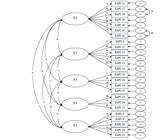
Factor model obtained by Confirmatory Factor Analysis (CFA) for the Self-Efficacy Scale for Scientific Research (EAPC)
Notably, the original numbering from the 42-item version was retained to transparently illustrate the item removal and retention process throughout the factor and validation analyses, leading to the final 25-item, 5-factor configuration.
Convergent and discriminant validity
Convergent validity was evaluated using the average variance extracted (AVE), reliability, and correlations between the EAPC factors and the total NGSE score. AVE values exceeded .50 for Factors 1, 2, and 4 (Factor 1 = .65; Factor 2 = .61; Factor 4 = .60) and surpassed .40 for Factors 3 and 5 (Factor 3 = .43; Factor 5 = .46).
Given the AVE < .50 in Factors 3 and 5, Composite Reliability (CR) was analyzed for all five factors to verify instrument reliability. The CR values were as follows: Factor 1 = .93; Factor 2 = .89; Factor 3 = .75; Factor 4 = .84; and Factor 5 = .81. All CR values exceeded .70, demonstrating adequate internal consistency across the five EAPC factors and theoretically justifying the .43 and .46 AVE values for Factors 3 and 5, respectively (Henseler & Schuberth, 2020).
Convergent validity was further supported by the correlation between the EAPC and the NGSE. Using the same sample (n = 222) from the EAPC CFA, we first assessed the fit indices of the NGSE. After correlating the measurement errors for items 4 and 5, the unifactorial NGSE model showed good fit [χ2/df = 2.35; CFI = .98; GFI = .99; RMSEA = .078; SRMR = .028], validating its use for convergent validity testing. Moreover, the NGSE demonstrated a strong composite reliability of .86 (> .70). As shown in Table 3, all five EAPC factors correlated positively with the NGSE. Furthermore, as expected, the correlation coefficients between the EAPC factors and the NGSE were weaker than the inter-factor correlations within the EAPC.
Discriminant validity was initially tested by verifying that the square root of each factor’s AVE exceeded its inter-factor correlations. The values were: √AVE Factor 1 = .81, √AVE Factor 2 = .78, √AVE Factor 3 = .65, √AVE Factor 4 = .77, and √AVE Factor 5 = .68. Although the square root of the AVE for certain constructs fell below their inter-construct correlations (Factor 1 - Factor 3; Factor 1 - Factor 5; Factor 3 - Factor 5), this likely stems from the inherent conceptual overlap among these related constructs, alongside contextual factors within the sampled population. Additional analyses, such as the Heterotrait-Monotrait (HTMT) ratio, supported discriminant validity (Table 4), suggesting that the constructs, while related, maintain theoretical distinctiveness by remaining below the .90 threshold (Cu et al., 2021; Dwivedi et al., 2019; Roemer et al., 2021).
Discussion
Beyond validating the internal structure of the EAPC, its convergent validity was supported by the composite reliability indices, average variance extracted (AVE) values, and correlations with a generalized self-efficacy measure. The CR and AVE values suggest that the scale consistently measures self-efficacy across different facets of research activity. Notably, the positive relationship between the EAPC dimensions and the general self-efficacy scale indicates that, while highly specific, scientific research self-efficacy aligns with an individual’s general sense of competence, consistent with theoretical expectations (Polydoro et al., 2010). Furthermore, as Bandura (2006) posits, self-efficacy is domain-specific. This is corroborated by the EAPC factors exhibiting stronger positive inter-correlations than their correlations with the NGSE. These results align with the notion that domain-specific self-efficacy (in this case, scientific research) both reflects and bolsters global self-efficacy. This supports targeted interventions designed to develop researcher confidence in specific skills, which may ultimately enhance research performance and productivity (Tas et al., 2023).
Finally, the discriminant validity of the scale was supported by the HTMT ratio (Cu et al., 2021; Dwivedi et al., 2019; Roemer et al., 2021), suggesting no excessive overlap among the EAPC factors. This distinction is essential to ensure that each dimension of the scale captures a unique and specific aspect of self-efficacy. Such nuance is highly relevant in scientific research, where distinct tasks-like planning, data processing, and results communication-play different roles and require highly specific skills (Bieschke et al., 1996).
In this context, robust self-efficacy beliefs positively predict research-related behaviors such as perseverance, innovation, and resilience in the face of difficulties (Bieschke et al., 1996; Poh & Kanesan Abdullah, 2019; Tas et al., 2023). Thus, a scale assessing research self-efficacy serves as a valuable tool not only to measure researchers’ confidence but also to pinpoint areas where capacity-building interventions are most needed. For instance, drafting a research project is a foundational step requiring the skills to structure and organize a study. Similarly, a crucial factor for research success is the ability to conduct a rigorous literature review. This involves evaluating and synthesizing existing knowledge, formatting it according to field-specific guidelines, and providing a solid theoretical foundation for the study. In turn, data analysis and processing require the capacity to handle data rigorously, an essential component for high-quality scientific research. Furthermore, the scientific process demands that researchers adopt a critical stance regarding their own work and its relationship to current field knowledge, while effectively balancing research with other academic training activities (Guzmán, 2020; Zambrano-Sandoval & Chacón Corzo, 2021). Finally, research dissemination and defense play a major role in professional development and scientific advancement, reflecting confidence in publicly communicating and defending one’s results.
A more detailed interpretation of these findings suggests that each identified factor captures an essential element for a successful research career. Self-efficacy for research planning is essential, as effective planning is the bedrock of any sound investigation. According to Creswell and Creswell (2022), planning is a core competency; high self-efficacy in this factor implies that researchers strongly believe in their ability to design and organize their studies. Self-efficacy for literature review and theoretical grounding encompasses the ability to locate, critique, and integrate existing literature-a central aspect of scientific activity. This factor also aligns with the need for a robust theoretical foundation, enabling the researcher to contextually ground their findings (Bieschke et al., 1996), an element closely tied to formatting scientific work and standardizing the presentation of the reviewed literature (Costa et al., 2023). Self-efficacy for data analysis and processing points to a technical component, reflecting confidence in analytical and methodological skills. For Bandura (1997), self-efficacy is tightly linked to performance on complex tasks, such as data analysis. Consequently, strong self-efficacy in this domain predicts more rigorous methodological execution and higher quality research outcomes. Self-efficacy for research dissemination and defense involves the ability to publicly communicate and defend findings, which is vital in an era that highly values scientific transparency and outreach (Tas et al., 2023). This factor is also linked to developing scientific communication skills, which are crucial for the broader acceptance and visibility of academic work. Finally, self-efficacy for critically evaluating scientific research is fundamental not only for understanding specific phenomena but also for guiding future investigations (Oliveira & Zanotti, 2018). It is also important to note that graduate education encompasses elements far beyond the core investigation; it requires managing diverse activities relevant to developing research skills, such as completing coursework, participating in research groups, and engaging in teaching assistantships (Freitas & Souza, 2018).
The fit indices, along with convergent and discriminant validity evidence, demonstrate that the EAPC is a reliable and appropriate instrument for measuring scientific research self-efficacy. The scale’s broad applicability makes it useful across various practical domains. The proposed scale can be utilized in longitudinal studies investigating the relationship between self-efficacy and academic success, scientific productivity, or retention in academic careers, enabling the assessment of how confidence in conducting research develops over time. Using the EAPC also allows researchers to explore the influence of self-efficacy on psychological well-being in specific research contexts, thereby contributing to the development of better strategies for coping with academic pressure and career challenges. A primary limitation is that, while the EAPC successfully measures research self-efficacy, its current validation is restricted to Brazilian graduate students in stricto sensu programs. Given the plurality of research contexts, the EAPC can be adapted and validated to reflect the specific activities of other programs both nationally (e.g., lato sensu postgraduate students) and internationally. Furthermore, the sample’s concentration in the Southeast and South regions of Brazil is a limitation, highlighting the need for future research that includes other geographic regions and their unique scientific landscapes. Finally, the AVE values < 0.50 in two EAPC factors, though theoretically justified by strong Composite Reliability, warrant verification and potential refinement in future studies.
References
- Bandura, A. (1997). Self-efficacy: The exercise of control W H Freeman & Co.
- Bandura, A. (2006). Guide for constructing self-efficacy scales. In F. Pajares & T. C. Urdan (Eds.), Self-efficacy beliefs in adolescents (pp. 307-337). Information Age.
-
Bieschke, K. J., Bishop, R. M., & Garcia, V. L. (1996). The utility of the research self-efficacy scale. Journal of Career Assessment, 4(1), 59-75. https://doi.org/10.1177/106907279600400104
» https://doi.org/10.1177/106907279600400104 -
Bishop, R. M., & Bieschke, K. J. (1998). Applying social cognitive theory to interest in research among counseling psychology doctoral students: A path analysis. Journal of Counseling Psychology, 45(2), 182-188. https://doi.org/10.1037/0022-0167.45.2.182
» https://doi.org/10.1037/0022-0167.45.2.182 -
Carneiro, A. M., Bin, A., Ferrero, L. G. P., & Morini, C. (2023). A motivação dos estudantes de programas de pós-graduação: Uma análise a partir das diferenças de perfis na área de administração [The motivation of students in postgraduate programs: An analysis based on differences in profiles in the area of administration]. Avaliação: Revista da Avaliação da Educação Superior (Campinas), 28, e023030. https://doi.org/10.1590/S1414-40772023000100050
» https://doi.org/10.1590/S1414-40772023000100050 -
Casey, C., Harvey, O., Taylor, J., Knight, F., & Trenoweth, S. (2022). Exploring the wellbeing and resilience of postgraduate researchers. Journal of Further and Higher Education, 46(6), 850-867. https://doi.org/10.1080/0309877X.2021.2018413
» https://doi.org/10.1080/0309877X.2021.2018413 -
Centro de Gestão e Estudos Estratégicos. (2024). Brasil: Mestres e doutores 2024 [Brazil: Masters and doctors 2024]. https://mestresdoutores2024.cgee.org.br
» https://mestresdoutores2024.cgee.org.br -
Cho, G., Hwang, H., Sarstedt, M., & Ringle, C. M. (2020). Cutoff criteria for overall model fit indexes in generalized structured component analysis. Journal of Market Analytics, 8, 189-202. https://doi.org/10.1057/s41270-020-00089-1
» https://doi.org/10.1057/s41270-020-00089-1 -
Coordenação de Aperfeiçoamento de Pessoal de Nível Superior. (2024). Pós-graduação stricto sensu tem mais de 350 mil matriculados [Stricto sensu postgraduate courses have more than 350,000 enrolled]. https://www.gov.br/capes/pt-br/assuntos/noticias/pos-graduacao-stricto-sensu-tem-mais-de-350-mil-matriculados#
» https://www.gov.br/capes/pt-br/assuntos/noticias/pos-graduacao-stricto-sensu-tem-mais-de-350-mil-matriculados# -
Costa, C. C. L. P., Santana, F. G., Borges, G. L. S., Rodrigues, J. S., Dias, L. P., Albuquerque, P. A., Tomé, P. M., Garcia, R. A., Silva, T. P., Carvalho, Y. E., & Aquino, R. L. (2023). A importância dos estilos de formatação de trabalhos acadêmicos: Uma revisão de literatura [The importance of formatting styles for academic papers: A literature review]. Brazilian Journal of Implantology and Health Sciences, 5(3), 718-738. https://doi.org/10.36557/2674-8169.2023v5n3p718-738
» https://doi.org/10.36557/2674-8169.2023v5n3p718-738 - Creswell, J. W., & Creswell, J. D. (2022). Research design: Qualitative, quantitative and mixed methods approaches (6th ed.). Sage.
- Cu, M., Chan, J., Peko, G., & Sundaram, D. (2021). Knowledge management practices: Innovation the path to organizational performance. In Cong Vinh, P. & Rakib, A. (Eds.), International Conference on Context-Aware Systems and Applications (pp. 20-37). Springer.
-
Dominguez-Lara, S. A. (2017). Construcción de una escala de autoeficacia para la investigación: Primeras evidencias de validez [Development of a research self-efficacy scale: Preliminary evidence of validity]. Revista Digital de Investigación en Docencia Universitaria, 11(2), 308-322. http://doi.org/10.19083/ridu.11.514
» http://doi.org/10.19083/ridu.11.514 -
Dwivedi, Y. K., Rana, N. P., Jeyaraj, A., Clement, M., & Williams, M. D. (2019). Re-examining the Unified Theory of Acceptance and Use of Technology (UTAUT): Towards a revised theoretical model. Information Systems Frontiers, 21, 719-734. https://doi.org/10.1007/s10796-017-9774-y
» https://doi.org/10.1007/s10796-017-9774-y -
Etherton, K., Steele-Johnson, D., Salvano, K., & Kovacs, N. (2022). Resilience effects on student performance and well-being: The role of self-efficacy, self-set goals, and anxiety. The Journal of General Psychology, 149(3), 279-298. https://doi.org/10.1080/00221309.2020.1835800
» https://doi.org/10.1080/00221309.2020.1835800 -
Fior, C. A., Polydoro, S. A. J., Pelissoni, A. M. S., Dantas, M. A., Martins, M. J., & Almeida, L. S. (2022). Impacto da autoeficácia e do rendimento acadêmico no abandono de estudantes do ensino superior [The impact of self-efficacy and academic performance on students dropping out of higher education]. Psicologia Escolar e Educacional, 26, e235218. https://doi.org/10.1590/2175-35392022235218
» https://doi.org/10.1590/2175-35392022235218 -
Fior, C. A., Sampaio, R. K. N., Reis, C. A. C., & Polydoro, S. A. J. (2022). Autoeficácia e procrastinação acadêmica em estudantes do ensino superior: Um estudo correlacional [Self-efficacy and academic procrastination in higher education students: A correlational study]. Psico, 53(1), e38943. https://doi.org/10.15448/1980-8623.2022.1.38943
» https://doi.org/10.15448/1980-8623.2022.1.38943 -
Freitas, M. F. Q., & Souza, J. (2018). Pensar a formação e a pesquisa na pós-graduação stricto sensu [Thinking about training and research in stricto sensu postgraduate courses]. Educar em Revista, 34(71), 9-18. https://doi.org/10.1590/0104-4060.62549
» https://doi.org/10.1590/0104-4060.62549 -
González-Rivera, J. A., Dominguez-Lara, S., Torres-Rivera, N., Ortiz-Santiago, T., Sepúlveda-López, V., Tirado de Alba, M., & González-Malavé, C. M. (2022). Análisis estructural de la Escala de Autoeficacia para Investigar en estudiantes de posgrado [Structural analysis of the Research Self-Efficacy Scale in graduate students]. Revista Evaluar, 22(1), 17-27. https://revistas.unc.edu.ar/index.php/revaluar/article/view/37414
» https://revistas.unc.edu.ar/index.php/revaluar/article/view/37414 -
Guzmán, M. B. (2020). Desarrollo de competencias básicas de investigación [Development of basic research skills]. Ajayu Órgano de Difusión Científica del Departamento de Psicología UCBSP, 18(1), 24-51. http://www.scielo.org.bo/scielo.php?script=sci_arttext&pid=S2077-21612020000100002&lng=es&tlng=es
» http://www.scielo.org.bo/scielo.php?script=sci_arttext&pid=S2077-21612020000100002&lng=es&tlng=es - Härdle, W. K., Simar, L. & Fengler, M. R. (2024). Applied multivariate statistical analysis (6th ed.). Springer
-
Henseler, J., & Schuberth, F. (2020). Using confirmatory composite analysis to assess emergent variables in business research. Journal of Business Research, 120, 147-156. https://doi.org/10.1016/j.jbusres.2020.07.026
» https://doi.org/10.1016/j.jbusres.2020.07.026 - Hoyle, R. H. (Ed.) (2023). Handbook of structural equation modeling (2nd ed.). Guilford Press.
-
Livinƫi, R., Gunnesch-Luca, G., & Iliescu, D. (2021). Research self-efficacy: A meta-analysis. Educational Psychologist, 56(3), 215-242. https://doi.org/10.1080/00461520.2021.1886103
» https://doi.org/10.1080/00461520.2021.1886103 - Marôco, J. (2010). Análise de equações estruturais: Fundamentos teóricos, software & aplicações [Structural equation analysis: Theoretical foundations, software & applications]. Report Number.
-
Miao, H., Guo, R., & Li, M. (2025). The influence of research self-efficacy and learning engagement on Ed. D students’ academic achievement. Frontiers in Psychology, 16, 1562354. https://doi.org/10.3389/fpsyg.2025.1562354
» https://doi.org/10.3389/fpsyg.2025.1562354 -
Oliveira, V. P., Maciel, L. F. P., Iaochite, R. T., Salles, W. N., Nascimento, J. V., & Folle, A. (2020). Autoeficácia no ensino superior e satisfação com as experiências acadêmicas: Percepções de estudantes de educação física [Self-efficacy in higher education and satisfaction with academic experiences: Perceptions of physical education students]. Movimento, 26, e26087. https://doi.org/10.22456/1982-8918.101307
» https://doi.org/10.22456/1982-8918.101307 -
Oliveira, J. T., & Zanotti, A. (2018). A Importância do raciocínio lógico para a metodologia da pesquisa: Raciocínio, planejamento e execução [The importance of logical reasoning for research methodology: Reasoning, planning and execution]. Research, Society and Development, 7(8), 978337. https://doi.org/10.17648/rsd-v7i8.337
» https://doi.org/10.17648/rsd-v7i8.337 -
Poh, R., & Kanesan Abdullah, A. G. B. (2019). Factors influencing students’ research self-efficacy: A case study of university students in Malaysia. Eurasian Journal of Educational Research, (82), 137-168. https://eric.ed.gov/?id=EJ1223661
» https://eric.ed.gov/?id=EJ1223661 - Polydoro, S. A. J., Azzi, R. G., & Vieira, D. A. (2010). Orientações de construção e aplicações de escalas na avaliação de crenças de auto-eficácia [Guidelines for constructing and applying scales to assess self-efficacy beliefs]. In A. A. A. Santos, F. F. Sisto, E. Boruchovitch, & E. Nascimento (Orgs.), Perspectivas em avaliação psicológica (pp. 189-210). Casa do Psicólogo.
-
Quezada-Berumen, L., Moral de la Rubia, J., & Landero-Hernández, R. (2019). Validación de la Escala de Actitud hacia la Investigación en estudiantes Mexicanos de Psicología [Validation of the Attitude Toward Research Scale in Mexican Psychology students]. Revista Evaluar, 19(1). https://doi.org/10.35670/1667-4545.v19.n1.23874
» https://doi.org/10.35670/1667-4545.v19.n1.23874 -
Rodrigues, D. S., Cruz, D. M. C., Nascimento, J. S., & Cid, M. F. B. (2022). Prevalência de transtornos mentais comuns e fatores associados em estudantes de uma universidade pública brasileira. Cadernos Brasileiros de Terapia Ocupacional, 30, e3305. https://doi.org/10.1590/2526-8910.ctoAO252833051
» https://doi.org/10.1590/2526-8910.ctoAO252833051 -
Roemer, E., Schuberth, F. & Henseler, J. (2021). HTMT2-an improved criterion for assessing discriminant validity in structural equation modelling. Industrial Management & Data Systems, 121(12), 2637-2650. https://doi.org/10.1108/IMDS-02-2021-0082
» https://doi.org/10.1108/IMDS-02-2021-0082 -
Rogers, P. (2022). Best practices for your exploratory factor analysis: A factor tutorial Revista de Administração Contemporânea, 26(6), e210085. https://doi.org/10.1590/1982-7849rac2022210085.en
» https://doi.org/10.1590/1982-7849rac2022210085.en -
Soares, A. B., Monteiro, M. C., Medeiros, H. C. P., Brito, A. D. G., Souza, B. A., & Mendes, V. S. A. (2022). Gestão do tempo: Percepções de gerenciamento com estudantes de Pós-Graduação [Time management: Perceptions of management with postgraduate students]. Revista Brasileira de Orientação Profissional, 23(2), 151-161. https://pepsic.bvsalud.org/pdf/rbop/v23n2/a05v23n2.pdf
» https://pepsic.bvsalud.org/pdf/rbop/v23n2/a05v23n2.pdf -
Tas, Y., Demiral-Uzan, M., & Uzan, E. (2023). Self-efficacy for research: Development and validation of a Comprehensive Research Self-Efficacy Scale (C-RSES). International Journal on Social and Education Sciences, 5(2), 275-294. https://doi.org/10.46328/ijonses.472
» https://doi.org/10.46328/ijonses.472 -
Zambrano-Sandoval, H. J., & Chacón Corzo, C. T. (2021). Competencias investigativas en la formación de posgrado: Análisis cualitativo [Research competencies in postgraduate education: Qualitative analysis]. Revista Educación, 45(2), 242-259. https://doi.org/10.15517/revedu.v45i1.43646
» https://doi.org/10.15517/revedu.v45i1.43646
-
Support:
This article is derived from the first author’s doctoral dissertation, supervised by the second and fourth authors, and defended in 2025 at the Psychobiology Graduate Program of the University of São Paulo. This study was supported by grants from CNPq (No. 140429/2020-4) and CAPES (No. 88887.837293/2023-00).
-
How to cite this article:
Mulle, R. L. D., Vieira, D. A., Oliveira, J. E., & Versuti, F. M. (2026). Validity indicators of the Self-Efficacy Scale for Scientific Research. Paidéia (Ribeirão Preto), 36, e3611. https://doi.org/10.1590/1982-4327e3611
-
Data Availability
The datasets generated and/or analyzed during the current study are available from the corresponding author on reasonable request.
The datasets generated and/or analyzed during the current study are available from the corresponding author on reasonable request.

