 Lost Lives, Preserved Memories: Grief and Resistance in the Black Brazilian Community
Abstract
The invisibility of grief within Black communities is reinforced by historical stereotypes. Therefore, this study aims to understand the grief of Black people who have lost family members. Qualitative exploratory research was conducted with ten Black individuals who had lost family members. The interviews followed a semi-structured script and were analyzed using IRaMuTeQ software. The results, with an 84.30% utilization of the textual corpus, produced five Descending Hierarchical Classes: (1) Losses and Justice; (2) Resilience and Grief: Family and Race; (3) Memory and Resistance; (4) Love and Gratitude; and (5) Grief and Struggle. It is concluded that Black grief is multifaceted, marked by racism and social pain, exacerbated by police violence and medical neglect, and characterized by limited space for emotional validation and identity resistance.
Keywords:
grief; blackness; memory; resilience; racism
Resumo
A invisibilidade do luto nas comunidades negras é reforçada por estereótipos históricos. Dessa forma, este estudo tem como objetivo compreender o luto de pessoas negras que perderam familiares. Realizou-se uma pesquisa qualitativa exploratória com dez pessoas negras que perderam familiares. As entrevistas seguiram um roteiro semiestruturado e foram analisadas pelo software IRaMuTeQ. Os resultados, com 84,30% de aproveitamento do corpus textual, geraram cinco Classes Hierárquicas Descendentes: (1) Perdas e Justiça; (2) Resiliência e Luto: Família e Raça; (3) Memória e Resistência; (4) Amor e Gratidão; e (5) Luto e Luta. Conclui-se que o luto negro é multifacetado, marcado pelo racismo e pela dor social, agravado pela violência policial e negligência médica, além de um espaço insuficiente para a validação emocional e a resistência identitária.
Palavras-chave:
luto; negritude; memória; resistência; racismo
Resumen
La invisibilidad del duelo en las comunidades negras está reforzada por estereotipos históricos. De esta forma, este estudio tiene como objetivo comprender el duelo de las personas negras que han perdido a familiares. Se realizó una investigación cualitativa exploratoria con diez personas negras que habían perdido familiares. Las entrevistas siguieron un guion semiestructurado y se analizaron utilizando el software IRaMuTeQ. Los resultados, con un 84,30% de aprovechamiento del corpus textual, generaron cinco Clases Jerárquicas Descendentes: (1) Pérdidas y Justicia; (2) Resiliencia y Duelo: Familia y Raza; (3) Memoria y Resistencia; (4) Amor y Gratitud; y (5) Duelo y Lucha. Se concluye que el duelo negro es multifacético, marcado por el racismo y el dolor social, agravado por la violencia policial y la negligencia médica, además de un espacio insuficiente para la validación emocional y la resistencia identitaria.
Palabras clave:
duelo; negritud; memoria; resistencia; racismo
Technical Report No. 2/2023 of the Mais SUS Agenda (2023) reveals that, in 2021, the IBGE registered 56.1% of black people in Brazil (47% mixed race and 9.1% black). Data on the health of the black population indicate worrying rates, especially in relation to mental health, such as the high suicide rate among young black people, which accounted for six out of ten cases in 2016 (Gaia & Zacarias, 2020; Agenda Mais SUS, 2023). The 2022 Brazilian Forum on Public Safety shows that, in the last decade, 408,605 black people were murdered, representing 72% of homicides in Brazil, with a 7.5% increase in homicides of black people.
These data exemplify the institutional racism present in health and public safety services, which hinders black people’s access to these services and creates implicit hierarchies in the care provided (Tavares, 2020). This structure discriminates in a subtle but systematic way against black people, undermining both preventive measures and effective care (Agenda Mais Sus, 2023), resulting in a higher number of deaths among black people.
Racism also extends to the experience of grief, impacting the way in which explicit manifestations of suffering are inhibited. Grief can be understood as a reaction to the loss of someone significant in an individual’s life, and to understand how this process will be experienced, it is necessary to consider not only the unique aspects related to death, but also the historical, cultural, and social aspects involved (Franco, 2021).
Historically, studies in this area of knowledge have been influenced and appropriated by eugenicist ideas, which gained prominence, especially at the turn of the 1920s. Therefore, the suffering of racial and ethnic minorities has been rendered invisible in the construction of knowledge, including in studies on grief. Thus, although the Black population is exposed to greater contact with death, studies in the field of thanatology still focus predominantly on a white and Eurocentric perspective (Tavares, 2021).
Tavares (2021) also points out that, historically, hiding affection was a survival strategy for enslaved Black people, who needed to conceal emotions that were incompatible with the values of white colonizers. This included the expression of grief, as they could not mourn their losses or name their pain, which resulted in their dehumanization by denying them the right to feel and understand the complexity of grief (Fanon, 2008; Norris & Kwanele, 2021).
The protection and recognition of a life in our society depends on the body’s conformity to cultural norms, which defines which bodies are mournable (Butler, 2019). In the case of Black lives, this normalization results in devaluation, evidenced by violence and lack of social recognition, which often prevents mourning for these lives from being considered socially relevant.
Based on this idea of violence against black bodies, we can see the social devaluation that affects various areas, including physical and mental care. Black lives are perceived as lives that are not worth mourning (Butler, 2019). This devaluation of black life generates high levels of what can be conceptualized as social pain, understood as the psychological suffering derived from aversive social experiences that undermine the subject’s value and social relationships (Deska et al., 2020). The idea is based on racist stereotypes, which generalize attributes of a group and form social representations (Moscovici, 2010) about black people and their grieving process. This perpetuates, to this day, the stigma surrounding the expression of pain by the black population.
Another factor exposed in the studies by Deska et al. (2020) on the manifestation of social pain in the black population is the belief that adversity and life difficulties make black people more resilient and less sensitive to social pain. This feeds into the historically created and socially maintained stereotype about the resilience of the black population, deepening the bias of dehumanization and, consequently, minimizing their suffering and the attention given to it, in addition to silencing their experiences (Kilomba, 2019; Lima & Romanini, 2024; Rosa & Alves, 2020; Santos, J. E. & Costa, 2023; Santos, L. B., 2023). Because of the minimization of Black pain and the invisibility of the grieving process, the Black population tends to have higher rates of complicated or prolonged grief (Tavares, 2021).
It should be noted that, in contemporary times, the combination of disciplinary, biopolitical, and necropolitical powers enables absolute domination in what is known as contemporary colonial occupation, in which entire populations are targets of repression and domination (Mbembe, 2018; Silva et al., 2022). Sovereignty, in this context, is understood as the ability to define who is disposable and who is not in our society (Mbembe, 2018; Morabito & Cremasco, 2024).
Research highlights the need to further study grief in the lives of Black people, especially regarding issues of affectivity and its importance in the experience of Black lives (Hooks, 2010, 2019; Viana, 2019). Furthermore, this is an area that has yet to be fully explored, especially in terms of practical research (Tavares, 2021; Wilson et al., 2024).
This study provides a space for black people to be heard, recognizing the relevance of their experiences in the grieving process. This approach is fundamental both for theoretical advances in understanding the phenomenon and for highlighting black perspectives, which are often silenced and neglected in scientific production.
Thus, this study aims to understand the grief of black people who have lost family members. As specific objectives, the research aims to: (1) investigate the psychological impacts of racism on the experience of grief; (2) identify the invisibility surrounding the grief experienced by black people; (3) understand the stereotypes related to affectivity in the grief of these people; and (4) examine the strategies of resistance and memory rescue adopted by black individuals.
Method
Participants
The research consisted of 10 interviews with black people aged between 22 and 57. Seven participants self-identified as black (70%) and three as brown (30%). Four were women (40%), five were men (50%), and one person preferred not to identify themselves (10%). Most participants were from Ceará (90%), with one participant from Pernambuco (10%). In the questionnaire, four reported having lost at least one grandparent (40%), three had lost a parent (30%), two had lost a child (20%), and one had lost a nephew (10%). The time since the loss ranged from 1 to 11 years (see Table 1). Participants were selected from a pre-registration sociodemographic form with 15 registrants, using inclusion criteria that required a first- or second-degree family relationship with the deceased, a minimum age of 18, and agreement to participate in the study. Non-black individuals, those without family ties to the deceased, or those with severe cognitive or psychological difficulties, including acute grief, were excluded, as were those who could not read or write.
Instruments
This exploratory study followed the guidelines of the Consolidated Guidelines for Reporting Qualitative Research (COREQ) (Souza et al., 2021), adopting a qualitative approach centered on everyday experiences (Flick, 2009; Minayo, 2001). Semi-structured interviews were conducted between March and April 2024 (in person and online) by a Black graduate student of psychology. The interview script, consisting of 15 questions, was organized into four thematic blocks: (1) characterization of loss, (2) relationship and mourning process, (3) impact of racism and invisibility, and (4) memory and resistance. The questions explored objective and subjective dimensions of grief, aligning with the investigation of the intersectionality between race, affection, and grief in the Black population. Participants also completed a sociodemographic form via Google Forms, which covered general data (age, profession) and the specific relationship with the deceased, including kinship and level of closeness.
Procedures
Data Collection. Participants were recruited using the “Snowball” strategy (Costa, 2018), involving black collectives and social networks, ensuring voluntary collaboration until the necessary sample was obtained. The invitation explained the research objectives, the conditions for participation, and the guarantee of privacy and anonymity of responses. Information about the researchers responsible, the approval of the Research Ethics Committee, and a link for pre-registration via Google Forms were also provided. The ten interviews lasted an average of 40 minutes, five of which were conducted in a virtual environment (Google Meet) and the other half in person, in university rooms, according to the availability of the research participants.
Data Analysis. IRaMuTeQ software was used for data analysis, allowing classic lexicographic analyses to be performed to verify the statistics of the number of evocations, forms, and text segments (TS). In addition, Descending Hierarchical Classification (DHC) analyses were performed, a statistical method that progressively segments the textual corpus into homogeneous thematic classes, based on lexical distribution and chi-square (χ²) tests to identify associations between words and classes (Camargo & Justo, 2013). In this context, the higher the χ², the greater the association of the word with the class, requiring a theoretical basis for interpreting the results obtained.
Ethical considerations
All participants signed the Free and Informed Consent Form (FICF) after pre-registration, in accordance with Resolutions 466/12 and 510/16 of the National Health Council and Circular Letter No. 2/2021/CONEP/SECNS/MS for online interviews. The research was approved by the institution’s Research Ethics Committee (REC) (Opinion No. 6,689,204). During the interviews, it was noted that some participants showed resistance or withdrawal when addressing traumatic aspects, such as police violence or medical negligence. Such situations were handled with pauses, emotional validation, and reinforcement of the voluntary nature of the study, ensuring the well-being of the participants without compromising the depth of the narratives, in line with the study’s rigorous ethical and methodological precepts.
Results and Discussion
This section presents the main results of the study, focusing on the descending hierarchical classification (DHC) analysis performed using IRaMuTeQ software and the participants’ statements that exemplify each class. The sample characteristics (see Table 1) can be consulted to contextualize the statements based on the participants’ profiles, providing a more specific understanding of the experiences reported. The results were discussed based on the existing literature, establishing dialogues between other empirical findings and important concepts that underpin this study.
It was observed that the type of loss influenced the experience of grief: participants who lost grandparents showed greater ease in addressing the topic than those who lost parents or children. The nature of death also proved to be a determining factor, with one IRaMuTeQ class predominantly adding reports of violent deaths and another focusing specifically on deaths from COVID-19. In addition, participants linked to collectives articulated with greater discursive clarity the impact of racism on their mourning processes.
Descending Hierarchical Classification
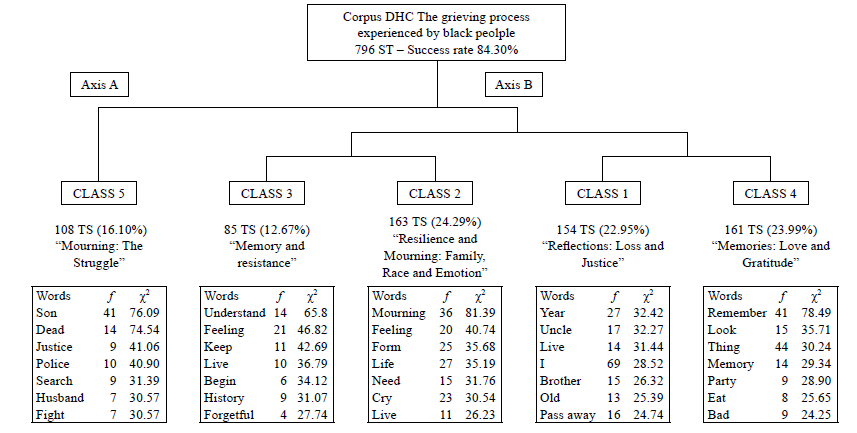
Figure 1 shows the dendrogram referring to the Descending Hierarchical Classification (DHC) performed based on statements about the mourning process experienced by black people. The general corpus consisted of 10 texts, separated into 796 text segments (TS), with 671 TS (84.30%) being used. Through this analysis, it was found that the group’s responses were organized into five classes: Class 1, with 154 TS (22.95%); Class 2, with 163 TS (24.29%); Class 3, with 85 TS (12.67%); Class 4, with 161 TS (23.99%); and Class 5, with 108 TS (16.1%). These five classes are divided into two branches (A and B) of the total corpus of the analysis.
Axis A (“Mourning and Struggle: Impacts of Police Violence on the Brazilian Black Community”) was composed of Class 5 (“Mourning: The Struggle”), while axis B (“Memory, Affection, and Resistance: The Process of Mourning in the Brazilian Black Community“) was composed of the other classes: Class 1 (”Reflections: Loss and Justice“), Class 2 (”Resilience and Mourning: Family, Race, and Emotion“), Class 3 (”Memory and Resistance“), and Class 4 (”Memories: Love and Gratitude”). Axis B was subdivided into two secondary axes: the first consisting of Classes 2 and 3, and the second consisting of Classes 1 and 4. As shown in Figure 1, Class 5 was distant from the other classes in terms of the content of the statements. Each axis and class will be discussed below, from left to right in the dendrogram.
Axis A: “Mourning and Struggle: Impacts of Police Violence on the Brazilian Black Community”
(1) Mourning: The Struggle
Axis A, composed of Class 5, brings together the reflections of black people interviewed who lost loved ones as a result of police violence, highlighting the repercussions of this loss and the ongoing struggle for justice. The reports indicate not only the emotional impact of the loss, but also the negative effects on the physical health of the bereaved and their social integration. Gaia and Zacarias (2020) highlight that police violence in Brazil has historical roots, dating back to the abolition of slavery, when police coercion was seen as a means of controlling the Black population. Police brutality is a characteristic mechanism of necropolitics, in which the genocidal state grants the police sovereign power to kill (Mbembe, 2018; Silva et al., 2022).
Three interviewees repeatedly reported the need to put their grief aside, without experiencing it in the way they considered appropriate, due to the need to gather strength to seek justice for the violent death of their loved ones:
Our family did not have the right to mourn, to protect ourselves, to spend that period crying, suffering; we did not have that period because we had to go out, we had to seek a solution for that, seek justice. (...) Our mourning was transformed into a struggle, and it is still like that today. (Lélia)
Losses resulting from police violence trigger significant stress for the bereaved, especially because it is a violent and unexpected death. Morabito and Cremasco (2024) emphasize that the feeling of injustice becomes latent, leading the family and close friends to experience a perpetual state of mourning, since there is no adequate space for it to be processed. Thus, the emotional pain that accompanies this loss intensifies the mourning and introduces complications to the process (Morabito & Cremasco, 2024; Wilson et al., 2024).
In addition, another factor experienced by these participants was the need to refute accusations about the people who died:
As he himself said, he tapped me on the shoulder and said, “You’re black and poor, it won’t work.” I had to prove that my daughter was innocent, that my daughter worked, that my daughter wasn’t a drug dealer. (Leci)
The reports reveal a process of revictimization of family members, which hinders the grieving process, since, in addition to dealing with loss, these individuals face accusations and attempts to erase the memory of their loved ones (Morabito & Cremasco, 2024). This phenomenon sends a powerful and explicit message to the Black community, reinforcing the idea that their lives have no value (Silva et al., 2022; Wilson et al., 2024). These cases are not isolated, but rather highlight the perception of the Black body as a threat, legitimizing violence and the devaluation of these lives and their families (Barreto, 2022). The destruction of the other, in this context, functions as a means of preserving the imaginary of sovereignty in a racist society (Mbembe, 2018).
Another important aspect is how the trauma of this loss and the lack of opportunities to experience and process grief lead to health complications for the bereaved (Norris & Kwanele, 2021). Deska et al. (2020) and Meyer (2003) point out that the experience of socially painful events negatively impacts individuals’ health, with repercussions in all areas of their lives. These situations are more frequent for people from minority groups, resulting in greater social stress (Meyer, 2003), as exemplified by the statement:
It’s as if they killed my daughter and buried a part of my body with her. I started having high blood pressure. My blood pressure reached 22, I almost had a heart attack, I had a pre-heart attack. (Leci)
Such experiences affect not only the physical health but also the mental health of black men and women directly involved, as well as those indirectly linked to the grieving process, due to the phenomenon of social identification (Wilson et al., 2024). Meyer (2003) suggests that identity characteristics, which place a person in a social group, can directly impact mental health by interacting with social stressors, causing suffering not through individual interpretation, but through the way that identity is socially perceived.
Thus, the loss of a Black person reminds the community of the constant struggle for survival, highlighting how close Black lives are to death (Tavares, 2021). This scenario forces Black individuals to live in a state of constant vigilance, anticipating the possibility of similar tragedies in their own lives or in those of their family and friends (Meyer, 2003).
Axis B: “Memory, Affection, and Resistance: The Process of Mourning in the Brazilian Black Community”
Axis B covers responses that emphasize the emotional aspects of the grieving process, exploring how participants experienced this moment, the importance of acceptance, and the experience of vulnerability at different stages of their lives. In addition, this axis addresses issues related to memory, recovery, and resilience linked to feelings for the loved one. Some responses highlighted the impact of the COVID-19 pandemic on the grieving process. As illustrated in the dendrogram (Figure 1), this axis is divided into two groups: the first composed of Classes 3 and 2, and the second by Classes 1 and 4.
(1) Memory: Resistance and Love
In Class 3, participants highlighted the importance of remembering and talking about their deceased loved ones as an act of resistance and affirmation. Franco (2021) suggests that constructing memories of loved ones and bonds with them has significant therapeutic value. For Black people, preserving and maintaining this memory represents a way of constructing their own narrative, challenging the systemic erasure that Black culture and bodies face in a racist society (Silva et al., 2023).
Lélia said that “We started this because of memory. (...) It is a way of ensuring that their history is not forgotten.” This recovery is about valuing blackness and its ancestry as a fundamental aspect in the construction of individual identity (Silva et al., 2023). Fanon (2008) states that the white world does not recognize and rejects the black body and its participation in society, causing black people to withdraw. Therefore, for there to be recognition and identification, it is necessary for black people to make themselves known, as expressed in Elisa’s statement when she says that “What keeps us standing today are our own, the voices of our dead that cannot be silenced through our mouths.”
Hooks (2019) describes that the act of loving blackness can be dangerous, as it is a way of opposing a system that rejects everything that comes from blackness. Therefore, adopting this stance is an act of political resistance, breaking with the self-hatred and self-denial that black people are taught to build upon themselves:
(...) From the moment we understand and racialize him as an individual, we also treat him as a collective, keeping this ancestry alive is resistance, and my grandfather is my ancestor (...) He is a person who is part of my history, even more so because he is a black person. He was this living ancestry and carried a lot of history with him. Resistance is just about keeping his memory alive. Everything else is just details, but as long as his name is spoken, when his children’s children, his grandchildren, talk about him, we will be honoring and keeping his memory alive. (Joaquim)
Recognizing loss allows individuals to adapt to their new reality, attributing meaning to the event and maintaining a bond with the deceased (Franco, 2021). For Black individuals, this process of recovering memory involves connecting with their ancestral heritage of struggle and resistance (Silva et al., 2023). Naming grief is a humanizing practice that recognizes the emotional dignity of Black people (Norris & Kwanele, 2021). Affirming this humanity is a form of resistance against the silencing and invisibility caused by racist violence, promoting a sense of belonging (Rosa & Alves, 2020).
In her work “Living from Love,” Hooks (2010) reflects on how oppression and the feeling of “no place” experienced by black people distort the ways of loving, based on daily and historical wounds. Thus, the act of honoring the memory of a loved one and rescuing the voice and history of that Black person is a form of affection, especially a form of love, that seeks healing and appreciation of Blackness and its ancestry.
(2) Resilience and Grief: Family, Race, and Emotion
The responses from Class 2 revealed the participants’ perceptions of their grieving process, addressing topics such as vulnerability, resilience, family support, the construction of racial identity, and the social dynamics that influence the expression of emotional suffering. Most reported receiving support during their grief, but many highlighted a tendency to withdraw and deal with their experiences privately, maintaining an attitude of strength and resilience without widely sharing their difficulties:
I always kept things to myself, but at that moment, which was a moment when I cried a lot, I think because of everything I had kept inside, his death or something, it was a moment when I cried a lot to get some of the anguish out. (Gilberto)
The pressure not to show weakness is a social construct that reinforces the idea that Black people are less sensitive and more emotionally resilient (Deska et al., 2020; Wilson et al., 2024). This conception is internalized by the Black community as a form of protection in a world dominated by whiteness, where there is a sense of not belonging, including in relation to one’s own feelings. This “non-place” arises from the fact that they are not heard (Santos, J. E. & Costa, 2023). This can even be observed as an identity construct within the family:
Perhaps that’s it, it’s a construct that we have as a family, but also as a race, that we don’t have space, the world won’t stop to comfort us or there’s no space for mourning, space is always for resilience. (Conceição)
However, this resilience based on stereotypes can result in the silencing of emotions, including grief, as well as generating misguided perceptions that black people do not need social support, which diminishes the validation of their pain (Deska et al., 2020). Relationships with others, and the way in which one is heard or not, have the power to both constitute and dispossess the subject of their identity and feelings (Butler, 2019), as exemplified by Milton’s statement that “I realize that light-skinned people always end up being seen as pitiful, and we black people always have to appear tough, appear to be strong, not show fragility,” and in Joaquim’s statement:
We are dehumanized, we are animalized, we end up being someone who is there without emotions. The person arrives and vents, tells you their whole life story, but when it’s your turn, you don’t have that same space. (Joaquim)
Based on such experiences, the individual’s identity construction is undeniably affected and violently impacted, preventing them from experiencing their own feelings. Thus, racism imposes this silencing, not only by “not speaking,” but also by making it impossible to express these feelings (Rosa & Alves, 2020). Santos, J. E. and Costa (2023) call this experience psychic apartheid, a silent segregation of the feelings of black people, who are prevented from living and expressing what they feel.
(3) Reflections: Losses and Justice
In Class 1, participants reaffirmed their feelings about loss. In addition, there was a strong emphasis on responses related to medical negligence and losses during the COVID-19 period, highlighting intense emotions of anger and a desire for justice, where the search for meaning and redress is mixed with the pain of loss:
He had some complications due to a heart problem, because the real cause of his death was a myocardial infarction. He had clots that formed due to this injury, which appeared while he was already in the hospital. (...) As a health student today, I can look at it this way and see the negligence he suffered. Both in the public and private sectors, he was neglected as an individual. This led to his death. This outrages me. (Joaquim)
Tavares (2020, p. 9) reports that, for the most part, both public and private health services are composed of “white professionals who reproduce their whiteness, which contributes to the pathologization of individuals and reaffirms institutional racism.” Thus, these bodies are denied the right to care, as are their families. Consequently, with this process of dehumanization, the vulnerability of health and mortality of the black population increases (Tavares, 2020). According to Lima and Romanini (2024), racism, whether inside or outside institutions, acts as a regulator of the distribution of death, allowing state-sanctioned killings of bodies considered to be of “lesser value.”
(...) COVID was devastating for my mother’s family because my grandfather died in the first wave, my grandmother died in the second wave, and my father became very ill. (...) To this day, what I feel towards Bolsonaro and his family is not divine justice, but revenge. My dream is to see in his face, in his children’s faces, the despair I saw in my grandmother when she felt she was going to die. (Pedro Paulo)
Tavares (2020) highlights that the COVID-19 period has added to the various crises already experienced by the black population in Brazil, increasing the number of diagnosed cases of disorders and the number of deaths. Thus, the black population continues to live under the sign of death (Lima & Romanini, 2024), facing contempt and devaluation of their lives, which prevents them from learning how to experience grief, both individually and collectively, due to social neglect that does not allow time for this process (Tavares, 2020).
The feeling of anger in the face of racism condoned by society, as pointed out by Santos, L. B. (2023), should be considered a right, which should not be restrained due to the stigmatization and stereotype of aggressiveness that falls on black people. This anger is a way of externalizing pain, a cry “for our bodies vilified by the nation-state and civil society (...) for wanting to leave the margins, the place of absence of rights, to combat images of control” (Santos, L. B., 2023, p. 27). Thus, anger as a reaction to racism can be a driving force in the search for justice and in denouncing everything that permeates our social system, denouncements that are stories (Lima & Romanini, 2024).
(4) Memories: Love and Gratitude
In Class 4, participants’ responses highlighted feelings of gratitude and memories, both general and specific, about their loved ones, emphasizing the value and importance of cherishing family rituals and moments of togetherness. In addition, in some cases, the process of transforming pain into more positive memories was mentioned, with the aim of keeping the memory and legacy of these people alive.
Finding a space that does not exclude and allows the construction of affection for black people is something powerful and represents a form of great resistance in the face of a society that perpetuates a cultural imaginary that isolates them (Viana, 2019). In the context of mourning, these spaces are fundamental for rescuing and (re)constructing the memory of the person who has passed away.
With those words, I began to see my father as someone who admired me, not just someone who was demanding or quarrelsome, and that greatly changed the way I dealt with my father’s death, which really improved things. (...) Normally, when someone is gone, we remember all the good things that happened (...) What remains in my experiences today is a very strong feeling of gratitude, and much of the pain has passed, but a lot of that gratitude remains. (Abdias)
Furthermore, the grieving process represents a significant transformation in an individual’s life, affecting their perception of the world and their self-image (Franco, 2021). This process can be mitigated through social relationships and safe spaces, where Black people can explore and name their feelings, recognizing them as legitimate and reaffirming their Blackness and ancestry (Lima & Romanini, 2024; Santos, J. E. & Costa, 2023). This recognition is crucial for the construction of decolonial and anti-racist perspectives in the training of new professionals, aiming to break the silence faced by Black bodies and voices in health and education contexts (Lima & Romanini, 2024; Rosa & Alves, 2020).
Another point to note is the construction of memorials and the maintenance of rituals linked to the loved one, which mark the affection for that person, as well as their importance and permanence in everyday life. Tavares (2020) emphasizes that these movements are important and decisive, both as a form of resistance to break with racism and coloniality, and as a way of restoring the mental health of black people. This perspective is exemplified in the words of participant Abdias, when asked how he keeps his father’s memory alive:
It’s Portela’s annual ritualistic parade. My family doesn’t really enjoy it, my mom doesn’t like it much, but my sister and I never miss it. We watch it with a beer, chicken hearts, that little chopped-up picanha steak, and off we go. (Abdias)
Racism erases Black histories, their affections, and the construction of individuals’ identities, denying their feelings. Proposing to preserve the memory of a Black person and to love that Blackness is a revolutionary act, both internally and externally (Hooks, 2019; Viana, 2019). It is a movement to rescue ancestry, in which one perceives and embraces traits of that person, understanding what they still mean and can continue to mean, creating something new without allowing that ancestor to disappear (Tavares, 2020).
I remember him fondly, his mannerisms. Today, I no longer carry pain with me when I remember him, because for a long time, when I remembered him, my eyes would fill with tears. But today, I remember and smile. (Joaquim)
Therefore, loving fully as a black person, respecting and caring for another black body, is both a learning process and a revolution (Viana, 2019). The grieving process is one of these ways of loving, because by remembering those who have passed away and keeping their memory alive, blackness is exalted as worthy of affection. It is a struggle against centuries of oppression and, essentially, an act of transformation.
At the end of this study, it becomes clear that mourning is a multifaceted experience, whose characteristics take on a unique dimension when examined in the lives of black people. When analyzing mourning beyond the Eurocentric perspective, it is crucial to consider the impact of racism and social pain, especially in light of the alarming scenario in which black people are the main victims of police violence and medical negligence.
In addition to reports of sudden and violent deaths, there was a constant sense of a lack of legitimate space for grief, which has harmful impacts on the physical and mental health of those who are mourning, as well as difficulties in emotional expression and validation, exacerbated by the stereotypes of strength and resilience often imposed on Black people. The participants’ reflections highlighted the importance of creating safe spaces for the expression of feelings, challenging the standard of resilience demanded by society. Furthermore, the grieving process for black people is deeply linked to resistance and the affirmation of black identity, as valuing the memory of deceased loved ones not only aids in mourning, but also functions as an act of resistance against cultural erasure and as a celebration of ancestry.
As with all scientific work, this study has limitations. With regard to the field, there is a limitation particularly related to Brazilian literature, which is still scarce in this area, especially concerning empirical studies on the experience of black people and the grieving process. In addition, there are specific challenges in conducting qualitative research, especially when addressing the topic of racism, given the sensitivity of the subject and the recollection of traumatic experiences, such as death. Another important limitation refers to the geographical distribution of the sample, which was concentrated in one capital city. We recognize the importance of studies that consider other realities experienced outside large urban centers.
This research highlights and validates Black perspectives by recognizing the experience of grief in their lives, serving as a starting point for future studies that can explore the phenomenon in greater depth and from different angles, including quantitative approaches. Directions for future research include studying these experiences of grief in relation to sociodemographic factors, as well as the need to consider the realities of people outside large urban centers and grief in complex contexts, such as families and couples. In addition, it is crucial that future studies investigate the impact of structural racism in the context of health care and explore how psychology can contribute to the development of mental health programs and adequate support for the black population in mourning.
Finally, this study offers significant contributions to the literature on grief, racism, and mental health among the Black population by highlighting the intersection between these phenomena and their implications for professional practice. The valorization of Black narratives in the context of grief enriches the theoretical field and guides the construction of more sensitive and culturally contextualized psychological interventions.
References
-
Agenda Mais Sus. (2023). Relatório técnico No. 2/2023: Saúde da população negra [Technical report No. 2/2023: Health of the black population]. IEPS; Umane; Instituto Veredas. https://agendamaissus.org.br/wp-content/uploads/2023/06/ieps-boletim02-saude-populacao-negra.pdf
» https://agendamaissus.org.br/wp-content/uploads/2023/06/ieps-boletim02-saude-populacao-negra.pdf -
Barreto, C. C. M. (2022). Racismo e violência policial em “O avesso da pele”, de Jeferson Tenório [Racism and police violence in “The reverse of the skin”, by Jeferson Tenório]. Mosaico, 14(22), 61-78. https://doi.org/10.12660/rm.v14n22.2022.85590
» https://doi.org/10.12660/rm.v14n22.2022.85590 - Butler, J. (2019). Vida precária: Os poderes do luto e da violência [Precarious life: The powers of mourning and violence]. Autêntica.
-
Camargo, B. V., & Justo, A. M. (2013). IRAMUTEQ: Um software gratuito para análise de dados textuais. Temas em Psicologia, 21(2), 513-518. https://doi.org/10.9788/TP2013.2-16
» https://doi.org/10.9788/TP2013.2-16 -
Costa, B. R. L. (2018). Bola de neve virtual: O uso das redes sociais virtuais no processo de coleta de dados de uma pesquisa científica [Virtual snowball: The use of virtual social networks in the data collection process of scientific research]. Revista Interdisciplinar de Gestão Social, 7(1), 15-37. https://periodicos.ufba.br/index.php/rigs/article/view/24649
» https://periodicos.ufba.br/index.php/rigs/article/view/24649 -
Deska, J. C., Kunstman, J., Lloyd, E. P., Almaraz, S. M., Bernstein, M. J., Gonzales, J. P., & Hugenberg, K. (2020). Race-based biases in judgments of social pain. Journal of Experimental Social Psychology, 88, 1-13. https://doi.org/10.1016/j.jesp.2020.103964
» https://doi.org/10.1016/j.jesp.2020.103964 - Fanon, F. (2008). Pele negra, máscaras brancas [Black skin, white masks]. EDUFBA.
- Flick, U. (2009). Desenho da pesquisa qualitativa [Designing qualitative research]. Artmed.
-
Fórum Brasileiro de Segurança Pública. (2022). A violência contra pessoas negras no Brasil 2022 [Violence against black people in Brazil 2022] [Infographic]. https://forumseguranca.org.br/wp-content/uploads/2022/11/infografico-violencia-desigualdade-racial-2022.pdf
» https://forumseguranca.org.br/wp-content/uploads/2022/11/infografico-violencia-desigualdade-racial-2022.pdf - Franco. M. H. P. (2021). O luto no século 21: Uma compreensão abrangente do fenômeno [Grief in the 21st century: A comprehensive understanding of the phenomenon]. Summus Editorial.
-
Gaia, R. S. P., & Zacarias, L. S. (2020). O fator raça na violência policial cotidiana: Um debate necessário [The race factor in everyday police violence: A necessary debate]. Kwanissa: Revista de Estudos Africanos e Afro-Brasileiros, 3(6), 56-77. https://periodicoseletronicos.ufma.br/index.php/kwanissa/article/view/14501
» https://periodicoseletronicos.ufma.br/index.php/kwanissa/article/view/14501 - Hooks, B. (2019). Olhares negros: Raça e representação [Black looks: Race and representation]. Elefante.
-
Hooks, B. (2010). Vivendo de amor [Living by love]. Geledés. https://www.geledes.org.br/vivendo-de-amor/
» https://www.geledes.org.br/vivendo-de-amor/ - Kilomba, G. (2019). Memórias da plantação: Episódios de racismo quotidiano. Orfeu Negro.
-
Lima, F. S., & Romanini, M. (2024). O que pode o homem negro sentir? Produção de subjetividades, violência e modos de resistir/existir [What can the black man feel? Production of subjectivities, violence and ways of resisting/existing]. Práticas e Cuidado: Revista de Saúde Coletiva, 4, e18973, 1-30. https://www.revistas.uneb.br/index.php/saudecoletiva/article/view/18973
» https://www.revistas.uneb.br/index.php/saudecoletiva/article/view/18973 - Mbembe, A. (2018). Necropolítica [Necropolitics] (3a ed.). n-1 edições.
-
Meyer, I. H. (2003). Prejudice, social stress, and mental health in lesbian, gay, and bisexual populations: Conceptual issues and research evidence. Psychological Bulletin, 129(5), 674-697. https://doi.org/10.1037/0033-2909.129.5.674
» https://doi.org/10.1037/0033-2909.129.5.674 - Minayo, M. C. S. (2001). O desafio da pesquisa social [The challenge of social research]. In M. C. S. Minayo (Org.), Pesquisa social: Teoria, método e criatividade [Social research: Theory, method, and creativity] (pp. 9-29). Vozes.
-
Morabito, J. T., & Cremasco, M. V. F. (2024). O luto materno em situação de violência policial: Contribuições psicanalíticas [Maternal grief in situations of police violence: Psychoanalytic contributions]. Psicologia Revista, 32(2), 459-484. https://doi.org/10.23925/2594-3871.2023v32i2p459-484
» https://doi.org/10.23925/2594-3871.2023v32i2p459-484 - Moscovici, S. (2010). Representações Sociais: Investigações em psicologia social [Social representations: Explorations in social psychology] (7a ed.). Vozes.
-
Norris, A., & Kwanele, B. (2021). (Un) hidden grief and loss inform the movement for black lives. International Journal of Human Rights Education, 5(1), 1-12. https://repository.usfca.edu/ijhre/vol5/iss1/9
» https://repository.usfca.edu/ijhre/vol5/iss1/9 -
Rosa, E. G., & Alves, M. C. (2020). Estilhaçando a máscara do silenciamento: Movimentos de (Re)existência de estudantes negros/negras [Shattering the mask of silencing: Movements for the (Re)existence of black students] [Special issue]. Psicologia: Ciência e Profissão, 40, e229978, 1-14. https://doi.org/10.1590/1982-3703003229978
» https://doi.org/10.1590/1982-3703003229978 -
Santos, J. E., & Costa, I. I. (2023). Vida contada, vida vivida: Racismo e sofrimento psíquico [Life told, life lived: Racism and psychological suffering]. Serviço Social & Sociedade, 146(2), e6628328. https://doi.org/10.1590/0101-6628.328
» https://doi.org/10.1590/0101-6628.328 -
Santos, L. B. (2023). Gênero, raça e direito à raiva: Estratégias de vida de uma mulher negra [Gender, race and the right to anger: Life strategies of a black woman]. Perspectivas em Políticas Públicas, 16(32), 16-39. https://doi.org/10.36704/ppp.v17i32.8055
» https://doi.org/10.36704/ppp.v17i32.8055 -
Silva, M. C. G., Lima, S. C. F., Lima, A. F., & Barros, J. P. P. (2022). Necropolítica e vidas não passíveis de luto: A (re)produção midiática do inimigo [Necropolitics and ungrievable lives: The media (re)production of the enemy]. Psicologia em Estudo, 27, e49027. https://doi.org/10.4025/psicolestud.v27i0.49027
» https://doi.org/10.4025/psicolestud.v27i0.49027 -
Silva, M. M, Ramalho, D. R., & Lima, M. M. G. (2023). Resgate da memória e da ancestralidade feminina negra em “Olhos D’água” de Conceição Evaristo [Rescue of black female memory and ancestry in “Olhos D’água” by Conceição Evaristo]. Revista de Letras Norte@mentos, 16(44). 493-513. https://doi.org/10.30681/rln.v16i44.11041
» https://doi.org/10.30681/rln.v16i44.11041 -
Souza, V. R. S., Marziale, M. H. P., Silva, G. T. R., & Nascimento, P. L. (2021). Tradução e validação para a língua portuguesa e avaliação do guia COREQ [Translation and validation into Portuguese and evaluation of the COREQ guide]. Acta Paulista de Enfermagem, 34, eAPE02631. https://doi.org/10.37689/acta-ape/2021AO02631
» https://doi.org/10.37689/acta-ape/2021AO02631 -
Tavares, J. S. C. (2020). Falando da perda: Hoje estou mal, espero que você entenda [Speaking of loss: Today I feel bad, I hope you understand]. Le Monde Diplomatique Brasil, 156. https://diplomatique.org.br/falando-da-perda-hoje-estou-mal-espero-que-voce-entenda/
» https://diplomatique.org.br/falando-da-perda-hoje-estou-mal-espero-que-voce-entenda/ - Tavares, J. S. C. (2021). Expressão do luto na população negra: Entre o invisível e o patológico [Expression of grief in the black population: Between the invisible and the pathological]. In J. S. Santana (Org.), Saúde das populações negras na América e África [Health of black populations in America and Africa] (pp. 63-83). EDUNEB.
-
Viana, M. D. R. (2019). Decolonizando afetos: A presença do colonialismo na construção de afetos da população negra e a decolonialidade do ser [Decolonizing affections: The presence of colonialism in the construction of affections of the black population and the decoloniality of being]. Revista Textos Graduados, 5(1), 63-84. https://periodicos.unb.br/index.php/tg/article/view/22499
» https://periodicos.unb.br/index.php/tg/article/view/22499 -
Wilson, B. L., Wolfer, T. A., Wooten, N. R., Pitner, R., Moore, S. E., & Anders, A. D. (2024). “Am I next?”: A qualitative study of black college students’ experiences of stress, trauma, and grief from exposures to police killings. Journal of Human Behavior in the Social Environment, 34(3), 390-422. https://doi.org/10.1080/10911359.2023.2173353
» https://doi.org/10.1080/10911359.2023.2173353
-
Data Availability
The datasets generated and/or analyzed during the current study are available from the corresponding author on reasonable request.
-
How to cite this article:
Freitas, Y. G., Lima, K. S., & Sousa, F. R. G. (2026). Lost Lives, Preserved Memories: Grief and Resistance in the Black Brazilian Community. Paidéia (Ribeirão Preto), 36, e3604. https://doi.org/10.1590/1982-4327e3604
The datasets generated and/or analyzed during the current study are available from the corresponding author on reasonable request.