 Profile and Professional Practices of Health Psychologists: a Brazilian Survey
Abstract
The work of psychologists in healthcare systems requires innovations in practice and continuous adjustments to meet institutional and social demands. This study aimed to characterize sociodemographic and professional training profiles and to analyze professional practices, expectations and perceptions of psychologists working in healthcare. A convenience sample (N=451) of Brazilian psychologists completed an online questionnaire, and their responses were subjected to descriptive and inferential analyzes. Most participants (81.4%) were women, graduated from private institutions (65.6%), held postgraduate degrees (73.4%) and worked in public healthcare services (56.3%). Professional practices were diversified, particularly among postgraduates and supervisors; patients´ reception, individual psychological care, and guidance for family members/caregivers prevailed. Positive expectations and perceptions of work in healthcare predominated among researchers and supervisors. In conclusion, although they operate in diverse ways, challenges persist in communication and interdisciplinary work, with implications for public health policies. The data can support curricular improvement in health education.
Keywords:
health psychology; hospital psychology; professional practice; Unified Health System
Resumo
O trabalho dos/as psicólogos/as nos sistemas de saúde exige ajustes contínuos para responder às demandas institucionais e sociais. O estudo objetivou caracterizar perfis sociodemográfico e de formação, analisar aspectos da atuação, práticas profissionais, expectativas e percepções relacionados ao trabalho na área. Uma amostra de conveniência (N=451) de psicólogos/as brasileiros/as responderam a um questionário online, analisado mediante estatísticas descritivas e inferenciais. A maioria era mulheres (82,4%), graduadas/os em instituições privadas (65,6%), pós-graduadas/os (73,4%) e inseridas/os em serviços públicos (56,3%). As práticas profissionais eram diversificadas, particularmente entre pós-graduadas/os e supervisores: acolhimento, atendimento psicológico individual e orientação a familiares/cuidadores prevaleceram. Entre pesquisadores e supervisores, predominaram as expectativas e percepções positivas em relação ao trabalho na área da saúde. Conclui-se que, embora atuem de forma diversificada, persistem desafios na comunicação e no trabalho interdisciplinar, com implicações para as políticas públicas de saúde. Os dados podem subsidiar o aprimoramento curricular na formação em saúde.
Palavras-chave:
psicologia da saúde; psicologia hospitalar; prática profissional; Sistema Único de Saúde
Resumen
El trabajo de los psicólogos en los sistemas de salud requiere innovaciones en la práctica y ajustes para satisfacer las demandas institucionales y sociales. Este estudio tuvo como objetivo caracterizar los perfiles sociodemográficos y de formación profesional, y analizar las prácticas profesionales, expectativas y percepciones de los psicólogos que trabajan en la salud. Una muestra (N=451) de psicólogos brasileños completó un cuestionario en línea, y sus respuestas fueron sujetas a análisis descriptivos e inferenciales. La mayoría (81,4%) eran mujeres, graduadas de instituciones privadas (65,6%), tenían títulos de posgrado (73,4%), trabajaban en servicios públicos de salud (56,3%). Las prácticas profesionales fueron diversificadas, particularmente entre los posgraduados y los supervisores. Las expectativas y percepciones positivas del trabajo predominaron entre los investigadores y supervisores. En conclusión, aunque operan de maneras diversas, persisten desafíos en la comunicación y el trabajo interdisciplinario. Los datos pueden respaldar la mejora curricular en educación para la salud.
Palabras clave:
psicología de la salud; psicología hospitalaria; práctica profesional; Sistema Único de Salud
From the 1970s onwards, the global political and socioeconomic context favored the inclusion of psychologists in health systems, a trend also observed in Brazil (Baptista et al., 2025; Gorayeb, 2010). A more accessible and socially committed professional practice was needed in psychology; one that would collaborate with the change from the biomedical to the biopsychosocial paradigm and prioritize integral and comprehensive care in health programs and services (Straub, 2022). In 1978, because of the growth of Health Psychology, it was formalized as a subspecialty by the American Psychological Association (APA) through the creation of Division 38, with the establishment of the following objectives: to identify psychological variables associated with the health-disease process; to promote health; to prevent, diagnose and treat diseases; to promote health policies and improve the health system (Matarazzo, 1980).
In Brazil, the advent of the Unified Health System (Sistema Único de Saúde - SUS), based on the Federal Constitution of 1988, favored the growth and strengthening of Health Psychology. Until then, the work of psychologists in health institutions and programs was quite incipient, as assessed by the Federal Council of Psychology (Conselho Federal de Psicologia [CFP], 1988) in a survey that outlined the profile of professionals working in the country at that time. This scenario has changed significantly over the last decades and currently the field of activity in psychology is broad and diverse, encompassing all levels of healthcare, from primary prevention to rehabilitation and palliative care services, in addition to integrated teaching, research, extension and management activities (CFP, 2022a; Seidl et al., 2019).
The presence of Brazilian psychologists in hospitals, especially in teaching and university hospitals, has helped to boost and strengthen work in the area since the 1970s (Baptista et al., 2025; Gorayeb, 2010; Seidl & Miyazaki, 2014). In view of this exponential growth, since 2007, the Federal Council of Psychology (CFP, 2022b) has recognized Hospital Psychology as one of the work specialties of psychologists in Brazil, although this terminology is not adopted internationally. World literature uses the term Health Psychology to name the field of work of psychologists in the area, regardless of where their practices are carried out. Following the international trend, in 2016, the CFP included a new area of specialty named Health Psychology, which began to encompass planning and intervention in different establishments and contexts of the healthcare network, beyond hospital units.
From primary to tertiary care, psychologists may work in the currently existing healthcare teams and institutions, according to regulations of the Ministry of Health (Ministério da Saúde [MS], 2022) and parameters established by the CFP for psychological practices at each of these levels (CFP, 2019, 2022b). Health psychologists also work in university settings carrying out teaching, research, community extension services (CES), and management. They also participate in national and international research networks that contribute to the production and dissemination of scientific work in the area. Furthermore, health management activities have been increasingly requested, representing yet another important training demand for health psychologists. Note that health psychologists may also work outside the space conventionally recognized as the “health sector”, such as institutions, social and community organizations, among others.
In recent years, health professionals training, which includes psychology, has been impacted by government actions at the federal, state and municipal levels with the aim to strengthen an integrated practice, such as multidisciplinary residency programs in health (Ferreira & Soares, 2021). Such actions are based on interprofessional education, a pedagogical strategy whose guiding axis is social problems that induce changes in education and health services (Organização Mundial da Saúde [OMS], 2010).
The integration of teaching, research based on SUS guidelines and interprofessional education strategies has been a challenge for psychology with effective results evidenced by the growing expansion in the number of psychologists specializing in the health area (CFP, 2022a). Specialized knowledge, conducting research in the workplace, and supervision of undergraduates and other psychologists in service by more experienced professionals tend to favor the recognition and sharing of the psychosocial variables involved in the health-disease process, the improvement of practices, and interdisciplinarity (Khalili & Price, 2021).
In the professional practice of psychology within the Brazilian health system, despite some hegemony of the clinical model, research has demonstrated the emergence of new practices or efforts to adapt existing ones for more effective and coherent responses to the singularities of different intervention contexts. For example, in the 2022 CensoPsi, a study for all areas of psychological practices, the set of activities most mentioned in the health area included psychological support, psychological assessment and psychotherapy. Particularly in the hospital setting, the activities most performed by psychologists were psychological support, patient and family care in wards and Intensive Care Units, psychological assessment, and listening (CFP, 2022a). Research by Seidl et al. (2019) showed that the most frequently performed practices in the professional routine of the participants were individual psychological care, psychological guidance/care for family members/caregivers, health education activities and care/interventions in groups of patients.
The SUS is one of the largest and most complex public health systems in the world due to its extensive coverage in a country of continental dimensions with very different local and regional demands and irregular distribution of the health services offered. Thus, knowing the profile, identifying professional practices, as well as expectations and perceptions about work in health is an important contribution to understanding the current state of the area and discussing future perspectives for training and professional practice.
Despite the historical consolidation of psychology in the field of health in Brazil, the contemporary scenario, including the development of health care and the consequences of covid-19 pandemic (Taylor, 2022), poses new challenges to professional practice, stemming from the expansion of health services, the diversification of levels of care, changes in public policies, and recent transformations in training models and labor market insertion. Added to this context are the heterogeneity of practices, regional inequalities in service provision, and the precarization of working conditions, which underscore the need for up-to-date empirical data on the profiles, training, and practices of psychologists working in health services (Oliveira et al., 2023; Peres et al., 2025). In this sense, the production of recent evidence is essential to inform professional training planning, curriculum suitability in undergraduate education, the organization of health work, and the improvement of public policies in this field.
Therefore, the general objective of the study was to characterize the sociodemographic and professional training profiles of psychologists who work in the Brazilian health system. In addition, to describe aspects of professional employment and practice, daily practices and expectations and perceptions about work in the health area of psychologists that work in public and private health services. It also investigated to what extent the professional practices and expectations and perceptions of work in health differ in relation to the following variables: undergraduate education versus postgraduate education; whether or not research has been conducted in the service; supervision or not of practices at undergraduate or postgraduate level; work in a hospital versus work in other types of services.
Method
This is an exploratory, cross-sectional, observational, national survey study.
Participants
The initial non-probabilistic and convenience sample consisted of 472 psychologists. The final sample had 451 psychologists who work at different levels of healthcare in different states and regions of Brazil. The inclusion criterion was to have worked as a psychologist in public or private health facilities for at least two months or to have been an internship/residency preceptor in this field for the same period. People who answered the questionnaire incompletely or incorrectly, or whose answers did not refer to work in health institutions, but as clinical psychologists in private practice, were excluded (n=21).
Instrument
A questionnaire from Seidl et al. (2019), which was used in a study conducted in the Federal District, was adapted and used in this Brazilian study. Adjustments were made to adapt the instrument to the objectives, given its national and census-based nature, according to the assessment of expert judges: health psychologists who are teachers and/or work in the field. The instrument was structured in five parts with questions, mostly multiple choice: (1) Sociodemographic information - data on age, sex, marital status, salary range, self-reported race/color, and presence of children; (2) Data on the undergraduate educational institution, time since graduation, health disciplines and internships taken in the undergraduate course, specialization, master’s and doctorate postgraduate courses; (3) Professional activities - to characterize professional activity: employment relationship; type of employment contract; place of work; work hours; theoretical-methodological frameworks adopted; types and frequency of professional practices performed (based in 16 health practices). About psychological health practices, aiming to obtain a continuous variable that would summarize the practices reported, a score for each participant was composed as follows: frequent performance (two points), occasional performance (one point) and non-performance (zero points). This measurement strategy ensured the distinction between practices performed at different frequencies and those not performed at all; (4) Participation in scientific events, research activities and supervision; and (5) Expectations and perceptions about work in health, based on 13 statements with answers on a 5-point Likert scale (1 = I completely disagree; 2 = I disagree; 3= I neither agree nor disagree; 4= I agree; 5 = I completely agree). Each participant’s score was calculated based on the arithmetic mean of their responses to the five points of the 13 items: the higher the score, the more favorable perceptions and positive expectations regarding work in the healthcare field. The internal consistency of this part of the instrument was .72, measured by Cronbach’s Alpha, in a unifatorial version.
Procedures
Data Collection. Data collection took place from September 2023 to July 2024, remotely. The questionnaire was inserted into an online file collection and storage platform (Google Forms). The dissemination of the study link was supported by CFP and its Regional Psychology Councils (Conselhos Regionais de Psicologia - CRPs), which posted the invitation on their online pages. The number of responses received per state was monitored weekly, with investment in requesting increased propagation for a more representative sample of the national scenario. One disclosure alternative was the insertion of the weblink on social networks (Facebook, Instagram and WhatsApp), relating to groups of health psychologists. Another strategy used was the snowball technique, starting with leading professionals in the field. Participants accessed the instrument autonomously and after agreeing to the Informed Consent Form, responded in a self-administered and anonymous manner.
Data Analysis. The Statistical Package for Social Sciences (SPSS), version 25, was used for descriptive and inferential statistical analysis. First, the frequencies and percentages of categorical variables, as well as the measures of dispersion and central tendency of continuous variables were analyzed. Regarding professional practices and expectations and perceptions of health work as continuous variables, after calculating the scores, the normality of the distribution was analyzed, which indicated that this assumption was violated for the first variable named professional practices (Kolmogorov-Smirnov, K-S = .079; p ≤ .001; Shapiro-Wilk - S-W = .98; p ≤ .001). The distribution of expectations and perceptions of health work also violated this assumption (K-S = .077; p ≤ .001; S-W = .954; p ≤ .001). Therefore, considering the sample size (N = 451), we chose to use the Student’s t-test for independent samples with bootstrapping procedures (1,000 resamplings; 5% BCa CI), aiming to correct deviations from the normality of the distribution, ensuring more reliable results, and presenting a 95% confidence interval for the differences between the mean values for these study variables. The homogeneity of variance was assessed by the Levene test. The significance level was p ≤ .05.
Ethical Considerations
The project was approved by the Research Ethics Committee of the Institute of Human and Social Sciences of the University of Brasília (Opinion n. 5.777.774). All study procedures met the Ethics Criteria for Research with Human Beings based on Resolutions 466/2012 and 510/2016 of the National Health Council (Conselho Nacional de Saúde - CNS).
Results
Sociodemographic and training characteristics of participants
The sample (N=451) had an average age of 38.7 years (SD=10.2; Mdn=36, minimum=23; maximum=70), and was predominantly composed of cis women (82.4%), married or in a consensual union (50.3%), without children (60.5%) and 69.6% self-declared white (Table 1). The most frequent salary range was 0-3 minimum wages (44.1%). The survey included participants from all regions of Brazil, with a greater concentration in the Southeast (44.6%) and Central-West (26.6%) regions. There was a greater participation of professionals residing in the cities of São Paulo (27.7%), Federal District (16.2%) and Rio de Janeiro (13.5%). The states of Espírito Santo, Amapá, Roraima and Rondônia had no respondents, although the same participant recruitment techniques were adopted.
Regarding training, the majority graduated from private higher education institutions (65.6%), with varying time since graduation, mostly between 6 and 10 years (28.3%) and 11 and 20 years (28.6%). There was a higher number of participants who took courses related to health (75.8%) and completed supervised internships in the health area (74.5%) during their undergraduate studies. Considering the entire sample, specialization postgraduate studies were reported by most participants (73.4%) in various courses. However, the majority (70.2%) did not have a specialist title in the health area issued by CRPs, and among those who obtained this title, the most frequent specialization was Hospital Psychology (15.5%), followed by Health Psychology (8.2%). One third of participants reported having completed a master’s degree (31.7%), 17.7% a multidisciplinary residency and 11.1% had a doctorate (Table 1).
Characteristics of professional employment
According to Table 2, the majority (56.3%) worked in public services of the SUS, followed by private institutions (24.4%). Most professionals (55.4%) reported working in a service located in the capital of the state. Regarding the entry method, public competition was mentioned by 41.5% of participants, and private selection processes (30.4%) came in second place. Note that the sample was mostly made up of professionals with up to a decade of work experience in health, ranging from 1 to 5 years (53.0%) and from 6 to 10 years (20.2%).
There was a predominance of professionals working under Consolidation of Labor Laws (43.2%) and civil servants (33.0%). A weekly workload of 31 to 40 hours was mentioned by 41.2% of the sample, followed by professionals who worked 21 to 30 hours (31.9%). Participants were also asked whether they performed any other professional activity as a psychologist and 64.1% answered affirmatively, being that the most frequently mentioned activities were clinical work and teaching in higher education. Regarding the exercise of paid activity outside of psychology, 8.2% answered yes, engaging in various activities.
Characteristics of work in health
Participants were asked about the characteristics of the professional activities they performed in the health area. Regarding the place of work, most performed their professional activities in hospitals, both general (32.0%) and specialized (11.1%). In non-hospital units, the most cited locations were: outpatient clinics/specialized clinics (11.3%), Basic Health Units (10.4%), and Psychosocial Care Centers (Centros de Atenção Psicossocial - CAPs) I, II or III (5.2%). It is worth noting that 14.9% of participants reported working in health units located at more than one level of care. Regarding the distribution by level of care, most were in tertiary care services (44.9%), followed by secondary care (27.5%), primary care (12.6%), and 14.9% reported working at more than one level of care.
When investigating which sectors or clinical specialty(ies) the professionals worked in, data indicated that for almost a third of them (29.1%) the work occurred in any specialties or sectors of the hospital. Other participants reported involvement in specific areas/programs or specialized services, such as hemodialysis, HIV/AIDS, bariatrics (15.3%), maternal and child (14.9%), oncology and palliative care (13.1%), internal medicine (11.9%), mental health (7.8%), Intensive Care Units - ICUs (5.2%) and, finally, orthopedics, trauma and rehabilitation (2.6%).
Regarding the theoretical-methodological framework, psychoanalysis (37.9%) was the predominant framework, followed by cognitive-behavioral (30.8%), humanistic-existential (12.9%), behavior analysis (12.2%), systemic (8.9%), gestalt therapy (8.4%), socio-historical (5.5%), cognitive (4.9%) and psychodrama (3.3%). Part of respondents (10%) reported other frameworks and 30.6% reported basing their practices on two or more psychological approaches. Considering research development, 70.1% of respondents identified that this activity was non-existent at their work institution. However, concerning academic supervision work, more than half responded that they supervised undergraduate internships (53.2%), and a smaller portion indicated acting as preceptors in residency training (9.9%). Note that 24.9% reported having previously supervised interns at the postgraduate level.
Another point explored was participation in scientific events in the previous five years: 375 (83.1%) of psychologists stated having participated in events such as congresses, seminars and conferences during this period. However, the majority (n = 199; 53.1%) participated as listeners and did not present papers. Those who did (n = 176; 46.9%) reported holding conferences, symposia, round tables, oral communications and poster presentations.
Professional practices
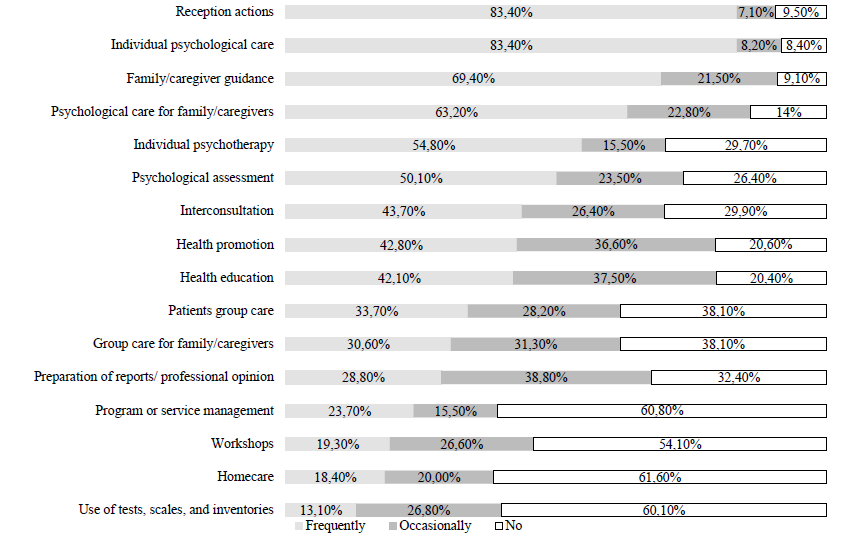
Respondents indicated the daily professional practices that they performed frequently, occasionally or not at all (Figure 1). The most frequent were reception actions (83.4%), individual psychological care (83.4%) and guidance to family members/caregivers (69.4%). Regarding the application of standardized tests and scales, 60.1% reported not using these instruments, neither performing home/care visits (61.6%) or facilitating workshops (54.1%).
Based on the 16 health practices (Figure 1), a score was composed, as explained in the instrument section. The premise was that performing a greater diversity of psychological procedures and practices could indicate modes of action that are more compatible with the different needs and demands of the health area, in line with the biopsychosocial conception of the health-disease process. A score ranging from zero to 32 was calculated: the average score was 17.99 (SD=5.93; Mdn = 18.0; min. = 2; max. = 32).
Expectations and perceptions of work in health
Expectations and perceptions of work in health were analyzed by 13 statements evaluated on a 5-point Likert scale. Just to describe the result of some items, aiming to aggregate and summarize this information, the responses were grouped into three levels: tendency to agree (completely agree and agree), midpoint, and tendency to disagree (disagree and completely disagree). Item analysis of the instrument investigated those with a strong tendency to agree: The item “I am interested in continuing to work in the area of health psychology” obtained 84.7% agreement, followed by “I feel the need for specific training to improve my professional practice in the area”, with 76.9%. Another item with high agreement was “My work as a psychologist is recognized by the health team with which I work”, reaching 76.7% of positive responses. Finally, the statement “Health has been my area of interest since my undergraduate course” obtained a 75.8% tendency to agree. These data revealed motivation to continue working in the area, perception of recognition for the performance achieved, along with an interest that has been present since graduation.
The analysis by item also investigated those with the highest percentage of tendency to disagree. The statement with the highest disagreement was “What most contributed to my choice of the area of health psychology were the opportunities in the job market”, with 41.9% of responses. This reflects the idea that interest in the health area was more influenced by personal motivations and interests, and not the result of contingencies in the job market. Next, the item “My work is carried out in a multidisciplinary team” received 31.0% disagreement, followed by the statement “Communication between the professionals on the team where I work is carried out in a clear and objective manner” which reached 29.9%. Finally, “The professionals with whom I work constitute an interdisciplinary team” received 26.4% disagreement. The results of these three items show challenges in the sphere of professional relationships and communication between team members.
In addition to this descriptive analysis by item, a score for this variable was calculated based on the arithmetic mean of the 13 items, obtaining a continuous measure ranging from 1 to 5. The mean score was 3.69 (SD = 0.55; Mdn = 3.77; minimum = 1.38; maximum = 5.00), indicating great variability in the responses, with some professionals revealing very positive expectations and perceptions about working in health, while others showed unfavorable expectations and views.
Associations between study variables
Based on some study variables, the Student’s t-test for independent samples was used to assess to what extent the levels of expectations and perceptions about work in health were different (Table 3). The results showed that professionals who conducted research had statistically higher scores (M = 3.81; SD = .54) compared to those who did not (M = 3.64; SD = .55) (t(449) = -3.12; p ≤ .01), although the effect size of this difference was small (Cohen’s = 0.31). A significant difference between the mean scores was observed in relation to performing supervision at the current or previous time (M = 3.74; SD = .55) compared to not performing this activity (M = 3.61; SD = .55) (t(443) = -2.42; p ≤ .05), although the effect size was negligible (Cohen’s d = 0.18). No difference was found in this variable in relation to undergraduate versus postgraduate training, and neither in relation to working in a hospital versus in other health units.
Regarding professional practices (Table 3), the results revealed the higher mean score of those who had a specialization or master’s/doctorate postgraduate degree (M = 18.33; SD = 6.02) with statistical significance, compared to those with an undergraduate degree (M = 16.32; SD = 6.03) (t(446) = -2.72; p ≤ .01), and the effect size of the difference was small (Cohen’s d = 0.36). Regarding supervision, the analysis also showed that this experience led to a statistically different mean score in professional practices (M = 18.78; SD = 6.78) compared to those who did not supervise (M = 16.61; SD = 5.81)(t(440)= -3.86; p ≤ .001), with high effect size of this difference (Cohen’s d = 0.92). No relevant differences in relation to professional practices were identified between professionals who conducted research and those who did not, and neither between professionals working in a hospital and those working in other health units.
Discussion
The study sought to outline a sociodemographic and professional profile of psychologists working in the health system in Brazil. The results confirm the historical characteristic of psychology as a female profession also among health professionals (CFP, 1988; 2022a). There was a significant number of respondents who graduated from private institutions, had postgraduate courses, worked in public hospitals and participated in scientific events. Investment in training may reflect both the need for improvement to deal with the complexity of psychology and to increase employability. These data are consistent with the findings of Seidl et al. (2019), according to which one third of professionals had postgraduate courses, worked predominantly in public hospitals and participated in scientific events.
Regarding training, most participants took courses and supervised internships in the health area, which may reflect the changes proposed by the National Curricular Guidelines (Diretrizes Curriculates Nacionais - DCNs) for undergraduate courses in Psychology implemented since 2004 in Brazil. The National Curricular Guidelines propose the development of biopsychosocial training with a critical view of sociocultural phenomena and legitimize health as a field of activity for psychologists, encourage the development of skills and competencies that enable them to work in teams, defending the idea of a diversified and comprehensive training as favorable for working in the SUS, identified as a scenario of greater professional employment by participants in this study (Conselho Nacional de Educação [CNE], 2023; Oliveira et al., 2023).
Concerning salary range, low salaries were observed, as almost half of participants reported receiving up to three minimum wages. This datum is similar to that of the last census of the category carried out by the CFP, in which 34.2% of psychologists earned up to three minimum wages from the profession (CFP, 2022a). Furthermore, in general, the participants reported a weekly workload of 31 to 40 hours, seeking other paid professional activities in the clinic and teaching, perhaps as a way to supplement their income. Working in other occupations was also observed in the study by Seidl et al. (2019), which can be explained by the insufficient remuneration obtained in the health area, leading professionals to seek other jobs. Excessive workload to obtain adequate income was also observed in the CensoPsi, in which a portion of professionals declared a weekly workload of more than 50 hours in order to obtain an average of seven minimum wages (CFP, 2022a). Data suggests that health psychologists may have precarious payment, a situation that also affects other workers in the field.
Regarding professional activity, general and specialized hospitals were the places most occupied by participants. This is consistent with the history of the field in the country, which began with the greater employment of professionals in hospital services (Baptista et al., 2025). No clinical specialty was significantly associated with the work of psychologists, which may be the result of the reduced number of professionals in health units, leading them to work in more than one sector, program or specialization. Health psychology seems to base its practices on different theoretical-methodological frameworks for acting and understanding the health-disease process and is not linked to any exclusive line of thought. The diversity of psi approaches reported by the participants reaffirms this idea, in line with other studies (Seidl et al., 2019), although further research is still needed to better elucidate this result.
A large number of participants in this study did not conduct research or scientific activities. However, the results indicated that the professionals who reported conducting research had more favorable expectations and perceptions about their work in the field. The low level of participation in scientific activities and limited contact with scientific production in the field can make it difficult to understand the needs of patients and family members, use evidence-based techniques and therapies, map challenges, and implement a routine for evaluating actions that may be beneficial to users of the system, in addition to assist in the training of professionals (Santos et al., 2019).
Data showed a great variability in the practices performed by psychologists in the context of health services, which may indicate forms of practice that are compatible with the different needs and demands of users and populations. The professionals who most diversified their practices were those with postgraduate training, and those with experience in supervision, which demonstrates the importance of qualified and continuous training.
The results indicated that psychotherapy is not the predominant type of psychological intervention in health services. The individual care provided by psychologists includes various activities, such as reception, individual psychological care and health education, for example, procedures that are part of the assignment of psychologists working in healthcare teams. User reception is an essential activity in the health system, in line with actions of humanization and comprehensive care. Therefore, the practice of user reception is defended as a light technology to be continuously incorporated into the care routine by all health workers (CFP, 2019). The occurrence of certain reported theoretical and methodological frameworks as well as some practices, especially individual psycotherapy, may represent influences from the clinical model acquired during undergraduate training, contradicting the assumptions of the biopsychosocial perspective in health (Baptista et al., 2025). Future studies could elucidate the application of these frameworks in the context of public health.
Individual actions were observed to be more prevalent than initiatives aimed at groups of patients or family members/caregivers, similar to what was observed by Bruscato and Condes (2020). Visits or homecare, the use of standardized tests and scales, and the facilitation of workshops were identified as less frequent actions. In the study by Seidl et al. (2019), a low frequency in the use of tests and scales was also found, indicating that psychological assessment in the health area may be predominantly carried out through interviews and observations. This may occur, for example, due to professionals’ lack of knowledge about validated instruments for the context of disease prevention and treatment, many of which are in a brief format, which is faster and more feasible to apply in public health contexts (Oliveira et al., 2023). As for home visits, this care practice is still rarely used by psychologists, although it helps to create bonds and better understand the life context of users, often in complex social situations (Lima et al., 2021). Furthermore, it usually occurs as an institutional team service, favoring interdisciplinarity.
Concerning expectations regarding work in the health area, the participants’ responses revealed greater agreement in relation to their interest in continuing to work in the area, the need for specific training, and the recognition of the contributions of psychology by the health team. The inclination to work in health proved to be more supported by personal motivation than by the job market, as also found by Seidl et al. (2019). A greater tendency for participants’ disagreement with statements regarding working in a multidisciplinary team and the observation of clear and objective communication between professionals were also found. This was also observed by Seidl et al. (2019), revealing challenges for the effective integration of work in a multidisciplinary and interdisciplinary team, according to participants’ perception (Clouder et al., 2022).
This study has limitations. It relied on a non-probabilistic convenience sample that is not representative of psychologists working in the health field in Brazil, which limits the generalizability of the findings. One difficulty is that access to psychologists depended on the release of online invitations by the CFP and CRPs, with the frequency of dissemination left to the award of these institutions. As a result, the sample was also uneven in terms of professionals working in health services and programs in the different states of the federation. In terms of future perspectives and initiatives, further studies should be carried out to help understand the practices of psychologists at different levels of healthcare, both with regard to their specificities and the actions shared with other professionals on work teams. Further detailing the practices with specific populations will help identify gaps in training and professional performance.
The study presented a wide range of data on the work of psychologists in the health field, contributing to the understanding of how psychology has served new audiences and demands in a society that is constantly changing, with innovations and adjustments in its set of practices. The results indicate a multiplicity of practices carried out with a broad and diverse audience and in different locations, including actions in the community as well as in highly specialized institutions. One of the challenges is the importance of investing in professional qualification at the postgraduate level in the field and training in research, so that psychologists are not mere reproducers of practices, but rather creators of those based on evidence to help solve specific problems of their target audience.
References
- Baptista, M. N., Laloni, D. T., Miyazaki, M. C. O. S., & Baptista, A. S. D. (Eds.). (2025). Psicologia hospitalar: Teorias, aplicações e casos clínicos [Hospital psychology: Theory, applications, and clinical cases] (4a ed.). Guanabara Koogan
-
Bruscato, W. L., & Condes, R. P. (2020). Caracterização do atendimento psicológico na saúde. [Characterization of psychological care in health]. Psicologia: Teoria e Pesquisa, 36, e3642. https://doi.org/10.1590/0102.3772e3642
» https://doi.org/10.1590/0102.3772e3642 -
Clouder, L., Bluteau, P., Jackson, J. A., Adefila, A., & Furlong, J. (2022). Education for integrated working: A qualitative research study exploring and contextualizing how practitioners learn in practice. Journal of Interprofessional Care, 36(1), 24-33. https://doi.org/10.1080/13561820.2021.1889485
» https://doi.org/10.1080/13561820.2021.1889485 - Conselho Federal de Psicologia. (1988). Quem é o psicólogo brasileiro? [Who is the Brazilian psychologist?]. Edicon.
- Conselho Federal de Psicologia. (2019). Referências técnicas para atuação de psicólogas(os) nos serviços hospitalares do SUS [Technical references for the work of psychologists in SUS hospital services].
- Conselho Federal de Psicologia. (2022a). Quem faz a psicologia brasileira? Um olhar sobre o presente para construir o futuro: Condições de trabalho, fazeres profissionais e engajamento social (Vol. 2) [Who makes Brazilian psychology? A look at the present to build the future: Working conditions, professional activities and social engagement].
-
Conselho Federal de Psicologia. (2022b, 13 de outubro). Resolução No. 23, de 13 de outubro de 2022 . Institui condições para concessão e registro de psicóloga e psicólogo especialistas [Establishes conditions for granting and registering specialist psychologists and psychologists]. Diário Oficial da União https://www.in.gov.br/en/web/dou/-/resolucao-n-23-de-13-de-outubro-de-2022-437945688
» https://www.in.gov.br/en/web/dou/-/resolucao-n-23-de-13-de-outubro-de-2022-437945688 -
Conselho Nacional de Educação. (2023, 11 de outubro). Resolução CNE/CES No. 1, de 11 de outubro de 2023. Institui as Diretrizes Curriculares Nacionais para os cursos de graduação em Psicologia [Establishes the National Curricular Guidelines for undergraduate courses in Psychology]. Diário Oficial da União https://www.in.gov.br/web/dou/-/resolucao-cne/ces-n-1-de-11-de-outubro-de-2023-518120795
» https://www.in.gov.br/web/dou/-/resolucao-cne/ces-n-1-de-11-de-outubro-de-2023-518120795 -
Ferreira, I. S. S., & Soares, C. T. (2021). Residência multiprofissional em saúde e formação de psicólogos para o SUS [Multiprofessional residency in health and training of psychologists for the SUS]. Psicologia: Ciência e Profissão, 41(spe2), e219139 https://doi.org/10.1590/1982-3703003219139
» https://doi.org/10.1590/1982-3703003219139 -
Gorayeb, R. (2010). Psicologia da saúde no Brasil [Health psychology in Brazil] . Psicologia: Teoria e Pesquisa, 26(spe), 115-122. https://doi.org/10.1590/S0102-37722010000500010
» https://doi.org/10.1590/S0102-37722010000500010 -
Khalili, H., & Price, S. L. (2021). From uniprofessionality to interprofessionality: Dual vs dueling identities in healthcare. Journal of Interprofessional Care, 36(3), 473-478. https://doi.org/10.1080/13561820.2021.1928029
» https://doi.org/10.1080/13561820.2021.1928029 -
Lima, M., Alves, J. B., Lago, L., Rebouças, F., & Grave, L. (2021). Visita domiciliar na atenção primária à saúde: Contribuições para a formação em Psicologia [House calls at primary health care: Contributions to psychology training]. Revista Psicologia, Diversidade e Saúde, 10(3), 442-454. https://doi.org/10.17267/2317-3394rpds.v10i3.3468
» https://doi.org/10.17267/2317-3394rpds.v10i3.3468 -
Matarazzo, J. D. (1980). Behavioral health and behavioral medicine: Frontiers for a new health psychology. American Psychologist, 35(9), 807-817. https://doi.org/10.1037/0003-066X.35.9.807
» https://doi.org/10.1037/0003-066X.35.9.807 -
Ministério da Saúde. (2022). Atenção primária e atenção especializada [Primary care and specialized care]. https://www.gov.br/saude/pt-br/assuntos/noticias/2022/marco/atencao-primaria-e-atencao-especializada-conheca-os-niveis-de-assistencia-do-maior-sistema-publico-de-saude-do-mundo
» https://www.gov.br/saude/pt-br/assuntos/noticias/2022/marco/atencao-primaria-e-atencao-especializada-conheca-os-niveis-de-assistencia-do-maior-sistema-publico-de-saude-do-mundo -
Oliveira, F. F., Coelho, S. G., Santos, J. A., Duarte, F. L., & Faria, M. E. L. (2023). Psicologia e políticas públicas no Brasil: Convergências nas práxis do campo profissional [Psychology and public policies in Brazil: Convergences in the practices of the professional field]. Cadernos de Psicologia, 1(1), 1-18. https://doi.org/10.9788/CP2023.1-01
» https://doi.org/10.9788/CP2023.1-01 -
Organização Mundial da Saúde. (2010). Marco para ação em educação interprofissional e prática colaborativa [Framework for action in interprofessional education and collaborative practice]. https://untref.edu.ar/uploads/Marco%20formacion%20interprofesional%20OMS-portugues.pdf
» https://untref.edu.ar/uploads/Marco%20formacion%20interprofesional%20OMS-portugues.pdf -
Peres, C. N., Meine, I. R., Jager, M. E., & Costa, D. F. C. (2025). As práticas psicológicas no Sistema Único de Saúde: Uma revisão integrativa [Psychological practices in the Brazilian Unified Health System: An integrative review]. Revista Psicologia e Saúde em Debate, 11(1), 694-718. https://doi.org/10.22289/2446-922X.V11A1A42
» https://doi.org/10.22289/2446-922X.V11A1A42 -
Santos, A. O., Barros, F. P. C., & Delduque, M. C. (2019). A pesquisa em saúde no Brasil: Desafios a enfrentar [Health research in Brazil: Challenges to face]. Saúde em Debate, 43(spe5), 126-136. https://www.researchgate.net/publication/342342256_A_pesquisa_em_saude_no_Brasil_desafios_a_enfrentar#fullTextFileContent
» https://www.researchgate.net/publication/342342256_A_pesquisa_em_saude_no_Brasil_desafios_a_enfrentar#fullTextFileContent -
Taylor, S. (2022). The psychology of pandemics. Annual Review of Clinical Psychology, 18, 581-609. https://doi.org/10.1146/annurev-clinpsy-072720-020131
» https://doi.org/10.1146/annurev-clinpsy-072720-020131 - Seidl, E. M. F., & Miyazaki, M. C. O. S. (Orgs.). (2014). Psicologia da saúde: Pesquisa e atuação profissional no contexto de enfermidades crônicas [Health psychology: Research and professional practice in the context of chronic illnesses]. Juruá.
-
Seidl, E. M. F., Duarte, S. C. S., Magalhães, D. B., & Costa, M. V. (2019). Profile and professional practices of health psychologists of the Federal District. Trends in Psychology, 27(1), 249-264. http://dx.doi.org/10.9788/TP2019.1-18
» http://dx.doi.org/10.9788/TP2019.1-18 - Straub, R. O. (2022). Health psychology: A biopsychosocial approach (7th ed.). Worth.
-
How to cite this article:
Seidl, E. M. F., Castro, E. K., Mendes-Chiloff, C. L., Melo, C.F., Queiroz, E., Hildebrandt, F. M. P., Nogueira, G. S., Kirchner, L. F., Miyazaki, M. C. O. S., Domingos, N. A. M., Alves, S. H. S., & Borges, L. M. (2026). Profile and professional practices of health psychologists: A Brazilian survey. Paidéia (Ribeirão Preto), 36, e3614. https://doi.org/10.1590/1982-4327e3614
-
Data Availability
The datasets generated and/or analyzed during the current study are available from the corresponding author on reasonable request.
The datasets generated and/or analyzed during the current study are available from the corresponding author on reasonable request.