 Hydrological regime modulates functional anatomy, imbibition dynamics, and early establishment of Copernicia alba seeds under submerged conditions1
ABSTRACT
Seed traits associated with tolerance to flooding are poorly understood in tropical palms, despite their potential importance for establishment in wetlands. This study aimed to evaluate whether composite seed lots collected from flooded and dry sites differ in functional anatomical traits, water uptake dynamics, germination, mean germination time, and normal seedling formation under submerged conditions. The composite lots were compared for seed anatomy, histochemistry, chemical composition, imbibition, greenhouse emergence, mean germination time, and post-germinative performance. Seeds from the flooded-site lot had a thicker inner epidermis, greater total seed-coat thickness, and a larger relative lipid area in the endosperm than seeds from the dry-site lot. Water uptake followed a triphasic pattern in both lots; however, the flooded-site lot showed slower initial imbibition and a longer mean germination time under water. In sawdust + sand, germination was similar between lots, whereas under water the flooded-site lot reached 86.50 % of germination and the dry-site lot 45.01 %. The contrast was even more pronounced for normal seedling formation: the flooded-site lot maintained 100 % of normal seedlings in both substrates, whereas the dry-site lot reached only 6.85 % under water.
KEYWORDS:
Carandá; flood tolerance; functional seed anatomy; wetland palms
RESUMO
Características de sementes associadas à tolerância a inundação são pouco compreendidas em palmeiras tropicais, apesar de sua importância potencial para o estabelecimento em áreas úmidas. Objetivou-se avaliar se lotes compostos de sementes coletados em sítios inundáveis e secos diferem em características anatômicas funcionais, dinâmica de absorção de água, germinação, tempo médio de germinação e formação de plântulas normais sob água. Os lotes compostos foram comparados quanto à anatomia de sementes, histoquímica, composição química, embebição, emergência em condições de casa de vegetação, tempo médio de germinação e desempenho pós-germinativo. As sementes do lote proveniente de sítio inundável apresentaram maior espessura da epiderme interna, maior espessura total do tegumento e maior área lipídica relativa no endosperma do que as sementes do lote proveniente de sítio seco. A absorção de água seguiu padrão trifásico em ambos os lotes, mas o lote de sítio inundável apresentou embebição inicial mais lenta e maior tempo médio de germinação sob água. Em serragem + areia, a germinação foi semelhante entre os lotes, enquanto sob água o lote inundável alcançou 86,50 % de germinação e o lote seco 45,01 %. O contraste foi ainda mais forte para a formação de plântulas normais: o lote inundável manteve 100 % de plântulas normais em ambos os substratos, enquanto o lote seco atingiu apenas 6,85 % sob água.
PALAVRAS-CHAVE:
Carandá; tolerância a inundação; anatomia funcional da semente; palmeiras de áreas úmidas
INTRODUCTION
Copernicia alba (Morong ex Morong & Britton), commonly known as carandá, is a widely distributed palm of the Pantanal biome that occurs under contrasting hydrological regimes. Because the species occurs both in dry sites and in areas subjected to prolonged water saturation, it provides a useful system for investigating how seed traits relate to early development under flooding. In seasonally flooded ecosystems, recruitment success depends not only on germination initiation, but also on the ability of propagules to sustain post-germinative development under water-saturated conditions, where water uptake, gas exchange, and seedling establishment may be strongly constrained (Kozlowski 1984, Crawford 1992, Lobo & Joly 1998).
In seeds, covering tissues and reserve compounds play central roles in regulating hydration and supporting early development. Seed-coat traits may influence the rate and pattern of water entry, whereas reserve-rich tissues may affect the capacity of the embryo and associated structures to maintain metabolism during germination and post-germinative growth (Bewley & Black 1994, Marcos-Filho 2015, Upretee et al. 2024).
In Arecaceae, several studies have highlighted the functional relevance of endosperm organization, reserve mobilization, and seed histochemistry during germination and establishment (Dias et al. 2018, Dias et al. 2020, Pereira et al. 2021). Thus, in palms, seed structure is relevant not only descriptively, but also as a potential contributor to germination dynamics and early seedling performance.
In species exposed to flooding, however, the critical bottleneck is not always germination itself. In many cases, the transition from germination to establishment is the stage at which developmental failure becomes most evident, especially when oxygen diffusion is limited and tissue integrity must be maintained under prolonged water exposure (Crawford 1992, Lobo & Joly 1998). This distinction is particularly important because studies focused exclusively on final germination percentage may fail to detect biologically relevant differences in post-germinative resilience.
For C. alba, Soares et al. (2022) showed that hydration conditions influence pyrene germination, indicating that the species responds sensitively to water exposure. However, it remains unclear whether seeds produced at contrasting hydrological sites differ not only in structural traits, but also in their ability to sustain successful post-germinative development under flooding. This is an important gap because such differences would indicate that site-associated variation may be expressed not only in seed anatomy, but also in the functional relationships among seed coverings, reserve composition, imbibition behavior, and early establishment.
Therefore, this study evaluated whether seeds from flooded and dry sites differ in functional anatomical traits, water uptake dynamics, germination, mean germination time, and normal seedling formation under flooding. We hypothesized that seeds from the flooded site would differ in protective tissues, reserve-related traits, hydration dynamics, and performance under flooding, particularly during the transition from germination to seedling establishment.
MATERIAL AND METHODS
This study compared composite seed lots obtained from two contrasting hydrological sites, hereafter referred to as the flooded site and the dry site. Because Copernicia alba fruits were collected during repeated field visits between March 2022 and December 2024, pooled within origin, and stored before analysis, hydrological origin is interpreted here as a lot-level descriptor. Therefore, the design does not allow site hydrology to be fully disentangled from maternal, genetic, year-of-collection, or storage-related effects. Accordingly, all results are interpreted as associations between contrasting composite seed lots rather than as definitive causal effects of site hydrology alone.
Mature fruits of Copernicia alba were collected at two sites within the Reserva Particular do Patrimônio Natural Jubran, in Cáceres, Mato Grosso state, Brazil, hereafter designated as the flooded site and the dry site. Both sites occur within the same legally protected reserve and share the same regional climate, but they differ in local hydrological conditions. The flooded site is a low-lying area that becomes seasonally inundated during the rainy season and may retain standing water for weeks to months, whereas the dry site is topographically higher and remains free of standing surface water during the same period. The distinction between sites was established from repeated in situ observations during fortnightly visits throughout the monitoring period, rather than from a historical hydrological series or remote-sensing classification.
Twenty adult plants were marked at each site and monitored every 15 days between March 2022 and December 2024 for phenological follow-up and collection of mature fruits when available. Thus, each composite lot integrated seeds produced by the fruiting mother plants represented in the monitored population over the collection period. After collection, fruits from each site were transported to the laboratory, sanitized by immersion in 2 % sodium hypochlorite solution, with visually damaged fruits being discarded. For each site, fruits collected across monitoring events were combined into a composite lot and stored in polyethylene bags at 12 ºC until analysis. Because the collections accumulated over time, the storage duration varied among collection events within each lot; however, both lots were processed, stored under the same protocol, and analyzed in parallel. For the greenhouse establishment assay, 800 seeds were used in each origin × substrate combination, except for the dry-site × water treatment, which included 811 seeds because of lot availability and plot balancing.
For morphological, anatomical, and histochemical analyses, 20 isolated seeds from each composite lot were sampled. The material was fixed in formaldehyde-acetic acid-70 % ethanol (FAA) for 48 h and then stored in 70 % ethanol. The samples were dehydrated in an ethanol series, softened for one week in 10 % ethylenediamine prepared in 60 % ethanol, and embedded in 2-hydroxyethyl methacrylate (Historesin Leica®). Longitudinal and transverse sections (8 µm thick) were obtained using a rotary microtome. The sections were mounted on microscope slides coated with synthetic adhesive (Permount®), stretched on a warming plate, and stained with toluidine blue in citrate buffer at pH 4.0. Histochemical tests were performed with ferric chloride III for general phenolic compounds and Sudan Red B for lipids. The anatomical and histochemical procedures followed standard plant microtechnique and histological approaches described by Johansen (1940), Gabe (1968), and O’Brien & McCully (1981). Photomicrographs were obtained using a Canon PowerShot A650 IS digital camera coupled to a Zeiss Primo Star light microscope.
Quantitative anatomical measurements were obtained from four independently processed seeds per composite lot, with each seed constituting one independent analytical unit (anatomical matrix). For each anatomical matrix, representative measurements were obtained for inner epidermis thickness (µm), total seed-coat thickness (µm), number of intermediate parenchyma layers, and relative lipid area in the endosperm (%). Multiple sections were prepared from each seed, and measurements were taken from standardized, well-preserved fields selected from representative sections. For each anatomical matrix, three representative sections were analyzed, and three standardized microscopic fields were measured per section. Thus, each matrix value was obtained from the mean of nine analyzed fields.
Relative lipid area was quantified from Sudan Red B-stained sections using a standardized digital image-analysis workflow. Micrographs were acquired under identical optical conditions, including magnification, illumination, and exposure settings. For each anatomical matrix, standardized fields of the endosperm were selected from representative sections, avoiding damaged regions and sectioning artifacts. Images were analyzed in Fiji/ImageJ, following the general workflow recommended for biological image analysis by Schindelin et al. (2012). The region of interest corresponded to the total endosperm area visible in each field, and lipid-rich regions stained by Sudan Red B were segmented using a fixed threshold applied uniformly to all images. Relative lipid area was calculated as the Sudan Red B-positive area divided by the total analyzed endosperm area and expressed as percentage. For each anatomical matrix, the final value was obtained as the mean of the analyzed fields.
Pericarp and seed fractions were analyzed separately in each composite lot. In the present manuscript, only the variables used in the Results are presented: crude protein, fixed oil, ash, and titratable acidity. Crude protein was determined by the Kjeldahl method using a conversion factor of 6.25, and fixed oil by Soxhlet extraction with hexane as the solvent, using 3-g aliquots. The ash content was determined by incineration in a muffle furnace at 550 ºC until constant mass. Titratable acidity was determined by suspending 1 g of sample in 50 mL of distilled water and titrating with 0.1 M NaOH. The analytical procedures followed the AOAC (2000). Four analytical replicates were considered for each origin × fraction combination, corresponding to analytical subsamples from homogenized material, and should not be interpreted as independent biological replicates.
Imbibition was evaluated using four independent subsamples of 25 seeds from each composite lot. The seeds were immersed in 100-mL beakers containing distilled water and maintained at 25 ºC under constant light. The seed mass was recorded at 11 time points (0, 1, 2, 4, 6, 12, 24, 48, 72, 96, and 120 h). At each time point, the seeds were removed from the beakers, blotted dry with paper towels, and weighed. The relative water gain was calculated as [(Mt - M0)/M0] × 100, where M0 is the initial seed mass and Mt the seed mass at time t. The imbibition pattern was interpreted according to the classical triphasic framework proposed by Vertucci & Leopold (1983), and the general approach adopted for palms followed Rodrigues-Junior et al. (2013).
The germination and post-germinative establishment experiment was conducted under greenhouse conditions and natural light, with a mean daily temperature of approximately 28 ºC, using 20 × 60 cm trays arranged in a completely randomized layout. Because this phase was performed under natural light and fluctuating greenhouse temperature, it is interpreted here as an establishment experiment rather than as a standardized laboratory germination test. Two substrates were evaluated: sawdust + washed sand, mixed at a 1:1 volume ratio and irrigated daily, and water, maintained as a shallow 5-cm water column under stagnant conditions, with minimal replacement every two days to compensate for evaporation. This procedure was adopted to simulate the flooded field condition observed at the flooded site, characterized by standing water with very slow renewal. During the water treatment, the depth of the water column and the replacement frequency were standardized. Dissolved oxygen and direct indicators of anoxia were not measured. The curated dataset analyzed in the present manuscript consisted of five analytical plots per treatment, totaling 160-163 seeds per plot. Germination was defined as cotyledonary petiole protrusion greater than 1 mm and monitored for 60 d. After germination, the seeds remained in their respective substrates for an additional period of 60 d for the assessment of normal seedling formation. Germination in C. alba was classified as remote tubular, with elongation of the cotyledonary petiole, formation of the primary root, secondary roots, germinative bud, and first eophyll. Normal seedlings were classified according to Brasil (2009) and ISTA (2024).
The mean germination time was calculated from sequential germination counts recorded for each plot according to the equation MGT = Σ(niti)/Σni, where ni is the number of seeds germinated at time ti, and ti is the time in days from sowing. The calculation and interpretation of mean germination time followed the general recommendations for germination-process analysis proposed by Ranal & Santana (2006). The mean germination time was analyzed as a complementary descriptor of the temporal organization of germination and interpreted together with cumulative germination curves and final germination performance.
Given the observational design, the site-derived lot was treated as a fixed lot-level factor. Quantitative anatomical variables were analyzed using Gaussian linear models comparing the two composite lots. Assumptions of normality and homoscedasticity were verified by residual inspection. Chemical composition was analyzed with linear models, including origin, fraction (pericarp or seed), and the origin × fraction interaction. Imbibition data were analyzed as repeated measurements using mixed-effects models, with origin, time, and the origin × time interaction as fixed effects and subsample as a random effect.
Final germination was analyzed using a generalized linear model with a binomial distribution and logit link, considering the number of germinated seeds in relation to the total number of seeds per plot. Normal seedling formation was analyzed using penalized logistic regression because complete separation was observed in the flooded-site treatments, which showed 100 % of normal seedlings among germinated seeds. Thus, the percentage of normal seedlings refers to the number of normal seedlings in relation to the number of germinated seeds, not to the total number of seeds sown. For all models, significance was assessed at 5 %. Whenever relevant, odds ratios and 95 % confidence intervals are presented to facilitate the biological interpretation of effect size. Statistical analyses were performed in Python 3.13 using the packages pandas, SciPy, statsmodels, and matplotlib.
RESULTS AND DISCUSSION
The comparison between seed lots from contrasting hydrological sites revealed a coherent pattern involving seed structure, hydration dynamics, germination performance under flooding, and post-germinative development. Fruit and seed morphology are shown in Figure 1, representative seed-coat anatomy and histochemical reactions are shown in Figure 2, and embryo morphology and anatomy are presented in Figure 3. Quantified anatomical differences between the two seed lots are summarized in Table 1.


Seed-coat anatomy and histochemical detection of phenolic compounds in Copernicia alba seeds from dry and flooded sites. a-b) Seed-coat cross-sections stained with toluidine blue showing tissue organization, including outer epidermis (ee), parenchyma (pi), and inner epidermis (el). The inner epidermis is thicker in seeds from the flooded site; c-d) histochemical reaction for phenolic compounds (FeCl3), showing their distribution along the seed coat; e-f) inner epidermis stained with Sudan Red B, indicating lipid bodies and a greater relative lipid area in seeds from the flooded site. Scale bars = 50 µm.
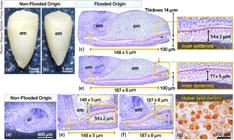
Morphological and anatomical aspects of the embryo of Copernicia alba. a) Stereomicroscopic view of the embryo; b) histological section showing the general organization of embryonic tissues; c-d) histochemical details of reserve compounds in embryo tissues, as indicated; e-f) comparative measurements of seed-coat thickness between site-derived lots (mean ± SE); g) embryo stained with Sudan Red B, indicating higher lipid density in seeds from the flooded site. Scale bars are indicated in each panel. em: embryo; pl: plumule.
The most pronounced anatomical differences between the two lots involved inner epidermis thickness, total seed-coat thickness, and relative lipid area. The inner epidermis thickness was 23.32 ± 0.60 µm in the flooded-site lot and 15.65 ± 0.83 µm in the dry-site lot, representing an increase of approximately 49 % in the flooded-site lot. The total seed-coat thickness was also greater in the flooded-site lot (103.40 ± 1.76 µm) than in the dry-site lot (97.33 ± 1.67 µm), whereas the relative lipid area increased from 21.18 ± 1.32 % in the dry-site lot to 33.17 ± 1.37 % in the flooded-site lot (Table 1).
By contrast, the number of intermediate parenchyma layers did not differ significantly between the lots. This pattern indicates that the structural differences between seed lots were not diffuse, but concentrated in traits more directly associated with the seed coat-endosperm system. The greater thickness of the inner epidermis and the greater total seed-coat thickness in the flooded-site lot are consistent with a more differentiated protective interface between the seed and the external environment, whereas the greater relative lipid area suggests that differences between lots also extended to reserve-related traits. However, these results should be interpreted with caution. Although the observed anatomical differences are consistent with a functional role of seed coverings in hydration dynamics, the present study did not directly measure permeability, resistance to water entry, or oxygen diffusion. Therefore, the proposed mechanism should be interpreted as a biologically plausible inference rather than direct proof.
The histochemical evidence shown in Figure 2 supports this interpretation by revealing phenolic compounds along the seed coat and lipid-rich areas associated with the Sudan Red B reaction. In palms, both seed coverings and reserve-rich tissues have been recognized as functionally relevant during germination and establishment, especially when water relations and reserve mobilization are involved (Nazário et al. 2013, Dias et al. 2018, Dias et al. 2020, Pereira et al. 2021). In the present case, the combination of thicker inner protective tissues and greater relative lipid area in the flooded-site lot is consistent with the broader literature indicating that differences in covering tissues and reserve organization may be associated with distinct early developmental trajectories. Still, the present study does not demonstrate that these anatomical traits directly control water entry or explain flooding performance by themselves. Rather, it supports the interpretation that the two seed lots differed in structural attributes compatible with different hydration and establishment behaviors.
Chemical composition varied according to both fraction and lot origin (Table 2). Crude protein, fixed oil, and ash showed significant effects of origin, fraction, and origin × fraction interaction, whereas titratable acidity showed significant main effects of origin and fraction, but no significant interaction. In practical terms, seed fractions had higher crude protein and fixed oil contents than pericarp fractions, whereas flooded-site material tended to show higher protein, fixed oil, and ash values, especially in the pericarp. Because these variables were not measured dynamically during germination, the chemical dataset should be interpreted as complementary evidence rather than as a direct explanatory axis of flooding performance. Even so, it reinforces the interpretation that differences between lots were not restricted to seed coverings, but also extended to reserve-associated traits during germination and early establishment in palms (Dias et al. 2018, Dias et al. 2020, Bicalho et al. 2016).
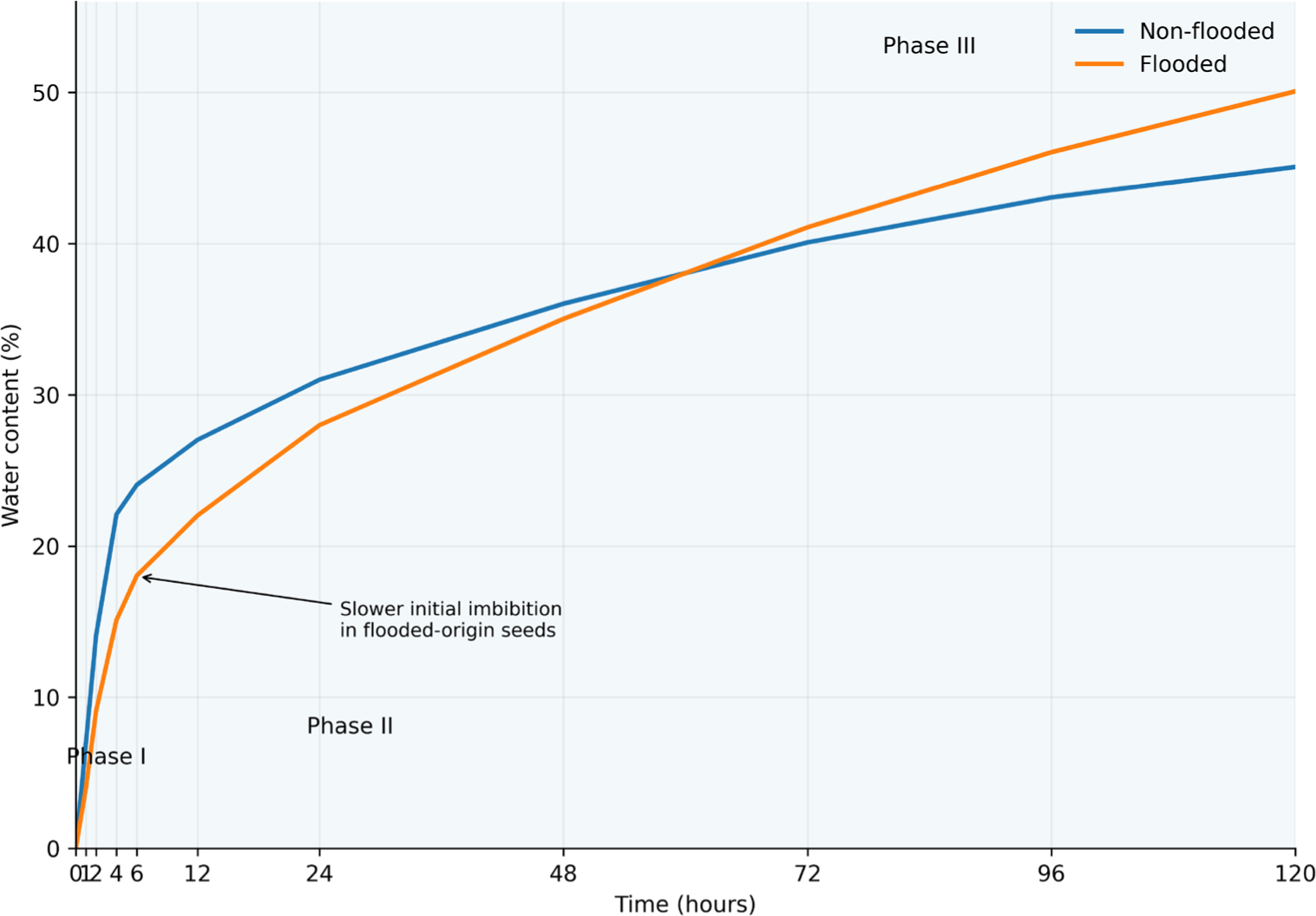
Imbibition was strongly affected by time (LR χ² = 402.392; df = 10; p < 0.001) and by lot origin (LR χ² = 21.532; df = 1; p < 0.001), with a significant origin × time interaction (LR χ² = 164.387; df = 10; p < 0.001). These results indicate that the two seed lots differed in hydration dynamics across the evaluation period. Flooded-site seeds showed faster initial water gain, reaching 8.02 ± 0.24 % after 1 h, whereas flooded-origin seeds reached 4.85 ± 0.58 % at the same time. By the end of the evaluation period, both lots reached similar final values, with a slight numerical advantage for the flooded-origin lot (34.01 ± 0.14 % vs. 33.61 ± 0.10 % at 120 h) (Figure 4).

Thus, the most informative difference between lots was not the final amount of absorbed water, but the temporal organization of hydration, especially during the earliest stages of imbibition. This pattern is biologically relevant because the initial hydration phase is critical for the transition from a dry seed to a metabolically active propagule (Bewley & Black 1994, Marcos-Filho 2015). Although the present study did not directly evaluate hydraulic conductivity or gas diffusion, the combination of slower initial water uptake and thicker internal protective tissues in the flooded-site lot is consistent with differentiated early hydration behavior under water-saturated conditions. This interpretation agrees with previous studies showing that seed traits can strongly influence hydration dynamics before germination, including in palms (Vertucci & Leopold 1983, Rodrigues-Junior et al. 2013, Upretee et al. 2024).
The final germination was significantly affected by lot origin (LR χ² = 158.236; df = 1; p < 0.001), substrate (LR χ2 = 40.356; df = 1; p < 0.001), and especially the origin × substrate interaction (LR χ2 = 166.609; df = 1; p < 0.001). Under sawdust + sand, germination was similar between lots, whereas under water the flooded-site lot showed a markedly higher germination than the dry-site lot. Under the water treatment, the odds of germination were 7.83 times higher in the flooded-site lot than in the dry-site lot (OR = 7.829; 95 % CI = 6.125-10.008; Table 3; Figures 5 and 6).


Final germination percentage of Copernicia alba seeds according to lot origin and substrate.
This pattern indicates a greater resilience under water rather than general superiority of one lot over the other. The dry-site lot was not globally inferior, since it germinated at a rate similar to that of the flooded-site lot in sawdust + sand. Its limitation became evident specifically under water, suggesting that the biological meaning of lot differentiation lies in performance under flooded conditions rather than in germination capacity under favorable conditions. Thus, lot differentiation in C. alba was expressed less in germination capacity under favorable conditions than in the maintenance of germination under water, extending previous evidence that hydration and immersion conditions affect propagule behavior in this species (Soares et al. 2022).
Final germination data are summarized in Table 3, cumulative germination over time is shown in Figure 5, and the contrast in final germination percentage is illustrated in Figure 6. The mean germination time was significantly affected by lot origin (F = 36.426; df = 1.16; p < 0.001) and by the origin × substrate interaction (F = 22.393; df = 1.16; p < 0.001), whereas the main effect of substrate was not significant (F = 3.152; df = 1.16; p = 0.0949). Under water, the flooded-origin lot showed a longer mean germination time than the dry-site-origin lot (29.60 ± 1.51 vs. 21.72 ± 2.12 days), indicating a slower and more gradual germination pattern despite the higher final success (Figure 7). Together with the cumulative trajectories shown in Figure 5, this result indicates that flooded-origin seeds germinated more gradually under water, whereas dry-site seeds showed faster early germination but lower final success. Therefore, a longer mean germination time under water should not be interpreted as lower vigor per se; in the present dataset, it was associated with higher final germination and much greater post-germinative success.

Final percentage of normal seedlings of Copernicia alba according to lot origin and substrate.
Normal seedling formation was analyzed using Firth penalized logistic regression because complete separation was observed in the flooded-site treatments. In the penalized model, both lot origin and the origin × substrate contrast supported the same biological interpretation observed for final germination: under water, the flooded-site lot maintained a much greater probability of producing normal seedlings than the dry-site lot. Because the denominator for this variable was the number of germinated seeds, these results show that the main contrast between lots was not only germination sensu stricto, but also the capacity to maintain post-germinative development under saturated conditions.
This result shifts the biological interpretation of flooding response from germination alone to post-germinative stability. Under water, the flooded-site lot maintained coordinated seedling development, whereas the dry-site lot showed strong developmental instability after germination (Figure 8). Therefore, the most biologically informative contrast between the two lots lies in establishment under water rather than in final germination under favorable conditions.
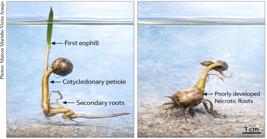
Contrasting seedling establishment of Copernicia alba under water according to seed origin. a) Seedling derived from the flooded-site lot, showing normal post-germinative development; b) seedling derived from the dry-site lot, showing impaired post-germinative development under water.
Taken together, the results support a coordinated interpretation. The flooded-site lot combined thicker internal protective tissues, greater relative lipid area, differentiated reserve-associated composition, slower initial imbibition, and greater success in both germination and normal seedling formation under water. These findings are consistent with the interpretation that the two composite lots differed in structural and physiological attributes associated with establishment under flooded conditions. However, they should not be interpreted as definitive proof of local adaptation or as a direct causal effect of hydrological origin, because the design does not isolate maternal, genetic, year-of-collection, or storage effects.
The limitations of the study should nevertheless be stated clearly. Because the design compared composite seed lots collected across multiple visits and from multiple mother plants, site hydrology cannot be fully disentangled from maternal, genetic, year-of-collection, or storage-related effects. In addition, the present study did not directly measure permeability, oxygen diffusion, reserve mobilization, or anaerobic metabolism. Thus, the proposed functional interpretation should be read as a biologically plausible explanation supported by multiple lines of evidence, but not as a directly demonstrated mechanism.
CONCLUSIONS
-
Contrasting composite seed lots from flooded and dry sites differed in seed-covering traits, imbibition dynamics, and establishment capacity under water-saturated conditions;
-
The flooded-site lot presented thicker inner protective tissues and greater relative lipid area, associated with slower initial imbibition;
-
The flooded-site lot showed greater success in both germination and normal seedling formation under water-saturated conditions;
-
The structural and physiological differences observed between composite lots were associated with the greater post-germinative stability of the flooded-site lot under water, considering the conditions evaluated in this study.
Data Availability Statement:
Research data are only made available by authors upon request.
REFERENCES
- ASSOCIATION OF OFFICIAL ANALYTICAL CHEMISTS (AOAC). Official methods of analysis of AOAC International 17. ed. Arlington: AOAC International, 2000.
- BEWLEY, J. D.; BLACK, M. Seeds: physiology of development and germination. 2. ed. New York: Plenum Press, 1994.
- BICALHO, E. M.; MOTOIKE, S. Y.; SILVA, C. V. L. e; ALVARENGA, Í. C. A.; DAVID, A. M. S. S. Enzyme activity and reserve mobilization during macaw palm (Acrocomia aculeata) seed germination. Acta Botanica Brasilica, v. 30, n. 3, p. 438-444, 2016.
- BRASIL. Ministério da Agricultura, Pecuária e Abastecimento. Regras para análise de sementes Brasília, DF: MAPA/ACS, 2009.
- CRAWFORD, R. M. M. Oxygen availability as an ecological limit to plant distribution. Advances in Ecological Research, v. 23, n. 1, p. 93-185, 1992.
- DIAS, D. S.; RIBEIRO, L. M.; LOPES, P. S. N.; MELO, G. A.; MÜLLER, M.; MUNNÉ-BOSCH, S. Haustorium-endosperm relationships and the integration between developmental pathways during reserve mobilization in Butia capitata (Arecaceae) seeds. Annals of Botany, v. 122, n. 2, p. 267-277, 2018.
- DIAS, G. P.; MAZZOTTINI-DOS-SANTOS, H. C.; RIBEIRO, L. M.; MERCADANTE-SIMÕES, M. O. Reserve mobilization dynamics and degradation pattern of mannan-rich cell walls in the recalcitrant seed of Mauritia flexuosa (Arecaceae). Plant Physiology and Biochemistry, v. 156, n. 1, p. 445-460, 2020.
- GABE, M. Techniques histologiques Paris: Masson, 1968.
- INTERNATIONAL SEED TESTING ASSOCIATION (ISTA). International rules for seed testing Bassersdorf: ISTA, 2024.
- JOHANSEN, D. A. Plant microtechnique New York: McGraw-Hill, 1940.
- KOZLOWSKI, T. T. Flooding and plant growth Orlando: Academic Press, 1984.
- LOBO, P. C.; JOLY, C. A. Tolerance to hypoxia and anoxia in neotropical tree species. Oecologia Brasiliensis, v. 4, n. 1, p. 137-156, 1998.
- MARCOS-FILHO, J. Fisiologia de sementes de plantas cultivadas Londrina: Abrates, 2015.
- NAZÁRIO, P.; FERREIRA, S. A. N.; LIMA, E. E.; GENOVESE-MARCOMINI, P. R.; MENDONÇA, M. S. Anatomical and histochemical aspects of the peach palm (Bactris gasipaes Kunth) seed. Journal of Seed Science, v. 35, n. 2, p. 171-178, 2013.
- O’BRIEN, T. P.; MCCULLY, M. E. The study of plant structure: principles and selected methods. Melbourne: Termarcarphi, 1981.
- PEREIRA, J. A. F.; COUTINHO, Í. A. C.; SOARES, E. L.; SOARES, A. A.; CAETANO, A. P. S.; CAMPOS, F. A. P. Morphoanatomical and histochemical studies of the seed of Mauritiella armata (Arecaceae). Rodriguésia, v. 72, e02902020, 2021.
- RANAL, M. A.; SANTANA, D. G. How and why to measure the germination process? Revista Brasileira de Botânica, v. 29, n. 1, p. 1-11, 2006.
- RODRIGUES JUNIOR, A. G.; OLIVEIRA, T. G. S.; SOUZA, P. P.; RIBEIRO, L. M. Water uptake and pre-germination treatments in macaw palm seeds. Journal of Seed Science, v. 35, n. 1, p. 99-105, 2013.
- SCHINDELIN, J.; ARGANDA-CARRERAS, I.; FRISE, E.; KAYNIG, V.; LONGAIR, M.; PIETZSCH, T.; PREIBISCH, S.; RUEDEN, C.; SAALFELD, S.; SCHMID, B.; TINEVEZ, J.-Y.; WHITE, D. J.; HARTENSTEIN, V.; ELICEIRI, K.; TOMANCAK, P.; CARDONA, A. Fiji: an open-source platform for biological-image analysis. Nature Methods, v. 9, n. 7, p. 676-682, 2012.
- SOARES, V. C.; DAIBES, L. F.; DAMASCENO-JÚNIOR, G. A.; LIMA, L. B. Water immersion and one-year storage influence the germination of the pyrenes of Copernicia alba Morong, a palm tree from a neotropical wetland. Hoehnea, v. 49, e782021, 2022.
- UPRETEE, P.; BANDARA, M. S.; TANINO, K. K. The role of seed characteristics on water uptake preceding germination. Seeds, v. 3, n. 4, p. 559-574, 2024.
- VERTUCCI, C. W.; LEOPOLD, A. C. Dynamics of imbibition of soybean embryos. Plant Physiology, v. 72, n. 1, p. 190-193, 1983.
-
Editor:
Luis Carlos Cunha Junior