A new species of Olixon Cameron, 1887 (Hymenoptera, Rhopalosomatidae) from southeastern Brazil
Abstract
A new species of the brachypterous wasp genus Olixon Cameron, 1887 is described and illustrated from southeastern Brazil. Olixon pluviatenuis sp. nov. is described based on a single male specimen collected in the Oswaldo Cruz Botanical Garden, São Paulo, representing the first record of the genus for the state of São Paulo. The new species is diagnosed and differentiated from its congeners, particularly the morphologically similar O. melinsula. Key distinguishing characters include the forewings extremely short and not expanded, with only one thick costal vein, and hindwings are entirely absent, a condition previously unreported from the New World fauna. This discovery increases the number of known Olixon species in Brazil to four and highlights the value of entomological collections in revealing hidden diversity, even in urban fragments.
Keywords:
Vespoidea; Cricket leeches; Taxonomy
INTRODUCTION
OlixonCameron, 1887 is a genus of small brachypterous parasitoid wasps with 30 species occurring in all biogeographic regions except the Palearctic (Lohrmann et al., 2020). The New World fauna was revised by Lohrmann et al. (2012), revealing five species, of which only one, O. banksi (Brues, 1922), is exclusive to the Nearctic. Two other species are exclusive to the Neotropics: O. atlanticus Fernández & Sarmiento, 2002 from Colombia and O. bicolor Roig-Alsina & Martínez, 2010 from Argentina. Finally, two species are recorded from both, the Neotropical and the Nearctic Region Olixon testaceum Cameron, 1887, widely distributed from southern United States to Argentina, and O. melinsula Lohrmann, Fox, Solis & Krogmann, 2012, with a disjunct occurrence in southeastern USA and Paraguay.
Recent studies on the genus have revealed two more species from the Neotropical region, O. pantanensis Bulbol, Bartholomay & Somavilla, 2023 and O. caju Celante, Martins & Bulbol, 2025, specifically from the Brazilian biomes of the Pantanal (Bulbol et al., 2023) and the northeastern Restinga (Celante et al., 2025), respectively. This brought the total to three species to the Brazilian territory: O. pantanensis and O. caju from Brazil and the widely distributed O. testaceum.
The Entomological Collection of the Instituto Butantan (IBSP-Ent.) is renowned for its significant collection of medically relevant material, mostly dipterans, which represent nearly 40% of the collection’s specimens (Oliveira et al., 2025). Nevertheless, during a visit to the institute in 2022, one specimen of Olixon was found among the 500 hymenopterans in the collection. Collected in the Oswaldo Cruz Botanical Garden, on the institute’s property, this specimen represents the first record of the genus for São Paulo State and closer examination revealed it to be a new species, which is herein described.
MATERIAL AND METHODS
The single Olixon specimen is deposited in the IBSP-Ent. and is double-mounted with its ventral side glued to a large triangle. The male genitalia were not extracted to preserve the type which was already damaged. The left antenna is broken and glued to the underside of the triangle, and the right tarsomeres III to V are missing. The importance of studying the genitalia is recognized, as recent studies have provided significant information on this. However, due to the specimen’s condition, it was decided not to further compromise the already fragile state of the individual and the way it is mounted, as it will be considered a holotype.
Identification was attempted using taxonomic keys in Lohrmann et al. (2012), Bulbol et al. (2023) and Celante et al. (2025).
The wasp was examined under a Leica M205C stereomicroscope. Photographs were captured with a Flexacam C1 through the LASx software. Images were stacked in Helicon Focus and Photoshop was used for plate assembly.
Terminology follows Krogmann et al. (2009) and Lohrmann et al. (2012) and abbreviations were used for tergum (T), sternum (S) and flagellomere (F). Label information is provided with one inverted slash signaling a new line and two inverted slashes indicating different labels.
RESULTS
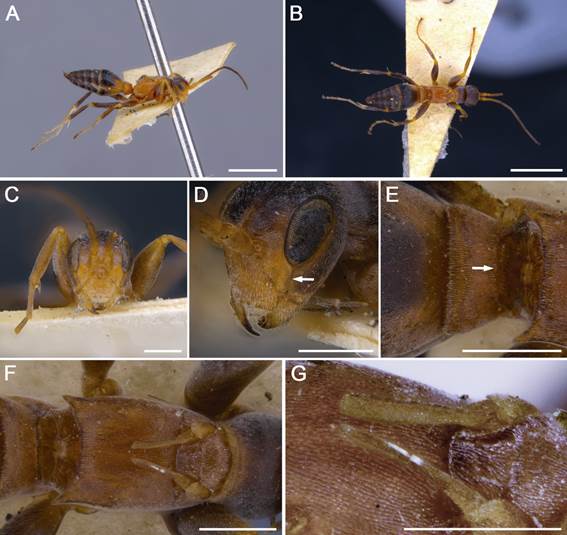
The single specimen (Fig. 1A-C) keyed to couplet three in all existing keys due to the presence of the malar sulcus (Fig. 1D) and the absence of a median sulcus on T1 (Fig. 1E). However, it did not key out clearly to any of the existing species. It most closely resembles O. melinsula, but its reduced forewings and the absence of hindwings readily differentiates the new species from its known Neotropical congeners. Therefore, for identification purposes, a new couplet is proposed to precede the most recent key of the group.
Holotype male of Olixon pluviatenuis Lopes & Bulbol, sp. nov. (A) Lateral habitus. (B) Dorsal habitus. (C) Frontal view of head. (D) Head, oblique view (arrow indicates malar sulcus). (E) First tergum, dorsal view (arrow indicates carina). (F) Propodeum, dorsal view. (G) Forewings, lateral view. Scales: A, B: 2.0 mm; C-G: 0.5 mm.
Identification key for Olixon from the New World
-
1. Forewings extremely reduced, not reaching end of propodeum and membrane not expanded; hindwings absent……………………………………………………O. pluviatenuis Lopes & Bulbol, sp. nov.
-
1′. Brachypterous, but forewings always reaching end of propodeum and membrane clearly expanded; hindwings as a small stub………………………………continue in key provided by Celante et al. (2025)
Olixon pluviatenuis Lopes & Bulbol, sp. nov.
Diagnosis: Within the New World Olixon, the new species stands out by its extremely short forewings, which are not reaching the posterior end of the propodeum, along with the absence of hindwings (Fig. 1F-G).
Furthermore, it can be distinguished by the following unique character combination: malar space with sulcus from eye to mandible (Fig. 1D); temple length 0.09 mm (shorter than antennal socket diameter) and malar space 0.39x as long as eye length; propodeum only with posterolateral propodeal processes (Fig. 1F); fore wing with only one thick costal vein (Fig. 1G); metasomal tergum I without median sulcus posterior to transverse carina (Fig. 1E).
Description
Male: Body length: 5.2 mm.
Color: Ferruginous, with the following dark brown: mandibular teeth; F-II to XI; dorsal half of head, except eye margins; pronotum except posterior margin; femora and tibiae; apical two-thirds of T2; apical fifth of S2; T3-T7; S3-S7. Ochraceous: mandibles; antennal scape, pedicel and first flagellomere; labrum; clypeus; frons below antennal sockets; temple near mandible insertion; antero-ventral surface of fore femora; fore tibiae and tarsi; joints of mid and hind legs; mid and hind tibial spurs and tarsomeres I-IV. Apical translucent bands on T2-6 and S2.
Head: Covered by dense whitish tomentum arising from equally dense punctation; longer on clypeus and labrum. Ocelli absent. Compound eye 1.91 times as long as wide. Temple length 0.24 of eye length (Fig. 1D). Clypeus 1.79 times as wide as high. Malar space 0.38 of eye length. Malar sulcus present and complete (Fig. 1D). F-I 6.0 times as long as wide, 5.0 times longer than pedicel and same length as F-II.
Mesosoma: Pronotal index (length/width): 1.0. Tegulae broad and oblong, separated from each other by 2.3 times the width of the tegula. Propodeal index (length/width): 1.17. Posterolateral processes well-developed, nearly connected by a weak posterior carina that is interrupted near each process (Fig. 1F). Posteromedian propodeal process absent. Mesosoma entirely covered by whitish tomentum.
Legs: Tarsi cylindrical, not flattened. Tarsomere IV of all legs slightly asymmetrical, with the inner lobe a little longer than the outer lobe. Hind femur 6.7 times as long as wide. Hind tibia with two spurs. Inner hind spur 0.46 times as long as hind basitarsus.
Wings: Fore wing with membrane not expanded; short, reaching only propodeal spiracles; only one thick costal vein observable (Fig. 1G). Hind wing absent.
Metasoma: First metasomal tergum with a regularly curved transverse carina (Fig. 1E) and without any kind of longitudinal median furrow or sulcus. The dense whitish tomentum is also seen on the entire metasoma.
Male genitalia: not extracted.
Etymology: The specific epithet is a noun in apposition, which can be translated as drizzle or light rain, since the city of São Paulo, the type locality, is also known as “terra da garoa”, translated as “land of the drizzle”.
Examined Material: Holotype male, “Butantan, S.P. \ Horto O. Cruz \ 25.4.73-LTF \\ 52” [IBSP-Ent.].
DISCUSSION
Using existing keys, the specimen keyed most closely to O. melinsula. However, some of the measurements are not within the ranges provided in the description by Lohrmann et al. (2012) for that species (Table 1). This initially led us to consider that the specimen represented the unknown male of O. melinsula, and the variation attributable to sexual dimorphism, but the following rationale led us to conclude it belongs to a new species. Krogmann et al. (2009) provided descriptions of both sexes, when available, for the Australian Olixon and highlighted the differences between them. These usually concern only body size and the proportions of the hind femur and not the head as presently observed.
Proportions of measurements of females of Olixon melinsula Lohrman et al., 2012 presented by Lohrmann et al. (2012) and the male holotype of O. pluviatenuis Lopes & Bulbol, sp. nov.
While some of the measured values are marginally close to those of O. melinsula, there are some that deviate considerably, especially those of the head and antenna. Lohrmann et al. (2012) mention a high variability in the temple length in O. banksii, but that does not seem to apply to other species. The only detailed description of variations between male and female of the Neotropical Olixon are provided for O. caju, in which the values of eye length and temple length vary similarly to the ones seen here, with males having smaller values (Celante et al., 2025).
Nevertheless, the specimen in question presents wing characters very discrepant from O. melinsula. The species is known to have the fore wing expanded and the hind wing reduced as a short stub (Lohrmann et al., 2012). However, this only specimen of O. pluviatenuis exhibits the fore wing not expanded and the hind wing absent, which is unknown for all remaining New World Olixon. Some species of the Australian fauna have been reported to have wings in such a reduced/absent state, but those characters are constant between both sexes and do not present dimorphic variation (Krogmann et al., 2009). This leads us to conclude that the female of O. pluviatenuis, once found, will also have reduced forewings and absence of hindwings.
This is the first Olixon reported for the State of São Paulo. The type locality, Oswaldo Cruz Botanical Garden, is a small fragment within the urban area of São Paulo City. However, before its foundation, in 1916, the region was far from urbanized and occupied by a flooded grassland (Hingst-Zaher & Teixeira Costa, 2016). While the garden started with the aim of planting useful and medicinal plants, its flora was subsequently greatly expanded, with over 160 species ranging from arboreal to herbal, 80% of which are native. By the 1970’s, when the type specimen was collected, residential construction had begun to intensify in the Butantan neighborhood (Barreiro, 2013).
Considering this series of changes in vegetation cover, there are three hypotheses that can be made about the occurrence of Olixon pluviatenuis sp. nov.: (i) it is typical of flooded grasslands, but managed to survive in the modified environment; (ii) it is native of denser forests and settled in after the establishment of the garden; (iii) it is a generalist and naturally occupies both kinds of vegetation. The absence of further material complicates this discussion and raises questions regarding the present existence of this species.
Closing remarks
This finding demonstrates that even smaller collections can have specimens new to science and deserve much more recognition than what is they are usually given. The scarcity of material makes it difficult to establish the biology of this group, especially in regions where there are few species and few individuals have been identified, leading us to consider several possibilities regarding its occurrence. Thus, our findings not only fill a distributional gap for Olixon but also help to build its taxonomic knowledge. This is the third species described for the genus in a period of a little over two years, representing a 60% increase compared to the previous total. Despite this, efforts are still needed to explore collections that have not yet been visited and to conduct more targeted screenings to identify this taxon.
DATA AVAILABILITY:
The contents underlying the research text are included in the manuscript.
Acknowledgments:
Authors thank Dr. Flavia Virginio, curator of the IB-Ent. For loaning the specimen. RBL thanks Ana Helena Cruciol for organizing the visit to the collection and helping to sort and identify the Hymenoptera in the IB-Ent.
REFERENCES
- Barreiro, J.E. 2013. Butantã: um bairro em movimento. São Paulo, Versal Editores. 164p.
-
Brues, C.T. 1922. On the hymenopterous genus Harpagocryptus and its allies. Psyche, 29(3): 101-109. https://doi.org/10.1155/1922/57042.
» https://doi.org/10.1155/1922/57042 -
Bulbol, M.M.; Bartholomay, P.R.; Oliveira, M.L.D. & Somavilla, A. 2023. A new species of Olixon Cameron, 1887 (Hymenoptera: Rhopalosomatidae) and new records for the genus in Brazil. Zootaxa, 5277(3): 573-580. https://doi.org/10.11646/zootaxa.5277.3.9.
» https://doi.org/10.11646/zootaxa.5277.3.9 - Cameron, P. 1887. Insecta. Hymenoptera (Families Tenthredinidae-Chysididae). In: Biologia Centrali-Americana V.1, 487p.
-
Celante, G.L.; Carvalho, A.G.; Martins, A.L.; Bulbol, M.M.; Brito, A.S.D.; Teodoro, A.V. & Jahyny, B.J.B. 2025. Contributions to the knowledge of Olixon Cameron, 1887 (Hymenoptera, Rhopalosomatidae): a new species and new records of the genus for northeastern Brazil. Zootaxa, 5570(3): 549-562. https://doi.org/10.11646/zootaxa.5570.3.6.
» https://doi.org/10.11646/zootaxa.5570.3.6 -
Fernández, F. & Sarmiento, C.E. 2002. A new species of Olixon Cameron and two new records of Rhopalosomatidae (Hymenoptera) from Colombia. Journal of the New York Entomological Society, 110(3-4): 365-369. https://doi.org/10.1664/0028-7199(2002)110[365:ANSOOC]2.0.CO;2.
» https://doi.org/10.1664/0028-7199(2002)110[365:ANSOOC]2.0.CO;2 - Hingst-Zaher, E. & Teixeira Costa, L. 2016. Raízes do paisagismo no Butantan: o Horto Osvaldo Cruz e a contribuição de F.C. Hoehne. In: Enokibaram, M.; Ghirardello, N. & Salcedo, R.F.B. Patrimônio, Paisagem e Cidade Tupã, ANAP. P. 101-127.
-
Krogmann, L.; Austin, A.D. & Naumann, I.D. 2009. Systematics and biogeography of Australian rhopalosomatid wasps (Hymenoptera: Rhopalosomatidae) with a global synopsis of the enigmatic genus Olixon Cameron. Systematic Entomology, 34(2): 222-251. https://doi.org/10.1111/j.1365-3113.2008.00460.x.
» https://doi.org/10.1111/j.1365-3113.2008.00460.x -
Lohrmann, V.; Fox, M.; Solis, M. & Krogmann, L. 2012. Systematic revision of the New World Olixon Cameron with descriptions of O. melinsula sp. nov. and the hitherto unknown female of O. bicolor (Hymenoptera, Rhopalosomatidae). Deutsche Entomologische Zeitschrift, 59(2): 259-275. https://doi.org/10.1002/mmnd.201200022.
» https://doi.org/10.1002/mmnd.201200022 -
Lohrmann, V.; Zhang, Q.; Michalik, P.; Blaschke, J.; Heanneau, L. & Perrichot, V. 2020. †Cretolixon - a remarkable new genus of rhopalosomatid wasps (Hymenoptera: Vespoidea: Rhopalosomatidae) from chemically tested, mid-Cretaceous Burmese (Kachin) amber supports the monophyly of Rhopalosomatinae. Fossil Record, 23(2): 215-236. https://doi.org/10.5194/fr-23-215-2020.
» https://doi.org/10.5194/fr-23-215-2020 -
Oliveira, E.C.D.; Falaschi, R.L.; Khatourian, N.B.; Fachin, D.A.; Ferreira, R.A.; Savaris, M.; Silva, B.D.R.D. & Virginio, F. 2025. Through the restructuring of an entomological collection, a treasure: 30s’ dipterans from the personal collection of Carlos Rodolpho Fischer bringing new records. Arquivos de Zoologia, 56(1): 1-9. https://doi.org/10.11606/2176-7793/2025.56.1.
» https://doi.org/10.11606/2176-7793/2025.56.1 -
Roig-Alsina, A. & Martínez, J.J. 2010. El género Olixon en la Argentina, con la descripción de una nueva especie (Hymenoptera, Rhopalosomatidae). Revista del Museo Argentino de Ciencias Naturales, 12(2): 263-266. https://doi.org/10.22179/REVMACN.12.245.
» https://doi.org/10.22179/REVMACN.12.245