Bat (Chiroptera, Mammalia) assemblages from three fragments in the threatened Pernambuco Endemism Center, northeastern Brazil
Abstract
Five centers of endemism are recognized in The Brazilian Atlantic Forest, including the Pernambuco center (PCE), which is located at the northern, and most impacted extreme of the biome, whose biodiversity is still relatively poorly-known. Using mist nets, we surveyed the bat assemblages of three privately-owned protected areas in the Brazilian state of Alagoas, located within the Pernambuco Centre of Endemism. The fragment areas ranged from 41 to 458 hectares. We compared the species composition, richness, and diversity of bat species among the areas. A total of 266 bats were captured, representing 21 species in five families, although 96% of the individuals captured belonged to species of the family Phyllostomidae. Six trophic guilds were recorded in the study. The highest species richness (14) and diversity were recorded at Madeira and Mata do Capiatã, although similarity was low among the assemblages of the three sites. The results of the study indicate that even small fragments of Atlantic Forest may support a considerable diversity of bats, especially at a landscape scale, and are thus vitally important for the maintenance of the ecosystem services provided by these mammals. Future research should adopt more comprehensive sampling methods, such as combining mist-nets with acoustic monitoring, to better represent the full spectrum of chiropteran diversity, particularly aerial insectivores.
Keywords:
Atlantic Forest; Chiropteran fauna; Diversity; Phyllostomids; Trophic guild; Mist-net
INTRODUCTION
The Atlantic Forest is one of the world’s most threatened biomes (Haddad et al., 2015), and for this reason was included among Myers et al. (2000) original biodiversity hotspots. This biome is home to approximately 8% of the world’s biodiversity (Silva & Casteleti, 2003) and, while highly impacted, it still has around 8,500 endemic species, including vascular plants, mammals, birds, reptiles, and amphibians (Myers et al., 2000; Anunciação et al., 2024). Approximately two thousand species of vertebrates have been recorded in the Atlantic Forest (Campanili & Schaffer, 2010), including 384 mammals, 90 of which are endemic to this biome (Paglia et al., 2012; Figueiredo et al., 2021). Among these, bats represent the most diverse group, accounting for nearly one-third (117) of the mammalian species (Varzinczak et al., 2015). This high diversity highlights the remarkable heterogeneity within the Atlantic Forest biome, which encompasses tropical, subtropical, and semideciduous forests (Ranta et al., 1998; Morellato & Haddad, 2000; Ribeiro et al., 2011).
The Atlantic Forest encompasses five centers of endemism based on the distribution of birds, primates, and butterflies (Silva & Casteleti, 2003): the Bahia, Northeastern Cloud Forest, Pernambuco, Diamantina, and Serra do Mar centers of endemism. Additionally, it includes three transitional zones: the São Francisco basin, Araucaria forests, and insular forests. The Pernambuco Center of Endemism (PEC) corresponds to the Atlantic Forest remnants located north of the São Francisco River, comprising the narrow corridor of coastal forest that extends through four Brazilian states - Alagoas to Rio Grande do Norte (Prance, 1982; Rizzini, 1997; Cavalcanti & Tabarelli, 2004). This region is not only the most deforested portion of the Atlantic Forest (Ribeiro et al., 2009; Bernard et al., 2011a), but it is also the least scientifically studied and contains relatively few protected areas (Coimbra-Filho & Câmara, 1996; Silva & Tabarelli, 2001).
In the Brazilian Northeast, the native forest has been largely replaced by sugarcane plantations (Bordonal et al., 2018; MapBiomas, 2024), which, together with other agricultural activities and urban and industrial development, has led to the formation of extensive landscape mosaics, where forest remnants are a minor feature (Coimbra-Filho & Câmara, 1996). In fact, most of the forest fragments that exist in this region have an area of less than 10 hectares, with only 7% of the fragments having an area of more than 100 ha (Dias et al., 2023; Feijó et al., 2023). Despite these impacts, the PEC is recognized as one of the most important South American centers of endemism, given its diversity of endemic species of both plants and animals (Prance, 1982; Mendes-Pontes et al., 2016; Dias et al., 2023).
Chiroptera is the most diverse mammalian order of the Neotropical region (Timm, 1994; Voss & Emmons, 1996; Rex et al., 2008; Fenton & Simmons, 2014) and studies of bat communities indicate that these animals may constitute more than half of the complement of mammalian species at some localities (Voss & Emmons, 1996; Simmons & Voss, 1998; Lim & Engstrom, 2001). This diversity reflects the enormous variety of foraging strategies in these animals (Kalko et al., 1996; Gunnell & Simmons, 2012). Bats also provide a range of important ecosystem services, including seed dispersal (Fleming & Heithaus, 1981; Fleming, 1988), pollination (Fleming & Muchhala, 2008), and the control of insect populations (Boyles et al., 2011; Cassano et al., 2016).
While research on the bats of the Atlantic Forest of the Brazilian Northeast has advanced considerably in recent years (e.g.,Faria et al., 2006; Mikalauskas et al., 2014; Guerra, 2015; Bocchiglieri et al., 2016; Feijó et al., 2016, Silvestre et al., 2016; Rocha et al., 2017a; Soares et al., 2017a; Leal et al., 2022), scientific knowledge of the chiropteran fauna of this region is still incipient (Varzinczak et al., 2015; Muylaert et al., 2017). Within the PCE, the Brazilian state of Alagoas is one of the areas with the least published data on the chiropteran fauna, and is considered to be very poorly inventoried (Muylaert et al., 2017). In the country-wide survey by Bernard et al. (2011b), no parts of the state were classified as “satisfactorily sampled”. Alagoas is also one of the northeastern states that have been deforested most intensively. Given both the gap in our scientific knowledge, and these deforestation rates, further research on the chiropteran fauna of Alagoas will be essential to better understand the local biodiversity, in particular, in the context of the conservation status of the PCE. In the present study, we investigated the bat assemblages of three forest fragments in Alagoas, and compared their species composition and diversity. The results provide important insights into the diversity of bats in the Brazilian state of Alagoas.
MATERIAL AND METHODS
Study area
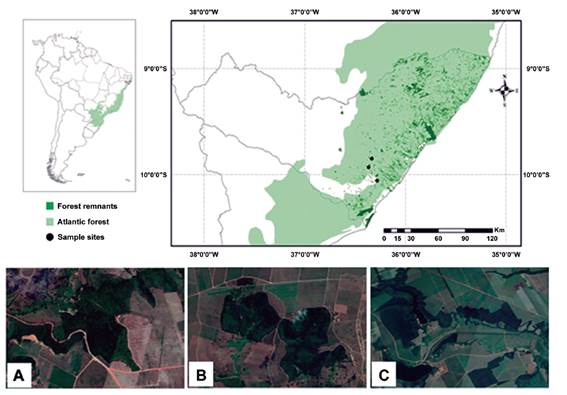
The study area was conducted in three fragments of Atlantic Forest in the state of Alagoas, within the PEC in northeastern Brazil (Fig. 1). All three sites are protected areas, as Private Natural Heritage Reserves, known in Portuguese by the acronym RPPN (Reserva Particular de Patrimônio Natural). The three protected areas, RPPN Gulandim (Fig. 1A), RPPN Madeira (Fig. 1B) and Mata do Capiatã (Fig. 1C), are all located within a radius of 20 km of each other. The local climate is classified as As’ in the Köppen system, with annual rainfall of 1,300-1,600 mm and temperatures of around 26℃ (Barros, 2012). The original vegetation is semi-deciduous rainforest, and all fragments are surrounded by a matrix of sugarcane plantations, pasture, and small settlements.
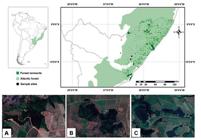
Location of the three forest reserves surveyed during the present study in the state of Alagoas, Brazil. (A) RPPN Gulandim; (B) Madeira; (C) Mata do Capiatã. Images: Google Earth.
The Mata do Capiatã (10°03′32″S, 36°16′43″W) is a 458-hectare fragment that is part of a complex of forest fragments that compose the Atlantic Forest Biosphere Reserve and is located on the property of the Coruripe sugar-mill (Usina Coruripe) in the municipality of Coruripe. The local forest is classified seasonal semideciduous, which is composed of trees that lose part of their foliage in the dry season and have lees epiphytes than the forests along the coast. The fragment has with a nucleus of well-preserved habitat, dominated by trees of the families Fabaceae, Lecythidaceae, and Moraceae, with some individuals reaching a height of 40 m (Silveira et al., 2003). This fragment has a high density of brazilwood (pau-brasil) trees, Caesalpina echinata. The Mata do Capiatã is part of a complex of forest remnants with a total of 7,544 hectares of non-continuous forest, most of which are at advanced stages of regeneration.
The RPPN Madeira (09°51′S, 36°20′W) is a 124.5-hectare fragment of secondary seasonal semideciduous forest, located in the municipality of Junqueiro. This reserve was created by federal ordinance 08/2010, and is currently recognized by UNESCO as an outpost of the Atlantic Forest Biosphere Reserve (RBMA). The forest is located on a steeply-sloping terrain with a number of freshwater springs within the most preserved portion (Oliveira et al., 2014). Trees of the families Fabaceae, Myrtaceae, and Sapotaceae are predominant, and the canopy reaches a height of approximately 20 m.
The RPPN Gulandim (09°56′S, 36°22′W) is a 41-hectare fragment of seasonal forest in the municipality of Teotônio Vilela (Oliveira et al., 2014). The reserve was created by IBAMA ordinance 098/2001. The forest of the RPPN Gulandim is poorly stratified, with a canopy of around 10-15 m in height, composed mainly of pioneer tree species such as those of the genus Cecropia. The vast majority of this fragment is at an initial stage of regeneration, and it suffers constant pressure from local residents.
Bat sampling
Two sites, RPPN Madeira and RPPN Gulandim, were sampled between October 2007 and March 2008. In September 2014 and November 2015, bats were captured at Mata do Capiatã, and also at RPPN Madeira. The bats were captured using five mist-nets (12 m × 3 m), which were set at ground level on trails within the forest, at the margins of water bodies (e.g., ponds, lakes, streams), and in orchards. The trophic guilds were defined based on Kalko et al. (1996). Active searches of daytime roosts were also conducted using hand-nets. Bats were captured over six nights at the Mata do Capiatã and RPPN Gulandim sites, and over 11 nights at RPPN Madeira.
Bats were captured between 17:00 h and 22:00 h, and all individuals were identified in the field by codes, marked with color-coded plastic collars, and released at the capture site. Licenses to collect and handle the bats were provided by the Chico Mendes Institute for Biodiversity Conservation, ICMBio, Brazilian Ministry of the Environment (license number 47698-1). One individual of each species was collected as a voucher specimen, and are deposited in the Natural History Museum of the Federal University of Alagoas, MHNUFAL. All the specimens collected were processed following the recommendations of the Committee for Animal Use and Welfare fixed in 10% formalin and conserved in 70% alcohol. The species were identified following Simmons & Voss (1998) and Gardner (2008). Additionally, the identification key published by Reis et al. (2017) was employed.
Data analysis
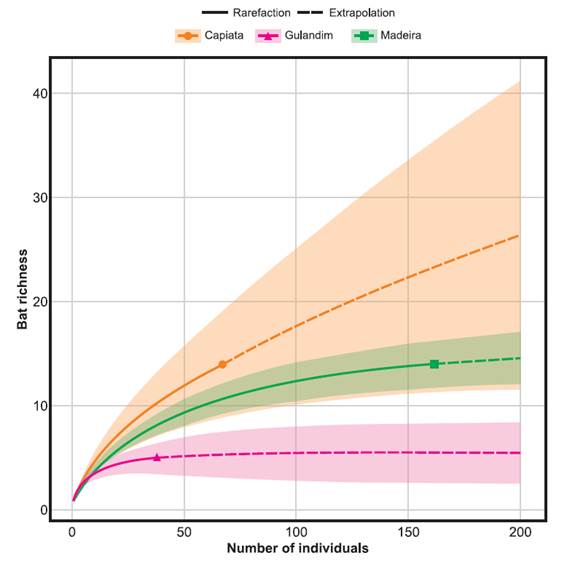
We constructed sample-size-based rarefaction and extrapolation curves according to the different sites sampled. Since there is a difference in the number of sampling days between sites, we used the rarefaction method. This method allows us to compare the number of species between communities when sample size (e.g., number of sampling units), sampling effort (e.g., sampling time), or the number of individuals are not the same. Rarefaction calculates the expected number of species in each community based on a value at which all samples reach a certain size. In this study, we chose to produce rarefaction curves that are individual-based, where comparisons are made by considering the abundance of the community, standardized by the smallest number of individuals (details in Gotelli & Colwell, 2001).
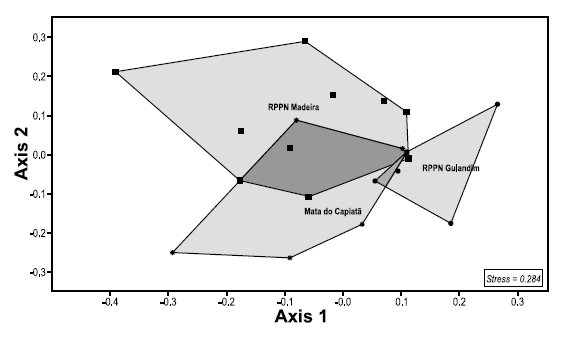
To evaluate the similarity of bat fauna across the three forest remnants, we calculated Jaccard’s similarity index, which measures the proportion of shared species between pairs of sites. This similarity metric was further used in a non-metric multidimensional scaling (NMDS) analysis to visualize the relationships among sites based on species composition. The NMDS ordination was constructed using the Jaccard index as the measure of association to represent ecological distances between the sites in a reduced dimensional space.
To identify the primary species driving the differences in species composition among sites, we conducted a Similarity Percentage analysis (SIMPER). This method quantifies the contribution of each species to the overall dissimilarities observed between study sites. This analysis was conducted based on the frequency of occurrence of each bat species, measured by the number of nights in which the species was recorded at each of the three study sites. The Bray-Curtis dissimilarity index was used to quantify the compositional dissimilarity between sites. In addition, we applied a Permutational Multivariate Analysis of Variance (PERMANOVA; Anderson, 2001) to test whether bat species composition differed significantly among the sites. The PERMANOVA used the presence/absence of each species as the response variable, with forest remnants as the predictor variable. Statistical significance was determined through comparison with a null model generated by 4,999 permutations of the original matrix.
All analyses were performed in the R software version 4.4.2 (R Core Team, 2024) using the packages “iNEXT” (Hsieh et al., 2016), “vegan” (Oksanen et al., 2019) and “ggplot2” (Wickham, 2016). Species recorded exclusively in roosts were excluded from these analyses to focus on the assemblages sampled using mist nets and other standardized methods.
RESULTS
During the present study, total sampling effort (E) was 21,600 m².h, with E = 9,900 m².h at RPPN Madeira, E = 6,300 m².h at Mata do Capiatã, and E = 5,400 m².h at RPPN Gulandim. This sampling resulted in the capture of 266 bats individuals, representing 21 species in five families: Embalonuridae, Molossidae, Noctilionidae, Phyllostomidae, and Vespertilionidae. Family Phyllostomidae was the most diverse and abundant, with 16 species and 256 individuals, representing 96% of the individuals captured. Three phyllostomids accounted for almost 80% of the total number of individuals, with Carollia perspicillata accounting for 60% of the individuals, followed by Dermanura cinerea (13%) and Platyrrhinus lineatus (3.8%). At the opposite extreme, six species were collected only once: Saccopteryx leptura (Schreber, 1774), Lophostoma brasiliense Peters, 1867, Micronycteris minuta (Gervais, 1856), Micronycteris schmidtorum Sanborn, 1935, Phyllostomus elongatus (É. Geoffroy, 1810) and Molossus rufus É. Geoffroy, 1805. Seven trophic guilds were recorded in the present study, of which the frugivores were the most common (Table 1). The eight frugivorous bat species were represented by 245 individuals, representing 88% of the individuals captured during the study at the three sites. While seven insectivorous species were recorded, only 13 individuals were captured. The other guilds were represented by only one or two species, and 2-9 individuals. The piscivore bat Noctilio leporinus (Linnaeus, 1758) was not captured by mist nets, however we recorded it foraging at RPPN Madeira.
Bat species captured in three privately-owned protected areas in the state of Alagoas, Brazil. N = number of individuals captured; % = percentage of the total number of individuals captured. * = species sighted during fieldwork.
Fourteen bat species were recorded at RPPN Madeira and Mata do Capiatã, where diversity was H′ = 2.3 and H′ = 2.4, respectively (Table 2). Five species were collected at Gulandim, where diversity was H′ = 1.4. The rarefied richness of bat species varied across the sites. Mata do Capiatã and Madeira exhibited higher rarefied richness, with overlapping confidence intervals, while Gulandim showed lower rarefied richness, with its confidence interval not overlapping with the other sites. Additionally, the interpolation patterns suggest that an increased sampling effort would likely result in a higher number of recorded species for Mata do Capiatã (Fig. 2).
The number of individuals of each bat species captured at the three Atlantic Forest remnants in Alagoas, northeastern Brazil. Dissimilarity contribution = SIMPER values of contribution to dissimilarity between environments (considering all assemblages combined).
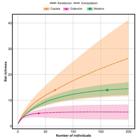
Rarefaction curves based on bat individuals collected for the three forest remnants surveyed during the present study in Alagoas, Brazil.
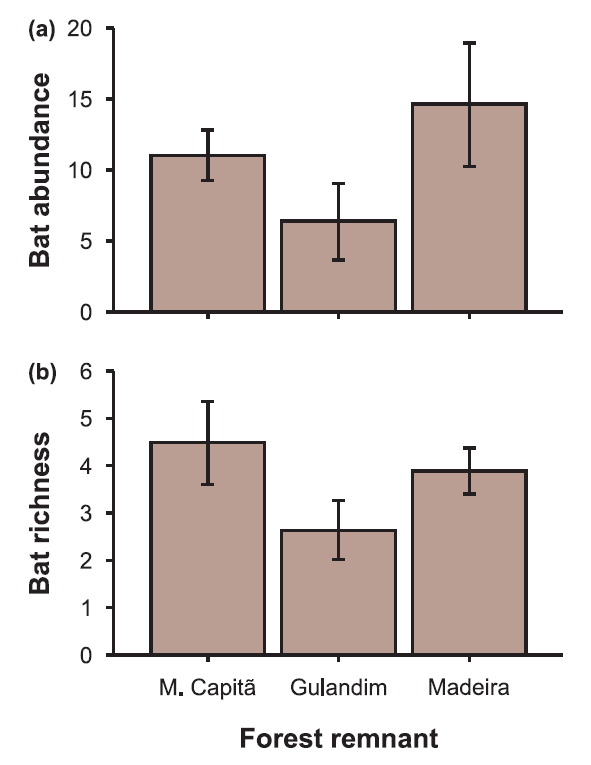
Neither mean bat abundance (H = 3.482, n = 23, p = 0.172; Fig. 3a) nor mean species richness (H = 2.889, n = 23 p = 0.224; Fig. 3b) varied significantly among the study sites. The Jaccard similarity index revealed 19% similarity between Gulandim and Mata do Capiatã, 38% between Gulandim and Madeira, and 42% between Madeira and Mata do Capiatã. Species composition varied considerably across the sites, with notable differences between Gulandim and the other forest remnants (F₂,₂₁ = 1.624; p = 0.042). The NMDS further indicated significant differences in bat assemblage composition among the forest remnants (Fig. 4). Six species were exclusively recorded at Mata do Capiatã, six at RPPN Madeira, and no exclusive species were found at RPPN Gulandim (Table 2).
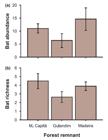
Bat abundance (A) and species (B) recorded in the three forest remnants surveyed in the present study in Alagoas, Brazil. The vertical bars represent the standard error.
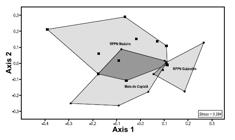
Non-metric multidimensional scaling (NMDS) of the bat species composition of the three forest remnants surveyed in the present study in Alagoas, Brazil.
The species that contributed most to the dissimilarity among the forest remnants were Platyrrhinus lineatus (É. Geoffroy, 1810) (12.1%), Dermanura cinerea Gervais, 1856 (10.7%), Artibeus lituratus (Olfers, 1818) (8.8%), Desmodus rotundus (É. Geoffroy, 1810) (8.3%), Carollia perspicillata (Linnaeus, 1758) (7.1%), Sturnira lilium (É. Geoffroy, 1810) (6.9%), Artibeus planirostris (Spix, 1823) (6.8%), Artibeus obscurus (Schinz, 1821), Trachops cirrhosus (Spix, 1823) (5.4% each), and Rhynchonycteris naso (Wied, 1820) (5%). Eight other bat species contributed less than 5% to this dissimilarity (Table 2).
Active searches identified a daytime roost in an abandoned house within the RPPN Madeira, where a colony with approximately 60 C. perspicillata and another colony with 10 Molossus rufus É. Geoffroy, 1805 were observed. Additionally, a colony of approximately 40 R. naso was found under a roof near a spring in Mata do Capiatã. One individual of C. perspicillata was recaptured in each of the study forests.
DISCUSSION
Phyllostomids dominated the bat communities at all three sites, a patter typical of the Neotropical region (Bernard et al., 2001; Sampaio et al., 2003) and particularly well-documented in the Atlantic Forest (Faria, 2006; Faria et al., 2006; Gomes et al., 2016, Muylaert et al., 2017; Abreu et al., 2021, Leal et al., 2022). Similar findings have been reported in studies conducted in Pernambuco Centre of Endemism (Guerra, 2015; Feijó et al., 2016; Soares et al., 2016, 2017b). However, the predominance of phyllostomids in mist-net samples is influenced by the methodology, as mist-nets primarily capture frugivorous bats that fly in the understory (Trevelin et al., 2017). Other families, such as Emballonuridae, Molossidae, and Vespertilionidae, which include aerial insectivorous species, are typically undersampled (Kalko, 1998; Trevelin et al., 2017). Most of these species use echolocation, and may locate the mist-nets in flight (Kalko et al., 1996). Molossids, in particular, forage in open areas or above the forest canopy, making them less likely to be captured in traditional mist-net setups (Schnitzler & Kalko, 1998).
The bat species recorded in the present study had all been previously documented in the state of Alagoas (Vieira, 1953; Alencar et al., 1994; Garcia et al., 2014; Guerra, 2015; Leal et al., 2022), confirming their expected presence in this region. Among these, Dermanura cinerea and Carollia perspicillata were the most abundant species, as observed at many sites in the southeast region of Brazil (Delgado-Jaramillo et al., 2020), and particularly in the Atlantic Forest (Bernardi & Passos, 2012; Soares et al., 2016; Muylaert et al., 2017). C. perspicillata, which accounted for more than half of the individuals captured, was the dominant species across all sites. Its dominance aligns with prior studies that have identified this species as one of the Atlantic Forest’s “hyper-dominant” bats (Muylaert et al., 2017), along with species such as A. lituratus, A. obscurus, A. planirostris, P. lineatus, and S. lilium. Moreover, the frugivorous bat C. perspicillata was also the dominant species at other sites in the PEC (Soares et al., 2016, 2017b). The prevalence of these species in anthropogenically disturbed landscapes can be attributed to its high environmental plasticity, as smaller and more generalist species often adapt better to modified habitats and exploit greater resource availability in these environments (Faria, 2006; Bobrowiec & Gribel, 2010; Bernardi & Passos, 2012; Ávila-Gómez et al., 2015).
In light of these findings, it is important to address potential taxonomic issues. As highlighted by Rocha et al. (2017b), caution is essential when working with data on Dermanura species due to the risk of misidentification in zoological collections. To mitigate this problem, future ecological monitoring should incorporate systematic and accurate diagnostic methods for Dermanura specimens. Moreover, a comprehensive revision of these specimens in scientific collections is necessary to enhance data reliability and strengthen research outcomes by providing a more robust taxonomic framework (Rocha et al., 2017b).
Building upon these taxonomic considerations, the results of this study revealed a marked dominance of frugivorous bats - accounting for 88% of captures - primarily from the subfamilies Sternodermatinae and Carollinae, across all three sites. This patter may be related to the relatively disturbed and fragmented nature of the surveyed forests, as frugivorous species are generally more abundant in impacted landscapes (Arroyo-Rodriguez et al., 2016). For instance, in the Amazon, Bobrowiec & Gripel (2010) reported a dominance of sternodermatines in early successional forests surrounded by abandoned pasturelands, whereas phyllostomine species were more selective and preferred less disturbed habitats.
The higher bat richness and diversity recorded at Mata do Capiatã and Madeira can likely be attributed to the larger size, better conservation status, and greater structural complexity of these forests, which offer a wider variety of roosting and foraging resources compared to RPPN Gulandim. Arroyo-Rodriguez et al. (2016) found that overall bat diversity increased in landscapes less subject to deforestation, where a larger number of rare species are typically found. Despite the relatively small size and close proximity (~ 20 km) of the forests surveyed in this study, the variation in their bat assemblage composition highlights the importance of preserving even small forest fragments to conserve regional biodiversity (Bobrowiec & Gribel, 2010) and ensure essential ecosystem services such as seed dispersal, pollination, and insect population control (Boyles et al., 2011).
Larger and more intact fragments are generally expected to support greater species diversity due to higher habitat heterogeneity and resource availability (Faria, 2006; Struebig et al., 2008). In contrast, the smaller and more disturbed forest fragment at Gulandim exhibited lower species richness and diversity, likely as a result of its reduced area, limited structural complexity, and higher levels of anthropogenic pressure (Fahring, 2003). These factors restrict critical resources for bats, such as suitable roosting and foraging sites, which are essential for maintaining diverse assemblages.
The marked differences in species composition among the three sites underscore the importance of conserving multiple forest fragments to protect regional bat biodiversity. Even relatively small fragments contribute significantly to the overall species pool by harboring unique subsets of the chiropteran fauna. For example, the six exclusive species recorded at Mata do Capiatã and Madeira highlight the complementary role that different fragments play in preserving regional biodiversity.
The predominance of frugivorous bats in our study underscores their ecological importance as seed dispersers, which facilitate forest regeneration in fragmented landscapes (Fleming & Kress, 2013). However, the observed low abundance of insectivorous bats - key providers of pest control services - raises concerns about the impact of habitat disturbances on this functional group. These differences suggest that habitat fragmentation and disturbance can affect bat functional groups in distinct ways, calling for targeted conservation strategies that restore habitat conditions (e.g., maintaining vertical forest structure and reducing anthropogenic pressures).
CONCLUSIONS
This study highlights the critical role of small protected forest fragments (Wintle et al., 2018) in maintaining bat diversity within the heavily fragmented landscapes of the Pernambuco Center of Endemism. Despite their small size, these fragments harbor diverse and unique bat assemblages, underscoring their importance for regional biodiversity conservation. Conservation strategies should prioritize the protection of both small and large forest remnants to ensure the long-term persistence of chiropteran populations and the ecosystem services they provide, such as seed dispersal, pollination, and pest control.
Future research should adopt more comprehensive sampling methods, such as combining mist-nets with acoustic monitoring, to better represent the full spectrum of chiropteran diversity, particularly aerial insectivores. Additionally, long-term monitoring and studies assessing the responses of bat communities to changes in landscape configuration are necessary to inform effective conservation planning. Expanding conservation initiatives, such as the establishment of new protected areas and the implementation of restoration programs, will be essential for safeguarding the unique biodiversity of the Atlantic Forest biome in northeastern Brazil.
DATA AVAILABILITY:
All datasets generated during and/or analyzed during the current study are contained within the article.
Acknowledgments:
We are grateful to Petrobras Socio-Environmental for funding this research, and Usina Seresta for logistic support in the field. We would also like to thank Thiago C. Acioli and Thainá Lessa for their invaluable assistance during the fieldwork, and Dr. Ludmilla da Costa-Pinto (MUFAL) for receiving our material.
REFERENCES
-
Abreu, M.D.A.A.; Tavares, V.C. & Moras, L.M. 2021. Bat diversity from an area of coastal Atlantic Forest in southeastern Brazil. Check List, 17: 1731-1743. https://doi.org/10.15560/17.6.1731.
» https://doi.org/10.15560/17.6.1731 - Alencar, A.O.; Silva, G.A.P.; Arruda, M.M.; Soares, A.J. & Guerra, D.Q. 1994. Aspectos biológicos e sistemáticos de Desmodus rotundus rotundus (Chiroptera) no nordeste do Brasil. Pesquisa Veterinária Brasileira, 14: 95-103.
-
Anderson, M.J. 2001. A new method for non-parametric multivariate analysis of variance. Austral Ecology, 26: 32-46. https://doi.org/10.1111/j.1442-9993.2001.01070.pp.x.
» https://doi.org/10.1111/j.1442-9993.2001.01070.pp.x -
Anunciação, P.R.; Valencia-Zuleta, A.; Signorelli, L.; Martins, M.; Bastos, R.P.; Bataus, Y. & Guidorizzi, C.E. 2024. Amphibian conservation status in Brazil: Spatial patterns, threats, and challenges. Journal for Nature Conservation, 79: 1-11, 126611. https://doi.org/10.1016/j.jnc.2024.126611.
» https://doi.org/10.1016/j.jnc.2024.126611 -
Arroyo-Rodríguez, V.; Rojas, C.; Saldaña-Vázquez, R.A.; Stoner, K.E. 2016. Landscape composition is more important than landscape configuration for phyllostomid bat assemblages in a fragmented biodiversity hotspot. Biological Conservation, 198: 84-92. https://doi.org/10.1016/j.biocon.2016.03.026.
» https://doi.org/10.1016/j.biocon.2016.03.026 -
Ávila-Gómez, E.S.; Moreno, C.E.; García-Morales, R.; Zuria, I.; Sánchez-Rojas, G. & Briones-Salas, M. 2015. Deforestation thresholds for phyllostomid bat populations in tropical landscapes in the Huasteca region, Mexico. Tropical Conservation Science, 8(3): 646-661. http://doi.org/10.1177/194008291500800305.
» https://doi.org/10.1177/194008291500800305 - Barros, A.H.C.; Araujo Fº, J.C.; Silva, A.B. & Santiago, G.A.C.F. 2012. Climatologia do Estado de Alagoas. Boletim de Pesquisa e Desenvolvimento/Embrapa Solos Embrapa Solos, Recife, 211: 1-32.
-
Bernard, E.; Albernaz, A.L.K.M. & Magnusson, W.E. 2001. Bat species composition in three localities in the Amazon Basin. Studies on Neotropical Fauna and Environment, 36(3): 177-184. https://doi.org/10.1076/snfe.36.3.177.2125.
» https://doi.org/10.1076/snfe.36.3.177.2125 -
Bernard, E.; Melo, F.P.L. & Pinto, S.R.R. 2011a. Challenges and opportunities for biodiversity conservation in the Atlantic Forest in face of bioethanol expansion. Tropical Conservation Science, 4(3): 267-275. https://doi.org/10.1177/194008291100400305.
» https://doi.org/10.1177/194008291100400305 -
Bernard, E.; Aguiar, L.S. & Machado, R. 2011b. Discovering the Brazilian bat fauna: a task for two centuries? Mammal Review, 41: 23-39. https://doi.org/10.1111/j.1365-2907.2010.00164.x.
» https://doi.org/10.1111/j.1365-2907.2010.00164.x - Bernardi, I.P. & Passos, F.C. 2012. Estrutura de comunidade de morcegos em relictos de Floresta Estacional Decidual no sul do Brasil. Mastozoología Neotropical, 19: 1-12.
-
Bobrowiec, P.E.D. & Gribel, R. 2010. Effects of different secondary vegetation types on bat community composition in Central Amazonia, Brazil. Animal Conservation, 13(2): 204-216. https://doi.org/10.1111/j.1469-1795.2009.00322.x.
» https://doi.org/10.1111/j.1469-1795.2009.00322.x -
Bocchiglieri, A.; Reis, D.S. & Melo, D.M. 2016. Thyroptera discifera (Lichtenstein & Peters, 1854) (Chiroptera: Thyropteridae): first record in the state of Sergipe, northeastern Brazil. Check List, 12: 1-4. https://doi.org/10.15560/12.4.1940.
» https://doi.org/10.15560/12.4.1940 -
Bordonal, R.d.O.; Carvalho, J.L.N.; Lal, R.; Figueiredo, E.B.; Oliveira, B.G. & Scala Jr., N.L. 2018. Sustainability of sugarcane production in Brazil. A review. Agronomy for Sustainable Development, 38: 13. https://doi.org/10.1007/s13593-018-0490-x.
» https://doi.org/10.1007/s13593-018-0490-x -
Boyles, J.G.; Cryan, P.M.; McCracken, G.F. & Kunz, T.H. 2011. Economic importance of bats in agriculture. Science, 332(6025): 41-42. https://doi.org/10.1126/science.1201366.
» https://doi.org/10.1126/science.1201366 - Campanili, M. & Schaffer, W.B. 2010. Mata Atlântica: patrimônio nacional dos brasileiros Brasília, MMA. 408p.
-
Cassano, C.R.; Silva, R.M.; Mariano-Neto, E.; Schroth, G. & Faria, D. 2016. Bat and bird exclusion but not shade cover influence arthropod abundance and cocoa leaf consumption in agroforestry landscape in northeast Brazil. Agriculture, Ecosystems & Environment, 232: 247-253. https://doi.org/10.1016/j.agee.2016.08.013.
» https://doi.org/10.1016/j.agee.2016.08.013 - Cavalcanti, D. & Tabarelli, M. 2004. Distribuição das plantas Amazônico-Nordestinas no Centro de Endemismo Pernambuco: Brejos de Altitude vs. Floresta de Terras Baixas. In: Pôrto, K.C.; Cabral, J.J.P. & Tabarelli, M. (Eds.). Brejos de Altitude em Pernambuco e Paraíba Brasília, MMA. p. 285-296.
- Coimbra-Filho, A.F. & Câmara, I.G. 1996. Os limites originais do bioma Mata Atlântica na região nordeste do Brasil Rio de Janeiro, Fundação Brasileira para Conservação da Natureza. 86p.
-
Delgado-Jaramillo, M.; Aguiar, L.M.S.; Machado, R.B. & Bernard, E. 2020. Assessing the distribution of a species-rich group in a continental-sized megadiverse country: Bats in Brazil. Diversity and Distributions, 26(5): 632-643. https://doi.org/10.1111/ddi.13043.
» https://doi.org/10.1111/ddi.13043 -
Dias, T.D.; Silveira, L.F. & Francisco, M.R. 2023. Spatiotemporal dynamics reveals forest rejuvenation, fragmentation, and edge effects in an Atlantic Forest hotspot, the Pernambuco Endemism Center, northeastern Brazil. PLOS One, 18(9): e0291234. https://doi.org/10.1371/journal.pone.0291234.
» https://doi.org/10.1371/journal.pone.0291234 -
Fahrig, L. 2003. Effects of habitat fragmentation on biodiversity. Annual Review of Ecology, Evolution, and Systematics, 34: 487-515. https://doi.org/10.1146/annurev.ecolsys.34.011802.132419.
» https://doi.org/10.1146/annurev.ecolsys.34.011802.132419 -
Faria, D. 2006. Phyllostomid bats of a fragmented landscape in the north-eastern Atlantic forest, Brazil. Journal of Tropical Ecology, 22(5): 531-542. https://doi.org/10.1017/S0266467406003385.
» https://doi.org/10.1017/S0266467406003385 -
Faria, D.; Santos, B.S. & Sampaio, E. 2006. Bats from the Atlantic rainforest of southern Bahia, Brazil. Biota Neotropica, 6: 1-13. https://doi.org/10.1590/S1676-06032006000200022.
» https://doi.org/10.1590/S1676-06032006000200022 -
Feijó, A.; Beltrão, M.G.; Costa-Pinto, A.L.; Rocha, P.A.; Freitas, M.A.; Campos, B.A.T.P.; Astúa, D. & Cordeiro-Estrela, P. 2023. Mammals of the Pernambuco Endemism Center: diversity, biogeography, research gaps, and conservation concerns. In: Gentil Filho, R.A.; França, F.; Vasconcellos, A. (Eds.). Animal biodiversity and conservation in Brazil’s Northern Atlantic Forest Cham, Springer. p. 201-228, https://doi.org/10.1007/978-3-031-21287-1_13.
» https://doi.org/10.1007/978-3-031-21287-1_13 - Feijó, A.; Nunes, H.L.N. & Langguth, A. 2016. Mamíferos da Reserva Biológica Guaribas, Paraíba, Brasil. Revista Nordestina de Biologia, 24: 57-74.
-
Fenton, M.B. & Simmons, N. 2014. Bats - A world of science and mystery Chicago, The University of Chicago Press. https://doi.org/10.7208/chicago/9780226065267.001.0001.
» https://doi.org/10.7208/chicago/9780226065267.001.0001 -
Figueiredo, M.S.L.; Weber, M.M.; Brasileiro, C.A.; Cerqueira, R.; Grelle, C.E.V.; Clinton, N.J; Solidade, C.V.; Thomé, M.T.C.; Vale, M.M. & Lorini, M.L. 2021. Tetrapod diversity in the Atlantic Forest: maps and gaps. In: Marques, M.C.M.; Grelle, C.E.V. (Eds.). The Atlantic Forest Springer, Cham. https://doi.org/10.1007/978-3-030-55322-7_9.
» https://doi.org/10.1007/978-3-030-55322-7_9 - Fleming, T.H. 1988. The short-tailed fruit bat: A study in plant-animal interactions Chicago, University of Chicago Press. 365p.
-
Fleming, T.H. & Heithaus, E.R. 1981. Frugivorous bats, seed shadows, and the structure of tropical forests. Biotropica, 13: 45-53. https://doi.org/10.2307/2388069.
» https://doi.org/10.2307/2388069 -
Fleming, T.H. & Kress, W.J. 2013. The ornaments of life: Coevolution and conservation in the tropics University of Chicago Press. https://doi.org/10.7208/chicago/9780226023328.001.0001.
» https://doi.org/10.7208/chicago/9780226023328.001.0001 -
Fleming, T.H. & Muchhala, N. 2008. Nectar-feeding bird and bat niches in two worlds: pantropical comparisons of vertebrate pollination systems. Journal of Biogeography, 35(5): 764-780. https://doi.org/10.1111/j.1365-2699.2007.01833.x.
» https://doi.org/10.1111/j.1365-2699.2007.01833.x -
Garcia, A.C.L.; Leal, E.S.B.; Rohde, C.; Carvalho-Neto, F.G. & Montes, M.A. 2014. The bats of northeastern Brazil: a panorama. Animal Biology, 64: 141-150. https://doi.org/10.1163/15707563-00002440.
» https://doi.org/10.1163/15707563-00002440 -
Gardner, A.L. 2008. Mammals of South America, Vol. 1: Marsupials, xenarthrans, shrews, and bats Chicago University of Chicago Press. 690p. https://doi.org/10.7208/chicago/9780226282428.001.0001.
» https://doi.org/10.7208/chicago/9780226282428.001.0001 -
Gomes, L.A.C.; Maas, A.C.S.; Martins, M.A.; Pedrozo, A.R.; De Araújo, R.M. & Peracchi, A.L. 2016. Bats from an area of restinga in a conservation unit located in the state of Rio de Janeiro, southeastern Brazil. Neotropical Biology and Conservation, 11: 31-37. https://doi.org/10.4013/nbc.2016.111.04.
» https://doi.org/10.4013/nbc.2016.111.04 -
Gotelli, N.J. & Colwell, R.K. 2001. Quantifying biodiversity: procedures and pitfalls in the measurement and comparison of species richness. Ecological Letters, 4(4): 379-391. https://doi.org/10.1046/j.1461-0248.2001.00230.x.
» https://doi.org/10.1046/j.1461-0248.2001.00230.x - Guerra, D.Q. 2015. Morcegos (Chiroptera) da Reserva Biológica de Pedra Talhada. Boissiera, Geneve, 68: 409-421.
-
Gunnell, G.F. & Simmons, N.B. 2012. Evolutionary history of bats: fossils, molecules and morphology Cambridge, Cambridge University Press. https://doi.org/10.1017/CBO9781139045599.
» https://doi.org/10.1017/CBO9781139045599 -
Haddad, N.M.; Brudvig, L.A.; Clobert, J.; Davies, K.F.; Gonzalez, A.; Holt, R.D.; Lovejoy, T.E.; Sexton, J.O.; Austiin, M.P.; Collins, C.D.; Cook, W.M.; Damschen, E.L.; Ewers, R.M.; Foster, B.L.; Jenkins, C.N.; King, A.J.; Laurance, W.F.; Levey, D.J.; Margules, C.R.; Melbourne, B.A.; Nicholls, A.O.; Orrock, J.L.; Song, D. & Townshend, J.R. 2015. Habitat fragmentation and its lasting impact on Earth’s ecosystems. Science Advances, 1(2): 1-9, e1500052. https://doi.org/10.1126/sciadv.1500052.
» https://doi.org/10.1126/sciadv.1500052 -
Hsieh, T.C.; Ma, K.H. & Chao, A. 2016. iNEXT: an R package for rarefaction and extrapolation of species diversity (Hill numbers). Methods in Ecology and Evolution, 7(12): 1451-1456. https://doi.org/10.1111/2041-210X.12613.
» https://doi.org/10.1111/2041-210X.12613 - Kalko, E.K.V. 1998. Organization and diversity of tropical bat communities through space and time. Zoology, 101(4): 281-297.
-
Kalko, E.K.V.; Handley, C.O. & Handley, D. 1996. Organization, diversity, and long-term dynamics of a Neotropical bat community. In: Cody, M. & Smallwood, J. (Eds.). Long-term studies in vertebrate communities. Los Angeles, Academic Press. p. 503-553. https://doi.org/10.1016/B978-012178075-3/50017-9.
» https://doi.org/10.1016/B978-012178075-3/50017-9 -
Leal, E.S.B.; Ramalho, D.F.; Soares, F.Â.M.; Costa-Pinto, A.L.; Brito, A.C.; Hintze, F.; Vilar, E.M.; Lopes, A.M.; Ranulpho, R.; Ferrari, S.F. & Guerra, D.Q. 2022. Bats from Alagoas State, Northeastern Brazil: Updated checklist based on literature, collections and acoustic records. Mastozoologia Neotropical, 29(2): 1-16, e0613. https://doi.org/10.31687/saremMN.22.29.2.02.e0613.
» https://doi.org/10.31687/saremMN.22.29.2.02.e0613 -
Lim, B.K. & Engstrom, M.D. 2001. Species diversity of bats (Mammalia: Chiroptera) in Iwokrama Forest, Guyana, and the Guianan subregion: implications for conservation. Biodiversity and Conservation, 10: 613-657. https://doi.org/10.1023/A:1016660123189.
» https://doi.org/10.1023/A:1016660123189 -
MapBiomas. 2024. RAD2023 Relatório Anual do Desmatamento no Brasil 2023 - São Paulo 154p. https://alerta.mapbiomas.org
» https://alerta.mapbiomas.org -
Mendes-Pontes, A.R.; Beltrão, A.C.M.; Normande, I.C.; Malta, A. de J.R.; Silva Júnior, A.P. da. & Santos, A.M.M. 2016. Mass extinction and the disappearance of unknown mammal species: scenario and perspectives of a biodiversity hotspot’s hotspot. PLOS One, 11(5): 1-26, e0150887. https://doi.org/10.1371/journal.pone.0150887.
» https://doi.org/10.1371/journal.pone.0150887 -
Mikalauskas, J.S.; Rocha, P.A.; Dias, D. & Peracchi, A.L. 2014. Update on the distribution of Peropteryx leucoptera Peters, 1867 (Mammalia, Chiroptera, Emballonuridae): First record for the state of Sergipe, northeastern Brazil. Check List, 10: 402-406. https://doi.org/10.15560/10.2.402.
» https://doi.org/10.15560/10.2.402 -
Morellato, L.P.C. & Haddad, F.B. 2000. Introduction: The Brazilian Atlantic Forest. Biotropica, 32(4b): 786-792. https://doi.org/10.1111/j.1744-7429.2000.tb00618.x.
» https://doi.org/10.1111/j.1744-7429.2000.tb00618.x -
Muylaert, R.L.; Stevens, R.D.; Esbérard, C.E.L.; Mello, M.A.R.; Garbino, G.S.T.; Varzinczak, L.H.; Faria, D.; Weber, M.M.; Rogeri, P.K.; Regolin, A.L.; Oliveira, H.F.M.; Costa, L.M.; Barros, M.A.S.; Sabino-Santos Jr., G.; Morais, M.A.C; Kavagutti, V.S.; Passos, F.C.; Marjakangas, E.-L.; Maia, F.G.M.; Ribeiro, M.C. & Galetti, M. 2017. Atlantic Bats: a dataset of bat communities from the Atlantic Forests of South America. Ecology, 98(12): 3227-3227. https://doi.org/10.1002/ecy.2007.
» https://doi.org/10.1002/ecy.2007 -
Myers, N.; Mittermeier, R.A.; Fonseca, G.A. & Kent, J. 2000. Biodiversity hotspots for conservation priorities. Nature, 403(6772): 853-858. https://doi.org/10.1038/35002501.
» https://doi.org/10.1038/35002501 - Oksanen, J.; Blanchet, F.G.; Friendly, M.; Kindt, R.; Legendre, P.; Mcglinn, D. & Stevens, M.H.H. 2019. Vegan: Community Ecology Package, 2: 5-6.
- Oliveira, A.N.S.; Amorim, C.M.F. & Lyra-Lemos, R.P. 2014. As riquezas das áreas protegidas no território alagoano Maceió, IMA-AL. 328p.
- Paglia, A.P.; Da Fonseca, G.A.B.; Rylands, A.B.; Herrmann, G.; Aguiar, L.M.S.; Chiarello, A.G.; Leite, Y.L.R.; Costa, L.P.; Siciliano, S.; Kierulff, M.C.M.; Mendes, S.L.; Tavares, V.C.; Mittermeier, R.A. & Patton, J.L. 2012. Lista Anotada dos Mamíferos do Brasil/Annotated Checklist of Brazilian Mammals 2. ed. Arlington, VA., Conservation International, 76p. (Occasional Papers in Conservation Biology, No. 6).
- Prance, G.T. 1982. Forest refuges: evidences from woody angiosperms. In: Prance, G.T. (Ed.). Biological diversification in the tropics New York, Columbia University Press. p. 137-158.
-
R Core Team. 2024. R: a language and environment for statistical computing Vienna, R Foundation for Statistical Computing. https://www.r-project.org
» https://www.r-project.org -
Ranta, P.; Blom, T.; Niemela, J.; Joensuu, E. & Siitonen, M. 1998. The fragmented Atlantic rain forest of Brazil: size, shape and distribution of forest fragments. Biodiversity and Conservation, 7(3): 385-403. https://doi.org/10.1023/A:1008885813543.
» https://doi.org/10.1023/A:1008885813543 - Reis, N.R.; Peracchi, A.L.; Batista, C.B.; Lima, I.P. & Pereira, A.D. 2017. História natural dos morcegos brasileiros: chave de identificação de espécies Rio de Janeiro, Technical Books. 416p.
-
Rex, K.; Kelm, D.H.; Wiesner, K.; Kunz, T.H. & Voigt, C.C. 2008. Species richness and structure of three Neotropical bat assemblages. Biological Journal of the Linnean Society, 94(3): 617-629. https://doi.org/10.1111/j.1095-8312.2008.01014.x.
» https://doi.org/10.1111/j.1095-8312.2008.01014.x - Ribeiro, M.C.; Martensen, A.C.; Metzger, J.P.; Tabarelli, M.; Scarano, F. & Fortin, M.J. 2011. The Brazilian Atlantic Forest: a shrinking biodiversity hotspot. In: Zachos, F.E. & Habel, J.C. (Eds.). Biodiversity hotspots: distribution and protection of conservation priority areas New York, Springer. p. 405-434.
- Rizzini, C.T. 1997. Tratado de fitogeografia do Brasil. Âmbito Cultural Edições Ltda, Rio de Janeiro.
- Rocha, P.A.; Soares, F.A.M.; Dias, D.; Mikalauskas, J.S.; Vilar, E.; Feijó, J.A. & Daher, M. 2017a. New records of Micronycteris schmidtorum Sanborn, 1935 (Phyllostomidae, Chiroptera) for Northeastern Brazil. Mastozoología Neotropical, 24: 475-482.
-
Rocha, P.A.; Tavares, V. da C.; Pedroso, M.A.; Beltrão-Mendes, R.; Ruiz-Esparza, J. & Ferrar, S.F. 2017b. First record of Dermanura anderseni (Chiroptera, Phyllostomidae) for the Atlantic Forest. Mammalia, 82(4): 1-5. https://doi.org/10.1515/mammalia-2017-0034.
» https://doi.org/10.1515/mammalia-2017-0034 -
Sampaio, E.M.; Kalko, E.K.V.; Bernard, E.; Rodríguez-Herrera, B. & Handley-Jr., C.O. 2003. A Biodiversity Assessment of Bats (Chiroptera) in a Tropical Lowland Rainforest of Central Amazonia, Including Methodological and Conservation Considerations. Studies on Neotropical Fauna and Environment, 38: 17-31. https://doi.org/10.1076/snfe.38.1.17.14035.
» https://doi.org/10.1076/snfe.38.1.17.14035 - Schnitzler, H.U. & Kalko, E.K.V. 1998. How echolocating bats search and find food. In: Kunz, T.H. & Racey, P.A. (Eds.). Bat biology and conservation Washington, Smithsonian Institution Press. p. 183-196.
- Silva, J.M.C. & Casteletti, C.H.M. 2003. Status of the biodiversity of the Atlantic Forest of Brazil. In: Galindo-Leal, C. & Câmara, I.G. (Eds.). The Atlantic Forest of south America: biodiversity status, threats, and outlook Washington, CABS and Island Press. p. 43-59.
-
Silva, J.M.C. & Tabarelli, M. 2001. The future of Atlantic Forest in Northeastern Brazil. Conservation Biology, 15(4): 819-820. https://doi.org/10.1046/j.1523-1739.2001.00014-4.x.
» https://doi.org/10.1046/j.1523-1739.2001.00014-4.x - Silveira, L.F.; Olmos, F. & Long, A.J. 2003. Birds in Atlantic Forest Fragments in Northeastern Brazil. Cotinga, 20: 32-46.
-
Silvestre, S.M.; Rocha, P.A.; Cunha, M.A.; Santana, J.P. & Ferrari, S.F. 2016. Diet and seed dispersal potential of the white-lined bat, (É. Geoffroy, 1810), at a site in northeastern Brazil. Studies on Neotropical Fauna and Environment, 51: 1-8. https://doi.org/10.1080/01650521.2016.1151244.
» https://doi.org/10.1080/01650521.2016.1151244 - Simmons, N.B. & Voss, R.S. 1998. The mammals of Paracou, French Guiana: a neotropical lowland rainforest fauna Part 1. Bats. Bulletin of the American Museum of Natural History, 237: 1-220.
-
Soares, F.A.M.; Graciolli, G.; Ribeiro, C.E.B.P.; Bandeira, R.S.; Torres, J.A. & Ferrari, S.F. 2016. Bat (Mammalia: Chiroptera) diversity in an area of mangrove forest in southern Pernambuco, Brazil, with a new species record and notes on ectoparasites (Diptera: Streblidae). Papéis Avulsos de Zoologia, 56: 63-68. https://doi.org/10.1590/0031-1049.2016.56.06.
» https://doi.org/10.1590/0031-1049.2016.56.06 -
Soares, F.A.M.; Rocha, P.A.; Mikalauskas, J.S.; Graciolli, G. & Ferrari, S.F. 2017a. Ectoparasitic bat flies (Diptera, Streblidae) of bats (Chiroptera, Mammalia) from Mata do Junco Wildlife Refuge, Sergipe, Northeastern Brazil. Oecologia Australis, 21(4): 385-395. https://doi.org/10.4257/oeco.2017.2104.03.
» https://doi.org/10.4257/oeco.2017.2104.03 -
Soares, F.A.M.; Pinto, C.E.B.R.; Daher, M.R.; Guerra, D. & Ferrari, S.F. 2017b. Bats (Mammalia: Chiroptera) from a remnant of Atlantic Forest in Pernambuco, northeastern Brazil. Revista Brasileira de Zoociências, 18: 53-66. https://doi.org/10.34019/2596-3325.2017.v18.24583.
» https://doi.org/10.34019/2596-3325.2017.v18.24583 -
Struebig, M.J.; Kingston, T.; Zubaid, A.; Mohd-Adnan, A. & Rossiter, S.J. 2008. Conservation value of forest fragments to Palaeotropical bats. Biological Conservation, 141(8): 2112-2126. https://doi.org/10.1016/j.biocon.2008.06.009.
» https://doi.org/10.1016/j.biocon.2008.06.009 - Timm, R. 1994. The mammal fauna. In: Mcdade, L.; Bawa, K.; Hespenheide, H. & Hartshorn, G. (Eds.). La Selva: ecology and natural history of a neotropical rain forest Chicago, University of Chicago Press. p. 229-237.
-
Trevelin, L.C.; Novaes, R.L.M.; Colas-Rosas, P.F.; Benathar, T.C.M. & Peres, C.A. 2017. Enhancing sampling design in mist-net bat surveys by accounting for sample size optimization. PLOS One, 12(3): 1-16, e0174067. https://doi.org/10.1371/journal.pone.0174067.
» https://doi.org/10.1371/journal.pone.0174067 -
Varzinczak, L.H.; Bernardi, I.P. & Passos, F.C. 2015. Is the knowledge of bat distribution in the Atlantic Rainforest sufficient? Comments about new findings and a case study in the Paraná State coastal area, Brazil. Mammalia, 80(3): 263-269. https://doi.org/10.1515/mammalia-2014-0130.
» https://doi.org/10.1515/mammalia-2014-0130 -
Vieira, C.O.C. 1953. Sobre uma coleção de mamíferos do estado de Alagoas. Arquivos de Zoologia São Paulo, 8: 209-222. https://doi.org/10.11606/issn.2176-7793.19558209-224.
» https://doi.org/10.11606/issn.2176-7793.19558209-224 - Voss, R.S. & Emmons, L.H. 1996. Mammalian diversity in Neotropical lowland rainforests: a preliminary assessment. Bulletin of the American Museum of Natural History, 230: 1-115.
-
Wickham, H. 2016. ggplot2: Elegant Graphics for Data Analysis. New York, Springer-Verlag. https://doi.org/10.1007/978-3-319-24277-4.
» https://doi.org/10.1007/978-3-319-24277-4 -
Wintle, B.A.; Kujalaa, H.; Whitehead, A.; Cameron, A.; Veloz, S.; Kukkala, A.; Moilanen, A.; Gordon, A.; Lentini, P.E.; Cadenhead, N.C.R. & Bekessy, S.A. 2018. Global synthesis of conservation studies reveals the importance of small habitat patches for biodiversity. Proceedings National Academy of Science, 13: 1-6. https://doi.org/10.1073/pnas.1813051115.
» https://doi.org/10.1073/pnas.1813051115