Diversity of dung beetles (Coleoptera: Scarabaeinae) from the Pampas del Heath, Bahuaja Sonene National Park - Peru: new country records
Abstract.
The composition of dung beetles (Scarabaeidae: Scarabaeinae) in the Bahuaja Sonene National Park (PNBS) was studied. Five surveys were conducted in forests and grasslands during both the dry and rainy seasons. Beetles were collected by pitfall traps baited with decomposed fish and human feces. A total of 2,371 individuals of 44 species were collected. Canthon septemmaculatus, Canthidium lentum, Onthophagus rubrescens, O. haematopus, and Coprophanaeus magnoi accounted for 63.1% of the total individuals. Richness estimators indicate a high percentage of inventory completeness. The assemblage structure varied significantly between habitats and sampling months, but not between climatic epochs. Abundance and diversity were higher in the rainy season than in the dry season. The highest richness, diversity, and abundance were recorded in November 2012. The observed richness shows that even small forested fragments are important for conservation purposes. Digitonthophagus gazella is registered for the first time for this area, and the species Canthon octodentatus, Canthidium viridiobscurum, Canthi. multipunctatum, Trichillidium quadridens, C. magnoi, and Uroxys corporaali, constitute new records for the dung beetle fauna of Peru. This is the first reported study of Scarabaeinae diversity from the Heath Pampas of the PNBS, highlighting the importance of comprehensive sampling and inventories at regional and national levels.
Keywords:
Grassland; Inventories; Scarabaeidae; Seasonality; Tropical forest.
INTRODUCTION
Dung beetles are a widely studied group within insects (Hanski & Cambefort, 1991; Scholtz et al., 2009; Simons & Ridsdill-Smith, 2011). Their biology and ecology are well understood, with a strong specialization in food resources, characterized by exclusive coprophagous behavior in some groups and others that combine coprophagy with carrion consumption (Pulido et al., 2003; Halffter et al., 2007; Correa et al., 2016). This group of beetles is considered a sensitive indicator of habitat quality and landscape change (Halffter & Favila, 1993; Otavo et al., 2013; Valencia, 2014; Noriega et al., 2021a). In addition, they provide important ecosystem services such as fly population control, soil fertilization, nutrient recycling, and secondary seed dispersal (Nichols et al., 2008).
This group of insects is closely associated with certain types of vegetation cover and soils, making it a highly selective and specific group that allows for the analysis of changes in these ecosystem variables over time and space (Spector & Ayzama, 2003; Figueroa & Alvarado, 2011; Daniel et al., 2021). In this context, disturbance events such as hunting, logging, fragmentation, habitat loss, or other larger-scale disturbances generate a reduction in spatial heterogeneity, which is reflected in a decrease in species richness, abundance, and composition, as well as in the composition of functional groups (Noriega et al., 2021a; Correa-Cuadros et al., 2022; López-Bedoya et al., 2022). Based on all of the above, this group has been used on several occasions to analyze and evaluate the ecosystem health of several National Natural Parks in the Neotropical region (Otavo et al., 2013; Noriega et al., 2020a; Pablo-Cea et al., 2020).
The Scarabaeidae family (Coleoptera: Scarabaeoidea) groups two main subfamilies, Aphodiinae and Scarabaeinae, which mostly exhibit coprophagic habits, so their entire life cycle depends on this resource (Hanski & Cambefort, 1991). The Scarabaeinae subfamily is the most diverse group in the tropical region, with more than 6,950 species in 284 genera known worldwide (Schoolmeesters, 2025). A significant proportion of these species, approximately 1,250, are distributed in the Neotropics (Escobar, 2000). Many of the Neotropical countries are still under-sampled and do not have complete inventories of the diversity of this group (Cupello et al., 2023). Only in Peru, there are 278 Scarabaeinae species recorded (Ratcliffe et al., 2015) and 205 species recorded for the department of Madre de Dios (Larsen, 2006).
Tropical moist savannas (i.e., palm savannas) are one of the most diverse and important ecosystems in the Neotropical region due to their spatial heterogeneity (Marchant, 2010). They extend over extensive areas in Bolivia, Brazil, and Paraguay. The Peruvian part is a small remnant in the Heath River basin that is currently surrounded by Amazonian forest. The Pampas del Heath region, located within the Bahuaja Sonene National Park (PNBS) in the department of Madre de Dios, comprises a little over 6,600 hectares of tropical moist savanna, being the only place in Peru with the presence of this type of ecosystem (SERNANP, 2015; MINAM, 2018). Additionally, the importance of the Pampas del Heath lies mainly in being a habitat with a high diversity of endemic species of both flora and fauna for the country (Foster et al., 1994).
Despite all the above, knowledge of the biodiversity of the Pampas del Heath is based on only two expeditions carried out in the 1990s, where the first inventories of vertebrates were documented (Foster et al., 1994; Cadle et al., 2002; Romo et al., 2022; Stotz et al., 2002) and except for butterflies (Lamas, 1994) there are no reports to date of other groups of arthropods. For all the above, the present research constitutes the first study of dung beetle species for this region of the country, investigating two types of habitats (forest and pastures), in two years (2012 and 2013), in two seasons (rainy and dry), and its main objective is to build a baseline that allows medium and long-term ecological studies with a view to consolidating regional conservation strategies.
MATERIAL AND METHODS
Study area
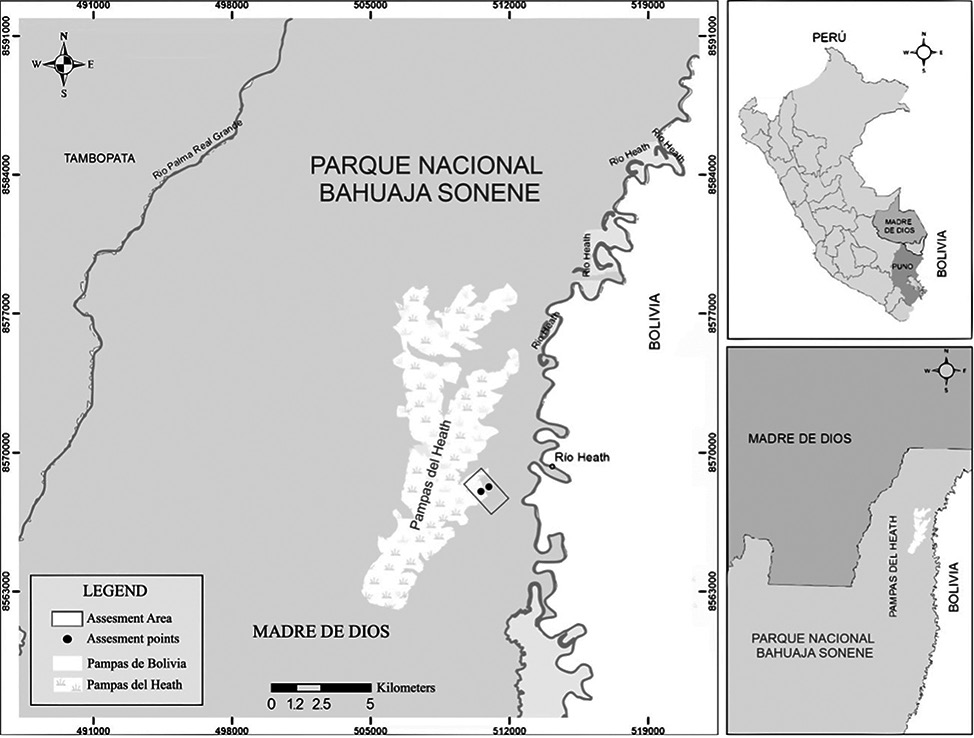
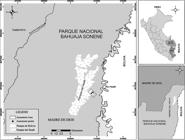
The study was conducted in the Heath River basin, in the area known as Pampas del Heath, located in the Tambopata district, Tambopata province, Madre de Dios, Peru, at 206 m a.s.l. and at the coordinates 12°57′11″S, 57′11″S and 68°54′10″W, 54′10″W (Fig. 1). The rainfall regime for the area is monomodal, presenting a rainy season and a dry season. The months from April to October correspond to the dry season, and November to March to the rainy season (Navarro et al., 2004).
Dung beetle sampling
Five samplings were carried out, three in the dry season (July 2012, April, and July 2013) and two in the rainy season (November 2012 and December 2013) over two years. Sampling was carried out in two habitats associated with the tropical humid savanna: (i) Open pampa (Grassland): which includes grasslands and shrub vegetation associated with termite mounds and (ii) Tierra firme forests (Forest): which includes the high terrace between the pampas and the Heath River (Montambault, 2002).
In each habitat, 12 NTP-97 pitfall traps (Valencia & Alonso, 1997) were installed, located every 15 m along a 180 m transect in each sampling area. Six traps were baited with decomposed fish (necrotraps) and six traps were baited with human feces (coprotraps), located in an interspersed manner. The pitfall traps remained in the field for a period of 48 h for each sampling event (Mora-Aguilar et al., 2023). One-liter plastic containers with an opening of 3 × 4 cm were buried at ground level, containing 200 ml of preservative solution, consisting of a saturated solution of water with detergent and salt. Inside, a small suspended container containing 100 g of bait was placed (Valencia & Alonso, 1997; Valencia, 2014).
The collected samples were collected in polyethylene bags with 70% alcohol, using collection labels, and were deposited in the Biodiversity Museum of Peru (MUBI) and in the Entomology Department of the National University of San Antonio Abad del Cusco (UNSAAC). The taxonomic determination was carried out using a Carl Zeiss Discovery v12 stereoscope and with the support of specialized literature (Génier, 1996; Edmonds & Zidek, 2004
; Génier, 2009; Edmonds & Zidek, 2010; Vaz de Mello et al., 2011; Edmonds & Zidek, 2012; Sarmiento-Garcés & Amat-García, 2014).
Data analysis
To assess sampling integrity, rarefaction-extrapolation curves of species were performed based on the total number of individuals captured during all sampling sessions (Chao et al., 2014). The analysis was based on the effective number of species, whose value is equivalent to the species richness (⁰D = S) (Jost, 2006; Rodríguez-López et al., 2019), and a Bootstrap resampling method with 1,000 replicates was used in the online software iNEXT (Chao et al., 2016; Rodríguez-López et al., 2019).
The diversity of the dung beetle assemblage was determined by the number of effective species (Jost, 2006). For this analysis we used: species richness (diversity of order 0; ⁰D), exponential entropy of Shannon index (¹D), and Simpson index inverse (²D). These indicators determine the influence of abundant species on the diversity measure: ⁰D does not take into account species abundances, ¹D includes all species with a weight proportional to their abundance, and ²D gives greater weight to the most abundant species (Gotelli & Chao, 2013; Ibarra-Polesel et al., 2015). The composition and distribution of species abundance in each of the habitats were contrasted using range-abundance curves.
Non-metric multidimensional scaling (NMDS) was used to represent clustering patterns in species composition among sampled habitats. To examine differences in species composition across habitats, climatic seasons, and sampling months, a similarity analysis (ANOSIM) and a percentage similarity analysis (SIMPER) were used to identify species that characterize the Pampas del Heath, considering those that contributed more than 7% to the abundance. For these three analyses, abundance data were used, employing the Bray-Curtis index in PAST v4.16c software (Hammer et al., 2012).
RESULTS
Dung beetle assemblage structure and diversity
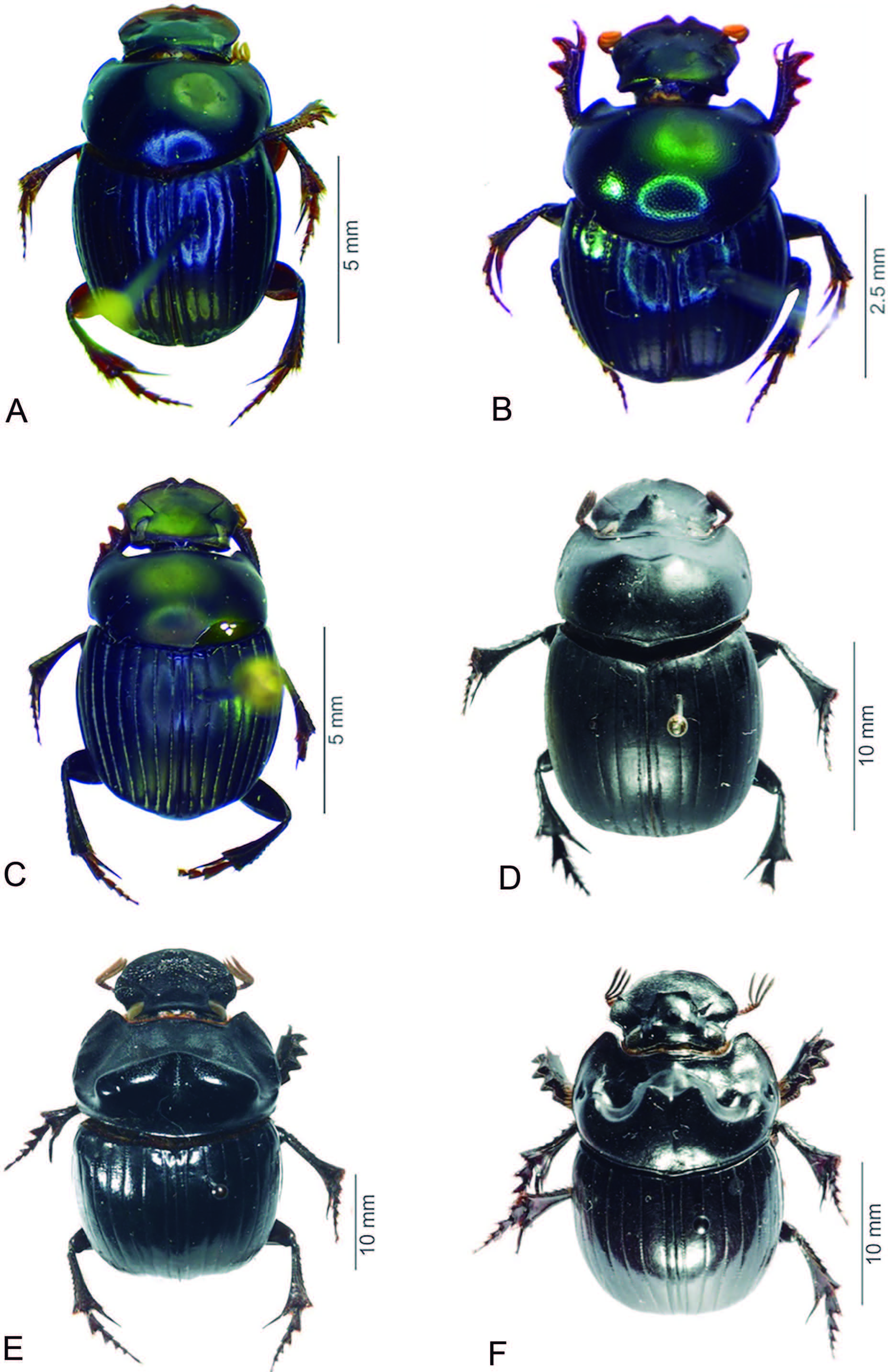
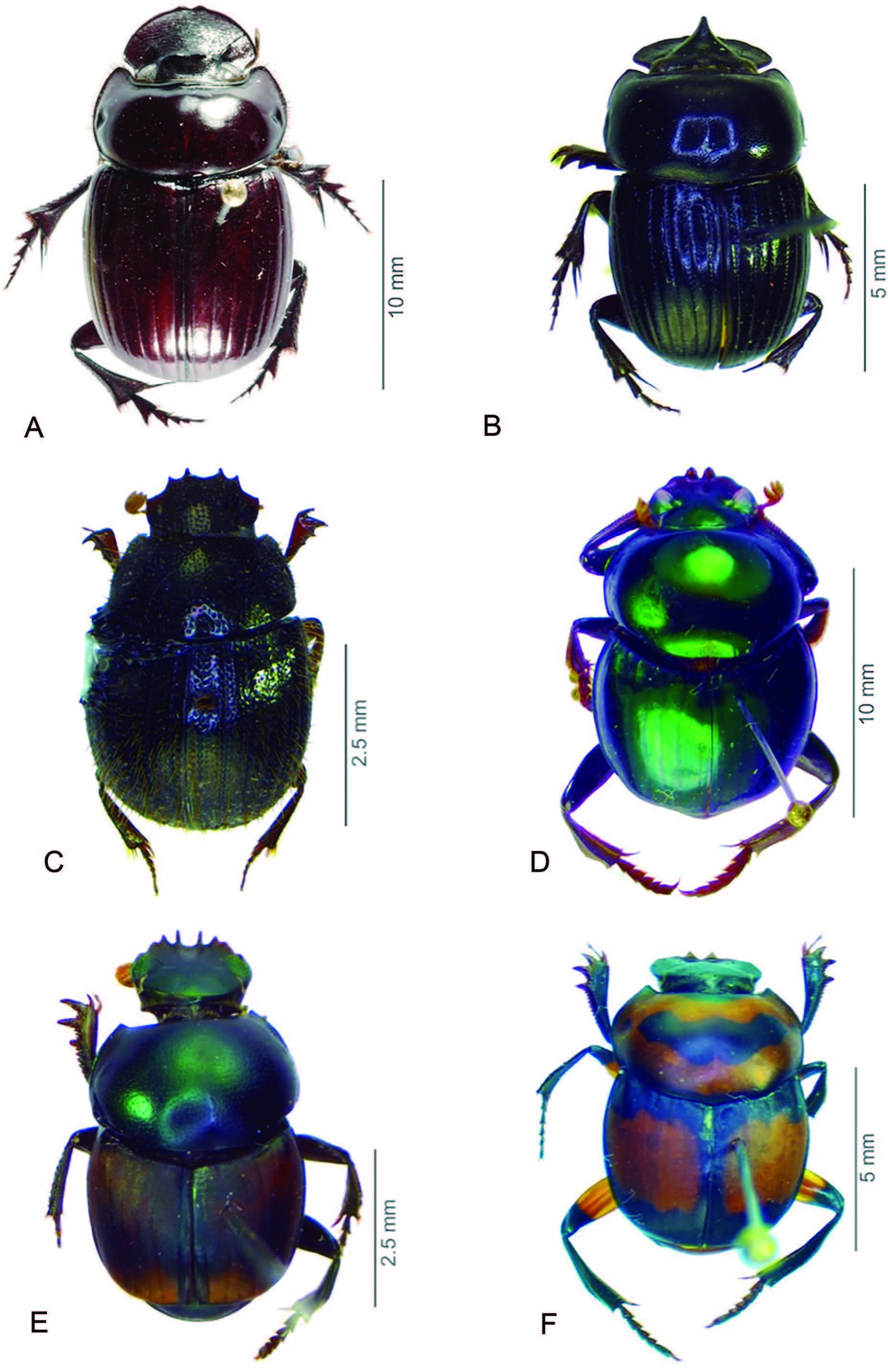
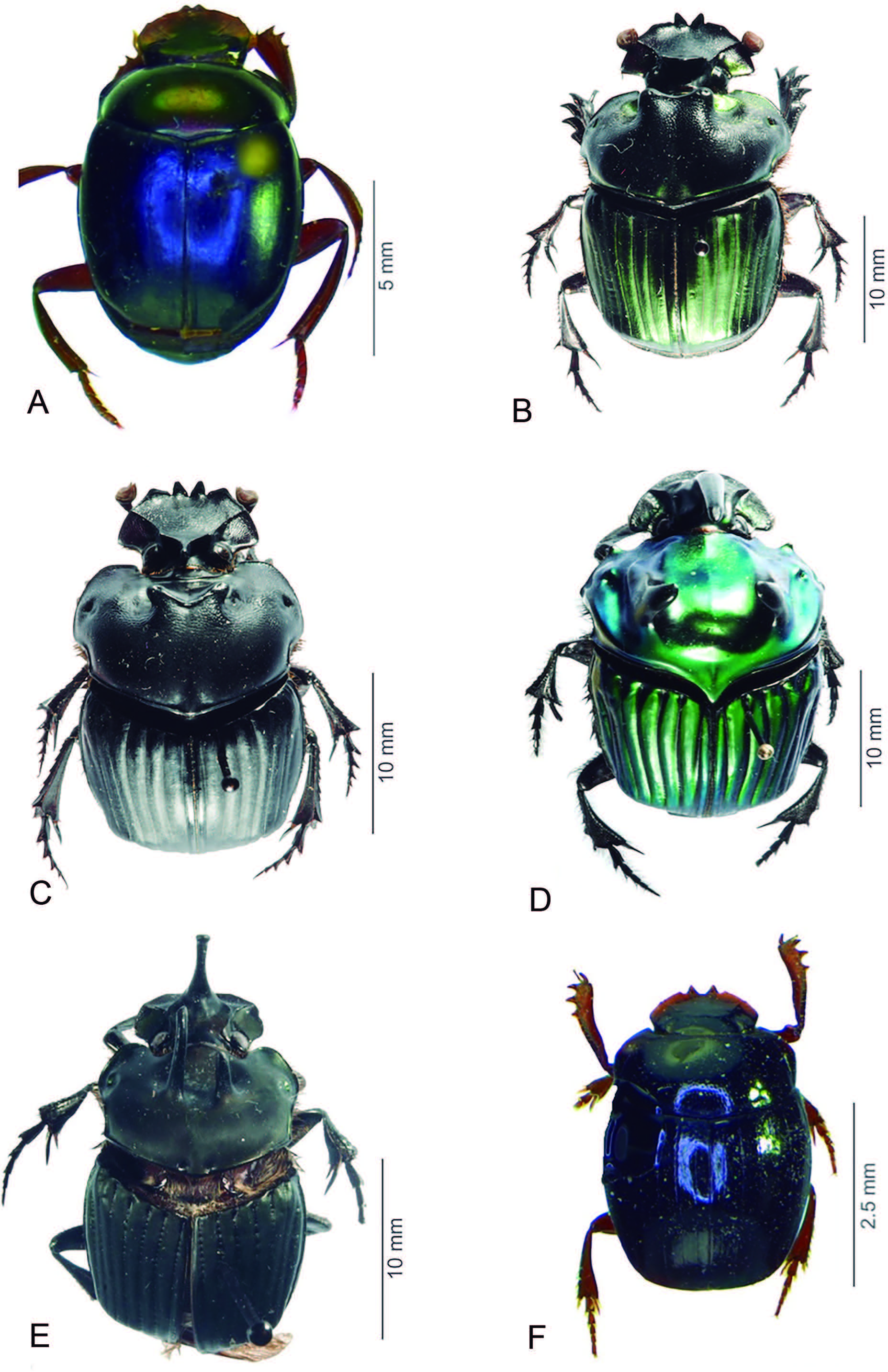
A total of 2,371 individuals were recorded, distributed among 44 species belonging to 6 tribes and 17 genera (Table 1, Figs.2-3 4 5). The Forest had the highest species richness, with 36 species, compared to the Grassland, which had 18 species (Table 1). The genera Canthidium, Canthon, Deltochilum, and Dichotomius had the highest species richness, with eight, six, and five species, respectively. Canthon septemmaculatus (Latreille, 1812) (n = 662), Canthidium lentum Erichson, 1847 (n = 251), Coprophanaeus magnoi Arnaud, 2002 (n = 144), and Uroxys corporaali Balthasar, 1940 (n = 138) were the dominant species in the Grassland. While Onthophagus haematopus Harold, 1875 (n = 192) and Onthophagus rubrescens Blanchard, 1845 (n = 232) were dominant in
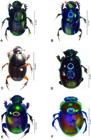
Photographic guide (I) of the species of dung beetles found in the Pampas del Heath, Bahuaja Sonene National Park, Peru: Onthophagus haematopus (A), Onthophagus rubrescens (B), Digitonthophagus gazella (C), Ateuchus substriatus (D), Canthidium cupreum (E), and Canthidium gerstaeckeri (F).
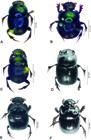
Photographic guide (II) of the species of dung beetles found in the Pampas del Heath, Bahuaja Sonene National Park, Peru: Canthidium lentum (A), Canthidium multipunctatum (B), Canthidium viridiobscurum (C), Dichotomius mamillatus (D), Dichotomius melzeri (E), and Dichotomius prietoi (F).
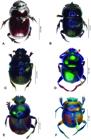
Photographic guide (III) of the species of dung beetles found in the Pampas del Heath, Bahuaja Sonene National Park, Peru: Dichotomius worontzowi (A), Ontherus aphodioides (B), Trichillidium quadridens (C), Canthon fulgidus (D), Canthon octodentatus (E), and Canthon septemmaculatus (F).
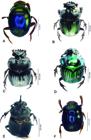
Photographic guide (VI) of the species of dung beetles found in the Pampas del Heath, Bahuaja Sonene National Park, Peru: Sylvicanthon bridarollii (A), Coprophanaeus magnoi (B), Coprophanaeus telamon (C), Oxysternon conspicillatum (D), Phanaeus bispinus (E), and Uroxys corporaali (F).
Diversity of dung beetles (Coleoptera: Scarabaeinae) assemblage in the Grassland and Forest in the different sampled months and periods in the PNBS, 2012-2013. Dung beetle assemblage diversity was determined by the number of effective species: species richness (⁰D), exponential entropy of Shannon index (¹D), and Simpson index inverse (²D) (Jost, 2006).
the Forest, together contributing 68.9% of the total abundance. In contrast, Ateuchus substriatus (Harold, 1868), Canthon fulgidus Redtenbacher, 1868, Sylvicanthon bridarollii (Martínez, 1949), Canthidium gerstaeckeri Harold, 1867, Canthi. nr. flavum, Dichotomius melzeri (Luederwaldt, 1922), Digitonthophagus gazella (Fabricius, 1787), and Phanaeus bispinus Bates, 1868 are represented by a single individual in the Grassland and in the Forest.
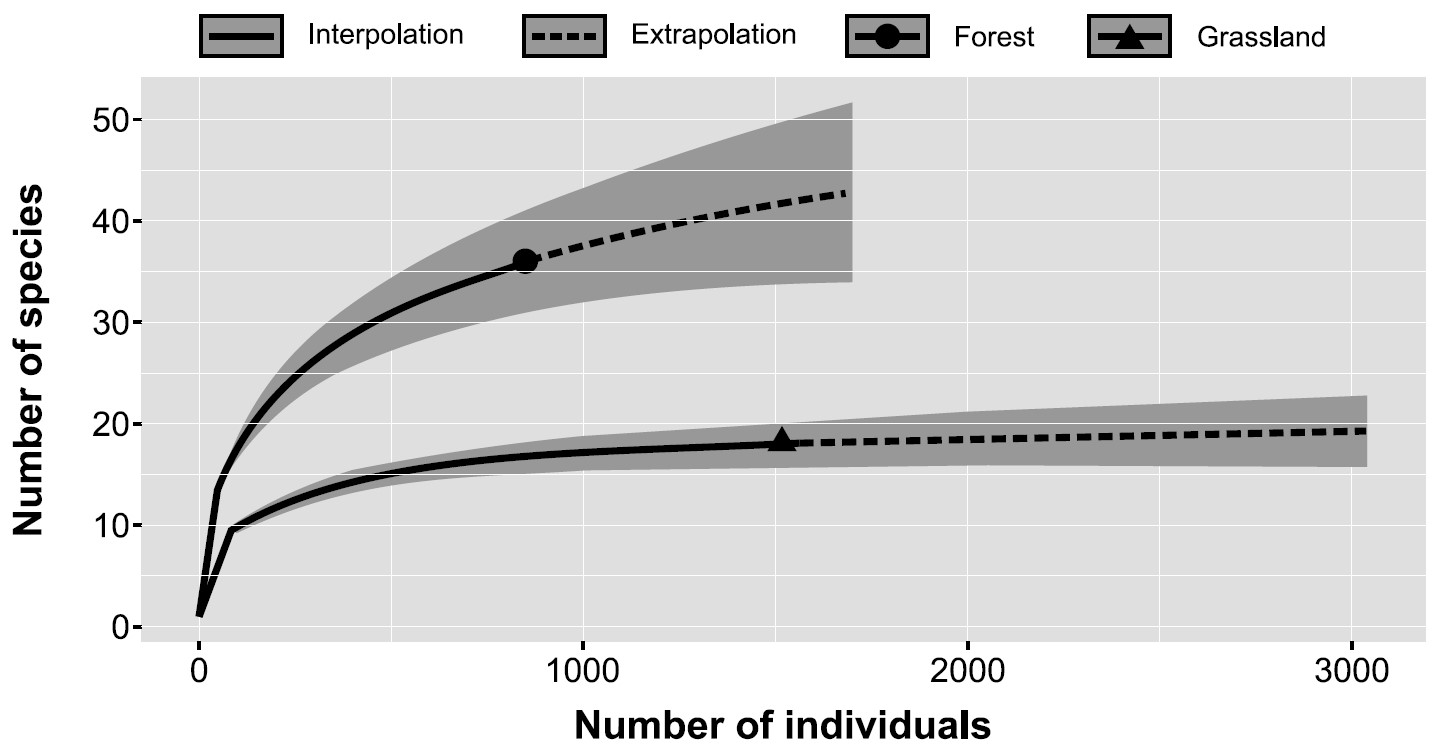
The rarefaction curves for the two habitats (Fig. 6) show different rates of species accumulation. The Grassland presents a rarefaction curve with the lowest number of species, reaching an asymptote, where the extrapolation for the estimated richness was 19.3 ± 3.5 effective species (Fig. 6). This indicates that the sampling effort was adequate, with 93.5% completeness. The Forest presents a rarefaction curve with the highest number of species without reaching an asymptote, where the extrapolation for the estimated richness was 43 ± 9 effective species (Fig. 6) with 84% completeness. When comparing the studied habitats, the Forest showed the highest richness (⁰D = 36 vs ⁰D = 18 in the grassland) and diversity (¹D = 10.8 and ²D = 6.6 vs ¹D = 6 and ²D = 4.1 in the grassland) (Table 2), however, the Grassland presented greater abundance (n = 1520 ind. vs n = 851 ind. in the forest). In both habitats, the diversity values ¹D and ²D were different, indicating an unequal composition of species with high and intermediate abundances. Likewise, the differences in ⁰D values concerning ¹D and ²D were greater, due to the greater number of uncommon or rare species, which are represented towards the end of the range-abundance curves (Table 2).
Dung beetle composition between grassland and forest
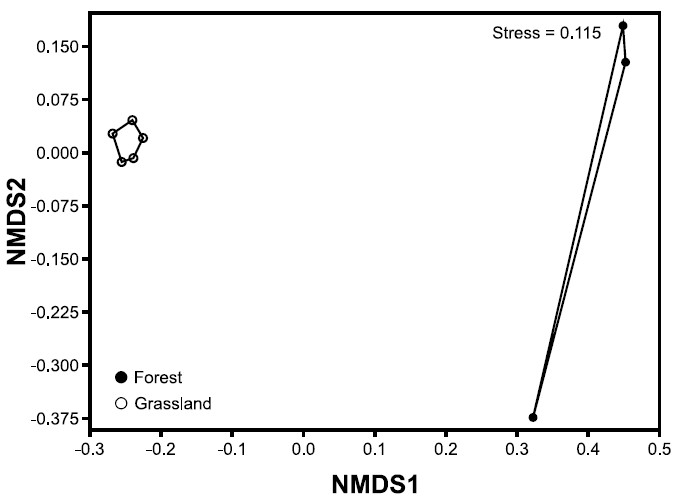
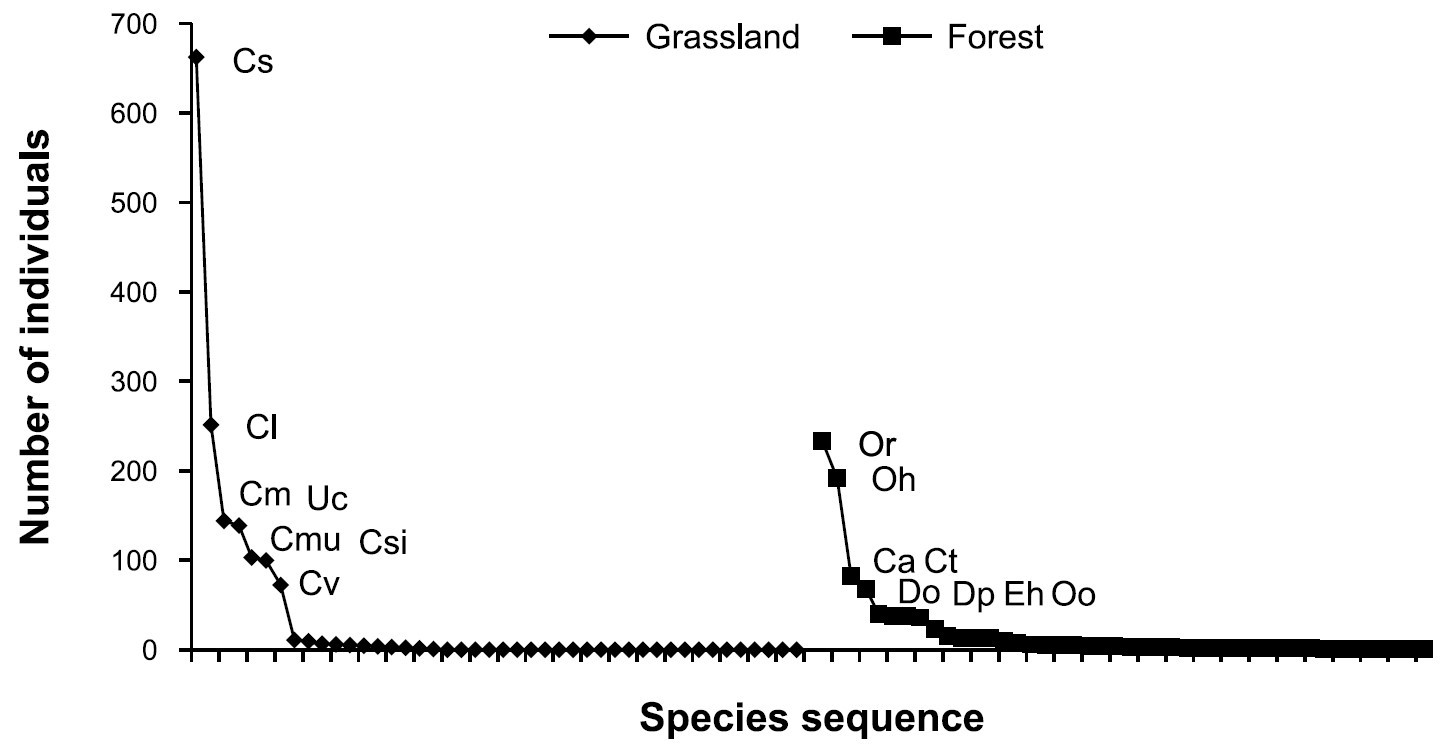
The range-abundance curves revealed differences in dung beetle composition between the two habitats, with distinct species representing the most abundant ones. Both curves had a similar distribution in their middle and posterior zones, with very steep slopes. The clustering patterns formed by the NMDS show a clear separation between the two sampled environments (Fig. 7), finding differences in the structure and composition of species despite the low representativeness of species in the Grassland (ANOSIM: R = 1; p = 0.0174). However, the distribution was more even in the Forest, where four species: O. rubrescens, O. haematopus, Canthon aff. angustatus, and Coprophanaeus telamon (Erichson, 1847) were dominant (Fig. 8). In contrast, the Grassland showed a steep slope due to the higher abundance of C. septemmaculatus (27.9%).
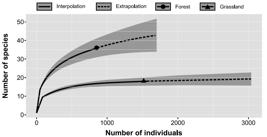
Rarefaction curves of the number of species (richness - ⁰D) of dung beetles (Coleoptera: Scarabaeidae) based on the number of individuals (total abun dance with a 95% confidence interval), collected in the Grassland and the Forest, Pampas del Heath, Bahuaja Sonene National Park, Peru.
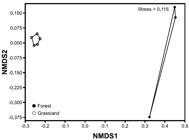
Non-Metric Multidimensional Scaling (NMDS1 and NMDS2) was developed from the Bray-Curtis index to establish the similarities of the Scarabaeinae fauna between environments in the Pampas del Heath, Bahuaja Sonene National Park, Peru.
Dung beetle seasonality
Regarding seasonality, the number of species and diversity were greater during the rainy season (37 spp., ¹D = 11.6) than during the dry season (22 spp., ¹D = 7.8), while abundance was three times higher (rainy = 1187 and dry = 489; Table2). However, despite the above result, when the values were compared between stations, no statistically significant differences were found (ANOSIM: R = -0.148; p = 0.79). The highest values for abundance (n = 954), richness (⁰D = 35), and diversity (¹D = 11.8 and ²D = 7.8) were recorded in November 2012 (Table 2). In contrast, the lowest values for the indices were recorded in December 2013, with a 70.5% decrease in diversity compared to November 2012 (Table 2). The
Percentage of similarity (SIMPER) of dung beetle species (Coleoptera: Scarabaeinae) collected in the Grassland and Forest of the Pampas del Heath in the PNBS.
²D diversity was lower in the December 2013 (²D = 3.2) sampling, due to the dominance of Canthi. lentum, C. septemmaculatus, and C. magnoi, which together represented 96% of the total individuals captured in that month. According to the SIMPER analysis, the species that characterized the Grassland and Forest of the Pampas del Heath were: C. septemmaculatus, Canthi. lentum, C. magnoi, O. rubrescens, and O. haematopus (Table 3), the first three species showed a marked population peak at the beginning and end of the rainy season in the Grassland and not in the Forest, and represented 69.5% of their abundance. Onthophagus rubrescens and O. haematopus characterized the Forest and represented 49.8% of the abundance.
DISCUSSION
This is the first research on dung beetle diversity of tropical moist savannas located in the Pampas del Health region - Bahuaja Sonene National Park (PNBS), department of Madre de Dios, in Peru. In this study, we analyze the differences between habitats (forests and grasslands), seasons (dry and rainy), and years. In general
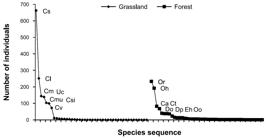
Range-abundance curves for dung beetle species collected in Grassland and Forest of the Pampas del Heath, Bahuaja Sonene National Park, Peru. Species codes used in Table 1.
terms, there were differences in the structure and composition of species between habitats, Forests had the highest species richness compared to Grasslands, and abundance and diversity were higher in the rainy season than in the dry season. At the conservation level, observed richness indicates that even small forested fragments are important for conservation purposes, to the extent that five new species records were found for the country. The general objective of the study, which was to build a baseline that allows for medium- and long-term ecological studies, was intended to consolidate regional conservation strategies.
The total species richness recorded in the Pampas del Heath represents 16% of the total species recorded in Peru (Ratcliffe et al., 2015) and 21.5% of the total Scarabaeinae species distributed in the Madre de Dios region (Larsen, 2006). Sampling estimators recorded a richness very close to that observed, demonstrating that it was a reliable assessment in both habitats. However, a greater sampling effort is suggested in the Forest and in addition the use of other complementary techniques (other types of baits, collection methods such as direct capture and flight interception traps, and sampling comparison between years in wider windows of time; see Mora-Aguilar et al., 2023) could increase the richness in this region, new country records, and potential new species for science.
This study offers a species richness of dung beetles similar to other investigations that have been carried out in the Madre de Dios region, such as the Tambopata National Reserve, where 38 species are reported (Figueroa & Alvarado, 2011), and the surroundings of Puerto Maldonado, where 52 species are reported (Grados & Alvarado, 2010). It is important to note that these investigations were carried out in larger sampling areas with a greater sampling effort and also used carrion for collections, a bait used for the collection of necro- or copro-necrophagous species, increasing the efficiency in the number of captured species (Noriega, 2015; Sánchez-Hernández et al., 2018; Rodríguez-López et al., 2019; Arellano et al., 2023; Correa et al., 2024). Forest showed the highest richness and diversity, with many rare species recorded, a common result in tropical forests with defined dry and wet climatic seasons (Halffter, 1991; Ibarra-Polesel et al., 2015; Noriega, 2015; Correa et al., 2020; Noriega et al., 2021b).
In terms of seasonality, our results are similar to those reported by Orozco & Perez (2008) and Ibarra-Polesel et al. (2015) in two dry premontane forests and humid montane forests. The pattern of greater richness and abundance during the rainy season in both habitats (grassland and forest) is closely related to a greater availability of food resources, temperature, and greater humidity that prevents potential desiccation problems. This trend has been documented in different types of Neotropical forests for multiple groups of insects (Janzen, 1983; Wolda, 1988; Medina & Lopes, 2014; Cassenote et al., 2019; van Dijk et al., 2024). Seasonality has a very important effect on the methodological design of the sampling, especially if the primary objective is to have complete inventories, the sampling must cover the different moments of the year (rain, drought, and the transitions between seasons) (Mora-Aguilar et al., 2023). For this reason, this study obtained an exhaustive sample by covering different years and different periods.
It is noteworthy that Digitonthophagus gazella (Fabricius, 1787) is considered in the National Action Plan on Invasive Alien Species in Peru (DS No. 006-2022, MINAM, 2022), it is of African origin and was introduced in 1970 in the American continent, although it is previously registered for Puerto Maldonado (Noriega et al., 2010) it is registered for the first time for the Pampas del Heath. Its presence is a potential indicator of the anthropic effect and the possible negative pressure that the expansion of livestock farming in the region can exert (Vidaurre et al., 2008; Noriega et al., 2020b). The species Canthon octodentatus Schmidt, 1920, Canthidium viridiobscurum Boucomont, 1928, Canthi. multipunctatum Balthasar, 1939, Trichillidium quadridens (Arrow, 1932), C. magnoi and U. corporaali constitute new records for the Scarabaeinae fauna of Peru. Of these, C. octodentatus and C. magnoi have been reported as indicators of grasslands and open areas in the Cerrado biogeographic province (Edmonds & Zidek, 2010; Batista et al., 2016; Ferreira et al., 2020; Correa et al., 2022; da Silva et al., 2024).
Although the Pampas del Heath is a small area, the number of species found in this study demonstrates a good state of conservation. The PNBS not only protects a representative sample of the beetle fauna, but also of other arthropods and vertebrates on which they depend. Furthermore, this is the first study of dung beetle diversity reported in the Pampas del Heath, consolidating a comprehensive inventory for Madre de Dios and more specifically for the PNBS, which will allow for more in-depth ecological studies in the future. Characterizing the assemblage of dung beetles in the pampas is essential for the completeness of the national inventory. In addition, it constitutes a starting point for the development of protocols that will allow for monitoring and diagnosing strategies for the impact of human activities on the richness and diversity of dung beetles in the territory in the medium and long term. Finally, all this information not only allows us to establish bioindicator species that can be used in environmental impact assessments, but also allows us to generate specific conservation strategies for this region and for the country.
ACKNOWLEDGMENTS:
This research was made possible thanks to the Frankfurt Zoological Society of Peru (FZS - Perú) and the National Service of Natural Protected Areas of Peru (SERNANP) through the Bahuaja Sonene National Park (PNBS) Headquarters. We want to thank David Aranibar, Fredy Quispe, Edwin Gutierrez (SERNANP), Juvenal Silva, Kevin Ivañez, Roger Pocco, and German Sebastian (FZS - Perú) for their assistance in conducting this research. We would also like to thank all the PNBS park rangers who assisted us during the field evaluations. We would also like to thank Javier Farfan Flores for his help in photographing the specimens used in this study. To David Morris for checking the English version of this article. To the government for the collection permits: RJ № 006-2012-SERNANP-DGANP-PNBS, RJ № 014-2012-SERNANP-DGANP-PNBS, RJ № 001-2013-SERNANP-DGANP-PNBS.
Data Availability:
All data are provided within the article and its supplementary materials. Any additional data is available from the corresponding author upon reasonable request.
REFERENCES
-
Arellano, L.; Noriega, J.A.; Ortega-Martinez, I.J.; Rivera, J.D.; Correa, C.M.A.; Gomez-Cifuentes, A.; Ramirez-Hernandez, A. & Barragan, F. 2023. Dung beetles (Coleoptera: Scarabaeidae) in grazing lands of the Neotropics: A review of patterns and research trends of taxonomic and functional diversity, and functions. Frontiers in Ecology and Evolution, 11: 1-20, 1084009. https://doi.org/10.3389/fevo.2023.1084009.
» https://doi.org/10.3389/fevo.2023.1084009 - Batista, M.C.; Lopes, G.S.; Marques, L.J. & Teodoro, A.V. 2016. The dung beetle assemblage (Coleoptera: Scarabaeinae) is differently affected by land use and seasonality in northeastern Brazil. Entomotropica, 31(13): 95-104.
- Cadle, J.; Icochea, J.; Pérez Zúñiga, J.; Portilla, A. & Rivera, A. 2002. La herpetofauna encontrada en el Refugio Juliaca y en el Puesto de Vigilancia Enahuipa del Santuario Nacional Pampas del Heath. In: Montambault, J.R. (Ed.). Informes de las evaluaciones biológicas Pampas del Heath, Perú; Alto Madidi, Bolivia; y Pando, Bolivia Washington, Conservation International. p. 52-57. (Bulletin of Biological Assessment 24)
-
Cassenote, S.; da Silva, P.G.; Di Mare, R.A. & Paladini, A. 2019. Seasonality of dung beetles (Coleoptera: Scarabaeinae) in Atlantic Forest sites with different levels of disturbances in southern Brazil. Iheringia, Série Zoologia, 109: 1-9, e2019035. https://doi.org/10.1590/1678-4766e2019035.
» https://doi.org/10.1590/1678-4766e2019035 -
Chao, A.; Gotelli, N.J.; Hsieh, T.C.; Sander, E.L.; Ma, K.H.; Colwell, R.K. & Ellison, A.M. 2014. Rarefaction and extrapolation with Hill numbers: a framework for sampling and estimation in species diversity studies. Ecological Monograph, 84(1): 45-67. https://doi.org/10.1890/130133.1.
» https://doi.org/10.1890/130133.1 -
Chao, A.; Ma, K.H. & Hsieh, T.C. 2016. iNEXT (iNterpolation and EXTrapolation) online: Software for interpolation and extrapolation of species diversity. Program and user’s guide https://chao.shinyapps.io/iNEXTOnline
» https://chao.shinyapps.io/iNEXTOnline -
Correa, C.M.; Ferreira, K.R.; Abot, A.R.; Louzada, J. & Vaz de Mello, F.Z. 2022. Ivermectin impacts on dung beetle diversity and their ecological functions in two distinct Brazilian ecosystems. Ecological Entomology, 47(5): 736-748. https://doi.org/10.1111/een.13158.
» https://doi.org/10.1111/een.13158 -
Correa, C.M.; Salomao, R.P.; Xavier, B.F.S.; Noriega, J.A.; Puker, A. & Ferreira, K.R. 2024. How much biodiversity do we lose in planted forests? A case study with dung beetles in the Brazilian Amazon rainforest. Biologia, Bratislava, 79: 3549-3560. https://doi.org/10.1007/s11756-024-01788-1.
» https://doi.org/10.1007/s11756-024-01788-1 -
Correa, C.M.A.; Puker, A. & Abot, A.R. 2020. Impacts of exotic pasture establishment on dung beetle assemblages (Coleoptera: Scarabaeidae: Scarabaeinae) in the Brazilian Cerrado. Environmental Entomology, 49(6): 1335-1344. https://doi.org/10.1093/ee/nvaa132.
» https://doi.org/10.1093/ee/nvaa132 -
Correa, C.M.A.; Puker, A.; Korasaki, V.; Ferreira, K.R. & Abot, A.R. 2016. The attractiveness of baits to dung beetles in Brazilian Cerrado and exotic pasturelands. Entomological Science, 19(2): 112-123. https://doi.org/10.1111/ens.12169.
» https://doi.org/10.1111/ens.12169 -
Correa-Cuadros, J.P.; Gómez-Cifuentes, A. & Noriega, J.A. 2022. Comparative effect of forest cutting and mammal hunting on dung beetle assemblages in Chocó Biogeographic forests in Colombia. International Journal of Tropical Insect Science, 42: 3045-3055. https://doi.org/10.1007/s42690-022-00839-x.
» https://doi.org/10.1007/s42690-022-00839-x -
Cupello, M.; Silva, F.A.B.; Vaz-de-Mello, F.Z. 2023. The taxonomic revolution of new world dung beetles (Coleoptera: Scarabaeidae: Scarabaeinae). Frontiers in Ecology and Evolution, 11: 1-42, 1168754. https://doi.org/10.3389/fevo.2023.1168754.
» https://doi.org/10.3389/fevo.2023.1168754 -
da Silva, V.R.; Mesquita, M.L.; Batista, M.C.; Vaz de Mello, F.Z. & de Sousa, J.R. 2024. Influence of environmental heterogeneity on the structure of the dung beetle (Coleoptera: Scarabaeidae: Scarabaeinae) assemblage of the Cerrado savanna of northeastern Brazil. Journal of Insect Conservation, 28: 291-303. https://doi.org/10.1007/s10841-024-00566-3.
» https://doi.org/10.1007/s10841-024-00566-3 -
Daniel, G.M.; Noriega, J.A.; Da Silva, P.; Deschodt, C.M.; Sole, C.L.; Scholtz, C.H. & Davis, A.L.V. 2021. Soil type, vegetation cover and temperature determinants of the diversity and structure of dung beetle assemblages in a South African open Woodland and closed canopy Mosaic. Austral Ecology, 47: 79-91. https://doi.org/10.1111/aec.13138.
» https://doi.org/10.1111/aec.13138 - Edmonds, W.D. & Zídek, J. 2004. Revision of the Neotropical dung beetle genus Oxysternon (Scarabaeidae: Scarabaeinae: Phanaeini). Folia Heyrovskyana, 11: 1-58.
- Edmonds, W.D. & Zídek, J. 2010. A taxonomic review of the neotropical genus Coprophanaeus Olsoufieff, 1924 (Coleoptera: Scarabaeidae, Scarabaeinae). Insecta Mundi, 0129: 1-111.
- Edmonds, W.D. & Zidek, J. 2012. Taxonomy of Phanaeus revisited: Revised keys to and comments on species of the New World dung beetle genus Phanaeus MacLeay, 1819 (Coleoptera: Scarabaeidae: Scarabaeinae: Phanaeini). Insecta Mundi, 784: 1-111.
- Escobar, F. 2000. Diversidad y distribución de los escarabajos del estiércol (Coleoptera: Scarabaeidae: Scarabaeinae) de Colombia. In: Piera, F.M.; Morrone, J.J. & Melic, A. (Eds.). Hacia un proyecto Cyted para el inventario y estimación de la diversidad entomológica en Iberoamerica Colombia, Villa de Leyva. p. 197-210.
-
Ferreira, K.R.; Puker, A. & Correa, C.M.A. 2020. The attraction of Amazonian dung beetle (Coleoptera: Scarabaeidae: Scarabaeinae) to the feces of omnivorous mammals is dependent on their diet: Implications for ecological monitoring. Environmental Entomology, 49(6): 1383-1392. https://doi.org/10.1093/ee/nvaa106.
» https://doi.org/10.1093/ee/nvaa106 -
Figueroa, L. & Alvarado, M. 2011. Coleópteros coprófagos (Scarabaeidae: Scarabeinae) de la Reserva Nacional Tambopata, Madre de Dios, Perú. Revista Peruana de Biología, 18(2): 209-212. https://doi.org/10.15381/rpb.v18i2.230.
» https://doi.org/10.15381/rpb.v18i2.230 - Foster, R.B.; Parker, T.A.; Gentry, A.H.; Chicchon, A.; Schulenberg, T.; Rodriguez, L. & Barkley, L.J. 1994. Rapid Assessment of Biodiverity in South-Eastern Peru. The Tambopata-Candamo Reserved Zone of Southeastern Peru: A Biological Assessment. 184p.
-
Génier, F. 1996. A revision of the neotropical genus Ontherus Erichson (Coleoptera: Scarabaeidae, Scarabaeinae). Memoirs of the Entomological Society of Canada, 170: 1-169. https://doi.org/10.4039/entm128170fv.
» https://doi.org/10.4039/entm128170fv - Génier, F. 2009. Le genre Eursyternus Dalman, 1824 (Scarabaeidae: Scarabaeinae: Oniticellini) revision taxonomique et clés de determination illustrées. Pensoft Series Faunistica, 85: 1-430.
-
Gotelli, N.J. & Chao, A. 2013. Measuring and estimating species richness, species diversity and biotic similarity from sampling data. In: Levin, S.A. (Ed.). Encyclopedia of Biodiversity 2.ed. San Diego, Academic Press. v. 5, p. 195-211. Waltham: Academic Press. https://doi.org/10.1016/B978-0-12-384719-5.00424-X.
» https://doi.org/10.1016/B978-0-12-384719-5.00424-X - Grados, J. & Alvarado, M. 2010. Insectos Scarabaeinae (Coleoptera) y Arctiidae (Lepidoptera). In: Figueroa, J. & Stucchi, M. (Eds.). Biodiversidad de los alrededores de Puerto Maldonado: Línea Base Ambiental del EIA del Lote 111 Madre de Dios Lima, PyD Ingenieros y AICB. p. 103-120
-
Halffter, G. 1991. Historical and ecological factors determining the geographical distribution of beetles (Coleoptera: Scarabaeidae: Scarabaeinae). Folia Entomológica Mexicana, 82: 195-238. https://doi.org/10.21426/B615110376.
» https://doi.org/10.21426/B615110376 - Halffter, G. & Favila, M.E. 1993. The Scarabaeinae (Insecta: Coleoptera) an animal group for analysing, inventorying and monitoring biodiversity in tropical rainforest and modified landscapes. Biology International, 27: 15-21.
-
Halffter, G.; Pineda, E.; Arellano, L. & Escobar, F. 2007. Instability of copronecrophagous beetle assemblages (Coleoptera: Scarabaeinae) in a mountainous tropical landscape of Mexico. Environmental Entomology, 36(6): 1397-1407. https://doi.org/10.1603/0046-225X(2007)36[1397:IOCBAC]2.0.CO;2.
» https://doi.org/10.1603/0046-225X(2007)36[1397:IOCBAC]2.0.CO;2 -
Hammer, O.; Harper, D.A. & Ryan, P.D. 2012. PAST (Paleontological Statistics) version 2.16. Software package for education and data analysis. Paleontología Electrónica, 4: 1-9. Available: Available: https://folk.uio.no/ohammer/past Access: 07/2023.
» https://folk.uio.no/ohammer/past -
Hanski, I. & Cambefort, Y. 1991. Dung beetle ecology New Jersey, Princeton University Press. 520p. https://doi.org/10.1515/9781400862092.
» https://doi.org/10.1515/9781400862092 -
Ibarra-Polesel, M.; Damborsky, M. & Porcel, E. 2015. Escarabajos copronecrófagos (Scarabaeidae: Scarabaeinae) de la Reserva Natural Educativa Colonia Benítez, Chaco, Argentina. Revista Mexicana de Biodiversidad, 86(3): 744-753. https://doi.org/10.1016/j.rmb.2015.05.011.
» https://doi.org/10.1016/j.rmb.2015.05.011 -
Janzen, D.H. 1983. Seasonal change in abundance of large nocturnal dung beetles (Scarabaeidae) in a Costa Rican deciduous forest and adjacent horse pasture. Oikos, 41(2): 274-283. https://doi.org/10.2307/3544274.
» https://doi.org/10.2307/3544274 -
Jost, L. 2006. Entropy and diversity. Oikos, 113(2): 363-375. https://doi.org/10.1111/j.2006.0030-1299.14714.x.
» https://doi.org/10.1111/j.2006.0030-1299.14714.x - Lamas, G. 1994. Sinopsis de los hexápodos conocidos del Perú. Revista Peruana de Entolomogía, 37(1): 1-9.
-
Larsen, T.H. 2006. Extreme Trophic and Habitat Specialization by Peruvian Dung Beetles (Coleoptera: Scarabaeidae: Scarabaeinae). The Coleopterists Bulletin, 60(4): 315-324. https://doi.org/10.1649/0010-065X(2006)60[315:ETAHSB]2.0.CO;2.
» https://doi.org/10.1649/0010-065X(2006)60[315:ETAHSB]2.0.CO;2 -
López-Bedoya, P.A.; Bohada-Murillo, M.; Ángel-Vallejo, M.C.; Audino, L.D.; Davis, A.L.V.; Gurr, G. & Noriega, J.A. 2022. Primary forest loss and degradation reduces biodiversity and ecosystem functioning: A global meta-analysis using dung beetles as an indicator taxon. Journal of Applied Ecology, 59(6): 1572-1585. https://doi.org/10.1111/1365-2664.14167.
» https://doi.org/10.1111/1365-2664.14167 -
Marchant, R. 2010. Understanding complexity in savannas: climate, biodiversity and people. Current Opinion in Environmental Sustainability, 2(1-2): 101-108. https://doi.org/10.1016/j.cosust.2010.03.001.
» https://doi.org/10.1016/j.cosust.2010.03.001 -
Medina, A.M. & Lopes, P.P. 2014. Seasonality in the dung beetle community in a Brazilian tropical dry forest: Do small changes make a difference? Journal of Insect Science, 14(1): 123. https://doi.org/10.1673/031.014.123.
» https://doi.org/10.1673/031.014.123 - Ministerio del Ambiente (MINAM). 2018. Mapa Nacional de Ecosistemas del Perú. Memoria descriptiva. Lima, Ministerio del Ambiente - MINAM.
- Ministerio del Ambiente (MINAM). 2022. Decreto Supremo que aprueba el Plan de Acción Nacional sobre las Especies Exóticas Invasoras en el Perú 2022-2026 El Peruano. Normas Legales: 2049465-8.
- Montambault, J.R. 2002. Informes de las evaluaciones biológicas Pampas del Heath, Perú, Alto Madidi, Bolivia y Pando, Bolivia Washington, DC, Conservation International. (Rap Bulletin Biological Assessment, v. 24).
- Mora-Aguilar, E.F.; Arriaga-Jiménez, A.; Correa, C.M.A.; da Silva, P.G.; Korasaki, V.; López-Bedoya, P.A.; Hernández, M.I.M.; Pablo-Cea, J.D.; Salomao, R.P.; Valencia, G.; Vulinec, K.; Edwards, F.A.; Edwards, D.P.; Halffter, G. & Noriega, J.A. 2023. Toward a standardized methodology for sampling dung beetles (Coleoptera: Scarabaeinae) in the Neotropics: A critical review. Frontiers in Ecology and Evolution, 11: 1-16, 1096208.
- Navarro, G.; Ferreira, W.; Antezana, C.; Arrázola, S. & Vargas, R. 2004. Capitulo 15: Zonificación Ecológica. In: Bio-Corredor Amboró Madidi Santa Cruz, Bolivia, FAN. p. 1-40.
-
Nichols, E.; Spector, S.; Louzada, J.; Larsen, T.; Amezquita, S.; Favila, M.E. & The Scarabaeinae Research Network. 2008. Ecological functions and ecosystem services provided by Scarabaeinae dung beetles. Biological Conservation, 141: 1461-1474. https://doi.org/10.1016/j.biocon.2008.04.011.
» https://doi.org/10.1016/j.biocon.2008.04.011 - Noriega, J.A. 2015. How a locality can have so many species? A case study with dung beetles (Coleoptera: Scarabaeinae) in a tropical rain forest in Colombia. In: Stack, C.(Ed.). Beetles: biodiversity, ecology and role in the environment Nova Science Publishers. p. 175-204.
-
Noriega, J.A.; Zapata-Prisco, C.; García, H.; Hernández, E.; Hernández, J.; Martínez, R.; Santos-Santos, J.H.; Pablo-Cea, J.D. & Calatayud, J. 2020a. Does ecotourism impact biodiversity? An assessment using dung beetles (Coleoptera: Scarabaeinae) as bioindicators in a tropical dry forest natural park. Ecological Indicators, 117: 1-8,106580. https://doi.org/10.1016/j.ecolind.2020.106580.
» https://doi.org/10.1016/j.ecolind.2020.106580 -
Noriega, J.A.; Floate, K.D.; Génier, F.; Reid, C.A.M.; Kohlmann, B.; Horgan, F.G.; Davis, A.L.V.; Forgie, S.A.; Aguilar, C.; Ibarra, M.G.; Vaz-de-Mello, F.; Ziani, S. & Lobo, J.M. 2020b. Global distribution patterns provide evidence of niche shift by the introduced African dung beetle Digitonthophagus gazella Entomologia Experimentalis et Applicata, 168(10): 766-782. https://doi.org/10.1111/eea.12961.
» https://doi.org/10.1111/eea.12961 -
Noriega, J.A.; Horgan, F.;. & Valencia, G. 2010. Records of an invasive dung beetle species, Digitothophagus gazella (Fabricius, 1787) (Coleoptera: Scarabaeidae), in Perú. Acta Zoológica Mexicana (nueva serie), 26(2): 451-456. https://doi.org/10.21829/azm.2010.262724.
» https://doi.org/10.21829/azm.2010.262724 -
Noriega, J.A.; March-Salas, M.; Castillo, S.; García-Q.; H.; Hortal, J. & Santos, A.M.C. 2021a. Human perturbations reduce dung beetle diversity and dung removal ecosystem function. Biotropica, 53(3): 753-766. https://doi.org/10.1111/btp.12953.
» https://doi.org/10.1111/btp.12953 -
Noriega, J.A.; Santos, A.M.C.; Calatayud, J.; Chozas, S. & 2021b. Short- and long-term temporal changes in the assemblage structure of Amazonian dung beetles. Oecologia, 195: 719-736. https://doi.org/10.1007/s00442-020-04831-5.
» https://doi.org/10.1007/s00442-020-04831-5 -
Orozco, J. & Pérez, M. 2008. Escarabajos coprófagos (Coleoptera, Scarabaeoidea) del Parque Nacional Los Estoraques (Norte Santabnbder Colombia). Revista Brasileira de Entomologia, 52: 36-40. https://doi.org/10.1590/S0085-56262008000100007.
» https://doi.org/10.1590/S0085-56262008000100007 -
Otavo, S.E.; Parrado-Rosselli, A. & Noriega, J.A. 2013. Superfamilia Scarabaeoidea (Insecta: Coleoptera) como elemento bioindicador de perturbación antropogénica en un parque Nacional Amazónico. Revista de Biología Tropical, 61(2): 735-752. https://doi.org/10.15517/rbt.v61i2.11219.
» https://doi.org/10.15517/rbt.v61i2.11219 -
Pablo-Cea, J.D.; Velado-Cano, M.A.; Noriega, J.A. 2020. A first step to evaluate the impact of ecotourism on biodiversity in El Salvador: a case study using dung beetles in a National Park. Journal of Ecotourism, 20: 51-69. https://doi.org/10.1080/14724049.2020.1772798.
» https://doi.org/10.1080/14724049.2020.1772798 - Pulido, L.A.; Riveros, R.A.; Gast, F. & Von Hildebrand, P. 2003. Escarabajos coprófagos (Coleoptera: Scarabaeidae: Scarabaeinae) del Parque Nacional Natural “Serranía De Chiribiquete”, Caqueta, Colombia (Parte I) Zaragoza, SEA. p. 51-58. (SEA m3m vol. 3).
-
Ratcliffe, B.C.; Jameson, M.L.; Figueroa, L.; Cave, R.D. & Paulsen, M.J. 2015. Beetles (Coleoptera) of Peru: A Survey of the Families. Scarabaeoidea. Journal of the Kansas Entomological Society, 88(2): 186-207. https://doi.org/10.2317/kent-88-02-186-207.1.
» https://doi.org/10.2317/kent-88-02-186-207.1 -
Rodríguez-López, M.E.; Sánchez-Hernaández, G. & Gómez, B. 2019. Escarabajos coprófagos (Coleoptera: Scarabaeidae: Scarabaeinae) en la reserva El Zapotal, Chiapas, México. Revista Peruana de Biología, 26(3): 339-350. https://doi.org/10.15381/rpb.v26i3.16778.
» https://doi.org/10.15381/rpb.v26i3.16778 - Romo, M.; Luna, L. & Cornejo-Farfán, A. 2022. Mamíferos encontrados en el Santuario Pampas del Heath. In: Montambault, J.R. (Ed.). Informes de las evaluaciones de Pampas del Heath, Perú, Alto Madidi, Bolivia y Pando, Bolivia Washington, Conservation International . p. 66-70. (Rap Bulletin Biological Assessment, v. 24).
-
Sánchez-Hernández, G.; Gómez, B.; Delgado, L.; Rodríguez-López, M.E. & Chamé-Vázquez, E.R. 2018. Diversidad de escarabajos copronecrófagos (Coleoptera: Scarabaeidae: Scarabaeinae) en la Reserva de la Biosfera Selva El Ocote, Chiapas, México. Caldasia, 40(1): 144-160. https://doi.org/10.15446/caldasia.v40n1.68602.
» https://doi.org/10.15446/caldasia.v40n1.68602 - Sarmiento-Garcés, R. & Amat-García, G. 2014. Escarabajos del género Dichotomius Hope 1838 (Scarabaeidae: Scarabaeinae) en Colombia. In: Fauna de Colombia, Bogotá, Universidad Nacional de Colombia. (Monografía 4).
- Scholtz, C.H.; Davis, A.L.V. & Kryger, U. 2009. Evolutionary biology and conservation of dung beetles Sofia, Bulgaria Pensoft Publishers. 567p.
-
Schoolmeesters, P. 2025. World Scarabaeidae Database. In: Bánki, O.; Roskov, Y.; Döring, M.; Ower, G.; Vandepitte, L.; Hobern, D. & Keping, M. Catalogue of life Amsterdam, Netherlands https://doi.org/10.48580/dgqdn-38g.
» https://doi.org/10.48580/dgqdn-38g - Servicio Nacional de Áreas Naturales Protegidas por el Estado (SERNANP). 2015. Plan Maestro del Parque Nacional Bahuja Sonene 2015-2019 Lima, SERNANP.
-
Simons, L.W & Ridsdill-Smith, T.J. 2011. Ecology and evolution of dung beetles Oxford, UK John Wiley & Sons. 368p. https://doi.org/10.1002/9781444342000.
» https://doi.org/10.1002/9781444342000 -
Spector, S. & Ayzama, S. 2003. Rapid turnover and effects in dung beetle assemblages (Scarabaeidae) at a Bolivian Neotropical forest-savana ecotone. Biotropica, 35(3): 394-404. https://doi.org/10.1111/j.1744-7429.2003.tb00593.x.
» https://doi.org/10.1111/j.1744-7429.2003.tb00593.x - Stotz, D.S.; Montambault, J.R.; Pequeño, T.; Valdez, A.; Mack, A. & Quiroga, C. 2002. Evaluación de la avifauna de Pampas del Heath, Perú y Alto Madidi, Bolivia. In: Montambault, J.R. (Ed.). Informes de las evaluaciones biológicas Pampas del Heath, Perú; Alto Madidi, Bolivia; y Pando, Bolivia Washington, DC, USA.: Conservation International. p. 45-51. (Bulletin of Biological Assessment 24).
-
Valencia, G. 2014. Metodos y técnicas de muestreo empleadas para el monitoreo de la entomofauna en el programa de monitoreo de la biodiversidad en Camisea. In: Metodologias para el monitoreo de la biodiversidad en la amazonia: Experiencias en el programa de monitoreo de la biodiversidad en el area del proyecto Camisea Lima, Perú. p. 47-60. https://pmb.pe/wp-content/uploads/2019/12/Archivo-02-Metodologias-final-web.pdf
» https://pmb.pe/wp-content/uploads/2019/12/Archivo-02-Metodologias-final-web.pdf - Valencia, G. & Alonso, A. 1997. Beetles (Coleoptera: Scarabaeidae): Biodiversity assessment in the lower Urubamba región. In: Dallmeier, F. & Alonso, A. (Eds.). Biodiversity assessment and monitoring of the lower Urubamba Región, Perú: San Martin-3 and Cashiriari-2 well sites SI/MAB series #1 Washington D.C., Smithsonian Institution/MAB Biodiversity Program. p. 169-176.
-
Van Dijk, L.J.A.; Fisher, B.L.; Miraldo, A.; Goodsell, R.M.; Eggebrecht, E.I.; Raharinjanahary, D.; Rajoelison, E.T.; Kukasik, P.; Andersson, A.F.; Ronquist, F.; Roslin, T. & Tack, A.J.M. 2024. Temperature and water availability drive insect seasonality across a temperature and a tropical region. Proceedings of The Royal Society B, Biological Sciences, 291: 1-12, 20240090. https://doi.org/10.1098/rspb.2024.0090.
» https://doi.org/10.1098/rspb.2024.0090 -
Vaz de Mello, F.Z.; Edmonds, W.D.; Ocampo, F.C. & Schoolmeesters P. 2011. A multilingual key to the genera and subgenera of the subfamily Scarabaeinae of the New World (Coleoptera: Scarabaeidae). Zootaxa, 2874: 1-73. https://doi.org/10.11646/zootaxa.2854.1.1.
» https://doi.org/10.11646/zootaxa.2854.1.1 -
Vidaurre, T.; Noriega, J.A. & Ledezma, M.J. 2008. First report on the distribution of Digitonthophagus gazella (Fabricius, 1787) (Coleoptera: Scarabaeidae) in Bolivia. Acta Zoológica Mexicana, 24(3): 217-220. https://doi.org/10.21829/azm.2008.243917.
» https://doi.org/10.21829/azm.2008.243917 -
Wolda, H. 1988. Insect seasonality: Why? Annual Review of Ecology, Evolution, and Systematics, 19: 1-18. https://doi.org/10.1146/annurev.ecolsys.19.1.1.
» https://doi.org/10.1146/annurev.ecolsys.19.1.1
-
Ethics Statement:
All fieldwork was conducted in compliance with local regulations and with permits from local authorities. The study adhered to “leave no trace” principles to minimize environmental impact. No endangered species were harmed, and all sampling was conducted ethically and in accordance with institutional guidelines.
-
Funding:
This work was funded in part by Frankfurt Zoological Society Perú (FZS - Perú)
-
Published with the financial support of the “Programa de Apoio às Publicações Científicas Periódicas da Universidade de São Paulo”.
Edited by
-
Edited by:
Simone Policena Rosa