Repositories of type specimens and insights for future taxonomic studies on Neotropical and Nearctic Megalodacne Crotch, 1873 (Coleoptera: Erotyloidea: Erotylidae)
Abstract.
Megalodacne Crotch, 1873 comprises over 150 species distributed across five subgenera. To date, no comprehensive taxonomic revision or phylogenetic study has been published for the genus. For future taxonomic and phylogenetic research, it is essential to gather detailed information on primary type specimens and to identify morphological characters with potential taxonomic value. In this study, we: (i) provide detailed information on the type specimens of Neotropical and Nearctic Megalodacne species; (ii) present images of these specimens or, when unavailable, of representative specimens to illustrate each species; and (iii) identify and discuss morphological characters with potential value for future taxonomic and phylogenetic studies. Additionally, lectotypes are designated for Dacne audouini Lacordaire, 1842, Megalodacne batesi Crotch, 1876, Dacne multifida Lacordaire, 1842, Ips fasciata Fabricius, 1777, and Episcapha heros Guérin-Méneville, 1841 (a junior synonym of Megalodacne indica indica (Linnaeus, 1758)). Megalodacne indica multifida (Lacordaire, 1842) is proposed as a new junior synonym of M. indica indica.
Keywords:
Pleasing fungus beetles; Erotylinae; Taxonomy; Morphology
INTRODUCTION
MegalodacneCrotch, 1873 comprises over 150 species distributed across five subgenera (Delkeskamp, 1952, 1981). It is one of the few genera of Erotylidae with a global distribution, with most species occurring in the Ethiopian, Oriental, and Australian regions (Delkeskamp, 1952, 1981; Chûjô & Chûjô, 1988). In the Neotropical region, six species and subspecies of the subgenus Psephodacne Heller, 1918 (restricted to the Neotropical region) are recognized: Megalodacne audouini Lacordaire, 1842; M. batesi Crotch, 1876; M. indica indica (Linnaeus, 1758); Megalodacne indica latifasciata Delkeskamp, 1952; Megalodacne indica multifida (Lacordaire, 1842); and M. tortuosa Lacordaire, 1842. In the Nearctic region, two species of the subgenus Megalodacne Crotch, 1873 (also present in the Ethiopian and Oriental regions) are found: Megalodacne fasciata (Fabricius, 1777) and Megalodacne heros (Say, 1823) (Delkeskamp, 1952, 1981; Boyle, 1954; Chûjô & Chûjô, 1988; Alvarenga, 1994). All species are morphologically homogeneous, characterized by an elongated body and typically exhibiting variations of transverse patches on the elytra.
Despite the broad distribution and diversity of Megalodacne, few taxonomic revisions have been published for the genus (e.g., Delkeskamp, 1952; Boyle, 1954). A revisionary study of the Neotropical and Nearctic species is currently in progress by ISCPM. Advancing the taxonomy and phylogeny of any genus, including Megalodacne, requires thorough documentation of type specimens and the recognition of morphological characters with potential taxonomic value. The main objectives of this study are to: (i) provide detailed information on the type specimens of Neotropical and Nearctic Megalodacne species; (ii) present images of type specimens or, when unavailable, of representative specimens to illustrate the species; and (iii) identify and discuss morphological characters that may serve as a foundation for future taxonomic and phylogenetic studies of Megalodacne.
MATERIAL AND METHODS
Acronyms of scientific collections: CELC: Coleção Entomológica do Laboratório de Sistemática e Biologia de Coleoptera, Universidade Federal de Viçosa (Viçosa, Minas Gerais, Brazil); CEMT: Coleção Entomológica de Mato Grosso Eurides Furtado (Cuiabá, Mato Grosso, Brazil); DZUP: Coleção Entomológica Padre Jesus Santiago Moure, Universidade Federal do Paraná (Curitiba, Paraná, Brazil); MNHN: Muséum national d’Histoire naturelle (Paris, France); UMZC: University Museum of Zoology Cambridge (Cambridge, United Kingdom); ZMUK: Zoological Museum of Kiel University (Kiel, Germany).
Terms for external morphology, photographs, nomenclature and distribution data
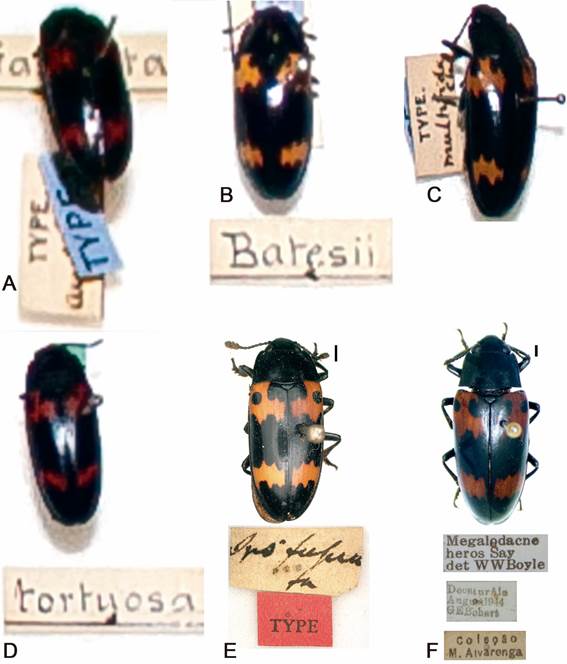
Transcription of label data and dissection of specimens followed Pecci-Maddalena & Lopes-Andrade (2017) and Pecci-Maddalena et al. (2021). Terminology for external morphology (Table 1) follows Węgrzynowicz (2002), McHugh et al. (1997), and Lawrence et al. (2011), while terminology for color pattern follows Skelley (1998a). Higher taxonomic classification follows Cai et al. (2022). Photography methods follow Pecci-Maddalena & Lopes-Andrade (2017), Pecci-Maddalena et al. (2021), and Pecci-Maddalena et al. (2023). Specimens in Fig. 1A-D were photographed by the senior author at UMZC under the available conditions (an old stereomicroscope and a CANON 1000D camera). Photographs 1A-D were taken at drawer level, and for this reason, it was not possible to include scale bars. Photograph 1E was kindly provided by the curator of the ZMUK. Most photographs were taken with a CANON 70D mounted on a stereomicroscope using an adapter. Scale bars were added, and color adjustments were made with an image-editing program. Despite their low resolution, we chose to include photographs 1A-D because they depict primary types. In addition, the dorsal coloration patterns of the photographed specimens provide useful information for the study of Erotylinae. Information about UMZC specimens was obtained from our photographs and from data provided by Skelley (1998b). Images in Figs. 2A and 2I-J were sent to us by the ZMUK curator. Subgeneric classification of Megalodacne follows Delkeskamp (1952, 1981). Data on the geographic distribution of the species were obtained from Boyle (1956) and Alvarenga (1994). Following the CODE (ICZN, 1999), “Recommendation 74G. Not merely for curatorial purposes”, the lectotype designations provided here are made as part of a revisionary study, and not merely for curatorial convenience. Lectotypes of M. audouini, M. batesi, and M. indica multifida were designated from a single syntype, whereas the lectotype of M. fasciata was chosen from two syntypes.
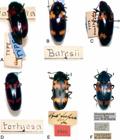
Specimens of Megalodacne Crotch, 1873: (A) lectotype of M. audouini Lacordaire, 1842 (UMZC). (B) lectotype of M. batesi Crotch, 1876 (UMZC). (C) lectotype of M. indica multifida (Lacordaire, 1842) (UMZC). (D) specimen of M. tortuosa (Lacordaire, 1842) (UMZC). (E) lectotype of M. fasciata (Fabricius, 1777) (ZMUK). (F) specimen of M. heros (Say, 1823) (DZUP). Scale bars: E-F = 1 mm.

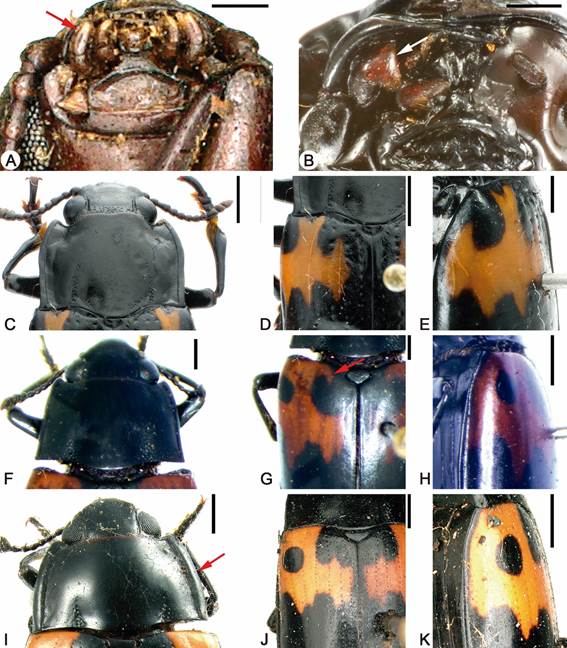
Morphological differences in the studied species of Megalodacne Crotch, 1873. Apical maxillary palpomere: (A) cylindrical (M. fasciata (Fabricius, 1777)), arrow; (B) axe-shaped (M. indica indica (Linnaeus, 1758)), arrow. Lateral pronotal marginal bead and pronotal curvature: (C) M. indica indica (Linnaeus, 1758); (F) M. heros (Say, 1823); (I) M. fasciata (Fabricius, 1777), arrow showing the wide pronotal marginal bead. Basal elytral fasciae, dorsal and lateral view, respectively: (D, E) M. indica indica (Linnaeus, 1758); (G, H) M. heros (Say, 1823), arrow showing the “tip” surpassing basal elytral edge; (J, K) M. fasciata (Fabricius, 1777). Scale bars: A, B = 0.5 mm; C, D = 2 mm; E-K = 1 mm.
RESULTS
Taxonomy
Genus Megalodacne Crotch, 1873
(Figs. 1-5)
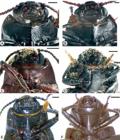
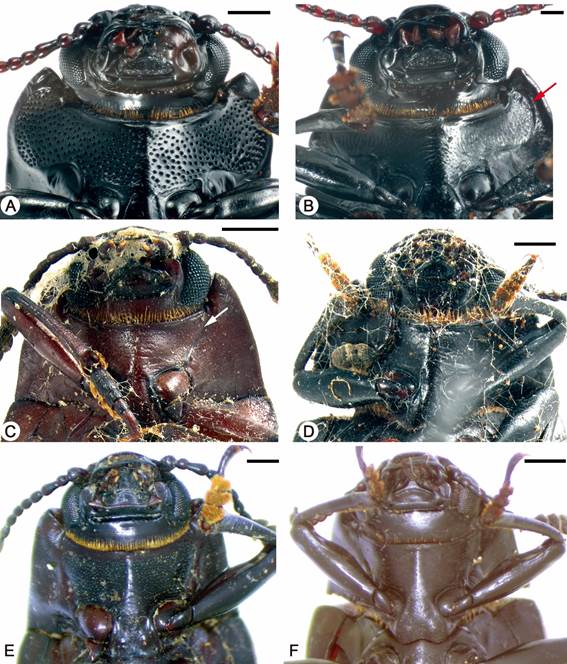
Morphological differences in the studied species of Megalodacne Crotch, 1873. Notesternal suture and prosternal pores, male and female specimens, respectively: (A-B) M. indica indica (Linnaeus, 1758); (C-D) M. fasciata (Fabricius, 1777); (E-F) M. heros (Say, 1823). Scale bars: 1 mm.
-
MegalodacneCrotch, 1873: 352 [description]. Gorham, 1888: 33 [citation]. Kuhnt, 1909: 114 [catalogue]. Heller, 1918: 141, 156 [citation]. Deelder, 1942: 56 [citation]. Delkeskamp, 1952: 62 [redescription]. Boyle, 1956: 78, 88 [redescription]. Alvarenga, 1965: 86 [citation]. Delkeskamp, 1981: 21 [catalogue]. Chûjô & Chûjô, 1988: 177 [catalogue]. Alvarenga, 1994: 4 [catalogue].
Included species (Neotropical and Nearctic)
-
Megalodacne audouiniLacordaire, 1842 (Fig. 1A)
-
Megalodacne batesiCrotch, 1876 (Fig. 1B)
-
Megalodacne fasciata (Fabricius, 1777) (Fig. 1E)
-
Megalodacne indica indica (Linnaeus, 1758) (Figs. 2C-E)
-
Megalodacne indica multifida (Lacordaire, 1842), new junior synonym (Fig. 1C)
-
-
Megalodacne indica latifasciata Delkeskamp, 1952
-
Megalodacne tortuosa (Lacordaire, 1842) (Fig. 1D)
Neotropical species
-
Subgenus Psephodacne Heller, 1918: 141. Heller, 1920: 57 [citation]. Delkeskamp, 1952: 65, 71, 73 [redescription]. Alvarenga, 1965: 88 [citation]. Delkeskamp, 1981: 21 [catalogue]. Subgenus-type: Silpha indica Linnaeus, 1758.
Megalodacne audouini Lacordaire, 1842
(Fig. 1A)
-
Dacne audouiniLacordaire, 1842: 66 [description]. Crotch, 1876: 416 [Megalodacne]. Gemminger & Harold, 1876: 3682 [catalogue]. Gorham, 1888: 33 [citation and redescriptions]. Kuhnt, 1909: 115 [catalogue]. Kuhnt, 1911: 80 [catalogue]. Schenkling, 1919: 93 [name unavailable]. Deelder, 1942: 112 [citation and distribution]. Blackwelder, 1945: 468 [catalogue]. Delkeskamp, 1952: 72 [citation]. Alvarenga, 1994: 4 [catalogue]. Skelley, 1998b: 11 [catalogue].
Primary type (UMZC): Lectotype, here designated (Fig. 1A). “TYPE [blue label, printed] \ TYPE audouini Ch. [printed]”.
Other specimens examined: 3 specimens (CEMT) “Jalisco, nepis. Unión de Tula, cerca de San Gaspar. 19°55′38″N, 109°11′46″W, set. 1620, 14 ago 2004, P. Carrillo y M.G. Torres legs. ex Ganoderma” [printed]; 4 specimens (CEMT) “Jalisco, San Cristobal de la Barran, Entrada rancho Poricos, “Ganoderma”; 24.vii.2004; 1,905 m; 21°05′15″N, 103°31′51″W; Nicolaide; Carrillo; Vaz-de-Mello leg. [printed]”.
Distribution: Mexico.
Megalodacne batesi Crotch, 1876
(Fig. 1B)
-
Megalodacne batesiCrotch, 1876: 416 [description]. Gemminger & Harold, 1876: 3682 [catalogue]. Kuhnt, 1909: 115 [catalogue]. Kuhnt, 1911: 80 [catalogue]. Blackwelder, 1945: 468 [catalogue]. Delkeskamp, 1952: 71 [citation]. Alvarenga, 1994: 4 [catalogue]. Skelley, 1998b: 11 [catalogue].
Primary type (UMZC): Lectotype, here designated (Fig. 1B). “TYPE [blue label, printed] \ green label \ TYPE. [printed] Batesii [handwritten]”.
Other specimens: 1 specimen (DZUP) “Coleção M. Alvarenga [printed] \ Serra Navio, Amapá, BR, XII.1972, M. Nobrega [handwritten] \ DZUP 372603 [printed]”.
Distribution: Northern Brazil.
Megalodacne indica indica (Linnaeus, 1758)
(Figs. 1-C, 2A-B, 4A, 5A)
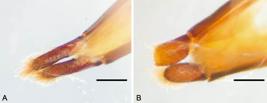
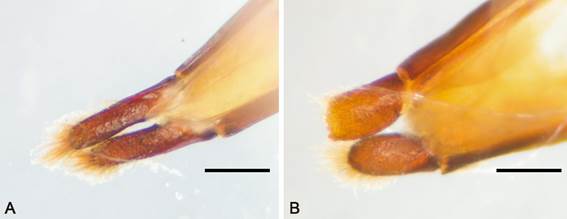
Parameres shape: (A) Megalodacne indica indica (Linnaeus, 1758) and (B) M. heros (Say, 1823). Scale bars: 1 mm.
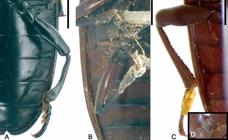
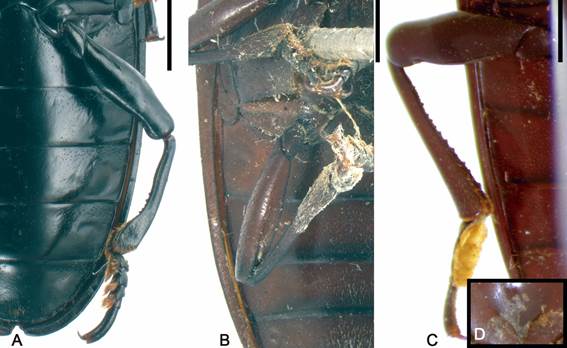
Metatibia in males (curvature and tubercular pattern): (A) Megalodacne indica indica (Linnaeus, 1758); (B) M. fasciata (Fabricius, 1777); (C) M. heros (Say, 1823). (D) Terminal abdominal ventrite in a male of M. heros. Scale bars: 1 mm.
-
Silpha indicaLinnaeus, 1758: 360 [description]. Fabricius, 1781: 85 [citation]. Bedel, 1919: 114 [Megalodacne]. Mader, 1942: 176 [citation]; Mader, 1951: 225 [citation]. Delkeskamp, 1952: 67, 72 [redescription]. Alvarenga, 1994: 4 [catalogue]. Skelley, 1998b: 11 [catalogue].
Primary type: Not examined.
Other specimens examined: 1 specimen male, dissected (CELC) “BRASIL: MG, Viçosa, Mata do Paraíso, 03.xi.2014; leg. A. Orsetti, S. Aloquio, I. Maddalena, A. Komonen & C. Lopes-Andrade [printed] \ Trilha do Pesquisador [printed] Ex. Ganoderma aplanatum Ganodermataceae [handwritten]” \ CELC005558 [printed]; 1 specimen female, dissected “BRASIL: MG, Viçosa, Mata do Paraíso, 10.v.2014; leg. A. Orsetti [printed] \ ex Ganoderma aplanatum [printed] \ CELC005493 [printed]”; 1 specimen (DZUP) “Coleção M. Alvarenga [printed] \ FLORESTA DA TIJUCA, Guanabara BRASIL [printed], II. 1974 [handwritten], C.A. Campos Seabra [printed]”; 1 specimen (DZUP) “Coleção M. Alvarenga [printed] \ REPRÊSA RIO GRANDE, Guanabara BRASIL [printed], I.I.1969, P.M. Oliveira [handwritten] \ 2128 [printed] \ ? [handwritten] \ DZUP 372582 [printed]”; 1 specimen “DPTº ZOOL, UF-PARANÁ [printed] \ SANTA TERESA - ES, BRASIL, 16/11/1967, C.T. & C. Elias [printed] \ DZUP 237296 [printed]”; 1 specimen (UMZC), Lectotype, here designated, “TYPE [blue label, printed] \ TYPE. [printed], heros Guér. = 4-guttata Ol. [handwritten]”.
Remarks: 1) The primary type of M. indica indica: We contacted curators of potential collections that could house Linnaeus’s specimens (e.g., The Natural History Museum, London; UMZC, Cambridge - visited by ISCPM; and The Linnean Society, London), but the type was not found in these institutions. We also attempted to reach staff from the Uppsala collection (Sweden), which preserves part of Linnaeus’s material, but without success. We suspect that the type of M. indica indica may still be housed in this collection, which requires future verification. Despite this uncertainty, the species is well represented in several collections containing Erotylidae material, including historical specimens (as verified by ISCPM at MNHN, Paris, and Museo Regionale di Scienze Naturali, Torino, among others). Therefore, the identification of M. indica indica can be readily achieved. 2) Megalodacne indica indica (L.) includes the following synonyms: (i) Episcapha heros Guérin-Méneville, 1841, a junior homonym of Megalodacne heros (Say, 1823), synonymized by Lacordaire (1842) with M. quadriguttata; (ii) Engis signata Laporte, 1840, synonymized by Lacordaire (1842); and (iii) Erotylus quadriguttata Olivier, 1792, synonymized by Bedel (1919). The type specimen of Episcapha heros Guérin-Méneville, 1841 is housed at UMZC. Based on a drawer-level image, we confirmed that it falls within the intraspecific variation of M. indica indica. The type specimens of Engis signata Laporte, 1840 and Erotylus quadriguttata Olivier, 1792 were not found. According to Horn et al. (1990), specimens described by Laporte (= Castelnau) are housed in several European museums and their identification requires further investigation. Regarding Olivier’s specimens, they are expected to be housed primarily at UMZC or at MNHN (see Pecci-Maddalena et al., 2023). Although specimens named “quadriguttata” were observed in these collections, we could not confirm whether they are indeed type specimens. 3) Megalodacne indica multifida (Fig. 1C) was described by Lacordaire (1842) as “Dacne multifida” based on a single adult female from Brazil. According to Lacordaire, the species is very similar to M. quadriguttata, differing in the weak elytral punctation. Delkeskamp (1952) considered M. multifida (Lacordaire, 1842) a subspecies of M. indica based on the elytral punctation, yellow and more dentate basal elytral fasciae, compared to other specimens of M. indica. The characters proposed by Lacordaire (1842) and Delkeskamp (1952) to consider M. indica multifida a separate taxon are fragile. Based on the examination of specimens from different Brazilian localities, it is clear that these characters constitute intraspecific variations under M. indica. Therefore, here we proposed M. indica multifida as a new junior synonym of Megalodacne indica indica. 4) Megalodacne indica latifasciata Delkeskamp, 1952, from Peru, differs from M. indica indica in the very large elytral fasciae (Delkeskamp, 1952). We suspected this character may be intraspecific variation; however, more Megalodacne specimens from Peru need to be examined for further considerations.
Distribution:Megalodacne indica indica is a broadly distributed species, especially in the central, southeastern, and southern portions of the Neotropical region.
Megalodacne indica latifasciata Delkeskamp, 1952
-
Megalodacne indica latifasciataDelkeskamp, 1952: 69 [description]. Alvarenga, 1994: 4 [citation].
Primary type: Not examined. Probably in Museum für Naturkunde Berlin (Berlin, Germany) (see Delkeskamp, 1952; Alvarenga, 1994).
Remarks:Delkeskamp (1952: 69) provided an illustration for this species.
Distribution: Peru and Ecuador.
Megalodacne indica multifida (Lacordaire, 1842)
(Fig. 1C)
-
Dacne multifidaLacordaire, 1842: 72. Crotch, 1876: 416 [Megalodacne]. Kuhnt, 1909: 115 [catalogue]; Kuhnt, 1911: 80 [catalogue]. Guérin, 1948: 21 [citation]. Delkeskamp, 1952: 68, 72, 73 [subgeneric combination].
Primary type (UMZC): Lectotype, here designated (Fig. 1C). “TYPE. [printed] multifida Ch [handwritten] \ TYPE. [blue label, printed]”.
Remarks: 1) New junior synonym of Silpha indica L. 2) Lacordaire (1842) described the species Dacne brasiliensis, which was later considered a synonym of M. indica multifida Delkeskamp (1952). Based on a drawer level image, the primary type of D. brasiliensis is probably housed at MNHN. However, additional information is required to confirm this identification and, therefore, a lectotype for D. brasiliensis is not designated in the present work.
Megalodacne tortuosa (Lacordaire, 1842)
(Fig. 1D)
-
Dacne tortuosaLacordaire, 1842: 69. Crotch, 1876: 416 [Megalodacne]. Gemminger & Harold, 1876: 3683 [catalogue]. Gorham, 1888: 34 [redescription]. Kuhnt, 1909: 115 [catalogue]; Kuhnt, 1911: 81 [catalogue]. Deelder, 1942: 112 [citation]. Blackwelder, 1945: 468 [catalogue]. Delkeskamp, 1952: 70, 72, 73 [citation]. Alvarenga, 1994: 5 [catalogue]. Skelley, 1998b: 11 [catalogue].
Primary type: Probably at UMZC (Fig. 1D).
Remarks: Based solely on the available images and the information provided by Skelley (1998b), the single specimen labeled as “M. tortuosa” in the UMZC (Fig. 1D) cannot be confirmed as a primary type. Although it is likely the specimen used by Lacordaire (1842) in the original description of M. tortuosa, definitive confirmation will require further investigation in future studies.
Distribution: Mexico. Colombia.
Nearctic species
-
Subgenus Megalodacne Crotch, 1873: 352. Heller, 1918: 141 [citation]. Delkeskamp, 1952: 65 [citation]. Boyle, 1956: 90 [citation]. Subgenus-type: Ips fasciata Fabricius, 1777.
Megalodacne fasciata (Fabricius, 1777)
(Figs. 1E, 2A, 2I-K, 3C-D)
-
Ips fasciataFabricius, 1777: 213. Olivier, 1792: 433 [Erotylus bifasciatus]. Fabricius, 1801: 582 [Engis fasciata]. Latreille, 1804: 14 [Dacne fasciata (Fabricius)]. Crotch, 1873: 353 [Megalodacne]. Delkeskamp, 1952: 72 [citation]. Boyle, 1956: 90 [citation and redescription]. Skelley, 1998b: 11 [catalogue].
Primary type (ZMUK): Lectotype, here designated (Fig. 1E). “Apis fasciata Fa [handwritten] \ Type [red label, printed]”.
Other specimens examined: 1 specimen male, dissected (CELC) “Georgia, Dougherty Co., Albany, about 4 miles N.E. February 21, 1969, Col. Lloyd R. Davis, Jr. [printed]”; 1 specimen female, dissected (CELC) “PENNA.: Delaware Co., Wallingford, 27-VI-1963, F.W. Skillman Jr., under maple bark [printed]”; 1 specimen (DZUP) “Coleção M. Alvarenga [printed] \ IND. Monroe County Bloomington [printed], #9, IV.16.1966 [handwritten], Ssrithunya \ DZUP 136428”.
Distribution: Southeastern Canada, United States of America and northeastern Mexico.
Megalodacne heros (Say, 1823)
(Fig. 1F, 2F-H, 3E-F, 4B)
-
Engis herosSay, 1823: 196. Lacordaire, 1842: 67 [Dacne heros (Say)]. Crotch, 1873: 353 [Megalodacne heros (Say)]. Delkeskamp, 1952: 72 [citation]. Boyle, 1956: 91 [citation and redescription]. Skelley, 1998b: 11 [catalogue].
Primary type: Not examined. Probably destroyed (see Discussion).
Other specimens examined: 1 specimen male, dissected (DZUP) “Coleção M. Alvarenga [printed] \ U.S. [handwritten] \ George Lewis Coll. B.M. 1926-369. [printed] \ Dacne heros [handwritten] \ DZUP 372604 [printed]”; 1 specimen female, dissected “Megalodacne heros Say det WWBoyle [printed] \ DecaturAla, August 1944, GEBohart [printed] \ Coleção M. Alvarenga [printed] \ DZUP 372600 [printed]”.
Distribution: Southeastern Canada and United States of America.
DISCUSSION
Taxonomy
Given their wide distribution and representation in collections, it is important to identify the potential repositories for the types of M. indica indica and M. heros. According to Horn et al. (1990), the primary collections housing Linnaean material include the Linnean Society of London (where the type of M. indica indica is not located, as confirmed via personal communication with the curator) and the University Museum of Zoology, Cambridge (examined by the senior author; the type of M. indica indica was not found there). Two additional collections known to hold Linnaean materials are the Smithsonian Institution in Washington, D.C., and the Uppsala Museum in Sweden. Linnaeus (1758), in his description of M. indica indica, used the abbreviation “M.L.U.,” which refers to the “Museum Ludovicae Ulricae,” a collection currently housed at Uppsala University (see Dance, 1967; Low & Mendoza, 2013). Therefore, it is likely that the type of M. indica indica is deposited at this institution. As for the type of M. heros, it was presumably destroyed along with Say’s collection, which suffered significant damage from insect pests (Boyle, 1956; Mawdsley, 1993). If this is confirmed, the designation of a neotype will need to be considered in future studies.
Morphology (Table 1)
Differences in the shape of the apical maxillary palpomere between Nearctic and Neotropical species of Megalodacne were first noted by Delkeskamp (1952). The Neotropical species Megalodacne indica indica, M. audouini and M. batesi (examined specimens, but not included here) exhibit an axe-shaped apical maxillary palpomere, a characteristic of the Neotropical subgenus Psephodacne. Conversely, the Nearctic species M. fasciata and M. heros possess a cylindrical apical maxillary palpomere, characteristic of the widespread subgenus Megalodacne. In Erotylinae, the cylindrical shape is typical of Dacnini, a tribe primarily distributed in the Northern Hemisphere and considered the sister group to the other four tribes of Erotylinae (Węgrzynowicz, 2002). In contrast, the axe-shaped apical palpomere is observed in other tribes, such as Erotylini and Tritomini (see example in Pecci-Maddalena et al., 2023). However, the genus Megalodacne and other genera within Megalodacnini exhibit a mixture of cylindrical and axe-shaped palpi. Given its binary and easily recognizable nature, we suggest that this character be included in future studies on Megalodacne.
Boyle (1956) used the characters “pronotal curvature” and “lateral pronotal marginal bead” to differentiate M. fasciata and M. heros. He described M. fasciata as having a “pronotum transverse, its lateral margins wide” and M. heros as having a “pronotum subquadrate, its lateral margins narrow”. While these differences are recognizable, we observed that they are not always distinct. A larger number of Megalodacne specimens must be examined to determine whether these variations are consistent across the genus or diagnostic only for Nearctic species.
Color patterns in Erotylinae serve as useful diagnostic characters, although intraspecific variation must be considered to avoid misidentifications (see examples in Pecci-Maddalena et al., 2021; Pecci-Maddalena et al., 2023). The Megalodacne species studied here exhibit conspicuous differences in the pattern of the basal elytral fascia. Megalodacne indica indica displays a highly serrated yellow basal elytral fascia with pointed contours and a free black humeral spot that is not enclosed by the yellow patch. In contrast, M. heros and M. fasciata have a less serrated yellow fascia with smoother contours, and the black humeral spot is entirely surrounded by the yellow fascia. All examined specimens followed these patterns, suggesting that the elytral color pattern may serve as a reliable diagnostic character for Megalodacne.
Węgrzynowicz (2002) described the “interrupted notosternal suture” in Megalodacne (specifically M. fasciata). In this study, we observed that the notosternal suture of M. indica indica is continuous with the pronotal edge, a feature absent in M. heros and M. fasciata. Additionally, among the species examined, M. indica indica is the only one exhibiting conspicuously deep and sparse punctures on the prosternum, a condition found exclusively in males. Interestingly, Delkeskamp (1959) previously reported this same sexual dimorphism in African species of Megalodacne, such as M. (Episcaphula) laeta Arrow, 1917. Further examination of additional Megalodacne species and other genera within Megalodacnini and Erotylinae is necessary to assess the taxonomic relevance of this character, especially in defining species complexes.
Regarding male genitalia, the flagellar head, an internal sac structure in Erotylidae, has been a powerful taxonomic tool for species recognition, particularly at the subgeneric level (Skelley, 1998a; Pecci-Maddalena et al., 2023). In Megalodacne, this structure will require further investigation during the taxonomic revision and its description was not included in this study. Conversely, significant variation was observed in the shape of the parameres between M. indica indica and M. heros. Unlike the flagellar head, the shape of the parameres is typically highly conserved in most Erotylinae (particularly in Erotylini and Tritomini). Future studies should explore whether the morphology of the parameres varies in other Megalodacne representatives (e.g., African species), and whether this character holds taxonomic and phylogenetic significance for the genus.
With respect to the metatibiae in males, we observed that M. indica indica has strongly curved metatibiae, in contrast to M. fasciata and M. heros, which have straight metatibiae. This character has been documented in other Erotylidae, for instance in large males of Mycotretus flavomarginatus Lacordaire, 1842 (Erotylinae: Tritomini) and similar species (see Pecci-Maddalena et al., 2023), and may be associated with body size, a hypothesis that warrants further investigation. Regarding the presence of tubercles on the metatibiae of males, some species of Dacnini also exhibit this character (see Skelley et al., 2021). In the present study, M. fasciata is the only species that displays inconspicuous tubercles. Future phylogenetic studies should assess whether the presence of tubercles, as well as the curvature of the metatibiae, can be considered synapomorphies supporting clades within Megalodacne.
The terminal abdominal ventrite in males of M. heros is the only one that exhibits a conspicuous V-shaped projection. Neither of the two previous studies that examined this species in detail (Boyle, 1956; McHugh et al., 1997) mentions any other congeneric species with this condition. Two other examined species of the subgenus Megalodacne (not included in this study), M. decipiens Delkeskamp, 1937 and M. congoana Duvivier, 1891, also do not exhibit this projection. This character may be exclusive to M. heros, a hypothesis that should be investigated in future studies.
DATA AVAILABILITY:
The contents underlying the research text are included in the manuscript.
Acknowledgments:
We thanks to: Museum of Comparative Zoology (Harvard University, USA) for its financial support via an Ernst Mayr Grant to study specimens in Crotch’s collection of Erotylidae housed in the UMZC. We thank the following curators and assistants for loaning specimens and for assistance during the visit of the senior author to their institutions: Lúcia Massutti de Almeida and Norma Giambarresi Ganho (DZUP), Fernando Zagury Vaz-de-Mello (CEMT), Edgar Turner, Russell Stebbings (UMZC). We also thanks to Michael Kuhlmann (ZMUK) for images of the type material of M. fasciata. We thank Florida Department of Agriculture and Consumer Services, Division of Plant Industry, for support of this work.
REFERENCES
- Alvarenga, M. 1965. Espécies tipos dos gêneros e subgêneros neotropicais da família Erotylidae (Coleoptera). Boletim da Universidade Federal do Paraná, 2: 75-92.
-
Alvarenga, M. 1994. Catálogo dos Erotylidae (Coleoptera) Neotropicais. Revista Brasileira de Zoologia, 11: 1-177. https://doi.org/10.1590/S0101-81751994000100001.
» https://doi.org/10.1590/S0101-81751994000100001 -
Bedel, L. 1919. Le Silpha indica Linné, consideré comme énigme, est un Megalodacne (Col. Erotylidae) de L’Amérique du Sud. Bulletin de la Société entomologique de France, 114-116. https://doi.org/10.3406/bsef.1919.26401.
» https://doi.org/10.3406/bsef.1919.26401 -
Blackwelder, R.E. 1945. Checklist of the coleopterous insects of Mexico, Central America, the West Indies and South America. Part 3. Bulletin of the United States National Museum 185, 3: 343-550. https://doi.org/10.5479/si.03629236.185.3.
» https://doi.org/10.5479/si.03629236.185.3 - Boyle, W.W. 1954. Concerning the status of Ischyrus graphicus Lacordaire, with description of four new erotylid species from western North America. Journal of the New York Entomological Society, 62: 39-53.
- Boyle, W.W. 1956. A revision of the Erotylidae of America north of Mexico (Coleoptera). Bulletin of the American Museum of Natural History, 110: 61-172.
-
Cai, C.; Tihelka, E.; Giacomelli, M.; Lawrence, J.F.; Ślipiński, A.; Kundrata, R.; Yamamoto, S.; Thayer, M.K.; Newton, A.F.; Leschen, R.A.B.; Gimmel, M.L.; Lü, L.; Engel, M.S.; Bouchard, P.; Huang, D.; Pisani, D. & Donoghue, P.C.J. 2022. Integrated phylogenomics and fossil data illuminate the evolution of beetles. Royal Society Open Science, 9: 1-15. https://doi.org/10.1098/rsos.211771.
» https://doi.org/10.1098/rsos.211771 -
Chûjô, M. & Chûjô, M. 1988. A catalogue of the Erotylidae (Insecta, Coleoptera) from the old word (Excl. the Ethiopian region). Esakia, 26: 139-185. https://doi.org/10.5109/2510.
» https://doi.org/10.5109/2510 -
Crotch, G.R. 1873. Synopsis of the Erotylidae of Boreal America. Transactions of the American Entomological Society, 4: 349-358. https://doi.org/10.2307/25076276.
» https://doi.org/10.2307/25076276 -
Crotch, G.R. 1876. A revision of the coleopterous family Erotylidae. Cistula Entomologica, 1: 377-572. https://doi.org/10.5962/bhl.title.9222.
» https://doi.org/10.5962/bhl.title.9222 -
Dance, S.P. 1967. Report on the Linnaean shell collection. Proceedings of the Linnean Society of London, 178: 1-24. https://doi.org/10.1111/j.1095-8312.1967.tb00959.x.
» https://doi.org/10.1111/j.1095-8312.1967.tb00959.x -
Deelder, C.L. 1942. Revision of the Erotylidae (Coleoptera) of the Leiden Museum. Zoologische Mededelingen, 24: 49-115. Available: https://repository.naturalis.nl/pub/318060 Access: 14/04/2023.
» https://repository.naturalis.nl/pub/318060 - Delkeskamp, K. 1952. Revision von 2 Untergattungen und Verzeichnis der Erotyliden-Arten von Angola (Col. Erotyl.). Publicações Culturais da Companhia de Diamantes de Angola, 14: 55-90.
- Delkeskamp, K. 1959. Sekundäre Geschlechtsmerkmale bei Erotyliden: Delkeskamp 26. Beitrag zur Kenntnis der Erotylidae (Col.). Mathematisch Naturwissenschaftliche Reihe, 8: 1089-1098.
- Delkeskamp, K. 1981. Erotylidae von Afrika und Madagascar Coleopterorum catalogus supplementa, Pars 34 Dr. W. Junk, The Hague. p. 1-65.
- Fabricius, J.C. 1777. Genera insectorum, eorumque characteres naturales Chilonii, Bartsch, Cologne. p. 1-310.
- Fabricius, J.C. 1781. Species insectorum Chilonii, Bartsch, Hamburgui. p. 1-552.
- Fabricius, J.C. 1801. Systema eleutheratorum secundum ordines, genera, species, t. 2. Bibliopolii Academici novi, Kiel, p. 611-687.
-
Gemminger, M. & Harold, E. 1876. Familia LXX. Erotylidae. In: Gemminger, M. & Harold, E. Catalogus Coleopterorum hucusque descriptorum synonymicus et systematicus Gummi, Monachii [Munich], volume, 10, 3479-3822. https://doi.org/10.5962/bhl.title.9089.
» https://doi.org/10.5962/bhl.title.9089 -
Gorham, H.S. 1888. Erotylidae, Endomychidae and Coccinellidae. In: Godman, F. & Salvin, O. Biologia Centrali-Americana. Insecta. Coleoptera R.H. Porter, London, volume, 7, 1887-1899. https://doi.org/10.5962/bhl.title.730.
» https://doi.org/10.5962/bhl.title.730 - Guérin, J. 1948. Catálogo dos Erotylidae (Col.) das coleções do Instituto de Ecologia e Experimentação Agricolas do Ministerio da Agricultura, com a descrição de algumas especies novas. Boletim do Instituto de Ecologia e Experimentação Agrícolas, 8: 1-26.
- Heller, K.M. 1918. Zur klassifikation einiger afrikanischer Erotyliden. Entomologische Blätter, 14: 136-157.
- Heller, K.M. 1920. Beitrag zur Kenntnis der Erotyliden de indo-australischen Region mit besonderer Berücksichtigung de philipischen Arten. Archiv für Naturgeschichte, 84: 1-121.
- Horn, W.; Kahle, F.I.; Friese, G. & Gaedike, R. 1990. Collectiones entomologicae. Ein Kompendium über den Verbleib entomologischer Sammlungen der Welt bis 1960. Teil 2, L bis Z Akademie der Landwirtschaftwissenschaften, Berlin. p. 1-355.
-
International Commission on Zoological Nomenclature (ICZN). 1999. International Code of Zoological Nomenclature. 4th Edition. International Trust for Zoological Nomenclature, London Available: https://www.iczn.org/the-code/the-code-online Access: 23/08/2025.
» https://www.iczn.org/the-code/the-code-online -
Kuhnt, P. 1909. Coleoptera, fam. Erotylidae, subfam. Erotylinae. In: Wytsman, P.A.G. Genera Insectorum 88 Desmet-Verteneuil, Bruxelles, 1-139. Available: https://www.biodiversitylibrary.org/page/43211062 Access: 14/02/2023.
» https://www.biodiversitylibrary.org/page/43211062 -
Kuhnt, P. 1911. Erotylidae. In: Junk, W. & Schenkling, S. Coleopterorum Catalogus Pars 34 W. Junk, Berlin, 1-103. Available: https://www.biodiversitylibrary.org/page/59206376 Access: 14/04/2023.
» https://www.biodiversitylibrary.org/page/59206376 -
Lacordaire, J.T. 1842. Monographie des Erotyliens, famille de l’ordre des Coléoptères Roret, Paris, p. 1-543. https://doi.org/10.5962/bhl.title.51458.
» https://doi.org/10.5962/bhl.title.51458 - Latreille, P.A. 1804. Histoire naturelle, général et particuliere, des crustaces et de insectes F. Dufart, Paris. p. 1-415.
-
Lawrence, J.F.; Ślipiński, A.; Seago, A.E.; Thayer, M.K.; Newton, A.F. & Marvaldi, A.E. 2011. Phylogeny of the Coleoptera based on morphological characters of adults and larvae. Annales Zoologici, 61: 1-217. https://doi.org/10.3161/000345411X576725.
» https://doi.org/10.3161/000345411X576725 - Linnaeus, C. 1758. Systema naturae. Ed. 10 Laurentii salvii, Stockholm. p. 1-823.
-
Low, M.E.Y. & Mendoza, J.C.E. 2013. Identification of Cancer lactatus Linnaeus, 1758 with Lophozozymus pictor (Fabricius, 1798) and reversal of precedence (Crustacea: Decapoda: Brachyura: Xanthidae). Zootaxa, 3683: 292-294. https://doi.org/10.11646/zootaxa.3683.3.6.
» https://doi.org/10.11646/zootaxa.3683.3.6 - Mader, L. 1942. Erotylidae (Col.). In: Titschack, E. Beiträge zur Fauna Perus G. Fischer, Hamburg, 149-201.
- Mader, L. 1951. Die Erotyliden von Peru (Col.). Entomologische Arbeiten aus dem Museum G. Frey, 2: 197-225.
-
Mawdsley, J.R. 1993. The entomological collection of Thomas Say. Psyche, 100: 163-171. https://doi.org/10.1155/1993/59616.
» https://doi.org/10.1155/1993/59616 - McHugh, J.V.; Marshall, C.J. & Fawcett, F.L. 1997. A study of adult morphology in Megalodacne heros (Say) (Coleoptera: Erotylidae). Transactions of the American Entomological Society, 123: 167-223.
- Olivier, A.G. 1792. Encyclopédie méthodique. Histoire naturelle. Insectes Panckoucke, Paris, p. 369-704.
-
Pecci-Maddalena, I.S.C. & Lopes-Andrade, C. 2017. Redescription of two species and proposal of a new synonym in the genus Mycotretus Lacordaire, 1842 (Coleoptera: Erotylidae: Tritomini). Zootaxa, 4282: 147-165. https://doi.org/10.11646/zootaxa.4282.1.9.
» https://doi.org/10.11646/zootaxa.4282.1.9 -
Pecci-Maddalena, I.S.C.; Lopes-Andrade, C. & Skelley, P. 2023. Catalogue of Mycotretus Lacordaire, 1842 (Coleoptera: Erotylidae: Tritomini): an annotated, illustrated and historical approach. European Journal of Taxonomy, 876: 1-182. https://doi.org/10.5852/ejt.2023.876.2149.
» https://doi.org/10.5852/ejt.2023.876.2149 -
Pecci-Maddalena, I.S.C.; Skelley, P.E. & Almeida, L.M. 2021. Erotylina Curran (Coleoptera: Erotylidae: Erotylini): redescription of type species, potential species groups and diversity of color patterns. Anais da Academia Brasileira de Ciências, 93: 1-24. https://doi.org/10.1590/0001-3765202120201452.
» https://doi.org/10.1590/0001-3765202120201452 - Say, T. 1823-1825. Descriptions of coleopterous insects collected in the late expedition to the Rocky Mountains, performed by order of Mr. Calhoun, Secretary of War, under the command of Major Long. Journal of the Academy of Natural Sciences of Philadelphia, 3: 139-216, 238-282, 298-331, 403-462; 4: 83-99.
- Schenkling, S. 1919. Erotylidén-Studien I. Archiv für Naturgeschichte, 83: 77-93.
- Skelley, P.E. 1998a. Revision of the genus Ischyrus Lacordaire, 1842 of North and Central America (Coleoptera: Erotylidae: Tritominae). Occasional Papers of the Florida State Collection of Arthropods, 9: 1-133.
- Skelley, P.E. 1998b. A catalogue of the Crotch collection of Erotylidae (Coleoptera). Annales Zoologici, 48: 1-44.
-
Skelley, P.E.; Leschen, R.A.B. & Liu, Z. 2021. New Australian Erotylinae with notes on Dacnini (Coleoptera: Cucujoidea: Erotylidae). Zootaxa, 4948(3): 363-380. https://doi.org/10.11646/zootaxa.4948.3.3.
» https://doi.org/10.11646/zootaxa.4948.3.3 - Węgrzynowicz, P. 2002. Morphology, phylogeny and classification of the family Erotylidae based on adult characters (Coleoptera: Cucujoidea). Genus, 13: 435-504.
-
FUNDING INFORMATION:
Financial support was provided by Conselho Nacional de Desenvolvimento Científico e Tecnológico (CNPq; research grant 3004339/2022-9 to C. Lopes-Andrade; PDJ grant 150136/2024-2 to I. Pecci-Maddalena). Add the following as funding: “This work was developed within the scope of the Instituto Nacional de Coleoptera (INCol), an INCT (National Institute of Science and Technology) by CNPq (408430/2024-9).”