New additions to Happia Bourguignat, 1890 (Stylommatophora: Scolodontidae) from northern South America
Abstract
Scolodontidae are a Neotropical family of non-obligatory carnivorous snails with a complex taxonomy. Recent efforts to revise the genera within the family have gone a long way into restricting wastebasket taxa such as the genus Happia, which currently includes four species. Such revisionary work also facilitates the recognition and description of new taxa. In the present study, we include a further two species in Happia: one new, Happia acreana sp. nov., from Acre state, Brazil; and another transferred from the marine family Tornidae, previously classified as Cochliolepis surinamensis van Regteren Altena, 1966 and presently re-classified as Happia surinamensis (van Regteren Altena, 1966) comb. nov. The new data also extends the genus’s distribution to the Brazilian Amazon and highlights incorrect systematic assignments of a species described decades ago as a marine animal.
Keywords:
Brazil; Cochliolepis surinamensis;
Happia acreana
sp. nov.
; Neotropics; Suriname; Tornidae
INTRODUCTION
The Scolodontidae are a Neotropical family of non-obligatory carnivorous snails with a complex taxonomy, nearly always based on conchological characters, which can be scarce for several taxa that present simple, glossy shells. Recently, the systematics of scolodontid genera started to be revised little by little (Salvador & Cavallari, 2019, 2020; Roosen & Breure, 2024a, 2024b, 2024c; Ravalo et al., 2023; Roosen et al., 2023, 2025a, 2025b).
One such genus is Happia Bourguignat, 1890, a minor wastebasket taxon in which several unrelated glossy-shelled species from all around the Neotropics were traditionally placed. Roosen & Breure (2024a) restricted the genus to a great extent based on a re-examination of the true type species of Ammonoceras Pfeiffer, 1855, for which Happia was a replacement name, and by disproving later type species restrictions. The characters of the type species, like the planorbid-like shell shape, teleoconch sculpture (microscopic spiral grooves or punctae), and the parietal incision on the aperture, resulted in a situation where only three species remained in the genus. That new definition of the genus also narrowed its geographic range to Colombia, Ecuador, and Peru (Roosen & Breure, 2024a). More recently, Gargominy et al. (2025) described a new species from French Guiana, Happia decaensi Gargominy et al., 2025, raising the total number of species in the genus to four and expanding its range to the east.
In the present study, we associate two further species to Happia, one of them new, and the other transferred from the marine family Tornidae (Cochliolepis surinamensis van Regteren Altena, 1966).
MATERIAL AND METHODS
The analysed material is housed in the following natural history collections: MZSP, Museu de Zoologia da Universidade de São Paulo (São Paulo, Brazil); RMNH, Naturalis Biodiversity Center (Leiden, The Netherlands). Specimens were imaged with scanning electron microscopes (SEM) and stereomicroscopes at the institutes where they are housed. Measurements were taken to the nearest 0.1 mm during imaging.
RESULTS
Taxonomy
Family Scolodontidae
Genus Happia Bourguignat, 1890
Type species:Helix ammonocerasReeve, 1854, by typification of the replaced name.
Included species:Happia ammonoceras (Reeve, 1854), Happia acreana sp. nov., Happia andia (Pilsbry, 1932), Happia decaensi Gargominy et al., 2025, Happia lyzarzaburui (Jousseaume, 1887), Happia surinamensis (van Regteren Altena, 1966) comb. nov.
Geographic distribution: Brazil, Colombia, Ecuador, French Guiana, Peru, Suriname.
Discussion: The new inclusions in the genus extend its distribution to Suriname and to the Brazilian Amazon, resulting in a greater range over northern South America.
Happia andia, H. lyzarzaburui and H. surinamensis should be considered only as tentative members of this genus, however. Happia andia does not have the typical punctate microsculpture, is small for Happia and only known from one type specimen that might not be an adult. This species was included in Happia by Roosen & Breure (2024a) based on its spiral grooves, as at that time Miradiscops H.B. Baker, 1925 also contained species with striate and punctate sculpture. Recently, the striate species of Miradiscops were separated into their own genus (Roosen et al., 2025b), which means the argumentation of Roosen & Breure (2024a) to keep H. andia in Happia is not valid anymore, though no other suitable genus is available at the moment.
Happia lyzarzaburui does have the typical punctate microsculpture, but the apertural incision (which we consider to be typical for Happia) is absent. We are still unsure whether this could be a variable feature in the genus or if this signifies that a different generic placement would be better. For remarks on H. surinamensis, see below.
The inclusion of these three species in Happia should be considered provisory, as no better placement is currently available and we lack appropriate specimens to build a molecular phylogenetic framework. We reiterate that, for now, Happia s.s. has the following combination of diagnostic characters: it has a medium size for the family (5-6 mm), a microsculpture of spiral oriented punctures (punctate sculpture), an incision in the parietal angle of the aperture. This is markedly different from Drepanostomella, for instance, which includes somewhat to much larger morphologically similar species that do not have a notable spiral sculpture (only patches of vestigial spiral ridges, like in Systrophiella) (Roosen & Breure, 2024a).
Happia acreana sp. nov.
https://zoobank.org/DC47166C-A2E9-42EE-844D-D8EDAB81222D
(Fig. 1)
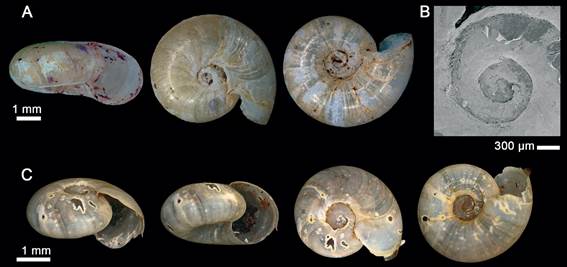
Happia acreana sp. nov. (A) Holotype MZSP 150055. (B) Close-up of the first whorls of the holotype, observed under SEM. (C) Paratype MZSP 150056.
-
Happia sp.: Lima et al., 2021: 275, fig. 4L-N.
Type specimens: Holotype MZSP150055 (col. L. Freitas 14/Dec/2018), paratype MZSP150056 (Reserva Florestal Humaitá, 09°45′32″S, 67°39′05″W, col. M. Lima & W. Lima 30/Oct/2018).
Type locality: Brazil, Acre, Porto Acre, Reserva Florestal Humaitá, 09°45′09″S, 67°40′22″W.
Etymology: The specific epithet alludes to the type locality in Acre state.
Diagnosis: Small shell, subdiscoidal, of nautiloid shape, beige whitish coloration with low spire and initial whorls centralized, with well-defined nucleus. Largely overlapping whorls. Last whorl much wider than the previous ones, expanded, with evident suture. Sub-oval aperture, with sharp lip; dorsal portion slightly inclined toward the base, accentuating its asymmetry and obliquity.
Description: Shell small, whitish beige in colour, fragile, with faint superficial gloss. Overall shape subdiscoidal, nautiloid, with the whorls rapidly increasing in diameter. Spire low, depressed. Whorls largely overlapping, with the first whorls arranged in a centralized manner, forming a well-defined nucleus. Last whorl proportionally much wider than previous one, considerably expanded, with well-marked suture. Protoconch smooth. Teleoconch with fine spiral sculpture (grooves, more evident under SEM) and discrete growth lines (more evident near aperture). Aperture simple, wide, sub-oval, slightly oblique, with sharp outer lip; parietal incision present. Abapical portion of the aperture with slight inclination toward the base, accentuating its obliquity and asymmetry. Umbilicus wide, shallow, about ⅓ of total shell width; as the whorls partially overlap the previous ones, the umbilical area has a slightly stepped aspect.
Shell measurements: Holotype: shell height = 2.7 mm; shell width = 5.6 mm; number of whorls = 3¼. Paratype: shell height = 1.1 mm; shell width = 2.1 mm; number of whorls = 2¼.
Distribution: Known only from the Humaitá Forest Reserve in Acre state, Brazil.
Discussion: Despite the collection efforts in the area, only two specimens are known. Lima et al. (2021) remarked that the specimens’ conchological characters were unknown in other Brazilian or Peruvian species of Happia sensu lato, including the East Peruvian species H. pebasensis (Preston, 1914), H. pucayaensis (Preston, 1914) and H. rosenbergiana (Preston, 1914), now understood to be part of other genera, such as Systrophiella H.B. Baker, 1925 (Roosen & Breure, 2024a; Roosen & Dorado, in press). At the time, Lima et al. (2021) refrained from describing a new species until the genus was revised, considering the confusion around Happia and other scolodontid genera then.
Thanks to the recent revision of scolodontid genera and the new framework for the genus Happia (Roosen & Breure, 2024a, 2024c; Roosen et al., 2025a, 2025b), this matter can now be addressed. The marked differences in shell shape of the present specimens to other Happia spp., as well as their unique distribution in the southern Amazon outside the genus’s range, allow the description of a new species.
The present species can be classified in Happia (cf. Roosen & Breure, 2024a) by the presence of spiral sculpture (more easily visible on the paratype), the shell size and shape, and the parietal incision of the aperture (visible in the holotype, though damaged). Happia acreana sp. nov. can be easily distinguished from H. ammonoceras, H. lyzarzaburui, and H. surinamensis comb. nov. by its more nautiloid shell shape, with higher whorls; those latter species display more flattened shell profiles. Furthermore, H. surinamensis comb. nov. and H. andia have a more rounded outline of the whorl. The most similar species in overall shell profile, when observed from an apertural view, is H. decaensi, though differences become clear when shells are compared in apical or umbilical views: the whorls of H. acreana sp. nov. overlap more strongly, being more similar in this regard to the type species H. ammonoceras - this feature is also useful in distinguishing between H. acreana sp. nov. and other Happia spp. Furthermore, H. acreana sp. nov. lacks the strong spiral and axial sculpture that H. decaensi has around the umbilicus (Gargominy et al., 2025), though that could be due to erosion of the shell.
Happia surinamensis (van Regteren Altena, 1966) comb. nov.
(Fig. 2)
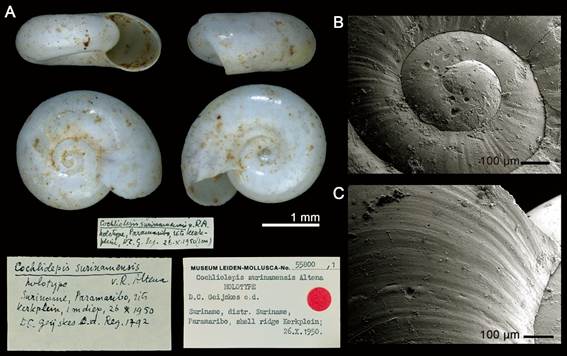
Happia surinamensis (van Regteren Altena, 1966) comb. nov., holotype RMNH.MOL.55800. (A) Standard views of the shell and historical labels. (B) Close-up of the first whorls, observed under SEM. (C) Close-up of the last whorl, observed under SEM.
-
Cochliolepis surinamensisvan Regteren Altena, 1966: 236, fig. 3a-d; van Regteren Altena, 1975: 18, fig. 8a-d; Princz, 1982: 111; Massemin et al., 2009: 115, textfig.; Rubio et al., 2011: 189.
Type material: Holotype RMNH.MOL.55800 (col. D.C. Geijskes 26/Oct/1950).
Type locality: “[S]hell ridge at the ‘Kerkplein’ (Church square) in Paramaribo, Suriname, at 1 m depth, D.C. Geijskes leg., October 26, 1950” (van Regteren Altena, 1966: 236).
Redescription: Shell small, discoid, with a seemingly smooth, glossy surface. Spire sunken, protoconch not clearly differentiated, though the first strong growth wrinkle at 1 1⁄2 whorl might mark the protoconch-teleoconch transition. Sculpture consists of minute, slightly flexuous growth lines and irregularly spaced stronger growth wrinkles. Aperture subcircular, peristome simple, neither thickened nor reflected, parietal incision weak or absent. Umbilicus wide, ca. 38% of total width.
Shell measurements: Holotype: shell height = 1.0 mm; shell width = 2.7 mm; number of whorls = 3.
Distribution: Known only from the type locality.
Discussion: This species was described from material gathered at Holocene deposits (shell ridges) in Suriname. As the deposits represented marine assemblages (see also Schepman, 1887, for more information on such deposits in Suriname), the new species was considered to be a Vitrinellidae (now Tornidae), but van Regteren Altena (1966: 237) remarked on the similarity of the shell to freshwater Planorbidae.
Herein, we re-identify the species as a Scolodontidae and, tentatively, belonging to the genus Happia, according to the revised concept of Roosen & Breure (2024a), even though two of the defining shell features cannot be observed: the punctate microsculpture is absent, but this could be due to the preservation of the shell (i.e., its “partly fossilized” state); likewise, the present specimen is a juvenile with a partially damaged aperture and no apertural incision can be observed. The presence of such incision can be easily inferred on the last whorls from the retracted growth lines close to the suture, which are not visible in the present specimen; retracted growth lines can also be observed on earlier whorls (i.e., it is present on juvenile shells), though this feature is not always easily visible. In any event, the shell shape and whorl growth pattern is otherwise in line with Happia (cf. Roosen & Breure, 2024a) and we consider the tentative transference of this species, previously classified as a marine snail, to Happia as the best solution at present and until more specimens are found.
Thus, we consider that the presence of this species in the shell ridge deposit is potentially a contamination of modern material, which often happens in such circumstances. The white and weathered aspect of the type specimens is often observed in modern dead shells exposed to that type of environment (The Authors, pers. obs.). Still, the possibility that this terrestrial specimen is a contamination that occurred simultaneously with the deposits cannot be excluded. Indeed, the latter context is common in Holocene marine deposits from Uruguay and Buenos Aires Province (Argentina), where Scolodontidae and even Strophocheilidae were commonly reported (see e.g., Farinati, 1987; Figueiras, 1961, 1963).
Happia surinamensiscomb. nov. is most similar to H. lyzarzaburui from West-Ecuador, but this species has a different, less perfectly circular, apertural shape. In addition, the microscopic punctate sculpture is distinctly spirally oriented in Happia specimens from West-Ecuador that are likely conspecific with H. lyzarzaburui (Roosen, pers. obs. 2019). Happia andia is also similar, but has a sculpture consisting of spiral grooves only (Roosen & Breure, 2024a). Lastly, H. decaensi occurs most closely to the type locality of H. surinamensis comb. nov. However, H. decaensi is distinctly larger, has overall higher whorls (resulting in a higher, but still discoid shell) and has distinct axial sculpture (growth marks) that is stronger than its spiral sculpture (Gargomingy et al., 2025).
Furthermore, H. surinamensis is very similar to other species such as “Happia” insularis (Boetgger, 1889) and “Drepanostomella” uruguayana Hylton Scott, 1978, respectively from Rio de Janeiro (Brazil) and Uruguay (Hylton Scott, 1978; Zilch, 1982). These species lack the parietal incision and need careful generic reassessment.
Remarks: Although coincidentally sharing the same epithet, Happiella surinamensis (L. Pfeiffer, 1872) is a different taxon (Tillier, 1980; Massemin et al., 2009).
DISCUSSION
Here we associate two further species, one new and one “old”, to Happia, considering the new delimitation of the genus proposed by Roosen & Breure (2024a). The new data also extended the genus’s distribution, notably into the Brazilian Amazon, and also highlights incorrect systematic assignments of a species described decades ago as a marine animal.
It is also important to note that the revision of Roosen & Breure (2024a) restricted Happia based on a re-examination of the type species of Ammonoceras Pfeiffer, 1855, the name for which Happia was a replacement. Those authors reclassified only part of the species that were traditionally placed in the “wastebasket” Happia. Their reclassified “Happia” were moved to other scolodontid genera such as Systrophiella Baker, 1925, Austroselenites Kobelt, 1905, and Prohappia Thiele, 1927. Roosen & Breure (2024a) suggested that other further species could belong to Systrophiella, but did not propose new combinations, in effect leaving several species “orphaned” (e.g., discussion in Salvador et al., 2024 about the Brazilian species). This is a matter that will eventually need to be resolved.
On the other hand, further species classified in other genera would likewise benefit from a reassessment regarding their potential allocation in Happia, such as Drepanostomella pinchoti Pilsbry, 1930 and Drepanostomella stolli (von Martens, 1892). The former is distributed through Central Nicaragua, east Panama (type locality: Gulf of San Blas, foothills near the Mandingo River), and north Venezuela (Pilsbry, 1930; Thompson, 1957, 2011; Pérez & López, 2003; Pérez et al., 2008), while the latter occurs in Guatemala (type locality: Retalhuleu), Costa Rica, and Panama (Pilsbry, 1930; Thompson, 2011). A final interesting case is a Happia-like juvenile shell reported by Salvador et al. (2018) from the Atlantic Forest biome of Pedra Talhada Biological Reserve (Alagoas state, Brazil) and misidentified as “Happia vitrina (Wagner, 1827)” (currently Systrophiella vitrina). Defining features from the adult shell (e.g., the apertural incision) cannot be observed, but the shell morphology is otherwise consistent with Happia sensu Roosen & Breure (2024a). If any such taxa is demonstrated to belong to Happia, the genus’s range would be significantly extended.
DATA AVAILABILITY:
The authors confirm that the data supporting the findings of this study are available within the article.
Acknowledgments:
We are very grateful to our institutions for the general support of our work; to Arike Gill (Naturalis), and Luiz Simone and Simone Lira (MZSP) for access to the specimens in the collections under their care; and to Frank Loggen and Bertie Joan van Heuven (Naturalis) for imaging the type specimen of Cochliolepis surinamensis; and to Bernhard Hausdorf and an anonymous reviewer for their helpful comments.
REFERENCES
-
Farinati, E.A. 1987 [“1985”]. La fauna de los cordones litorales holocenos de Bahía Blanca, Provincia de Buenos Aires, Argentina. Comunicaciones de la Sociedad Malacológica del Uruguay, 6(49): 317-326. https://doi.org/10.5962/p.421166.
» https://doi.org/10.5962/p.421166 -
Figueiras, A. 1961. Contribución al conocimiento de la malacofauna holocena del Uruguay. Comunicaciones de la Sociedad Malacológica del Uruguay, 1(1): 15-21. https://doi.org/10.5962/p.420966.
» https://doi.org/10.5962/p.420966 -
Figueiras, A. 1963. Enumeración sistemática de los moluscos terrestres del Uruguay. Comunicaciones de la Sociedad Malacológica del Uruguay, 1(4): 79-96. https://doi.org/10.5962/p.420979.
» https://doi.org/10.5962/p.420979 -
Gargominy, O.; Fontaine, B.; Tercerie, S. & Zuccon, D. 2025. New species and new records of families, genera and species of land snails (Mollusca, Gastropoda) from French Guiana. ZooKeys, 1230: 155-194. https://doi.org/10.3897/zookeys.1230.133585.
» https://doi.org/10.3897/zookeys.1230.133585 -
Hylton Scott, M.I. 1978. Un reducto malacológico en el Uruguay. Comunicaciones de la Sociedad Malacológica del Uruguay, 5(35): 47-51. https://doi.org/10.5962/p.421121.
» https://doi.org/10.5962/p.421121 - Jousseaume, F. 1887. Mollusques nouveaux de la République de l’Equateur. Bulletin de la Société Zoologique de France, 12: 165-186.
-
Lima, M.S.; Silva, F.S.; Simone, L.R.L.; Salvador, R.B. & Guilherme, E. 2021. Terrestrial gastropods of Reserva Florestal Humaitá, southwestern Brazilian Amazon. Check List, 17(1): 269-281. https://doi.org/10.15560/17.1.269.
» https://doi.org/10.15560/17.1.269 - Martens, E. von. 1890-1901. Biologia Centrali-Americana. Land and freshwater Mollusca London, R.H. Porter. 706 p + 44 pls.
- Massemin, D.; Lamy, D.; Pointier, J.-P. & Gargominy, O. 2009. Coquillages et escargots de Guyane - Seashells and snails from French Guiana Paris, Biotope. 456p.
- Pérez, A.M. & López, A. 2003. Listado de la malacofauna continental (Mollusca: Gastropoda) del Pacífico de Nicaragua. Revista de Biología Tropical, 51(Suppl. 3): 405-451.
- Pérez, A.M.; Sotelo, M.; Arana, I. & López, A. 2008. Diversidad de moluscos gasterópodos terrestres en la región del Pacífico de Nicaragua y sus preferencias de hábitat. Revista de Biología Tropical, 56(1): 317-332.
- Pilsbry, H.A. 1930. Results of the Pinchot South Sea Expedition, II. Land mollusks of the Canal Zone, the Republic of Panama and the Cayman Islands. Proceedings of the Academy of Natural Sciences of Philadelphia, 82: 339-354.
- Princz, D. 1982. Lista y bibliografía de los gasterópodos marinos vivos de los mares de Venezuela, Trinidad e Islas de Sotavento. Boletín de la Sociedad Venezolana de Ciencias Naturales, 37: 103-147.
-
Ravalo, L.G.O.; Gargominy, O. & Salvador, R.B. 2023. New species of Miradiscops (Gastropoda: Scolodontidae) from Martinique. Folia Malacologica, 31(3): 129-135. https://doi.org/10.12657/folmal.031.018.
» https://doi.org/10.12657/folmal.031.018 - Reeve, L.A. 1851-1854. Monograph of the genus Helix. In: Conchologia iconica, or, illustrations of the shells of molluscous animals. Vol. 7. London, L. Reeve & Co. Unpaginated.
-
Roosen, M.T. & Breure, A.S.H. 2024a. Revision of the genera of Scolodontidae part 1: Happia Bourguignat, 1890 from Austroselenites Kobelt, 1905, Drepanostomella Bourguignat, 1890, Hirtudiscus Hylton Scott, 1973, Luteostriatella gen. nov., and Systrophiella H.B. Baker, 1925. Journal of Conchology, 45: 91-110. https://doi.org/10.61733/jconch/4511.
» https://doi.org/10.61733/jconch/4511 -
Roosen, M.T. & Breure, A.S.H. 2024b. Helix entodonta L. Pfeiffer, 1859, a terrestrial snail from Ecuador, is a species of Zilchistrophia Weyrauch, 1960 (Gastropoda: Scolodontidae): Implications for the diagnosis and interpretation of Systrophia Pfeiffer, 1855 and Entodina Ancey, 1887. Folia Malacologica, 32(3): 186-190. https://doi.org/10.12657/folmal.032.016.
» https://doi.org/10.12657/folmal.032.016 -
Roosen, M.T. & Breure, A.S.H. 2024c. Revision of the genera of Scolodontidae, part 2: Guestieria Crosse, 1872, Xenodiscula Pilsbry, 1919, and a misidentified planorbid. Journal of Conchology, 45(2): 245-250. https://doi.org/10.61733/jconch/4524.
» https://doi.org/10.61733/jconch/4524 - Roosen, M.T. & Dorado, C. In press Some Peruvian Helicinidae and Scolodontidae (Gastropoda) described by Pilsbry, Preston and Rolle. Basteria, 89: 320-330.
-
Roosen, M.T.; Salvador, R.B. & Breure, A.S.H. 2025a. Revision of the genera of Scolodontidae, part 3: Entodina Ancey, 1887, Keranella gen. nov., Martinella Jousseaume, 1887, †Patagocharopa Miquel & P.E. Rodriguez, 2016, Polygyratia Gray, 1847, Ridleyconcha Christensen, 2020, Smenodonta gen. nov., Systrophia L. Pfeiffer, 1855, and Zilchistrophia Weyrauch, 1960. Journal of Conchology, 45(3): 430-449. https://doi.org/10.61733/jconch/4536.
» https://doi.org/10.61733/jconch/4536 -
Roosen, M.T.; Salvador, R.B. & Breure, A.S.H. 2025b. Revision of the genera of Scolodontidae, part 4: Miradiscops H.B. Baker, 1925 and Mayadiscops gen. nov. Journal of Conchology, 45(4): 604-616. https://doi.org/10.61733/jconch/4552.
» https://doi.org/10.61733/jconch/4552 -
Roosen, M.T.; Weijsenfeld, J. & Dorado, C. 2023. Notes on the genus Xenodiscula Pilsbry, 1919 (Gastropoda, Scolodontidae), with the description of a new species from NW Ecuador. Folia Malacologica, 31(2): 100-106. https://doi.org/10.12657/folmal.031.014.
» https://doi.org/10.12657/folmal.031.014 - Rubio, F.; Fernández-Garcés, R. & Rolán, E. 2011. The family Tornidae (Gastropoda, Rissooidea) in the Caribbean and neighboring areas. Iberus, 29(2): 1-240.
-
Salvador, R.B. & Cavallari, D.C. 2019. Taxonomic revision of the genus Hyperaulax Pilsbry, 1897 (Gastropoda, Stylommatophora, Odontostomidae). Zoosystematics and Evolution, 95(2): 453-463. https://doi.org/10.3897/zse.95.38259.
» https://doi.org/10.3897/zse.95.38259 -
Salvador, R.B. & Cavallari, D.C. 2020. Taxonomy and distribution of enigmatic “helicoid” Polygyratia Gray, 1847 (Gastropoda, Stylommatophora). Zoosystematics and Evolution, 96(1): 91-101. https://doi.org/10.3897/zse.96.51047.
» https://doi.org/10.3897/zse.96.51047 -
Salvador, R.B.; Charles, L.; Simone, L.R.L. & Maestrati, P. 2018. Terrestrial gastropods from Pedra Talhada Biological Reserve, Alagoas state, Brazil, with description of a new species of Radiodiscus (Gastropoda: Charopidae). Archiv für Molluskenkunde, 147(1): 101-128. https://doi.org/10.1127/arch.moll/147/101-128.
» https://doi.org/10.1127/arch.moll/147/101-128 -
Salvador, R.B.; Miranda, M.S.; Silva, F.S.; Oliveira, C.D.C.; Arruda, J.O.; Cavallari, D.C.; Gomes, S.R.; La Pasta, A.; Pena, M.S.; Ovando, X.M.C.; Rosa, R.M.; Salles, A.C.A.; Santos, S.B.; Simone, L.R.L. & Machado, F.M. 2024. Checklist of the terrestrial gastropods of Brazil. Journal of Conchology, 45(2): 141-185. https://doi.org/10.61733/jconch/4516.
» https://doi.org/10.61733/jconch/4516 - Schepman, M.M. 1887. Bijdrage tot de kennis der Mollusken-fauna van de schelpritsen van Suriname, naar de door den heer Voltz gemaakte verzameling bewerkt. Sammlungen des geologischen Reichs-Museums in Leiden, (2)1: 150-168.
- Thompson, F.G. 1957. A collection of mollusks from northern Venezuela. Occasional Papers of the Museum of Zoology University of Michigan, 591: 1-10.
-
Thompson, F.G. 2011. An annotated checklist and bibliography of the land and freshwater snails of México and Central America. Florida Museum of Natural History Bulletin, 50(1): 1-299. https://doi.org/10.58782/flmnh.bnej7351.
» https://doi.org/10.58782/flmnh.bnej7351 - Tillier, S. 1980. Gastéropodes terrestres et fluviatiles de Guyane française. Mémoires du Muséum National d’Histoire Naturelle, Nouvelle Série A, Zoologie, 118: 1-175.
- van Regteren Altena, C.O. 1966. Vitrinellidae (Marine Mollusca Gastropoda) from Holocene deposits in Surinam (Dutch Guiana). Zoologische Mededelingen, 41(16): 233-241.
-
van Regteren Altena, C.O. 1975. The Marine Mollusca of Suriname (Dutch Guiana) Holocene and recent Part III. Gastropoda and Cephalopoda. Zoologische Verhandelingen, 139(1): 1-104. https://doi.org/10.1163/9789004742932.
» https://doi.org/10.1163/9789004742932 - Zilch, A. 1982. Die Typen und Typoide des Natur-Museums Senckenberg, 71): Mollusca: Streptaxacea (2): Haplotrematidae, Systrophiidae, Rhytididae, Streptaxidae (Nachträge zu Teil 24). Archiv für Molluskenkunde, 113(1-6): 117-149; 231-233.