Cecidomyiidae (Diptera): richness and distribution in the Amazonian forest
Abstract
The present study aimed to survey the richness and distribution of gall midge species (Cecidomyiidae) in the Amazon forest. Additionally, we compilated data on the characterization of insect galls and host plant species identification, and developed a taxonomic key of gall midge genera registered in the Amazon forest. For this, data were obtained from the literature, but also from papers containing the original description of each gall midge species. A total of 31 gall midge species have been recorded in the Amazonian forest, with the majority reported in the Brazilian Amazon (29) and two species found in the Peruvian Amazon. The genera Lopesia was the best represented among gall midges. Calophyllaceae were the plant family with the greatest number of gall midge species. Leaves were the most attacked plant organ (74%). Most morphotypes are globoid (75%), green (42%), glabrous (58%), and one-chambered (55%). The state of Amazonas (Brazil) and the department of Loreto (Peru) recorded the highest number of gall-inducing species. Furthermore, 17 gall midges species were described from the Brazilian Amazon, while only two species were described from the Peruvian Amazon. The remaining species (12) were described from other biomes and latter recorded in the Amazon forest. In the 20th and 21st centuries, 13 and six gall midges species were described, respectively, being Rübsaamen and Maia the authors who described the highest number of species. After 1921, there was an 85 years interval without new taxonomic contributions until 2006, when two new species were described from the Amazon forest. The taxonomic key for gall midge genera stands out as one of the few available for distinguishing genera in the Neotropical region, facilitating the work of taxonomists. It is also the first taxonomic key specifically designed for this phytogeographic domain. In order to fill these gaps in the taxonomic information on gall-inducing insect species in the Amazon forest, more efforts are needed in the identification and description of gall-inducing species, particularly within the family Cecidomyiidae.
Keywords:
Calophyllaceae; Gall midge species; Host plant; Insect-plant interactions; Rainforest.
INTRODUCTION
It is estimated that there are approximately 5.5 million insect species in the world, with 80% yet to be discovered, and that greater emphasis should be placed on less-studied taxa, such as Diptera (Stork, 2018). The Amazonian forest harbors a rich diversity of Diptera, with 856 species identified across 56 families, with the Cecidomyiidae family being one of the most abundant in this biome (Amorim et al., 2022). Cecidomyiidae is one of the largest families within the Diptera order, encompassing over 6,500 described species worldwide (Gagné & Jaschhof, 2021). However, in the Amazonian forest, only 31 species of Cecidomyiidae have been identified to date (Gagné & Jaschhof, 2021). This limited number can be attributed to the scarcity of taxonomic knowledge regarding gall-inducing insects in the Amazon. This is primarily due to taxonomic uncertainties, difficulties in identification, and the fact that many species remain undescribed (Grandez-Rios et al., 2015).
The pioneering taxonomic studies on Cecidomyiidae species in the Amazonian forest were conducted between 1905 and 1921 by renowned taxonomists such as Rübsaamen (1905, 1915a, 1915b), Felt (1915, 1921), and Kieffer (1913). These researchers are credited with approximately 55% of the recorded gall-inducing species (Maia, 2021). Additional records were contributed by Möhn (1960), Gagné (1994), Maia & Vasquez (2006), Maia & Fernandes (2006), Fernandes et al. (2010), Maia & Vasquez (2010), Proença & Maia (2020), and Gagné & Jaschhof (2021).
Most taxonomic studies on Cecidomyiidae in the Amazon forest have been conducted in the Brazilian Amazon (Maia, 2021), resulting in a strong geographic bias in current knowledge. In contrast, other Amazonian countries remain poorly studied, with scarce taxonomic and faunistic information available (Grandez-Rios et al., 2024). This uneven research effort limits our understanding of the true diversity and distribution of gall-inducing species across the Amazon. Furthermore, taxonomic identification keys for Cecidomyiidae are scarce, with the only comprehensive key available for the Neotropical region being that developed by Gagné (1994). The lack of region-specific and updated identification tools may hinder accurate species delimitation, particularly in highly diverse and understudied areas such as the Amazon (Grandez-Rios et al., 2015). In this context, taxonomic keys are essential, as they enable standardized and reliable species identification, improve the quality of biological inventories, and strengthen biodiversity and conservation studies (Espírito-Santo & Fernandes, 2007).
The main objective of this work is to survey the richness and distribution of gall midge species in the Amazon forest. Additionally, we compiled data on the characterization of insect galls, identify the main host plant species, and develop a taxonomic key of gall midge genera registered in the Amazonian forest.
MATERIAL AND METHODS
The study was conducted through a literature survey of data on gall-inducing insects and their host plants in the Amazon forest. Initially, a systematic research was performed in the online databases SciVerse Scopus, Portal Capes, and Google Scholar between June and July 2023, using the following keyword combinations: (galls* OR insect galls*) AND (Cecidomyiidae*) AND (Amazon*) AND (rainforest*), to list gall midge species described in the Amazon forest. Subsequently, papers containing the original descriptions of each species, along with other taxonomic studies, were examined to validate species records and gather detailed information on their occurrence localities and host plants.
Data on gall-inducing insect species, host plants, morphological characteristics of the galls, and geographical distribution (country, state, or department where the gall-inducing insect species occur) were compiled. Botanical names and synonyms of the host plants were verified on the GBIF platform (https://www.gbif.org). Plant species determined only at the genus level (i.e., species identified as “sp.”) and family were also included in the list of host plants. To standardize the morphology of the galls, the terminology of Isaias et al. (2013) was adopted. Furthermore, a taxonomic key was developed for gall midge genera registered in the Amazonian forests. Morphological data were obtained from the literature. The key includes mainly male and female characters, and some characters of the 3rd instar larva. Most of them are illustrated. Photographs were taken from specimens deposited in the entomology collection of the Museu Nacional do Rio de Janeiro. For genera not represented in the collection, illustrations were obtained from the literature.
RESULTS
In total, 31 species of Cecidomyiidae from seven tribes and 21 genera were reported in the Amazonian forests (Table 1). The best represented tribes were Lopesiini and Asphondyliini, each with 7 species. The other tribes had lower values: Clinodiplosini had 4 species, while Anadiplosini, Alycaulini, Cecidomyiini, and Dasineurini, each with one species. Additionally, nine cecidogenous species not positioned in tribe were reported. Sixteen genera were represented by a single species, four (Asphondylia Loew, 1850, Bruggmannia Tavares, 1906, Clinodiplosis Kieffer, 1894, and MacroporpaRübsaamen, 1915b) by two, and one (LopesiaRübsaamen, 1908) by seven, the latter being the genus with the highest species richness in the biome.
Gall midge species were associated with 17 botanical families distributed across 19 genera and 21 plant species (Table 1). Calophyllaceae is the plant family with the highest species richness of gall-inducing species (five), followed by Asteraceae with three, Burseraceae, Fabaceae, Malvaceae, Nyctaginaceae, and Urticaceae with two each. All other families host a single cecidogenous species. Ten gall-inducing species are associated with host plants identified only at the genus level, such as Arrabidaeasp. (Bignonaceae), Cecropiasp. (Urticaceae), Clusiasp. (Clusiaceae), Coussapoasp. (Urticaceae), Mikaniasp. (Asteraceae), Neeasp. (Nyctaginaceae), Serjaniasp. (Sapindaceae), Solanumsp. (Solanaceae), and Sterculiasp. (Malvaceae). Two gall-inducing insect species were found on host plants identified only by family, one in Malpighiaceae and another in Lauraceae. Additionally, five cecidogenous species (Alexomyia ciliataFelt, 1921, Haplusia braziliensis Felt, 1915, Macroporpa peruvianaRübsaamen, 1915a, Macroporpa ulei Rübsaamen, 1915b, and Ouradiplosis aurata Felt, 1915) did not have their host plants reported.
Most galls were induced on leaves (23 morphotypes), representing 74% of the total, followed by stems and fruits, both with two gall morphotypes, and roots with one morphotype. Four gall shapes were reported: globoid (21 morphotypes), fusiform (3), marginal roll (2), and conical (2). The galls displayed green, yellow, or brown coloration, with green being predominant (42%). Most galls were glabrous (58%), while the rest were hairy. Seventeen morphotypes (about 55%) had a single chamber, often occupied by a single gall-inducing larva, while four galls were multilocular. The gall shape, color, presence of trichomes, host organ, and number of chambers were not reported for three cecidogenous species: Alexomyia ciliata, Haplusia braziliensis, and Ouradiplosis aurata (Table 1).
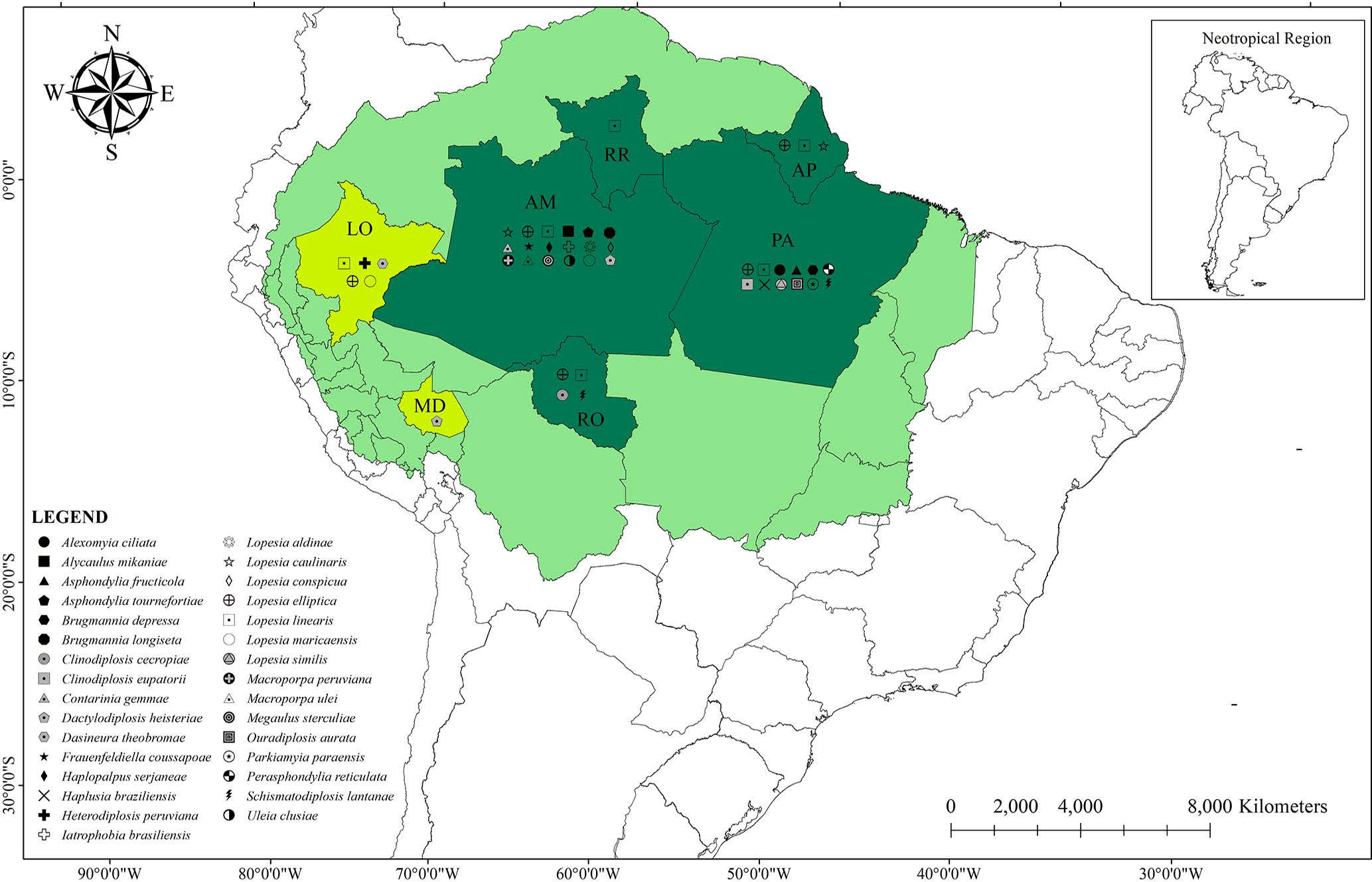
Regarding the geographical distribution of the 31 Cecidomyiidae species reported in the Amazonian forests, four occurred in both Brazil and Peru (Dactylodiplosis heisteriaeRübsaamen, 1915b, Lopesia elliptica Maia, 2003, Lopesia linearis Maia 2003, and Lopesia maricaensisRodrigues & Maia, 2010), while 25 species were exclusively reported for Brazil and two species exclusively for Peru (Fig. 1). In Brazil, the highest number of gall-inducing species was recorded in the state of Amazonas (18 species), followed by Pará with twelve, Rondônia with four, Amapá with three, and Roraima with one. In Peru, a total of six species were recorded, of which five were reported for the Loreto department and one species for the Madre de Dios department. Additionally, the species Lopesia linearis, L. elliptica, and L. maricaensis were recorded in Brazil across five states (Amapá, Amazonas, Pará, Rondônia, Roraima), four (Amapá, Amazonas, Pará, Rondônia), and one (Amazonas), respectively, and also in one department in Peru (Loreto). Meanwhile, L. caulinaris Maia, 2003 (Amapá and Amazonas) and Schismatodiplosis lantanaeRübsaamen, 1908 (Rondônia and Pará) were recorded in two different states in Brazil, while Dactylodiplosis heisteriae was reported in one state in Brazil (Amazonas) and one department in Peru (Madre de Dios) (Fig. 1).
Characterization of insect galls recorded for each gall-inducing species in the Amazon forest.
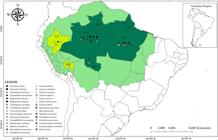
Distribution of the number of Cecidomyiidae species (Diptera) in the Amazon forest, by department in Peru and state in Brazil. Legend: Peru, LO: Loreto and MD: Madre de Dios; and Brasil, AM: Amazonas; AP: Amapá; PA: Pará; RO: Rondônia and RR: Roraima
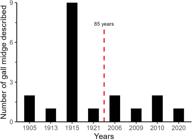
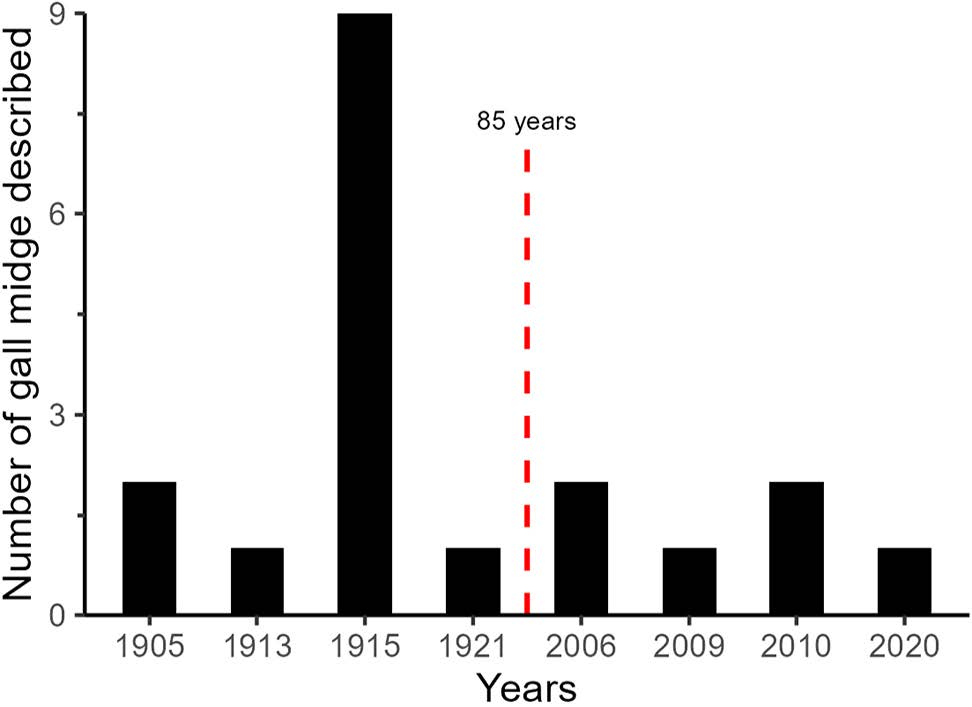
Comparison of the number of gall-inducing insect species de scribed per year in the Amazon forest.
Insect gall-inducing species of the Cecidomyiidae family (Diptera) described for the Amazonian forest in the 20th and 21st centuries, in chrono- logical order. The hyphen indicates species not placed in a tribe.
On the other hand, 17 cecidogenous species were described for the Brazilian Amazon forest between 1905 and 2020, while for the Peruvian Amazon forest, only two species were described, one in 2006 and another in 2010 (Table 2). The remaining species (12) were first reported in other biomes and latter in the Amazon forest. Additionally, in the 20th century, 13 species were described, being Rübsaamen the author with the highest number of species described during this period (n = 7), while in the 21st century, six species were described, being Maia the author with the greatest contribution (Table 3). The last species described in the 20th century was Alexomyia ciliataFelt, 1921, followed by an 85-years interval without new taxonomic contributions until 2006, when two new species were described for the Amazon forest (Table 2, Fig. 2).
Key to genera of Cecidomyiidae recorded in the Amazonian forest
The following key includes 21 genera of Cecidomyiidae recorded in the Amazonian forests. Lopesia and Clinodiplosis appeared twice and three in the key due their morphological diversity, respectively. The number of species of each genus in the Amazon forest is given in brackets.
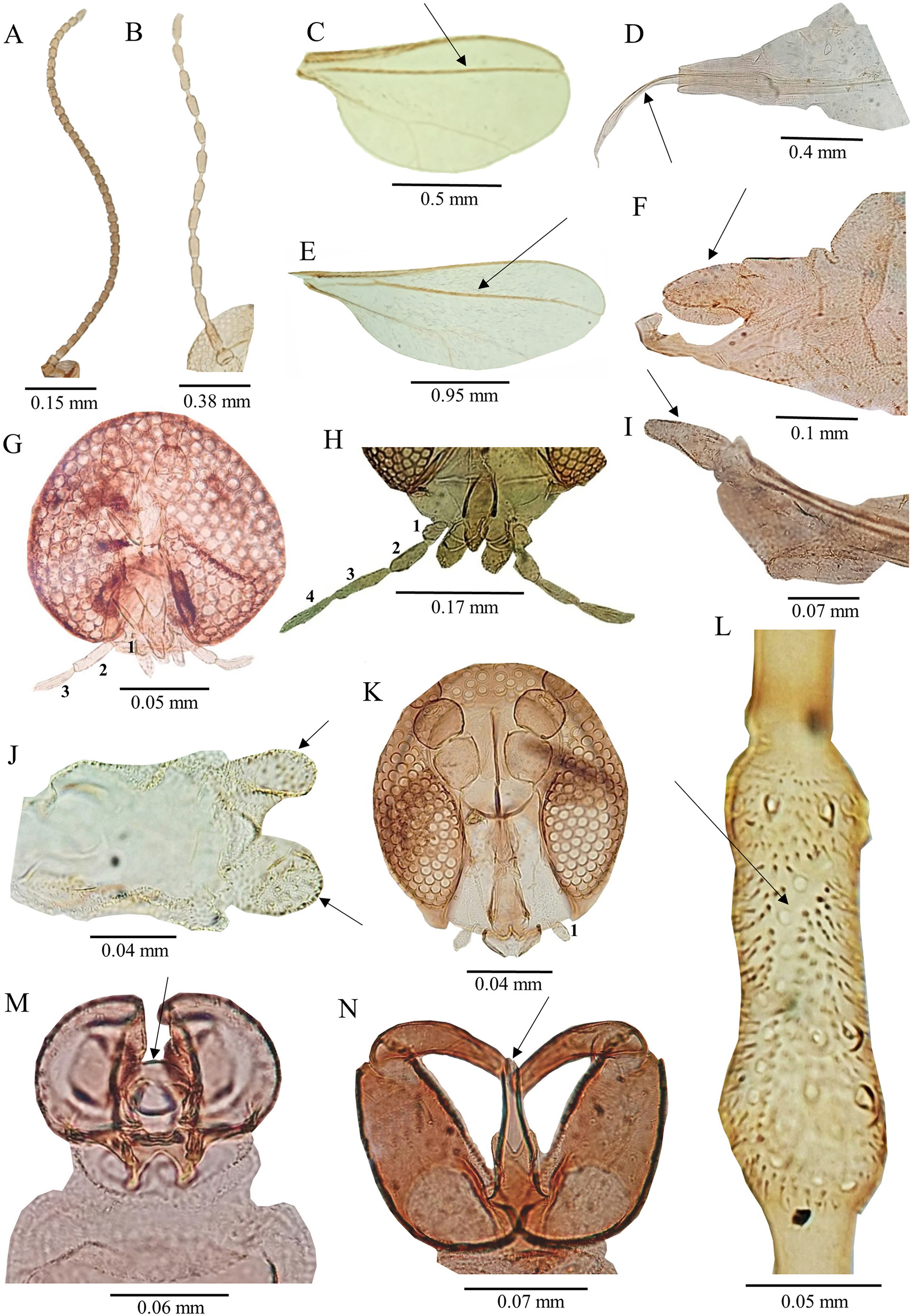
1. Antenna with more than 12 flagellomeres (Fig. 3A) 2
1′. Antenna with 12 flagellomeres (Fig. 3B) 6
2. R5 shorter than wing (Fig. 3C); ovipositor protrusible (Fig. 3D) 3
2′. R5 longer than or as long as wing (Fig. 3E); ovipositor not protrusible (Fig. 3F) 4
3. Palpus with three segments (Fig. 3G); male antennal flagellomeres squarishAlycaulus (1 sp.)
3′. Palpus with four segments (Fig. 3H); male antennal flagellomeres cylindricalDasineura (1 sp.)
4. R5 as long as than wing; ovipositor cerci fused (Fig. 3I)Uleia (1 sp.)
4′. R5 longer than wing; ovipositor cerci not fused (Fig. 3J) 5
5. Antenna with 14 flagellomeres; palpus with three segments (Fig. 3G)Haplusia (1 sp.)
5′. Antenna with 24 flagellomeres; palpus with one segment (Fig. 3K)Haplopalpus (1 sp.)
6. Palpus with one segment 7
6′. Palpus with three or four segments 9
7. Female cerci fusedAlexomyia (1 sp.)
7′. Female cerci not fused 8
8. Female antenna with sinuous circumfilaFrauenfeldiella (1 sp.)
8′. Female antenna with not sinuous circumfila (Fig. 3L)Clinodiplosis in part (2 spp.)
9. R5 as long as than wing 10
9′. R5 longer than wing 13
10. Ovipositor not protrusible; male with aedeagus wide (Fig. 3M)Macroporpa (2 spp.)
10′. Ovipositor protrusible; male with aedeagus narrow (Fig. 3N)Parkiamyia (1 sp.)
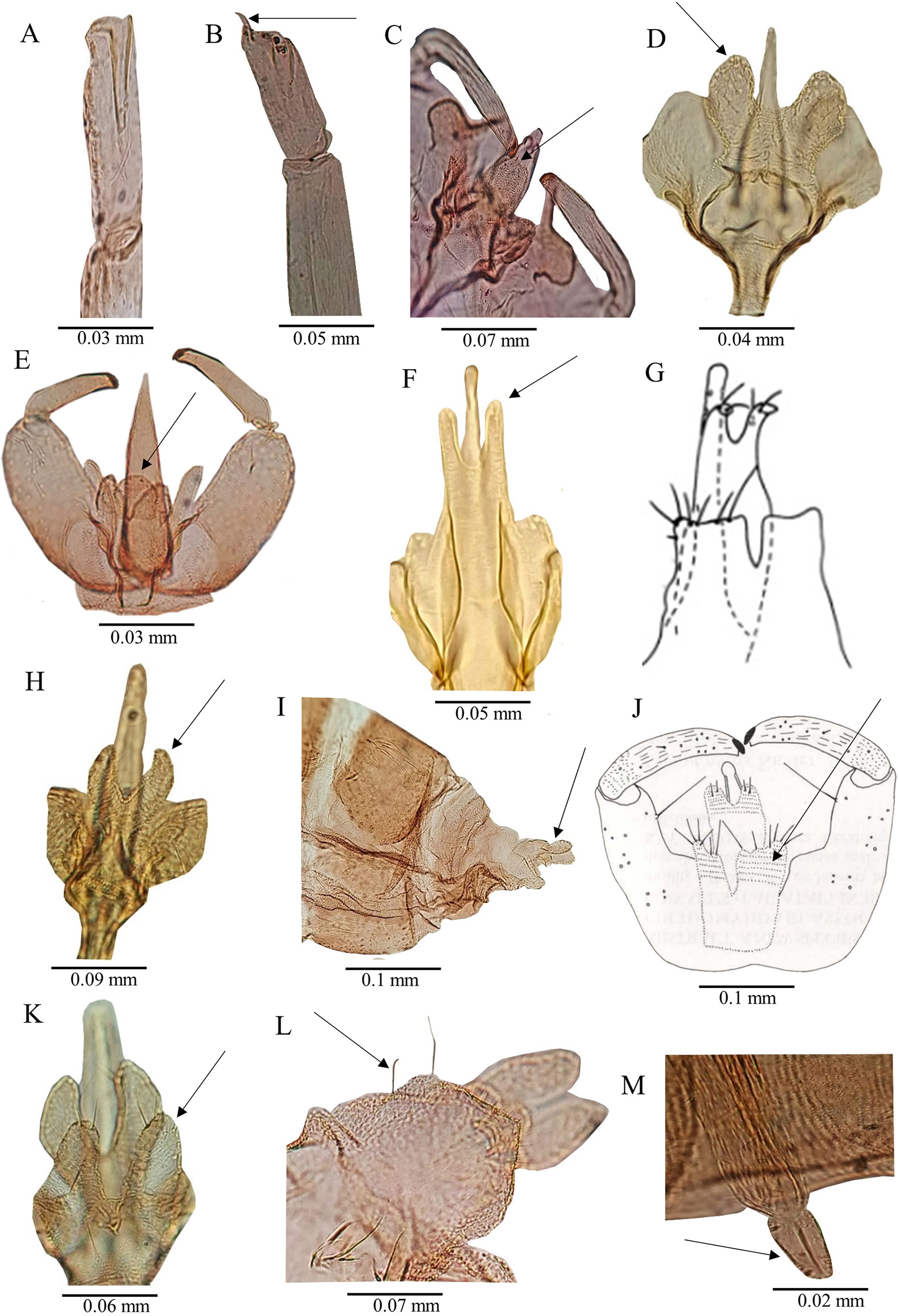
11. First tarsomere with not apical projection (Fig. 4A)Bruggmannia (2 spp.)
11′. First tarsomere with apical projection (Fig. 4B) 12
12. Ovipositor with cerci fusedAsphondylia (2 spp.)
12′. Ovipositor with cerci not fusedPerasphondylia (1 sp.)
13. Palpus with three segments 14
13′. Palpus with four segments 15
14. Male with hypoproct almost simple (Fig. 4C)Heterodiplosis (1 sp.)
14′. Male with hypoproct deeply bilobed (Fig. 4D)Lopesia in part (7 spp.)
15. Male with hypoproct simple (Fig. 4E)Dactylodiplosis (1 sp.)
15′. Male with hypoproct bilobed (Fig. 4F) 16
16. Male hypoproct with recurved apical lobes (Fig. 4G)Iatrophobia (1 sp.)
16′. Male hypoproct with not recurved apical lobe (Fig. 4H) 17
17. Female flagellomeres with circumfilar loopsMegaulus (1 sp.)
17′. Female flagellomeres without circumfilar loops (Fig. 3M) 18
18. Female with very elongate cerciOuradiplosis (1 sp.)
18′. Female with short cerci (Fig. 4I) 19
19. Male cerci with secondarily lobed (Fig. 4J) 20
19′. Male cerci not secondarily lobed (Fig. 4K) 21
20. Female 10th tergum setose (Fig. 4L)Schismatodiplosis (1 sp.)
20′. Female 10th tergum not setose (Fig. 4I)Clinodiplosis in part (2 spp.)
21. Female with cerci closely appressed to one another mesally (Fig. 4M)Contarinia (1 sp.)
21′. Female with cerci not closely appressed to one another mesally (Fig. 5A) 22
22. Larva with four pairs of terminal papillae: three pairs corniform (one smaller than others) and one pair setiform (Fig. 5B)Clinodiplosis in part (2 spp.)
22′. Larva with four pairs of terminal papillae, all corniform (Fig. 5C)Lopesia in part (7 spp.)
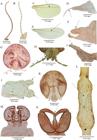
Adults of Cecidomyiidae: (A-B) Female antenna: (A) Dasineura sp.; (B) Lopesia grandis; (C) Dasineura sp., male wing; (D) Dasineura sp., ovipositor, lateral view; (E) Lopesia grandis, male wing; (F) Lopesia sp., ovipositor, lateral view; (G-H) Female head, ventral view: (G) Lopesia grandis; (H) Dasineura sp.; (I-J) Ovipositor: (I) Dasineura microstachysae, lateral view; (J) Dasineura ovalifoliae, dorsal view; (K) Asteromyia sp., female head, ventral view; (L) Clinodiplosis agerati, female 5th flag ellomere; (M-N) Male terminalia, dorsal view: (M) Bruggmannia capixaba; (N) Parkiamyia paraensis.
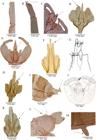
Adults of Cecidomyiidae: (A-B) male anterior and posterior legs, first tarsomere: (A) Bruggmannia capixaba; (B) Asphondylia fluminensis; (C-F) Male hy poproct and aedeagus, dorsal view: (C) Heterodiplosis peruviana; (D) Lopesia elliptica; (E) Dactylodiplosis sp.; (F) Iatrophobia brasiliensis; (G) Iatrophobia brasiliensis, male hypoproct with recurved apical lobes and aedeagus, dorsal view (from Gagné, 1994; without scale), (H) Clinodiplosis agerati, male hypoproct and aedeagus, dorsal view; (I) Lopesia conspicua, last female abdominal segments and cerci, (J-K) Male cerci and hypoproct, dorsal view: (J) Clinodiplosis melissae (from Maia, 1993); (K) Lopesia marginalis, (L) Schismatodiplosis lantanae, female 10th tergum and cerci, dorsal view; (M) Contarinia sp., female cerci, dorsal view..
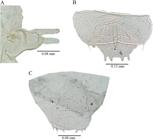
Cecidomyiidae: (A) Clinodiplosis melissae, female cerci; (B-C) Larva, terminal segment, dorsal view: (B) Clinodiplosis sp.; (C) Lopesia maricaensis.
DISCUSSION
The best represented genus of gall midges in the Amazonian forest was Lopesia. This genus, belonging to the tribe Lopesiini, is widely distributed with 30 described species, 25 of which are found in the Neotropics (Maia, 2020). Additionally, seven species are known to occur in the Amazonian forest (Maia, 2021), of which Lopesia elliptica, Lopesia linearis, and Lopesia maricaensis have been recorded in both the Brazilian and Peruvian Amazon regions (Arriola et al., 2016; Maia, 2020). Futhermore, Lopesia is also well represented in the Cerrado (Maia, 2021) and Atlantic forest (Maia & Silva, 2011).
In this study, Calophyllaceae was identified as the host plant family with the highest number of gall midge species, a finding consistent with the observations of Grandez-Rios et al. (2023) in the Peruvian Amazon. Several studies suggest that a greater diversity of plant species within a family is often associated with a richer fauna of galling associates (Gonçalves-Alvim & Fernandes, 2001). Other host plant families that were also found to be important include Burseraceae, Fabaceae, Malvaceae, Nyctaginaceae, and Urticaceae. According to Julião et al. (2014), these families are also recorded in the Amazonian forest as hosts for gall-inducing insect species.
Leaves were the most frequently galled plant organ in our study. Generally, leaves are the most attacked plant organ, likely because they represent a constant and abundant resource for the gallers (Maia, 2011). According to Grandez-Rios et al. (2023) and Proença & Maia (2023), 90% and 81% of galls, respectively, occurred on leaves in the Amazon forest. The globoid shape was also the most common. According to Isaias et al. (2013), this is the most common shape in the Neotropical region. Most galls were green color, with a glabrous surface and a single chamber. These predominant characteristics are consistent with previous studies conducted in the Amazon forest (Grandez-Rios et al., 2023; Proença & Maia, 2023).
The gall-inducing midge species are primarily distributed across various Amazonian states in Brazil, with the state of Amazonas recording the highest number of species. In the Peruvian Amazon, only six gall midge species have been recorded. Furthermore, there are no occurrence records of these species in the countries where this biome extends. This reflects the areas of expertise of specialists, who are predominantly located in Brazil (Maia, 2021), revealing a spatial discontinuity of information and indicating the need for collection efforts in areas where no records have been documented.
There are few published taxonomic keys to genus-level for the Neotropical region. The key by Gagné (1994) is the most comprehensive; however, it is outdated, due to the description of several new genera. Additionally, another genus-level key has been developed in Argentina (Maia, 2014). Apart from these, no other keys are available for this region. This new key will be valuable as it will facilitate the work of taxonomists. It is the first taxonomic key specifically designed for this phytogeographic domain.
In the Amazonian forest, gall-inducing insects are poorly known from a taxonomic perspective, with most species being new to science. Of the 31 gall-inducing species reported, 19 were described for the Amazon forests between the years 1905 and 2020, representing 4% of the total species described for the Neotropical region (500 species, Gagné, 1994). Moreover, the majority of these species were described from the Brazilian Amazon. This is because, in recent years, many species from Brazil have been described (Proença & Maia, 2020). On the other hand, only two species of Cecidomyiidae have been described from the Peruvian Amazon, while the estimated number of gall-inducing insect species for Peru is 3,090 species (Grandez-Rios et al., 2015). Additionally, some Cecidomyiidae species did not have a complete identification of their host plants due to the enormous floristic diversity found in the Amazon forests, which complicates the specific determination of botanical specimens (Grandez-Rios et al., 2015).
CONCLUSION
In this study, 31 gall midge species were recorded in the Amazon forest, with 17 species described from the Brazilian Amazon and only two from the Peruvian Amazon. The remaining species were originally described from other biomes and later recorded in the Amazon forest. Lopesia was the most represented genus within Cecidomyiidae. The family Calophyllaceae hosted the highest richness of gall-inducing species. Leaves were the most frequently galled plant organ, and the most common gall morphology was globoid. The state of Amazonas (Brazil) and the department of Loreto (Peru) recorded the highest number of gall-inducing species. There was an 85-year gap before new species were described for the Amazon Forest. This is the first taxonomic key at the genus level for the Amazon forest, which will facilitate identification for taxonomists. Furthermore, more efforts are needed in the identification and description of gall-inducing species, particularly for the family Cecidomyiidae. To achieve this, it is essential to establish collaborations among researchers, institutions, and taxonomy experts to advance in this research area and improve our knowledge of gall-inducing insects.
ACKNOWLEDGMENTS:
The authors wish to thank the Programa Nacional de Becas y Crédito Educativo (PRONABEC), which provided a scholarship allowing the first author to pursue post-graduate studies in Brazil, and the Conselho Nacional de Desenvolvimento Científico e Tecnológico (CNPq) for financial support (Proc. 304240/2024 9). Furthermore, we are grateful for the constructive suggestions provided by Marcelo Guerra Santos, Pedro Souza Dias, and Leonardo Gil Azevedo.
Data Availability:
All datasets generated or analyzed during the current study are included in this article.
REFERENCES
-
Amorim, D.S.; Brown, B.V.; Boscolo, D.; Ale-Rocha, R.; Alvarez-Garcia, D.M.; Balbi, M.I.P.A.; Barbosa, A.M.; Capellari, R.S.; de Carvalho, C.J.B.; Couri, M.S.; Dios, R.V.P.; Fachin, D.A.; Ferro, G.B.; Flores, H.F.; Frare, L.M.; Gudin, F.M.; Hauser, M.; Lamas, C.J.E.; Lindsay, K.G.; Marinho, M.A.T.; Marques, D.W.A.; Marshall, S.A.; Mello-Patiu, C.A.; Menezes, M.A.; Morales, M.N.; Nihei, S.S.; Oliveira, S.S.; Pirani, G.; Ribeiro, G.C.; Riccardi, P.R.; Santis, M.D.; Santos, D.; Santos, J.R.; Silva, V.C.; Wood, E.M. & Rafael, J.A. 2022. Vertical stratification of insect abundance and species richness in an Amazonian tropical forest. Scientific Reports, 12: 1-10, 1734. https://doi.org/10.1038/s41598-022-05677-y.
» https://doi.org/10.1038/s41598-022-05677-y -
Arriola, I.A.; Melo-Júnior, J.C.M.; Mouga, D.M.D.; Isaias, R.M.S. & Costa, E.C. 2016. Where host plant goes, galls go too: new records of the Neotropical galling Cecidomyiidae (Diptera) associated with Calophyllum brasiliense Cambess. (Calophyllaceae). Check List, 12(4): 1-8. https://doi.org/10.15560/12.4.1924.
» https://doi.org/10.15560/12.4.1924 - Espírito-Santo, M.M. & Fernandes, G.W. 2007. How many species of gall-inducing insects are there on earth, and where are they? Annals of the Entomological Society of America, 100(2): 95-99.
- Felt, E.P. 1911. Two new gall midges (Dip.). Entomological News, 22: 109-111.
-
Felt, E.P. 1915. New South American gall midges. Psyche, 22: 152-157. https://doi.org/10.1155/1915/42393.
» https://doi.org/10.1155/1915/42393 - Felt, E.P. 1921. Three new sub-tropical gall midges (Itonididae, Dipt.). Entomological News, 32: 141-143.
-
Fernandes, S.P.C.; Maia, V.C. & Rafael, J.A. 2010. Gall midges (Diptera, Cecidomyiidae) associated with Aldina heterophylla Spr. ex Benth. (Fabaceae) from Brazil. Biota Neotropica, 10: 161-166. https://doi.org/10.1590/S1676-06032010000100016.
» https://doi.org/10.1590/S1676-06032010000100016 - Gagné, R.J. 1994. The gall midges of the Neotropical Region Ithaca, Comstock Publ. 325p.
-
Gagné, R.J. & Jaschhof, M. 2021. A Catalog of the Cecidomyiidae (Diptera) of the World 5. ed. 813p. Available: Available: https://www.ars.usda.gov/ARSUserFiles/80420580/Gagne_Jaschhof_2021_World_Cat_5th_Ed.pdf Access: 07/06/2023.
» https://www.ars.usda.gov/ARSUserFiles/80420580/Gagne_Jaschhof_2021_World_Cat_5th_Ed.pdf -
Gonçalves-Alvim, S.J. & Fernandes, G.W. 2001. Biodiversity of galling insects: historical, community and habitat effects in four neotropical savannas. Biodiversity & Conservation, 10: 79-98. https://doi.org/10.1023/A:1016602213305.
» https://doi.org/10.1023/A:1016602213305 -
Grandez-Rios, J.M.; Araújo, W.S.; Coronado, E.N.H.; Baker, T.R.; Martínez, R.V.; Mendoza, A.M.; García-Villacorta, R.; Llampazo G.F.; Huaymacari J.R.; Azevedo M.A.P. & Maia, V.C. 2023. Occurrence and characterization of insect galls in two reserves of the Peruvian Amazon. Biota Neotropica, 23(4): 1-26, e20231568. https://doi.org/10.1590/1676-0611-bn-2023-1568.
» https://doi.org/10.1590/1676-0611-bn-2023-1568 -
Grandez-Rios, J.M.; De Araújo, W.S.; Kauppinen, S. & Maia, V.C. 2024. Contribution to the knowledge of gall-inducing insects in the Amazon forest. Folia Amazonica, 33(1): 1-15, e33734. https://doi.org/10.24841/fa.v33i1.734.
» https://doi.org/10.24841/fa.v33i1.734 -
Grandez-Rios, J.M.; García-Villacorta, R.; Cuevas-Reyes, P. & Araújo, W.S. 2015. Insectos inductores de agallas en América Latina: ecología, importancia y nuevas perspectivas. Revista de Biologia Neotropical, 12(2): 92-103. https://doi.org/10.5216/rbn.v12i2.32619.
» https://doi.org/10.5216/rbn.v12i2.32619 -
Isaias, R.M.S.; Carneiro, R.G.S.; Oliveira, D.C. & Santos, J.C. 2013. Illustrated and annotated checklist of Brazilian gall morphotypes. Neotropical Entomology, 42(3): 230-239. https://doi.org/10.1007/s13744-013-0115-7.
» https://doi.org/10.1007/s13744-013-0115-7 -
Julião, G.R.; Almada, E.D. & Fernandes, G.W. 2014. Galling insects in the Pantanal wetland and Amazonian rainforest. In: Fernandes G.W. & Santos J.C. (Eds.). Neotropical Insect Galls Dordrecht, Springer Netherlands, p. 377-403. https://doi.org/10.1007/978-94-017-8783-3_19.
» https://doi.org/10.1007/978-94-017-8783-3_19 - Kieffer, J.J. 1913. Diptera. Fam. Cecidomyiidae. Fascicule 152. In: Wytsman, P. Genera Isectorum Bruxelles. 346p.
- Madeira, J.A.; Maia, V.C. & Monteiro, R.F. 2003. Gall makers (Cecidomyiidae, Diptera) on Calophyllum brasiliense Camb. (Clusiaceae): descriptions and biology. Arquivos do Museu Nacional, 61(1): 31-48.
-
Maia, V.C. 1993. Uma nova espécie de Clinodiplosis Kieffer (Diptera, Cecidomyiidae) associada com Melissa officinalis Linnaeus (Labiatae) no Brasil. Revista Brasileira de Zoologia, 10(4): 695-697. https://doi.org/10.1590/S0101-81751993000400014.
» https://doi.org/10.1590/S0101-81751993000400014 -
Maia, V.C. 2011. Characterization of insect galls, gall makers, and associated fauna of Platô Bacaba (Porto de Trombetas, Pará, Brazil). Biota Neotropica, 11(4): 37-53. https://doi.org/10.1590/S1676-06032011000400003.
» https://doi.org/10.1590/S1676-06032011000400003 - Maia, V.C. 2014. Diptera: Cecidomyiidae. In: Roig-Juñent, S.E.; Claps, L. & Morrone, J. (Eds.). Biodiversidad de Artrópodos Argentinos vol. 4. INSUE - UNT. Ediciones. p. 339-357.
- Maia, V.C. 2020. New geographic records of Lopesia Rübsaamen, 1908 (Insecta, Diptera, Cecidomyiidae) in South America. Macapá, 10(3): 25-28.
-
Maia, V.C. 2021. Cecidomyiidae (Diptera, Insecta): richness of species and distribution in Brazil. Biota Neotropica, 21(2): 1-35, e20201038. https://doi.org/10.1590/1676-0611-bn-2020-1038.
» https://doi.org/10.1590/1676-0611-bn-2020-1038 -
Maia, V.C. & Fernandes, G.W. 2006. A new genus and species of gall midge (Diptera, Cecidomyiidae) associated with Parkia pendula (Fabaceae, Mimosoideae). Revista Brasileira de Entomologia, 50: 1-5. https://doi.org/10.1590/S0085-56262006000100001.
» https://doi.org/10.1590/S0085-56262006000100001 -
Maia, V.C. & Silva, S.A.H. 2011. Representatividade do gênero Lopesia Rübsaamen (Diptera, Cecidomyiidae) no Brasil. Papéis Avulsos de Zoologia, 51(23): 359-365. https://doi.org/10.1590/S0031-10492011002300001.
» https://doi.org/10.1590/S0031-10492011002300001 - Maia, V.C. & Vásquez, J. 2006. A new species of gall midge (Diptera: Cecidomyiidae) associated with Theobroma bicolor (Sterculiaceae) from Peru. Arquivos do Museu Nacional, 64(2): 125-129.
- Maia, V.C. & Vásquez, J. 2010. New genus and species of Cecidomyiidae (Diptera) associated with Arrabidaeasp. (Bignoniaceae) from Peru. Arquivos do Museu Nacional, 68(1-2): 35-40.
-
Maia, V.C.; Santos, J.C. & Fernandes, G.W. 2009. Asphondylia fructicola, a new species of Cecidomyiidae (Diptera) associated with Solanumsp. (Solanaceae) from Brazil. Revista Brasileira de Entomologia, 53(2): 166-170. https://doi.org/10.1590/S0085-56262009000200002.
» https://doi.org/10.1590/S0085-56262009000200002 - Möhn, E. 1960. Gallmücken (Diptera, Cecidomyiidae) aus El Salvador. 2. Teil. Senckenbergiana Biologica, 41: 197-240.
-
Narahara, K.L.; Maia, V.C. & Monteiro, R.F. 2004. Two new species of gall midges (Diptera, Cecidomyiidae) associated with Protium heptaphyllum (Aubl.) Marchand (Burseraceae) in Brazil. Revista Brasileira de Entomologia, 48(4): 485-490. https://doi.org/10.1590/S0085-56262004000400010.
» https://doi.org/10.1590/S0085-56262004000400010 -
Proença, B. & Maia, V.C. 2014. New state record of Schismatodiplosis lantanae (Rübsaamen, 1908) (Insecta, Diptera, Cecidomyiidae) in Brazil. Check List, 10(6): 1557-1559. https://doi.org/10.15560/10.6.1557.
» https://doi.org/10.15560/10.6.1557 -
Proença, B. & Maia, V.C. 2020. A new species of Clinodiplosis Kieffer (Diptera, Cecidomyiidae) associated with Cecropiasp. (Urticaceae) in Brazil. Papéis Avulsos de Zoologia, 60 (3): 1-7, e20206003. https://doi.org/10.11606/1807-0205/2020.60.03.
» https://doi.org/10.11606/1807-0205/2020.60.03 -
Proença, B. & Maia, V.C. 2023. Insect galls from Amazon rainforest areas in Rondônia (Brazil). Anais da Academia Brasileira de Ciências, 95(4): 1-35, e20190869. https://doi.org/10.1590/0001-3765202320190869.
» https://doi.org/10.1590/0001-3765202320190869 -
Rodrigues, A.R. & Maia, V.C. 2010. Duas novas espécies de Lopesia Rübsaamen (Diptera, Cecidomyiidae) do Brasil, com chave para as espécies. Biota Neotropica, 10: 85-99. https://doi.org/10.1590/S1676-06032010000100008.
» https://doi.org/10.1590/S1676-06032010000100008 - Rübsaamen, E.H. 1905. Beitrage zur Kenntnis aussereuropäischer Zoocecidien. II. Beitrag: Gallen aus Brasilien und Peru. (Fortsetzung.). Marcellia, 4: 11-138.
- Rübsaamen, E.H. 1908. Beiträge zur Kenntnis aussereuropäischer Zoocecidien. III. Beitrag: Gallen aus Brasilien und Peru. Marcellia, 7: 15-79.
- Rübsaamen, E.H. 1915a. Beitrag zur Kenntnis aussereuropäischer Gallmucken. Sitzungsberichte der Gesellschaft Naturforschender Freunde zu Berlin, 1915: 431-481.
- Rübsaamen, E.H. 1915b. Cecidomyidenstudien V. Revision der deutschen Asphondyliarien Sitzungsberichte der Gesellschaft Naturforschender Freunde zu Berlin, 1916: 1-12.
-
Stork, N.E. 2018. How many species of insects and other terrestrial arthropods are there on Earth? Annual Review of Entomology, 63(1): 31-45. https://doi.org/10.1146/annurev-ento-020117-043348.
» https://doi.org/10.1146/annurev-ento-020117-043348
-
Ethics Statement:
Not applicable given the type of study conducted.
-
AI Use:
Not applicable; no artificial intelligence tools were used in this study.
-
Funding:
This research was funded by the Programa Nacional de Becas y Crédito Educativo (PRONABEC).
-
Published with the financial support of the “Programa de Apoio às Publicações Científicas Periódicas da Universidade de São Paulo”.
Edited by
-
Edited by:
Carlos José Einicker Lamas