Phytoseiidae (Acari: Mesostigmata) on native Cerrado plants in a fragment in Eastern Mato Grosso do Sul, Brazil
Abstract
Phytoseiidae mites are key natural enemies in agricultural and natural ecosystems. However, their diversity in some areas of the Cerrado biome, particularly in the state of Mato Grosso do Sul (MS), Brazil, remains poorly documented. This study aimed to survey the Phytoseiidae species associated with native plants in a Cerrado fragment in the municipality of Aparecida do Taboado, MS. Sampling was conducted quarterly over one year (2023-2024) on ten selected native plant species. A total of 268 adult mites were collected, belonging to 12 species in two subfamilies (Amblyseiinae and Phytoseiinae). The most abundant species were Euseius citrifolius Denmark & Muma (106 specimens), Phytoseius nahuatlensis De Leon (82), and Iphiseiodes zuluagai Denmark & Muma (36). Xylopia aromatica (Lam.) Mart. (Annonaceae) and Mabea fistulifera Mart. (Euphorbiaceae) were the plant species harboring the highest mite abundance. This study provides the first records of Amblydromalus zannoui Sourassou, Sarmento & Moraes and Phytoseius kaapre Demite, Lofego & Feres for the state of Mato Grosso do Sul. Furthermore, the findings suggest that plant - mite associations are influenced by leaf traits and food resources: P. nahuatlensis was dominant on the trichome-rich leaves of X. aromatica, I. zuluagai utilized leaf domatia on Matayba guianensis Aubl., and the abundant E. citrifolius was linked to M. fistulifera, likely utilizing its pollen. These data help fill a faunistic gap and highlight the role of native Cerrado vegetation as a reservoir of functional biodiversity, maintaining stable populations of natural enemies.
Keywords:
Diversity; Ecosystem Services; Natural Enemies; Plant-Mite Interaction; Survey
INTRODUCTION
Mites are extremely successful organisms, occurring in virtually all natural and modified ecosystems. In plant canopies, they are an important component (May, 1988) and exhibit high diversity (Walter & Proctor, 2013). Phytoseiidae is the most studied and representative family of predatory mites in Brazil, with more than 260 species recorded (Jacinavicius et al., 2025). These mites have garnered considerable interest owing to their potential as natural enemies of phytophagous organisms (McMurtry et al., 2015), as the majority exhibit predatory behavior with varying levels of specificity (Gerson et al., 2003; McMurtry et al., 2013). Several species have already demonstrated efficacy in the biological control of phytophagous mites and small insect pests in agricultural systems (McMurtry et al., 2013).
Despite this ecological and applied relevance, knowledge of the phytoseiid fauna remains limited in several regions of Brazil. In the state of Mato Grosso do Sul, for example, there are few records from native Cerrado plants. Rezende & Lofego (2011) reported four species from collections made in a Cerrado area in the state. Other surveys have been conducted in Pantanal areas (Mendonça et al., 2019) or human-modified environments, such as roadsides and agricultural crops (Furtado et al., 2014; Barroso et al., 2019), reinforcing the scarcity of studies on native vegetation, particularly within the Cerrado biome from Mato Grosso do Sul.
Beyond the faunistic aspect, natural areas play a strategic role in the conservation and dispersal of natural enemies. These environments can act as sources of organisms that colonize cultivated areas (Altieri, 1994). Therefore, understanding their potential as predator reservoirs is an initial step for ecological pest management. Considering the scarcity of records for the state and the relevance of these environments as a source of natural enemies, this study aimed to provide new data on the occurrence of Phytoseiidae on native Cerrado plants in Mato Grosso do Sul, Brazil.
MATERIAL AND METHODS
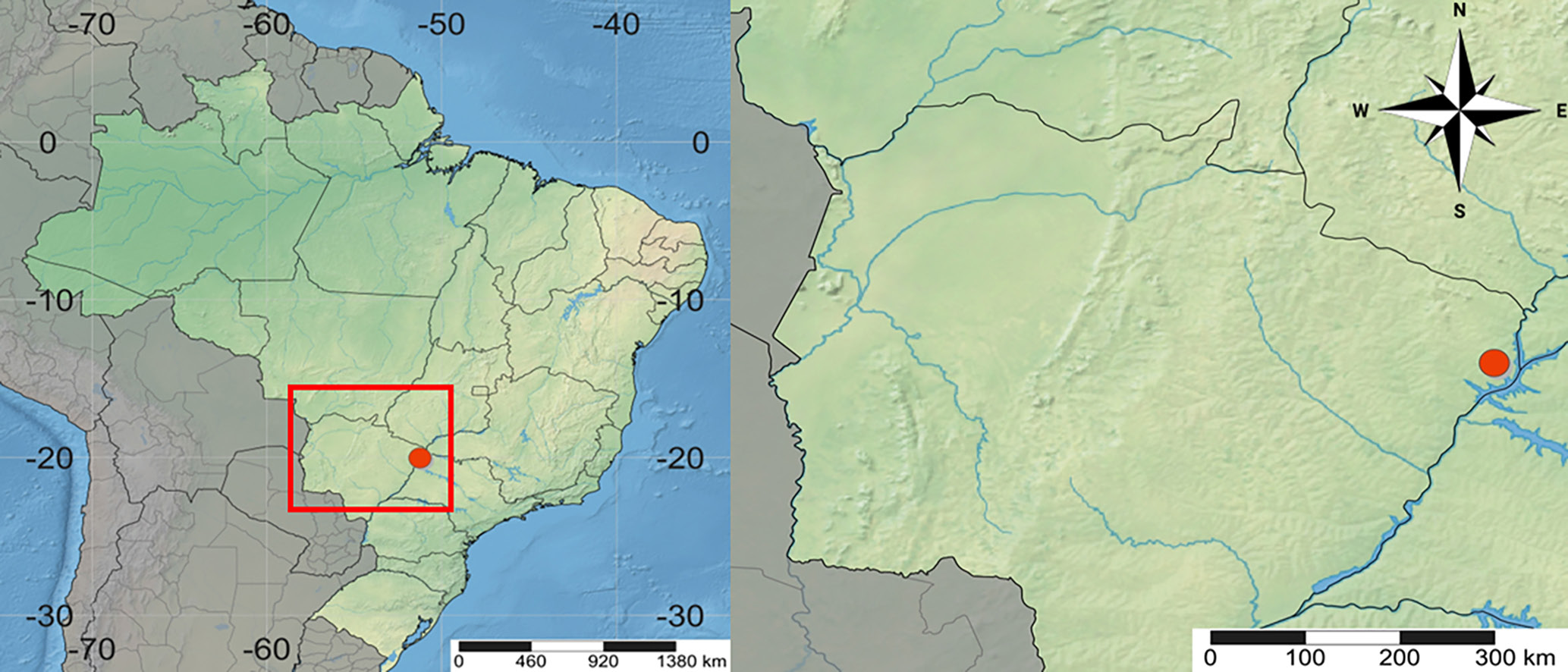
The study was conducted in a Cerrado remnant in the municipality of Aparecida do Taboado, Eastern Mato Grosso do Sul (20°02′06″S, 51°14′25″W; 318 m a.s.l.; Fig. 1). Ten native plant species were selected for sampling, namely Annona coriaceae Mart. (Annonaceae), Byrsonima intermedia A. Juss. (Malpighiaceae), Caryocar brasiliense Cambess. (Caryocaraceae), Handroanthus cf. chrysotrichus (Bignoniaceae), Mabea fistulifera Mart. (Euphorbiaceae), Matayba guianensis Aubl. (Sapindaceae), Myrsine coriacea (Sw.) R.Br. Ex Roem & Schult. (Primulaceae), Qualea grandiflora Mart. (Vochysiaceae), Xylopia aromatica (Lam.) Mart. (Annonaceae), and Anacardiaceae sp. Three individuals of each plant species were selected and marked for sampling mites. The selection considered different types of leaf architecture, such as the presence of trichomes, domatia, prominent veins, and extrafloral nectaries. The sampling effort was standardized into six levels, established based on the leaf dimensions (length and width) of each plant species. Plant species with larger leaf surface areas (Q. grandiflora and C. brasiliense) were represented by samples of 15 and 20 leaves, respectively. Species with intermediate leaf sizes were sampled with 25 (A. coriacea) to 30 leaves (H.cf.chrysotrichus). For hosts with narrow or small leaves, the sampling effort consisted of 40 leaves (Anacardiaceae sp., B. intermedia, M. fistulifera and X. aromatica), reaching 50 leaves for species with the smallest leaf area (M. guianensis and M. coriacea). Four samplings were performed over the course of a year, in November 2023, February 2024, May 2024, and August 2024.
Leaves or leaflets were collected using pruning shears and placed in paper bags, which were subsequently sealed inside polyethylene bags and stored in insulated polystyrene boxes with ice. The phytoseiid specimens were mounted on slides in Hoyer’s medium (Krantz & Walter, 2009) under a 40× stereomicroscope (Leica EZ4). Identification was performed based only on adults, under a phase-contrast optical microscope (Zeiss Axio Imager M3), using the bibliographies of Chant & McMurtry (2007), Lofego et al. (2024), and taxonomic description and revision works (Demite et al., 2016; Cavalcante et al., 2017; Sourassou et al., 2017; Ferragut & Navia, 2022, 2024).
We assembled a species versus host abundance matrix (edges weighted by counts; zeros omitted) and visualized it in RAWGraphs 2.0 (Bipartite Network). The layout used bipartite + d3-force; edge width ∝ weight, and node size ∝ degree (species) or total abundance (hosts). The map of the fragment’s location was created using SimpleMappr (Shorthouse, 2010). The voucher material is deposited in the mite collection of the Laboratório de Acarologia da UNESP, campus de São José do Rio Preto, São Paulo State, Brazil.
RESULTS
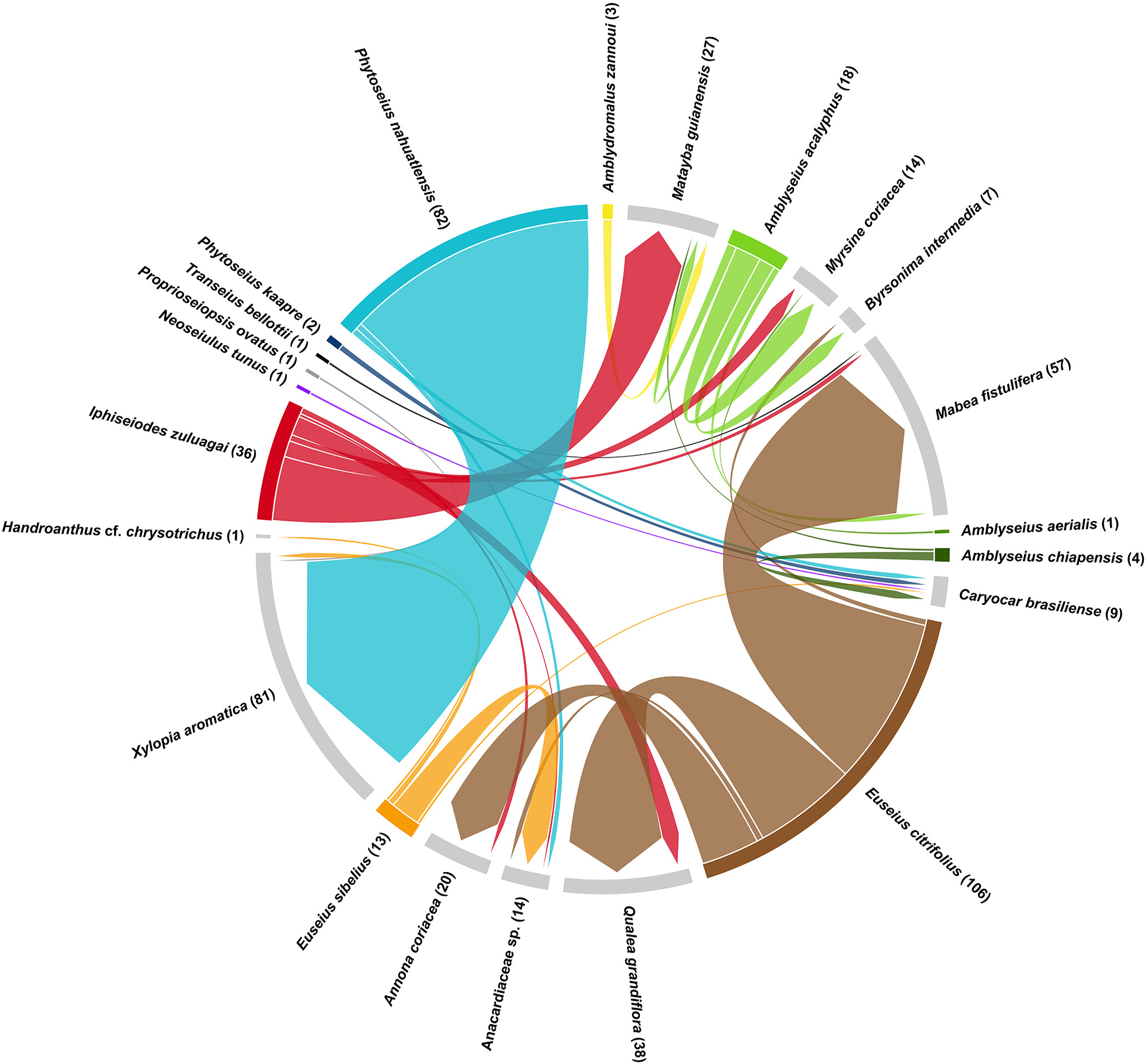
A total of 268 adult phytoseiids belonging to 12 species were recorded on the sampled plants (Table 1). The most abundant species in this study was Euseius citrifolius Denmark & Muma, with 106 specimens, followed by Phytoseius nahuatlensis De Leon (82) and Iphiseiodes zuluagai Denmark & Muma (36). Among the host plants, Xylopia aromatica (Lam.) Mart. (Annonaceae) and Mabea fistulifera Mart. (Euphorbiaceae) harbored the highest abundance of phytoseiids, with 81 and 57 specimens, respectively (Table 1, Fig. 2).
The bipartite network(Fig. 2) illustrates the associations between phytoseiid species and host plants. Phytoseius nahuatlensis showed a strong association with Xylopia aromatica, with approximately 95% of the specimens collected on this host. Iphiseiodes zuluagai was recorded on the largest number of host plants (six species), whereas E. citrifolius occurred on five plant species, being particularly abundant on M. fistulifera. Most specimens of I. zuluagai collected on Matayba guianensis were found inside leaf domatia.
In addition to the dominant species, other phytoseiids were recorded in lower abundances, including Amblydromalus zannoui Sourassou, Sarmento & Moraes, Amblyseius acalyphus Denmark & Muma, Amblyseius aerialis (Muma), Amblyseius chiapensis De Leon, Euseius sibelius (De Leon), Neoseiulus tunus (De Leon), Proprioseiopsis ovatus (Garman), Transeius bellottii (Moraes & Mesa), and Phytoseius kaapre Demite, Lofego & Feres. Two species, A. zannoui and P. kaapre, represent new records for the state of Mato Grosso do Sul.
DISCUSSION
The results of this study provide new insights into diversity and distribution of phytoseiid mites associated with native Cerrado vegetation In Mato Grosso do Sul. Rezende & Lofego (2011) reported four species from collections made in a Cerrado area in the state. Other surveys have been conducted in Pantanal areas (Mendonça et al., 2019) or in human-modified environments, such as roadsides and agricultural crops (Cardoso et al., 2010; Furtado et al., 2014; Barroso et al., 2019), highlighting the limited ecological understanding of phytoseiid communities in native Cerrado vegetation, particularly in Mato Grosso do Sul.
The occurrence of species with a wide distribution in other biomes, such as E. citrifolius, P. nahuatlensis, and I. zuluagai, suggests that part of the Cerrado phytoseiid fauna has a wide distribution but remains poorly documented in the state. In the Central-West region, the three most abundant species had already been mentioned in surveys in the Distrito Federal (Duarte et al., 2021; Rezende & Lofego, 2011), Goiás (Demite et al., 2017; Teixeira et al., 2017; Moraes et al., 2022; Rossetti et al., 2025), and Mato Grosso (Demite et al., 2009, 2021; Conceição et al., 2021). In Mato Grosso do Sul, however, only E. citrifolius had been recorded on native vegetation. Species such as Neoseiulus tunus and Proprioseiopsis ovatus were previously reported in the state’s Cerrado (Rezende & Lofego, 2011). Most previous records for Mato Grosso do Sul occurred in agricultural areas (Barroso et al., 2019), roadsides (Furtado et al., 2014), and Pantanal areas (Mendonça et al., 2019).
Host plants with the highest abundance of phytoseiids, especially M. fistulifera and X. aromatica, have already been identified as important sources of predators in other studies conducted in São Paulo (Daud & Feres, 2005; Demite et al., 2011; Nuvoloni et al., 2011). In the study by Daud & Feres (2005), which reported six Phytoseiidae species, E. citrifolius was the most abundant species associated with M. fistulifera. These authors correlated the abundance of this phytoseiid with the greater availability of pollen produced by the plant. In addition, Daud & Feres (2004) demonstrated that populations of E. citrifolius develop better when fed pollen of M. fistulifera than pollen from other plant species, reinforcing the importance of this host as a food resource for predatory mites. Euseius species are known as Type IV generalist predators, able to feed on pollen and nectar (McMurtry et al., 2013).
Bipartite network illustrating associations between Phytoseiidae species and host plants in Cerrado vegetation, Aparecida do Taboado, Mato Grosso do Sul, Brazil. Line thickness indicates relative abundance of mites.
Nuvoloni et al. (2011) surveyed the mite fauna associated with X. aromatica, reporting six Phytoseiidae species, with P. nahuatlensis (mainly), E. sibelius, and P. guianensis being the most abundant. Phytoseius nahuatlensis was also the most abundant species, with 95% of the specimens associated with this host. Xylopia aromatica has leaves with trichomes on their lower surface (Simioni et al., 2018), which may favor the occurrence of phytoseiids possessing a more suitable morphology, such as a narrower idiosoma and erect setae, characteristics of Phytoseius (Walter, 1992). Thus, leaf structures and alternative food sources, such as pollen and nectar, may foster specific associations.
This information reinforces the role of host plants in maintaining local diversity. Furthermore, the occurrence of I. zuluagai on six plant species and E. citrifolius on five species highlights their generalist habits and ecological potential as opportunistic predators in natural environments. Euseius citrifolius and I. zuluagai are species reported in all regions of Brazil, occurring in both natural and agricultural environments (Lofego et al., 2024; Demite et al., 2025).
Additionally, most specimens of I. zuluagai collected on M. guianensis were found inside leaf domatia. These structures are known to provide shelter and favorable microhabitats for predatory mites, protecting them from desiccation (Rowles & O’Dowd, 2009) and natural enemies (Faraji et al., 2002a,b; Ferreira et al., 2008). The presence of domatia has been associated with higher densities of phytoseiid mites on several plant species, as these structures may function as refuges and oviposition sites (e.g.,Walter & O’Dowd, 1992; Grostal & O’Dowd, 1994; Matos et al., 2006a,b). Experimental studies have also shown that domatia can increase the survivorship and oviposition of I. zuluagai, with females preferentially depositing eggs inside these structures (Matos et al., 2004). Thus, the occurrence of I. zuluagai inside domatia suggests that this plant trait may help maintain predatory mite populations in Cerrado vegetation.
The records obtained in this study expand the knowledge of the distribution of phytoseiid mites in the Cerrado biome and in the state of Mato Grosso do Sul. All species recorded here had previously been reported in association with native Cerrado plants (e.g.,Lofego et al., 2004; Demite et al., 2009, 2017, 2021; Rezende & Lofego, 2011; Teixeira et al., 2017; Sourassou et al., 2017; Conceição et al., 2021; Ferragut & Navia, 2022; Rossetti et al., 2025). However, Amblydromalus zannoui and Phytoseius kaapre are recorded for the first time in Mato Grosso do Sul. Amblydromalus zannoui has been previously reported in the states of Tocantins (Sourassou et al., 2017; Miranda et al., 2021) and Amazonas (Cruz et al., 2019), and P. kaapre in the states of Goiás (Rossetti et al., 2025), Mato Grosso (Conceição et al., 2021; Demite et al., 2021) and São Paulo (Demite et al., 2008, 2011; Lofego et al., 2017; Moraes et al., 2013).
Among the species previously known from the state, different patterns of occurrence across environments have been reported. Amblyseius acalyphus and A. aerialis had previously been recorded only from the Pantanal biome (Mendonça et al., 2019). Amblyseius chiapensis, E. sibelius, P. nahuatlensis, and T. bellottii were known only from the Pantanal (Mendonça et al., 2019) and roadside vegetation (Furtado et al., 2014). Euseius citrifolius and P. ovatus have been reported in a wider range of environments, including the Cerrado (Rezende & Lofego, 2011) and Pantanal (Mendonça et al., 2019) biomes, as well as agroecosystems (Cardoso et al., 2010; Barroso et al., 2019) and roadside plants (Furtado et al., 2014). Iphiseiodes zuluagai had previously been recorded from the Pantanal (Mendonça et al., 2019), agroecosystems (Barroso et al., 2019), and roadside vegetation (Furtado et al., 2014), whereas Neoseiulus tunus had only been reported from the Cerrado in Mato Grosso do Sul (Rezende & Lofego, 2011).
The observed patterns reinforce the importance of Cerrado fragments as reservoirs of natural enemies, capable of maintaining stable populations and acting as sources for adjacent cultivated areas. These environments contribute to the conservation of functional biodiversity and may favor biological control through ecosystem services provided by predatory mites.
In conclusion, this study advances the knowledge of Phytoseiidae diversity in the Cerrado of Mato Grosso do Sul, recording twelve species, including two new occurrences for the state. Native vegetation, particularly hosts such as M. fistulifera and X. aromatica, supports abundant and diverse mite populations, likely driven by leaf structural traits and the availability of alternative food resources such as pollen and nectar. These findings highlight the ecological value of Cerrado remnants as reservoirs of predatory mites that can naturally regulate pest populations in surrounding crops, reinforcing the importance of conserving native vegetation for biodiversity maintenance and ecosystem services related to biological control.
Acknowledgments:
We thank Fabio D.B. Evangelista, Manoel A.M. Neto, Shaysa da C. Bezerra, Mayane Ferreira and Fernando Machado (Escola Estadual Ernesto Rodrigues, Aparecida do Taboado, Mato Grosso do Sul) for their assistance with the collections carried out in the fragment.
Data Availability:
The authors confirm that the data supporting the findings of this study are available within the article.
REFERENCES
- Altieri, M.A. 1994. Biodiversity and pest management in agroecosystems New York, Haworth Press.
-
Barroso, G.; Rocha, C.M. da, Moreira, G.F.; Hata, F.T.; Roggia, S.; Ventura, M.U.; Pasini, A.; Silva, J.E.P. da, Holtz, A.M. & Moraes, G.J. de. 2019. What is the southern limit of the distribution of red palm mite, Raoiella indica (Acari: Tenuipalpidae), in agricultural lands in Brazil? Florida Entomologist, 102(3): 581-585. https://doi.org/10.1653/024.102.0334.
» https://doi.org/10.1653/024.102.0334 -
Cardoso, M.S.M.; Vieira, M.R.; Figueira, J.C. & Silva, H.A.S. 2010. Atividade predatória de Euseius citrifolius Denmark & Muma (Acari: Phytoseiidae) sobre Tenuipalpus heveae Baker (Acari: Tenuipalpidae). Arquivos do Instituto Biológico, 77(3): 471-476. https://doi.org/10.1590/1808-1657v77p4712010.
» https://doi.org/10.1590/1808-1657v77p4712010 -
Cavalcante, A.C.C.; Demite, P.R.; Amaral, F.S.R.; Lofego, A.C. & Moraes, G.J. de. 2017. Complementary description of Neoseiulus tunus (De Leon) (Acari: Mesostigmata: Phytoseiidae) and observation on its reproductive strategy. Acarologia, 57(3): 591-599. https://doi.org/10.24349/acarologia/20174178.
» https://doi.org/10.24349/acarologia/20174178 - Chant, D.A. & McMurtry, J.A. 2007. Illustrated keys and diagnoses for the genera and subgenera of the Phytoseiidae of the world (Acari: Mesostigmata) West Bloomfield, Indira Publishing House.
-
Conceição, E.M.; Demite, P.R.; Rezende, J.M.; Carniello, M.A. & Lofego, A.C. 2021. Phytoseiidae (Acar: Parasitiformes: Mesostigmata) inhabiting native plants from three biomes in Mato Grosso State, Brazil, with description of a new species. Systematic & Applied Acarology, 26(12): 2268-2286. https://doi.org/10.11158/saa.26.12.6.
» https://doi.org/10.11158/saa.26.12.6 -
Cruz, W.P. da, Krug, C.; Vasconcelos, G.J.N. de & Moraes, G.J. de. 2019. Mite (Arachnida: Acari) diversity and abundance on oil palms in the central region of the Brazilian Amazonia. Systematic & Applied Acarology, 24(9): 1736-1750. https://doi.org/10.11158/saa.24.9.10.
» https://doi.org/10.11158/saa.24.9.10 -
Daud, R.D. & Feres, R.J.F. 2004. O valor de Mabea fistulifera Mart. (Euphorbiaceae), planta nativa do Brasil, como reservatório para o predador Euseius citrifolius Denmark & Muma (Acari, Phytoseiidae). Revista Brasileira de Zoologia, 21(3): 453-458. https://doi.org/10.1590/S0101-81752004000300006.
» https://doi.org/10.1590/S0101-81752004000300006 -
Daud, R.D. & Feres, R.J.F. 2005. Diversidade e flutuação populacional de ácaros (Acari) em Mabea fistulifera Mart. (Euphorbiaceae) de dois fragmentos de Mata Estacional Semidecídua em São José do Rio Preto, SP. Neotropical Entomology, 34(2): 191-201. https://doi.org/10.1590/S1519-566X2005000200007.
» https://doi.org/10.1590/S1519-566X2005000200007 -
Demite, P.R.; Cavalcante, A.C.; Dias, M.A. & Lofego, A.C. 2016. A new species and redescription of two species of Euseius Wainstein (Acari: Phytoseiidae) from Cerrado biome areas in Brazil. International Journal of Acarology, 42: 334-340. https://doi.org/10.1080/01647954.2016.1197311.
» https://doi.org/10.1080/01647954.2016.1197311 -
Demite, P.R.; Dias, M.A.; Cavalcante, A.C.C.; Ramos, M.V.V. & Lofego, A.C. 2017. Phytoseiid mites (Acari: Mesostigmata: Phytoseiidae) associated with Cerrado biome plants in Brazil, with description of a new species. Systematic & Applied Acarology, 22(12): 2141-2177. https://doi.org/10.11158/saa.22.12.9.
» https://doi.org/10.11158/saa.22.12.9 -
Demite, P.R.; Feres, R.J.F.; Lofego, A.C. & Oliveira, A.R. 2009. Plant inhabiting mites (Acari) from the Cerrado biome of Mato Grosso State, Brazil. Zootaxa, 2061: 45-60. https://doi.org/10.11646/zootaxa.2061.1.3.
» https://doi.org/10.11646/zootaxa.2061.1.3 -
Demite, P.R.; Lofego, A.C. & Feres, R.J.F. 2008. Three new species of Phytoseius Ribaga (Acari: Phytoseiidae), and a new record from Brazil. Zootaxa, 1909: 16-26. https://doi.org/10.11646/zootaxa.1909.1.2.
» https://doi.org/10.11646/zootaxa.1909.1.2 -
Demite, P.R.; Lofego, A.C. & Feres, R.J.F. 2011. Phytoseiidae (Acari) in forest fragments in the State of São Paulo, Brazil. Zootaxa, 3086(1): 31-56. https://doi.org/10.11646/zootaxa.3086.1.2.
» https://doi.org/10.11646/zootaxa.3086.1.2 -
Demite, P.R.; Moraes, G.J. de, McMurtry, J.A.; Denmark, H.A. & Castilho, R. de C. 2025. Phytoseiidae Database Available: Available: http://www.lea.esalq.usp.br/phytoseiidae Access: 15/10/2025.
» http://www.lea.esalq.usp.br/phytoseiidae -
Demite, P.R.; Rezende, J.M.; Lofego, A.C.; Amaral, F.S.R.; Barreto, M.R. & Moraes, G.J. de. 2021. Phytoseiid mites (Acari: Mesostigmata: Phytoseiidae) from Mato Grosso State, Central Western Brazil. Anais da Academia Brasileira de Ciências, 93(suppl. 3): 1-10, e20200729. https://doi.org/10.1590/0001-3765202120200729.
» https://doi.org/10.1590/0001-3765202120200729 -
Duarte, M.E.; Demite, P.R.; Mendonça, R.S. de, Michereff-Filho, M.; Alves, M.L.S.C. de M.; Peixoto, R.P. & Navia, D. 2021. Phytoseiidae mites associated with native and cultivated solanaceous in Central-West Brazil. Systematic & Applied Acarology, 26(12): 2358-2384. https://doi.org/10.11158/saa.26.12.13.
» https://doi.org/10.11158/saa.26.12.13 -
Faraji, F.; Janssen, A. & Sabelis, M. 2002a. Oviposition patterns in a predatory mite reduce the risk of egg predation caused by prey. Ecological Entomology, 27(6): 660-664. https://doi.org/10.1046/j.1365-2311.2002.00456.x.
» https://doi.org/10.1046/j.1365-2311.2002.00456.x -
Faraji, F.; Janssen, A. & Sabelis, M.W. 2002b. The benefits of clustering eggs: the role of egg predation and larval cannibalism in a predatory mite. Oecologia, 131: 20-26. https://doi.org/10.1007/s00442-001-0846-8.
» https://doi.org/10.1007/s00442-001-0846-8 -
Ferragut, F. & Navia, D. 2022. The genus Neoseiulus Hughes (Mesostigmata: Phytoseiidae) in the Espinhaço Range, a great reservoir of biodiversity. Zootaxa, 5120(4): 523-542. https://doi.org/10.11646/zootaxa.5120.4.4.
» https://doi.org/10.11646/zootaxa.5120.4.4 -
Ferragut, F. & Navia, D. 2024. Phytoseius Ribaga (Mesostigmata: Phytoseiidae) in the Brazilian Espinhaço Range: seven new species, renaming of the plumifer species group, and a critical review of its taxonomic characters. Zootaxa, 5493(3): 201-245. https://doi.org/10.11646/zootaxa.5493.3.1.
» https://doi.org/10.11646/zootaxa.5493.3.1 -
Ferreira, J.A.M.; Eshuis, B.; Jansen, A. & Sabelis, M.W. 2008. Domatia reduce larval cannibalism in predatory mites. Ecological Entomology, 33(3): 374-379. https://doi.org/10.1111/j.1365-2311.2007.00970.x.
» https://doi.org/10.1111/j.1365-2311.2007.00970.x -
Furtado, I.P.; Moraes, G.J. de, Kreiter, S.; Flechtmann, C.H.W.; Tixier, M.-S. & Knapp, M. 2014. Plant inhabiting phytoseiid predators of Midwestern Brazil, with emphasis on those associated with the tomato red spider mite, Tetranychus evansi (Acari: Phytoseiidae, Tetranychidae). Acarologia, 54(4): 425-431. https://doi.org/10.1051/acarologia/20142138.
» https://doi.org/10.1051/acarologia/20142138 -
Gerson, U.; Smiley, R.L. & Ochoa, R. 2003. Mites (Acari) for Pest Control Oxford, Blackwell Publishing Ltd. https://doi.org/10.1002/9780470750995.
» https://doi.org/10.1002/9780470750995 -
Grostal, P. & O’Dowd, D.J. 1994. Plants, mites and mutualism: leaf domatia and the abundance and reproduction of mites on Viburnum tinus (Caprifoliaceae). Oecologia, 97: 308-315. https://doi.org/10.1007/BF00317319.
» https://doi.org/10.1007/BF00317319 -
Jacinavicius, F.C.; Valim, M.P.; Bernardi, L.F.O.; Almeida, J.C.; Andrade, G.R.; Araújo, M.S.; Barbosa, M.F.C.; Barreto, C.; Barros, Á.R.A.; Bassini-Silva, R.; Barros-Battesti, D.M.; Bizarro, G.L.; Castilho, R.C.; Castro, E.B.; Castro, L.A.S.; Demite, P.R.; Duarte, M.E.; Ferla, N.J.; Flechtmann, C.H.W.; Franklin, E.; Gettinger, D.; Haitlinger, R.; Hernandes, F.A.; Johann, L.; Kaszewska, K.; Labruna, M.B.; Lofego, A.C.; Marciniak, N.; Martin J.P.I.; Martins, T.F.; Mascarenhas, C.S.; Matioli, A.L.; Moraes, G.J.; Muñoz-Leal, S.A.; Narita, J.P.; Navia, D.; Ochoa, R.; Proctor, H.C.; Rueda-Ramírez, D.; Rezende, J.M.; Rocha, M.S.; Santos, J.C.; Silva, D.E.; Silva, G.L.; Silva, R.A.; Silva, V.B.; Skoracki, M.; Tassi, A.D.; Vázquez-Gonzalez, M.M. & Welbourn, C. 2025. Taxonomic catalog of the Brazilian fauna: the Brazilian acarofauna (Holothyrida, Ixodida, Mesostigmata, Opilioacarida, Sarcoptiformes and Trombidiformes. Zoologia, 42 (Special issue): 1-49, e24081. https://doi.org/10.1590/S1984-4689.v42.e24081.
» https://doi.org/10.1590/S1984-4689.v42.e24081 - Krantz, G.W. & Walter, D.E. 2009. A Manual of Acarology 3. ed. Lubbock, Texas Tech University Press.
-
Lofego, A.C.; Barbosa, M.F. de C.; Demite, P.R. & Moraes, G.J. de. 2024. Phytoseiidae (Acari: Mesostigmata) of the subfamily Amblyseiinae from Brazil. Zootaxa, 5439(1): 1-306. https://doi.org/10.11646/zootaxa.5439.1.1.
» https://doi.org/10.11646/zootaxa.5439.1.1 -
Lofego, A.C.; Moraes, G.J. de & Castro, L.A.S. 2004. Phytoseiid mites (Acari: Phytoseiidae) on Myrtaceae in the state of São Paulo, Brazil. Zootaxa, 516(1): 1-18. https://doi.org/10.11646/zootaxa.516.1.1.
» https://doi.org/10.11646/zootaxa.516.1.1 -
Lofego, A.C.; Rezende, J.M.; Demite, P.R. & Feres, R.J.F. 2017. Mite fauna associated with Cecropia pachystachya Trec. (Urticaceae) - the importance of the plant as reservoir and dissemination means for predatory mites. Systematic & Applied Acarology, 22(10): 1780-1794. https://doi.org/10.11158/saa.22.10.16.
» https://doi.org/10.11158/saa.22.10.16 -
Matos, C.H.C.; Pallini, A.; Chaves, F.F. & Galbiati, C. 2004. Domácias do cafeeiro beneficiam o ácaro predador Iphiseiodes zuluagai Denmark & Muma (Acari: Phytoseiidae)? Neotropical Entomology, 33(1): 57-63. https://doi.org/10.1590/S1519-566X2004000100011.
» https://doi.org/10.1590/S1519-566X2004000100011 -
Matos, C.H.C.; Pallini, A.; Bellini, L.L. & Freitas, R.C.P. de. 2006a. Domáceas e seu papel na defesa das plantas. Ciência Rural, 36(3): 1021-1026. https://doi.org/10.1590/S0103-84782006000300050.
» https://doi.org/10.1590/S0103-84782006000300050 -
Matos, C.H.C.; Pallini, A.; Chaves, F.F.; Schroereder, J.H. & Janssen, A. 2006b. Do domatia mediate mutualistic interactions between coffee plants and predatory mites? Entomologia Experimentalis et Applicata, 118(3): 185-192. https://doi.org/10.1111/j.1570-7458.2006.00381.x.
» https://doi.org/10.1111/j.1570-7458.2006.00381.x -
May, R.M. 1988. How many species are there on Earth? Science, 241(4872): 1441-1449. https://doi.org/10.1126/science.241.4872.1441.
» https://doi.org/10.1126/science.241.4872.1441 -
McMurtry, J.A.; Famah Sourassou, N. & Demite, P.R. 2015. The Phytoseiidae (Acari: Mesostigmata) as biological control agents. In: Carrilo, D.; Moraes, G.J. de & Peña, J.E. (Eds.). Prospects for biological control of plant feeding mites and other harmful organisms Cham, Springer. p. 133-149. https://doi.org/10.1007/978-3-319-15042-0_5.
» https://doi.org/10.1007/978-3-319-15042-0_5 -
McMurtry, J.A.; Moraes, G.J. de & Famah Sourassou, N. 2013. Revision of the lifestyles of phytoseiid mites (Acari: Phytoseiidae) and implications for biological control strategies. Systematic & Applied Acarology, 18(4): 297-320. https://doi.org/10.11158/saa.18.4.1.
» https://doi.org/10.11158/saa.18.4.1 -
Mendonça, A.L.; Lofego, A.C.; Pott, A.; Daud, R.D. & Demite, P.R. 2019. Phytoseiidae (Parasitiformes: Mesostigmata) from the Pantanal, Mato Grosso do Sul State, Brazil. Systematic & Applied Acarology, 24(4): 587-612. https://doi.org/10.11158/saa.24.4.6.
» https://doi.org/10.11158/saa.24.4.6 -
Miranda, V.C.; Azevedo, E.B. de, Cruz, W.P. da, Jorge, S.J.; Pedro-Neto, M.; Castilho, R. de C.; Tixier, M.-S.; Moraes, G.J. de & Sarmento, R.A. 2021. Potential of the predatory mite Amblydromalus zannoui to control pest mites on Jatropha curcas Biocontrol, 66: 487-493. https://doi.org/10.1007/s10526-021-10080-z.
» https://doi.org/10.1007/s10526-021-10080-z -
Moraes, G.J. de, Barbosa, M.F. de C. & Castro, T.M.M.G. de. 2013. Phytoseiidae (Acari: Mesostigmata) from natural ecosystems in the state of São Paulo, Brazil. Zootaxa, 3700(3): 301-347. https://doi.org/10.11646/zootaxa.3700.3.1.
» https://doi.org/10.11646/zootaxa.3700.3.1 -
Moraes, V. de S.; Nunes, S.N.; Demite, P.R. & Daud, R.D. 2022. Vegetation structure define mite assemblage on plants: a case study in Cerrado biome. Entomological Communications, 4: 1-4, ec04029. https://doi.org/10.37486/2675-1305.ec04029.
» https://doi.org/10.37486/2675-1305.ec04029 -
Nuvoloni, F.M.; Feres, R.J.F. & Demite, P.R. 2011. Mites associated to Xylopia aromática (Lam.) Mart. (Annonaceae) in urban and rural fragments of semidecidual forest. Revista Brasileira de Entomologia, 55(4): 571-577. https://doi.org/10.1590/S0085-56262011000400013.
» https://doi.org/10.1590/S0085-56262011000400013 -
Rezende, J.M. & Lofego, A.C. 2011. Phytoseiidae (Acari: Mesostigmata) on plants of the central region of the Brazilian Cerrado. Acarologia, 51(4): 449-463. https://doi.org/10.1051/acarologia/20112027.
» https://doi.org/10.1051/acarologia/20112027 -
Rossetti, O.C.; Barroso, G .; Demite, P.R.; Lima, E.L. de & Daud, R.D. 2025. Phytoseiidae mite (Parasitiformes: Phytoseiidae) assemblages from different Cerrado vegetation types. Acarologia, 65(2): 505-518. https://doi.org/10.24349/3rdh-xfoj.
» https://doi.org/10.24349/3rdh-xfoj -
Rowles, A.D. & O’Dowd, D.J. 2009. Leaf domatia and protection of a predatory mite Typhlodromus doreenae Schicha (Acari: Phytoseiidae) from drying humidity. Australian Journal of Entomology, 48: 276-281. https://doi.org/10.1111/j.1440-6055.2009.00716.x.
» https://doi.org/10.1111/j.1440-6055.2009.00716.x -
Shorthouse, D.P. 2010. SimpleMappr, an online tool to produce publication-quality point maps Available: Available: https://www.simplemappr.net Access: 20/10/2025.
» https://www.simplemappr.net -
Simioni, P.F.; Pessoa, M.J.G.; Cardoso, M.A.; Cabral, F.F. Teixeira, S.O. & Silva, I.V. 2018. Leaf anatomy of Xylopia aromatica (Lam.) Mart. (Annonaceae) occurring in a rocky savannah in the Brazilian Amazonian. Acta Scientiarum, 40: 1-7, e37334. https://doi.org/10.4025/actascibiolsci.v40i1.37334.
» https://doi.org/10.4025/actascibiolsci.v40i1.37334 -
Sourassou, N.F.; Sarmento, R.A. & Moraes, G.J. de. 2017. Description of a new species of the Amblydromalus limonicus (Acari: Phytoseiidae) species group based on morphological and molecular evidences. International Journal of Acarology, 43(5): 374-379. https://doi.org/10.1080/01647954.2017.1317021.
» https://doi.org/10.1080/01647954.2017.1317021 -
Teixeira, J.V.; Ribeiro, R.N. & Daud, R.D. 2017. Mites on Curatella americana L. (Dilleniaceae) from Cerrado vegetation remnants in mining site vicinities. International Journal of Acarology, 43(4): 302-307. https://doi.org/10.1080/01647954.2017.1284899.
» https://doi.org/10.1080/01647954.2017.1284899 -
Walter, D.E. 1992. Leaf surface structure and the distribution of Phytoseius mites (Acarina: Phytoseiidae) in South-eastern Australian forest. Australian Journal of Zoology, 40(6): 593-603. https://doi.org/10.24349/3rdh-xfoj.
» https://doi.org/10.24349/3rdh-xfoj -
Walter, D.E. & O’Dowd, D.J. 1992. Leaves with domatia have more mites. Ecology, 73(4): 1514-1518. https://doi.org/10.2307/1940694.
» https://doi.org/10.2307/1940694 -
Walter, D.E. & Proctor, H.C. 2013. Mites and biological diversity. In: Walter, D.E. & Proctor, H.C. (Eds.). Mites: ecology, evolution & behaviour Dordrecht, Springer. p. 447-459. https://doi.org/10.1007/978-94-007-7164-2_11.
» https://doi.org/10.1007/978-94-007-7164-2_11
-
Funding:
This work was supported by the Foundation for the Support of Teaching, Science, and Technology Development of the State of Mato Grosso do Sul (Fundação de Apoio ao Desenvolvimento do Ensino, Ciência e Tecnologia do Estado de Mato Grosso do Sul - FUNDECT) (Proc. № 83/045.355/2023).
-
Published with the financial support of the “Programa de Apoio às Publicações Científicas Periódicas da Universidade de São Paulo”.
-
Ethics Statement:
Voucher specimens of the species reported in this study are deposited in public biological collection.
-
AI Use:
No AI tools were used in this manuscript.
Edited by
-
Edited by:
Carlos José Einicker Lamas