 Epidemiological Survey of Oral and Maxillofacial Lesion Patients Diagnosed in a Hospital Service of Anatomopathology
ABSTRACT
Objective: To carry out an epidemiological survey of oral and maxillofacial lesions at the Integrated Center for Pathological Anatomy of the Oswaldo Cruz University Hospital, Brazil.
Material and Methods: Between the years 2013 and 2023, the histopathological reports and clinical forwarding sheets were analyzed. Among the 909 units obtained, 118 patients were excluded because they had lesions on their skin or had inconclusive histopathological diagnoses. The data were presented using descriptive statistics.
Results: 791 different reports and 88 different histopathological variants were obtained. The distribution by race or skin color showed that most patients were non-black (33.1%). The most prevalent sex was female (51.9%), and the mean age was 42 years (1 to 100). Most biopsies were excisional (68.5%), of a benign nature (87.1%), and located in the jaws (51.6%). The group of epithelial pathologies (18.8%), odontogenic cysts (17%), and bone pathology (14%) were the most common ones. Regarding diagnoses, oral squamous cell carcinoma (8.98%) was the most frequently reported, followed by fibrous hyperplasia (8.09%) and ameloblastoma (7.33%).
Conclusion: The profile of patients with oral and maxillofacial lesions assisted at the service corresponds to individuals who need high-complexity medical and dental treatment.
Keywords:
Biopsy; Epidemiology; Health Services Accessibility; Pathology; Oral.
Introduction
Epidemiological studies are one of the primary resources for observing and estimating the needs for implantation and maintenance of oral health services for a given population [1]. Most oral health studies are based solely on clinical data, which, although important, do not reveal the true pathological nature of the lesion. However, identifying the frequency of anatomopathological diagnoses of oral and maxillofacial lesions is fundamental for establishing the diagnosis and treatment of the patient [2].
In addition to their clinical importance, demographic and histopathological data are essential for planning and executing public health programs [3]. Although the literature is vast in relation to the prevalence of oral lesions from the histopathological diagnosis, most studies have limitations. For example, only addressing the classification and location of pathologies [4], specific age groups [5,6], and specific population groups [7].
Furthermore, studies that document the frequency of histologically confirmed lesions without restricting groups lack methodological uniformity, especially regarding the classification of lesions. Consequently, the comparison between works becomes difficult and promotes inconsistent interpretations [8]. Another aspect to be considered is the location of the histopathological analysis center, as there is a difference in the service profile between the pathology laboratory located in a hospital environment and dental centers [9].
Therefore, the objective of this work was to carry out an epidemiological survey including demographic and histopathological data of all oral and maxillofacial lesions diagnosed at the Centro Integrado de Anatomia Patológica (CIAP) located at the Oswaldo Cruz University Hospital (HUOC) of the University of Pernambuco (UPE), Brazil.
Material and Methods
Study Design and Ethical Clearance
This is a retrospective study with secondary data obtained from the survey of the anatomopathological reports of the oral and maxillofacial region and the biopsy forwarding sheets. The study was approved by the HUOC institutional ethics committee (Protocol number: 4.962.573) and complied with the Declaration of Helsinki.
Data Collection
The pieces of information were collected at CIAP/HUOC/UPE from January 2013 to December 2023. It is worth mentioning that most of the reports generated are derived from specimens obtained by surgical procedures performed in the hospital unit. Among the study inclusion criteria, some samples had histopathological diagnostic information. Skin lesions and inconclusive anatomopathological diagnoses were excluded from the present research.
General information such as race/skin color (black and non-black), gender (female and male), and age group (in years) was also collected from the clinical sheets. The item "race/skin color" was categorized into black (black and brown) and non-black (white, indigenous, and yellow), according to the criteria of the Brazilian Institute of Geography and Statistics (IBGE) for racial aggregation [10].
In addition, data were obtained in relation to the lesions, such as: type of biopsy (incisional or excisional), nature of the lesions (benign/ malignant/ unreported), anatomical location (jaws/soft tissues of the oral cavity/salivary glands/oropharynx/unreported) and detailed anatomical location (maxilla/mandible/tongue/lip/buccal mucosa/mouth floor/palate/oropharynx/alveolar ridge/gums/retromolar trigone/major and minor salivary glands/maxillary sinus/unreported). Lesions were organized into groups, and frequencies were calculated.
Data Analysis
SPSS 13.0 software (Statistical Package for the Social Sciences, IBM Corp., Armonk, NY, USA) for Windows was used. The data were presented using descriptive statistics.
Results
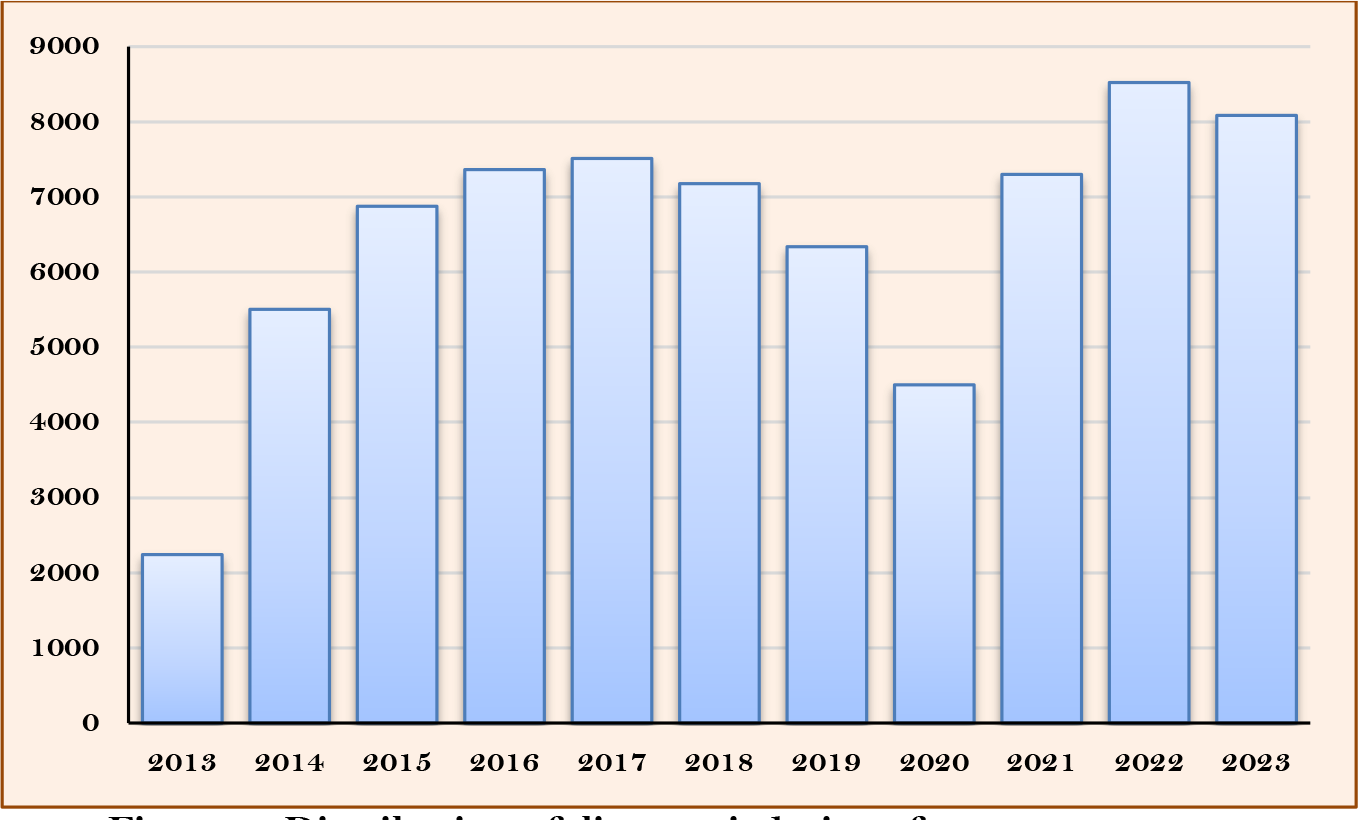
A total of 71.421 reports were issued, distributed linearly between 2015 and 2019. The year 2013 represents the lowest number of diagnoses in the entire collection period. In 2020, there was a decrease in quantity. From 2021 onwards, activity like that described between 2015 and 2019 is observed. From 2021 onwards, there was a growing increase in cases, with the peak in reports occurring in 2022 (Figure 1). Lesions in the oral and maxillofacial region represent 791 reports (1.3%). From these, 118 patients were removed from the investigation because of skin lesions and inconclusive histopathological diagnosis. Thus, a total sample of 791 reports (0.11%) and 88 different histopathological variants were obtained.

Regarding race or skin color, most patients were non-black (black 26.2% and non-black 33.1%). A slight majority of the sample was female (53.9%), and they were between 1 and 100 years old, with a mean age of 42 years (Table 1).
Regarding the type of biopsy used, a large part of the sample was submitted to an excisional biopsy (68.5%). Regarding the nature of the lesions, there was a predominance of benign lesions (87.1%). Table 2 shows the anatomical locations of the lesions, which were grouped into jaws (mandible and maxilla), soft tissues of the oral cavity (tongue, hard and soft palate, buccal mucosa, gum, alveolar ridge, retromolar trigone, mouth floor, and lip), salivary glands (major and minor), and oropharynx. The jaws were the most prevalent locations (51.6%), and the mandible was the most affected site (30.2%), followed by the maxilla (15.3%).
Regarding the group of lesions, epithelial pathologies (18.8%) were the most frequent ones (Table 2), primarily oral squamous cell carcinoma (OSCC) (8.98%). Odontogenic cysts (17%) represent the second most prevalent group of lesions, with the most predominant lesions corresponding to dentigerous cysts (6.45%), radicular cysts (5.31%), and odontogenic keratocysts (4.93%). Bone pathology lesions were the third most frequent group of lesions (14%) (Table 2), with fibro-osseous dysplasia being the most common lesion in this group (2.28%) (Table 3).
Discussion
Between January 2013 and December 2023 (11 years), a total of 71.421 histopathological reports were issued by CIAP, distributed linearly between 2015 and 2019. The low number of histopathological reports issued in 2013 was likely due to a change in the storage system at the service, resulting in information losses in that year and partially in 2014.
In 2020, there was a decrease in the number of reports. This period coincides with the beginning of the COVID-19 pandemic, which promoted social distancing, mainly by individuals with chronic health problems and the older population. There was also a reduction in demand for outpatient and hospital care, for fear of contamination by the virus. In addition, the health units directed the services provided to patients suspected or diagnosed with the disease. All these aspects made it difficult for the population to use health services [11].
Most studies analyzing the prevalence of oral lesions based on histopathological diagnosis focus on specific types of pathologies or are divided by age group or other population subgroups [4-7]. This study included all histopathological reports, without restriction by specific groups (sex, age, or origin of the pathology), over 11 years. During this period, lesions in the oral and maxillofacial region corresponded to 791 reports (1.3%) of the total sample and were classified into 88 different histopathological variants.
In this research, the number of diagnosed oral and maxillofacial lesions was relatively minor in relation to what was recorded in other epidemiological surveys. In the study carried out by Kelloway et al. [12] in the department of Oral Pathology at the University of Queensland (Australia), an average of 1.746 reports were issued in 10 years. The institution received material from outpatient clinics conducted by generalist dentists, specialists, and physicians, as it was the only local service where there were oral pathologists. In addition, there was adequate data collection through electronic medical records. Mendez et al. [13] carried out a study at the Faculty of Dentistry of the Federal University of Rio Grande do Sul (Brazil), showing 6.831 cases in 10 years. The oral pathology service receives specimens from private and public dental clinics. Additionally, the laboratory obtains samples collected for research purposes from experimental studies.
A probable justification for the fact is that the sector in which our study was carried out represents a medical pathology center, and only as of 2019 was there the inclusion of an oral pathologist. Consequently, there has been an increasing number of oral and maxillofacial diagnoses since that date. Another reason for the smaller number of cases in our study is the location of the service within a hospital unit, which issues histopathological reports exclusively from biopsies performed in the unit. It is noted that as of 2021, cases of oral pathology have increased significantly. A possible explanation for this is that the dental school clinics at the UPE were not fully operational. Therefore, patients who needed care were referred to the HUOC/UPE hospital service.
The study by Guedes et al. [14] was performed at the Department of Oral Pathology of Hospital Santo Antônio (Portugal), and it obtained 1.042 specimens in seven years. Yakin et al. [15] compiled the reports of biopsies performed at the Department of Histopathology at the University Hospital of Rizgary (Iraq), resulting in 616 specimens in five years. Although both services are located in hospital units, it can be seen that they receive external specimens and are almost exclusive centers of reference for oral and maxillofacial alterations.
Regarding the age group of patients, there was a variation between 1 and 100 years, with an average age of 42 years. In other studies, the concentration of adult patients between the second and fourth decades of life is noted. Nascimento et al. [8] and Joseph et al. [2] conducted their epidemiological studies in oral pathology laboratories located in university centers and showed an average age of 35.8 and 37.8 years, respectively.
Guedes et al. [14], Yakin et al. [15], and Monteiro et al. [16] carried out their respective research in a hospital environment, obtaining an average age of the sample in the proper order of 47.8, 51.7, and patients in the second to fourth decade of life. Thus, it is concluded that regardless of the location of the pathology center, most of the sample is composed of adults. A possible justification for this is the relationship between economically active individuals and access to health services.
As for race/skin color, in the Brazilian population, black individuals represent about 67% of the total public served by the public health service. In addition, most care within the Sistema Único de Saúde (SUS) is provided to users with low income. Thus, the black and economically disadvantaged population is the main public dependent on the SUS [10]. However, in the present study, the number of black participants was lower than that of non-black participants. This result is not consistent with the reality of the service's patient profile and was possibly the result of the high number of medical records that did not include race/skin color. Perhaps the large number of uninformed people contributed to this.
The incorrect filling of medical records generates data losses in epidemiological surveys. In the study by Kelloway et al. [12], the collection of 10.130 cases was done through electronic medical records. Even with the computerization of the data and being a reference center for oral and maxillofacial pathology, 2.058 (20.3%) medical records had a definitive or ambiguous diagnosis, beyond incomplete data regarding age, sex, or race/skin color.
In Mendez et al. [13], information was also collected through the service's electronic database. The topics age (92.5%), sex (99.5%), and race/skin color (90%) were described in most of the sample. However, data loss occurred for other reasons, such as materials received for research purposes (688 - 8.42%) and reports in which the tissue amount was inadequate for diagnosis (649 - 7.95%). There is little attention given by professionals to the act of filling out the medical records, even though data extraction has become digital. In our study, data collection was performed from both physical and electronic records, which led to data loss due to improper filling and storage.
This study recorded a slight female predilection for injuries with 51.3% of cases, similar to Ali and Sundaram [17] (51.4%), Moridani et al. [18] (53.3%), and Takashima and Etges [19] (59%). In contrast, Chidzonga [20] reported a higher male predilection of 54.5% in their study. This finding may be associated with a higher demand for healthcare services among women. However, it is not possible to conclude that females are actually more affected by oral and maxillofacial lesions. Although most of the literature indicates that females constitute the majority of the sample in epidemiological studies on oral cavity lesions, when analyzing the relationship between gender and the nature of the lesions, it is observed that malignant lesions are more frequent in men than in women. These findings corroborate data from Brazil and worldwide [10].
This study recorded a predominantly benign nature of the biopsied lesions (83.3%), like other studies [21]. On the other hand, this study recorded a prevalence of 15.4% of malignant neoplasms, corroborating the studies by Guedes et al. [14] (19.6%), Monteiro et al. [16] (27.6%), and Akindayo et al. [22] (25.5%), which were performed from biopsies from hospital centers. This prevalence is high when compared to studies by Joseph et al. [2], Moridani et al. [18], and Oliveira e Silva et al. [21], who found a prevalence of 2 to 6% of malignant lesions from surveys carried out in non-hospital pathology services. Additionally, when analyzing the individual frequency of lesions, OSCC was the most common injury. The data presented suggest that in suspected cases of malignancy, health professionals choose to refer patients to hospital services.
Another suggestion for this high prevalence of malignant neoplasms is that the biopsies came from both medical departments (head and neck surgery and oncology) and dental departments (oral maxillofacial surgery, traumatology, and hospital dentistry). Therefore, a greater number of malignant lesions in the oral cavity are destined for these specialties. Additionally, the HUOC is a hospital qualified in specialized care for oncology within the SUS, being described as a High Complexity Unit in Oncology. Therefore, it offers diagnostic procedures, treatment, rehabilitation, and palliative care [23].
The most common location of oral and maxillofacial lesions was on the jaws. The soft tissues of the mouth showed the second most frequent location, followed by the salivary glands. This may reflect the origin of the parts received by the service. The HUOC/UPE CTBMF service, which is a reference in the treatment of odontogenic pathologies, corresponds to the greater demand for biopsies sent to the service where this survey was carried out. This also reflects on the frequency of the type of lesion found. Cysts (17%) and odontogenic tumors (11.4%) correspond together to 28.4% of the cases, with ameloblastoma being the most common lesion in both groups (7.3%).
The findings are consistent with Rees et al. [24]. This 2024 multicenter study was the first retrospective analysis of cysts and odontogenic tumors based on the latest World Health Organization Classification. It evaluated 22.914 histopathological reports, 18.4% of which were cysts, with radicular, dentigerous, and keratocysts being the most prevalent. The studied population also had a similar sex distribution and average age. Thus, the results align with those of our research.
Rees et al. [24] reported a 2.4% prevalence of odontogenic tumors, with ameloblastoma being the most common diagnosis. Our study found a higher prevalence of 11.4%, which may be due to differences in study settings, as ours included a reference center for facial pathologies. Consistently, Boffano et al. [25], in their multicenter study on the epidemiology and management of ameloblastoma, propose that the tumor is commonly diagnosed due to its aggressive behavior and resulting aesthetic and functional issues, which motivate patients to seek high-complexity care, thus increasing diagnoses.
The group of salivary gland lesions represented 11.6% of all biopsied lesions, in agreement with the study by Akindayo et al. [22]. The parotid was the most affected salivary gland. This datum aligns with some studies, particularly those from medical centers, which indicate that the parotid gland is by far the most commonly affected salivary gland, accounting for 40% to 80% of all salivary gland tumors [9,23,26]. Still in relation to lesions of the salivary glands, all surveys clearly show that pleomorphic adenoma is expressively the most common neoplasm [9,26], corroborating this research.
Committeri et al. [26] describe that 5% of all neoplasms in the cervicofacial area are salivary gland tumors, with 60% being benign and 85% diagnosed as pleomorphic adenoma. Surgery is generally the treatment of choice for tumors located in the salivary glands. In this context, the author emphasizes the need for hospital assistance for the diagnosis and treatment of this patient profile. These findings align with the results observed in our epidemiological survey, where a high prevalence of these lesions was noted. An interesting point was the significant rise in the diagnosis of fibrous hyperplasia from 2021 onwards. This lesion does not align with the pattern previously observed at the studied center. A possible explanation was the reduced operation of the UPE dental school clinic, as mentioned earlier.
Information on the prevalence of oral and maxillofacial lesions is an essential aspect of oral health practice and provides epidemiological data on the distribution of these lesions in populations. The results of the present study must be interpreted according to the limitations of the type of analysis used. The selected sample does not represent the entire population, as it is concentrated in a hospital-based population. Furthermore, the study encompasses only a limited period, and it is well known that temporal variations are relevant in epidemiological studies. Moreover, the collection of secondary data is subject to difficulty in obtaining information due to inadequate filling of medical records.
Conclusion
The range of oral and maxillofacial lesions diagnosed in this study is diverse, and our results are of interest to the medical and dental community. It is essential to consider that differences in the frequencies of the types of injuries can be influenced by whether they derive from hospital centers or not. This study also revealed some challenges that can be encountered in hospital service, which include insufficient biopsy specimens and inadequate physical and electronic filing and storage of medical records and reports.
-
Financial Support
None.
Acknowledgments
The authors would like to thank the collaborators of the HUOC/UPE.
Data Availability
The data used to support the findings of this study can be made available upon request to the corresponding author.
References
- [1] World Health Organization. Oral health surveys: Basic methods. 5th ed. Geneva; 2013. 137p.
-
[2] Joseph BK, Ali MA, Dashti H, Sundaram DB. Analysis of oral and maxillofacial pathology lesions over an 18-year period diagnosed at Kuwait University. J Investig Clin Dent 2019; 10(4):e12432. https://doi.org/10.1111/jicd.12432
» https://doi.org/10.1111/jicd.12432 -
[3] Alhindi NA, Sindi AM, Binmadi NO, Elias WY. A retrospective study of oral and maxillofacial pathology lesions diagnosed at the Faculty of Dentistry, King Abdulaziz University. Clin Cosmet Investig Dent 2019; 11(1):45-52. https://doi.org/10.2147/ccide.s190092
» https://doi.org/10.2147/ccide.s190092 -
[4] Corrêa PH, Nunes LC, Johann AC, Aguiar MC, Gomez RS, Mesquita RA. Prevalence of oral hemangioma, vascular malformation and varix in a Brazilian population. Braz Oral Res 2007; 21(1):40-45. https://doi.org/10.1590/s1806-83242007000100007
» https://doi.org/10.1590/s1806-83242007000100007 -
[5] Cavalcante RB, Turatti E, Daniel AP, de Alencar GF, Chen Z. Retrospective review of oral and maxillofacial pathology in a Brazilian paediatric population. Eur Arch Paediatr Dent 2016; 17(2):115-122. https://doi.org/10.1007/s40368-015-0217-5
» https://doi.org/10.1007/s40368-015-0217-5 -
[6] Prosdócimo ML, Agostini M, Romañach MJ, de Andrade BA. A retrospective analysis of oral and maxillofacial pathology in a pediatric population from Rio de Janeiro-Brazil over a 75-year period. Med Oral Patol Oral Cir Bucal 2018; 23(5):e511-e517. https://doi.org/10.4317/medoral.22428
» https://doi.org/10.4317/medoral.22428 -
[7] Araújo VS, Godinho EL, Farias LC, Marques-Silva L, Santos SH, Rodrigues-Neto JF, et al. Prevalence of oral mucosal lesions in a Brazilian military police population. J Clin Exp Dent 2015; 7(2):e208-211. https://doi.org/10.4317/jced.51934
» https://doi.org/10.4317/jced.51934 - [8] Nascimento GJF, Paraiso DP, Goes PSA, Sobral APV. Epidemiological study of 2.147 cases of oral and maxillofacial lesions. Res Bras Patol Oral 2005; 4(2):82-89.
-
[9] Fonseca FP, Carvalho Mde V, de Almeida OP, Rangel AL, Takizawa MC, Bueno AG, et al. Clinicopathologic analysis of 493 cases of salivary gland tumors in a Southern Brazilian population. Oral Surg Oral Med Oral Pathol Oral Radiol 2012; 114(2):230-239. https://doi.org/10.1016/j.oooo.2012.04.008
» https://doi.org/10.1016/j.oooo.2012.04.008 -
[10] Ramos LF, Sobrinho AR, Ribeiro LN, Martins-de-Barros AV, Maurício HA, Ferreira SJ, et al. Racial disparity and prognosis in patients with mouth and oropharynx cancer in Brazil. Med Oral Patol Oral Cir Bucal 2022; 27(4):e392-e396. https://doi.org/10.4317/medoral.25334
» https://doi.org/10.4317/medoral.25334 -
[11] Malta DC, Gomes CS, Silva AG, Cardoso LSM, Barros MBA, Lima MG, et al. Use of health services and adherence to social distancing by adults with Noncommunicable Diseases during the COVID-19 pandemic, Brazil. Ciênc Saúde Colet 2021; 26(7):2833-2842. https://doi.org/10.1590/1413-81232021267.00602021
» https://doi.org/10.1590/1413-81232021267.00602021 -
[12] Kelloway E, Ha WN, Dost F, Farah CS. A retrospective analysis of oral and maxillofacial pathology in an Australian adult population. Aust Dent J 2014; 59(2):215-220. https://doi.org/10.1111/adj.12175
» https://doi.org/10.1111/adj.12175 -
[13] Mendez M, Carrard VC, Haas AN, Lauxen Ida S, Barbachan JJ, Rados PV. A 10-year study of specimens submitted to oral pathology laboratory analysis: Lesion occurrence and demographic features. Braz Oral Res 2012; 26(3):235-241. https://doi.org/10.1590/s1806-83242012000300009
» https://doi.org/10.1590/s1806-83242012000300009 -
[14] Guedes MM, Albuquerque R Lopes CA, Amaral JB, Pacheco JJ, Monteiro LS. Oral soft tissue biopsies in Oporto, Portugal: An eight year retrospective analysis. J Clin Exp Dent 2015; 7(5):e640-648. https://doi.org/10.4317/jced.52677
» https://doi.org/10.4317/jced.52677 -
[15] Yakin M, Jalal JA, Al-Khurri LE, Rich AM. Oral and maxillofacial pathology submitted to Rizgary Teaching Hospital: A 6-year retrospective study. Int Dent J 2016; 66(2):78-85. https://doi.org/10.1111/idj.12211
» https://doi.org/10.1111/idj.12211 -
[16] Monteiro LS, Albuquerque R, Paiva A, de la Peña-Moral J, Amaral JB, Lopes CA. A comparative analysis of oral and maxillofacial pathology over a 16-year period, in the north of Portugal. Int Dent J 2017; 67(1):38-45. https://doi.org/10.1111/idj.12258
» https://doi.org/10.1111/idj.12258 -
[17] Ali M, Sundaram D. Biopsied oral soft tissue lesions in Kuwait: A six-year retrospective analysis. Med Princ Pract 2012; 21(6):569-575. https://doi.org/10.1159/000339121
» https://doi.org/10.1159/000339121 - [18] Moridani SG, Shaahsavari F, Adeli MB. A 7- year retrospective study of biopsied oral lesions in 460 Iranian patients. RSBO 2014; 11(2):118-124.
- [19] Takashima MR, Etges A. Epidemiological survey of biopsy performed in a residency program in bucco maxillofacial surgery. RGO 2012; 60(3):337-342.
-
[20] Chidzonga MM. Oral malignant neoplasia: A survey of 428 cases in two Zimbabwean hospitals. Oral Oncol 2006; 42(2):177-183. https://doi.org/10.1016/j.oraloncology.2005.07.003
» https://doi.org/10.1016/j.oraloncology.2005.07.003 -
[21] Oliveira e Silva KR, Siqueira ALL, Caldeira PC, Guimarães de Abreu MHN, Ferreira de Aguiar MC. Profile of usage of a reference diagnostic service on oral pathology: A 10-year evaluation. BMC Health Serv Res 2014; 20(14):653-657. https://doi.org/10.1186/s12913-014-0653-7
» https://doi.org/10.1186/s12913-014-0653-7 -
[22] Akinyamoju AO, Adeyemi BF, Adisa AO, Okoli CN. Okoli. Audit of oral histopathology service at a Nigerian tertiary institution over a 24-year period. Ethiop J Health Sci 2017; 27(4):383-392. https://doi.org/10.4314/ejhs.v27i4.9
» https://doi.org/10.4314/ejhs.v27i4.9 - [23] Executive Secretary of Health Care of the State of Pernambuco. Department of Health Care - Recife: Health Department of the State of Pernambuco (SES-PE), 2020.
-
[24] Rees V, Klare M, Samaniego V, Leiva F, Jara R, Martínez RB, et al. Epidemiological features of 4777 cysts and odontogenic tumors based on the 2022 WHO classification. Oral Diseases 2025; 31(2):532-540. https://doi.org/10.1111/odi.15146
» https://doi.org/10.1111/odi.15146 -
[25] Boffano P, Cavarra F, Tricarico G, Masu L, Brucoli M, Ruslin M, et al. The epidemiology and management of ameloblastomas: A European multicenter study. J Craniomaxillofac Surg 2021; 49(12):1107-1112. https://doi.org/10.1016/j.jcms.2021.09.007
» https://doi.org/10.1016/j.jcms.2021.09.007 -
[26] Committeri U, Arena A, Iaquino V, Salzano G, Blasi FD, Esposito M, et al. Surgical management and side effects of parotid gland surgery for benign lesions: A retrospective analysis of our experience from 2012 to 2021. Br J Oral Maxillofac Surg 2023; 61(6):411-415. https://doi.org/10.1016/j.bjoms.2023.03.011
» https://doi.org/10.1016/j.bjoms.2023.03.011
Edited by
-
Academic Editor:
Wilton Wilney Nascimento Padilha