 Effect of Brushing with Activated Charcoal Toothpaste on the Color, Surface Roughness, and Microhardness of Enamel: An in Vitro Study
ABSTRACT
Objective: To evaluate in vitro the effect of brushing with toothpaste containing activated charcoal on the color, surface roughness, and microhardness of enamel.
Material and Methods: In this experimental study, 40 human premolars were randomly assigned to four groups based on the type of toothpaste used (distilled water, conventional toothpaste, bleaching toothpaste, or activated charcoal toothpaste). Two enamel slabs were prepared from each tooth (80 slabs). Then 20 g of each toothpaste was dissolved in 40 mL of water for 5 minutes, and the toothpaste was brushed for 14 minutes (equivalent to three months) using an Oral-B electric toothbrush at 200 g of force. After performing the tests, One-way ANOVA and Tukey post hoc tests were used to analyze discoloration and surface roughness, and the Kruskal-Wallis test was used to compare microhardness (p<0.05).
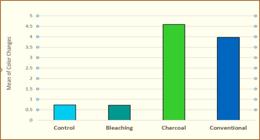
Results: Color changes of charcoal toothpaste (4.59 ± 2.06) and conventional toothpaste (3.97 ± 1.32) were significantly greater than those of distilled water (0.74 ± 2.50) and bleaching toothpaste (0.72 ± 2.17). There was no significant difference in surface roughness and microhardness of tooth enamel in the studied toothpaste (p>0.05).
Conclusion: The change in surface roughness and microhardness of enamel by charcoal toothpaste was negligible. The bleaching properties of charcoal toothpaste were greater than those of bleaching toothpaste.
Keywords:
Toothpastes; Toothbrushing; Charcoal; Color; Hardness.
Introduction
Teeth become discolored for a variety of reasons. Acquired factors include poor oral hygiene, smoking, colored drinks, aging, and cationic substances such as chlorhexidine [1]. Today, discoloration can be removed using many methods, including scaling, dental crowns, veneers, bleaching compounds, and toothpastes. Although restorative methods are effective for removing discoloration, bleaching techniques are preferable as a first attempt, as they are more conservative [2].
Brushing is the most common method of oral hygiene maintenance and preventing tooth discoloration. Using a toothbrush /and bleaching toothpaste to remove tooth discoloration is one of the most common methods [3,4]. Today, various toothpastes are available on the market, and you can choose the appropriate one by understanding its composition and function. In general, toothpaste on the market today combines abrasives, detergents, and one or more therapeutic agents [5,6]. Activated charcoal is an ingredient in some toothpaste products. Regular toothbrushing with activated charcoal has been reported to improve tooth appearance [7]. Charcoal can absorb pigments, chromophores, and stains that contribute to tooth discoloration [5,8]. The absorbent properties of charcoal bind only to surface stains such as coffee and tea, making it effective for removing discoloration of the outer tooth surface. The mechanism of action of charcoal toothpaste is based on the absorption of external stains on the tooth surface, and with light abrasion [5].
Abrasives in toothpaste are an effective factor in creating enamel surface roughness [9,10]. These changes in surface properties can increase bacterial proliferation and biofilm formation, as well as bacterial resistance and caries [4]. Melo et al. showed that toothpaste containing 10% carbamide peroxide significantly increased enamel surface roughness compared to its initial value [3]. Charcoal toothpaste can be abrasive due to the composition and shape of the coal particles [6] and may increase enamel surface roughness, leading to side effects such as reduced resistance to pressure, pigment absorption, and increased susceptibility to decay. In a profilometric study, the addition of activated charcoal to toothpaste significantly increased surface roughness [5].
De Moraes et al. showed that the use of bleaching toothpaste did not result in a significant change in color or surface roughness [1]. On the other hand, Hilgenberg et al. [6] examined the effect of bleaching toothpaste on enamel surface roughness, finding that enamel surface changes are tangible and that secondary surface roughness increases significantly. Shamel et al. [11] reported a significant color change in enamel after brushing with toothpaste containing blue covarine and showed that secondary surface roughness increased compared to primary surface roughness.
Microhardness is a physical property that depends on the effects of physical and chemical factors on the tooth's hard surface and can be influenced by the abrasion mechanism of charcoal toothpaste [12]. Enamel surface resistance refers to the resistance of teeth to scratches, abrasions, and indentations, as well as resistance to deformation during the application of force [13]. Numerous studies have examined the effect of bleaching on enamel microhardness, with mixed results [12,14]. Khamverdi et al. [12] investigated the impact of bleaching toothpaste on the microhardness of enamel and composites and showed that there was no significant change in the microhardness of tooth enamel. Moreover, another study investigated the effects of fluoride and bleaching toothpaste on the microhardness and surface roughness of enamel and found that microhardness decreased and surface roughness increased [15].
Due to the increase in advertising in the field of using charcoal toothpaste to improve tooth color and the lack of sufficient studies on the effect of these toothpastes on the surface properties of enamel, the purpose of this study was to investigate the effect of activated charcoal toothpastes on the color, surface roughness, and microhardness of enamel.
Material and Methods
Forty human premolars with intact enamel that were extracted for orthodontic reasons from patients in the age range of 20-35 years without any specific systemic and pathological problems were selected for this experimental study. According to Vaz et al. [8], the mean and standard deviation of the color change between the two toothpastes, B&W and TA (control), were equal to 7.40 ± 3.14 and 2.47 ± 2.75, respectively. Taking into account the first type of error equal to 0.05 and the power of the test equal to 80%, a total of 7 samples were obtained in each group. To increase the study's validity, the sample size was increased by 20%, resulting in a final sample of 10 per group.
Sample Preparation
After extraction and cleaning, the teeth were kept in a 0.5% chloramine-T solution for up to 3 months. The root was cut in the CEJ with a diamond saw and cooling water. Two horizontal incisions were made by a double-sided diamond disc in the middle half of the crown on the buccal and lingual surfaces. Therefore, two enamel slabs with dimensions of 2×4×6 mm were obtained from each tooth (80 slabs). They were examined under a stereomicroscope (SMZ-800N, Nikon Corp., Tokyo, Japan) for cracks and fractures. During preparation, water spray was used to prevent sample dehydration. The slabs were then placed in a self-curing acrylic resin within a 1.5 cm-diameter plastic mold, with the enamel surface facing outward. Then, aluminum oxide disks with grit sizes of 400, 600, and 1000 were used for finishing and polishing the enamel surface and for standardization, respectively [8,13]. During preparation, the samples were kept in distilled water at 37 °C.
Brushing Samples
Eighty prepared enamel slabs were randomly divided into four groups (n=10) based on the toothpaste type used for brushing: Group 1 (Control): Distilled water; Group 2: Nasim conventional toothpaste; Group 3: Vi-One whitening toothpaste; and Group 4: Bencer activated charcoal toothpaste. The composition and ingredients of each toothpaste are provided in Table 1.
Twenty grams of each toothpaste were dissolved in 40 mL of water for 5 minutes. Brushing was performed at a typical force of 200 g using the Oral-B Vitality Precision electric toothbrush (Procter & Gamble Company, Dubai, United Arab Emirates) mounted on a handle. An orthodontic gauge measured the applied force. A new brush head was used for each sample. Brushing was performed for 4 minutes and 40 seconds (equivalent to 1 month of brushing) and then for 9 minutes and 20 seconds (equivalent to 2 months of brushing) [5,12].
Color Measurement
Three color parameters (L* a* b⃰ ) of each sample were calculated from the surface of enamel slabs using the Spectroshade micro spectrophotometer (Spectroshade Micro, MHT S.p.A., Milan, Italy) according to the CIE L* a* b⃰ color system before brushing and after different brushing periods with the following formula:
L* indicates the amount of gray and determines the value or brightness; a⃰ indicates the degree of inclination towards the red-green axis, and b* indicates the degree of inclination towards the blue-yellow axis. For each sample, these values were measured three times, and the average value was recorded [11].
Measurement of Surface Roughness
The initial surface roughness was measured using a white-light interferometer at a level of 2.2 mm. Secondary and tertiary surface roughness were then calculated for each sample after the brushing period, and the differences between primary, secondary, and tertiary surface roughness were determined [11].
Microhardness Measurement
Primary and secondary microhardness were measured using a Vickers hardness tester with a load (vertical force) of 100g and a duration of 10 seconds. The effect of this force on the sample surface was pyramidal, as determined by measuring the diameter and calculating its mean [14].
Statistical Analysis
The results of the Kolmogorov-Smirnov test indicated that the data for color change and surface roughness follow a normal distribution, so parametric tests, including One-way ANOVA and Tukey post hoc tests, were used to compare these variables. However, the microhardness data were not normally distributed, so a nonparametric Kruskal-Wallis test was used to compare microhardness. A probability of less than 5% was considered significant.
Results
Regarding color change, a significant difference among toothpastes was observed. The Tukey test showed that Charcoal (G4) and Nasim (G2) toothpaste caused significantly greater color change than distilled water (G1) and bleaching (G3) toothpaste (Table 2 and Figure 1).
Regarding surface roughness, no significant differences were observed. The rate of change in surface roughness was increased in distilled water (G1) (0.057 ± 0.108), Charcoal (G4) toothpaste (0.155 ± 0.166), and Nasim toothpaste (G2) (0.016 ± 0.206), and decreased in bleaching (G3) toothpaste (-0.080 ± 0.620) (Table 3).
Regarding microhardness, no significant differences in changes in microhardness among the toothpastes were observed. The rate of microhardness changes was increased in control (0.80 ± 38.94), in bleaching toothpaste (27.38 ± 44.26), and in Nasim toothpaste (18.50 ± 41.21), and decreased in Charcoal toothpaste (-11.60 ± 41.24) (Table 4).
Discussion
Activated charcoal, in the form of particles, has very small pores and is highly absorbent, and, due to its porosity, can cause tooth bleaching. Activated charcoal also absorbs tannins found in compounds, such as coffee and tea [16]. In the present study, there was a significant difference among the tested toothpastes in terms of color change. Charcoal and Nasim toothpastes caused more color changes than distilled water and bleaching toothpaste. Palandi et al. [17] demonstrated that the activated charcoal powder did not enhance color change when combined with regular and whitening toothpastes, and low-concentrated CP resulted in greater color change than charcoal powder. Vaz et al. [8], in an in vitro study, demonstrated superior whitening efficacy of microbreads, abrasives, and blue covarine toothpastes compared with activated charcoal toothpaste. The results of the above studies, as in the present study, showed that tooth enamel color changed under the influence of activated charcoal.
In contrast, Ghajari et al. [18] demonstrated that Bencer, Beverly, and Colgate charcoal toothpastes caused significant changes in tooth color before and after tooth brushing, indicating their whitening ability. However, the difference in dental color change among the toothpastes was not significant [18]. Furthermore, Franco et al. [19] reported that the charcoal-based tooth powder had a limited whitening effect, with no significant difference compared with the control toothpaste, and was less effective than carbamide peroxide bleaching.
As another significant finding, the present study showed no significant difference in changes in enamel surface roughness and microhardness among the studied toothpastes. However, the results showed that charcoal toothpaste increased surface roughness and decreased enamel microhardness, but these differences were not statistically significant. Investigating the effect of activated charcoal-based powder for enamel bleaching, Franco et al. [19] did not report any statistically significant difference in surface roughness between activated charcoal powder and control. Viana et al. [20] showed that none of the activated charcoal-based toothpastes caused greater surface erosion than artificial saliva. However, in contrast to the present study, Bolay et al. examined the effects of bleaching and fluoride toothpaste and found that microhardness decreased and surface roughness increased [15]. Melo et al. [3] and Higenberg et al. [6] demonstrated that bleaching toothpaste increases the surface roughness of tooth enamel. However, studies by Roselino et al. [1] and Khamverdi et al. [12] did not show significant changes in roughness and hardness due to toothpaste or bleach.
Abrasives are a nearly constant component of most toothpastes. These materials make up 25% to 60% of toothpastes [21,22]. On the other hand, the abrasive properties of toothpaste can cause enamel damage, increase tooth sensitivity, lead to cosmetic problems, and ultimately compromise the masticatory system. The degree of abrasion of toothpaste depends on the number and size of abrasive particles, as well as the hardness and shape of the abrasive components. Activated charcoal is a form of carbon whose structure is full of pores and therefore has abrasive properties [21-24]. To assess the abrasive power of toothpaste in the present study, changes in surface roughness and microhardness were measured using an interferometer and a Vickers hardness tester, respectively. Palandi et al. [17] showed that although activated charcoal alone increases surface roughness and alters enamel topography, surface roughness does not increase when activated charcoal is used with regular and bleaching toothpastes. These researchers stated that although coal powder does not increase the active surface area of tooth enamel when used with toothpaste, activated charcoal negatively affects topography [17].
Ghajari et al. [18] showed that bleaching toothpastes containing charcoal altered surface properties and, in turn, had an abrasive effect. In a study by Pertiwi et al. [5], it was shown that, due to particle shape, the addition of activated carbon to toothpaste increases toothpaste abrasion and significantly increases surface roughness.
In this study, to control for potential confounders, all samples underwent the same finishing and polishing steps. In addition, all samples were subjected to abrasion using the same toothbrush for a specified duration, with controlled force, under the same laboratory conditions. However, it should be noted that toothpaste abrasion in laboratory studies is slightly higher than in real clinical settings [16]. This problem can be due to incomplete reconstruction of oral conditions in in vitro studies, including the lack of pellicle and plaque formation, the absence of bacterial populations and their effects, and the absence of soft tissue, saliva, and so on [25]. Accordingly, although laboratory studies may not be appropriate for estimating the exact amount of toothpaste abrasion over time, these results can also be used to compare toothpaste abrasion values.
Conclusion
There was a significant difference in tooth color change among the studied toothpastes. Charcoal and Nasim toothpastes caused significantly more color change than distilled water and bleaching toothpaste. There was no significant difference in changes in surface roughness and microhardness of tooth enamel among the studied toothpastes. Charcoal toothpaste, despite its tooth-bleaching effects, may have long-term effects on the roughness and hardness of the enamel surface, leading to destructive changes in the enamel. Therefore, more research is needed on the use of this toothpaste.
-
Financial Support
Dental and Periodontal Research Center, Tabriz University of Medical Sciences, Tabriz, Iran.
Acknowledgements
The authors would like to thank Vice Chancellor for Research and Technology, Tabriz University of Medical Sciences, Tabriz, Iran.
Data Availability
The data used to support the findings of this study can be made available upon request to the corresponding author.
References
-
[1] Roselino LMR, Tirapelli C, Pires-de-Souza FCP. Randomized clinical study of alterations in the color and surface roughness of dental enamel brushed with whitening toothpaste. J Esthet Restor Dent 2018; 30(5):383-389. https://doi.org/10.1111/jerd.12379
» https://doi.org/10.1111/jerd.12379 -
[2] Polydorou O, Mönting JS, Hellwig E, Auschill TM. Effect of in-office tooth bleaching on the microhardness of six dental esthetic restorative materials. Dent Mater 2007; 23(2):153-158. https://doi.org/10.1016/j.dental.2006.01.004
» https://doi.org/10.1016/j.dental.2006.01.004 - [3] Melo CFM, Manfroi FB, Spohr AM. Microhardness and roughness of enamel bleached with 10% carbamide peroxide and brushed with different toothpastes: An in situ study. J Int Oral Health 2014; 6(4):18-24.
-
[4] Detara M, Triaminingsih S, Irawan B. Effects of nano calcium carbonate and siwak toothpaste on demineralized enamel surface roughness. J Phys Conf Ser 2018; 1073(3):032011. https://doi.org/10.1088/1742-6596/1073/3/032011
» https://doi.org/10.1088/1742-6596/1073/3/032011 -
[5] Pertiwi U, Eriwati YK, Irawan B. Surface changes of enamel after brushing with charcoal toothpaste. J Phys Conf Ser 2017; 884(1):012002. https://doi.org/10.1088/1742-6596/884/1/012002
» https://doi.org/10.1088/1742-6596/884/1/012002 -
[6] Hilgenberg SP, Pinto SCS, Farago PV, Santos FA, Wambier DS. Physical-chemical characteristics of whitening toothpaste and evaluation of its effects on enamel roughness. Braz Oral Res 2011; 25(4):288-294. https://doi.org/10.1590/s1806-83242011005000012
» https://doi.org/10.1590/s1806-83242011005000012 -
[7] Thakur A, Ganeshpurkar A, Jaiswal A. Charcoal in Dentistry. In: Chauhan DN, Singh PR, Shah K, Chauhan NS. Natural Oral Care in Dental Therapy. Hoboken, New Jersey: Wiley-Scrivener; 2020. https://doi.org/10.1002/9781119618973.ch13
» https://doi.org/10.1002/9781119618973.ch13 -
[8] Vaz VTP, Jubilato DP, Oliveira MRM, Bortolatto JF, Floros MC, Dantas AAR, et al. Whitening toothpaste containing activated charcoal, blue covarine, hydrogen peroxide or microbeads: Which one is the most effective? J Appl Oral Sci 2019; 27:e20180051. https://doi.org/10.1590/1678-7757-2018-0051
» https://doi.org/10.1590/1678-7757-2018-0051 -
[9] Worschech CC, Rodrigues JA, Martins LRM, Ambrosano GMB. In vitro evaluation of human dental enamel surface roughness bleached with 35% carbamide peroxide and submitted to abrasive dentifrice brushing. Braz Oral Res 2003; 17(4):342-348. https://doi.org/10.1590/s1517-74912003000400009
» https://doi.org/10.1590/s1517-74912003000400009 -
[10] Özkan P, Kansu G, Özak ŞT, KurtulmuŞ-Yilmaz S, Kansu P. Effect of bleaching agents and whitening dentifrices on the surface roughness of human teeth enamel. Acta Odontol Scand 2013; 71(3-4):488-497. https://doi.org/10.3109/00016357.2012.696691
» https://doi.org/10.3109/00016357.2012.696691 -
[11] Shamel M, Al-Ankily MM, Bakr MM. Influence of different types of whitening tooth pastes on the tooth color, enamel surface roughness and enamel morphology of human teeth. F1000 Res 2019; 8:1764. https://doi.org/10.12688/f1000research.20811.1
» https://doi.org/10.12688/f1000research.20811.1 - [12] Khamverdi Z, Kasraie S, Rezaei-Soufi L, Jebeli S. Comparison of the effects of two whitening toothpastes on microhardness of the enamel and a microhybride composite resin: An in vitro study. J Dent 2010; 7(3):139-145.
-
[13] Molaasadolah F, Eskandarion S, Ehsani A, Sanginan M. In vitro evaluation of enamel microhardness after application of two types of fluoride varnish. J Clin Diagnost Res 2017; 11(8):ZC64-ZC66. https://doi.org/10.7860/JCDR/2017/30121.10412
» https://doi.org/10.7860/JCDR/2017/30121.10412 - [14] Jabbarifar SE, Salavati S, Akhavan A, Khosravi K, Tavakoli N, Nilchian F. Effect of fluoridated dentifrices on surface microhardness of the enamel of deciduous teeth. Dent Res J 2011; 8(3):113-117.
- [15] Bolay S, Cakir FY, Gurgan S. Effects of toothbrushing with fluoride abrasive and whitening dentifrices on both unbleached and bleached human enamel surface in terms of roughness and hardness: An in vitro study. J Contemp Dent Pract 2012; 13(5):584-589.
-
[16] Addy M, Hughes J, Pickles MJ, Joiner A, Huntington E. Development of a method in situ to study toothpaste abrasion of dentine. Comparison of 2 products. J Clin Periodontol 2002; 29(10):896-900. https://doi.org/10.1034/j.1600-051x.2002.291004.x
» https://doi.org/10.1034/j.1600-051x.2002.291004.x -
[17] Palandi SDS, Kury M, Picolo MZD, Coelho CSS, Cavalli V. Effects of activated charcoal powder combined with toothpastes on enamel color change and surface properties. J Esthet Restor Dent 2020; 32(8):783-790. https://doi.org/10.1111/jerd.12646
» https://doi.org/10.1111/jerd.12646 - [18] Ghajari MF, Shamsaei M, Basandeh K, Galouyak MS. Abrasiveness and whitening effect of charcoal-containing whitening toothpastes in permanent teeth. Dent Res J 2021; 18:51.
-
[19] Franco MC, Uehara J, Meroni BM, Zuttion GS, Cenci MS. The effect of a charcoal-based powder for enamel dental bleaching. Oper Dent 2020; 45(6):618-623. https://doi.org/10.2341/19-122-L
» https://doi.org/10.2341/19-122-L -
[20] Viana ÍEL, Weiss GS, Sakae LO, Niemeyer SH, Borges AB, Scaramucci T. Activated charcoal toothpastes do not increase erosive tooth wear. J Dent 2021; 109:103677. https://doi.org/10.1016/j.jdent.2021.103677
» https://doi.org/10.1016/j.jdent.2021.103677 -
[21] Hamza B, Attin T, Paqué PN, Wiedemeier DB, Wegehaupt FJ. Mechanical properties of toothpastes with diamond abrasives. J Esthet Restor Dent 2020; 32(4):416-423. https://doi.org/10.1111/jerd.12588
» https://doi.org/10.1111/jerd.12588 - [22] Mathias-Santamaria IF, Roulet J-F. The effect of diamond toothpastes on surface gloss of resin composites. Am J Dent 2019; 32(4):169-173.
-
[23] Silva EM, Maia JNSMD, Mitraud CG, Russo JES, Poskus LT, Guimarães JGA. Can whitening toothpastes maintain the optical stability of enamel over time? J Appl Oral Sci 2018; 26:e20160460. https://doi.org/10.1590/1678-7757-2016-0460
» https://doi.org/10.1590/1678-7757-2016-0460 - [24] Soares CN, Amaral FL, Mesquita MF, Franca FM, Basting RT, Turssi CP. Toothpastes containing abrasive and chemical whitening agents: efficacy in reducing extrinsic dental staining. Gen Dent 2015; 63(6):e24-28.
-
[25] Gregg T, Mace S, West NX, Addy M. A study in vitro of the abrasive effect of the tongue on enamel and dentine softened by acid erosion. Caries Res 2004; 38(6):557-560. https://doi.org/10.1159/000080586
» https://doi.org/10.1159/000080586
Edited by
-
Academic Editor:
Wilton Wilney Nascimento Padilha

