 Impact of Glycated Haemoglobin and Diabetes Duration on the Oral Health-Related Quality of Life in Type 1 Diabetic Children
ABSTRACT
Objective: To assess the correlation of glycated haemoglobin and diabetes duration with oral health status and oral health-related quality of life (OHRQoL) in children with type 1 diabetes mellitus.
Material and Methods: In an observational cross-sectional study, oral health status and Oral Health-Related Quality of Life (OHRQoL) were clinically assessed in 80 children with type 1 diabetes aged 11-14 years. Diabetic duration and HbA1c were obtained from the interview and the patient’s medical record. The Hindi version of the Child Perception Questionnaire (CPQ11-14) was used to assess the oral health-related quality of life (OHRQoL) in type 1 diabetes mellitus children. Children were also examined for plaque index, gingival index and DMFT index. Spearman's rank-order correlation test to measure the association between two ranked variables and the Mann-Whitney U test for nonparametric data were used.
Results: CPQ11-14 score was positively correlated with HbA1c (p < 0.001), suggesting poor OHRQoL in children with poor metabolic control. A significant positive correlation was observed between HbA1c and clinical variables, including plaque index and gingival index. The correlation between the duration of diabetes and clinical variables, as well as the CPQ11-14 score, was not significant.
Conclusion: Among diabetics, an increase in HbA1c (%) was significantly associated with an increase in the CPQ11-14 score. This indicates poor OHRQoL in children with uncontrolled diabetes.
Keywords:
Diabetes Mellitus; Quality of Life; Oral Health.
Introduction
Type 1 diabetes mellitus (T1DM) predominantly manifests during childhood and adolescence, exhibiting a condition marked by inadequate insulin synthesis and consequent elevation of blood glucose levels, commonly referred to as hyperglycemia [1]. Diabetes mellitus has emerged as a global health concern with profound implications on various organ systems [2]. Recent research has increasingly focused on the intricate relationship between diabetes and oral health beyond its well-established systemic manifestations. The oral cavity is susceptible to alterations influenced by the metabolic imbalances associated with diabetes [3].
The duration of diabetes and glycated hemoglobin (HbA1c) levels are critical parameters that emphasize the chronicity and control of the disease, respectively [4]. While existing literature has explored the impact of diabetes on oral health [5-8], there is a noticeable gap in understanding how the duration of diabetes and glycated hemoglobin levels collectively influence oral health status and oral health-related quality of life (OHRQoL) in children with type 1 diabetes mellitus.
The objectives of this investigation are twofold: first, to explore the influence of glycated hemoglobin levels on oral health status, considering parameters such as, dental caries, plaque index and gingival index and their impact on oral health-related quality of life (OHRQoL) of children and second, to elucidate the relationship between the duration of diabetes and these oral health outcomes, with a specific focus on the impact on OHRQoL.
The OHRQoL and its characteristics have been the subject of numerous studies published in various developed and developing nations; however, less research has been reported from India. It was worthwhile to conduct a study to explore the correlations among glycated hemoglobin, diabetes duration, oral health status, and Oral Health-Related Quality of Life (OHRQoL) in children with type 1 diabetes mellitus. There is a lack of data on the impact of type 1 diabetes mellitus on the OHRQoL in India. Given the need for regional data in this population, this study aims to bridge this gap by conducting a comprehensive assessment of the correlation between diabetes duration and glycated hemoglobin levels, and their combined effect on oral health and OHRQoL. Understanding these associations is crucial not only for enhancing our comprehension of the multifaceted interplay between diabetes and oral health, with its impact on quality of life, but also for informing targeted interventions aimed at improving the oral health-related quality of life in individuals living with diabetes.
Material and Methods
Ethical Approval
After obtaining ethical clearance from the Scientific Ethics Committee of the University College of Medical Sciences and GTB Hospital, Delhi, India (IECHR-2022-53-11), the study was conducted from July 2022 to July 2023. The nature of the study was explained to the participants and parents. The parents of the participants signed the written consent form prior to the initiation of the study.
Study Design and Setting
This was an observational cross-sectional study conducted from July 2022 to July 2023. The study was conducted in the outpatient department of pediatric dentistry and endocrinology at a tertiary hospital in Delhi-NCR. The study population comprised 80 participants with type 1 diabetes mellitus, including 51 (63.8%) females and 29 (36.3%) males, aged 11 to 14 years, recruited from the Outpatient Department of Endocrinology. The clinical examination was performed in the Unit of Pedodontics and Preventive Dentistry, Department of Dentistry.
Participants
The participants in the study had clinically diagnosed type 1 diabetes mellitus and optimal Hindi language comprehension skills. Children with specific medical illnesses other than Diabetes, children with special needs or lacking cognitive ability, and children undergoing orthodontic treatment with fixed appliances at the time of evaluation were excluded from the study. The principal investigator used a simple random sampling method, with computer-generated random tables, to recruit children who met the study's inclusion criteria.
Questionnaire
Data on age, gender, and the duration of type 1 diabetes mellitus were obtained from the face-to-face interview and the patient's medical records. The metabolic control data were documented [glycosylated hemoglobin (HbA1c)], whereby HbA1c < 8.0% was considered to indicate good metabolic control and HbA1c > 8.0% poor metabolic control.
A validated Hindi version of the Child Perception Questionnaire (CPQ11-14) was provided to the participants to assess OHRQoL [9,10]. This questionnaire had 39 items: 2 questions about self-reported oral health (global rating) and oral health-related well-being (overall well-being) and 37 CPQ11-14 questions in Hindi. These 37 questions were divided into four main domains: oral symptoms (OS), functional limitations (FL), emotional well-being (EWB) and social well-being (SWB). The children were asked to specify the frequency of a particular experience in the last 3 months before the application instrument. The response scale for each item was a five-point Likert scale: “Never” = 0; “Once/twice” = 1; “Sometimes” = 2; “Often” = 3; and “Every day/almost every day” = 4. The total score ranges from 0 to 156, with higher scores indicating that oral conditions have a more detrimental effect on OHRQoL.
Clinical Oral Examination
In the clinical data collection, the children were examined by a single examiner, previously calibrated, within a dental clinic. The children were examined seated in a dental chair with a high backrest, with the examiner standing in front of the chair. The examiner used a dental mirror, a dental explorer, a periodontal probe, and a gauze swab to examine participants under artificial lighting for the dental examination. All the teeth were examined after drying with a gauze swab.
During the visits, the children were accompanied by their parents/caretakers, and intra-oral clinical examination was performed to assess caries status, dental plaque, and gingival health using standard indices in both groups. Children were examined for dental caries using the DMFT index (Decayed, Missing, and Filled teeth) for permanent teeth, with mouth mirror and explorer according to WHO guidelines for epidemiological survey of dental caries [11]. Plaque accumulation and gingival condition were appraised using the Plaque index (PI) and Gingival index (GI), respectively [12,13].
Calibration Procedure
A senior research faculty member with comprehensive knowledge of the subject and more than 20 years of experience in the research field performed calibration of the principal investigator. By evaluating a group subject twice, on different days, with a minimum of 30 minutes between tests, the examiner ascertained the degree of consistency with which the primary investigator could apply the diagnostic criteria. The Intraclass correlation coefficient (ICC) was used to evaluate intraand inter-examiner reliability for the GI, PI, and DMFT. According to the results, the ICC values for intra-examiner reliability for GI, PI, and DMFT were 0.85, 0.81, and 0.89, respectively, and the ICC values for inter-examiner reliability for GI, PI, and DMFT were 0.87, 0.85, and 0.87, respectively, indicating good reliability. The patients used in the calibration process were excluded from the main sample. The questionnaire used in the study was already validated and tested for reliability by Jokovic et al. [9]. The Hindi version of the same questionnaire was appraised for validity and reliability for use among North Indian children aged 11-14 years [10].
Statistical Analysis
Microsoft Excel was used for data collection and compilation. After appropriate coding, SPSS version 26.0 was used to import the data into the statistical software and perform statistical analysis (IBM Corp., Armonk, NY, USA). Descriptive statistics were applied. Spearman's rank-order correlation test was used to measure the strength and direction of association between two ranked variables. The Mann-Whitney U test was used to analyze nonparametric data. The present study was reported in compliance with the Strengthening the Reporting of Observational Studies in Epidemiology (STROBE) statement.
Results
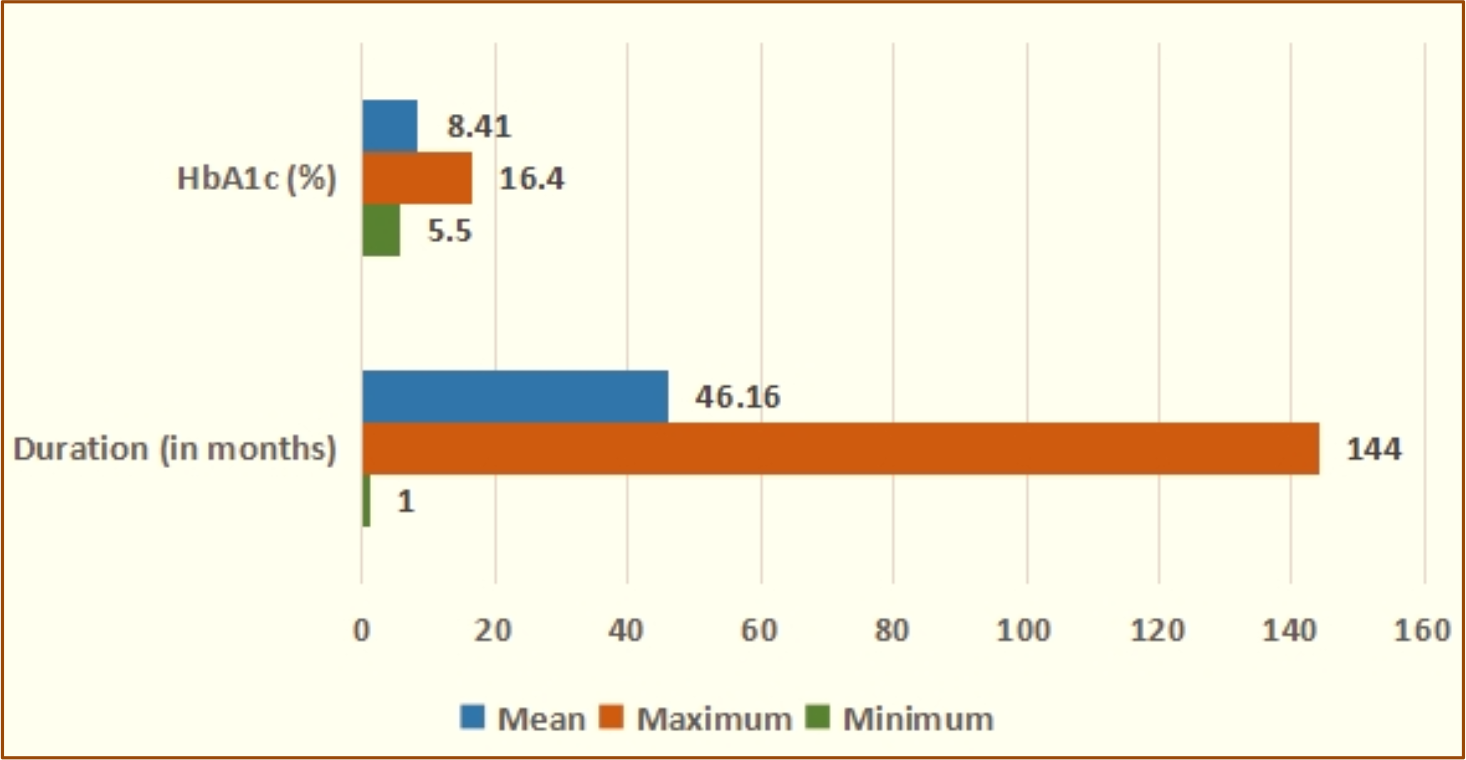
The mean age of participants was 12.86 ± 2.0 years. The range of HbA1c was 5.5% to 16.4% and the mean HbA1c (%) was 8.41% among diabetic children (Table 1 and Figure 1). Increase in HbA1c (%) was positively correlated with an increase in plaque index, gingival index (r = 0.261 for plaque index and r = 0.357 for gingival index with p < 0.01). DMFT index and HbA1c showed a weak positive correlation (r = 0.111, p = 0.329). This suggests that, as metabolic control is not properly maintained, there is a substantial increase in the scores of clinical variables (Table 2).
A significant weak positive correlation was observed between HbA1c and global rating (r = 0.269 and p = 0.016). A significant moderate positive correlation wasobserved between HbA1c and other conceptual domains, including oral symptoms (r = 0.481), functional limitations (r = 0.474), emotional well-being (r = 0.501), and social well-being (r = 0.486) in diabetic children (p < 0.001). Among diabetics, an increase in HbA1c (%) was significantly associated with an increase in OS score, FL score, EWB score, and SWB score (p < 0.001) (Table 2).
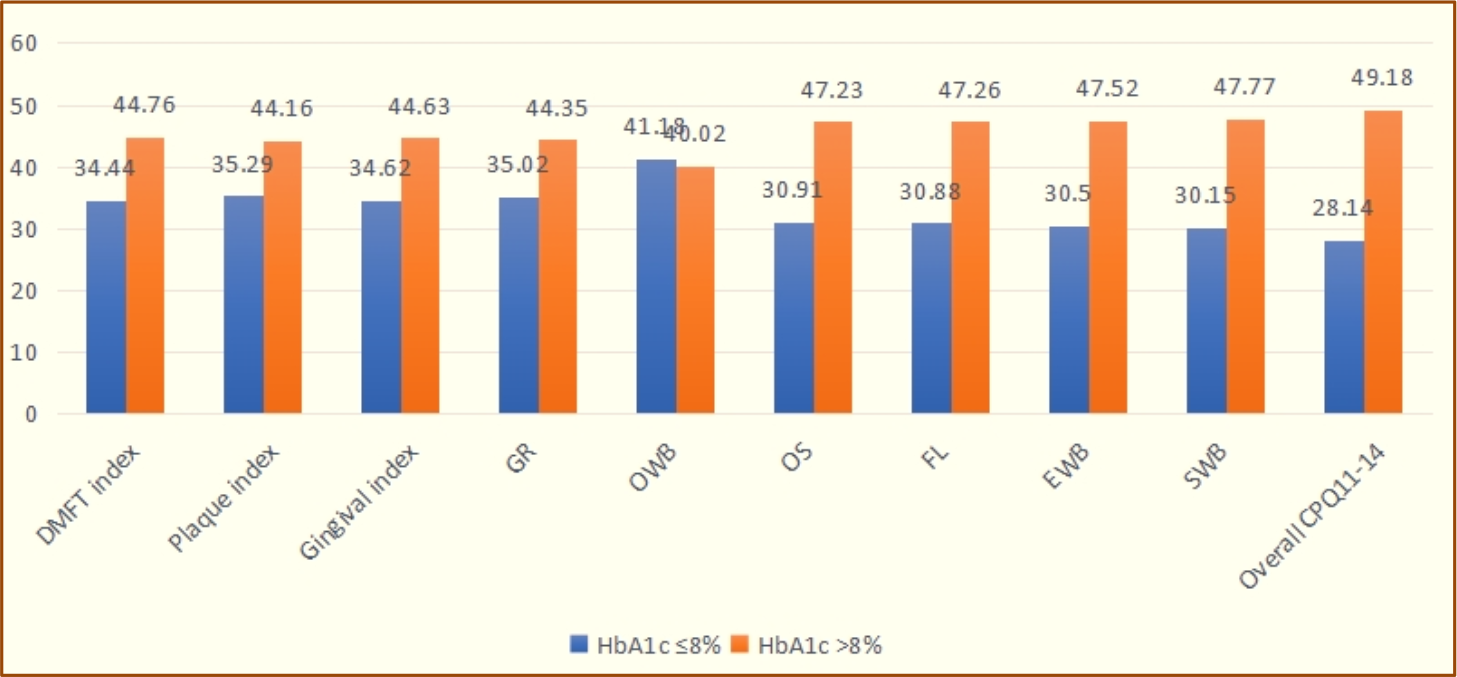
Table 3 and Figure 2 illustrate the comparison of DMFT, PI, GI scores, and CPQ domain scores between the study groups according to HbA1c %. Diabetic children with >8% HbA1c showed significantly higher DMFT scores as compared to children with HbA1c ≤8%. Also, diabetic children with HbA1c>8% showed significantly higher oral symptoms score, functional limitations score, emotional well-being score, social well-being score, and total CPQ11-14 score than children with HbA1c ≤8%.
Mean rank of the HbA1c in relation to the DMFT index, PI, GI scores, and the CPQ11-14 domains scores of the study groups.
Mean rank of the HbA1c in relation to the oral condition and DMFT, PI, GI scores and the CPQ domains scores of the study groups.
In this study, diabetes duration ranged from 1 to 144 months (12 years), with an average duration of 46.16 months (Table 1 and Figure 1). In the Spearman rank correlation test, ranks are assigned to the data after sorting them in descending order. It is observed that as the duration of diabetes increases, plaque index, gingival index, and DMFT index score of participants also increase, suggesting a positive correlation. In plaque index and gingival index, the correlation coefficient is [r = 0.017 and r = 0.021, respectively (p > 0.005)], near 0, which suggests a very negligible positive correlation with the duration of diabetes. For the DMFT index, a weak positive correlation is observed with diabetes duration (r = 0.141, p = 0.211). We can conclude that as diabetes duration increases, plaque accumulation, gingivitis, and caries experience increase (Table 4).
Weak positive correlations and negligible positive correlations were observed with respect to diabetes duration and global rating, respectively, and with oral symptoms. This interpretation suggests that as the duration of diabetes increases, the global rating score and oral symptoms score increase, whereas a negligible negative correlation is observed between duration of diabetes and domains such as overall well-being, functional limitations, emotional well-being, and social well-being.
As diabetes duration increases, the effect of oral symptoms on functional limitations, emotional well-being, and social well-being decreases. Although these clinical variables and domains of CPQ were not significantly associated with the duration of diabetes (p > 0.05) (Table 4).
Discussion
The current study was conducted to assess the correlations between glycated haemoglobin and diabetes duration and oral health status and Oral Health-Related Quality of Life (OHRQoL) in children with type 1 diabetes mellitus. Validated Hindi version of the Child Perception Questionnaire (11-14) was used to assess the OHRQoL of children with type 1 diabetes mellitus. Metabolic control in children with type 1 diabetes mellitus was assessed by HbA1c, which was classified as metabolically controlled (HbA1c 8%) or poorly controlled (HbA1c > 8%) [14]. In the current investigation, the frequency of poorly controlled diabetic status was 48 (60%).
In the present study, the comparison of DMFT, PI, GI scores, and CPQ11-14 domain scores between the study groups according to HbA1c % was performed. Elevated HbA1c levels may be attributed to poor dietary habits and a higher intake of saturated fat. The results show a significant positive correlation between HbA1c levels and clinical variables such as plaque index, gingival index, and DMFT index, as well as the total CPQ11-14 score, which may be attributed to poor metabolic regulation leading to dental biofilm accumulation. This stimulated the host's defensive mechanism, especially when accompanied by poor oral hygiene. Research indicates that individuals diagnosed with type 1 diabetes exhibit an exaggerated gingival inflammatory response in response to dental biofilm as compared to individuals without diabetes [15].
Consistent with the present research, a study by Al-Khabbaz et al. [16] found that individuals with type 1 diabetes who had better glycemic control had a lower mean gingival index than those with poor glycemic control. Similarly, the study by Elheeny et al. [17] showed a significant association among dental plaque, gingival inflammation, and HbA1c levels. Similar results were observed in the study by Rafatjou et al. [18]: participants with poor glycemic control, as indicated by elevated HbA1c levels, exhibited increased gingival inflammation, consistent with prior findings by Jindal et al. [19] and Dakovik and Pavlovic [20].
Diabetic children with >8% HbA1c showed significantly higher DMFT scores as compared to children with HbA1c ≤8%. This could be justified by the fact that higher glucose concentrations in saliva and decreased stimulated salivary flow rate in children with poor metabolic control, along with dietary noncompliance, lead to a higher caries index. These findings are consistent with earlier studies that have assessed caries and HbA1c levels [14,21-23]. Carneiro et al. [14] observed that caries and bleeding gingiva were more prevalent in the HbA1c > 10% group than in the other groups. Twetman et al. [21] reported high caries prevalence in patients with T1DM aged 8 to 16 years having HbA1c > 8%.
In the present study, a significant positive correlation between HbA1c and the Child Perception Questionnaire (CPQ11-14) domains suggests that poor metabolic control negatively affects oral health status and, subsequently, OHRQoL. Children with >8% HbA1c showed significantly higher oral symptoms score, functional limitations score, emotional well-being score, social well-being score and total CPQ11-14 score as compared to children with HbA1c ≤8%. This suggests the significant impact of poor glycemic control on the OHRQoL of diabetic children. Inadequate compliance with insulin therapy, diminished effective self-management behavior, and negligence towards oral hygiene will lead to poor metabolic control as well as a negative impact on emotional and social well-being due to increased oral symptoms and functional limitations. In line with the present investigation's findings, Elheeny et al. [17] reported a significant correlation between OHRQoL and HbA1c in the diabetic group.
In the present study, clinical variables such as plaque index, gingival index and DMFT were not significantly associated with the diabetes duration (p > 0.05). A plausible explanation for the absence of a correlation between diabetes duration and Oral Health-Related Quality of Life (OHRQoL) is that individuals with diabetes may prioritize attention to other health issues associated with their condition. Consequently, individuals in this context might not have considered oral health as exerting a noteworthy influence on their overall well-being.
In contrast, in the investigation conducted by Rafatjou et al. [18], a statistically significant association was observed between the diabetes duration and the gingival index and decayed, missing, or filled teeth (DMFT). Also, a case-control study of children with T1DM in Kuwait suggests that longer disease duration may affect the development and progression of gingival inflammation [16].
The present study provides valuable insights into the relationships among diabetes duration, glycated haemoglobin, and oral health status and oral health-related quality of life (OHRQoL).. Furthermore, the findings from this investigation have the potential to guide healthcare practitioners, researchers, and policymakers in developing specific strategies for the preventive as well as comprehensive management of diabetes, addressing not only its systemic implications but also its impact on oral health and oral health-related quality of life.
The study was conducted at a tertiary public health center that primarily serves low-income families, which may affect the generalizability of the results. The cross-sectional study design makes it challenging to demonstrate causality. Also, children and early adolescents could have recall bias in their responses.
Conclusion
Among diabetics, an increase in HbA1c (%) was significantly associated with an increase in CPQ11-14 score, which suggests poor OHRQoL in children with uncontrolled diabetes. The duration of diabetes is not significantly correlated with the clinical variables or CPQ domains. There is future scope to explore the long-term consequences of glycated haemoglobin and diabetes duration on oral health status and Oral Health Related Quality of Life in children with type 1 diabetes mellitus, using a longitudinal study design.
-
Financial Support
None.
Data Availability
The data used to support the findings of this study can be made available upon request to the corresponding author.
Acknowledgments
We would like to thank Dr. Mahesh Khairnar for his valuable contribution in statistical analysis of the study.
References
-
[1] Katsarou A, Gudbjörnsdottir S, Rawshani A, Dabelea D, Bonifacio E, Anderson BJ, et al. Type 1 diabetes mellitus. Nat Rev Dis Primers 2017; 3:17016. https://doi.org/10.1038/nrdp.2017.16
» https://doi.org/10.1038/nrdp.2017.16 -
[2] GBD 2021 Diabetes Collaborators. Global, regional, and national burden of diabetes from 1990 to 2021, with projections of prevalence to 2050: A systematic analysis for the Global Burden of Disease Study 2021. Lancet 2023; 402(10397):203-234. https://doi.org/10.1016/S0140-6736(23)01301-6
» https://doi.org/10.1016/S0140-6736(23)01301-6 -
[3] González-Moles MÁ, Ramos-García P. State of evidence on oral health problems in diabetic patients: A critical review of the literature. J Clin Med 2021; 10(22):5383. https://doi.org/10.3390/jcm10225383
» https://doi.org/10.3390/jcm10225383 -
[4] Azogui-Lévy S, Dray-Spira R, Attal S, Hartemann A, Anagnostou F, Azerad J. Factors associated with oral health-related quality of life in patients with diabetes. Aust Dent J 2018; 63(2):163-169. https://doi.org/10.1111/adj.12577
» https://doi.org/10.1111/adj.12577 -
[5] Vidya K, Shetty P, Anandakrishna L. Oral health and glycosylated hemoglobin among type 1 diabetes children in South India. J Indian Soc Pedod Prev Dent 2018; 36(1):38-42. https://doi.org/10.4103/JISPPD.JISPPD_330_16
» https://doi.org/10.4103/JISPPD.JISPPD_330_16 -
[6] Banyai D, Vegh D, Vegh A, Ujpal M, Payer M, Biczo Z, et al. Oral health status of children living with type 1 diabetes mellitus. Int J Environ Res Public Health 2022; 19(1):545. https://doi.org/10.3390/ijerph19010545
» https://doi.org/10.3390/ijerph19010545 -
[7] Mandura RA, Meligy OAE, Attar MH, Alamoudi RA. Diabetes mellitus and dental health in children: A review of literature. Int J Clin Pediatr Dent 2021; 14(5):719-725. https://doi.org/10.5005/jp-journals-10005-2006
» https://doi.org/10.5005/jp-journals-10005-2006 -
[8] AlMutairi FF, Pani SC, Alrobaie FM, Ingle NA. Relationship between type-I diabetes mellitus and oral health status and oral health-related quality of life among children of Saudi Arabia. J Family Med Prim Care 2020; 9(2):647-651. https://doi.org/10.4103/jfmpc.jfmpc_1160_19
» https://doi.org/10.4103/jfmpc.jfmpc_1160_19 -
[9] Jokovic A, Locker D, Stephens M, Kenny D, Tompson B, Guyatt G. Validity and reliability of a questionnaire for measuring child oral-health-related quality of life. J Dent Res 2002; 81(7):459-463. https://doi.org/10.1177/154405910208100705
» https://doi.org/10.1177/154405910208100705 -
[10] Jain V, Agarwal N, Jabin Z, Singh S, Anand A, Jain M. Cross-cultural adaptation and psychometric properties of the Hindi version of Child Perception Questionnaire (CPQ11-14) in school children. Int J Paediatr Dent 2021; 31(4):459-467. https://doi.org/10.1111/ipd.12693
» https://doi.org/10.1111/ipd.12693 - [11] Petersen, Poul Erik, Baez, Ramon J, World Health Organization. Oral health surveys: Basic methods. 5th ed. Geneva: World Health Organization; 2013.125p.
-
[12] Silness J, Loe H. Periodontal disease in pregnancy II. Correlation between oral hygiene and periodontal condtion. Acta Odontol Scand 1964; 22(1):121-135. https://doi.org/10.3109/00016356408993968
» https://doi.org/10.3109/00016356408993968 -
[13] Loe H, Silness J. Periodontal disease in pregnancy I. Prevalence and severity. Acta Odontol Scand 1963; 21(6):533-551. https://doi.org/10.3109/00016356309011240
» https://doi.org/10.3109/00016356309011240 -
[14] Carneiro VL, Fraiz FC, Ferreira Fde M, Pintarelli TP, Oliveira AC, Boguszewski MC. The influence of glycemic control on the oral health of children and adolescents with diabetes mellitus type 1. Arch Endocrinol Metab 2015; 59(6):535-540. https://doi.org/10.1590/2359-3997000000117
» https://doi.org/10.1590/2359-3997000000117 -
[15] Salvi GE, Kandylaki M, Troendle A, Persson GR, Lang NP. Experimental gingivitis in type 1 diabetics: A controlled clinical and microbiological study. J Clin Periodontol 2005; 32(3):310-316. https://doi.org/10.1111/j.1600-051x.2005.00682.x
» https://doi.org/10.1111/j.1600-051x.2005.00682.x -
[16] Al-Khabbaz AK, Al-Shammari KF, Hasan A, Abdul-Rasoul M. Periodontal health of children with type 1 diabetes mellitus in Kuwait: A case-control study. Med Princ Pract 2013; 22(2):144-149. https://doi.org/10.1159/000342624
» https://doi.org/10.1159/000342624 -
[17] Elheeny AAH. Oral health status and impact on the oral health-related quality of life of Egyptian children and early adolescents with type-1 diabetes: A case-control study. Clin Oral Investig 2020; 24(11):4033-4042. https://doi.org/10.1007/s00784-020-03273-w
» https://doi.org/10.1007/s00784-020-03273-w - [18] Rafatjou R, Razavi Z, Tayebi S, Khalili M, Farhadian M. Dental health status and hygiene in children and adolescents with type 1 diabetes mellitus. J Res Health Sci 2016; 16(3):122-126.
- [19] Jindal A, Parihar AS, Sood M, Singh P, Singh N. Relationship between severity of periodontal disease and control of diabetes (glycated hemoglobin) in patients with type 1 diabetes mellitus. J Int Oral Health 2015; 7(Suppl 2):17-20.
-
[20] Dakovic D, Pavlovic MD. Periodontal disease in children and adolescents with type 1 diabetes in Serbia. J Periodontol 2008; 79(6):987-992. https://doi.org/10.1902/jop.2008.070549
» https://doi.org/10.1902/jop.2008.070549 -
[21] Twetman S, Johansson I, Birkhed D, Nederfors T. Caries incidence in young type 1 diabetes mellitus patients in relation to metabolic control and caries-associated risk factors. Caries Res 2002; 36(1):31-35. https://doi.org/10.1159/000057587
» https://doi.org/10.1159/000057587 -
[22] Siudikiene J, Machiulskiene V, Nyvad B, Tenovuo J, Nedzelskiene I. Dental caries and salivary status in children with type 1 diabetes mellitus, related to the metabolic control of the disease. Eur J Oral Sci 2006; 114(1):8-14. https://doi.org/10.1111/j.1600-0722.2006.00277.x
» https://doi.org/10.1111/j.1600-0722.2006.00277.x -
[23] Siudikiene J, Machiulskiene V, Nyvad B, Tenovuo J, Nedzelskiene I. Dental caries increments and related factors in children with type 1 diabetes mellitus. Caries Res 2008; 42(5):354-362. https://doi.org/10.1159/000151582
» https://doi.org/10.1159/000151582
Edited by
-
Academic Editor:
Fátima Regina Nunes de Sousa