 LAW 13.935/2019 AND THE HIRING OF SCHOOL PSYCHOLOGISTS: THE PROCESS CARRIED OUT BY JOINVILLE/SC
ABSTRACT
The implementation process of Law No. 13,935 (2019) must be organized by the Departments of Education of Brazilian municipalities and states. Therefore, it is necessary to monitor the ongoing organizational and hiring processes. Therefore, this research aims to understand how the hiring process for school psychologists to work in the municipal Basic Education system of the city of Joinville unfolded. To this end, five reflective interviews were conducted with psychology professionals working in the municipal Basic Education system. The data were organized based on Content Analysis, and the theoretical construction and argumentation of the analyses were based on the authors from Historical-Cultural Psychology. The results point to a hiring process characterized by a rushed organization, a lack of information to justify certain decisions, and the use of public notices with no connection to Education.
Keywords:
school psychology; educational psychology; law 13,935
RESUMO
O processo de implementação da Lei n. 13.935 (2019) deve ser organizado pelas Secretarias de Educação de municípios e estados brasileiros. Desse modo, entende-se a necessidade de acompanhar processos de organização e de contratação de profissionais estão decorrendo. Sendo assim, esta pesquisa tem como objetivo entender como aconteceu o processo de contratação de psicólogas escolares para atuação na rede de Educação Básica municipal da cidade de Joinville. Para isso, foram realizadas 5 entrevistas, com uma perspectiva reflexiva, com profissionais da Psicologia atuantes da rede municipal de Educação Básica; os dados foram organizados com base na Análise de Conteúdo e a construção e argumentação teórica das análises tiveram como base autores da Psicologia Histórico-Cultural. Os resultados apontam para um processo de contratação caracterizado pela maneira apressada na qual foi organizado, pela falta de informações que justificassem certas decisões e o uso de editais sem qualquer vínculo com a educação.
Palavras-chave:
psicologia escolar; psicologia educacional; lei federal 13.935
RESUMEN
El proceso de implementación de la Ley n. 13.935 (2019) debe ser organizada por las Secretarías de Educación de municipios y estados brasileños. De este modo, se entiende la necesidad de acompañar procesos de organización y de contratación de profesionales están sucediendo. Siendo así, esta investigación tiene como objetivo entender como sucedió el proceso de contratación de psicólogas escolares para actuación en la red básica municipal de la ciudad de Joinville. Para eso, se realizaron 5 entrevistas, con una perspectiva reflexiva, con profesionales de la Psicología actuantes de la red municipal de educación básica, los datos se organizaron con base en el Análisis de Contenido; la construcción y argumentación teórica de los análisis se basaron en autores de la Psicología Histórico-cultural. Los resultados apuntan para un proceso de contratación caracterizado por la manera apresurada la cual se organizó, por la falta de informaciones que justificaran ciertas decisiones y el uso de edictos sin cualquier vínculo con la educación.
Palabras clave:
psicología escolar; psicología educacional; ley federal 13.935
INTRODUCTION
The Education field was essential for the construction of Psychology as an autonomous science in Brazil; historically, the knowledge of this science began to develop, gain scope, and practical possibilities for action through its insertion in educational discussions while still forming part of pedagogy (Antunes, 2008; Massimi, 1990). Psychology and Education have been side by side in the social changes that have occurred in Brazil since the colonial period. Antunes, Souza, and Barbosa (2021, p. 24) understand that it is at the heart of these constant social changes that occurred amidst the process of the constitution of capitalism in the country that Psychology emerged as an instrument for the “adjustment” of students.
As a result, a Psychology allied to the interests of the elite manifested itself, based on justifications that served to classify, select, and blame students, their families, and their living conditions for their own school failures. All of this led to the establishment of a profession concerned with dealing with the shortcomings and deficiencies of individuals, assigning them responsibility for their failures and thus excluding the social, cultural, and economic factors that permeate the trajectory of individuals (Souza & Barbosa, 2014; Antunes, Santos, & Barbosa, 2021; Souza et al., 2022). According to Patto (Patto, 2020, p. 115), “psychology then developed in laboratories, attached to schools or para-school institutions, focused on experimentation in the European manner, practiced by members of the local bourgeoisie, almost always educated in Europe, or by imported European researchers.”
Understanding the events mentioned as part of a historical process, it is understood that the constitution of Psychology, as a science and profession, followed a path of instrumentalization of social paradigms and stigmas. This means that, for a long time, Psychology was used as an instrument for naturalizing and hierarchizing the functional, social, and cultural differences of individuals, employing so-called scientific knowledge to corroborate classist, homophobic, racist, and misogynistic theories (Patto, 2000 and 2022). In the words of Barbosa (2011, p. 390), “school and educational psychology assumed the characteristics described above, of investigating and treating ‘problem children,’ aiming at school ‘adaptation’ and ‘adjustment’.”
The Brazilian educational context of the 1960s and 1970s, focused on technical and vocational education, was combined with a strong influence of theories from the United States, which did not correspond to the Brazilian historical-cultural context. These adaptations theories, in a way, fostered the movement described earlier, of a School and Educational Psychology concerned with the adjustment and pathologization of subjects (Barbosa, 2011).
Although the hegemony of traditional education has never been completely overcome, as Saviani (2021) warns, it is important to highlight the movement that emerged in the late 1970s in the Latin American context. This movement aimed to think about Psychology and Education in a critical way, seeking an alternative of thought that would allow the constitution of practices that went beyond identifying what students lacked, especially those from lower classes, but to provide quality education to these populations.
Thus, a “crisis” was constituted in Psychology, which concretely intensified the alignment with various affiliations, with different Psychologies, with different approaches and ways of thinking about man, society and the role of Psychology. But, in a synthetic way, as occurred in the field of history, one can also speak of a Traditional Psychology and another direction in Psychology, called by some Critical Psychology, by others not specifically named, but which is clearly distinct. A polarization is observed between: Psychology that allies itself with a mode of thought that maintains the capitalist social order, or that which defends the opposite, the liberation of man through consciousness and liberating actions that can build another mode of social organization (Barbosa, 2011, p. 401).
The 1990s and 2000s were characterized by the production of studies and events aimed at consolidating the theoretical and practical possibilities of a critical nature in the context of education. The creation of the Asssociação Brasileira de Psicologia Escolar e Educacional (ABRAPEE) in 1990, and its journal of Psicologia Escolar e Educacional (1996), signaled a movement towards creating an appropriate space for discussion and publication of what was being fostered in the field. Within this same timeframe, the expansion of the work was observed, encompassing not only the school environment but also spaces related to educational processes such as literacy, medicalization, and collaborative work in Early Childhood Education, Elementary and Secondary Education (Souza & Barbosa, 2014; Antunes, Santos, & Barbosa, 2021).
As one of the direct consequences of this critical movement, allied with the organization of the working class in Psychology, we have the beginning of the period of struggle for the inclusion of psychology professionals in school contexts. In the 2000s, Bill 3,688/2000 (Brazil, 2000) was filed, which initially aimed at the inclusion of social work professionals in schools. Thus, the incorporation of psychology professionals occurred through Bill 837 in April 2003, which was incorporated into the previous law project, so the professional categories continued together (Marinho-Araújo, Teixeira, & Cavalcante, 2023).
The law project’s journey through the Chamber of Deputies was extensive - about 19 years - and exhausting, marked by numerous back-and-forth in Congress, with specific committees that sometimes rejected the law project entirely, and other times requested minor changes to its text. These movements led to structural changes, where with each new update the text left behind points considered important and adapted to the legislative committees.
However, from 2012 onwards, the law’s process began to make significant progress, starting with approval in committees related to citizenship, education, culture, and social security. Subsequently, in 2015, the bill’s voting gained momentum and advanced through the committees, until it was concluded with approval in September 2019.
On September 19, 2019, the Speaker of the House sent the bill to the President of the Republic for sanction. To the frustration and indignation of all who worked hard on the project, including parliamentarians, professionals, academics, professional associations, and civil society organizations, on October 9, 2019, the president of the republic announced a complete veto of the project (Marinho-Araújo et al., 2023, p. 14).
This refusal and veto joined numerous setbacks, authoritarianism, denialism, and dismantling that characterized the government of Jair Bolsonaro (Marinho-Araújo et al., 2023). The presidential veto almost immediately triggered a wave of reactions from entities linked to the professions of Psychology and Social Work, which joined movements from civilians and parliamentarians who were directly involved in the approval of the Law. Due to the mobilization, the presidential veto was overturned by the National Congress, and thus, Law 13.935 (Brazil, 2019) was sanctioned and published in the official gazette on December 11, 2019.
THE PRESIDENT OF THE REPUBLIC I hereby announce that the National Congress decrees and I promulgate, in accordance with paragraph 5 of article 66 of the Federal Constitution, the following Law:
Article 1. Public basic education networks will have psychology and social work services to meet the needs and priorities defined by education policies, through multidisciplinary teams.
§ 1. Multiprofessional teams shall develop actions to improve the quality of the teaching-learning process, with the participation of the school community, acting in the mediation of social and institutional relations.
§ 2. The work of the multiprofessional team shall consider the political-pedagogical project of the public basic education networks and their educational establishments.
Art. 2. The education systems shall have 1 (one) year, from the date of publication of this Law, to take the necessary measures to comply with its provisions.
Art. 3. This Law enters into force on the date of its publication (Brazil, 2019, n.p.).
It should be noted that a few months after the approval of Law 13.935 (Brazil, 2019), the global COVID-19 pandemic began, impacting society in all sectors and Education, prompting a series of adjustments to ensure the continuity of activities safely, establishing a remote teaching format. The decision-making process regarding these measures was not a single process. Gatti (2020) highlights that guidelines came from both the Ministry of Education and the National Education Council for the functioning of educational institutions in the emergency imposed by the social situation created by the pandemic.
According to Marinho-Araújo et al. (2023), the political developments, along with several questionable decisions by the president of the republic in addressing the problems caused by the COVID-19 pandemic, directly affected the implementation process of the law.
Although the aforementioned Law is considered the result of a significant victory for these groups regarding the relevance of their actions, it is undeniable that the paths taken by municipalities and states are individualized according to their political scenarios. It is also known that a significant number of Brazilian public schools, which were uniquely affected and impacted by the pandemic, do not even yet constitute a technical staff. A pedagogical approach compatible with their demands - which delays the establishment of a shared management with School and Educational Psychologists (Dipp, Santos, & Bortoli, 2021, p. 148).
In order to continue the implementation process, amidst the context that presented itself and to stimulate discussions about the Law, in 2020, the booklet “Psicólogas(os) e Assistentes Sociais na rede pública de educação básica: orientações para a regulamentação da Lei 13.935/2019” was launched by the Federal Councils of Psychology (CFP, 2021) and Social Work [CFESS] together with other entities linked to the professions of Psychology and Social Work. The document aimed to assist municipalities and state governments in implementing the Law.
Because it is a recent, concise law that does not provide many guidelines for its implementation, it has fallen to the municipal and state education departments to organize their implementation processes and, consequently, the hiring of professionals. With this in mind, this article aims to understand how the hiring process for school psychologists to work in the municipal basic education system of the city of Joinville has been taking place.
METHODOLOGICAL APPROACHES
Based on the objective of understanding how the hiring process for school psychologists to work in the municipal basic education network of the city of Joinville has been taking place, a qualitative research was conducted, based on the Historical-Cultural Theory. Thus, it presupposes a view of the human subject as historically contextualized, a product of the knowledge of preceding generations, whose dynamic development occurs throughout life, and that such characteristics are pertinent to all subjects regardless of their biological characteristics (Vygotsky, 1998).
The methods that promote a perspective in which the researcher analyzes an object are distanced from the methodological approach applied in this study, because they are based on the appearance of the process of formation of phenomena, disregarding the diversity of historical, social, and cultural factors that constitute the uniqueness of the development of human potentialities.
Molon (2008, p. 63) states that understanding the subject from a historical perspective
[...] makes it possible to know the traces, residues, and fragments that present themselves as important psychological documents that allow us to (re)cognize the historical and cultural movement of the subject’s constitution and, at the same time, the specificities of the subject’s own constitution, that is, its processes of appropriation and signification that constitute it in a unique and singular way. It privileges the study of singular situations and the search for interconnections between the individual and the social.
Starting from this conception of the subject and through a reflective perspective of the interviews, we sought to propose a space for listening and speaking with the professionals who agreed to participate in the research. Szymanski (2011, p. 11) understands the interview as a meeting between two people whose purpose is to obtain information and/or data on a subject, through conversation of a professional nature, and points out that “[...] the nature of the relationship between interviewer/interviewee influences both its course and the type of information that emerges.”
Thinking about what was desired with the professional, the aim was for the meeting to be carefully planned to foster the construction of new knowledge, from the two subjects involved in this relation, where there is no one who knows more or less, but rather two people willing to elaborate about a subject (Szymanski, 2011).
After approval of the research by the Ethics Committee, number 4.100.345, contact was made with the Department of Education of the City of Joinville (SED), and the context of the research, its objectives and purposes were explained at the meeting. After this, the secretariat granted the letter of consent, and consequently the approval of the research, and provided the researchers with the contact information of the person responsible for organizing the Psychology professionals.
The initial dialogues with the person in charge took place through a messaging application, and the process of explaining the research, its objectives, and how the interviews would take place was repeated. With the coordinator’s approval, the researchers were given the contact information of all 15 professionals linked to the municipal SED of Joinville. After inviting all the contacted professionals, 5 were interested in participating in the research; the others either did not respond to the invitation or declined for personal reasons and/or lack of time.
The second stage was the moment to arrange the locations and times of the interviews; all felt comfortable holding the meeting in private rooms within their respective workplaces. Upon signing the Informed Consent Form (ICF), the interviews were conducted and recorded with a recorder. To demonstrate how the interviews took place, Box 1(2023) was created.
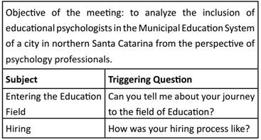
As demonstrated, the interviews began with trigger questions foreseen in the reflective interview technique, which aims to:
Be the starting point for the participant’s speech, focusing on the point to be studied, while also expanding enough for them to choose where they want to begin. With this, we will already have a direction for the interviewee’s reflections, who will initially be offered time for their free expression regarding the topic to be investigated. (Szymanski, 2011, p. 29).
The trigger questions were developed based on the research objectives, and the other questions emerged from what the professionals brought up in their speeches. The interviews were transcribed and shared with the psychologists so that they could read them, and they were offered the possibility of modifying something through a new meeting. All wanted to keep their original writings without modifications, stating that they were consistent with what they thought.
The data were organized based on the assumptions of Franco’s (2009) content analysis. Initially, a preliminary reading of the transcripts was conducted to familiarize oneself with the speeches. From the second reading onwards, the process of identifying the indicators of the main themes began.
Since the emphasis of this research is on the hiring process, two categories were created in order to understand the organization and hiring process of the professionals currently working in the city of Joinville, which were named: “The meeting: how the hiring process was organized”; “I applied for a health-related job posting’: the job postings”.
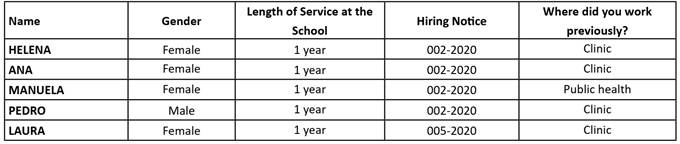
Based on the interview data, Box 2 (2023) was created, which contains some general information about the professionals participating in the research.
THE MEETING: HOW THE HIRING PROCESS WAS ORGANIZED
The meeting mentioned in the category title took place at the City Council of Joinville on September 14, 2021. It was broadcast live on YouTube, is available to the public, and aimed to explore and discuss the organization and implementation of Law No. 13.935/2019 in the city of Joinville.
It is necessary to point out how this meeting was arranged, as well as the need to include it in the analyses. During the analytical process of the data produced by the interviews with the professionals, we sought, together with them, to understand the process of organizing the public power in relation to the demands of School and Educational Psychology in the municipality. However, it was found that there were gaps in the statements that were not covered, but were significant points for understanding the organization of the implementation.
Based on Cruces and Caldas (2021), the understanding that, in order to understand how work in public policy is constituted, it is necessary to understand how the policy was implemented, since this process is also constitutive of the professional practice that will be exercised in the field of action.
The public session was attended by teachers and directors from the city’s public education network, representatives from the Municipal and State Departments of Education, as well as a school psychologist linked to the Regional Council of Psychology (CRP12).
For this research, the speech of the representative from the Municipal Department of Education stood out, since what is presented became complementary to the interviews, which in their content indicated the existence of this public session. As mentioned earlier, there was no prior disclosure by the public authorities.
So, within our project of discussions in the Municipal network, we have Law No. 13,935. The definition of the poles and the form of contracting. [...] This mapping today, we started with several professionals in the Municipal Department of Education, but we are still working with the idea of areas of territorial coverage. In a second phase, we brought together health and social assistance professionals to create a document that could guide their work in the School Unit. In a third phase, we even exhausted this demand for training professionals in Education, Social Assistance, and Health, with the aim of understanding the role of the psychologist and, above all, Educational Psychology in the context of regular schools [...] so that we could advance in practical terms regarding the work of these professionals in Education, we called psychologists and social workers from both the health department and the social assistance department for a dialogue and to create a document [...] We are also aware of how necessary it is to mobilize the network, to articulate the network to this student who needs assistance [...] (Municipal SED Representative, 2021).
In the excerpt above, some of the city hall’s guidelines regarding the implementation of Law 13.935 can be observed. The first, which we want to highlight, was the movement carried out by the SED (State Department of Education) to seek out Psychology professionals working in the Municipal Health and Social Assistance Network, in order to resolve doubts about the role of Psychology in the field of Education.
It is considered that the role of Psychology constitutes a profession with diverse fields of activity, thus enabling professional participation in different contexts. Consequently, it is understood that each area of activity in Psychology has its specificities, and in Education it could not be different. Thus, it is emphasized that in defending the specificity of the role in School and Educational Psychology, the aim is to support
A psychology (school and educational) capable of understanding the teaching-learning process and its articulation with development, based on human concreteness (socio-historical determinations), understood from the categories of totality, contradiction, mediation and overcoming. It must provide theoretical categories and concepts that allow for an understanding of the psychological processes that constitute the subject of the educational process and are necessary for the effectiveness of pedagogical action. (Antunes, 2008, p. 6, emphasis added).
In light of the above, based on Antunes (2008) and Antunes, Santos, and Barbosa (2021), it is highlighted that the Psychology professional working in the field of Education must appropriate understandings about education and school, comprehending their roles and objectives, as well as the social contexts that regulate and influence their directions.
Thus, the Psychology professional who will work in schools needs to know the public policies that underpin the performance and implementation of public education; the territorial reality of the school, including who the students and their families are; their living conditions and how the practices of teaching professionals, principals, coordinators, counselors, among others, develop. Therefore, it is necessary to know all members of the school community, whether in the relational, political or social sphere, since these factors affect and constitute the teaching-learning process (Souza & Barbosa, 2014; Andrada, Petroni, Jesus, & Souza, 2019; Marinho-Araújo et al., 2023).
In view of this, it is stated that the specificities of the work of School and Educational Psychology are better understood by those who dedicate themselves to acting, studying and researching this specific field. Thus, seeking help from professionals from other fields of Psychology can empty or even erase such specificities, since these professionals, coming from assistance and health, have their own specificities, management and understandings of the subject (Jacinto & Dazzani, 2023). This whole process demonstrates that there was no participation of professionals from School and Educational Psychology in this process.
The second point of focus was the process of constructing what would come to be understood as the practical duties of professionals, and at that moment a focus on working with students was perceived.
[...] Subsequently, considering the total number of students and thinking, above all [...] about how many students each professional will be responsible for, we do have [...] But in any case, we are currently working with one thousand eight hundred, two thousand, two hundred students per pair (psychologist and social worker). (Joinville City Council, 2021).
During her speech, the representative did not explain how the calculations were carried out, nor what criteria, indicators, and bases were used to determine the number of students per professional. In any case, this position, in addition to highlighting the centrality of the student, denotes the weakening of the specificities of School and Educational Psychology in the implementation of Law No. 13,935.
As pointed out in this study, the work of School and Educational Psychology encompasses all those who access and constitute the school and the school community, not being restricted only to the student, but considering the relations that are established in and by the school and their reverberations in the teaching-learning process.
By focusing the understanding of the work of School and Educational Psychology on the student, a complex discussion is entered into, since the constitution of Psychology in Education involves practices that may be “based on the idea of school failure, through the identification of the problem student” (Antunes, Souza, & Barbosa, 2021, p. 24). In this way, a fine line is configured that can lead to understandings that individualize students in their educational processes, erasing the social, cultural and political processes that are part of their learning process. The CFP (2019, p. 45) argues that “[...] it is essential to evaluate the student prospectively, in what he or she can develop, and not to restrict oneself to what the student cannot achieve, or even to focus only on the student, without reflecting on the social production of school failure.”
Thus, the public discussion session served to demonstrate the paths taken by the city hall for implementation; however, the lack of official documents that could be consulted regarding the actions taken by the Municipal Department of Education (SED) stands out, with the first information to which access was available being the meeting mentioned throughout this text. However, the meeting took place when the entire implementation process was already underway and organized, thus suppressing the participation of the professional, school and population community in these discussions. For Valente and Menezes (2023), such attitudes end up hindering access to information, which consequently makes it difficult to monitor the actual effectiveness of public policies.
“I REGISTERED FOR HEALTH”: THE SELECTION NOTICES
As seen so far, the public session provided some indications of what was intended for the formation of the professional teams; however, it is noteworthy that at no point in the speech of the professional linked to the municipal SED was there any mention of the hiring processes, it was only reiterated that the professionals were already in the hiring process.
Therefore, at this point there was a return to the interviews, to understand how these professionals were hired and how this process was organized. When asked about their hiring processes, the following answers were obtained:
[...] I passed a simplified selection process that I had registered for at the city hall. This was in 2021, because I had registered in 2020, so I didn’t even remember. But I registered because I thought it was for health. I never imagined it was for education, you know? So when I saw my area there, education there, man, I was terrified, you know? Because I don’t know, I didn’t remember anything [...] (Pedro).
[...] When I received the email I didn’t even know that this selection process was still valid, to be perfectly honest, because it had been quite a while, I think it reached the maximum timeframe of the selection process. Almost a year and eight months, a year and a bit, almost two years. They can extend it for up to two more years, depending on the notice, that whole thing. And then they called. When they called, I believed it was for healthcare. But okay, right? (Manuela)
[...] Then I registered for the selection process for the pandemic, for the healthcare area, emergency care during the pandemic (Ana).
Based on the statements mentioned above, it was possible to find Notice 002-2020 (Simplified Selection Process, Notice 002.2020, 2020) through which Ana, Helena, Manuela, and Pedro were hired. This public notice emerged in the midst of the Covid-19 pandemic in 2020, at the peak of the disease in Brazil, which infected approximately 30 million people nationwide. This necessitated new emergency hires to work in hospitals, primary healthcare units (UBS), and emergency care units (UPAs).
This notice concerns
the hiring of personnel for a fixed term, to meet a temporary need of exceptional public interest and the declaration of a state of emergency in the Municipality of Joinville through Municipal Decree No. 37,630/2020, making public the Simplified Selection Process - PSS for filling temporary positions in the Unified Personnel Framework of the Direct and Indirect Administration of the Municipality of Joinville and São José Municipal Hospital. (Secretary of Personnel Management, City Hall of Joinville, p. 1)
This notice focuses on work in the health sector, with regard to the scoring: “the classification of the Simplified Selection Process will be carried out by summing the points obtained from the evaluation of qualifications and hospital and professional experience” (Simplified Selection Process, Notice 002.2020, 2020a, p. 3). It should be noted, therefore, that professionals working in schools were hired through a health-related public notice, which indicates a distortion of the notice’s objectives, since the document issued and published by the city hall does not explicitly state that the professionals could be allocated to other areas of work.
It is understood that what attracted these professionals was the fact that it was a health-related public notice, as it was designed for that purpose; in this sense, there was surprise when they were informed that the vacancies were intended for education, since this possibility is never mentioned in the document.
Concurrently, the hiring process was taking place via a second public notice, 005-2020 (Simplified Selection Process - Public Notice 005-2020-SGP, 2020b), which was responsible for Laura’s hiring and differs from the other, as it is a hiring document for all areas of the city hall’s operations (Simplified Selection Process, Public Notice 005.2020, Simplified Selection Process - Public Notice 005-2020-SGP, 2020b).
The ranking order in this public notice does not have specificities like in the other, after all, it is a general hiring process, in which all levels of postgraduate studies (lato sensu or strictu sensu) in the field of Psychology, regardless of the focus, would be scored. At first glance, this seems to be an advantage, as by not being directed to a specific area, it can offer greater opportunity for professionals to apply.
However, it is noteworthy that the use of calls for applications without any field specificity can lead to the hiring of unprepared, unqualified professionals, and even those without interest in the school context, who end up entering the field without any technical preparation for school demands.
The use of notices for applications from other areas is not specific to the Joinville context. Jacinto and Dazzani (2023) analyzed some cities in the Northeast region in their research and found that calls for applications - for the hiring of school psychologists - still persist that link the area of School and Educational Psychology to psychometric aspects, clinical psychodiagnosis, and psychotherapeutic care. Gonçalves (2018) understands that this process occurs due to the little importance given to professionals in School and Educational Psychology within municipal governments, which do not understand their duties and the possibilities they can bring to the educational field.
When focusing on the job description of a psychologist, the document states that they are:
responsible for providing psychological care, screening, interviewing, and conducting individual, group, and/or family consultations; developing psychological programs, surveys, and studies; developing therapeutic plans, patient follow-ups, and family guidance; discussing cases, developing training topics, and conducting home visits and joint sessions to improve the health and quality of life of the population; and performing other technical analyses related to their area of expertise (Simplified Selection Process, Notice 005.2020, 2020, pp. 21-22, emphasis added).
It is therefore clear that this is a general definition of the psychologist’s work, which at first glance does not take into account the specificities of the field of Education; this, according to Lessa and Facci (2011), can end up defining in advance what the Psychology professional will do regardless of the context in which they work. Therefore, the importance of having a position for School and Educational Psychologist is understood, which delimits the specificities of public institutions, understands the needs of the area and makes this clear in its duties.
In any case, if there was an intention to hire a professional to work in schools, it is expected at least that this specificity is explicit in the documents and expectations regarding this professional, which does not occur in any of the calls for applications used for hiring.
These situations demonstrate that the public notices were used as instruments to initiate the implementation process of Law 13.935 (Brazil, 2019), since, as reported by the professionals, they were only summoned at the beginning of the second half of 2021, that is, a year and a half after their publication.
The use of these public notices also contrasts with what is advocated by the CFP (2020) in its official guidance document for the regulation and implementation of Law No. 13.935/2019. This document contains a series of recommendations, exemplifying the representative body’s position regarding the hiring process, including reiterating that:
Entry into public service should be through public competitive examination [...] in the case of Psychology professionals, differentiated scoring for professionals who have postgraduate courses (lato or stricto sensu) in School and Educational Psychology or in Education (Special Education, Inclusive Education, Psychopedagogy, Psychology of Education, Educational Psychology), recognized by the MEC [...]. (CFP, 2020, p. 39)
Taking into account what is defended by the document and what occurred in the process in the city of Joinville, it is clear that the only indication that appears is the fact that everyone is trained and has an active registration. The rest of the text does not present itself as a mere indication of work, which is worrying, as it gives the impression of a decontextualized and rushed process to meet an established deadline.
This could lead to the exclusion of psychology professionals who are interested in school practices, since professionals dedicated to studies and practices in the field of education may not apply for a call for proposals exclusively related to health.
FINAL CONSIDERATIONS
The research aimed to understand how the hiring process of school psychologists has been taking place in the municipal education network of a city located in northern Santa Catarina. Initially, it was understood that the implementation process of Law 13.935 (Brazil, 2019) is the origin for the insertion of these professionals in the aforementioned city.
In Joinville, the city studied, the first known step towards implementation was a joint meeting of the Education and Health Committees on September 14, 2021, held at the Joinville City Council, which was attended by several professionals linked to the municipal and state education departments, the CRP-12 (Regional Council of Psychology - 12th Region), and schools in the city. In this meeting, it was possible to get a first glimpse of how the city hall had organized itself to manage a municipal network that currently has 51 schools.
It is noteworthy that no document issued by the city hall justifying the number of students per professional was found, nor a plan, which ultimately hinders the process of monitoring the insertion of the professionals. The lack of publication or the lack of access to documentation explaining how the professionals were assigned to one school and not others makes it difficult to explain and substantiate these decisions. The absence of documents corresponding to these decisions makes it difficult to monitor the implementation process of the public policy.
Another point is the focus on the student to calculate the population size to be monitored by the professional. This denoted a certain lack of knowledge of the work of School and Educational Psychology on the part of the municipal public authorities and the team that coordinated the team’s hiring process.
The hiring model used by the city hall is considered a crucial point for understanding this implementation process. Two public notices were used, which were not specific to School Psychology, nor did they take into account knowledge in the area. One of them, responsible for hiring most of the professionals, was a public notice exclusively designed for health, which even took into account, for classification and ranking, training to work in the area.
It is understood that the process of establishing the field of School and Educational Psychology in the city is directly influenced by this hiring process, considering that these are the first Psychology professionals who will work with schools in the Municipal Basic Education System. Therefore, the ways in which they are hired may influence the practices that will be established later. Although there is a theoretical and practical framework capable of supporting the work of School and Educational Psychology professionals, there is still a predominance of a generalist view of the psychologist’s work, without taking into account the specificities of the field, which can lead to practices based on individualizing and biologizing perspectives of the subject, which cause processes of blaming students, teachers and families for school failures.
Finally, the need for the continuation of this study is understood, as it is of utmost importance to monitor the implementation of Law 13.935/2019, as well as to conduct research that delves deeper into how the work of these professionals is being structured in the schools where they are located, and the development of relationships with other education professionals, in order to theoretically and practically strengthen the performance of school psychologists who are being hired to work in public education.
References
- Andrada, P. C, Petroni, A. P., Jesus, J. S., & Souza, V. L. T. (2019). A Dimensão Psicossocial na formação do psicólogo escolar crítico. In V. L. T. Souza, F. S. B. Aquino, R. S. L. Guzzo, & C. M. Marinho-Araujo (Eds.), Psicologia Escolar Crítica: Atuações emancipatórias nas escolas públicas Alínea.
-
Antunes, M. A. M. (2008). Psicologia Escolar e Educacional: história, compromissos e perspectivas. Psicologia escolar e educacional, 12, 469-475. https://doi.org/10.1590/S1413- 85572008000200020
» https://doi.org/10.1590/S1413- 85572008000200020 - Antunes, M. A. M., Santos, R. C., & Barbosa, D. R. (2021). Psicologia e Educação: sobre as raízes da Lei nº 13.935/2019 e os desafios da psicologia escolar. In M. G. D. Facci, A. A. Anache, & R. F. L. Caldas (Eds.), Por que a psicologia na educação?Em defesa da emancipação humana no processo de escolarização. (vol. 1, pp. 17-32). CRV.
- Barbosa, D. R. (2011). Estudos para uma história da Psicologia Educacional e Escolar no Brasil [Tese de Doutorado, Universidade de São Paulo, São Paulo- SP].
-
Brasil. (2000). Projeto de Lei 3.688/2000 Dispõe sobre a introdução de assistente social no quadro de profissionais de educação em cada escolahttps://www.camara.leg.br/proposicoesWeb/fichadetramitacao?idProposicao=20050
» https://www.camara.leg.br/proposicoesWeb/fichadetramitacao?idProposicao=20050 -
Brasil(2019). Lei 13.935, de 11 de dezembro de 2019 Dispõe sobre a prestação de serviços de psicologia e de serviço social nas redes públicas de educação básica http://www.planalto.gov.br/ccivil_03/_ato2019-2022/2019/lei/L13935.htm
» http://www.planalto.gov.br/ccivil_03/_ato2019-2022/2019/lei/L13935.htm -
Câmara de Vereadores de Joinville. (2021). Reunião conjunta das Comissões de Educação e de Saúde em 14 de setembro de 2021 (120 min., vídeo). Joinville, SC. https://www.youtube.com/watch?v=Nv5G65HnC1I
» https://www.youtube.com/watch?v=Nv5G65HnC1I - Conselho Federal de Psicologia. (2019.Referências técnicas para atuação de psicólogas(os) na educação básica CFP.
-
Conselho Federal de Psicologia[CFP]. (2020). A(O) psicóloga(o) e a(o) assistente social na rede pública de educação básica: orientação para regulamentação da Lei n.º 13.935, de 2019 Brasília, DF: CFP. https://site.cfp.org.br/wp-content/uploads/2020/08/psicologas-os-e-assistentes-sociaisna-rede-publica-de-educacao-basica.pdf
» https://site.cfp.org.br/wp-content/uploads/2020/08/psicologas-os-e-assistentes-sociaisna-rede-publica-de-educacao-basica.pdf - Cruces, A. V., & Caldas, R. F. L. (2021). A psicologia escolar e educacional em São Paulo: sua história, suas lutas e suas conquistas. In M. G. D. Facci , A. A. Anache , & R. F. L. Caldas (Eds.), Por que a psicologia na educação? Em defesa da emancipação humana no processo de escolarização (vol. 1, pp. 71-88). CRV.
- Dipp, R. P., Santos, A. M., & Bortoli, G. G. (2021). A Psicologia escolar e educacional pensando as infâncias na pandemia: os reflexos do antes ao depois do isolamento social sobre as crianças. In F. Negreiros, & B. de O. Ferreira(Eds.), Onde está a psicologia escolar no meio da pandemia? (pp. 869-882). Pimenta Cultural.
- Franco, M. L. P. B. (2009). Análise de conteúdo (3a ed.). Líber Livro
- Gatti, B. A. (2020). Possível reconfiguração dos modelos educacionais pós-pandemia. Estudos Avançados, 34(100), 29-41.
- Gonçalves, M. O. (2018).A formação inicial na psicologia escolar: Atuação, perspectivas e desafios da profissionalização[Dissertação de Mestrado, Universidade Federal da Bahia].
- Jacinto, P. M. S., & Dazzani, M. V. M. (2023). Atribuições e competências para o psicólogo escolar: uma análise do perfil requerido em concursos públicos. In: C. M. Marinho-Araújo, A. M. B. Teixeira, & L. Cavalcante(Eds.), Psicologia Escolar: atuação profissional e a Lei 13.935\2019 (pp. 13- 33). Alínea.
- Lessa, P. V., & Facci, M. G. D. (2011). A atuação do psicólogo no ensino público do Estado do Paraná.Psicologia Escolar e Educacional, 15(1), 131-141.
- Marinho-Araújo, C. M, Teixeira, A. M. B., & Cavalcante, L. (2023). Lei 13035\2019: histórico, limites e potencialidades para a Psicologia Escolar. In: C. M. Marinho-Araújo, A. M. B. Teixeira, & L. Cavalcante (Eds.), Psicologia Escolar: atuação profissional e a Lei 13.935\2019 (pp. 13- 33). Alínea.
- Massimi, M. (1990). História da psicologia brasileira: da época colonial até 1934 EPU.
-
Molon, S. I. (2008). Questões metodológicas de pesquisa na abordagemsócio-histórica.Informática na educação: teoria & prática, 11(1), 56-68. https://seer.ufrgs.br/index.php/InfEducTeoriaPratica/article/view/7132
» https://seer.ufrgs.br/index.php/InfEducTeoriaPratica/article/view/7132 - Patto, M. H. S. (2000). A produção do fracasso escolar: histórias de submissão e rebeldia (2a ed.). Casa do Psicólogo.
- Patto, M. H. S. (2022). Psicologia e ideologia: uma introdução crítica à Psicologia Escolar T. A. Queiroz.
-
Prefeitura de Joinville. Processo Seletivo Simplificado - Edital 002-2020-SGP (2020). Edital de contratação de pessoal. Joinville, SC. https://www.joinville.sc.gov.br/public/portaladm/pdf/jornal/47423df5eb755bdce7c58c06f7814ad8.pdf
» https://www.joinville.sc.gov.br/public/portaladm/pdf/jornal/47423df5eb755bdce7c58c06f7814ad8.pdf -
Prefeitura de Joinville. Processo Seletivo Simplificado - Edital 005-2020-SGP(2020). Edital de contratação de pessoal. Joinville, SC. https://www.joinville.sc.gov.br/public/portaladm/pdf/jornal/3b150a1565e80709f2daa548e1c5e49e.pdf
» https://www.joinville.sc.gov.br/public/portaladm/pdf/jornal/3b150a1565e80709f2daa548e1c5e49e.pdf - Saviani, D. (2021).História das ideias pedagógicas no Brasil ed. 6º. Autores Associados
- Seixas, P. S., & Yamamoto, O. H. (2019). Fundamentos dos projetos pedagógicos dos cursos de psicologia no Brasil. In M. A. Barreto, & M. G. D. Facci (Eds.), Formação em Psicologia: Temas (IM)pertinentes (pp. 51-64). CRV.
- Souza, B. P., & Barbosa, D. R. (2014). Psicologia educacional e escolar: A riqueza de um campo de saber e práticas. In E. T. D. Dias & L. P. L. Azevedo(Eds.),Psicologia escolar e educacional: Percursos, saberes e intervenção Paco Editorial.
- Souza, M. P. R., Lima, C. P., Ramos, C. J. M., Barbosa, D. R., Yamamoto, K., & Calado, V. A. (2022). Atuação do psicólogo na educação: O que pensam pesquisadores brasileiros sobre o tema. In M. P. R. Souza, S. C. Silva, & K. Yamamoto (Eds.),Atuação do psicólogo na educação básica: Concepções, práticas e esafios pp. 47-6EDUFU
- Szymanski, H. (2011. A entrevista na educação: Uma prática reflexiva4ª ed. Liber Livro
- Vigotski, L. S. (1998).A formação social da mente Martins Fontes.
Research data is only available upon request.

 Source: Research data.
 Source: Research data.