 SCHOOL AND THE CONSTRUCTION OF IDENTITIES: THE STUDENTS’ PERSPECTIVE
ABSTRACT
This article presents the results of a master’s degree research project conducted at a public High School in the Federal District, with the participation of eight third-year students. Using the theoretical framework of Cultural Psychology, qualitative research was conducted to investigate students’ perspectives about the role of school in the construction of gender, racial, and sexual identities. Focus groups and workshops were held in which participants analyzed and created images representing their perceptions about the topics. The results indicated that schools often condone the reproduction of prejudice and discrimination against women, Black people, and those with sexual orientations other than heterosexuality. For the participants, schools promote equality when they disseminate knowledge, but they could address issues of gender, race, and sexuality as a way to contribute to transforming schools into democratic spaces that include all.
Keywords:
social identities; school; prejudice; cultural psychology
RESUMO
O presente artigo apresenta os resultados de uma pesquisa de mestrado realizada em uma escola pública de Ensino Médio do Distrito Federal, com a participação de oito estudantes do 3º ano. A partir do referencial teórico da Psicologia Cultural, foi realizada uma pesquisa qualitativa com o objetivo de investigar a perspectiva dos/as estudantes sobre o papel da escola na construção das identidades de gênero, de raça e sexuais. Foram realizados grupos focais e oficinas nos quais os/as participantes analisaram imagens e construíram imagens representando suas percepções sobre os temas. Os resultados indicaram que a escola é, frequentemente, conivente com a reprodução de preconceitos e discriminações contra mulheres, pessoas negras e com orientações sexuais diferentes da heterossexualidade. Para os/as participantes, a escola promove igualdade quando dissemina conhecimentos, mas poderia trabalhar as questões de gênero, de raça e de sexualidade como forma de contribuir para transformar a escola em um espaço democrático que inclua todos/as.
Palavras-chave:
identidades sociais; escola; preconceito; psicologia cultural
RESUMEN
El presente artículo presenta los resultados de una investigación de maestría realizada en una escuela pública de enseñanza secundaria del Distrito Federal, con la participación de ocho estudiantes del 3º curso. A partir del referencial teórico de la Psicología Cultural, se realizó una investigación cualitativa con el objetivo de investigar la perspectiva de los/las estudiantes sobre el papel de la escuela en la construcción de las identidades de género, de raza y sexuales. Se realizaron grupos focales y talleres en los cuales los/las participantes analizaron imágenes y construyeron imágenes representando sus percepciones sobre los temas. Los resultados indicaron que la escuela es, frecuentemente, connivente con la reproducción de prejuicios y discriminaciones en contra mujeres, personas negras y con orientaciones sexuales distintas de la heterosexualidad. Para los/las participantes, la escuela promueve igualdad cuando disemina conocimientos, pero podría trabajar las cuestiones de género, de raza y de sexualidad como forma de contribuir para transformar la escuela en un espacio democrático que incluya todos/as.
Palabras clave:
identidades sociales; escuela; prejuicio; psicología cultural
INTRODUCTION
So, it [prejudice] really exists, guys. It is not only a matter of homophobia, racism, or bullying [...] We have to keep in mind that we are all human beings and we are all going to the same place when we die. There in the casket, flesh is gone, all is gone. There is only white bone dust. Got it? And that is it. (Testimony by Alice, high school student at a public school in the Federal District).
Schools are not institutions that are “disconnected” from their social contexts. Just like any other institution, schools are made up of people, they are situated in specific historical moments and marked by particularities of the cultural context of which they are part. That is the reason why at school we can find the prejudice, the discrimination, and the violence that we can see outside the schools.
In the testimony that starts this article, student Alice1 explains that at school, there are all kinds of prejudice and discriminatory practices that reveal how individuals exclude and get excluded. She argues that we have to keep in mind that human beings, despite all differences, have their great equalizer: death.
How can school contribute to raise students’ awareness that people have the right to be respected in their specificities? Is it a responsibility of schools to confront prejudiced attitudes discriminatory practices regarding groups and individuals that are historically discriminated?
Several authors nowadays defend that schools are privileged spaces for the promotion of a culture of appreciation of diversity and of overcoming stereotyping, prejudice, and discrimination (Franco & Cicillini, 2015; Gusmão, 2003; Louro, 2003; Madureira, 2007; Madureira & Branco, 2012, 2015; Madureira, Barreto, Silva, & Bastianello, 2021; Marques & Castanho, 2011; Moreira & Câmara, 2008, and so on). Due to their plural composition, schools are places where different people get together. They are fertile ground for the construction of bonds of solidarity and for learning how to exercise democracy.
However, in certain sectors of our society, we have observed resistance to the idea that schools must work on the deconstruction of inequality in ethnic-racial, gender, and sexual-orientation terms (Madureira, Paula, & Barreto, 2018). For instance, we can mention the “Escola Sem Partido” Movement, which has influenced the creation of several law projects with the purpose to change Law no. 9.394, from December 20th, 1996 (Brasil, 1996), the Law of Educational Directives and Bases (LDB), to prevent educators from realizing what the Movement defines as “ideological indoctrination”: the use of classroom space to promote their ideological, religious, moral, and political “preferences” as well as their opinions and conceptions of the world. Among the “forbidden themes”, the movement in question pays special attention to matters of gender and sexuality. Initiatives such as this one invariably deprive students of their right to an education that is based in knowledge, on debate, on dialogue, and on the respectful confrontation of opinions (Madureira, Paula, & Barreto, 2018).2
The present article corresponds to an excerpt from a research that was realized at a public school in the Federal District, in which the first author, under orientation by the second author, investigated the perceptions, the feelings, and the beliefs of high school students regarding the role played by school in the construction of social identities, with a focus on gender, race, and sexual identities.
The results of the aforementioned research constitute the Mastering Dissertation entitled “School and its role in the construction of social identities” (Mastering Program in Psychology, Line of Research: Psychology and Education, Centro Universitário de Brasília - UniCEUB). With the intention to present a scientific article format (more synthetic in comparison with the mastering dissertation process), we decided to select some of the most significant results that were obtained in the research, while analyzing some of the meanings that were attributed by the students to the way school approaches matters of gender, race, and sexual orientation.
The study was based on important concepts and assumptions of Cultural Psychology in its semiotic aspect. This theoretical perspective emphasizes the fundamental, structural role played by culture in human psyche, with a highlight on the processes of cultural channeling of ways of being, acting, thinking, and feeling that different individuals display in society (Madureira, 2016, 2018; Valsiner, 2012). Because of their capacity to create and use signals, human beings are constantly involved with processes of signification. That is, they are always attributing meanings to their experiences, always immersed in the irreversible flow of time (Madureira, 2018; Valsiner, 2012). In a more specific way, according to Branco (2021, p. 70),
To cultural psychology, culture is the central and essential factor for the development of human beings in all its aspects and dimensions. [...] Adopting sociogenesis and the constructive character of human beings as fundamental, it is possible to affirm that the most important characteristic of cultural psychology is the fact that it is constituted by a systemic and dialogical perspective, which establishes the centrality of the mutual constitution between individuals and culture [...].
It is important to explain that considering that culture drives the ways of being in the world does not mean believing that it determines the forms of subjectivation that are experienced by concrete people. The reason for that is that human beings are always attributing their own meanings to messages from their cultural contexts, contributing in different ways for cultures, as complex systems, to be always in movement (Valsiner, 2012).
More specifically, based on Cultural Psychology in its semiotic aspect, researchers tried to understand, from the high-school students’ perspective, the way school acts in the construction of identities, with the practices it disseminates, the contents it transmits, the values and beliefs it promotes, and also with its silence...
It is important to emphasize that several authors in contemporary times have highlighted how much silence on the themes, which are often considered polemic, contributes to the maintenance or even the strengthening of inequality among blacks and whites, men and women, and among heterosexuals and people with non-hegemonic sexual orientations (such as Borrillo, 2009; Lionço & Diniz, 2009; Louro, 2003; Madureira, Holanda, Paula, & Fonseca, 2021; Madureira, Barreto, Silva, & Bastianello, 2021; Obando, 2021).
It is important to emphasize that identity processes involve the always culturally contextualized construction of distinct social identities (in terms of gender, sexual orientation, social class, ethnic-social affiliation...). The construction of social identities involves a feeling of affiliation in individuals regarding distinct groups that constitute societies, by means of the symbolic marking of differences (Madureira, 2007, 2018; Madureira & Barreto, 2018; Woodward, 2000).
However, when the symbolic marking of difference results in the construction of rigid, hierarchic, and symbolic frontiers that disqualify certain social groups, there is prejudice such as sexism, homophobia, elitism, and racism (Madureira, 2007, 2018; Madureira & Branco, 2012, 2015). Therefore, there is a profound connection between prejudice and identity processes, as complex psychosocial phenomena. School psychology, as a field of investigation and of professional intervention, must seriously consider such connections towards the delineation of actions that target the prevention of violence and the construction of a peace culture, in alignment with the appreciation of the diversity that constitutes us as humans (Madureira, 2013).
Therefore, it is necessary to pay attention to these aspects of the education process because sexism, racism, homophobia, ethnocentrism, and other discriminatory practices are frequently reinforced in everyday-life activities at schools. So, it is fundamental to ask ourselves: what are the values that are stimulated, even unintentionally by schools? (Branco, 2018).
In addition, it is necessary to promote dialogue and promote the construction of spaces for exchange and for effective participation by students in the classroom (Fernandes, 2010; hooks, 2013; Lionço & Diniz 2009; Louro, 2003; Madureira & Branco, 2015; Madureira & Barreto, 2018). To hooks (2013), dialogue is the condition for learning. In a classroom where everyone can express themselves, students commit to the creation of an effective space for learning and for listening to each other, while recognizing differences and respect them (Madureira & Barreto, 2018).
However, school is often unprepared to listen to students and promote their active participation (Gomes, Padovani, Dazzani, & Ristum, 2014; Marques & Castanho, 2011; Mendes, 2015). In this sense, the research presented here was based on the comprehension that students can offer significant contributions to the way schools have acted on the construction of gender, ethno-racial, and sexual identities. In addition, students might provide us with clues as to how schools can take action to change and become a place that makes sense to them, a space where they can be respected and appreciated in their differences.
Seriously considering the voices of the students is in agreement with the overcoming of the traditional individualistic model of practice in the area of school psychology (“clinical model”), towards the consolidation of an institutional, preventive, and relational model for professional practice in the area of school psychology (CFP, 2019; Madureira, 2013; Marinho-Araujo & Almeida, 2008; Neves, 2011). According to the technical references presented by the Federal Psychology Council (FPC, 2019) regarding the practice by school psychologists:
For an intervention in the area, the first question professionals can ask themselves is: what is the social function of the school? [...] The objective of school is to socialize content and the instruments that are necessary to have access to knowledge. [...] Thus, psychologists understand that their action can lead to the transformation or the maintenance of society that way it is organized (CFP, 2019, pp. 42-43).
The general objective of the research was to analyze, from the students’ perspective, the way schools contribute to the construction of different social identities (the analysis focuses on the following social markers: gender, sexuality, and race). Concerning the specific objectives of the research: (a) by means of meetings with focal groups, researchers attempted to identify the conceptions, beliefs, and feelings of a group of adolescent students at a public high school in the Federal District (Brazil) regarding the role played by school in the construction of social identities of gender, race, and sexuality: and (b) by means of workshops, researchers attempted to promote the debate and the exchange of experiences among the participants on themes that emerged in the focal groups and that are associated with the discussion on the construction of the social identities that were approached in the research.
METHOD
The research involved the use of a qualitative methodology of investigation, which is more in accordance with the important assumptions and principles of the theoretical perspective that was adopted in the research: cultural psychology (Valsiner, 2012). Specifically, the research included the realization of two focal group sessions and four workshops with high school students at a public school in the Federal District to work the themes of social identity, race, gender, and sexuality by means of the use of images as methodological tools (Madureira, 2016). The images were used as tools for accessing the conceptions, beliefs, and feelings of the students on the researched themes. In order to do it, we created a collective space of trust and active participation that was very important for the realization of the research.
Participants
The research had the participation of eight students from a public high school in the Federal District: five girls and three boys who were enrolled in the 3rd year. The students have been given fictitious names: Alice, 19 anos; Cláudio, 17 anos; Érica, 17 anos; João, 19 anos; Juliana, 17 anos; Lílian; 17 anos; Pedro, 17 anos and Sílvia, 17 anos.
The school is situated in one of the administrative regions of the Federal District, in the outskirts of Brasília and it is exclusively attended by high school students. Just like in other peripheral administrative regions of the Federal District, its origin is in the settlements that sheltered workers and their families during the construction of Brasília.
During a visit to the school, specifically to the 3rd year classes, the objectives of the research were presented and, in general terms, the activities that were to be developed with the participants. Ten vacancies were offered and a deadline was established for those who were interested to fill in the application forms, which were available at the pedagogical coordination of the school.
The eight participants who chose to participate in the research demonstrated genuine interest, which contributed to their engagement in the activities that were developed during the research.
Information construction procedures
Initially, the research project was submitted to the Research Ethics Committee of Centro Universitário de Brasilia (CAAE 44732315.2.0000.0023). Later, the research project was approved and the field research could then be realized. The commitment with the production of scientific knowledge that might somehow contribute to the improvement of the lives of people in their everyday-life context led us into the use of methodological strategies that contemplated the communicative processes among the participants and also with the researcher, in conformity with the discussion that was developed by González Rey (2015). Thus, we intended to create a space for trust and collaboration where students could freely express their opinions, their beliefs, and their feelings on the researched themes.
More specifically, the methodological strategies that were used during the meetings with the participants were the following:
-
Focal Groups: the first two meetings with the participants of the research were realized by means of focal groups, with a duration of approximately one hour and thirty minutes each. In the first focal group, the students received information on the research, introduced themselves and explained their interest to participate in the research. In the second focal group, using diverse printed internet images, the students were asked to explore some ideas about the themes of the research. There were 20 printed images each one on an A4-size sheet. The images suggested reflections on themes such as: identity, school, relation with students, subjectivity, violence, dialogue, diversity, freedom etc. These two initial moments were important for the construction of the communication processes between the research and the participants (González Rey, 2015).
-
Workshops: four workshops were realized, and each one lasted one hour and forty minutes, approximately. By working with workshops as a methodological strategy for the construction of information on the themes that were approached by the research, it was possible to create an environment that was different from the classroom. The realization of workshops contributed to the active participation of the students because there was a different proposal at each meeting and there was encouragement for students to creatively reveal their ideas and feelings on the themes that were approached by the research.
We agree that the use of images in qualitative researches has proven a fruitful methodological tool in the construction of relevant information on the meanings that the participants attribute to everyday-life situations and experiences (Madureira, 2012, 2016). In addition to the use of internet images as a means to promote debate among the participants, we requested the teenagers in the workshops to produce their own images, generally after a previous discussion on the selected theme for that day. Now we will present a brief summary of the four realized workshops.
Gender workshop: the students produce 30 photographs at the school, displaying scenes, episodes, events, and objects that revealed some information about the way gender relations constitute themselves in that environment. In the gender workshop, the printed photographs were presented to the participants so that they could discuss their choices of photographs and the gender theme.
Race workshop: we started the meeting with a debate on the differences between racial discrimination in Brazil and in the USA and with the exhibition of a short video approaching the racism issue.3 After that, the participants were asked to produce, in pairs, a collage that represented their opinions in the way the school handles the theme of racial inequality.
Sexuality Workshop: in order to start this workshop, the students read a selected excerpt from a report in the Nova Escola4 magazine. It was the testimony of a student who had gone through serious difficulty due to discrimination at school. The reason was her non-heterosexual orientation. After the students presented their opinions on this student’s experience, they were asked to produce an image in clay as an answer to the following question: “How does the school handle the sexuality theme (or how should it be handled?5).
Conclusion Workshop: in this last workshop, we remembered the themes that were approached during the two focal group sessions and the four realized workshops. Later, the students talked about how they felt about participating in the research.
Analysis procedures
The audio recordings of the six meetings were made with the students’ authorization and the researchers listened to the recordings right after each meeting. We aimed at registering relevant aspects in the dialogues and several parts were fully transcribed. A field diary was also produced and the information that seemed most relevant was registered after each meeting. After that, all images that were produced by the participants (photographs, drawings, collages and clay figures) became a valuable material in the process of analysis of the information that was obtained in the field research.
Based on a preliminary analysis of the set of information pieces produced in the six meetings, theme analysis categories were created to guide the interpretative work, while facilitating the identification of the points of convergence and divergence (Madureira, 2007). Specifically, the theme analysis categories were: The role played by school; (2) Identity issues; (3) Gender issues; (4) Racial issues; and (5) Sexuality issues. In the next section, the most meaningful results that were obtained in the realized research will be presented and discussed.
RESULTS AND DISCUSSION
The participants expressed diverse opinions on the role played by school in the promotion of discussions on matters of gender, identity, race and sexuality with students, as we can see in the following examples. It is important to remember that all names are fictitious.
I think it is important to discuss social identity at school. But the primary function of school is to provide education.
[...] Regarding social identity I think there should be more connection between families and the school. (João).
But there must be assistance. It is fundamental [...]. Many students do not have the space for such conversations at home with their parents. They do not have the freedom to go up to their parents and talk about it. So I believe that, yes, school can be very helpful. (Érica)
In the first testimony, we observed that participant João considers that the primary role of the school is to teach basic content and that when teachers teach, for example, Portuguese, math, and history, they do not express their personal opinions on most diverse themes such as the ones related to gender, race, and sexuality. However, it is important to mention that all scientific productions and pedagogical practices are based on specific world conceptions and connect to determined science, education, and society projects in a broader sense (Madureira, Paula, & Barreto, 2018). It is naïve to ignore these relations. It might hinder dialogue among differing opinions.
The testimonies by students João and Érica also lead us to reflect on the delicate and necessary relation between family and school. Despite their differences, both institutions take on the task of preparing the new generations for life in society and, when they establish a respectful relationship that is committed to dialogue and mutual recognition, everyone benefits in the school community (Szymanski, 2007). As participant Érica argues, school can help students comprehend their experiences in the construction of their identities, especially when families have difficulty to explore matters that are, many times, regarded as delicate with their sons and daughters.
It is sad to observe that, frequently, schools fail to become spaces for acceptance of differences and that it acts in the direction of the homogenization of the diverse characteristics of their students. To Candau (2008), these homogenizing practices end up making students suffer because the education provided by school seems distant from their socio-cultural experiences. Such disconnection from the students’ personal experiences often contributes to their discomfort at school, in addition to promoting evasion and school failure.
It is of fundamental importance, therefore, that School Psychology in contemporaneity aims at contributing to the delineation and the implementation of intervention strategies that target the deconstruction of prejudice such as homophobia and transphobia at educational institutions. After all, according to Negreiros, Pereira Neto and Araújo (2023, p. 33),
Historically, the LGBTQIA+ community has been the victim of many types of violence. During the school years, these situations can be disguised as innocent jokes or bullying. However, they can affect one’s whole existence [...]. Thus, the critical, cooperative and socially referenced practice of school psychologists is indispensable considering their theoretical assumptions in a joint action with the school community in order to promote education, respect, and constant struggle for the LGBTQIA+ population’s right to education.
Several present-time authors draw our attention to the suffering experienced by students who go through discrimination at school because of their non-hegemonic social identities (such as Franco & Cicillini, 2015; Junqueira, 2009, 2010; Madureira & Branco, 2015; Madureira, Holanda, Paula, & Fonseca, 2021) or simply because of their ethnic-racial affiliations (Gomes, 2002; Madureira, Barreto, Silva, & Bastianello, 2021; Silva, 2014). The participants of the research also reported discrimination situations that happened inside the school, sometimes encouraged by their teachers.
Every class is the same, he talks about sex and criticizes women. Every single class. And then he was like: “both my wife and I have jobs, so when we get home, there is housework to do. But what can I do? I don’t know how to do things around the house. I don’t know how to do it, so what is the point helping her? It would be a waste of time”. And then the boys say: “yeah, housework is for women. Women shouldn’t be dating around.” (Alice)
Participant Alice reported that, in the classroom, there was a male teacher who was constantly making sexist, disrespectful remarks about women. Other participants confirmed that this teacher usually made such remarks.
Teachers should use their privileged position, as authority figures in the classroom, to help students be able to recognize prejudiced attitudes, which are the basis of discriminatory practices against women (Madureira & Branco, 2012). Unfortunately, this teacher who was mentioned by the participants seems to be on the opposite direction, that is, in the reproduction of archaic gender stereotypes that end up contributing to the maintenance of inequalities among men and women. After all, the reproduction of gender stereotypes plays a strategic role in the maintenance of sexism in everyday cultural practices.
In the school context, it is common for matters of gender, race, and sexuality to be approached this way: by means of practices that reproduce the nefarious effects of racism, sexism, and homophobia. On the other hand, the participants also drew attention to another mechanism of reproduction of discriminatory practices: silence.

In the sexuality workshop, for example, some participants talked about the inexistence of pedagogical activities that focused on the debate over sexuality matters. In the following image, which reproduces the clay figure created by student Pedro, he expresses his opinion on the school’s refusal to see, recognize, problematize and confront prejudice against people with non-heterosexual orientation. Homophobic practices exist within the school context but they are neglected or muted, which ends up contributing to the perpetuation of such practices.
The similar figures represent the different individuals at school. The school regards them as equal, as having the same weight, but in fact, what really exists is a big problem [the clay ball] that they try to hide. But it does not work. The small cloth hides the problem. The school merely tries to keep up appearances. The problem is prejudice and rejection (Pedro).
This silence does not happen only in relation to homophobia, but also to racism. In this sense, it is important to mention the research realized by Silva (2014), which aimed at analyzing the possible implications of racism and sexism in the education process of women to reported themselves as black. According to the author, schools are normally complacent regarding discriminatory racist practices that black children go through in the school environment and this omission provokes significant suffering in black children, in addition to contributing to the construction of a deteriorated self-image.
During the racism workshop, a pair of participants represented their feelings regarding the existence, nowadays of situations that place black people in situations of disadvantage regarding white people. The collage produced by one of the pairs of participants displays the image of a black man with a facial expression that shows irritation or apathy and, above this image, the words: “we are talking about racism!” According to the perception of the pair of participants, it is unacceptable that people are still judged by the color of their skin. That is the reason why we need to recognize and confront the overt and covert ways racism exists in everyday life.
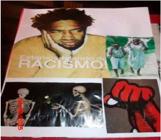
The same collage displays the image of a fist that represents the fight, the commitment to discuss the theme in all contexts, including at school. In addition, there is very significant image selected by the pair of participants in order to demonstrate the things all humans have in common. The image of two skeletons, and one of them is giving the other a flower, reminds us of the importance of us recognizing the reality to which Alice’s testimony at the beginning of this article draws our attention: “... we are all human beings and we are all going to the same place: death. Ther in the casket, flesh is gone, there only white bone dust. Got it?” (Alice).
Although they recognize that school is, many times, complacent in situations of discrimination that take place within its walls, the participants believe that school contributes to the reduction of gender, race and sexual orientation discrimination. School does it by disseminating knowledge and putting together different people in classrooms and provides them with an education without privilege.
The following image is an example of this opinion. It was produced by another pair of students in the racism workshop. As we have mentioned before, in this activity, the participants should produce a collage as an answer to the following questions: “how does our school handle the racial inequality issue? How is the race theme handled in our school?”

The collage contemplates images of three people of different ethnic-racial identities (a black person, a white, and an indigenous person). They are displayed side by side and share the same starting and finish line, represented by several symbols of “success”, according to the point of view of the students who produced the collage: rights, freedom, education, and money. In this same image, there is the question: “What is the color of success?”. In the opinion of the pair of students, school treats everyone with equality and, by means of school education, students can have “success” in life. This opinion was confirmed by other participants, as in the discussion on sexuality in which the student created a clay figure (reproduced below) that represents the teacher teaching content to homosexual and heterosexual students, no difference.
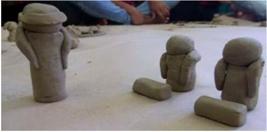
This was a significant aspect that was observed during the field work. While participants reported situations of homophobia, sexism and racism within the school, defended that it should approach these themes, which it was not doing, and also believed that school was already somehow contributing to the reduction of racial, sexual, and gender inequality.
FINAL CONSIDERATIONS
There are certain themes that correspond to recurrent demands at school. For example: preventing and confronting bullying, promotion of inclusion at school and the construction of a peace culture. Such demands are fertile soil for research and for interventions in the field of school psychology. [...] After all, it is fundamental that we keep in mind the possible implications of our research works and, on the other hand, remember the theoretical foundations that sustain the adopted intervention strategies (Madureira, 2013, p. 64).
This article aimed at presenting a part of a research that was realized at a public high school in the Federal District (Brazil) and at understanding how students perceive the role played by school in the construction of different social identities. The starting point was the notion that school, as a significant social institution in the realm of literate contemporary societies, plays a relevant role in the construction of the students’ identities (Moreira & Câmara, 2008). Despite the fact that its plural formation contributes to its configuration as a privileged space for the appreciation of difference and for the construction of democratic values, schools often fall into the reproduction of stereotypes and prejudices that are part of the context in which they are inserted.
The students who participated in the research believe that there is prejudice and discrimination at school. They also believe that there is a lack of discussions on gender, race, and sexual orientation inequalities. They demonstrated a lot of interest to talk on these themes and listen to different opinions. Most of them believe that schools must promote this type of discussion and encourage students to reflect on their own identity. In addition, they argue that, by disseminating knowledge, school is already helping to reduce inequality.
This perception might indicate that they fail to notice that the knowledge that is disseminated at school (the way they are produced, the way they are shared by the teachers, the content that composes the curricula, and so on) can also contribute the reproduction or even the strengthening of stereotypes and prejudice. Such perception, demands, therefore, a critical education. That is, everyday pedagogical practices that target the development of critical thinking, and the promotion of respectful, empathic dialogue, which is fundamental in the exercise of citizenship in the context of democratic societies. Something that schools can certainly provide. School psychologists can, therefore, provide important contributions in this direction, that is, in agreement with a relational, preventive, and institutional professional practice, according to the present article.
The results of the research indicate the relevance of promoting, in the school space, critical reflection and dialogue on gender, race, and sexuality issues, not only with students but also with teachers and other professionals who are involved with the school. In this sense, the use of images, as cultural artefacts, might benefit a more significant approximation, in subjective terms, which appreciates emotional aspects that are involved in the discussion of these themes. In a nutshell, the images can be useful educational tools for professional practice by school psychologists.
The research also indicated the importance of appreciating the active participation of the students in the construction of a more inclusive and democratic school that makes sense to them. In order to do it, we think it is fundamental to amplify research works in the field of school psychology that involve the active participation of students.
References
- Borrillo, D. (2009). A homofobia. In Lionço, T. & Diniz, D. (Eds.), Homofobia & Educação: um desafio ao silêncio (pp. 15-46). LetrasLivres / Editora da Universidade de Brasília.
- Branco, A. U. (2018). Values, Education and Human Development: The Major Role of Social Interactions’ Quality Within Classroom Cultural Contexts. In: A. U. Branco & M. C. S. L. Oliveira(Eds.), Alterity, Values, and Socialization: Human Development Within Educational Contexts (pp.31-50). Springer International Publishing.
- Branco, A. U. (2021). Cultura e Processos Afetivo-Semióticos na Investigação Científica do Desenvolvimento Moral. In A. F. A. Madureira & J. Bizerril (Eds.), Psicologia & Cultura: Teoria, Pesquisa e Prática Profissional(pp. 61-89). Cortez.
-
Brasil. (1996). Lei nº 9.394, de 20 de dezembro de 1996 Estabelece as Diretrizes e Bases da Educação Nacional. https://www.planalto.gov.br/ccivil_03/leis/l9394.htm#:~:text=L9394&text=Estabelece%20as%20diretrizes%20e%20bases%20da%20educa%C3%A7%C3%A3o%20nacional.&text=Art.%201%C2%BA%20A%20educa%C3%A7%C3%A3o%20abrange,civil%20e%20nas%20manifesta%C3%A7%C3%B5es%20culturais
» https://www.planalto.gov.br/ccivil_03/leis/l9394.htm#:~:text=L9394&text=Estabelece%20as%20diretrizes%20e%20bases%20da%20educa%C3%A7%C3%A3o%20nacional.&text=Art.%201%C2%BA%20A%20educa%C3%A7%C3%A3o%20abrange,civil%20e%20nas%20manifesta%C3%A7%C3%B5es%20culturais - Candau, V. M. (2008). Multiculturalismo e educação: desafios para a prática pedagógica. In A. F. Moreira & V. M. Candau(Eds.), Multiculturalismo: diferenças culturais e práticas pedagógicas(pp. 13-37). Vozes.
- Conselho Federal de Psicologia(2019). Referências técnicas para atuação de psicólogas(os) na Educação Básica Eixo 2: A Psicologia e a Escola; Eixo 3: Possibilidades de atuação da(o) psicóloga(o) na educação básica, pp. 31-52
- Fernandes, C. M. B. (2010). A procura da senha da vida: de-senha a aula dialógica? In I. P. A. Veiga (Ed.), Aula: gênese, dimensões, princípios e práticas (pp.145-165). Papirus.
-
Franco, N., & Cicillini, G. A. (2015). Professoras trans brasileiras em seu processo de escolarização. Estudos Feministas, 23(2), 325-346. https://doi.org/10.1590/0104-026X2015v23n2p325
» https://doi.org/10.1590/0104-026X2015v23n2p325 -
Gomes, N. L. (2002). Trajetórias escolares, corpo negro e cabelo crespo: reprodução de estereótipos ou ressignificação cultural? Revista Brasileira de Educação, (21), 40-51. https://doi.org/10.1590/S1413-24782002000300004
» https://doi.org/10.1590/S1413-24782002000300004 -
Gomes, R. C., Padovani, A. S., Dazzani, M. V. M., & Ristum, M. (2014). Significados construídos por adolescentes acerca do processo de escolarização. Psicologia da Educação, (39), 75-88. https://pepsic.bvsalud.org/scielo.php?script=sci_arttext&pid=S1414-69752014000200007
» https://pepsic.bvsalud.org/scielo.php?script=sci_arttext&pid=S1414-69752014000200007 - González Rey, F. G. (2015). Pesquisa qualitativa e Subjetividade: os processos de construção da informação Cengage Learning.
- Gusmão, N. M. M. (2003). Os desafios da diversidade na escola. In N. M. M. Gusmão(Ed.), Diversidade, Cultura e Educação: Olhares cruzados (pp. 83-105). Biruta.
- hooks, b. (2013). Ensinando a transgredir. A educação como prática da liberdade Martins Fontes.
- Junqueira, R. D. (2009). Homofobia na escola: um problema de todos. In R. G. Junqueira (Ed.), Diversidade Sexual na Educação: problematizações sobre homofobia nas escolas(13-50). Ministério da Educação, Secretaria de Educação Continuada, Alfabetização e Diversidade, UNESCO.
- Junqueira, R. D. (2010). Currículo heteronormativo e cotidiano escolar homofóbico. Espaço do currículo, 2(2), 208-230.
- Lionço, T., & Diniz, D. (2009). Homofobia, silêncio e naturalização: por uma narrativa da diversidade sexual. In T. Lionço, & D. Diniz(Eds.), Homofobia & Educação: um desafio ao silêncio(pp. 47-71). LetrasLivres / Editora da Universidade de Brasília.
- Louro, G. L. (2003). Gênero, sexualidade e educação: uma perspectiva pós estruturalista Vozes.
- Madureira, A. F. A. (2007). Gênero, sexualidade e diversidade na escola: a construção de uma cultura democrática [Tese de Doutorado, Instituto de Psicologia, Universidade de Brasília, Brasília/DF].
- Madureira, A. F. A. (2012). Belonging to gender: social identities, simbolic boundaries and images. In J. Valsiner(Ed.), The Oxford Handbook of culture and Psychology(pp. 582-601). Oxford University Press.
- Madureira, A. F. A. (2013). Psicologia Escolar na contemporaneidade: construindo “pontes” entre a pesquisa e a intervenção. In E. Tunes (Ed.), O fio tenso que une a Psicologia à Educação(pp. 55-73). CEUB.
- Madureira, A. F. A. (2016). Diálogos entre a Psicologia e as Artes Visuais: as Imagens enquanto Artefatos Culturais. In J. L. Freitas, & E. P. Flores (Eds.), Arte e Psicologia: Fundamentos e Práticas(pp. 57-82). Juruá.
- Madureira, A. F. A. (2018). Social Identities, Gender, and Self: Cultural Canalization in Imagery Societies. In A. Rosa, & J. Valsiner(Eds.), The Cambridge Handbook of Sociocultural Psychology (pp. 597-614). Cambridge University Press.
- Madureira, A. F. A., & Branco, A. M. C. U. A. (2012). As raízes histórico-culturais e afetivas do preconceito e a construção de uma cultura democrática na escola. In A. M. C. U. A. Branco, & M. C. S. L. Oliveira(Eds.), Diversidade e cultura da paz na escola: contribuições da perspectiva sociocultural Mediação.
-
Madureira, A. F. A., & Branco, A. M. C. U. A. (2015). Gênero, Sexualidade e Diversidade na Escola a partir da Perspectiva de Professores/as. Temas em Psicologia, 23(3), 577- 591. https://doi.org/10.9788/TP2015.3-05
» https://doi.org/10.9788/TP2015.3-05 - Madureira, A. F. A., Holanda, J. M. G. B., Paula, L. D., & Fonseca, J. V. C. (2021). Gênero e Sexualidade na Escola: Processos Identitários, Diversidade e Preconceito na Perspectiva da Psicologia Cultural. In A. F. A. Madureira & J. Bizerril (Eds.), Psicologia & Cultura: Teoria, Pesquisa e Prática Profissional(pp. 202-237). Cortez.
- Madureira, A. F. A., Paula, L. D., & Barreto, A. L. C. S. (2018). Educação, Política e Compromisso Social: Desconstruindo o Mito da Neutralidade Pedagógica. In E. Tunes(Ed.), Desafios da Educação para a Psicologia(p. 137-154). CRV.
- Madureira, A. F. A., & Barreto, A. L. C. S. (2018). Diversity, Social Identities, and Alterity: Deconstructing Prejudices in School. In A. U. Branco, & M. C. L. Oliveira (Eds.), Alterity, Values, and Socialization - Human Development Within Educational Contexts (Vol. 6, pp. 167-190). Springer.
- Madureira, A. F. A., Barreto, A. L. C. S., Silva, M. R. G., & Bastianello, M. A. (2021). Pertencimento Étnico-Racial e Racismo no Brasil: Processos Identitários, Diversidade e Preconceito na Perspectiva da Psicologia Cultural.In A. F. A. Madureira & J. Bizerril (Eds.), Psicologia & Cultura: Teoria, Pesquisa e Prática Profissional (pp. 238-270). Cortez.
- Marinho-Araujo, C. M., & Almeida, S. F. C. (2008). Psicologia Escolar: construção e consolidação da identidade profissional Editora Alínea.
-
Marques, P., & Castanho, M. I. S. (2011). O que é a escola a partir do sentido construído por alunos. Psicologia Escolar e Educacional, 15, 23-33. https://doi.org/10.1590/S1413-85572011000100003
» https://doi.org/10.1590/S1413-85572011000100003 - Mendes, M. V. (2015). Reflexão sobre o ensino da Filosofia no ensino médio, a partir da visão do aluno. In A. F. A. Madureira, L. M. M. Santos, L. O. Campolina, & S. F. C. D. Freire(Eds.), Novos Olhares sobre a escola: ensino e pesquisa em ciências humanas no Distrito Federal. (pp. 77-105). Editora Universidade de Brasília.
- Moreira, A. F. B., & Câmara, M. J. (2008). Reflexões sobre currículo e identidade: implicações para a prática pedagógica. In A. F. Moreira, & V. M. Candau(Eds.), Multiculturalismo: diferenças culturais e práticas pedagógicas(pp. 38-66). Vozes.
- Negreiros, F., Pereira -Neto, A. A., & Araújo, M. G. N. (2023). Contribuições e possibilidades da atuação em psicologia escolar e educacional crítica diante da população LGBTQIA+. In F. Negreiros, & R. Alexandrino(Eds.), Psicologia Escolar e Educacional & População LGBTQIA+ (pp. 17-38). Editora Alínea.
- Neves, M M. B. J. (2011). Queixas escolares: conceituação, discussão e modelo de atuação. In R. S. L. Guzzo, & C. M. Marinho-Araújo(Eds.), Psicologia Escolar: identificando e superando barreiras (pp. 175-192). Editora Alínea.
-
Obando, J. M. (2021). Educação Sexual: O Papel da Escola na Prevenção da Violência Sexual contra as Mulheres [Dissertação de Mestrado, Programa de Mestrado em Psicologia (Linha de Pesquisa: Psicologia e Educação), Centro Universitário de Brasília, Brasília]. https://repositorio.uniceub.br/jspui/handle/prefix/16758
» https://repositorio.uniceub.br/jspui/handle/prefix/16758 - Silva, M. R. G. (2014). Mulheres negras e escolarização: possíveis implicações do racismo e do sexismo nos processos educativos [Monografia, Faculdade de Psicologia, Uniceub, Brasília].
- Szymanski, H. (2007). A relação família/escola. Desafios e perspectivas Liber Livro.
- Valsiner, J. (2012). Fundamentos da Psicologia Cultural: mundos da mente, mundos da vida(Tradução de Ana Cecília de Sousa Bastos). Artmed.
- Woodward, K. (2000). Identidade e diferença: uma introdução conceitual. In T. T. Silva (Ed.), Identidade e diferença: a perspectiva dos estudos culturais(pp. 7-72). Editora Vozes.
-
1
In order to protect personal identities, all participants’ names are fictitious.
-
2
Decision by the Supreme Federal Court - STF (year: 2020): “The law projects for the Escola Livre movement [laws that were inspired by the Escola Sem Partido movement] and the prohibition of the teaching of sexuality is unconstitutional According to the rapporteur, minister Luís Roberto Barroso, the freedom to teach and the pluralism of ideas are cornerstones of the Brazilian educational system”. For further information, access: https://portal.stf.jus.br/noticias/verNoticiaDetalhe.asp?idConteudo=450392&ori=1
-
3
In the video Racism Test for Children, two dolls are shown to the participating kids: a black one and a white one. The children answered questions such as the following ones: Which doll is the pretty one? Which one is ugly? Which doll is a bad doll? The children (all black) associate the white doll to characteristics that are socially regarded as positive (pretty, good) and the black doll is associated to characteristics that are socially regarded as negative (ugly, bad). The researcher also asks the children which doll they believe they physically resemble the most. Available at: http://www.youtube.com/watch?v=CPf0eDe8HVo
-
4
The February 2015 edition of the Nova Escola magazine approached the issue of “the way schools are prejudiced against those who challenge the gender rules for males and females”. The testimony used in this workshop and other excerpts of the report can be accessed at: http://revistaescola.abril.com.br/edicoes-impressas/revista-nova-escola-indice-fevereiro-2015- 834500.shtml
-
5
The participants were asked to produce an image that expressed “the way school handles the sexuality theme”. However, one of the participants asked if she could produce an image that expressed “how school should handle the theme”. The suggestion was immediately accepted.
-
Data declaration:
The authors declare that the set of data in the study is not publicly available because it contains personal information that might lead to the identification of the students who participated in the research as well as their locations.
-
15
This paper was translated from Portuguese by Régis Lima.
The authors declare that the set of data in the study is not publicly available because it contains personal information that might lead to the identification of the students who participated in the research as well as their locations.

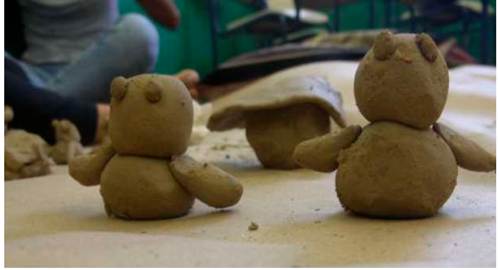 Note: clay figure, created by student Pedro, in the sexuality workshop. “How does the school handle the sexuality theme (or how should it do it?)
 Note: Collage by one of the pairs in the racism workshop: How does the school handle the racial inequality issue?
 Note: Collage by one of the pairs in the racism workshop: How does the school handle the racial inequality theme?
 Note: clay figure, created by student Cláudio, in the sexuality workshop.:“How does the school handle the sexuality theme (or how should it do it?).