Design Patterns and Learning Modalities: architecture and education in conjunction for a school building assessment tool
Abstract
This study analysed school designs based on the connection of two concepts: the Design Patters/DPs (architectural settings) and Learning Modalities/LMs (learning and teaching styles). An observation method was developed to assess such aspects, working as a post-occupancy evaluation tool. Understanding and incorporating DPs and LMs nurture communication, collaboration, inclusion, and creativity which are essential for 21st-century innovative learning environments. The created method was used as a framework to analyse the physical support for learning and teaching activities in two contrasting Brazilian secondary schools. The investigation using such a tool included walkthroughs and in-loco data collection addressing the differences concerning traditional and non-traditional schools. The results establish a direct correlation between the existence of DPs and LMs, acting like a lighthouse on linking both concepts within the schools’ context. Ultimately, employing such a post-occupancy analysis strategy for school design can aid to better understand the impact of different kinds of spaces and approaches for the construction or renovation of school buildings. Considering DPs and LMs may leverage architects, educators, and policy makers to conduct evidence-based decisions for school architectural design that support a range of environmental needs that enhance learning requirements.
Keywords
school design; learning environments; educational practices; school building assessment tool; post-occupancy evaluation
Resumo
Este estudo analisou projetos escolares a partir da articulação de dois conceitos: os Parâmetros de Projeto (PPs) (configurações arquitetônicas) e as Modalidades de Aprendizagem (MAs) (estilos de ensino e aprendizagem). Foi desenvolvido um método de observação para avaliar tais aspectos, funcionando como uma ferramenta de avaliação pós-ocupação. A compreensão e a incorporação de PPs e MAs fomentam a comunicação, a colaboração, a inclusão e a criatividade, elementos essenciais para ambientes de aprendizagem inovadores do século XXI. O método elaborado foi utilizado como estrutura para analisar o suporte físico às atividades de ensino e aprendizagem em duas escolas secundárias brasileiras com distintos perfis arquitetônicos A investigação, com base nessa ferramenta, incluiu walkthroughs e coleta de dados in loco, contemplando as diferenças entre escolas tradicionais e não-tradicionais. Os resultados estabelecem uma correlação direta entre a presença de PPs e MAs, atuando como um direcionador na conexão de ambos os conceitos no contexto escolar. Em última instância, o emprego de tal estratégia de análise pós-ocupação para o design escolar pode contribuir para uma melhor compreensão do impacto de diferentes tipologias espaciais e abordagens na construção ou renovação de edifícios escolares. A consideração dos PPs e MAs pode fornecer subsídios a arquitetos, educadores e formuladores de políticas para a tomada de decisões baseadas em evidências no âmbito do projeto arquitetônico escolar, apoiando um conjunto de necessidades ambientais que potencializam os requisitos de aprendizagem.
Palavras-chave
arquitetura escolar; ambientes de aprendizagem; práticas educacionais; ferramenta de avaliação de edifícios escolares; avaliação pós-ocupação
Introduction
21st-century school building design includes specific architectural elements and concepts that foster human diversity and support a wide range of contemporary teaching and learning activities, preparing students for the future. We advocate that there are specific design patterns, those developed and discussed by Nair et al. (2013), to promote such an environment. The spatial configurations they favour, coupled with a varied utilization form of schools provide insights into the association between the built environment and pedagogical practices in the 21st century (Leiringer; Cardellino, 2011; Souza, 2018; Veloso; Marques, 2017), escaping generalized approaches to particular situations (Woolner; Cardellino, 2021).
Access to solid research data improves the consistency of design activities and allows for evolution within the field, as indicated by Schønheyder & Nordby (2018); Zielhuis et al. (2022). School analysis methods based on the observation of the relationship between people and the built environment are important to holistically capture the situation of the analysed spaces (Azevedo, 2012; Benade, 2019; Bolden III et al., 2017; Byers, 2016; Imms; Byers, 2016; Kowaltowski, 2011; Negris de Souza et al., 2020; Taylor, 2009). However, rigorous experimental methodologies to delineate between the physical affordances of spaces and how these affect teaching and learning are scarce (Painter et al., 2013).
This study introduces a new design approach and method by utilizing real-life observations and incorporating the concepts of DPs and LMs, which can be seen as a Post-Occupancy Evaluation (POE) method. The information obtained through this type of method equips designers with substantial content for discussions on new and refurbishment designs, supporting and challenging their individual work (Gray, 2022; Hay et al., 2018). Furthermore, as a fact-based process, it facilitates knowledge acquisition (Demirkan, 2016); enhances collaborative design engagement, (Nisha, 2022), and promotes mindful project planning (Prochner & Godin, 2022).
We examine the following questions: Which aspects must be considered when observing the contemporary school environment, their physical and use aspects? A tool combining the DPs and LMs identifies the physical and educational aspects of school buildings? and Which features must be taken into account when devising visual design methods to facilitate school building analysis? To present and test our methodology and tool, we analysed and assessed spaces of two Brazilian secondary schools in terms of the support provided for specific learning and teaching activities.
School context
The two contrasting cases located at Campinas, São Paulo-Brazil, were one private school, following Freinet pedagogy, with a non-traditional layout for comparison of about 440 students; the other is a public school adhering to a Traditional pedagogy with also traditional physical configuration standards set by the Foundation for the Development of Education (FDE) in Campinas/BR, of approximately 1600 students. They were analysed as belonging to different categories once FDE, as a public agency, provides very standardized building guidelines, providing precise technical orientations (square footage, architectural program, opening types, furniture distribution) for architects involved in their bidding and construction processes. In contrast, non-traditional approaches possess more contextualized types of physical spaces. In essence, visual methods help systematically observe such differences in school design and the correlation between teaching and learning activities encountered. The Findings section provides further details.
Background literature
School architecture
Innovative configurations and infrastructures are needed to support educational goals such as collaboration, diversity and inclusion (Azevedo; Bastos; Blower, 2007; Coelho et al., 2022; Frelin; Grannäs, 2021; Lippman; Matthews, 2018; Maxwell, 2016). However, the meaning of innovation in school spaces remains ambiguous, leading to different interpretations and potentially inadequate design solutions due to a knowledge gap (Lippman & Matthews, 2018). Evidence-based design can enhance the comprehension of innovative learning environments by introducing crucial concepts to bridge this gap. Design Patterns (DPs), developed by Alexander et al. (1977), and Learning Modalities (LMs), identified by Lippman (2003), are two such concepts. The association of DPs with LMs enables a comprehensive assessment of school environments.
The traditional enclosed classrooms with minimum dimensions, environmental requirements, and installations, for a typical group of 30 students and their teacher is still widespread as the basic teaching environment (Byers; Imms; Hartnell-Young, 2018; Graça, 2002). Innovations demand predominantly openness, flexibility, integrated settings and collaborative areas, aesthetically pleasing and comfortable learning spaces with technology (Deppeler; Aikens, 2020; Lippman; Matthews, 2018; Woolner; Thomas; Charteris, 2021), encouraging dynamic, engaging and inspiring learning behaviours and educational changes (Cardellino; Deed, 2024; Sasson; Yehuda; Miedijensky, 2022). School analysis methods observing the relationship between people and the built environment are crucial to assess school spaces holistically (Azevedo, 2012; Benade, 2019; Bolden III et al., 2017; Byers, 2016; Imms; Byers, 2016; Kowaltowski, 2011; Negris de Souza et al., 2020; Taylor, 2009). However, rigorous experimental methodologies to delineate between the physical affordances of spaces and how these affect teaching and learning are scarce (Painter et al., 2013).
Typical school design processes often overlook important steps like “problem seeking” in an effort to save time and costs (Deliberador, 2016; Peña; Parshall, 2012; Taylor, 2009). Generally, there is a great concern in student capacity demands, rather than prioritizing building quality. This can result in the replication or mirroring of solutions without evidence of their effectiveness and limited compatibility with the context, including access, neighbourhood, shape, land characteristic, and educational goals and pedagogies adopted (Cardellino; Deed, 2024; Woolner; Cardellino, 2021).
Despite existing challenges, efforts to enhance school architecture are evident globally. In Brazil, agencies like FDE and National Fund for Education Developmet (FNDE) play a significant role in the production and maintenance of thousands of school spaces. FDE, for instance, actively engage in discussions on school building design and benefit from valuable feedback gained through evaluations of previous projects, allowing for continuous improvement (Kowaltowski, 2011).
Schools of 21st-century should incorporate design elements that support multiple intelligences-based learning (Gardner, 1983, 2006). Additionally, school spaces should reflect values such as human aspirations, relationships, and individual and collaborative growth (Doppelt; Schunn, 2008; Frelin; Grannäs, 2014; Marin, 2008). Nair et al. (2013) have defined school Design Patterns (Table 1) that offer specific characteristics for configuring educational spaces, aiding the design process.
The 29 patterns, based on the concept of patterns from Alexander et al. (1977), recurring problem-solving solutions that can be applied repeatedly without repetition. According to Moreira, (2007), patterns are functional responses to specific problems, in this case, the design of educational spaces for the 21st-century students. Specific design patterns for schools facilitate the inclusion of essential design elements and support idea exploration. Moreover, they can be related to various learning modalities, which are crucial for aligning school building design with educational objectives.
Learning Modalities influencing school design
Qualitative architectural standards supporting school activities and learning go beyond codes and specifications (Taylor, 2009). Design considerations should encompass aspects like identity, context, site and surroundings, building organization and operation, learning concepts, chosen pedagogy, temporal and durable features, and other criteria that address user needs (Coelho et al., 2022; Deliberador, 2016; Woolner; Cardellino, 2021).
School spaces, or "learning environments", are also shaped by non-physical elements that contribute to the overall school climate (Cardellino; Deed, 2024; Gislason, 2009; Molinari; Grazia, 2023; Rusticus; Pashootan; Mah, 2023). Architectural aspects can influence educational practices, but successful teaching and learning also depend on factors like organizational culture and dynamics (Figure 1).

Learning Modalities, listed by Lippman (2003), encompass 18 different items (Table 2). A well-designed school should accommodate multiple modalities, replacing limited-purpose spaces with versatile ones to promote diversity.
Behavior settings
Spaces support diverse human actions based on behaviour patterns. Understanding these patterns and the underlying "laws" requires observing behaviour settings (Barker, 1968). Research of behaviour settings relates the dynamics of the relationship, comprising the person acting, the behaviour itself, and the environment, separately but at the same time in connection.
In school environments, students interact with spaces in individual ways (Grannäs; Frelin, 2017; Zandvliet; Broekhuizen, 2017). Schools play a crucial role in fostering constructive relationships for teaching and learning. The environment should support personal growth and societal development. School architecture influences relationships and learning outcomes. Understanding the needs of students, teachers, and staff is essential for creating a user-centred, and functional school architecture that enhances the curriculum and meets their outlined purposes (Frelin; Grannäs, 2021).
Methodology
This investigation considered the coupling of the concepts of Design Patterns and Learning Modalities and incorporated these into observation tools to assess school environments their physical settings and user activities. An exploratory approach was determined with the combination of qualitative and quantitative analysis. Thus, observations of spaces and their use were carried out through detailed note-taking and mapping took place.
To collect data, we arranged school visits and had informal discussions with principals. Preparations began in 2017. Our small-scale study on two Brazilian schools aims to validate tools for confirming the methodological connection between DPs and LMs. We compared traditional and non-traditional schools, highlighting specific physical and educational features.
Tools development
Two types of tables were designed to document observations of case schools: the "Table of Notes" for noting observed patterns, and the "Table of Observation" for identifying LMs. Behaviour maps were also included using the behaviour setting analysis, a technique for tracking behavioural patterns in a specific space. These tools focused on data analysis for architectural configurations, space usage, and occupation. The study aimed to develop simple tools for a single observer to record information during school visits, using readily available materials like Microsoft Excel and Google Spreadsheets. This made it possible to use smartphones or tablets connected to the Internet for field research, with simultaneous graph generation enabling faster data analysis.
Design Pattern table – Table of Notes
To observe DPs two approaches were considered: pattern registration and situation description. Figure 2 shows an example of the table with some data. There are two columns: Design Patterns and Observations. The first column lists and numbers the 29 DPs to be observed, while the second is open for the observer’s annotations regarding each DP. A detailed record is thus possible. The DPs were created by (Nair; Fielding; Lackney, 2013), and observations by an independent researcher can contribute to enriching DP descriptions.

A three-colour distinguishes DP presence: green for total presence, yellow for partial, and orange for absence in a space. These classifications were based on to the definitions of Nair et al. (2013).
Learning Modalities table – Table of Observation
Table in Figure 3 collects data on activities in school spaces. First column lists areas visited. This list was determined prior to data collection, set in relation to the school plan, allowed area access, and the route defined for a specific study. Second to fourth columns (in red, green, and yellow) have the 18 LMs established by (Lippman, 2003).

Observations should be done at different times of the day and week, depending on the school schedule Three coloured columns correspond to each cycle of school observation, with the number of cycles determined by school time and class duration. During a school visit, adding the letter "S" in front of the number changes the field colour from white to green. LMs can be registered once per space per visit, even if multiple students are performing the activity. The app is used to change the colour from white to gray for areas with no activities.
Design Patterns and Learning Modalities – Behaviour Map Construction
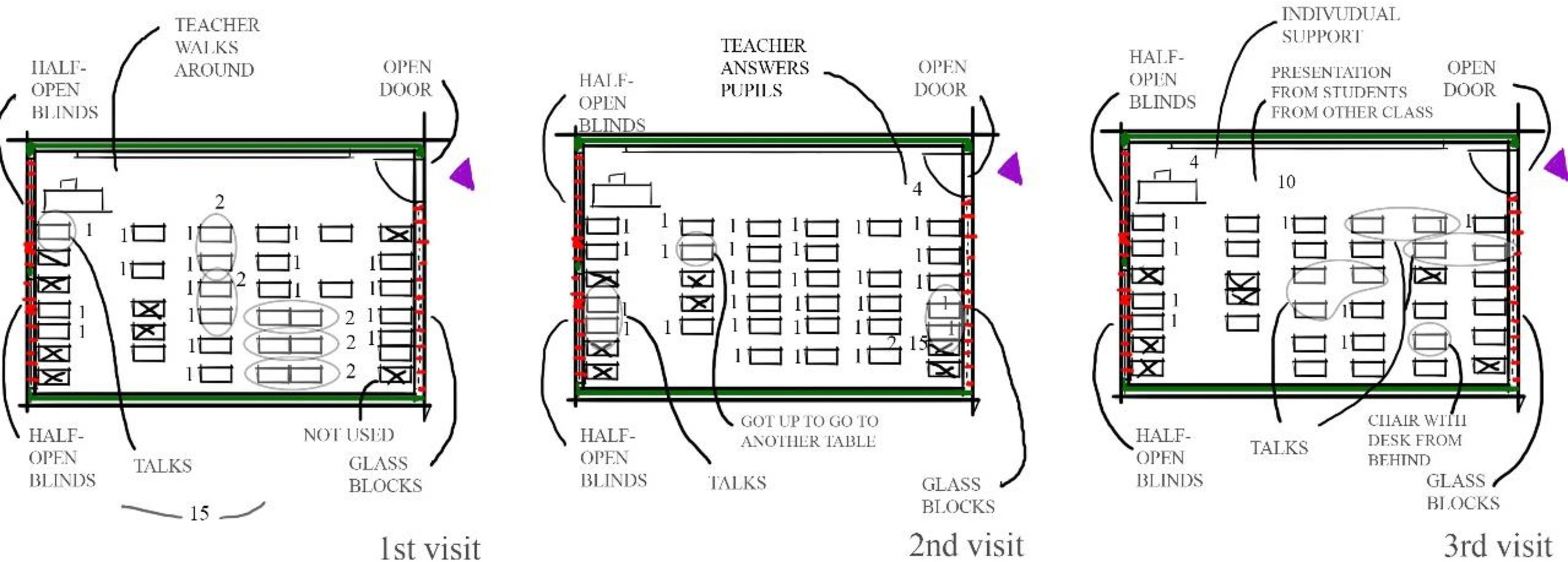
Figure 4 shows behaviour maps. It complements DPs and LMs observations, providing qualitative and quantitative evaluation of activities and space use. The maps indicate the degree of use and architectural configuration of space, aiding graphic representation of DPs and LMs.

Maps should match space's physical features. Numbers from 1 to 18, are marked on the map where activities occur. For distributed activities, a registration is maken in the outside area. For larger LM areas, an ellipse is drawn to delineate the area. Repeated LMs are marked multiple times. Other events observed should also be recorded as written notes on the map. A legend system shows architectural elements such as walls, windows, and access or doors. Colours aid identification (Figure 4). The maps are important for school design analysis and school familiarity.
Using the tools – Visit protocol
The non-traditional school we analysed will be referred to as "Case School 1" (C1) and the traditional school as "Case School 2" (C2). Two visits to each school were organized to evaluate our tools, with four research phases required.
During the first visit, a site analysis occurs. The observer learns about the school’s infrastructure, history, pedagogy, organization, and functioning. A walkthrough with the headteacher supports a technical and complete approach. Filling the DPs table finishes is the second phase. The third phase takes place during the second visit, involving systematic observations of activities using the LM table to indicate the ordered list of spaces to be observed. At the same time, the behaviour maps are prepared to complete the fourth phase of a typical study. Figure 5 describes the protocol of the four phases.

Visits have no time restriction, but duration varies based on school size and layout. The first visit allows ample time to explore all spaces at the pace of the headteacher or other responsible person. The second visit, with prior familiarity, requires time frames for the specified cycles of LM observations mentioned in the table.
To expedite the study, it should be established the total visit length based on school schedule and consent. A time division is required afterwards to determine the duration of each cycle. Our study found that each space requires 3 to 10 minutes, including annotations and transitions. The three cycles were derived from this calculation. However, additional factors must be considered. For instance, if the school has fixed class periods, the observer may want to be present at specific classes t capture diverse activities. Adjustments may be necessary if a scheduled space is unexpectedly unavailable.
At the end of the data collection cycles shown in Figure 5, observations should present DPs, LMs, and their occurrences on behaviour maps. This includes identifying LMs, recording their frequency (through cycle repetition), participant numbers, and location.
Analysing data
After data collection, data analysis begins. Information is analysed individually and comparatively. First, data from a specific school is individually analysed. Data from a specific school is first analysed individually. Graphs are automatically generated from the DP table. An overview of the schools’ physical setting is systematized. The LM table is then assessed. Graphs are automatically generated to show LM occurrences. Highlights may demonstrate specific school space details.
In the follow-up phase, DPs and LMs are paired to explore existing relationships. A comparative analysis of different case studies can be conducted. Patterns and Modalities are correlated by types and quantities to analyse approaches in traditional and non-traditional schools. Finally, architectural modifications can be suggested to enhance understanding of DPs and LMs in contemporary education.
Findings
To test the assessment tools for school buildings, a selection criterion must be defined. School case studies should be chosen aligned with the research focus, while maintaining the same analysis procedure. Information is gathered following the phases established in our protocol: 1) Walkthrough, 2) Design Pattern Table; 3) Learning Modality Table; 4) Behaviour Maps.
Phase 1 – Walkthrough
As per the research protocol, walkthroughs were conducted during the initial visits to both schools. Accompanied by the headmaster or designated teacher, information was gathered on the school's construction, operation, and technical drawings. Most spaces were shown, and their use explained. Essential data such as student population, class sizes, school hours, age of the building, and any infrastructure refurbishments or renovations were collected to comprehend the school context. Floor plans and sections provided accurate graphical information for the subsequent phases.
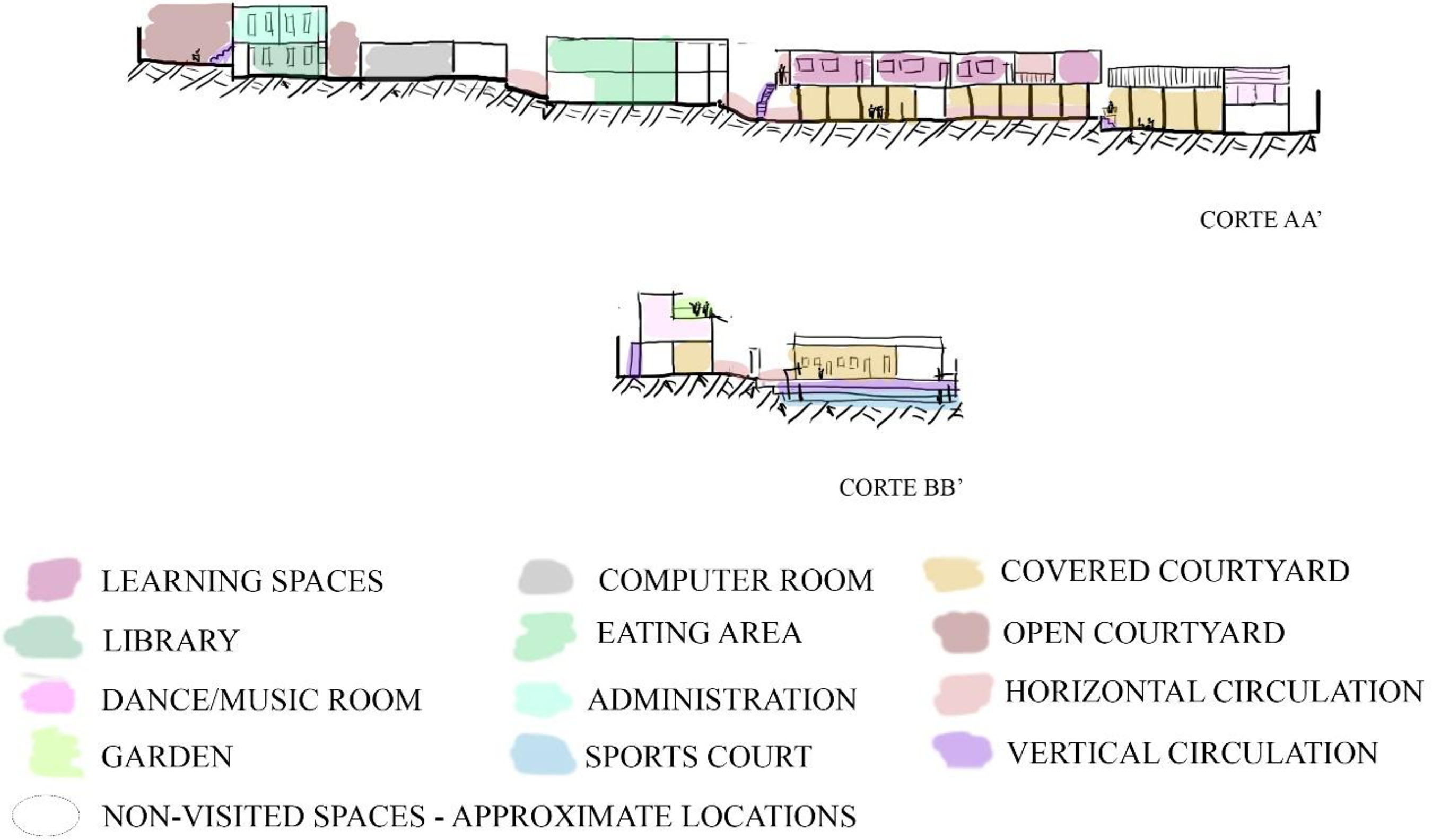
Figures 6 and Figure 7 depict simplified diagrams of school C1's physical layout, showcasing its traditional features such as enclosed classrooms. Additionally, the diagrams highlight the presence of spacious and adaptable areas, including outdoor spaces that provide opportunities for contact with nature throughout the school day.


Figures 8 and Figure 9 display a schematic layout of school C2. The main school block consists of enclosed rectangular classrooms arranged along central halls on both floors. The administration and teacher's room share a similar pattern and physical characteristics. Despite the traditional configuration of classrooms, a significant open area is present, facilitating flexible use and promoting student interactions.


Phase 2 – Design Pattern assessment
This phase enhances understanding of a school facility's physical features. Design patterns (DPs) are individually discussed using the DP table. Figure 10 presents the analysis results for C1, revealing the identification of five DPs, accounting for approximately 17% of the total DPs. Additionally, when considering the combination of these with partially observed DPs (19 in total), it is evident that at least partially, 83% of the DPs are present. However, five DPs, representing 17% of the total list, were not found in C1.

In contrast, school C2 had only two fully present DPs, accounting for 10% of the DP list. DP 7 (Physical Fitness) and DP 28 (Safety and Security) were the observed patterns, as indicated in Figure 11. Nevertheless, 19 DPs were absent, representing 65.5% of the total DP list.

The correlation between the walkthrough information and the DP analysis provided a reliable overview of each school's physical reality. Observations included specific details on physical elements, ensuring a comprehensive understanding of school facilities, zoning, and spatial flexibility. Classroom distribution, study areas, open spaces, visual and physical connections, as well as natural elements like trees and gardens, were described in detail, contributing to a thorough assessment.
Phase 3 – Learning Modalities
On the second day of visits, the LM table and behaviour maps are completed, with observations of actual student activities. Authorization from the principal is required for all observations. The length of stay and analysis period may vary between case studies depending on the school's size.
Data was collected at school C1 from 7:40 am to 12:30 pm, with three visits to each of the thirteen surveyed spaces. The spaces included the main entrance, library, elementary classrooms and secondary classrooms, courtyards, sports court, dance room, and terrace with a garden. The observation cycles, lasting approximately 45 minutes each, were aligned with class durations and excluded break periods. The cycles occurred from 7:45 am to 9:05 am, 9:15 am to 10:55 am (with a break from 9:55 am to 10:15 am), and 11:05 am to 12:25 am, resulting in 120 LMs indicated.
At school C2, visits were conducted in 10 selected spaces: four classrooms, video room, computer room, food hall/covered courtyard (including cafeteria, amphitheatre, and sports court), science lab, and the library, in that order. The observation cycles occurred in three cycles from 7 am to 12:20 pm. The first cycle was from 7:10 to 8:30 am, the second from 8:50 to 10:30 am (with a break from 9:30 to 9:50 am), and the third from 10:50 am to 12:10 pm. A total of 36 LMs were observed.
Figure 12 and Figure 13 (see below) display the LMs results from C1 and C2, respectively. In Figure 12, almost all LMs were found at the first school, with the highest percentage in social/emotional learning, accounting for over 14% of observations. This result was due to the understanding that group activities are a form of social/emotional learning. At C2, only seven LMs occurred, less than half of the total of recommended 18, and LM1 (Independent Study) accounted for 28% of the total, due to tests being applied when the class was observed, or activities with teacher instructions. The graphs offer a visual overview of activities, highlight results, and help to plan future activities.


Phase 4 – Behaviour Maps
Drawing behaviour maps demands preparation. Collecting data on that occurred at the same time of LMs observation. These maps provide evidence of school usage (how and where) and help understand student activities. Figure 14 depicts a 9th-grade classroom in school C1 with good student interaction and diverse activities. Students moved freely within and outside their classroom, particularly for a school project. Figure 15 displays the dynamics observed in secondary rooms outside the area.


In C2, classroom activities were observed with attempts to overcome traditional aspects. Figure 16 shows behaviour maps of this area. LM 15, Social/emotional learning, appeared in student pairs, indicating interpersonal relationships. The food hall/covered patio and cafeteria area also had LM 15, with table tennis games (Figure 17).


Discussion
In the literature review, the school-built environment and space use dynamics are linked. Our paper demonstrated observation tools for school building assessment enabled data collection of both aspects at two schools. The case studies results can be, therefore, categorized. Each school can be analysed individually, and data from both schools can be compared.
Individual analysis
The individual analysis examines each case school separately, with specific observations on DPs and LMs. The purpose of this discussion it to bring to light design elements that impact learning activities.
Case School 1 – C1
The school building occupies the entire site but includes some natural elements (vegetation and green areas). Data on DPs and LMs indicate that learning, and teaching activities occur throughout most of the school. although varying in intensity. Spaces are integrated to promote students’ movement and interactions, as indicated by DP1 (Classrooms, Learning Studios, Advisories, and Small Learning Communities) and LM 1-4 (Independent study, Peer tutoring, Team collaborative work in small and mid-size groups, and One-on-one learning with teacher). However, specific niches (DPs 16 and 17 - Watering Hole and Cave Space) needed for LMs 1, 2 and 3 are not currently offered.
Artistic activities (LM 16 - Art-based learnings), encompass learning through LMs 1, 2, 3, and 4, and also those corresponding to learning by projects and manual projects (LMs 6 and 18). School C1 supports these activities via DP 12, facilitating internal and external connections. This pattern, although only partially present, is enabled by the physical connection between the covered patio areas and other outdoor environments.
Natural lighting and ventilation (DPs 19 and 20) are utilized in classrooms, which have windows on two sides. Primary classrooms connect to a circulation space, while Secondary classrooms are adjacent to a wide circulation space used as an informal teaching-learning environment. The library space (DP27) could be utilized more effectively to also support these types of activities. In this space, associated with the computer room, where no activities occurred during the observation period, technology-based learning assignments and Internet searches (MAs 7 and 9) could occur, strengthened by DP 11 (distributed technology). Informal learning, including artistic activities, contributes to the school’s culture and identity DP 23 (local signature). The relationship between the number of DPs and LMs in school C1 is depicted in Figure 18.

Case School 2 – C2
The collected data and analysis of site and ground floor plans reveal the distribution of spaces and activities within the school area. Students primarily occupy their designated classrooms, engaging in activities related to LMs 1 to 5 (Independent study, Peer tutoring, Team collaborative work in small and mid-size groups, One-on-one learning with teacher, Lecture format with the teacher or outside expert at centre stage). The classrooms along the central corridor on the ground and 1st floors support these activities. However, due to enclosed traditional classrooms, their dimensions, and low variability layout, only a partial presence of DP 1 was registered (Classrooms, Learning Studios, Advisories, and Small Learning Communities).
The lack of versatility in classroom types, including video and computer rooms, laboratories, and the library, contributes to the absence of DP 18 (Design for Multiple Intelligences). Moreover, the physical characteristic of the spaces and their limited usage, except for the classrooms, contributes to the absence or low presence of LMs 6, 7, 16 and 18 (Project-based learning, Technology-based learning, Art-based learning, and Learning by building—hands-on learning). The covered courtyard and the amphitheatre partially fulfil DP 6, (Art, Music, and Performance), and DP 15 (Campfire Space), with potential for LMs 10 and 11 (Student presentations and Performance and music-based learning). However, activities in this area were not significantly observed.
DP 16 and 17 (Watering Hole and Cave Space) were absent, lacking architectural elements designed for their defined functions. This restricts student utilization on these spaces for teaching and learning purposes. Only classrooms are currently used for learning activities. Additionally, the lack of external and internal connections defined in DP 12 hinders access to the library (DP 27), reducing its use and integration with LMs. The relationship between the number of DPs and LMs in school C2 is seen in Figure 19.

Comparative analysis
In this investigation, C1 represented a non-traditional school, with a less-conventional architecture, whereas C2 was an example of a school with traditional architecture in the FDE model. Similarities with respect to their architectural design were noticed: classrooms’ format, and layout, types of windows and doors, which hamper connections, and the distribution of furniture (board, desks, and chairs). C1 classrooms differ with windows on opposite sides for cross-ventilation and visibility.
C1 had student artworks in murals in each classroom. Furniture layouts were more modified in C1 than C2. Also, more LMs were observed in C1, initiated by teachers or students to facilitate school tasks, while C2 changes were directed by teachers, thus lacking spontaneity. At the same time, school C2 maintains row/column desk arrangement in all the classrooms visited.
Figure 20 shows a comparison of LMs in the two case studies. C1 has a higher number of LMs due to outdoor activities areas. School C2 also has outdoor space, however, in school C1 students make high use of these environments, while in school C2 most classes are held inside classrooms. Unused environments were found in both schools, being the dance/music room, computer room, and library in C1, and the laboratory, video room, computer room, and library in C2. This fact may be directly linked to a lack of staff to manage and ensure the permanent functioning of available spaces. But the reduced use may be due to a low pedagogical focus on activities developed in such environments, affecting the support of multiple intelligences.

Overall, little variation exists in the built-environment configuration between the two schools. Both have enclosed classrooms, covered and open courtyards, library, cafeteria, and computer room. However, despite their similarities, it is possible to observe differences. School C1 maximizes site use, has a garden-terrace and dance/music room, and incorporates trees for shade, which encourages outdoor activities. School C2, although having a student union room and a video room, also has free site areas that could be better used for educational activities.
A comparison between the two schools highlights differences in the number of DPs found (Figure 21). C2 does not have 19 DPs, and 8 were only partially found, reflecting on the number of LMs. C1, has more LMs, with a greater variety of spaces, especially regarding informal learning environments, and also more DPs.

LMs in schools C1 and C2 indicate frequent individual learning. However, it is important to note that LM 1 was developed differently in each case. C1 presented more than 10% of this activity, with students organized individually or in pairs by choice. In C2, individual activities mostly occurred after teacher presentation, sometimes in pairs. Therefore, one can point out that the spaces use varied based on activity nature. School C1 provided more freedom, based on pedagogy and to a minor extent also on space distribution.
Technology-related LMs were scarce. In both schools, computers/notebooks used for research or specific activities, but computer rooms remained closed. The two schools could encourage technology use beyond computer rooms, and tablets loans could enhance technology use in various spaces.
Conclusion
The utilization of our observation tools for data collection can provide valuable support for analysing school environment and their usage. These tools not only offer immediate feedback on current physical and usage aspects but also can aid in refurbishing existing schools and planning new institutions, serving as Post-Occupancy Evaluations (POEs). The inclusion of important concepts such as design patterns (DPs) and learning modalities (LMs) in these assessment tools establishes a specific language focused on the primary purpose of school buildings: teaching and learning.
Investigating the architectural configurations of schools is essential to understanding the impact of architecture on educational activities. In this research, we approached the built environment through design patterns and evaluated their influence on the student activities, referred to as learning modalities. It is important to acknowledge the significance of pedagogy in relation to school architecture, as the architectural design influences activities, relationships, and the overall appropriation of the space. Likewise, architecture should serve educational functions effectively.
Our research found that the school with a greater presence of DPs also had a higher number of LMs, indicating a wider variety of activities and better utilization of the available space through the school´s infrastructure. However, we encountered difficulties in finding schools in our study region that truly represented the values of 21st-century education and new trends in school architecture. Ideally, new school architecture should encompass all 29 DPs and facilitate the proper execution of all 18 LMs.
The data obtained from the developed observational tools can be used for various analyses. For example, it is possible to examine the relationships between specific DPs and the presence of particular LMs. In our case, DPs 15, 16, and 17 (Campfire Space, Watering Hole Space, and Cave Space) facilitated LMs such as Independent Study, Peer Tutoring, and Team Collaborative Work in small to mid-size groups, as well as art-based learning, among others.
Lastly, our analysis method allowed the joint evaluation of the concepts of design patterns and learning modalities in school environments. The incorporation of technology, such as smartphones (which can be replaced by tablets, or similar devices) enhanced the efficiency of data collection and compilation. This technological integration ensured automated recording and reduced errors associated with manual collection, thereby saving time. Additionally, this method and evaluation tools can be applied to research other architectural typologies, demanding only internal content modifications, to identify suitable design patterns for specific functions, activities, and their goals.
Research data availability:
Research data will be available on demand to authors.
Support and Funding:
Copy Editing services:
References
- ALEXANDER, C.; ISHIKAWA, S.; SILVERSTEIN, M. A pattern language: towns, buildings, construction New York: Oxford University Press, 1977.
- AZEVEDO, Giselle Arteiro Nielsen. Sobre o papel da arquitetura escolar no cotidiano da educação: análise das interações pessoa-ambiente para a transformação qualitativa do lugar pedagógico. Encontro nacional de tecnologia do ambiente construído, v. 14, p. 3494–3504, 2012.
- AZEVEDO, Giselle Arteiro Nielsen; BASTOS, Leopoldo Eurico Gonçalves; BLOWER, Hélide Steenhagen. Escolas de ontem, educação hoje: é possível atualizar usos em projetos padronizados? Cadernos PROARQ, p. 59, 2007.
- BARKER, R. G. Ecological Psychology: Concepts and methods for studying the environment of human behavior Stanford: Stanford University Press, 1968.
- BENADE, L. Flexible Learning Spaces: Inclusive by Design? New Zealand Journal of Educational Studies, 21 fev. 2019.
- BOLDEN III, Edward C. et al. Location, location, location: A comparison of student experience in a lecture hall to a small classroom using similar techniques. Active Learning in Higher Education, p. 1469787417742018, 22 nov. 2017.
- BYERS, T. Development of an Observation Metric for Linking Pedagogy, Technology and Space [S.l.]: LEaRN, University of Melbourne, 2016.
- BYERS, Terry; IMMS, Wes; HARTNELL-YOUNG, Elizabeth. Comparative analysis of the impact of traditional versus innovative learning environment on student attitudes and learning outcomes. Studies in Educational Evaluation, v. 58, p. 167–177, 1 set. 2018.
- CARDELLINO, Paula; DEED, Craig. Interactions between Design Innovation and Educational Change in Non-Western Schools. Buildings, v. 14, n. 3, p. 716, mar. 2024.
- COELHO, Carolina et al. Survey on Student School Spaces: An Inclusive Design Tool for a Better School. Buildings, v. 12, n. 4, p. 392, abr. 2022.
- DELIBERADOR, Marcella Savioli. Parâmetros da arquitetura escolar e o jogo de cartas como ferramenta de apoio ao desenvolvimento do programa arquitetônico Tese—Campinas: Faculdade de Engenharia Civil, Arquitetura e Urbanismo, Universidade Estadual de Campinas, 2016.
- DEMIRKAN, Halime. An inquiry into the learning-style and knowledge-building preferences of interior architecture students. Design Studies, v. 44, p. 28–51, 1 maio 2016.
- DEPPELER, Joanne; AIKENS, Kathleen. Responsible innovation in school design – a systematic review. Journal of Responsible Innovation, v. 7, n. 3, p. 573–597, 1 set. 2020.
- DOPPELT, Yaron; SCHUNN, Christian D. Identifying students’ perceptions of the important classroom features affecting learning aspects of a design-based learning environment. Learning Environments Research, v. 11, n. 3, p. 195–209, out. 2008.
- FRELIN, Anneli; GRANNÄS, Jan. Studying relational spaces in secondary school: Applying a spatial framework for the study of borderlands and relational work in school improvement processes. Improving Schools, v. 17, n. 2, p. 135–147, 1 jul. 2014.
- FRELIN, Anneli; GRANNÄS, Jan. Designing and Building Robust Innovative Learning Environments. Buildings, v. 11, n. 8, p. 345, ago. 2021.
- GARDNER, Howard. Frames of mind: The theory of multiple intelligences New York: Basic Books, 1983.
- GARDNER, Howard. Multiple Intelligences: New Horizons Nova York: Basic Books, 2006.
- GISLASON, Neil. Mapping School Design: A Qualitative Study of the Relations Among Facilities Design, Curriculum Delivery, and School Climate. The Journal of Environmental Education, v. 40, n. 4, p. 17–34, 1 jul. 2009.
- GRAÇA, V. A. C. da. Otimização de Projetos Arquitetônicos considerando Parâmetros de Conforto Ambiental: O caso das Escolas da Rede Estadual de São Paulo Dissertação de Mestrado—Campinas: Faculdade de Engenharia Civil, Arquitetura e Urbanismo, Universidade Estadual de Campinas, 2002.
- GRANNÄS, Jan; FRELIN, Anneli. Spaces of student support – Comparing educational environments from two time periods. Improving Schools, v. 20, n. 2, p. 127–142, 1 jul. 2017.
- GRAY, Colin M. Languaging design methods. Design Studies, v. 78, p. 101076, jan. 2022.
- HAY, Rowena et al. Post-occupancy evaluation in architecture: experiences and perspectives from UK practice. Building Research & Information, v. 46, n. 6, p. 698–710, 18 ago. 2018.
- IMMS, Wesley; BYERS, Terry. Impact of classroom design on teacher pedagogy and student engagement and performance in mathematics. Learning Environments Research, 1 jun. 2016.
- KOWALTOWSKI, Doris Catharine Cornelie Knatz. Arquitetura escolar: o projeto do ambiente de ensino São Paulo: Oficina de Textos, 2011.
- LEIRINGER, Roine; CARDELLINO, Paula. Schools for the twenty-first century: school design and educational transformation. British Educational Research Journal, v. 37, n. 6, p. 915–934, dez. 2011.
- LIPPMAN, Peter C. Advancing Concepts about activity settings within learning environments. CAE Quarterly Newsletter - AIA Committee on Architecture for Education, 2003.
- LIPPMAN, Peter C.; MATTHEWS, Elizabeth. Re-Imagining the Open Classroom. In: ALTERATOR, Scott; DEED, Craig (Eds.). School Space and its Occupation: Conceptualising and Evaluating Innovative Learning Environments Advances in Learning Environments Research. [S.l.]: Brill, 2018. v. 10 p. 63–85.
- MARIN, A. A. Pesquisa em educação ambiental e percepção ambiental. Pesquisa em educação ambiental, v. 3, p. 203–222, 2008.
- MAXWELL, Lorraine E. School building condition, social climate, student attendance and academic achievement: A mediation model. Journal of Environmental Psychology, v. 46, p. 206–216, jun. 2016.
- MOLINARI, Luisa; GRAZIA, Valentina. Students’ school climate perceptions: do engagement and burnout matter? Learning Environments Research, v. 26, n. 1, p. 1–18, 1 abr. 2023.
- MOREIRA, Daniel de Carvalho. Os principios da síntese da forma e a análise de projetos arquitetônicos Tese—Campinas: Faculdade de Engenharia Civil, Arquitetura e Urbanismo, Universidade Estadual de Campinas, 2007.
- NAIR, P.; FIELDING, R.; LACKNEY, J. The Language of School Design: Design Patterns for 21st Century Schools Minneapolis: DesignShare, 2013.
- NEGRIS DE SOUZA, Larissa et al. School design patterns supporting learning through play. International Journal of Play, v. 0, n. 0, p. 1–28, 21 maio 2020.
- NISHA, Bobby. Lost in imagined space: A psychoanalysis of participatory design. Design Studies, v. 81, p. 101108, 1 jul. 2022.
- PAINTER, Susan et al. Research on Learning Space Design: Present State, Future Directions. 2013.
- PEÑA, William M.; PARSHALL, Steven A. Problem Seeking: An Architectural Programming Primer 5. ed. New Jersey: John Wiley & Sons, 2012.
- PROCHNER, Isabel; GODIN, Danny. Quality in research through design projects: Recommendations for evaluation and enhancement. Design Studies, v. 78, p. 101061, 1 jan. 2022.
- RUSTICUS, Shayna A.; PASHOOTAN, Tina; MAH, Andrea. What are the key elements of a positive learning environment? Perspectives from students and faculty. Learning Environments Research, v. 26, n. 1, p. 161–175, 1 abr. 2023.
- SASSON, Irit; YEHUDA, Itamar; MIEDIJENSKY, Shirley. Innovative learning spaces: class management and universal design for learning. Learning Environments Research, v. 25, n. 3, p. 725–739, 1 out. 2022.
- SCHØNHEYDER, Jan Fredrik; NORDBY, Kjetil. The use and evolution of design methods in professional design practice. Design Studies, v. 58, p. 36–62, 1 set. 2018.
- SOUZA, Larissa Negris de. Arquitetura escolar, parâmetros de projeto e modalidades de aprendizagem Dissertação—Campinas: Faculdade de Engenharia Civil, Arquitetura e Urbanismo, Universidade Estadual de Campinas, 2018.
- TAYLOR, A. P. Linking Architecture and Education: sustainable design for learning environments New Mexico: University of New Mexico Press, 2009.
- VELOSO, Luísa; MARQUES, Joana S. Designing science laboratories: learning environments, school architecture and teaching and learning models. Learning Environments Research, v. 20, n. 2, p. 221–248, 1 jul. 2017.
- WOOLNER, Pamela; CARDELLINO, Paula. Crossing Contexts: Applying a System for Collaborative Investigation of School Space to Inform Design Decisions in Contrasting Settings. Buildings, v. 11, n. 11, p. 496, nov. 2021.
- WOOLNER, Pamela; THOMAS, Ulrike; CHARTERIS, Jennifer. The risks of standardised school building design: Beyond aligning the parts of a learning environment. European Educational Research Journal, p. 14749041211021262, 6 jun. 2021.
- ZANDVLIET, David; BROEKHUIZEN, Avril. Spaces for learning: development and validation of the School Physical and Campus Environment Survey. Learning Environments Research, v. 20, n. 2, p. 175–187, 1 jul. 2017.
- ZIELHUIS, Marieke et al. Making design research relevant for design practice: What is in the way? Design Studies, v. 78, p. 101063, 1 jan. 2022.