 QFD method in the generation of geoinformation technical requirements: a case in the Amazon
Abstract
Paper aims To explore the pioneering application of the QFD methodology in cartographic production in Brazil, focusing on aligning customer expectations with technical specifications in the development of orthoimage products.
Originality This study represents a novel approach to employing the QFD methodology in the Brazilian cartographic sector, highlighting its potential to transform customer requirements (VOC) into prioritized technical attributes, an approach not widely used in this context.
Research method The research employs a QFD-based approach, integrating qualitative and quantitative analyses to translate customer expectations into technical specifications. The methodology was applied in the design of orthoimage maps and extracts, with a focus on customer needs and operational requirements.
Main findings Nine customer expectations (WHATs) related to image information were identified and addressed through fifteen technical descriptors (HOWs) using the QFD methodology. The study highlights the effectiveness of QFD while emphasizing the need for clearer definitions of cartographic products, scale, and operational requirements to improve the translation of VOC into VOE.
Implications for theory and practice This study demonstrates the feasibility and challenges of applying the QFD methodology in cartographic production. It provides insights into bridging the gap between customer expectations and technical production, emphasizing the need for structured approaches in geoinformation projects. The findings can guide future research and practice in improving cartographic product development, particularly in aligning user needs with technical capabilities.
Keywords:
Quality Function Deployment (QFD); Cartographic production; Orthoimage maps; Geoinformation; Technical requirements (HOWs)
1. Introduction
Cartographic production in Brazil follows the standards established by Decree-Law Nº. 243 (1967), which created the National Cartographic System (NCS). The Directorate of Geographic Service (DSG), in addition to being one of the agencies responsible for systematic mapping production, is also tasked with providing geoinformation to the Brazilian Army. Through Geographic Information Systems (GIS), remote sensing, and other technologies utilizing geographic data, the DSG makes its products available in the Army Geographic Database (BDGEx), which serves as the source for disseminating geospatial products to society (Anthamatten, 2020; Szrajbman, 2020). In the Amazon region, a significant portion of its collection is outdated or non-existent, and at scales of 1:50,000 and 1:25,000, only 35% of the products have been mapped, leading to deficiencies in both infrastructure planning for northern Brazilian states and military operations (Santos, 2022).
The speed of obtaining geographic information is a crucial factor for military users when selecting the resources and guidance needed to meet their demands. Due to the nature of their profession, Brazilian Army (EB) personnel engage in various activities using topographic maps, orthoimage-based maps, aerial imagery, drone imagery, and satellite images, both in planning and execution. Previous studies on the use of geoinformation within the Armed Forces indicate that requests for geospatial products have delivery timelines of up to 90 days (Cardoso & Diniz, 2020) and, in some cases, up to 30 days (Lima, 2022) from the time of request to product delivery, whether in printed or digital format. This reality often drives users to seek alternative means to obtain the necessary products if the available time does not align with the production timelines of the DSG's production sector.
In the Amazon region, this reality is even more evident. Rivers play a crucial role due to the lack of road infrastructure, making navigation essential for transportation, security, and logistical support (Rodrigues et al., 2025). However, with outdated topographic and nautical maps and the reliance of satellite imagery on cloud-free conditions during the imaging process, obtaining the best geoinformation becomes an even greater challenge (Prudente et al., 2022). Identifying the essential requirements for geoinformation products used by military personnel operating on Amazonian rivers is a priority for the DSG.
For this purpose, the QFD (Quality Function Deployment) method was employed to identify and investigate the needs of military users in the context of cartographic production for operations in the Amazon, with an emphasis on the use of river routes. Incorporating the user's voice into the cartographic production process can drive the adoption of new technologies and focus efforts on ensuring that geoinformation is used more effectively and aligned with operational demands (Gaadi, 2024; Lima, 2022).
The first of the four phases of QFD, called the House of Quality (HOQ), examines customer needs concerning product quality (Voice of the Customer - VOC) and translates them into technical requirements (Voice of Engineering - VOE) (Ginting et al., 2020). This article developed the HOQ to present the technical requirements that must be included in a cartographic product based on orthorectified satellite images, which can be considered a rapid cartographic product as it does not contain all the information present in a topographic map. Remote Sensing Data (RSD) from sensors used in Brazil, as well as other nautical and topographic information, were taken into account.
2. Theoretical reference
2.1. Rapid mapping and remote sensing
Cartographic production refers to the set of stages and procedures using inputs for the acquisition and processing of geospatial data to create maps (Catalão, 2016). Currently, it is based on the use of Geographic Information Systems (GIS), where data is manipulated in vector and raster formats, efficiently representing the terrain.
Rapid mapping focuses on providing immediate responses to emergency situations, such as natural disasters, including floods, wildfires, extreme droughts, hurricanes, and others. In recent years, in the Amazon, in addition to intense wildfires and frequent floods, severe drought events have been recorded, further exacerbating the region's environmental and social vulnerability. These extreme droughts, often associated with the El Niño phenomenon, have drastically reduced river levels. For instance, the Rio Negro reached its lowest level in over a century in 2023, impacting access to water and the livelihoods of local communities (Castro, 2023).
To serve this population, where every second of response time is crucial, rapid mapping primarily utilizes satellite or aerial imagery, as illustrated in the steps shown in Figure 1, presented by Ajmar et al. (2015). Although positional accuracy may be slightly compromised, this approach prioritizes the quick delivery of critical information to users. Thus, this agile production, even with potential accuracy limitations, becomes an indispensable solution to meet the growing demand for geoinformation, standing out as a tool that combines efficiency and functionality for practical and urgent applications. According to Devaux (2021), product quality has come to be defined as customer satisfaction regarding the product's suitability for its intended use.

The map produced will consist of a set of georeferenced and orthorectified satellite images, complemented by vectors to be included in accordance with the ET-PCDG (Exército Brasileiro, 2016). Figure 2 illustrates an example of an orthoimage map at a 1:50,000 scale (E50k), representing the Manaus-N region, created using WorldView-2 satellite images and produced by DSG. Cardoso & Diniz (2020) emphasize that, for maps based on orthoimages, the following vector information is essential: elevation points and contour lines (relief), federal and state highways, place names, rivers, protected land boundaries (indigenous lands and state or federal preservation areas), locations of buildings under federal, state, or municipal jurisdiction, as well as energy distribution and generation stations. Considering that the research focuses on river routes in the Amazon, vectors and additional information found in nautical charts were also analyzed, such as tide data, flood and ebb periods, riverbed topography and composition, sandbanks, and submerged rocks.
The satellite image, obtained from remote sensing data (RSD), is the main input for Rapid Mapping. These data consist of digital information generated by the reflected optical signal, captured by Earth observation sensors installed on orbiting satellites (Jensen, 2009). The spaceborne sensor is primarily characterized by four attributes, whose list and significance are as follows:
-
Spatial Resolution: This refers to the smallest size of an object that the remote sensing sensor can detect from its orbit. The Multispectral Imager (MSI) onboard the Sentinel-2 satellite series of the ESA (European Space Agency) under the Global Monitoring for Environment and Security (GMES) program has bands with a spatial resolution of 10m. This means that Sentinel-2 can capture the image of an object with a size of 10m on the ground from its orbit.
-
Spectral Resolution: This refers to a sensor's ability to record the various tonal components of a feature on the ground. The spectral band specifications of the Sentinel-2 MSI sensor include thirteen spectral bands with colored filters, is shown in Table 1.
-
Temporal Resolution: Temporal resolution refers to a satellite's ability to revisit the same geographic location on the Earth's surface at regular time intervals. The satellite's movement is controlled to ensure it captures images of a specific area after a fixed period. This interval, known as the revisit capability, defines the satellite's temporal resolution. For Sentinel-2, the temporal resolution is 5 days, enabling frequent monitoring of areas of interest (European Space Agency, 2015).
-
Radiometric Resolution: The remote sensing sensor is an electro-optical device that records the intensity of a continuous optical signal (analog), reflected from the Earth, in discrete digital numbers (DN). This “sampling” of the continuous signal into discrete numbers requires the sensor to be designed with a predefined sampling interval. This sampling interval is referred to as the Radiometric Resolution or Quantization (Q) of the remote sensing sensor. A sensor with Q-bit quantization can sample the signal into 2Q levels, with these values being recorded as positive digital numbers ranging from 0 to 2Q−1. The Sentinel-2 MSI sensor has a quantity of 12 bits, allowing the signal to be recorded as described in Equation 1.
Covering digital values from 0 to 4095.
In addition to sensor characteristics, other parameters related to scene acquisition and processing must also be considered, such as the cloud cover percentage. In optical imagery, a high rate of cloud coverage can obscure the Earth's surface, compromising the quality and usability of the collected data. Although there are various studies and techniques to address this issue, this study only analyzed the cloud cover percentage without applying filters or additional image processing methods.
2.2. The house of quality
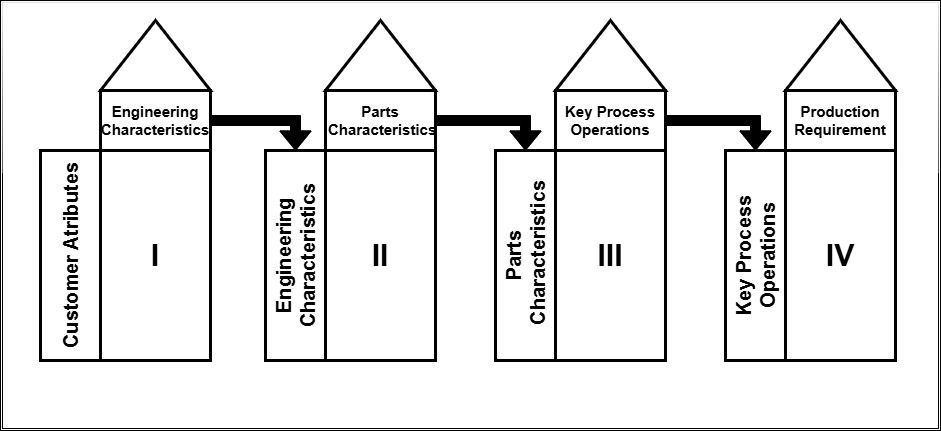
Created by Akao (2004), QFD is one of the Total Quality Management (TQM) processes, comprising quantitative tools and techniques used to translate customer requirements and specifications into appropriate technical or service requirements (Prasad et al., 2014). Of the four phases of QFD, the first two feature the House of Quality (HoQ), guiding the requirements for product improvement or the creation of a new product (Figure 3).
The QFD method consists of the Voice of the Customer, or customer attributes and their importance, guided by customer objectives—referred to as “WHATs” (labeled as A and B in the matrix in Figure 4); the Voice of the Engineer, or design parameters, which are the technical measures required to meet customer requirements—referred to as “HOWs” (labeled as D in the matrix in Figure 4); the Market Analysis, illustrating customer perceptions observed in market research, including the relative importance of customer requirements, as well as the performance of the company's and competitors' products in meeting those requirements (labeled as C in the matrix in Figure 4); the Interrelationship Matrix, which describes the relationship between customer requirements and design parameters (labeled as E in the matrix in Figure 4); the roof of the House of Quality (HoQ), which shows the correlation between design parameters (labeled as G in the matrix in Figure 4); and the Technical Priorities, benchmarks, and targets, used to record the priorities assigned to technical requirements, measure the technical performance achieved by competing products, and evaluate the degree of difficulty in developing each requirement. The final result of the matrix is a set of target values for each technical requirement, to be met by the new design, aligned with customer demands (Akao, 2004).

In this research, we present the analysis of matrices A, B, D and E from Figure 4, covering the process from generating the Voice of the Customer (VOC) to creating the Voice of the Engineer (VOE), or the design parameters. Regarding the “market analysis,” this phase of the methodology involves comparing the product or service with others already in use, which requires significant time to execute. For this reason, it has not been conducted at this stage. It is important to emphasize that the absence of this phase does not undermine the credibility of the method.
3. Methods
The methodological procedures for the development of this work are presented in Figure 5. This research stands out as a pioneering application of the QFD method in the context of cartographic production in Brazil, innovating by integrating the specific needs of users into the development of geoinformation products. This advancement faced significant challenges, particularly in designing a questionnaire capable of accurately capturing the “Voice of the Customer,” ensuring that demands were translated into appropriate technical requirements.

3.1. Customer definition
After reviewing the literature on the use of geoinformation within the Brazilian Army (EB), the complexity of defining the client — the military user of the EB — was evident. Szrajbman (2020) and Lima (2022) interviewed military personnel about their preferences for geoinformation products, including information on relief, hydrography, or the appropriate scale for military operations such as fire acquisition, border platoon patrols, and collaboration with other agencies to support the population during natural disasters. Many respondents indicated uncertainty about which option to choose.
To avoid this generalization and with a focus on the use of geoinformation through Amazonian rivers as routes, the client's needs were defined as the geoinformation requirements necessary for conducting operations/missions. Five primary operations/missions were identified:
-
Logistics;
-
Combating illegal activities;
-
Patrols (control of critical points);
-
Support to the population during natural disasters; and
-
Support to indigenous populations
Although it may seem trivial, the strategy of dividing customers into subgroups with similar characteristics, similar to market segmentation, enables the customization of geoinformation products. Furthermore, relating the “WHATs” (customer needs) to the “HOWs” (technical requirements) for RSD and geoinformation quality requires a clear distinction among RSD customers based on the product's end use. Unlike the study by Desai et al. (2016), in which users/customers had extensive knowledge of remote sensing characteristics, this research focuses on users who lack this technical knowledge but have a more specific goal: interpreting images and identifying potential targets.
3.2. Questionnaire application
The questionnaire was created in Google Forms and sent via email to geoinformation users to respond based on the missions they had carried out. If they preferred not to provide an opinion, they could select the option “nothing to declare.” Some questions also included fields for respondents to add observations if they wished. Thus, the questionnaire was structured with open-ended questions organized into three main sections:
-
Section 2: Type of product used by the respondent. This section analyzes the preference for orthoimage maps or extracts, the use of aerial images, drones/UAVs, and their format of use (printed or digital);
-
Section 3: Preferences regarding satellite image characteristics. This section evaluates acceptance levels concerning permissible positional error (up to 10m or 30m), types of image usage, including radar and band compositions (false-color, thermal colors, vegetation indices), the presence of clouds in operational and displacement areas, as well as the minimum satellite revisit time required to obtain images; and
-
Section 4: Inclusion of Nautical Information in Orthoimage Maps.
In Section 1, qualitative questions were posed to assess the respondent's profile. In this section, issues previously studied in earlier works were analyzed.
The questions in Sections 2, 3, and 4 were designed using a numerical scale based on the Likert Scale to represent respondents' preferences regarding their choices. The scale is as follows: 1 corresponds to “not important/preferred”, 2 to “little importance/preferred”, 3 to “important/preferred”, 4 to “very important/preferred”, and 5 to “extremely important/preferred” (Koo & Yang, 2025). Figure 6 provides an example of a question corresponding to Section 2.

QFD can cater to a single client or a wide range of clients, but its primary goal is to identify the “key customer,” the one who ultimately determines the success or failure of the research. If the needs of this key customer are not met from the outset, the entire customer chain may collapse. Following the approach of López & Balboa (2008), the separation of respondent groups within the sample aims to consider more qualified responses compared to others. Based on this, the parameter “work location” was selected to identify the Military Organization (MO) where the respondent works, has worked, or, in some cases, has never been assigned, particularly for MOs located in the northern region of the country. Thus, different weights were assigned to segment the population, as shown in Table 2.
4. Results
4.1. Analysis of responses
From June 19 to July 25, 2024, the questionnaire was administered, yielding 343 responses, classified as follows: 62 of type C1, 220 of type C2, and 61 of type C3. The research incorporates two analysis parameters: the qualitative parameter, which disregards the type of operation/mission and customer classification, encompassing responses that served as a basis to guide potential directions in cartographic production. The second parameter is the quantitative analysis, which considers the responses obtained using the Likert Scale.
4.1.1. Qualitative analysis
In this subsection, the quality items required up to level 2 (Cheng & Melo Filho, 2010) will be presented, contributing to the improvement of geoinformation dissemination. Table 3 highlights the technical descriptors which, although not directly assigned values in terms of importance, were weighted due to their relevance. These descriptors were emphasized in responses to open-ended questions and also identified in previous studies (Brito, 2012; Cardoso & Diniz, 2020; Szrajbman, 2020; Lima, 2022; Santos, 2022).
Conversion of responses into required quality items, guiding changes in cartographic production.
There is a clear tendency among geoinformation users to develop their own products. This result reflects the users' awareness of the high costs involved in acquiring image strips for systematic mapping at scales defined by the National Cartographic System. This fact contributes to the increasing obsolescence or even absence of cartographic products in the BDGEx.
4.1.2. Quantitative analysis
For the selected questions, where respondents assigned values according to the Likert scale, the opinions were calculated, considering the weighting of the different types of customers who responded to sections 2, 3, and 4. The results are presented as percentages per question in Table 4.
Percentage of results in the sections according to user opinions on their use in military missions/operations.
Even when diversifying the various missions carried out by users on Amazon, certain preference trends were identified, although they are not analyzed in depth in this study. One example is the significant appreciation of “Drone/UAV images,” particularly for missions involving “Combating Illegal Activities” (10.87%) and “Patrols” (10.68%). This emphasis reflects the growing global interest in drone usage, heightened by their relevance observed in the Ukraine-Russia conflict, although their application remains predominantly military. Additionally, the preference for “aerial images” stands out, especially in “Patrols,” making this the most desired tactical-level solution without requiring complementary products for operations in the area.
Other issues were analyzed as potential items to compose the quality matrix required by clients. One example is the question on “positional accuracy,” which revealed a high acceptance of errors up to 10m, while errors of up to 30m were deemed of low importance across all missions/operations. This indicates that many satellite sensors would not meet the geoinformation requirements of users operating in Amazon. The three questions related to “cloud presence” highlighted the level of tolerance users have regarding this factor. In a region where cloud coverage exceeds 80% for most of the year (Bezerra et al., 2023), military personnel must adapt to this reality, which limits scene selection. This limitation is further complicated by the relationship between temporal resolution and cloud coverage rates, forcing users to choose between more recent images with high cloud coverage or older scenes with lower cloud percentages.
4.2. Generation of the VOC
To define the Voice of the Customer (VOC), the concept proposed by Desai et al. (2016) was adopted: meeting the requirements of the most demanding customer ensures that the needs of all customers are addressed. Based on the qualitative and quantitative analyses performed, the VOC attributes related to the properties of the orthoimage map were defined. For each “WHAT,” the results from Tables 3 (Aj) and 4 (Qj) were cross-referenced, with the final value assigned to each item determined according to the data in Table 5.
The customer requirements, as outlined in Table 5, were categorized into four:
-
Image Information: The main theme identified was the “target recognition capability,” encompassing the use of radar images, spatial resolution, and spectral resolution. Additionally, the ability to obtain “updated” images was evaluated, considering the availability of scenes with acceptable levels of cloud coverage.
-
Nautical Information: The primary theme was “nautical vectors,” focusing on their inclusion in orthoimage maps. Another, broader theme also considered orthoimage extracts in both printed and digital formats, emphasizing the “map usage” — whether printed or digital — and its availability.
-
General Information: It emphasized the customer's ability to create their own geoinformation product. Under the theme “Training,” the focus was on evaluating the quality demanded, including aspects such as ease of downloading scenes; e
-
Marginal Information: Under the theme “Orthoimage Map,” the analysis focused on the vectors that should be included in these products, as well as those that need to be incorporated into orthoimage map extracts.
4.3. Generation of the VOE
After defining the “WHATs,” at least one technical descriptor must be identified for each item in the matrix. This process results in the creation of a new matrix: the Voice of the Engineer (VOE), where each item is referred to as a “HOW.” A symbol (+ or -) is placed before each HOW to indicate the direction of action (increase or decrease). These HOWs must be specified clearly, operational, and manageable.
As illustrated in Figure 4, the WHATs and HOWs are arranged in a two-dimensional matrix, with the WHATs in the rows and the HOWs in the columns. This matrix is used to specify, in each cell i, j, the correlation between the WHATs and HOWs, as interpreted by the House of Quality (HoQ) team based on their experience. Using different levels of correlation (9 = high, 3 = medium, 1 = low) allows for determining the relative importance of each HOW by applying Equation 2. These values are typically displayed below the correlation matrix (submatrix H in Figure 3) (López & Balboa, 2008).
where R is the importance rating for each “HOWj ”, P is the priority of each “WHATi ”, and C is the correlation index between each “WHAT” and each “HOW”. This correlation is presented in Table 6.
Table 7 summarizes the complete design, detailing the units used for each descriptor, the target values, and a brief justification. All aspects included in this table are not immediate results but stem from an iterative design process based on objective data, decision-making interactions, team expertise, and user expectations, even in the absence of competitive analysis.
The technical requirements are divided into the following three steps:
-
Area Selection: The first step in creating a geoinformation product. The second step, which will define the image characteristics, is the definition of scale and corresponding minimum error percentages.
-
Access to the software for image download: Before obtaining the scene, the user must register, manually check the scenes, or use another method to be able to download the images. The hardware required to perform these tasks must also be considered.
-
Configuration and technical characteristics: The user must assess the sensor used, the available vectors, the information to be included in the product, and whether it will be complete (Orthoimage Map or Extract).
Thus, the proposal for the final product became a methodological process for two types of rapid mapping products: Orthoimage Map or Orthoimage Extract. This process spans from the definition of the product area to its use (digital and/or printed).
5. Conclusions
The foundations of the QFD methodology and Rapid Mapping were presented, along with an example for the development of a cartographic product through the House of Quality (HoQ). We developed a HoQ to define a methodology for producing an orthoimage map and an orthoimage extract. Although the Market Analysis, which could present unexplored possibilities, was not conducted, the qualitative analysis embedded within the quantitative analysis made the VOC more robust for capturing the customer’s voice at the end of the questionnaire. At the conclusion of this analysis, nine main customer expectations (“WHATs”) were considered in relation to image information, general, marginal, and nautical. Fifteen technical requirements (“HOWs”) were implemented to meet the users' expectations.
Using the QFD method in cartographic production in Brazil in a pioneering way demonstrates how challenging the application was. However, when done correctly in pursuit of application, it prioritizes the transformation of the customer’s requirement, ensuring it is placed above other elements being researched, thus preventing time loss (Akao, 2004). However, since geoinformation users are often novices in areas that require more technical knowledge of cartography and remote sensing, this creates difficulty in translating their voice into production. Defining the type of cartographic product, the scale, the mission/operation the user will undertake, potential targets to be pursued, and the region involved are elements that could improve the translation of the VOC and consequently the generation of the VOE in future work.
Although the application of QFD has generated technical requirements aligned with operational needs in the Amazon, the practical validation of these cartographic products by end-users remains a critical gap. The absence of comparative testing between the developed products (based on the proposed requirements) and existing market products prevents definitive confirmation of their superiority in real-world scenarios. Future studies should include operational validation phases, where military personnel in training or on missions evaluate the effectiveness of the rapid-generated products, comparing them with conventional tools such as Google Earth or nautical charts. This empirically grounded approach would be essential to consolidate the proposed methodology.
User training emerged as a central pillar for the success of tactical geoinformation. The implementation of modular courses—ranging from basic remote sensing concepts to advanced orthoimage production techniques—could mitigate the identified technical barrier. A hybrid model, combining online platforms (such as tutorials on BDGEx) and in-person training at Geoinformation Centers, would enable agile knowledge scaling. Notably, as reported in the questionnaire, even users with minimal knowledge could produce operational maps if guided by intuitive tools and standardized workflows, like OpenStreetMap but adapted to military specificities, such as data security and the precision required in missions.
The proposed segmentation between officers (strategic-operational level) and non-commissioned officers/sergeants (tactical level) reveals an opportunity for refining the QFD. Different user profiles demand distinct cartographic products: while officers may prioritize synoptic views and integration of multitemporal data for planning, non-commissioned officers require simplified, real-time updatable extracts during operations. This division could generate two specialized Houses of Quality (HoQs), each with specific technical requirements (“Hows”) and adjusted prioritization metrics. Additionally, incorporating Machine Learning techniques for automated analysis of open-ended questionnaire responses could identify non-obvious patterns within these groups, further enriching the VOC and VOE.
-
How to cite this article:
Ferreira, D. L., & Brito, L. A. T. (2025). QFD method in the generation of geoinformation technical requirements: a case in the Amazon. Production, 35, e20240149. https://doi.org/10.1590/0103-6513.20240149
-
Financial support
This research did not receive external funding or support.
-
Ethical Statement
This research does not fall within the scope of evaluation by the CEP/Conep System (Research Ethics Committees/National Research Ethics Commission), in accordance with the sole paragraph of Article 1 of Resolution No. 510, dated April 7, 2016, issued by the Brazilian National Health Council (CNS). The adopted methodology complies with Item V of the aforementioned resolution, as it constitutes “research using databases with aggregated information, without the possibility of individual identification.” Therefore, the study was not registered or evaluated by the CEP/Conep system, and ethical committee approval was not required.
-
Data availability
Research data were extracted from the master's dissertation in Cartographic Engineering from the Military Institute of Engineering (IME), entitled “Aplicação do Método QFD para produção rápida de geoinformação: um caso para rotas fluviais em operações militares na Amazônia”, and are available only upon request via email: biblioteca@ime.eb.br.
References
-
Ajmar, A., Boccardo, P., Disabato, F., & Giulio Tonolo, F. (2015). Rapid Mapping: geomatics role and research opportunities. Rendiconti Lincei. Scienze Fisiche e Naturali, 26(Suppl 1), 63-73. http://doi.org/10.1007/s12210-015-0410-9
» http://doi.org/10.1007/s12210-015-0410-9 - Akao, Y. (2004). Quality function deployment: integrating customer requirements into product design. Cambridge: CRC Press.
-
Anthamatten, P. (2020). How to make maps: an introduction to theory and practice of cartography New York: Routledge. http://doi.org/10.4324/9781315158426
» http://doi.org/10.4324/9781315158426 -
Bezerra, E., Mafalda, S., Alvarez, A. B., Uman-Flores, D. A., Perez-Torres, W. I., & Palomino-Quispe, F. (2023). A cloud coverage image reconstruction approach for remote sensing of temperature and vegetation in the Amazon rainforest. Applied Sciences, 13(23), 12900. http://doi.org/10.3390/app132312900
» http://doi.org/10.3390/app132312900 -
Brasil, Banco de Dados Geográficos do Exército – BDGEx. (2024). Orthoimage map Manaus-N, MI 0517-4. Brasília. Retrieved in 2024, December 22, from https://geoportal.eb.mil.br/bdgexapp
» https://geoportal.eb.mil.br/bdgexapp - Brito, L. A. T. (2012). Maps in analog format for military use: Needs and possibilities Rio de Janeiro: Instituto Militar de Engenharia.
- Cardoso, R. L., & Diniz, F. C. (2020). Analysis of the applicability of expedited cartographic products at different levels of the Brazilian Army. Escola de Aperfeiçoamento de Oficiais, Rio de Janeiro
-
Castro, F. (2023, October 16). Climate crisis: severe drought in the Amazon is exacerbated by deforestation and fire Retrieved in 2024, December 22, from https://www.wwf.org.br/?87003/Crise-climatica-seca-severa-na-Amazonia-e-agravada-por-desmatamento-e-fogo
» https://www.wwf.org.br/?87003/Crise-climatica-seca-severa-na-Amazonia-e-agravada-por-desmatamento-e-fogo - Catalão, J. (2016). Cartographic production processes (PhD thesis). Universidade de Lisboa, Lisboa.
- Cheng, L. C., & Melo Filho, L. D. R. (2010). QFD: Quality function deployment in product development management. São Paulo: Editora Blucher.
-
Desai, Y., Kartikeyan, B., & Panchal, N. (2016). “Hows” of quality for remote sensing data user: a house of quality approach. International Journal of Geomatics and Geosciences, 6(3), 1708-1723. [REMOVED IF= FIELD]Retrieved in 2024, December 22, from https://www.indianjournals.com/ijor.aspx?target=ijor:ijggs&volume=6&issue=3&article=007
» https://www.indianjournals.com/ijor.aspx?target=ijor:ijggs&volume=6&issue=3&article=007 - Devaux, M. (2021). Proposed methodology for user satisfaction assessment regarding the use of geospatial data (Master's thesis). Instituto Militar de Engenharia, Rio de Janeiro.
-
European Space Agency (2015, July 24). Sentinel-2 MSI user guide Retrieved in 2024, December 22, from https://sentinels.copernicus.eu/web/sentinel/user-guides/sentinel-2-msi
» https://sentinels.copernicus.eu/web/sentinel/user-guides/sentinel-2-msi - Exército Brasileiro (2016). ET-PCDG: Especificação técnica para produtos de conjuntos de dados geoespaciais Brasília, DF: Diretoria de Serviço Geográfico.
- Gaadi, A. M. (2024). Effective strategies used by business leaders in software as a service industry faced with disruptive Technologies (Doctoral dissertation). Walden University, Minneapolis.
-
Ginting, R., Tarigan, U., & Panjaitan, N. (2020). Integration of quality function deployment and value engineering: A case study of designing a Texon cutting tool. Songklanakarin Journal of Science and Technology, 42(4), 771-779. Retrieved in 2024, December 22, from https://www.scopus.com/inward/record.uri?eid=2-s2.0-85085741164&partnerID=40&md5=df9728aaf975127eb0665d08d697b380
» https://www.scopus.com/inward/record.uri?eid=2-s2.0-85085741164&partnerID=40&md5=df9728aaf975127eb0665d08d697b380 - Jensen, J. R. (2009). Remote sensing of the environment: An earth resource perspective India: Pearson Education.
-
Koo, M., & Yang, S.-W. (2025). Likert-type scale. Encyclopedia, 5(1), 18. http://doi.org/10.3390/encyclopedia5010018
» http://doi.org/10.3390/encyclopedia5010018 - Lima, L. L. D. (2022). Rapid cartography for supporting military operations. Rio de Janeiro: Instituto Militar de Engenharia.
-
López, F. J. A., & Balboa, J. L. G. (2008). Approximating cartography to the customer’s expectations: applying the “House of Quality” to map design. Cartographica, 43(2), 107-123. http://doi.org/10.3138/carto.43.2.107
» http://doi.org/10.3138/carto.43.2.107 -
Prasad, K. G. D., Subbaiah, K. V., & Rao, K. N. (2014). Multi-objective optimization approach for cost management during product design at the conceptual phase. Journal of Industrial Engineering International, 10(1), 48. http://doi.org/10.1007/s40092-014-0048-8
» http://doi.org/10.1007/s40092-014-0048-8 -
Prudente, V. H. R., Skakun, S., Oldoni, L. V., Xaud, H. A. M., Xaud, M. R., Adami, M., & Sanches, I. D. (2022). Multisensor approach to land use and land cover mapping in Brazilian Amazon. ISPRS Journal of Photogrammetry and Remote Sensing, 189, 95-109. http://doi.org/10.1016/j.isprsjprs.2022.04.025
» http://doi.org/10.1016/j.isprsjprs.2022.04.025 -
Rodrigues, M., dos Santos, A., Lima, H., Nogueira, W., & Lucena Junior, V. (2025). Tracking boats on amazon rivers: a case study with the LoRa/LoRaWAN. Sensors (Basel), 25(2), 496. http://doi.org/10.3390/s25020496 PMid:39860866.
» http://doi.org/10.3390/s25020496 - Santos, D. M. P. (2022). A study on the need for updating geographic mapping in the military commands of the Amazon and the North, due to the dynamics of the territory and the demands of the Brazilian Army to meet the national defense policy. Rio de Janeiro: Escola de Comando e Estado-Maior do Exército.
- Szrajbman, D. (2020). Digital geoinformation: Use and needs in the Brazilian Army. Rio de Janeiro: Instituto Militar de Engenharia.
Edited by
-
Editor(s)
Adriana Leiras
Research data were extracted from the master's dissertation in Cartographic Engineering from the Military Institute of Engineering (IME), entitled “Aplicação do Método QFD para produção rápida de geoinformação: um caso para rotas fluviais em operações militares na Amazônia”, and are available only upon request via email: biblioteca@ime.eb.br.