 Organizational practices and innovation capability in regulated financial services
Abstract
Purpose: This study examines how organizational practices shape innovation capability in a highly regulated bank in an emerging economy, focusing on how regulatory constraints influence the configuration and empirical separability of these practices.
Originality/value: It introduces contextual entanglement-the substantive bundling of organizational practices (authority relations, role allocation, cooperation) under intense regulation. Rather than treating weak psychometric separation as measurement failure, the study examines whether such patterns may reflect institutionally structured practice coupling, while acknowledging methodological limitations.
Design/methodology/approach: A sequential mixed-methods design combined semi-structured interviews with a bank-wide survey. Confirmatory factor analysis (MLR) assessed measurement properties and diagnostically examined construct separability, with alternative specifications considered in line with cumulative SEM practices (Bido & Souza, 2025). K-means cluster analysis identified organizational profiles.
Results: Innovation-capability dimensions (proactivity, future orientation, openness, creativity, risk propensity) displayed stable measurement properties. In contrast, several organizational practice dimensions showed limited discriminant validity and high inter-factor correlations, particularly authority, role distribution, and cooperation. While these patterns constrain psychometric interpretation, their convergence with qualitative evidence suggests contextual entanglement. Three profiles emerged, traditional-formalist, emerging-innovator, and dynamic-innovator, revealing heterogeneous practice-capability configurations within a shared regulatory environment.
Contribution/implication: Theoretically, the study refines perspectives on innovation capability and dynamic capabilities through a context-sensitive interpretation of organizational practices in regulated financial services. Methodologically, it demonstrates the value of using CFA diagnostically in institutionally constrained settings and of triangulating quantitative with qualitative evidence. Practically, it offers insights on redesigning governance structures, clarifying roles, strengthening cross-unit cooperation, and developing ambidextrous leadership to balance compliance and innovation.
Keywords:
innovation capability; organizational practices; regulated financial services; dynamic capabilities; confirmatory factor analysis
Resumo
Objetivo: Este estudo examina como as práticas organizacionais moldam a capacidade de inovação em um banco altamente regulado de uma economia emergente, com atenção especial à forma como as restrições regulatórias influenciam a configuração e a separabilidade empírica dessas práticas.
Originalidade/valor: O artigo introduz o conceito de entrelaçamento contextual, definido como o agrupamento substantivo de práticas organizacionais, tais como relações de autoridade, alocação de papéis e cooperação, em condições de intensa regulação. Em vez de tratar a fraca separação psicométrica entre dimensões de práticas como uma falha de mensuração, o estudo examina se tais padrões podem refletir um acoplamento estruturado institucionalmente entre práticas, ao mesmo tempo em que reconhece explicitamente limitações metodológicas.
Design/metodologia/abordagem: Método misto sequencial (QUAL→ QUAN), combinando entrevistas semiestruturadas com um survey aplicado em todo o banco. A análise fatorial confirmatória (MLR) foi empregada para avaliar as propriedades de mensuração e, de forma diagnóstica, examinar a separabilidade dos construtos. Especificações alternativas e procedimentos de refinamento foram considerados, em consonância com as práticas acumuladas na Modelagem de Equações Estruturais (Bido & Souza, 2025). Posteriormente, aplicou-se a análise de clusters (K-means) para identificar perfis organizacionais.
Resultados: As dimensões da capacidade de inovação, como proatividade, orientação para o futuro, abertura, criatividade e propensão ao risco, apresentaram propriedades de mensuração comparativamente estáveis. Em contraste, diversas dimensões de práticas organizacionais mostraram validade discriminante limitada e altas correlações entre fatores, especialmente as relacionadas à autoridade, à distribuição de papéis e à cooperação. Embora esses padrões imponham restrições à interpretação psicométrica, sua convergência com evidências qualitativas sugere a possibilidade de um entrelaçamento contextual. Três perfis organizacionais emergiram - tradicional-formalista, emergente-inovador e inovador-dinâmico -, revelando configurações heterogêneas de práticas e de capacidade de inovação no mesmo ambiente regulatório.
Contribuição/implicações: Contribui para refinar a perspectiva sobre a capacidade de inovação e as capacidades dinâmicas, por meio de uma interpretação sensível ao contexto das práticas organizacionais nos serviços financeiros regulados. Metodológica: Demonstra o valor de utilizar a análise fatorial confirmatória de forma diagnóstica em contextos institucionalmente restritos e de triangular resultados quantitativos com evidências qualitativas. Prática: Oferece insights para gestores de instituições financeiras reguladas sobre o redesenho de estruturas de governança, a clarificação de papéis, o fortalecimento da cooperação entre unidades e o desenvolvimento de liderança ambidestra para equilibrar conformidade regulatória e inovação.
Palavras-chave:
capacidade de inovação; práticas organizacionais; serviços financeiros regulados; capacidades dinâmicas; análise fatorial confirmatória
INTRODUCTION
Innovation in financial services is shaped not only by technological advances but also by the organizational practices through which firms identify opportunities, mobilize resources, and adapt to changing environments. The dynamic capabilities perspective emphasizes that organizations innovate through processes of sensing, seizing, and reconfiguring in response to environmental change (Teece, 2007; Eisenhardt & Martin, 2000). While these mechanisms were developed as general theoretical constructs, subsequent research has shown that their enactment depends heavily on organizational context, particularly in service industries and institutional environments characterized by strong regulatory constraints (Gallouj & Djellal, 2010; Schilke et al., 2018).
In highly regulated sectors such as banking, innovation unfolds within dense institutional and compliance frameworks that shape authority relations, role definitions, and patterns of cooperation. Institutional theory highlights how regulatory pressures, professional norms, and accountability requirements influence organizational structures and practices (DiMaggio & Powell, 1983). In financial services, these pressures are especially salient because innovation must coexist with prudential regulation, risk management, and auditability, which directly affect how work is organized and coordinated (Helfat & Peteraf, 2015; Gomber et al., 2018).
These tensions are particularly visible in emerging economies. In Brazil, the banking sector combines high market concentration, strong prudential oversight, and accelerated digital transformation. Regulatory initiatives led by the Central Bank of Brazil, such as instant payments (PIX) and Open Finance, have expanded competitive dynamics while simultaneously increasing organizational complexity and compliance demands (Banco Central do Brasil, 2023; FEBRABAN, 2024). Recent strategy research highlights that such configurations are increasingly common in emerging economies, where firms must reconcile innovation imperatives with institutional constraints and uneven market development (Hoskisson et al., 2024). Brazilian banking, therefore, offers a salient empirical setting for examining how innovation capability is shaped by regulatory intensity, without implying institutional uniqueness.
A growing body of literature has examined innovation in financial services, with an emphasis on digital disruption, fintech competition, and service reconfiguration (Gomber et al., 2018; Gallouj & Djellal, 2010). Parallel research on innovation capability and dynamic capabilities has highlighted the role of organizational microfoundations routines, practices, and managerial processes in sustaining innovation over time (Felin et al., 2012; Schilke et al., 2018); recent advances have begun to unpack these microfoundations in specific contexts, including sustainability-oriented innovation (Mehrabi et al., 2024), digital transformation (Höhener, 2024), and non-profit organizations (Kadyrova & Shapira, 2024). Recent empirical studies in banking and related financial sectors increasingly examine learning, organizational practices, and governance as drivers of innovation outcomes, even when not explicitly framed in microfoundational terms (Alsoukini et al., 2025; Mohamed & Hussein, 2025). Nevertheless, fine-grained empirical evidence remains limited regarding how organizational practices are configured and experienced inside highly regulated banks, particularly in emerging-economy contexts. Research on innovation capability further distinguishes between relatively general capability elements-such as creativity, proactivity, openness, future orientation, and risk propensity-and the organizational practices that enable these elements to be enacted in practice (Lawson & Samson, 2001; Wang & Ahmed, 2004; Ruvio et al., 2014). Empirical evidence suggests that innovation capability dimensions often display stability across contexts, whereas organizational practices are more sensitive to institutional and regulatory conditions (Silva et al., 2018; Barreto, 2020). In regulated settings, attempts to empirically disentangle practices related to authority, role distribution, and cooperation often yield high intercorrelations and modest global model fit, which are typically interpreted as measurement limitations rather than as theoretically informative patterns.
This article advances an alternative interpretation. We argue that regulation fosters contextual entanglement, a condition in which organizational practices, particularly authority relations, role allocation, and cooperation, are substantively bundled in everyday work and therefore resist neat analytical separation. Drawing on practice-based and cultural perspectives, contextual entanglement is conceptualized as a structural feature of regulated service organizations, where practices co-occur to ensure control, reliability, and compliance (D’Iribarne, 1989, 2014; Feldman & Orlikowski, 2011). From this perspective, weak discriminant validity among practice constructs does not necessarily indicate measurement failure, but may instead provide diagnostic insight into how regulation shapes organizational functioning in financial services.
To examine this argument, we investigate a highly regulated private bank in Brazil using a sequential mixed-methods design (QUAL→QUAN). Semi-structured interviews are combined with a bank-wide survey to explore how organizational practices and innovation capability co-occur across organizational units. Confirmatory factor analysis is employed not only to assess measurement properties but also as a diagnostic tool to examine whether theoretically distinct practice constructs remain empirically separable under strong institutional constraints (Fornell & Larcker, 1981; Brown, 2015). Cluster analysis is then used to identify organizational profiles that capture heterogeneous configurations of practices and innovation capability within a shared regulatory environment (Meyer et al., 1993).
The study makes three contributions. First, it extends an integrative model of organizational practices and innovation capability, originally developed in a public-sector context (Souza, 2014; Barreto, 2020), to a regulated private financial institution, highlighting how institutional conditions shape model performance. Second, it contributes to debates on dynamic capabilities and service innovation by reframing weak measurement separation among organizational practices as substantive evidence of contextual entanglement in regulated services (Teece, 2007; Gallouj & Djellal, 2010). Third, it offers practice-relevant insights for managers in regulated financial institutions seeking to balance compliance and innovation through governance design, clearer role allocation, strengthened cross-unit cooperation, and ambidextrous leadership (O’Reilly & Tushman, 2013).
Rather than proposing a universal measurement model of organizational practices in banking, this study adopts a theory-refinement orientation. Consistent with scholarship on dynamic capabilities and institutional perspectives, we examine how regulatory intensity conditions the empirical structure of practices. Our objective is therefore not to maximize model fit at any cost, but to investigate how deviations from ideal psychometric separation may themselves provide theoretically relevant information when interpreted within a triangulated and robustness-aware framework.
The remainder of the article is structured as follows. The next section develops the theoretical framework, integrating perspectives on innovation in financial services, dynamic capabilities, and organizational practices under regulation. The methodology section then details the sequential mixed-methods design and analytical procedures. Results from the qualitative and quantitative phases are subsequently presented and integrated. The article concludes with a discussion of theoretical, methodological, and practical implications, as well as directions for future research.
THEORETICAL APPROACH
Innovation in financial services: Organizational and institutional lens
Research on financial innovation has moved beyond technological determinism to emphasize the organizational and institutional conditions that enable service innovation (Gallouj & Djellal, 2010). In banking, innovation frequently takes the form of reconfiguration of routines, roles, and relationships rather than discrete technological artifacts, because service value is co-produced through processes and compliance architectures.
Building on this foundational perspective, subsequent research has significantly advanced the understanding of service innovation by emphasizing its organizational, institutional, and processual nature. Djellal and Gallouj (2018) synthesize developments in Service Innovation Studies by showing that innovation in services frequently takes non-technological forms and emerges through the reconfiguration of routines, coordination mechanisms, and governance arrangements, often under conditions of regulation and standardization. More recent contributions further highlight that service innovation is best understood as a dynamic process shaped by digitalization, institutional constraints, and the growing interdependence between services and other economic activities, particularly in complex and regulated sectors (Meirelles et al., 2022). From this perspective, innovation capacity in services reflects the ability to organize and align multiple practices over time rather than to generate isolated technological outputs, reinforcing the need for context-sensitive approaches to both theorizing and measurement (Perez, Vargas, & Gallouj, 2025).
Digital disruption and fintech competition intensify these organizational demands, requiring incumbents to redesign decision structures and collaboration mechanisms not only to adopt technology but also to use it productively under regulation (Christensen, 1997; Gomber, Kauffman, Parker, & Weber, 2018).
Dynamic capabilities and their microfoundations
Dynamic capabilities (DC) explain how organizations purposefully adapt to changing environments by sensing opportunities and threats, seizing opportunities, and reconfiguring resources and routines (Teece, 2007; Eisenhardt & Martin, 2000). Rather than representing generic best practices, dynamic capabilities are understood as higher-order capacities that enable organizations to renew their resource base in response to environmental turbulence. While early formulations emphasized commonalities across firms, subsequent research has highlighted that the effectiveness of dynamic capabilities depends strongly on context, particularly institutional and industry conditions (Schilke et al., 2018).
More recent work has advanced the microfoundations perspective, which focuses on the specific routines, practices, and managerial processes through which dynamic capabilities are enacted in everyday organizational life (Felin et al., 2012). From this view, dynamic capabilities do not operate independently of organizational arrangements but emerge from patterned interactions among individuals, teams, and organizational structures. A growing body of research emphasizes that these microfoundations span multiple analytical levels, encompassing individual cognition and skills, organizational practices and routines, and broader institutional conditions that enable or constrain action (Schilke et al., 2018).
Synthesizing this literature, Chen et al. (2023) provide a systematic review and propose a multilevel framework of the microfoundations of dynamic capabilities, highlighting that capabilities arise from interdependent configurations rather than isolated mechanisms. Their review underscores that microfoundations are shaped not only by managerial intent and organizational design, but also by institutional environments that condition how practices are combined, stabilized, or transformed over time. This multilevel and configurational perspective reinforces the view that dynamic capabilities should be examined as systems of practices embedded in specific contexts, rather than as transferable templates.
In regulated service industries such as banking, the microfoundations of dynamic capabilities are particularly influenced by compliance requirements, risk management logics, and accountability structures. Regulatory frameworks impose formalized procedures, hierarchical controls, and documentation demands that shape how authority is exercised, how roles are defined, and how cooperation across units is organized. Helfat and Peteraf’s (2015) distinction between technical fitness (the internal quality and efficiency of a capability) and evolutionary fitness (its alignment with environmental conditions) helps explain why practices associated with innovation and adaptability may perform differently across regulatory regimes. Practices that enhance flexibility in lightly regulated contexts may lose effectiveness or become tightly coupled with control-oriented arrangements in highly regulated environments.
Taken together, these perspectives suggest that innovation-oriented dynamic capabilities in banking are contingent on how their microfoundations are configured under regulatory constraint. Rather than assuming that practices supporting sensing, seizing, and reconfiguring can be analytically separated or uniformly deployed, this study adopts a contextual perspective that examines how organizational practices are bundled and enacted in situ. This theoretical grounding provides the basis for analyzing how regulatory intensity shapes the microfoundations of innovation capability in financial services.
Innovation capability as a multidimensional, service-oriented construct
Innovation capability denotes the underlying capacity to generate and implement valuable ideas over time, distinct from inputs (e.g., R&D) and outputs (e.g., new products) (Lawson & Samson, 2001; Wang & Ahmed, 2004). For service organizations, a behavioral and strategic emphasis is appropriate: creativity, openness, future orientation, risk propensity, and proactivity combine to sustain renewal (Ruvio et al., 2014; Silva et al., 2018). These elements (our ECI dimensions) are theorized as relatively portable across contexts because they reflect broad cognitive-behavioral orientations that can be enacted in various institutional settings.
By contrast, organizational practices-the recurring patterns that enact authority, allocate responsibilities, and coordinate cooperation-are strongly context-dependent. Cultural-practice perspectives show that practices carry locally meaningful logics that condition how rules are interpreted and how work is coordinated (D’Iribarne, 1989; 2014; Bourdieu, 1990). In banking, authority relations, role clarity, and cross-unit cooperation are often co-determined by compliance routines, auditability, and risk thresholds. This produces practice bundles: configurations that co-occur and resist neat analytical separation. We label this phenomenon contextual entanglement-not merely a measurement artifact but a substantive feature of regulated service work, in which practices are tightly coupled to ensure control and reliability.
It is important to distinguish contextual entanglement from related concepts such as multicollinearity or construct redundancy. While multicollinearity refers to statistical correlation among predictors and redundancy suggests conceptual duplication, contextual entanglement describes a substantive organizational phenomenon in which practices must co-occur to maintain regulatory compliance and operational integrity. This distinction matters because it shifts the analytical focus from eliminating statistical overlap to understanding why such overlap exists and what it reveals about organizational functioning in constrained environments.
Integrating the perspectives for regulated emerging-economy settings
Bringing these strands together, we conceptualize innovation capability in regulated financial services as the interaction between (a) relatively general innovation capability elements (ECI) and (b) enabling organizational practice (EPO) that are institutionally embedded. Enabling organizational practices to support innovation by empowering employees and fostering collaboration, thereby creating the cultural and structural conditions necessary for sustained organizational learning and adaptability. In emerging-economy banking systems, regulatory activism, market concentration, and rapid digitalization amplify this embedding, increasing the likelihood that practice factors-authority, role distribution, cooperation-move together as bundles.
Under such conditions, variance-based psychometric separation may underrepresent the reality of interdependence in practice. Consistent with DC theory, we therefore treat weak discriminant validity among practice dimensions as theoretically interpretable evidence of contextual entanglement, while expecting ECI dimensions to display comparatively stable structure across units and subcultures (Teece, 2007; Schilke et al., 2018; Gallouj & Djellal, 2010).
Such weak discriminant validity among practice dimensions may signal either measurement compression or substantive practice coupling. Rather than assuming either interpretation a priori, we examine whether empirical overlap aligns with qualitative evidence and institutional logics. This cautious stance allows the data to inform theoretical refinement without conflating psychometric limitations with substantive confirmation.
Implications for the empirical strategy
This theoretical framing motivates two design choices that guide our study. First, we use confirmatory factor analysis not only as a validation tool but as a diagnostic of contextual structure. If practices are bundled by regulation, high inter-factor correlations are substantively meaningful rather than automatically disqualifying. Second, we complement measurement tests with cluster analysis to surface organizational profiles-configurations that link practice bundles to levels of innovation capability-thereby aligning with configurational and service-innovation logics and providing managerially interpretable evidence for governance and coordination redesign.
Guided by our theoretical framing, we model innovation capability in a regulated bank as the interaction between two construct families: Enabling Organizational Practices (EPO)-sense of duty, authority relations, role distribution, regulation, rewards/punishments (recognition systems), perceived control, cooperation quality-, and Innovation Capability Elements (ECI)-creativity, organizational openness, future orientation, risk propensity, proactivity. We treat EPO as context-embedded practice bundles that enable or constrain ECI; accordingly, we do not specify linear hypotheses among all factors but use the measurement model diagnostically and a configurational lens (profiles) to capture how practices and capabilities co-occur in situ. Details of item wording and original item counts are in the Supplementary material.
METHODOLOGY
Research design and philosophical positioning
We adopted a sequential exploratory mixed-methods (QUAL→QUAN) design to examine how organizational practices relate to innovation capability in a regulated private bank (“Blue Bank,” pseudonym). The study is descriptive and cross-sectional, with a confirmatory objective for the measurement model previously proposed in the literature (Barreto, 2020).
The mixed-methods approach is particularly appropriate for studying complex organizational phenomena where context matters. As Creswell and Plano Clark (2017) argue, combining qualitative depth with quantitative breadth provides a more comprehensive understanding than either method alone. In our case, interviews revealed nuanced interpretations of practice that surveys alone would miss, while the survey enabled statistical testing of patterns suggested by qualitative data.
Model specification logic and structural sensitivity
From a covariance-based SEM perspective, weak global fit and high latent correlations raise three possible interpretive scenarios: 1. empirical non-discriminability due to measurement insufficiency; 2. statistical multicollinearity driven by redundant operationalization; or 3. substantive structural compression of theoretically distinct constructs under contextual constraints (Brown, 2015; Kline, 2023). Distinguishing among these scenarios requires systematic model comparison rather than reliance on a single specification.
Following cumulative SEM logic (Bido & Souza, 2025), we treated the initial CFA model as a baseline specification. Refinement procedures based on factor loadings were implemented conservatively (removal at λ < .50), and conceptual coherence was preserved to avoid post hoc overfitting. However, the persistence of high inter-factor correlations suggests structural sensitivity to contextual conditions.
Importantly, near-unity correlations among governance-related constructs do not merely signal multicollinearity at the statistical level; they also imply that the data’s covariance structure may be compatible with alternative higher-order or aggregated specifications. While such rival models were not exhaustively estimated in the present dataset, their theoretical plausibility reinforces the need for cautious inference. Therefore, we refrain from claiming definitive construct separation and instead interpret the current structure as contextually contingent.
Research context and case selection
The study was conducted at a large Brazilian private financial institution. To preserve confidentiality, the organization is anonymized as Blue Bank; only aggregate descriptors are reported elsewhere in the paper. The selection of Blue Bank as our research site was strategic rather than convenient. As Eisenhardt and Graebner (2007) argue, theoretical sampling in case research should prioritize contexts where the phenomenon of interest is “transparently observable.” Blue Bank presents an extreme case (Yin, 2018) of the innovation-regulation tension: it operates under statutory restrictions more stringent than those of typical private banks, yet faces market pressure to innovate at a pace comparable to that of less-regulated competitors. This configuration makes the theoretical relationships particularly salient.
The bank’s recent history provides additional analytical leverage. Between 2019 and 2023, Blue Bank underwent a significant transformation, expanding its credit portfolio by 145% while improving asset quality (the NPL ratio declining from 2.1% to 1.4%). This performance improvement occurred despite, or perhaps because of, organizational restructuring that created natural variation in practices across units. Such within-case variation enhances internal validity by providing quasi-experimental conditions for examining practice-capability bundles.
Population and sample
The population comprises employees in strategic and operational areas who are directly or indirectly involved in innovation, product development, people management, or process improvement. We used criterion-based intentional sampling for the qualitative phase (n=15 key informants) and a non-probabilistic intentional sample for the quantitative phase (n=329 valid responses). The sample size meets the common CFA recommendation of 5-10 respondents per observed variable. Although the sample size (n=329) meets minimum CFA requirements of 5-10 respondents per observed variable (Hair et al., 2019), we acknowledge that no a priori power analysis was conducted. This limitation is addressed in the Discussion section.
Data collection instruments
In the qualitative phase, semi-structured interviews were conducted with 15 participants using a script based on the theoretical model’s constructs (Souza, 2014; Ruvio et al., 2014), validated by specialist professors. Interviews were conducted individually, with an average duration of 40 minutes. The interviews were transcribed and subjected to content analysis following Bardin (2011) and Minayo (2001), using pre-analysis, material exploration, and results treatment phases.
For the quantitative Phase, data collection used a structured questionnaire (full questionnaire in Supplementary material) comprising two main scales:
-
Organizational Practices Scale (EPO): Adapted from Souza (2014), based on D’Iribarne’s (1989, 1994) categories, previously validated in public sector studies. The scale includes seven dimensions: sense of duty, authority relations, responsibility definition, regulation, rewards and punishments, perceived control, and cooperation quality.
-
Innovation Capability Scale (ECI): Based on Ruvio et al. (2014) and validated by Silva et al. (2018), comprising five dimensions: creativity, organizational openness, future orientation, risk propensity, and proactivity.
Both scales used a six-point Likert response format (1 = Strongly disagree to 6 = Strongly agree). The questionnaire was administered digitally through Microsoft Forms, with anonymity and confidentiality guaranteed.
Data analysis procedures
Qualitative Analysis: We conducted categorical thematic content analysis (Bardin, 2011; Minayo, 2001), supported by Atlas.ti for coding and thematic organization, and used frequency/similarity outputs to aid theme development. The process involved similarity analysis, word cloud extraction, and thematic grouping from participants’ statements. The textual corpus comprised 2,477 occurrences across 533 unique forms, with 258 hapaxes (words appearing only once).
Quantitative Analysis: We used confirmatory factor analysis (CFA) with MLR estimation to assess model fit (χ2/df, CFI, TLI, RMSEA, SRMR), reliability (Cronbach’s α; composite reliability), and validity (AVE; HTMT for discriminant validity). We estimated rival specifications to gauge model robustness. For configurational patterns, we applied K-means clustering to construct scores, selecting the number of clusters based on the elbow criterion and interpretability. (Software: R/RStudio for CFA and clustering.)
Procedures to mitigate common method bias.
To mitigate common method bias, we implemented several procedural remedies (Podsakoff et al., 2003): 1. guaranteeing anonymity to reduce social desirability; 2. separating items from different constructs into distinct sections to minimize priming effects; and 3. emphasizing that there were no right or wrong answers. No post hoc statistical control (e.g., Harman’s single-factor test) was implemented, as procedural controls are considered more effective for prevention (Conway & Lance, 2010).
After an initial specification with an unsatisfactory global fit, we removed indicators with λ < .50, following Hair et al. (2019) and Brown (2015), which improved but did not normalize the fit; details and full results are reported in the Results section.
RESULTS
Text corpus and thematic structure (QUAL)
A textual corpus of 2,477 occurrences across 533 unique forms (with 258 hapax) was analyzed. Frequency patterns highlighted the salience of control and change, with top tokens including “controle/’control’” (87), “visão/’vision’” (62), “técnicas/’techniques’” (54), “colaboração/’ collaboration’” (51), and “mudanças/’changes’” (48). A hierarchical similarity dendrogram segmented the material into three discourse clusters:
-
Control & regulation (predominantly support/compliance areas): Vocabulary centered on rules, approvals, and upward information flows.
-
Collaboration & process change (project/process roles): Emphasis on team coordination, workflow adjustments, and experimentation within constraints.
-
Vision & future orientation (strategy/digital product roles): Focus on strategic framing, forward-looking initiatives, and opportunity scanning.
These themes anticipate the measurement tensions and the cluster patterns obtained in the quantitative phase.
Measurement model (QUAN-CFA)
The full integrative model yielded partial validation. Global fit indices indicated limited adjustment (χ2 [1949] = 9871.237; CFI = 0.565, TLI = 0.536, RMSEA = 0.111, SRMR = 0.076). A refinement step improved but did not normalize fit (CFI = 0.679, TLI = 0.647, RMSEA = 0.110, SRMR = 0.068). In short, the innovation capability (ECI) dimensions were comparatively stable, whereas several organizational practices (EPO) dimensions showed weaker item loadings and lower conceptual adjacency.
The measurement challenges encountered merit theoretical consideration. Following Fornell and Larcker’s (1981) criteria, constructs should demonstrate AVE > 0.50 for adequate convergent validity. While ECI dimensions consistently met these criteria, EPO dimensions showed systematic violations, particularly among authority relations (AVE=0.285), role distribution (AVE=0.342), and cooperation quality (AVE=0.387). These violations, rather than representing mere measurement error, may reflect the substantive reality of how these practices operate in regulated banking environments.
To provide transparency, Table 1 reports the global fit indices for both the initial and refined CFA models. While refinement improved some indices, overall fit remained below conventional thresholds, suggesting substantive overlap among practice constructs. We treat these indices as diagnostic evidence of practice bundling under regulation rather than as a failed validation per se.
Measurements of reliability and validity
Table 2 reveals a theoretically significant divergence between innovation capability (ECI) and organizational practices (EPO) constructs. Three distinct patterns emerge, warranting analytical interpretation. First, all five ECI dimensions demonstrated strong psychometric performance, with composite reliabilities exceeding 0.88 and AVEs well above the 0.50 threshold for proactivity, openness, creativity, future orientation, and risk propensity. This consistency indicates that innovation capability operates as a coherent attitudinal system whose dimensions remain empirically distinguishable even within a highly regulated environment. The stability of these measures suggests that innovation-related dispositions function at a level of abstraction that transcends specific organizational arrangements-a pattern that will be further confirmed by consistent ECI differentiation across the organizational clusters identified below.
Second, a subset of EPO dimensions-perceived control and rewards and punishments-also achieved adequate convergent validity (AVE ≥ 0.50). These dimensions capture experiences that individuals can assess relatively independently: how much autonomy one perceives in daily tasks and whether performance is formally recognized. Their adequate measurement properties suggest that not all practice dimensions are equally subject to regulatory entanglement.
Third, three EPO dimensions-authority relations, role distribution, and cooperation quality-display AVE values well below the 0.50 threshold (ranging from 0.285 to 0.387), with sense of duty and regulation falling in a borderline range. Critically, these same scales have demonstrated adequate validity in less-regulated public-sector contexts (Souza, 2014; Barreto, 2020). This contrast suggests that the weak convergent validity observed here is not an instrument deficiency but rather reflects substantive characteristics of the banking environment, where governance-related practices may be too tightly interwoven to function as distinct constructs.
The interrelationships among these three measurement patterns become clearer when examining discriminant validity. Two practice pairs showed near-unity correlations: perceived control ↔ role distribution (r = 0.991) and regulation ↔ cooperation quality (r = 0.990). These findings initially appear paradoxical: perceived control achieved strong convergent validity (AVE = 0.598), yet correlates almost perfectly with role distribution, which has weak validity (AVE = 0.342). However, this pattern is theoretically coherent when interpreted in light of the qualitative findings. The control & regulation discourse that emerged from interviews revealed that employees experience autonomy as structurally contingent on role boundaries and that discretion exists within, not apart from, clearly specified responsibilities. Thus, perceived control and role distribution, though measurable as distinct constructs in less constrained settings, collapse into a single governance experience in this regulatory context.
Similarly, the regulation-cooperation quality correlation (r = 0.990) reflects patterns evident in the collaboration & process change discourse: cross-unit collaboration is mediated through formal procedures rather than informal relationships. High-quality cooperation occurs precisely when interactions follow standardized protocols that reduce coordination uncertainty. Regulation and cooperation are not opposing forces but rather complementary facets of the same compliance-oriented coordination system.
These correlation patterns provide quantitative evidence for what we term contextual entanglement: the regulatory compression of practice dimensions that might operate independently elsewhere. Importantly, this entanglement does not preclude further analysis-rather, it informs how we interpret organizational profiles. The strong covariation among governance-related practices suggests that these dimensions will move together across organizational units. In contrast, the robust ECI dimensions provide a stable foundation for distinguishing units by innovation capability. The cluster analysis that follows explores whether distinct organizational configurations emerge despite (or because of) this practice entanglement, and the subsequent integrative analysis examines how these configurations align with the qualitative discourse themes that first revealed the coupling of authority, role clarity, and cooperation in daily work.
Robustness assessment and interpretive boundaries
The weak global fit indices (CFI and TLI below conventional thresholds) and the presence of near-unity correlations among certain governance-related constructs require methodological prudence. According to established SEM standards (Brown, 2015; Kline, 2023), such patterns may reflect insufficient discriminant validity, construct redundancy, or model misspecification rather than substantive structural phenomena per se.
In line with cumulative modeling principles (Bido & Souza, 2025), we treated the CFA results not as definitive confirmation or refutation of the theoretical model, but as part of an iterative specification process. Indicator-level refinements were implemented based on loading thresholds (λ < .50), and rival specifications were examined to assess structural sensitivity. However, additional robustness procedures-such as hierarchical (second-order) modeling, bifactor specification, constrained model comparison (χ2 difference tests), and multi-group invariance testing across clusters-were not fully implemented within the present dataset and remain avenues for future confirmatory research.
Cluster analysis (K-means)
A three-cluster solution balanced parsimony and interpretability:
-
Traditional-formalist (~37%, n = 122): higher regulation (M = 4.8) and control (M = 4.6); lower creativity (M = 3.2) and openness (M = 3.1). Innovation is framed as a set of formal projects that require multilayered approvals.
-
Emerging-innovator (~42%, n = 138): balanced profile; moderate regulation (M = 4.2) and intermediate creativity (M = 4.1). Innovation is “possible within clear limits.”
-
Dynamic-innovator (~21%, n = 69): higher proactivity (M = 5.3), future orientation (M = 5.1), and creativity (M = 5.0); more flexible authority and common experimentation in digital/strategic units.
Cluster sizes and descriptors are summarized in Table 3. The cluster solution revealed important patterns in the distribution of innovation capability. The concentration of dynamic-innovators in digital and strategic units (as indicated by the qualitative data) suggests that innovation capability is not randomly distributed but rather clusters in specific organizational locations. This pattern aligns with the theoretical expectation that different organizational units develop distinct practice configurations in response to their specific regulatory and competitive pressures.
To illustrate the practical differences, consider a hypothetical innovation initiative (e.g., launching a digital lending platform). In traditional-formalist units, such initiatives typically require multiple layers of approval and extensive compliance documentation before piloting. Emerging-innovator units show moderate flexibility, piloting within predefined boundaries but with limited resources. Dynamic-innovator units, concentrated in digital and strategic areas, rapidly prototype using agile methodologies and maintain direct communication channels with senior leadership. These different modes of organizing innovation work explain why identical strategic mandates produce heterogeneous outcomes across organizational subunits.
Integrative analysis (QUAL ↔ QUAN)
Triangulation shows strong convergence between discourse themes and quantitative structures:
-
The control and regulation discourse aligns with the traditional-formalist cluster and with the overlap observed among authority/roles/cooperation, helping to explain low discriminant validity in practices.
-
The collaboration & process change discourse maps onto the emerging-innovator profile, where bounded experimentation coexists with compliance.
-
The vision & future discourse mirrors the dynamic-innovator profile, where future orientation and proactivity score highest, and authority is more enabling.
Across clusters, innovation capability (ECI) remains robustly measured, whereas organizational practices (EPO) vary markedly, producing partial ambidexterity at the organizational level and localized “pockets” of innovation.
Table 4 consolidates the post-CFA status of each dimension, distinguishing between those confirmed, partially supported, or not validated, and aligning these outcomes with the qualitative themes.
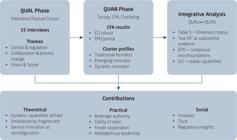
Figure 1 illustrates the research pipeline (QUAL→QUAN), the main analyses conducted, and their integrative outcomes. It highlights how themes from the textual corpus converged with CFA and cluster results, and how triangulation transformed “low fit” into substantive evidence. The figure also summarizes the theoretical, practical, and social contributions derived from this integration.
DISCUSSION
Revisiting partial validation with methodological prudence
The CFA results revealed weak global fit and limited discriminant validity among several governance-related practice dimensions. Importantly, these statistical patterns do not, in isolation, confirm contextual entanglement. Rather, they indicate that the proposed multidimensional structure does not achieve full empirical separation under the current specification.
Only when triangulated with qualitative evidence and institutional theory does a substantive interpretation become theoretically plausible. Interviews consistently showed that authority relations, role distribution, and cooperation are experienced as tightly coupled in daily work under regulatory oversight. Thus, contextual entanglement is presented not as a psychometric conclusion derived solely from fit indices, but as a theoretically grounded hypothesis emerging from convergent mixed-methods evidence.
In accordance with best practices in structural equation modeling (Bido & Souza, 2025), we interpret the present findings as provisional and context-bound. Future confirmatory studies employing alternative model specifications, independent samples, longitudinal designs, and invariance testing will be necessary to establish whether contextual entanglement constitutes a generalizable structural feature of regulated financial organizations.
Lock-in and structural barriers to disruption
These findings extend the argument of Christensen’s Innovator’s Dilemma (1997). In his formulation, incumbents fail to adopt disruptive technologies because of structural commitments and a customer focus. The present study shows that in regulated banking, structural lock-in also operates through organizational practices. Rigid authority structures and ambiguous role allocation, justified by compliance needs, limit the diffusion of novel initiatives. Innovation pockets exist, but system-level transformation is constrained by the very routines that safeguard stability.
Service innovation as reconfiguration
Gallouj and Djellal (2010) emphasize that service innovation often manifests as organizational and relational reconfigurations rather than as standalone technological artifacts. The integrative analysis supports this perspective: The emerging-innovator cluster reflects incremental adjustments to collaboration and processes, while the dynamic-innovator cluster represents deeper reconfiguration of authority and cooperation. This suggests that, in financial services, organizational architecture, rather than new technology per se, determines whether innovation capability translates into effective outcomes.
This reconfiguration manifests concretely in how different clusters approach innovation projects. The qualitative data revealed that traditional-formalist units typically require multiple approval layers and formal documentation even for minor process improvements. In contrast, dynamic-innovator units have developed informal workarounds that maintain compliance while accelerating decision-making. These different approaches to the same regulatory requirements illustrate how organizational architecture shapes innovation outcomes.
Dynamic capabilities: universal logics, contextual microfoundations
Attitudinal capability elements, creativity, proactivity, and future orientation behaved as relatively universal, while the microfoundations that enact them (authority, roles, and cooperation) were context-dependent and intertwined under regulation. Dynamic capabilities may generalize in principle, but their organizational instantiation varies with institutional regimes.
Ambidexterity as fragmented practice
O’Reilly and Tushman (2013) conceptualize ambidexterity as the ability to balance exploration and exploitation. Our findings suggest that in highly regulated banks, ambidexterity may manifest not as firm-level balance but as spatial differentiation: Traditional-formalist units specialize in exploitation (efficiency, compliance), dynamic-innovator units focus on exploration (experimentation, new capabilities), and emerging-innovator units occupy an intermediate space. This fragmented ambidexterity creates “islands of innovation” without strong integrative mechanisms, a configuration that may be adaptive in the short term but potentially problematic for systemic transformation. The challenge is developing bridging mechanisms (e.g., cross-cluster project teams, knowledge brokers) that enable learning transfer without imposing uniformity.
Methodological implications
The persistently low fit and near-unity inter-factor correlations among certain practices (e.g., perceived control ↔ role distribution; regulation ↔ cooperation quality) caution against automatic model respecification in regulated settings. Poor fit may itself be data about how practices are bundled; measurement in institutionally constrained contexts should consider such entanglement rather than force orthogonality.
This study reinforces the importance of treating CFA outcomes as part of an ongoing specification and modeling process rather than as binary validation tests. As emphasized in recent methodological discussions (Bido & Souza, 2025), equivalent or competing models may yield similar fit indices, and substantive interpretation must be grounded in comparative reasoning and theoretical coherence. By explicitly distinguishing between psychometric limitations and theoretical insight, this study seeks to contribute cautiously to the dialogue on organizational practices and innovation capability in regulated service contexts.
Boundary conditions: The Brazilian case
Finally, this study underscores the importance of boundary conditions for theories of innovation. Brazil’s financial sector combines concentration, regulation, and rapid digital adoption-a configuration that is less commonly observed in lightly regulated financial systems. The evidence suggests that models developed in less-regulated environments cannot be transplanted directly. Instead, they require adaptation that accounts for how institutional pressures shape organizational practices. This insight expands the external validity of prior models while guiding other emerging economies facing similar trade-offs between stability and innovation.
The single-organization design, while enabling deep contextual understanding, necessarily limits statistical generalization. Future research should test whether contextual entanglement manifests similarly in (a) banks with different regulatory regimes (e.g., cooperative banks, investment banks), (b) other highly regulated services (healthcare, utilities), and (c) emerging-economy settings with distinct institutional configurations. Multi-site studies would clarify which patterns are bank-specific, sector-specific, or generalizable across regulated services.
CONTRIBUTIONS AND IMPLICATIONS
Theoretical contributions
This study advances theory in four ways. First, it extends the integrative model of organizational practices and innovation capability developed by Barreto (2020) and Souza (2014), originally examined in a public-sector setting, to a highly regulated private-sector financial institution. The results reinforce the robustness of innovation capability dimensions (ECI) while revealing systematic fragilities and overlaps among practice-related dimensions (EPO). Rather than treating these overlaps solely as construct failure, we theorize them as consistent with contextual entanglement, a regulatory-driven bundling of authority, role allocation, and cooperation that shapes how innovation work is organized and experienced in regulated financial services. More broadly, the study offers a theoretically transferable lens for examining how regulatory intensity shapes the microfoundations of innovation capability, thereby informing comparative research on other regulated financial institutions without presuming institutional equivalence.
Second, the findings refine dynamic capabilities theory by shaping the distinction between capability elements and their organizational microfoundations (Teece, 2007; Eisenhardt & Martin, 2000; Felin et al., 2012; Schilke et al., 2018). In our data, capability elements such as creativity, proactivity, and future orientation behaved as comparatively stable orientations, whereas enabling practices functioned as context-dependent arrangements shaped by regulatory and risk logics. This pattern aligns with the view that capabilities may be general in principle, yet are instantiated through microfoundations that vary with institutional conditions (Helfat & Peteraf, 2015). Importantly, this theorization contributes to contemporary debates on strategy and innovation in emerging-economy settings by showing how institutional intensity can condition the micro-level organization of innovation in banks (Hoskisson et al., 2024).
Third, by integrating cultural and practice-based perspectives with innovation-capability approaches, the study explains why enabling may resist being psychometrically separated in regulated organizations. Practices are not merely technical routines; they also encode meaning systems that shape how rules are interpreted, how accountability is enacted, and how cooperation becomes possible under constraint (D’Iribarne, 1989, 2014; Feldman & Orlikowski, 2011; Ruvio et al., 2014; Silva et al., 2018). The concept of contextual entanglement, therefore, provides a theoretically grounded explanation for the observed empirical pattern of high intercorrelations among practice dimensions, without collapsing it into a purely methodological artifact. This interpretation is consistent with recent empirical evidence showing that organizational capabilities operate as interdependent systems, in which partial or unbalanced development can lead to negative performance effects rather than incremental gains (Seabra & Pettigrew, 2026).
Finally, the typology of clusters extends the debates on organizational ambidexterity by showing that, in highly regulated financial services, exploration and exploitation may coexist through spatial differentiation rather than firm-level integration (O’Reilly & Tushman, 2013). The profiles identified, traditional-formalist, emerging-innovator, and dynamic-innovator, suggest that regulated banks can develop “pockets” of exploration alongside strong compliance-oriented units, producing a form of fragmented ambidexterity. This configuration helps explain why innovation capability can be unevenly distributed within the same regulatory regime and offers a theoretically informed basis for future comparative research across banks and other regulated service sectors. Recent banking research on innovation, learning, and capability development reinforces the relevance of examining these internal configurations rather than assuming uniform capability across the organization (Alsoukini et al., 2025; Mohamed & Hussein, 2025).
Methodological contributions
This study also offers methodological contributions relevant to research on innovation capability and organizational practices in regulated contexts. First, the article demonstrates the value of using confirmatory factor analysis (CFA) not only as a tool for construct validation, but also as a diagnostic instrument for examining how theoretically distinct organizational practices behave under strong institutional constraints. While CFA is traditionally employed to confirm measurement models, recent methodological discussions emphasize that model misfit and weak discriminant validity can also signal substantive tensions between theory and empirical reality, particularly in complex organizational settings (Brown, 2015; Kline, 2023). In this study, the observed overlap among practice-related dimensions is therefore interpreted with caution and analyzed, rather than dismissed as a purely technical flaw.
Second, the study contributes by explicitly combining CFA with qualitative evidence in a sequential mixed-methods design (QUAL↔QUAN). The qualitative phase provided insight into how authority, role clarity, and cooperation are experienced jointly in everyday work, informing the interpretation of quantitative results and mitigating the risk of overinterpreting statistical artifacts. This triangulation strengthens the credibility of the findings by linking measurement behavior to observed organizational practices, in line with best practices in mixed-methods research (Creswell & Plano Clark, 2017; Tashakkori & Teddlie, 2010).
Third, the methodological approach highlights the importance of distinguishing between measurement limitations and interpretive contributions. While the study acknowledges constraints related to global model fit and discriminant validity among organizational practice constructs, these limitations are treated transparently and situated within the research context’s institutional characteristics. Rather than claiming definitive construct validation, the analysis shows how psychometric tensions can be theoretically informative when examined alongside qualitative evidence and contextual knowledge. This approach responds to recent calls for greater reflexivity in quantitative organizational research, particularly in institutionally complex environments (Aguinis et al., 2018).
Finally, cluster analysis complements the factor-analytic results by revealing heterogeneous organizational profiles within a single regulated institution. By identifying configurations of practices and innovation capability across organizational units, the study moves beyond average effects. It illustrates how innovation capability can be unevenly distributed under the same regulatory regime. This configuration-oriented perspective is particularly suited to regulated service organizations and offers a methodological template for future comparative studies across banks and other regulated sectors (Meyer et al., 1993; Fiss, 2011).
Practical implications
The study also provides actionable recommendations for managers in the financial sector:
-
Redesign authority structures by establishing clear innovation mandates at middle management levels, creating ‘innovation sponsors’ with defined decision rights for projects below specified risk thresholds, and implementing fast-track approval processes for experiments that meet pre-established criteria.
-
Clarify role allocation: Transparency in responsibilities reduces overlaps and accelerates decision-making.
-
Strengthen cross-unit cooperation: Targeted mechanisms such as multidisciplinary teams and knowledge-sharing incentives can enhance integration.
-
Differentiate management by cluster: Recognizing heterogeneous organizational profiles allows tailored approaches. Traditional-formalist groups may benefit from awareness-building and gradual capability development, whereas dynamic-innovator groups may require greater autonomy and resources.
-
Monitor both practices and capabilities: Management dashboards should capture EPO and ECI indicators simultaneously to enable evidence-based decisions.
These implications are particularly relevant as banks navigate digital transformation under regulatory oversight. By addressing the microfoundations of innovation, managers can avoid superficial reforms and foster lasting capability development.
Based on the cluster analysis results, organizations should consider a phased approach to developing innovation capabilities. This phased framework is grounded in the empirical cluster structure identified in the study. It reflects observed differences in authority, cooperation, and innovation practices across organizational units, rather than a prescriptive maturity model derived solely from prior literature.
-
Phase 1: Foundation Building (Traditional-Formalist clusters, ~37% of sample)
-
- Focus: Awareness creation and basic innovation capability development.
-
- Actions: Innovation literacy workshops, process improvement training.
-
- Timeline: 12-18 months.
-
- Expected outcome: A shift toward the emerging-innovator profile.
-
-
Phase 2: Capability Enhancement (Emerging-Innovator clusters, ~42%)
-
- Focus: Providing greater autonomy within established boundaries.
-
- Actions: Innovation challenge programs, protected experimentation spaces.
-
- Timeline: 6-12 months.
-
- Expected outcome: Selective transition to Dynamic-Innovator.
-
-
Phase 3: Innovation Acceleration (Dynamic-Innovator clusters, ~21%).
-
- Focus: Removing bureaucratic barriers, scaling successful innovations.
-
- Actions: Direct access to senior leadership, dedicated innovation budgets.
-
- Timeline: Ongoing.
-
- Expected outcome: Organization-wide knowledge diffusion.
-
This differentiated approach recognizes that uniform innovation initiatives are likely to fail when capability levels vary dramatically across the organization.
The role of leadership
Leadership emerged as a critical microfoundation mediating between organizational practices and innovation behaviors. Leaders face the paradox of reconciling regulatory compliance with the need for flexibility. The most effective were perceived as those practicing ambidextrous leadership (O’Reilly & Tushman, 2013), alternating between control and autonomy in response to situational demands.
Key leadership capabilities include:
-
Paradox management: Recognizing and balancing stability and change.
-
Dialog facilitation: Bridging conflicts across units with divergent logics.
-
Psychological safety creation: Encouraging experimentation despite risk exposure.
Investing in the development of ambidextrous leaders is, therefore, a strategic pathway for financial institutions seeking to innovate while preserving trust and compliance.
Social and policy implications
Beyond organizational outcomes, the study has broader implications. Innovation in financial services affects inclusion, accessibility, and trust in societies where banks play a central role. By improving organizational practices, banks can not only accelerate digital transformation but also expand access to underserved populations and reinforce consumer confidence.
For policymakers, the findings highlight the double-edged role of regulation: while it safeguards stability, it can inadvertently reinforce rigid practices that constrain innovation. Regulatory agencies may thus consider complementing compliance frameworks with incentives for organizational flexibility and cross-sector collaboration.
LIMITATIONS
This study presents several methodological limitations that warrant careful consideration. First, although the sample size meets conventional CFA thresholds, no a priori statistical power analysis was conducted. Future studies should incorporate power-based sampling strategies to enhance precision in parameter estimation.
Second, the weak global model fit and limited discriminant validity among governance-related practice constructs restrict definitive measurement claims. While triangulated evidence supports a contextual interpretation, alternative specifications-including hierarchical, bifactor, or aggregated models-must be formally tested in independent samples before broader generalization.
Third, the cross-sectional design prevents temporal inference regarding the stability of practice bundling under regulatory change. Longitudinal designs could clarify whether contextual entanglement persists or evolves alongside regulatory reforms and digital transformation initiatives.
Finally, because the study relies on a single organization, albeit theoretically selected, replication across multiple regulated banks and institutional environments is necessary to determine the boundary conditions of contextual entanglement.
By explicitly distinguishing between empirical limitation and theoretical insight, we aim to preserve analytical rigor while advancing a context-sensitive research agenda.
CONCLUSIONS
This study examined how organizational practices shape innovation capability in a highly regulated financial institution, with particular attention to how regulatory constraints influence the configuration and empirical separability of organizational practices. By integrating qualitative and quantitative evidence from a Brazilian private bank, the article contributes to ongoing debates on innovation capability, dynamic capabilities, and service innovation in regulated environments.
The findings show that capability dimensions such as creativity, openness, proactivity, future orientation, and risk propensity exhibit comparatively stable measurement properties, even under strong regulatory pressure. In contrast, organizational practices related to authority, role distribution, and cooperation display substantial overlap and limited empirical separability. Rather than interpreting this pattern solely as a measurement limitation, the study advances the concept of contextual entanglement to explain how regulatory intensity fosters coupled practice configurations in everyday organizational work tightly. This interpretation highlights how compliance requirements, accountability structures, and risk-management logics shape not only formal governance arrangements but also the lived experience of innovation within regulated financial services.
From a theoretical perspective, the study refines innovation capability and dynamic capabilities frameworks by distinguishing between relatively general capability elements and context-sensitive organizational microfoundations. It shows that while capability orientations may travel across settings, their enabling practices are deeply conditioned by institutional environments. By foregrounding contextual entanglement, the article offers a nuanced, empirically grounded explanation of why organizational practices may resist analytical separation in regulated service organizations, thereby extending existing theory without overstating its generalizability.
Methodologically, the study demonstrates the value of a sequential mixed methods design in institutionally complex contexts. The combined use of qualitative analysis, confirmatory factor analysis, and cluster analysis illustrates how psychometric results can be interpreted diagnostically when triangulated with qualitative evidence and contextual knowledge. Rather than claiming definitive construct validation, the article shows how methodological tensions, such as modest global fit and limited discriminant validity, can inform theory development when treated reflexively and transparently. The Identification of three organizational profiles, traditional-formalist, emerging-innovator, and dynamic-innovator, further underscores the uneven distribution of innovation capability within a single regulatory regime. These profiles reveal how regulated banks may develop differentiated internal configurations that allow exploration and compliance to coexist spatially, offering insight into how innovation can emerge alongside strong control structures.
For practitioners, the findings suggest that fostering innovation in regulated financial institutions requires more than investing in technology or promoting creativity in isolation. Managers must attend to how authority structures, role clarity, and cooperation are designed and enacted together, as fragmented or partially developed practice configurations may constrain innovation efforts. Governance redesign, clearer role allocation, strengthened cross-unit cooperation, and ambidextrous leadership emerge as key levers for balancing regulatory compliance and innovation capability.
Finally, while the study is grounded in a single Brazilian bank, its contribution lies in analytical generalization rather than statistical inference. By articulating how organizational practices become entangled under regulatory intensity, the article offers a theoretically informed lens that can guide future research across banks, financial institutions, and other regulated service sectors. Comparative, longitudinal, and multi-institutional studies are encouraged to further examine further how contextual entanglement evolves over time and across different regulatory regimes.
In summary, this article contributes to a more context-sensitive understanding of innovation capability in regulated financial services, highlighting the importance of organizational practices not as isolated mechanisms but as interdependent systems shaped by institutional constraints.
Open Data:
the data cannot be made publicly available as it was collected under the condition of anonymity.
-
RAM does not have permission from the authors or evaluators to publish this article’s review.
-
RAM does not have information about open data regarding this manuscript.
REFERENCES
-
Aguinis, H., Ramani, R. S., & Alabduljader, N. (2018). What you see is what you get? Enhancing methodological transparency in management research. Academy of Management Annals, 12(1), 83-110. https://doi.org/10.5465/annals.2016.0011
» https://doi.org/10.5465/annals.2016.0011 -
Alsoukini, F. A. M., Adedokun, M. W., & Berberoğlu, A. (2025). Enhancing sustainable innovation performance in the banking sector of Libya: The impact of artificial intelligence and organizational learning. Sustainability, 17(12), 5345. https://doi.org/10.3390/su17125345
» https://doi.org/10.3390/su17125345 - Banco Central do Brasil. (2023). Relatório de Economia Bancária.
- Bardin, L. (2011). Análise de conteúdo Edições 70.
- Barreto, R. S. (2020). Relação entre práticas organizacionais e capacidade de inovação: Um estudo no Banco do Brasil [Unpublished master’s thesis]. Instituto de Educação Superior de Brasília.
-
Bido, D. de S., & Souza, C. A. de. (2025). Structural equation modeling: Is it still worth learning? Proceedings of 28th SemeAd. São Paulo: EAD/FEA/USP. https://login.semead.com.br/28semead/anais/download.php?cod_trabalho=2140
» https://login.semead.com.br/28semead/anais/download.php?cod_trabalho=2140 - Bourdieu, P. (1990). The Logic of Practice Stanford University Press.
- Brown, T. A. (2015). Confirmatory factor analysis for applied research Guilford Press.
-
Chen, Y., Liu, L., Li, W., Xie, Z., & Wei, C. (2023). Microfoundations of dynamic capabilities: A systematic review and a multilevel framework. Management Decision, 61(6), 1717-1753. https://doi.org/10.1108/MD-05-2022-0615
» https://doi.org/10.1108/MD-05-2022-0615 - Christensen, C. M. (1997). The innovator’s dilemma: When new technologies cause great firms to fail. Harvard Business Review Press.
-
Conway, J. M., & Lance, C. E. (2010). What reviewers should expect from authors regarding common method bias in organizational research. Journal of Business and Psychology, 25(3), 325-334. https://doi.org/10.1007/s10869-010-9181-6
» https://doi.org/10.1007/s10869-010-9181-6 - Creswell, J. W., & Plano Clark, V. L. (2017). Designing and conducting mixed methods research (3rd ed.). Sage.
- D’Iribarne, P. (1989). La logique de l’honneur: Gestion des entreprises et traditions nationales Seuil.
- D’Iribarne, P. (2014). Managing corporate values in diverse national cultures Routledge.
-
DiMaggio, P. J., & Powell, W. W. (1983). The iron cage revisited: Institutional isomorphism and collective rationality in organizational fields. American Sociological Review, 48(2), 147-160. https://doi.org/10.2307/2095101
» https://doi.org/10.2307/2095101 -
Djellal, F., & Gallouj, F. (2018). Fifteen Advances in Service Innovation Studies. In A. Scupola & L. Fuglsang (Eds.), Integrated Crossroads of Service, Innovation and Experience Research-Emerging and Established Trends (pp. 39-65). Edward Elgar Publishers. https://doi.org/10.4337/9781788114301.00009
» https://doi.org/10.4337/9781788114301.00009 -
Eisenhardt, K. M., & Martin, J. A. (2000). Dynamic capabilities: What are they? Strategic Management Journal, 21(10-11), 1105-1121. https://doi.org/10.1002/1097-0266(200010/11)21:10/11<1105::AID-SMJ133>3.0.CO;2-E
» https://doi.org/10.1002/1097-0266(200010/11)21:10/11<1105::AID-SMJ133>3.0.CO;2-E -
Eisenhardt, K. M., & Graebner, M. E. (2007). Theory building from cases: Opportunities and challenges. Academy of Management Journal, 50(1), 25-32. https://doi.org/10.5465/amj.2007.24160888
» https://doi.org/10.5465/amj.2007.24160888 - FEBRABAN - Federação Brasileira de Bancos. (2024). Pesquisa FEBRABAN de Tecnologia Bancária 2024 FEBRABAN.
-
Feldman, M. S., & Orlikowski, W. J. (2011). Theorizing practice and practicing theory. Organization Science, 22(5), 1240-1253. https://doi.org/10.1287/orsc.1100.0612
» https://doi.org/10.1287/orsc.1100.0612 -
Felin, T., Foss, N. J., Heimeriks, K. H., & Madsen, T. L. (2012). Microfoundations of routines and capabilities: Individuals, processes, and structure. Journal of Management Studies, 49(8), 1351-1374. https://doi.org/10.1111/j.1467-6486.2012.01052.x
» https://doi.org/10.1111/j.1467-6486.2012.01052.x -
Fiss, P. C. (2011). Building better causal theories: A fuzzy set approach to typologies in organization research. Academy of Management Journal, 54(2), 393-420. https://doi.org/10.5465/amj.2011.60263120
» https://doi.org/10.5465/amj.2011.60263120 -
Fornell, C., & Larcker, D. F. (1981). Evaluating structural equation models with unobservable variables and measurement error. Journal of Marketing Research, 18(1), 39-50. https://doi.org/10.1177/002224378101800104
» https://doi.org/10.1177/002224378101800104 - Gallouj, F., & Djellal, F. (2010). The handbook of innovation and services Edward Elgar Publishing.
-
Gomber, P., Kauffman, R. J., Parker, C., & Weber, B. W. (2018). On the fintech revolution: Interpreting the forces of innovation, disruption, and transformation in financial services. Journal of Management Information Systems, 35(1), 220-265. https://doi.org/10.1080/07421222.2018.1440766
» https://doi.org/10.1080/07421222.2018.1440766 - Hair, J. F., Black, W. C., Babin, B. J., & Anderson, R. E. (2019). Multivariate data analysis (8th ed.) Cengage Learning.
-
Helfat, C. E., & Peteraf, M. A. (2015). Managerial cognitive capabilities and the microfoundations of dynamic capabilities. Strategic Management Journal, 36(6), 831-850. https://doi.org/10.1002/smj.2247
» https://doi.org/10.1002/smj.2247 -
Höhener, D. (2024). Dynamic Capabilities to Manage Generative Artificial Intelligence in Digital Transformation Efforts. Wirtschaftsinformatik 2024 Proceedings 1. https://aisel.aisnet.org/wi2024/1
» https://aisel.aisnet.org/wi2024/1 -
Hoskisson, R. E., Wright, M., Filatotchev, I., & Peng, M. W. (2024). Strategy research in emerging economies: Challenging the conventional wisdom. Journal of Management Studies, 61(1), 1-35. https://doi.org/10.1111/j.1467-6486.2012.01085.x
» https://doi.org/10.1111/j.1467-6486.2012.01085.x -
Hu, L., & Bentler, P. M. (1999). Cutoff criteria for fit indexes in covariance structure analysis: Conventional criteria versus new alternatives. Structural Equation Modeling: A Multidisciplinary Journal, 6(1), 1-55. https://doi.org/10.1080/10705519909540118
» https://doi.org/10.1080/10705519909540118 -
Kadyrova, A., & Shapira, P. (2024). Microfoundations of Dynamic Capabilities for Social Innovations in Small Non-Profit Organizations. Nonprofit and Voluntary Sector Quarterly, 53(6), 1410-1433. https://doi.org/10.1177/08997640231214738
» https://doi.org/10.1177/08997640231214738 - Kline, R. B. (2023). Principles and practice of structural equation modeling (5th ed.). The Guilford Press.
-
Lawson, B., & Samson, D. (2001). Developing innovation capability in organisations: A dynamic capabilities approach. International Journal of Innovation Management, 5(3), 377-400. https://doi.org/10.1142/S1363919601000427
» https://doi.org/10.1142/S1363919601000427 -
Mehrabi, S., Mahdad, M., Bijman, J., Cholez, C., Mesa, J. C. P., & Giagnocavo, C. (2024). Microfoundations of dynamic capabilities enabling scaling pathways of sustainability-oriented innovation business models. Business Strategy and the Environment, 34(1), 849-871. https://doi.org/10.1002/bse.4004
» https://doi.org/10.1002/bse.4004 -
Meirelles, D. S. E., Gallouj, F., Vargas, E. R., Oliva, F. L., & Zawislak, P. A. (2022). Innovation in services: An introduction. RAM Revista de Administração Mackenzie, 23(6), eRAMD220400. https://doi.org/10.1590/1678-6971/eRAMD220400.en
» https://doi.org/10.1590/1678-6971/eRAMD220400.en -
Meyer, A. D., Tsui, A. S., & Hinings, C. R. (1993). Configurational approaches to organizational analysis. Academy of Management Journal, 36(6), 1175-1195. https://doi.org/10.5465/256809
» https://doi.org/10.5465/256809 - Minayo, M. C. S. (2001). Pesquisa social: Teoria, método e criatividade (18th ed.). Vozes.
-
Mohamed, S. D., & Hussein, H. A. (2025). Unveiling the role of innovation practices in organizational learning as a mediator for sustainable performance enhancement in Somali banks. Discover Sustainability, 6(1), 1-18. https://doi.org/10.1007/s43621-025-00924-4
» https://doi.org/10.1007/s43621-025-00924-4 -
O’Reilly, C. A., & Tushman, M. L. (2013). Organizational ambidexterity: Past, present, and future. Academy of Management Perspectives, 27(4), 324-338. https://doi.org/10.5465/amp.2013.0025
» https://doi.org/10.5465/amp.2013.0025 -
Perez, G., Vargas, C. J., & Gallouj, F. (2025). Understanding and Measuring Innovation Capacity in Services. In W. Bataglia & L. Segura (eds.), Impacts of Innovation and Cognition in Management (pp. 263-286). IGI Global Scientific Publishing. https://doi.org/10.4018/979-8-3693-5777-4.ch011
» https://doi.org/10.4018/979-8-3693-5777-4.ch011 -
Podsakoff, P. M., MacKenzie, S. B., Lee, J.-Y., & Podsakoff, N. P. (2003). Common method biases in behavioral research: A critical review of the literature and recommended remedies. Journal of Applied Psychology, 88(5), 879-903. https://doi.org/10.1037/0021-9010.88.5.879
» https://doi.org/10.1037/0021-9010.88.5.879 -
Ruvio, A., Shoham, A., Vigoda-Gadot, E., & Schwabsky, N. (2014). Organizational innovativeness: Construct development and cross-cultural validation. Journal of Product Innovation Management, 31(5), 1004-1022. https://doi.org/10.1111/jpim.12141
» https://doi.org/10.1111/jpim.12141 -
Schilke, O., Hu, S., & Helfat, C. E. (2018). Quo vadis, dynamic capabilities? A content-analytic review. Academy of Management Annals, 12(1), 390-439. https://doi.org/10.5465/annals.2016.0014
» https://doi.org/10.5465/annals.2016.0014 -
Seabra, S. N., & Pettigrew, A. M. (2026). The Perils of Partial Reform: Capability Systems and Public Organization Performance. Public Organization Review, 1-26. https://doi.org/10.1007/s11115-025-00977-z
» https://doi.org/10.1007/s11115-025-00977-z -
Silva, R. G. S., Broilo, P. L., Frio, R. S., Sampaio, C. H., & Perin, M. G. (2018). Organizational innovativeness scale: Evidence of validation for the Brazilian context. Revista de Administração da UFSM, 10(6), 1061-1080. https://doi.org/10.5902/1983465918944
» https://doi.org/10.5902/1983465918944 - Souza, G. H. S. (2014). Práticas organizacionais e inovação: Um estudo em organizações públicas [Unpublished doctoral dissertation]. Universidade de Brasília.
- Tashakkori, A., & Teddlie, C. (eds.). (2010). Sage handbook of mixed methods in social & behavioral research (2nd ed.). Sage.
-
Teece, D. J. (2007). Explicating dynamic capabilities: The nature and microfoundations of (sustainable) enterprise performance. Strategic Management Journal, 28(13), 1319-1350. https://doi.org/10.1002/smj.640
» https://doi.org/10.1002/smj.640 -
Wang, C. L., & Ahmed, P. K. (2004). The development and validation of the organisational innovativeness construct. European Journal of Innovation Management, 7(4), 303-313. https://doi.org/10.1108/14601060410565056
» https://doi.org/10.1108/14601060410565056 - Yin, R. K. (2018). Case study research and applications: Design and methods (6th ed.). Sage.
Edited by
-
EDITORIAL BOARD
Editor-in-chiefAlmir Martins VieiraAssociated editorVera CançadoTechnical supportVitória Batista Santos Silva
-
EDITORIAL PRODUCTION
Publishing coordinationAndreia Ferreira CominettiEditorial InternSofia LelisLanguage editorBardo EditorialLayout designerLibroGraphic designerLibro