 “I’m a chameleon”: The protean career raveled
Abstract
Purpose: To analyze how protean tendencies shape the career trajectories of information technology (IT) professionals.
Originality: The study highlights the need for organizations to develop protean profiles to attract and retain key personnel.
Design/methodology/approach: We used Gubler et al.’s (2014) model to conduct 16 semi-structured interviews with IT professionals in different areas.
Findings: Value orientation was evident in engagement, job satisfaction, and attraction to dynamic employment. Participants-versatile, determined, self-directed, and open to change-sought high-quality and purposeful work they could balance with their personal lives. The study has several limitations. For example, it focuses solely on the protean dimensions of the participants’ career trajectories at the expense of other influencing factors. In practical terms, the study indicates the importance of implementing managerial interventions that meet the needs of chameleonic individuals, thereby increasing retention rates. In the Brazilian context, a lack of work standardization legislation has adverse social consequences; this is an issue that policymakers might address.
Keywords:
organizations; protean career; career development; IT professionals; protean organization
Resumo
Objetivo: Analisar como a trajetória de carreira dos profissionais de tecnologia da informação é moldada pelas dimensões da carreira proteana.
Originalidade: O estudo destaca a necessidade de as organizações desenvolverem um perfil variado para reter seu pessoal-chave.
Design/metodologia/abordagem: Com base no modelo de Gubler et al. (2014), foram realizadas 16 entrevistas semiestruturadas com profissionais de diferentes áreas da Tecnologia da Informação.
Resultados: A orientação a valores é evidenciada no engajamento no trabalho, satisfação no trabalho e atração pelo trabalho dinâmico, com busca de qualidade de vida no trabalho, desejo de fazer um trabalho com propósi-to e necessidade de equilibrar trabalho e vida pessoal. Além disso, a adaptabilidade é influenciada por fatores como versatilidade e abertura a possíveis mudanças. Ademais, o fator autodireção enfatiza a capacidade de ter uma carreira autodeterminada e buscar novas experiências. As limitações da pesquisa são que o presente estudo se concentrou apenas nas dimensões da carreira proteana e não considerou outras concepções de carreira significativas para a categoria profissional à luz do cenário do trabalho contemporâneo. Como implicações práticas, nossa contribuição é apresentar a necessidade de implementação de intervenções gerenciais que vise m atender às necessidades desses indivíduos proteanos, contribuindo para sua satisfação e retenção. Sobre as implicações sociais, no que diz respeito à legislação brasileira, ainda falta uma padronização do trabalho que dê conta das consequências das atividades.
Palavras-chave:
organizações; carreira proteana; desenvolvimento de carreira; profissionais de TI; organização proteana
INTRODUCTION
Many workers traditionally expected to remain employed in one organization for their careers. Their long-term loyalty was rewarded through job security and careful career management (Cortellazzo et al., 2020; Doden et al., 2018). Nowadays, individuals no longer seek to serve organizations; they expect organizations to serve them (Baruch, 2006; Hekman et al., 2009). Consequently, the length of time they stay attached to organizations has reduced (Baruch, 2006). Employees have begun to exert more control over their careers (Cortellazzo et al., 2020), giving rise to the protean career concept. Concomitantly, different types of relationships between companies and their staff and more integrated approaches to professional development have emerged (Haengglia et al., 2021; Hall, 2002).
Protean professionals reconfigure their competencies according to market needs, moving from company to company and project to project (while ensuring employment continuity) and seeking work that aligns with their values and goals (Baruch & Rousseau, 2018; Grimland et al., 2012). Compared with traditional, linear professionals, such individuals are more likely to change jobs, organizations, and occupations (Cortellazzo et al., 2020; Grimland et al., 2012). The protean career is characterized by self-direction, self-management, and the constant manipulation of work-related variables (Costa & Kienen, 2021). This is not necessarily always positive; the term job hopper has been applied to employees who change jobs more than twice in a short period (Baruch & Vardi, 2016; Lanke & Nath, 2023). Frequent transitions lead to transient career experiences and short work cycles, leading to a lower likelihood of maturation and high levels of achievement (Baruch & Vardi, 2016).
Information technology professionals design, build, and manage information systems, providing training, documentation, and support in organizational contexts (Niederman et al., 2016). Crespi-Vallbona and Mascarilla-Miró (2018) suggested that this group is less loyal to their employers than other professional categories. Similarly, Moreno Jr. et al. (2009) identified a weakness in the bond between IT professionals and their employers. Information technology careers encompass a variety of positions and functions that can easily be incorporated into a self-directed career model (Kilimnik et al., 2012); this may explain why IT professionals often take a different approach to their jobs than other professionals (Buhari et al., 2020).
The present study examines the chameleonic nature of IT professionals. Two common issues are associated with this group: turnover (Farooq et al., 2022) and turn-away (e.g., a move to a position in another company area; Ramos & Joia, 2014). The first must be reduced if organizations are to achieve their objectives. As IT becomes increasingly important (Irani-Williams et al., 2021), companies need to change their processes and policies and reward self-employed, flexible, and cutting-edge workers (Strom et al., 2021), developing strategies that engage them and eschewing conventional management styles that no longer offer them guidance (Gupta, 2018).
The Protean Career
Protean career professionals have their criteria for success. These are typically focused on self-realization and ideals of happiness, which are often linked to objectives such as achieving promotion (Kaushal & Vashisht, 2021), getting more job offers (Cortellazzo et al., 2020), and more substantial affective organizational commitments (Alonderiene∙ & Šimkevičiute∙ , 2018) rather than traditional, straightforward drivers (e.g., salaries).
In this new framework, a career is viewed as a series of work experiences that bring personal satisfaction and psychological well-being (Cortellazzo et al., 2020; De Vos & Van der Heijden, 2017; Hall et al., 2018; Steiner et al., 2019), a protean perspective that is a particular characteristic of Generation Y workers (i.e., those born between 1980 and 2000; da Silva et al., 2022). Their careers must be reinvented from time to time and driven by themselves rather than the organizations they work for. Such a perspective is a function of educational experiences, training, employment in multiple organizations, and changing fields of work (Cortellazzo et al., 2020). Meanwhile, Vaclavik et al. (2021) showed that the formal labor market and traditional business activities have stimulated a desire for self-directed change.
According to Hall (2002), individuals and organizations have become acquainted with short-term work relationships focused on specific needs. The protean career requires a humanized and flexible organizational management system that considers individual needs and values. From the professional’s perspective, it means improving, acquiring greater knowledge, becoming self-aware, and adapting to changes prompted by personal requirements or environmental factors (Herrmann et al., 2015). Protean professionals seek autonomy and flexibility, engage in continual learning, endeavor to work beyond their limits, and ensure they have the freedom to move around (Cordeiro & Albuquerque, 2017). They set ambitious targets for themselves and undertake additional efforts to reach them (Herrmann et al., 2015).
Protean organizations adapt to changing circumstances (e.g., the presence of chameleonic workers on the payroll). They acknowledge and respond to the need to reshape how work is carried out and how careers are built. Such organizations attract and retain valuable talent by rejecting the traditional career model (emphasizing continuous, full-time employment), thereby gaining a competitive advantage (Cabrera, 2009).
The literature presents different protean career models. For instance, Briscoe et al.’s (2006) was based on two dimensions (values and self-mana-gement), while Gubler et al.’s (2014) consisted of four conceptual components, albeit based on the former. The combination of the two models represented a comprehensive conceptualization of the protean career (Table 1).
Table 1 shows that the first component corresponds to the individual being transparent about their needs, motivation, abilities, values, and interests based on identity (Hall, 2002, 2004). As an attitudinal component, a protean career orientation comprises cognitive, evaluative, and behavioral elements (Briscoe & Hall, 2006). Although protean career models stress that the chameleonic individual is responsible for determining how their career develops (and that they value psychological success), not all workers possess the necessary attributes needed to pursue a career that combines these characteristics because they feel the need for external support (Hall, 2002).
The second component (i.e., having personal values that are both the guidance and measure of career success) is grounded in Hall’s (1976) original definition and addressed by Briscoe et al. (2006). For Gubler et al. (2014), being values-driven does not mean that a person’s values have to run counter to organizational values. Briscoe et al. (2006) used the term to refer to a person’s internal orientation rather than the orientation of an organi-zation, regardless of whether one agrees with its values. Values can help understand individual motivations regarding career or organizational attachment (Gubler et al., 2014).
The third component (i.e., being competent and motivated to learn and adapt to a changing environment) accords with Briscoe and Hall’s (1999) discussion of developing an individual’s learning ability. This component relates to the second protean career meta-competency of adaptability (Hall, 2002) and self-direction (Briscoe & Hall, 2006). Despite its conceptual rele-vance, few researchers have addressed this component empirically (Gubler et al., 2014).
The fourth component (i.e., a feeling of independence and being in charge of one’s career; Hall, 1976, 2004) corresponds to being “self-directed” because it involves taking responsibility for managing and developing one’s career path (Briscoe & Hall, 2006; De Vos & Van der Heijden, 2017). Protean career-oriented individuals tend to have clear values and are self-directed, making them more likely to satisfy their needs by participating in organizations that do likewise (Gubler et al., 2014; Hall, 2002).
The IT professional
The IT sector includes the IT software industry, companies that manufacture goods relevant to the use of new information and communication technologies (NTICs), and the IT services industry. As a result, the profile of the IT professional is difficult to define and continues to evolve (Piurcosky et al., 2021). A highly qualified IT professional is no longer considered a mere tool or technical resource but an integral part of organizational strategy. They exhibit characteristics arguably contrary to those of a traditional professional, demonstrating dynamism, objectivity, creativity, a desire for novelty, and a wish to be challenged (Foina & Eiras, 2016).
As noted above, the IT sector contains professionals who occupy various positions and perform various functions; they use technology to generate pro-ducts and/or services well-suited to the self-directed career model (Kilimnik et al., 2012). At the same time, they often face career, autonomy, and family difficulties, which make them ripe for further investigation (Moura Junior & Helal, 2014). Up-and-coming IT professionals emphasize learning and employability more than job security (Chaudhuri et al., 2018). They are highly mobile professionals in the real world so that they can switch jobs with alacrity (Miller, 2018). Because they do not spend their entire careers in one company, it has become increasingly important for them to find ways to become more employable (De Cuyper & De Witte, 2011; Sok et al., 2013).
The principal foci of IT professionals are professional fulfillment, recognition by superiors and peers, autonomy and responsibility, interest in work, advancement to higher tasks and professional development (Arnold, 2016), learning opportunities (Steil et al., 2020), decent remuneration (Steil et al., 2022), and finding a balance between personal and professional life (Ferreira et al., 2021). The high demand for IT professionals means that organizations have to place them in stimulating environments (Foina & Eiras, 2016), mini-mize invisible tasks such as digi-housekeeping (Whiting & Symon, 2020), nurture interpersonal and organizational attachments (Allen & Meyer, 2000), and encourage indications of affective commitment (Briscoe & Finkelstein, 2009).
METHODOLOGY
The present study follows a qualitative rather than a positive approach (Creswell, 2014), thus making it possible to access the subjective viewpoints of the participants (Oliveira & Rowe, 2018; Pérez-Nebra et al., 2021). The sample (of 16 interviewees) was sufficient to detect data saturation. Table 2 displays the characteristics of the participants in chronological order. Interviewees are identified under the heading “Participant,” followed by a number corresponding to the order of the interviews.
Six participants worked for public organizations, four for companies abroad, two at a law firm, one as a contractor for a public agency, and another under a Brazilian labor law regime. A two-part interview with a semi-structured script was used to collect the data: the first comprised questions about the profile of the participants, and the second referred to the research objectives (the two dimensions of the protean career in particular). The script comprised 16 questions regarding the four core aspects thereof. The questions were designed to establish how the participants felt about their careers, what values and interests were important to them, and how prepared they were for possible changes in their roles and organizations (given their future aspirations).
The interviews took place in 2022, and the participants were recruited using snowball sampling (Biernacki & Waldorf, 1981). After the initial contact, appointments were made so that the interviews could be carried out according to the availability of the participants and after the termos de consentimento livre e esclarecido (TCLE; in English, terms of free and informed consent) were agreed upon (and formalized with signatures). The interviews were recorded with the participants’ authorization and fully transcribed for analysis.
The data analysis was carried out following Bardin (2016). The researchers coded, classified, and categorized data with the help of the qualitative analysis software packing Atlas.ti version 22; a total of 51 codes resulted (seven were a priori analysis categories and 44 were a posteriori recording units). Categories are classes that bring together a group of elements (recording units) under a generic title, under which they are grouped because of their shared characteristics (Bardin, 2016). In the present study, the conceptual model used to classify the data was the four-component protean career model developed by Gubler et al. (2014) and discussed above. The categories of analysis were organized according to the literature and the research objectives (Table 1), which gave rise to a recording units category based on the gradual classification of elements, that is, words or phrases that appeared in the participants’ responses to the questions.
RESULTS
Topics such as the traditional career, the traditional organization, and the protean organization were discussed during the interviews.
Dimension: values-driven
In the analysis of the participant’s identity, we sought to determine whether they exhibited the characteristics of a protean career as described by Gubler et al. (2014), according to which identity and being values-driven were aspects of what it was to be values-driven (i.e., needs, motivations, abilities, interests, and values).
Core aspect: identity
Identity, or identity awareness, refers to an individual’s clarity about their needs, motivations, skills, values, and interests (Figure 1).

Many participants stated that they had been inquisitive since their youth; many learned about computers by disassembling and assembling their components (i.e., hardware). The work engagement component was viewed as a behavioral characteristic comprising a stubbornness to overcome challenges and advance within the company: for example, “It is because currently my life is focused on my career; if I do not have anything to invest in my career, what will I do with my life?” (P05)
Job satisfaction was one of the most relevant components of identity. Several referred to their interest in science, technology, engineering, and mathematics (STEM). For instance, P05 stated, “I have liked mathematics and physics since I was 18. So, I have studied math and physics for 10 years. Since I was a child. My life has always been based on logic.” Dynamism was considered important to the participants; work had to be challenging. Additionally, they wanted to be role models for their colleagues:
Technically, I want to take what I know, get even better, you know, to reach the level which… so I do not say, “Ah, there is this problem, I will talk to [P11], he will know.” So, there are some technologies that I am studying, and I am studying more and more, which is my goal. (P11)
The participants were not only ambitious; the financial aspect played an important role in how far they bonded with their employers, though this was less important than the psychological contract (Baruch & Rousseau, 2018). Although difficulty in dealing with people was a problem, they recognized that team cohesion was essential; as P01 put it, “When you can create a stronger bond with your co-workers, work improves, it is more pleasant to work, and it generates more security, right, when you change to a new [team] it generates maybe more uncertainty.” There was a positive correlation between being a part of a group, feeling positive about belonging to it and having a healthy work relationship. However, the participants were more inclined to prefer working independently.
Core aspect: being value-driven
Being values-driven relates to orientation and measures of career success (Figure 2). The participants valued the achievement component of their careers and sought a sense of accomplishment and professional growth within trajectories that could be constricting. A sense of professional achievement was identified as one of the primary retention criteria (Arnold, 2016). Contrary to the assertions of Kaushal and Vashisht (2021), the participants had a sense of duty to their employers and society. Foina and Eiras (2016) emphasized recognizing IT professionals as strategic partners. Occasionally exhausting and challenging routines encouraged them to value their health and high-quality workplace environments. This finding corroborated the conclusions of Wolff and Andretta (2023).

We identified doing a meaningful job as an important element. This allowed the participants to feel they were contributing to society (e.g., by producing something that had a positive effect) beyond organizational boundaries. This also demonstrated the importance of acknowledgment and trust-based relationships. As P03 stated, “Everything I say people understand, people respect me a lot.” They sought to understand and empathize with their colleagues; indeed, this was one of the most important components of their work because it allowed them to help others construct knowledge and contribute to their growth. The participants appreciated work bonds that allowed them to be truthful about their claims -so they did not conceal their objectives, values, and interests. According to Hall (1976) and De Vos and Van der Heijden (2017), the protean career emphasizes personal satisfaction, psychological success, and even the reconciliation of different trajectories.
Although some participants stated that they had planned their careers in some way, such as applying to college for technology-based courses and being prepared to work in the public sector, others found themselves working in IT by accident. As P08 told us, “I never planned my career. It seems that things happened. I never really planned it.”
The participant’s commitment to self-development confirmed the findings of Supeli and Creed (2015), who observed a shift in attitude toward wanting to maintain control over one’s career. Baruch (2006) and Hekman et al. (2009) pointed out that protean professionals expected rather than yearned for their organizations to serve their purposes. Therefore, organizations must be accommodating and not cross the line between their employees’ professional responsibilities and private lives.
Dimension: self-directed
According to Gubler et al. (2014), adaptability and self-direction were components associated with feelings of independence.
Core aspect: adaptability
Being adaptable meant being able to learn and be motivated to adjust to changing environments. The participants who possessed this attribute are represented in Figure 3.

The different projects the participants engaged in demonstrated their commitment to ongoing learning; P03 explained it thus: “I really like to study, right? I really like to learn, and the technology area gives this aspect of always being updated, studying, and learning new things to you.” The need to stay current in a rapidly evolving field was frequently expressed as a concern. However, the participants were anyway curious people who wanted to understand the whole work process:
Despite being 10 years in the same area and the same company, the aspect of learning is... I have not done the same job since I started there 2 years ago, as the area has been evolving, so we evolve along with the area. (P07)
Similarly, P09 stated, “Let us say that I am a person that… I am kind of a chameleon, so I adapt professionally to my environment, but I have been through some changes at [company name].” Even when these participants had been in the same organization for some time, they still embraced change:
It is not something I consider that way, and I will be like, wow, I will have to change again. I think this is natural, right? Every time we must change and adapt, this world here is not something that frustrates me; I think it is natural. (P07)
This illustrates the participants’ inherent ability to adapt to pursue their interests and satisfy their needs. Foina and Eiras (2016) argued that such individuals require organizations to fuel their motivation by, for example, investing in their development, providing them with opportunities to work with the most advanced technology, and engaging them in stimulating activities. Hall (1976) also suggested that some people have to reinvent their careers periodically, and the participants in the present study were no exception.
Core aspect: being self-directed
Self-directedness was associated with independence and the capacity to retain command over one’s career, assuming responsibility for its management and development (Figure 4).

Self-direction was characterized by the desire to seek new experiences and confront challenges:
Even after almost 15 years at work, I go, there is no such thing [as a challenge], I really like to learn, I really like challenges, and I do not, I would not say, I will not say I will not go, because I am already settled, almost a public servant, right, people think, “Ah, 15 years have turned me into a public servant! No, I can go, no problem at all, got it?” (PO3)
The participants revealed they could work for technology companies and other organizations, indicating their protean profile (Piurcosky et al., 2021). The combination of independence and a booming IT market meant those interested could pursue parallel careers (e.g., as magistrates in one case).
Contrary to Baruch and Vardi’s (2016) job-hopper argument, frequent transitions did not limit the participants’ ability to mature and become high-level achievers. They still retained control over their careers and a sense of independence, both fundamental components of self-direction (Gubler et al., 2014). The participants’ thirst for new challenges, which promoted new learning, corroborated Chaudhuri et al.’s (2018) view that such professionals have to do so to remain employable, even at the risk of losing their jobs.
Traditional careers
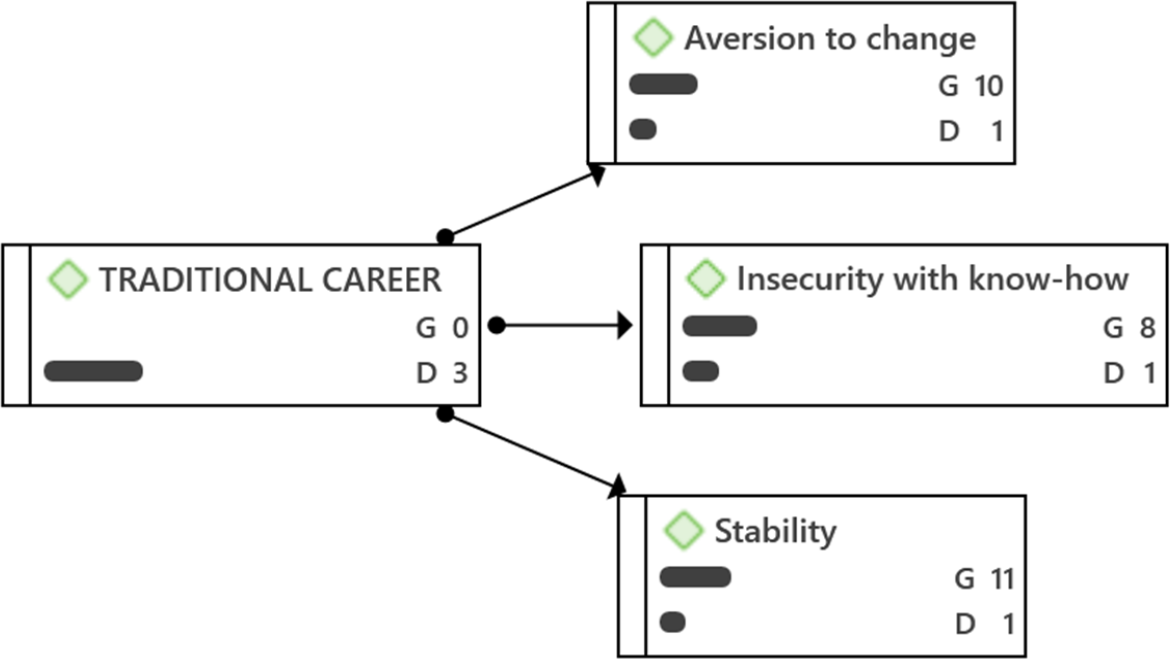
We also observed specific characteristics consistent with a traditional profile among some participants (Figure 5).

There were indications that some participants were averse to change and, therefore, were not unreservedly chameleonic. This characteristic did not appear to be correlated with age but with insecurity and know-how. As P05 explained: “My knowledge is not solid enough for me to be a guy with seniority in any company.” These individuals sought stability, whether this meant working for public agencies or committing to the same company for an extended period. Their affective commitment was indicated by how they bonded with co-workers in small groups, a process that-according to Allen and Meyer (2000)-is a sign of a sense of attachment to more significant subgroups or organizations per se. Allen and Meyer pointed out that this process takes time; what is more, it is not an inevitable outcome of simple job continuity.
Traditional organizations
When values related to change were examined more closely, organizations emerged as the principal actors involved. Organizational attributes substantially impacted the participants (despite the latter being highly self-directed), although most of them possessed at least some traditional traits. Those who sought to adapt to the participants’ interests tended to be startups (Figure 6).

Traditional organizations were more inclined to suffer from paperwork overload during the development of projects; some participants remarked that they had to go through several managers until the final approval:
You have to have the approval of a team that is there in another corner, and you have to finish there, so the team has to finish, I do not know what, then you have to have the client who is going to use what I did and so on, and do I do not know what, at the end of all this kind of bureaucracy, right? (P16)
Organizational problems, such as management issues, were highlighted. These were so serious that some participants moved to other firms to avoid dealing with their current bosses. Stalled career progression in public sector companies was another issue, with P06 claiming that “The [company name] has a limitation in that, in a way, to earn more, you have to become a boss, right?” Nevertheless, some organizations attempted to adapt to some participants’ demands. According to Hall (2004), not every individual can adjust their needs and values, demonstrating that even protean professionals can be traditional-minded. However, it tended to be that if the participants could not align their jobs with their values, they were more likely to seek alternative employment (and even occupations)-, unlike traditional linear-minded professionals (Grimland et al., 2012).
Protean organizations
One of the reasons the participants were with their current companies was because they (the companies) had protean profiles, just as the model employed by the present study suggested. According to Cabrera (2009), protean organizations adapt to changing circumstances; in doing so, they become more effective and competitive (because they have a more remarkable ability to attract and retain talent). The participants explained that they determined whether organizations were protean (e.g., whether they could accommodate developments in the job market and meet their needs) by their adaptability regarding new ways of working, motivational strategies, formulating appropriate career plans, and investing in training (Figure 7).

Figure 7 illustrates how companies have sought to adjust to new work formats. For example, remote working was instituted widely during the pandemic and continued thereafter. This organizational component was an important criterion for participants:
It was a flexible, absurdly flexible startup that gave you power [...]. It was a company that had all the values and ethics in terms of what I was looking for, and it was highly human, so it was the perfect match. (P13)
The company in question wanted humanized and flexible organizational management, a positive attribute identified by Herrmann et al. (2015). This could be achieved by incorporating the strategic components of motivational action, a structured system of career planning, and a commitment to investing in training.
The protean behaviors of organizations are arguably more complex than the bonds they form with IT professionals, who are liable to develop a sense of belonging to said organizations if their values are aligned (Moreno et al., 2009). Many organizations have sought to move away from the traditional career model (Cabrera, 2009); contrary to Irani-Williams et al.’s claim (2021), high turnover among IT professionals tends to abate when they find what they seek, which suggests that they are happy to remain loyal to their organi-zations when (or perhaps, only when) their needs (or demands) are met.
CONCLUSIONS
The present study has shown how the aspirational trajectories of IT professionals are predicated on the dimensions of the protean career. The results indicate that organizations can also exhibit protean characteristics. The participants expressed that only when an organization was regarded as being protean would they consider working for it. They sought companies to help them advance their careers and fulfill their general aspirations. Who needs dynamism in their activities, and the organization needs to adapt to this. The participants expected their employers to be motivational, offer challenging projects, expose them to different areas of IT, help them understand the business orientations of clients, and generally provide new expe-riences. The participants also prioritized work-life balance, even over financial remuneration. If companies could not satisfy their requirements, they ran the risk of losing them or not recruiting them in the first place. A commitment to career planning was another highly sought-after trait.
While the participants were eminently employable given their skill sets, many valued stability in terms of finances and relationships. They conside-red bonding with colleagues a fundamental component of their work and, by extension, their affective commitment to an organization. It is also worth noting that the participants did not begin their IT career trajectories with distinctly traditional or protean profiles; instead, one or the other (or occasionally both) developed according to the individuals’ evolving interests and needs. Furthermore, neither age nor qualifications were determining factors in this process. The findings also show that the protean career is characteri-zed by individual self-management. This requires strategic coordination with organizations and a certain degree of bonding therewith. The engagement of human resource managers with a facility for effective people mana-gement-consistent with the protean profile and particularities of the IT professional-should be taken as a given by organizations.
The COVID-19 pandemic has made it all the more important to attract, stimulate, and retain workers in ways that transcend traditional strategies. A flexible organizational culture and a protean profile are essential. The participants opined that organizations must reformulate their recruitment, selection, and work strategies to accord with individual boundaries, for example, by opening up clear communication channels, offering career planning opportunities, flexible working hours, quality of life and mental health programs, and competitive salaries; investing in research, training, and development; providing tools consistent with the operationalization of professional tasks; recognizing achievement; and generally allowing employees to feel that they have accomplished something meaningful.
The present study has significant theoretical, practical, and social implications. It broadens current conceptualizations of the protean organization, highlights the need for management interventions that meet the needs of protean individuals and make it easier to retain them (e.g., flexible hours and remote working), and identifies the importance (in the Brazilian context) of introducing regulations to reduce the number of invisible tasks IT professionals are expected to carry minimize the negative consequences of Digi-housekeeping. These must be made more visible to measure workloads more reliably.
One limitation of the present study was its focus on the protean career at the expense of careers without borders, kaleidoscopic careers, and parallel careers (among others). Such alternative paths merit further investigation. Future researchers might also conduct studies that allow us to gain a deeper understanding of the requirements and trends that shape IT work, for example, by identifying the complex processes involved in formulating career plans that both respond to organizational needs and meet employees’ prefe-rences (Jiang et al., 2018).
-
RAM does not have permission from the authors or evaluators to publish this article’s review.
-
RAM does not have information about open data regarding this manuscript.
REFERENCES
- Allen, N. J., & Meyer, J. P. (2000). Construct validation in organizational behavior research: The case of organizational commitment, in problems and solutions in human assessment (pp. 285-314). Springer.
-
Alonderienė, R., & Šimkevičiūtė, I. (2018). Linking protean and boundaryless career with organizational commitment. Baltic Journal of Management, 13(4), 471-487. https://doi.org/10.1108/bjm-06-2017-0179
» https://doi.org/10.1108/bjm-06-2017-0179 - Arnold, L. (2016). Strategies for reducing high turnover among information technology professionals [Doctoral dissertation, Walden University].
- Bardin, L. (2016). Análise de conteúdo Edições 70.
-
Baruch, Y. (2006). Career development in organizations and beyond: Balancing traditional and contemporary viewpoints. Human Resource Management Review, 16(2), 125-138. https://doi.org/10.1016/j.hrmr.2006.03.002
» https://doi.org/10.1016/j.hrmr.2006.03.002 -
Baruch, Y., & Vardi, Y. (2016). A fresh look at the dark side of contemporary careers: Toward a realistic discourse. British Journal of Management, 27(2), 355-372. https://doi.org/10.1111/1467-8551.12107
» https://doi.org/10.1111/1467-8551.12107 -
Baruch, Y., & Rousseau, D. M. (2018). Integrating psychological contracts and ecosystems in career studies and management. Academy of Management Annals, 13(1), 84-111.https://doi.org/10.5465/annals.2016.0103
» https://doi.org/10.5465/annals.2016.0103 -
Biernacki, P., & Waldorf, D. (1981). Snowball sampling: Problems and techniques of chain referral sampling. Sociological Methods & Research, 10(2), 141-163. https://doi.org/10.1177/004912418101000205
» https://doi.org/10.1177/004912418101000205 -
Briscoe, J. P., & Finkelstein, L. M. (2009). The “new career” and organizational commitment: Do boundaryless and protean attitudes make a dif-ference? Career Development International https://doi.org/10.1108/13620430910966424
» https://doi.org/10.1108/13620430910966424 -
Briscoe, J. P., & Hall, D. T. (1999). An alternative approach and new guidelines for practice. Organizational Dynamics, 28(2), 37-52. https://doi.org/10.1016/S0090-2616(00)80015-7
» https://doi.org/10.1016/S0090-2616(00)80015-7 -
Briscoe, J. P., & Hall, D. T. (2006). The interplay of boundaryless and protean careers: Combinations and implications. Journal of Vocational Behavior, 69(1), 4-18. https://doi.org/10.1016/j.jvb.2005.09.002
» https://doi.org/10.1016/j.jvb.2005.09.002 -
Briscoe, J. P., Hall, D. T., & DeMuth, R. L. F. (2006). Protean and boundaryless careers: An empirical exploration. Journal of Vocational Behavior, 69(1), 30-47. https://doi.org/10.1016/j.jvb.2005.09.003
» https://doi.org/10.1016/j.jvb.2005.09.003 -
Buhari, M. M., Yong, C. C., & Lee, S. T. (2020). I am more committed to my profession than to my organization: Professional commitment and perceived organizational support in turnover. International Journal of Human Capital and Information Technology Professionals, 11(3), 37-58. https://doi.org/10.4018/IJHCITP.2020070103
» https://doi.org/10.4018/IJHCITP.2020070103 -
Cabrera, E. F. (2009). Protean organizations: Reshaping work and careers to retain female talent. Career Development International https://doi.org/10.1108/13620430910950773
» https://doi.org/10.1108/13620430910950773 -
Chaudhuri, S., Hirudayaraj, M., & Ardichvili, A. (2018). Borrow or grow: An overview of talent development/management practices in Indian IT organizations. Advances in Developing Human Resources, 20(4), 460-478. https://doi.org/10.1177/1523422318803345
» https://doi.org/10.1177/1523422318803345 -
Crespi-Vallbona, M., & Mascarilla-Miró, O. (2018). Job satisfaction. The case of information technology (IT) professionals in Spain. Universia Business Review, 58(2), 36-51. https://doi.org/10.3232/UBR.2018.V15.N2.02
» https://doi.org/10.3232/UBR.2018.V15.N2.02 - Creswell, J. W. (2014). A concise introduction to mixed methods research SAGE publications.
-
Cordeiro, H. T. D., & Albuquerque, L. G. D. (2017). Career profiles of Generation Y and their potential influencers. Brazilian Administration Review, 14 https://doi.org/10.1590/1807-7692bar2017170013
» https://doi.org/10.1590/1807-7692bar2017170013 -
Cortellazzo, L., Bonesso, S., Gerli, F., & Batista-Foguet, J. M. (2020). Protean career orientation. Journal of Vocational Behavior https://doi.org/10.1016/j.jvb.2019.103343
» https://doi.org/10.1016/j.jvb.2019.103343 - Costa, E. N. F., & Kienen, N. (2021). Autogestión: Una interpretación analítica conductual. Revista CES Psicologia, 14(2), 20-47.
-
da Silva, V. B., Cardoso, L. C., Oliveira, E. A. D. A. Q., & de Sá Rodrigues, M. (2022). Âncoras de carreira e estágios da vida vocacional de jovens militares e ex-militares do exército brasileiro. Caderno de Administração, 30(1), 65-80. https://doi.org/10.4025/cadadm.v30i1.61682
» https://doi.org/10.4025/cadadm.v30i1.61682 -
De Cuyper, N., & De Witte, H. (2011). The management paradox: Self-rated employability and organizational commitment and performance. Personnel Review https://doi.org/10.1108/00483481111106057
» https://doi.org/10.1108/00483481111106057 -
De Vos, A., Van der Heijden, B. I. (2017). Current thinking on contemporary careers: The key roles of sustainable HRM and sustainability of careers. Current Opinion in Environmental Sustainability, 28, 41-50. http://doi.org/10.1016/j.cosust.2017.07.003
» http://doi.org/10.1016/j.cosust.2017.07.003 -
Doden, W., Grote, G., & Rigotti, T. (2018). Does leader-member exchange buffer or intensify detrimental reactions to psychological contract breach? Journal of Vocational Behavior, 106(15), 192-208. https://doi.org/10.1016/j.jvb.2018.02.004
» https://doi.org/10.1016/j.jvb.2018.02.004 -
Farooq, H., Janjua, U. I., Madni, T. M., Waheed, A., Zareei, M., & Alanazi, F. (2022). Identification and analysis of factors influencing turnover intention of Pakistan IT professionals: An empirical study. IEEE Access, 10, 64234-64256. https://doi.org/10.1109/ACCESS.2022.3181753
» https://doi.org/10.1109/ACCESS.2022.3181753 -
Ferreira, C., Pedrosa, I., & Calheiros, A. (2021). Rotatividade nas empresas tecnológicas em Portugal: Estado da arte. Revista Ibérica de Sistemas e Tecnologias de Informação, E42, 222-237. http://www.risti.xyz/issues/ristie42.pdf
» http://www.risti.xyz/issues/ristie42.pdf -
Foina, P. R., & Eiras, V. L. (2016). Os desafios motivacionais na gestão dos profissionais de TI: Estudo de três empresas. Universitas: Gestão e TI, 6(2). https://doi.org/10.5102/un.gti.v6i2.3555
» https://doi.org/10.5102/un.gti.v6i2.3555 -
Grimland, S., Vigoda-Gadot, E., & Baruch, Y. (2012). Career attitudes and success of managers: The impact of chance event, protean, and traditional careers. The International Journal of Human Resource Management, 23(6), 1074-1094. http://doi.org/10.1080/09585192.2011.560884
» http://doi.org/10.1080/09585192.2011.560884 -
Gubler, M., Arnold, J., & Coombs, C. (2014). Reassessing the protean career concept: Empirical findings, conceptual components, and measurement. Journal of Organizational Behavior, 35(S1), S23-S40. https://doi.org/10.1002/job.1908
» https://doi.org/10.1002/job.1908 - Gupta, M. (2018). Liquid Workforce: The workforce of the Future. In P. Duhan, K. Singh, & R. Verna (Eds.), Radical reorganization of existing work structures through digitalization (pp. 1-17). IGI Global.
- Haenggli, M., Hirschi, A., Rudolph, C. W., & Peiró, J. M. (2021). Exploring the dynamics of protean career orientation, career management behaviors, and subjective career success: An action regulation theory approach. Journal of Vocational Behavior, 131, 103650.
- Hall, D.T. (1976). Careers in Organizations Goodyear Pub, Pacific Palisades.
- Hall, D. T. (2002). Careers in and out of organizations Sage Publications.
-
Hall, D. T. (2004). The protean career: A quarter-century journey. Journal of Vocational Behavior, 65(1), 1-13. https://doi.org/10.1016/j.jvb.2003.10.006
» https://doi.org/10.1016/j.jvb.2003.10.006 -
Hall, D. T., Yip, J., & Doiron, K. (2018). Protean careers at work: Self-direction and values orientation in psychological success. Annual Review of Organizational Psychology and Organizational Behavior, 5, 129-156. https://doi.org/10.1146/annurev-orgpsych-032117-104631
» https://doi.org/10.1146/annurev-orgpsych-032117-104631 -
Hekman, D. R., Bigley, G. A., Steensma, H. K., & Hereford, J. F. (2009). Combined effects of organizational and professional identification on the reciprocity dynamic for professional employees. Academy of Management Journal, 52, 506-526. https://doi.org/10.5465/AMJ.2009.41330897
» https://doi.org/10.5465/AMJ.2009.41330897 -
Herrmann, A., Hirschi, A., & Baruch, Y. (2015). The protean career orientation as a predictor of career outcomes: Evaluation of incremental validity and mediation effects. Journal of Vocational Behavior, 88, 205-214. https://doi.org/10.5465/AMJ.2009.41330897
» https://doi.org/10.5465/AMJ.2009.41330897 -
Irani-Williams, F., Tribble, L., Rutner, P. S., Campbell, C., McKnight, D. H., & Hardgrave, B. C. (2021). Just let me do my job! Exploring the impact of micromanagement on IT professionals. ACM SIGMIS Database: The DATABASE for Advances in Information Systems, 52(3), 77-95. https://doi.org/10.1145/3481629.3481635
» https://doi.org/10.1145/3481629.3481635 -
Jiang, J. J., Huang, W. W., Klein, G., & Tsai, J. C. A. (2018). The career satisfaction of IT professionals with mixed job demands. IEEE Transactions on Engineering Management, 67(1), 30-41. https://doi.org/10.1109/TEM.2018.2870085
» https://doi.org/10.1109/TEM.2018.2870085 -
Kaushal, P., & Vashisht, S. (2021). Protean career orientation, career decision self-efficacy and career outcomes of millennial IT professionals. Management and Labour Studies, 46(3), 248-262. https://doi.org/10.1177/0258042X21991016
» https://doi.org/10.1177/0258042X21991016 -
Kilimnik, Z. M., Dias, S. M. O., & Jamil, G. L. (2012). Fatores de pressão no trabalho e comprometimento com a carreira: Um estudo com profissionais de tecnologia da informação. Revista Eletrônica de Sistemas de Informação, 11(2). https://doi.org/10.5329/RESI.2012.1102007
» https://doi.org/10.5329/RESI.2012.1102007 - Lanke, P., & Nath, P. (2023). Job switching and communities of practice: Mapping facilitators and dampeners to life cycle. VINE Journal of Information and Knowledge Management Systems, 53(3), 414-429.
-
Miller, J. L. (2018). Why do Software Engineers Change Jobs so Frequently?https://www.forbes.com/sites/quora/2018/02/06/why-do-software-engineers-change-jobs-so-frequently/
» https://www.forbes.com/sites/quora/2018/02/06/why-do-software-engineers-change-jobs-so-frequently/ -
Moreno, V. D. A., Jr., Cavazotte, F. D. S. C. N., & Farias, E. D. (2009). Carreira e relações de trabalho na prestação de serviços de tecnologia da informação: A visão dos profissionais de TI e seus gerentes. JISTEM-Journal of Information Systems and Technology Management, 6, 437-462. https://doi.org/10.4301/S1807-17752009000300004
» https://doi.org/10.4301/S1807-17752009000300004 -
Moura Junior, P. J. D., & Helal, D. H. (2014). Profissionais e profissionalização em Tecnologia da Informação: Indicativos de controvérsias e conflitos. Cadernos EBAPE.BR, 12(2), 321-338. https://doi.org/10.1590/1679-39519889
» https://doi.org/10.1590/1679-39519889 - Niederman, F., Ferratt, T. W., & Trauth, E. M. (2016). On the co-evolution of information technology and information systems personnel. ACM SIGMIS Database: The DATABASE for Advances in Information Systems, 47(1), 29-50.
-
Nimmi, P. M., Zakkariya, K. A., & Nezrin, R. (2020). Insight to impact: The effect of protean career attitude on employability perceptions of IT professionals. https://doi.org/10.4038/cbj.v11i1.55
» https://doi.org/10.4038/cbj.v11i1.55 -
Oliveira, P. N., & Rowe, D. E. O. (2018). Organizational commitment in the public sector: Review and research agenda. Revista Pensamento Contemporâneo em Administração, 12(2), 43-54. https://doi.org/10.12712/rpca.v12i2.1259
» https://doi.org/10.12712/rpca.v12i2.1259 -
Pérez-Nebra, A., Sklaveniti, C., Islam, G., Petrović, I., Pickett, J., Alija, M., ... & Sanderson, Z. (2021). COVID-19 and the future of work and organisational psychology. Journal of Industrial Psychology, 47 https://doi.org/10.4102/sajip.v47i0.1854
» https://doi.org/10.4102/sajip.v47i0.1854 -
Piurcosky, F. P., Frogeri, R. F., Portugal, P. D. S., Jr., & Oliveira, D. M. (2021). Perfil e particularidades sobre a profissão e o profissional de Tecnologia da Informação no Sul de Minas Gerais. Revista de Sistemas e Computação, 11(1). https://doi.org/10.36558/rsc.v11i1.7049
» https://doi.org/10.36558/rsc.v11i1.7049 -
Ramos, E. A. D. A., & Joia, L. A. (2014). Uma investigação acerca do fenômeno do turn-away entre os profissionais de tecnologia da informação. Revista de Administração Mackenzie, 15(4), 75-109. https://doi.org/10.1590/1678-69712014
» https://doi.org/10.1590/1678-69712014 -
Sok, J., Blomme, R., & Tromp D. (2013). The use of the psychological contract to explain self-perceived employability. International Journal of Hospitality Management, 34, 274-284. https://doi.org/10.1016/j.ijhm.2013.03.008
» https://doi.org/10.1016/j.ijhm.2013.03.008 -
Steil, A. V., Cuffa, D., Iwaya, G. H., & Pacheco, R. C. S. (2020). Perceived learning opportunities, behavioral intentions and employee retention in technology organizations. Journal of Workplace Learning, 32(2), 147-159. https://doi.org/10.1108/JWL-04-2019-0045
» https://doi.org/10.1108/JWL-04-2019-0045 -
Steil, A. V., Bello, J. D. S. A., Cuffa, D. D., & Freitas, A. F. D. (2022). Job satisfaction and employee retention by public and private it organizations. Revista de Administração da UFSM, 15, 354-369. https://doi.org/10.5902/19834659 68850
» https://doi.org/10.5902/19834659 68850 -
Steiner, R. S., Hirschi, A., & Wang, M. (2019). Predictors of a protean career orientation and vocational training enrollment in the post-school transition. Journal of Vocational Behavior, 112(13), 216-228. https://doi.org/10.1016/j.jvb.2019.03.002
» https://doi.org/10.1016/j.jvb.2019.03.002 - Strom, S., Gumbel, P., & Philpot, J. (2021). The future of work after COVID-19 McKinsey Global Institute.
-
Supeli, A., & Creed, P. A. (2015). The longitudinal relationship between protean career orientation and job satisfaction, organizational commitment, and intention-to-quit. Journal of Career Development, 43(1), 66-80. https://doi.org/10.1177/0894845315581686
» https://doi.org/10.1177/0894845315581686 -
Vaclavik, M. C., Rocha-de-Oliveira, S., & Oltramari, A. P. (2021). Proteus looks around: Agency, time, and context in a gig economy career analysis. Brazilian Administration Review, 18 https://doi.org/10.1590/1807-7692bar2021200098
» https://doi.org/10.1590/1807-7692bar2021200098 - Van der Heijden, B. I., & De Vos, A. (2015). Sustainable careers: Introductory chapter. In A. De Vos, & B. I. J. M. Van Der Heijden (Eds.), Handbook of research on sustainable careers Edward Elgar Publishing.
-
Wolff, L., & Andretta, I. (2023). Avaliação da eficácia de uma intervenção sobre a percepção das forças de caráter e bem-estar psicológico em profissionais de Tecnologia da Informação. Revista Psicologia: Organizações e Trabalho, 23(1), 2329-2337. https://doi.org/10.5935/rpot/2023.1.23095
» https://doi.org/10.5935/rpot/2023.1.23095
Edited by
-
EDITORIAL BOARD
Editor-in-chiefAlmir Martins Vieira
-
Associated editor
Amalia Pérez-Nebra
-
Technical support
Gabriel Henrique Carille
-
EDITORIAL PRODUCTION
Publishing coordinationAndreia Cominetti
-
Editorial intern
Bruna Silva de Angelis
-
Copy editor
Irina Migliari (Bardo Editorial)
-
Layout designer
Emap
-
Graphic designer
Emap
RAM does not have information about open data regarding this manuscript.