 Remaking the State from within: presidential control through bureaucratic redesign in Brazil’s Foreign Ministry
Abstract
Why do presidents reorganize bureaucracies, and what political effects follow? This article examines how intra-ministerial bureaucratic redesign functions as a strategic tool of presidential control and agenda prioritization within Brazil’s Ministry of Foreign Affairs (MFA) from 1985 to 2020. Drawing on agency design and institutional change literature, the study argues that administrative reorganizations are not merely technocratic adjustments, but deliberate attempts by presidents to (i) embed thematic priorities into bureaucratic structures and (ii) expand control over high-leverage institutional arenas. We propose that organizational “choke points,” such as command hierarchies and thematic units, are particularly targeted for intervention. Using a mixed-methods approach that combines descriptive statistics, geospatial mapping, and qualitative case studies, we identify three distinct redesign logics: (1) political-control interventions, as illustrated by Collor’s tripartite fragmentation of the Secretary-General; (2) agenda expansion and ideational signaling, evident in the creation of thematic units and the expansion of diplomatic posts under Lula; and (3) symbolic reversal and institutional hollowing, marked by the dismantling of multilateral, climate, and human rights units under Bolsonaro. These processes generate long-term institutional consequences, including policy drift, conversion, and the erosion or consolidation of bureaucratic capacity. The findings contribute to debates on presidential governance by showing how even highly professionalized and insulated bureaucracies can be strategically reshaped through everyday administrative instruments.
Keywords:
presidential control; bureaucratic redesign; institutional change; foreign policy; bureaucracy
Resumo
Por que os presidentes reorganizam burocracias e quais são os efeitos políticos decorrentes? Este artigo examina como o redesenho burocrático intraministerial funciona como uma ferramenta estratégica de controle presidencial e priorização de agenda no Ministério das Relações Exteriores (MRE) do Brasil, de 1985 a 2020. Fundamentado nas literaturas de desenho organizacional (agency design) e mudança institucional, o estudo argumenta que reorganizações administrativas não são meros ajustes tecnocráticos, mas tentativas deliberadas dos presidentes para (i) inserir prioridades temáticas nas estruturas burocráticas e (ii) expandir o controle sobre arenas institucionais de alta influência. Propomos que “pontos de estrangulamento” (choke points) organizacionais, como hierarquias de comando e unidades temáticas, são alvos preferenciais de intervenção. Utilizando uma abordagem de métodos mistos que combina estatística descritiva, mapeamento geoespacial e estudos de caso qualitativos, identificamos três lógicas distintas de redesenho: (1) intervenções de controle político, como ilustrado pela fragmentação tripartite da Secretaria-Geral no governo Collor; (2) expansão de agenda e sinalização ideacional, evidente na criação de unidades temáticas e na expansão de postos diplomáticos sob o governo Lula; e (3) reversão simbólica e esvaziamento institucional, marcados pelo desmantelamento das unidades de multilateralismo, clima e direitos humanos sob o governo Bolsonaro. Esses processos geram consequências institucionais de longo prazo, incluindo deriva de políticas (policy drift), conversão e a erosão ou consolidação da capacidade burocrática. Os achados contribuem para os debates sobre governança presidencial ao demonstrar como até mesmo burocracias altamente profissionalizadas e insuladas podem ser remodeladas estrategicamente por meio de instrumentos administrativos cotidianos.
Palavras-chave:
controle presidencial; redesenho burocrático; mudança institucional; política externa; burocracia
Resumen
¿Por qué los presidentes reorganizan las burocracias y qué efectos políticos se derivan de ello? Este artículo examina cómo el rediseño burocrático intraministerial funciona como una herramienta estratégica de control presidencial y de priorización de la agenda dentro del Ministerio de Relaciones Exteriores (MRE) de Brasil entre 1985 y 2020. Basándose en la literatura sobre el diseño organizacional (agency design) y el cambio institucional, el estudio sostiene que las reorganizaciones administrativas no son meros ajustes tecnocráticos, sino intentos deliberados de los presidentes para (i) integrar prioridades temáticas a las estructuras burocráticas y (ii) expandir el control sobre arenas institucionales de gran influencia. Proponemos que los “puntos de estrangulamiento” (choke points) organizativos, tales como las jerarquías de mando y las unidades temáticas, son especialmente objeto de intervención. Mediante un enfoque de métodos mixtos que combina estadísticas descriptivas, mapeo geoespacial y estudios de caso cualitativos, identificamos tres lógicas de rediseño distintas: (1) intervenciones de control político, ilustradas por la fragmentación tripartita de la Secretaría General en el gobierno de Collor; (2) expansión de la agenda y señalización ideacional, evidente en la creación de unidades temáticas y la expansión de puestos diplomáticos bajo el gobierno de Lula; (3) reversión simbólica y vaciamiento institucional, marcados por el desmantelamiento de las unidades multilaterales, climáticas y de derechos humanos durante el gobierno de Bolsonaro. Estos procesos generan consecuencias institucionales a largo plazo, incluyendo la deriva de políticas (policy drift), la conversión y la erosión o consolidación de la capacidad burocrática. Los hallazgos contribuyen a los debates sobre la gobernanza presidencial al mostrar cómo incluso las burocracias altamente profesionalizadas y aisladas pueden ser remodeladas estratégicamente a través de instrumentos administrativos cotidianos.
Palabras clave:
control presidencial, rediseño burocrático, cambio institucional, política exterior; burocracia
1. INTRODUCTION
Why do presidents reorganize bureaucracies, and what political effects follow? While public administration research acknowledges the strategic value of agency design, most studies focus on the creation of new institutions or formal reforms. Less attention has been paid to intra-ministerial reorganizations, changes within existing bureaucracies, as instruments of presidential control and agenda signaling (Guerra, 2019; Nou, 2015; Yesilkagit, 2021; Yesilkagit et al., 2022), especially in foreign policy settings.
While existing research examines agency creation, abolition, and formal reforms, much less is known about the more subtle but pervasive practice of intraministerial redesign: the internal rearrangement of units, hierarchies, and thematic clusters. This article advances this frontier by demonstrating how presidents strategically use such internal reorganizations to reshape foreign policy institutions.
Brazil’s Ministry of Foreign Affairs (MFA) offers a revealing case. Celebrated for its professionalism, continuity, and autonomy, anchored in the powerful Secretary-General role, it has long been considered resistant to politicization1 (Figueira, 2010; Lewis, 2010). Yet, its structure has undergone repeated episodes of fragmentation, centralization, and thematic redesign, suggesting that even insulated bureaucracies are not immune to political intervention. This article investigates how Brazilian presidents (1985-2020) have used administrative reorganization within the MFA to realign internal structures with their political objectives.
Through the creation, suppression, or reconfiguration of units, presidents seek to reshape internal hierarchies, marginalize veto players, and institutionalize policy preferences, often without formal legal reform (Whitford, 2021). We propose that bureaucratic redesign within the MFA follows two primary logics of presidential intervention: 1) control, where reorganization alters hierarchies and personnel flows to increase political leverage over foreign policy e 2) agenda signaling, whereby structural changes encode thematic priorities and signal ideological realignment, both domestically and internationally.
To test this argument, we develop an analytical model linking presidential motivations to reorganization mechanisms and their outcomes, including long-term effects such as policy drift and institutional erosion. We employ a mixed-methods strategy that combines original datasets on internal MFA restructuring and Brazil’s global diplomatic network with case studies of the Collor, Lula, and Bolsonaro administrations.
This study advances the literature in three ways. First, it shifts focus from agency creation to internal redesign within established bureaucracies. Second, it connects institutionalist theories of drift and dismantling to executive-led administrative reform. Third, it provides empirical insight into how foreign policy institutions, often assumed to be insulated and technocratic, are actively reconfigured by presidential actors.
The article proceeds as follows. Section 2 presents the theoretical framework, drawing from the literature on agency design, presidential control, and institutional change. Section 3 details the methodological approach. Section 4 presents the empirical analysis, structured around the two logics of redesign. Section 5 discusses the broader implications of our findings and avenues for future research.
2. THEORETICAL FRAMEWORK
2.1. When structure becomes strategy: the political logic of agency design
Administrative reorganization refers to the deliberate alteration of a government organization’s internal structure, its units, hierarchies, and functional linkages, with the aim of achieving specific managerial or political objectives (Guerra, 2019; Lewis, 2004; Vieira, 2013). The design of bureaucratic institutions is a deeply political act. As Fisher and Moe (1981) and Moe (1989) argue, reorganization debates frequently mask underlying political struggles over power, discretion, and control. What may appear as an effort to enhance coordination or eliminate redundancy often reflects strategic attempts to reshape authority within the state.
Organizational structures are not neutral vessels. They embody normative assumptions, distribute decision-making capacity, and signal institutional priorities (Whitford, 2021). March and Olsen (1983) conceptualized agency design as a form of “organizing political life,” where structures not only execute policy but also reinforce symbolic orders and bureaucratic identities. In this view, redesigns are less about efficiency than about encoding certain values and excluding others.
Howell and Lewis (2002) demonstrate that agency design choices systematically reflect presidential preferences, with newly created agencies more likely to be located within the Executive Office or staffed with loyal appointees. Their findings provide support for the notion that “agencies by presidential design” are strategic tools for managing the political risks and opportunities of governing.
Whitford (2021) emphasizes that administrative design is routinely used by executives to consolidate influence over public agencies, even in institutional environments with legal and political constraints. Presidents may reorganize structures not only to advance their agenda, but also to fragment potential veto points or reward loyalists. As Casarões (2012) aptly notes, it is as if the quarterback not only called the play and selected the team, but as our analysis of administrative reorganization further suggests, also designed the tactical scheme itself.
In sum, the literature suggests that bureaucratic design is not simply a question of “form follows function”. Rather, it reflects a deliberate balancing act between institutional autonomy and political responsiveness, with presidents using organizational tools to remake the state in their image (Guerra, 2019; Howell & Lewis, 2002; Lewis, 2004; Vieira, 2013; Whitford, 2021). These redesign logics activate distinct modes of institutional change, drift, layering, conversion, or displacement, whose observable manifestations guide our empirical coding and interpretation.
2.2. Calling the play, picking the team, designing the scheme: presidential control and agenda management
Agency design is intimately tied to the mechanisms by which presidents exercise control over the bureaucracy. Executives frequently reorganize ministries to centralize decision-making, bypass resistance, and enhance their ability to implement core priorities (Nou, 2015; Parsneau, 2013; Vieira, 2013). Structural fragmentation or recentralization often serves to reduce the autonomy of bureaucrats and increase the executive’s discretionary reach over policy implementation (Bach & Veit, 2018).
One common strategy is the appointment of loyalists to strategic positions, especially in policy-sensitive or ideologically salient units. As Bach and Veit (2018) demonstrate in the German context, access to senior posts increasingly hinges on partisan alignment and political capital, rather than technical expertise or tenure. This logic holds particular weight in presidential systems, where sub cabinet positions are less insulated and appointments serve as key levers of control.
Agency reorganization also operates as a tool for agenda management and policy signaling. Presidents often use structural modifications, such as creating new units, renaming departments, or merging existing divisions, to highlight preferred themes and suppress undesired ones (Yesilkagit et al., 2022). Hong and Park (2019) describe such strategies as “administrative signaling”, whereby organizational changes function as cues to internal and external audiences about the salience of specific policy issues.
Shpaizman (2022) shows how ministers reorganize portfolios to foreground favored policy areas and marginalize others. The prioritization of policy agendas through organizational design also generates path-dependent effects. Mortensen and Green-Pedersen (2015) argue that once institutionalized, new structures create focal points for attention, resources, and policy legitimation. Thus, bureaucratic redesign is not only an instrument of control, it is a mechanism for shaping the policy field itself.
2.3. Gradual institutional change: drift, conversion, layering, and displacement
While much attention has been devoted to formal institutional reform, a growing body of scholarship demonstrates that profound transformations often occur through subtle and incremental processes. Institutions may persist in legal form while their purposes, internal balances of power, and policy effects shift substantially over time (Carroll et al., 2022; Hacker, 2004; Mahoney & Thelen, 2010).
The concept of policy drift, developed by Hacker (2004), provides a foundational starting point. Drift occurs when institutional rules remain formally intact but their impact changes due to shifting political conditions, altered enforcement patterns, or strategic neglect. In such cases, change does not result from overt revision of legal frameworks, but from the interaction between stable rules and a transformed political or economic environment. Drift is particularly powerful in contexts where formal reform is politically costly or procedurally constrained. Building on this insight, Mahoney and Thelen (2010) develop a broader typology of gradual institutional change, distinguishing four analytically distinct mechanisms: drift, layering, conversion, and displacement. These mechanisms capture alternative pathways through which institutions evolve without necessarily undergoing formal abolition.
Drift occurs when formal rules remain stable but their effects shift due to strategic inaction, under-enforcement, or changing contextual conditions. Layering, by contrast, operates through the incremental addition of new rules or structures alongside existing ones, gradually redirecting institutional trajectories through accumulation. Conversion entails the reinterpretation or redeployment of existing institutional arrangements toward new purposes, often facilitated by elite repositioning within established frameworks. Displacement, finally, refers to the replacement of preexisting institutional arrangements by alternative structures that assume central authority.
These mechanisms differ in both their mode of operation and their observable organizational consequences. Drift operates through neglect or environmental change; layering through additive institutional expansion; conversion through functional reinterpretation; and displacement through structural substitution. To ensure analytical precision in the empirical sections that follow, this study treats these four categories as mechanisms of change. By contrast, phenomena such as erosion or organizational hollowing are understood as observable outcomes that may result from one or more of these mechanisms.
Carroll et al. (2022), for example, document cases in which public agencies persist formally while losing operational capacity, a condition they describe as organizational hollowing. Such hollowing may emerge from drift (when units are deprived of resources without formal abolition) or from conversion (when mandates are symbolically maintained but substantively redirected). Erosion, similarly, refers to the gradual weakening of institutional capacity or authority and is treated here as an empirical effect rather than as an autonomous mechanism.
The symbolic dimension of gradual change is equally significant. Yesilkagit et al. (2022) demonstrate that renaming and relabeling bureaucratic units, often dismissed as superficial, can reshape how agencies are perceived, funded, and politically evaluated. Such symbolic interventions may operate through layering (adding ideational markers), conversion (redefining mandates), or drift (allowing existing structures to persist while their meaning shifts).
Taken together, this framework highlights that institutional transformation is frequently less about formal abolition than about redirection, accumulation, reinterpretation, or strategic neglect. Presidents do not always need to dismantle bureaucracies outright to reshape them. They may instead layer new structures onto existing ones, convert established units to new purposes, allow previously central areas to drift, or, in rarer cases, displace key organizational nodes.
By distinguishing clearly among these mechanisms and separating them from their empirical outcomes, this study provides a structured lens through which episodes of bureaucratic redesign in Brazil’s Ministry of Foreign Affairs can be systematically classified and compared across administrations.
2.4. Analytical framework for executive redesign
Rather than treating administrative reorganization as a neutral managerial exercise, this paper conceptualizes bureaucratic redesign as a strategic tool through which presidents reshape internal power dynamics and embed policy priorities within state structures. Organizational reforms rarely follow a single rationale; instead, they combine technical, political, and symbolic motivations (Vieira, 2013). To analyze these dynamics, we develop a typology grounded in agency design and institutional change literatures (Lewis, 2004; Mahoney & Thelen, 2010; Moe, 1989; Whitford, 2021), distinguishing three core redesign logics: Efficiency, Political Control, and Ideational Signaling.
Each logic is associated with specific mechanisms and observable structural indicators. Efficiency-oriented reforms consolidate units, streamline reporting lines, and reduce redundancy. Control-oriented interventions fragment powerful bureaus, centralize authority, and reallocate high-level posts (Lewis, 2004; Mahoney & Thelen, 2010; Moe, 1989; Whitford, 2021). Ideational redesign introduces or suppresses thematic units, renames departments, and embeds symbolic markers linked to presidential worldviews (Yesilkagit et al., 2022). While analytically distinct, these logics frequently overlap; presidents often combine them in ways that blur the boundaries between managerial, political, and symbolic objectives. For this reason, reforms are classified according to their dominant structural effect, not their stated justification.
To ensure consistent classification across administrations, we apply three criteria: (i) the direction of structural change (consolidation versus fragmentation); (ii) the redistribution of authority (toward or away from the presidency and its appointees); and (iii) the thematic or symbolic content of decrees and organizational labels. This effects-based approach avoids speculation about presidential intent and anchors coding in observable organizational consequences.
To unify these dynamics analytically, we consolidate the redesign logics, their core mechanisms, observable indicators, and expected organizational effects into a single integrated Mechanisms Matrix. The matrix specifies how different redesign manifests through concrete organizational interventions such as merging, fragmenting, renaming, or suppressing units and provides a framework for interpreting how reforms redistribute authority, reshape thematic priorities, and generate long-term institutional consequences such as drift, conversion, or the hollowing out of state capacity.
The table illustrates how presidents activate different redesign logics through targeted interventions in hierarchical choke points and thematic divisions, generating both immediate organizational changes and cumulative institutional effects. This strategy allows for systematic comparison across administrations and underlying redesign logics.
2.4. Here be dragons2: what is and why Itamaraty?
Formally known as the Ministry of Foreign Affairs (Ministério das Relações Exteriores), Itamaraty is Brazil’s diplomatic bureaucracy, responsible for the formulation and execution of foreign policy. It is historically recognized for its professionalized diplomatic corps, highly selective entry process, and cohesive internal culture (Casarões, 2012; Cheibub, 1989; Figueira, 2010; Moura, 2006). The name “Itamaraty” derives from the palace in Rio de Janeiro that originally housed the ministry and has since become shorthand for the Brazilian foreign policy establishment (Matsuda, 2022).
Organizationally, the MFA is headed by the Minister of Foreign Affairs, a political appointee and member of the presidential cabinet. Beneath the minister, the top-ranking career official is the Secretary-General (Secretário-Geral), who serves as the de facto administrative and operational head of the institution. Functionally, this position is analogous to a Permanent Secretary in Westminster systems or the Secretary of State in the U.S. State Department (Castro, 2009; Figueira, 2010).
The Secretary-General is responsible for managing the ministry’s internal machinery, overseeing diplomatic posts, supervising career appointments, and coordinating thematic and geographic secretariats. Because of this centrality, the position acts as both a gatekeeper and amplifier of presidential influence, making it a focal point in episodes of bureaucratic redesign (Casarões, 2012; Lampreia, 2010, Santos, 2022).
Beneath the Secretary-General lies a complex hierarchy of geographic departments, thematic secretariats, and technical units, which together implement Brazil’s foreign policy agenda. These structures are subject to presidential restructuring through normative decrees, without requiring legislative approval (Castro, 2009; Guerra, 2019; Nou, 2015).
What makes Itamaraty particularly relevant for the present analysis is its status as one of the most insulated bureaucracies in the Brazilian state (Cheibub, 1984, 1989; Figueira, 2010). Its institutional prestige, tradition of autonomy, and alleged historical distance from partisan influence (Cheibub, 1984) make it a hard case for administrative reconfiguration. If redesign can be observed and explained in such a context, the mechanisms at work are likely to be analytically significant and applicable to broader theories of bureaucratic control.
3. DATA AND METHODS
3.1. Research design and strategy
Although the Ministry of Foreign Affairs is often portrayed as a stable and cohesive institution, its internal structure has been subject to multiple reorganizations across different political regimes (Castro, 2009). During the military period (1964-1985), reforms were largely driven by security concerns and geopolitical realignments. In the democratic period that followed, organizational redesign became more closely associated with presidential agenda-setting, institutional experimentation, and political signaling (Castro, 2009). These waves of reform provide a rich empirical basis to analyze how formal structures are adapted in response to political pressures and evolving policy goals.
3.2. Data sources
Our empirical strategy draws on a multi-layered set of primary and secondary sources that together allow for a systematic reconstruction of administrative reorganizations within the Ministry of Foreign Affairs. The core of the dataset is composed of presidential decrees published in the Diário Oficial da União, which define, amend, or consolidate the Ministry’s organizational structure. These decrees were retrieved through a genealogical procedure that traces each normative change back through its explicit legal predecessors. Because Brazilian executive decrees routinely indicate the instruments they modify, this backward-linking method made it possible to reconstitute the sequences of structural reforms.
To ensure historical depth, we complemented the decree dataset with information from Flávio Mendes de Oliveira Castro’s 1808-2008: Dois Séculos de História da Organização do Itamaraty, a comprehensive institutional history that documents the Ministry’s major organizational “metamorphoses” between 1985 and 2009. Castro’s compilation served both as an initial anchor for identifying structural changes and as a benchmark for validating the continuity and coherence of the reconstructed normative chain.
Additional administrative information was drawn from the federal organizational database (SIORG), the Anuário Diplomático, internal Ministry bulletins, and archival materials made available through the Ministry of Foreign Affairs. To capture the organizational dynamics of Brazil’s diplomatic representations abroad, we relied on a structured dataset produced by the Alexandre de Gusmão Foundation (FUNAG), developed in collaboration with the Ministry. The original dataset records the annual presence of Brazilian representatives in embassies; for analytical purposes, we transformed it into a year-by-year organizational account of diplomatic missions, allowing comparability with domestic structural data.
To contextualize formal institutional changes and reconstruct internal political dynamics, we also draw on qualitative material from the FGV CPDOC Oral History Program. These interviews consist primarily of semi-structured life-history interviews with former foreign ministers, secretaries-general, ambassadors, and senior diplomats. The interviews typically address career trajectories, decision-making processes, institutional reforms, and presidential - bureaucratic relations within the Ministry.
Taken together, this combination of normative acts, administrative databases, archival sources, structured diplomatic datasets, and oral history material provides a layered empirical foundation for analyzing bureaucratic redesign in the Brazilian Ministry of Foreign Affairs between 1985 and 2020.
3.3. Case selection
To capture temporal variation in redesign strategies and assess the political logic behind structural reforms, we compiled a timeline of major administrative reorganizations within the Ministry of Foreign Affairs (MFA) from 1985 to 2022. Table 2 summarizes key reform episodes across presidential administrations, identifying the types of changes implemented, the ministers responsible, and the specific structures affected. This diachronic overview provides a comparative backdrop for the case studies that follow, allowing us to locate each episode within broader patterns of institutional transformation and presidential intervention.
In addition to quantitative trends, we conduct case-based analysis of selected presidential administrations that exhibit distinctive approaches to bureaucratic redesign. We focus in particular on: 1) Fernando Collor (1990-1992): notable for the tripartite fragmentation of the Secretary-General position, reflecting a strategy of internal power division. 2) Luiz Inácio Lula da Silva (2003-2010): characterized by thematic expansion of South-South diplomacy and corresponding organizational proliferation. 3) Jair Bolsonaro (2019-2022): known for reversals in international engagement and the strategic dismantling of bureaucratic units, including environmental and multilateral sections.
3.4. Analytical procedures
We analyze internal reforms using decrees, norms and Castro (2009), coded by type of change and target unit. External diplomatic changes are assessed using descriptive geospatial analysis, enabling us to visualize shifts in foreign policy emphasis through the expansion or contraction of diplomatic representation by region and theme.
All evidence is interpreted through the lens of the mechanisms presented in our theoretical model. Where possible, we cross-reference normative acts with secondary sources and media coverage to strengthen inference about intent and political logic. This methodological strategy ensures that our analysis remains grounded in empirical evidence while also responding to the theoretical ambition of the study: to explain how presidential agency shapes state architecture through strategic bureaucratic redesign.
While we focus on the political functions of bureaucratic redesign, we do not assume that all organizational effects stem directly from explicit presidential intent. In some cases, structural changes may reflect a combination of managerial demands, internal bureaucratic dynamics, or coalition pressures. To address this ambiguity, we adopt an effects-based attribution strategy: redesign events are classified according to their observable structural consequences, and only interpreted as politically motivated when corroborated by triangulated evidence (timing of reform, decree content, presidential discourse, or elite appointment patterns).
3.5. Limitations and data robustness
This study draws on extensive documentary sources and mixed-methods evidence, but several limitations merit acknowledgment. First, our reconstruction relies primarily on formal instruments of administrative organization, presidential decrees, ministerial ordinances, and SIORG records, which capture the official architecture of reforms but offer limited visibility into informal negotiations, implementation gaps, or intra-bureaucratic conflict. To mitigate this, we triangulated these documents with qualitative material from the FGV CPDOC oral history program.
Interviews with former ministers, ambassadors, and senior diplomats provide valuable insights into internal dynamics and political pressures often absent from formal texts. Nonetheless, retrospective accounts are subject to selectivity, memory effects, and institutional loyalty; accordingly, qualitative evidence was used to contextualize and corroborate structural changes rather than to infer causal mechanisms independently.
Second, SIORG’s historical coverage is uneven. Some entries lack detail on intermediate hierarchical layers or temporary units, especially in earlier decades. We addressed this by cross-validating SIORG records with Diário Oficial da União publications, historical organograms, FUNAG archival materials, and the original decrees establishing or modifying units. When inconsistencies arose, we relied on chronological triangulation and privileged the earliest verifiable source.
Despite these limitations, the combination of formal administrative documentation, archival materials, oral history interviews, and systematic cross-validation provides a transparent empirical foundation for analyzing bureaucratic redesign in the Brazilian Ministry of Foreign Affairs from 1985 to 2020.
4. Results and Analysis
The longitudinal evolution of administrative units in Figure 1 reinforces the study’s core claim that internal restructuring of the Ministry of Foreign Affairs (MFA) is closely tied to presidential priorities and political cycles rather than to organic, technical adjustments. Three patterns stand out.
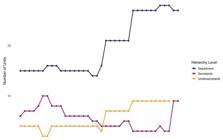
First, the relative stability of departmental structures (top line) until the mid-2000s suggests that presidents across this period refrained from undertaking major organizational interventions, maintaining the ministry’s core architecture largely intact. The sharp increase in the number of departments during the 2000s corresponds directly to the thematic expansion under Lula, when new units were created to institutionalize South-South cooperation, humanitarian diplomacy, multilateral engagement, and development-related issues. This rise signals layering and conversion, the mechanisms described in the article, through which presidential agendas are embedded into bureaucratic design without altering the ministry’s legal foundations.
Second, the pronounced volatility in the number of secretariats, visible in the sharp spike and subsequent collapse under Collor (1990-1992) and mirrored again under Bolsonaro, indicates moments in which presidents departed from the prevailing pattern of organizational continuity to pursue disruptive redesign strategies. In both administrations, the expansion and subsequent rollback (Collor’s case) of secretariats is inconsistent with managerial rationalization and instead reflects attempts at political control through internal fragmentation, the redistribution of authority, and the deliberate weakening of established chains of command.
Third, the rise of undersecretariats from the mid-2000s onward, followed by stability and then some adjustments in the late 2010s, reflects two contrasting logics: Lula’s expansion of thematic complexity and Bolsonaro’s later effort to hollow out or downgrade specific areas (environment, human rights, multilateralism). This combination of formal persistence and functional downgrading matches the drift and selective conversion strategies typical of ideologically motivated redesigns that operate through resource depletion or symbolic reframing rather than institutional abolition.
Taken together, the trajectories in Figure 1 suggest that the MFA’s structure moves in step with presidential projects: Collor’s control-oriented fragmentation appears and disappears quickly; Lula’s thematic expansion produces lasting structural density; Bolsonaro’s reversals manifest less in the creation or elimination of units and more in the hollowing out of existing ones.
4.1. Political control: fragmentation and centralization
One of the most illustrative examples of bureaucratic redesign aimed at political control occurred during the Collor administration (1990-1992), which implemented a significant fragmentation of the Secretary-General, traditionally the second-highest authority in the MFA. This position was split into three coexisting sub-secretariats (Administrative, Political, and Economic), effectively diluting centralized authority and weakening the institutional cohesion of the diplomatic elite. The reform bypassed traditional consultative processes and aligned with Collor’s broader project of curbing bureaucratic autonomy across ministries (Barros, 2009; Casarões, 2012; Lafer, 1993; Lampreia, 2010).
Similarly, under Jair Bolsonaro (2019-2022), organizational changes within the MFA reflected an intentional dismantling of autonomous policy structures. Notably, the General Coordination for Climate Change and Environmental Issues was demoted, and its functions dispersed or eliminated (Casarões, 2020; Casarões & Flemes, 2019).
Another telling case is the reorganization of the Executive Secretariat of the Foreign Trade Chamber (CAMEX) under different governments3. Originally subordinated to the MFA, CAMEX was progressively drawn into the orbit of the Presidency and the Ministry of Economy, reflecting shifts in control over trade diplomacy4.
These restructurings aimed to recentralize decision-making and reduce the MFA’s influence over high-stakes policy areas. Across cases, we observe that reorganization is often used to fragment veto points, increase presidential leverage, and insert loyal actors into strategic nodes of bureaucratic decision-making.
Building on the structural trends identified in the previous section, we will return in the case studies (Section 4.3) to examine the mechanisms through which Brazilian presidents have used bureaucratic redesign to exercise political control within the MFA. In particular, certain episodes of reorganization reveal how internal hierarchies and strategic units were deliberately altered to fragment authority, marginalize bureaucratic autonomy, and recentralize decision-making under presidential influence. The cases examined below, spanning from Collor’s structural fragmentation to Bolsonaro’s dismantling of thematic units, illustrate how administrative reforms function as tools for reconfiguring power within the state apparatus (Silva et al., 2010).
4.2. Agenda prioritization: thematic expansion and institutional signaling
A significant dimension of bureaucratic redesign during the Lula administration involved not only the creation of thematic secretariats within the Ministry of Foreign Affairs, but also the external projection of Brazil’s new diplomatic priorities (Messari, 2006). This was materially expressed in the expansion of Brazil’s global diplomatic presence, particularly in Africa and the Middle East.
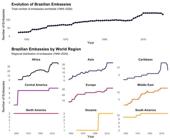
As shown in Figure 2, the number of Brazilian embassies increased sharply during the early 2000s, with more than 20 new missions established in regions historically underrepresented in Brazilian diplomacy. This expansion mirrors the agenda promoted internally by thematic units focused on South-South cooperation, humanitarian engagement, and global equity.
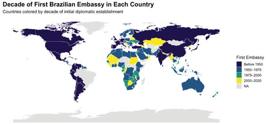
The temporal evolution of Brazil’s diplomatic presence is summarized in Figure 3, which maps the decade in which each country received its first Brazilian embassy. The spatial pattern reveals that the expansion of the Ministry of Foreign Affairs (MFA) occurred in successive waves that align with domestic political shifts and major transformations in the international system (Coelho & Santos, 2017).
Before 1950, Brazil’s diplomatic network was concentrated in the North Atlantic, the Southern Cone, and a limited set of European capitals, regions historically associated with the priorities of the First Republic and the Estado Novo. Between 1950 and 1975, the map shows a clear inflection marked by the incorporation of newly independent states in Africa and the Middle East, reflecting both decolonization dynamics and Brazil’s early efforts to broaden its engagement with the so-called Third World.
From the mid-1970s to 2000, the network expanded toward Asia and non-aligned countries with broader attempts to diversify Brazil’s geopolitical partnerships.
Finally, the period from 2000 to 2020 represents the largest expansion cycle in the MFA’s history, especially in Sub-Saharan Africa and the Caribbean, aligned with the South-South orientation and presidential activism under the Lula administrations. This map thus not only documents the historical growth of Brazil’s diplomatic network but also illustrates how successive presidents used the opening of embassies as an instrument of institutional redesign and a vehicle for signaling evolving strategic priorities.
The Lula administration (2003-2010) offers a clear example of redesign used for agenda advancement and institutional signaling. During this period, the MFA expanded its thematic portfolio by creating or upgrading units dedicated to South-South cooperation, humanitarian aid, and cultural diplomacy (Vigevani & Cepaluni, 2007). The nomenclature and scope of new secretariats, such as the Secretariat for Africa and South America, and the Department for Social and Humanitarian Themes, reflected a deliberate attempt to encode presidential foreign policy goals into the bureaucratic architecture.
This symbolic redesign was mirrored externally in the expansion of Brazil’s diplomatic network in Africa and the Middle East, with over 20 new embassies opened during Lula’s two terms. These moves were not merely logistical; they communicated Brazil’s desired repositioning in global affairs and were embedded in a broader narrative of multipolarity and solidarity.
The Bolsonaro administration reversed many of these institutional arrangements. Several thematic units were suppressed or downgraded, including those linked to multilateralism, human rights, and climate diplomacy. The renaming of offices, e.g., replacing terms such as “diversity” and “sustainability” with “sovereignty” or “strategic interests”, suggests an intentional reframing of Brazil’s diplomatic stance (Oliveira, 2019). These symbolic shifts were accompanied by concrete organizational suppressions, illustrating the interplay between discursive repositioning and administrative dismantling (Casarões, 2020; Casarões & Flemes, 2019).
Together, these cases demonstrate how administrative redesign functions as both a tool for executing policy priorities and a medium for articulating ideological shifts. Reorganization becomes a form of performative governance, encoding presidential preferences into the material and symbolic fabric of the state.
In contrast to redesigns primarily aimed at control, other reorganizational episodes were driven by the desire to prioritize and institutionalize specific policy agendas. Particularly during the Lula and Dilma administrations, structural reforms within the MFA were used to embed new thematic orientations, such as South-South cooperation, humanitarian diplomacy, and global equity, into the bureaucratic architecture (Ministério das Relações Exteriores, 2022). These changes reflected not only managerial adaptation, but also deliberate efforts to align institutional structures with evolving presidential worldviews. The following cases illustrate how reorganization served as a vehicle for agenda promotion and symbolic signaling, both within the Ministry and to the broader international community.
4.3. Case studies
4.3.1. Fernando Collor (1990-1992): fragmentation and ideational disruption
The Collor administration initiated one of the most abrupt and politically charged reorganizations in the Ministry of Foreign Affairs. Decree nº 99,578/1990 dismantled the traditional, centralized Secretaria-Geral, then the core command node of the diplomatic hierarchy, and replaced it with a tripartite structure (SGPE, SGE, SGC) reporting directly to the minister. As Moreira recounts (as cited in Casarões, 2015), it was precisely Collor’s exposure to foreign political circuits that led him to pursue what he described as a “very deep alteration” in the Ministry’s organizational design, extending even to Brazil’s diplomatic network abroad, “including embassies where career ambassadors were stationed.”
Contemporary accounts (Barros, 2009; Casarões, 2012) indicate that the move aimed less at improving coordination than at fragmenting bureaucratic authority and weakening the influence of senior diplomats, particularly Ambassador Paulo Tarso Flecha de Lima5 (Casarões, 2012; Lampreia, 2010; Lafer, 1993; Barros, 2009; Lampreia, 2010). Testimonies suggest that political appointees close to Collor, such as Marcos Coimbra6 and Ambassador Eduardo Hosannah, encouraged the reform to dilute the symbolic and practical power of the career elite (Lampreia, 2010 7).
As Casarões (2012) notes, “[…] the president sought to select, from among the senior ranks of the diplomatic corps, those whose trajectories and worldviews were aligned with a liberalizing national project.” In addition, Velasco and Cruz (2004) argue that the president’s strategy “[…] was to intervene in the highly polarized field of diplomacy, consecrating the victory of the side that advocated policies compatible with the discourse already predominant among Brazilian elites and with the general thrust of his governing program.”
These interventions generated substantial bureaucratic disruption. The fragmentation of the Secretaria-Geral created overlapping chains of command and decision-making ambiguity without improving workflow or responsiveness (Oliveira, 2014)8. Collor’s strained relationship with the diplomatic corps was reinforced by the elites he chose to elevate. As Barros9 (2009) observes, Marcos Coimbra, despite a marginal and uneven career, became a central actor in promoting the circulation of preferred personnel.
Oliveira (2014) notes that Coimbra encouraged Collor to replace senior career diplomats, a process that targeted even figures such as Paulo Tarso, one of the most respected ambassadors of his generation. As Rezek (2014) emphasizes, these moves were “[…] not merely a technical matter,” but actions driven by an underlying political purpose.
The reforms also triggered internal resistance. Oral history interviews (FGV CPDOC) document passive non-compliance, technical criticism through internal memoranda, and informal reassertion of traditional hierarchies. Many new units lacked legitimacy and cohesion, reinforcing perceptions that the redesign was externally imposed and misaligned with Itamaraty’s organizational culture (Barros, 2009; Lampreia, 2010; Oliveira, 2014; Rezek, 2014).
Because Collor’s presidency ended abruptly, few of these changes became institutionalized. Most structures created between 1990 and 1992 were rapidly reversed under President Itamar Franco, and the unified Secretaria-Geral was restored. Nonetheless, the episode remains analytically significant: it reveals how ideational shocks and political-control attempts can disrupt bureaucratic equilibrium. Lampreia (2010) recounts that, during his tenure as what he describes as the “caretaker” of the Itamaraty, he inherited a ministry marked by personal conflicts and tensions he attributed to “[…] the Collor years, when divisive measures had been taken.”
4.3.2. Lula da Silva (2003-2010): embedding the presidential agenda into bureaucratic design
By the early 2000s, the Brazilian Ministry of Foreign Affairs had maintained a relatively stable organizational architecture, inherited from the 1990s. Its structure prioritized bilateral diplomacy with North Atlantic countries, participation in traditional multilateral organizations such as the WTO and the UN, and a functionally organized internal division with limited thematic specialization (Vigevani & Cepaluni, 2007).
The arrival of President Luiz Inácio Lula da Silva in 2003 marked a turning point in both Brazil’s foreign policy orientation and the internal configuration of the MFA (Silva et al., 201010; Spécie, 200811). Without altering its legal foundation, Lula initiated a process of thematic expansion and organizational reorientation aimed at embedding his administration’s foreign policy priorities within the ministry’s structure. Key to this process was the creation and upgrading of thematic units that embodied the administration’s foreign policy priorities (Mourão et al., 2006).
Among the most emblematic were the Secretariat for Africa and South America, the Department for Social and Humanitarian Themes, the General Coordination for Humanitarian Cooperation, and the Department of Environment and Sustainable Development. These changes were enacted through presidential decrees and internal reclassifications, rather than legislative reform, highlighting the use of administrative tools for strategic repositioning (Farias & Carmo, 2015).
A parallel process occurred at the level of elite circulation12. The “crown jewel” post in Washington, for instance, shifted from Roberto Abdenur to Antônio Patriota13, a diplomat closely aligned with Celso Amorim. Patriota later replaced Samuel Pinheiro Guimarães as Secretary-General and eventually became Foreign Minister under Dilma Rousseff.
As Cervo (2009) notes, the cohort promoted during this period was “highly attuned” to the administration’s foreign policy, a view echoed by Barbosa (2009), who highlighted their personal and political alignment with Amorim. By contrast, the Lula administrations (2003-2010) illustrate how bureaucratic redesign becomes institutionalized when presidential priorities activate strands already present (though not always dominant) within Itamaraty.
As Saraiva (2010) shows, since the 1990s the ministry has encompassed competing diplomatic orientations, notably pragmatic institutionalists and autonomists. Lula’s agenda selectively strengthened the autonomist strand through the creation of new thematic units (layering) and the redirection of existing structures toward South-South and redistributive agendas (conversion), reinforced by the strategic reallocation of aligned diplomats. In this sense, Lula’s reforms reshaped the internal balance among competing diplomatic visions rather than simply matching a fixed bureaucratic identity (Santos, 2024)
Among the mid-career diplomats elevated to key posts were Everton Vargas, Mauro Vieira, and Ricardo Neiva Tavares, figures whose trajectories reflected professional experience and thematic affinity14. This pattern illustrates how Lula’s redesign selectively strengthened diplomats whose trajectories and interpretations were compatible with the administration’s agenda, thereby facilitating the translation of presidential priorities into bureaucratic practice (Cervo, 2009, Santos, 2024). While these traditions were not uncontested within the ministry, their institutional strengthening during this period altered the internal balance among competing diplomatic orientations (Saraiva, 2010).
The Lula administration also pursued a geopolitical reconfiguration of Brazil’s diplomatic presence abroad. Over 20 new embassies were opened across Africa and the Middle East, particularly in underrepresented regions such as the Sahel and West Africa (CEDEAO countries). This expansion not only altered the geographic balance of Brazil’s foreign service but also signaled a redefinition of diplomatic priorities rooted in multipolarity, solidarity, and South-South cooperation (Mourão, 2006; Vigevani & Cepaluni, 2007).
The structural effects of this redesign were multifold. Internally, Itamaraty now hosted units dedicated to food security, global health, humanitarian action, and social diplomacy, topics previously marginal in Brazil’s bureaucratic framework. Externally, the newly created embassies and specialized departments served as signaling mechanisms for Brazil’s redefined identity in global affairs. These moves were not merely functional; they contributed to embedding the presidential agenda within the ministry’s organizational architecture.
Analytically, the Lula case exemplifies a logic of agenda prioritization via symbolic and ideational redesign. While some of the reforms produced operational benefits, such as improving thematic specialization and expanding Brazil’s global reach, their core rationale was political and representational. The naming, elevation, and strategic positioning of new units sought to encode presidential priorities into the ministry’s organizational grammar. As such, the Lula-era redesign illustrates how executives can embed ideological transformations into the very architecture of foreign policy bureaucracies, producing long-term institutional consequences even in the absence of formal legal reform.
4.3.3. Jair Bolsonaro (2019-2022): reversing and reframing through institutional hollowing
The Bolsonaro administration introduced a process of bureaucratic restructuring within the Ministry of Foreign Affairs (MFA), marked by ideational and symbolic changes in the organization of Brazil’s foreign policy. Upon taking office in 2019, President Bolsonaro and his appointed foreign minister Ernesto Araújo initiated a campaign to redefine Brazil’s foreign policy orientation, not through formal legislative reform, but through strategic redesign, symbolic reframing, and targeted suppression of internal bureaucratic structures (Casarões, 2020; Casarões & Flemes, 2019).
A comparable form of elite circulation also emerged under Jair Bolsonaro, though directed toward a different cohort of junior diplomats. Even during the transition, the prominence of Diego de Souza Araújo Campos15, a recently recruited third secretary (Duchiade, 2018) publicly identified as close to Eduardo Bolsonaro, signaled a reconfiguration of internal access channels; his spouse’s inclusion in the transition team reinforced this proximity16.
These dynamics intensified after the 2019 administrative reorganization, which eliminated the existing subsecretariats and introduced a smaller set of secretariats, opening space for accelerated advancement. Criteria traditionally reserved for senior diplomats were relaxed, allowing counselors to assume posts previously limited to ambassadors and ministers17. Promotions themselves became instruments of political alignment. The resulting pattern was a targeted circulation of elites that privileged ideological affinity and proximity to the presidential family (Amado, 2019).
At the time, Itamaraty had a well-established thematic apparatus rooted in South-South cooperation, climate diplomacy, human rights advocacy, and multilateral engagement. These units had emerged over previous decades, especially during the Lula and Dilma administrations, and were structurally embedded in the ministry’s internal configuration (Farias & Carmo, 2015; Casarões, 2012, Belém Lopes, Carvalho & Santos, 2022). They included departments dedicated to humanitarian affairs, sustainable development, and diversity.
Bolsonaro’s approach to institutional redesign involved a strategic dismantling of these thematic units, often via suppression, downgrading, or symbolic renaming. For instance, the Coordenação-Geral de Meio Ambiente e Temas Climáticos (General Coordination for Environment and Climate Change) was demoted and stripped of influence, and units dealing with diversity, gender, and social development were dissolved or merged into non-specialized departments. These changes were enacted through decrees such as Decree nº 10,387/2020 and Decree nº 10,433/2020, which restructured the ministry’s secretariats without abolishing them outright.
Alongside these internal suppressions, the administration engaged in symbolic rebranding, replacing terms like “sustainability” and “diversity” with concepts such as “sovereignty” and “strategic interests.” This reframing signaled a departure from cosmopolitan diplomacy toward a nationalist, ideologically conservative posture, reflecting the foreign policy worldview articulated in Araújo’s public writings and speeches (Araújo, 2021, Belém Lopes, Carvalho & Santos, 2022).
The structural impact of these reforms was twofold. First, there was a hollowing-out of institutional capacity, whereby units continued to exist in formal terms but were deprived of authority: a classic form of policy drift (Hacker, 2004; Mahoney & Thelen, 2010). Second, the ministry’s ideological identity shifted through bureaucratic reframing, reshaping the content and tone of Brazil’s international engagements without necessitating constitutional or legal reform.
Analytically, the Bolsonaro case illustrates a hybrid logic of political control and symbolic reversal. Unlike the expansionist redesign of the Lula era, Bolsonaro’s interventions aimed to dismantle the institutional legacy of prior governments and reorient the MFA as an instrument of ideological projection. While the formal structure remained intact, the internal architecture of influence and thematic priorities was substantially reconfigured. This case confirms the core proposition of this study: bureaucratic redesign serves not only as a vehicle for operational change, but as a mechanism of strategic dismantling, capable of producing lasting institutional effects even under a façade of continuity.
5. DISCUSSION: BUREAUCRATIC REDESIGN, ELITE CIRCULATION, AND MODES OF INSTITUTIONAL CHANGE
The three reform episodes examined in this article show that presidential redesign strategies activate distinct modes of institutional change in the Ministry of Foreign Affairs. Building on Mahoney and Thelen’s (2010) framework, we demonstrate how drift, layering, conversion, and, more rarely, displacement emerge through the combined manipulation of organizational structures and elite circulation. Across administrations, promotions, removals, and the elevation of aligned cadres served as mechanisms through which internal authority was redistributed and thematic priorities redefined.
The Collor administration illustrates how attempted displacement falters when political support is weak and bureaucratic resistance strong. Collor fragmented the Secretary-General’s role, reorganized units, and promoted politically aligned advisers despite their limited bureaucratic standing. These moves sought to build a new command nucleus but lacked bureaucratic buy-in and were quickly reversed. The result was temporary drift and turbulence, without lasting institutional transformation.
By contrast, the Lula administrations (2003-2010) illustrate how bureaucratic redesign becomes institutionalized when presidential priorities activate and consolidate strands already present (though not always dominant) within Itamaraty’s institutional repertoire (Saraiva, 2010). Rather than aligning with a fixed bureaucratic identity, Lula’s agenda selectively strengthened developmental and autonomy-oriented traditions in Brazilian diplomacy through the creation of new thematic units (layering) and the redirection of existing structures toward South-South and redistributive agendas (conversion). These changes were reinforced by the strategic reallocation of ideationally aligned diplomats to key positions, enabling consolidation rather than sustained resistance. In this sense, Lula’s reforms did not merely reflect bureaucratic identity; they contributed to reshaping it.
The Bolsonaro government presents a distinct configuration rooted in symbolic reversal and institutional hollowing. Units associated with multilateralism, climate diplomacy, and human rights formally persisted while losing authority, an effective form of drift. Selective elite circulation complemented this process: junior diplomats with ideological affinity or proximity to the presidential family were placed in posts traditionally reserved for senior ranks, reinforcing conversion toward nationalist priorities. The combined effect was an asymmetric redesign strategy that weakened previously central units while elevating ideologically salient ones.
Taken together, these cases reveal how presidential redesign interacts with institutional resilience. Displacement falters without political continuity or bureaucratic support; layering thrives when reforms and personnel align with organizational identities; drift serves as a low-cost instrument of executive control; and conversion operates at the intersection of symbolic politics and organizational adaptation. Across administrations, bureaucratic redesign, whether formal, incremental, or enacted through strategic inaction, functions as a key mechanism through which presidents reshape foreign policy institutions. Elite circulation amplifies these effects by determining who exercises authority within redesigned structures, shaping the long-term trajectory of the foreign policy apparatus.
6. CONCLUSION
This article showed that presidential control over foreign policy does not occur solely through formal authority or high-visibility institutional reforms. In Brazil’s Ministry of Foreign Affairs presidents have repeatedly relied on intra-organizational redesign to advance political priorities, redistribute authority, and reshape the ministry. By tracing administrative reforms between 1985 and 2020, we demonstrated that reorganizations of units, hierarchies, and personnel flows constitute a distinct mode of presidential governance, one that operates through everyday decrees rather than constitutional change.
Across administrations, we identified three recurring redesign logics: political control, agenda expansion, and symbolic reversal. Collor sought to fragment command structures and weaken senior diplomats; Lula expanded thematic capacities and embedded his foreign policy worldview into the bureaucracy; Bolsonaro deployed selective hollowing and ideological reframing to reverse earlier agendas. Although substantively different, these strategies shared a common feature: they relied on the combined manipulation of organizational architecture and elite circulation.
These findings extend existing scholarship by showing that bureaucratic redesign is both an instrument of presidential agency and a mechanism of institutional evolution. Even highly professionalized ministries can be reshaped through incremental interventions that alter authority flows, thematic priorities, and internal constituencies. They also suggest avenues for future research: How do redesigned structures evolve across multiple administrations? Under what conditions do bureaucracies resist, appropriate, or reinterpret presidential reforms? And how do internal reorganizations affect policy outputs in areas such as trade, climate diplomacy, or multilateral engagement?
By treating administrative redesign as a political strategy rather than an administrative footnote, this article contributes to a broader understanding of how executives remake the state from within, quietly, cumulatively, and often with lasting effects on the trajectory of foreign policy institutions.
ACKNOWLEDGEMENTS
The author thanks Thales Carvalho, Yulieth Martinez and the two anonymous reviewers for their insightful comments.
REFERÊNCIAS
-
Amado, G. (2019). Ernesto Araújo manda ex-chanceleres de Dilma para embaixadas simples. Época https://oglobo.globo.com/epoca/guilherme-amado/ernesto-araujo-manda-ex-chanceleres-de-dilma-para-embaixadas-simples-23538484 Acessado em: 20 de março de 2019
» https://oglobo.globo.com/epoca/guilherme-amado/ernesto-araujo-manda-ex-chanceleres-de-dilma-para-embaixadas-simples-23538484 -
Antônio de Aguiar Patriota será o embaixador do Brasil nos EUA. (2012, 4 de março). Estadão https://www.estadao.com.br/politica/antonio-patriota-sera-o-embaixador-do-brasil-nos-eua/
» https://www.estadao.com.br/politica/antonio-patriota-sera-o-embaixador-do-brasil-nos-eua/ - Araújo, E. H. F. (2021). Política externa: Soberania, democracia e liberdade: Coletânea de discursos, artigos e entrevistas do Ministro das Relações Exteriores, 2020 Fundação Alexandre de Gusmão.
- Bach, T., & Veit, S. (2018). The determinants of promotion to high public office in Germany: Partisan loyalty, political craft, or managerial competencies? Journal of Public Administration Research and Theory, 28(2), 254-269.
- Belém Lopes, D., Carvalho, T., & Santos, V. (2022). Did the far right breed a new variety of foreign policy? The case of Bolsonaro’s “more-bark-than-bite” Brazil. Global Studies Quarterly, 2(4), ksac078.
- Carroll, B. J., Bertels, J., Froio, C., Kuipers, S., Schulze-Gabrechten, L., & Viallet-Thévenin, S. (2022). Between life and death: Organizational change in central state bureaucracies in cross-national comparison. International Review of Administrative Sciences, 88(4), 943-959.
-
Casarões, G. (2012). O papel do Itamaraty na definição da política externa do governo Collor de Mello. Revista Brasileira de Política Internacional, 55(1), 135-153. https://doi.org/10.1590/S0034-73292012000100008
» https://doi.org/10.1590/S0034-73292012000100008 - Casarões, G. (2015). Em busca da credibilidade perdida: A turnê global de Collor como presidente-eleito. Carta Internacional, 10(2), 97-119.
- Casarões, G. (2020). Religião e poder: A ascensão de um projeto de nação evangélica no Brasil. Revista Interesse Nacional, 13(49), 9-16.
- Casarões, G., & Flemes, D. (2019). Brazil first, climate last: Bolsonaro’s foreign policy Social Science Open Access Repository.
- Castro, F. M. O. (2009). Dois séculos de história da organização do Itamaraty (1808-2008) Fundação Alexandre de Gusmão.
- Cervo, A. L. (2009). Três ideias conflitantes. Revista Conjuntura Econômica, 63(9), 53-53.
- Cheibub, Z. B. (1984). Diplomacia e construção institucional: O Itamaraty em uma perspectiva histórica. Pensamiento Iberoamericano, (6), 113-131.
- Cheibub, Z. B. (1989). A carreira diplomática no Brasil: O processo de burocratização do Itamarati. Revista de Administração Pública, 23(2), 97-131.
-
Coelho, A. L., & Santos, V. (2017, 10 de abril). O primeiro ano da política externa de Temer e a desconstrução das últimas décadas. Escuta: Revista de Política e Cultura https://www.google.com/search?q=https://revistaescuta.wordpress.com/2017/04/10/o-primeiro-ano-da-politica-externa-de-temer-ea-desconstrucao-das-ultimas-decadas
» https://www.google.com/search?q=https://revistaescuta.wordpress.com/2017/04/10/o-primeiro-ano-da-politica-externa-de-temer-ea-desconstrucao-das-ultimas-decadas -
Duchiade, A. (2018, 17 de dezembro). Equipe de transição do Itamaraty tem diplomata iniciante e membros do PSL. O Globo https://oglobo.globo.com/mundo/equipe-de-transicao-do-itamaraty-tem-diplomata-iniciante-membros-do-psl-23289895
» https://oglobo.globo.com/mundo/equipe-de-transicao-do-itamaraty-tem-diplomata-iniciante-membros-do-psl-23289895 - Farias, R. S., & Carmo, G. F. (2015). Alma mater diplomática: A formação acadêmica dos diplomatas brasileiros (1985-2010). Mundorama, (91).
- Farias, R., & Ferreira, C. (2019). Legações e embaixadas do Brasil Fundação Alexandre de Gusmão.
- Figueira, A. R. (2010). Rupturas e continuidades no padrão organizacional e decisório do Ministério das Relações Exteriores. Revista Brasileira de Política Internacional, 53(1), 5-22.
- Fisher, L., & Moe, R. C. (1981). Presidential reorganization authority: Is it worth the cost? Political Science Quarterly, 96(2), 301-318.
-
Guedes e Ernesto divergem sobre condução da política comercial brasileira. (2019, 23 de abril). Folha de S.Paulo https://www1.folha.uol.com.br/mercado/2019/04/guedes-e-ernesto-divergem-sobre-conducao-da-politica-comercial-brasileira.shtml
» https://www1.folha.uol.com.br/mercado/2019/04/guedes-e-ernesto-divergem-sobre-conducao-da-politica-comercial-brasileira.shtml - Guerra, R. (2019). Mudanças intraministeriais e gestão da coalizão: Brasil, de 1990 a 2014. Opinião Pública, 25(3), 630-659.
-
Hacker, J. S. (2004). Privatizing risk without privatizing benefits: Path dependence, policy drift, and welfare-state reform in the United States. American Political Science Review, 98(2), 243-260. https://doi.org/10.1017/S000305540400113X
» https://doi.org/10.1017/S000305540400113X -
Hong, S., & Park, N. (2019). Administrative reorganization as a signal: Bounded rationality, agency merger, and salience of policy issues. Governance, 32(3), 421-439. https://doi.org/10.1111/gove.12383
» https://doi.org/10.1111/gove.12383 -
Howell, W. G., & Lewis, D. E. (2002). Agencies by presidential design. The Journal of Politics, 64(4), 1095-1114. https://doi.org/10.1111/1468-2508.00164
» https://doi.org/10.1111/1468-2508.00164 - Lampreia, L. F. (2010). Luiz Felipe Lampreia (depoimento, 2008) FGV CPDOC.
- Lewis, D. E. (2004). Presidents and the politics of agency design: Political insulation in the United States government bureaucracy, 1946-1997 Stanford University Press.
- Lewis, D. E. (2010). The politics of presidential appointments: Political control and bureaucratic performance Princeton University Press.
- Mahoney, J., & Thelen, K. (2010). A theory of gradual institutional change. In J. Mahoney & K. Thelen (Eds.), Explaining institutional change: Ambiguity, agency, and power (pp. 1-37). Cambridge University Press.
- March, J. G., & Olson, J. P. (1983). Organizing political life: What administrative reorganization tells us about government. American Political Science Review, 77(2), 281-296.
- Matsuda, K. A. (2022). Narrativas sobre o Palácio Itamaraty a partir do jornal Correio Braziliense (1960-1970). Anais do Museu Paulista: História e Cultura Material, 30, e29.
- Messari, N. (2006). O Brasil e o mundo árabe. In H. Altemani & A. C. Lessa (Eds.), Relações internacionais do Brasil: Temas e agendas (Vol. 1, pp. 123-145). Saraiva.
-
Ministério das Relações Exteriores. (2022). Organograma ampliado https://www.gov.br/mre/pt-br/arquivos/documentos/administrativo/organograma_mre_2022.pdf
» https://www.gov.br/mre/pt-br/arquivos/documentos/administrativo/organograma_mre_2022.pdf - Moe, T. M. (1989). The politics of bureaucratic structure. In J. E. Chubb & P. E. Peterson (Eds.), Can the government govern? (pp. 267-329). Brookings Institution Press.
-
Mortensen, P. B., & Green-Pedersen, C. (2015). Institutional effects of changes in political attention: Explaining organizational changes in the top bureaucracy. Journal of Public Administration Research and Theory, 25(1), 165-189. https://doi.org/10.1093/jopart/mut023
» https://doi.org/10.1093/jopart/mut023 - Moura, C. P. (2006). O inglês, o parentesco e o elitismo na Casa de Rio Branco. Cena Internacional, 8(1), 20-34.
- Nou, J. (2015). Intra-agency coordination. Harvard Law Review, 129, 421-491.
- Oliveira, A. B. P. de. (2014). Amaury Banhos Porto de Oliveira (depoimento, 2014) Depoimento em vídeo. FGV CPDOC.
-
Oliveira, E. (2019, 10 de janeiro). Nova estrutura do Itamaraty terá secretaria de soberania nacional e cidadania. O Globo https://oglobo.globo.com/mundo/nova-estrutura-do-itamaraty-tera-secretaria-de-soberania-nacional-cidadania-23360155
» https://oglobo.globo.com/mundo/nova-estrutura-do-itamaraty-tera-secretaria-de-soberania-nacional-cidadania-23360155 -
Oliveira, E., & Duchiade, A. (2019, 2 de janeiro). Diplomatas menos graduados ocuparão cargos mais elevados no Itamaraty. O Globo https://oglobo.globo.com/mundo/diplomatas-menos-graduados-assumirao-cargos-mais-elevados-no-itamaraty-23340703
» https://oglobo.globo.com/mundo/diplomatas-menos-graduados-assumirao-cargos-mais-elevados-no-itamaraty-23340703 - Parsneau, K. (2013). Politicizing priority departments: Presidential priorities and subcabinet experience and loyalty. American Politics Research, 41(3), 443-470.
-
Portaria nº 49, de 12 de dezembro de 2018. (2018). Diário Oficial da União https://www.in.gov.br/web/dou/-/portaria-n-49-de-12-de-dezembro-de-2018-54983892
» https://www.in.gov.br/web/dou/-/portaria-n-49-de-12-de-dezembro-de-2018-54983892 - Rezek, J. F. (2014). José Francisco Rezek II (depoimento, 2014) FGV CPDOC.
- Santos, V. (2022). Disputas e dissonâncias na política externa brasileira: Presidentes, burocracia e o legislativo na Nova República Tese de doutorado, Universidade Federal de Minas Gerais. Repositório Institucional da UFMG.
- Santos, V. (2024). Navigating turf wars: Disruptions in the politics of bureaucracy in Brazil. Revista Brasileira de Ciência Política, 43, e275476.
- Saraiva, M. G. (2010). A diplomacia brasileira e as visões sobre a inserção externa do Brasil: Institucionalistas pragmáticos x autonomistas. Mural Internacional, 1(1), 45-52.
- Shpaizman, I. (2022). Cabinet ministers and the use of agenda‐setting power: Evidence from cabinet ministers in Israel. Policy Studies Journal, 50(4), 897-920.
- Silva, E. C. G. D., Spécie, P., & Vitale, D. (2010). Um novo arranjo institucional para a política externa brasileira Ipea.
- Souza, A. L. C. F., & dos Santos, V. S. (2014). A análise da política externa do governo Dilma Rousseff na perspectiva dos pronunciamentos oficiais na ONU. Mural Internacional, 5(2), 128-138.
-
Temer devolve o comando da Camex ao Ministério da Indústria. (2017, 12 de abril). Folha de S.Paulo http://www1.folha.uol.com.br/mercado/2017/04/1874923-temer-devolve-comando-da-camex-ao-ministerio-da-industria.shtml
» http://www1.folha.uol.com.br/mercado/2017/04/1874923-temer-devolve-comando-da-camex-ao-ministerio-da-industria.shtml -
Vez dos cinquentões no Itamaraty, A. (2009, 22 de outubro). Correio Braziliense https://www.correiobraziliense.com.br/app/noticia/mundo/2009/10/22/interna_mundo,149918/a-vez-dos-cinquentoes-no-itamaraty.shtml
» https://www.correiobraziliense.com.br/app/noticia/mundo/2009/10/22/interna_mundo,149918/a-vez-dos-cinquentoes-no-itamaraty.shtml - Vieira, M. M. (2013). Controle político da burocracia no presidencialismo de coalizão Tese de doutorado, Instituto de Estudos Sociais e Políticos - IESP - UERJ. Repositório Institucional da UERJ.
- Vigevani, T., & Cepaluni, G. (2007). A política externa de Lula da Silva: A estratégia da autonomia pela diversificação. Contexto Internacional, 29(2), 273-335.
- Whitford, A. B. (2021). Presidential reorganization and the politics of public agencies. Administration & Society, 53(2), 193-221.
- Yesilkagit, K. (2021). Termination, aggregation, or replacement? A competing risks approach to agency transitions. Governance, 34(3), 803-819.
- Yesilkagit, K., Bezes, P., & Fleischer, J. (2022). What’s in a name? The politics of name changes inside bureaucracy. Public Administration, 100(4), 1091-1106.
-
1
In this article, the term politicization is used in the sense developed by institutionalist analyses of presidentialism, particularly Lewis’s (2010) conception of polarization as the use of appointments as a political instrument. We acknowledge, however, that politicization is also commonly employed to describe the expansion and intensification of public debate and its associated social and ideological contestation.
-
2
Echoing the practice of early cartographers who wrote “here be dragons” over unexplored regions, we employ the phrase to denote the opaque and insufficiently mapped realm of intrabureaucratic administrative reorganization: an area that, for decades, remained understudied in part because the dominant narrative of bureaucratic insulation discouraged closer scrutiny of the Itamaraty.
-
3
Temer devolve comando da Camex ao Ministério da Indústria (2017).
-
4
Guedes e Ernesto divergem sobre condução da política comercial brasileira (2019).
-
5
His tenure as Secretary-General reportedly reinforced his image as a “hyper-empowered” figure within the ministry (Barros, 2009; Cassarões, 2012; Lafer, 1993; Lampreia, 2010).
-
6
The diplomat was married to the president’s sister, Leda Collor, and came to be regarded as one of his closest and most influential aides, serving as both chief of staff and diplomatic adviser, thereby “[…] assuming a central role in the organizational determinations of foreign policy” (Cassarões, 2012).
-
7
As Lampreia (2010) recounts, “Coimbra had a close friend in the Itamaraty, Ambassador Eduardo Hosannah. Both were obsessed with carrying out a profound restructuring of the ministry’s internal organization.”
-
8
As Oliveira (2014) recounts, Collor’s intervention was viewed within the diplomatic corps as deeply disruptive and technically unsound: “They even introduced new legislation that forced many people into retirement within months. It was sheer foolishness. Foolishness. And very poorly executed. Nothing respectable. It was a period […] a period […] Fortunately Brazil doesn’t face many problems; as long as we don’t make too many foolish moves, nothing happens […]”.
-
9
As Barros (2009, emphasis in original) remarks, Marcos Coimbra was regarded as “[…] not particularly dull, but […] a correct and very pleasant man who had spent his entire career working very little and in marginal postings”.
-
10
For the authors: “Parallel to the transformation of the Secretariat in Brasília, one also observes the expansion of Brazil’s representations abroad. In this regard, during the Lula administration alone, between 2003 and 2010, more than 60 embassies and consulates were created” (Silva et al., 2010).
-
11
In the author’s assessment, “[...] today the Itamaraty has two Secretariats-General for Policy, with at least three times the number of specialized departments and divisions compared to the late 1980s” (Spécie, 2008, p. 46).
-
12
A vez dos cinquentões no Itamaraty (2009).
-
13
Antônio de Aguiar Patriota será o embaixador do Brasil nos EUA (2012).
-
14
“There is considerable expectation surrounding them because there has been a major renewal. They are young people, competent bureaucrats, and we will wait to see what they will do” (A vez dos cinquentões no Itamaraty, 2009).
-
15
Portaria nº 49, de 12 de dezembro de 2018 (2018).
-
16
Reporting at the time also highlighted appointments with no prior connection to the public service. One such case involved a PUC-Goiás graduate in International Relations, whose professional background included translation work and service as a Cambridge oral examiner. Her nomination generated discontent among diplomats, particularly given her lack of previous governmental experience; as she stated, the appointment resulted from her personal rapport with the incoming foreign minister (See Duchiade, 2018).
-
17
Under Provisional Measure nº 870, less senior diplomats were authorized to occupy higher-ranking posts within the Ministry. Notable cases included second-class ministers Fábio Marzano and Kenneth Félix da Nóbrega, who assumed positions at the secretariat level, and Pedro Wolny, also a second-class minister, who became chief of staff to the Foreign Minister. Contemporary reporting documented the unprecedented relaxation of rank requirements for these appointments (see Oliveira & Duchiade, 2019).
-
26
[Original version]
-
RESEARCH DATA AVAILABILITY
The entire dataset supporting the results of this study is available upon request to the corresponding author.
-
ARTIFICIAL INTELLIGENCE USAGE
The author used AI-assisted tools (e.g., GPT and Grammarly) for language editing and translation support. All content was critically reviewed and validated by the author, who remains fully responsible for the manuscript.
-
Reviewers:
Kutsal Yesilkagit, Universiteit Leiden, Leiden, Netherlands
-
Reviewers:
Rodrigo Fracalossi de Moraes, Instituto de Pesquisa Econômica Aplicada, Brasília, DF, Brazil
-
25
The peer review report is available at https://periodicos.fgv.br/rap/article/view/97069/90457
The entire dataset supporting the results of this study is available upon request to the corresponding author.

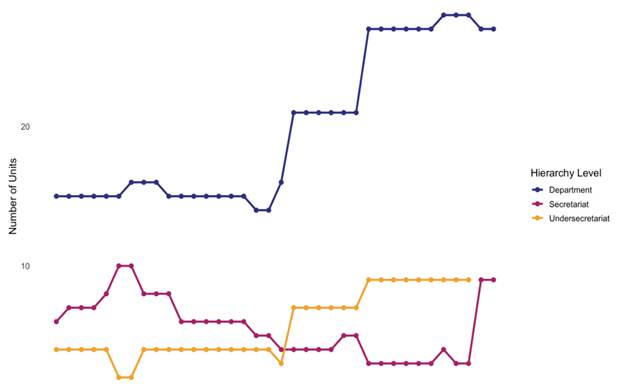 Source: Elaborated by the author.
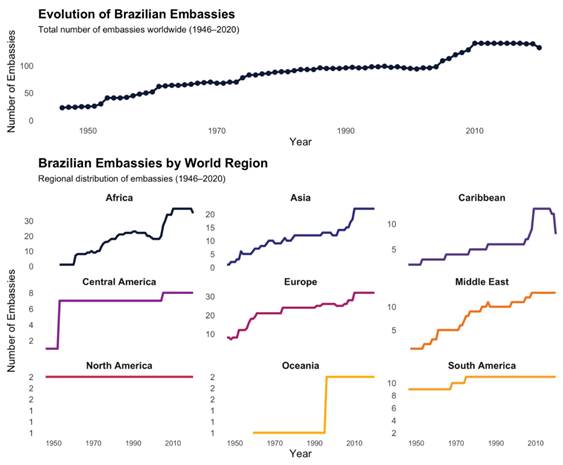 Source: Elaborated by the author based on
 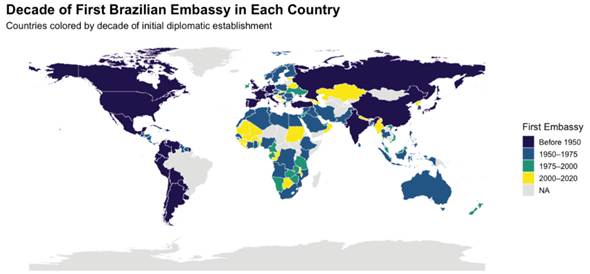 Source: Elaborated by the author based on Farias and Ferreira (2020).