 STRUCTURE AND COMPOSITION OF THE VEGETATION OF A TROPICAL FOREST IN THE PERUVIAN AMAZON
ABSTRACT
The tropical forests in the Peruvian High Amazon are strategic ecosystems for biodiversity conservation; however, their structural complexity and successional patterns remain understudied, limiting the development of effective management plans. This study characterizes the floristic composition, Importance Value Index (IVI), diametric structure, and sociological position of the National Agrarian University of the Amazon Reserved Forest (BRUNAS). The study provides a quantitative diagnostic of the forest’s structural integrity to facilitate conservation strategies in high-altitude Amazonian remnants. Two permanent sampling plots (1.0 ha each) were established, recording all individuals with a diameter at breast height (DBH) ≥ 10 cm. Horizontal structure was determined through IVI, while vertical organization was assessed using sociological position analysis. The results revealed high taxonomic diversity, with a total richness of 113 and 114 species per plot. Senefeldera inclinata (IVI = 16.4%) and Parkia panurensis (IVI = 10.2%) emerged as the most dominant species. The diameter distribution followed an inverted "J" curve, with 85.5% of individuals concentrated in the lower DBH classes (10-20 cm), indicating vigorous natural regeneration. Vertical stratification showed a well-defined hierarchy where S. inclinata dominates the lower strata, whereas P. panurensis occupies the middle and upper layers. In conclusion, the BRUNAS forest exhibits a balanced structure and high resilience, typical of primary forest remnants. These findings demonstrate that stem diameter distribution and vertical organization analysis is essential to ensure the long-term conservation of these high-Amazonian ecosystems.
Keywords:
Forest Management; Forest Structure; Importance Value Index; Sociological Position; Tropical Biodiversity
RESUMO
As florestas tropicais da Alta Amazônia peruana são ecossistemas estratégicos para a conservação da biodiversidade; no entanto, sua complexidade estrutural e padrões sucessionais permanecem pouco estudados, limitando o desenvolvimento de planos de manejo eficazes. Este estudo caracteriza a composição florística, o Índice de Valor de Importância (IVI), a estrutura diamétrica e a posição sociológica da Reserva Florestal da Universidad Nacional Agraria de la Selva (BRUNAS). O estudo fornece um diagnóstico quantitativo da integridade estrutural da floresta para facilitar estratégias de conservação em remanescentes amazônicos de altitude. Foram estabelecidas duas parcelas permanentes de amostragem (1,0 ha cada), registrando todos os indivíduos com diâmetro à altura do peito (DAP) ≥ 10 cm. A estrutura horizontal foi determinada através do IVI, enquanto a organização vertical foi avaliada por meio da análise da posição sociológica. Os resultados revelaram alta diversidade taxonômica, com uma riqueza total de 113 e 114 espécies por parcela. Senefeldera inclinata (IVI = 16,4%) e Parkia panurensis (IVI = 10,2%) surgiram como as espécies mais dominantes. A distribuição diamétrica seguiu uma curva de "J invertido", com 85,5% dos indivíduos concentrados nas classes de DAP inferiores (10-20 cm), indicando uma regeneração natural vigorosa. A estratificação vertical mostrou uma hierarquia bem definida, onde S. inclinata domina os estratos inferiores, enquanto P. panurensis ocupa as camadas média e superior. Em conclusão, a floresta BRUNAS exibe uma estrutura equilibrada e alta resiliência, típica de remanescentes de floresta primária. Estes achados demonstram que a análise da distribuição diamétrica e da organização vertical é essencial para garantir a conservação a longo prazo destes ecossistemas da Alta Amazônia.
Palavras-Chave:
Manejo florestal; Estrutura florestal; Índice de Valor de Importância; Posição sociológica; Biodiversidade tropical
1. INTRODUCTION
Tropical forests are vital for stabilizing biogeochemical cycles and harboring over two-thirds of terrestrial biota (Hofhansl et al., 2019). The Peruvian Amazon, with its rich floristic diversity, supports endemic species of high ecological value (Zárate et al., 2015; Oré et al., 2021). However, anthropogenic pressures such as deforestation and land-use change threaten the resilience of these ecosystems. In Peru, despite the existence of protected areas, many biodiversity hotspots and nature’s contributions to people (NCPs) remain inadequately protected, especially in transition zones where structural data are limited (Móstiga et al., 2023).
The floristic composition and structure of these forests are pivotal to understanding their successional status and conservation condition. Species diversity is influenced by abiotic factors and disturbance history (Bienu et al., 2023; Sanjeewani et al., 2024). As human pressures increase, affecting the biodiversity and functionality (Marsh et al., 2025), studying structural attributes becomes essential to assess forest health and its capacity to withstand climatic stress (Forzieri et al., 2022).
Forest structure is traditionally analyzed through the Importance Value Index (IVI), diametric distribution, and sociological position. The IVI identifies species critical to ecological balance by combining abundance, dominance, and frequency (Acosta et al., 2006). Furthermore, the diametric distribution often displaying an inverted "J" curve reflects the forest's successional stage and demonstrates whether natural regeneration is sufficient to sustain the ecosystem over time (Mijares-S. & Pérez-Buitrago, 2018). Similarly, the sociological position reveals the vertical organization and hierarchy across strata, which is fundamental for understanding niche differentiation and competition for resources (Astigarraga et al., 2025).
The Reserved Forest of the National Agrarian University of the Amazon (BRUNAS) represents a strategic study site in the Peruvian High Amazon. Situated in a transitional area between lowland and high-altitude forests, it serves as a primary model for studying how structural integrity is maintained in fragmented landscapes (Bañares-de-Dios et al., 2022). Despite its importance, detailed diagnostics of its vertical and horizontal organization are needed to optimaze conservation strategies that ensure its long-term sustainability.
The aim of this research was to characterize the floristic composition, Importance Value Index, structure, and sociological position of the BRUNAS forest. We hypothesize that the forest maintains a balanced structural organization characterized by an inverted "J" diametric distribution and a well-defined vertical stratification. This structure indicates a high capacity for natural regeneration and ecosystem resilience, providing a reliable baseline for the design of sustainable management strategies in the High Amazonian remnants.
2. MATERIAL AND METHODS
2.1 Study area
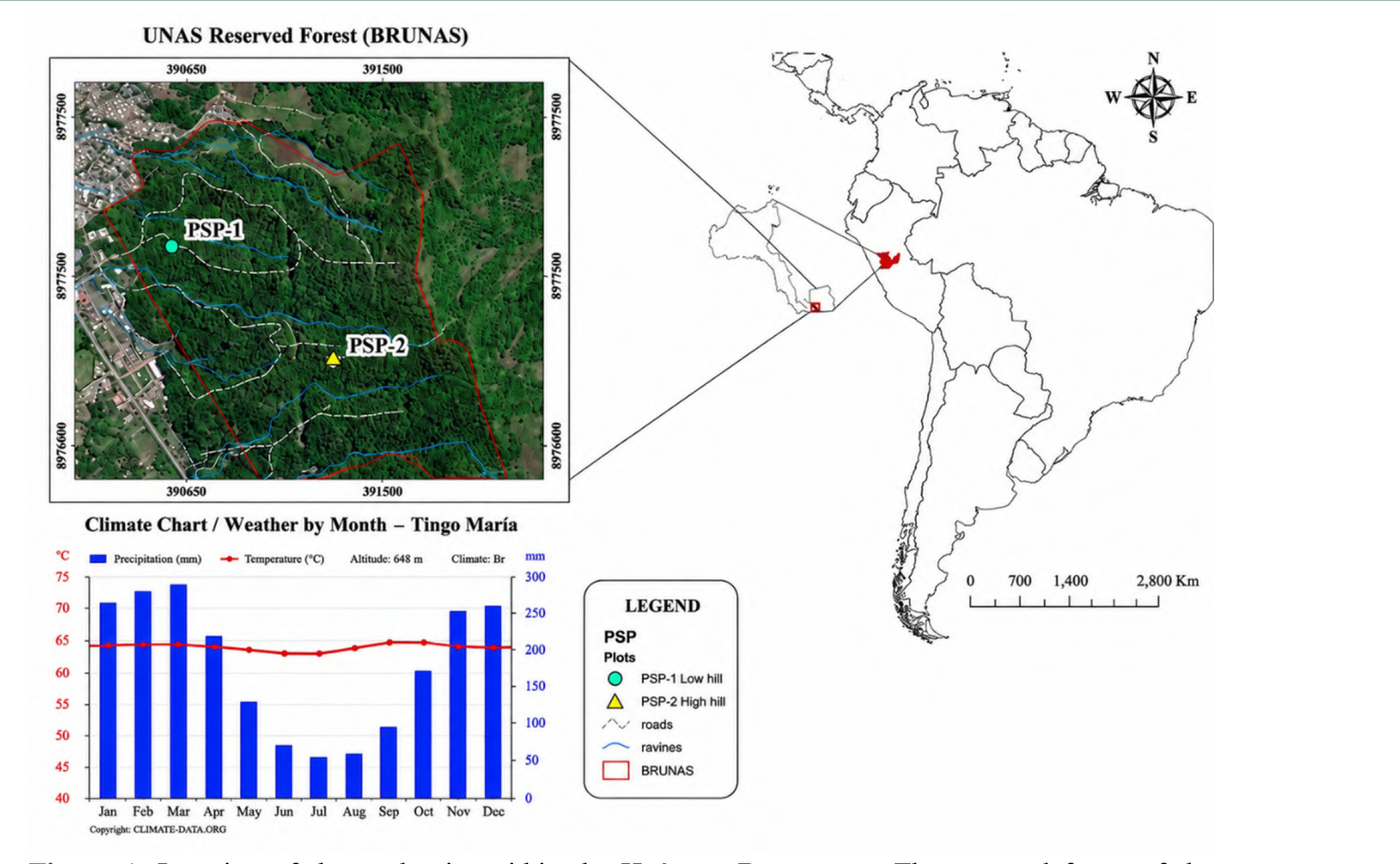
The study was conducted in the Reserved Forest of the National Agraria University of the Amazon (BRUNAS), located in Tingo María, Peru (Figure 1). This region represents a strategic ecotone between the Lowland and High Amazon, characterized by high taxonomic diversity and its role as a biodiversity hotspot within the Peruvian protected area system (Móstiga et al., 2023). The climate is classified as tropical rainforest (Af) according to Köeppen (1948), with an average annual temperature of 25.5°C and relative humidity of 85%. Annual precipitation is approximately 3,000 mm, with a well defined rainy season occurring from November to March that significantly influences forest regrowth and phenological patterns (Zepner et al., 2021).

Location of the study site within the Huánuco Department. The reserved forest of the National Agrarian University of the Amazon - BRUNAS, and location of the permanent sampling plots. Climate diagram of the study area for the period 1993-2022 (Zepner et al., 2021). The red line indicates the average monthly temperature, the blue line indicates average precipitation; the light blue indicates the rainy season and dark blue indicates when the average precipitation is greater than 100 mm
Figura 1
Localização do local de estudo no Departamento de Huánuco. A Reserva Florestal da Universidade Nacional Agrária da Amazônia - BRUNAS, e localização das parcelas de amostragem permanente. Diagrama climático da área de estudo para o período de 1993-2022 (Zepner et al., 2021). A linha vermelha indica a temperatura média mensal, a linha azul indica a precipitação média; o azul claro indica a estação chuvosa e o azul escuro indica quando a precipitação média é superior a 100 mm
The topography is mountainous, dominated by the Ibiapaba Formation with fertile soils that support subtropical premontane moist forests (bmh-PST) according to Holdridge (1982) classification. We established two Permanent Sampling Plots (PSP) of 1 hectare (100 x 100 m) each to evaluate structural variations across the local relief: PSP-1, situated on a lowland hill (735 m a.s.l.; -9.308566°, -75.994678°), and PSP-2, situated on a highland hill (875 m a.s.l.;-9.313650°, -75.987408°). Despite the relatively small elevational difference (140 m), the distinction between these topographic positions is justified by variations in slope and drainage patterns, which are known to drive niche differentiation and structural complexity in Andean-Amazonian transition zones (Bañares-de-Dios et al., 2022; Marcelo-Peña et al., 2007). Such structural diversity is a pivotal modulator of ecosystem resilience and tree growth synchrony in response to climatic stress (Astigarraga et al., 2025; Forzieri et al., 2022), making the BRUNAS forest an ideal model for assessing the health of High Amazonian remnants.
2.2 Sampling protocol
Tree inventory was conducted between 2015-2016 across two 1-hectare (100 m x 100 m) permanent sampling plots (PSP). Following a stratified random design based on topographic variations (lowland vs. highland hills), each plot was divided into 25 subplots of 20 m x 20 m (400 m2). We recorded and measured all tree individuals with a diameter at breast height (DBH) ≥ 10 cm.
DBH was measured at 1.30 m from the ground using a metric tape, and total height was estimated using a Suunto PM-5/360PC clinometer. To ensure plot orientation and alignment, a Suunto compass was utilized. Taxonomic identification followed a rigorous protocol: specimens were first characterized in situ and, for those requiring further verification, botanical samples were collected using pole pruners. Samples were preserved in newspapers and dried in a wooden airtight dryer at the Forest Seed Certification Laboratory. Final taxonomic determination was performed at the Herbarium of the Missouri Botanical Garden (Oxapampa, Peru) with the collaboration of specialized botanists. The use of Permanent Sampling Plots (PSP) facilitates a precise quantitative characterization of forest architecture and composition. In addition to DBH and height, we calculated primary ecological variables, including abundance, frequency, and dominance. These parameters were integrated into the Importance Value Index (IVI) to evaluate the ecological significance of species within each topographic condition. This methodological framework provides a robust baseline for analyzing how species are spatially and vertically distributed in High Amazonian remnants, ensuring the reproducibility of the structural diagnostic.
2.3 Structural and phytosociological analysis
To characterize the forest architecture and the ecological significance of the species, we integrated horizontal, diametric, and vertical structural parameters as follows:
Horizontal Structure and Importance Value Index (IVI)
The horizontal structure was evaluated through the Importance Value Index (IVI), which determines the phytosociological significance of each species by integrating three relative variables: abundance, frequency, and dominance (Mostacedo & Fredericksen, 2000; Suárez-R. & Vargas-R., 2019). Dominance was determined based on the Basal Area (BA), calculated from the Diameter at Breast Height (DBH) measured at 1.30 m from the soil line (Mijares-S. & Pérez-Buitrago, 2018). The mathematical expressions for these indicators are detailed in Table 1.
Mathematical expression and description of elements to determine the IVI indicators
Tabela 1
Expressão matemática e descrição dos elementos para determinar os indicadores IVI
Diametric Structure
For the analysis of diametric structure, individuals in each plot were grouped into diameter classes with 10 cm intervals (e.g., 10-20 cm, 20-30 cm). This distribution was used to identify successional patterns and the regenerative capacity of the forest community (Prodan et al., 1997).
Vertical Structure (Sociological Position)
The vertical organization was characterized by subdividing the vegetation into three uniform strata-Lower, Middle, and Upper-based on the maximum total height recorded in each sampling plot (Lamprecht, 1990). The predefined height categories for these strata are detailed in Table 2.
Categorias predefinidas com base na altura total e PSP
Tabela 2
Predefined categories based on total height and PSP
To determine the Absolute (PSa) and Relative Sociological Position (PSr), we followed the method proposed by Finol (1976). This approach assigns a phytosociological value to each substratum (VFe) based on individual density, as described in Table 3. This analysis enables a quantitative assessment of species distribution across the different canopy layers (Acosta et al., 2006).
Mathematical expression and description of elements for sociological position
Tabela 3
Expressão matemática e descrição dos elementos para a posição sociológica
2.4 Statistical analysis
Data processing and statistical analysis were performed using R software version 4.4.2 (R Core Team, 2025), via the RStudio interface. We employed the tidyverse collection of packages, specifically dplyr and tidyr, for data cleaning, consistency checks, and structural manipulation (Wickham et al., 2019).
The Importance Value Index (IVI), diametric distribution, and sociological position data were organized into comparative matrices for PSP-1 and PSP-2. For data visualization, we utilized the ggplot2 package to generate: (i) rank-abundance bar graphs for IVI values, (ii) frequency histograms for 10 cm diameter classes, and (iii) stacked bar charts to illustrate species distribution across vertical strata. These quantitative procedures ensured a robust diagnostic of forest architecture.
3. RESULTS
Floristic Composition and Diversity
A total of 1,235 individuals were identified in the BRUNAS Reserved Forest. In PSP-1 (lowland), we recorded a richness of 113 species distributed across 41 families. In PSP-2 (highland), the richness was 114 species belonging to 39 families. The family with the highest species richness was Fabaceae, followed by Euphorbiaceae and Moraceae. The Shannon-Wiener diversity index (H') was 4.12 for PSP-1 and 3.98 for PSP-2, reflecting high floristic complexity. The Pielou evenness index (J') reached 0.87 and 0.84, respectively. These values demonstrate that the forest remnants maintain high diversity and a balanced distribution of individuals, despite the significant ecological dominance of certain species in the highland plot.
Horizontal Structure: Importance Value Index (IVI)
The analysis of the Importance Value Index (IVI) (Figure 2) showed that the ten most ecologically important species account for 55.04% of the total IVI in both plots.

IVI of woody species in PSP-1 and PSP-2 (inclusion criteria: DBH ≥ 10 cm)
Figura 2
IVI das espécies lenhosas no PSP-1 e PSP-2 (critério de inclusão: DAP ≥ 10 cm)
In PSP-1, the forest was dominated by Parkia panurensis H.C Hopkins (Fabaceae) with an IVI of 10.24%, followed by Senefeldera inclinata Müll. Arg. (Euphorbiaceae) (5.5%) and Casearia ulmifolia Vahl (Salicaceae) (5.3%).
In PSP-2, the dominance of S. inclinata was more pronounced, reaching an IVI of 16.36%. It was followed by Pourouma minor Benoist (Urticaceae) (5.39%) and Cedrelinga cateniformis (Ducke) Ducke (Fabaceae) (3.71%). Other relevant species in this plot included Hevea guianensis Aubl. (Euphorbiaceae) (3.64%) and Otoba parvifolia (A.DC.) A.H. Gentry (Myristicaceae) (3.62%) (Figure 2).
Diametric Structure
The diametric distribution in both plots followed the "inverted J" pattern (Figure 3), indicating active natural regeneration. In PSP-1, 85.55% of the individuals (581 trees) were concentrated in the smaller diameter classes (10-30 cm). In PSP-2, a similar trend was observed with 76.4% of the individuals (424 trees) within the same range.

Percentage distribution of individuals by diameter classes (10 cm intervals) in PSP-1 and PSP-2
Figura 3
Distribuição percentual de indivíduos por classes diamétricas (intervalos de 10 cm) nas parcelas PSP-1 e PSP-2
The highest concentration of individuals occurred in the first diameter class [10-20 cm], representing 59.7% of the total in PSP-1 and 50.1% in PSP-2 (Figure 3). The number of individuals decreased progressively as diameter increased, with very few trees reaching classes greater than 60 cm, which is typical of these Amazonian transition forests.
Vertical Structure and Sociological Position
The vertical organization revealed a high density of individuals in the lower and middle strata (Table 4). In PSP-1, P. panurensis achieved the highest Relative Sociological Position (PSr = 20.59%), with 48 individuals in the middle stratum and 12 reaching the upper canopy.
Vegetation profile (vertical structure PSP-1 and PSP-2). PSR: Relative Sociological Position. PSP: Permanent Sampling Plot. Vfi: Lower Phytosociological Value. VFm: Middle Phytosociological Value. VFs: Upper Phytosociological Value
Tabela 4
Perfil da vegetação (estrutura vertical PSP-1 e PSP-2). Vfi: Valor Fitossociológico Inferior. VFm: Valor Fitossociológico Médio. VFs: Valor Fitossociológico Superior
In PSP-2, S. inclinata showed an absolute dominance in the vertical profile (PSr = 88.46%), being present with 99 individuals in the lower stratum and 65 in the middle stratum (Table 4). Species like P. minor and H. guianensis showed a more homogeneous vertical occupation, appearing in all three strata, which suggests a high capacity to occupy different light conditions in the forest profile (Figure 4).

Species distribution by stratum and plot in the BRUNAS Reserved Forest
Figura 4
Distribuição das espécies por estrato e parcela na Reserva Florestal BRUNAS
4. DISCUSSION
The high species richness recorded in the BRUNAS forest remnants is consistent with the high biological diversity reported for the Peruvian Amazon. Our results align with Alvarez-Montalván et al. (2021), who emphasize that these transition forests maintain significant complexity despite historical fragmentation. The Shannon-Wiener index values (H' > 3.9) and Pielou evenness (J' > 0.8) suggest a balanced community structure, typical of well-preserved remnants where a few species do not absolutely overwhelm the system, a phenomenon described as "oligarchic dominance" by Hofhansl et al. (2019).
A notable ecological pattern was the contrasting dominance between the two plots, with Parkia panurensis prevailing in PSP-1 and Senefeldera inclinata in PSP-2. This variation is likely driven by edaphic properties and topographic position, as suggested by Bañares-de-Dios et al. (2022), who state that soil gradients are primary drivers of floristic composition in tropical forests.
The dominance of S. inclinata in the highland plot can be explained by its functional attributes: it acts as a late-successional species with high capacity for shade tolerance in its early stages, allowing it to dominate the lower and middle strata. In contrast, P. panurensis functions as a large canopy tree that requires more light, explaining its importance in the lowland plot where the canopy might be more dynamic.
The vertical organization of the BRUNAS forest is characterized by a high density of individuals in the lower and middle strata. This structure is typical of recovering tropical forests in the Peruvian Amazon, where vertical complexity increases as the forest matures after past disturbances (Gutiérrez Huamán et al., 2021).
Species such as Pourouma minor and Hevea guianensis demonstrated a plastic ecological strategy by occupying all three vertical strata. According to Hofhansl et al. (2019), such species possess functional traits including specific wood density and leaf architecture that allow them to transition efficiently from the shaded understory to the illuminated upper canopy. The presence of these taxa across the vertical profile indicates a healthy recruitment process and a stable successional state, as they are capable of maintaining populations under varying light conditions within the forest interior.
The "inverted J" pattern observed in the diametric distribution (Figure 3) confirms that the forest is undergoing active natural regeneration. This recruitment pattern is essential for long-term structural maintenance, as noted by Marcelo-Peña et al. (2007).
The observed decrease in the abundance of certain late-successional or specialist taxa is often a signature of past anthropogenic pressures. In the region of Tingo María, selective logging and agricultural expansion have historically altered forest microclimates. As pointed out by Suárez-R & Vargas-R (2019), such interventions favor pioneer species at the expense of specialists, which are more sensitive to the edge effects and temperature fluctuations typical of fragmented landscapes. Therefore, the current dominance of species like S. inclinata may also reflect a process of floristic homogenization resulting from these historical disturbances.
The structural stability and high diversity found in this study reinforce the role of the BRUNAS Reserved Forest as a vital germplasm reservoir. As highlighted by Bienu et al. (2023), maintaining these structural parameters and species richness is crucial for ecosystem services, including carbon sequestration and the preservation of evolutionary lineages in the face of ongoing climate change.
5. CONCLUSION
The forest structure in the BRUNAS reserved area exhibits a balanced diametric distribution in an inverted "J" shape, confirming our hypothesis regarding the occurrence of natural regeneration processes and the capacity for self-replacement of the community. The high density of individuals in the lower diameter classes ensures the maintenance of forest architecture despite local environmental pressures. Vertical stratification reveals a well-defined hierarchy, where Senefeldera inclinata and Parkia panurensis emerge as dominant species in the lower and middle strata, respectively. The sociological position analysis indicates that the forest is not uniform; instead, it presents a complex organization where species competition and niche specialization allow for the coexistence of high biodiversity across different canopy layers. These findings validate the prediction that structural integrity in High Amazonian forest remnants is linked to a vigorous successional state. Consequently, the results provide a quantitative baseline that justifies the conservation of the BRUNAS forest as a strategic representative of Peruvian High Amazon forests.
ACKNOWLEDGEMENTS
The authors would like to thank the Reserved Forest of the Universidad Nacional Agraria de la Selva (BRUNAS) for providing the facilities required for the development of this research, including access to the study area and logistical support during field activities.
DATAAVAILABILITY
The entire dataset supporting the findings of this study has been published within the article.
7. REFERENCES
-
Acosta, V. H., Araujo, P. A., & Iturre, M. C. (2006). Caracteres estructurales de las masas. Universidad Nacional de Santiago del Estero, Vol. 22. https://fcf.unse.edu.ar/archivos/series-didacticas/SD-22-Caracteres-estructurales-ACOSTA.pdf
» https://fcf.unse.edu.ar/archivos/series-didacticas/SD-22-Caracteres-estructurales-ACOSTA.pdf -
Alvarez-Montalván, C. E., Manrique-León, S., Vela-Da Fonseca, M., Cardozo-Soarez, J., Callo-Ccorcca, J., Bravo-Camara, P., Castañeda-Tinco, I., & Alvarez-Orellana, J. (2021). Floristic composition, structure and tree diversity of an amazon forest in Peru. Scientia Agropecuaria, 12(1), 73-82. https://doi.org/10.17268/sci.agropecu.2021.009
» https://doi.org/10.17268/sci.agropecu.2021.009 -
Astigarraga, J., Calatayud, J., Ruiz-Benito, P., Madrigal-González, J., Tijerín-Triviño, J., Zavala, M. A., Andivia, E., & Herrero, A. (2025). Forest structural diversity modulates tree growth synchrony in response to climate change. Forest Ecology and Management, 579, 122505. https://doi.org/10.1016/j.foreco.2025.122505
» https://doi.org/10.1016/j.foreco.2025.122505 -
Bañares-de-Dios, G. (2022). Soil and Climate Drive Floristic Composition in Tropical Forests: A Literature Review. Frontiers in Ecology and Evolution, 10, 12. https://doi.org/10.3389/fevo.2022.866905
» https://doi.org/10.3389/fevo.2022.866905 -
Bienu, S. A., Lubalega, T. K., Khasa, D. P., Kaviriri, D. K., Yang, L., Yuhua, L., Eyul’Anki, D. M., Tango, E. K., & Katula, H. B. (2023). Floristic diversity and structural parameters on the forest tree population in the Luki biosphere reserve, Democratic Republic of Congo. Global Ecology and Conservation, 44, e02489. https://doi.org/10.1016/j.gecco.2023.e02489
» https://doi.org/10.1016/j.gecco.2023.e02489 - Finol, U. H. (1976). Métodos de regeneración natural en algunos tipos de bosques venezolanos. Revista Forestal Venezolana, 19(26), 17-44.
-
Forzieri, G., Dakos, V., McDowell, N. G., Ramdane, A., & Cescatti, A. (2022). Emerging signals of declining forest resilience under climate change. Nature, 608(7923), 534-539. https://doi.org/10.1038/s41586-022-04959-9
» https://doi.org/10.1038/s41586-022-04959-9 -
Gutiérrez, F. H., Ore Cierto, L. E., Loarte Aliaga, W. C., & Oré Cierto, J. D. (2021). Evaluación de la restauración forestal de una franja deforestada en 1998 en el Bosque Reservado. Llamkasun, 2(1), 105-120. https://doi.org/10.47797/llamkasun.v2i1.35
» https://doi.org/10.47797/llamkasun.v2i1.35 - Hofhansl, F., Chacón-Madrigal, E., Morera, A., Huber, W., Weissenhofer, A., & Wanek, W. (2019). Diversity and composition of tropical forest plant communities in the Golfo Dulce region. Acta ZooBot, 156, 31-46.
- Holdridge, L. R. (1982). Ecología basada en zonas de vida (H. Jiménez Saa, trad.; 1.ª ed.). Instituto Interamericano de Cooperación para la Agricultura.
- Köeppen, W. (1948). Climatología: Con un estudio de los climas de la tierra Fondo de Cultura Económica.
- Lamprecht, H. (1990). Silvicultura en los trópicos. Los ecosistemas forestales en los bosques tropicales y sus especies arbóreas. Posibilidades y métodos para un aprovechamiento sostenido (pp. 276-288). Eschborn: GTZ. Deutsche Gesellschaft für Technische Zusammenarbeit.
-
Marcelo-Peña, J. L., Reynel-Rodríguez, C., Zevallos-Pollito, P., Bulnes-Soriano, F., & Pérez-Ojeda del Arco, A. (2007). Diversidad, composición florística y endemismos en los bosques estacionalmente secos alterados del distrito de Jaén, Perú. Ecología Aplicada, 6(1-2), 9. https://www.scielo.org.pe/pdf/ecol/v6n1-2/a02v6n1-2.pdf
» https://www.scielo.org.pe/pdf/ecol/v6n1-2/a02v6n1-2.pdf -
Marsh, C. J., Turner, E. C., Blonder, B. W., Bongalov, B., Both, S., Cruz, R. S., Elias, D. M. O., Hemprich-Bennett, D., Jotan, P., Kemp, V., Kritzler, U. H., Milne, S., Milodowski, D. T., Mitchell, S. L., Pillco, M. M., Nunes, M. H., Riutta, T., Robinson, S. J. B., Slade, E. M., … Hector, A. (2025). Tropical forest clearance impacts biodiversity and function, whereas logging changes structure. Science, 387(6730), 171-175. https://doi.org/10.1126/science.adf9856
» https://doi.org/10.1126/science.adf9856 -
Mijares-Santana, F. J., & Pérez Buitrago, N. (2018). Estudio florístico y estructural de un zural boscoso en el municipio de Arauca, Colombia. Colombia forestal, 22(1), 37-50. https://doi.org/10.14483/2256201X.13237
» https://doi.org/10.14483/2256201X.13237 -
Mostacedo, B., & Fredericksen, T. S. (2000). Manual de Métodos Básicos de Muestreo y Análisis en Ecología Vegetal BOLFOR. https://www.bio-nica.info/biblioteca/mostacedo2000ecologiavegetal.pdf
» https://www.bio-nica.info/biblioteca/mostacedo2000ecologiavegetal.pdf -
Móstiga, M., Armenteras, D., Vayreda, J., & Retana, J. (2023). Nature’s Contributions to People (NCPs) and biodiversity hotspots: A step towards multifunctionality of conservation areas in Peru. Perspectives in Ecology and Conservation, 21(4), 329-339. https://doi.org/10.1016/j.pecon.2023.09.004
» https://doi.org/10.1016/j.pecon.2023.09.004 -
Oré, L. E., Soto, L. E., Soto, Y. C., Díaz, E., Loarte, W. C., & Oré, J. D. (2021). Composición florística en bosques secundarios en la Provincia de Leoncio Prado - Huánuco. Qantu Yachay, 2(2), 14-29. https://doi.org/10.54942/qantuyachay.v2i2.27
» https://doi.org/10.54942/qantuyachay.v2i2.27 -
Prodan, M., Peters, R., Cox, F., & Real, P. (1997). Mensura Forestal Instituto Interamericano de Cooperación para la Agricultura (IICA). https://hdl.handle.net/11324/15038
» https://hdl.handle.net/11324/15038 -
R Core Team. (2025). R: A Language and Environment for Statistical Computing (Version 4.4.3) [Computer software]. R Foundation for Statistical Computing. https://www.R-project.org/
» https://www.R-project.org/ -
Sanjeewani, N., Samarasinghe, D., Jayasinghe, H., Ukuwela, K., Wijetunga, A., Wahala, S., & De Costa, J. (2024). Variation of floristic diversity, community composition, endemism, and conservation status of tree species in tropical rainforests of Sri Lanka across a wide altitudinal gradient. Scientific Reports, 14(1), 2090. https://doi.org/10.1038/s41598-024-52594-3
» https://doi.org/10.1038/s41598-024-52594-3 -
Suárez-R., S., & Vargas-R., O. (2019). Composición florística y relaciones ecológicas de las especies de borde, parches y árboles aislados de un bosque seco tropical en Colombia. Implicaciones para su restauración ecológica. Caldasia, 41(1), 28-41. https://doi.org/10.15446/caldasia.v41n1.71281
» https://doi.org/10.15446/caldasia.v41n1.71281 -
Wickham, H., Averick, M., Bryan, J., Chang, W., McGowan, L., François, R., Grolemund, G., Hayes, A., Henry, L., Hester, J., Kuhn, M., Pedersen, T., Miller, E., Bache, S., Müller, K., Ooms, J., Robinson, D., Seidel, D., Spinu, V., … Yutani, H. (2019). Welcome to the Tidyverse. Journal of Open Source Software, 4(43), 1686. https://doi.org/10.21105/joss.01686
» https://doi.org/10.21105/joss.01686 -
Zárate, R., Mori, T. J., Macedo, N. L., Gallardo, G. P., Flores, M., Martínez-Dávila, P., Ramírez, F. F., & Torres, L. A. (2015). Contribución al conocimiento de la composición florística del departamento de Huánuco, Perú. Folia Amazónica, 24(1), 91-100. https://doi.org/10.24841/fa.v24i1.65
» https://doi.org/10.24841/fa.v24i1.65 -
Zepner, L., Karrasch, P., Wiemann, F., & Bernard, L. (2021). ClimateCharts.net - an interactive climate analysis web platform. International Journal of Digital Earth, 14(3), 338-356. https://doi.org/10.1080/17538947.2020.1829112
» https://doi.org/10.1080/17538947.2020.1829112