 Hydroxytyrosol Improves Broiler Performance under Commercial Production Conditions During a Respiratory Challenge
ABSTRACT
Under commercial conditions during a respiratory challenge, birds fed 25 mg Hydroxytyrosol (HT)/kg of feed had higher body weight (BW) (p=0.02) and BW gain (BWG) (p=0.02) compared with birds fed 50 mg HT/kg of feed from 1 to 20 days. Over the entire period (40 days), HT affected BW, BWG, and feed conversion ratio (FCR) (p≤0.01), whereas feed intake (FI) and viability were not affected. Broilers fed 25 mg HT/kg of feed showed the highest BW and BWG (p=0.01), while the birds fed 10 mg HT/kg of feed showed the best feed conversion ratio (FCR) (p=0.004). RT-PCR analysis of throat swabs of dead animals and litter revealed the presence of infectious bronchitis virus (IBV) and low pathogenic avian influenza (LPAI) H9N2 in chickens treated and untreated with HT. In vitro assays indicated that HT reduced H9N2 infectivity after 24 h at concentrations as low as 0.01 mg/mL. In the in ovo model, HT concentrations ≥1 mg/mL were well tolerated and were associated with fewer typical IBV macroscopic lesions (dwarfism or hemorrhage) compared with the positive control.
Keywords:
Antioxidant; poultry; growth performance; antiviral properties; commercial production
INTRODUCTION
The poultry industry is a major source of animal protein and continues to be one of the most efficient methods for converting feed into meat and eggs. The demand for chicken meat around the world is likely to keep growing due to populational growth, and this protein source is increasingly accessible (Bist et al., 2024). However, challenges such as higher feed costs, disease outbreaks, and heat stress can affect poultry production. Low-pathogenic avian influenza (LPAI) and infectious bronchitis virus (IBV) are two particularly relevant diseases that cause substantial damage to poultry. When these two diseases occur simultaneously, their effects on the flock can be severe, leading to high mortality, reduced growth performance, and significant economic losses (Samy & Naguib, 2018; Belkasmi et al., 2020).
LPAI H9N2 and IBV are diseases that occur in Morocco(El Mellouli et al., 2022; Sikht et al., 2022). Since it was first detected in 2016, H9N2 has been a low-pathogenic avian influenza virus on Moroccan poultry farms(El Houadfi et al., 2016; El Mellouli et al., 2022; Sikht et al., 2022; Arbani et al., 2023). The virulence of H9N2 is amplified in field conditions, especially when co-infection with other respiratory pathogens, including IBV, is present (Belkasmi et al., 2020). When H9N2 and IBV are both present, they worsen respiratory and systemic symptoms, which negatively affects poultry health. Symptoms of respiratory problems, higher mortality rates, and marked drops in productivity are some of the effects of IBV. This co-infection complicates the management and control of the disease, since it combines clinical signs with immunosuppressive effects, makingbirds more susceptible to other infections(Kong et al., 2022). These challenges make it important to combine effective health management with nutritional strategies that help sustain performance during disease pressure (Choi et al., 2023; Yue et al., 2024).
Polyphenols derived from plants are natural bioactive compounds with properties that have been documented in the literature, including antiviral, antioxidant, anti-inflammatory, and immunomodulatory effects (Britton et al., 2019; Shan et al., 2023; Dias et al., 2024b). Hydroxytyrosol (HT) is a polyphenol characterized by an o-dihydroxyphenyl structure and is naturally found in olives but may also be synthesized using chemical and biotechnological processes (Britton et al., 2019).
Antioxidants of plant origin can be a strategy to minimize the negative impacts in situations where oxidative stress and inflammatory responses can impair broilers’ performances(Gessner et al., 2016; Basiouni et al., 2023). HT has been investigated because it combines antioxidant and anti-inflammatory actions and may support intestinal function and immune responses (Dias et al., 2024b; Wang et al., 2025). Recent research on broilers indicates that responses associated with HT may be more pronounced when birds are exposed to challenges that elevate metabolic and immune demands; in contrast, under well-regulated, low-stress sanitary conditions, performance responses may be limited (Dias et al., 2024a; Dias et al., 2024b).
Moreover, HT demonstrated antioxidant and anti-inflammatory effects and was associated with lower levels of lipids in the blood and carcass and better intestinal morphology(Dias et al., 2024a; Dias et al., 2024b).HT has shown antiviral activity against viruses like H1N1, H3N2, and H5N1, as well as Newcastle Disease virus (NDV) and SARS-CoV-2 (Yamada et al., 2009; Takeda et al., 2021).Since IBV is an RNA virus, antiviral effects of HT against IBV and H9N2 in controlled settings were also considered.
Therefore, we hypothesized that dietary HT supplementation would improve broiler growth performance during a respiratory challenge under commercial production conditions characterized by elevated oxidative and inflammatory stress.
Accordingly, the objective of this study was to evaluate the effects of dietary HT supplementation on broiler growth performance from 1 to 40 days of age under commercial production conditions in a flock experiencing a respiratory challenge, as confirmed by molecular diagnosis of samples from dead birds and litter. Further in vitro and in ovo studies were performed under controlled laboratory conditions to evaluate the antiviral efficacy of HT against H9N2 and IBV, supporting the validation of the field data.
MATERIALS AND METHODS
Ethics Committee
The Moroccan Ethics Committee for Animal Veterinary Science and Public Health (CESASPV) approved all procedures carried out in this study under protocol number “CESASPV_2024_A04”.
HT Product
1-HT® Hydroxytyrosol powder used in this study was provided and manufactured by Nova Mentis Ltd., Dublin, Ireland. The product is produced biotechnologically and is highly pure (MW=154.16 g/mol, ≥98%). The compound was stored at 4°C until use. The 1-HT® powder contained 25% hydroxytyrosol (w/w) and 75% inulin (w/w). Thus, 40, 100, and 200 mg of 1-HT® hydroxytyrosol powder were supplied per kg of feed,delivering 10, 25, and 50 mg of hydroxytyrosol per kg of feed, respectively. In the 1-HT® powder, inulin serves as a carrier for the bioactive molecule, enabling standardizeddosing and proper dispersion of hydroxytyrosol in the feed. Under the experimental conditions of this study, the maximum inulin inclusion from the product was 150 mg/kg of feed in the treatment with the highest level of hydroxytyrosol. These doses are substantially below the range reported in studies on the prebiotic effects of inulin in broiler chickens, which far exceed the maximum inulin level used in the present study.
Birds’ Husbandry and Vaccination Protocols
The experiment took place at UMA Volailles facilities, a company belonging to Zalar Holding Group, located in Casablanca, Morocco. A total of 1,000 one-day-old Cobb500™ male and female chicks, with an initial body weight of 40.0 g ± 2.00 g, were distributed in a completely random design into four treatment groups with 5 replicates and 50 birds each, totaling 20 experimental units (1.1 m x 3.0 m). Individual body weight measurements were performed at 1, 20, and 40 days of age. In the experimental design, each pen (experimental unit) containing 50 birds was considered a replicate. Temperatures were checked daily with thermometers placed in the pens. The birds were housed in pens bedded with hay made from locally sourced native grasses. Each experimental unit had two tubular feeders supplying pelleted feed ad libitum, with feeder height routinely adjusted as birds grew to maintain appropriate access and minimize waste. Eight automatic nipple drinkers per experimental unit supplied clean, treated water ad libitum throughout the trial.
The vaccination program followed the hatchery’s routine practices. On the first day of life, chicks received two subcutaneous vaccines: one against Newcastle disease (Vectormune ND, Ceva Sante Animale, France) and one immune complex vaccine against infectious bursal disease (Transmune IBD, Ceva Sante Animale, France). On the same day, the animals received a spray vaccination against Newcastle disease and infectious bronchitis virus(Vitabron ND + IB and Ibrid IB, Ceva Sante Animale, France). The flock started the trial free of Salmonella and with negative test results forMycoplasma gallisepticum and Mycoplasma synoviae.
To achieve similar commercial conditions, the animals were housed in experimental units arranged in a 108 m x 12 m commercial shed, allowing the experimental animals to be adjacent to the other chickens, simulating the density, housing conditions, and shared air.
The house’s capacity was 20,000 broilers, so the 1,000 animals in this study were housed at the same density (15.15 animals/m²). The building was fully automated and had a negative-pressure system. The shed was a dark house with air inlets on all sides, regulated to maintain the desired temperature during production. It also featured evaporative cellulose sheets and exhaust fans at one end.
Experimental Design
The 40-day trial followed two growth phases: starter (1 to 20 days) and grower/finisher (21 to 40 days). Four treatment groups received different inclusion levels of hydroxytyrosol(0, 10, 25, or 50 mg/kg feed).
To achieve these levels, a 1-HT® hydroxytyrosol powder, containing 25% HT and 75% inulin (Table 1), was added as a supplement to the chickens’ basal diet at four different concentrations: 0, 40, 100, and 200 mg of 1-HT® hydroxytyrosol powder/kg of feed.
Corn and soybean meal-based basal diets were formulated according to Rostagno et al. (2017), with no antibiotics as growth promoters (Table 2).
Performance
Body weight (BW, kg/bird) corresponded to the measurements obtained at the end of each phase. Body weight gain (BWG, kg/bird) corresponded to the difference between the initial and final weights of the birds at each phase, and feed intake (FI) corresponded to the difference between the initial and final weights of the feed. The feed conversion ratio (FCR) was calculated by dividing FI by BWG.
Daily mortality records served to adjust performance data, and the following formula determined viability (VIAB, %): VIAB=[(number of housed birds - number of dead birds) / (number of housed birds)] × 100.
Endemic Disease Outbreaks During the Trial
The production unit experienced a respiratory outbreak on day 28 of the experiment, with clinical signs persisting until the end of the trial (day 40), for approximately 12 days. Oropharyngeal and cloacal swab samples collected from sick birds were placed in tubes containing 1.5 ml of BHI broth with antibiotics (gentamicin [200 mg/ml], penicillin G [2000 U/ml], and amphotericin B [4 mg/ml]; Sigma Chemical Co., St. Louis, MO) and sent to the Avian Pathology Unit of the Hassan II Agronomy and Veterinary Institute in Rabat, Morocco, for analysis. Samples of trachea, lungs, and cecal tonsils were collected and stored at −20°C until processing. Species-specific PCRs using Kylt® Kits (AniCon Labor GmbH, Hoeltinghausen, Germany) enabled differential diagnosis of respiratory viral, bacterial, and fungal pathogens, covering Mycoplasma gallisepticum (MG), Paramyxovirus type 1 (NDV), Chlamydia psittaci, Infectious Laryngotracheitis Virus (ILT), and Avian Metapneumovirus (AMPV), as well as LPAI H9N2 and avian coronavirus as part of a monitoring program. Bacteriological and mycological analyses conducted according to conventional protocols excluded Aspergillus sp. infection and detected co-infecting bacterial pathogens. Microscopic analysis of crop and intestinal scrapings indicated the presence or absence of parasite helminths and protozoa.
The spontaneous outbreak prompted continued research to record how broilers responded to commercial respiratory disease stress. The dietary HT supplementation allowed for the evaluation of performance maintenance over this period, while supplementary in vitro and in ovo experiments investigated antiviral activity under controlled settings.
In Vitro and In Ovo Antiviral Experiments Reagents
HT was kept at +4°C, and new stock solutions were made in water at the appropriate concentration for each test. Gibco BRL (Grand Island, NY) and Biowest (Nuaillé, France) were the suppliers of the key reagents. These included penicillin (100 IU/ml), streptomycin (100 μg/ml), L-glutamine, trypsin-EDTA (0.25%), bovine serum albumin (BSA, 7.5%), bovine donor serum (BDS), fetal calf serum (FBS), and Dulbecco’s Modified Eagle Medium (DMEM).
Oseltamivir (10 mM) was provided by the National Reference Institute of Health in Rabat, Morocco, and served as the positive control for in vitro experiments targeting influenza A. Stock solutions of N-tosyl-L-phenylalanine chloromethyl ketone (TPCK) (2 mg/ml) in sterile water were freshly prepared before use. Standard protocols governed the handling and storage of all reagents to maintain their efficacy.
Cells, Specific Pathogen-Free (SPF) Embryonated Eggs and Viruses
Madin-Darby canine kidney (MDCK) cells were cultured in DMEM supplemented with 10% FBS, 1% antibiotic solution, and 1% L-glutamine to form a complete medium. The cells were maintained at 37°C in a humidified atmosphere with 5% CO2 to support optimal growth. Specific Pathogen-Free (SPF) embryonated eggs, aged 9-11 days, were kept in a controlled environment at 37°C and 54% relative humidity. The eggs were candled before inoculation to confirm viability and suitability for experiments.
The H9N2 strain of the LPAI virus [A/chicken/Morocco/469/2023 (H9N2)], with GenBank accession number OR149149.1, was obtained from the Avian Pathology Department at the Agronomy and Veterinary Institute Hassan II in Rabat, Morocco. This virus was adapted to passage 3 (P3) on MDCK cells for the experiment.
The IBV strain, isolated and characterized at passage 2 level in SPF embryonated eggs, was used in the study. Its genetic data is recorded under GenBank accession number KM594189.1.
MDCK Cell Viability Assay and Antiviral Testin
The LPAI H9N2 virus was propagated and titrated in MDCK cells. The dimethylthiazol-2-yl-2,5-diphenyltetrazolium bromide (MTT) assay was used to determine how different concentrations of HT affected the viability of MDCK cells. For 24 hours, MDCK cells were grown in a 96-well plate with 2.5 × 10^4 cells per well. The medium was then replaced with DMEM containing HT at concentrations of 10, 1, 0.1, 0.01, and 0.001 mg/ml. The cells were further incubated at 37°C for 48 hours. After incubation, 5 mg/ml MTT in 1x PBS was added to each well, and the plates were incubated at 37°C for an additional 4 hours. Following removal of the supernatant by aspiration, 50μL of DMSO was added to each well, and the plates were incubated for 30 minutes. Finally, absorbance was measured at 570 nm using a microplate reader (Haidari et al., 2009).
This study assessed the virucidal activity of HT by adapting the guidelines outlined in EN 14476:2013+A2:2019 “Chemical disinfectants and antiseptics - Quantitative suspension test for the evaluation of virucidal activity in the medical field - Test method and requirements (Phase 2/Step 1) for testing chemicals as disinfectants”.
The treatment of LPAI H9N2 with HT was conducted as described by Yamada et al. (2009), with minor modifications. Virus suspensions of LPAI H9N2 viruses were incubated with 1, 0.1, 0.01, and 0.001 mg/ml HT at room temperature for 2, 5, or 24 hours. In parallel, one-day-old MDCK cell monolayers were prepared in 96-well plates using DMEM (containing 100 IU/ml penicillin, 100 µg/ml streptomycin, 7% FBS, and 3% BDS) at a concentration of 1.5 x 10^4 cells per well. When 80% cell confluence was reached, the cells were washed twice with DMEM-free medium to remove residual FBS, then washed with DMEM containing 7.5% BSA. For each treatment time, 50 µL of virus-HT mixtures were incubated with MDCK cells for 1 hour at 37°C. Simultaneously, MDCK cells were incubated with the non-treated virus as a control. Following this, 50 µL of DMEM with 7.5% BSA medium containing 2 µg/ml trypsin TPCK supplemented the wells for 48-72 hours. Finally, infectious titers and hemagglutination titers were determined as described by Touil et al. (2023) and Fellahi et al. (2021), respectively.
HT Anti-IBV In Ovo Assay
For IBV inoculations, this study employed an in ovo antiviral assay. Briefly, SPF eggs were randomly divided into seven groups (each with four SPF eggs); two groups were kept as positive control (IBV-infected and untreated with HT) and negative control (uninfected and untreated with HT) (Table 3). For all groups except the controls, the challenge virus was administered via the allantoic route at 10^3 EID50 in 200 µl of HT solution at the respective concentration (Table 3) under sterile conditions. The eggs remained at 37°C throughout incubation, with daily candling over seven days. The survival status of chicken embryos was monitored every 12 hours, and those that died within 24 hours were discarded. Typical IBV lesions, such as dwarfing, stunting, and curling, were recorded at the end of the experiment. Allantoic fluids from infected embryos and controls were collected and stored at −80°C.
Statistical Analysis
The ExpDes.pt package in RStudio (R version 4.2.0) was used for data analysis. The Bartlett and Shapiro-Wilk tests were used to test homogeneity of variances and normality, respectively. The analysis of variance (ANOVA) then examined differences among the treatments. The Tukey test was conducted at a 5% significance level to compare all the experimental treatments.
RESULTS
Growth Performance
During the starter phase (1 to 20 days), BWG and BW were significantly affected by HT levels (p<0.05). Birds fed 25 mg HT/kg of feed had the highest BW and BWG, while those fed 50 mg HT/kg had the lowest (Table 4). FI, FCR, and VIAB were not affected by HT levels (p>0.05).
Throughout the entire experimental period, BWG, BW, and FCR were significantly affected by HT levels (p<0.05), with birds fed 10 and 25 mg HT/kg of feed exhibiting the highest BWG and the lowest FCR. Birds not receiving HT showed the lowest BWG and the highest FCR (Table 5). Birds fed 10 mg HT/kg of feed had the lowest FCR. Throughout the entire period, FI and VIAB were not affected by HT levels (p>0.05).
Performance data for each replicate are provided in the Supplementary Tables.
Endemic Disease Outbreaks During the Trial
A respiratory disease outbreak was observed on the 28th day of the trial, persisting until the 40th day, comprising a 12-day clinical episode. Infected birds had characteristic respiratory symptoms, such as coughing and difficulty breathing. Examinations indicated congestion in the trachea and lungs.
RT-PCR analyses confirmed co-infection with the H9N2 LPAI subtype and IBV. All other examined respiratory pathogens (including Mycoplasma gallisepticum, Newcastle disease virus, avian metapneumovirus, Chlamydia psittaci, and infectious laryngotracheitis virus) tested negative. Bacteriological, mycological, and parasitological analyses did not detect any co-infectious agents, thereby excluding secondary infections as the principal cause of the observed clinical signs. IBV detection in field samples was performed by RT-PCR. Positive samples were subsequently screened using a commercial variant-specific RT-PCR assay, which confirmed the presence of the IBV 793B (4/91) variant (Kylt® IBV-Variant 4/91, AniCon Labor GmbH, Germany).
Mortality was primarily concentrated in the early phase of the outbreak, with about 70% of deaths occurring within the first five days. The total mortality during the outbreak was similar across treatments: T1 (0 mg HT/kg) (19 birds), T2 (10 mg HT/kg) (19 birds), and T3 (25 mg HT/kg) (21 birds), while a lower mortality observed in T4 (50 mg HT/kg) (13 birds).
Despite the sanitary challenge, differences in zootechnical performance were observed between treatments. In an experimental setting where the production facility was affected by LPAI H9N2 and IBV, supplementation with 10 mg/kg and 25 mg/kg hydroxytyrosol in the diet improved performance parameters. Birds in these groups showed increased body weight and a reduced feed conversion ratio (FCR), suggesting higher resilience to the disease challenge. In contrast, the control group and the highest supplementation group (50 mg/kg) did not show similar performance improvements.
Overall, these findings suggest that moderate hydroxytyrosol supplementation may help maintain productive performance under endemic respiratory disease pressure, even in the absence of other detectable co-infections.
Assessment of In Vitro HT Antiviral Effects Against LPAI H9N2 and IBV Subtypes
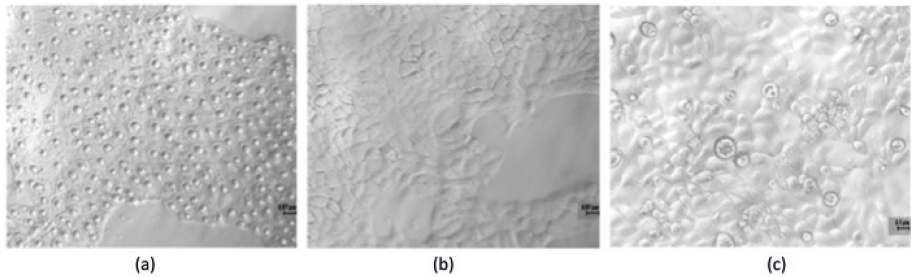
Across different concentrations of the HT component added to MDCK cells, the MTT assay indicated a significant effect on cell viability at 10 mg/ml HT, resulting in approximately 90% cytotoxicity (Figure 1, Table 6). A concentration of 1 mg/ml HT was identified as the threshold dose that did not induce cytotoxic effects in the cells after 24 hours. In contrast, Oseltamivir at 10 µM was not cytotoxic to MDCK cells, exhibiting an absorbance value of 0.0430 at 570 nm (A570OD), similar to the control cells.

a: Madin-Darby canine kidney (MDCK) cells inoculated with HT at a concentration of 10 µM (0.0015 mg HT/ml) (scale: 1cm = 0.07µm); b: MDCK cells inoculated with Oseltamivir at a concentration of 10 µM (0.003 mg/ml) (scale: 1cm = 0.07µm); c: Cytopathic effect of H9N2 on MDCK cells (scale: 1cm = 0.1µm).
HT solutions at 1 mg/ml reduced the LPAI virus titer by 3 log TCID50/ml after 2 hours of treatment. Additionally, infectious titers decreased in a dose-dependent manner (Table 7) after 24 hours of treatment with LPAI viruses. The virus titer declined by 0.57 and 1.29 logs after treatment with 0.001 and 0.01 mg/ml HT, respectively, and stabilized at 3 logs following inoculation of the virus into 0.1 mg/ml HT. At 1 mg/ml, the titers decreased by more than 3.17 logs for H9N2 subtypes.
Infectious titers of H9N2 viruses after treatment with different concentrations of hydroxytyrosol (HT).
In Ovo Evaluation of HT Antiviral Properties Against IBV
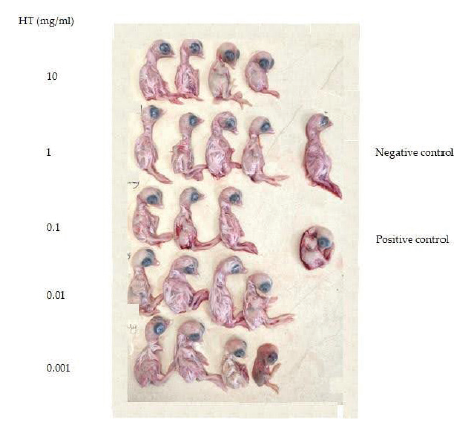
The toxicity and antiviral effects of HT on eggs were evaluated by monitoring egg survival and IBV signs across all tested dilutions. There were no deaths in any of the experimental groups, meaning that HT had no lethal effect on the embryos. There were no visible lesions in the first four dilutions (10 mg/ml, 1 mg/ml, 0.1 mg/ml, and 0.01 mg/ml). The embryos exhibited normal development, measuring 6 to 6.5 cm, with adequate down feathering, indicating that HT dosages did not impede embryo growth or development (Figure 2). The lack of dwarfism and hemorrhaging observed during the postmortem examination, symptoms associated with IBV, indicate that these HT dosages were well tolerated and did not intensify the infection. However, at 0.001 mg/ml, 50% of the embryos showed visible lesions, including hemorrhage, dwarfism, and curling, similar to those observed in the IBV-positive control group (Figure 2). This suggests that HT at concentrations≥ 0.01 mg/ml effectively prevents IBV effects in ovo.

Macroscopic aspect of the embryos for all hydroxytyrosol dilutions tested. Negative control - uninfected and untreated with HT. Positive control - IBV infected and untreated.
DISCUSSION
HT is the main phenolic compound in olives and, due to its remarkable antioxidant properties, it has been extensively studied in broilers, mainly through olive by-products such as olive pulp, olive leaf extract, and olive oil by-product (Pappas et al., 2019; Pečjak et al., 2020). HT is a potent antioxidant because it can form stable hydrogen bonds with peroxyl radicals; furthermore, its hydroxyl (OH) groups are in the ortho position, allowing them to donate electrons (De la Torre-Carbot et al., 2005). Additionally, the antioxidant effect of HT depends on its ability to enhance the activity and synthesis of antioxidant enzymes (Bertelli et al., 2020). Few studies have examined how HT in its pure form affects broilers (Dias et al., 2024a; Dias et al., 2024b). Inulin is widely recognized as a prebiotic that modulates intestinal microbiota and immune response in broiler chickens. However, reports on its impact on poultry performance are often contradictory, as its effectiveness largely depends on the type, dose, and duration of administration (Buclaw, 2016). Research on inulin supplementation in broiler chickens has utilized substantially higher concentrations than those in the present study, with quantities varying from 5,000 mg/kg to 40,000 mg/kg of feed (Alzueta et al., 2010; Kareem et al., 2016; Xia et al., 2019). Given that the highest inulin content in the product tested in this study was only 150 mg/kg, it is unlikely this fraction had a meaningful prebiotic effect or isolated influence on the animals’ performance. Therefore, although a potential interaction among the product’s components cannot be completely rejected, the results indicate that the effects on performance and response to the health challenge are mainly attributable to hydroxytyrosol, especially given its well-known antioxidant, anti-inflammatory, and antiviral properties.
This study shows that adding HT to the diet of broilers in commercial settings has a positive effect on their growth. Antioxidants are known to reduce oxidative stress, which can be caused by genetic, environmental, nutritional, management, and pathogenic factors in broiler production (Oke et al., 2024). Owing to genetic selection for higher growth rates, increased feed intake, breast yield, and high metabolic demand, commercial broilers are especially vulnerable to oxidative damage (Soleimani et al., 2011; Estévez, 2015; Nawaz & Zhang, 2021). Supplementing with antioxidants, such as HT, can help mitigate oxidative stress damage by modulating broilers’ immune and antioxidant responses (Dias et al., 2024b). Our findings show that HT supplementation significantly improves broiler growth performance, as demonstrated by increases in BWG, BW, and FCR, especially at 10 and 25 mg HT/kg of feed, corroborating our hypothesis that HT would enhance broiler growth performance in commercial rearing conditions.
On the other hand, Dias et al. (2024b) reported no effect of HT on broiler growth performance. According to the same authors, the absence of an effect may be due to the animals being raised under good sanitary conditions and low stress. However, consistent with our results, HT has been shown to improve broiler performance under more demanding production environments (Pappas et al., 2019; Shan & Miao, 2022; Dias et al., 2024a). Our findings align with these observations, demonstrating that birds fed 10 and 25 mg 1-HT/kg of feed showed improved BWG, BW, and FCR under challenging conditions such as H9N2 and IBV infections. Research has shown that broilers fed diets high in phenolic compounds and natural antioxidants, especially during oxidative or health-related stress, have better growth performance, feed efficiency,and antioxidant capacity. These effects have largely been attributed to the ability of such compounds to modulate redox balance and systemic inflammatory responses, thereby improving nutrient utilization and enhancing the birds’ physiological resilience(Azimi et al., 2020; Tavakkoli et al., 2021).
On the other hand, the absence of beneficial effects from 50 mg HT/kg feed on FCR may be due to altered energy metabolism. Antioxidants need energy to work appropriately in the body (Celi & Gabai, 2015). The metabolic demands of the immune system in broilers increase significantly during viral infections (Caron, 2010; Demas et al., 2012). In this situation, excessive antioxidant supplementation may impose an additional metabolic burden. Antioxidants are important for neutralizing reactive oxygen species; however, an excessive amount may interfere with redox signaling pathways, which are crucial for regulating metabolism, immune responses, and adaptive mechanisms (Surai et al., 2019; Surai et al., 2021; Kouvedaki et al., 2024; Oke et al., 2024). Also, the metabolism and excretion of phenolic compounds at higher doses may need more energy, which could take it away from processes that support growth (Chamorro et al., 2019; Sierżant et al., 2023; Kouvedaki et al., 2024). Thus, higher doses of hydroxytyrosol may not improve performance and could even worsen feed efficiency. This reflects a non-linear, dose-dependent biological response commonly observed with natural antioxidants in poultry nutrition. This highlights the importance of identifying the appropriate dose of antioxidants such as HT during viral challenges to support immune function and animal health.
The H9N2 virus and IBV have been shown to negatively affect poultry production by impairing respiratory and gastrointestinal health, reducing growth, and decreasing the flock’s overall productivity (Cavanagh, 2007; Samy & Naguib, 2018; Bhuiyan et al., 2021; Bóna et al., 2023; Falchieri et al., 2024). These effects were observed in this study through poorer performance in animals that did not receive HT supplementation. Innate immunity can be activated directly after exposure to the IBV virus within the broiler’s body and is considered the first line of defense against this disease (Bhuiyan et al., 2021). H9N2 often increases susceptibility to secondary infections and contributes to oxidative stress by increasing pro-inflammatory and antiviral cytokines during viral replication and immune activation (Qi et al., 2018; Mohamed et al., 2019). Recent studies indicate that HT can influence the immune and antioxidant systems in LPS-challenged broilers, resulting in the downregulation of particular pro-inflammatory cytokines and antioxidant enzymes(Dias et al., 2024b). It was also reported that HT may improve intestinal morphology in stressed broilers, indicating lower intestinal morphometric damage and positive effects on growth performance (Dias et al., 2024b).
In light of the challenges faced, our findings indicate that HT can improve broiler performance when supplemented at 10 and 25 mg/kg feed. This may have improved nutrient absorption, reduced gut inflammation, and, as a result, improved FCR. Broilers fed HT may have less immune stress because they may be more resilient, which helps the immune system focus on combating viral infections. Yamada et al. (2009) observed that following HT treatment, H9N2 viral mRNA and protein were undetectable. Using electron microscopy, Yamada et al. (2009) also suggested that the antiviral effect of HT against the H9N2 virus may be related to structural modification of the virus by breaking down its protein coat.
The results obtained from this field trial should be interpreted carefully, as the study design does not allow for establishing a direct cause-and-effect relationship between dietary hydroxytyrosol (HT) supplementation and reductions in H9N2 and/or IBV infection in terms of clinical severity, viral load dynamics, or duration of viral shedding. During the outbreak period, there was no continuous virological monitoring of live birds or standardized clinical scoring based on treatment group. Given that fact, it was impossible to measure infection-related endpoints.
In commercial farming conditions and during a naturally occurring respiratory outbreak confirmed by RT-PCR in samples from dead birds and litter, supplementation with HT at 10 and 25 mg/kg of feed was associated with improved zootechnical performance, particularly with regard to increased body weight and reduced feed conversion ratio, relative to the non-supplemented control group. These findings suggest a potential role for HT in enhancing resilience under respiratory disease pressure, rather than demonstrating a direct effect on infection endpoints. This hypothesis is corroborated by previous studies emphasizing the antioxidant, anti-inflammatory, and immunomodulatory characteristics of HT, which may enhance physiological responses during stress and infection (Ghanbari et al., 2012;Basiouni et al., 2023; Barrera-Chamorro et al., 2024; Oke et al., 2024; Wang et al., 2025). Oxidative stress is known to worsen respiratory viral infections in birds such as avian influenza and infectious bronchitis by damaging the immune system and tissue health (Rehman et al., 2018; Ye et al., 2015; Han et al., 2024). Thus, nutritional strategies that maintain redox balance may indirectly support performance during disease outbreaks.
In parallel, the complementary in vitro and in ovo experiments conducted in this study showed that HT has antiviral activity against H9N2 and provides protection against IBV in the embryonated egg model.These findings are consistent with previous research that elucidates the antiviral efficacy of phenolic compounds, including olive-derived polyphenols, against diverse enveloped viruses via mechanisms that inhibit viral entry, replication, and the modulation of host cell responses (Chojnacka et al., 2021; Musarra-Pizzo et al., 2021). These data support the biological potential of HT’s prospective antiviral efficacy; however, they do not replace rigorously controlled in vivo studies explicitly aimed at assessing infection dynamics, viral shedding, and clinical outcomes.
In addition to the controlled 1,000-bird trial, routine monitoring data from larger commercial flocks within the same production system were available over the same 1 to 40-day growing period. Briefly, 20,000 birds received 25 mg HT/kg feed (Shed 2), and 20,000 birds received 50 mg HT/kg feed (Shed 3), while 20,000 birds served as non-supplemented controls (Shed 4). These larger flocks were not monitored with the same level of detail as the 1,000-bird experiment. During the outbreak period, cumulative mortality was 17.7% in the control shed, compared with 13.5% and 9.5% in the 25 and 50 mg HT/kg sheds, respectively. While this pattern is consistent with a possible association between HT supplementation and lower mortality under commercial disease pressure, these data were collected for routine monitoring purposes and were not generated under a controlled experimental design. In particular, initial body weight, management practices, and exposure conditions may have varied among sheds, and performance metrics were not monitored in these flocks. So, these observations are reported descriptively and should be interpreted with care, not used to draw any conclusions about cause and effect.
Taken together, the present results suggest that moderate HT supplementation (10-25 mg/kg) may help maintain productive performance under endemic respiratory disease pressure. Nevertheless, additional controlled experimental and field studies utilizing standardized clinical scoring, quantitative virology (e.g., viral load kinetics), and immune response profiling are necessary to validate its role in disease mitigation and to clarify the underlying mechanisms of action.
In the embryonated egg model, HT was well tolerated at the tested concentrations and was associated with fewer typical IBV macroscopic lesions at higher concentrations (≥0.01 mg/ml) compared with the positive control (Figure 2). At lower concentrations (e.g., 0.001 mg/ml), partial effects were observed, suggesting a possible dose-dependent response in this model. However, because viral load, shedding, and replication kinetics were not quantified, these findings should be interpreted as indicative of a protective effect in ovo rather than definitive evidence of infection prevention or suppression of viral replication.
The improvements in BWG, BW, and FCR observed with HT supplementation (10 and 25 mg HT/kg feed) in this field study likely indicate a multifactorial response, consistent with antioxidant and anti-inflammatory support during commercial respiratory disease challenges. Importantly, the field trial was not designed to quantify infection-related endpoints (such as standardized clinical scoring, serial virology, or viral kinetics). Therefore, the present results support the use of moderate HT supplementation as a dietary strategy to help maintain productive performance under challenging conditions, while further controlled studies are needed to better understand the relationship between HT supplementation, host responses, and infection dynamics.
CONCLUSION
Supplementing the broiler diet with hydroxytyrosol can boost performance during the starter phase and from 1 to 40 days. In the starter phase, the recommended level of HT is 25 mg/kg of feed; for the entire period, considering FCR, the recommended level is 10 mg/kg of feed. The health challenge in these birds was confirmed by RT-PCR detection of LPAI H9N2 and IBV, and including 1-HT® in the diet resulted in heavier birds at the end of the cycle under high-health-challenge conditions. In vitro antiviral assays showed that HT has significant antiviral activity at ≥0.01 mg/ml and was associated with reduced typical IBV lesions in embryos.
ACKNOWLEDGEMENTS
We dedicate this manuscript to the memory of Luiz Fernando Teixeira Albino, a colleague, collaborator, and inspirational researcher.
REFERENCES
-
Alzueta C, Rodríguez ML, Ortiz LT, et al. Effects of inulin on growth performance, nutrient digestibility, and metabolisable energy in broiler chickens. British Poultry Science 2010;51(3):393-8. https://doi.org/10.1080/00071668.2010.503482
» https://doi.org/10.1080/00071668.2010.503482 -
Arbani O, Ducatez MF, Mahmoudi S, et al.. Low Pathogenic avian influenza H9N2 viruses in Morocco: antigenic and molecular evolution from 2021 to 2023. Viruses 2023;15(12):2355. https://doi.org/10.3390/v15122355
» https://doi.org/10.3390/v15122355 -
Barrera-Chamorro L, Fernandez-Prior A, Gonzalez-de la Rosa T, et al. Evaluation of immunomodulatory properties of phenolic extracts from olive mill by-products using Caco-2 cells and molecular docking analysis. Journal of Agriculture and Food Research 2024;18:101399. https://doi.org/10.1016/j.jafr.2024.101399
» https://doi.org/10.1016/j.jafr.2024.101399 -
Basiouni S, Tellez-Isaias G, Latorre JD, et al. Anti-inflammatory and antioxidative phytogenic substances against secret killers in poultry: current status and prospects. Veterinary Sciences 2023;10(1):55. https://doi.org/10.3390/vetsci10010055
» https://doi.org/10.3390/vetsci10010055 -
Belkasmi SFZ, Siham F, Charifa Drissi T, et al. Co-infections of chickens with avian influenza virus H9N2 and moroccan italy 02 infectious bronchitis virus: effect on pathogenesis and protection conferred by different vaccination programmes. Avian Pathology 2020;49:21-2. https://doi.org/10.1080/03079457.2019.1656328
» https://doi.org/10.1080/03079457.2019.1656328 -
Bertelli M, KianiAK, Paolacci S, et al. Hydroxytyrosol: a natural compound with promising pharmacological activities. Journal of Biotechnology 2020;309;29-33. https://doi.org/10.1016/j.jbiotec.2019.12.016
» https://doi.org/10.1016/j.jbiotec.2019.12.016 -
Bhuiyan MSA, Amin Z, Rodrigues KF, et al. Infectious bronchitis virus (Gammacoronavirus) in poultry farming: vaccination, immune response and measures for mitigation. Veterinary Sciences 2021;8(11):273. https://doi.org/10.3390/vetsci8110273
» https://doi.org/10.3390/vetsci8110273 -
Bist RB, Bist K, Poudel S, et al. Sustainable poultry farming practices: a critical review of current strategies and future pro-spects. Poultry Science 2024;103(12):104295. https://doi.org/10.1016/j.psj.2024.104295
» https://doi.org/10.1016/j.psj.2024.104295 -
Bóna M, Földi J, Dénes L, et al. Evaluation of the virulence of low pathogenic H9N2 avian influenza virus strains in broiler chickens. Veterinary Sciences2023;10(12):671. https://doi.org/10.3390/vetsci10120671
» https://doi.org/10.3390/vetsci10120671 -
Britton J, Davis R, O'Connor KE. Chemical, physical and biotechnological approaches to the production of the potent antioxidant hydroxytyrosol. Applied Microbiology and Biotechnology 2019;103:5957-74. https://doi.org/10.1007/s00253-019-09914-9
» https://doi.org/10.1007/s00253-019-09914-9 -
Buclaw M. The use of inulin in poultry feeding: a review. Journal of Animal Phisiology and Animal Nutrition 2016;100(6):1015-22. https://doi.org/10.1111/jpn.12484
» https://doi.org/10.1111/jpn.12484 -
Cavanagh D. Coronavirus avian infectious bronchitis virus. Veterinary Research2007;38(2):281-97. https://doi.org/10.1051/vetres:2006055
» https://doi.org/10.1051/vetres:2006055 -
Caron, L. Etiology and immunology of infectious bronchitis virus. Brazilian Journal of Poultry Science 2010;12:115-9. https://doi.org/10.1590/S1516-635X2010000200007
» https://doi.org/10.1590/S1516-635X2010000200007 -
Celi P, Gaba, G. Oxidant/antioxidant balance in animal nutrition and health: the role of protein oxidation. Frontiers in Veterinary Science 2015;2. https://doi.org/10.3389/fvets.2015.00048
» https://doi.org/10.3389/fvets.2015.00048 -
Chamorro S, Romero C, Brenes A, et al. Impact of a sustained consumption of grape extract on digestion, gut microbial metabolism and intestinal barrier in broiler chickens. Food & Function 2019;10(3):1444-54. https://doi.org/10.1039/C8FO02465K
» https://doi.org/10.1039/C8FO02465K -
Choi J, Kong B, BowkerBC, et al. Nutritional strategies to improve meat quality and composition in the challenging conditions of broiler production: a review. Animals2023;13(8):1386. https://doi.org/10.3390/ani13081386
» https://doi.org/10.3390/ani13081386 -
Chojnacka K, Skrzypczak D, Izydorczyk G, et al. Antiviral properties of polyphenols from plants. International Journal of Molecular Sciences 2021;22(21):11797. https://pmc.ncbi.nlm.nih.gov/articles/PMC8534698/
» https://pmc.ncbi.nlm.nih.gov/articles/PMC8534698 -
De la Torre-Carbot K, Jauregui O, Gimeno E, et al. Characterization and quantification of phenolic compounds in olive oils by solid-phase extraction, HPLC-DAD, and HPLC-MS/MS. Journal of Agricultural and Food Chemistry 2005;53(11):4331-40. https://doi.org/10.1021/jf0501948
» https://doi.org/10.1021/jf0501948 - Demas G, Greives T. The Energetics of immunity: mechanisms of trade-offs in ecoimmunology. In: Demas G, Nelson R.Ecoimmunology.New York: OxfordUniversity Press; 2012. p.249-96.
-
Dias KMM, Oliveira CH, Calderano AA, et al. Effects of hydroxytyrosol supplementation on performance, fat and blood parameters of broiler chickens. Animals 2024a;14(1):119. https://doi.org/10.3390/ani14010119
» https://doi.org/10.3390/ani14010119 -
Dias KMM, Oliveira CH, Calderano AA, et al. Dietary hydroxytyrosol supplementation on growth performance, gut morphometry, and oxidative and inflammatory status in lps-challenged broilers. Animals 2024b;14(6):871. https://doi.org/10.3390/ani14060871
» https://doi.org/10.3390/ani14060871 -
El Houadfi M, Fellahi S, Nassik S, et al. First outbreaks and phylogenetic analyses of avian influenza h9n2 viruses isolated from poultry flocks in Morocco. Virology Journal 2016;13(1):140. https://doi.org/10.1186/s12985-016-0596-1
» https://doi.org/10.1186/s12985-016-0596-1 -
El Mellouli F, Mouahid M, Fusaro A, et al. Spatiotemporal dynamics, evolutionary history and zoonotic potential of moroccan H9N2 avian influenza viruses from 2016 to 2021. Viruses 2022;14(3):509. https://doi.org/10.3390/v14030509
» https://doi.org/10.3390/v14030509 -
Estévez, M. Oxidative damage to poultry: from farm to fork. Poultry Science 2015;94(6):1368-78. https://doi.org/10.3382/ps/pev094
» https://doi.org/10.3382/ps/pev094 -
Falchieri M, Coward VJ, Reid SM, et al. Infectious bronchitis virus: an overview of the "chicken coronavirus". Journal of Medical Microbiology 2024;73(5):1828. https://doi.org/10.1099/jmm.0.001828
» https://doi.org/10.1099/jmm.0.001828 -
Fellahi S, Nassik S, Maaroufi I, et al. Pathogenesis of avian influenza virus subtype h9n2 in turkeys and evaluation of inactivated vaccine efficacy. Avian Disease 2021;65(1):46-51. https://doi.org/10.1637/aviandiseases-D-20-00067
» https://doi.org/10.1637/aviandiseases-D-20-00067 -
Ghanbari R, Anwar F, Alkharfy KM, et al. Valuable nutrients and functional bioactives in different parts of olive (Olea europaea L.) - areview. International Journal of Molecular Sciences 2012;13(3):3291-340. https://doi.org/10.3390/ijms13033291
» https://doi.org/10.3390/ijms13033291 -
Gessner DK, Ringseis R, Eder K. Potential of plant polyphenols to combat oxidative stress and inflammatory processes in farm animals. Journal of Animal Physiology and Animal Nutrition 2016;101(4):605-28. https://doi.org/10.1111/jpn.12579
» https://doi.org/10.1111/jpn.12579 -
Haidari M, Ali M, Ward Casscells S, et al. Pomegranate (Punica granatum) purified polyphenol extract inhibits influenza virus and has a synergistic effect with oseltamivir. Phytomedicine 2009;16(12):1127-36. https://doi.org/10.1016/j.phymed.2009.06.002
» https://doi.org/10.1016/j.phymed.2009.06.002 -
Han X, Huang Y, Hao J. Avian coronavirus infectious bronchitis virus activates mitochondria-mediated apoptosis pathway and affects viral replication by inducing reactive oxygen species production in chicken HD11 cells. Biology 2024;13(7):491. https://doi.org/10.3390/biology13070491
» https://doi.org/10.3390/biology13070491 -
KareemKY, Loh TC, Foo HL, et al. Effects of dietary postbiotic and inulin on growth performance, IGF1 and GHR mRNA expression, faecal microbiota and volatile fatty acids in broilers. BMC Veterinary Research 2016;12(1):163. https://doi.org/10.1186/s12917-016-0790-9
» https://doi.org/10.1186/s12917-016-0790-9 -
Kong L, You R, Zhang D, et al. Infectious Bronchitis Virus Infection Increases Pathogenicity of H9N2 Avian Influenza Virus by Inducing Severe Inflammatory Response. Frontiers in Veterinary Science 2022;8:824179. https://doi.org/10.3389/fvets.2021.824179
» https://doi.org/10.3389/fvets.2021.824179 -
Kouvedaki I, Pappas AC, Surai PF, et al. Nutrigenomics of natural antioxidants in broilers. Antioxidants 2024;13(3):270. https://doi.org/10.3390/antiox13030270
» https://doi.org/10.3390/antiox13030270 -
Mohamed F, Amer F, Omar D, et al. Molecular characterization, pathogenesis and immunological effect of avian influenza h9n2 virus isolated from broiler chickens in Egypt during 2019. Alexandria Journal of Veterinary Sciences 2021;69(1):155. https://doi.org/10.5455/ajvs.64788
» https://doi.org/10.5455/ajvs.64788 -
Musarra-Pizzo M, Pennisi R, Ben-Amor I, et al. Antiviral activity exerted by natural products against human viruses. Viruses 2021;13(5):828. https://pmc.ncbi.nlm.nih.gov/articles/PMC8147851/
» https://pmc.ncbi.nlm.nih.gov/articles/PMC8147851 -
Nawaz AH, Zhang L. Oxidative stress in broiler chicken and its consequences on meat quality. International Journal of Life Science Research Archive 2021;1:45-54, https://doi.org/10.53771/ijlsra.2021.1.1.0054
» https://doi.org/10.53771/ijlsra.2021.1.1.0054 -
Oke OE, Akosile OA, Oni AI, et al. Oxidative stress in poultry production. Poultry Science 2024;103(9):104003. https://doi.org/10.1016/j.psj.2024.104003
» https://doi.org/10.1016/j.psj.2024.104003 -
Pappas AC, Tsiplakou E, Papadomichelakis G, et al. Effects of olive pulp addition to broiler diets on performance, selected biochemical parameters and antioxidant enzymes. Journal of the Hellenic Veterinary Medical Society 2019;70(3):1687-96. https://doi.org/10.12681/jhvms.21793
» https://doi.org/10.12681/jhvms.21793 -
Pecjak M, Levart A, Salobir J, et al. Effect of the supplementation of olive leaves and olive cake on growth performance and bone mineralisation of broiler chickens. Acta Fytotechnica et Zootechnica 2020;23:105-11. https://doi.org/10.15414/afz.2020.23.mi-fpap.105-111
» https://doi.org/10.15414/afz.2020.23.mi-fpap.105-111 -
Qi X, Zhang H, Xue T, et al. Down-regulation of cellular protein heme oxygenase-1 inhibits proliferation of avian influenza virus h9n2 in chicken oviduct epithelial cells. Journal of General Virology 2018;99(1):36-43. https://doi.org/10.1099/jgv.0.000986
» https://doi.org/10.1099/jgv.0.000986 -
Rehman ZU, Meng C, Sun Y, et al. Oxidative stress in poultry: lessons from the viral infections. Oxidative Medicine and Cellular Longevity 2018;2018:5123147. https://doi.org/10.1155/2018/5123147
» https://doi.org/10.1155/2018/5123147 - Rostagno HS. Brazilian tables for poultry and swine. 4th ed. Viçosa:UFV;2017.
-
Samy A, Naguib MM. Avian respiratory coinfection and impact on avian influenza pathogenicity in domestic poultry: field and experimental findings. Veterinary Sciences 2018;5(1):23. https://doi.org/10.3390/vetsci5010023
» https://doi.org/10.3390/vetsci5010023 -
Shan C, Miao F. Immunomodulatory and antioxidant effects of hydroxytyrosol in cyclophosphamide-induced immunosuppressed broilers. Poultry Science2022;101(1):101516. https://doi.org/10.1016/j.psj.2021.101516
» https://doi.org/10.1016/j.psj.2021.101516 -
Shan C, Xiong Y, Miao F, et al. Hydroxytyrosol mitigates mycoplasma gallisepticum-induced pulmonary injury through downregulation of the NF-?B/NLRP3/IL-1ß signaling pathway in chicken. Poultry Science 2023;102(5):102582. https://doi.org/10.1016/j.psj.2023.102582
» https://doi.org/10.1016/j.psj.2023.102582 -
Sierzant K, Piksa E, Konkol D, et al. Performance and antioxidant traits of broiler chickens fed with diets containing rapeseed or flaxseed oil and optimized quercetin. Scientific Reports 2023;13(1):14011. https://doi.org/10.1038/s41598-023-41282-3
» https://doi.org/10.1038/s41598-023-41282-3 -
Sikht F-Z, Ducatez M, Touzani CD, et al. Avian influenza a H9N2 viruses in Morocco, 2018-2019. Viruses 2022;14(3):529. https://doi.org/10.3390/v14030529
» https://doi.org/10.3390/v14030529 -
Soleimani AF, Zulkifli I, Omar AR, et al. physiological responses of 3 chicken breeds to acute heat stress. Poultry Science 2011;90(7):1435-40. https://doi.org/10.3382/ps.2011-01381
» https://doi.org/10.3382/ps.2011-01381 -
Surai PF, Kochish II, Fisinin VI, et al. Antioxidant defence systems and oxidative stress in poultry biology: an update. Antioxidants 2019a;8(7):235. https://doi.org/10.3390/antiox8070235
» https://doi.org/10.3390/antiox8070235 -
Surai PF, Kochish II, Kidd MT. Redox homeostasis in poultry: regulatory roles of NF-?B. Antioxidants 2021;10(2):186. https://doi.org/10.3390/antiox10020186
» https://doi.org/10.3390/antiox10020186 -
Takeda Y, Jamsransuren D, Matsuda S, et al. The SARS-CoV-2-inactivating activity of hydroxytyrosol-rich aqueous olive pulp extract (HIDROX(r)) and its use as a virucidal cream for topical application. Viruses 2021;13(2):232. https://doi.org/10.3390/v13020232
» https://doi.org/10.3390/v13020232 -
Tavakkoli AA, Mirakzehi MT, Saleh H, et al. The effects of supplementation of Withania coagulans and a-tocopherol acetate in diets containing oxidised oil on growth performance, immune response and antioxidant indices in broiler chickens. Archives of Animal Nutrition 2021;75(4):278-93. https://doi.org/10.1080/1745039X.2021.1942765
» https://doi.org/10.1080/1745039X.2021.1942765 -
Touil N, Touzani CD, Benaissa EM, et al. Neutralising antibodies against SARS-CoV-2 give important information on covid-19 epidemic evolution in rabat, Morocco, March 2020 - February 2021. African Health Sciences 2023;23(3):400-5. https://doi.org/10.4314/ahs.v23i3.46
» https://doi.org/10.4314/ahs.v23i3.46 -
Wang Z, Lei Z, Zhang H, et al. From biosynthesis to legislation: a review of hydroxytyrosol's biological functions and safety. International Journal of Molecular Sciences 2025;26(10):4470. https://www.mdpi.com/1422-0067/26/10/4470
» https://www.mdpi.com/1422-0067/26/10/4470 -
Xia Y, Kong J, Zhang G, et al. Effects of dietary inulin supplementation on the composition and dynamics of cecal microbiota and growth-related parameters in broiler chickens. Poultry Science 2019;98(12):6942-53. https://doi.org/10.3382/ps/pez483
» https://doi.org/10.3382/ps/pez483 -
Yamada K, Ogawa H, Hara A, et al. Mechanism of the antiviral effect of hydroxytyrosol on influenza virus appears to involve morphological change of the virus. Antiviral Research 2009;83(1):35-44. https://doi.org/10.1016/j.antiviral.2009.03.002
» https://doi.org/10.1016/j.antiviral.2009.03.002 -
Ye S, Lowther S, Stambas J. Inhibition of reactive oxygen species production ameliorates inflammation induced by influenza A viruses via upregulation of SOCS1 and SOCS3. Journal of Virology 2015;89(5):2672-83. https://doi.org/10.1128/JVI.03529-14
» https://doi.org/10.1128/JVI.03529-14 -
Yue K, Cao Q, Shaukat A, et al. Insights into the evaluation, influential factors and improvement strategies for poultry meat quality: a review. NPJ Science of Food 2024;8(1):62. https://doi.org/10.1038/s41538-024-00306-6
» https://doi.org/10.1038/s41538-024-00306-6
-
FUNDING
No support has been received for this study.
-
DATA AVAILABILITY STATEMENT
The data presented in this study are available upon request from the corresponding author.
-
DISCLAIMER/PUBLISHER’S NOTE
The published papers’ statements, opinions, and data are those of the individual author(s) and contributor(s). The editor(s) disclaim responsibility for any injury to people or property resulting from any ideas, methods, instructions, or products referred to in the content.
The data presented in this study are available upon request from the corresponding author.