 Energy expenditure during a Pilates exercise session: a systematic review
Abstract
Abstract The aim of the present study was to verify the energy expenditure during a Pilates session under different intervention protocols. A systematic review was carried out, in order to verify the potential of Pilates exercises in meeting the international recommendations of 1,000 kcal/week spent with the practice of physical activity. Searches were conducted in the following databases: PubMed, Embase, CENTRAL, CINAHL, Web of Science, SPORTDiscus and LILACS. 931 reports were located and after screening, four studies met the inclusion criteria. The total number of participants was 71 young adults. Energy expenditure in one session ranged from 64.5 ± 10.7 to 213.7 ± 76.4 Kcal. Proportionally, the highest energy expenditure (8.3 kcal/min) occurred in the following condition: Pilates on equipment, performed in 1x10 series/rep, with one minute of rest between exercises. In conclusion, to reach the recommendations of 1,000 kcal/week, Pilates practitioners must train at least three times a week, considering 60-minute sessions, with exercises performed between 10-15 repetitions and intervals of a maximum of one minute between sets.
Key words:
Exercise; Energy metabolism; Physical conditioning, human
Resumo
Resumo O objetivo do presente estudo foi verificar o gasto energético durante uma sessão de Pilates sob diferentes protocolos de intervenção. Foi realizada uma revisão sistemática, a fim de verificar o potencial dos exercícios de Pilates em atender às recomendações internacionais de 1.000 kcal/semana gastas com a prática de atividade física. As buscas foram realizadas nas seguintes bases de dados: PubMed, Embase, CENTRAL, CINAHL, Web of Science, SPORTDiscus e LILACS. Foram localizados 931 relatórios e, após a triagem, quatro estudos preencheram os critérios de inclusão. O número total de participantes foi de 71 jovens adultos. O gasto energético em uma sessão variou de 64,5 ± 10,7 a 213,7 ± 76,4 kcal. Proporcionalmente, o maior gasto energético (8,3 kcal/min) ocorreu na seguinte condição: Pilates em aparelhos, realizado em 1x10 séries/repetições, com um minuto de descanso entre os exercícios. Concluindo, para atingir a recomendação de 1.000 kcal/semana, os praticantes de Pilates devem treinar no mínimo três vezes por semana, considerando sessões de 60 minutos, com exercícios realizados entre 10-15 repetições e intervalos de no máximo um minuto entre as séries.
Palavras-chave:
Exercício; Metabolismo energético; Condicionamento físico humano
INTRODUCTION
Knowledge of the energy expenditure of different modalities of physical exercise becomes fundamental for decision making by different health professionals, as it helps in choosing the modality, intensity and volume of exercise depending on the objectives to be achieved1-3. This is because energy expenditure has a direct impact on different health outcomes, such as body composition and cardiorespiratory fitness, for example4,5. The recommendation of the American College of Sports Medicine (ACSM)6 is to spend at least 1,000 kcal/week with the practice of physical activity. In this sense, by identifying the energy expenditure of a single session in different forms of exercise and the respective protocols used, it is possible to estimate the total amount of exercise needed during a week to reach the recommendations.
For example, Benito et al.7 aimed to evaluate energy expenditure in moderately active young adults, comparing three different types of circuit training, involving: 1) free weights; 2) machines; 3) free weights interspersed with aerobic exercises (combined training). All with a 45-minute session, containing eight exercises, performed in 3 series, with 15 repetitions and 15 seconds of rest. The lowest energy expenditure occurred in machine training (173 ± 48 Kcal), followed by free weight training (203 ± 58 Kcal) and combined training (259 ± 65). In this example, to meet the ACSM recommendations, it would take four weekly sessions of combination training, or five sessions of free weights, or six sessions of machine training.
Other forms of exercise, particularly those in which the execution of movements occurs in a slower and more controlled manner, requiring concentration and breathing techniques, may require less energy expenditure, as is the case with exercises commonly known as body-mind8. Hatha Yoga exercises, performed in 24 minutes, by young male adults, experienced practitioners/instructors with the technique, resulted in 41.2 kcal/session9, while Tai-Chi-Chuan exercises, performed in 30 minutes, by healthy adults of different age groups, inexperienced with the technique, resulted in energy expenditure of approximately 48 kcal/session10. It can be seen that for both practices, even if 60-minute sessions were performed every day of the week, it would not be enough to meet the recommendations of 1,000 kcal/week recommended by the ACSM, making it necessary to complement the practice of these activities with other activities. that generate greater energy expenditure.
Another activity with a body-mind characteristic is Pilates, for which there are six basic principles that must be respected during practice: concentration, center, control, fluidity, breathing and precision11. This makes the execution of the movements slow and rhythmic, which supposedly can also generate a lower energy expenditure when compared to conventional activities. However, it should be considered that Pilates exercises can be performed in different ways, such as on the mat, involving only body weight as a form of resistance, or with the aid of specific equipment, which use springs of different intensities to generate resistance12. Furthermore, as in conventional resistance training, factors such as number of sets, number of repetitions and rest intervals between sets should impact the energy expenditure of a session.
Identifying how much energy a Pilates session generates and factors that can impact greater or lesser expenditure becomes important, considering that the technique has been increasingly sought after. In Brazil, for example, when grouped alongside Yoga, gymnastics and stretching, it was the sixth most practiced activity regardless of age group. When considering only people aged 60 or over, it was the second most practiced activity13. Thus, the objective of the present study was to verify the energy expenditure during a Pilates session and to identify factors that may eventually impact a greater or lesser expenditure.
METHODS
This research was intended to carry out a systematic review. For the writing of the study, the recommendations of the PRISMA protocol were followed14. Regarding the methodological procedures, the recommendations of the Cochrane collaboration were followed15. The protocol was registered in PROSPERO (CRD42022370937). Inclusion criteria were: a) intervention with Pilates exercises; b) assessment of energy expenditure during a session; c) healthy participants, without restriction of ethnicity, age or physical fitness level.
Search strategy
The databases used were: PubMed, Embase, CENTRAL, CINAHL, Web of Science, SPORTDiscus and LILACS. As a complement, a clinical trial registration platform was also consulted (clinicaltrials.gov) in order to locate unpublished studies. There was no restriction on publication date or language. Additionally, the references of the included studies were approached, in order to try to locate works that might not have been identified in the databases.
The search strategy consisted of the following search terms: (“Pilates” OR “Pilates method” OR “Pilates-based exercises” OR “Pilates exercise” OR “clinical Pilates” OR “clinic Pilates” OR “Pilates training” OR “mat Pilates” OR “mat-based Pilates” OR “equipment-based Pilates” OR “apparatus Pilates”) AND (“energy expenditure” OR “aerobic metabolism” OR “oxygen consumption” OR “metabolism” OR “aerobic exercise” OR “exercise intensity” OR “blood lactate” OR “blood pressure” OR “heart rates” OR “heart rate” OR “cardiac rate” OR “cardiac rates” OR “metabolic” OR “metabolism” OR “cardiorespiratory fitness” OR “cardiorespiratory endurance” OR “aerobic test” OR “aerobic capacity” OR “cardiorespiratory” OR “maximum oxygen uptake” OR “maximum oxygen consumption” OR “maximum volume of oxygen” OR “cardiorespiratory exercise” OR “cardiorespiratory test” OR “cardiorespiratory activity” OR “aerobic fitness” OR “maximal cardiorespiratory fitness” OR “oxygen volume” OR “metabolic equivalents” OR “metabolic equivalent” OR “MET” OR “METs” OR “kcal” OR “calorie” OR “calories” OR “kilocalorie”). The strategy was adapted for each database when necessary. The search took place on September 22, 2022.
Selection of studies
A reviewer (RGO) carried out the initial search strategy in the databases, extracting the titles and abstracts. Subsequently, this same reviewer performed the extraction of duplicates. Next, two reviewers (GBBV and RAGP) blindly read titles and abstracts, excluding papers that did not meet the inclusion criteria. The studies that went through this phase were read in full by the same reviewers, blindly, to define the works that should effectively compose the systematic review study. Disagreements, when not resolved between the two researchers, were transmitted to a third party (RGO), who decided on the issue.
Data extraction
Data extracted from each eligible study were: author, year of publication, nationality of the study, gender of participants, age, body mass index, intervention protocols, method for assessing energy expenditure, observed results and possible adverse events. The same form for data extraction was used by two blind reviewers (GBBV and RAGP). Possible discrepancies were later resolved by a third reviewer (RGO).
Methodological quality assessment
The methodological quality of the studies was assessed using the JBI Critical Appraisal Checklist For Quasi-Experimental Studies (The Joanna Briggs Institute)16. This scale has a total of 9 questions. For the purposes of this study, an adapted version was used, since some questions were not applicable to the methodological design of the included works. Thus, four questions were maintained to assess methodological quality, namely: 1) Is it clear in the study which is the 'cause' and which is the 'effect'? 2) Were the participants included in any comparison similar? 3) Were the results measured reliably? 4) Was appropriate statistical analysis used?
Each item that met the required criteria received one point, making it possible to classify works from 0-4 points. Studies with scores ≥ 3 points were considered to have satisfactory methodological quality. Two independent reviewers (GBBV and RAGP) carried out the classification blindly and when there were disagreements, a third reviewer (RGO) was requested.
RESULTS
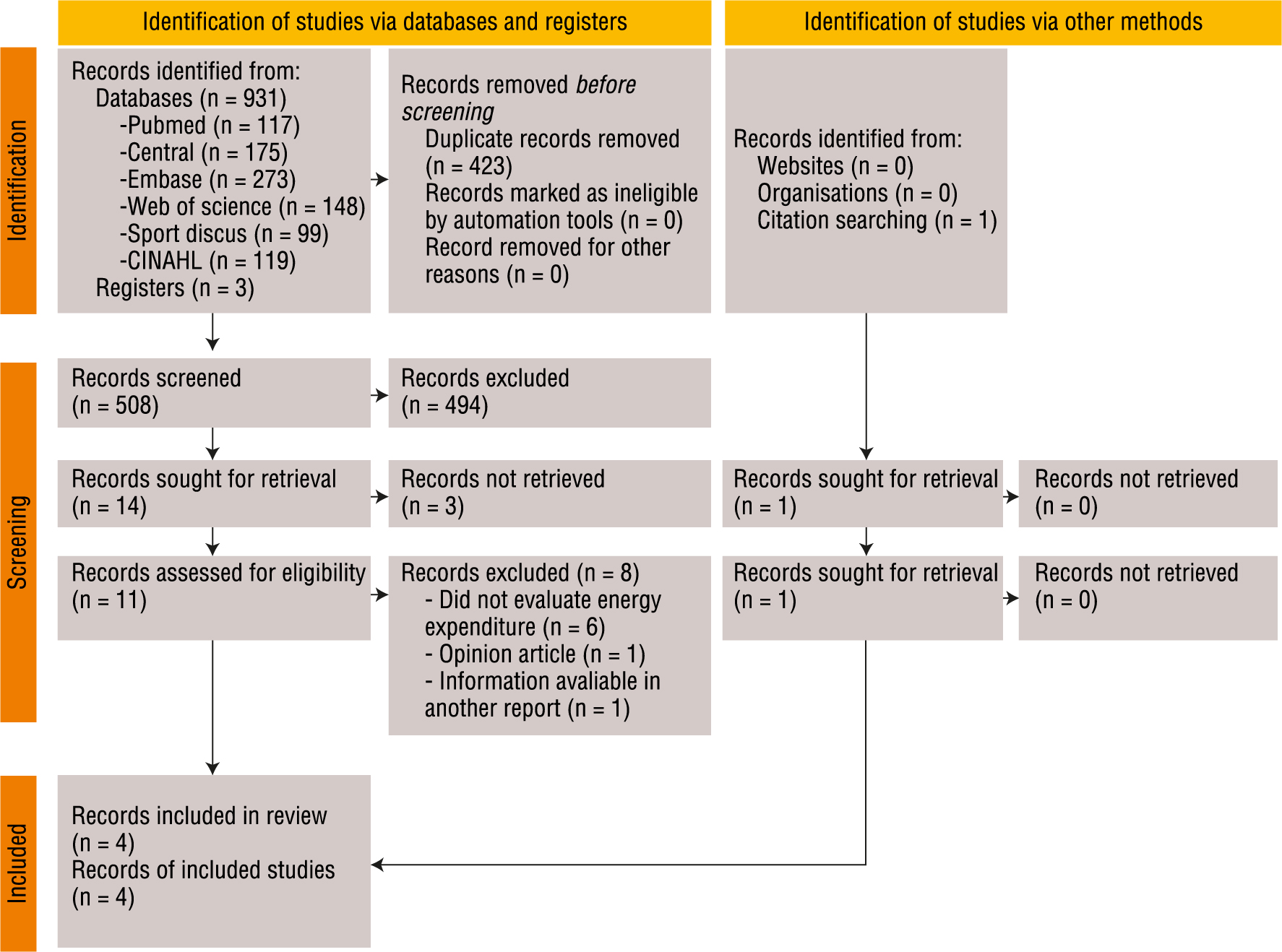
Initially, 931 potentially eligible reports were identified, in addition to three clinical trial registries. After eliminating duplicates, 508 papers remained for reading titles and abstracts, of which 494 were excluded for not meeting the eligibility criteria. When searching for the full texts of the remaining 14 reports, three were not retrieved (Supplementary Table 1). Thus, 11 reports were accessed and the full text was read. Of these, eight did not meet the eligibility criteria (Supplementary Table 2). The reasons for exclusion were: a) no assessment of energy expenditure (6 reports), b) opinion article (1 report), c) duplicate information in another report already included (1 report). As a result, three reports (each representing a study) met the eligibility criteria and were included in the systematic review. When reviewing the references of the studies included in the review, an additional potentially eligible report was located. After the screening process, the report met the inclusion criteria and was included in the review, totaling four studies included in the systematic review. The Prism diagram, with the representation of the identification, screening and inclusion events can be seen in Figure 1.

Table 1 presents the synthesis of the studies included in the systematic review. The studies were published between 2014 and 202117-20. All were carried out in Brazil, with the number of participants ranging from 1017,18 to 3320. Three studies included physically inactive women17,19,20 and another included men and women with at least one year of Pilates practice18. In three studies, the sample consisted of young adults with BMI within the normal range17,19,20, while one study did not report BMI18.
Interventions ranged from studies that performed a single experimental session17,18 to studies that performed two19 and three sessions20 due to the number of protocols tested. The number of exercises performed during the session ranged from five17 to 2118. Three studies used Mat Pilates protocol18-20 and two tested Pilates on apparatus17,19. The most tested number of sets and repetitions was 1x10¹⁸-20, with 2 minutes of rest between sets18,19 or no rest18. Non-traditional sessions, with alternative sets and repetitions (1x20 and 3x12), both with a 30-second interval between sets, were tested by one study20, while another study tested 1x15 (sets x repetitions), with one minute of rest17. Session duration ranged from 2320 to 90 minutes19.
Assessment of energy expenditure in two studies was estimated through oxygen consumption assessed by a portable gas analyzer19,20, while two studies estimated it through heart rate17,18. Regarding the observed results, the total energy expenditure of the session ranged from 213.7 ± 76.4 kcal (session with 21 Mat Pilates exercises, duration of 45-60 minutes, in individuals practicing Pilates for more than one year)18, up to 64.5 ± 10.7 kcal (session with 12 Mat Pilates exercises, duration of 33 minutes, in physically inactive women)20. Proportionally considering the duration of the session, the study that observed the highest energy expenditure (208 kcal/session - 8.3 kcal/min) performed exercises exclusively on equipment, in a session of approximately 30 minutes, in physically inactive women17.
Methodological quality of studies
The methodological quality of the studies was considered satisfactory, with all scoring three points on a scale of zero to four17-20. The only item not addressed by the studies concerned the reliability of the outcome measures, since the number of evaluators, their training and intra- and inter-evaluator reliability were not reported. In this case, the question is about the reliability of the measurement and not about the validity of the instruments used.
DISCUSSION
This systematic review study aimed to verify the energy expenditure during a session of Pilates exercises. In total, seven different types of protocols were tested. In raw values, what demonstrated to generate greater energy expenditure (213.71 ± 76.41 kcal) was performed by practitioners experienced with the technique, for at least one year, in mat Pilates exercises, with a number of sets and traditional repetitions (1 x 10), however, with no rest interval between series, in sessions of 45-60 minutes18. However, proportionally considering the duration of the session, the study by Silva et al.17 was the one that observed the highest energy expenditure, with 208 kcal in a session of approximately 30 minutes. Even if in a limited way, when we extrapolate this value to a 60-minute session, the energy expenditure would be greater than 400 kcal.
In this case, to meet the ACSM recommendations of 1,000 kcal/week, three weekly sessions would be necessary, while when considering the values obtained by the study by Santo et al.18, five weekly sessions would be required, which in this case is not common for Pilates practitioners, who typically perform sessions 2 to 3 times a week21. In the other five protocols tested19,20 (energy expenditure was lower, ranging from 64.5 to 142.9 kcal/session, demonstrating that in many cases, Pilates practitioners must complement their weekly exercise routine with other activities, to reach the 1,000 kcal suggested by ACSM.
This important variation in the total energy expenditure observed in a single Pilates session between different studies can apparently be explained by some factors. The first refers to the adopted protocol. It is observed that the main factor to determine the energy expenditure seems to be the interval between the sets. Protocols that adopted a rest time of a maximum of one minute17,18,20 generated greater energy expenditure than those that used a two-minute interval19,20. According to Thornton and Potteiger22 the decrease in the rest interval leads to an increase in the intensity of the exercise, since a smaller recovery between series causes greater stress produced by the exercise.
This premise has already been observed in studies involving different exercise modalities. In the study by Haltom et al.23 a higher energy expenditure was verified in healthy men who performed circuit training with a rest interval of 20 seconds, compared to the same protocol respecting 60 seconds of rest between sets. In addition, the authors observed a significantly higher post-exercise oxygen consumption in the protocol with a shorter rest interval. Ratamess et al.24 observed similar results when evaluating the energy expenditure in exercises performed with the naval rope in participants of both sexes submitted to two exercise protocols, which differed only by the rest time between series (1 min vs. 2 min).
Another factor related to the intervention protocol concerns Pilates being applied with apparatus vs mat. Silva et al.17 was the only one that tested the protocol using different Pilates apparatus, such as the Lader Barrel, Cadillac, Wall-Unit, Reformer and Step-Chair, being the study that proportionally found the highest energy expenditure. Furthermore, Andrade et al.19 when comparing the same protocol of mat Pilates exercises vs on the Reformer apparatus, found a significantly higher energy expenditure for the protocol performed on the apparatus (130 vs 95 kcal/session). Possibly, the higher energy expenditure found in the Pilates exercise protocol performed on apparatus is due to the possibility of better adjustment of the training load12. In Pilates apparatus, the springs progressively increase the resistance torque as it is extended during the exercise, which does not occur in mat Pilates, in which only the body weight offers resistance during the exercises25-27.
This particularity of Pilates, of performing exercises on equipment or just using a gym mat, makes it difficult to compare with other modalities, since in mat Pilates, typically, no load is added beyond body weight. In the study by Benito et al.7 for example, three different circuit exercise modalities were compared (free weights; strength machines; combined training). Machine training had the lowest energy expenditure when compared to other activities, however, in other modalities, external loads were added, that is, training did not occur only with the practitioner's body weight. Likewise, Abreu27, when comparing three different types of training (combined training; resistance training; indoor cycling) found that combined training had the highest energy expenditure7. In this sense, the possible lower energy expenditure observed in mat Pilates sessions may be linked to the non-use of load. This can eventually be adjusted, using elastic bands or other accessories that generate resistance, which can be tested in future studies.
In addition, we must take into account that the measures of energy expenditure occurred, in all studies, by aerobic methods (oxygen consumption and heart rate), which may have generated an underestimation of the values found. According to Scott28, in exercises with anaerobic characteristics, forms of evaluation through oxygen consumption may not be the most adequate. This is because, in evaluations of energy expenditure through estimates of values provided by respiratory quotient, analysis occurs by the amount of oxygen consumed and carbon dioxide produced29,30. Resistance exercise is an intermittent activity that involves anaerobic metabolic pathways for energy production, that is, it uses glucose and phosphocreatine stores to produce adenosine triphosphate (ATP) during short and intense periods, instead of oxygen31.
In resistance training, due to the intensity of the exercises, there is a limitation of the absorption of oxygen by the musculature during the activity, increasing the metabolic stress, leading to dependence on the anaerobic metabolism32. This leads, for example, to a greater increase in the need for energy in the moments after performing the activity33. In this sense, when carrying out an evaluation only at the time of the training session, the values of energy expenditure can be underestimated, since there is an important demand for excess oxygen, in the period of recovery from resistance exercise34. In the studies included in this review, there was no observation of energy expenditure after the training session, which should be considered when interpreting the results.
In this sense, when evaluating the energy expenditure in exercises with anaerobic characteristics such as Pilates, it is also necessary to evaluate the post-exercise moment, so that there is no possibility of underestimating the potential of the activity. Scott28 and Lyristakis et al.35 recommend that for estimates of energy expenditure in anaerobic activities, measurements of blood lactate are used and also, evaluation of excess oxygen consumption after exercise. Of the studies included in this review, only one carried out blood lactate measurements during the Pilates session19 not observing significant differences for this variable between the mat session vs apparatus, which may indicate, in this case, that the contribution of anaerobic pathways may not differ between the two forms of application of the technique.
Another factor to be highlighted is the fact that Pilates exercises are part of exercises that emphasize the body-mind relationship, which leads to greater concentration and fluidity in the execution of movements, as well as slower execution12,36. According to Mazzetti et al.37 the execution speed of the movements directly influences the energy expenditure, with slower exercises providing a lower energy expenditure, when compared to faster execution exercises. The speed of execution of the exercises was not reported by the studies in this review, which could help to interpret how much this variable can influence the energy expenditure during a Pilates session. In general, Pilates exercises are performed in a slow and controlled manner11. With that, it becomes important that future studies report the execution speed of Pilates exercises.
The present study stands out for summarizing the literature regarding energy expenditure during a single Pilates session, which may be important for the definition of intervention protocols by physical exercise professionals. We extend the search to the main databases and do not restrict the inclusion of reports, such as by language or date of publication. However, some limitations should be highlighted, mainly due to the information available within the included studies: a) all studies were produced in a single geographic region (Brazil), requiring studies in other locations; b) only young adults were observed, knowing that most Pilates practitioners are middle-aged and older people; c) only a few Pilates protocol possibilities were observed, due to the small number of included studies; d) there was no observation of excess energy expenditure after exercise, an important factor when considering activities with predominantly anaerobic characteristics. Future studies should observe these limitations and try to overcome them, in order to better explain the energy expenditure provided by Pilates exercises in different intervention conditions.
CONCLUSION
In order to meet the ACSM recommendations of 1,000 kcal/week, Pilates practitioners should perform, as a priority, exercises on equipment, in 60-minute sessions, at least three times a week, with a number of repetitions ranging from 10 to 15 and rest time between sets of no more than one minute. Other forms of Pilates application can be considered, however, to reach the recommendations of 1,000 kcal/week, the weekly frequency must be increased or other forms of physical exercise can be used to complement the Pilates exercises.
SUPPLEMENTARY MATERIAL
Supplementary material accompanies this paper.
Supplementary Table 1: Free access in https://osf.io/dpkw9/
Supplementary Table 2: Free access in https://osf.io/dpkw9/
-
How to cite this article
Vitor GBB, Oliveira LC, Pessôa RAG, Oliveira RG. Energy expenditure during a Pilates exercise session: a systematic review. Rev Bras Cineantropom Desempenho Hum 2025, 27:e95667. DOI: https://doi.org/10.1590/1980-0037.2025v27e95667
-
COMPLIANCE WITH ETHICAL STANDARDS
-
Funding
This study was financed in part by the Coordenação de Aperfeiçoamento de Pessoal de Nível Superior – Brazil (CAPES) – Finance Code 001.
-
Data Availability Statement
The data that support the findings of this study are available from the corresponding author, upon reasonable request.
-
Ethical approval
This research is in accordance with the standards set by the Declaration of Helsinki.
REFERENCES
-
1 Brubaker PH, Ross JH, Joo KC. Contemporary approaches to prescribing exercise in coronary artery disease patients. Am J Lifestyle Med. 2016;12(2):130-9. http://doi.org/10.1177/1559827615625482 PMid:30202385.
» http://doi.org/10.1177/1559827615625482 -
2 Khanfir MA, Awicha HB, Masmoudi HB, Hmadou FB, Dardouri W, Alardan S, et al. Effects of different low-intensity exercise types on duration, energy expenditure and perceived exertion in obese individuals. Int J Environ Res Public Health. 2022;19(8):4893. http://doi.org/10.3390/ijerph19084893 PMid:35457760.
» http://doi.org/10.3390/ijerph19084893 -
3 Colley RC, Hills AP, King NA, Byrne NM. Exercise-induced energy expenditure: implications for exercise prescription and obesity. Patient Educ Couns. 2010;79(3):327-32. http://doi.org/10.1016/j.pec.2010.03.001 PMid:20392589.
» http://doi.org/10.1016/j.pec.2010.03.001 -
4 Westerterp KR. Control of energy expenditure in humans. Eur J Clin Nutr. 2017;71(3):340-4. http://doi.org/10.1038/ejcn.2016.237 PMid:27901037.
» http://doi.org/10.1038/ejcn.2016.237 -
5 Garber CE, Blissmer B, Deschenes MR, Franklin BA, Lamonte MJ, Lee IM, et al. Quantity and quality of exercise for developing and maintaining cardiorespiratory, musculoskeletal, and neuromotor fitness in apparently healthy adults: guidance for prescribing exercise. Med Sci Sports Exerc. 2011;43(7):1334-59. http://doi.org/10.1249/MSS.0b013e318213fefb PMid:21694556.
» http://doi.org/10.1249/MSS.0b013e318213fefb - 6 ACSM: American College of Sports Medicine. ACSM’s guidelines for exercise testing and prescription. 10th ed. Baltimore: Lippincott Williams & Wilkins; 2018.
-
7 Benito PJ, Alvarez-Sanchez M, Diaz V, Morencos E, Peinado AB, Cupeiro R, et al. Cardiovascular fitness and energy expenditure response during a combined aerobic and circuit weight training protocol. PLoS One. 2016;11(11):e0164349. http://doi.org/10.1371/journal.pone.0164349 PMid:27832062.
» http://doi.org/10.1371/journal.pone.0164349 -
8 Telles S, Gandharva K, Sharma SK, Gupta RK, Balkrishna A. Body temperature and energy expenditure during and after yoga breathing practices traditionally described as cooling. Med Sci Monit Basic Res. 2020;26:e920107. http://doi.org/10.12659/MSMBR.920107 PMid:31907342.
» http://doi.org/10.12659/MSMBR.920107 -
9 Ray US, Pathak A, Tomer OS. Hatha yoga practices: energy expenditure, respiratory changes and intensity of exercise. Evid Based Complement Alternat Med. 2011;2011(1):241294. http://doi.org/10.1093/ecam/neq046 PMid:21799675.
» http://doi.org/10.1093/ecam/neq046 -
10 Smith LL, Wherry SJ, Larkey LK, Ainsworth BE, Swan PD. Energy expenditure and cardiovascular responses to Tai Chi easy. Complement Ther Med. 2015;23(6):802-5. http://doi.org/10.1016/j.ctim.2015.09.004 PMid:26645519.
» http://doi.org/10.1016/j.ctim.2015.09.004 -
11 Wells C, Kolt GS, Bialocerkowski A. Defining Pilates exercise: a systematic review. Complement Ther Med. 2012;20(4):253-62. http://doi.org/10.1016/j.ctim.2012.02.005 PMid:22579438.
» http://doi.org/10.1016/j.ctim.2012.02.005 -
12 Muscolino JE, Cipriani S. Pilates and the “powerhouse”—II. J Bodyw Mov Ther. 2004;8(2):122-30. http://doi.org/10.1016/S1360-8592(03)00058-5
» http://doi.org/10.1016/S1360-8592(03)00058-5 -
13 Lima MG, Malta DC, Monteiro CN, Sousa NFS, Stopa SR, Medina LPB, et al. Leisure-time physical activity and sports in the Brazilian population: a social disparity analysis. PLoS One. 2019;14(12):e0225940. http://doi.org/10.1371/journal.pone.0225940 PMid:31794582.
» http://doi.org/10.1371/journal.pone.0225940 -
14 Page MJ, Mckenzie JE, Bossuyt PM, Boutron I, Hoffmann TC, Mulrow CD, et al. The PRISMA 2020 statement: an updated guideline for reporting systematic reviews. BMJ. 2021;372:n71. http://doi.org/10.1136/bmj.n71 PMid:33782057.
» http://doi.org/10.1136/bmj.n71 -
15 Higgins J, Thomas J. Cochrane handbook for systematic reviews of interventions. Version 6.2 [Internet]. 2021 [cited 2022 Nov 30]. Available from: https://training.cochrane.org/handbook/current
» https://training.cochrane.org/handbook/current - 16 Tufanaru C, Munn Z, Aromataris E, Campbell J, Hopp L. Systematic reviews of effectiveness. In: Aromataris E, Munn Z, editors. Joanna Briggs Institute reviewer’s manual. Adelaide: JBI; 2017.
-
17 Silva ML, Rezende TM, Gonçalves LM, Silva AJ Jr. Parâmetros cardiovasculares e gasto energético indireto no Pilates. Ciênc Mov. 2014;16(32):17-25. http://doi.org/10.15602/1983-9480/cmrs.v16n32p17-25
» http://doi.org/10.15602/1983-9480/cmrs.v16n32p17-25 -
18 Santo BCRE, Garcias L, Bertoli J, Silva ACK, Freitas CR. Acute effects of mat Pilates session on heart rate and rating of perceived exertion. J Bodyw Mov Ther. 2020;24(2):104-8. http://doi.org/10.1016/j.jbmt.2019.10.004 PMid:32507133.
» http://doi.org/10.1016/j.jbmt.2019.10.004 -
19 Andrade LS, Almeida IS, Mochizuki L, Sousa CV, Falk JH No, Kennedy MD, et al. What is the exercise intensity of Pilates? an analysis of the energy expenditure, blood lactate, and intensity of apparatus and mat Pilates sessions. J Bodyw Mov Ther. 2021;26:36-42. http://doi.org/10.1016/j.jbmt.2020.12.007 PMid:33992270.
» http://doi.org/10.1016/j.jbmt.2020.12.007 -
20 Almeida IS, Andrade LS, Mochizuki L, Sousa CV, Falk JH No, Kennedy MD, et al. Effect of three different Pilates sessions on energy expenditure and aerobic metabolism in healthy females. Sport Sci Health. 2021;17(1):223-31. http://doi.org/10.1007/s11332-020-00676-w
» http://doi.org/10.1007/s11332-020-00676-w -
21 Pessôa RAG, Oliveira LC, Vitor GBB, Oliveira RG. Effects of Pilates exercises on cardiorespiratory fitness: a systematic review and meta-analysis. Complement Ther Clin Pract. 2023;52:101772. http://doi.org/10.1016/j.ctcp.2023.101772 PMid:37244080.
» http://doi.org/10.1016/j.ctcp.2023.101772 -
22 Thornton MK, Potteiger JA. Effects of resistance exercise bouts of different intensities but equal work on EPOC. Med Sci Sports Exerc. 2002;34(4):715-22. http://doi.org/10.1249/00005768-200204000-00024 PMid:11932584.
» http://doi.org/10.1249/00005768-200204000-00024 -
23 Haltom RW, Kraemer RR, Sloan RA, Hebert EP, Frank K, Tryniecki JL. Circuit weight training and its effects on excess postexercise oxygen consumption. Med Sci Sports Exerc. 1999;31(11):1613-8. http://doi.org/10.1097/00005768-199911000-00018 PMid:10589865.
» http://doi.org/10.1097/00005768-199911000-00018 -
24 Ratamess NA, Smith CR, Beller NA, Faigenbaum AD, Bush JA. Effects of rest interval length on acute battling rope exercise metabolism. J Strength Cond Res. 2015;29(9):2375-87. http://doi.org/10.1519/JSC.0000000000001053 PMid:26049794.
» http://doi.org/10.1519/JSC.0000000000001053 -
25 Lee K. Motion analysis of core stabilization exercise in women: kinematics and electromyographic analysis. Sports. 2023;11(3):66. http://doi.org/10.3390/sports11030066 PMid:36976952.
» http://doi.org/10.3390/sports11030066 -
26 Luz MAJ, Costa LOP, Fuhro FF, Manzoni ACT, Oliveira NTB, Cabral CMN. Effectiveness of mat Pilates or equipment-based Pilates exercises in patients with chronic nonspecific low back pain: a randomized controlled trial. Phys Ther. 2014;94(5):623-31. http://doi.org/10.2522/ptj.20130277 PMid:24435105.
» http://doi.org/10.2522/ptj.20130277 - 27 Abreu DPA. Comparação da intensidade de esforço em três tipos de high intensity interval training: treino funcional, musculação e indoor cycle [thesis]. Porto: Faculdade de Desporto, Universidade do Porto; 2014.
-
28 Scott CB. Quantifying the immediate recovery energy expenditure of resistance training. J Strength Cond Res. 2011;25(4):1159-63. http://doi.org/10.1519/JSC.0b013e3181d64eb5 PMid:20733523.
» http://doi.org/10.1519/JSC.0b013e3181d64eb5 -
29 Melo CM, Tirapegui J, Ribeiro SML. Gasto energético corporal: conceitos, formas de avaliação e sua relação com a obesidade. Arq Bras Endocrinol Metabol. 2008;52(3):452-64. http://doi.org/10.1590/S0004-27302008000300005 PMid:18506270.
» http://doi.org/10.1590/S0004-27302008000300005 -
30 Oshima T, Graf S, Heidegger CP, Genton L, Pugin J, Pichard C. Can calculation of energy expenditure based on CO2 measurements replace indirect calorimetry? Crit Care. 2017;21(1):1-8. http://doi.org/10.1186/s13054-016-1595-8
» http://doi.org/10.1186/s13054-016-1595-8 -
31 Vezina JW, Ananian CAD, Campbell KD, Meckes N, Ainsworth BE. An examination of the differences between two methods of estimating energy expenditure in resistance training activities. J Strength Cond Res. 2014;28(4):1026-31. http://doi.org/10.1519/JSC.0000000000000375 PMid:24402448.
» http://doi.org/10.1519/JSC.0000000000000375 -
32 Freitas MC, Gerosa-Neto J, Zanchi NE, Lira FS, Rossi FE. Role of metabolic stress for enhancing muscle adaptations: Practical applications. World J Methodol. 2017;7(2):46-54. http://doi.org/10.5662/wjm.v7.i2.46 PMid:28706859.
» http://doi.org/10.5662/wjm.v7.i2.46 -
33 Laforgia J, Withers RT, Gore CJ. Effects of exercise intensity and duration on the excess post-exercise oxygen consumption. J Sports Sci. 2006;24(12):1247-64. http://doi.org/10.1080/02640410600552064 PMid:17101527.
» http://doi.org/10.1080/02640410600552064 -
34 Børsheim E, Bahr R. Effect of exercise intensity, duration and mode on post-exercise oxygen consumption. Sports Med. 2003;33(14):1037-60. http://doi.org/10.2165/00007256-200333140-00002 PMid:14599232.
» http://doi.org/10.2165/00007256-200333140-00002 -
35 Lyristakis P, Ball N, Mckune AJ. Reliability of methods to measure energy expenditure during and after resistance exercise. Appl Physiol Nutr Metab. 2019;44(12):1276-82. http://doi.org/10.1139/apnm-2019-0076 PMid:30978301.
» http://doi.org/10.1139/apnm-2019-0076 - 36 Latey P. Updating the principles of the Pilates method—part 2. J Bodyw Mov Ther. 2002;2:94-101.
-
37 Mazzetti S, Douglass M, Yocum A, Harber M. Effect of explosive versus slow contractions and exercise intensity on energy expenditure. Med Sci Sports Exerc. 2007;39(8):1291-301. http://doi.org/10.1249/mss.0b013e318058a603 PMid:17762362.
» http://doi.org/10.1249/mss.0b013e318058a603
Edited by
-
Scientific Editor:
Diego Augusto Santos Silva
The data that support the findings of this study are available from the corresponding author, upon reasonable request.