
 Thermoeconomic analysis of a rural micro-generation power plant integrated with a fertigation system
ABSTRACT
The biofertilizer segment stabilized in anaerobic digesters offers a promising solution for reducing reliance on imported products. However, the development of this sector is largely constrained by logistical challenges, as well as the cost and feasibility of processing, transporting, and distributing organic fertilizers. To address these issues, this research presents a comprehensive thermoeconomic study of four scenarios applied in a rural microgeneration power plant in Toledo, Paraná state, Brazil. The main objectives were to determine the cost of the primary products, evaluate the system’s potential for energy self-sufficiency, and assess its economic viability. These findings would help amortize the costs associated with installing and operating the technology while adding greater value to its by-products. In the thermodynamic analysis, the potential for electricity generation from swine residues was evaluated. The economic analysis used the net present value, internal rate of return, payback period, and levelized costs of both energy and biofertilizer. By comparing the energy consumption required to fertigate 1 m³ of swine manure with its electricity generation potential, the system could achieve energy self-sufficiency. Moreover, the economic indicators of the scenarios demonstrate their viability, driven by the sale of electricity, transportation services, and biofertilizers.
Key words:
pig farming waste; nutrient-rich digestate; distributed electricity microgeneration; energy potential; cost allocation
HIGHLIGHTS:
Fertigating 1 m3 of swine manure uses 2.95% of its 13.20 kWh m-3 potential, con-firming system’s energy self-sufficiency.
The levelized cost of energy is 15.7% lower if the digestate is considered a useful product rather than a waste.
Economic indicators show energy self-sufficiency in fertigation less attractive than selling genera-ted electricity.
RESUMO
O segmento de biofertilizantes estabilizado em biodigestores anaeróbios oferece uma solução promissora para reduzir a dependência de produtos importados. Um dos principais desafios para o desenvolvimento desse setor é a logística, o custo e a viabilidade do tratamento, transporte e distribuição desses fertilizantes orgânicos. Para contribuir com a redução dessas dificuldades, esta pesquisa propôs um estudo termoeconômico abrangente de quatro cenários aplicados em uma usina de microgeração rural, localizada em Toledo, Paraná, Brasil. Portanto, ao considerar esses cenários, o objetivo foi obter o custo dos principais produtos. Isso incluiu identificar se o sistema atingiu a autossuficiência energética e se essa implementação foi economicamente viável, contribuindo para a amortização dos custos associados à instalação e operação desta tecnologia, ao passo que agrega maior valor aos seus subprodutos. Na análise termodinâmica, foi avaliado o potencial de geração de eletricidade a partir de resíduos suínos. A análise econômica foi determinada utilizando o valor presente líquido, a taxa interna de retorno, o período de retorno, bem como o custo nivelado de energia e biofertilizante. O consumo de energia necessário para fertirrigar 1 m3 de esterco suíno, quando comparado ao potencial de geração de eletricidade deste esterco, poderá permitir que o sistema alcance autossuficiência energética. Os indicadores econômicos dos cenários considerados revelaram que são economicamente viáveis devido à venda de toda a energia elétrica, serviços de transporte e vendas de biofertilizantes.
Palavras-chave:
resíduos de suinocultura; digestato rico em nutrientes; microgeração distribuída de eletricidade; potencial energético; alocação dos custos
Introduction
The Brazilian agribusiness sector is one of the most competitive and dynamic in the world, with significant importance for the economic growth and development of the country (CEPEA/USP/CNA, 2024). Among its production chains, the consumption of fertilizers represents an important relationship with productivity increase in the field (CONAB, 2024). However, according to the Brazilian National Fertilizer Association (ANDA, 2024), the production of national fertilizers (about 6.8 million tons) still does not meet the high demand required by the Brazilian market, which in 2023 was about 45.83 million tons. Thus, this external dependence on macronutrients leaves Brazil vulnerable to price fluctuations in imported products, threatening the sector’s competitiveness and economic viability (Cruz et al., 2017).
Given this scenario, the biofertilizer segment - stabilized in anaerobic biodigesters - offers a promising solution to reduce dependence on imported products. Furthermore, it provides an environmentally responsible means of managing residues generated by Brazilian agribusiness, contributing to a more circular economy (Cruz et al., 2017; Peng & Pivato, 2019).
Nevertheless, despite the capacity to use biofertilizer produced by the inevitable decomposition of organic matter - whether through composting or anaerobic digestion - this potential remains underexploited. One of the greatest challenges to expanding this sector lies in the logistics, as well as the cost and feasibility of treating, transporting, and distributing these organic fertilizers (Kunz et al., 2022).
To help address these challenges, this research proposed a comprehensive thermoeconomic study of four scenarios applied in a rural distributed micro-generation power plant in Toledo, Paraná state, Brazil. Thermoeconomics - defined as the science of energy rationalization, optimization, and control - significantly contributes to effective strategies for the environmental sustainability of agricultural systems, as demonstrated in the literature (Tsatsaronis & Winhold, 1984; Barati et al., 2017; Housseinpour et al., 2017). Moreover, few studies have examined the thermoeconomic performance of a biogas plant integrated with a fertigation system. In considering these scenarios, the primary objective was to determine the costs of the main flows that interrelate in this system. This involved assessing whether the system achieved energy self-sufficiency and whether its implementation was economically viable - contributing to the amortization of installation and operation costs while enhancing the value of its by-products.
Material and Methods
The first stage of the research, conducted from May to August 2021, involved a 14-week case study on a farm located in the city of Toledo, in western Paraná state, Brazil (24° 46’ 26.63” S, 53° 50’ 22.67” W, at an altitude of 512 m), during which monitoring data were collected.
Tables 1 and 2 present the monitored physicochemical data, with the respective methods detailed in the supplementary materials. Measurements were conducted at the Environmental Sanitation Laboratory of the State University of Western Paraná (Universidade Estadual do Oeste do Paraná, UNIOESTE), Cascavel Campus, following the official analysis methods of the Association of Official Agricultural Chemists (AOAC, 2016).
The analyzed property accommodates more than 2,100 swine, with their effluents being directed to a 3,500 m³ covered lagoon biodigester (CLB), producing biogas that fuels the engine generator set with an installed power of 75 kW. Therefore, the undertaking fits the definition of distributed micro-generation, according to the regulations of the Brazilian Electricity Regulatory Agency (ANEEL, 2023). The facility operates for approximately 10.86 hours per day and generates an average of 760.20 kWh of electricity, resulting in an annual production of 277,547 MWh. Because the project is classified as having multiple consumer units, all generated electricity is fully injected into the grid and commercialized as credits by the electricity distribution concessionaire, following ANEEL’s regulations (BRASIL, 2022). Moreover, the farm produces around 19,288.43 m³ of digestate annually, which is transported and distributed to third-party properties by the hose-reel sprinkler fertigation system, with a discount of 100% concerning the fertilizer value.
The first step in cost allocation is to identify each component of the plant. Therefore, the system was defined as a set of units connected to the reference environment - encompassing physical and economic aspects - through additional sets involving mass, heat, and workflow (Lozano & Valero, 1993).
Figure 1 shows a schematic illustration of the plant components, illustrating each unit and its input and output flows. The four analyzed scenarios included: 1) Anaerobic Digestion Module (Unit A): This module features a sedimentation box (to remove heavy solid materials such as sand and stones), a CLB, a substrate agitation system, a biological desulfurization system (achieved by adding oxygen to the biodigester), and a digestate tank with a capacity of 5,290 m³; Electricity Generation Module (Unit B): This module comprises a biogas refrigeration system that maintains optimal conditions for the engine-generator set (an Otto-cycle, 6-cylinder ER-BR/MWM engine and a GMWM120 generator rated at 120 kVA); Fertigation Module (Unit C): Integrated into the plant, it is responsible for transporting and distributing digestate to third-party areas.
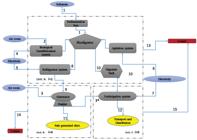
The fertigation system’s motor pump, with a nominal power of 22 kW (Model: ASMO 40-160S), is connected to the electricity grid (flow “7” in Figure 1). However, in Scenario 3, a hypothetical setup was considered where the pump would be powered by electricity generated by the biogas plant (flow “7*” in Figure 1).
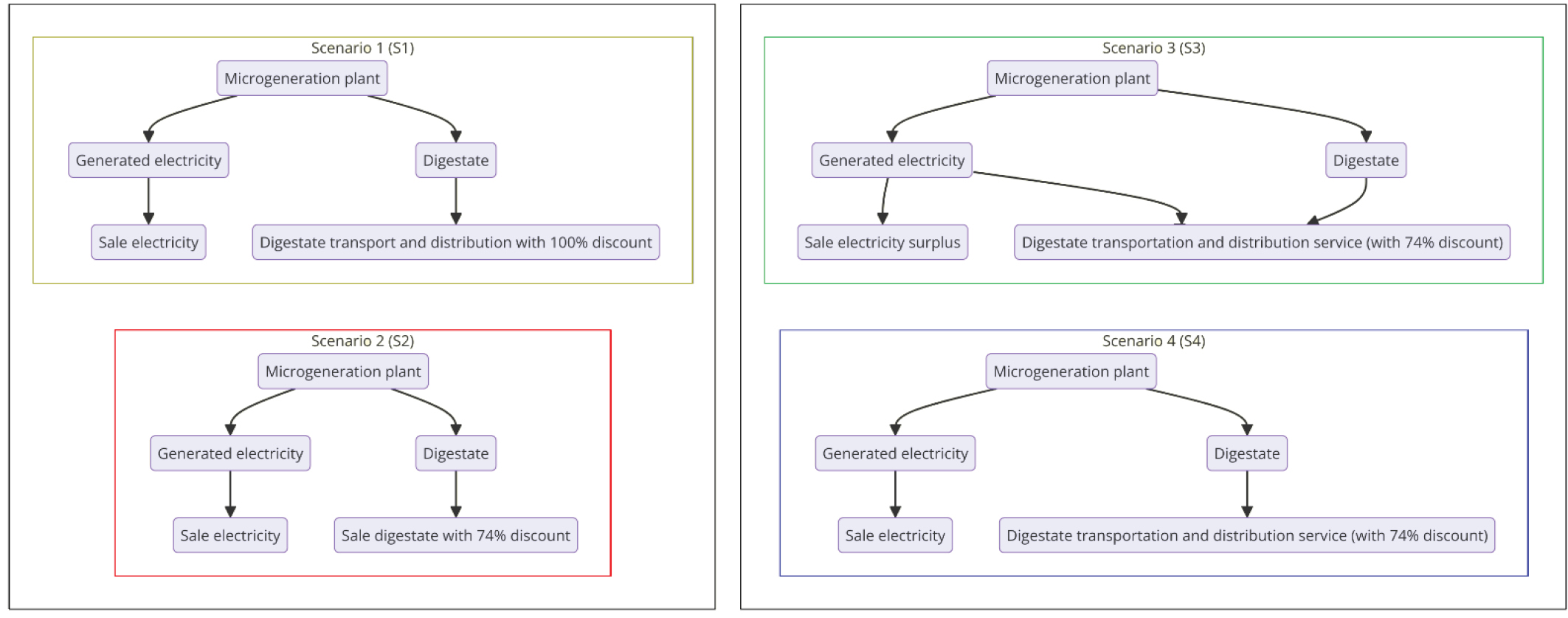
Scenario 1 (S1) reflects the plant’s current operation, where all electricity generated from the biogas is sold, and the digestate is distributed free of charge (a 100% discount relative to fertilizer pricing). Scenario 2 (S2) proposes selling both the electricity generated and the digestate (at a 74% discount compared to fertilizer prices). Scenario 3 (S3) recommends integrating the fertigation system into the biogas plant to achieve energy self-sufficiency. The economic advantages stem from avoiding the cost of fertigation, selling surplus electricity, and providing transport and commercialization services for the liquid biofertilizer. Scenario 4 (S4) considers implementing the fertigation system without energy self-sufficiency - meaning the plant continues to sell all generated electricity while also offering transport and commercialization services for the liquid biofertilizer to the cultivation area. Figure 2 illustrates these scenarios.
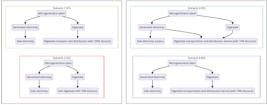
Scenarios for the management and commercialization of energy and digestate from a biogas plant
In the third scenario, biogas is used as fuel for transporting and distributing digestate to crops, thereby reducing costs and increasing the added value of the two by-products from the anaerobic digester. However, potential benefits associated with the fertigation system - such as increased crop productivity - were not included in this study; only the avoided cost of purchasing mineral fertilizers was considered.
The relationship between the physical structure of the plant, Figure 1, with its respective energy flows (Ė), was arranged using the incidence matrix A = [ixj], where: “i” - is the number of subsystems, and - “j” - is the number of flows that occur between the subsystems, as proposed by Lozano & Valero (1993). Therefore, the elements of the matrix “aij” assume the value +1 if the flows enter the subsystem “i”; -1 if the flows leave the subsystem “i”; and 0 if the flows are not related to the subsystem “i”.
According to Tsatsaronis & Winhold (1984), to define a certain productive function that contributes to achieving the final production goal, it is necessary to indicate the flows of consumed inputs or fuels (F), their products (P), and losses (L). These flows are obtained by the matrix multiplication of energy flows (Ė) by the respective matrices, referring to inputs (AF), outputs as products (AP), and losses (AL), as shown in Eqs. 1, 2, 3, and 4. Thus, the following equations could be written, allowing the energy analyses of the plants, as in Eqs. 5 and 6.
The energy flows (Ė) represent every thermodynamic characteristic of each flow that is interrelated to the physical structure of the system. They consider mass flows (m), given in kg s-1, which enter and leave each subsystem, and the specific energy value (ej), given in kJ kg-1. In this case, the specific energies (ej) are calculated based on Eq. 7.
The specific energy of the biogas components (CH4, CO2, CO, O2, and H2S) was determined by multiplying the concentration of each substance (CCⱼ), expressed as a percentage, by the tabulated lower heating value (PCIⱼ), based on Szargut et al. (2007), Moran et al. (2013), and Valero et al. (2018), at a reference temperature of 298.15 K and a pressure of 1 atm.
Nonetheless, swine manure does not explicitly exhibit all the compounds found in typical organic matter. Therefore, a bomb calorimeter (model C-2000 Basic Calorimeter, IKA, UK) was used to measure the higher heating value (HHVorg.) of the organic components in both the substrate and the digestate, following Eq. 8.
The relationship between the higher heating value (HHV), measured in the calorimeter, and the lower heating value (LHV) on a dry basis is indicated in Eq. 9.
where:
MMH2O and MMHorg. - the molar masses of water and hydrogen in the biomass, respectively;
HBM - the mass percentage of hydrogen in the fuel; and,
ΔHo vap.H2O - the enthalpy of water vaporization at the reference temperature.
The evaluated fertigation system consists of a mobile reel that unwinds a hose with a sprinkler at its end, enabling uniform digestate distribution over a large area. An electric motor pump with a nominal power of 22 kW (Model: ASMO 40-160S) provides the necessary pressure for digestate flow. The system also features programmable controls to adjust the volume of water applied, the retraction speed of the reel, and the irrigation frequency.
The fertigation system’s energy consumption was measured at the control panel by recording values before and after fertigating 5.290 m³ (VR) of liquid biofertilizer. The difference between these two measurements represents the total energy consumed by the system during fertigation. To estimate the motor pump’s power demand (Ėj=14), the total energy consumption was divided by the fertigation system’s operating time (tFS). The operating time was determined by dividing VR by the system’s flow rate at the sprinkler nozzle (QSF).
This manure flow rate at the sprinkler nozzle (QSF) was obtained using the Reel control table (TURBOMAQ 75/GS). In this case, considering the 12.5 mm of irrigation application depth, with 50 m h-1 of recoil velocity, reaching a flow rate of 33.6 m3 h-1.
Because the biodigestion module (i = 1) is part of a process that simultaneously generates multiple products (e.g., biogas and biofertilizer), Technical Pronouncement CPC 16 (CPC, 2009) requires that costs be allocated to each by-product using a rational and consistent approach. Therefore, the energy cost of producing each by-product (ki) was considered, as shown in Eqs. 10 and 11. These equations express the conversion and stabilization yield of the organic matter (present in fresh manure) into biogas and biofertilizers.
where:
ki=2 - the energy cost of producing biogas; and,
ki=3 - the energy cost of producing biofertilizer calculated as in Eq. 6.
Accordingly, production factors (fpBg and fpBf) represent the proportion of investment for each by-product (biogas and biofertilizer) produced. These factors were used to evaluate how biogas production costs would be affected if the biofertilizer were considered a useful product that contributes to amortizing the invested capital.
To determine the cost of electricity generated, the original definition of levelized cost of energy (LCOE), Eqs. 12, was used. This definition measures the net present value of energy generation over the useful life of the plant (Lai et al., 2017; IRNEA, 2020). Analogous to the approach for the Levelized Cost of Water (LCOW) (Caldera & Breyer, 2020), an adaptation is introduced here for the Levelized Cost of Methane (LCOBCH4) and the Levelized Cost of biofertilizer (LCOBf), presented in Eqs. 13 and 14, respectively.
where:
I - the implementation costs;
Ii=4 - the cost of implementing unit B;
Co&M - the operation and maintenance costs of each plant component, obtained from suppliers and the rural producer;
Co&Mi=4 - the operation and maintenance costs of unit B components, obtained from suppliers and the rural producer;
E(n) - the total electricity produced in the year n;
d - the interest rate;
n - the year of the asset’s useful life; and,
ki=4 - the energy cost of unit B.
where:
Ii=1 - the cost of implementing unit A (the anaerobic digestion module);
I - the implementation cost (of the entire plant);
Co&M - the operation and maintenance costs of each plant component;
Co&Mi=1 - the operating and maintenance costs of unit A components, obtained from suppliers and the rural producer;
BCH4(n) - the total methane energy produced in the year n;
d - the interest rate;
n - the year (n) of the asset’s useful life; and,
fpBg - the production factor of biogas (calculated as in Eq. 10).
where:
Ii=1 - the cost of implementing unit A (the anaerobic digestion module);
I - the total implementation cost;
Co&M - the operation and maintenance costs of each plant component, obtained from suppliers and the rural producer;
Co&Mi=1 - the operating and maintenance costs of unit A components, obtained from suppliers and the rural producer;
Bf(n) - the total production of biofertilizer in the year n (in terms of NPK content, calculated as in Eq. 15);
d - the interest rate;
n - the year (n) of the asset’s useful life; and,
fpBf - the production factor of biofertilizer, calculated as in Eq. 11.
where:
mMP - the manure production;
ρ - the density of the digestate; and,
%NH4, %P2O5, and %K2O - the contents of nitrogen, phosphorus, and potassium in the effluent, respectively.
The manure production (mMP) was determined based on waste generation data from Normative Instruction 11 of the Santa Catarina Environment Institute (IMA, 2021).
Operation and maintenance (O&M) costs included labor, preventive maintenance, routine component replacements, handling equipment, raw materials, and other related expenses. To calculate the Levelized Costs, the analysis considered interest rates (d) of 4, 8, 12, and 16% per annum, along with life cycles (n) of 10, 15, 20, 25, and 30 years. This range of discount rates accommodates various investor profiles. All values follow the exchange rate of 1 USD (US dollar) = R$5.66 (November 1, 2021).
Finally, an economic evaluation of the four scenarios was performed using the costs and revenues (R) in Table 3 and the scenarios in Figure 2. This assessment applied net present value (NPV), internal rate of return (IRR), and payback period (PBP), following the methods described by Fernandez-Lopez et al. (2015) and Ayodele et al. (2018).
In this sense, if the NPV of a prospective project is positive, it implies that the project is economically attractive. However, if the NPV is negative, the project should be rejected, as the cash flows will also be negative. The payback period, which represents the time after which the investment becomes profitable, should be as short as possible. Finally, for a project to be considered financially viable, the IRR should exceed the discount rate (d).
As shown in Table 3 and Eqs. 17, 18, and 19, the difference between the mineral fertilizer market price (CMF) and the biofertilizer production cost (LCOBf) represents the cost savings achieved by using digestate instead of purchasing fertilizers. Thus, these values are illustrative, allowing different biofertilizers to be compared on the same basis (NPK value) (Czekala et al., 2020). In this case, a 74% discount is considered to represent the potential price of digestate, as discussed by Miele et al. (2015). According to these authors, the revenue for transporting and distributing the digestate to the crop is set at R$ 1.50 m-3 (or US$ 0.26 m ), based on consultations with swine producers in the southern region who maintain large-scale operations but have no farming area of their own.
The annual operating time of the fertigation system (tFS; in hours) is calculated by dividing the annual volume of manure by the flow rate at the sprinkler nozzle (QSF). Additionally, “tge” represents the operating time of the generator engine.
References for electricity prices (used to estimate Relet.) and fertilizer prices (which will be compared with the costs of products from the biogas plant) were obtained from ANEEL (2021), Fertilizer Week, Fertilizer International, and the World Bank (2021). The purchasing costs of mineral fertilizers (CMF) are based on the market prices of urea (Cureia; 45% N), triple superphosphate (CSFT; 43% P2O5), and potassium chloride (CKCl; 60% K2O), as expressed in Eq. (20).
where:
CMF - the total purchasing cost of mineral fertilizers (in terms of NPK contents);
Cureia - the market prices of urea;
%N - the percentage of nitrogen in urea;
CSFT - the market price of triple superphosphate;
%P2O5 - the percentage of phosphorus in triple superphosphate;
CKCl - the market price of potassium chloride; and,
%K2O - the percentage of potassium in potassium chloride.
Results and Discussion
An energy analysis of the biogas plant was conducted using the theoretical considerations presented in ‘Energy Analysis and Determination of Thermodynamic States.’ This analysis incorporated the manure and biogas characterization data from Tables 1 and 2, along with the matrix equations (Eqs. 1-6). The results are illustrated in Table 4.
Table 4 indicates that the energy efficiency of the CLB is 77.38%, reflecting the system’s ability to convert manure energy into biogas while retaining the remaining energy in the digestate after the digestion process. However, this efficiency overstates the performance of anaerobic digestion for biogas production (F) because it treats the digestate as waste rather than a valuable product. When only biogas is considered a useful product, the efficiency is about 27.48% (Table 4). To improve overall biogas plant performance and minimize thermodynamic inefficiencies, the digestate should be treated as a valuable product instead of waste.
One of the main findings of this analysis is the energy potential of swine manure. With an energy efficiency for biogas production of 27.48% (Table 4), the analyzed manure can yield 179.39 MJ of energy per m³ of swine residue in the form of biogas - given its bomb calorimeter-determined energy content of 652.79 MJ m-3. Furthermore, considering that the engine-generator set (i = 4) operates at 26.40% efficiency (Table 4), 1 m³ of manure has the potential to generate 13.20 kWh of electricity. In a previous study, Tápparo et al. (2020) reported yields of 13.7 and 22.01 kWh m-³ for biogas power plants treating swine manure. This slight divergence is attributable to variations in residue characteristics, organic matter concentrations, and operational conditions, such as manure retention time in barns and growth stage (Mito et al., 2018; Nakashima et al., 2020; Hollas et al., 2021).
These results are particularly relevant for swine production facilities assessing their energy self-sufficiency and the potential for additional revenue from surplus electricity sales. Moreover, the findings can support life cycle assessment (LCA) studies evaluating the environmental impacts of biogas plants in swine production. For example, Hollas et al. (2021) assessed the effects of manure storage time on biogas production and found that energy generation reached 4.5 kWh per m³ of raw manure when storage time was less than five days.
During fertigation monitoring, 2.039 kWh of electrical energy was consumed to pump 5,290.19 m³ of the digestate (tank volume), corresponding to an average power draw of 12.95 kW (flow 12 in Table 4) over 157.45 hours of operation. Based on these data, the specific electricity consumption was estimated at 0.39 kWh per m³ of effluent under the fertigation conditions observed at neighboring farms. Consequently, when integrated with the rural biogas plant, the fertigation system at these farms could achieve energy self-sufficiency, as its electricity consumption represents only 2.95% of the total energy available in the swine effluents. This finding underscores the substantial potential for optimizing energy use on rural properties. Nakashima & Oliveira Júnior (2020) similarly noted that integrating anaerobic digestion with fertigation maximizes energy recovery while ensuring sustainable effluent management.
Finally, the Levelized Costs of Biofertilizer (LCOBf), Methane (LCOBCH4), and Generated Electricity (LCOE) were assessed under different discount rates, with their trends over the plant’s lifetime illustrated in Figures 3A, B, and C. As expected, costs decreased over time due to investment amortization, whereas higher discount rates led to increased levelized costs, thereby affecting the system’s economic feasibility.
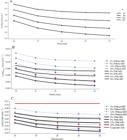
Levelized Costs of Biofertilizer (LCOBf) as a function of useful life (10-30 years) and interest rates (4-16%) (A), comparison between the Levelized Costs of Methane (LCOBCH4) with and without digestate marketing (DM) as a function of useful life and interest rates (B), and comparison between Levelized Costs of Generated Electricity (LCOE) with and without DM as a function of useful life and interest rates (C)
The collected operation and maintenance (O&M) costs, detailed in the Supplementary Materials, totaled USD 3,577.85 per year - representing 5.4% of the plant’s initial investment (USD 65,654.28). If the fertigation system were included, these costs would rise to 5.8%. In general, these O&M costs are consistent with those reported by the International Renewable Energy Agency (IRENA, 2021) for bioenergy in 2020, which range from 2 to 6% of total installation costs.
Figure 3A highlights that the biofertilizer cost is extremely low compared to major mineral fertilizers, which range from USD 0.25 to USD 0.78 ton-1 depending on the useful life and interest rates (Fertilizer Week; Fertilizer; International; World Bank, 2021; see Supplementary Material). Consequently, using biofertilizer on-site provides an economic benefit equal to the avoided cost of purchasing market fertilizers - up to USD 6,492.48 per year. Moreover, when considering a 74% discount to represent the potential sale price of digestate (Miele et al., 2015), its commercialization could yield an annual benefit of USD 1,688.04.
Figure 3B shows that in scenarios 2, 3, and 4, where digestate is sold, the production cost of methane is 29.39% lower than the scenario where only electricity is sold. This difference was derived from the production factor of biogas (fpBg) and biofertilizer (fpBf), which reflects the contribution of each by-product to the return on investment. In scenarios 2, 3, and 4, these factors were 62.46% for biogas and 37.54% for biofertilizer, respectively. In contrast, in scenario 1, fpBg equals 1 (fpBf = 0) since only biogas-derived electricity contributes to recovering the investment. Nowak et al. (2024) support these findings by showing that digestate management is critical to plant operating costs and the overall economic viability of anaerobic digestion. This aligns with the cost reductions observed in scenarios 2 and 4, where digestate sales help offset methane production costs. Moreover, neglecting the economic value of digestate leads to an overestimation of methane production costs, as observed in scenario 1 of this study.
Finally, Figure 3C shows that the LCOE ranges from USD 0.024 to USD 0.076 kW h-1 when biofertilizer is commercialized, compared to USD 0.029 to USD 0.090 kW h-1 when only electricity is sold, with interest rates from 4 to 16% considered. This reinforces that the LCOE would be 15.72% lower if the biofertilizer started contributing to the amortization of the invested cost. Notably, the LCOE for plants selling only electricity falls within the range reported by IRENA (2021) - from a weighted average of USD 0.057 kW h-1 in India to USD 0.097 kW h-1 in North America. Consistent with predictions by similar farms (Prasodjo et al., 2013), the LCOE for residues ranges from USD 0.058 to USD 0.111 kW h-1. The significant reduction in electricity generation costs observed in Figure 3C, coupled with the mitigation of thermodynamic inefficiencies discussed earlier, could enhance the competitiveness of biogas plants in the energy market.
If implemented, the significant reduction in electricity generation costs (Figure 3C) and the mitigation of thermodynamic inefficiencies discussed earlier could enhance the competitiveness of biogas plants in the energy market. As discussed by Peng & Pivato (2019), implementing these findings could not only make biogas plants more economically viable and attractive for investment but also reinforce their standing as a genuinely sustainable renewable energy source. This is particularly relevant in a circular economy, where effective digestate management is crucial to the long-term viability of biogas plants. Consequently, this analysis furnishes valuable information for decision-makers, investors, and researchers seeking to advance more efficient and economically sustainable solutions in the realm of renewable energy.
The red horizontal lines in Figure 3C indicate the sale price of electricity to distribution concessionaires. As this price exceeds the LCOE for all interest rates and periods considered, it positively impacts other economic metrics, suggesting that the plant will generate a financial return.
To determine the additional cost of implementing a fertigation system - with or without energy self-sufficiency - and to assess the economic viability of the micro-generation plant, three economic indicators were employed (NPV, IRR, and PBP), considering a 20-year useful life (Table 5).
Table 5 shows the scenarios considered viable. In scenario 1, at a 16% discount rate (d), the project is not financially attractive because the IRR is below the discount rate (IRR < d) and the NPV is negative. In short, given the ease of selling electricity credits under the Legal Framework for Distributed Generation (BRASIL, 2022), investing in rural biogas microgeneration plants is financially viable at interest rates below 16% and with a projected useful life of 20 years.
These results align with economic assessments by Instituto 17 (2022), which indicate that under suitable regulatory conditions - such as those established by the Legal Framework for Distributed Generation (BRASIL, 2022) - rural biogas microgeneration can be financially viable, particularly when interest rates are moderate. Furthermore, the report shows that plants marketing multiple products (biogas, electricity, and digestate) perform economically better than those relying exclusively on electricity sales.
Nevertheless, the NPV and IRR for scenarios 2, 3, and 4 (Table 5) are higher than those for scenario 1, and they exhibit shorter payback periods (PBP). This indicates that, across various interest rates, biogas plants are more profitable and sustainable when digestate is treated as a by-product rather than as waste. Consequently, managing digestate reduces the costs of the distributed generation process (Figure 3C), supports a holistic circular economy model, and enhances the overall sustainability of rural biogas plants (Peng & Pivato, 2019). Lamolinara et al. (2022) similarly emphasize that integrating digestate valorization is crucial for the economic sustainability and resource efficiency of biogas plants.
However, despite the advantages of this alternative, its effective application in agriculture is hindered by limited market acceptance and rising transport and distribution costs. Therefore, stimulating and strengthening this market is key to enhancing biogas plant profitability - especially by ensuring proper allocation of the final effluent - and achieving overall sustainability in light of increasingly stringent legislation (Herbes et al., 2020; Lamolinara et al., 2022). These actions would encourage both the supply and demand for services, driven by competition, to use these resources more efficiently, thereby mitigating the issue raised by Kunz et al. (2022).
Another result shown in Table 5 reveals that scenarios 3 and 4, which propose the commercialization, transport, and distribution services of the liquid biofertilizer, are more attractive than the other alternatives, even considering the extra costs of implementing the fertigation system. Nonetheless, this fact is not due to energy self-sufficiency, as scenario 4 (without self-sufficiency) is more attractive than scenario 3 (with self-sufficiency), with higher NPV and IRR. In other words, the profit from the sale of electricity generated in the biogas plant is higher than the avoided cost with the energy self-sufficiency of the fertigation system. This is because the purchase of electricity in the tariff group B2 (Rural) (USD 0.082 kW h-1) is, currently, lower than the sale of electricity generated in concessionaires (USD 0.104 kW h-1). Thus, it is more attractive to sell it at a higher price than to use it in fertigation.
This study has not considered potential revenue from carbon credits, as the market is still emerging; therefore, future research explores this opportunity.
Conclusions
-
The integration of the micro-generation plant with the fertigation system demonstrated energy self-sufficiency, although it is less financially attractive compared to selling electricity to energy concessionaires.
-
The economic analysis shows that a biogas plant selling only electricity is financially viable at most interest rates, except at 16% per annum.
-
Scenarios incorporating digestate marketing and transportation services achieve superior economic performance compared to those where electricity is the sole valuable product - even when accounting for the extra costs of the fertigation system.
-
Digestate commercialization substantially reduced electricity generation costs and mitigated thermodynamic inefficiencies.
Acknowledgments
The present work was carried out with the support of Coordenação de Aperfeiçoamento de Pessoal de Nível Superior (CAPES).
Literature Cited
-
ANDA - Associação Nacional para Difusão de Adubos. Pesquisa setorial. 2024. Available on: < Available on: https://anda.org.br/pesquisa_setorial/ >. Accessed on: Jul 2024
» https://anda.org.br/pesquisa_setorial/ -
ANEEL - Agência Nacional de Energia Elétrica. Tarifas e taxas. 2023. Available on: < Available on: http://www.dme-pc.com.br/atendimento/tarifas >. Accessed on: Jul 2024
» http://www.dme-pc.com.br/atendimento/tarifas - AOAC - Association of Official Analytical Chemists. Official Methods of Analysis. 20th ed. Gaithersburg, MD: AOAC International, 2016.
-
Ayodele, T. R.; Ogunjuyigbe, A. S. O.; Alao, M. A. Economic and environmental assessment of electricity generation using biogas from organic fraction of municipal solid waste for the city of Ibadan. Nigeria. Journal of Cleaner Production, v.203, p.718-735, 2018. https://doi.org/10.1016/j.jclepro.2018.08.282
» https://doi.org/10.1016/j.jclepro.2018.08.282 -
Barati, M. R.; Aghbashlo, M.; Ghanavati, H.; Tabatabaei, M.; Sharif, M.; Javadirad, G.; Dadak, A.; Soufiyan, M. M. Comprehensive exergy analysis of a gas engine-equipped anaerobic digestion plant producing electricity and biofertilizer from organic fraction of municipal solid waste. Energy Conversion and Management, v.151, p.753-763, 2017. https://doi.org/10.1016/j.enconman.2017.09.017
» https://doi.org/10.1016/j.enconman.2017.09.017 -
BRASIL. Lei n° 14.300, de 6 de Janeiro de 2022. Institui o marco legal da microgeração e minigeração distribuída. Brasília DF, Diário Oficial da União, 2022. Available on: < Available on: https://www.planalto.gov.br/ccivil_03/_ato2019-2022/2022/lei/l14300.htm >. Accessed on: Jul 2024
» https://www.planalto.gov.br/ccivil_03/_ato2019-2022/2022/lei/l14300.htm -
Caldera, U.; Breyer, C. Strengthening the global water supply through a decarbonised global desalination sector and improved irrigation systems. Energy, v.200, e117507, 2020. https://doi.org/10.1016/j.energy.2020.117507
» https://doi.org/10.1016/j.energy.2020.117507 -
CEPEA/USP/CNA - Centro de Estudos Avançados em Economia Aplicada - Universidade de São Paulo - Confederação da Agricultura e Pecuária do Brasil. PIB do agronegócio: dados de 1996 a 2023. Published 2024. Available on: < Available on: https://www.cepea.esalq.usp.br/br/pib-do-agronegocio-brasileiro.aspx?utm_source& >. Accessed on: Jul 2024
» https://www.cepea.esalq.usp.br/br/pib-do-agronegocio-brasileiro.aspx?utm_source& -
Cruz, A. C.; Pereira, F. S.; Figueiredo, V. S. Fertilizantes organominerais de resíduos do agronegócio: Avaliação do potencial econômico brasileiro. BNDES Setorial, v.45, 2017. 51p. Available on: < Available on: https://web.bndes.gov.br/bib/jspui/handle/1408/11814 >. Accessed on: Jul 2024
» https://web.bndes.gov.br/bib/jspui/handle/1408/11814 -
CPC - Comitê de Pronunciamentos Contábeis. CPC 16, Estoques. 2009. Available on: < Available on: http://www.cpc.org.br/CPC/Documentos-Emitidos/Pronunciamentos/ Pronunciamen to?Id=47 >. Accessed on: Jul 2024
» http://www.cpc.org.br/CPC/Documentos-Emitidos/Pronunciamentos/ Pronunciamen to?Id=47 -
CONAB - Companhia Nacional de Abastecimento. Série histórica da produção no Brasil por unidades da Federação. Brasília, 2024. Available on: <Available on: https://www.conab.gov.br/info-agro/safras/serie-historica-das-safras >. Accessed on: Jul 2024
» https://www.conab.gov.br/info-agro/safras/serie-historica-das-safras -
Czekala, W.; Lewicki, A.; Pochwatka, P.; Czekała, A.; Wojcieszak, D.; Jozwiakowski, K.; Waliszewska, H. Digestate management in Polish farms as an element of the nutrient cycle. Journal of Cleaner Production , v.242, e118454, 2020. https://doi.org/10.1016/j.jclepro.2019.118454
» https://doi.org/10.1016/j.jclepro.2019.118454 -
Fernandez-Lopez, M.; Puig-Gamero, M.; Lopez-Gonzalez, D.; Avalos-Ramirez, A.; Valverde, J.; Sanchez-Silva, L. Life cycle assessment of swine and dairy manure: Pyrolysis and combustion processes. Bioresource Technology, v.182, p.184-192, 2015. https://doi.org/10.1016/j.biortech.2015.01.140
» https://doi.org/10.1016/j.biortech.2015.01.140 -
Fertilizer Week; Fertilizer International; Work Bank. Preços das Mercadorias. 2021. Available on: < Available on: https://www.indexmundi.com/pt/pre%C3%A7os-de-mercado/ >. Accessed on: Jul 2024
» https://www.indexmundi.com/pt/pre%C3%A7os-de-mercado/ -
Herbes, C.; Roth, U.; Wulf, S.; Dahlin, S. Economic assessment of different biogas digestate processing technologies: A scenario-based analysis. Journal of Cleaner Production , v.255, e120282, 2020. https://doi.org/10.1016/j.jclepro.2020.120282
» https://doi.org/10.1016/j.jclepro.2020.120282 -
Hollas, C. E.; Bolsan, A. C.; Chini, A.; Venturin, B.; Bonassa, G.; Cândido, D.; Antes, F. G.; Steinmetz, R. L. R.; Prado, N. V.; Kunz, A. Effects of swine manure storage time on solid-liquid separation and biogas production: A life-cycle assessment approach. Renewable and Sustainable Energy Reviews, v.150, e111472, 2021. https://doi.org/10.1016/j.rser.2021.111472
» https://doi.org/10.1016/j.rser.2021.111472 -
Housseinpour, S.; Aghbashlo, M.; Tabatabaei, M.; Younesi, H.; Mehrpooya, M.; Ramakrishna, S. Multi-objective exergy-based optimization of a continuous photobioreactor applied to produce hydrogen using a novel combination of soft computing techniques. International Journal of Hydrogen Energy, v.42, p.8518-8529, 2017. https://doi.org/10.1016/j.ijhydene.2016.11.090
» https://doi.org/10.1016/j.ijhydene.2016.11.090 -
IMA - Instituto do Meio Ambiente de Santa Catarina. Instrução Normativa 11 - Suinocultura. , p.1-37, 2021. Available on: < Available on: https://in.ima.sc.gov.br/instrucaoNormativa/downloadPDF/11 >. Accessed on: Jul 2024
» https://in.ima.sc.gov.br/instrucaoNormativa/downloadPDF/11 -
Instituto 17. Biogás no Brasil: Análise de viabilidade econômica e de potencial de investimentos. Programa de Energia para o Brasil - BEP, 2022. <https://i17.eco.br/wp-content/uploads/2022/11/RT02-2022.pdf> Accessed on: Fev 2025
» https://i17.eco.br/wp-content/uploads/2022/11/RT02-2022.pdf - Kunz, A.; Steinmetz, R. L. R.; Amaral, A. C. do. Fundamentals of anaerobic digestion, biogas purification, use and treatment of digestate. Sbera: Embrapa Suínos e Aves, Concórdia, SC: v.1, 2022.
-
Lai, C. S.; Jia, Y.; Xu, Z.; Lai, L. L.; Li, X. Cao, J. McCulloch, M. D. Levelized cost of electricity for photovoltaic/biogas power plant hybrid system with electrical energy storage degradation costs. Energy Conversion and Management , v.153, p.34-47, 2017. https://doi.org/10.1016/j.enconman.2017.09.076
» https://doi.org/10.1016/j.enconman.2017.09.076 -
Lamolinara, B.; Pérez-Martínez, A.; Guardado-Yordi, E.; Fiallos, C. G.; Diéguez-Santana, K.; Ruiz-Mercado, G. J. Anaerobic digestate management, environmental impacts, and techno-economic challenges. Waste Management, v.140, p.14-30, 2022. https://doi.org/10.1016/j.wasman.2021.12.035
» https://doi.org/10.1016/j.wasman.2021.12.035 -
Lozano, M. A.; Valero, A. Theory of the exergetic cost Energy. Energy, v.12, p.939-960, 1993. https://doi.org/10.1016/0360-5442(93)90006-Y
» https://doi.org/10.1016/0360-5442(93)90006-Y - Moran N. M. L.; Shapiro, N. R.; Boettner, D. D.; Bailey, M. B. Princípio de termodiâmica para engenharia. 7th ed ed. Rio de Janeiro, 2013.
-
Miele, M.; Silva, M. L. B.; Nicoloso, R. S.; Corrêa, J. C.; Higarashi, M. M.; Kunz, A.; Sandi, A. J. Tratamento dos efluentes de usinas de biogás. Revista de Política Agrícola, v.24, p.31-46, 2015. https://ainfo.cnptia.embrapa.br/digital/bitstream/item/131043/1/final7567
» https://ainfo.cnptia.embrapa.br/digital/bitstream/item/131043/1/final7567 -
Mito, J. Y. L. de; Kerkhoff, S.; Silva, J. L. G.; Vendrame, M. G.; Steinmetz, R. L. R.; Kunz, A. Methodology for Estimating the Potential of Biogas and Biomethane from Pig and Beef Herds in Brazil. 2018. Available at: <Available at: https://www.embrapa.br/documents/1355242/0/Biog%C3%A1sFert+-+Metodologia+para+estimar+o+potencial+de+biog%C3%A1s+e+biometano+a+partir+de+plant%C3%A9is+su%C3%ADnos+e+bovinos+no+Brasil.pdf >. Accessed on: Fev 2025
» https://www.embrapa.br/documents/1355242/0/Biog%C3%A1sFert+-+Metodologia+para+estimar+o+potencial+de+biog%C3%A1s+e+biometano+a+partir+de+plant%C3%A9is+su%C3%ADnos+e+bovinos+no+Brasil.pdf -
Nakashima, R. N.; Oliveira Júnior, S. de. Comparative exergy assessment of vinasse disposal alternatives: Concentration, anaerobic digestion and fertirrigation. Renewable Energy, v.147, p.1969-1978, 2020. https://doi.org/10.1016/j.renene.2019.09.124
» https://doi.org/10.1016/j.renene.2019.09.124 - Nitshce, P. R.; Caramori, P. H.; Ricce, W. S.; Pinto, L. F. D. Atlas climático do estado do Paraná, Londrina, PR: IAPAR, 2022.
-
Nowak, M.; Bojarski, W.; Czekała, W. Economic and Energy Efficiency Analysis of the Biogas Plant Digestate Management Methods. Energies, v.17, e3021, 2024. https://doi.org/10.3390/en17123021
» https://doi.org/10.3390/en17123021 -
Peng, W.; Pivato, A. Sustainable management of digestate from the organic fraction of municipal solid waste and food waste under the concepts of back-to-earth alternatives and circular economy. Waste and Biomass Valorization, v.10, p.465-481, 2019. https://doi.org/10.1007/s12649-017-0071-2
» https://doi.org/10.1007/s12649-017-0071-2 - Prasodjo, D.; Vujic, T.; Cooley, D.; Yeh, K.; Lee, M. A Spatial-economic optimization study of swine waste-derived biogas infrastructure design in North Carolina. 2013, 203p.
- Szargut, J. Exergy method: technical and ecological application. Publishing House of the Silesian University of Technology. Gliwice, Polond, 2007, 192p.
- Szargut, J, Morris, D. R.; Steward, F. R. Exergy analysis of thermal, chemical, and metallurgical processes. Hemisphere Publishing, New York, NY, 1998, 332p.
-
Tápparo, D. C.; Rogovski, P.; Cadamuro, R. D.; Marques Souza, D. S.; Bonatto, C.; Frumi Camargo, A.; Scapini, T.; Stefanski, F.; Amaral, A.; Kunz, A.; Hernández, M.; Treichel, H.; Rodríguez-Lázaro, D.; Fongaro, G. Nutritional, Energy and Sanitary Aspects of Swine Manure and Carcass Co-digestion. Frontiers in Bioengineering and Biotechnology, v.8, e333, 2020. https://doi.org/10.3389/fbioe.2020.00333
» https://doi.org/10.3389/fbioe.2020.00333 - Tsatsaronis, G.; Winhold, M. Thermoeconomic analysis of power plants. Final report. United States: N. 1984, 3651e.
-
1 Research developed at Universidade Estadual do Oeste do Paraná, Programa de Pós-Graduação em Engenharia de Energia na Agricultura, Cascavel, PR, Brazil
-
Supplementary documents
The datasets generated and/or analyzed during the current study are available from the corresponding author on request.
-
Financing statement
This research was funded by the Coordenação de Aperfeiçoamento de Pessoal de Nível Superior (CAPES).

 Unit. A - Anaerobic digestion module composed of the sedimentation box; CLB - Covered lagoon biodigester, substrate agitation system, biologic desulfurization system, and a digestate tank; Unit. B - Electricity generation module composed of the generator motor set; Unit. C - Fertigation module composed of the electric motor pump and the hose-reel sprinkler irrigation
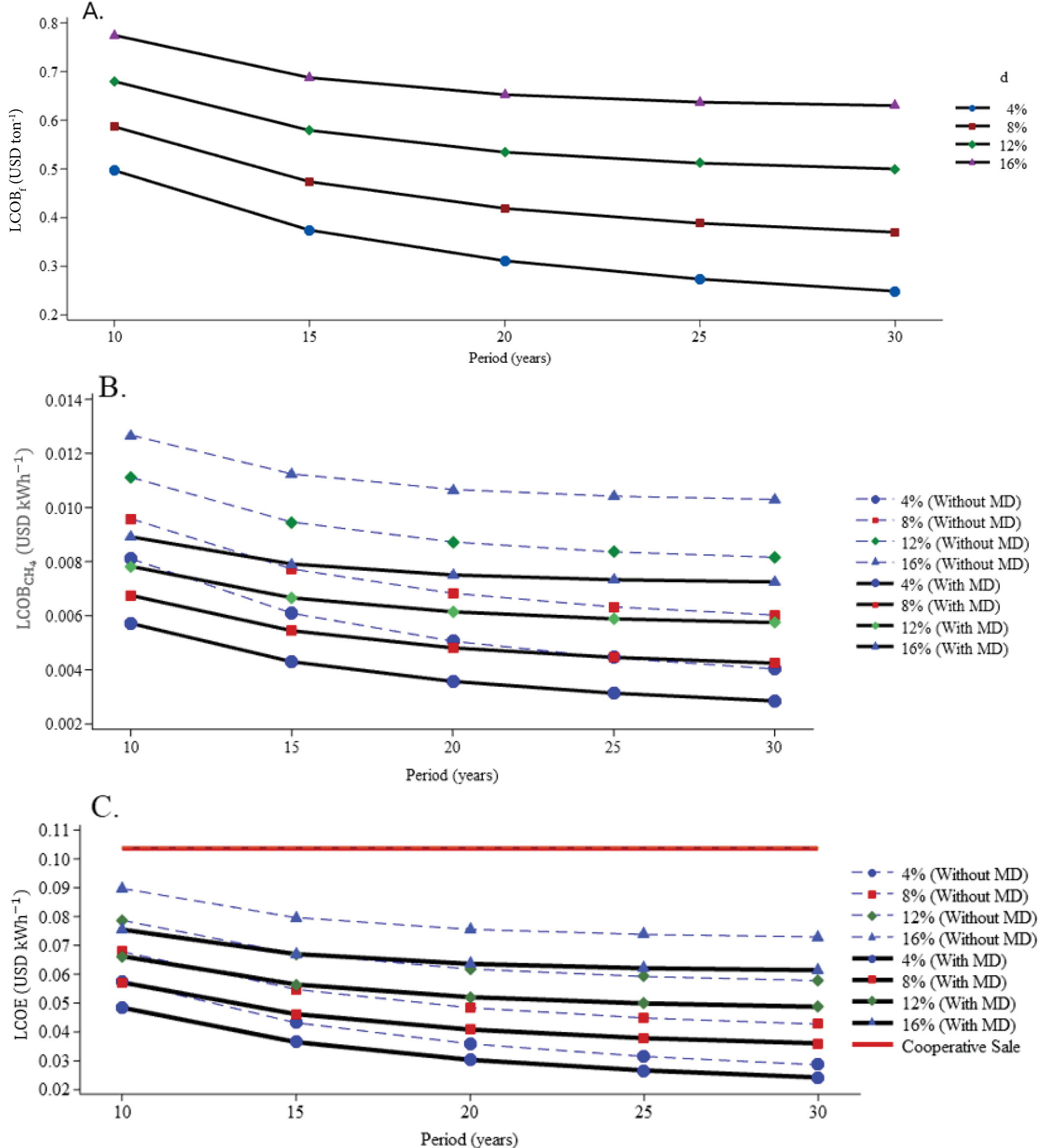 LCOBf - Levelized cost of biofertilizer; LCOBCH4 - Levelized cost of methane; LCOE - Levelized cost of electricity; d - Interest rates; MD - Marketing the digestate