
 Salicylic acid and jasmonic acid improve quality and post-harvest conservation of cherry tomatoes
ABSTRACT
The search to improve postharvest fruit quality and the preservation of perishable fruits involves increasing antioxidants, which can be achieved with growth regulators. Among them, salicylic acid and jasmonic acid stand out, acting by increasing antioxidant capacity, improving the preservation and quality of the fruits. Therefore, the objective was to evaluate the effect of salicylic acid and jasmonic acid on the quality and postharvest conservation of cherry tomato fruits in different storage times. The experiment was performed in a completely randomized design in a split-plot scheme (4 × 3), with the plots consisting of four phytohormones concentrations (SA = 500 µM salicylic acid; JA = 50 µM jasmonic acid; SA + JA = 500 µM salicylic acid + 50 µM jasmonic acid, and control - without application of phytohormones), and the subplots of three storage times (0, 8, and 16 days). SA increased the values of color, fruit firmness, soluble solids and lycopene at 16 days of storage. The SA + JA combination improved the antioxidant activity of the fruits, with increases in the contents of soluble solids, reducing sugars, ascorbic acid, β-carotene, total polyphenols and ABTS activity at 8 days of storage. In this context, foliar application of 500 µM of SA + 50 µM of JA promoted improvements in the physicochemical quality and in the conservation of the shelf life of cherry tomato fruits.
Key words:
Solanum lycopersicum var; cerasiforme; cold storage; antioxidant activity; growth regulators
HIGHLIGHTS:
Salicylic acid increases the firmness of cherry tomato fruits.
Salicylic acid and jasmonic acid improve the quality of tomato fruits stored for eight days in a refrigerated environment.
The use of these phytohormones reduces senescence and increases the shelf life of cherry tomato fruits.
RESUMO
A busca por aumentar a qualidade pós-colheita de frutos e a conservação de frutos perecíveis passa pelo aumento de antioxidantes, o que pode ser obtido com a utilização de reguladores de crescimento. Dentre eles, destacam-se o ácido salicílico e o ácido jasmônico, os quais atuam aumentando a capacidade antioxidante, melhorando a conservação e a qualidade dos frutos. Diante disso, o objetivo foi avaliar o efeito do ácido salicílico e do ácido jasmônico sobre a qualidade e conservação pós-colheita de frutos de tomate cereja em função de diferentes tempos de armazenamento. O experimento foi realizado em delineamento inteiramente casualizado em esquema de parcelas subdivididas (4 × 3), sendo as parcelas constituídas por quatro concentrações de fitohormônios (AS = 500 µM de ácido salicílico; JA = 50 µM de ácido jasmônico; AS + JA = 500 µM de ácido salicílico + 50 µM de ácido jasmônico e o controle - sem aplicação dos fitohormônios) e as sub-parcelas por três tempos de armazenamento (0, 8 e 16 dias). O AS aumentou os valores de coloração, firmeza dos frutos, sólidos solúveis e licopeno aos 16 dias de armazenagem. A combinação AS + JA melhorou a atividade antioxidante dos frutos, com aumentos nos teores de sólidos solúveis, açúcares redutores, ácido ascórbico, β caroteno, polifenois totais e na atividade ABTS aos 8 dias de armazenamento. Neste sentido, a aplicação foliar de 500 µM de AS + 50 µM de JA, proporcionou melhorias na qualidade físico-química e na conservação da vida útil dos frutos de tomate cereja.
Palavras-chave:
Solanum lycopersicun var; cerasiforme, armazenamento refrigerado; atividade antioxidante; reguladores de crescimento
INTRODUCTION
Tomato (Solanum lycopersicum L.) is one of the most widely produced and consumed vegetables worldwide, with a variety of uses, including fast food, snacks, and main meals, as well as fresh salads and other dishes (Guedes et al., 2023). However, it is considered a climacteric fruit, meaning its ripening process continues after harvest. With the increase in ethylene production in the fruit, it is necessary to study and implement techniques that can reduce the speed at which this process occurs. Therefore, the use of effective strategies that reduce the production of hormones that cause faster ripening and deterioration of fruits is increasingly common, such as packaging that reduces the respiration rate, cold chain management, and others (Brumos, 2021).
Fruit firmness and storage temperature are important aspects during tomato marketing, and are considered parameters to evaluate the quality and post-harvest shelf life of fruits in the markets, fairs and fruit and vegetable stores (Pérez et al., 2018). According to Tang et al. (2020), cherry tomatoes stored at 10 °C had an increase in ethylene production during the first seven days, followed by a decrease. Lycopene levels in these fruits tend to increase until 28 days of storage, when they are completely red in color.
In this context, it is essential to look for ways to improve quality during fruit production and post-harvest to ensure better preservation. Some methods, such as plant growth regulators, can be effective. Salicylic acid (SA) is a phytohormone and is naturally present in plants, playing an important role in the growth, development and resistance of plants to pathogens and abiotic stresses, through signaling and expression of genes involved in the antioxidant system (Figueiredo et al., 2022; Fátima et al., 2023). Among the defense mechanisms associated with the mechanisms triggered by SA, there is an increase in the activity of enzymes such as peroxidase, which delays fruit ripening by reducing cell wall degradation, increasing firmness and causing fruit softening to occur more slowly (Kaygisiz et al., 2025).
Jasmonic acid (JA) is a phytohormone that is involved in the regulation of several processes, from molecular to morphological, involved in the synthesis and expression of genes and antioxidant enzymes associated with the plant defense system (Jeyasri et al., 2023). When associated with post-harvest treatment, JA can improve the shelf life of fruits, delaying senescence and increasing quality (El-Beltagi et al., 2023).
The beneficial effect of these phytohormones on maintaining quality during fruit storage has been reported by several authors, such as Baek et al. (2023), who found that the use of 0.25 mM methyl jasmonic and 0.5 mM SA promoted improvements in the antioxidant activity of the fruits, increasing their nutritional quality. Essa & Alwan (2025) found that foliar application of 200 g L-1 of salicylic acid and methyl jasmonic promoted an increase in chlorophyll contents, soluble solids and titratable acidity, promoting improvements in the quality of cherry tomato fruits. In blackberry, Wu et al. (2025) found that the combination of 200 µM SA and JA promoted an increase in fruit quality when fruits were stored at 4 ºC, associating the expression of genes and enzymes involved in the antioxidant system.
Given the above, the hypothesis of this research is that foliar application of salicylic acid and jasmonic acid can stimulate the plant’s antioxidant defense system, resulting in delay of the senescence process and increasing the shelf life and quality of cherry tomato fruits. Thus, the objective in this study was to evaluate the effect of salicylic acid and jasmonic acid on the quality and post-harvest conservation of cherry tomato fruits in different storage times.
MATERIAL AND METHODS
The experiment was performed in a greenhouse at the Universidade Federal Rural do Semi-Árido (UFERSA), Mossoró city, Rio Grande do Norte state, Brazil. The municipality is located between the geographic coordinates 5° 11′ 16″ S latitude, 37° 20′ 38″ W longitude and altitude of 37 m above sea level, with a predominant climate of hot and dry semiarid (BSwh’), according to Köppen’s classification (Alvares et al., 2013). During the experiment, temperature and relative air humidity data were measured daily using a portable thermo-hygrometer, with the values shown in Figure 1.

Climatic conditions of temperature and relative air humidity during the experiment in a greenhouse
The experiment was conducted in a completely randomized design in a split-plot scheme (4 × 3), with the plots consisting of four phytohormone concentrations (SA = 500 µM of salicylic acid; JA = 50 µM of jasmonic acid; SA + JA = 500 µM of salicylic acid + 50 µM of jasmonic acid; and the control - without application of phytohormones), and the subplots of three storage times (0, 8, and 16 days), with three replicates, totaling 36 experimental units. The concentrations of phytohormones used were based on the study by Melo et al. (2025).
Cherry tomato (Solanum lycopersicum L. var. cerasiforme cv. Samambaia) seedlings were produced in 162-cell polystyrene trays filled with coconut fiber-based substrate and organic compost in a 2:1 volume ratio. The seedlings were transplanted 24 days after sowing (DAS), when they had two pairs of definitive leaves expanded.
Plants were grown in pots with a capacity of 4.5 dm3 filled with coconut fiber that served as support for them. A 3-cm-thick layer of gravel and a screen were added to the base to allow drainage of excess nutrient solution.
The water used to prepare the nutrient solution came from the supply system of the Water and Sewage Company of Rio Grande do Norte state, with electrical conductivity (EC) of 0.65 dS m-1. The nutrient solution used was based on Moraes & Furlani (1999) and was prepared at 50% ionic strength, with an electrical conductivity of 2.16 dS m-1 and pH 6.0 after dilution of the fertilizers.
Fertilizers used were potassium nitrate (KNO3: 13% N, 44% K2O), calcium nitrate (Ca (NO3)2): 15% N, 19% Ca), monoammonium phosphate (NH4H2PO4: 11% N, 50% P2O5), magnesium sulfate (MgSO4.7H2O: 9% Mg, 12% S), and potassium chloride (KCl: 60% K2O, 47% Cl) at concentrations of 2.0, 50.0, 12.5, 20.0, and 30.0 g L-1, respectively.
In addition, a micronutrient mixture (Rexolin BRA, Yara Tera, Yara Brasil Fertilizantes SA, Porto Alegre, RS, Brazil) containing 11.6% K2O, 1.28% S, 2.1% B, 0.36% Cu, 2.66% Fe, 2.48% Mn, 0.036% Mo, and 3.38% Zn was added at concentrations of 3.0 and 6.0 g L-1 to the 25 and 50% ionic strength solutions, respectively. The 25% solution was applied up to seven days after transplanting (DAT), after which the 50% ionic strength solution was applied. Solution was applied twice a day, with the volume applied based on the water balance.
Phytohormones were applied at 12, 20, 24 and 40 days after transplanting (DAT), considering the phenological phases of the crop, in the vegetative, flowering and fruiting periods, respectively. Solutions containing the appropriate phytohormones were prepared by diluting them in distilled water and applying them via foliar spray using a hand sprayer. Distilled water was applied to the control plants. A drop of the adjuvant Haiten® was added to the solutions to break leaf tension and facilitate the fixation and absorption of the phytohormones by the plant. To avoid drift, a plastic structure was used at the time of spraying to protect the neighboring plants.
From 59 DAT onwards, fruits were harvested at the reddish stage (fully ripe) and taken to the Post-Harvest Physiology and Technology Laboratory of UFERSA for post-harvest quality assessment. Ten fruits from each treatment were collected, packaged in low-density polypropylene packaging (1 g cm-3) and stored in a cold chamber at 10 ± 3 ºC and 90 ± 3% of relative air humidity for 16 days, controlled environmental conditions that maintain the quality and conservation of tomato fruits (Kabir et al., 2020), containing three replicates for each treatment, with the analyses being performed on days 0, 8, and 16 of cold storage, according to the previously established treatments.
Peel color was evaluated by the CIELab system using a colorimeter (model CR400, Konica Minolta, Tokyo, Japan), with two readings being taken on the 10 fruits of each treatment (Minolta, 2007), being determined by the parameters lightness and coordinates a* and b*. Fruit firmness and elasticity were evaluated using a computerized texturometer (model TA.XTExpress /TA.XT2icon, Stable Micro Systems) equipped with a 5-mm-diameter tip, inserted at a distance of 5 mm, with a test speed of 2 mm s-1 and an applied force of 5 g; two measurements were taken on opposite sides of the fruit.
Titratable acidity (TA, g citric acid per 100 g-1 of pulp) and hydrogen potential (pH) were determined according to the methodology of the Instituto Adolfo Lutz (IAL, 2008), pH using a pH meter (Model mPA-210 Tecnal, Piracicaba, SP, Brazil), and titratable acidity through titration with 0.1 M NaOH of 1.0 g of pulp diluted in 50 mL of distilled water using 1.0% phenolphthalein as a color indicator.
Soluble solids (SS) content was determined by reading on a digital refractometer with automatic temperature correction, and the results were expressed in % (IAL, 2008). Ascorbic acid content was determined by titrimetry with Tillman’s solution (2,6-dichlorophenol-indophenol at 0.02%), according to the methodology proposed by Strohecker & Henning (1967), and the results were expressed in mg of ascorbic acid 100 g-1.
Total sugar content was determined according to Yemn & Willis (1954), carried out by the anthrone method, and the reducing sugars according to Miller (1959), using the DNS reagent (3,5-DinitroSalicylic), with values expressed in mg 100 g-1. The non-reducing sugar content was obtained by subtracting the reducing sugar content from the soluble solids content.
Lycopene and β-carotene were determined according to Nagata & Yamashita (1992) by spectrophotometry, extracting the pigments with acetone and hexane (4:6) at once, with readings performed on a digital spectrophotometer (model Poxlab® UV12 - UV/Vis) at wavelengths 663, 645, 505 and 453 nm at the same time, and estimating the content in mg 100 g-1.
To determine the total extractable polyphenols (TEP) according to Larrauri et al. (1997), and the total antioxidant activity by capturing the ABTS+ radical, according to the methodology of Sanchez-Moreno (1998), an extract was obtained using 11 g of the pulp in methanol and acetone. TEP was determined by spectrophotometry using the Folin-Ciocalteau reagent, and the results were expressed in mg 100 g-1. The antioxidant activity was measured in a spectrophotometer (model Poxlab® UV12 - UV/Vis) at absorbance of 734 nm, and the results were expressed in µmol TEAC g-1.
The data obtained were subjected to the normality test (Shapiro-Wilk) and Bartlett homogeneity test. Then, analysis of variance was applied using the F test (p ≤ 0.05) and, in cases of significant effect, the treatment means were subjected to comparison using the Tukey test (p ≤ 0.05). In addition, to evaluate the interrelationships between the physical-chemical quality variables of the fruits and the phytohormones, a Principal Component Analysis (PCA) was applied. These statistical procedures were performed using R software (R Core Team, 2022).
RESULTS AND DISCUSSION
There was a significant effect for the interaction between phytohormones and storage times (P × ST) for almost all physical-chemical variables of cherry tomato fruits, except for pH and total sugar contents, which had a significant isolated effect for the factors studied (Table 1).
Summary of the analysis of variance for the variables lightness (L), color coordinates (a* and b*), titratable acidity (TA), hydrogen potential (pH), soluble solids (SS), SS/TA ratio (SS/TA), ascorbic acid (AsA), total sugars (TS), reducing sugars (RS), lycopene (Lic), β-carotene (β-Car), total extractable polyphenols (TEP), total antioxidant activity (ABTS), firmness (Fir), and elasticity (Ela) of cherry tomato fruits subjected to the application of phytohormones and storage times
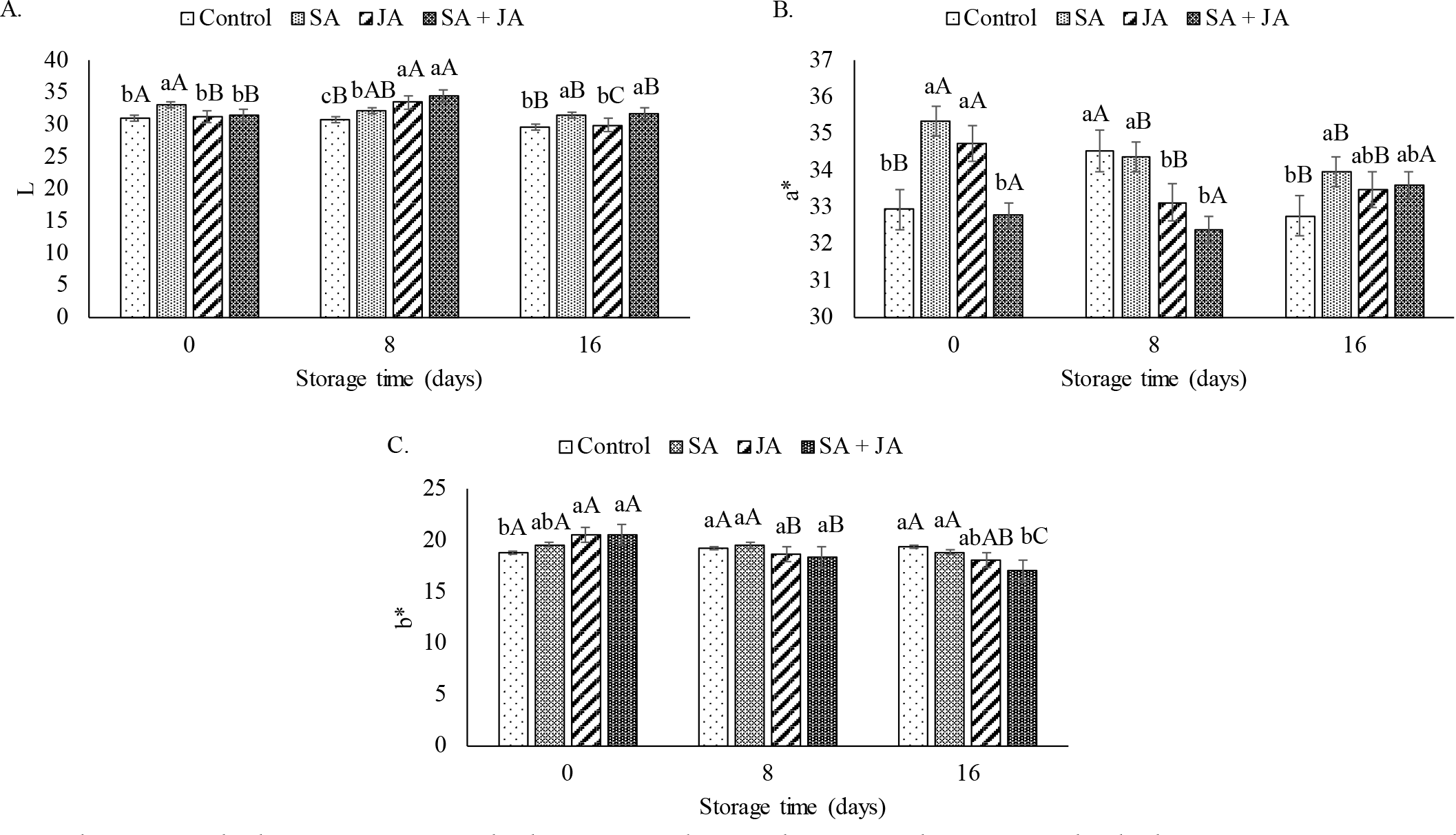
The lightness of the fruits underwent changes during storage and as a function of phytohormones (Figure 2A). When SA was applied, lightness was higher (6.03% than the other treatments in fruits that were not subjected to storage (day 0). With eight days of storage, JA and the SA + JA combination provided gains of 7.81 and 10.33%, respectively, when compared to the control. Up to 16 days of storage, the highest values were obtained with the SA + JA and SA treatments, providing gains of 6.5 and 6.1%, respectively, compared to the control. Regarding the effect of phytohormones as a function of time, it is possible to verify that the increase in storage time decreases the lightness of the control treatment with SA, while JA and SA + JA present greater lightness with eight days of storage of the fruits. Visible changes in fruits are common during storage, especially in color, and lightness may decrease over time (Bezerra et al., 2025). On the other hand, it was observed that the application of JA and the combination of SA + JA favored an increase in lightness with eight days of storage, which may be associated with the mechanism of decreasing the fruit senescence process.

Lightness, L (A), color coordinates a* (B) and b* (C) of cherry tomato fruits subjected to the application of phytohormones and storage times
The color coordinate a* indicates that the application of SA and JA on day 0 was superior to the control and the SA + JA combination, while on the eighth day of storage, higher values were observed in the control treatment and in SA (Figure 2B). As time passed until the 16th day, it was observed that the application of the different phytohormones led to higher values compared to the control, but only SA proved to be statistically superior.
In coordinate b*, all treatments were superior to the control on day 0 of storage, while on the eighth day there was no difference between treatments and on the 16th day, the control, SA and JA were superior to SA + JA (Figure 2C). Regarding the effects of phytohormones, control and SA treatments did not show any difference as a function of the storage times, while JA and SA + JA were superior on day 0 of storage. Colorimetric analysis indicates that the application of phytohormones improved the appearance of cherry tomato fruits, especially as storage time progressed.
The a* and b* values indicate the advancement of fruit transformation activity, changing from green to red and bright. These fruit color characteristics were maintained for 16 days of storage due to the application of SA, JA, and SA + JA. This effect may be associated with the action of these phytohormones in fruit conservation, delaying senescence and degradation of the pigments involved in fruit color, improving their appearance, even as the storage time progressed (Yang et al., 2022). It is important to highlight that the color of the fruits is a determining factor for consumers’ choice of tomatoes during their commercialization, since with the ripening process the pigments present undergo changes, in which mainly chlorophylls are degraded while other pigments, such as flavonoids and carotenoids, are produced (Solovchenko et al., 2019).
Fruit firmness showed differences between phytohormones only on the 16th day of storage, with the highest value (9.6 N) observed in the SA treatment, being superior to the JA and SA + JA treatments, but not statistically different from the control treatment (Figure 3A). Regarding the effect of phytohormones as a function of storage time (days), it was found that SA + JA showed lower firmness at 8 days, while at JA and SA + JA treatments showed the lowest firmness at 16 days. This beneficial effect of the application of phytohormones was also observed in fruit firmness, with SA being the most efficient in maintaining fruit rigidity over time. This may be associated with the fact that SA inhibits the synthesis of some enzymes involved in cell wall degradation, preventing the fruit from softening easily (Wang et al., 2022).

Firmness (A) and elasticity (B) of cherry tomato fruits subjected to the application of phytohormones and storage times
This beneficial effect of phytohormones in reducing senescence of cherry tomato fruits was observed for other species such as Ziziphus jujuba Mill cv. Dongzao, for which the application of 3.0 mmol of SA improved fruit color and firmness (Yang et al., 2022). In strawberries, the use of up to 4 mM SA and 0.50 mM methyl jasmonic reduced fruit deterioration, improving color and firmness (El-Mogy et al., 2019).
The elasticity of cherry tomato fruits was greater during the 16-day storage period for all treatments, with the control differing statistically only from the SA, while the others did not differ from each other (Figure 3B). On the other hand, it was observed that the elasticity of the fruits increased at 16 days of storage, which is common because the advance of ripening induces the loss of water and the change of components of the cell walls, such as cellulose, hemicellulose and lignin, which consequently makes the fruit appear wilted and increases elasticity (Yao et al., 2024). In addition, keeping the fruits covered with plastic film and in a refrigerated environment can cause the evaporation of water or the formation of ice chests, which tends to contribute to the loss of moisture, resulting in the occurrence of wilting of the fruits, which increases elasticity (Chen et al., 2024).
Titratable acidity increased with the application of the SA + JA combination at all three storage times, and with JA on days 0 and 16 of storage (Figure 4A). Regarding the effect of phytohormones as a function of storage time, it was observed that, for SA, increasing the time raised the titratable acidity, with the highest value on the 8th day, while in the control treatment the opposite occurred, with a reduction in titratable acidity as a function of increasing days, with the lowest value observed at 16 days of storage. In the SA + JA combination, the greatest effect occurred on the eighth day, followed by 16th, both higher than day 0. For the JA treatment, there was no difference as a function of storage time.

Titratable acidity (A), soluble solids (B), SS/TA ratio (C), ascorbic acid (D) and reducing sugars (E) of cherry tomato fruits subjected to the application of phytohormones and storage times
Soluble solids content only showed a difference between treatments on the eighth day of storage, with the highest values (5.90 and 5.93%) obtained with the application of JA and SA + JA, both higher than those found in the other treatments (Figure 4B). Regarding the effect of the phytohormones as a function of the days of storage, it is possible to observe that the phytohormones JA and SA + JA have the highest soluble solids contents on days 0 and 8 of storage, respectively for SA, the highest values were obtained on days 0 and 16 of storage, while for the control it was on day 0.
Regarding the observed behavior in the soluble solids content of cherry tomato fruits, it is noteworthy that the application of the phytohormones JA and SA + JA improved their quality, while SA increased titratable acidity, promoting improvements in these attributes. This increase in fruit quality is directly associated with the reduction in citric acid levels as the fruit matures, with the conversion of organic acids into sugars, which can be stimulated by the application of phytohormones (Baek et al., 2021). The increase in titratable acidity by the application of SA is an excellent source of acids, increasing the acidity of the fruit, as observed by Essa & Alwan (2025) in cherry tomatoes.
Since these are two attributes associated with the flavor and sweetness of the fruits, their elevation indicates that the application of JA and SA + JA was efficient in increasing the quality of the fruits, especially as the storage time progressed. This improvement can be attributed to the expression of genes involved in the response of the plant’s antioxidant defense system, which induced a greater conversion of organic acids into sugars, increasing the quality of tomato fruits (Baek et al., 2023).
For the SS/TA ratio (Figure 4C), it was found that on day 0 there was no difference between treatments, while on day 8, the JA treatment was superior to the other treatments. On day 16, the highest values occurred in the control treatment and in the JA treatment, statistically exceeding the others. Regarding the effect of treatments as a function of storage times, it was observed that for JA the highest value occurred on day 8 of storage, while for SA it occurred on day 0. For the SA + JA combination, the highest value occurred on day 0, but did not differ statistically from the other storage days. In the control, the highest values occurred on days 0 and 16 of storage. These ratio values indicate good performance of JA in improving the flavor of cherry tomatoes.
The ascorbic acid content showed a difference only on the 8th day of storage, with the highest values (45.27 and 44.88 mg 100 g-1 FW) in the SA and SA + JA treatments, both higher than those found in the other treatments (Figure 4D). Regarding the effect of the treatments as a function of the storage days, it is observed that, in the control treatment, the highest values were obtained on days 8 and 16, while for the phytohormones JA, SA and SA + JA, the highest value was obtained on the eighth day.
For the reducing sugar content (Figure 4E), the SA + JA treatment provided the highest values in all storage times, with emphasis on the 8th as the highest (0.39 mg 100 g-1 FW) value observed in tomato fruits when compared to the other storage times. Regarding the effect of phytohormones as a function of storage time, it is noteworthy that, for the control, JA, and SA + JA, the greatest increases occurred on the eighth day, exceeding the other storage times. For SA, the highest values were obtained on days 8 and 16 of storage.
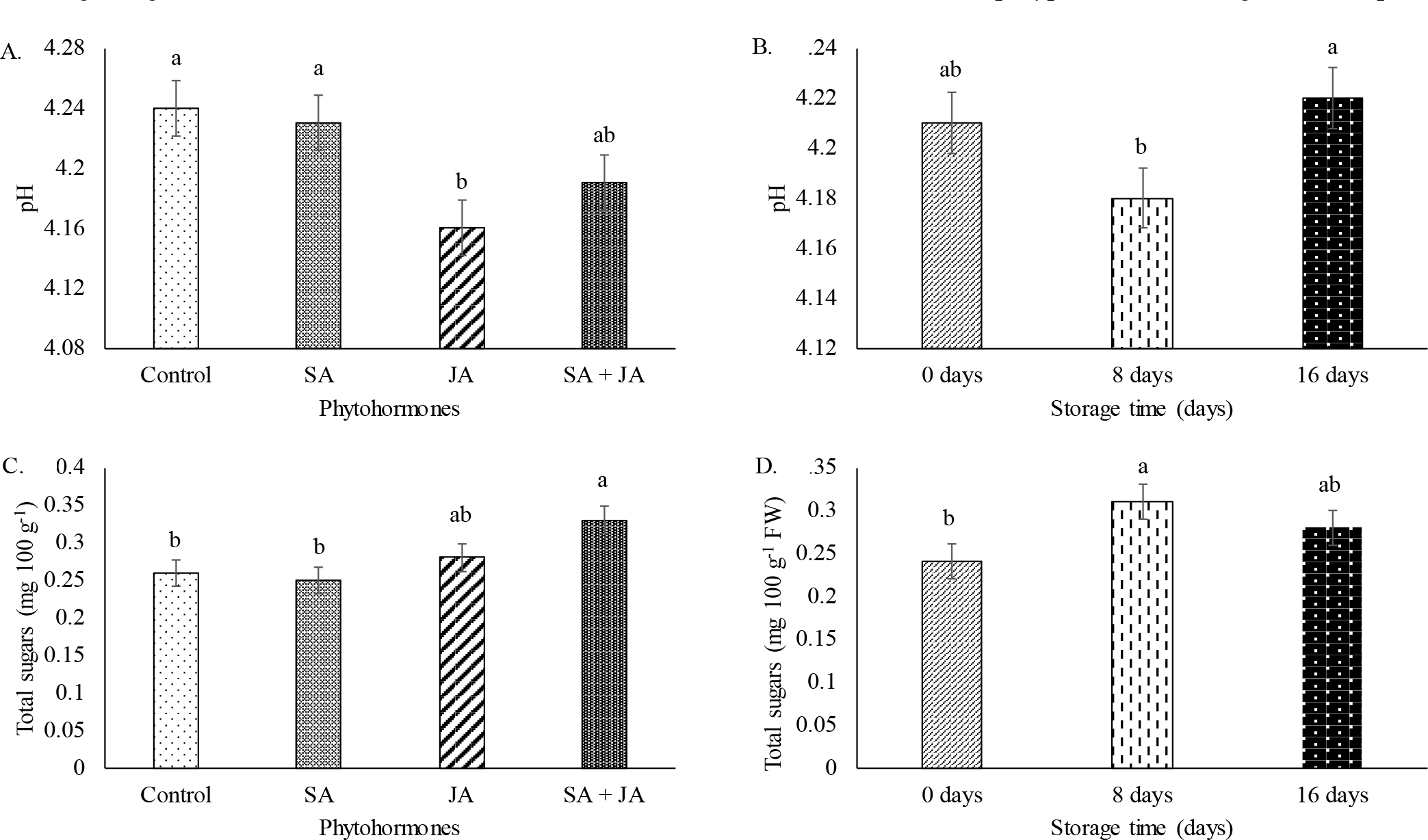
For pH values and total sugar contents, an isolated effect of the studied factors was observed. For the effects of phytohormones on pH (Figure 5A), it is possible to verify that the highest values occurred in the control and in the SA treatment. Regarding the storage time, the values were higher on days 0 and 16 days (Figure 5B).
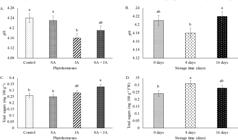
pH and total sugar content as a function of phytohormone application (A and C) and storage times (B and D) of cherry tomato fruit
The total sugar content was higher (0.28 and 0.33 mg 100 g-1) in the fruits of the JA and SA + JA treatments, with increases of 24.24 and 10.71% compared to the SA treatment and of 21.21 and 7.14% compared to the control, respectively (Figure 5C). Regarding the storage time, the advancement of time stimulated the total sugar content, with the highest values observed on days 8 and 16 of storage, promoting increases of 22.58 and 14.29%, respectively, compared to the control (Figure 5D).
Similarly, the levels of ascorbic acid, reducing sugars and total extractable polyphenols were higher when plants received the combined application of SA + JA, indicating a beneficial interaction in improving the quality of cherry tomato fruits, especially with 8 days of storage. This can be explained by the action of these phytohormones in stimulating the production of antioxidants, through the activity of enzymes such as ascorbate oxidase reductase, monodehydroascorbate reductase and dehydroascorbate reductase, favoring the production and accumulation of these compounds (Zhu et al., 2022).
This increase in antioxidant activity represented by the contents of sugars, ascorbic acid and phenolic compounds, can be seen as a way for the fruit to delay the senescence process by eliminating free radicals, which is stimulated by SA and JA, a fact also observed by Wu et al. (2025) in blackberry fruits, with the increase in enzymatic activity being associated with the application of these phytohormones, increasing fruit quality.
The lycopene content in cherry tomato fruits varied as a function of storage time. On day 0, the control, SA, and SA + JA (0.44, 0.63, and 0.63 mg 100 g⁻1, respectively) were superior to JA (0.28 mg 100 g⁻1) (Figure 6A). On the eighth day, there was no difference between treatments, while on day 16 of storage, SA and SA + JA showed the highest values (0.55 and 0.44 mg 100 g⁻1), although the latter did not differ statistically from the others. Regarding the effect of phytohormones on the treatments as a function of storage time, for the SA + JA treatment and the control, lycopene values decreased with increasing storage days, while SA and JA alone did not differ statistically at different fruit storage times.
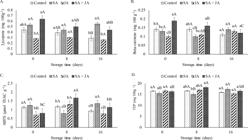
Lycopene (A), β-carotene (B), ABTS (C), and total extractable polyphenols - TEP (D) contents of cherry tomato fruits subjected to the application of phytohormones and storage times
β-carotene content was higher (0.19 and 0.16 mg 100 g-1) in fruits from the SA + JA treatment, at 0 and 8 days of storage, while on the 16th day there was no difference between treatments (Figure 6B). For the effect of phytohormones as a function of storage time, it was observed that for the SA + JA treatment the β-carotene value was reduced with increasing time. For JA it was the opposite, the increase in storage time increased the β-carotene esters, while in SA the highest values occurred on days 0 and 16, and in the control no difference was observed as a function of the days of storage of the fruits.
Levels of lycopene and β-carotene were higher when the combined phytohormones (SA + JA) were applied up to 8 days and under SA at 16 days of storage. The increase in the biosynthesis of these compounds is directly related to the advancement of the physiological maturity of the fruits, which is associated with the increase in the antioxidant activity induced by the phytohormones. According to Meza et al. (2022), the observed behavior is related to the increase in the synthesis of carotenoids, which is stimulated by jasmonic acid, which reflects in this increase in the levels of lycopene and β-carotene. In addition, SA induces the production of a greater amount of acids that release free radicals, which may have stimulated the increase in the concentration of lycopene and β-carotene, as a mechanism to sequester the free radicals present in the fruits (Gorni et al., 2021).
ABTS values varied according to storage days, with the highest values (1.14 and 1.25 µmol TEAC g-1) obtained on day 0 for the control and SA treatments (Figure 6C). At 8 days, the highest value observed (1.67 µmol TEAC g-1) occurred in the SA + JA, promoting gains of 29.34, 52.69, and 21.56% compared to the control, SA, and JA, respectively. While on the 16th day, the highest estimated value (1.36 µmol TEAC g-1) was obtained in the fruits subjected to SA application, showing increases of 30.88, 42.65, and 16.18% compared to the control, JA, and SA + JA, respectively. For the effect of phytohormones according to storage time, it was found that for JA and SA + JA, the highest values occurred on the eighth day. As for SA, at 0 and 16 days the values were higher than at 8 days; and for the control the highest estimated values occurred on days 0 and 8 of storage.
Total extractable polyphenol content showed statistical difference only on the 8th day of storage, with the highest values observed in SA + JA, JA and the control (18.15, 16.98 and 16.68 mg 100 g-1, respectively) (Figure 6D). Regarding the effect of phytohormones as a function of the storage time, it is possible to observe that for SA the highest value occurred on the 16th day, while in SA + JA it occurred on the 8th day. For the control and JA, no difference was observed in the contents of total phenolic compounds as a function of the storage time.
The total antioxidant activity by the ABTS method was stimulated by phytohormones with increasing storage time, with emphasis on SA + JA and SA, at 8 and 16 days, respectively. This increase in antioxidant capacity is a response mechanism induced by stress caused by the phytohormone itself, inducing the production of secondary metabolites (Sariñana-Aldaco et al., 2020), which can be observed in this study with the increase in the levels of phenolic compounds, lycopene, ascorbic acid, among others.
Principal component analysis indicates that the interaction between phytohormones and the variables analyzed corresponded to a total variability of 83.7%, represented by the two first components (PC1 and PC2) (Figure 7). For PC1, it is found that its representativeness was 58.9%, and this variation is associated with the effect of SA on the variables firmness, pH and ABTS, in addition to the control treatment strongly associated with titratable acidity, firmness and elasticity of the fruits.

Principal Component Analysis for the interrelationship between phytohormones and physicochemical variables of cherry tomato fruits
For the second component (PC2), it was observed that it contributed 24.8% of the total variability; this behavior is mainly related to the SA + JA treatment, which correlated with the largest set of variables, such as reducing and total sugars, ascorbic acid, lycopene, and β-carotene, showing its positive effect on the quality of tomato fruits. The correlation presented by the principal component analysis makes it possible to observe the beneficial effect of phytohormones on maintaining the quality of cherry tomato fruits, with emphasis on SA and the combination SA + JA, as those that promoted the greatest influence on the variables analyzed, thanks to the mode of action of these phytohormones that stimulate the production of secondary compounds, expression of genes and enzymes involved in the plant defense antioxidant system, which results in fruits with greater nutritional quality (Jeyasri et al., 2023).
CONCLUSION
Foliar application of salicylic acid combined with jasmonic acid stimulates the production of secondary metabolic compounds, such as reducing and total sugars, ascorbic acid, lycopene, and β-carotene, increasing the antioxidant activity of cherry tomato fruits, especially with increasing storage time. This allows to conclude that these phytohormones improve the quality and post-harvest preservation of cherry tomatoes.
Acknowledgments:
The present study was carried out with support from the National Council for Scientific and Technological Development - Brazil (CNPq), and Coordination for the Improvement of Higher Education Personnel - Brazil (CAPES).
Data Availability Statement:
The authors declare that there are no data underlying the text.
LITERATURE CITED
-
Alvares, C. A. et al. Köppen’s climate classification map for Brazil. Meteorologische Zeitschritt, v.22, p.711-728, 2013. https://doi.org/10.1127/0941-2948/2013/0507
» https://doi.org/10.1127/0941-2948/2013/0507 -
Baek, M. W. et al. Preharvest treatment of methyl jasmonic and salicylic acid increase the yield; antioxidant activity and GABA content of tomato. Agronomy, v.11, 2293, 2021. https://doi.org/10.3390/agronomy11112293
» https://doi.org/10.3390/agronomy11112293 -
Baek, M. W. et al. Preharvest methyl jasmonic and salicylic acid treatments improve the nutritional qualities and postharvest storability of tomato. Scientiae Horticulturae, v.321, 112312, 2023. https://doi.org/10.1016/j.scienta.2023.112332
» https://doi.org/10.1016/j.scienta.2023.112332 -
Bezerra, L. de S. et al. Postharvest quality of atemoya at various stages of ripeness grown in semi-arid conditions. Acta Scientiarum Agronomy, v.47, e70076, 2025. https://doi.org/10.4025/actasciagron.v47i1.70076
» https://doi.org/10.4025/actasciagron.v47i1.70076 -
Brumos, J. Gene regulation in climacteric fruit ripening. Current Opinion in Plant Biology, v.63, 102042, 2021. https://doi.org/10.1016/j.pbi.2021.102042
» https://doi.org/10.1016/j.pbi.2021.102042 -
Chen, K. et al. Moisture loss inhibition with biopolymer films for preservation of fruits and vegetables: A review. International Journal of Biological Macromolecules, v.263, 130337, 2024. https://doi.org/10.1016/j.ijbiomac.2024.130337
» https://doi.org/10.1016/j.ijbiomac.2024.130337 -
El-Beltagi, H. S. et al. A new approach for extending shelf-life of pomegranate arils with combined application of salicylic acid and methyl jasmonic. Horticulturae, v.9, 225, 2023. https://doi.org/10.3390/horticulturae9020225
» https://doi.org/10.3390/horticulturae9020225 -
El-Mogy, M. M. et al. Impact of salicylic acid, abscisic acid, and methyl jasmonic on postharvest quality and bioactive compounds of cultivated strawberry fruit. Journal of Berry Research, v.9, p.333-348, 2019. https://doi.org/10.3233/JBR-180349
» https://doi.org/10.3233/JBR-180349 -
Essa, B. A.; Alwan, O. K. Jasmonic and salicylic sprays improve cherry tomato fruit productivity and quality in unheated greenhouses. Agronomia Mesoamericana, v.36, 58254, 2025. https://doi.org/10.15517/am.2024.58254
» https://doi.org/10.15517/am.2024.58254 -
Fátima, R. T. de. et al. Salicylic acid concentrations and forms of application mitigate water stress in sour passion fruit seedlings. Brazilian Journal of Biology, v.83, e270865, 2023. https://doi.org/10.1590/1519-6984.270865
» https://doi.org/10.1590/1519-6984.270865 -
Figueiredo, F. R. A. et al. Morphology of tomato plants under nematode attack and salicylic acid application. Nativa, v.10, p.90-94, 2022. https://doi.org/10.31413/nativa.v10i1.13217
» https://doi.org/10.31413/nativa.v10i1.13217 -
Gorni, P. H. et al. Exogenous salicylic acid and ferulic acid improve growth, phenolic and carotenoid content in tomato. Advances in Horticultural Science, v.35, p.335-341, 2021. https://doi.org/10.36253/ahsc-8295
» https://doi.org/10.36253/ahsc-8295 -
Guedes, M. A. et al. Hydroponic cultivation of laranja cherry tomatoes under salt stress and foliar application of hydrogen peroxide. Agriculture, v.13, 1688, 2023. https://doi.org/10.3390/agriculture13091688
» https://doi.org/10.3390/agriculture13091688 - IAL - Instituto Adolfo Lutz. Normas analíticas do Instituto Adolfo Lutz. In: Métodos químicos e físicos para análise de alimentos, 3.ed., São Paulo: IMESP. 2008. 1020p.
-
Jeyasri, R. et al. Methyl jasmonic and salicylic acid as powerful elicitors for enhancing the production of secondary metabolites in medicinal plants: an updated review. Plant Cell, Tissue and Organ Culture, v.153, p.447-458, 2023. https://doi.org/10.1007/s11240-023-02485-8
» https://doi.org/10.1007/s11240-023-02485-8 -
Kabir, M. S. N. et al. Physicochemical quality changes in tomatoes during delayed cooling and storage in a controlled chamber. Agricuture, v.10, 196, 2020. https://doi.org/10.3390/agriculture10060196
» https://doi.org/10.3390/agriculture10060196 -
Kaygısız, T. et al. Effect of postharvest melatonin and salicylic acid applications on quality characteristics and primary and secondary metabolite physiology of tomato fruits. BMC Plant Biology, v.25, 1090, 2025. https://doi.org/10.1186/s12870-025-07013-8
» https://doi.org/10.1186/s12870-025-07013-8 -
Larrauri, J. A. et al. Effect of drying temperature on the stability of polyphenols and antioxidant activity of red grape pomace peels. Journal Agricultural and Food Chemistry, v.45, p.1390-1393, 1997. https://doi.org/10.1021/jf960282f
» https://doi.org/10.1021/jf960282f -
Melo, M. F. et al. Action of biotic elicitors on cherry tomato under saline stress: physiological and biochemical variables. Journal of Plant Growth Regulation, v.44, p.3025-3038, 2025. https://doi.org/10.1007/s00344-024-11594-3
» https://doi.org/10.1007/s00344-024-11594-3 -
Meza, S. L. R. et al. Induction of metabolic changes in amino acid, fatty acid, tocopherol, and phytosterol profiles by exogenous methyl jasmonic application in tomato fruits. Plants, v.11, 366, 2022. https://doi.org/10.3390/plants11030366
» https://doi.org/10.3390/plants11030366 -
Miller, G. L. Use of dinitrosalicylic acid reagent for determination of reducing sugars. Analytical Chemistry, v.31, p.426-428, 1959. https://doi.org/10.1021/ac60147a030
» https://doi.org/10.1021/ac60147a030 - Minolta. Precise color communication: Color control from feeling to instrumentation. Minolta Corp. Ltda. 2007.
- Moraes, C. A. G.; Furlani, P. R. Cultivo de hortaliças de frutos em hidroponia em ambiente protegido, In: Lacerda, V. L. A. (Ed.) Cultivo protegido de hortaliças em solo e hidroponia. Informe agropecuário, Belo Horizonte, MG, 1999. p.105-113.
- Nagata, M.; Yamashita, I. Simple method for simultaneous determination of chlorophyll and carotenoids in tomato fruit. Nippon Shokuhin Kogyo Gakkaish, v.39, p.925-928, 1992.
-
Pérez, M. D. et al. Marketability probability study of cherry tomato cultivars based on logistic regression models. Agronomy, v.8, 176, 2018. https://doi.org/10.3390/agronomy8090176
» https://doi.org/10.3390/agronomy8090176 -
R Core Team. R: A language and environment for statistical computing. R Foundation for Statistical Computing. Vienna, Austria, 2022. Available on: https://www.r-project.org/ Accessed in: May. 2025.
» https://www.r-project.org/ -
Sanchez-Moreno, C. et al. A procedure to measure the antiradical efficiency of polyphenols. Journal Science Food Agriculture, v.76, p.270-276, 1998. https://doi.org/10.1002/(SICI)1097-0010(199802)76:2%3C270::AID-JSFA945%3E3.0.CO;2-9
» https://doi.org/10.1002/(SICI)1097-0010(199802)76:2%3C270::AID-JSFA945%3E3.0.CO;2-9 -
Sariñana-Aldaco, O. et al. Foliar aspersion of salicylic acid improves nutraceutical quality and fruit yield in tomato. Agriculture, v.10, 482, 2020. https://doi.org/10.3390/agriculture10100482
» https://doi.org/10.3390/agriculture10100482 -
Solovchenko, A. et al. Postharvest physiology and biochemistry of fruits and vegetables. Woodhead Publishing, 2019. Cap.11, p.225-252. https://doi.org/10.1016/B978-0-12-813278-4.00011-7
» https://doi.org/10.1016/B978-0-12-813278-4.00011-7 - Strohecker, R.; Henining, H. M. Análisis de vitaminas: métodos comprobrados. Paz Montalvo, Madrid. 1967. 428p.
-
Tang, N. et al. Metabolic and transcriptional regulatory mechanism associated with postharvest fruit ripening and senescence in cherry tomatoes. Postharvest Biology and Technology, v.168, 111274, 2020. https://doi.org/10.1016/j.postharvbio.2020.111274
» https://doi.org/10.1016/j.postharvbio.2020.111274 -
Wang, J. et al. The effects of salicylic acid on quality control of horticultural commodities. New Zealand Journal of Crop and Horticultural Science, v.50, p.99-117, 2022. https://doi.org/10.1080/01140671.2022.2037672
» https://doi.org/10.1080/01140671.2022.2037672 -
Wu, Y. et al. Methyl jasmonic and salicylic acid treatment changes the nutritional quality, antioxidant profile and gene expression of postharvest blackberry fruit. Postharvest Biology and Technology, v.219, 113205, 2025. https://doi.org/10.1016/j.postharvbio.2024.113205
» https://doi.org/10.1016/j.postharvbio.2024.113205 -
Yang, W. et al. Effect of salicylic acid treatment on antioxidant capacity and endogenous hormones in winter jujube during shelf life. Food Chemistry, v.397, 133788, 2022. https://doi.org/10.1016/j.foodchem.2022.133788
» https://doi.org/10.1016/j.foodchem.2022.133788 -
Yao, Y. et al. Hydrogen-rich water irrigation promotes fruit ripening and nutritional composition in tomato. Postharvest Biology and Technology, v.213, 112920, 2024. https://doi.org/10.1016/j.postharvbio.2024.112920
» https://doi.org/10.1016/j.postharvbio.2024.112920 -
Yemn, E. W.; Willis, A. J. The estimation of carbohydrate in plant extracts by anthrone. The Biochemical Journal, v.57, p.508-514, 1954. https://doi.org/10.1042/bj0570508
» https://doi.org/10.1042/bj0570508 -
Zhu, L. et al. Effect of methyl jasmonic on the quality and antioxidant capacity by modulating ascorbate-glutathione cycle in peach fruit. Scientiae Horticulturae, v.303, 111216, 2022. https://doi.org/10.1016/j.scienta.2022.111216
» https://doi.org/10.1016/j.scienta.2022.111216
Edited by
-
Editors:
Toshik Iarley da Silva & Carlos Alberto Vieira de Azevedo


 Lowercase letters compare phytohormone concentrations within the storage time and uppercase letters compare the storage time within phytohormone concentrations; Means with same letters do not differ from each other by the Tukey’s test at p ≤ 0.05; SA = 500 µM of salicylic acid; JA = 50 µM of jasmonic acid; SA + JA = 500 µM of salicylic acid + 50 µM of jasmonic acid; and the control - without application of phytohormones
 Lowercase letters compare phytohormone concentrations within the storage time and uppercase letters compare the storage time within phytohormone concentrations; Means with same letters do not differ from each other by the Tukey’s test at p ≤ 0.05; SA = 500 µM of salicylic acid; JA = 50 µM of jasmonic acid; SA + JA = 500 µM of salicylic acid + 50 µM of jasmonic acid; and the control - without application of phytohormones
 Lowercase letters compare phytohormone concentrations within the storage time and uppercase letters compare the storage time within phytohormone concentrations; Means with same letters do not differ from each other by the Tukey’s test at p ≤ 0.05; SA = 500 µM of salicylic acid; JA = 50 µM of jasmonic acid; SA + JA = 500 µM of salicylic acid + 50 µM of jasmonic acid; and the control - without application of phytohormones
 Means with same letter do not differ from each other by the Tukey’s test at p ≤ 0.05; SA = 500 µM of salicylic acid; JA = 50 µM of jasmonic acid; SA + JA = 500 µM of salicylic acid + 50 µM of jasmonic acid; and the control - without application of phytohormones
 Lowercase letters compare phytohormone concentrations within the storage time and uppercase letters compare the storage time within phytohormone concentrations; Means with same letters do not differ from each other by the Tukey’s test at p ≤ 0.05; SA = 500 µM of salicylic acid; JA = 50 µM of jasmonic acid; SA + JA = 500 µM of salicylic acid + 50 µM of jasmonic acid; and the control - without application of phytohormones
 SA = 500 µM of salicylic acid; JA = 50 µM of jasmonic acid; SA + JA = 500 µM of salicylic acid + 50 µM of jasmonic acid; and the control - without application of phytohormones. Lightness (L), titratable acidity (Titrat Acid), hydrogen potential (pH), soluble solids (SS), ascorbic acid (Asc. Acid), total sugars (TS), reducing sugars (Red Sugar), lycopene, β-carotene (Beta-carot), total extractable polyphenols (TEP), total antioxidant activity (ABTS), firmness (Firm) and elasticity (Elast)