 Analysis of brazilian YouTube channels dedicated to teaching physics
Abstract
Since its inception, YouTube has established itself not only as a simple video-sharing tool but also as a huge and disruptive content distribution platform. Due to its reach and its content posting reward system, many teachers have created educational channels to broadcast their video lessons, and an overwhelming number of people around the world access the content for free and on demand. This article conducted a quantitative analysis of Brazilian YouTube channels with at least ten thousand subscribers that teach Physics (n = 50). The study aimed to quantitatively examine the factors influencing the popularity of Brazilian physics education channels on YouTube and identify the most engaging content. The results showed that, on average, the analyzed channels have over 120,000 subscribers, more than two million views, and 580 published videos. The main topics that generate public engagement are: Kinematics, Electrodynamics, and general Physics subjects for the ENEM exam.
Keywords
YouTube; Teaching Physics; Virtual Education; Quantitative Analysis
Resumo
Desde seu surgimento, o YouTube se estabeleceu não apenas como uma simples ferramenta para compartilhar vídeos, mas também como uma plataforma abrangente e disruptiva de distribuição de conteúdo. Devido ao seu alcance e às suas formas de retribuição de postagem de conteúdo, muitos professores têm criado canais educacionais para veicular suas videoaulas e uma quantidade exorbitante de pessoas ao redor do mundo acessa o conteúdo de forma gratuita e sob demanda. Este artigo realizou uma análise quantitativa de canais brasileiros do YouTube, com no mínimo dez mil inscritos e que ensinam Física (n = 50). O objetivo deste estudo foi analisar quantitativamente os fatores que influenciam na popularidade dos canais brasileiros de ensino de Física no YouTube e identificar os conteúdos de maior engajamento. Os resultados mostraram que, em média, os canais considerados possuem mais de 120 mil inscritos, mais de dois milhões de visualizações e 580 vídeos publicados. Os principais tópicos que geram engajamento do público são: Cinemática, dinâmica e assuntos gerais de Física para o ENEM (Exame Nacional do Ensino Médio).
Palavras-chave:
YouTube; Ensino de Física; Educação Virtual; Análise Quantitativa
1. Introduction
In general, the teaching and learning process has undergone many changes in recent decades. In the past, students had more contact with books, encyclopedias, magazines and printed materials in various formats [1, 2]. Today, students have access to a range of digitized content; social networks, where digital influencers, with a solid academic background, provide reliable information; and video-sharing platforms, where users can upload, watch, comment on and share videos for free, with YouTube being the most popular [3, 4].
YouTube was created in 2005 and acquired the following year by Google for 1.65 billion dollars [5]. It is one of the most popular social networks in the world and hosts a huge variety of content, including: educational videos, music, vlogs, tutorials, documentaries, entertainment, among others [6,7,8].
Individuals who produce and publish videos on YouTube are usually known as content creators or youtubers. Each youtuber has at least one channel, where videos are published and organized. They receive financial compensation – also known as monetization – every time advertisements are shown before or during their videos, in addition to other types of remuneration available on the platform [9, 10].
One niche that has always been on the rise on YouTube is educational videos [11, 12]. There are teachers from various areas of knowledge, including physics, who record lessons and publish them on their channel on the video portal [13]. At the other end, there is a large, interested and loyal audience – made up mainly of students at all levels – ready to consume the content on demand, according to their availability, pace and convenience.
Currently, high school students use YouTube not only for entertainment, but also as a tool to complement their studies [14, 15]. Some of the reasons for consuming digital content are the colloquial explanations and everyday references that captivate this type of audience [15]. Many high school students also access YouTube with the aim of preparing for the National High School Exam (ENEM) by watching and listening to explanations from teachers in other cities [16].
In [17] conducted a study that analyzed student perspectives on the use of YouTube for learning, usage patterns and motivating factors. They interviewed 30 students and developed an academic learning scale validated with 321 students from the University of Malaya. Results indicated that entertainment, information seeking and academic learning are the main motivations. It is recommended that YouTube be integrated into courses to enhance the teaching-learning experience.
In [18] conducted a search for educational physics videos on YouTube, using the Powtoon application, on the subject of temperature and heat, meeting validity criteria. The method followed was Research and Development with the Borg and Gall model. The results indicate high validity, with expert evaluations: 84% (media), 92% (media) (content) and 89% (media). Teachers and students showed positive receptivity, with 85% (media) approval by teachers, 79% (media) in small group tests and 82% (media) in field tests. The videos developed proved to be highly valid and effective as educational media.
In [19] developed and analyzed the feasibility of a project-based learning model assisted by YouTube videos for the subject of automotive engineering design. They used the ADDIE methodology (Analysis, Design, Development, Implementation, Evaluation) simplified into four stages. The model was validated by experts in content, media and teaching practices, as well as user perception tests. Questionnaires with a five-point Likert scale assessed the viability of the product. The model includes planning, implementation and evaluation, described in a guide. Results showed high viability and excellent acceptance by students, demonstrating suitability for teaching.
In [20] started from the premise that low critical thinking skills and self-confidence can hinder learning. To solve this problem, appropriate models and media are needed. This study evaluated the impact of the YouTube-supported Project-Based Learning (PjBL) model on students’ critical thinking and self-confidence. With a quasi-experimental method and non-equivalent control design, it included 185 11th grade students from a school in Indonesia. The sample included classes XI IPA 1 (control) and XI IPA 2 (experimental), selected by cluster sampling. Tests and questionnaires indicated that the model had a positive influence on both aspects.
The aim of this article was to carry out a quantitative analysis of Brazilian physics teaching YouTube channels. Various parameters were extracted from 50 channels in the field of study in question, making it possible to identify the popularity of the channels and their respective videos with the most engagement. Therefore, the following research questions were developed and answered in the course of this manuscript:
-
Among the metrics number of subscribers, number of views and number of videos published, which of them most influence the popularity of Brazilian physics teaching channels on YouTube?
-
Which physics content generates the most engagement on the channels with the best metrics?
The structure of this article is as follows: The structure of this article is as follows: Section 2 describes the methodology employed to obtain the results; and the Section 4 offers the final considerations.
2. Methodology
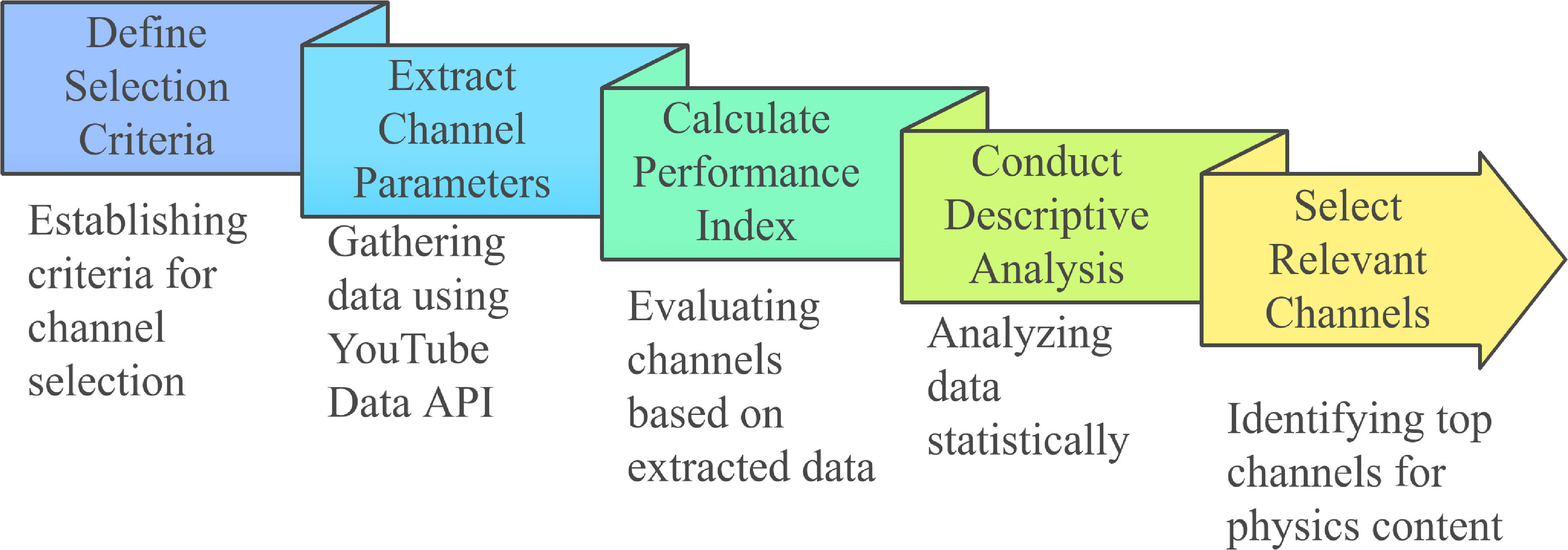
The first stage of the study involved defining the criteria for selecting the channels and researching the channels to be analyzed. At this stage, fifty Brazilian channels with at least ten thousand subscribers were considered. In the second stage, the following parameters were extracted from each channel in January/2025 using the “YouTube Data API” tool: number of subscribers, number of views and number of videos published. Using this API (Application Programming Interface), the Python programming language (version 3.10.12) and Google Colab, it was possible to quickly and accurately acquire and analyze the measurements for each channel 1.
Based on the parameters mentioned, the third stage consisted of calculating the performance index (PI) for each channel using eq.1. Note that the median is used to smooth out the outliers and that the log is taken into account to standardize the values into smaller magnitudes. It is important to emphasize that this model that calculates the PI does not take into account the didactic quality and conceptual accuracy and the frequency of uploading new videos.
where PI is channel performance index, S is number of subscribers to the channel, V is number of videos published, W is number of views of the channel’s videos, and the therms are the medians of the respective variables.
Then, in the fourth stage, a descriptive statistical analysis of the data was carried out. Finally, in the fifth stage, the three most relevant channels were selected, based on the statistical analysis, to identify the physics content that generates the most engagement on YouTube. All of these stages are shown in Figure 1. The results achieved through this methodology are detailed in the next section.

3. Results and Discussion
The analysis of the results is divided into two parts: exploratory data analysis and analysis of the physics content that generates the most engagement on YouTube.
3.1. Exploratory data analysis
The descriptive statistics for the parameters extracted from each channel is shown in Table 1. There is a large standard deviation from the mean in all the indicators, except for the number of videos, showing that there are channels with extremely high numbers of subscribers and views and others with more modest levels.
This information was confirmed by analyzing the boxplots for each parameter (Figure 2). Ten outlier channels were found in the range of 167e3 to 1,280e3 subscribers, in descending order: “Professor Boaro”, “Davi Oliveira – Física 2.0”, “Física Flávio”, “FISICATOTAL”, “Física e Afins”, “Física com Douglas”, “O Fisico Turista”, “FisicaInterativa.Com”, “Chama o Físico”, “Minuto da Física”. The eight outlier channels for the views parameter, identified in the range 20e6 to 570e6, are listed in descending order: “Física Flávio”, “Professor Boaro”, “Davi Oliveira – Física 2.0”, “Física e Afins”, “Física com Douglas”, “Linha na Física”, “FisicaInterativa.Com”, “FISICATOTAL”. The only outlier shown in the boxplot of the number of videos is the “Professor Boaro” channel, with 2295 videos published up to the period of data extraction for this study. In terms of the PI of each channel, the best are (in descending order): “Professor Boaro”, “Física Flávio” and “Davi Oliveira – Física 2.0”.

The channels sorted by PI are shown in Figure 3, and it is possible to see how different the channel numbers are from one another: there are six channels with PI > 2; five with 1 < PI < 2; thirteen with 0 < PI < 1; fifteen with −1 < PI < 0; nine with −2 < PI < −1 and two with PI < −2. As a result, 23 channels reached PI levels that denote positive performance and 27 negative performances.
The linear correlation (R2) between the parameters of the 50 channels surveyed is shown in Figure 4. It was found that the more videos and views a channel has, the more subscribers it has. It was also found that there is no strong R2 between the number of views and the number of videos published, so according to the data, the strategy of posting lots of videos to gain views is not effective. It was also noted that PI has a positive R2, from moderate to strong with the parameters number of subscribers, number of views and number of videos, indicating that eq. 1 results in a balanced value for the performance of the channels.

3.2. Engagement analysis of the three channels with the best PI
This subsection considers the six channels with PI > 2 and analyzes the videos that generated the most audience engagement. It should be noted that for this analysis, short videos (known as shorts) were not considered.
According to [21], there are four levels of engagement on internet content platforms, ordered from weakest to strongest: viewing the post only; viewing and liking the post; viewing, liking and writing a comment on the post; viewing, liking, writing a comment on the post and sharing it. Therefore, this study considered the parameter video likes to analyze engagement.
It is important to note that, in the context of Education, engagement can be related to the difficulty that the audience finds in the content that most arouses their interest [22].
All video titles, shown in the next Figures, were translated from Portuguese to English, because all channels are Brazilian.
3.2.1. “Professor Boaro” channel2
“Professor Boaro” is the channel with the highest PI(3.84). This profile was created on November 15, 2013 on YouTube, has 1.28 million subscribers, 2295 videos published and over 112 million views. The following message appears in the channel description: “Hey guys! On this channel I’ll be posting videos with tips for the entrance exams, solving the most recent exams, as well as lessons divided into small modules to make it easier for you to learn. I’ll also be posting videos on important issues involving science and what’s going on in the world, as well as experiments to bring your study closer to your everyday life. Enjoy!”.
The titles and respective number of likes of the ten videos with the most likes, taking into account all those already published on the channel, are shown in Figure 5. It was noted that six refer to the subject of Kinematics, two to Thermology, one to Vectors and one to Electrostatics.

Silva (2023) [23] has based on the hypothesis that the teaching of kinematics faces persistent difficulties and used a qualitative approach with quantitative data to carry out a survey in five state schools, combining a literature review and interviews. Silva (2023) [23] also observed that the mathematical complexity and the time required for the content remain challenges and concluded that it is necessary to improve the preparation of students in functions and graphical interpretation and to adopt more effective pedagogical proposals. This justifies the large search for kinematics content on YouTube.
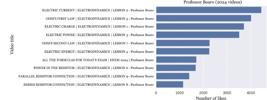
The titles and respective number of likes of the ten most liked videos of all those published in 2024 are shown in Figure 6, in order to check for more recent engagement. Of the ten videos, nine are about electrodynamics and one is about physics formulas that could be included in the ENEM 2024 exam.
3.2.2. “Física Flávio” channel3
The “Física Flávio” channel is the profile with the second highest PI(3.60). It began its activities on August 17, 2006 on YouTube, has 582, 000 subscribers, 574 videos published and more than 572 million views. The creator did not provide a description of the channel.
The titles and number of likes of the ten most liked videos of all those published on the channel are shown in Figure 7. It was observed that four of these videos deal with Waves and Oscillations, four deal with Electrostatics, one deals with Astronomy and another refers to Mechanics.

The titles and number of likes of the ten most liked videos published exclusively in 2024 are shown in Figure 8, with the aim of analyzing the most recent engagements. It was noted that, among these videos, seven deal with general Physics topics for the ENEM, two with Thermology, focused on the ENEM, and one reviews Electrodynamics, also for the ENEM.

Vizzoto (2022) [24] emphasized that ENEM is crucial for access to public and private higher education, significantly impacting the future of candidates. Vizzoto (2022) [24] conducted a study that analyzed the psychometric quality of the Physics items in the tests from 2009 to 2019, revealing that most of the questions are not suitable for assessing the knowledge proposed in the area of Natural Sciences. The results suggest a need to improve the quality of this large-scale exam. Faced with this confusing scenario, national exam candidates are looking for different ways to learn Physics for ENEM, including via YouTube.
3.2.3. “Davi Oliveira – Física 2.0” channel4
“Davi Oliveira – Physics 2.0” is the channel with the third highest PI(3.11). It began operations on June 6, 2016 on YouTube, has 893, 000 subscribers, 879 videos published and more than 78 million views. The profile description reads: “On this channel you can learn Physics in an integrative and collaborative way. Professor Davi has a degree in Physics and a postgraduate degree in Physics Teaching from UFRRJ. He has worked for 20 years in public and private schools and preparatory courses, and has extensive experience in delivering content in a didactic and objective way. We welcome you all and invite you to learn this subject, which is the cheapest”.
The titles and number of likes of the ten most popular videos published on the channel are shown in Figure 9. It was noted that seven of them deal with Kinematics, one deals with Electrodynamics, one is related to Newton’s first law and another to Thermology.

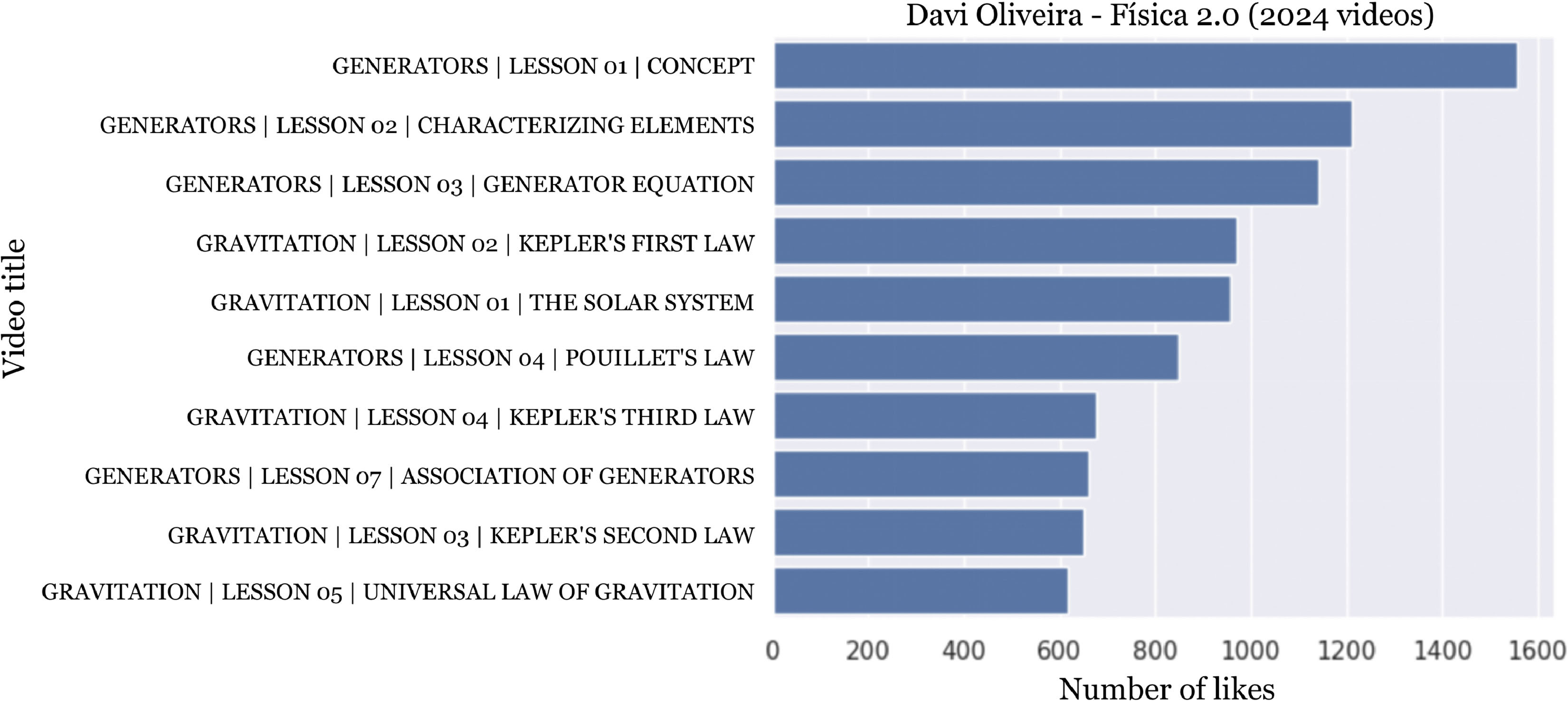
The titles and number of likes of the ten most liked videos published exclusively in 2024 are shown in Figure 10, in order to assess the most recent engagement. It was noticed that, among these videos, five deal with the subject of generators, which is part of the topic of Electrodynamics, and five deal with the subject of gravitation, which is part of the topic of Mechanics.

Carneiro et al. (2022) [25] carried out a systematic review of the literature on the teaching of electrodynamics in basic education and revealed an increase in recent research, with a focus on experimentation and technological resources. Carneiro et al. (2022) [25] identified that simple electrical circuits are the most covered topics, while generators and receivers are less discussed. This helps to explain the high level of engagement with electrodynamics topics, especially generators.
3.2.4. “Física com Douglas” channel5
Ranked fourth in performance index (PI = 2.60), the “Física com Douglas” channel has been active since August 27, 2017. It currently counts 385, 000 subscribers, with a total of 1, 413 videos published and over 34 million views. The creator provided the following description: “A conceptual approach to Physics that prioritizes understanding over rote memorization. Content is structured to support learners at all educational levels from elementary and secondary education to undergraduate and graduate studies. Everyday Physics is the core focus of this educational framework, offering meaningful connections between theory and real-world applications. Special attention is also given to preparation for national exams such as the ENEM and university entrance assessments. You are warmly welcomed to join this learning journey”.
According Figure 11, among the ten most liked videos on the channel, three address topics in General Relativity, two in Thermology, and two in Hydrostatics. Additionally, there is one video for each of the following subjects: Mechanics, Electromagnetism, and Wave Physics.

Considering only the videos published in 2024 Figure 12, in order to analyze more recent engagement, it is observed that three videos focus on the ENEM exam; two address how to study Physics the right way, according to the author; two cover Thermodynamics; one discusses satellites (Astronomy); another explores vector theory; and one addresses a possible error made by the 2024 UNEB public examination board.

The interest in videos related to the ENEM exam has already been evidenced by other channels analyzed in this study, as well as by Vizzotto (2022) [24]. Videos that address the best ways to study Physics have been sought after, as students’ beliefs about specific topics influence their study approaches in Physics, and traditional courses rarely promote significant changes in these conceptions [26].
3.2.5. “Física e afins” channel6
This channel ranked fifth, with a PI value of 2.50. It has 456 thousand subscribers, 926 published videos, and over 35 million views. The channel was created on June 29, 2016, and is described as follows: “Gabriela Bailas holds PhD in Theoretical Particle Physics, having completed her doctorate in France through a scholarship from the French government. She is currently completing a specialization in Neuroscience and Behavior. She is a professor, researcher, author, and science communicator. Here I share information about science. Promoter of critical thinking and skepticism.”
According to Figure 13, among the ten videos with the most likes – considering all videos published on the channel – four are about Quantum Physics, one addresses how to study more efficiently, and the remaining five deal with topics not directly related to Physics: facial microexpressions, family constellation, mystical youth, exoskeletons, and faith healing.

With the aim of identifying the most recent content that engaged the audience, the graph of the most liked videos published in 2024 (Figure 14) shows that one addresses Quantum Physics, another discusses the new high school curriculum, and the remaining eight cover various topics not directly related to Physics, such as family constellation, faith healing, chiropractic, sectarianism, political criticism, the author’s life in Japan, candles and incense, and flat Earth theories.
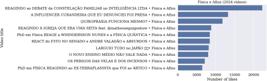
Among the six channels with the highest PI values, this is the only one hosted by a woman and the only one that covers many side topics related to Physics, as suggested by the channel’s name. However, in most of the videos that generated audience engagement, the themes are not strongly connected to Physics, indicating that the channel does not serve as a systematic study resource for Physics topics, but rather as an information source with a more media-oriented appeal [27].
3.2.6. “FISICATOTAL” channel7
This channel ranked sixth in the PI ranking (2.47). Upon accessing the channel’s YouTube page, it is noted that it has 486 thousand subscribers, over 1, 400 published videos, more than 20 million views, and was created on February 15, 2013. The channel description reads: “On this channel, Professor Ivys Urquiza will provide video lessons that are part of the FÍSICA TOTAL Project. The project originated as an extension of the work done on the blog ‘Física para o novo ENEM’. Through the channel, students will have FREE access to the complete Physics course by a professor with over 20 years of experience in the field. To make the most of the course, you should also follow the posts, materials, and podcast on the Física Total website and stay updated via the projectâ s Facebook page. Questions, comments, and suggestions are always welcome! Letâ s interact as much as possible. The word is Physics. The dimension, TOTAL!”
Regarding the channel’s engagement, Figure 15 shows that five of the most liked videos are about Kinematics, three about Thermology, one about physical quantities, and another about Vectors.

Analyzing the most recent engagement, the ten videos published in 2024 that received the highest number of likes are listed in Figure 16. It was identified that eight of them focus on Electrodynamics and Electrostatics, one on Wave Physics, and another on Optics. All the videos consist of commented problem-solving sessions.
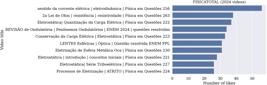
The audience’s interest in Kinematics has already been evidenced in other channels analyzed in this study and confirmed by Silva (2023) [23]. The same applies to topics in Electrodynamics and Electrostatics [25], as well as Thermology [28].
4. Final Considerations
Fifty YouTube channels were considered for the quantitative analysis described in this article, which revealed the parameters that have the greatest or least influence on their popularity. In addition, an PI based on the channels’ parameters was calculated to rank them, making it possible to identify the six best channels out of the fifty and analyze the videos they publish that generate the most audience engagement.
Two research questions were established and answered:
1. Among the metrics number of subscribers, number of views and number of videos published, which of them most influence the popularity of Brazilian physics teaching channels on YouTube?
The linear correlation analysis (Figure 4) showed that the increase in the number of videos published and views is directly related to the growth in the number of subscribers to the channel. It was also found that the correlation between the number of views and the number of videos published is weak.
2. Which physics content generates the most engagement on the channels with the best metrics?
In the context of these 50 physics teaching channels on Youtube, it was pointed out that student engagement is related to the difficulty they encounter in the topics in which they leave likes on the video. Therefore, the ten videos with the most likes from the top six channels, which achieved the best PIs, were considered to discover that the main topics of student engagement are: Kinematics, Thermology, Electrostatics and Electrodynamics, Waves and Oscillations, Quantum Physics and general Physics subjects for the ENEM. Topics such as Hydrostatics, Astronomy, and Electromagnetism resulted in lower engagement.
It is important to know that the engagement may be influenced by other uncontrolled factors, such as the teaching style of content creators, the quality of video production, or even YouTube’s algorithmic recommendations.
As future work, we intend to investigate non-Brazilian physics teaching channels; group the channels using machine learning clustering techniques and analyze the characteristics of each group. Besides, we intend to consider alternative ways of evaluating educational effectiveness, analyzing the most viewed videos through qualitative metrics using artificial intelligence tools capable of converting audio into text and tracking the teacher’s face during their explanation. In addition, the aim is to carry out this same type of study for other areas of knowledge, such as: Mathematics, Chemistry, Biology, History, Geography, and Portuguese.
Data Availability
The dataset supporting the findings of this study is not publicly available.
References
- [1] A.T.C, Fernandes, Educação e pesquisa 30, 531 (2004).
- [2] G.R. Cabral, Linha Mestra 18, 144 (2024).
- [3] S. Balbay and S. Kilis, Eurasian Journal of Applied Linguistics 3, 235 (2017).
- [4] Y. Syahraini, E. Elisa and A. Halim, Asian Journal of Science Education 1, 26 (2019).
-
[5] J. Carpanez, Google Compra Site YouTube por US$$1,65 Bilhão, disponível em: https://g1.globo.com/Noticias/Tecnologia/0,,AA1304481-6174,00.html
» https://g1.globo.com/Noticias/Tecnologia/0,,AA1304481-6174,00.html - [6] J. Burgess and J. Green, YouTube e a revolução digital (Aleph, São Paulo, 2009).
- [7] A.W. Tadbier and A. Shoufan, Education and Information Technologies 26, 3077 (2021).
- [8] J.P. Almeida Castañón, Análise de popularidade de canais do YouTube Bachelor Thesis, Universidade Federal de Ouro Preto, Ouro Preto (2017).
- [9] L.C. Pedroso, Como os youtubers ganham dinheiro: um estudo sobre a monetização no programa de parcerias do Youtube Masters Dissertation, Universidade Católica de Brasília, Brasília (2022).
- [10] I. Irvani and R. Warliani, Jurnal Pendidikan Fisika Indonesia 18, 1 (2022).
- [11] D.L.V. Junges and A. Gatti, Revista Informação em Cultura (RIC) 1, 113 (2019).
- [12] M.R.B. Mion and D.Q. Lopes, Revista Novas Tecnologias na Educação 19, 526 (2021).
- [13] P. Bitzenbauer, T. Teußner, J.M. Veith and C. Kulgemeyer, Research in Science Education 54, 413 (2024).
- [14] W.A. Esteves and M.C. Silva, South American Journal of Basic Education, Technical and Technological 6, 699 (2019).
- [15] G.F. Knoll, A.M. Xavier and T.S. Ghisleni, Kiri-Kerê Pesquisa em Ensino 1, 174 (2023).
- [16] K.L.T. Lima, E.N.S. Freire, C.A.C. Marques, M.G.V Lima and G.F. Silva, in: Anais da 15? Jornada Científica e Tecnológica e 12? Simpósio de Pós-Graduação do IFSULDEMINAS (Inconfidentes, 2022).
- [17] S. Moghavvemi, A. Sulaiman, N.I. Jaafar and N. Kasem, The International journal of management education 16, 37 (2018).
- [18] A. Anam, W. Wati and N. Asiah, U-Teach: Journal Education of Young Physics Teacher 1, 19 (2020).
- [19] K.W. Haryanto, F. Mutohhari, M. Nurtanto and S. Suyitno, Journal of Physics: Conference Series 2111, 012020 (2021).
- [20] S. Fadilah, Y. Yuberti and N. Hidayah, Online Learning In Educational Research 3, 23 (2023).
- [21] M.F. Souza, P.S.F. Nascimento, B.V.C. Oliveira, F.R.S. Barbosa, M.L. Monteiro and R.S. Gouveia, Revista Ibérica de Sistemas e Tecnologias de Informação 44, 38 (2021).
- [22] R.O. Santos, Acta Scientiarum Education 44, e52730 (2022).
- [23] R.G. Silva, Perspectiva sobre o ensino de cinemática: uma análise do ensino médio estadual de Caicó-RN. Bachelor Thesis, Instituto Federal de Educação, Ciência e Tecnologia do Rio Grande do Norte, Caicó (2023).
- [24] P.A. Vizzotto, Revista Brasileira de Ensino de Física 44, e20220140 (2022).
- [25] M.M.P. Carneiro, A.A. Cavalcante, F.M. Silva, M.H.F.S. Guerra, B.R.T. Silva, M.C. Romeu and G.L. Sales, Research, Society and Development 11, e235111032622 (2022).
- [26] A. Elby, American Journal of Physics 69, S54 (2001).
- [27] M. Trunfio and S. Rossi, Italian Journal of Marketing 2021, 267 (2021).
- [28] M.M.S. Batista and D. Nascimento, Research, Society and Development 10, e469101220851 (2021).
Edited by
-
Editor-Chefe:
Marcello Ferreira https://orcid.org/0000-0003-4945-3169