 The inverse skin effect in a weakly conducting médium
Abstract
This paper examines the electrical properties of conductors with arbitrary values of conductivity in the case of high-frequency electric current flowing through them. We show that significant displacement current can lead to the appearance of the inverse skin effect in such a medium where the electric current is concentrated mainly in the central part of the conductor. As a consequence, at high frequencies, the internal impedance and its components are monotonically decreasing functions of the frequency.
Keywords
Poor conductors; displacement current; inverse skin effect
1. Introduction
Skin effect (or surface effect) is the observable phenomenon of the amplitude decreasing of electromagnetic waves as they penetrate deeper into a conducting medium. As a result of this effect, for example, high-frequency alternating current flowing through a conductor is not distributed evenly across the cross-section, but predominantly in the surface layer [1]. The various approaches to explaining the nature of the skin effect are discussed in a number of papers [2,3,4,5].
Because the interior of a large conductor carries little of the current, tubular conductors can be used to save weight and cost. By using tubular round conductors, the voltage drop due to the impedance of the conductors, power loss and reactive power can be significantly reduced [6]. Due to the skin effect in a high-frequency magnetic field, heat is released predominantly in the surface layer. This allows the conductor to be heated in a thin surface layer without significantly changing the temperature of the internal regions. This phenomenon is used in an industrially important method of surface hardening of metals, implemented on the basis of induction heating [7].
It should be noted that the skin effect theory was developed exclusively for the case of good conductors. The meticulous students (puzzling the author), repeatedly asked how the skin effect theory should be modified for the case of intermediate or even very small conductivity. This paper examines the electrical properties of conductors with arbitrary values of conductivity in the case of high-frequency electric current flowing through them. The issues outlined in this article will be useful for undergraduate students studying the advanced topics of classical electrodynamics.
2. The Inverse Skin-effect
Skin-effect theory starts from Maxwell’s equations (we choose the SI-units) for isotropic media with relative electric permittivity ϵr and relative magnetic permeability μr:
where E and B are the electric field strength and magnetic flux density; μ0 and ϵ0 are the vacuum permeability and vacuum permittivity; j is the electric current density. According to the continuum (differential) form of Ohm’s law, j = σE, where σ is the electrical conductivity (or specific conductance). Therefore, in the case of isotropic conductors vectors j and E have the same direction.
From the equations (2) and (3), we obtain:
Using equations (4) and (1), we get the telegrapher’s-type equation relative to vector E, which is valid for the case of arbitrary conductivity σ:
Let us consider infinitely long, straight, cylindrical wire with radius a, which carries a time-harmonic current I = I0exp(−iωt), where i is the imaginary unit; ω is the angular frequency of the current. We choose the cylindrical coordinate system so that the z-axis coincides with the symmetry axis of the wire. There is only one non-zero component of j (namely, jz). Due to the axial symmetry of the problem, this component can only depend on the radial distance ρ. In that case, Ez = jz/σ (jz-component of the current density is related to the absolute value of z-component of E through Ohmâ s law); Eρ = Eφ = 0 and
where is the unit vector.
Using equation (6) and expression for the Laplace operator in cylindrical coordinates, we can reduce equation (5) to the form:
where is the skin depth which is defined as the depth below the plane surface of a good conductor at which the current density has fallen to 1/e (about 0.37) of the value at the surface and measured in meters; γ = ϵ0ϵrω/σ is the dimensionless ratio of displacement to conduction current. As ω increases, the value of δ decreases while ratio γ increases.
Introducing the dimensionless distance simplifies equation (7) to
This is the Bessel differential equation (the linear second-order ordinary differential equation). Its solution, which is finite at the center of the wire (r = 0), is the zero-order Bessel function of the first kind J0(r). Therefore, jz(r) = CJ0(r). Denoting (the value of current density along the wire surface), we obtain the integration constant: . Then finally
The reader should not be confused by both the complex-valued argument and function in equation (9). The resulting current density can be represented in the exponential form as j = |j(ρ)|exp[−i(ωt + φ0(ρ))], where is the absolute value (magnitude) of the current density; φ0 = arg(j) is the phase of the current density (the argument of complex number). Therefore, the imaginary part of j causes a phase shift φ0 between the current density and current I(t). Both these values is difficult to calculate manually. However, this is very easy to do with modern mathematical software (for instance, Maplesoft or Wolfram Mathematica).
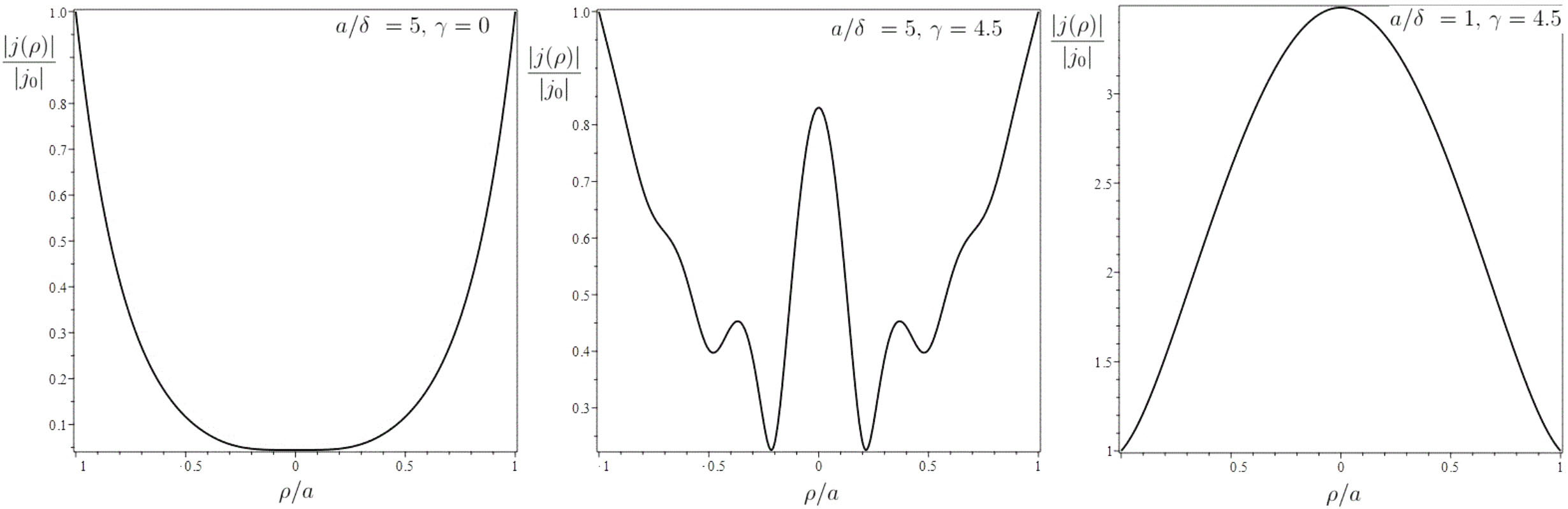
An example of such calculations is shown in Figure 1, where we plot the current density distribution for different values of a/δ and γ. At γ → 0 (good conductors with very large values of σ), there is an ordinary skin effect (left part of Figure 1) which is entirely determined by the second term in equation (5).

The magnitude of the current density |j(ρ)| normalized to its value at the surface of the wire for different values of a/δ and γ.
Conversely, for relatively large values of γ and small ratios a/δ (poor conductors with relatively small radius a), the third term in equation (5) plays a dominant role. This situation for the case of insulators is considered in detail in Ref. [8] and the Feynman lectures on physics [9]. In the case of conductors (γ has a finite value), it leads to the inverse skin effect where the electric current is concentrated mainly in the central part of the wire (right part of Figure 1). In general case, there is an interplay between the second and third term in equation (5) which leads to the occurrence of quite a complex picture of the current density distribution (middle part of Figure 1).
In Figure 2 we plot the phase shift φ0 distribution for different values of a/δ and γ. For the significant skin effect (a/δ ≫ 1) there is a set of jump discontinuities accompanied by sharp changes in phase shift by 2π (left and middle part of Figure 2) [1]. These discontinuities are associated with the zeros of the imaginary part of the Bessel function (9) which exist simultaneously with the negative values of its real part. The number of these discontinuities increases as the ratio a/δ increases. As a consequence of these discontinuities, the radial dependence of the instantaneous current density is an oscillating function (Figure 3) [1].


3. The Impedance
The internal complex impedance Zint(ω) can be found as the ratio of the voltage drop V along a linear distance l of the wire surface to the total current I carried by the wire. We have:
where jD = ϵ0ϵr(∂E/∂t) = −iγj is the displacement current density. Considering equation (9), we get:
where J1(r) is the first-order Bessel function of the first kind. Then
where R0 = l/(πσa2) is the static (ω = 0) resistance of the wire; R = ℜ(Zint) and ωLint(ω) = ℑ(Zint) are the frequency-dependent resistance and inductive reactance; Lint is the internal inductance.
The last equality in equation (13) is the usual representation of a complex number as the sum of its real and imaginary parts. These parts can be expanded in terms of Kelvin functions [10] or obtained numerically with the assistance of Maple software as used here.
The total impedance can be can be represented as follows [11]:
where Lext is the external inductance of the wire. In the case of the significant displacement current, the calculation of the external inductance represents a separate complex problem.
Figure 4 shows the behavior of the internal impedance of the solid cylindrical conductor of pure copper at 20°C with two different conductor radii and conductivity σ = 5.9⋅107 Ω−1 m−1. It is seen that the skin effect is more pronounced for large-diameter wires.

In the limit of ω → 0 (the low-frequency approximation), we should put γ = 0 in equation (13) and consider Zint as a function of a purely imaginary argument, whose absolute value is close to zero. In this case, we can use Taylor expansion of the Bessel function ratio in equation (13) and obtain [11]:
where L0 = μrμ0l/(8π) is the low-frequency constant internal inductance of a length l of wire. For ω → ∞, σ → ∞, ω/σ → 0 (the high-frequency approximation or strong skin effect for good conductors) the Bessel function ratio in equation (13) tends to −i [11]. Therefore,
Hence, at high frequencies, resistance and the absolute value of the internal inductive reactance of good conductors are approximately equal and both are to the square root of the applied frequency ω. In Figure 5 we plot frequency dependence graphs of both normalized resistive and reactive components of copper wire at 20°C with two different conductor radii.
The frequency dependences of both normalized resistive and internal reactive components of copper wire at 20°C.
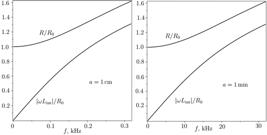
Figure 6 presents the frequency dependence of the internal impedance and its components for the column of brackish water (poor conductor with σ = 0.1 Ω−1 m−1) with radius a = 1 cm. We see that at high frequencies, unlike good conductors, all these quantities are monotonically decreasing functions of ω. This pattern has already been experimentally revealed in germanium plates [12] and can be explained by the existence of the inverse skin effect. Moreover, the internal inductive reactance reaches a maximum at some intermediate frequency value.

The frequency dependences of the internal impedance and its components for the column of brackish water.
4. Conclusion
This paper presents a comparative analysis of the electrical properties of good and poor conductors in the case of high-frequency electric current flowing through them. In particular, we discuss the conditions for the occurrence of the inverse skin effect where the electric current is concentrated mainly in the central part of the wire. We show that under these conditions the internal impedance and its components of poor conductors are monotonically decreasing functions of the frequency in the high-frequency range.
An interested student may wish to continue our analysis by plotting the radial current density distribution from the same examples in Figure 1, but normalized to the total current I0. We can also invite the reader to continue our consideration by analyzing the frequency dependences of the phase angle of internal impedance and internal inductance for both good and poor conductors.
References
- [1] O. Coufal, Appl. Sci. 13, 12416 (2023).
- [2] N. Gauthier, Am. J. Phys. 54, 649 (1986).
- [3] E.N. Miranda, Int. J. Elect. Enging. Educ. 36, 31 (1999).
- [4] G.S. Smith, Eur. J. Phys. 35, 025002 (2014).
- [5] V. Mathew and P. Arun, Phys. Educ. 52, 043007 (2017).
- [6] F. Capelli and J.R. Riba, Electr. Eng. 99, 827 (2017).
- [7] V. Rudnev, D. Loveless, R.L. Cook, Handbook of Induction Heating (CRC Press, Boca Raton, 2017).
- [8] A Beléndez, J.J. Sirvent-Verdú, T Lloret, J.C. García-Vázquez and R. Ramírez-Vázquez, Eur. J. Phys. 45, 045201 (2024).
- [9] R. Feynman, R. Leighton and M. Sands, The Feynman Lectures on Physics Vol. 2: Mainly Electromagnetism and Matter (Persus Books Group, New York, 2013).
- [10] O.M.O. Gatous and J.P. Filho, in: IEEE/PES Transmision and Distribution Conference and Exposition: Latin America (São Paulo, 2004).
- [11] M.S. Raven, Acta Technica CSAV 60, 51 (2015).
- [12] A.H. Frei and M.J.O. Strutt, Proceedings of the IRE 48, 1272 (1960).
Edited by
-
Editor-in-Chief:
Marcello Ferreira https://orcid.org/0000-0003-4945-3169