
 Vascular ligation simulation using bovine model
ABSTRACT
Introduction: Venous dissection and the vascular ligation technique are of critical importance; therefore, given their relevance and effectiveness, knowledge is crucial for the training of medical students.
Experience report: Given the above, the objective of the study was to report a practical activity, simulating dissection and vascular ligation in a non-living biological model, for 4th-year medical students, describing the steps of the procedure.
Discussion: Practical training in surgical skills for medical students is of paramount importance, highlighting its relevance for future clinical practice and patient safety.
Conclusions: The proposed example had good acceptability in vessel ligation training, and the possible reproduction of the practice is notable, with good quality and low financial cost, which makes it viable for teaching. Additional studies are needed to validate the technique.
Keywords:
Simulation; Dissection; Ligature; Animal models; Medical education
RESUMO
Introdução: Como a dissecção venosa e a técnica de ligadura vascular assumem uma importância crítica, é crucial, perante sua relevância e eficácia, o conhecimento para a formação do acadêmico em Medicina.
Relato de experiência: Diante do exposto, o objetivo do estudo foi relatar a atividade prática - simulando a dissecção e ligadura vascular em um modelo biológico não vivo - para acadêmicos do quarto ano do curso de Medicina, com a descrição das etapas do procedimento.
Discussão: O treinamento prático em habilidades cirúrgicas para estudantes de Medicina é de suma importância, de modo a destacar sua relevância para a prática clínica futura e a segurança do paciente.
Conclusão: O exemplo proposto teve boa aceitabilidade no treinamento de ligadura de vaso, e é notória a possível reprodução da prática, com boa qualidade e baixo custo financeiro, o que se torna viável para o ensino. Estudos adicionais são necessários para a validação da técnica.
Palavras-chave:
Simulação; Dissecação; Ligadura; Modelos Animais; Educação Médica
INTRODUCTION
Trauma is one of the main causes of morbidity and mortality in the world, with 4.9 million deaths per year worldwide, comprising more than 90% of deaths related to these injuries in low- and middle-income countries, with a prevalence of traffic accidents (TA), mainly involving adolescents and young adults1),(2.
TA currently occupies the ninth position among the main causes of death in the world, occurring mainly among the population aged between five and 29 years of age, representing a serious public health problem. Brazil remains in third place among the countries with the highest numbers of traffic deaths, with TA being the second cause of preventable non-natural death, generating around 40,000 deaths per year. Damage ranges from death due to immediate and early trauma, severe brain injuries, or significant blood loss after penetrating or blunt trauma3),(4. Therefore, directly or indirectly, they cause fractures or injuries, resulting in massive post-traumatic bleeding, with hemorrhage as the most frequent cause of avoidable death in patients with trauma in the hospital environment4),(5.
To contain hemorrhages, the physician must be prepared to identify the injured vessel and adopt appropriate management. The main vascular structures affected are the veins, especially the venae cavae in 29% of the cases, the iliac veins in 20%, followed by injury to the iliac arteries in 16%; however, venous or arterial treatment follows similar approaches, such as ligation, transient bypass, and tamponade of the vessels6.
Venous dissection consists of the isolation and distal ligation of a vein, performed under local anesthesia, and may involve both superficial and deep veins7. However, due to the low frequency of phlebotomies, this procedure is rarely practiced and observed by medical students, becoming little known and valued.
Given its relevance and effectiveness, it is essential that students acquire theoretical knowledge (indications, contraindications, and complications) and carry out practical training with the appropriate technique in a supervised environment. This is crucial for the training of professionals and to minimize risks to patients8.
In this sense, the training of skills is necessary before practice, aiming to integrate new knowledge and/or improve preexisting ones, as complex surgeries and procedures require different levels of dexterity. The creation of strategies for surgical training and invasive procedures, with different models and levels of complexity, is essential9. Medical practices in simulated scenarios significantly improve the teaching-learning process considering the development of psychomotor techniques for basic skills, aiming at the applicability in surgical internships and invasive procedures, with the objective of reducing iatrogenic risks, negligence and malpractice10.
The use of non-living biological models reproduces different situations and is able to represent all stages of the procedures, differentiating itself from non-biological models11. The bovine tongue has been used as a substitute for human skin, because in addition to its low cost and the fact that it is easily acquired, its aspects resemble different tissues, such as the dorsal surface of the tongue, especially the distal portion, which mimics human thick skin in relation to thickness and consistency; the ventral aspect of the tongue simulates a delicate epidermis; and the tongue thickness allows the training of intradermal and deep sutures, as well as subcutaneous sutures12.
In view of the aforementioned context, considering the importance of the technique of venous dissection and vessel ligation in medical practice and the obstacles in the teaching of surgical techniques during undergraduate studies, this article discusses the technique of practical simulation of venous dissection and vessel ligation using a non-living biological model.
Therefore, the objective of this study was to report the creation of a practical activity, simulating vascular dissection and ligation in a non-living biological model, for 4th-year medical students, portraying with greater veracity all stages of the procedure.
EXPERIENCE REPORT
The activity was applied to 4th-year students of the medical course at a private institution located in the interior of São Paulo, in the months of August and September 2023. The students were placed in small groups, with an average of 20 students in each activity, supervised by a surgeon and a nurse.
The activities were carried out in a laboratory that simulates practice, consisting of a women’s and men’s locker room, a scrubbing area and an operating room.
MATERIALS
Description of the making of the biological model
The bovine tongue was assembled by laboratory technicians. Initially, a cut was made on the posterior surface of the tongue with a scalpel, and Metzenbaum scissors were used to deepen the cut. After that, 02 latex tubes were inserted, measuring 4.5 mm in their internal diameter and 07 mm external diameter, measuring about 15 cm in length each, and a simple point was made for fixation (Figure 1).

Initially, the bovine tongue was divided into three portions to facilitate the practice. With the posterior face on the bench, the cut was made with a scalpel, about 10 cm long and 02 cm deep.
Budget:
To carry out the activity, some materials were already available at the institution, such as the instruments used in the procedures. However, it was necessary to purchase other items, as listed below:
-
Degerming brush with chlorhexidine - R$ 2.88
-
Fabric gown (S, M, L and XL) - R$ 120.00
-
Pair of sterile gloves (6.5, 7.0, 7.5, 8.0) - R$ 1.90
-
Sterile fenestrated drape (30 cm x 30 cm) - R$ 5.93
-
Alcohol 70% (1L) - R$ 7.24
-
Sterile gauze package (10 units) - R$ 0.70
-
Micropore (25 mm x 10 meters) - R$ 6.00
-
Absorbable suture thread (polyglycolic acid), 4-0, 3/8 atraumatic needle, 3.0 cm (VetSuture, 24 units) - R$ 259.00
-
Non-absorbable suture thread (black nylon), 4-0, 3/8 traumatic needle, 2.0 cm (TechSuture, 24 units) - R$ 47.93
-
Bovine tongue (800-1000g each) - R$ 16.50
These materials complemented the existing resources and allowed the adequate performance of the planned activity.
Thus, the investment for each student is low, given the advantages attributed to the activity and reduced technological need, obtaining a cost per student of approximately R$ 187.30 (Table 1).
Still from the perspective of effective cost for the performance of the activity, we emphasize that our option was to use fabric gowns, which are reusable after being washed in our laboratory. In this way, the cost of the next class of students is reduced by R$ 120.00 (individual cost of the coat). The first group amounted to R$ 187.30 per student and from the second onwards, R$ 67.30 per student.
Description of the technique
Initially, students were directed to the locker rooms to put on disposable gowns and masks, remove adornments and perform simple hand hygiene. Afterwards, they performed antisepsis in the preoperative period with the use of a brush soaked in degerming solution in the scrubbing area and, subsequently, hand drying. Sterile gowns and gloves were worn in the operating room. With the students wearing the adequate garments, the orientations in relation to the practical activity were carried out step by step by the teachers.
The tables were lined with sterile drapes and arranged as follows: a N. 15 scalpel, a 4-scalpel handle, a rat-tooth forceps, a straight Mayo scissors, a straight Metzenbaum scissors, two straight Kelly forceps, a Mixter forceps, a needle holder, 2-0 Polyglycolic Acid suture, 4-0 Nylon suture, 40 cm of string, two Farabeuf retractors, a round basin for asepsis, a package of sterile gauze, a 40x12mm needle, a 25x70mm needle, a 10 mL syringe and two 10 mL bottles of saline solution, sterile fenestrated drape and bovine tongue.
The table assembly was carried out by the assistant student, who instrumented for the student responsible for performing the dissection and ligation; later, the students alternated the positions.
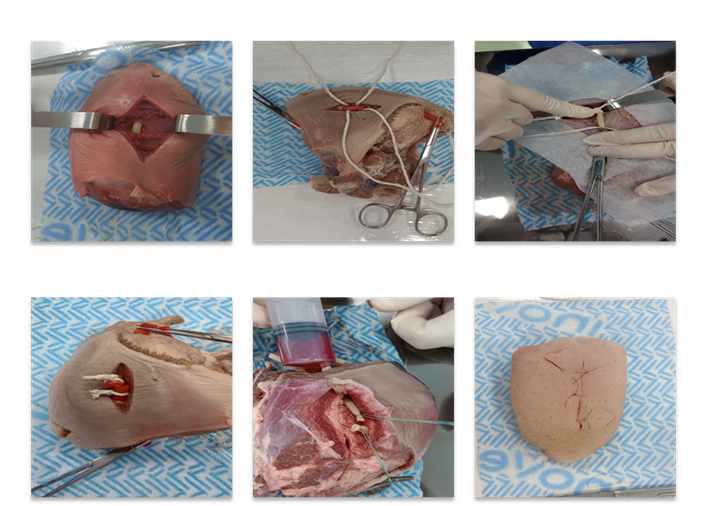
The procedure occurred as follows (Figure 2):
-
Antisepsis of the diaeresis site;
-
Application of anesthesia (simulated with saline solution, using a 10 mL syringe, 40x12mm needle for aspiration and 25x70mm for application) at the diaeresis site;
-
Covering the region with sterile fenestrated drape;
-
Incision with a scalpel, followed by divulsion with Metzenbaum scissors and rat tooth forceps, contemplating the diaeresis stage;
-
Presentation of the field by the student handing the instruments, using Farabeuf retractor;
-
Progression of divulsion using Metzenbaum scissors;
-
Identification of the vessel (simulated by a middle tourniquet), and when it was detected, it was divulsed until the perception of total separation from the adjacent tissues was attained, and a string was passed around it, using the Mixter forceps, performing at the two longitudinal extremities of the vessel;
-
Through the strings, the surgeon’s knot (bimanual Pouchet) was performed, followed by two consecutive Pouchet knots with the middle finger at each longitudinal end of the vessel;
-
After performing the knots, venotomy (transversal) was performed using straight Mayo scissors;
-
Subsequently, subcutaneous sutures were performed to approximate the tissues, using 2-0 Polyglycolic Acid thread;
-
Then, epidermal suture was performed with 4-0 Nylon thread, ending the activity;
-
After the end of the activity, the students discarded the materials used in their proper disposal sites (infectious waste and sharps), and the laboratory technicians remove the bovine tongues and dispose of them in black waste bags.

DISCUSSION
Practical training in surgical skills for medical students is of paramount importance, highlighting its relevance to future clinical practice and patient safety13. The teaching techniques in this area are advancing with innovations in anatomical models and augmented reality simulators, providing more tools for the development of necessary competencies in simulated environments. Theoretical knowledge and improvement of manual skills are important in view of the low performance of these practical procedures during the undergraduate course and considering the need to ensure the desired skills for the physician during critical trauma situations.
In trauma care, bleeding control and obtaining vascular access are essential to ensure patient survival. The vascular ligation technique is of critical importance, being essential to contain potentially fatal hemorrhages, stabilizing the patient until more advanced medical care is available. In addition to the initial conducts of hemodynamic stabilization requiring rapid vascular access, which is a challenge for the team, urging decision-making, technical knowledge and adequate management of the possibilities in each unique situation.
In this context, the utilization of low-cost anatomical models has been used as a solution to improve practical activities during undergraduate studies, but human cadavers and animal models continue to be the gold standard for education based on procedural health14. It is worth noting that one of the main complications found in surgical practices in industrial models is the wear of the material in the presence of damage caused by perforations, dissection at each use by the students, highlighting the evaluation of costs and accessibility of the materials15. Therefore, more economically accessible alternatives have been sought, such as the use of models with refills and biological materials, of swine and bovine origin, for the construction of simulators.
Previous studies have described low-cost techniques; these involve simulators built with affordable and renewable materials, seeking the greatest similarity of the procedures in possible real scenarios. For the construction of the limbs and refill of only a portion of the part used in the procedure, a description used floating pool spaghetti, latex tube and synthetic silicone rubber skin for the construction of the lower limb for the practice of venous dissection, with an average production price of R$350.0016. Swine models were previously used for training in the cricothyroidotomy technique17 and venous dissection, and for the latter, evaluations were carried out among the students participating in the study, which considered a good anatomical correlation with the practice simulator8.
Despite the limitations and poorly answered questions about the learning curve in specific conditions in the surgical area, a systematic review considered the feasibility and usefulness of patient-specific simulation for surgical education as a support tool in competency training18. The future applications of practical simulations, with the incorporation of new technologies that enable the development of more complex scenarios, productively corroborate the safe and efficient consolidation of surgical skills in simulated scenarios and their transfer into real practice19. Among the technologies described are robotic simulators, but the high cost and low institutional access are still limiting in the reality of educational institutions20.
The present study, due to its descriptive nature of a teaching technique, has the limitation of not systematically evaluating the impact of the simulation application in medical students on the learning of the technique, nor does it compare the efficiency and efficacy with other techniques already mentioned in the literature.
CONCLUSIONS
Experimental training models are crucial for the development of manual dexterity, better techniques and results, generating greater confidence in the performer. The act helps to develop precision of movement, sensory and anatomical conditions, so the repetition of the process leads to satisfactory results naturally. This model is something simple, practical and of great value in supervised learning during the medical undergraduate course, or even for constant exercise of the technique. Thus, the proposed model had good acceptability in the training of vessel ligation, and the possible reproduction of the model is notorious, with good quality and low financial cost, which becomes feasible for teaching. Additional studies are needed to validate the technique.
References
-
1 Soni KD, Bansal V, Arora H, Verma S, Wärnberg MG, Roy N. The state of global trauma and acute care surgery/surgical critical care. Crit Care Clin. 2022 Oct 1º;38(4):695-706 [acesso em 26 jul 2023]. Disponível em: Disponível em: https://www.sciencedirect.com/science/article/pii/S0749070422000458
» https://www.sciencedirect.com/science/article/pii/S0749070422000458 - 2 Brown HA, Tidwell C, Prest P. Trauma training in low- and middle-income countries: a scoping review of ATLS alternatives. Afr J Emerg Med. 2022 Mar;12(1):53-60.
- 3 Koch DA, Hagebusch P, Lefering R, Faul P, Hoffmann R, Schweigkofler U. Changes in injury patterns, injury severity and hospital mortality in motorized vehicle accidents: a retrospective, cross-sectional, multicenter study with 19,225 cases derived from the TraumaRegister DGU®. Eur J Trauma Emerg Surg. 2023 Mar 8;49(4):1917-25.
- 4 Keel M, Trentz O. Pathophysiology of polytrauma. Injury. 2005;36:691-709.
- 5 Lier H, Böttiger BW, Hinkelbein J, Krep H, Bernhard M. Coagulation management in multiple trauma: a systematic review. Intensive Care Med. 2011 Feb 12;37(4):572-82.
-
6 Garcia A, Millan M, Burbano D, Ordoñez CA, Parra MW, González-Hadad A, et al. Damage control in abdominal vascular trauma. Colomb Med. 2021 Nov 18;52(2):e4064808 [acesso em 23 abr 2023]. Disponível em: Disponível em: https://www.ncbi.nlm.nih.gov/pmc/articles/PMC8754163/pdf/1657-9534-cm-52-02-e10.pdf
» https://www.ncbi.nlm.nih.gov/pmc/articles/PMC8754163/pdf/1657-9534-cm-52-02-e10.pdf - 7 Cunha CMQ da, Frota Júnior JAG, Ferreira JD, Troiani Neto G, Félix DF, Menezes FJC de. Montagem e aplicação de modelo de baixo custo de dissecção venosa. Rev Med. 2017;96(4):220-224.
- 8 Spencer Netto FC, Silva MTB, Constantino MM, Cipriani RFF, Cardoso M. Educational project: low-cost porcine model for venous cutdown training. Rev Col Bras Cir. 2017 Oct 1º;44(5):545-8.
-
9 Olijnyk LD, Patel K, Brandão MR, Morais ANL de, Carvalho RF de, Severino AG, et al. The role of low-cost microsurgical training models and experience with exercises based on a bovine heart. World Neurosurg. 2019 Oct 1º;130:59-64 [acesso em 23 abr 2023]. Disponível em: Disponível em: https://pubmed.ncbi.nlm.nih.gov/31238170/
» https://pubmed.ncbi.nlm.nih.gov/31238170/ - 10 Sullivan S, Ruis A, Pugh C. Procedural simulations and reflective practice: meeting the need. J Laparoendosc Adv Surg Tech. 2017 May;27(5):455-8.
- 11 Pinheiro MF, Kleber R, Maciel J, Henrique E, Valente AL, Feijó DH, et al. Modelo de dissecção e acesso vascular de baixo custo. Rev Soc Bras Clin Med. 2018;16(3):171-3.
- 12 Franco D, Medeiros J, Grossi A, Franco T. Uso de língua bovina na prática de técnicas de sutura. Rev Col Bras Cir . 2008;35(6):442-4.
- 13 Nabavi A, Schipper J. Op.-Simulation in der Chirurgie. HNO. 2016 Sept 28;65(1):7-12.
- 14 Wanderling C, Saxton A, Phan D, Sheppard L, Schuler N, Ghazi A. Recent advances in surgical simulation for resident education. Curr Urol Rep. 2023 Sept 22;24(11):491-502.
- 15 Ritter KA, Leifer D, Orabi D, Prabhu A, French J, Lipman JM. How we do it: creation of a low-cost endoscopic skills model for fundamentals of endoscopic surgery training. J Surg Educ. 2019 Nov 1º;76(6):1456-9.
- 16 Figueiredo IAT da S, Sena HC, Cabral M, Lima J, Maciel J, Nascimento FC. Modelo de simulação em dissecção de acesso vascular. Braz J Health Rev. 2021;4(5):19082-96.
- 17 Spencer Netto FAC, Zacharias P, Cipriani RFF, Constantino MDM, Cardoso M, Pereira RA. A porcine model for teaching surgical cricothyroidotomy. Rev Col Bras Cir . 2015 Jun;42(3):193-6.
- 18 Ryu WHA, Dharampal N, Mostafa AE, Sharlin E, Kopp G, Jacobs WB, et al. Systematic review of patient-specific surgical simulation: toward advancing medical education. J Surg Educ . 2017 Nov;74(6):1028-38.
-
19 Buckley CE, Kavanagh DO, Traynor O, Neary PC. Is the skillset obtained in surgical simulation transferable to the operating theatre? Am J Surg. 2014 Jan;207(1):146-57 [acesso em 25 jan 2020]. Disponível em: Disponível em: https://www.sciencedirect.com/science/article/abs/pii/S0002961013005680
» https://www.sciencedirect.com/science/article/abs/pii/S0002961013005680 - 20 Kumar A, Smith R, Patel VR. Current status of robotic simulators in acquisition of robotic surgical skills. Curr Opin Urol. 2015 Mar;25(2):168-74.

 Source: prepared by the authors.
 Source: prepared by the authors.