 Sorghum genotypes with potential resistance to the aphid Melanaphis sorghi (Hemiptera: Aphididae)
ABSTRACT
The sorghum aphid Melanaphis sorghi (Hemiptera: Aphididae) has become the primary threat to crop production in various parts of the world. Although the combined use of organosynthetic insecticides and resistant hybrids is a common strategy in countries like the USA, Brazilian farmers face the challenge of a lack of registered active ingredients and resistant cultivars against M. sorghi. This study aimed to evaluate grain sorghum genotypes for resistance to M. sorghi infestation. In the initial screening phase, 28 genotypes were evaluated, from which eight were selected and grouped as: i) resistant to M. sorghi (BRS373, CMSXS3017, BRS310, and SC110 [control]); and ii) susceptible (CMSXS3012, 1822043, 2116017, and AG 1085), for further assessment and determination of productivity in subsequent stages. The trial was conducted in a greenhouse under controlled humidity and temperature, with three controlled artificial infestations and injury assessments every seven days. Aphid infestation primarily reduced the plant fresh weight of the plant and grain size, negatively affecting grain weight per panicle. Without M. sorghi infestation, the hybrid genotypes AG 1085, 1822043, and CMSXS3012 showed the highest grain weight; however, they were susceptible to aphids when infested. Under infestation, the most resistant genotypes with the highest grain weight values were CMSXS3017, SC110, BRS373, and BRS310. The SC110 lineage was minimally affected by aphid infestation and should be used as a source of resistance in breeding programs for aphid tolerance. The results of this study may be used to evaluate productivity losses due to sorghum aphid infestation and to propose potential resistant genetic materials. Combined with other integrated management tactics, these findings can make sorghum aphid control more precise and sustainable.
Keywords:
Plant resistance; Yellow aphid; Integrated pest management; Sorghum bicolor
Introduction
The sorghum aphid Melanaphis sorghi (Hemiptera: Aphididae), previously identified as the sugarcane aphid Melanaphis sacchari (Nibouche et al., 2021), is considered the primary phytosanitary problem for sorghum cultivation in the Americas (Nibouche et al., 2018; Avellar et al., 2023). Its successful invasion and establishment in these areas are attributed to its adaptability to a wide range of climatic conditions and ecosystems (Armstrong et al., 2015; Haar et al., 2019), its broad host range (Bowling et al., 2016), and its efficient reproductive and dispersal capacity, which present challenges for effective control, leading to significant economic losses (Souza and Davis, 2020; Harris-Shultz and Ni, 2021).
The sorghum aphid feeds on phloem sap, which is rich in sugars, from healthy leaf and stem tissues (Royer et al., 2015). Feeding injuries caused by M. sorghi also result in the production of large amounts of honeydew, a sugary substance that promotes the growth of dark sooty mold fungi on plant surfaces. This creates favorable conditions for phytopathogens, reducing photosynthesis in affected leaves (Bowling et al., 2016; Pekarcik and Jacobson, 2021). Additionally, plants may exhibit symptoms such as chlorosis and necrosis of leaves, stunted growth, delayed or hindered panicle emergence, and reduced or arrested plant development, directly affecting crop yield (Haar et al., 2019; Wilson et al., 2020; Lahiri et al., 2021).
Considering the highly destructive and reproductive capacity of the pest, which has intensified with rising global temperatures, assertive field management of M. sorghi is essential. Host plant resistance, combined with other integrated management tactics, is a crucial tool in M. sorghi control. Resistant cultivars provide a baseline of protection, suppressing population growth rates, reducing injuries, and improving grain yield (Pekarcik and Jacobson, 2021). Therefore, it is urgent to study sorghum plant defenses that can be incorporated into breeding programs for resistance to sorghum aphids.
Plant resistance to herbivorous insects and other arthropods is a complex phenomenon involving a variety of plant traits that reduce herbivore damage. These resistance mechanisms are often categorized into three primary types: antixenosis, antibiosis, and tolerance (Painter, 1951). Understanding these mechanisms is crucial for developing sustainable pest management strategies and breeding resistant crop varieties. Antixenosis, also referred to as non-preference, describes plant characteristics that deter herbivores from colonizing, feeding, or ovipositing on a particular host (Dudareva et al., 2013; Smith et al., 2021; Zhang et al., 2022). These characteristics can involve a range of physical and chemical plant attributes. Antibiosis involves plant traits that negatively affect herbivore biology, such as survival, growth, development, or reproduction, after the herbivore has begun to feed on or utilize the plant (Dahlman and Hibbs, 1975). These effects are typically mediated by toxic or antinutritional compounds present in the plant tissue. Finally, the tolerance differs from antixenosis and antibiosis in that it does not affect herbivore behavior or biology. Instead, tolerance describes the ability of a plant to withstand or recover from herbivore damage without significant yield or fitness reduction (Painter, 1951). Tolerant plants can maintain their productivity despite sustaining a level of herbivore damage that would severely affect susceptible plants (Rao et al., 2020).
While the combined strategy of resistant hybrids and organosynthetic insecticides has been validated in various studies in the USA (Lahiri et al., 2021; Pekarcik and Jacobson, 2021; Uyi et al., 2022; Vasquez et al., 2025), there are no registered organosynthetic insecticides for M. sorghi control in sorghum crops in Brazil. Thus, investigations into resistant sorghum cultivars should be prioritized. Initial steps in plant breeding focus on identifying resistance in regionally adapted commercial materials already bred for other characteristics, especially grain yield. Only after this preliminary evaluation, and if no source of resistance is found, the next step is to introduce resistance from exotic or less-enhanced material.
Studies indicate that different sorghum genotypes exhibit significantly distinct phenotypic responses influenced by aphid infestation (Armstrong et al., 2015; Bayoumy et al., 2016). Given the current scenario of high field infestations by the sorghum aphid, it is necessary to find genotypes with potential resistance traits to recommend them in sorghum integrated pest management and breeding programs. This study aimed to evaluate sorghum genotypes (pre-commercial and commercial) for resistance levels to the sorghum aphid Melanaphis sorghi.
Materials and methods
Plants
The trials were conducted in a controlled greenhouse environment with an average temperature of 26 ± 2°C and relative humidity of 60 ± 10%.
Initially, 28 grain sorghum genotypes, including varieties and pre-launch hybrids from the Embrapa Milho e Sorgo (Brazil) germplasm bank were evaluated. After the screening phase, eight genotypes were selected: three commercial, four in the pre-launch phase, and one resistant lineage (=standard). The selected grain sorghum hybrids included BRS373, CMSXS3017, AG1085, CMSXS3012, BRS310, 1822043, and 2116017, as well as the resistant SC110 lineage (=standard). Among these, four genotypes (BRS373, CMSXS3017, BRS310, and SC110) were identified as more resistant to M. sorghi, while four (CMSXS3012, 1822043, 2116017, and AG1085) were classified as susceptible.
Transplantation was performed in 18-liter pots filled with Tropstrato Hortaliças® commercial substrate to evaluate plant characteristics such as plant fresh weight, plant dry weight, 1000-grain weight (with 10 replicates =plants), and grain yield to assess the damage caused by aphids. Each pot was irrigated individually as needed to maintain substrate saturation throughout the trial.
Insects and plant infestation
Populations of M. sorghi were collected from both greenhouse-grown (under controlled conditions at 25 ± 2 °C, 65 ± 10% relative humidity, and a photoperiod of 16 hours light and 8 hours dark) and field-grown plants. Artificial infestation was performed 19 days after sowing. Leaf fragments of approximately 4 cm2, taken from infested plants in the greenhouse, were used to introduce aphids to the experimental plants.
Infestation percentage and the severity of aphid-induced injuries were evaluated at 21 days after each infestation cycle. At the end of the experiment, the aphid population was controlled with foliar application of Verter® insecticide (Sulfoxaflor: Sulfoximines) at a rate of 70 ml/ha to prevent further damage and allow the completion of the crop cycle.
A five-grade scale was employed to assess infestation, progressing from Grade 1 (20%) with few aphids and no exuviae, to Grade 2 (40%) where exuviae became apparent. Grade 3 (60%) denoted a moderate aphid population, numerous exuviae, and the emergence of symptoms like leaf discoloration, with large colonies exceeding 50 aphids per leaf. Grade 4 (80%) was characterized by a large aphid population, abundant exuviae, and symptom expression both centrally and marginally on the leaves. Finally, Grade 5 (100%) represented a plant overwhelmed by aphids and exuviae, exhibiting severe symptoms throughout, and the beginning of leaf death. (Fernandes et al., 2021). Genotypes that did not survive until the end of the experiment were classified as “dead plants.” The uninfested control group of plants consisted of the same materials (i.e., eight treatments with five replicates). To manage potential infestations, Verter® insecticide was applied throughout the crop cycle at a dose of 0.4 L/ha.
Statistical analysis
Preliminary data analysis included the Shapiro-Wilk test to assess normality and the Levene test to evaluate homogeneity of variance, both at a 5% significance level. The presence of outliers in the response variables (=outliers) was also assessed using box-plot visualizations. Ensuring assumptions were met is necessary when applying the use of parametric tests.
A completely randomized design (CRD) was used, with explanatory variables (x's) being M. sorghi infestation and sorghum cultivar, and response variables (y's) including dry matter weight, plant fresh weight, grain weight, and 1000-grain weight (in grams). The plants were maintained in the greenhouse until the panicle reached the maturation stage for harvesting. An initial Analysis of Variance (ANOVA) was performed, followed by the Scott-Knott test for mean comparisons at a 5% significance level, provided that the assumptions for such models were satisfied.
For preliminary data analysis, model fitting, and graph generation, the R statistical environment (R Development Core Team, 2024, v.4.4.1) was used. The packages MASS, car, and rstatix were employed for model adjustments, while ggplot2 was used for generating graphs. The numerical dataset, scripts for model fitting, and graph generation will be stored in an open-access GitHub repository to enhance the reproducibility and verification of results by other researchers (Gandrud, 2020).
Results
The evaluation of M. sorghi injury in the 28 sorghum genotypes was assessed 21 days after infestation (F = 4.69, df = 236, p < 0.001). The choice of genotypes to be evaluated in the next stage was based on the results in Table 1.
Mean (± standard deviation) of Melanaphis sorghi injury at 21 days after the initial infestation in a greenhouse. Means followed by the same letter do not differ by the Scott-Knott test at 5% significance.
The infestation of the sorghum aphid M. sorghi reduced dry matter by 0.8 times (F= 82.0; df = 1; p < 0.001; Fig. 1a), plant fresh weight by 0.5 times (F= 129.9; df = 1; p < 0.001; Fig. 1b), grain weight by 0.5 times (F= 214.9; df = 1; p < 0.001; Fig. 1c), and 1000-grain weight by 0.5 times (F= 202.0; df = 1; p < 0.001; Fig. 1d) in sorghum plants.
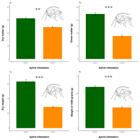
Infestation by the sorghum aphid Melanaphis sorghi reduced (a) dry matter, (b) plant fresh weight, (c) grain weight, and (d) 1000-grain weight (mean ± standard deviation) in sorghum plants. (*** statistically significant difference at 1% significance level for F-test). July 2024. Sete Lagoas, MG, Brazil.
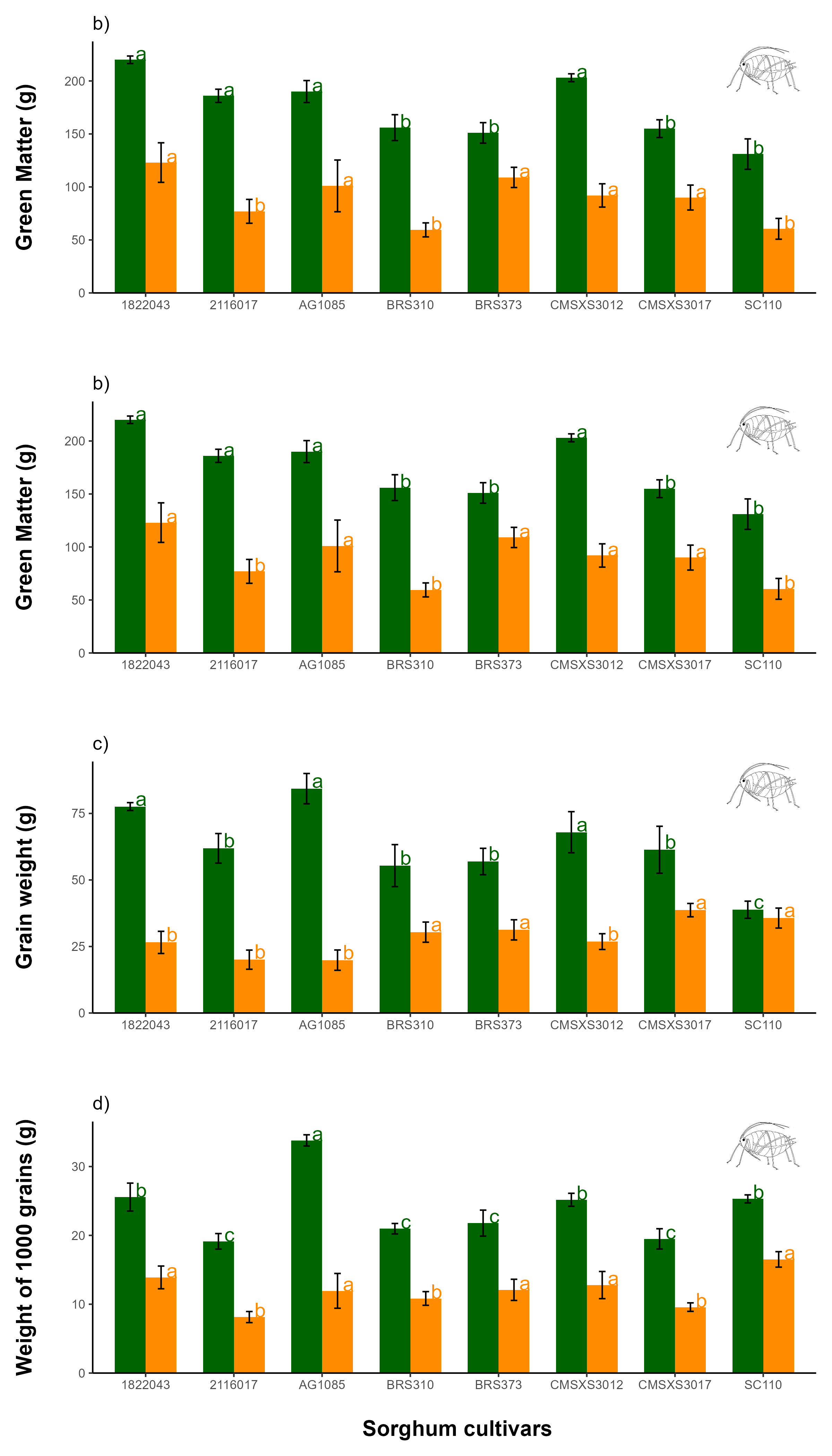
In the absence of M. sorghi infestation (Fig. 2, green bars), the genotypes with the highest dry matter values, in descending order, were 1822043, CMSXS3012, 2116017, and AG1085 (F= 15.2; df = 7; p < 0.001; Fig. 2a). For plant fresh weight, the highest values were observed in 1822043, CMSXS3012, AG1085, and 2116017 (F= 10.6; df = 7; p < 0.001; Fig. 2b). For grain weight, the highest values were for AG1085, 1822043, and CMSXS3012 (F= 5.2; df = 7; p < 0.001; Fig. 2c), and for the 1000-grain weight, the highest value was observed in AG1085 (F= 13.4; df = 7; p < 0.001; Fig. 2d).

Mean ± standard deviation of (a) dry matter, (b) plant fresh weight, (c) grain weight, and (d) 1000-grain weight for eight sorghum cultivars under absent and present infestation of the aphid Melanaphis sorghi. (Bars followed by the same letter of the same color do not differ statistically by the Scott-Knott post hoc test at 5% significance). July 2024. Sete Lagoas, MG, Brazil.
In the presence of M. sorghi infestation (Fig. 2, orange bars), cultivars with the highest dry matter values, in descending order, were CMSXS3012, AG1085, CMSXS3017, BRS373, 2116017, and 1822043 (F= 4.6; df = 7; p < 0.001; Fig. 2a). For plant fresh weight, the highest values were in 1822043, BRS373, AG1085, CMSXS3012, and CMSXS3017 (F= 2.6; df = 7; p = 0.019; Fig. 2b). For grain weight, the highest values were for CMSXS3017, SC110 (=resistant standard), BRS373, and BRS310 (F= 3.5; df = 7; p = 0.002; Fig. 2c), and for the 1000-grain weight, the highest values were observed in SC110, 1822043, CMSXS3012, BRS373, and AG1085 (F= 2.9; df = 7; p = 0.011; Fig. 2d).
Discussion
The study assessed the reduction in production and the resistance levels of sorghum genotypes to the sorghum aphid M. sorghi. The genotypes were grouped into two categories: the first being genotypes less susceptible to the attack of the sorghum aphid, based on the highest values of the production component, grain weight: CMSXS3017, SC110, BRS373, and BRS310; and the second group being susceptible genotypes, with lower grain weight values: AG1085, 2116017, 1822043, and CMSXS3012. Hybrids AG1085, 1822043, and CMSXS3012 were among the most productive without infestation but proved susceptible when exposed to M. sorghi, which resulted in significant reductions in grain size.
The SC110 lineage (=resistant control) demonstrated a unique response in which despite a reduction in plant fresh weight caused by the aphids, there was no impact on grain production, as reflected in the stable grain and 1000-grain weights. This suggests that SC110 may exhibit a tolerance mechanism, allowing it to withstand injury without yield loss. Tolerance is a plant response that does not affect insect behavior or development. It plays a crucial role in breeding resistant cultivars since insects have a great ability to develop resistant biotypes to plants. This defense mechanism also raises the economic damage threshold for crops, reducing the immediate need for other control tactics (Reese et al., 1994).
Phenotypic plasticity responses of sorghum genotypes to M. sorghi infestation varied significantly. Our results show that M. sorghi infestation affects critical components such as dry matter, plant fresh weight, grain weight, and 1000-grain weight. High aphid densities can cause physiological stress, including soot mold (Capnodium spp.) incidence, leading to symptoms like wilting, chlorosis, and tissue necrosis (Bowling et al., 2016), which can reduce production by over 50% in susceptible hybrids.
In other regions, such as the southern USA, Asia, Africa, Oceania, and other Latin American countries, M. sorghi is a pest of economic relevance, causing significant yield losses (Singh et al., 2004; Peña-Martinez et al., 2016; Brewer et al., 2017; Szczepaniec, 2018; Lahiri et al., 2021). In Brazil, the lack of registered insecticides for sorghum poses additional challenges for controlling this pest.
Research efforts have focused on identifying and selecting resistant plants (Armstrong et al., 2015; Bayoumy et al., 2016; Nibouche et al., 2021). Resistant cultivars provide baseline protection by suppressing aphid population growth rates, reducing injury and damage, and directly benefiting grain yield (Lahiri et al., 2021). Evaluation of resistance mechanisms of M. sacchari in grain sorghum and forage sorghum, such as tolerance, antibiosis and antixenosis (Armstrong et al., 2017; Paudyal et al., 2019; Gordy et al., 2021). As well as integrated control tactics, such as biological and chemical methods (Brewer and Elliott, 2004).
As shown in our results, Gordy et al. (2021) also reported that infestation during sorghum panicle formation resulted in delayed development and malformed grains. Furthermore, infestation during grain filling reduced grain size and weight, causing cumulative yield losses due to multiple stressors, including aphids as biotic stress agents.
This study provides a foundation for future field research on M. sorghi population ecology and interactions with the studied hybrids. Plant-insect interactions vary by environment. Some research groups have also focused their efforts in this direction, seeking to understand the different levels of resistance of hybrids to the sorghum aphid (Bowling et al., 2016; Haar et al., 2019; Souza and Davis, 2020; Gordy et al., 2021). Resistance is strongly influenced by climatic factors like temperature and water regimes. Therefore, considering systematic changes in the climate, studies on environmental drivers of infestation intensity are essential for pest management.
Conclusion
In conclusion, M. sorghi infestation impacts dry matter, plant fresh weight, grain weight, and 1000-grain weight in the studied hybrids. The hybrids CMSXS3017, BRS373, and BRS310, along with the SC110 lineage, showed higher grain weight values, with SC110 (=control) maintaining yield despite reduced plant fresh weight.
Acknowledgments
We are grateful to each person from the ‘Federal University of São João Del Rey’ (UFSJ) and ‘Embrapa Maize and Sorghum’ institutions, who contributed to the development of this project. To ‘Minas Gerais State Research Support Foundation’ (FAPEMIG) and ‘National Council for Scientific and Technological Development’ (CNPq), for partial financial support of this research.
References
-
Armstrong, J. S., Rooney, W. L., Peterson, G. C., Villenueva, R. T., Brewer, M. J., Sekula-Ortiz, D., 2015. Sugarcane aphid (Hemiptera: Aphididae): host range and sorghum resistance including cross-resistance from greenbug sources. J. Econ. Entomol. 108 (2), 576-582. PMid:26470168. http://doi.org/10.1093/jee/tou065
» http://doi.org/10.1093/jee/tou065 -
Armstrong, J. S., Mbulwe, L., Sekula-Ortiz, D., Villanueva, R. T., Rooney, W. L., 2017. Resistance to Melanaphis sacchari (Hemiptera: Aphididae) in forage and grain sorghums. J. Econ. Entomol. 110 (1), 259-265. PMid:28011682. http://doi.org/10.1093/jee/tow261
» http://doi.org/10.1093/jee/tow261 -
Avellar, G. S., Marriel, I. E., Menezes, C. B., de, Santos, D. G., Santos, N. M., Mendes, S. M., 2023. Pulgão Melanaphis sorghi (Theobald, 1904. (Hemiptera: Aphididae) na cultura do sorgo: análise do cenário brasileiro. Entomol. Commun. 5, ec05042. http://doi.org/10.37486/2675-1305.ec05042
» http://doi.org/10.37486/2675-1305.ec05042 -
Bayoumy, M. H., Perumal, R., Michaud, J. P., 2016. Comparative life histories of greenbugs and sugarcane aphids (Hemiptera: Aphididae) coinfesting susceptible and resistant sorghums. J. Econ. Entomol. 109 (1), 385-391. PMid:26357844. http://doi.org/10.1093/jee/tov271
» http://doi.org/10.1093/jee/tov271 -
Bowling, R. D., Brewer, M. J., Kerns, D. L., Gordy, J., Seiter, N., Elliott, N. E., Buntin, G. D., Way, M. O., Royer, T. A., Biles, S., Maxson, E., 2016. Sugarcane aphid (Hemiptera: Aphididae): a new pest on sorghum in North America. J. Integr. Pest Manag. 7 (1), 12. PMid:28446991. http://doi.org/10.1093/jipm/pmw011
» http://doi.org/10.1093/jipm/pmw011 -
Brewer, M. J., Elliott, N. C., 2004. Biological control of cereal aphids and mediating effects of host plant and habitat manipulations. Annu. Rev. Entomol. 49 (1), 219-242. PMid:14651463. http://doi.org/10.1146/annurev.ento.49.061802.123149
» http://doi.org/10.1146/annurev.ento.49.061802.123149 -
Brewer, M. J., Gordy, J. W., Kerns, D. L., Woolley, J. B., Rooney, W. L., Bowling, R. D., 2017. Sugarcane aphid population growth, plant injury, and natural enemies on selected grain sorghum hybrids in Texas and Louisiana. J. Econ. Entomol. 110 (5), 2109-2118. PMid:28962004. http://doi.org/10.1093/jee/tox204
» http://doi.org/10.1093/jee/tox204 - Dahlman, D. L., Hibbs, E. T., 1975. Developmental interactions of Xanthium strumarium with the imported long-horned beetle, Mecas saturnina Entomol. Exp. Appl. 18 (1), 67-77.
- Dudareva, N., Negre, F., Pichersky, E., Gershenzon, J., 2013. Plant volatiles: nature’s molecular signatures. Annu. Rev. Plant Biol. 64, 383-414.
- Fernandes, F. O., Souza, C. S. F., Avellar, G. S., Nascimento, P. T., Damasceno, N. C. R., Santos, N. M., Lima, P. F., Santos, M. V. C., Simeone, M. L. F., Parrella, R. A. C., Menezes, C. B., Oliveira, I. R., Mendes, S. M., 2021. Manejo do pulgão da cana-de- -açúcar (Melanaphis sacchari/sorghi) na cultura do sorgo. Embrapa de Milho Sorgo, Sete Lagoas, p. 1-25. Comunicado Técnico 1.
- Gandrud, C., 2020. Reproducible Research with R and RStudio, 3rd ed. CRC Press, Boca Raton, 276 pp.
-
Gordy, J. W., Seiter, N. J., Kerns, D. L., Reay-Jones, F. P. F., Bowling, R. D., Way, M. O., Brewer, M. J., 2021. Field assessment of aphid doubling time and yield of sorghum susceptible and partially resistant to sugarcane aphid (Hemiptera: Aphididae). J. Econ. Entomol. 114 (5), 2076-2087. PMid:34260707. http://doi.org/10.1093/jee/toab135
» http://doi.org/10.1093/jee/toab135 -
Haar, P. J., Buntin, G. D., Jacobson, A., Pekarcik, A., Way, M. O., Zarrabi, A., 2019. Evaluation of tactics for management of sugarcane aphid (Hemiptera: Aphididae) in grain sorghum. J. Econ. Entomol. 112 (6), 2719-2730. PMid:31504648. http://doi.org/10.1093/jee/toz215
» http://doi.org/10.1093/jee/toz215 -
Harris-Shultz, K., Ni, X., 2021. A sugarcane aphid (Hemiptera: Aphididae) “super-clone” remains on U.S. sorghum and Johnsongrass and feeds on giant Miscanthus. J. Entomol. Sci. 56 (1), 43-52. http://doi.org/10.18474/0749-8004-56.1.43
» http://doi.org/10.18474/0749-8004-56.1.43 -
Lahiri, S., Ni, X., Buntin, G. D., Punnuri, S., Jacobson, A., Reay-Jones, F. P. F., Toews, M. D., 2021. Combining host plant resistance and foliar insecticide application to manage Melanaphis sacchari (Hemiptera: Aphididae) in grain sorghum. Int. J. Pest Manage. 67 (1), 1, 10-19. http://doi.org/10.1080/09670874.2019.1660830
» http://doi.org/10.1080/09670874.2019.1660830 -
Nibouche, S., Costet, L., Holt, J. R., Jacobson, A., Pekarcik, A., Sadeyen, J., Armstrong, J. S., Peterson, G. C., McLaren, N., Medina, R. F., 2018. Invasion of sorghum in the Americas by a new sugarcane aphid (Melanaphis sacchari) superclone. PLoS One 13 (4), e0196124. PMid:29694435. http://doi.org/10.1371/journal.pone.0196124
» http://doi.org/10.1371/journal.pone.0196124 -
Nibouche, S., Costet, L., Medina, R. F., Holt, J. R., Sadeyen, J., Zoogones, A.-S., Brown, P., Blackman, R. L., 2021. Morphometric and molecular discrimination of the sugarcane aphid, Melanaphis sacchari, (Zehntner, 1897) and the sorghum aphid Melanaphis sorghi (Theobald, 1904). PLoS One 16 (3), e0241881. PMid:33764987. http://doi.org/10.1371/journal.pone.0241881
» http://doi.org/10.1371/journal.pone.0241881 - Painter, R. H., 1951. Insect Resistance in Crop Plants. Macmillan, New York.
-
Paudyal, S., Armstrong, J. S., Giles, K. L., Payton, M. E., Opit, G. P., Limaje, A., 2019. Categories of resistance to sugarcane aphid (Hemiptera: Aphididae) among sorghum genotypes. J. Econ. Entomol. 112 (4), 1932-1940. PMid:30972411. http://doi.org/10.1093/jee/toz077
» http://doi.org/10.1093/jee/toz077 -
Pekarcik, A. J., Jacobson, A. L., 2021. Evaluating sugarcane aphid, Melanaphis sacchari (Hemiptera: Aphididae), population dynamics, feeding injury, and grain yield among commercial sorghum varieties in Alabama. J. Econ. Entomol. 114 (2), 757-768. PMid:33595638. http://doi.org/10.1093/jee/toab013
» http://doi.org/10.1093/jee/toab013 -
Peña-Martinez, R., Muñoz-Viveros, A. L., Bujanos-Muniz, R., Luevano-Borroel, J., Tamayo-Mejia, F., Cortez-Mondaca, E., 2016. Sexual forms of sorghum aphid complex Melanaphis sacchari/sorghi in Mexico. Southwest. Entomol. 41 (1), 127-132. http://doi.org/10.3958/059.041.0114
» http://doi.org/10.3958/059.041.0114 - R Development Core Team, 2024. R: a Language and Environment for Statistical Computing. R Foundation for Statistical Computing, Vienna.
- Rao, P. P., Dixon, J., Tan, Y., Horgan, F. G., 2020. Tolerance mechanisms in rice against planthopper and leafhopper pests. Crop J. 8 (1), 17-27.
- Reese, J. C., Schwenke, J. R., Lamont, P. S., Zehr, D. D., 1994. Importance and quantification of plant tolerance in crop pest management programs for aphids: greenbug resistance in sorghum. J. Agric. Entomol. Clemson 11 (3), 255-270.
-
Royer, T. A., Pendleton, B. B., Elliott, N. C., Giles, K. L., 2015. Greenbug(Hemiptera: Aphididae) biology, ecology, and management in wheat and sorghum. J. Integr. Pest Manag. 6 (1), 19. http://doi.org/10.1093/jipm/pmv018
» http://doi.org/10.1093/jipm/pmv018 -
Singh, B. U., Padmaja, P. G., Seetharama, N., 2004. Biology and management of the sugarcane aphid, Melanaphis sacchari (Zehntner) (Homoptera: Aphididae), in sorghum: a review. Crop Prot. 23 (9), 739-755. http://doi.org/10.1016/j.cropro.2004.01.004
» http://doi.org/10.1016/j.cropro.2004.01.004 - Smith, C. M., Clement, S. L., Johnson, D. A., 2021. Breeding arthropod-resistant vegetable crops. Hortic. Rev. 55, 127-192.
-
Souza, M. F., Davis, J. A., 2020. Potential population growth of Melanaphis sacchari (Zehntner) (Hemiptera: Aphididae) under six constant temperatures on grain sorghum (Sorghum bicolor L.). Fla. Entomol. 103 (1), 116-123. http://doi.org/10.1653/024.103.0419
» http://doi.org/10.1653/024.103.0419 -
Szczepaniec, A., 2018. Interactive effects of crop variety, insecticide seed treatment, and planting date on population dynamics of sugarcane aphid (Melanaphis sacchari) and their predators in late-colonized sorghum. Crop Prot. 109, 72-79. http://doi.org/10.1016/j.cropro.2018.03.002
» http://doi.org/10.1016/j.cropro.2018.03.002 -
Uyi, O., Reay-Jones, F. P. F., Ni, X., Buntin, D., Jacobson, A., Punnuri, S., Toews, M. D., 2022. Impact of planting date and insecticide application methods on Melanaphis sorghi (Hemiptera: Aphididae) infestation and forage type sorghum yield. Insects 13 (11), 1038. PMid:36354863. http://doi.org/10.3390/insects13111038
» http://doi.org/10.3390/insects13111038 -
Vasquez, A., Belsky, J., Khanal, N., Puri, H., Balakrishnan, D., Joshi, N. K., Louis, J., Studebaker, G., Kariyat, R., 2025. Melanaphis sacchari/sorghi complex: current status, challenges and integrated strategies for managing the invasive sap-feeding insect pest of sorghum. Pest Manag. Sci. 81 (5), 2427-2441. PMid:39001705. http://doi.org/10.1002/ps.8291
» http://doi.org/10.1002/ps.8291 -
Wilson, B. E., Reay-Jones, F. P. F., Lama, L., Mulcahy, M., Reagan, T. E., Davis, J. A., Yang, Y., Wilson, L. T., 2020. Influence of sorghum cultivar, nitrogen fertilization, and insecticides on infestations of the sugarcane aphid (Hemiptera: Aphididae) in the southern United States. J. Econ. Entomol. 113 (4), 1850-1857. PMid:32515791. http://doi.org/10.1093/jee/toaa121
» http://doi.org/10.1093/jee/toaa121 -
Zhang, H., Huang, J., Huang, Y., 2022. Identification and characterization of plant resistance genes (R genes) in sorghum and their involvement in plant defense against aphids. Plant Growth Regul. 96 (3), 443-461. http://doi.org/10.1007/s10725-022-00797-x
» http://doi.org/10.1007/s10725-022-00797-x