 Floral and reproductive biology of Surinam cherry trees with pyrenic and apyrenic fruits
Abstract:
Surinam cherry tree (Eugenia uniflora) is native to Brazil, but it is found in several subtropical countries of Latin America. Its fruit has different berries according to the maturation stage and variety. However, a genotype may have greater market potential, especially if intended for processing, as it produces seedless fruits. The aim of this study was to characterize the floral and reproductive biology of a E. uniflora apyrenic genotype, comparing possible differences with a pyrenic genotype. Works were carried at UTFPR – Câmpus of Dois Vizinhos, Brazil and EEAD (CSIC), Zaragoza, Spain. The period between the beginning of flowering and fruit maturation, anthesis time, quantification of the number of anthers per flower, pollen per anther, pollen grain development, and in vitropollen germination were evaluated. The pyrenic Surinam cherry genotype has higher number of anthers per flower, pollen per anther and pollen per flower. The in vitro viability of pollen grains was greater with flowers after anthesis and when longer incubation periods were used. Under natural conditions, pollen grain germination and pollen tube growth occur normally, with no self-incompatibility.
Index terms
Eugenia uniflora; Myrtaceae; Seedless fruit; Pollen viability
Resumo:
A pitangueira é fruteira nativa do Brasil, podendo ser encontrada em países subtropicais da América Latina. O fruto apresenta diferentes tonalidades, variando pelo estágio de maturação e pelo genótipo. Porém, um genótipo pode ter maior potencial de mercado, principalmente se destinado à industrialização, pois produz frutos sem sementes. O objetivo deste estudo foi caracterizar a biologia floral e reprodutiva do genótipo apirênico de pitangueira, comparando com o pirênico. Os trabalhos foram realizados na UTFPR – Câmpus Dois Vizinhos, Brasil, e na EEAD (CSIC), Espanha. Foram avaliados o período entre o início da floração e da maturação dos frutos, horário de antese, quantificação do número de anteras por flor, pólen por antera, desenvolvimento dos grãos de pólen e germinação in vitro de pólen. O genótipo pirênico da pitangueiraapresenta maior número de anteras por flor, pólen por antera e pólen por flor. A viabilidade in vitro dos grãos de pólen foi maior com flores após antese e quando foram utilizados períodos de incubação mais longos. Em condições naturais, a germinação dos grãos de pólen e ocrescimento do tubo polínico ocorrem normalmente, sem autoincompatibilidade.
Termos para indexação
Eugenia uniflora; Myrtaceae; Fruta sem sementes; Viabilidade do pólen
Introduction
Surinam cherry is a native Brazilian fruit with potential for fresh consumption and processing.
Several health benefits are attributed to this fruit, which includes anti-inflammatory, anti-microbial, antihypertensive, antidiabetic, antitumor and anthelmintic properties (FIDELIS et al., 2022).
One of the obstacles to its use by the industry is the size of its seeds, reducing pulp yield. This makes it necessary to identify genotypes in which the seeds are absent or, when present, are reduced in size. A plant is considered apyrenic when it is capable of producing seedless fruits, with seed traces or with seeds reduced in number and size (VAROQUAUX et al., 2000).
Apyrenia is observed in grapes, which is the result of two biologically distinct processes, parthenocarpy or stenospermocarpy (CONSTANTINI et al., 2021). In parthenocarpic fruits, the ovary development occurs without prior fertilization of ovules, resulting in the absence of seeds inside the fruit (TIAN et al., 2023).
In the stenospermocarpy process, embryo and endosperm development begins after fertilization, but endosperm tissues degenerate prematurely, leading to the production of fruits containing traces of unsclerified seeds. Chronologically, endosperm degeneration and consequently embryo death occur three to six weeks after anthesis, with the embryo reaching, at most, the globular stage (LI et al., 2020).
According to Picarella et al. (2019), apyrenia is controlled by recessive genes and its heritability is significantly influenced by the maternal genotype. However, the behavior that causes this effect in Surinam cherry tree remains unknown, since until then, there is no record of other genotypes that produced all fruits on a single plant with this characteristic.
A Surinam cherry genotype with apyrenic fruits has been identified at the area of the native fruit trees collection of the Federal University of Technology of Paraná (UTFPR) (UTFPR) - Campus of Dois Vizinhos, state of Paraná, Brazil. This could serve as a basis for carrying out studies seeking to understand the cause and type of apyrenia in this species and whether there is any differentiated effect on the floral and reproductive biology of this fruit tree.
Thus, the aim of this study was to characterize the floral and reproductive biology of E.uniflora apyrenic genotype, comparing possible differences with a pyrenic genotype.
Material and Methods
Works were carried out at the native fruit trees collection and the Laboratory of Plant Physiology of the Federal University of Technology of Paraná (UTFPR) - Campus of Dois Vizinhos, Dois Vizinhos - Paraná. In addition, analyses were carried out at the Estación Experimental de Aula Dei - CSCI - Zaragoza, Spain.
At the Brazilian institution, one plant was identified in the native fruit trees collection, producing fruits without seeds or with very small seeds. This observation was performed during five production cycles. Materials for studies were collected from this apyrenic tree genotype, and through another pyrenic tree genotype used for comparison.
Plants in the UTFPR collection are 12 years old, spaced 4 x 4 meters apart, without any management practices such as pruning, fruit thinning, or fertilization, with only weed control through mowing. In addition to thirty- five Surinam cherry tree accessions, there are other species in the area, such as jaboticaba trees (Plinia sp.) (twenty), Forest cherry trees (Eugenia involucrata) (twelve) and Chal-chal tree (Allophylus edulis) (sixteen).
Anthesis, floral senescence and fruiting
The period between the beginning of flowering and fruit maturation was determined (DE MOURA et al., 2020). Anthesis time and possible pollinators were also determined.
For this, five branches were used, randomly chosen from each genotype (pyrenic and apyrenic). Thus , 10 floral buds were counted on each branch for 72 hours, from 06:00 am to 07:00 pm, with an interval of one hour, observations were carried out, according to methodology of Guollo et al. (2023).
Quantification of the number of anthers per flower and pollen per anther
For the quantification of the number of anthers per flower and pollen per anther, branches containing balloon-stage flowers from apyrenic and pyrenic Surinam cherry tree genotypes were randomly collected.
Ten flowers were collected from these branches, also randomly, shortly before anthesis.
The number of anthers of each flower was counted using stereoscopic microscope with 10 x magnification. From these samples, 20 flowers were also randomly collected shortly before anthesis, from which five anthers were removed per flower, totaling 100 anthers, in order to count the number of pollen grains per anther. Anthers were placed in glass bottles (penicillin type), which remained uncovered and kept at room temperature to dry and release the pollen. After complete dehiscence of anthers (two to three days), 1 mL of 85% lactic acid was added to each bottle, forming a suspension of pollen grains. Bottles were then capped and homogenized. Counting was performed using a Newbauer plate.
Slides were mounted with coverslip on the plate and a drop of the pollen grain suspension was placed at each end of the plate, and counting was performed after a few minutes. Four slides (replicates) were observed, making two counts/slide, that is, one in each field of the Newbauer plate, under optical microscope with 20x magnification.
The number of pollen grains per anther was calculated using the formula described by Albuquerque Junior et al. (2010). Data were previously subjected to the Lillefors Normality Test, which means that there was no need for data transformation, and they were then submitted to analysis of variance and means were compared using the Tukey test (α = 0.05). All analyses were carried out using the ASISTAT® computer application.
Pollen characterization
At the Estación Experimental de Aula Dei - CSCI - Zaragoza, Spain, the development of pollen grains from pyrenic and apyrenic Surinam cherry trees was evaluated.
Preparations were made by crushing and staining with Aniline blue, specific for callose observation. Histological cuts were also performed in pre-anthesis floral balloons, observing their pollen grains. For the crushing method, anthers were collected from floral balloons at different development stages, which were denominated as 0A, 0B and 0C, corresponding to one, five and ten days before anthesis, respectively. Subsequently, blades were prepared with anthers by crushing (squash), with a drop of 0.1% Aniline Blue in 0.1N PO4K3 (LINSKENS; ESSER, 1957).
Observations were made in Leica DM2500 microscope (Cambridge, UK) with fluorescent light, photographed by means of DFC310 FX camera (Leica, Cambridge, UK).
For histological sections, pre-anthesis flowers at different development stages and fixed in FAA 70 solution (90 alcohol: 5 acetic acid: 5 formaldehyde) were collected from apyrenic and pyrenic matrices (JOHANSEN, 1940). Samples were dehydrated in ascending ethyl series (alcohol 70%, 80%, 90% and 100%) in 15-minute steps and later infiltrated in paraffin. Blocks were sectioned on a rotation microtome, in 10 nm thick sections, spread on slides, after deparaffinization and stained with 0.1% Aniline Blue in 0.1N PO4K3 (LINSKENS;ESSER, 1957) Then, cuts were assembled in synthetic resin (Permout®) for observation and description of the corresponding stages of pollen grains.
Observations were also made under Leica DM2500 microscope (Cambridge, UK) with fluorescent light and photographed using DFC310 FX camera (Leica, Cambridge, UK).
In vitro pollen germination
For in vitro pollen germination, pollen was collected from flowers at the balloon stage (pre-anthesis) and immediately after anthesis from pyrenic and apyrenic genotypes.
Balloon flowers were collected in the field, in paper packages and taken to the Laboratory of Plant Physiology, UTFPR - Brazil, remaining at room temperature for 48 hours. In the pollen collection after anthesis, branches containing floral balloons were collected, which remained fixed in phenolic foam soaked in water until anthesis, when the pollen was removed. In both cases, pollen was collected according to methodology described by Franzon et al., (2007), with anthers detached and placed to dry in paper trays at room temperature (20 to 25°C) for 48 hours. After collection, pollen was used for in vitro germination tests. For this purpose, a standard culture composed of 10% sugar + 1% agar was made. Culture media components were mixed and dissolved in distilled water, heated in microwave oven until agar was completely dissolved, without coming into boil. The media, still hot, was distributed on blades (for observation under optical microscope), containing two polyvinyl chloride (PVC) rings of 21 mm in diameter and 3 mm in height, an adaptation that replaces the excavated blade. Each blade with PVC rings represented a replicate. After the culture medium had cooled, the pollen was sprinkled onto the medium using a fine camel wool brush (number 2). Slides with the pollen sprinkled onto the culture medium were placed in Petri dishes with lids and moistened absorbent paper, forming a humid chamber and incubated in a B.O.D. type incubator at 25°C for three, five, seven, nine and 24 hours, in the absence of light.
After each period, germinated pollen grains (which emitted the pollen tube) were counted in optical microscope with 20 X magnification.
The 100 pollen grains were counted with the aid of manual counter, obtaining the percentage of viable (germinated) and non-viable (non-germinated) pollen grains.
Pollen grains with pollen tube length equal to or greater than the diameter of the pollen grain were considered germinated. The design used was completely randomized, in a 2 x 5 x 2 factorial scheme (Surinam cherry tree genotype x time x type of flower), with four replicates (blades), counting 100 pollen grains per blade. Data were previously submitted to the Lilliefors Normality Test, and for both genotypes (pyrenic and apyrenic), data were transformed according to the sine arc x/100, being also submitted to analysis of variance, and means were compared by the Tukey test (α = 0.05). The analysis was performed using the SANEST® computational application.
Pollen germination under natural conditions and pollen tube growth
For pollen germination under natural conditions and pollen tube growth, flowers with 1, 2, 3, 4, 5, 6, 7 and 8 days after anthesis were randomly collected from apyrenic and pyrenic trees, and therefore already pollinated under natural conditions. For collection, glass bottles (penicillin type) containing FAA fixative solution (formaldehyde, acetic acid and 70% alcohol, at 1:1:8 ratio) were used.
Subsequently, only the flower pistil was removed, and the ovary was separated for histological analysis. The remaining pistil (stigma and style) was used to analyze the pollen tube germination and the growth along the style, observing whether it germinated and reached the base of the style. In order to observe the pollen tube growth along the style, pistils were removed from the fixative solution and left in glass bottles (penicillin type) with distilled water for one hour.
Subsequently, water was removed and the same procedure was repeated three times.
Then, they were placed in 5% sodium sulphite and left for 24 hours. Subsequently, pistils were cooked in sodium sulfite for approximately two minutes, counted after boiling.
A 5% sodium sulfite solution was prepared by dissolving 5g of sodium sulfite in 100 mL of distilled water. Aniline blue dye was prepared at 0.1% in 0.1 N PO4K3, which used 0.1 gram of water-soluble dye for 100 cm3 of 0.1 N PO4K3.
In order to visualize the pollen germination and the growth of pollen tubes of apyrenic and pyrenic Surinam cherry trees and verify possible the differences between them, slides were prepared by squashing with a drop of 0.1% aniline blue in 0.1N PO4K3 (LINSKENS; ESSER, 1957), with the objective of coloring the callose. Observations were made 24 hours after the preparation of slides under Leica DM2500 microscope (Cambridge, UK) with fluorescent light, and photographed with DFC310 FX camera (Leica, Cambridge, UK). Pollen tube compatibility or incompatibility was observed.
Incompatibility was verified through the presence of swelling at the base of the pollen tube, which would no longer be able to grow, and compatibility with normal growth and with the arrival of the pollen tube in the ovary. Number of germinated pollen grains; pollen tube length along the style (%), and number of pollen tubes that reached the base of the style were analyzed. A degree from 0 to 100% was assigned, according to the development stage of pollen tubes, being 0% pollen grains that did not germinate; 30% those that germinated and were found between the flower stigma and 1/3 of the style; 50% when the pollen tube was between 1/3 and 2/3 of the style; 90% when the pollen tube was found between the base of the style; and 100% when it reached the ovary, observing in this case that the ovary was removed, and pollen tubes arrived at the base of the style.
Results and Discussion
Anthesis, floral senescence and fruiting
The total period between the beginning of the appearance of floral buds and fruit maturation was 78 and 71 days for pyrenic and apyrenic genotypes, respectively.
This 7-day difference in fruit growing is important, as it is possible to add greater market value through precocity, combined with the fact that the rapid cycle reduces the chances of the occurrence of biotic and abiotic stress factors. Therefore, this may also be another advantage of using seedless Surinam cherry trees.
Danner et al. (2010) observed cycle of 50 days for Surinam cherry in the same region of this study. This difference between phenological cycles can be attributed to genetic or environmental factors.
Phenological studies are essential to guide the collection of fruits and seeds for genetic conservation and help to define the best time for seedling production (AOKI et al., 2018).
Quantification of the number of anthers per flower and pollen per anther
For variables number of anthers per flower, pollen per anther and pollen per flower, the apyrenic genotype had the lowest averages compared to the pyrenic Surinam cherry (Table 1). These results may be related to the genetic characteristic of each genotype.
Mello Junior et al., (2011) emphasize that the greater number of anthers is not always indicative of greater quantity of pollen grains per flower, a fact that was not observed in the present work with Surinam cherry genotypes.
The greater amount of pollen grains, per anther and per flower, can be advantageous in terms of the action of pollinating agents, particularly for bee pollination, insect that pollinates the Surinam cherry blossoms (SILVA; PINHEIRO, 2007).
Pollen characterization
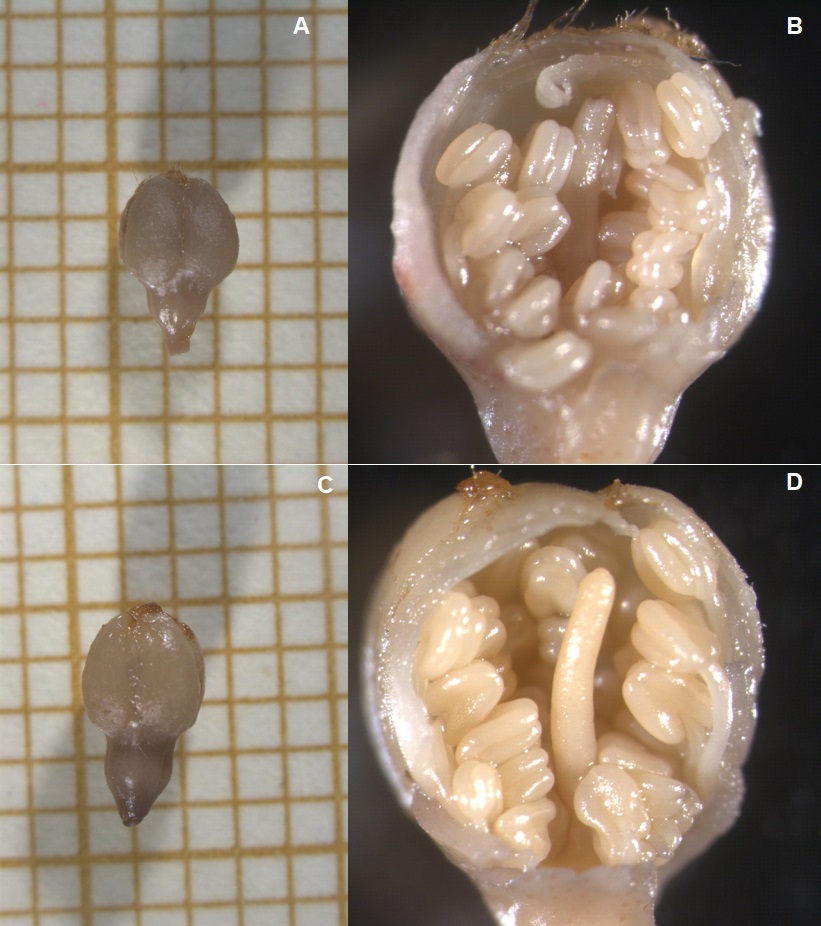
It was observed that the tetrad stage, a meiosis later stage, occurred during stage 0B (Figures 1A and 1B), corresponding to flower buds five days before anthesis (Figures 2A, 2B, 2C, 2D), which are about 2.5 mm in diameter.
On the day immediately before anthesis, at stage 0C, it was already possible to observe the mature pollen grains, both by the method of squashing anthers (Figures 1C and 1D), and by histological sections (Figures 1E and 1F).
The meiotic phase of tetrads is indicated as the most advisable to evaluate, with reasonable precision and greater speed, the behavior of the formation of pollen grains (GRANATO et al., 2019). Meiotic indices below 90% can cause problems in a breeding program due to the instability of the plant or species (LAVINSCKY et al., 2017).
According to Franzon et al. (2004), pollen viability is directly related to the formation of normal tetrads, that is, with the meiotic index. Differences in the meiotic index may occur among plants of the same species and, possibly, in pollen viability.
As observed in detail in Figures 1C and 1D, the pollen grains of Surinam cherry trees were mainly presented in a triangular shape.
Pollen grains of the genus Eugenia can vary from small to medium, they are isopolar; can be oblate-spheroidal triangular, quadrangular or pentagonal, depending on the species (STANSKI, 2014).

Stages of development of the pyrenic (A, C and E) and apyrenic (B, D and F) pollen grain of Surinam cherry tree. A and B: Pollen grains after meiosis, Tetrad; C and D: Mature pollen grains. Squash preparations and dyed with aniline blue. E and F: Anthers containing mature pollen grains. 10µm paraffin sections and stained with aniline blue. Scale bars: A, B, C and D = 50µm; E and F = 100µm
Pyrenic floral balloons (A and B) and apyrenic (C and D) of Surinam cherry tree, in stage 0B (corresponding to five days before anthesis), when it was possible to identify the tetrads. Observations made in the magnifier glass.
In vitropollen germination
In general, there were no differences for the in vitro pollen germination of both Surinam cherry tree genotypes (pyrenic and apyrenic), with the exception of collection during anthesis at seven and 24 hours of evaluation and balloon flowers at five hours, with higher averages for the apyrenic genotype.
There was only significant difference for the time factor of flowers collected in balloons of pyrenic and apyrenic Surinam cherry trees, with higher averages at nine and 24 hours. During anthesis, this factor was only influenced in the apyrenic Surinam cherry genotype, with higher average in 24 hours (Table 2). Franzon et al. (2007) also verified germination increase with longer incubation period. The incubation time is one of the factors that influence the percentage of in vitro germination, and varies according to the species, as each species responds differently to the culture medium composition and type (NOGUEIRA et al., 2015).
Pollen germination was higher when collected from flowers just after anthesis, in all incubation periods evaluated, for both pyrenic or apyrenic genotypes. The highest averages were 25.9% in post-anthesis and 10.33% for floral balloons for the pyrenic genotype and, for apyrenic genotype, the highest averages were 46.60% for post-anthesis and the lowest 10.88% for floral balloons (Table 2).
Similar results were found by Franzon et al., (2007) with the same species, in which the authors obtained average germination of 22.9% for pollen collected after anthesis and 16.5% for floral balloons.
Pollen germination under natural conditions and pollen tube growth Pollen grain germination and pollen tube growth occurred normally in the pistil of both Surinam cherry trees (pyrenic and apyrenic genotypes). Due to the growth pattern in stigma and style, both genotypes do not show self-incompatibility (Figure 3).
When there is incompatibility, the pollen tube presents slow or absent development, which may present some type of abnormality (SILVA et al., 2016).
The percentage of flowers with pollen tubes at the base of the style was also variable between genotypes, but 24 hours after anthesis, the pyrenic Surinam cherry tree had 20% of flowers with pollen tubes at the base of the style, and the pyrenic genotype with 80% (Figure 4A).
However, in the apyrenic Surinam cherry genotype, the pollen tube growth was slower in relation to the pyrenic genotype. Twenty-four hours after anthesis, the pollen tube length reached 38% in the apyrenic Surinam cherry genotype and 76% in the pyrenic Surinam cherry genotype. However, 48 hours after anthesis, the pollen tube length reached 100% in both Surinam cherry trees (pyrenic and apyrenic genotypes) (Figure 4B).
The time required for the pollen tube to reach the ovary is variable according to the species, and may take hours or days (TANGMITCHAROEN; OWENS, 1997). In the present study, it was observed that the pollen tube growth was rapid, and within 24 hours after anthesis, with some pollen tubes reaching the base of the style (Figure 4C) and, within 48 hours, it was possible to verify some traces of pollen tubes in the ovary of both Surinam cherry trees (pyrenic and apyrenic genotypes).

Pistils of pyrenic (A, C and E) and apyrenic (B, D and F) Surinam cherry tree flowers. A and B: Pollen grains germinated in the stigma; C and D: Pollen tubes growing along the style; E and F: Pollen tubes reaching the base of the style. Squash preparations and dyed with aniline blue. Scale bar = 100µm.

Pollen tubes in pyrenic and apyrenic Surinam cherry tree flowers, according to days after anthesis. A: Flowers (%) with pollen tubes at the base of the style; B: Pollen tube length (%) along the style; C: Number of pollen tubes at the base of the style.
Conclusions
The total period, considering the appearance of floral balloons until fruit maturation, was approximately 85 days for the pyrenic genotype and 75 days for the apyrenic genotype.
The in vitro pollen grain viability for both genotypes was greater when collected from flowers after anthesis and when longer incubation periods were used. Under natural conditions, pollen grain germination and pollen tube growth occur normally, reaching the end of the style 48 hours after anthesis, with no self-incompatibility for both accessions.
Acknowledgment
The authors wish to extend their thanks and appreciation to Estación Experimental de Aula Dei, Zaragoza, Spain and gratefully acknowledge the CNPq (Conselho Nacional de Desenvolvimento Cientifíco e Tecnológico) CAPES (Coordenação de Aperfeiçoamento de Pessoal de Nível Superior—Brasil for their financial support and research fellowship.
References
-
ALBUQUERQUE JUNIOR, C.L.; DENARDI, F.; DANTAS, A.C.M.; NODARI, R.O. Número de anteras por flor, grãos de pólen por antera e capacidade germinativa do pólen de diferentes cultivares de macieiras. Revista Brasileira de Fruticultura, Jaboticabal, v.32, n.4, 2010. https://doi.org/10.1590/S0100-29452010005000129
» https://doi.org/10.1590/S0100-29452010005000129 - AOKI, C.; GOMES, M.D.; SAVALA, L.S.; GREGORIO, G.C.; MASSARANDUBA, V. Fenologia reprodutiva de pitanga (Eugenia pitanga) no Pantanal. Cadernos de Agroecologia, Recife, v.13, n.2, p.1-7, 2018
-
COSTANTINI, L., MORENO-SANZ, P., NWAFOR, C.C.; LORENZI, S.; MARRANO, A.; CRISTOFOLINI, F.; GOTTARDINI, E.; RAIMONDI, S.; RUFFA, P.; GRIBAUDO, I.; SCHNEIDER, A.; GRANDO, M.S. Somatic variants for seed and fruit set in grapevine. BMC Plant Biology, London, v.21, n.135, 2021. https://doi.org/10.1186/s12870-021-02865-2
» https://doi.org/10.1186/s12870-021-02865-2 -
DANNER, M.A., CITADIN, I., SASSO, S.A.Z., SACHET, M.R., AMBRÓSIO, R. Fenologia da floração e frutificação de mirtáceas nativas da floresta com araucária. Revista Brasileira de Fruticultura, Jaboticabal, v.32, n.1, p.291-5, 2010. https://doi.org/10.1590/S0100-29452010005000008
» https://doi.org/10.1590/S0100-29452010005000008 - DE MOURA, E.A.; DE ANDRADE, A.D.; MENDONÇA, V.; MELO, M.F., MENDONÇA, L. F., DE OLIVEIRA, L.M., ALVES, A.A.; FARIAS, W.C.; FIGUEIREDO, F.R.A.; IRINEU, T.H. Phenological characterisation, thermal requirement and production in the selection of pitanga genotypes in semiarid conditions. Annals of Applied Biology, Warwick, v.177, n.1, p.16-25, 2020.
-
FIDELIS, E.M.; SAVALL, A.S.P.; PEREIRA, F.O.; QUINES, C.B.; ÁVILA, D.S.; PINTON, S. Pitanga (Eugenia uniflora L.) as a source of bioactive compounds for health benefits: a review. Arabian Journal of Chemistry, Riade, v.15, n.4, p.103691, 2022. https://doi.org/10.1016/j.arabjc.2022.103691
» https://doi.org/10.1016/j.arabjc.2022.103691 - FRANZON, R.C.; RASEIRA, M. do C.B.; WAGNER JR, A. Testes de germinação in vitro e armazenamento de pólen de pitangueira (Eugenia uniflora L.). Acta Scientiarum, Maringá, v.29, p.251-255, 2007.
-
FRANZON, R.C.; RASEIRA, M. do C.B. Meiotic index in Myrtaceae native fruits trees from southern Brazil. Crop Breeding and Applied Biotechnology, Londrina, v.4, p.344-9, 2004. https://doi.org/ 10.12702/1984-7033.v04n03a13
» https://doi.org/ 10.12702/1984-7033.v04n03a13 -
GRANATO, L.M.; RAMOS, L.C.S.; PINTO-MAGLIO, C.A.F. Relationship between meiotic instability and fertility in F2 generation Arabusta coffe plants. Plant Breeding, Oxford, v.78, n.2, p.215-28, 2019. https://doi.org/10.1590/1678-4499.20180215
» https://doi.org/10.1590/1678-4499.20180215 -
GUOLLO, K.; KOSERA NETO, C.; ROSA, V. da; GARAY, I.A.; WAGNER JUNIOR, A.; ROCHA, M.A.M. Floral, reproductive, and pollination biology of Floral, reproductive, and pollination biology of Eugenia myrcianthes Nied. Comunicata Scientiae, Bom Jesus, v.15, p.e3504, 2023. https://doi.org/10.14295/cs.v15.3504
» https://doi.org/10.14295/cs.v15.3504 - JOHANSEN, D.A. Plant microtechnique New York: McGraw-Hill, 1940. 523 p
-
LAVINSCKY, M.; SOUZA, M.; SILVA, G.; MELO, C. Contributions of classical and molecular Cytogenetics in meiotic analysis and pollen viability for plant breeding. Genetics and Molecular Research, Ribeirão Preto, v.16, n.3, 2017. https://doi.org/10.4238/gmr16039582
» https://doi.org/10.4238/gmr16039582 -
LI, S.; LIU, K.; YU, S.; JIA, S.; CHEN, S.; SUN, F.; LUO, Q.; WANG, Y.. The process of embryo abortion of stenospermocarpic grape and it develops into plantlet in vitro using embryo rescue. Plant Cell Tissie Organ Culture, Dordrecht, v.143, p.389-409, 2020. https://doi.org/10.1007/s11240-020-01926-y
» https://doi.org/10.1007/s11240-020-01926-y - LINSKENS, H.F.; ESSER, K. Uber eine spezifische Anfarbung der pollen-shlauche und die zagl kallosapropten nach selbstung und fremdung. Naturwissenschaften, Heidelberg, v.44, p.16, 1957.
-
MELLO JUNIOR, L.J. de; ORTH, A.I.; MORETTO, G. Ecologia da polinização da amoreira preta (Rubus sp.) (Rosaceae) em Timbó SC, Brasil. Revista Brasileira de Fruticultura, Jaboticabal, v.33, p.1015 8, 2011. https://doi.org/10.1590/S0100 29452011005000096
» https://doi.org/10.1590/S0100 29452011005000096 -
NOGUEIRA, P.V.; DA SILVA, D.F.; PIO, R; SILVA, P.A. DE O.; BISI, R.B.; BALBI, R.V.Germinação de pólen e aplicação de ácido bórico em botões florais de nespereiras. Bragantia, Campinas, v.74, n.1, p.9–15, 2015. https://doi.org/10.1590/1678-4499.0264
» https://doi.org/10.1590/1678-4499.0264 -
PICARELLA, M.E.; MAZUCCATO, A. The ocurrence of seedlessness in higher plants; insights on roles and mechanisms of parthenorcarpy. Frontiers in Plant Science, Lausannem v.9, 2019. https://doi.org/10.3389/fpls.2018.01997
» https://doi.org/10.3389/fpls.2018.01997 - SILVA, A.L.G.; PINHEIRO, M.C.B. Biologia floral e da polinização de quatro espécies de Eugenia L. (Myrtaceae). Acta Botânica Brasilica, São Paulo, v.21, n.1, p.235-247, 2007.
-
SILVA, L.F.O.; ZAMBON, C.R.; PIO, R.; OLIVEIRA, A.F.; GONÇALVES, E.D. Establishment of growth medium and quantification of pollen grains of olive cultivars in Brazil's subtropical areas. Bragantia, Campinas, v.75, n.1, p.26–32, 2016. https://doi.org/10.1590/1678-4499.213
» https://doi.org/10.1590/1678-4499.213 - STANSKI, C. Catálogo polínico de espécies de Myrtaceae e Solanaceae da região dos Campos Gerais – Paraná, Brasil 2014, 183 f. Dissertação (mestrado) - Universidade Federal do Paraná, Curitiba, 2014.
-
TANGMITCHAROEN, S.; OWENS, J. N. Floral biology, pollination, pistil receptivity, and pollen tube growth of teak (Tectona grandis L.f.). Annals of Botany, London, v.79, n.3, p.227–41, 1997, https://doi.org/10.1006/anbo.1996.0317
» https://doi.org/10.1006/anbo.1996.0317 -
TIAN, S.; ZHANG, Z.; QIN, G.; XU, Y. Parthenocarpy in cucurbitaceae: advances for economic and environmental sustainability. Plants, Basel, v.12, n.3462, 2023. https://doi.org/10.3390/plants12193462
» https://doi.org/10.3390/plants12193462 -
VAROQUAUX, F.; BLANVILLAIN, R.; DELSENY, M.; GALLOIS, P. Less is better: new approaches for seedless fruit production.Trends in Biotechnology, Amsterdam, v.18, p.233-42. 2000. https://doi.org/10.1016/s0167-7799(00)01448-7
» https://doi.org/10.1016/s0167-7799(00)01448-7
Edited by
-
Juliana Domingues Lima