 Impact of Soil Management on Water Storage and Soybean Yield
Abstract
The study assesses the impact of diverse soil management techniques on water storage and soybean yield, considering changes in precipitation patterns in Rondônia and the potential water stress on the soybean crop due to alterations in land use and soil cover. The experiment, conducted in Vilhena-RO during the 2021/2022 harvest, included treatments with two management techniques (no tillage and minimal tillage) and soybean cultivation under three soil cover conditions (no cover, no-till, and intercropped with Brachiaria brizantha cv. marandu). Agrometeorological monitoring collected data such as precipitation, temperature, relative humidity, solar radiation, soil temperature, and humidity. Analysis of volumetric soil moisture indicated similar variability between treatments, but conditions without tillage showed greater water retention, associated with soil structuring. No statistical differences were observed between the soil cover conditions. The study underscores the importance of the soil's physical conditions in regulating surface water storage for soybean cultivation in Vilhena-RO.
Keywords
maize residue;
Glycine max
; no-tillage; plowing; southern Amazon
Resumo
O estudo analisa o impacto de diferentes técnicas de manejo do solo no armazenamento de água e na produtividade da soja, tendo em vista as alterações nos padrões de precipitação em Rondônia e o potencial estresse hídrico na cultura da soja devido às mudanças no uso e cobertura do solo. O experimento, realizado em Vilhena-RO durante a safra 2021/2022, envolveu tratamentos com duas técnicas de manejo (sem mobilização e com mobilização mínima do solo) e cultivo da soja em três condições de cobertura do solo (sem cobertura, plantio direto e consorciado com Brachiaria brizantha cv. marandu). O monitoramento agrometeorológico coletou dados como precipitação, temperatura, umidade relativa do ar, radiação solar, temperatura e umidade do solo. A análise da umidade volumétrica do solo indicou variabilidade semelhante entre os tratamentos, porém, condições sem mobilização apresentaram maior retenção de água, associada à estruturação do solo. Já entre as condições de cobertura do solo não foram observadas diferenças estatísticas. O estudo destaca a importância das condições físicas do solo na regulação do armazenamento de água superficial para o cultivo de soja em Vilhena-RO.
Palavras-chave
resíduo de milho;
Glycine max
; plantio direto; aração; sul da Amazônia
1. Introduction
Brazil has stood out in the agricultural commodities market as the world's leading producer and exporter of soybeans (de Avelar and Tannus, 2022). However, recent studies have shown that some soy-producing regions in Brazil are showing trends towards changes in regional climate patterns.
Rondônia stands out as an important agricultural producer in the Amazon region, with farming playing a central role in the state's economy. According to EMBRAPA (2024), in 2024 the Gross Value of Agricultural Production (VBP) in the state was estimated at R$ 18.99 billion, with beef cattle accounting for 46.9% of this total, followed by soybeans (18.3%), coffee (11.1%), maize (7.3%) and milk production (5.1%). Other production chains, such as cassava, bananas, rice and cotton, complement the diversity of Rondonia's agricultural sector. Agricultural yield in the state is strongly influenced by regional climatic conditions, which regulate crop growth and determine the viability of systems such as soybean-maize succession, which is predominant in the region.
Rondônia's climate is tropical humid (Aw and Am classification, according to Köppen), characterized by a well-defined rainy season from October to April and a dry season concentrated between June and August. Average annual rainfall varies between 1800 and 2500 mm, with average temperatures of 24 to 27 °C and high relative humidity, ranging between 75 and 90% throughout the year (RadamBrasil, 1978; Alvares et al., 2013). Rainfall dynamics in the region have been impacted by changes in climatic patterns, associated with the advance of associated with the advance of deforestation and large-scale atmospheric variability, resulting in delays in the start of the rainy season and an increase in the frequency of dry periods (Butt et al., 2011; Flach et al., 2021).
Vilhena is a municipality in the state of Rondônia, located in the mesoregion known as the Southern Cone of Rondônia (SCRO), concentrating a large part of the state's agricultural grain production (Mota, 2024). Over the last 40 years, the municipality has shown changes in its hydroclimatic pattern, such as the delayed onset and shortening of the rainy season (Butt et al., 2011), increase in temperature (Flach et al., 2021) and changes in the spatial distribution patterns of precipitation, driven above all by the advance of deforestation in the region (Khana et al., 2017; Chambers and Artaxo, 2017, Leite-Filho et al., 2022). And in years of drought in the Amazon, the reduction in rainfall is more evident in deforested areas of Rondônia, due to the regional feedback between drought and deforestation (Mu et al., 2023).
These changes have a direct effect on the risk indices that modulate the performance of agricultural crops, resulting in reduced water availability and longer periods of drought. This exposes the soybean to water deficit conditions, limiting crop transpiration due to the decrease in soil water storages (Ferrari, et al., 2015).
Some techniques have been used, such as genetic improvement (adopting more resistant cultivars) and adjusting soybean management (adjusting sowing dates, no-till farming, intercropping and crop rotation), with the aim of increasing yields, making efficient use of natural resources and inputs, and mitigating climate risk (Zanon et al., 2016; Seixas et al., 2020).
The most common management in the region is no-till, which consists of minimizing soil tillage and preserving the straw from previous crops, benefiting soil structure, nutrient cycling and reducing water evaporation (Fialho et al., 2020; Seixas et al., 2020).
However, in the no-tillage system, soil compaction in the surface layer is a recurring phenomenon that can compromise crop development, depending on its intensity (Mahl et al., 2008). Compaction reduces soil porosity, limiting water infiltration and retention, as well as restricting root growth and nutrient absorption, factors that directly affect agricultural yield.
To mitigate this problem, harrowing can be used as a strategy to reduce compaction, help control weeds, improve soil aeration, incorporate inputs and increase the rate of water infiltration. However, excessive use of this management can intensify susceptibility to erosion, accelerate the loss of organic matter and promote compaction in deeper layers, especially when combined with heavy traffic from heavy agricultural machinery (Chetan et al., 2021). It is therefore essential to adopt balanced soil management in order to preserve its structure, maintain moisture and guarantee ideal conditions for crop development, ensuring the long-term sustainability of agricultural production.
In this context, alternatives to mechanical tillage have been studied to minimize the negative impacts of harrowing and improve soil structure in a sustainable way. One promising technique, which is still not widespread, is intercropping soybeans with forage crops, which can promote nutrient cycling, increase protection against erosion and help improve the physical quality of the soil.
However, this practice still needs more in-depth studies due to the lack of understanding of the microclimate interaction between soybeans and forage crops (Silva et al., 2006). Kluthcouski et al. (2000) observed that soybeans competed with different species of Brachiaria, such as B. brizantha, B. decumbens or B. ruziziensis, resulting in reduced yields.
On the other hand, Silva et al. (2006) found an increase in soybean yields when intercropped with B. brizantha cv. marandu, especially when controlled doses of graminicide were applied. In addition, competition between soybeans and small, slow-growing forage plants, such as massai grass, was minimal, as reported by Machado and Weismann (2007). Franchini et al. (2014) showed that the yield of three different soybean cultivars in intercropping with Urochloa ruziziensis and Urochloa brizantha was not affected by any of the grass species.
Another factor that influences the yield of the soybean-forage consortium is the time of over-seeding. Crusciol et al. (2009) showed that soybean yields in a consortium with B. brizantha can be optimized by adopting different forage planting times, reducing interference between the species.
Machado et al. (2017) showed that soybean intercropped with perennial forage crops (Megathyrsus maximus, cultivars Aruana and BRS Tamani; Urochloa brizantha, cultivars Xaraés, BRS Piatã and BRS Paiaguás; U. decumbens; and U. ruziziensis), sown 14 and 21 days after soybean sowing, did not differ from soybean alone, except for soybean + U. ruziziensis and soybean + BRS Paiaguás.
In view of the hydroclimatic changes recorded in the SCRO region, such as alterations in the rainfall regime, the temporal distribution of rainfall and the soil water balance, it is essential to develop and adopt agricultural management strategies that reduce the vulnerability of crops to climatic oscillations. Adapting conservation practices to the new environmental conditions is essential to maximize water use efficiency, optimize water retention in the soil and minimize the adverse effects of water deficit on agricultural yield (Leite-Filho et al., 2019; 2021). In this context, studies that evaluate the performance of different management systems are fundamental for defining practices that improve the dynamics of water in the soil and favor the adaptation of the soybean crop to regional conditions, reducing the impact of climatic variations on crop yields.
The article presents the response of soil water storage in soybean cultivation to the adoption of different management techniques, analyzing their impact on development and yield, as well as providing technical information to local producers on which treatments can be adopted in the region.
2. Material and Methods
The field trial was conducted in the experimental area of the Faculdade Marechal Rondon (FARON), located in Vilhena, RO, Brazil (60°05’ O e 12°46’ S, 600 m in the Southern Cone of Rondônia (SCRO) mesoregion, between October 2021 and February 2022.
The region has an Am climate (tropical monsoon with a short dry season), according to the Köppen classification, with average annual rainfall of 2200 mm, average annual air temperature of 24.6 °C and relative humidity of the air of 74% (Alvares et al., 2013). The soil in the experimental area is classified as Latossolo Vermelho-Amarelo distrófico (Oxisol), savanna phase and flat relief (da Silva et al., 2022).
Since 2017, the area has been used for successive cultivation of soybeans and maize, with the introduction of millet in the off-season, in order to maintain soil cover and improve the profile's physical and chemical properties. Previously, the site was exploited by a pottery for the production of bricks, due to the high clay texture of the soil, a predominant characteristic of the region. The agricultural management adopted follows the principle of minimal soil disturbance, with soybeans and maize being planted directly on the remaining straw, in an attempt to preserve the soil structure, retain moisture and improve the processes of infiltration and redistribution of water in the profile.
Based on the results of the soil's chemical analysis, liming was carried out by applying 0.63 t/ha of dolomitic limestone (RNV 85%), with the aim of raising the soil's base saturation from 60 to 70%. It was applied manually, evenly throughout the experimental area, and incorporated into the soil using a hoe, 60 days before the experimental plots were set up.
The soil in the experimental area contains 3.3% organic matter in the arable layer, a pH of 5.3 and a cation exchange capacity of 1.34 cmolc/dm3. The overall density of the soil is 1.8 g/cm3, with a clayey texture, made up of 61% clay, 19% silt and 19% sand. The water properties include saturation moisture of 0.314 m3/m3, field capacity of 0.300 m3/m3 and permanent wilting point of 0.158 m3/m3, as well as a hydraulic conductivity of 0.5 cm/h up to a depth of 30 cm (Mota et al., 2024).
Initially, the experiment included two sowing seasons, with the second being planted 30 days after the first. However, a delay in sowing soybeans directly impacts the crop's productive performance and compromises agricultural succession, since soybeans are grown on maize stubble in the no-tillage system, which is widely adopted in the SCRO. This delay in the soybean harvest consequently results in a delay in the sowing of off-season maize, which is now planted under unfavorable hydrothermal conditions.
The late establishment of maize reduces water availability throughout its cycle, as the crop will be sown in a period of lower rainfall, increasing the risk of water deficit and exposure to high temperatures during critical phenological phases, such as flowering and grain filling, which compromises its yield. Therefore, excluding the second sowing season from the experimental analysis was essential to ensure methodological consistency and precision in the results, avoiding the inclusion of data that does not reflect the agricultural reality of soybean cultivation in Rondônia.
The soybean cultivar used was 83HO113 IPRO (HO Genética, 2022). It was established in the field in a randomized block experimental design, following a 2 × 3 factorial scheme, with five replications, and each plot consisted of five planting lines, spaced 0.5 m apart. The treatments were distributed based on two factors, with factor 1 referring to soil structure, in which the soil without tillage (CT) represented the traditional cultivation system in the region, while the soil with minimal tillage (MA) was prepared with a plough harrow at a depth of 0-30 cm, carried out 90 days before sowing. Factor 2 refers to the soil cover conditions, including three treatments: soybean sowing in exposed soil (E), without vegetal cover; consortium with B. brizantha cv. marandu (B), with soybeans interspersed with the forage, sown in the rows 15 days after soybean emergence; and seeding over maize straw (P), using the residue from the maize growing season (Fig. 1).
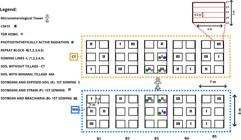
Sketch of the experimental area - randomized block design, following a 2×3 factorial scheme. Where CT is the set of soil plots under traditional planting conditions in the region; MA is the set of plots under soil conditions with minimum tillage; I, II and III are the factorials; B1, B2, B3, B4 and B5 are the repetition blocks; L1, L2, L3, L4 and L5 are the sowing lines of each plot; the tower indicates the position of the micrometeorological tower; the purple circles are the soil moisture sensors (TDR's - Time Domain Reflectometers) installed at a depth of 10 cm - S-SMD-M005 from HOBO®; the blue circles are the soil moisture sensors (TDR's) installed at a depth of 30 cm - CS615 from Campbell Sientific®; the green circles are the photosynthetically active radiation sensors (PAR radiation).
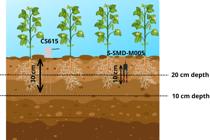
Soil water storage (A) was determined by measuring the volumetric content of the soil (∆zi) (Eq. 1), obtained using HOBO® S-SMD-M005 and Campbell Scientific® CS615 TDR sensors. The Campbell sensors have a larger reference volume compared to the HOBO® sensors, due to the length of the rods, 30 cm for the former and 10 cm for the latter. The CS615 sensor was installed in the center of the experimental plot, while the S-SMD-M005 sensor was positioned at a depth of 10 cm, as shown in Fig. 2.
To ensure the comparability of the volumetric soil moisture data, the values obtained by the HOBO® sensors were corrected by linear regression, using the Campbell® sensor data as a reference. Both sensors were installed in soil plots with minimal tillage and maize straw cover (Fig. 1).
The accumulated variation in daily soil water storage (∆A) was obtained by quantifying the following variables:
Daily soil water storage (Eq. (1))
where A is the daily soil water storage (mm/day) and is the soil moisture at depth Z, in m3/m3, quantifying the water retained in the volume of soil Z over the 24 h of the day.Variation of daily accumulated soil water storage (Eq. (2))
where δA variation in daily accumulation (mm/day), resulting from the difference between daily soil water storage from 8 a.m. on the previous day (i - 1) to 8 a.m. on the day in question (i), in order to quantify whether there has been an increase or decrease in the amount of water in the soil volume.Daily soil water storage (Eq. (3))
where the daily soil water storage (mm/day), describes the accumulated result of the recharges and discharges of soil water storage during the 120-day experiment.In order to determine whether the differences in the daily soil water storage between treatments were statistically significant, the Shapiro-Wilk (SW) test was applied, which assessed whether the series had a normal distribution.
In this test, W represents the degree of deviation from normality, and when p > 0.05, the series are considered to be normally distributed. The Kruskal-Wallis (KW) test was used to check whether the water storages between the CT and MA conditions differed significantly. This test indicated that, when p < 0.05, there are statistically significant differences between the groups. To compare individual differences between pairs of treatments, the Dwass-Steel-Chritchlow-Fligner (DSCF) test was applied, which confirms the existence of statistically significant differences if p < 0.05. Statistical analyses were carried out using Jamovi software, version 2.3 (https://www.jamovi.org).
The yield was determined from the mass of grains per area of each plot and defined as a function of kilograms per hectare. Harvesting was carried out manually at reproductive stages R8 and R9, when 95% of the vegetables had turned brown, indicating physiological ripeness. After harvesting, the plants were dried in a controlled environment at 18 °C and relative humidity of approximately 30%, for around 10 days, until the moisture content of the grain mass was reduced to 13%, ensuring the standardization of the results.
3. Results and Discussion
3.1. Meteorological variables
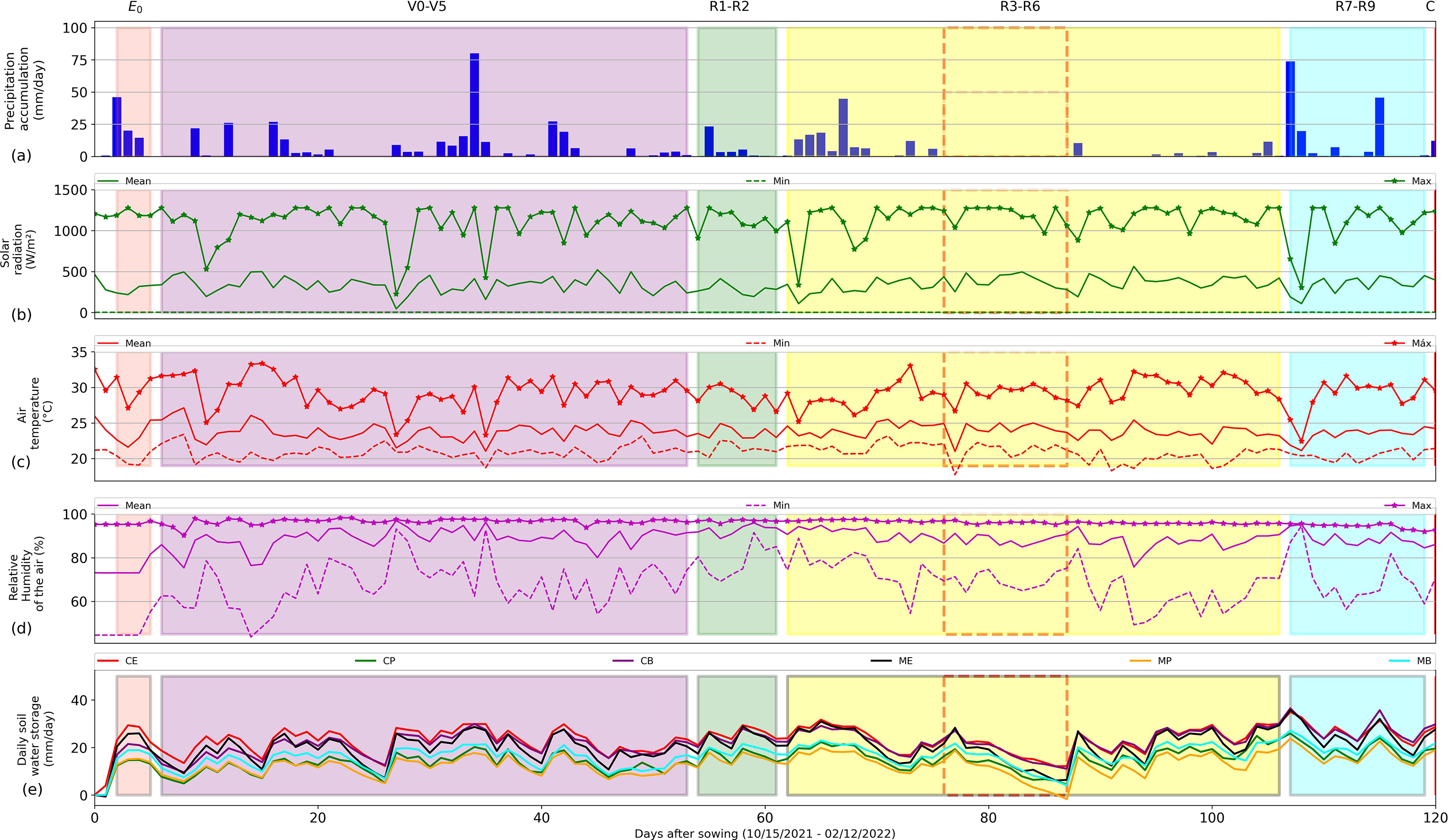
Figure 3 shows the minimum, average and maximum values of the meteorological variables and the stock of water in the soil for the treatments evaluated: CE - soil under traditional cultivation and soybean sowing without mulch; CP - soil under traditional cultivation with mulch; CB - soil under traditional cultivation and intercropped with B. brizantha cv. marandu; ME - soil with minimum tillage and soybean sowing without mulch, MP - soil with minimum tillage and sowing on mulch; MB - soil with minimum tillage and intercropped with B. brizantha cv. marandu. These relationships were characterized over the 120 days of soybean crop development, allowing for a comparative analysis between management systems and their influence on soil water dynamics and weather conditions during the crop cycle.

Daily conditions of the agrometeorological variables (Y axis) during the 2021/2022 soybean harvest in Vilhena-RO, for the 120 days of crop development (X axis). (a) accumulated precipitation (mm/day); (b) solar radiation (W/m2); (c) air temperature (°C); (d) relative humidity of the air (%); and (e) daily soil water storage (mm/day).
The weather variables showed great variability during the growing season. Rainfall showed a heterogeneous temporal distribution throughout the stages of soybean development, totaling 700 mm during the 120 days of the experiment. On the 34th, 67th, 106th and 114th days after sowing (Fig. 3a), there were intense episodes of rainfall, with daily accumulations varying between 40 and 90 mm. These events were associated with the configuration of the South Atlantic Convergence Zone (SACZ), intensified by the action of the large-scale phenomenon La Niña (CENSIPAM, 2021). The only period without precipitation was recorded between days 76 and 86 after sowing, coinciding with the R5 reproductive stage of soybeans.
During the soybean emergence phase (vegetative stage V0), the rainfall events contributed to maintaining mild air temperatures, ranging between 19 and 25 °C (Fig. 3c) and relative humidity of the air between 60 and 90% (Fig. 3d). These values remained within the favorable thresholds for crop development during this period (Fig. 3 - red shaded).
Throughout the vegetative growth stage (V1-V11), the accumulated rainfall was over 68 mm, with average daily global radiation of around 320 W/m2 and air temperature ranging from 23 to 24 °C. There were no water surpluses that could have compromised the development of the trefoils. The weather conditions during this period were therefore favorable, providing an ideal environment for photosynthetic activity and the crop's growth rate.
At the beggining of the reproductive state (R1-R2) (Fig. 3a - green shaded), occurred a reduction in the preciptation, although the meteorological conditions remained suitable to the soybean development. However, during the legume formation (R3-R4) and grain filling (R5-R6) stage (Fig. 3a - yellow shaded), there was no precipitation, which allied to the increase of global radiation, contributed to the maintenance of air temperature between 20 and 30 °C, and the relative humidity of the air above 80% (RH > 80%).
This condition favored the occurrence of Corynespora cassiicola, which causes target spots in soybeans, affecting the grain filling stage and resulting in reduced yields in some experimental plots.
3.2. Soil water storage
The variability of the water storage storage in the soil, shown in Fig. 3(e), demonstrates a strong relationship with the daily accumulation of precipitation, increasing during rainy periods and decreasing as precipitation decreases.
In the first 25 days after sowing, the storage of water in the soil was more consistent between treatments. However, as the soybeans developed, the differences between the treatments became more evident, reflecting the influence of the soil's physical conditions, the type of cover and the system's response to variations in rainfall frequency.
The soil in the experimental area, which has been cultivated with soybeans in a no-tillage system on maize stubble since 2017, has shown structural changes over time, reflected in the reduction in soil density. According to Mota et al. (2024), in 2017, the average soil density was 1.8 g/cm3, while in 2022, this value fell to 1.2 g/cm3, showing the effects of conservation management on improving soil structure.
Therefore, the CE, CP and CB treatments reflect the soil structure resulting from the planting successions, which may explain the greater water storage in the CE and CP conditions, as shown in Table 1. The CE treatment had a median of 23.7 mm, with first and third quartiles of 18.4 and 25.9 mm, respectively, while CP had the same median of 23.7 mm, highlighting the benefit of minimal tillage in water conservation.
Although the CB condition also went through this structuring process, its water storage was slightly lower than that of the other CT conditions. This behavior can be attributed to competition between soybeans and B. cv. marandu during crop development. Even with the structural benefit of the soil, the presence of two plant species carrying out evapotranspiration simultaneously reduced the available water storage.
Among the MA treatments evaluated, MP had the highest water storage values, with a median of 20.6 mm. The lowest storage values were observed in the MB treatment, with a median of 13.3 mm, and first and third quartiles of 9.77 and 16.3 mm, respectively. These results indicate that the maize straw cover favored the maintenance of water storage, reducing evaporation losses. On the other hand, intercropping with B. brizantha cv. marandu did not contribute to an increase in soil water storages, possibly due to competition between the species for water resources.
While the minimal tillage in the soil has promoted more water infiltration, the absence of factors that contribute to its retention can lead to evapotranspiration and drainage losses, as seen in ME treatment, that presented a 15 mm reduction in the water storage during the season of higher water deficit (Fig. 3 - season marked in dashed red).
3.3. Statistics
Statistic tests were applied to assess whether the differences observed between soil water storages were statistically significant. The SW test indicated that the storages did not show a normal distribution, characterizing them as non-parametric. This behavior is associated with the reduction in water storages on consecutive days without precipitation.
In view of this result, the non-parametric KW test was carried out, which confirmed the significant difference between soil water storages, since the p-value was lower than the threshold of 0.05, as shown in Table 2.
Shapiro-Wilk statistic test, Kruskal-Wallis non-parametric test, and Dwass-Steel Chritchlow-Fligner pairwise statistic test for daily soil water storage.
However, according to the analysis of treatments between pairs by DSCF (Table 2), some pairs did not show significant differences (p > 0.05). One example is the CB treatment, which showed statistical equality with the CE and ME treatments, indicating that soybeans intercropped with B. brizantha cv. marandu, under traditional cultivation conditions, showed a water storage in the soil statistically equivalent to the exposed soil, regardless of physical structuring. This result suggests that, under the weather conditions prevailing during the experiment, it was not possible to verify the potential effect of Brachiaria in increasing soil water storage.
Different from the results observed between PC and MP (p > 0.05), that were statistically equal, the data indicates that the soil water storage, in relation to the maize straw, is independent from the soil structure. This behavior may be associated with the ability of straw to reduce water loss through evaporation, as described by Seixas et al. (2020) (Fig. 3e).
3.4. Crop yield
Soybean yields in the six treatments evaluated are shown in the box diagram in Fig. 4. The highest yields were recorded in the traditional cultivation treatments (CT: CE, CP and CB), which showed an increase of 1496.4 kg/ha compared to the minimum tillage treatments (MA: ME, MP and MB), with statistically significant differences according to the Tukey test (Table 3).
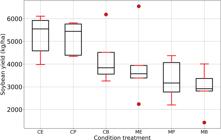
The CE, CP and CB treatments had average yields of 5228.4, 5150.4 and 4272 kg/ha, respectively. In the treatments under minimum tillage (MA), yields were 3938.4 (ME), 3316.8 (MP) and 2906.4 kg/ha (MB). Only the MP and MB treatments were below the average yield for Rondônia (3396 kg/ha), according to data from CONAB (2023).
Although the MA treatments had lower yields, the ME treatment performed similarly to CB, which statistically shares the same water storage by the DSCF test (Table 2). For both soil conditions, intercropping with B. brizanta cv. marandu did not benefit soybean yields, a result similar to that observed by Kluthcouski et al. (2000). Although many studies have dealt with competition between soybeans and forage crops, there are no records of changes in the components of the oilseed's grain yield when cultivated with grasses. However, Crusciol et al. (2012) and Saraiva et al. (2014) found significant differences in the number of pods per plant and the number of grains per pod when soybeans were intercropped with U. brizantha. The morphological differences between the soybean and the forage plant may have contributed to the competition for water, since the root system of the forage plant is fasciculated and radicular, while that of the soybean is pivotal, so the forage plant has a greater capacity for extracting water than the soybean (Machado et al., 2017).
The better yield may be associated with the soil's physical and water conditions in the CT system, since the soil structure resulting from the succession of direct soybean plantings provided better water storage conditions.
Similar results were observed by Liu et al. (2013), who showed that soil water storage was higher in no-tillage compared to minimum and traditional tillage, especially in the 0-30 cm depth layer. Similarly, Acharya et al. (2019) found that in very fine sandy loam soils, CT increased water movement in the top 40 cm of the soil.
This behavior was most evident in stages R3 to R6, when there were 10 consecutive days without precipitation (red dashed line - Fig. 3a), a period in which the TC showed greater conservation of water storage.
In general, the medians showed a downward trend between treatments, with interquartile asymmetry (Fig. 4) and a high degree of dispersion, indicating fluctuations between treatment repetitions.
However, the Tukey test indicated that there were no statistically significant differences between the types of management during the 2021/2022 harvest. This result can be attributed mainly to the regular distribution of rainfall throughout the crop cycle. As there were no prolonged periods of water deficit, the humidity conditions were adequate for soybean development, which may have contributed to the lack of significant differences between the treatments.
This behavior is similar to that observed by Teixeira et al. (2016), who found that CT had lower penetration resistance values in the layer between 10-20 cm, but the cover treatments adopted did not significantly influence yield and thousand-grain mass.
In years marked by climatic phenomena that reduce rainfall or prolong the dry season, it is hoped that the treatments adopted will favor water storage in the soil, helping to mitigate water impacts on soybean yield.
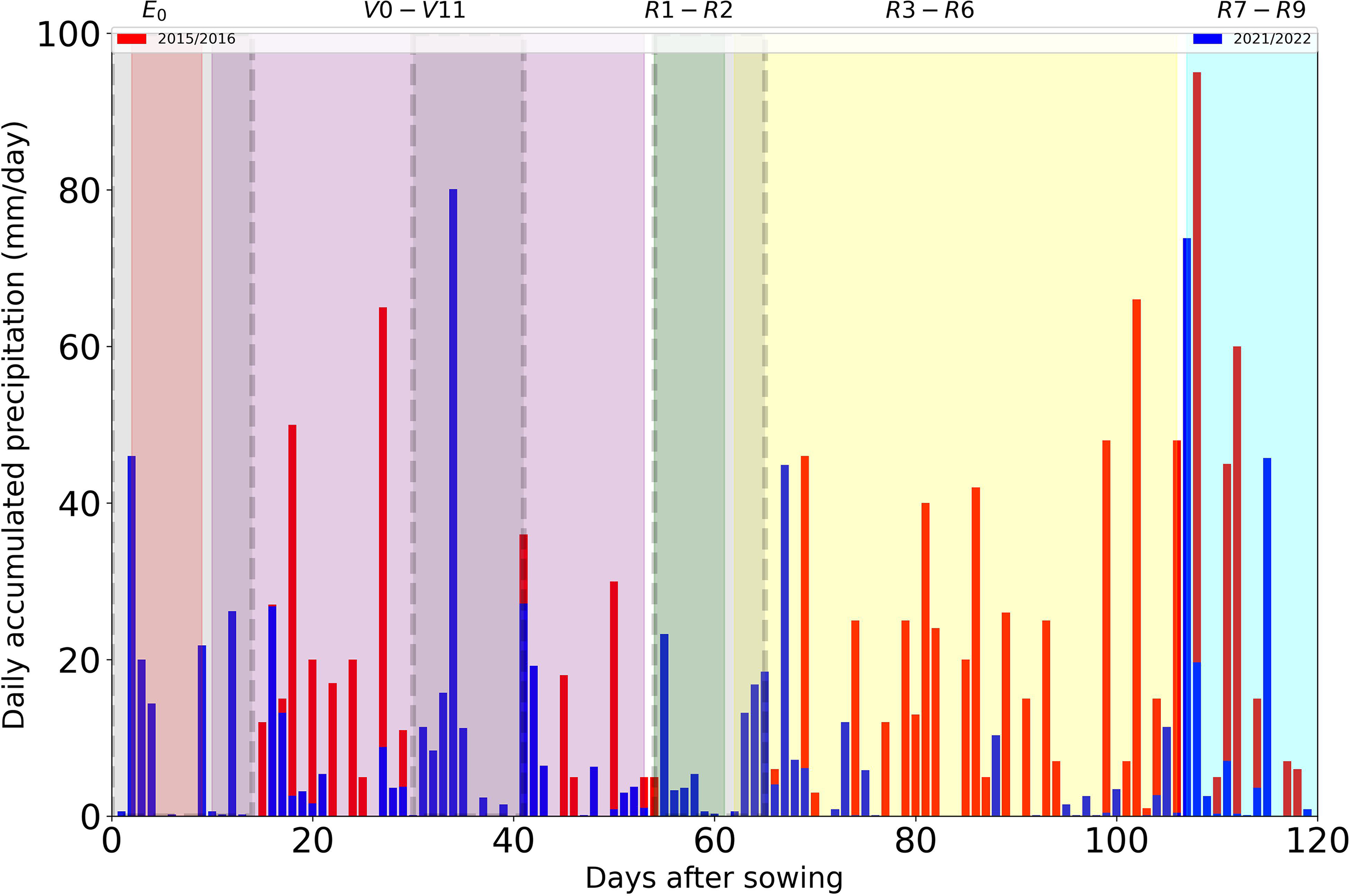
In the 2015/2016 harvest, for example, there was a strong El Niño event (NOAA, 2024), resulting in a significant reduction or absence of rainfall at critical moments in the crop cycle. Water deficits occurred during soybean emergence, at the beginning and middle of vegetative growth, and in the early reproductive stages, causing periods of veranico (Fig. 5). This phenomenon, characterized by high temperatures, high irradiance and low relative humidity, occurred in both the rainy season and the winter, impacting sowing and increasing the risks to crop yield (CONAB, 2016).
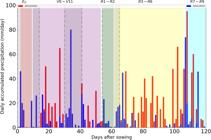
However, despite the adverse weather conditions, yield was not compromised. From December 2015 onwards, rainfall returned to levels appropriate to the physiological requirements of soybeans, guaranteeing water replenishment in the soil and allowing the crop to complete its cycle within the conditions necessary for a satisfactory yield.
4. Conclusions
The managements applied significantly influenced the water storage in the soil, with emphasis on the systems of exposed soil without tillage, soil without tillage with straw cover and soil with minimal tillage and straw cover, which showed greater water retention. This effect is related to the structuring of the soil and the regular distribution of rainfall during the 2021/2022 harvest. Statistically, the water storages between the systems without tillage and with minimal tillage and straw were equivalent, indicating that the straw coverhelped conserve soil moisture, regardless of physical structure.
The yield results show that the preservation of the soil's physical structure favors soybean cultivation, with the traditional planting system achieving 78% higher yields compared to the soil with minimal tillage. Only the treatments with minimal tillage and consortium with B. brizantha were below the state average (3396 kg/ha - CONAB, 2023), while the others increased yields by up to 70.7%.
Despite the differences in water storage, it was not possible to prove a direct impact of management on yield, since the Tukey test did not identify statistical differences between treatments, possibly due to the regularity of rainfall during the experiment. However, the variations in water storage during periods of lower rainfall suggest that soil cover and structure influence water conservation.
The results reinforce the importance of conserving soil structure for better water storage, highlighting no-till farming as an efficient strategy for SCRO. However, it is worth noting that the weather conditions observed in the year of the study were regular. Continuous monitoring of agricultural crops is therefore recommended, especially in years of extreme weather conditions. During El Niño, soybeans can be impacted by water deficits during the dry season, while during La Niña, excess rainfall during the harvest period can compromise crop yield, regardless of the management adopted. Thus, the adoption of adaptive strategies and climate monitoring are essential to mitigate risks and ensure greater stability in soybean production in the region.
Acknowledgments
We are grateful to the Faculdade Marechal Rondon (FARON) and Fazenda São Carlos for its manager, Agronomist Fabrício da Costa Czarnobay. We are also thank Agronomist Carlos Eduardo Barbosa de Souza, Civil Engineer Maria Juliana de Melo Monte, Embrapa CNPTIA, EMBRAPA-Vilhena (Centro de Pesquisa Agroflorestal de Rondônia, Setor de Pesquisa e Desenvolvimento), the Postgraduate Program in Climate and Environment (PPG-CLIAMB/INPA), the Laboratório de Modelagem Climática (LMC/INPA), and the research funders CNPq (131461/2020-6), CAPES and FAPEAM/POSGRAD, for all the support and assistance made available for this research.
References
-
ACHARYA, B.S.; DODLA, S.; GASTON, L.A.; DARAPUNENI, M.; WANG, J.J.; et al Winter cover crops effect on soil moisture and soybean growth and yield under different tillage systems. Soil and Tillage Research, v. 195, 104430, 2019. doi
» https://doi.org/10.1016/j.still.2019.104430 -
ALVARES, C.A.; STAPE, J.L.; SENTELHAS, P.C.; GONçALVES, J.D.M; SPAROVEK, G. Köppen's climate classification map for Brazil. Meteorologische zeitschrift, v. 22, n. 6, p. 711-728, 2013. doi
» https://doi.org/10.1127/0941-2948/2013/0507 -
BUTT, N.; DE OLIVEIRA, P.A.; COSTA, M.H. Evidence that deforestation affects the onset of the rainy season in Rondonia, Brazil. Journal of Geophysical Research: Atmospheres, v. 116, n. D11, 2011. doi
» https://doi.org/10.1029/2010JD015174 -
CENSIPAM. Centro gestor e operacional do sistema de proteção da Amazônia. Boletim Climático da Amazônia, v. 17, n. 10, 2021. Disponível em https://panorama.sipam.gov.br/panorama/pages/boletimClima.php Acesso em 23 out. 2024.
» https://panorama.sipam.gov.br/panorama/pages/boletimClima.php -
CHAMBERS, J.Q.; ARTAXO, P. Deforestation size influences rainfall. Nature Climate Change, v. 7, n. 3, p. 175-176, 2017. doi
» https://doi.org/10.1038/nclimate3238 - CHETAN, F.; CHETAN, C.; MURESANU, F.; SUCIU, L.; CRISAN, I. Research regarding the efficiency of soybean cultivation in different tillage systems and their influence on soil compaction, accumulation and water storage. Romanian Journal for Plant Protection, v. 14, 2021.
- CONAB, C.N.A. Acompanhamento da Safra Brasileira de Grãos, V. 6 Brasília: CONAB, p. 125, 2016.
- CONAB, C.N.A. Acompanhamento da Safra Brasileira de Grãos: Safra 2022/23 - Quinto Levantamento Brasília: CONAB, p. 1-84, 2023.
- CRUSCIOL, C.A.C.; SORATTO, R.P.; BORGHI, E.; MATEUS, G.P. Integração lavoura-pecuária: benefícios das gramíneas perenes nos sistemas de produção. Informações Agronômicas, v. 1, n. 125, p. 2-15, 2009.
-
CRUSCIOL, C.A.C.; MATEUS, G.P., NASCENTE, A.S.; MARTINS, P.O.; BORGHI, E.; et al An innovative crop-forage intercrop system: early cycle soybean cultivars and palisadegrass. Agronomy Journal, v. 104, p. 1085-1095, 2012. doi
» https://doi.org/10.2134/agronj2012.0002 -
DA SILVA, K.E.M.; MOTA, M.C.; BONADEU, F.; DE SOUZA, K.G.; ALVES, S.M.; et al Effect of selective micronutrients on productivity of upland rice varieties. African Journal of Agricultural Research, v. 18, n. 5, p. 346-352, 2022. doi
» https://doi.org/10.5897/AJAR2022.15994 -
DE AVELAR, M.M.; TANNUS, S.P. Indicadores das exportações brasileiras de soja em grão. Revista Competitividade e Sustentabilidade, v. 9, n. 1, p. 44-53, 2022. doi
» https://doi.org/10.48075/comsus.v9i1.29027 - EMBRAPA, Empresa Brasileira de Pesquisa Agropecuária. Informativo Agropecuário de Rondônia n. 13, Porto Velho: Embrapa Rondônia, 2024.
-
FERRARI, E.; DA PAZ, A.; DA SILVA, A. Déficit hídrico e altas temperaturas no metabolismo da soja em semeaduras antecipadas. Nativa, v. 3, n. 1, p. 67-77, 2015. doi
» https://doi.org/10.31413/nativa.v3i1.1855 - FIALHO, A.R. Sistemas de Produção de Soja em Sucessão a Culturas Anuais de Cobertura Dissertação de Mestrado em Ciências Agrárias, Instituto Federal de Educação, Ciência e Tecnologia Goiano, 2020.
-
FLACH, R.; ABRAHãO, G.; BRYANT, B.; SCARABELLO, M.; SOTERRONI, A.C.; et al Conserving the Cerrado and Amazon biomes of Brazil protects the soy economy from damaging warming. World Development, v. 146, 105582, 2021. doi
» https://doi.org/10.1016/j.worlddev.2021.105582 -
FRANCHINI, J.C.; BALBINOT JUNIOR, A.A.; DEBIASI, H.; PROCóPIO, S.D.O. Intercropping of soybean cultivars with Urochloa. Pesquisa Agropecuária Tropical, v. 44, p. 119-126, 2014. doi
» https://doi.org/10.1590/S1983-40632014000200007 -
HO, Genética Ho Cristalino iPro: Manual Técnico [S.l.]: Goiânia: HOgenetica, 2022. Disponível em https://www.hogenetica.com/ Acesso em 14 fev. 2023.
» https://www.hogenetica.com/ -
KHANNA, J.; MEDVIGY, D.; FUEGLISTALER, S.; WALKO, R. Regional dry-season climate changes due to three decades of Amazonian deforestation. Nature Climate Change, v. 7, n. 3, p. 200-204, 2017. doi
» https://doi.org/10.1038/nclimate3226 - KLUTHCOUSKI, J.; COBUCCI, T.; AIDAR, H.; YOKOYAMA, L.P.; DE OLIVEIRA, I.P.; et al Integracao Lavoura-Pecuaria Pelo Consorcio de Culturas Anuais com Forrageiras, em áreas de Alvoura, nos Sistemas Direto e Convencional, v. 21 Santo Antônio de Goiás: Embrapa Arroz e Feijão, 2000.
-
LEITE‐FILHO, A.T.; DE SOUSA PONTES, V.Y.; COSTA, M.H. Effects of deforestation on the onset of the rainy season and the duration of dry spells in southern Amazonia. Journal of Geophysical Research: Atmospheres, v. 124, n. 10, p. 5268-5281, 2019. doi
» https://doi.org/10.1029/2018JD029537 -
LEITE-FILHO, A.T.; SOARES-FILHO, B.S.; DAVIS, J.L.; ABRAHãO, G.M.; BöRNER, J. Deforestation reduces rainfall and agricultural revenues in the Brazilian Amazon. Nature Communications, v. 12, n. 1, p. 2591, 2021. doi
» https://doi.org/10.1038/s41467-021-22840-7 - LEITE FILHO, A.T. Interações Entre Desmatamento, Mudanças Climáticas e Produção Agrícola no Cerrado e na Amazônia Brasileira Tese de Doutorado, Programa de Pós-Graduação em Análise e Modelagem de Sistemas Ambientais, Universidade Federal de Minas Gerais, 2022.
-
LIU, S.; ZHANG, X.Y.; YANG, J.; DRURY, C.F. Effect of conservation and conventional tillage on soil water storage, water use efficiency and productivity of corn and soybean in Northeast China. Acta Agriculturae Scandinavica, Section B-Soil & Plant Science, v. 63, n. 5, p. 383-394, 2013. doi
» https://doi.org/10.1080/09064710.2012.762803 - MACHADO, L.; WEISMANN, M. Estabelecimento de forrageiras perenes em consórcio com a cultura da soja. In: Simpósio Internacional em Integração Lavoura-Pecuária, Curitiba, 2007.
-
MACHADO, L.A.Z.; CECATO, U.; COMUNELLO, E.; CONCENçO, G.; CECCON, G. Estabelecimento de forrageiras perenes em consórcio com soja, para sistemas integrados de produção agropecuária. Pesquisa Agropecuária Brasileira, v. 52, p. 521-529, 2017. doi
» https://doi.org/10.1590/S0100-204X2017000700006 -
MAHL, D.; SILVA, R.B.D.; GAMERO, C.A.; SILVA, P.R.A. Resistência do solo à penetração, cobertura vegetal e produtividade do milho em plantio direto escarificado. Acta Scientiarum. Agronomy, v. 30, p. 741-747, 2008. doi
» https://doi.org/10.4025/actasciagron.v30i5.5976 -
MOTA, M.C.; CANDIDO, L.A.; CUADRA, S.V.; MARENCO, R.A.; DE SOUZA, R.V.A.; et al CROPGRO-soybean model - Validation and application for the southern Amazon, Brazil. Computers and Electronics in Agriculture, v. 216, p. 108478, 2024. doi
» https://doi.org/10.1016/j.compag.2023.108478 -
MU, Y.; BIGGS, T.W.; JONES, C. Importance in shifting circulation patterns for dry season moisture sources in the Brazilian Amazon. Geophysical Research Letters, v. 50, n. 9, e2023GL103167, 2023. doi
» https://doi.org/10.1029/2023GL103167 -
NOAA - NATIONAL OCEANIC AND ATMOSPHERIC ADMINISTRATION. Climate Prediction Center: Oceanic Niño Index (ONI). Disponível em https://origin.cpc.ncep.noaa.gov/products/analysis_monitoring/ensostuff/ONI_v5.php Acesso em 6 de set. 2024.
» https://origin.cpc.ncep.noaa.gov/products/analysis_monitoring/ensostuff/ONI_v5.php - RADAMBRASIL. Geologia, Geomorfologia, Pedologia, Vegetação e Uso Potencial da Terra Brasília: Ministério das Minas e Energia, 1978.
-
SARAIVA, A.S.; DORNELAS, B.F.; SILVA, J.I.C.; ERASMO, E.A.L.; DORNELAS, D.F; et al Soja M-8527 RR consorciada com braquiária piatã em diferentes densidades e épocas de semeadura. Planta Daninha, v. 32, p. 497-505, 2014. doi
» https://doi.org/10.1590/S0100-83582014000300005 - SEIXAS, C.D.S.; NEUMAIER, N.; BALBINOT JUNIOR, A.A.; KRZYZANOWSKI, F.C.; LEITE, R.M.V.B.C. Tecnologias de Produção de Soja Londrina: Embrapa Soja-Sistema de Produção, 2020.
-
TEIXEIRA, R.B.; BORGES, M.C.; ROQUE, C.G., OLIVEIRA, M.P. Tillage systems and cover crops on soil physical properties after soybean cultivation. Revista Brasileira de Engenharia Agrícola e Ambiental, v. 20, p. 1057-1061, 2016. doi
» https://doi.org/10.1590/1807-1929/agriambi.v20n12p1057-1061 -
SILVA, F.A.M.D.; PINTO, H.S.; SCOPEL, E.; CORBEELS, M.; AFFHOLDER, F. Dinâmica da água nas palhadas de milho, milheto e soja utilizadas em plantio direto. Pesquisa Agropecuária Brasileira, v. 41, p. 717-724, 2006. doi
» https://doi.org/10.1590/S0100-204X2006000500001 -
ZANON, A.J.; STRECK, N.A.; GRASSINI, P. Climate and management factors influence soybean yield potential in a subtropical environment. Agronomy Journal, v. 108, n. 4, p. 1447-1454, 2016. doi
» https://doi.org/10.2134/agronj2015.0535