 Effects of repetitive transcranial magnetic stimulation on obsessive-compulsive disorder: a systematic review, meta-analysis, and meta-regression
Abstract
Objectives: The objective of this study was to provide updated evidence on the efficacy of repetitive transcranial magnetic stimulation in obsessive-compulsive disorder, to assess its sustained effects, and to identify moderators of treatment response.
Methods: A systematic review and meta-analysis of randomized controlled trials was conducted of publications up to September 2024. The searches included the Cochrane Library, MEDLINE, Web of Science, Scopus, PsycINFO, and Embase databases. The risk of bias was assessed with RoB 2, and effect sizes were calculated using mean differences (MD) in Yale-Brown Obsessive-Compulsive Scale scores. Subgroup analyses were used to evaluate protocol variations, while the role of moderators was explored through meta-regression.
Results: A total of 31 trials were included. The analysis revealed substantial reductions for treatment over the left dorsolateral prefrontal cortex (MD: -4.63; 95%CI -7.73 to -1.52) and the medial prefrontal/anterior cingulate cortex (MD: -3.92; 95%CI -6.93 to -0.90). Frequencies ranging from < 1 Hz to > 5 Hz were found to be effective, whereas continuous theta burst stimulation was not as efficacious. Repeated repetitive transcranial magnetic stimulation reduced Yale-Brown Obsessive-Compulsive Scale scores (MD: -3.30; 95%CI -4.55 to -2.04), although below the minimal clinically important difference (4.9 points). The number needed to treat for a response was 6, and the dropout rates were comparable to those in the sham group, indicating good tolerability. There was no significant change in scores from post-treatment through follow-up, indicating the effect was maintained (MD: 0.07; 95%CI -0.60 to 0.75; I 2 = 0%; p = 0.83). In contrast, analysis of the overall effect from baseline to follow-up confirmed that the treatment had a significant and sustained benefit (MD: -3.17; 95%CI -4.68 to -1.65; I 2 = 64%; p < 0.0001). Baseline severity moderated outcomes, while coil type and neuronavigation did not.
Conclusion: According to our analysis, repetitive transcranial magnetic stimulation is an effective treatment for obsessive-compulsive disorder, particularly when administered to specific targets and at specific frequencies. Nevertheless, the mean clinical impact was negligible. These findings indicate the need for optimized protocols and pragmatic maintenance strategies.
Systematic review registration: PROSPERO, CRD42022346493.
Keywords:
Obsessive-compulsive disorder; transcranial magnetic stimulation; systematic review
Introduction
Obsessive-compulsive disorder (OCD) is a chronic and debilitating psychiatric condition characterized by the presence of obsessions and compulsions. The prevalence of this condition ranges from 1% to 3% in the adult population. This condition can result in significant impairments to functionality and quality of life.1,2 Neuroimaging studies have indicated that OCD is triggered by a dysfunction of the cortico-striatal-thalamo-cortical circuit at both the anatomical and functional levels.2,3 Although selective serotonin reuptake inhibitors and cognitive behavioral therapy are considered first-line treatments, a significant proportion of patients remain unresponsive to conventional approaches.4,5
In this context, repetitive transcranial magnetic stimulation (rTMS) has been investigated as a promising, non-invasive alternative therapeutic tool. rTMS modulates neuronal activity through electromagnetic pulses applied over specific cortical areas, potentially inducing excitatory or inhibitory effects depending on the frequency and protocol.6
In recent years, rTMS has been employed in the treatment of various psychiatric disorders, especially OCD. The efficacy of rTMS in this context has been a subject of increasing interest among researchers. Recent research has indicated that the stimulation of specific brain areas, such as the dorsolateral prefrontal cortex (DLPFC) and the medial prefrontal cortex/anterior cingulate cortex (mPFC/ACC),7,8 results in significant improvement in obsessive-compulsive symptoms. However, it should be noted that previous reviews have highlighted significant methodological limitations, including the inclusion of open-label studies, heterogeneous study protocols, a lack of analysis on the durability and sustainability of rTMS effects,7-12 and a paucity of moderator analyses.10-12
In view of the aforementioned points, we conducted a systematic review with meta-analysis and meta-regression to provide updated evidence on the efficacy of rTMS in OCD treatment. Subgroup analyses of cortical targets, frequencies, and protocols were conducted, and the durability of intervention effects was assessed. A meta-regression was then conducted to investigate potential response moderators. Our results could help optimize clinical use of rTMS and guide future research in this field.
Methods
Protocol and registration
A systematic review and meta-analysis was conducted in accordance with Cochrane Collaboration and following the Preferred Reporting Items for Systematic Reviews and Meta-Analyses guidelines.13,14 The protocol was registered in the International Prospective Register of Systematic Reviews (CRD42022346493). The primary outcome was change in OCD symptom severity, which was measured with the Yale-Brown Obsessive-Compulsive Scale (Y-BOCS). Secondary outcomes included changes in anxiety and depressive symptoms, which were assessed with the Hamilton Anxiety Rating Scale (HAM-A) and the Hamilton Depression Rating Scale (HAM-D).
Eligibility
The inclusion criteria were randomized clinical trials (single-blind or double-blind, parallel or crossover design) with a minimum of five participants with OCD per randomization arm. The eligibility criteria for participants were adults aged ≥ 18 years with a primary diagnosis of OCD according to either the DSM-5 or the ICD-11.4
The intervention type was rTMS and protocol variations, such as continuous theta burst stimulation (cTBS), intermittent TBS (iTBS), and deep TMS (dTMS), which were administered in a series of five sessions as an adjunct treatment for OCD, at either low frequency (< 1 Hz) or high frequency (≥ 5 Hz). No restrictions were applied regarding sex or ethnicity.
The following studies were excluded from the analysis: pilot studies, studies available only as abstracts, studies presenting insufficient data even after contact with the authors, studies that did not involve a sham comparator group, and studies in which the participants had medication dosage adjustments or began cognitive behavioral therapy < 2 months prior to rTMS intervention.
Search strategy
The database search was conducted from the earliest publications until September 21, 2024. No restrictions were imposed on publication date or language. The following databases were included in the review: PubMed, Scopus, Web of Science, Cochrane Library, PsycINFO, and Embase (Supplementary Box S1). In addition to database searches, a reference search of relevant previous meta-analyses was performed. The search results were transferred to Rayyan Intelligent Systematic Review software for study inclusion and exclusion based on the title and abstract, as well as to remove duplicates.15
Collection data
Study data were independently extracted by three researchers (BAA, DRO, and MHBSQ) and were entered into RevMan 5 using a data extraction form. This process was conducted in accordance with Cochrane Collaboration recommendations.13 The following information was collated: authors, year of publication, group distribution, participant and OCD characteristics, outcomes, intervention (rTMS technique parameters), research methods, and results (Y-BOCS scores, anxiety, and depression).
Risk of bias assessment
The risk of bias was evaluated using the Cochrane Collaboration RoB 2 tool, which classifies studies as high risk, unclear risk, or low risk.13 The risk of bias for each study was assessed independently by two researchers (GNC, RAL). In cases of disagreement, consensus was achieved through evaluation by a third researcher (MMCF).
Statistical analysis
Statistical analyses were conducted using Comprehensive Meta-Analysis Version 4 and RevMan 5.3.13,16 A random-effects model with inverse variance was used to calculate effect size using Hedge’s g for standardized mean difference applied to secondary outcomes, and MD for the outcome. Furthermore, frequency and protocol, pre-treatment vs follow-up, and post-treatment vs follow-up analyses were also performed.
Treatment response and attrition rates were evaluated using random-effects models with dichotomous data, with the effect measure being the risk ratio (RR). Treatment response was defined studies in which participant Y-BOCS scores reduced ≥ 35% or Clinical Global Impression (CGI)-I scores reduced by 1-2 points. Participants who met these criteria were designated as responders. An RR of 1 indicated no difference in treatment response between conditions, while an RR of 3 suggests a threefold higher probability that rTMS would elicit a treatment response.
In addition to MDs, the relative percentage change was calculated by dividing the pooled MD by the weighted baseline Y-BOCS mean. Furthermore, the responder RRs were converted to the number needed to treat (NNT) using the control event rate.
The analyzed subgroups included cortical target areas. The following areas of the brain were stimulated using various protocols and frequencies: the DLPFC, the supplementary motor area (SMA), the orbitofrontal cortex, and the mPFC/ACC. The stimulation protocols included rTMS, cTBS, iTBS, and dTMS, both accelerated and standard. The stimulation frequencies ranged from ≤ 1 Hz to ≥ 5 Hz. The follow-up durations ranged from ≤ 2 weeks to 12 weeks. The primary outcome measure was change in Y-BOCS score between pre-treatment and post-treatment, pre-treatment and follow-up, and post-treatment and short- and medium-term follow-up.
In crossover studies, the use of initial data is imperative to circumvent carryover effects, thereby conceptualizing them as parallel studies.17-21
As the included studies did not report the correlation between pre- and post-treatment measures, an estimated value of r = 0.5 was used, as recommended in the Cochrane Handbook. This value is considered a reasonable estimate in the absence of specific data. Furthermore, the Cochrane Handbook stipulates that effect sizes < 0.3 are to be considered as small, those ranging from 0.3 to 0.7 as moderate, and > 0.7 as large.13
Heterogeneity among studies was assessed using the chi-square test. The degree of heterogeneity (I 2) was interpreted according to reference values: negligible or low (< 25%), moderate (> 50%), substantial (> 75%).13 The funnel plot for publication bias was generated in Comprehensive Meta-Analysis 4, while Egger’s test and the trim and fill method were applied to assess asymmetry in the funnel plot.
Meta-regression was used to investigate factors that influenced rTMS effects, exploring moderators such as mean age, the number of male and female participants, disease duration, the presence of comorbidities, geographical location, study location, the acceptance of non-conventional treatment modalities, the baseline Y-BOCS mean score in the active group, and stimulation parameters (frequency, intensity, number of sessions and pulses, blinding, sham technique, coil type, targeting, provocation/exposure and response prevention, and design).
Meta-regression or moderator modeling was exclusively designated for cases in which an adequate number of studies was available (i.e., ≥ 10 per category) to circumvent statistical instability.
Sensitivity analysis
To verify the robustness of the results, studies with a high risk of bias were sequentially excluded. In instances where change-score analyses required an assumption for the correlation between repeated measures, the primary assumption was r = 0.5. Sensitivity analyses were conducted to assess the robustness of the model, with r varying from 0.3 to 0.7.
Quality of evidence
GRADEpro 4 was used to evaluate the certainty of the evidence22 based on researcher consensus (MMCF, RMAF).
Results
Study selection
A total of 1,079 articles were identified through database searches, of which 327 duplicates were removed. In the initial screening process, the titles and abstracts of 752 articles were assessed, of which 707 were excluded. Consequently, 45 articles underwent a comprehensive full-text review.
The most prevalent reasons for exclusion were: unavailability of the full text (six articles), lack of a sham comparator group,23-25 introduction of medication or dose adjustment during the study,26,27 duplicate data,28 and unavailability of complete statistical data even after contacting the authors.29,30 Following a comprehensive examination of the literature and application of the inclusion criteria, 31 articles were selected for inclusion in the review (Supplementary Figure S1).
Risk of bias assessment
The risk of bias was assessed for all 31 studies. Twelve studies (38.7%) were classified as low risk of bias; 13 (41.9%) as unclear risk; and six (19.4%) as high risk according to the Cochrane RoB 2 tool14 (Supplementary Figure S2).
Individual studies
The 31 included articles were single-blind or double-blind randomized clinical trials with an average of 17 sessions and a mean protocol duration of 3 weeks. A number of studies were conducted in which participants were assessed in either outpatient or laboratory settings. In 20 of these studies, the participants were treatment-resistant, while in three studies, the participants were non-resistant to conventional therapy. Prior to randomization, all participants had been receiving standard treatment with selective serotonin reuptake inhibitors or cognitive behavioral therapy, irrespective of subsequent allocation to the intervention or control group. Control group participants received a sham treatment commonly used in rTMS interventions (Supplementary Table S1).
Of the 31 included trials, one used a per-protocol analysis17 and six used an intention-to-treat approach.31-36 Regarding comedication, 24 studies reported the use of antidepressants, 12 reported the use of benzodiazepines, and 11 reported the concomitant use of both (Supplementary Table S2).
Baseline to post-treatment effect according to cortical target
When the results were analyzed according to cortical target, active rTMS produced a mean reduction of -3.30 points (95%CI -4.55 to -2.04) compared to sham, corresponding to an average improvement of 12.2% relative to baseline severity (baseline mean = 27.03). In addition to the pooled MD, the 95% prediction interval was calculated, which ranged from -8.28 to 1.45. Thus, while the mean effect indicated that rTMS is beneficial, the true effect in future individual studies may vary considerably, potentially ranging from a clinically meaningful reduction to a null effect. rTMS over the left DLPFC led to a substantial reduction in OCD symptoms (-4.62 points on the Y-BOCS, 95%CI -7.73 to -1.52; Z = 2.92; p = 0.004), with moderate heterogeneity (I 2 = 61%).
Significant efficacy was not found for the right DLPFC (-1.32 points, 95%CI -3.18 to 0.53; p = 0.16), with consistent homogeneity (I 2 = 0%). In studies that did not specify a hemisphere, the largest effect was observed for stimulation of the DLPFC (-6.42 points, 95%CI -8.90 to -3.95; Z = 5.09; p < 0.00001), with no evidence of heterogeneity (I 2 = 0%). No substantial benefit was observed for the orbitofrontal cortex (-0.81 points, 95%CI -2.45 to 0.83; p = 0.33), with minimal heterogeneity (I 2 = 32%; p = 0.33).
No significant results were found for the SMA (-2.88 points, 95%CI -5.93 to 0.17; p = 0.06), with a high degree of heterogeneity (I 2 = 79%; p < 0.0001). A significant reduction of 3.92 points was found for the mPFC/ACC (95%CI -6.93 to -0.90; p = 0.01), with low heterogeneity (I 2 = 40%) (Figure 1).

Baseline to post-treatment effects according to cortical target. Prepared by the authors using RevMan 5.3.16 ACC = anterior cingulate cortex; Chi2 = chi-square test; df = degrees of freedom; DLPFC = dorsolateral PFC; Hz = Hertz; L-DLPFC = left DLPFC; mPFC = medial PFC; OFC = orbitofrontal cortex; PFC = prefrontal cortex; R-DLPFC = right DLPFC; rTMS = repetitive transcranial magnetic stimulation; Tau2 = between-study variance; Z = test for overall effect.
Baseline to post-treatment effects according to stimulation frequency and protocol
In the subgroup analysis according to stimulation frequency, the MD was -3.23 points (95%CI -4.47 to -2.00), representing a 12% improvement relative to the weighted baseline mean (27.02). The analysis according to stimulation frequency revealed that both low (≤ 1 Hz) and high (≥ 5 Hz) frequency protocols produced significant reductions in Y-BOCS scores (-3.80; p = 0.0005 and -4.03 points; p = 0.001, respectively), with greater heterogeneity in low-frequency studies (I 2 = 74%). dTMS was also efficacious (-3.92 points; p = 0.01), but no significant effects were found for cTBS (p = 0.56). The between-subgroup heterogeneity was moderate (I 2 = 63.1%), suggesting variations in response according to protocol (Figure 2).

Baseline to post-treatment effects according to stimulation frequency and stimulation protocol. Prepared by the authors using RevMan 5.3.16 Chi2 = chi-square test; cTBS = continuous theta burst stimulation; df = degrees of freedom; DLPFC = dorsolateral prefrontal cortex; dTMS = deep TMS; Hz = Hertz; OFC = orbitofrontal cortex; rTMS = repetitive TMS; Tau2 = between-study variance; TMS = transcranial magnetic stimulation; Z = test for overall effect.
In the analysis according to stimulation schedule, accelerated protocols (≥ 2 sessions per day; five studies) did not significantly differ from sham (MD = -1.40; 95%CI -3.58 to 0.78; p = 0.21). Conversely, standard protocols (1 session per day; 24 studies) resulted in a substantial reduction in OCD symptoms, favoring rTMS (MD = -3.76; 95%CI -5.18 to -2.34; p < 0.00001). The test for subgroup differences was not significant (χ2 = 3.15; p = 0.08) (Supplementary Figure S3).
Effect maintenance between baseline and follow-up
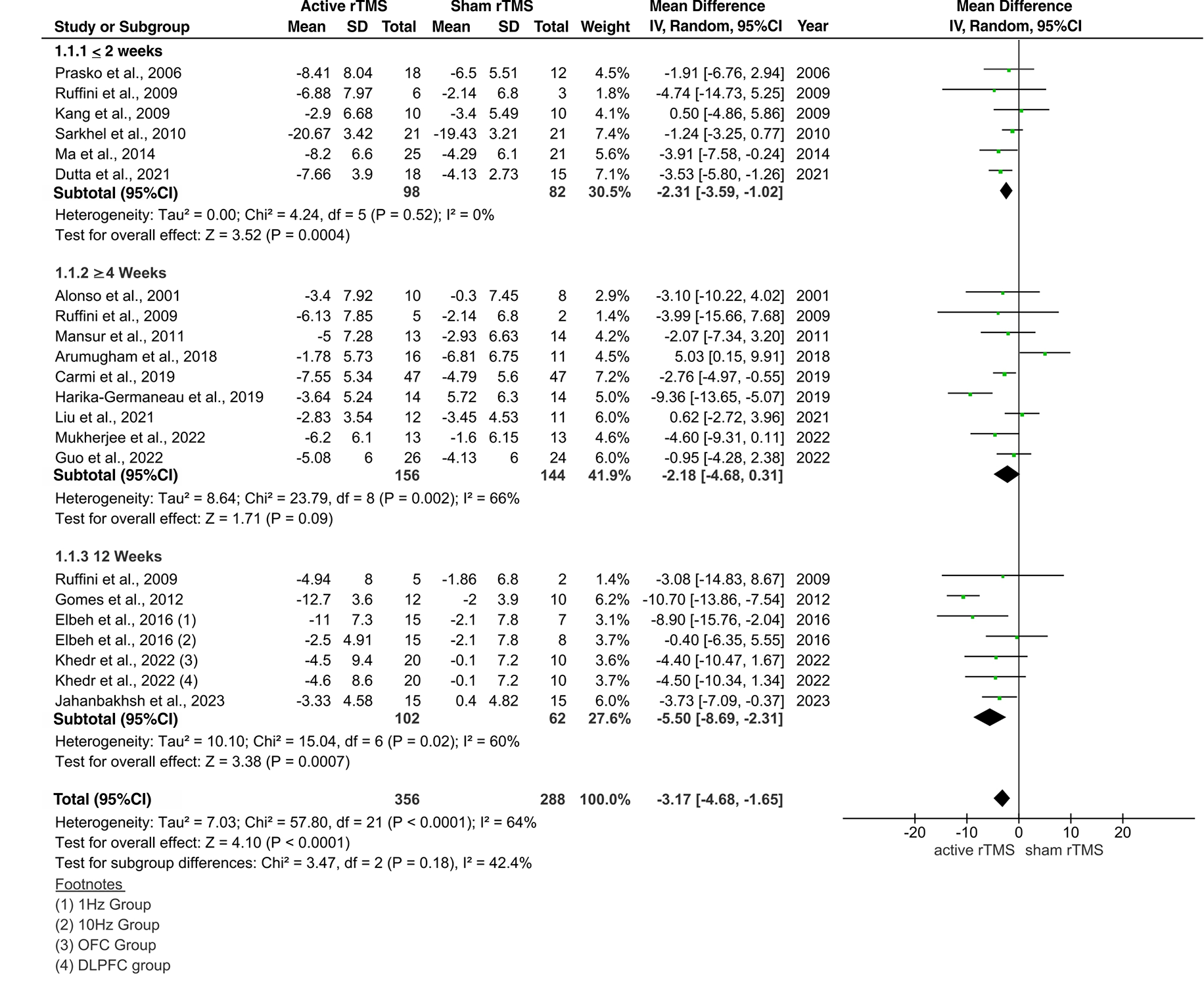
Y-BOCS scores reduced significantly between baseline and follow-up, with an overall effect MD of -3.17 points (95%CI -4.68 to -1.65; p < 0.0001). Subgroup analysis according to follow-up duration revealed that the effect was particularly pronounced in 12-weeks of follow-up (-5.50 points; 95%CI -8.69 to -2.31), exceeding reductions observed in ≤ 2-weeks of follow-up. The results were not significant in 4 weeks of follow-up, with 95%CI -4.68, 0.31 and moderate heterogeneity (I 2 = 66%) (Figure 3).

Baseline to follow-up effects according to protocol duration. Prepared by the authors using RevMan 5.3.16 Chi2 = chi-square test; df = degrees of freedom; DLPFC = dorsolateral prefrontal cortex; Hz = Hertz; OFC = orbitofrontal cortex; rTMS = repetitive transcranial magnetic stimulation; Tau2 = between-study variance; Z = test for overall effect.
Effect maintenance during follow-up
A thorough analysis of Y-BOCS scores revealed no significant effect, which was consistent across all the assessed periods. In the immediate follow-up (≤ 2 weeks), the MD was 0.04 points (95%CI -1.46 to 1.39; p = 0.96), which remained similar in intermediate follow-up (≥ 4 weeks) (95%CI -1.04 to 1.75; p = 0.61) and late follow-up (12 weeks) (95%CI -1.27 to 2.35; p = 0.56), with no significant variation among periods (p = 0.87; I 2 = 0%) (Figure 4).

Follow-up effects according to protocol duration. Prepared by the authors using RevMan 5.3.16 Chi2 = chi-square test; df = degrees of freedom; DLPFC = dorsolateral prefrontal cortex; Hz = Hertz; OFC = orbitofrontal cortex; rTMS = repetitive transcranial magnetic stimulation; Tau2 = between-study variance; Z = test for overall effect.
Effects on anxiety from baseline to post-treatment
Analysis of anxiety levels demonstrated a significant post-treatment reduction, with a standardized mean difference of -0.39 (95%CI -0.54 to -0.23; Z = 4.76; p < 0.00001), corresponding to a small effect. The I 2 value of 0% and p-value of 0.60 indicated a lack of heterogeneity, suggesting the findings were consistent. The Egger regression analysis showed no evidence of publication bias (intercept = -0.09; p = 0.921; 95%CI -1.85 to 1.68). The overall effect of rTMS on anxiety (standardized mean difference = -0.39) corresponds to a 2.3-point reduction in Hamilton Anxiety Rating Scale scores, based on the mean standard deviation of control groups (Supplementary Figure S4).
Effects on depression from baseline to post-treatment
The analysis of depressive symptoms indicated a modest yet significant reduction, with a standardized mean difference of -0.34 (95%CI -0.50 to -0.18; Z = 4.13; p < 0.0001). The heterogeneity analysis indicated no heterogeneity among the included studies (I 2 = 0; p = 0.80). The Egger regression analysis showed no evidence of publication bias (intercept = -0.50; p = 0.39; 95%CI -1.67 to 0.67). The overall effect of rTMS on depression (standardized mean difference = -0.34) corresponded to a 1.84-point reduction in Hamilton Depression Rating Scale scores, based on the mean standard deviation of control groups (Supplementary Figure S5).
Treatment response
The treatment response analysis indicated that active rTMS was significantly more effective than placebo, with a RR of 3.20 (95%CI 2.08 to 4.91; p < 0.00001), suggesting that patients who received rTMS had more than three times the likelihood of clinical response than controls. There was no between-study heterogeneity (I 2 = 0%), indicating consistency across disparate protocols (Supplementary Figure S6).
Analysis of participant responses revealed that the pooled RR of 3.20 was equivalent to a NNT of 6. This indicates that a minimum of six patients would require rTMS treatment to achieve one additional clinical response in comparison with sham treatment. The 95%CI for the NNT was derived from the RR CI; when the adjusted RR CI included zero, the NNT CI was considered imprecise.
The sensitivity analysis, which was restricted to the four studies that used the combined response criterion (Y-BOCS ≥ 35% + Clinical Global Impression-I 1-2 points), revealed no significant difference between rTMS and sham (RR = 1.58; 95%CI 0.47, 5.26; p = 0.46). As the RR was not significant and its CI included 1, it can be deduced that the CI for the adjusted RR included zero. Therefore, the non-nullity test NNT CI was unstable (i.e., it includes infinity). Consequently, the NNT for this sensitivity analysis was uninformative (Supplementary Figure S7).
Egger’s regression indicated significant funnel plot asymmetry (intercept = 1.42; 95%CI 0.29 to 2.55; p = 0.02), suggesting the presence of publication bias. The trim and fill method estimated four missing studies on the left side (smaller or negative effects). Following adjustment, the effect size changed from 3.2 (95%CI 2.08 to 4.91) to 2.7 (95%CI 1.80 to 4.07).
Dropout rate
There were no significant differences in dropout rate between groups (RR = 1.19; 95%CI 0.70 to 2.02; I 2 = 0%; p = 0.53), indicating that the rTMS tolerability profile was similar to that of placebo in the included studies (Supplementary Figure S8).
Egger’s regression revealed no significant funnel plot asymmetry (intercept = 0.66; 95%CI -1.04 to 2.36; p = 0.41), indicating that publication bias was not a contributing factor. The trim and fill method estimated two missing studies on the left side. Following adjustment, the effect size changed from 1.19 (95%CI 0.70 to 2.02) to 1.07 (95%CI 0.64 to 1.77).
Publication bias
Publication bias was assessed through Egger’s regression and the Duval and Tweedie trim and fill method, both utilizing a random-effects model. When all studies were included in the analysis, Egger’s regression indicated significant funnel plot asymmetry (intercept = -1.71; 95%CI -2.83 to -0.59; p = 0.004), suggesting publication bias. The trim and fill method estimated 12 missing studies on the right side (i.e., with less negative or positive effect), suggesting potential bias because studies with smaller or null effects may not have been published (Supplementary Figure S9).
Following adjustment, the effect size was substantially reduced, from -3.11 (95%CI -4.15 to -2.06) to -1.46 (95%CI -2.61 to -0.31). This further substantiates the prevailing suspicion of bias in the literature (Supplementary Figure S10).
Sensitivity analysis
The studies by Badawy et al.,37 Mansur et al.,38 Jahangard et al.,21 and Shayganfard et al.,19 classified as high risk of bias, were excluded in a new analysis. Following their exclusion, the active group consisted of 431 individuals, while the placebo group consisted of 359 participants. The heterogeneity was moderate (I 2 = 69%), with a 95%CI -4.66; -1.96; p < 0.00001; χ2 = 77.46; Z = 2.55, and there was an average reduction of 3.31 points in Y-BOCS score, demonstrating the persistent efficacy of rTMS compared to placebo in reducing OCD symptom severity.
Following the exclusion of studies deemed to be at high risk of bias, Egger’s regression analysis nevertheless suggested potential asymmetry (intercept = -1.77; 95%CI -3.02 to -0.53; p = 0.007). However, the trim and fill method did not identify missing studies, thus the effect size remained unchanged (-3.29; 95%CI -4.46 to -2.13). This suggests that publication bias had less influence among studies with better methodological quality.
Although studies with a high risk of bias were included in the present analyses, a sensitivity analysis without them was conducted to assess their influence on the results. It was observed that even with their exclusion, the effect of rTMS on OCD symptoms remained significant and of similar magnitude.
Furthermore, the trim and fill method failed to detect missing studies when only higher-quality studies were considered, thereby reinforcing the robustness of the findings. We decided to include all studies in the main analysis for greater statistical power and a more representative sample of the available literature, without compromising the validity of the conclusions.
To assess the impact of the assumed correlation between repeated measures, the primary meta-analysis was repeated using r = 0.3 and r = 0.7 (plausible bounds). In the instance of r = 0.3, the MD was -3.25 (95%CI -4.39 to -2.11; p = 0.002). The standard error was calculated to be 0.582, the variance to be 0.339, and the I 2 to be 48.2%. The prediction interval was found to be from -7.54 to 1.04. In the instance of r = 0.7, the MD was -3.59 (95%CI -4.72 to -2.45; p < 0.001), with a standard error of 0.581, a variance of 0.338, I 2 = 76.6%, and prediction interval = -9.00 to 1.83.
Consequently, while the pooled effect magnitude and statistical significance remain resilient to variation in r, between-study heterogeneity and prediction interval width escalate with elevated assumed correlations, signifying heightened uncertainty about the observations of future studies.
Meta-regression
The meta-regression was conducted using a parsimonious model (one moderator at a time), as recommended. Baseline Y-BOCS severity was found to be a significant moderator of the effects of rTMS (coefficient = -0.46; 95%CI -0.88 to -0.04; p = 0.031), accounting for 47% of the observed between-study heterogeneity. This finding suggests that higher baseline severity is associated with smaller reductions in symptoms, a clinically relevant finding.
Univariate meta-regression was used to assess the impact of two moderators: the targeting method (neuronavigation vs. the 5 cm rule) and the coil type (figure-eight vs. H7). No statistically significant associations were observed (Supplementary Table S3).
In addition to our moderator analysis, previous meta-analyses have also explored factors associated with treatment response to rTMS in OCD. Supplementary Table S4 provides a comparative overview of these moderators, highlighting that only a few studies systematically evaluated baseline severity or targeting precision as potential predictors.
Evidence quality assessment
For the primary outcome of OCD severity, measured using the Y-BOCS and including 29 studies, with 474 participants in the active group and 403 in the placebo group, the quality of evidence was significantly compromised. The risk of bias was classified as serious, with 12 studies categorized as low risk, 13 studies as unclear risk, and six studies as high risk.
There was also evidence of serious inconsistency, as indicated by high heterogeneity (I 2 = 68%), as well as serious imprecision, given that the 95%CI -4.55 to -2.04 did not reach a minimum clinically important difference of 5-6 points on the Y-BOCS scale. Publication bias was suspected (p = 0.004), and the effect size was considered large. Due to these limitations, the quality of the evidence for this outcome was rated as very low.
Regarding the anxiety outcome, which included 26 studies, with 357 participants in the active group and 293 in the placebo group, the risk of bias was also considered substantial, with 10 studies categorized as unclear risk and 2 as high risk. However, neither the inconsistency (I 2 = 0%) nor the imprecision (with a narrow 95%CI of -0.54 to -0.23) were considered serious. A lack of publication bias was confirmed (p = 0.921) and the effect size was minimal. The quality of the evidence for this outcome was considered moderate, primarily due to risk of bias concerns.
Regarding the depression outcome, which included 27 studies, with 329 participants in the active group and 287 in the sham group, the risk of bias was again considered serious, with 11 studies categorized as unclear risk and 4 as high risk. Neither the inconsistency (I 2 = 0%) nor the imprecision (with a narrow 95%CI -0.50 to -0.18) were categorized as serious. There was no evidence of publication bias (p = 0.39), and the effect size was minimal.
Therefore, the quality of evidence for this outcome was considered moderate, with the principal limiting factor being the risk of bias (Supplementary Figure S11). The findings, including absolute effects and NNT, in accordance with GRADE recommendations, are summarized in Supplementary Table S5.
Discussion
This systematic review has provided updated evidence about the effects of rTMS on OCD symptoms. It addressed a range of factors, including different frequencies, modalities, overall effects, their sustainability, and moderators of clinical response. The brain regions associated with statistically significant effects were the DLPFC and the mPFC/ACC.
Significant reductions in Y-BOCS scores were found for frequencies < 1 Hz and > 5 Hz, as well as for dTMS, but not for cTBS. However, the MD was below the contemporary minimum clinically important difference of 4.9 points, suggesting that the average effect may be clinically modest.39 This nuanced interpretation was supported by a favorable NNT for treatment response.
The present analysis, which focused on the endpoint and follow-up, an area not explored in earlier reviews, showed no significant differences between follow-up durations of < 2 weeks, > 4 weeks, and 12 weeks. However, the analysis that considered baseline in relation to follow-up showed a significant effect at < 2 weeks and 12 weeks, but not at > 4 weeks, suggesting that the treatment effect neither decayed nor increased over time.
Regarding secondary outcomes, rTMS effectively reduced anxiety and depression symptoms with narrow CIs, indicating precise estimates of small but consistent effects. Participants receiving active rTMS were 3.2 times more likely to respond to treatment than those receiving placebo, and there was no significant difference in dropout rates between the groups, suggesting that the treatment was well tolerated.
These results corroborate previous studies, such as systematic reviews by Liang et al.40 and Thatikonda et al.,12 in which rTMS over the DLPFC and mPFC/ACC had significant effects. The left DLPFC has been associated with executive control, thus reinforcing the importance of fronto-striatal circuit modulation in OCD. In contrast, the right DLPFC and orbitofrontal cortex have been associated with mood regulation and a reduction in depressive symptoms.41,42
Contrary to the findings of Dehghani-Arani et al.,9 who reported an effect for the right DLPFC but not for the orbitofrontal cortex, we found no significant results for the right DLPFC. This discrepancy may be attributable to methodological differences in the categorization of stimulation targets18,19,21 and study selection, such as Alonso et al.43 and Seo et al.,44 which were not included in the primary analysis due to unavailable data.
A comprehensive network meta-analysis by Vinod et al.45categorized excitatory bilateral DLPFC and both excitatory and inhibitory mPFC/ACC protocols as the most effective interventions, with very similar and high surface under the cumulative ranking curve values, suggesting comparable efficacy between these targets. This convergence of evidence across methodologies is further underscored by the earlier work of Liang et al.,40 who also found DLPFC stimulation to be highly efficacious. However, it is important to note a point of divergence: while Vinod et al.45 found the mPFC/ACC to be highly effective, while Liang et al.40 did not find HF-rTMS over the ACC/mPFC to be superior to sham, highlighting potential methodological or study selection differences.
Dehghani-Arani et al.’s9electrical field modeling provides a potential neurophysiological rationale for the efficacy of these targets, demonstrating that DLPFC stimulation generates strong electric fields in cognitive circuits, while the pre-SMA modulates a wider array of circuits implicated in OCD pathophysiology. The preponderance of evidence suggests that both the DLPFC and the mPFC/ACC are robust and leading targets for rTMS in OCD, potentially resulting in superior outcomes to other sites, such as the orbitofrontal cortex.
No significant effect was found for the SMA, which contradicts the findings of previous meta-analyses.40,46 The lack of an effect may be explained by our inclusion of only studies whose patients were on stable medication for ≥ 2 months and our exclusion of those involving pharmacological changes during the protocol. This is in contrast to earlier analyses, which included studies with concomitant medication adjustments.47
Furthermore, our inclusion of three studies published after 2022, which had not been included in previous analyses, enhanced the robustness of the evidence. Previous reviews have included open-label studies7 or excluded cTBS protocols,9 which limits the possibility of direct comparisons with the current review. We found that protocols operating at frequencies < 1 Hz and > 5 Hz were efficacious.48 This finding is consistent with a clinical trial by Elbeh et al.49 and a meta-analysis by Zhou et al.10 The meta-analysis reported significant improvements that were sustained for up to 3 months, with no observed difference between low and high frequency protocols. This effect is associated with modulation of GABAergic interneurons, which are essential for cortical inhibition.50,51 dTMS has also shown promising results, with Carmi et al.32 reporting a response rate of 45.2% in the active group vs. 17.8% in the sham group after 1 month.
More recently, Houben et al.52 replicated and extended these findings in a multicenter RCT using deep TMS over the dorsal medial PFC/ACC combined with symptom provocation, reporting significant reductions in Y-BOCS scores and sustained benefits at 4 weeks post-treatment, thereby reinforcing the robustness of this target, which has been approved by the U.S. Food and Drug Administration.
In accordance with these findings, a recent meta-analysis by Li et al.53 demonstrated that dTMS has robust efficacy for treatment-resistant OCD. Patients receiving active dTMS were 3.7 times more likely to respond than those receiving sham stimulation, and sustained benefits were observed at 1 month of follow-up. This evidence reinforces that dTMS over the mPFC/ACC is a reliable and well-tolerated protocol, a notion that is currently supported by converging data from both individual randomized clinical trials and aggregated analyses.
The ineffectiveness of cTBS for OCD is in accordance with a meta-analysis by Perera et al.54 This may be attributable to the reduced total stimulation load and the selection of non-responsive cortical targets, such as the SMA and the orbitofrontal cortex, which had previously been identified as non-significant targets in previous reviews9,12 and the present review. This is further compounded by the reduced number of sessions and the limited sample sizes.55-59
This finding aligns with Perera et al.,54 whose meta-analysis revealed comparable improvements for low-frequency rTMS and cTBS over the right DLPFC, with no significant between-group difference. These results suggest that cTBS may not offer any significant advantage over conventional protocols,60 which is in contrast to the emerging, albeit complex, evidence for its counterpart, iTBS. The divergent clinical outcomes could be rooted in their fundamental neurophysiological effects, in which iTBS facilitates and cTBS inhibits cortical excitability.61
In a randomized controlled trial, Akyol et al.62 used an accelerated d-iTBS protocol, finding a significant group x time interaction and a delayed therapeutic effect, a pattern also hinted at in earlier pilot work.63 The investigation of such accelerated iTBS protocols is motivated by their success in other conditions, such as treatment-resistant depression.64 Consequently, the null findings for cTBS and the delayed efficacy for iTBS emphasize that both the protocol type (inhibitory vs. facilitatory) and the temporal assessment window are critical.
In parallel with these protocol-specific findings, accelerated protocols have garnered attention for their capacity to expedite symptom alleviation. Observational datasets and small pilot trials have reported early responses and high responder rates, but these are typically uncontrolled and underpowered.65,66 To date, the most rigorous randomized evidence has revealed significant post-treatment improvements in both arms but no between-group superiority.25 Future studies should directly compare these TBS modalities using optimized targets, intensive regimens, and extended follow-up to definitively establish their distinct roles in OCD treatment.
Accordingly, in a meta-analysis, Joseph et al.67 reported a moderate pooled effect size for accelerated TMS paradigms across psychiatric disorders, with preliminary and inconsistent evidence specifically for OCD. It is evident that uncontrolled studies may result in the overestimation of between-group effects.
Despite promising results, there is currently a lack of sufficient controlled evidence to conclude whether accelerated paradigms are superior to standard or sham protocols. In the above mentioned meta-analysis, the “accelerated” subgroup included only five studies, which resulted in limited power and considerable heterogeneity. Consequently, despite their initial promise, there is currently insufficient controlled evidence to conclude that accelerated paradigms are superior to standard protocols or sham treatment.
Building upon these findings, accelerated TMS/TBS protocols have emerged as a potential strategy to shorten treatment and speed clinical response. Recent studies have indicated favorable short-term efficacy and acceptable tolerability across affective disorders, with preliminary support regarding OCD.25,68 However, it should be noted that protocols remain heterogeneous and follow-up data are scarce.
Carmi et al.’s32 multicenter randomized controlled trial established dTMS over the mPFC/ACC as a Food and Drug Administration-approved protocol for OCD, thereby underscoring the importance of addressing maintenance strategies. Pragmatic maintenance approaches inspired by rTMS protocols for depression suggest that weekly sessions during the first month, followed by biweekly boosters for 2 to 4 months, may be reasonable methods of consolidating treatment gains.69
Beyond innovations in stimulation frequency and scheduling, an important aspect observed in our review was that only two of the included studies32,33 incorporated symptom provocation prior to stimulation in order to more strongly engage hyperactivated fronto-striatal circuitry in OCD. The available theoretical evidence suggests that stimulating specific cortical regions during an activated state may enhance neural plasticity and thereby improve the clinical effects of rTMS/dTMS. The evidence base for targeting the mPFC/ACC using the H7 coil in OCD is supported by a mechanistically coherent rationale in the cortico-striatal-thalamo-cortical circuit model.
Carmi et al.32found that high-frequency dTMS over the dorsal medial PFC/ACC led to a significant reduction in Y-BOCS scores in comparison with sham stimulation, with sustained effects during follow-up. This target is neurobiologically justified, as the ACC and dorsal medial PFC are key nodes in the affective limbic loop of the cortico-striatal-thalamo-cortical circuit, which is hyperactive in patients with OCD and normalized following effective treatment. The H7 coil’s capacity to modulate these deeper structures, as evidenced by computational modeling and physiological studies, enhances the intervention’s specificity in comparison to superficial coils.70
In the effect maintenance analysis, the stability of clinical gains achieved with rTMS emerged as the most salient finding. A comparison of post-treatment and follow-up assessments showed no significant decay in effects across time windows. Interpreted from a non-inferiority perspective, this indicates that symptom improvement was maintained after treatment discontinuation,51,71,72 a conclusion corroborated by the sustained significance of baseline to follow-up comparisons at ≤ 2 and 12 weeks.73 The loss of significance at 4 weeks is likely attributable to dissipation of the acute effect and to methodological variability,74 which does not invalidate the overall stability pattern.
However, the lack of increased effects in subsequent assessments serves to reinforce the finding that, without structured reinforcement protocols (a limitation of most of the included trials), the effects tend to plateau, with rTMS-induced neural plasticity remaining temporary and without consolidation.75-77
This perspective is corroborated by the findings of recent studies: although randomized clinical trials have investigated intensified protocols (e.g., twice-daily cTBS) and extended reinforcement sessions, Dehghani-Arani et al.9 concluded that such dosing does not inherently amplify the magnitude of symptom improvement. The present findings are consistent with this conclusion, indicating that the primary function of reinforcement may be to consolidate the effects and prevent their long-term decay, rather than to induce further increases.78
As demonstrated by Thatikonda et al.,12 rTMS is efficacious in reducing anxiety and depression symptoms, which suggests benefits for core OCD symptoms and emotional comorbidities. The findings of our meta-analysis support the hypothesis that rTMS can function as an adjuvant intervention for OCD, whilst simultaneously exposing its clinical limitations.
The mean improvement in Y-BOCS scores, while statistically significant, falls below the contemporary minimum clinically important difference threshold of 5-6 points,39 suggesting that the average effect may be clinically modest for the general population. However, the responder analysis indicated that a subgroup of patients experiences a clinically robust benefit, which aligns with the recognized heterogeneity of OCD and the hypothesis that only certain cortico-striatal circuits can be modulated by rTMS.
Beyond the quantitative findings, it is important to examine the nature and meaning of these improvements in anxiety and depressive symptoms. The effects on anxiety and depression, although modest, are consistent and clinically relevant. This is because anxious and depressive comorbidities often worsen OCD prognosis, increase avoidance behaviors, and limit therapeutic adherence.79 However it is crucial to acknowledge the inherent limitation of shared method variance.80 Given that improvement in anxiety and depression symptoms was assessed in the same individuals and within the same context as the primary OCD intervention, it is plausible that part of this effect reflects a secondary artifact of the core reduction in obsessive-compulsive symptoms, rather than a direct and independent effect of rTMS on mood.
Network studies81 have indicated that symptoms such as “panic” and “distress caused by compulsive behaviors” act as central and bridge nodes, potentiating symptom interconnectivity and justifying the indirect targeting of these domains by rTMS. Collectively, these results suggest that rTMS should not be viewed as an isolated therapy, but rather as part of a multimodal strategy. It is particularly suited for patients with specific symptom profiles or anxiety comorbidities, potentially combined with pharmacological approaches and exposure-based psychotherapies, which are crucial for reducing avoidance.
Despite the fact that the moderator tests did not yield significant associations with rTMS response, the expanding corpus of literature on functional connectivity suggests that targeting precision may be critically important. Recent studies have demonstrated that resting-state networks and connectivity involving the thalamus, ACC, and mPFC correlate with treatment response in OCD and other psychiatric disorders.79,82 These findings support the hypothesis that targeting methods based on functional connectivity, as opposed to scalp heuristics or superficial coil placement, have the potential to enhance the clinical efficacy of rTMS.
The non-significant moderator analysis results could be attributed to several factors, including an insufficient number of study participants, variations in localization protocols (e.g., the 5-cm rule83 vs. neuronavigation vs. imaging-based identification), and heterogeneity in the precise location of the target. In agreement with the circuit-specific effects emphasized in the moderator analysis, Postma et al.84 demonstrated that pretreatment task-based fMRI activation and connectivity in cognitive control and motor-inhibitory networks predict individual response to rTMS over the DLPFC and pre-SMA when combined with exposure therapy, thereby highlighting the relevance of neuroimaging-informed personalization.
Our finding that higher baseline severity (according to Y-BOCS score) is associated with less symptom improvement is consistent with recent naturalistic studies.85 However, previous meta-analyses have not consistently observed this effect,86 which may reflect differences in studies, moderator coding, or power.
Conversely, Storch et al.87 found that patients with elevated baseline severity had greater absolute improvement following dTMS over the dorsal medial PFC/ACC. This divergence is presumably attributable to methodological differences, given that our meta-regression used study-level data from heterogeneous protocols, whereas Storch et al.87 analyzed individual-level outcomes from a single RCT. Collectively, these findings imply that the role of baseline severity in rTMS response may be contingent on analytical level and clinical context, underscoring the need for individual-participant data meta-analyses.
Contrary to previous meta-analyses by Zhou et al.10 and Pellegrini et al.,11 which found no significant relationship, we found that greater baseline OCD symptom severity (according to Y-BOCS scores) in the active group was associated with poorer response to rTMS treatment. This key finding may explain the previously observed null results. It is conceivable that within their cohorts, which mainly consisted of treatment-resistant patients88 (a subgroup characterized by high severity and low responsiveness), the “ceiling” effect of severity was already in effect, thereby obscuring detection of a linear gradient. The broader dataset, encompassing a wider range of severity levels, revealed an inverse dose-response relationship, indicating that patients recruited for rTMS trials who begin treatment in a more severe state are generally those who benefit the least.
Although earlier meta-analyses40,46,86 have provided valuable evidence supporting the efficacy of rTMS for OCD, the present review offers several methodological and temporal advancements. Specifically, our study included trials published until September 2024, thereby extending the evidence base beyond that of previous analyses. This was achieved by applying more stringent inclusion criteria, such as stable medication use, and excluding open-label designs. Furthermore, we conducted quantitative assessments of treatment durability and moderator effects, which had not been systematically explored in previous reviews. These refinements contribute to a more contemporary and rigorous understanding of the clinical profile of rTMS in OCD.
When interpreting these findings, it is imperative to consider their methodological constraints. The present study is subject to several limitations. First, the moderator analyses were conducted at the study level rather than the participant level, which could introduce a risk of ecological bias. Despite re-running the meta-regression using parsimonious models were restricted to one moderator at a time, the restriction to more elementary analytical approaches limited our ability to address collinearity and interaction effects.
The limited number of studies conducted in specific subgroups, such as accelerated protocols and symptom provocation, precluded more robust analyses and may have resulted in lower statistical power. The methodological heterogeneity across the included trials, in terms of stimulation parameters, response definitions, and blinding integrity, may have influenced both the magnitude and the consistency of the observed effects.
A final limitation pertains to the September 2024 search cut-off. Subsequent randomized controlled trials52,60,62,84 were not included in the quantitative synthesis. These studies explored novel paradigms, such as deep iTBS, combined rTMS-exposure and response prevention designs, and neuroimaging-based predictors, which broaden the emerging evidence base.
In conclusion, this updated meta-analysis lends further support to the efficacy of rTMS as an adjunctive intervention for OCD, with the most consistent evidence supporting the DLPFC and mPFC/ACC as targets, while cTBS and SMA showed no significant benefits. Although the mean Y-BOCS reductions were statistically significant, they fell below the contemporary threshold for clinical significance, suggesting modest average benefits at the population level but clinically meaningful effects in responder subgroups.
In addition, there was a discernible yet uniform reduction in anxiety and depressive symptoms, accompanied by favorable tolerability and an attrition rate commensurate with the sham group. These findings support the role of rTMS within a multimodal treatment strategy for OCD. However, the results also underscore the need for future trials that employ standardized protocols, enhanced targeting precision, and systematic evaluation of maintenance strategies to ensure sustained long-term benefits.
Supplementary Materials
Supplementary Material
Acknowledgements
We would like to express our gratitude to the research team and the institution that supported the development of this study.
Data availability statement
The data that support this study are available in the body of the paper and/or supplementary materials.
References
- 1 Leckman JF, Bloch MH, King RA. Symptom dimensions and subtypes of obsessive-compulsive disorder: a developmental perspective. Dialogues Clin Neurosci. 2009;11:21-33.
- 2 Pampaloni I, Marriott S, Pessina E, Fisher C, Govender A, Mohamed H, et al. The global assessment of OCD. Compr Psychiatry. 2022;118:152342.
- 3 Park J, Kim T, Kim M, Lee TY, Kwon JS. Functional connectivity of the striatum as a neural correlate of symptom severity in patient with obsessive-compulsive disorder. Psychiatry Investig. 2020;17:87-95.
- 4 American Psychiatric Association. DSM-IV-TR: manual diagnóstico e estatístico de transtornos mentais. 4a ed. rev. Porto Alegre: Artmed; 2002.
- 5 Nezgovorova V, Reid J, Fineberg NA, Hollander E. Optimizing first line treatments for adults with OCD. Compr Psychiatry. 2022;115:152305.
- 6 Chen R. Guideline on therapeutic use of repetitive transcranial magnetic stimulation: Useful but know the methods and limitations. Clin Neurophysiol. 2020;131:461-2.
- 7 Grassi G, Moradei C, Cecchelli C. Will transcranial magnetic stimulation improve the treatment of obsessive-compulsive disorder? A systematic review and meta-analysis of current targets and clinical evidence. Life (Basel). 2023;13:1494.
- 8 Rehn S, Eslick GD, Brakoulias V. A meta-analysis of the effectiveness of different cortical targets used in Repetitive Transcranial Magnetic Stimulation (rTMS) for the treatment of Obsessive-Compulsive Disorder (OCD). Psychiatr Q. 2018;89:645-65.
- 9 Dehghani-Arani F, Kazemi R, Hallajian AH, Sima S, Boutimaz S, Hedayati S, et al. Metaanalysis of Repetitive Transcranial Magnetic Stimulation (rTMS) efficacy for OCD treatment: the impact of stimulation parameters, symptom subtype and rTMS-Induced Electrical Field. J Clin Med. 2024;13:5358.
- 10 Zhou DD, Wang W, Wang GM, Li DQ, Kuang L. An updated meta-analysis: Short-term therapeutic effects of repeated transcranial magnetic stimulation in treating obsessive-compulsive disorder. J Affect Disord. 2017;215:187-96.
- 11 Pellegrini L, Garg K, Enara A, Gottlieb DS, Wellsted D, Albert U, et al. Repetitive transcranial magnetic stimulation (r-TMS) and selective serotonin reuptake inhibitor-resistance in obsessive-compulsive disorder: a meta-analysis and clinical implications. Compr Psychiatry. 2022;118:152339.
- 12 Thatikonda NS, Vinod P, Balachander S, Bhaskarpillai B, Arumugham SS, Reddy YCJ. Efficacy of repetitive transcranial magnetic stimulation on comorbid anxiety and depression symptoms in Obsessive-Compulsive Disorder: A meta-analysis of randomized sham-controlled trials. Can J Psychiatry. 2023;68:407-17.
-
13 Cochrane Collaboration. What are systematic reviews? [Internet]. London: Cochrane [cited 2025 Nov 06]. https://www.cochrane.org/pt/evidence
» https://www.cochrane.org/pt/evidence - 14 Page MJ, Moher D, Bossuyt PM, Boutron I, Hoffmann TC, Mulrow CD, et al. PRISMA 2020 explanation and elaboration: updated guidance and exemplars for reporting systematic reviews. BMJ. 2021;372:n160.
-
15 Rayyan. Rayyan intelligent systematic review [Internet]. Version 2.0. 2023 [cited 2025 Nov 06]. https://www.rayyan.ai/
» https://www.rayyan.ai/ -
16 Biostat Inc. Comprehensive Meta-Analysis (CMA): software for meta-analysis [Internet]. Version 4.0. Englewood, NJ: Biostat. 2013 [cited 2025 Nov 06]. https://www.meta-analysis.com
» https://www.meta-analysis.com - 17 Nauczyciel C, Le Jeune F, Naudet F, Douabin S, Esquevin A, Vérin M, et al. Repetitive transcranial magnetic stimulation over the orbitofrontal cortex for obsessive-compulsive disorder: a double-blind, crossover study. Transl Psychiatry. 2014;4:e436.
- 18 Haghighi M, Shayganfard M, Jahangard L, Ahmadpanah M, Bajoghli H, Pirdehghan A, et al. Repetitive Transcranial Magnetic Stimulation (rTMS) improves symptoms and reduces clinical illness in patients suffering from OCD--Results from a single-blind, randomized clinical trial with sham cross-over condition. J Psychiatr Res. 2015;68:238-44.
- 19 Shayganfard M, Jahangard L, Nazaribadie M, Haghighi M, Ahmadpanah M, Sadeghi Bahmani D, et al. Repetitive transcranial magnetic stimulation improved symptoms of obsessive-compulsive disorders but not executive functions: results from a randomized clinical trial with crossover design and Sham condition. Neuropsychobiology. 2016;74:115-24.
- 20 Ziblak A., Tumkaya S., Kashyap H. Transcranial magnetic stimulation over orbitofrontal cortex in obsessive compulsive disorder: a double-blind placebo-controlled trial. J Obsessive Compuls Relat Disord. 2021;31:100687.
- 21 Jahangard L, Haghighi M, Shyayganfard M, Ahmadpanah M, Sadeghi Bahmani D, Bajoghli H, et al. Repetitive transcranial magnetic stimulation improved symptoms of obsessive-compulsive disorder, but also cognitive performance: results from a randomized clinical trial with a cross-over design and Sham Condition. Neuropsychobiology. 2016;73:224-32.
-
22 GRADE Working Group. GRADEpro guideline development tool (GDT) [Internet]. Version 4.0. Hamilton: McMaster University. 2024 [cited 2025 Nov 06].https://www.gradepro.org
» https://www.gradepro.org - 23 Sachdev PS, McBride R, Loo CK, Mitchell PB, Malhi GS, Croker VM. Right versus left prefrontal transcranial magnetic stimulation for obsessive-compulsive disorder: a preliminary investigation. J Clin Psychiatry. 2001;62:981-4.
- 24 Akbarzadeh F, Mohammadzadeh A, Ghoshuni M, Abdollahian E, Talaei A, Najjari B, et al. Efficacy of repetitive transcranial magnetic stimulation in patients with obsessive-compulsive disorder: a pilot study. Neuropsychiatr. 2021;35:192-8.
- 25 Jiang J, Wan K, Liu Y, Tang Y, Tang W, Liu J, et al. A controlled clinical study of accelerated high-dose theta burst stimulation in patients with Obsessive-Compulsive disorder. Neural Plast. 2023;2023:2741287.
- 26 Joshi M, Kar SK, Dalal PK. Safety and efficacy of early augmentation with repetitive transcranial magnetic stimulation in the treatment of drug-free patients with obsessive-compulsive disorder. CNS Spectr. 2022:1-7.
- 27 Zhang K, Fan X, Yuan J, Yin J, Su H, Hashimoto K, et al. Impact of serotonin transporter gene on rTMS augmentation of SSRIs for obsessive compulsive disorder. Neuropsychiatr Dis Treat. 2019;15:1771-9.
- 28 Mantovani A, Rossi S, Bassi BD, Simpson HB, Fallon BA, Lisanby SH. Modulation of motor cortex excitability in obsessive-compulsive disorder: an exploratory study on the relations of neurophysiology measures with clinical outcome. Psychiatry Res. 2013;210:1026-32.
- 29 Meek BP, Fotros A, Abo Aoun M, Modirrousta M. Improvements in error-monitoring and symptoms following low-frequency rTMS of dorsal anterior cingulate cortex in obsessive compulsive disorder; a randomized, sham-controlled study. Brain Cogn. 2021;154:105809.
- 30 Diarjani A.A., Javadi S.A.H.S. The effect of low-frequency repetitive transcranial magnetic stimulation on left dorsolateral prefrontal cortex in patients with the obsessive-compulsive disorder: a double-blinded, sham-controlled clinical trial. Middle East Curr Psychiatry. 2022;29:15.
- 31 Arumugham SS, Vs S, Hn M, B V, Ravi M, Sharma E, et al. Augmentation effect of low-frequency repetitive transcranial magnetic stimulation over presupplementary motor area in obsessive-compulsive disorder: a randomized controlled trial. J ECT. 2018;34:253-7.
- 32 Carmi L, Tendler A, Bystritsky A, Hollander E, Blumberger DM, Daskalakis J, et al. Efficacy and safety of deep transcranial magnetic stimulation for obsessive-compulsive disorder: a prospective multicenter randomized double-blind placebo-controlled trial. Am J Psychiatry. 2019;176:931-8.
- 33 Guo Q, Wang K, Han H, Li P, Cheng J, Zhu J, et al. Continuous theta burst stimulation over the bilateral supplementary motor area in obsessive-compulsive disorder treatment: A clinical randomized single-blind sham-controlled trial. Eur Psychiatry. 2022;65:e64.
- 34 Hawken ER, Dilkov D, Kaludiev E, Simek S, Zhang F, Milev R. Transcranial magnetic stimulation of the supplementary motor area in the treatment of obsessive-compulsive disorder: A Multi-Site Study. Int J Mol Sci. 2016;17:420.
- 35 Ozer U, Yucens B, Tumkaya S. Efficacy of accelerated deep transcranial magnetic stimulation wi?th double cone coi?l in obsessive-compulsive disorder: a double-blind, placebo-controlled study. J Psychiatr Res. 2024;171:325-31.
- 36 Pelissolo A, Harika-Germaneau G, Rachid F, Gaudeau-Bosma C, Tanguy ML, BenAdhira R, et al. Repetitive transcranial magnetic stimulation to supplementary motor area in refractory obsessive-compulsive disorder treatment: a sham-controlled trial. Int J Neuropsychopharmacol. 2016;19:pyw025.
- 37 Badawy AA, El Sawy H, Abd El Hay MA. Efficacy of repetitive transcranial magnetic stimulation in the management of obsessive-compulsive disorder. Egypt J Neurol Psychiatr Neurosurg. 2010;47:393-8.
- 38 Mansur CG, Myczkowski ML, de Barros Cabral S, Sartorelli MC, Bellini BB, Dias AM, et al. Placebo effect after prefrontal magnetic stimulation in the treatment of resistant obsessive-compulsive disorder: a randomized controlled trial. Int J Neuropsychopharmacol. 2011;14:1389-97.
- 39 Cohen SE, Zantvoord JB, Mattila TK, Storosum BWC, de Boer A, Denys D. The minimal important difference in obsessive-compulsive disorder: an analysis of double-blind SSRI trials in adults. Eur Psychiatry. 2024;67:e53.
- 40 Liang K, Li H, Bu X, Li X, Cao L, Liu J, et al. Efficacy and tolerability of repetitive transcranial magnetic stimulation for the treatment of obsessive-compulsive disorder in adults: a systematic review and network meta-analysis. Transl Psychiatry. 2021;11:332.
- 41 Loo CK, Mitchell PB. A review of the efficacy of transcranial magnetic stimulation (TMS) treatment for depression, and current and future strategies to optimize efficacy. J Affect Disord. 2005;88:255-67.
- 42 Alonso P, Pujol J, Cardoner N, Benlloch L, Deus J, Menchón JM, et al. Right prefrontal repetitive transcranial magnetic stimulation in obsessive-compulsive disorder: a double-blind, placebo-controlled study. Am J Psychiatry. 2001;158:1143-5.
- 43 Seo HJ, Jung YE, Lim HK, Um YH, Lee CU, Chae JH. Adjunctive low-frequency repetitive transcranial magnetic stimulation over the right dorsolateral prefrontal cortex in patients with treatment-resistant obsessive-compulsive disorder: a randomized controlled trial. Clin Psychopharmacol Neurosci. 2016;14:153-60.
- 44 Vinod P, Thatikonda NS, Malo PK, Bhaskarapillai B, Arumugham SS, Janardhan Reddy YC. Comparative efficacy of repetitive transcranial magnetic stimulation protocols for obsessive-compulsive disorder: a network meta-analysis. Asian J Psychiatr. 2024;94:103962.
- 45 Fitzsimmons SMDD, van der Werf YD, van Campen AD, Arns M, Sack AT, Hoogendoorn AW, et al. Repetitive transcranial magnetic stimulation for obsessive-compulsive disorder: A systematic review and pairwise/network meta-analysis. J Affect Disord. 2022;302:302-12.
- 46 Zhang T, Lu L, Didonna F, Wang Z, Zhang H, Fan Q. Mindfulness-based cognitive therapy for unmedicated obsessive-compulsive disorder: a randomized controlled trial with 6-month follow-up. Front Psychiatry. 2021;12:661807.
- 47 Elbeh KAM, Elserogy YMB, Khalifa HE, Ahmed MA, Hafez MH, Khedr EM. Repetitive transcranial magnetic stimulation in the treatment of obsessive-compulsive disorders: double blind randomized clinical trial. Psychiatry Res. 2016;238:264-9.
- 48 Nathou C, Etard O, Simon G, Dollfus S. How do high- and low-frequency repetitive transcranial magnetic stimulations modulate the temporal cortex. Psychophysiology. 2015;52:192-8.
- 49 Houben M, Postma TS, Fitzsimmons SMDD, Vriend C, Batelaan NM, Hoogendoorn AW, et al. Increased amygdala activation during symptom provocation predicts response to combined repetitive transcranial magnetic stimulation and exposure therapy in obsessive-compulsive disorder in a randomized controlled trial. Biol Psychiatry Cogn Neurosci Neuroimaging. 2025;10:295-303.
- 50 Li K, Qian L, Zhang C, Li R, Zeng J, Xue C, et al. Deep transcranial magnetic stimulation for treatment-resistant obsessive-compulsive disorder: a meta-analysis of randomized-controlled trials. J Psychiatr Res. 2024;180:96-102.
- 51 Perera MPN, Mallawaarachchi S, Miljevic A, Bailey NW, Herring SE, Fitzgerald PB. Repetitive transcranial magnetic stimulation for obsessive-compulsive disorder: a meta-analysis of randomized, sham-controlled trials. Biol Psychiatry Cogn Neurosci Neuroimaging. 2021;6:947-60.
- 52 Harika-Germaneau G, Rachid F, Chatard A, Lafay-Chebassier C, Solinas M, Thirioux B, et al. Continuous theta burst stimulation over the supplementary motor area in refractory obsessive-compulsive disorder treatment: a randomized sham-controlled trial. Brain Stimul. 2019;12:1565-71
- 53 Liu W, Shao H, Liao J, Yang D, Ma M, Yang J. Continuous theta-burst stimulation over the right orbitofrontal cortex in treatment-resistant obsessive-compulsive disorder treatment: a randomized sham-controlled trial. Int J Gen Med. 2021;14:3109-18.
- 54 Dutta P, Dhyani M, Garg S, Tikka SK, Khattri S, Mehta S, et al. Efficacy of intensive orbitofrontal continuous Theta Burst Stimulation (iOFcTBS) in obsessive compulsive disorder: a randomized placebo controlled study. Psychiatry Res. 2021;298:113784.
- 55 Ji GJ, Xie W, Yang T, Wu Q, Sui P, Bai T, et al. Pre-supplementary motor network connectivity and clinical outcome of magnetic stimulation in obsessive-compulsive disorder. Hum Brain Mapp. 2021;42:3833-44.
- 56 Mukherjee A, Kumre PK, Goyal N, Khanra S. Adjunctive neuronavigated accelerated continuous theta-burst stimulation in obsessive-compulsive disorder: a randomized sham-controlled study. CNS Spectr. 2023;28:495-504.
- 57 Gautam VK, Aich TK, Khan AH, Kar SK, Chaudhury A, Kushwaha U. The short-term efficacy of low-frequency rTMS versus continuous theta burst stimulation as early augmentation, targeting right DLPFC in the management of obsessive-compulsive disorder: a randomized clinical study. CNS Spectr. 2025;30:e67.
- 58 Huang YZ, Edwards MJ, Rounis E, Bhatia KP, Rothwell JC. Theta burst stimulation of the human motor cortex. Neuron. 2005;45:201-6.
- 59 Akyol GK, Yucens B, Tumkaya S. Accelerated deep intermittent theta-burst stimulation for obsessive-compulsive disorder: a double-blind, randomized, controlled study. J Psychiatr Res. 2025;189:365-72.
- 60 Naro A, Billeri L, Cannavò A, De Luca R, Portaro S, Bramanti P, et al. Theta burst stimulation for the treatment of obsessive-compulsive disorder: a pilot study. J Neural Transm (Vienna). 2019;126:1667-77.
- 61 Cole EJ, Phillips AL, Bentzley BS, Stimpson KH, Nejad R, Barmak F, et al. Stanford Neuromodulation Therapy (SNT): a double-blind randomized controlled trial. Am J Psychiatry. 2022;179:132-41.
- 62 Williams NR, Sudheimer KD, Cole EJ, Varias AD, Goldstein-Piekarski AN, Stetz P, et al. Accelerated neuromodulation therapy for obsessive-compulsive disorder. Brain Stimul. 2021;14:435-7.
- 63 Mudunuru AK, Reddy MS, Valipay K, A BS, M M, N C, et al. The clinical efficacy of accelerated deep repetitive transcranial magnetic stimulation in depression and obsessive-compulsive disorder: multi-centric real-world observational data. Cureus. 2024;16:e60895.
- 64 Joseph JT, Vishwanath R, Praharaj SK. Efficacy and safety of accelerated transcranial magnetic stimulation for obsessive-compulsive disorder: a systematic review and meta-analysis. Asian J Psychiatr. 2025;106:104420.
- 65 van Rooij SJH, Arulpragasam AR, McDonald WM, Philip NS. Accelerated TMS – moving quickly into the future of depression treatment. Neuropsychopharmacology. 2024;49:128-37.
- 66 Akram S, Nanji I, Deniz I, Akram F, Mukhtar F. Maintenance repetitive transcranial magnetic stimulation for major depressive disorder: a meta-analysis. J ECT. 2025;41:77-83.
- 67 Bello D, Jones M, Gadiyar I, Artim L, Blyth SH, Brady RO Jr, et al. Symptom provocation and clinical response to transcranial magnetic stimulation: a systematic review and meta-Analysis. JAMA Psychiatry. 2025;82:768-77.
- 68 Piaggio G, Elbourne DR, Pocock SJ, Evans SJ, Altman DG. Reporting of noninferiority and equivalence randomized trials: extension of the CONSORT 2010 statement. JAMA. 2012;308:2594-604.
- 69 Prasko J, Pasková B, Záleský R, Novák T, Kopecek M, Bares M, et al. The effect of repetitive transcranial magnetic stimulation (rTMS) on symptoms in obsessive compulsive disorder. A randomized, double blind, sham controlled study. Neuro Endocrinol Lett. 2006;27:327-32.
- 70 Khedr EM, Elbeh K, Saber M, Abdelrady Z, Abdelwarith A. A double blind randomized clinical trial of the effectiveness of low frequency rTMS over right DLPFC or OFC for treatment of obsessive-compulsive disorder. J Psychiatr Res. 2022;156:122-31.
- 71 Jahanbakhsh G, Alireza Haji Seyed Javadi S, Majidi M, Khademi M, Karimi R. Effectiveness of adjunctive low-frequency repetitive transcranial magnetic stimulation therapy over the left dorsolateral prefrontal cortex in patients with obsessive-compulsive disorder refractory to medical treatment: a double-blind, randomized clinical trial. Asian J Psychiatr. 2023;80:103384.
- 72 Dunlop K, Woodside B, Olmsted M, Colton P, Giacobbe P, Downar J. Reductions in cortico-striatal hyperconnectivity accompany successful treatment of obsessive-compulsive disorder with dorsomedial prefrontal rTMS. Neuropsychopharmacology. 2016;41:1395-403.
- 73 Richieri R, Guedj E, Michel P, Loundou A, Auquier P, Lançon C, et al. Maintenance transcranial magnetic stimulation reduces depression relapse: a propensity-adjusted analysis. J Affect Disord. 2013;151:129-35.
- 74 Sharma E, Sharma LP, Balachander S, Lin B, Manohar H, Khanna P, et al. Comorbidities in obsessive-compulsive disorder across the lifespan: a systematic review and meta-analysis. Front Psychiatry. 2021;12:703701.
- 75 Podsakoff PM, MacKenzie SB, Lee JY, Podsakoff NP. Common method biases in behavioral research: a critical review of the literature and recommended remedies. J Appl Psychol. 2003;88:879-903.
- 76 Fox MD, Buckner RL, Liu H, Chakravarty MM, Lozano AM, Pascual-Leone A. Resting-state networks link invasive and noninvasive brain stimulation across diverse psychiatric and neurological diseases. Proc Natl Acad Sci U S A. 2014;111:E4367-75.
- 77 Cash RFH, Zalesky A, Thomson RH, Tian Y, Cocchi L, Fitzgerald PB. Subgenual functional connectivity predicts antidepressant treatment response to transcranial magnetic stimulation: independent validation and evaluation of personalization. Biol Psychiatry. 2019;86:e5-7.
- 78 Postma TS, Fitzsimmons SMDD, Vriend C, Batelaan NM, van der Werf YD, van den Heuvel OA. transcranial magnetic stimulation-induced plasticity improving cognitive control in obsessive-compulsive disorder, part II: task-based neural predictors of treatment response. Biol Psychiatry. 2025;97:688-97.
- 79 Breiger M, Baldi S, Perlo S, Brennan BP, Brown JC, Siddiqi SH, et al. Patterns, predictors, and effectiveness of TMS for treatment-resistant OCD: a naturalistic study. Transcranial Magnetic Stimulation. 2025;4:100096.
- 80 Steuber ER, McGuire JF. A meta-analysis of transcranial magnetic stimulation in obsessive-compulsive disorder. Biol Psychiatry Cogn Neurosci Neuroimaging. 2023;8:1145-55.
- 81 Storch EA, Tendler A, Schneider SC, Guzick AG, La Buissonniere-Ariza V, Goodman WK. Moderators and predictors of response to deep transcranial magnetic stimulation for obsessive-compulsive disorder. J Psychiatr Res. 2021;136:508-14.
- 82 Mantovani A, Simpson HB, Fallon BA, Rossi S, Lisanby SH. Randomized sham-controlled trial of repetitive transcranial magnetic stimulation in treatment-resistant obsessive-compulsive disorder. Int J Neuropsychopharmacol. 2010;13:217-27.
- 83 Gomes PV, Brasil-Neto JP, Allam N, Rodrigues de Souza E. A randomized, double-blind trial of repetitive transcranial magnetic stimulation in obsessive-compulsive disorder with three-month follow-up. J Neuropsychiatry Clin Neurosci. 2012;24:437-43.
- 84 Ma X, Huang Y, Liao L, Jin Y. A randomized double-blinded sham-controlled trial of α electroencephalogram-guided transcranial magnetic stimulation for obsessive-compulsive disorder. Chin Med J (Engl). 2014;127:601-6.
- 85 Sachdev PS, Loo CK, Mitchell PB, McFarquhar TF, Malhi GS. Repetitive transcranial magnetic stimulation for the treatment of obsessive compulsive disorder: a double-blind controlled investigation. Psychol Med. 2007;37:1645-9.
- 86 Sarkhel S, Sinha VK, Praharaj SK. Adjunctive high-frequency right prefrontal repetitive transcranial magnetic stimulation (rTMS) was not effective in obsessive-compulsive disorder but improved secondary depression. J Anxiety Disord. 2010;24:535-9.
- 87 Kang JI, Kim CH, Namkoong K, Lee CI, Kim SJ. A randomized controlled study of sequentially applied repetitive transcranial magnetic stimulation in obsessive-compulsive disorder. J Clin Psychiatry. 2009;70:1645-51.
- 88 Ruffini C, Locatelli M, Lucca A, Benedetti F, Insacco C, Smeraldi E. Augmentation effect of repetitive transcranial magnetic stimulation over the orbitofrontal cortex in drug-resistant obsessive-compulsive disorder patients: a controlled investigation. Prim Care Companion J Clin Psychiatry. 2009;11:226-30.
-
How to cite this article:
Figueiredo MMC, Fonseca RMA, de Oliveira DR, Queiroz MHBS, da Cruz GN, Laurentino RA, et al. Effects of repetitive transcranial magnetic stimulation on obsessive-compulsive disorder: a systematic review, meta-analysis, and meta-regression. Braz J Psychiatry. 2026;48:e20254515. Epub 2025 Oct 31. http://doi.org/10.47626/1516-4446-2025-4515
Edited by
-
Handling Editor:
Gustavo Medeiros