 First molecular detection of Sarcocystis arctica (Apicomplexa: Sarcocystidae) infecting crab-eating raccoon (Procyon cancrivorus) in Brazil
Abstract
The crab-eating raccoon (Procyon cancrivorus) is a wild carnivore with a broad geographic distribution, randing from Costa Rica to South America. This species remains understudied, particularly regarding Sarcocystis spp. infections. This study aimed to report the first molecular detection of Sarcocystis arctica in P. cancrivorus. The roadkill specimen, recovered from the highway of Pedro Osório, Rio Grande do Sul, Brazil, was subjected to necropsy. Tissues samples, bone marrow and blood were collected, and their genomic DNA was extracted. PCR amplification targeting 18S rRNA, COX1 and 28S genes, genetic sequencing and phylogenetic analysis confirmed the presence of S. arctica DNA in cardiac muscle samples. Molecular characterization showed 98.62-99.6% identity to sequences of this species deposited in GenBank. We report the first documentation of S. arctica infection in a P. cancrivorus heart sample. While species within the genus Procyon serve as definitive and intermediate hosts for other Sarcocystis species, it is uncertain whether P. cancrivorus acts as an aberrant host or plays a regular role in the protozoan life cycle, particularly in muscle tissue. Additionally, its impact on P. cancrivorus populations is still unknown, highlighting the need for further studies.
Keywords:
Muscle infection; Sarcocystosis; Southern raccoon; Wild carnivore
Resumo
Mão-pelada (Procyon cancrivorus) é um carnívoro selvagem com ampla distribuição geográfica, abrangendo a Costa Rica até a América do Sul. Essa espécie é pouco estudada, particularmente em relação às infecções por Sarcocystis spp. Este estudo objetivou reportar a primeira detecção molecular de Sarcocystis arctica em P. cancrivorus. Um espécime atropelado, recuperado das rodovias de Pedro Osório, Rio Grande do Sul, Brasil, foi submetido à necropsia. Fragmentos de tecidos, medula óssea e sangue foram coletados e seu DNA genômico foi extraído. A amplificação da PCR, direcionada aos genes 18S rRNA, COX1 e 28S, sequenciamento genético e análise filogenética confirmaram a presença de DNA de S. arctica em amostras de músculo cardíaco. A caracterização molecular mostrou 98,62-99,6% de identidade com sequências dessa espécie depositadas no GenBank. Foi relatada a primeira documentação de infecção por S. arctica em amostra de coração de P. cancrivorus. Embora espécies, dentro do gênero Procyon, sirvam como hospedeiros definitivos e intermediários para outras espécies de Sarcocystis, é incerto se P. cancrivorus atua como um hospedeiro aberrante ou desempenha um papel regular no ciclo de vida do protozoário, particularmente no tecido muscular. Além disso, seu impacto nas populações de P. cancrivorus ainda é desconhecido, destacando a necessidade de mais estudos.
Palavras-chave:
Infecção muscular; Sarcocistose; Guaxinim do Sul; Carnívoro silvestre
Procyon cancrivorus is a nocturnal and crepuscular wild carnivore that inhabits shrubby areas near water sources. This species is commonly known as the crab-eating raccoon, “mão-pelada” or “guaxinim-sulamericano” and has a wide geographic distribution from Costa Rica to southern South America (Wilson & Mittermeier, 2009). The genus Procyon also includes two other species: P. lotor, which ranges from southeastern Canada to the southern United States, extends through Central America to central-western and northern Panamá, and is also found in South America, particularly in Colombia, Ecuador, and Venezuela (Marín et al., 2012); and P. pygmaeus is found exclusively on Cozumel Island, Mexico (Wilson & Mittermeier, 2009).
Procyon lotor has previously been identified as a definitive host for Sarcocystis cruzi, Sarcocystis tarandivulpes, Sarcocystis grueneri, and Sarcocystis miescheriana (synonym of Sarcocystis suicanis), as well as an intermediate host for Sarcocystis neurona, Sarcocystis kirkpatricki and Sarcocystis lutrae (Dubey et al., 2016; Máca, 2020). However, information about Sarcocytis spp. infections in P. cancrivorus and P. pygmaeus is currently unavailable.
Parasites of the genus Sarcocystis affect various domestic and wild animals (e.g., birds, reptiles, and mammals, including humans) and are characterized by an obligate two-host life cycle, based on prey-predator or scavenging relationships (Dubey et al., 2016; Máca, 2020). Definitive hosts are infected by ingesting tissues containing sarcocysts which are present mainly in striated muscles of the intermediate host (asexual stage). Intermediate hosts become infected by ingesting sporocysts shed by definitive hosts (sexual phase) (Dubey et al., 2016). Carnivorous species serving as definitive hosts for one Sarcocystis species may also serve as intermediate hosts for other Sarcocystis species, harboring sarcocysts in the musculature (Kubo et al., 2009).
According to Dubey et al. (2016), the number of species of Sarcocystis is constantly increasing, and currently there are approximately 200 valid species (Máca, 2020). However, the complete life cycle, including identifying definitive hosts, is not completely elucidated for most Sarcocystis species. Until recently, carnivores were primarily regarded as the definitive hosts of Sarcocystis. However, many wild carnivore species are now being identified as intermediate hosts (Dubey et al., 2016). Here we report the first molecular detection of Sarcocystis arctica in a P. cancrivorus.
A roadkill specimen of a P. cancrivorus adult female was recovered on the highway in the city of Pedro Osório, Rio Grande do Sul (RS), Brazil (31º52'58''S; 52º47'41''W). The sampling occurred as part of a scheduled research on trypanosomatid protozoa in wild animals in southern Brazil (Registration number: Cobalto/UFPel 5604). The carcass had preserved and unexposed viscera, without the presence of fly larvae, with an estimated time of death between one and seven hours and was transported to the laboratory of the Group of Studies in Parasitic Diseases at the Veterinary Faculty of the Federal University of Pelotas (UFPel) in Capão do Leão, RS, using an isothermal box with ice, where it was immediately subjected to necropsy. Tissue fragments (spleen, liver, kidney, heart, lung and lymph nodes), bone marrow and blood were collected. Blood was collected from the animal's cardiac chambers, and marrow was collected from the femur bone, through a cross-section of the diaphyseal region. All samples (tissue, blood and bone marrow) were stored in sterile 2 mL plastic microtubes and frozen at -20°C until molecular analyses were performed.
DNA was extracted from all tissue, bone marrow, and blood samples using commercial kits: PetNAD™ Nucleic Acid Co-Prep Kit for bone marrow and blood, and the ID Gene™ Spin Universal Extraction Kit for tissues, in accordance with the manufacturer's instructions. The quality and quantity of extracted DNA were measured using an ultraviolet light spectrophotometer (Thermo Scientific NanoDrop Lite Spectrophotometer, Waltham, Massachusetts, USA) and 1% agarose gel electrophoresis. The extracted DNA was stored at −20°C until PCR was performed. To identify the presence of Sarcocystis spp. DNA, a conventional PCR (cPCR) was performed, amplifying the 18S rRNA, COX1, and 28S genes using the primers described in Table 1. The cPCR was conducted in a total reaction volume of 25μL, containing 2.0 μL of target DNA (50 ng/µL), 2.0 μL of mixed deoxynucleotide triphosphates (dNTP 2.5mM), 0.5 μL of each primer (10mM), 2.5μL of 10x reaction buffer, 1.25 μL of MgCl2 (50 mM), 0.25 μL of Taq DNA polymerase (5U/μL), and 16.5μL of sterile ultrapure water. The amplifications were carried out in a conventional thermal cycler (Bio-Rad, Hercules, California, USA). DNA from sarcocysts of Sarcocystis gigantea and ultrapure water were used as positive and negative controls, respectively. Amplified products were analyzed by electrophoresis on 1.5% agarose gels stained with ethidium bromide (0.5μg/mL) and visualized under ultraviolet light. A molecular weight standard of 100bp was used (Ladder 100bp, Ludwig Biotecnologia, Porto Alegre, Rio Grande do Sul, Brazil).
Oligonucleotide primers used for amplification of DNA from the 18S rRNA, COX1 and 28S genes of Sarcocystis spp. derived from crab-eating raccoon (Procyon cancrivorus) in Brazil.
The amplicons (Figure 1) were excised and purified using a Gel Purification Kit (Ludwig Biotechnology, Porto Alegre, Rio Grande do Sul, Brazil), following the manufacturer's recommendations, and then sequenced using the BigDye Terminator Cycle Sequencing Kit v3.1 (Thermo Fisher, USA) on an ABI3500 genetic analyzer (Applied Biosystems, USA). Consensus sequences were obtained by electrogram analysis with Phred base calling and Phrap-assembly tool, and subsequently aligned using MEGA11: Molecular Evolutionary Genetics Analysis version 11 software (Tamura et al., 2021). Multiple sequences were aligned using the ClustalW method. Sequence similarity searches with sequences deposited in the National Center for Biotechnology Information (NCBI) database were conducted using the Basic Local Alignment Search (BLAST) tool (Altschul et al., 1990). Evolutionary history for wild Sarcocystis species was inferred using the Maximum Likelihood method and Hasegawa-Kishino-Yano model (Hasegawa et al., 1985) for the 18S rRNA gene and using the Maximum Likelihood method and Tamura 3-parameter model (Tamura, 1992) for the COX1 and 28S genes. Toxoplasma gondii and Hammondia heydorni were used as outgroups. The MEGA11 software (Tamura et al., 2021) was also used to carry out evolutionary analyses. Statistical analysis was performed using the bootstrap method with 2000 replicates.

Agarose gel illustrating cPCR products for the 18S rRNA, COX1, and 28S genes. A+ represents positive sample (heart of Procyon cancrivorus), while C+ and C- represent positive control (sarcocysts of Sarcocystis gigantea) and negative control (ultrapure water), respectively.
PCR-positive tissue samples had their tissue fragments thawed and analyzed to detect sarcocystic macrocysts, using a Leica EZ4 HD Digital Stereo Microscope (Leica Microsystems, Wetzlar, Germany). Subsequently, the fragments were macerated, mixed with 20 mL of phosphate-buffered saline (PBS, pH 7.3), and filtered through a gauze into a Petri dish. The filtrate was checked for the presence of sarcocysts microcysts, using an optical microscopy at 400x magnification, as described by Portella et al. (2021). Samples were analyzed in duplicate.
In our study, of all samples tested by cPCR, only cardiac tissue tested positive for Sarcocystis spp. No macrocysts or microcysts were found. Genetic sequencing identified the species as S. arctica.
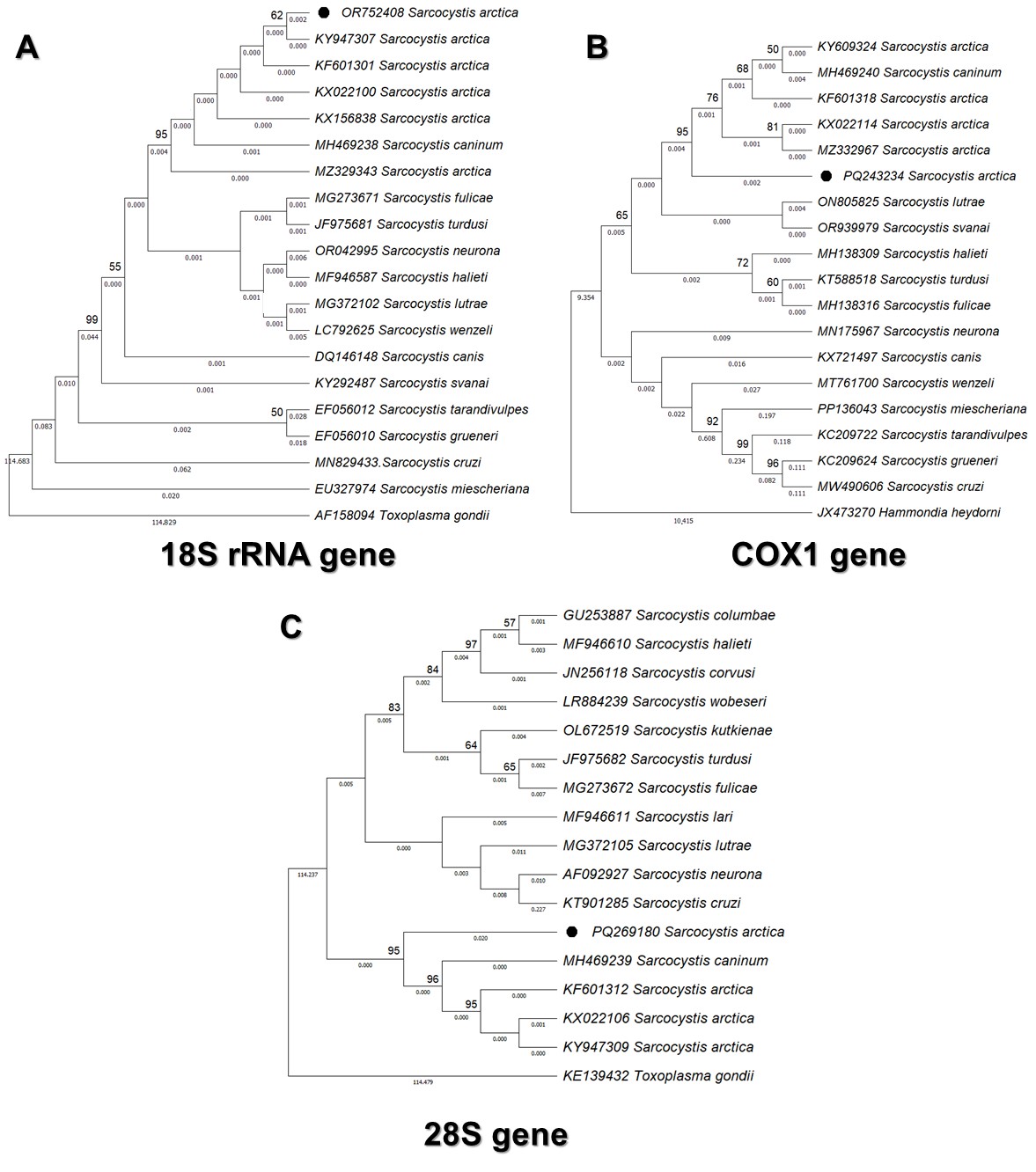
The sequences obtained for the 18S rRNA, COX1, and 28S genes of Sarcocystis arctica detected in the cardiac tissue sample were deposited in NCBI GenBank under accession numbers OR752408, PQ243234 and PQ269180, respectively. Our sequences showed 98.62-99.6% similarity to S. arctica/S. caninum as described in Table 2. Phylogenetic studies based on sequences of the 18S rRNA and COX1 genes placed the P. cancrivorus isolate in the same clade as S. arctica/S. caninum detected in red foxes (Vulpes vulpes) (Pavlásek & Máca, 2017), arctic foxes (Vulpes lagopus) from Norway (Gjerde & Schulze, 2014) and from Alaska, USA (Cerqueira-Cézar et al., 2017), Alaskan wolf (Canis lupus) (Calero-Bernal et al., 2016), domestic dogs (Canis familiaris) (Ye et al., 2018) and white-tailed eagle (Haliaeetus albicilla) (Máca & Gonzalez-Solis, 2022) (Figure 2). Considering the morphological and phylogenetic similarities, it has been suggested that S. caninum and S. arctica may represent the same species of Sarcocystis (S. caninum being a junior synonym of S. arctica) (Dubey et al., 2015; Ye et al., 2018).
Similarity of our Sarcocystis arctica sequences obtained for the 18s rRNA, COX1 and 28S genes, compared with sequences from other authors found in the GenBank database.

Phylogenetic trees. GenBank accession numbers for all sequences are given in front of the taxon names. Bootstrap consensus trees were inferred from 2000 replicates and probability values are represented by the numbers at the nodes. A- Phylogenetic tree inferred using the Maximum Likelihood method and Hasegawa-Kishino-Yano model for wild Sarcocystis species based on sequences of the 18S rRNA gene. Toxoplasma gondii was used as an outgroup. B- Phylogenetic tree inferred using the Maximum Likelihood method and Tamura 3-parameter model for wild Sarcocystis species based on sequences of the COX1 gene. Hammondia heydorni was used as an outgroup. C- Phylogenetic tree inferred using the Maximum Likelihood method and Tamura 3-parameter model for wild Sarcocystis species based on sequences of the 28S gene. Toxoplasma gondii was used as an outgroup.
Roadkill wild animals represent an important source of research material. According to Pavlásek & Máca (2017), molecular methods are considered more sensitive in detecting protozoa such as Sarcocystis spp. Since no macro or microcysts were found, it remains unclear whether the sample size or the potential initial decomposition of tissues influenced the detection of sarcocysts.
Currently, there are no reports on Sarcocystis spp. in crab-eating raccoons (P. cancrivorus) worldwide. Previous research conducted in the states of São Paulo and Paraná, Brazil, also did not detect the presence of Sarcocystis spp. in roadkill P. cancrivorus (Richini-Pereira et al., 2016; Balbino et al., 2022). As previously mentioned, Procyon species are definitive and intermediate hosts of several other Sarcocystis species. However, it is still unclear whether P. cancrivorus are aberrant hosts of Sarcocystis or whether there is a regular cycle that involves transmission through their muscles, as no macro and microcysts were observed in the samples studied. Furthermore, the investigation of sarcocysts only in the cardiac musculature is an important limiting factor in our study, as other muscle groups (e.g., tongue, limbs) were not analyzed due to sample availability, which could increase the chances of identifying these structures.
Some authors have suggested that muscular sarcocystosis in carnivores results from accidental or unusual infections, due to immunosuppression (Hill et al., 1988). However, this hypothesis is not strongly supported, as even clinically healthy carnivores may harbor sarcocysts (Anderson et al., 1992). Recently, severe myositis in dogs was associated with infection by two Sarcocystis species, including S. caninum (Hagner et al., 2018). The definitive hosts for S. arctica and S. caninum remain unknown (Dubey et al., 2016). However, it has been suggested that S. arctica mainly uses canids as intermediate hosts and mammalian or avian carnivores (scavengers) as definitive hosts (Gjerde & Schulze, 2014; Máca & Gonzalez-Solis, 2022).
Wild terrestrial carnivores' role in transmitting infectious diseases requires continued study. The crab-eating raccoon has a great adaptation to various types of habitats and specifically in Brazil, it is found across all biomes (Wilson & Mittermeier, 2009). In countries where it exists, this animal is hunted for its fur, and according to Rosenthal (2021), hunters play a crucial role in the dissemination of pathogens such as protozoa from the genus Sarcocystis, including zoonotic species. Discarding the remains of carcasses in the environment or feeding viscera of slaughtered animals to domestic animals (e.g., dogs) can function as a transmission pathway, spreading the pathogen to various animal species in the vicinity.
This is the first record of molecular detection of S. arctica in the cardiac muscle of P. cancrivorus. This discovery warrants further investigation to determine whether this species should be considered a new intermediate host or an aberrant host of the protozoan. Finally, it is crucial to assess the impact of this parasite on P. cancrivorus populations.
Acknowledgements
This study was financed in part by the Coordenação de Aperfeiçoamento de Pessoal de Nível Superior - Brasil (CAPES) - Finance Code 001.
-
How to cite:
Lignon JS, Pinto DM, Monteiro SG, Martins KR, Cunha RC, Lima DD, et al. First molecular detection of Sarcocystis arctica (Apicomplexa: Sarcocystidae) infecting crab-eating raccoon (Procyon cancrivorus) in Brazil. Braz J Vet Parasitol 2025; 34(3): e021024. https://doi.org/10.1590/S1984-29612025023
-
Ethics declaration
The collection and transport of roadkill wild animals were authorized by the Authorization and Information System on Biodiversity of the Ministry of the Environment under registration 82632-3 based on Normative Instruction number 03/2014. This work was also released by the Ethics Committee on the Use of Animals of the UFPel (process number 23110.046990/2022-02).
References
-
Altschul SF, Gish W, Miller W, Myers EW, Lipman DJ. Basic local alignment search tool. J Mol Biol 1990; 215(3): 403-410. http://doi.org/10.1016/S0022-2836(05)80360-2 PMid:2231712.
» http://doi.org/10.1016/S0022-2836(05)80360-2 -
Anderson AJ, Greiner EC, Atkinson CT, Roelke ME. Sarcocysts in the Florida bobcat (Felis rufus floridanus). J Wildl Dis 1992; 28(1): 116-120. http://doi.org/10.7589/0090-3558-28.1.116 PMid:1548790.
» http://doi.org/10.7589/0090-3558-28.1.116 -
Balbino LS, Bernardes JC, Paschoal ATP, Santomauro RA, Caldart ET, Pasquali AKS, et al. Apicomplexa parasites in the brains of road-killed wild animals in the State of Paraná, Brazil. Semina: Ciênc Agrár 2022; 43(3): 1365-1372. http://doi.org/10.5433/1679-0359.2022v43n3p1365
» http://doi.org/10.5433/1679-0359.2022v43n3p1365 -
Calero-Bernal R, Cerqueira-Cézar CK, Verma SK, Mowery J, Carmena D, Beckmen K, et al. Sarcocystis arctica (Apicomplexa: Sarcocystidae): ultrastructural description and its new host record, the Alaskan wolf (Canis lupus). Parasitol Res 2016; 115(7): 2893-2897. http://doi.org/10.1007/s00436-016-5067-5 PMid:27112760.
» http://doi.org/10.1007/s00436-016-5067-5 -
Cerqueira-Cézar CK, Thompson PC, Verma SK, Mowery J, Calero-Bernal R, Antunes Murata FH, et al. Morphological and molecular characterization of Sarcocystis arctica-like sarcocysts from the Arctic fox (Vulpes lagopus) from Alaska, USA. Parasitol Res 2017; 116(7): 1871-1878. http://doi.org/10.1007/s00436-017-5462-6 PMid:28503709.
» http://doi.org/10.1007/s00436-017-5462-6 - Dubey JP, Calero-Bernal R, Rosenthal BM, Speer CA, Fayer R. Sarcocystosis of animals and humans 2nd ed. Boca Raton, Florida: CRC Press; 2016.
-
Dubey JP, Sykes JE, Shelton GD, Sharp N, Verma SK, Calero-Bernal R, et al. Sarcocystis caninum and Sarcocystis svanai n. spp. (Apicomplexa: Sarcocystidae) associated with severe myositis and hepatitis in the domestic dog (Canis familiaris). J Eukaryot Microbiol 2015; 62(3): 307-317. http://doi.org/10.1111/jeu.12182 PMid:25256157.
» http://doi.org/10.1111/jeu.12182 -
Ferreira MST, Vogel FSF, Sangioni LA, Cezar AS, Braunig P, Botton SA, et al. Sarcocystis species identification in cattle hearts destined to human consumption in southern Brazil. Vet Parasitol Reg Stud Rep 2018; 14: 94-98. http://doi.org/10.1016/j.vprsr.2018.09.002 PMid:31014745.
» http://doi.org/10.1016/j.vprsr.2018.09.002 -
Gjerde B, Schulze J. Muscular sarcocystosis in two arctic foxes (Vulpes lagopus) due to Sarcocystis arctica n. sp.: sarcocyst morphology, molecular characteristics and phylogeny. Parasitol Res 2014; 113(3): 811-821. http://doi.org/10.1007/s00436-013-3711-x PMid:24297693.
» http://doi.org/10.1007/s00436-013-3711-x -
Hagner K, Jokinen TS, Lavikainen A, Sukura A. Acute fulminant necrotizing myopathy in a dog caused by co-infection with ultrastructural Sarcocystis caninum and Sarcocystis svanai-like apicomplexan protozoa. Vet Parasitol 2018; 252: 153-156. http://doi.org/10.1016/j.vetpar.2018.02.011 PMid:29559139.
» http://doi.org/10.1016/j.vetpar.2018.02.011 -
Hasegawa M, Kishino H, Yano T. Dating the human-ape splitting by a molecular clock of mitochondrial DNA. J Mol Evol 1985; 22(2): 160-174. http://doi.org/10.1007/BF02101694 PMid:3934395.
» http://doi.org/10.1007/BF02101694 -
Hill JE, Chapman WL Jr, Prestwood AK. Intramuscular Sarcocystis sp. in two cats and a dog. J Parasitol 1988; 74(4): 724-727. http://doi.org/10.2307/3282198 PMid:3135379.
» http://doi.org/10.2307/3282198 -
Kubo M, Okano T, Ito K, Tsubota T, Sakai H, Yanai T. Muscular sarcocystosis in wild carnivores in Honshu, Japan. Parasitol Res 2009; 106(1): 213-219. http://doi.org/10.1007/s00436-009-1653-0 PMid:19841942.
» http://doi.org/10.1007/s00436-009-1653-0 -
Máca O, González-Solís D. Role of three bird species in the life cycle of two Sarcocystis spp. (Apicomplexa, Sarcocystidae) in the Czech Republic. Int J Parasitol Parasites Wildl 2022; 17: 133-137. http://doi.org/10.1016/j.ijppaw.2022.01.002 PMid:35070681.
» http://doi.org/10.1016/j.ijppaw.2022.01.002 -
Máca O. Molecular identifcation of Sarcocystis lutrae (Apicomplexa: Sarcocystidae) from the raccoon dog, Nyctereutes procyonoides, and the common raccoon, Procyon lotor, in the Czech Republic. Parasit Vectors 2020; 13(1): 231. http://doi.org/10.1186/s13071-020-04108-z PMid:32375886.
» http://doi.org/10.1186/s13071-020-04108-z - Marín D, Ramírez-Chaves HE, Suárez-Castro AF. Revisión Cráneo-Dentaria de Procyon (Carnivora: Procyonidae) en Colombia y Ecuador, con notas sobre su taxonomía y distribución. Mastozool Neotrop 2012; 19(2): 259-270.
-
Pavlásek I, Máca O. Morphological and molecular identification of Sarcocystis arctica sarcocysts in three red foxes (Vulpes vulpes) from the Czech Republic. Parasitol Int 2017; 66(5): 603-605. http://doi.org/10.1016/j.parint.2017.05.003 PMid:28499980.
» http://doi.org/10.1016/j.parint.2017.05.003 -
Portella LP, Fernandes FD, Minuzzi CE, Pelegrini RFV, Sangioni LA, Cargnelutti JF, et al. Molecular Detection and Characterization of Sarcocystis Infection in Naturally Infected Buffaloes, Brazil. J Food Prot 2021; 84(3): 429-433. http://doi.org/10.4315/JFP-20-130 PMid:33108439.
» http://doi.org/10.4315/JFP-20-130 -
Richini-Pereira VB, Marson PM, Silva RC, Langoni H. Genotyping of Toxoplasma gondii and Sarcocystis spp. in road-killed wild mammals from the Central Western Region of the State of São Paulo, Brazil. Rev Soc Bras Med Trop 2016; 49(5): 602-607. http://doi.org/10.1590/0037-8682-0270-2016 PMid:27812655.
» http://doi.org/10.1590/0037-8682-0270-2016 -
Rosenthal BM. Zoonotic Sarcocystis. Res Vet Sci 2021; 136: 151-157. http://doi.org/10.1016/j.rvsc.2021.02.008 PMid:33626441.
» http://doi.org/10.1016/j.rvsc.2021.02.008 -
Tamura K, Stecher G, Kumar S. MEGA11: Molecular Evolutionary Genetics Analysis Version 11. Mol Biol Evol 2021; 38(7): 3022-3027. http://doi.org/10.1093/molbev/msab120 PMid:33892491.
» http://doi.org/10.1093/molbev/msab120 -
Tamura K. Estimation of the number of nucleotide substitutions when there are strong transition-transversion and G + C-content biases. Mol Biol Evol 1992; 9(4): 678-687. http://doi.org/10.1093/oxfordjournals.molbev.a040752 PMid:1630306.
» http://doi.org/10.1093/oxfordjournals.molbev.a040752 - Wilson DE, Mittermeier RA. Handbook of the mammals of the world. Vol. 1. Barcelona: Lynx Edicions; 2009.
-
Ye Y, Liang Y, Hu J, Huang Z, Zhang Y. First isolation of Sarcocystis caninum sarcocysts from two domestic dogs (Canis familiaris) from China. Parasitol Res 2018; 117(11): 3613-3618. http://doi.org/10.1007/s00436-018-6060-y PMid:30151633.
» http://doi.org/10.1007/s00436-018-6060-y