
 Reliability of using gorse (Ulex europaeus) shrub waste in erosion control system
ABSTRACT
This study aimed to assess the feasibility of using common gorse (Ulex europaeus) to produce weaving meshes for soil protection and revegetation. This species was imported several years ago for creating natural fences. However, due to its easy propagation, generates negative impacts on Colombian moor ecosystems. Hence, governmental agencies are struggling with eradicating this shrub, generating lot of waste and additional costs. Thus, to add value, was proposed as an alternative to transform such waste for to develop open weave meshes using fibers extracted from the shrub stem. In doing so, the first stems were characterized to define potential uses. This involved physical and mechanical tests that evaluate performance in the laboratory, simulating field exposure conditions in contact with the soil and water. Results showed that, through fiber extraction, 60% of waste reuse was achieved when stems were in mature stages. This meshes accounted for a reliable mechanical behavior.
Keywords:
Ulex europaeus; Natural fibers; Open weave meshe; Soil erosion
RESUMO
O objetivo deste estudofoi avaliar a viabilidade do uso do tojo (Ulex europaeus) na produção de malhas abertas para proteção e revegetação do solo. Esta espécie foi introduzida há vários anos para a criação de cercas naturais. No entanto, devido à sua fácil propagação, causa impactos negativos nos ecosistemas de paramo Colômbia. Por essa razão, entidades governamentais trabalham para erradicar a planta, o que gera grandes quantidades de resíduos e custos adicionais. Para agregar valor a esses resíduos,propôs-se desenvolver malhas de trama aberta a partir de fibras extraídas do caule do arbusto. Para isso, os caules foram caracterizados inicialmente para definir usos potenciais, incluindo testes físicos e mecânicos que avaliaram seu desempenho em laboratório, simulando condições de exposição em campo, em contato com solo e água. Os resultados indicaram que, por meio da extração das fibras, foi possível reaproveitar até 60% dos resíduos, especialmente quando os caules estavam em estágios de maturação avançada. Essas malhas apresentaram um comportamento mecânico confiável. .
Palavras-chave:
Ulex europaeus; Fibras naturais; Malha de tecido aberto; Erosão do solo
INTRODUCTION
Numerous studies quantify the magnitude of soil erosion by runoff; these reveal that countries with a tropical climate in South America have higher erosivity magnitudes, a condition that increases with agricultural activity. However, most of the studies are limited to estimating erosivity without analyzing soil loss rates (20% of all studies), and only 7% relate soil loss measurements (Sousa et al., 2022), such as those developed by Carvalho & Hernani (2001), Marques et al. (1997), Silva et al. (2009), Bertol et al. (2007), Schick et al. (2014) and Silva et al. (2016), these investigations used experimental plots to measure soil loss.
Water erosion not only decreases the thickness of the soil, it also contributes to reducing soil fertility and the productivity of agricultural land, degrades water quality by increasing the concentration of sediments, affects the availability of water for irrigation and consumption, intensifies the sedimentation of the reservoirs and impacts the road infrastructure, therefore, the measurement and evaluation of soil erosion and the production of sediments are fundamental in the planning and management of hydrographic basins. This is so important that the United Nations (UN) adopted the Sustainable Development Goals (SDG) in 2015 as a global policy framework for sustainable development, well-being and food security (Costanza et al., 2016), among them, soil protection occupies great interest as a requirement to achieve the elimination of land degradation by 2030 (Keesstra et al., 2016).
Santos et al. (2023) and Sousa et al. (2022), agree on the low availability of monitored data on erosion and sediment transport, this is relevant, because without quality data at field scale, the verification and calibration of the Soil erosion models have been impossible (Hsieh et al., 2022), without these experimental data it is difficult to validate and calibrate options for soil management that mitigate environmental degradation in the basin. In fact, Trimble & Crosson (2000) have pointed out that “Over the years, little physical evidence has been provided to verify the accuracy of soil erosion estimated by the Universal Soil Loss Equation (USLE).” In this research, it allows comparing the efficiency of natural weaved grids made with Ulex europaeus for erosion control and vegetation growth.
Ulex europaeus was introduced in Latin American countries in the 19th century with ornamental purposes and as a fence element for animal containment or as a build natural living green fences around reservoir zones (Osorio-Castiblanco et al., 2019), generating vastly impacts as was reported by Kattenborn et al. (2019). Yet, throughout the years, this plant has changed from being desired to being denounced as invasive, as analyzed by Udo et al. (2019).
Nowadays, in the Colombian eastern mountain range, there are two foremost nonnative invasive species: French broom (genista monspessulana) and common gorse (Ulex europaeus). The latter is a major threat to ecosystems because of its invasiveness and spread potential. Ulex europaeus is an evergreen thorny shrub listed as one of the most invasive plants on earth by the International Union for Conservation of Nature (Broadfield & McHenry, 2019). This plant is the most significant invasive species in the Colombian moor ecosystem. Just in the adjacent zones to Bogota, 1,017 invaded hectares were registered in 2019 (Barrera-Cataño et al., 2019). Gorse infestation has generated several consequences because it competes with native species.
The moor ecosystem is the main origin of Colombian freshwaters. This makes it extremely fragile and restricts the use of biological and chemical controls on common gorse infestation, the appropriate eradication method being manually cutting stumps. Thus, governmental agencies have implemented management programs to keep the biological equilibrium in these vulnerable zones. This strategy implies a high cost due to the environmental constraints and required procedures in order to avoid seed production and dissemination. Similarly, it entails dealing with a great amount of complicated waste. Therefore, waste reuse alternatives are required to help reduce the cost impact that is currently causing this invasive shrub.
According to the Global Invasive Species Database (Invasive Species Specialist Group, 2020), developed by the International Union for Conservation of Nature, Ulex europaeus is a spiny, perennial, shrub that grows in dense and impenetrable thickets, making it susceptible to fires. Shrubs could reach 4 m tall and have a diameter of roughly 12 cm when aged 20 or more. However, in eradication campaigns, the heights correspond to shrubs of 1 or 2 meters in height with diameters of up to 2 cm. These small diameters limit their use and produce substantial woody waste.
Like other countries, in Colombia approaches to cope with such waste is privileging manual eradication combined with shredding for compost production and burning and incineration. Nonetheless, there are scarce effective alternatives to reusing gorse stem waste. For instance, despite the promissory-reported results on reusing it in bioethanol production, this would require a significant investment in infrastructure combined with well-elaborated recollection plans, this is unaffordable for rural communities. Hence, contemplating the quick shrub widespread in the Colombian Andean region these alternatives are not sufficient to guarantee a long-term sustainable eradication. Other proposals should be explored following the same tactics applied in natural fiber obtention from lignocellulosic crop waste. Examples of this are the pineapple leaf PALF used for textiles, mango seeds employed in packing development, or coir for geotextile development (Álvarez-Mozos et al., 2014).
Consequently, it is necessary to ponder alternatives that transform the eradication and disposal of this shrub into a more profitable enterprise. Only in 2018, Cundinamarca’s environmental protection agency spent approximately 5,000-6,000 USD per hectare, and the land infested by Ulex europaeus in its jurisdiction (central Colombian zone) was estimated in around 1,717,815 hectares (Barrera-Cataño et al., 2019). This reveals the enormous investments required in order to guarantee effective control. Thus, this research was focused on searching for alternative options for Ulex europaeus stem reuse giving rise to natural weaved grids for erosion control and vegetation growth as a possible bio-engineering slope stability remediation technique.
MATERIALS AND METHODS
Ulex europaeus, also known as common gorse, is a woody legume endemic to the headlands of western Europe (Leary et al., 2006). It is a member of the fabaceae legume family with hairy twigs in juvenile stages; in adult stages, plants are tall and spiny, forming intricately intertwined stiff branches with spiny foliage (Millener, 1961). Sharp spines of about 5 cm long densely cover the plant with a defensive role (see Figure 1).

Ulex Europaeus Development Stages. Progressively loses the leaves of juvenile stage, the ratio of woody material increases and stiff spines thorns grow that densely cover the plant.
Furthermore, the ratio of woody green material increases during its development stages, making this gorse prone to fire. According to DiTomaso (1998), common gorse has photosynthetic stem tissue and it thrives in soils with high moisture levels. The rooting system comprises deep taproot and laterals roots and, generally, is extended in a surface zone of 15 cm. In addition, long-living root nodules contain aerobic nitrogen-fixing bacteria, Leary et al. (2006) and MacCarter & Gaynor (1980) converting this shrub into a successful invasive species. The shrub has a sympodial growth resulting in a differential strength of the bifurcated branches; in other words, one branch forming the primary shoot is stronger than the branches that appear laterally. The steam diameter could reach about 10 cm in advanced ages (aged 15 or more). The reported lifespan for the gorse is about 30 years getting its maximum stem diameter around 22 cm (Clements et al., 2001).
Finally, in regard to Ulex stems, chemical composition cellulose has been reported as the main component about 50% dry weight whereas hemicellulose is about 20% dry weight, exhibiting highly soluble sugars and other polysaccharides (Celis et al., 2014). These levels of compounds reveal their proneness to degradation, which is a key factor for any material to be used in biodegradable matting to prevent erosion and expedite revegetation.
In order to have a wide appraisal of the material and its potential, the research was developed in two stages. First, the waste was assessed in a natural condition (cut stems) looking for possibilities with minimal transformation efforts. Second, fibers were extracted from the stems through handiwork, trying to harness the previously reported performance of Ulex cellulosic fibers for industrial applications (Celis et al., 2014). Manual fiber extraction was selected, sidestepping the chemical pulping process to avoid the application of chemical compounds such as sodium hydroxide (NaOH). In the same vein, devices such as mills, which are traditionally used to get delignification in laboratories and industrial fiber extraction processes, were not employed because they were not suitable in rural communities in the protected zones. Lastly, with the extracted fibers open wave meshes (OWM) were generated.
Cut stems characterization
A stem classification scheme was applied in properties assessment according to the Ulex branches and stem cross-section structure evolution described in 1922 by Skipper (1922). Hence, the stem, in its initial stages, starts with layers of large cells with scanty contents. This is followed by a stage in which develops a central pith with thick walled six-sided cells. Finally, a mature stage consists of a white network on a greenish background of sclerenchyma, which is generated because wood parenchyma and conducting elements run obliquely in narrow irregular bands from the pith. Thus, these tree development stem stages were identified and related to stem diameter evolution (see Figure 2), consequently, a classification scheme was defined.

Steam structure development stages. a) early b) intermediate c) mature. By increasing the stem diameter, the gorse develops a central pith with wood parenchyma.
As a result, 150 stems were sampled in a period of 4 months in the Monserrate hill area in Bogotá. First, the stems were manually homogenized by removing the thorns, cutting them to 30 cm long, and classifying them according to their mean diameters in one of the three identified development stages. The use of recovered stems in future eradication campaigns should be classified depending on the stage of development of the gorse.
The stem characterization stage was carried out seeking to recognize constitutive woody material strength evolution concerning the gorse development stage. Additionally, to identify material response to moistening when it is in contact with soil, a group of stems was buried and exposed daily to wet and drying cycles 30 and 60, emulating rainfall effects for almost two years. This is the maximum lifespan of these materials before degradation occurs, which was defined in regard to the reported minimal lasting time of similar natural biodegradable materials used for erosion controls (Sutherland & Ziegler, 2007) and (Sanyal, 2017). So, the rainfall event intensity (8mm) was estimated considering the median for 42-year rain records from a meteorological station in the surrounding area to the hillslope where soil samples were retrieved.
In the first instance, stems were air dried for four weeks observing possible changes or alterations in their structure and seeking to make the spores dormant. Next, some stems were buried and exposed to wet/dry cycles, dividing them into three groups (i.e., 0, 4, and 8 weeks). This process aimed to assess possible physical and mechanical changes in stem performance in bushes, at different maturity, found during eradication campaigns, and its durability in raw conditions regarding different exposure periods in contact with the soil. Lastly, some samples from altered zones were taken to be observed in scanning electron microscopy (SEM). This was done to examine the effectiveness of the drying process to inactivate spores, and how its behavior was after each exposure period looking for not persistent seedbanks, that could generate shrubs regrows considering seed bank is very difficult to eradicate as reported by León Cordero et al. (2016).
Fiber extraction and weaved meshes manufacture
As mentioned above, extracted fibers were used to generate OWM, i.e., a type of biodegradable meshes that help revegetate slopes and mitigate erosion. Hence, thanks to the support of handicraftsmen from the rural zones, prototype meshes were developed. First, the external stem crust was removed by manual scratching. Afterward, the canes were processed using a decorticator by means of a crushing process. Finally, the straws were washed and dried (see Figure 3).

Handiwork Process for Fiber Extraction. Initially, the pith and crust are separated manually, with the extracted fibers braids are woven that finally form meshes (OWM).
Subsequently, the straws were used to produce three types of meshes in regard to the opening: 10 mm, 20 mm, and 30 mm (see Figure 4).

Table 1 presents their average from Manufactured meshes characteristics.
Tensile tests
In the first instance, tensile tests on clear stems were applied according to ASTM D143. OWM width tensile tests were conducted according to ASTM D 4595. Both tensile tests were developed using a universal testing machine, controlling adequate gripping without generating damage in the meshes during the test and guaranteeing a good hold on the stems. Thus, 150 stems were tested in 30 scenarios considering air drying duration (1, 2, 4) weeks and wetting and drying cycles (30 and 60). Additionally, a group of stems was oven dried as a reference for changes due to the high stress induced in the oven. However, the intended process for stem treatment before use was air dried in order to make it easy for rural communities to carry it out. Stems were classified by their maturity stage (early, intermediate, and mature) as explained before. Five specimens were tested for any maturity stage. In addition, for the tensile test on OWM, three specimens were tested for any opening of the mesh. Lastly, tensile strength reduction was assessed after rain simulation exposure.
OWM rainfall laboratory exposure
To verify the reliability of the knitted meshes to control runoff phenomena on slopes and their performance throughout time, an experimental setup was developed (see Figure 5).
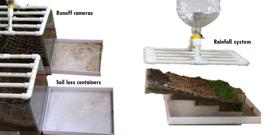
Detail Experimental Setup for Rainfall Exposure. A network of perforated pipes simulates rainfall, the water that smash on surface ground is divided into infiltration and surface runoff on slopes, the runoff and eroded soil was collected in the soil loss container.
Such a setup was built endeavoring to simulate slope surface layer conditions in a controlled laboratory environment because of the environmental restrictions to use these materials outdoors, avoiding further shrub spreading triggered by seed scattering during meshes location on the soil. Thus, prior to field experiments, it was necessary to first assess the reliability and safety of Ulex OWM indoors. The experimental setup comprised four closed compartments provided with a water-dropping system, simulating the precipitation effect upon topsoil. Thus, as above-mentioned, the soil was retrieved from Guayabetal zone in the center of Colombia considering the high occurrence record of runoff events associated with precipitation. A representative soil sample, taken from the upper layer of the intermediate gradient slope, was collected to be used as a substrate during the runoff tests. Table 2 presents the soil characteristics and its classification index parameters.
The rainfall system was dimensioned intending to simulate a critical year regarding accumulated precipitation. Hence, a 36-year-long precipitation register was weighed with the historical slope stability reports, choosing the period in which more runoff reports were generated (i.e., June 2004). Hence, the system was standardized to be applied in intervals of 8 hours, followed by 16 hours of drying, allowing the soil to recover and reach an equilibrium state. Drying and developing of internal breakdown generated by suction during drying were also allowed. Thus, 5.5 liters of water were applied during each wetting cycle, equivalent to 0.06mm/m2/min, simulating the occurrence of 20 events. According to the precipitation reported, this represented the number of severe events that could occurs during an 18-month lapse considered the expected lifespan for the meshes. It was interesting to analyze the breakdown because, in the Colombian central zone, upper soil masses on hillslopes are prone to developing intense disintegration. This is due to its climatic conditions (exposed to intense drying and wetting cycles) and a geological setup with an abundance of weak rocks and intermediate geomaterials (Rincon et al., 2016). Therefore, slope gradient was selected to avoid steep conditions in order to reach an equilibrium in infiltration and runoff water.
Finally, after precipitation exposure, the meshes were kept in cameras for 12 months with room conditions of 20°C- HR 60% at the laboratory facilities of Universidad de La Salle. The setups were visually inspected to verify vegetation development and changes in the meshes.
Afterward, SEM observations were made from retrieved mesh samples, seeking to corroborate the state of remnant spores on the Ulex fibers (see Figure 6).

Stems Strength Evolution after Wetting and Drying Cycles. Columns order for any state reflects pretreatment drying weeks 1,2,4, demonstrating that tensile strength decreases with a greater number of wetting and drying cycles.
Data analysisA container was designed to allow water infiltration and surface runoff on an inclined soil surface. The minimum soil thickness was determined to be approximately 3 cm at the vertex of each step, ensuring the stability of the slope and allowing for the collection of water and soil resulting from surface runoff. The rainfall-runoff simulator consists of a perforated pipe network that enables uniform distribution of precipitation over the sample, a 19° inclined surface with a stepped shape and 1 mm perforations, and impermeable side elements that define the control condition.
At the end of 8 hours of simulation, equivalent to 4 events lasting 2 hours each, the weight of the composite sample (water and sediment) was measured. The sample was placed in an oven at 60°C until all the water evaporated. It was then weighed to determine the mass of dry soil eroded during each wetting and drying cycle. This result was accumulated over 5 consecutive cycles, completing a total of 40 hours of simulation.
Utilizing the availability of 4 laboratory-scale simulators, this procedure was developed simultaneously for the bare soil condition (control model) and the 3 mesh openings, ensuring that environmental conditions remained consistent across all models.
Hydrological records indicate that 20 critical events occur in an 18-month period in the Colombian Andes region. To establish the equivalence of soil loss per year per square meter, the total amount of soil eroded at the end of the process was divided by 1.5 years (equivalent to 18 months), yielding the result in grams per square meter per year (g/m2/y). To calculate efficiency, the soil loss for the control sample was set at 100%, allowing for the definition of efficiency in the mesh models based on the proportion of soil loss relative to the control sample.
Finally, to quantitatively assess the change in particle size distribution of the coarse fraction (>1 mm) due to erosion, the disintegration index proposed by Erguler & Shakoor (2009) is used, defined as the ratio between the area under the particle size curve of the tested material and the total area.
RESULTS AND DISCUSSION
Stems tensile test
As aforementioned, initial tensile behavior was assessed in clear stems trying to analyze how material mechanical behavior evolved after different pretreatment processes regarding wetting exposure cycles buried in the soil. Figure 6 presents how tensile strength dropped for stems classified in the three stages of development. The average tensile retained strength ratio after 30 moistening cycles was about 33.9% whereas, after 60 moistening cycles, it was about 27.4%. This reflects how Ulex woody materials experience decrement vis-à-vis stiffness because of internal degradation. It also reveals a gradual decrease in tensile strength between early and mature stages. However, for stems classified in an early stage of development, after 4 weeks of air drying prior to moistening, the drop was higher compared to other stems. Such a phenomenon was associated with low homogeneity of early stage gorse, contrary to it was observed in intermediate and mature stages due to sclerenchyma patterns emergence and pith irregular bands generated in the conducting elements in mature stages.
Figure 7 displays how the strain stress curve changed after different cycles of moistening. The modulus of elasticity fluctuated between 8182 MPa and 1269 MPa, locating the material in stiffness performance similar to different hard and soft woods reported (Laboratory, 2021). Yet, after exposure to moistening, the drop was about 85%, which shows how environmental exposure could affect the material's mechanical performance making it prone to degradation, a key property to develop materials for erosion control.

Ulex Stem Material’s Strain Stress Curves Evolution after Moistening Cycles. Strain of Ulex stem increases with a greater number of wetting and drying cycles, the modulus of elasticity decreases after exposure to moistening.
OWM tensile tests
According to the results obtained from the stem characterization stage, it was possible to establish that Ulex woody material could be used as a biodegradable element in erosion control systems. After analyzing possibilities and endeavoring to maximize the reuse, open woven meshes were selected as the best alternative.
As previously stated, OWMs were created from extracted fibers. Evaluate the tensile behavior of this type of meshes is a complex task because it required careful elaboration uniform specimens. Thus, as expected, tensile tests showed that meshes with less open area exhibit a better strength strain response compared to major opening area meshes (see Figure 8), which corresponds to a major number of mesh threads in both directions longitudinal and orthogonal to load application.
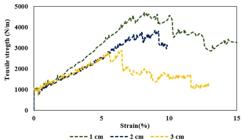
Strength strain behavior OWM. Demonstrating that tensile strength decreases with a greater diameter Ulex stem.
A proportional linear decrease in the average ultimate tensile strength was inferred regarding an increase in mesh opening (4.9, 4.1, 3.2 kN/m). This proportional trend suggests uniformity in meshes despite the handiwork process. The obtained average tensile values located Ulex meshes in an intermediate performance concerning the tensile values for open weave coir systems with low mass per unit area and the random fiber coir system stitched with degradable threads, as reported by Sutherland & Ziegler (2007). However, the obtained tensile values were enough to guarantee mesh stability to retain the mass of soil during the process of grass emergence.
OWM rainfall laboratory exposure
Figure 9 presents the soil losses in the runoff tests applied to the three types of meshes evaluated, which reveals that the OWM made with Ulex fibers have a good performance in reducing soil losses. The soil losses without mesh reached 17.8 g/m2, which is equivalent to 11.8 g/m2/y, this loss was reduced to 2.8 g/m2/y by protecting the soil with OWM of opening 3 cm, and reached a minimum loss up to 0.5 g/m2/y with OWM of opening 1 cm. Thus, the meshes with the largest opening (3 cm) reduced the losses about three times with respect to the bare soil. On the other hand, in meshes with a smaller opening (1 cm), the losses were insignificant because they behave like mats considering their small opening (47.2%).
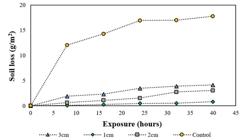
Top View Grid Arrangements for Runoff Tests. The performance in reducing soil losses is observed in the three types of meshes evaluated (OWM) with respect to bare soil.
In background, reported by Álvarez-Mozos et al. (2014) the total losses measured for jute meshes (120.3 g/m2) and coir blankets (39.8 g/m2), applied upon 45° real slopes, exposed to 16 runoff events during 21 months. By contrast, the losses relative to the three Ulex OWM were lower related to jute netting. On the other hand, with respect to the coconut fiber mat, in the 3-cm opening the OWM losses were higher, in the 2-cm opening the OWM losses were similar and in the 1-cm opening the OWM losses they were minor.
Furthermore, in order to seek an indicator to map the internal breakdown generated by suction during desiccation, the disintegration ratio (DR), proposed by Erguler & Shakoor (2009), was applied in the range between soil maximum size (Dmax) to 1 mm. This was because this range covers the size distribution of particles within the soil possibly affected by wetting and dry exposure (see Figure 10).

Determination Disintegration Ratio (DR). Through the disintegration ratio (DR), the change is demonstrated by the increase in fragmentation in the soil mass due to the process of wetting and drying and soil losses due to erosion.
This index was selected because was applied successfully in order to map disintegration in mudstones and stiff oxysol deposits due to slaking in the eastern Andes Mountain range. Hence, changes in the soil mass were evidenced in fragmentation increase because of the wetting and drying process and soil losses caused by erosion, yielding changes in granulometric distribution. Thus, indicators based on granulometry such as DR eq.1, proposed by Erguler & Shakoor (2009), can be useful to provide complementary data about changes that occurred in the soil mass. Likewise, such an index could be employed to examine changes in the intermediate fraction of fragmented materials or the detrital fractions of weak rocks and indurate soils exposed to slaking. After the exposure period, DR results showed how soils protected with OWM (1cm) keep a major homogeneity in intermediate size fractions because of low values of DR 0.15. In contrast, DR values were higher for meshes with 2- and 3-centimeter openings. This entails a major alteration occurring in the fraction of the medium particles (1-9 mm of soil), the major alteration being for bare surface, namely, DR 0.24 equivalent to 60% of change regarding 1-centimeter mesh opening.
-
DR: Disintegration ratio
-
AC: area under any grain size distribution curve
-
AT: area encompassing all grain size distribution curves of the samples tested
Regrowth corroboration
Control of possible shrub regrowth was developed, which was important considering that Ulex europaeus seeds may remain dormant for several years (between 30-70 years) by Zabkiewicz & Gaskin (1978), and a little increase in temperature (and due to burial in soil) could make sprout new buds. Thus, through visual inspections, microphotographs, and SEM observations did not evidence remnant seed banks or pollen in the whole Ulex europaeus treated stems and fibers. SEM images helped reveal fungal growth in Ulex material after wetting and drying cycles in contact with the ground (see Figure 11), this favors the decomposition of the mesh (OWM).

SEM Image Fungal Spores. SEM images helped to manifest fungal growth in Ulex material after wetting and drying cycles in contact with the ground. This favors the decomposition of the mesh (OWM), behaving as expected from any temporary erosion control.
The circumstance above is positive because the observed fungal spores reveal how the degradation of the material is advancing, behaving as expected in any temporary erosion control and seed establishment based on organic materials. Adding organic matter to the soil as it degrades, in a short time, almost a year or two, will help regenerate the upper soil layer besides establishing grass roots.
Finally, after the wetting and drying exposure period, it selected a group of meshes random and was kept under room temperature for almost 12 months in order to verify new gorse sprouts. After the assessment period, no Ulex shrub was observed; instead, healthy grass emerged although no seeding was carried out. This confirms the reliability of OWM when used as an effective erosion control element that helps seeds to develop and establish grass in early stages, even in drought periods when the soil is prone to erosion. Thus, it was possible to test that there is not any risk to promote Ulex europaeus propagation and seeds dissemination after the manual transformation of stems. Lastly, OWM meshes showed good stability throughout the year guaranteeing enough time to boost and consolidate protective grass before their natural degradation finishes.
ANALYSIS AND DISCUSSION
Viability of meshes (OWM) made with Ulex fibersfs
The proposed approach to reusing Ulex europaeus stems in waved meshes manufacturing opens a new door for governmental agencies and communities in infested zones. It also adds value to gorse problematic waste since current disposal strategies are gridding or burning, generating a high cost because these must be performed in zones far from moor ecosystems. At the time of eradication, depending on the stage of development of the gorse, 40-60% of the biomass generated corresponds to the stems, the remaining biomass corresponds to thorns, leaves and flowers. Therefore, this alternative makes it possible to reuse up to 60% of the biomass, reducing the high costs of manual eradication campaigns and logistics for waste transportation in central Colombia. Thus, the meshes produced could be used for erosion treatments for affected soils in the moor boundary zones, transforming waste into a mitigation tool, it could drop costs in environmental protection and provide rural communities with additional income through handiwork considering the limitation of these zones to develop intensive crops.
Another advantage of this novel approach is the manual transformation of gorse stems without major environmental risks unlike previous approaches made for Chilean Ulex europaeus fibers (Celis et al., 2014). Regarding the latter, extraction requires a chemical pulping process that implies infrastructure development and environmental management of chemical waste. This urges additional investments, narrows possible industrial applications of this fiber, and does not account for an adequate rate of return.
The gorse stem material performance reported here was similar to other woody materials. In its natural state, it classifies as hardwood in regard to its stiffness. However, its low diameter increases with time making it unreliable to be used for industrial applications. Additionally, the material performance is affected by wetting and drying because shrinkage in outer layers produces cracks, fungal growth, and degradation. Such degradation increases significatively when the material is in contact with soil. According to the mechanical performance of the stem, it was possible to define that the best stage for the collection of Ulex is the intermediate state to maintain a better tensile performance and obtain greater benefits for the reuse of the material.
Performance of meshes (OWM) for reduced the soil losses
The OWM made with Ulex fibers reducing soil losses of 11.8 g/m2/y between 2.8 g/m2/y (opening 3 cm) and 0.5 g/m2/y (opening 1 cm). This loss on slopes with bare soil surface is comparable to reported by dos Santos et al. (2023) for soil with slope of 23° (1.2 g/m2/y), Álvarez-Mozos et al. (2014) for soil with slope of 45° (22.7 g/m2/y) and Hsieh et al. (2022) for agricultural land with slope of 5% (23 g/m2/y), this proves the efficiency of meshes for reduced the soil losses with respect to the bare soil surface.
OWM efficiency generally is measured through soil losses. In this vein, Ulex meshes proved to be efficient in reducing soil losses just as other sorts of meshes. Moreover, in this study, a complementary indicator was considered, namely, the disintegration ratio (DR). In this case, it allowed assessing how size distribution changes due to the breakdown generated by suction during desiccation. Similarly, DR indicated a reliable performance to assess change in soil intermediate coarse fraction after runoff experiments when exposure hours were not continuous, and wetting and drying cycles were applied. This is because the drying period leads to soil drain, generating suction into the matrix of soil just as it occurs in a hillslope, that suction being the cause of breakdown. These alternate cycles simulate a more realistic behavior considering that runoff events are not simultaneous.
In this research, the total rain exposure hours (40) for OWM were defined seeking to match 20 critical events (with an exceedance probability of 80%), with an estimated duration of around two hours. This was done to mirror the events expected in the hillslope during the lapse of time in which protection is achieved for the soil after OWM is installed and the grass grows and establishes. According to Efthimiou (2023), protecting the soil is important in regions with torrential rains, shallow, strong inclination and low organic matter content, conditions similar to those observed in this research.
Limitations of the rain-runoff simulator
Mendes et al. (2020) state that establishing the minimum thickness of the soil sample is important to avoid the effects of boundary conditions. They also note that the upper area of the slope tends to drain more quickly, while the lower area tends to accumulate moisture. To minimize the impact of non-uniformity in soil moisture, Mendes et al. (2020) recommend an initial equilibrium stage that reduces the difference between the hydraulic loads at the bottom and top of the soil sample, ensuring a constant water content and pore pressure for a horizontal sample without rainfall.
The results from rainfall-runoff simulators presented by Mendes et al. (2020) suggest that the runoff and infiltration rates should be analyzed cumulatively over the entire surface of the sample, avoiding scale effects associated with spatial non-uniformity.
As mentioned by de Macedo et al. (2018), laboratory-scale models offer greater flexibility and the opportunity to control environmental variables, such as the occurrence and intensity of rainfall. However, frequently scaling key parameters, such as flow and duration, is insufficient to guarantee similarity with results on a real scale. It is important to incorporate soil depth as a variable in infiltration and runoff studies, as the results cannot be extrapolated to the field.
According to Failache & Zuquette (2021), physical models to simulate infiltration offer greater precision in analyzing effects associated with land use and management practices, but they have lower performance compared to empirical models when assessing infiltration conditions in the presence of macroporosity and heterogeneity. Therefore, they suggest that the best model for a specific infiltration condition may not be applicable to other problems, such as erosion, flooding, and the quantification of runoff coefficients.
Modeling on a laboratory scale allows us to identify key variables of the process; in this case, the efficiency of the mesh opening in protecting the soil against erosion, since this is a surface process. However, to model the infiltration process accurately, the thickness of the soil must be incorporated as a variable in future modeling. The arrangement of the soil on a perforated base ensures continuous percolation, so runoff is not limited by the saturation of deeper soil layers, which is a relevant condition according to the results obtained by de Macedo et al. (2018).
Runoff generation can occur in two ways: a) when effective precipitation is greater than surface infiltration, regardless of the influence of the soil profile or stratification; or b) when the soil storage capacity has already been reached (full reservoir). The first condition is related to surface hydraulic conductivity and governs the infiltration process in the absence of highly conductive or impermeable layers, as observed in the models conducted. However, in simulators with small sample thickness and relatively long test durations, undesirable storage conditions can occur, similar to a full reservoir.
Mendes et al. (2020) conclude that no scale factors associated with the length of the model are evident; however, small thickness values can pose a problem, especially when the bottom boundary condition restricts the percolation process and induces saturation of the soil sample. Recognizing the low height of the soil samples as the main limitation of the simulations conducted in this research, it is advisable to incorporate this depth as a variable in future laboratory-scale tests, ensuring that the perforated base on which the soil is placed does not restrict the infiltration and percolation processes.
Returning to the findings of Failache & Zuquette (2021), it is appropriate for subsequent studies to analyze the efficiency of woven meshes in compacted soils, whether as a result of agricultural practices or intervention with machinery for infrastructure projects. It is also advisable to test the woven meshes on a field or prototype scale under environmental conditions to validate their efficiency in erosion protection, as well as their biodegradation and incorporation into the soil, allowing for future comparison of the results obtained in this research.
CONCLUSIONS
Results revealed that Ulex europaeus natural wood fibers perform well in the construction of degradable open-weaved meshes for temporary erosion control and seed establishment. They also demonstrated that there is no risk of promoting regrowth or propagation of this invasive shrub through seed dissemination after being in contact with the ground for nearly a year. Similarly, the experimental results showed that the optimal development stage for harvestingUlex during eradication campaigns is the intermediate stage, in which the stem diameter is between 4mm and 8mm, and it develops a central pith with a thick wall of six-sided cells. This is important because this bark serves as the raw material for the construction of woven meshes. Accordingly, this stage ensures better performance and greater benefits when reusing the material.
The disintegration ratio (DR) proved to be a reliable complementary indicator for assessing the effectiveness of open-weaved meshes' and netted mats. It Demonstrates the contribution of these meshes to preventing soil loss. The results confirm that this parameter reflects changes in soil granulometric distribution caused by internal breakdown due to suction during the desiccation process, providing a broader assessment of upper layer stability before grass root establish and stabilize the soil.
The laboratory-scale simulation of the rainfall-runoff process demonstrated the efficiency of woven meshes (OWM) made from Ulex europaeus fibers in reducing soil loss due to erosion. Although the highest efficiency was achieved with meshes that had a 1 cm opening (95.8%), the use of 2 cm meshes is recommended, as they achieve a reduction of 85.1% with a lower proportion of biomass.
To verify the efficiency of the meshes in erosion control and their biodegradation under environmental conditions at field scale, the values obtained from the rainfall-runoff simulator allow for the advancement towards the implementation of the prototype with 2 cm opening meshes. These models must consider the determination and monitoring of the following for successful analysis: soil properties, characterization of in situ precipitation events, temporal and spatial variation of antecedent moisture, and assessment of soil macroporosity.
ACKNOWLEDGEMENTS
The authors thank Universidad de la Salle for the financial support for this research. Special thanks to the civil engineering laboratory staff and Sneyder Gerley Mora for his help in gathering the stems.
REFERENCES
- Álvarez-Mozos, J., Abad, E., Giménez, R., Campo, M. A., Goñi, M., Arive, M., Casali, J., Díez, J., & Diego, I. (2014). Evaluation of erosion control geotextiles on steep slopes. Part 1: effects on runoff and soil loss. Catena, 118, 168-178.
- Barrera-Cataño, J. I., Rojas Rojas, J. E., Contreras-Rodríguez, S. M., & Basto Mercado, S. (2019). Plan de prevención, manejo y control de las especies de retamo espinoso (Ulex europaeus) y retamo liso (Genista monspessulana) en la jurisdicción CAR Bogotá: Pontificia Universidad Javeriana.
-
Bertol, I., Leite, D., Engel, F. L., Cogo, N. P., & Gonzalez, A. P. (2007). Erodibilidade de um nitossolo haplico alumínico determinada em condiçoes de campo. Revista Brasileira de Ciência do Solo, 31, 541. http://dx.doi.org/10.1590/S0100-06832007000300014
» http://dx.doi.org/10.1590/S0100-06832007000300014 - Broadfield, N., & McHenry, M. T. (2019). A world of gorse: persistence of ulex europaeus in managed landscapes. Plants (Basel, Switzerland), 8, 523.
-
Carvalho, M. P., & Hernani, L. C. (2001). Parametros de erosividade da chuva e da enxurrada correlacionados com perdas de solo e erodibilidade de um Latossolo Roxo de Dourados (MS). Revista Brasileira de Ciência do Solo, 25, 137-146. http://dx.doi.org/10.1590/s0100-06832001000100015
» http://dx.doi.org/10.1590/s0100-06832001000100015 - Celis, R., Torres, M., Valenzuela, P., Ríos, R., Gacitúa, W., & Pesenti, H. (2014). Characterizing cellulosic fibers from Ulex europaeus. BioResources, 9(4), 6968-6980.
- Clements, D. R., Peterson, D. J., & Prasad, R. (2001). The biology of Canadian weeds. 112. Ulex europaeus L. Canadian Journal of Plant Science, 81(2), 325-337.
-
Costanza, R., Fioramonti, L., & Kubiszewski, I. (2016). The UN Sustainable Development Goals and the dynamics of well-being. Frontiers in Ecology and the Environment, 14, 59. http://dx.doi.org/10.1002/fee.1231
» http://dx.doi.org/10.1002/fee.1231 - DiTomaso, J. M. The biology and ecology of brooms and gorse. In Proceedings of California Weed Science Society (pp. 142-148). California: California Weed Science Society, 1998.
-
Efthimiou, N. (2023). Object‐oriented soil erosion modelling: a non-stationary approach towards a realistic calculation of soil loss at parcel level. Catena, 222, 106816. http://dx.doi.org/10.1016/j.catena.2022.106816
» http://dx.doi.org/10.1016/j.catena.2022.106816 - Erguler, Z. A., & Shakoor, A. (2009). Relative contribution of various climatic processes in disintegration of clay-bearing rocks. Engineering Geology, 108, 36-42.
-
Failache, M. F., & Zuquette, L. V. (2021). Soil water infiltration under different land use conditions: In situ tests and modelin. Revista Brasileira de Recursos Hidricos, 26, e26. https://doi.org/10.1590/2318-0331.262120210063
» https://doi.org/10.1590/2318-0331.262120210063 -
Hsieh, Y. P., Nemours, D., & Bugna, G. (2022). A field-scale soil erosion study: an example from a North Florida farm. Catena, 218, 106551. http://dx.doi.org/10.1016/j.catena.2022.106551
» http://dx.doi.org/10.1016/j.catena.2022.106551 -
Invasive Species Specialist Group – ISSG. (2020). Global Invasive Species Database. Species profile: Ulex europaeus Retrieved in 2024, June 18, from http://www.iucngisd.org/gisd/species.php?sc=69
» http://www.iucngisd.org/gisd/species.php?sc=69 - Kattenborn, T., Lopatin, J., Förster, M., Braun, A. C., & Fassnacht, F. E. (2019). UAV data as alternative to field sampling to map woody invasive species based on combined Sentinel-1 and Sentinel-2 data. Remote Sensing of Environment, 227, 61-73.
-
Keesstra, S. D., Bouma, J., Wallinga, J., Tittonell, P., Smith, P., Cerd’a, A., Montanarella, L., Quinton, J. N., Pachepsky, Y., & van der Putten, W. H. (2016). The significance of soils and soil science towards realization of the United Nations Sustainable Development Goals. Soil (Göttingen), 2, 111-128. http://dx.doi.org/10.5194/soil-2-111-2016
» http://dx.doi.org/10.5194/soil-2-111-2016 - Laboratory, F. P. (2021). Wood handbook: wood as an engineering material. Madison, Wisconsin: Department of Agriculture, Forest Service, Forest Products Laboratory.
- Leary, J. K., Hue, N. V., Singleton, P. W., & Borthakur, D. (2006). The major features of an infestation by the invasive weed legume gorse (Ulex europaeus) on volcanic soils in Hawaii. Biology and Fertility of Soils, 42, 215-223.
- León Cordero, R., Torchelsen, F. P., Overbeck, G. E., & Anand, M. (2016). Invasive gorse (Ulex europaeus, Fabaceae) changes plant community structure in subtropical forest–grassland mosaics of southern Brazil. Biological Invasions, 18, 1629-1643.
- MacCarter, L. E., & Gaynor, D. L. (1980). Gorse: a subject for biological control in New Zealand. New Zealand Journal of Experimental Agriculture, 8(3-4), 321-330.
-
Macedo, M. B., Lago, C. A. F., Mendiondo, E. M., & Souza, V. C. B. (2018). Performance of bioretention experimental devices: contrasting laboratory and field scales through controlled experiments. Revista Brasileira de Recursos Hidricos, 23, e3. https://doi.org/10.1590/2318-0331.0318170038
» https://doi.org/10.1590/2318-0331.0318170038 - Marques, J. J. G. S. M., Alvarenga, R. C., Curi, N., Santana, D. P., & Silva, M. L. N. (1997). Indices de erosividade da chuva, perdas de solo e fator erodibilidade para dois solos da regiao dos cerrados - primeira aproximaçao. Revista Brasileira de Ciência do Solo, 21, 427-434.
- Mendes, T. A., Gitirana Junior, G. D. F. N., Rebolledo, J. F. R., Vaz, E. F., & Luz, M. P. D. (2020). Numerical evaluation of laboratory apparatuses for the study of infiltration and runoff. RBRH, 25, e37.
- Millener, L. H. (1961). Day-length as related to vegetative development in Ulex europaeus I. The New Phytologist, 60, 339-354.
- Osorio-Castiblanco, D. F., Peyre, G., & Saldarriaga, J. F. (2019). Physicochemical analysis and essential oils extraction of the gorse (ulex europaeus) and French broom (Genista monspessulana), two highly invasive species in the Colombian Andes. Sustainability, 12(1), 57.
- Rincon, O., Shakoor, A., & Ocampo, M. (2016). Investigating the reliability of H/V spectral ratio and image entropy for quantifying the degree of disintegration of weak rocks. Engineering Geology, 207, 115-128.
-
Santos, F. M., de Souza Pelinson, N., de Oliveira, R. P., & Di Lollo, J. A. (2023). Using the SWAT model to identify erosion prone areas and to estimate soil loss and sediment transport in Mogi Guaçu River basin in Sao Paulo State, Brazil. Catena, 222, 106872. http://dx.doi.org/10.1016/j.catena.2022.106872
» http://dx.doi.org/10.1016/j.catena.2022.106872 - Sanyal, T. Jute geotextiles: its types and functions. In: T. Sanyal (ed.). Jute Geotextiles and their Applications in Civil Engineering (pp. 19-31). Singapore: Springer Singapore, 2017.
-
Schick, J., Bertol, I., Pedro Cogo, N., & Paz Gonzalez, A. (2014). Erosividade das chuvas de Lages, Santa Catarina. Revista Brasileira de Ciência do Solo, 38, 1890-1905. http://dx.doi.org/10.1590/S0100-06832014000600024
» http://dx.doi.org/10.1590/S0100-06832014000600024 -
Silva, A. M., Silva, M. L. N., Curi, N., Avanzi, J. C., & Ferreira, M. M. (2009). Erosividade da chuva e erodibilidade de Cambissolo e Latossolo na regiao de Lavras, sul de Minas Gerais. Revista Brasileira de Ciência do Solo, 33, 1811-1820. http://dx.doi.org/10.1590/s0100-06832009000600029
» http://dx.doi.org/10.1590/s0100-06832009000600029 -
Silva, B. P. C., Silva, M. L. N., Batista, P. V. G., Pontes, L. M., Araújo, E. F., & Curi, N. (2016). Soil and water losses in eucalyptus plantation and natural forest and determination of the USLE factors at a pilot sub-basin in Rio Grande do Sul, Brazil. Ciência e Agrotecnologia, 40, 432-442. http://dx.doi.org/10.1590/1413-70542016404013216
» http://dx.doi.org/10.1590/1413-70542016404013216 - Skipper, E. G. (1922). The ecology of the gorse (Ulex) with special reference to the growth-forms on hindhead common. Journal of Ecology, 10, 24-52.
-
Sousa, D., Avelino, R., Castro, M., Ferreira, G., & Fernandes, E. (2022). Recent advancements in rainfall erosivity assessment in Brazil: A review. Catena, 219, http://dx.doi.org/10.1016/j.catena.2022.106572
» http://dx.doi.org/10.1016/j.catena.2022.106572 - Sutherland, R. A., & Ziegler, A. D. (2007). Effectiveness of coir-based rolled erosion control systems in reducing sediment transport from hillslopes. Applied Geography (Sevenoaks, England), 27(3-4), 150-164.
- Trimble, S. W., & Crosson, P. (2000). US soil erosion rates--myth and reality. Science, 289(5477), 248-250.
- Udo, N., Darrot, C., & Atlan, A. (2019). From useful to invasive, the status of gorse on Reunion Island. Journal of Environmental Management, 229, 166-173.
- Zabkiewicz, J. A., & Gaskin, R. E. (1978). Seasonal variation of gorse (Ulex europaeus L) surface wax and trichomes. The New Phytologist, 81(2), 367-373.
Edited by
-
Editor-in-Chief:
Adilson Pinheiro
-
Associated Editor:
Michael Mannich


