 Assessing the agronomic efficiency of rock dust as a nutrient source in agriculture
ABSTRACT
Silicate rocks derived from mining waste, particularly siltstone powder, have the potential to function as a nutrient source in agriculture. It is worth noting that their effectiveness can be enhanced when combined with limestone. This study aimed to assess the agronomic efficiency of using siltstone powder in controlled environments. The experiment utilized soils with different textures (Typic Quartzipsamment (TQ) and Oxisol (OX)). The soils were incubated with doses of rock dust (0, 4, 8, 16, and 32 t ha−1) for 60 days, followed by chemical attribute analysis. Subsequently, four separate pot experiments were conducted, involving maize and bean cultivation with four replications. During plant flowering, the production of dry mass and accumulation of macronutrients and micronutrients were evaluated. TQ soil with the highest dose of rock dust exhibited significantly higher levels of potassium, calcium, and magnesium compared to untreated samples: ten, twenty, and eight times higher, respectively. Ox samples with the highest dose showed double the levels of magnesium, and four times the levels of potassium and calcium compared to untreated soil. The highest dose of rock dust increased pH by 49% in sandy soil and 38% in medium soil. Maize plants showed 40% and 200% increases in shoot dry matter in TQ and OX, respectively, at the lowest rock dust dose. Similarly, bean plants showed 126% and 283% increases in shoot dry matter in TQ and OX, respectively, at the lowest rock dust dose. The rock dust shows promise as a nutritional management option for crop cultivation.
Keywords:
Remineralizer; Siltstone powder; Silicate rocks
INTRODUCTION
Acid soils with low natural fertility are among the challenges to increasing Brazilian agricultural productivity. This characteristic requires the application of high doses of fertilizers and soil amendments to guarantee high productivity. Brazil accounts for approximately 8% of global fertilizer consumption, of which roughly 86% comes from imports (Brasil, 2022; National Association for Fertilizer Diffusion, 2024). Thus, the use of agricultural practices that seek to increase productivity through alternative sources is of paramount importance (Conceição et al., 2022).
The exploration of emerging nutrient reservoirs within agricultural frameworks assumes paramount importance for several imperatives rooted in scientific inquiry (Manning; Theodoro, 2020). Scientific exploration of novel nutrient sources has the potential to economize within the agricultural domain, based on the economic accessibility of renewable alternatives compared to chemical fertilizers (Bouwman et al., 2017). The introduction of new nutrient substrates enhances the quality of cultivated crops, as naturally derived nutrients tend to have increased bioavailability and health benefits for consumers (Manning; Theodoro, 2020). Additionally, exploring new nutrient sources helps drive agricultural innovation, providing farmers with new methods to tackle challenges from climate change and other environmental issues (Bouwman et al., 2017; Conceição et al., 2022; Manning; Theodoro, 2020).
The use of rock dust is a technology that seeks to reduce the excessive consumption of chemical fertilizers, seeking a positive change in soil chemical attributes, being a sustainable alternative for replacing nutrients removed by crops from the soil and restoring fertility (Ramos et al., 2015). Rock dust is obtained by simply processing mineral materials, which can come from mining waste, showing slower solubility, and making nutrients available to plants for a longer period than conventional fertilizers (Swoboda et al., 2022; Viana et al., 2021). This technique offers a cost-effective and more accessible alternative than imported chemical fertilizers (Ramos et al., 2015, 2020, 2022). However, selecting the correct type of rock dust for the soil conditions and requirements of the plants to be cultivated is important, standing out the potential use of siltstone powder.
The use of siltstone powder in agriculture is still relatively understudied and untested (Burbano et al., 2022; Swoboda et al., 2022). Although preliminary studies have shown positive results, more research is needed to determine whether the use of siltstone dust is feasible and effective in different agricultural contexts (Campe et al., 2022). Siltstone is a sedimentary rock rich in silica and its powder can be added to the soil as a source of nutrients and to improve soil (Ribeiro et al., 2019). Potential benefits include the supply of nutrients such as silica, potassium, calcium, and magnesium, as well as enhanced plant resistance to biotic and abiotic stresses (Camargo et al., 2021, 2022; Camargo; Keeping, 2021). However, the effectiveness of siltstone powder may hinge on factors such as soil type, climate, cultivated crop, and the quality and quantity of the powder.
The use of rock dust with a soil amendment (e.g., limestone) promotes the effectiveness of this dust in the remineralization process (Burbano et al., 2022; Swoboda et al., 2022). Thus, we hypothesized that the use of siltstone powder may increase crop production and provide improvement in soil chemical attributes. This study aimed to evaluate the agronomic efficiency of siltstone powder in the management of soils cultivated with bean (Phaseolus vulgaris) and maize (Zea mays).
MATERIAL AND METHODS
Soil sampling and rock dust characterization
The investigation was executed within a controlled greenhouse environment at the Federal Institute of Mato Grosso do Sul (IFMS). Vessels, each possessing a 5-liter capacity, were filled with Typic Quartzipsamment (TQ) and Oxisol (OX) soil (USDA, 2014) specimens extracted from a depth of 0 to 20 cm in Nova Andradina municipality, State of Mato Grosso do Sul, Brazil (Table 1). Preceding the experimental setup, the soil samples underwent desiccation through air-drying and sieving via a 4-mm mesh.
The rock dust comprised a blend of siltstone powder and limestone in a 1:1 ratio. Subsamples of the rock dust (400 g) were employed to ascertain the comprehensive chemical composition of major elements in the form of oxides, a process referred to as quantitative geochemical and mineralogical characterization. The chemical characterization of the major elements in the rock powder is as follows: silicon dioxide (SiO2) constitutes 38.80%, aluminum oxide (Al2O3) is 9.70%, iron oxide (Fe2O3) accounts for 3.40%, calcium oxide (CaO) represents 22.90%, magnesium oxide (MgO) makes up 1.00%, sodium oxide (Na2O) is at 0.1%, potassium oxide (K2O) stands at 2.3%, manganese oxide (MnO) is less than 0.01%, phosphorus pentoxide (P2O5) is at 0.23%, and titanium dioxide (TiO2) is at 0.50%. The potentially toxic elements in the rock dust were found to be at low concentrations, adhering to Brazilian legislation (Brasil, 2016): arsenic (As) below 15 mg kg−1, cadmium (Cd) below 10 mg kg−1, lead (Pb) below 200 mg kg−1, and mercury (Hg) below 0.1 mg kg−1. The residue has an abrasion pH of 8.08 and mineralogy with the most reactive minerals, that is, calcite (40.9%) and muscovite pyroxene augite (24.3%) (Table 3). The particle size analysis showed that 100.00% (± 0.1) of the sample mass passed through a 2.00-mm-mesh sieve, 97.84% (± 0.8) passed through a 0.840-mm-mesh sieve, and 93.31% (±0.6) passed through a 0.300-mm-mesh sieve.
Height and stem diameter in maize plants and height and stem diameter in bean plants cultivated up to 65 days after emergence in Typic Quartzipsamment (TQ) and Oxisol (OX) grown in soil containing different concentrations of rock powder for 65 days
The mineralogical composition of the rock powder is outlined in Table 3. Calcite comprises 40.90%, Muscovite accounts for 24.30%, Chlorite constitutes 1.80%, Quartz is present at 21.90%, and Kaolinite makes up 9.00% of the composition. Additionally, Anatasio is found at 0.80%, Rutile at 0.10%, and Hematite at 0.70%.
Soil incubation experiment
The experimental unit for the incubation test was a 5.5-kg polyethylene pot, filled with 5 kg of soil and varying doses of rock dust. A completely randomized design incorporating five treatments (rock dust doses) and eight replications, yielding a total of 40 experimental units for each soil type, was employed. The experimental layout followed a factorial scheme (5 × 2). The rock dust doses applied to both soils were 0, 4, 8, 16, and 32 t ha−1. The incubation period spanned 60 days, during which weight corrections were made weekly by adding deionized water to sustain moisture levels at approximately 70% of the field capacity. Following the incubation period, soil samples (300 g each) were extracted from every pot, subjected to drying, sieved through a 2-mm mesh, meticulously identified, and stored for subsequent chemical analysis. Soil samples collected were subjected to chemical analysis (Raij, 2011).
Maize and bean growth experiment
Following the incubation test, maize plants (Zea mays – Feroz VIP hybrid) and bean plants (Phaseolus vulgaris – cv. Pérola) were cultivated in the same experimental units. These genotypes are well-suited to the region and recommended for advanced technology farming, suitable for both summer and off-seasons. The growth analysis was conducted using a randomized block design, encompassing five treatments (rock dust doses) and four replications, resulting in a total of 20 experimental units for each crop and soil type.
Each pot was supplemented with 200.0 mg dm−3 of nitrogen (N), 50.0 mg dm−3 of phosphorus (P), and 60.0 mg dm−3 of potassium (K), along with the pre-mixed rock dust doses from the incubation test. A fertilization for maize and bean plants cultivation was the same and based on previous experiments conducted by the group and published in Conceição et al. (2022). Additionally, a micronutrient solution containing 0.5 mg dm−3 of boron (B), 2.0 mg kg−3 of copper (Cu), 3.0 mg kg−3 of manganese (Mn), and 4.0 mg kg−3 of zinc (Zn) was applied. These recommendations align with the anticipated productivity in Cerrado soils (Sousa; Lobato, 2014), as utilized in the experiment. No amendments or corrective materials for soil acidity were introduced.
Throughout the experimental duration, plants were systematically monitored and received daily irrigation with deionized water to uphold soil moisture levels at approximately 70% of the water holding capacity. Subsequent to plant cultivation, soil samples weighing 200 g were gathered from each pot. These samples underwent a drying process, followed by sieving through a 2-mm-mesh sieve, meticulous identification, and storage for subsequent chemical analysis.
The experiment concluded 65 days after the emergence of plants. Plant height (cm) was measured using a tape measure, and the stem diameter (mm) was assessed 10 cm above the soil surface with a caliper. Subsequently, the plant shoot was severed at the soil level, rinsed under running water, placed in paper bags, and subjected to a 72-hour drying period in a forced-air circulation oven at 60 °C. Following the drying process, all plant material was weighed to determine dry matter mass. The dried plant material was then pulverized using a Willey mill equipped with a 40-mesh sieve, homogenized, packaged in properly labeled polyethylene bags, and stored for subsequent chemical analysis.
Maize and bean plant shoot samples (0.5 g dry weight) underwent wet digestion using nitric acid (HNO3) and perchloric acid (HClO4). The nitrogen concentration was determined through steam distillation in the extract obtained from sulfuric acid digestion. All analyses were conducted in triplicate. The shoot concentrations of K, Ca, Mg, Cu, Fe, Mn, and Zn were determined via atomic absorption spectrophotometry, while P was analyzed using colorimetry, and S was measured through turbidimetry (Santos et al., 2017). Soil samples collected after the plant cultivation were subjected to chemical analysis (Raij, 2011).
Statistical analysis
The data underwent analysis of variance (ANOVA) to assess statistical significance at a 5% error probability level. Model assumptions were scrutinized utilizing the Shapiro-Wilk test for normality and the Hartley test for homoscedasticity of variance. Significant interactions between formulations and rock dust doses were examined through a regression test with a 5% significance level. Model selection was based on the significance of the regression coefficients, employing the t-test for the coefficient of determination (R2). These analyses were conducted using R software (version 3.5.1). For the creation of graphical representations, SigmaPlot 12.5 software (Systat Software, San Jose, CA, USA) was employed.
RESULTS AND DISCUSSION
Response to rock dust incubation in soil
Sandy soil (TQ) incubated with rock dust showed significant changes in its chemical attributes. The addition of rock dust provided a linear increase in P, K, Ca, and Mg contents in TQ, showing an improvement in soil fertility after the incubation period (Figure 1). In addition, the linear responses indicate a higher potential for the increment of these attributes with the use of higher rock dust doses.

Chemical attributes obtained in Typic Quartzipsamment (TQ o) and Oxisol (OX •) after 60 days of incubation with siltstone powder. (** and * – Significant at 1% and 5% probability)
The increase in P, K, Ca, and Mg contents was reflected in the increase in the sum of bases and base saturation indices. Soil samples incubated with the highest dose of rock dust showed P, K, Ca, and Mg contents approximately three, ten, twenty, and eight times higher than the samples that did not receive rock dust, respectively. Similar results were observed for SB and BS%, in which the soil incubated with the highest dose of rock dust showed values of the sum of bases and base saturation sixteen and fourteen times higher than samples incubated without rock dust application, respectively. Significant increments in P, K, Ca, and Mg contents and the sum of bases and base saturation values were found even at the lowest dose of rock dust, showing the benefits of applying this mining waste, regardless of the dose.
Importantly, soil samples incubated with the highest dose of rock dust obtained a 49% increase in pH values when compared to samples without application. Increasing pH induced a reduction in exchangeable acidity (Al) and potential acidity (H + Al) values. Soil samples incubated with the highest dose of rock dust presented H+Al values four times lower than samples that did not receive the product. Furthermore, the pH values for the third highest dose of siltstone powder (5 t ha−1) induced the total neutralization of exchangeable Al, thus demonstrating null m% values (Table 2).
Chemical attributes obtained in Typic Quartzipsamment (TQ) and Oxisol (OX) after 60 days of incubation with rock powder
Samples incubated with the highest dose of rock dust showed a 38% increase in pH values when compared to samples without its application. Increasing pH induced a reduction in potential acidity (H + Al) values. Importantly, soil samples incubated with the third tested dose of siltstone powder (8 t ha−1) showed null values of exchangeable acidity (Al) and Al saturation (m%) (Table 2). The results obtained are consistent with those of other studies on the effect of siltstone powder on soil pH modification. Violatti et al. (2019), Cunha and Almeida (2021) and Rodrigues et al. (2021) also observed a significant increase in soil pH after the application of siltstone powder. This pH increase was accompanied by a reduction in potential acidity values. The authors of these studies attributed these results to the high levels of SiO2 and CaO present in the siltstone powder, which may have neutralized soil acidity. In the present work, the rock dust used showed high levels of CaO (22.9%) and SiO2 (38.8%), similar to what was observed by Rodrigues et al. (2021).
Several studies have demonstrated the beneficial effects of using rock dust on soil chemical properties (Beerling et al., 2020; Burbano et al., 2022; Ramos et al., 2020), mainly the increase in K contents (Conceição et al., 2022; Manning; Theodoro, 2020; Nogueira et al., 2021; Santos et al., 2021). Increments for all nutrients were observed in the present study, mainly K and Ca contents in both soils.
After being incubated with the highest amount of rock powder, Conceição et al. (2022) demonstrated that levels of K and Ca were ten and fifteen times higher, respectively, compared to samples without the rock powder in sandy soil. Similarly, Oxisol samples incubated with the highest rate showed K and Ca levels in the soil approximately three times higher than samples without the rock powder. Nogueira et al. (2021) reported that the use of Phonolite rock powder resulted in a 16% increase in soil K content and a 30% increase in calcium content in sandy soils. Santos et al. (2021), working with biotite syenite, reported that the use of rock powder allowed K contents to be twice as high as samples that did not receive rock powder in Oxisol. This approach enables farmers unable to afford conventional fertilizers to utilize efficient and alternative sources of potassium (K) and calcium (Ca), aligning with the pursuit of a more sustainable world where food security is a critical axis of development (Manning; Theodoro, 2020).
Continuous cultivation systems in soils under tropical environments have been promoting higher removal of K and Ca from the soil, mainly by grain crops (Soratto et al., 2021; Volf et al., 2021). Furthermore, agriculture in acid soils uses liming as the main management practice for the entry of Ca into the soil-plant system (Antonangelo et al., 2022). However, the increase in crop productivity has been demanding a higher Ca content in the soil beyond that provided by liming. The use of rock dust is a beneficial alternative to the management of these nutrients in the soil. In addition to significantly increasing K contents, it can also be used with complementary management to increase the available Ca contents.
Increases in pH values by rock dust in both soils have also been observed in other studies. Conceição et al. (2022) observed a 25% increase in pH in TQ when rock powder was applied, compared to the control treatment. For OX, samples incubated with the highest rate of rock powder showed a 15% increase in pH compared to control samples. In another study, Nogueira et al. (2021) tested rock powders in a TQ and observed an 8% increase in pH at the end of incubation. Tito et al. (2019) noticed a 29% increase in pH in OX after the application of rock powders, with the pH increase correlated with the applied rate, as also observed in our study. Violatti et al. (2019) recorded an increase in pH when using siltite powder in a TQ and suggested that this increase favored the availability of other nutrients.
Acidity correction favors an increase in the availability of nutrients such as K, Ca, and Mg, which are exchangeable bases, in addition to decreasing the presence of Al, as well as P adsorption. Rodrigues et al. (2021) reported that using siltstone powder resulted in an increase in phosphorus availability. They attributed this increase to the fact that the application of siltstone powder also raised the pH, leading to a reduction in phosphorus fixation in the soil, as well as the rate of organic matter mineralization. Cunha and Almeida (2021), when incubating the soil with siltstone powder for 45 days, observed increases in K content and attributed this to the mineralogy of the siltstone powder. The siltstone powder used in our study contains muscovite, a mica that is a source of K. Decomposition of muscovite can release K ions, increasing the availability of this nutrient in the soil (Bahadur et al., 2017). Additionally, siltstone powder also contains calcite, a source of Ca (Durand et al., 2018), and chlorite, which may contain Mg in its composition (Worden et al., 2020). These minerals may play a role in the release of specific nutrients in the soil, contributing to the increase in K, Ca, and Mg content observed after the application of siltstone powder. However, the need for soil correction aiming at high productivity requires the search for new sources to assist in soil fertility management, as well as bringing production closer to the consumer market. Therefore, the use of rock dust is suggested as an option for soil acidity correction and the increment of K and Ca in the soil solution.
Impact of rock dust on maize growth
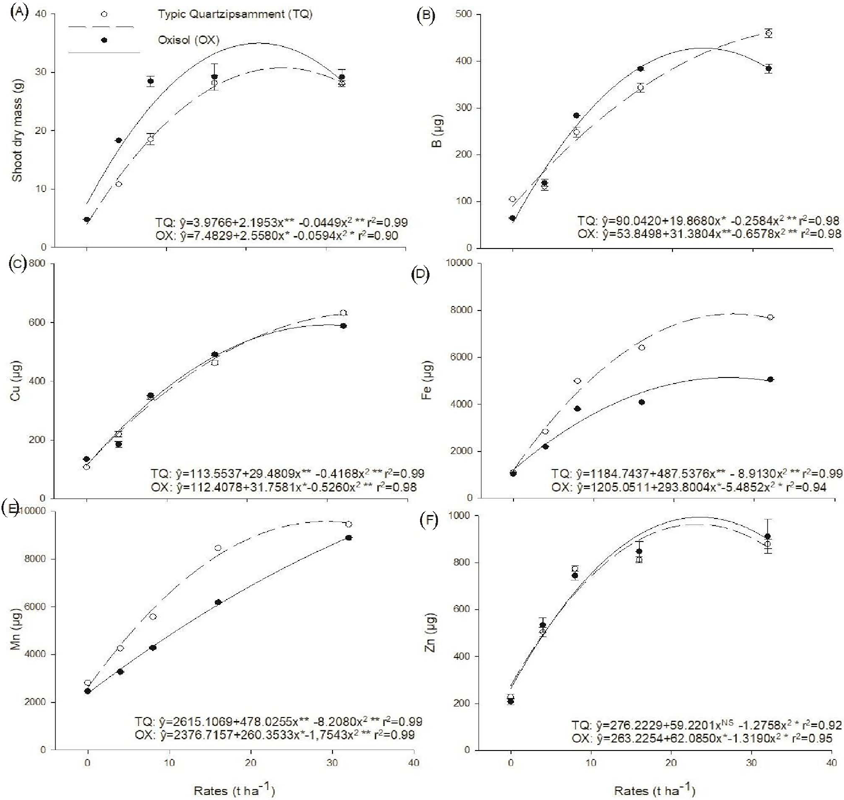
Maize plants showed a quadratic increase as a function of rock dust doses for shoot dry mass (Figure 2), height, and stem diameter, both when grown in the soil with sandy texture (TQ) and grown in OX (Table 3). Maize plants grown in TQ showed an increase in shoot dry mass, stem height, and stem diameter of 40, 63, and 61%, respectively, from the first dose of rock dust (4.0 t ha−1) relative to plants grown without the product (0 t ha−1 – only chemical fertilization). Plants grown in OX showed a more expressive effect due to the application of rock dust on plant growth. The comparison between plants that did not receive rock dust in OX with those grown under its lowest dose showed a two-fold increase in shoot mass approximately.

Shoot dry matter (A) and shoot accumulation of boron (B, B); cupper (Cu, C); iron (Fe, D); manganese (Mn, E); and zinc (Zn, F) in maize plants cultivated up to 65 days after emergence of maize plants (V6 stage) in Typic Quartzipsamment (TQ ○) and Oxisol (OX ●) grown in soil containing different concentrations of siltstone powder for 65 days. (**,* e NS – Significant at 1%, 5% probability and not significant)
A quadratic increase was observed in the macronutrient accumulation in the shoot of maize plants grown in both soils (Figure 3). Similar to what was found for the growth data (Table 3), rock dust doses provided expressive increments of macronutrients. Likewise, a quadratic increase was observed in the micronutrient accumulation in the shoot of maize plants grown in both soils (Figure 2). The results in both soils after maize cultivation indicate that the residual effect of rock dust resulted in increases in P, K, Ca, and Mg contents. These increases in the contents of these nutrients led to increases in the sum of bases and base saturation indices in both soils.

Shoot accumulation of nitrogen (N, A); phosphorus (P, B); potassium (K, C); calcium (Ca, D); magnesium (Mg, E); and sulfur (S, F) in maize plants cultivated up to 65 days after emergence of maize plants (V6 stage) in Typic Quartzipsamment (TQ ○) and Oxisol (OX ●) grown in soil containing different concentrations of siltstone powder for 65 days. (**,* eNS – Significant at 1%, 5% probability and not significant)
The residual effect of siltstone powder observed at the end of the experiment is related to the rock’s mineralogy. The rock powder used in this study is mainly composed of muscovite and calcite, which can serve as sources of K and Ca, respectively. These minerals can gradually release nutrients into the soil due to weathering and mineral degradation processes. During these processes, minerals decompose gradually, releasing nutrient ions that become available to plants (Ribeiro et al., 2020; Swoboda et al., 2022). This slow and continuous release of nutrients contributes to the residual effect of rock powder, maintaining soil nutrient levels even after crop removal.
Maize plants with lower height development and thinner stems before flowering are less tolerant to drought stress and more susceptible to attack by pests and diseases (Castro et al., 2017; Martineau et al., 2017; Momesso et al., 2022). The use of rock dust proved to be an option to assist in the nutritional management of maize, providing good increases in its initial development. The use of these silicate agromineral residues aims to reduce dependence on the use of imported fertilizers for cultivation (Nogueira et al., 2021). In the present study, even plants grown under the first dose of rock dust showed a higher nutrient accumulation than plants grown only with fertilizers with water-soluble sources in both evaluated soils.
Impact of rock dust on bean growth
Rock dust doses provided a quadratic increase in shoot dry mass (Figure 4), height, and stem diameter of bean plants grown in both soils (Table 3). Bean plants grown in TP showed an increase in shoot dry mass, height, and stem diameter of 126, 83, and 35%, respectively, from the lowest dose of rock dust (4.0 t ha−1) relative to plants grown without rock dust (0 t ha−1 – chemical fertilization only). Plants grown in OX had a similar effect with the use of siltstone powder. Plants that did not receive rock dust in OX showed an increase in shoot dry mass, height, and stem diameter of 283, 143, and 57%, respectively, compared to those grown with the lowest dose (4.0 t ha−1). Similarly, bean plants grown with the highest doses of rock dust in TQ had an accumulation of shoot dry mass (27.86 g) similar to the largest bean plants grown in OX (28.56 g).

Shoot dry matter (A) and shoot accumulation of boron (B, B); cupper (Cu, C); iron (Fe, D); manganese (Mn, E); and zinc (Zn, F) in bean plants cultivated up to 65 days after emergence of bean plants (F1 stage) in Typic Quartzipsamment (TQ ○) and Oxisol (OX ●) grown in soil containing different concentrations of siltstone powder for 65 days. (**,* e NS - Significant at 1%, 5% probability and not significant)
The accumulation of macronutrients (Figure 5) and micronutrients (Figure 4) in the shoot of bean plants increased with an increment in siltstone powder doses in both soils. Similar to what was observed for the growth data (Table 3), siltstone powder doses stimulated the uptake of macronutrients and micronutrients by bean plants.
Shoot accumulation of nitrogen (N, A); phosphorus (P, B); potassium (K, C); calcium (Ca, D); magnesium (Mg, E); and sulfur (S, F) in maize plants cultivated up to 65 days after emergence of bean plants (F1 stage) in Typic Quartzipsamment (TQ ○) and Oxisol (OX ●) grown in soil containing different concentrations of siltstone powder for 65 days. (**,* e NS - Significant at 1%, 5% probability and not significant)
The increased soil pH as a function of rock dust doses did not reduce the uptake of micronutrients by plants, as observed for micronutrient accumulation in maize (Figure 2). The results in both soils after bean cultivation indicated that the residual effect of rock dust resulted in increases in P, K, Ca, and Mg contents. These increases in the contents of these nutrients conditioned increases in the sum of bases and base saturation indices in both soils.
Bean is considered a nutrient-demanding plant due to its small and shallow root system (Moura et al., 2022). In this sense, the use of siltstone powder could optimize the nutritional status of bean plants by stimulating nutrient uptake. The high nutrient accumulation in bean plants stimulates their productive potential, which is often disregarded in the nutritional management of the production system (Souza et al., 2018).
The use of rock powder with a high content of silicate minerals, such as muscovite and augite, as in the present study, provides higher silicon (Si) uptake by plants (Campe et al., 2022; Swoboda et al., 2022). The use of Si sources confers a series of benefits such as increased resistance to lodging, higher photosynthetic efficiency, and higher tolerance to biotic and abiotic stresses (Camargo et al., 2021, 2022). The effect of mechanical protection is mainly attributed to the silicon deposition in the form of silica in the cell wall. Silicon accumulation in the stomata causes the formation of a double layer of cuticular silica, which makes the plants require less water by reducing transpiration (Camargo; Keeping, 2021). It can be extremely important for maize and bean plants that grow in tropical climate soils, where they are subject to dry spells.
The results of this study for maize and beans reported an increment not only in Ca and K contents but also in all evaluated macronutrients and micronutrients. After cultivation, soil analysis showed that nutrients available in rock dust may occur over time, as suggested by Conceição et al. (2022). The benefits from the use of rock dust are several, as the rock can provide part of the macronutrients and micronutrients necessary for the development of plants, as well as a rebalancing of the soil pH.
CONCLUSIONS
The application of rock dust promotes changes in soil fertility and the development of crops, mainly increments in K and Ca contents. In addition, the application of this rock dust reduced aluminum saturation, as well as active and potential acidity. Agronomic tests with maize and bean demonstrated that the cultivation of plants in soils that received rock dust provided an increase in the accumulation of macronutrients and micronutrients, in addition to a high dry mass accumulation. Thus, the rock dust siltstone residues has the potential to help manage soil fertility and plant nutrition and may be a complementary input to fertilization with soluble fertilizers.
ACKNOWLEDGEMENTS
The authors would like to thank the Instituto Federal de Mato Grosso do Sul and the National Council for Scientific and Technological Development (CNPq - 310494/2022-2) for the financial support to perform this study.
REFERENCES
-
ANTONANGELO, J. A. et al. Lime and calcium-magnesium silicate cause chemical attributes stratification in no-till fields. Soil and Tillage Research, v. 224, e105522, 2022. DOI: https://doi.org/https://doi.org/10.1016/j.still.2022.105522
» https://doi.org/10.1016/j.still.2022.105522 -
BAHADUR, I. et al. Mineral release dynamics of tricalcium phosphate and waste muscovite by mineral-solubilizing rhizobacteria isolated from indo-gangetic plain of India. Geomicrobiology Journal, v. 34, n. 5, p. 454-466, 2017. DOI: https://doi.org/10.1080/01490451.2016.1219431
» https://doi.org/10.1080/01490451.2016.1219431 -
BEERLING, D. J. et al. Potential for large-scale CO2 removal via enhanced rock weathering with croplands. Nature, v. 583, 2020. DOI: https://doi.org/10.1038/s41586-020-2448-9
» https://doi.org/10.1038/s41586-020-2448-9 -
BOUWMAN, A. F. et al. Lessons from temporal and spatial patterns in global use of N and P fertilizer on cropland. Scietific Reports, v. 7, p. 1-11, 2017. DOI: https://doi.org/10.1038/srep40366
» https://doi.org/10.1038/srep40366 -
BRAZIL. Ministry of Agriculture, Livestock and Supply. Normative Instruction No. 5, of March 10, 2016. Establishes the rules on definitions, classification, specifications and guarantees, tolerances, registration, packaging, labeling and advertising of remineralizers and plant substrates, intended for agriculture. Official Gazette of the Union, 2016. 8 p. Available at: https://www.gov.br/agricultura/pt-br/assuntos/insumos-agropecuarios/insumos-agricolas/fertilizantes/legislacao/in-5-de-10-3-16-remineralizadores-e-substratos-para-plantas Accessed on: 1Dec. 19, 2023.
» https://www.gov.br/agricultura/pt-br/assuntos/insumos-agropecuarios/insumos-agricolas/fertilizantes/legislacao/in-5-de-10-3-16-remineralizadores-e-substratos-para-plantas -
BRAZIL. The National Fertilizer Plan. 2022. Available at: https://www.gov.br/agricultura/pt-br/assuntos/insumos-agropecuarios/insumos-agricolas/fertilizantes/plano-nacional-de-fertilizantes/o-plano-nacional-de-fertilizantes Accessed on: Mar. 16, 2024.
» https://www.gov.br/agricultura/pt-br/assuntos/insumos-agropecuarios/insumos-agricolas/fertilizantes/plano-nacional-de-fertilizantes/o-plano-nacional-de-fertilizantes -
BURBANO, D. F. M. et al. Crushed volcanic rock as soil remineralizer: a strategy to overcome the global fertilizer crisis. Natural Resources Research, v. 31, p. 2197-2210, 2022. DOI: https://doi.org/10.1007/s11053-022-10107-x
» https://doi.org/10.1007/s11053-022-10107-x -
CAMARGO, M. S. et al. Silicon fertilization enhances photosynthetic activity and sugar metabolism in sugarcane cultivars under water deficit at the ripening phase. Silicon, v. 15, n. 7, p. 3021-3033, 2022. DOI: https://doi.org/10.1007/s12633-022-02236-y
» https://doi.org/10.1007/s12633-022-02236-y -
CAMARGO, M. S. et al. Silicon fertilization increases gas-exchange and biomass by silicophytolith deposition in the leaves of contrasting drought-tolerant sugarcane cultivars under well-watered conditions. Plant and Soil, v. 466, p. 581-595, 2021. DOI: https://doi.org/10.1007/s11104-021-05063-z
» https://doi.org/10.1007/s11104-021-05063-z -
CAMARGO, M. S.; KEEPING, M. G. Silicon in sugarcane: availability in soil, fertilization, and uptake. Silicon, v. 13, p. 3691-3701, 2021. DOI: https://doi.org/10.1007/s12633-020-00935-y
» https://doi.org/10.1007/s12633-020-00935-y - CAMPE, J. et al. Remineralization for a Healthy Planet. [S. l.: s. n.], 2022. 39 p.
- CASTRO, G. S. A. et al. Surface lime and silicate application and crop production system effects on physical characteristics of a Brazilian Oxisol. Soil Research, v. 55, p. 778-787, 2017.
-
CONCEIÇÃO, L. T. et al. Potential of basalt dust to improve soil fertility and crop nutrition. Journal of Agriculture and Food Research, v. 10, 2022. DOI: https://doi.org/10.1016/j.jafr.2022.100443
» https://doi.org/10.1016/j.jafr.2022.100443 -
CUNHA, G. O. M.; ALMEIDA, J. A. Agronomic potential of four rock powders, pure or mixed, as soil remineralizers. Research, Society and Development, v. 10, n. 17, e169101724828-e169101724828, 2021. DOI: http://dx.doi.org/10.33448/rsd-v10i17.24828
» https://doi.org/10.33448/rsd-v10i17.24828 -
DURAND, N. et al. Calcium carbonate features. Jn: DURAND, N. et al. Interpretation of micromorphological characteristics of soils and regoliths. [S. l.]: Elsevier, 2018. p. 205-258. DOI: https://doi.org/10.1016/B978-0-444-63522-8.00009-7
» https://doi.org/10.1016/B978-0-444-63522-8.00009-7 -
MANNING, D. A. C.; THEODORO S. H. Enabling food security through use of local rocks and minerals. The Extractive Industries and Society, v. 7, p. 480-487, 2020. DOI: https://doi.org/https://doi.org/10.1016/j.exis.2018.11.002
» https://doi.org/10.1016/j.exis.2018.11.002 -
MARTINEAU, E. et al. The effects of potassium nutrition on water use in field-grown maize (Zea mays L.). Environmental and Experimental Botany, v. 134, p. 62-71, 2017. DOI: https://doi.org/10.1016/j.envexpbot.2016.11.004
» https://doi.org/10.1016/j.envexpbot.2016.11.004 -
MOMESSO, L. et al. Optimizing cover crop and fertilizer timing for high maize yield and nitrogen cycle control. Geoderma, v. 405, p. 115423, 2022. DOI: https://doi.org/https://doi.org/10.1016/j.geoderma.2021.115423
» https://doi.org/https://doi.org/10.1016/j.geoderma.2021.115423 -
MOURA, F. T. et al. So many rhizobial partners, so little nitrogen fixed: the intriguing symbiotic promiscuity of common bean (Phaseolus vulgaris L.). Symbiosis, v. 86, p. 169-185, 2022. DOI: https://doi.org/10.1007/s13199-022-00831-6
» https://doi.org/10.1007/s13199-022-00831-6 -
NATIONAL ASSOCIATION FOR FERTILIZER DIFFUSION. 2024. Sector Research. Available at: http://www.anda.org.br Accessed on: Mar. 16, 2024.
» http://www.anda.org.br -
NOGUEIRA, T. A. R. et al. Nepheline syenite and phonolite as alternative potassium sources for maize. Agronomy, v. 11, p. 1-19, 2021. DOI: https://doi.org/10.3390/agronomy11071385
» https://doi.org/10.3390/agronomy11071385 - RAIJ, B. Soil fertility and nutrient management. Piracicaba: International Plant Nutrition Institute (Brasil), 2011.
-
RAMOS, C. G. et al. Evaluation of soil re-mineralizer from by-product of volcanic rock mining: experimental proof using black oats and maize crops. Natural Resources Research, v. 29, p. 1583-1600, 2020. DOI: https://doi.org/10.1007/s11053-019-09529-x
» https://doi.org/10.1007/s11053-019-09529-x -
RAMOS, C. G. et al. Possibilities of using silicate rock powder: an overview. Geoscience Frontiers, v. 13, p. 101185, 2022. DOI: https://doi.org/10.1016/j.gsf.2021.101185
» https://doi.org/10.1016/j.gsf.2021.101185 -
RAMOS, C. G. et al. A preliminary evaluation of volcanic rock powder for application in agriculture as soil a remineralizer. Science of the Total Environment, v. 512, p. 371-380, 2015. DOI: https://doi.org/10.1016/j.scitotenv.2014.12.070
» https://doi.org/10.1016/j.scitotenv.2014.12.070 -
RIBEIRO, I. D. A. et al. Use of mineral weathering bacteria to enhance nutrient availability in crops: a review. Frontiers in Plant Science, v. 11, e590774, 2020. DOI: https://doi.org/10.3389/fpls.2020.590774
» https://doi.org/10.3389/fpls.2020.590774 -
RIBEIRO, R. P. et al. Mineralogical and thermal characterization of soft rock from Campinas, Brazil. Journal of Thermal Analysis and Calorimetry, v. 136, p. 483-492, 2019. DOI: https://doi.org/10.1007/s10973-018-7601-4
» https://doi.org/10.1007/s10973-018-7601-4 -
RODRIGUES, M. et al. Mining coproducts as alternative sources of nutrients for the cultivation of sugarcane (Saccharum officinarum). Journal ofCleaner Production, v. 291, e125925, 2021. DOI: https://doi.org/10.1016/j.jclepro.2021.125925
» https://doi.org/10.1016/j.jclepro.2021.125925 -
SANTOS, E. F. et al. Prognosis of physiological disorders in physic nut to N, P, and K deficiency during initial growth. Plant Physiology and Biochemistry, v. 115, p. 249-258, 2017. DOI: https://doi.org/10.1016/j.plaphy.2017.04.001
» https://doi.org/10.1016/j.plaphy.2017.04.001 -
SANTOS, L. F. et al. Effects of biotite syenite on the nutrient levels and electrical charges in a Brazilian Savanna Ferralsol. Pesquisa Agropecuária Tropical, v. 51, 2021. DOI: https://doi.org/10.1590/1983-40632021v5166691
» https://doi.org/10.1590/1983-40632021v5166691 -
SORATTO, R. P. et al. Silicate rocks as an alternative potassium fertilizer for upland rice and common bean crops. Pesquisa Agropecuária Brasileira, v. 56, 2021. DOI: https://doi.org/10.1590/S1678-3921.pab2021.v56.01411
» https://doi.org/10.1590/S1678-3921.pab2021.v56.01411 - SOUSA, D. M. G.; LOBATO, E. Cerrado: correção do solo e adubação. Brasília, DF: Embrapa Informação Tecnológica; Planaltina, DF: Embrapa Cerrados, 2014.
-
SOUZA, T. L. P. O. et al. Agronomic Performance and Yield Stability of the RNA Interference-Based Bean golden mosaic virus-Resistant Common Bean. Crop Science, v. 58, p. 579-591, 2018. DOI: https://doi.org/https://doi.org/10.2135/cropsci2017.06.0355
» https://doi.org/https://doi.org/10.2135/cropsci2017.06.0355 -
SWOBODA, P. et al. Remineralizing soils? The agricultural usage of silicate rock powders: a review. Science of the Total Environment, v. 807, 2022. DOI: https://doi.org/10.1016/j.scitotenv.2021.150976
» https://doi.org/10.1016/j.scitotenv.2021.150976 -
TITO, G. A. et al. Influence of Bentonite and MB4 on the Chemical Characteristics of an Oxisol. Agricultural Sciences, v. 10, p. 651-664., 2019. DOI: https://doi.org/10.4236/as.2019.105050
» https://doi.org/10.4236/as.2019.105050 - USDA. Resources Conservation Service. Soil Survey Staff Keys to Soil Taxonomy. 12 th ed. Washington, DC, 2014.
-
VIANA, J. H. M. et al. Evaluation of the agricultural potential of the serpentinite rock as a soil remineralizer. Anais da Academia Brasileira de Ciencias, v. 93, p. 1-14, 2021. DOI: https://doi.org/10.1590/0001-3765202120201614
» https://doi.org/10.1590/0001-3765202120201614 -
VIOLATTI, I. C. A. et al. Siltito glauconítico como fertilizante multinutriente para’ Urochloa brizantha cv. Marandú’. Australian Journal of Crop Science, v. 8, p. 1280-1287, 2019. DOI: https://doi.org/10.21475/ajcs.19.13.08.p1609
» https://doi.org/10.21475/ajcs.19.13.08.p1609 -
VOLF, M. R. et al. Potassium Bioavailability in a Tropical Kaolinitic Soil. Agronomy, v. 11, n. 10, p. 2016, 2021. DOI: https://doi.org/10.3390/agronomy11102016
» https://doi.org/10.3390/agronomy11102016 -
WORDEN, R. H. et al. Chlorite in sandstones. Earth-Science Reviews, v. 204, e103105, 2020. DOI: https://doi.org/10.1016/j.earscirev.2020.103105
» https://doi.org/10.1016/j.earscirev.2020.103105
Edited by
-
Editor-in-Chief: Profa. Mirian Cristina Gomes Costa - mirian.costa@ufc.br