 Exogenously applied growth regulators affect the growth, phenols, protein and essential oil composition Melissa officinalis
ABSTRACT
Different growth regulators have been applied to several medicinal plant species to help increasing secondary metabolites’ production in them. The aim of the current study is to analyze the effect of growth regulators’ application, at different concentrations; on Melissa officinalis dry weight production, total phenol and soluble protein contents, and essential oil content and chemical composition. The study has followed a completely randomized design, at 3 × 3 + 1 factorial arrangement, which comprised three growth regulators [naphthalene acetic acid (NAA), benzylaminopurine (BAP) and gibberellic acid (GA3)] at three different concentrations (25, 50 and 100 mg L−1), as well as the additional treatment (control), with 4 replications. Growth regulators applied at different concentrations have significantly influenced Melissa officinalis growth. GA3 and NAA regulators’ application at 100 mg L−1 has favored the shoot length and total leaf area of the investigated species. BAP application on leaves, at the highest concentration, led to apical dominance loss; however, the lowest concentration of it has favored soluble protein concentrations in the leaves. BAP application at 25 mg L−1 has favored protein concentrations in the leaves. The highest total phenol contents were observed in plants sprayed with increasing GA3 and BAP doses; they did not differ from the control treatment, only. Essential oil compounds varied depending on the adopted growth regulator type and concentration. GA3 application at the lowest dose (25 mg L−1) resulted in citral content increase by 18% and in citronellal compound content gain ranging from 8% to 10%.
Keywords:
Lemon balm; Volatile compounds; Citral
INTRODUCTION
Aromatic plant species Melissa officinalis L. (Lamiaceae) is originally distributed in European and Asian countries, but it can be easily grown in temperate climate regions, such as in Southern and Southeastern Brazil. Its propagation can take place via seed, clump division or even cutting, which is the most used propagation method (Winiarczyk et al., 2016).
This species’ economic importance is associated with the biological and pharmaceutical activities of the essential oil extracted from its leaves, since it comprises several constituents, such as citronellal and citral, which often appear as its major components (Pirbalouti et al., 2019). This oil is of great interest to many industries, since it can be used to produce teas, condiments, flavorings, cosmetics and pharmaceuticals, given its antioxidant, anti-inflammatory, antibacterial and anxiolytic properties (Chien et al., 2019; Schnitzler, 2019).
Citronellal and citral (neral + geranial) presence as major elements in the chemical composition ofM. officinalis’ essential oil is the aspect mostly valued by different industries, mainly by pharmaceutical companies focused on vitamin A synthesis. Citronellal - which belongs to the group of monoterpenes - presents nematicidal and fungicidal activity (Araújo-Filho et al., 2019; Medeiros et al., 2017).
Citral, in its turn, is a monoterpenoid aldehyde deriving from the neral/geranial mix; it is widely used in food and cosmetics industries due to its antibacterial, antiviral and effective antioxidant effects against some stressors (Long et al., 2019; Schnitzler, 2019).
Continuous supply of high-quality essential oils is essential at the time to meet market demands for pharmaceutical, food and cosmetic products. Plant growth regulators, which can have positive or negative effects on dry matter production, and on the chemical and productive features of the essential oil extracted from aromatic plants, are among several factors capable of affecting essential oil quality and quantity (Opabode; Raji, 2019; Suehiro et al., 2019).
Some studies have shown that plant regulators, such as auxins, cytokinins and gibberellins, have been commercially used depending on producers’ economic goals, whether to dry matter production purposes or to improve secondary metabolites’ quality and yield (Akbari et al., 2018; Opabode; Raji, 2019; Yuan et al., 2019). Plant growth regulator ‘gibberellic acid’ (GA3) helped increasing the yield of essential oil extracted from Salvia officinalis L. plants, unlike what was observed after benzylaminopurine (BAP) application, which decreased the values recorded for this variable (Povh; Ono, 2006). Studies have shown that naphthalene acetic acid (NAA) regulator externally applied on plants has positively affected shoot growth, root system and plant yield, as well as improved the absorption of nutrients, such as calcium (Abbasi et al., 2013; Rostami; Movahedi, 2016). Plant growth regulators’ nano form can be used to enhance both the production and the yield of essential oil extracted from Ocimum tenuiflorum L. plants (Khan et al., 2023).
The application of growth regulators in plants can have various advantages and disadvantages, depending on the objective and cultivation conditions. Growth regulators can enhance plant growth and development, increase the synthesis of secondary metabolites, boost productivity, control physiological processes, and improve stress resistance. However, there are some disadvantages, such as high costs for large areas, undesirable effects from improper dosages, and dependence on environmental conditions. Therefore, the use of growth regulators needs to be carefully planned to maximize benefits and minimize risks and negative impacts. By keeping this information in mind, we herein hypothesized that PGR solutions applied to plant leaves would help inproving Melissa officinalis growth, total phenols, soluble proteins and essential oil’s content and chemical composition. A pot experiment carried out with Melissa officinalis was conducted to test this hypothesis.
MATERIAL AND METHODS
Study site and seedling production
The experiment was carried out in greenhouse located at the following geographic coordinates: 21° 14’S and 45° 00W, at 918-m altitude. Melissa officinalis L. seedlings were obtained from 7-cm apical cuttings removed from plants and grown in 128-cell Styrofoam trays covered with commercial substrate (Tropstrato HA), under irrigation, for 15 days. A voucher specimen was properly prepared and deposited in the ESAL Herbarium of the Biology Department at UFLA, under registry n. 22155.
Each plot comprised 4 pots (10-L capacity) filled with Dystrophic Red Latosol/sand mix, at 2:1 ratio, which was added with 450 g of cattle manure (per pot). Seedlings presenting 3 to 4 pairs of leaves, approximately 10 cm long, were transplanted to these pots. The adopted substrate presented the following features: 191.84 K+ (mg dm3), 27.05 P (mg drrf), 2.11 Ca+2 (cmolc drrf), 0.77 Mg+2, 0.05Al+3 (cmolc dm3), 0.81 H+Al+3, 7.6 pH, 3.37 base saturation (BS) (cmolc dm3), 3.42t (cmolc dmrf), 4.18T (cmolc dmtf), 80.67 V (%), 1.46 m (%), 2.67 organic matter (OM) (dag Kg−1) and 30.76 remaining phosphorus (P-Rem) (mg L−1).
Experimental design and conduction
The current study has followed a completely randomized experimental design, at 3x3 +1 factorial arrangement with additional treatment and four repetitions; each repetition comprised four plants. The investigated factors were growth regulator types [GA3 (gibberellic acid), BAP (6-benzylaminopurine) and NAA (naphthalene acetic acid)], concentration levels (25, 50 and 100 mg L−1) and a control, which was used as additional treatment (distilled water) - Tween 80 was added to all treatments. Three growth regulator applications were carried out at 15-day intervals, during the 90-day species cultivation cycle. The first application was carried out 45 days after seedling transplantation, whereas the other applications were performed at 60 and 75 days. Treatments were applied on plants’ leaves (200 mL) - with the aid of manual sprayer - until reaching the suspension dripping point.
Plant growth, photosynthetic pigment, protein and phenolic compound analysis
Vegetative growth
Plants’ shoot length (SL-cm) was assessed 90 days after transplantation. Plants were packed in craft paper and placed in drying oven, at 45 °C, for 72 h. Then, they were weighed on analytical scale to find leaf (LDW), stem (SDW) and root (RDW) dry weight; results were expressed in grams. Total leaf area (TLA) was calculated based on using all leaves of the three plants from each treatment. Integrator model 3100 LI was used for such a purpose and results were expressed in square centimeters. Leaf area ratio (LAR) was expressed as total leaf area (TLA) per total dry weight (TDW). Specific leaf area (SLA) was expressed as total leaf area (TLA) per leaf dry weight (LDW). Specific leaf weight (SLW) was expressed as leaf dry weight (LDW) per total leaf area (TLA). Leaf weight ratio (LWR) was expressed as leaf dry weight (LDW) per shoot dry weight (ShDW).
Photosynthetic pigments
Three completely expanded leaves were removed from plant’s upper part, wrapped in aluminum foil and stored in Styrofoam box filled with ice in order to determine chlorophyll a, b, total (a + b) and carotenoids. These pigments were quantified based on the method developed by Hiscox and Israelstam (1979). In order to do so, 50 mg of fresh leaves were taken to Falcon tubes covered with aluminum foil and incubated with 10 mL dimethyl sulfoxide (DMSO) - at the proportion of 5 g L−1 saturated with calcium carbonate (CaCO3) - in oven, at 65 °C, for 48 h. After the solution was stirred for four hours, filtered and centrifuged, three 3-mL aliquots of each sample were transferred to a quartz cuvette. Photosynthetic pigment values were determined based on absorbance readings conducted at 480, 649 and 665 nm, in TECAN INFINITY M200 PRO spectrophotometer operated by the I-Control® data processing system (version 3.37). Results were compared to saturated DMSO blank. After this reading, pigment content (mg g−1 Fresh weight - FW) was quantified as follows: Chlorophyll a 649 = (12.47 × A665) - (3.62 × A649); Chlorophyll b 665 = (25.06 × A649) - (6.5 × A665); Carotenoids 480 = (1000 × A480 - 1.29 × chlorophyll a - 53.78 x chlorophyll b)/220; Total chlorophyll = Chlorophyll a + Chlorophyll b, wherein A= absorbance of samples read at the corresponding wavelength.
Soluble proteins
Amount of 15 mg of leaves from each treatment were sampled in triplicate; soluble protein content in them was determined based on the methodology described by Bradford (1976). Absorbance readings were performed in TECAN INFINITY M200 PRO spectrophotometer at 595 nm and compared to the standard curve of bovine serum albumin (BSA) at final concentration of 5µg µL−1. The curve was adjusted through linear regression and resulted in the following equation: y = 0.0034x + 0.2701 (R2 = 0.9917), which was used to determine leaf protein concentration. Results were expressed as mg mL−1 protein extract.
Total Phenols
Amount of 50 mg of pulverized dry leaves were taken to a 2 mL microtube, extracted with 1 mL of Ethanol 92.8° GL; the solution was vortexed and, then, sonicated for 10 minutes. After this procedure was over, the ethanolic extract was centrifuged at 12,000 rpm, for 15 minutes; the supernatant was removed and added to an amber bottle labeled according to the corresponding treatment sample. Another 1 mL was added to the precipitate resulting from the ethanolic extract and subjected to additional sonication and centrifugation cycle. The resulting solution was diluted in ethanol 16 times. Then, 50 µL of vegetable ethanolic solution were added to microplates that, in their turn, were added with 100 µL of 10% Folin-Ciocalteau reagent and 7% sodium carbonate, 2 minutes later. Phenols were quantified based on the spectrophotometric method by Folin-Ciocalteau (Singleton; Orthofer; Lamuela-Raventós, 1999); gallic acid was used as standard. The analysis was performed in quintuplicate and results were expressed as mean ± standard deviation in mg of gallic acid equivalents (GAE) per g of leaf dry weight.
Essential oil extraction, content and yield
The aliquot of 50 g of leaves dried in triplicate for each treatment was added to 2 L distillation flask to obtain the essential oil. The flask was added with 1,000 mL of distilled water, and left to hydrodistill in Clevenger apparatus for 1 h. The resulting hydrolate was subjected to liquid-liquid partition in separating funnel, as well as to three washes in dichloromethane (3 × 5 mL). The organic phase was combined and treated with anhydrous magnesium sulfate salt, for approximately 5 min, to enable moisture residues’ absorbance; subsequently, it was filtered. The essential oil obtained after evaporation of the dichloromethane solvent evaporation, at room temperature, under gas exhaust hood, was collected in hermetically closed amber bottles, labeled and previously weighed on digital scale at 0.0001 g sensitivity; its mass (in mg) was determined based on the difference observed in the bottle’s weight, before and after the oil was added to it.
Essential oil content (mL100 g of dry weight−1) was determined based on the following formula: EOC% = (oil mass (g)/50 g) × 100), whereas essential oil yield (g plant−1) was determined based on the formula: EOY = (mass of oil (g)/50 g) × leaf dry weight /plant (g). Flasks filled with essential oil were stored in freezer at −4 °C, until chemical constituents’ analysis time.
Quantitative and qualitative analysis applied to chemical constituents
Quantitative analyses of essential oils’ chemical constituents were performed in triplicate. The separation technique based on Gas Chromatography (GC) with Flame Ionization detector (GC-FID) was put in place in Agilent® 7890A equipment, operated with MSD CHEM Station Ver. E.02.02.1431, equipped with CombiPAL Autosampler System autosampler/injector (CTC Analytic AG, Switzerland).
Ten (10) µL of Carvacrol stock solution was used as internal standard added to the known essential oil masses, which were diluted in 1 mL ethyl acetate, for sample preparation purposes. Injection volume of 1.0 µL was used in split mode at injection ratio of 50:1. Essential oils were analyzed based on using HP-5MS column (30 m in length × 250 µm in internal diameter × 0.25 µm in film thickness - California, USA); helium gas was used to drag the constituents at flow of 1.0 mL.min−1. Both the injector and detector temperatures were within the range from 240 °C to 300 °C. Initial oven temperature was 60 °C; temperature ramp of 3 °C min−1 was applied until it reached 240 °C; it was followed by temperature ramp of 10 °C min−1 until it reached 280 °C.
Qualitative analyses were based on the gas chromatography-mass spectrometry (GC-MS) separation technique; they were conducted in Agilent® 7890A chromatograph coupled to Agilent® MSD 5975C mass selective detector (Agilent Technologies, California, USA), operated through electronic impact ionization at 70 eV, in scan mode, at speed of 1.0 scan/s, with mass acquisition ranging from 40 to 400 m/z.
Chemical constituents were identified by comparing their retention rates to co-injection of standard n-alkane solution (C8 - C20) and/or by comparing mass spectra from the NIST/EPA/NHI library database to the ones reported in the literature (Adams, 2017). Retention indices described in the literature were consulted for assignment purposess (Adams, 2017).
Statistical analysis
Collected data were subjected to analysis of variance (ANOVA); means were compared to each other through Scott-Knott test, at 5% probability of error, in SISVAR® 5.0 statistical software (Ferreira, 2019).
RESULTS AND DISCUSSION
Vegetative growth
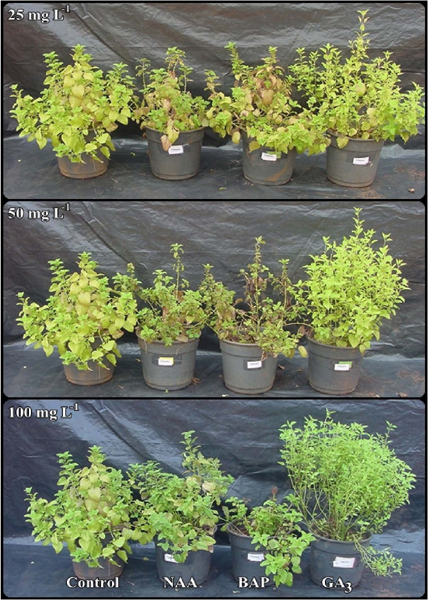
There was significant interaction between growth regulator types and concentration factors in dry weight production (Table 1). The lowest dry weight production recorded for M. officinalis plants was observed after NAA application. All dry weight values decreased following the application of the highest BAP doses; however, the dry weight observed with this regulator was higher than that recorded after NAA application. GA3 application, at the highest concentrations, increased stem dry weight from 11.67 to 14.84 g plant−1; consequently, it increased shoot dry weight. Based on Figure 1, it is possible seeing increased shoot and younger branches’ growth after GA3 application.
Effect of foliar application of the type of regulators (NAA, BAP and GA3) and concentrations on the vegetative growth of Melissa officinalis L.

General aspect of a Melissa officinalis plant cultivated under the effect of different concentrations and types of growth regulators
Growth regulator cytokinin applied at adequate doses stimulates lateral shoot growth (Akbari et al., 2018). This factor stimulates greater leaf yield, since this hormone breaks apical dominance and promotes axillary buds’ growth in several species. This phenomenon can also be promoted by gibberellin. The stimulation of lateral shoots in M. officinalis was more observed after gibberellin (GA3) application than after cytokinin (BAP) application. In addition, cytokinin also accounts for regulating root growth; it presents concentration-dependent effect, since high doses of this hormone inhibit root growth in some species by stimulating ethylene biosynthesis, which, in its turn, reduces root meristem size and cell length (Zou et al., 2018). The lowest M. officinalis root dry weight (7.91 g plant−1) and, consequently, the lowest root-to-shoot ratio (R: ShDW 0.29), were observed after gibberellin application at the highest dose.
There was interactive effect between growth regulator and concentration on M. officinalis shoot length, total leaf area and leaf area ratio (LAR). The application of 100 mg L−1 of GA3 was the most effective in stimutaling shoot growth in the investigated species, which reached 52.06 cm, on average, in comparison to plants subjected to BAP and NAA concentrations, whose shoot growth ranged from 37.50 to 44.56 cm, as well as to the control plants (37.06 cm) (Table 2).
Effect of foliar application of growth regulators (NAA, BAP and GA3) with different concentrations on growth analysis of Melissa officinalis L.
Plants subjected to GA3 application presented larger number of small leaves than that observed in plants subjected to other treatments (Figure 1). Consequently, higher total leaf area value (2,343.68 cm2) was recorded for plants subjected to 100 mg L−1 GA3. The highest BAP concentration led to apical dominance loss in the investigated species, decreased plants’ shoot length and induced the growth of axillary shoots with larger number of leaves and smaller leaf area.
Variation in leaf area ratio (LAR) recorded for M. officinalis L. plants subjected to different treatments with plant growth regulators is shown in Table 2. LAR expresses the useful leaf area for photosynthesis in comparison to total dry weight. This factor indicates the leaf area used by plants to produce 1 g of dry weight (Benincasa, 2003). Overall, treatments based on GA3 and NAA application led to increased LAR values. This behavior is the evidence that these plants grew after the application of these regulators. LAR is often higher at early vegetative cycle stage; it decreases later on, as plants’ maturation progresses. BAP application induced LAR decrease, and it means that the amount of assimilates allocated to the leaves has decreased. Untreated plants (control) recorded LAR values close to ones observed for plants subjected to the BAP treatment. If one takes into consideration that leaf area ratio represents the proportion of photosynthetic material related to plants’ total dry weight, it is possible suggesting that the BAP and control treatments presented lower amount of photosynthetic material in comparison to total dry weight, 90 days after planting.
Specific leaf area (SLA) is a component that indicates morphological and anatomical changes in leaves, since it relates leaf surface to leaf dry weight (Benincasa, 2003). Overall, higher SLA was observed after NAA and GA3 application; greater leaf area and lower leaf dry weight were also observed for these regulators (Table 2). It is possible inferring those plants invested a relatively larger amount of photoassimilates to increase leaf area - given the larger number of leaves observed in the current case - in order to maximize the capture of available light. Inverse SLA often indicates leaf thickness, which is associated with specific leaf weight (SLW) (Benincasa, 2003). The lowest SLW values recorded in the current study were observed after NAA and GA3 application, and it enabled inferring that these leaves were thinner than the ones grown in plants subjected to BAP treatment and in the control group, which recorded higher SLW values. M. officinalis plants subjected to growth regulators’ application behaved like plants grown in the shade. According to Lambers, Chapim III and Pons (1998), leaves grown under shading were thinner, as well as presented higher specific leaf area (SLA) and lower leaf dry weight. Shaded plants presented increased SLA, which was directly related to anatomical changes, such as thinner cuticle and epidermis, as well as lower mesophyll and palisade parenchyma thickness (Berlyn; Cho, 2000). BAP application overall resulted in higher leaf weight ratio (LWR). This finding shows that plants subjected to BAP application accumulated more leaf dry weight.
Gibberellins, mainly GA3, have been one of the main exogenously sprayed plant hormones used to increase plant growth, flowering and yield, as well as to delay senescence in several agricultural crops. It is so, because it is associated with plant growth and with better absorption of minerals such as phosphorus, calcium, potassium and magnesium (Opabode; Raji, 2019; Ramesh et al., 2019; Zulfiqar et al., 2019). The magnitude of GA3’s effect, as well as of BAP, depends on experimental conditions, such as year and plant species, since high concentrations of these hormones can stimulate ethylene biosynthesis, which is the hormone accounting for the maturation of plant organs and, consequently, for the maturation of the organs (Suehiro et al., 2019).
Photosynthetic pigments
The application of different growth regulators has significantly affected photosynthetic pigment levels, although the applied doses did no have significant effect on this variable (Table 3). In addition, NAA application to plants led to higher chlorophyll a (1.13 mg g−1 FW), chlorophyll b (0.53 mg g−1 FW), total chlorophyll (1.65 mg g−1 fW) and carotenoid (0.35 mg g−1 FW) contents, although it did not significantly differ from the control treatment, only (Table 3).
Photosynthetic pigment content of Melissa officinalis leaves under different concentrations and types of plant growth regulators
The herein observed increase in photosynthetic pigments may be associated with plants’ direct dependence on these hormones to trigger biological processes linked to chlorophyll content and plant growth (Opabode; Raji, 2019). Increased auxin level activates the genetic mechanisms involved in chlorophyll and carbohydrate synthesis, which, in its turn, enables plant growth (Yuan et al, 2019). However, in the case of M. officinalis, the applied auxin (NAA) led to lower dry weight accumulation.
Protein and total phenols’ contents
Melissa officinalis leaf proteins were significantly affected by the interaction between growth regulator concentrations and types (Table 4). BAP application at 25 mg L−1 has favored leaf protein concentration (0.53 mg mL−1), similarly to what was observed for the application of increasing NAA concentrations. GA3 application, in its turn, reduced the values recorded for this variable. Application of BAP at reduced concentrations (0.1 mM) was capable of delaying leaf senescence in some plant species; they associated this behavior with increased crude protein content in leaves (Wilson-Garcia et al., 2008). Thus, high concentrations of this growth regulator sprayed on plants’ leaves may have had oxidative effect on M. officinalis, since it reduced its protein content.
Effect of different concentrations and types of growth regulators on the concentration of total soluble proteins (TSP) in dry leaves of Melissa officinalis cultivated within 90 days
The highest total phenol contents recorded for M. officinalis were observed in plants sprayed with GA3 and BAP, at increasing doses, although they did not significantly differ from the control treatment. On the other hand, the NAA regulator had decreasing effect on leaf phenolic content recorced for the aforementioned species (Table 5). The exogenous application of gibberellic acid GA3 increased plants’ antioxidant capacity, through the maintenance and synthesis of phenolic compounds, such as flavonoids and phenolic acids (Almughraby; Kalimullin; Timofeeva, 2019; Hu et al., 2018). Species M. officinalis is one of the medicinal plants presenting high phenolic compound levels; rosmarinic acid and flavonoids stand out among the main factors accounting for its antioxidant capacity (Pistelli et al., 2019; Safari; Akramian; Salehi-Arjmand, 2020). Rosmarinic acid is found at large amounts in species M. officinalis; its antioxidant, antibacterial and antifungal activity plays key role in this species’ pharmacological performance (Caleja et al., 2018; Ertas; Yener, 2020).
Effect of different concentrations and types of plant growth regulators on the total phenol content of Melissa officinalis cultivated within 90 days
Essential oil content, yield and chemical composition
The application of different growth regulator types and doses to M. officinalis plants did not affect its essential oil content, which ranged from 0.44% to 0.47% (Table 6). There was isolated growth regulator concentration effect on the investigated species’ essential oil yield. Growth regulator concentrations of 25 and 100 mg L−1 were the most effective ones for essential oil yield, which ranged from 61 to 64 mg plant−1, respectively. In relation to the regulators, the effect of the control application was superior to the others.
Effect of different concentrations and types of plant growth regulators on the essential oil content and yield of Melissa officinalis cultivated within 90 days
According to some studies conducted with species belonging to family Lamiaceae, the application of growth regulators to plants has led to higher essential oil content. Povh and Ono (2006), for example, applied GA3 to Salvia officinallis L. and observed increased essential oil content in this species; BAP was ineffective for the response variable. It was observed significant increase in essential oil content and in the concentration of some monoterpenes in Thymus vulgaris L plants (Rabiei; Bahador; Kordrostami, 2018). Besides the adopted growth regulator type and concentration, M. officinalis oil content also depended on plants’ genotype and age; the aforementioned plant presented relatively low oil content (0.01% to 0.35%).
Essential oil compounds have changed depending on growth regulator type and concentration (Table 7). Citral and citronellal are major compounds in the chemical composition of the essential oil extracted from M. officinalis. They are used by the industrial sector, mainly by pharmaceutical companies, for vitamin A synthesis purposes. BAP application at doses of 25 and 50 mg L−1 increased citral content by 10%, whereas the highest dose of it (100 mg L−1) only increased this content by 4%. GA3 application at the lowest dose (25 mg L−1) increased citral content by 18%, whereas the doses of 50 mg L−1 and 100 mg L−1 increased this content by 6% and 3%, respectively (Table 7). Citronellal compound recorded content gain ranging from 8% to 10%, at the lowest dose (25 mg L−1) of all growth regulators applied.
The application of growth regulators did not affect the total content of the essential oil but altered its composition. Citral and citronellal are valuable compounds for the pharmaceutical industry. Therefore, the application of the growth regulator gibberellin would be advantageous due to the increase in these compounds in the essential oil. The combination of gibberellin and auxin could be studied to evaluate the joint effect of these regulators. Auxin and gibberellic acid (GA3) exhibit a synergistic effect in plants, meaning they can work together to enhance or complement their actions in plant growth and development. This synergistic interaction between growth regulators is essential for plant development. Auxins can enhance the biosynthesis or activity of gibberellic acid in certain tissues, amplifying its effects. The integrated signaling of these growth regulators is crucial for promoting more efficient growth and, consequently, increasing the synthesis of the compounds present in the essential oil.
External factors, such as the application of growth regulators like cytokinin and auxin, affect terpenoids biogenesis, by increasing or inhibiting their content in some plant species (Danova et al., 2018; Krumova et al., 2013). The application of regulators, such as gibberellic acid (GA3), indole 3-acetic acid (IAA) and benzylaminopurine (BAP), has increased the chemical composition of some components in Ocimum gratissimum L species’ essential oil (Hazzoumi; Moustakime; Amrani Joutei, 2014).
CONCLUSIONS
1. BAP and GA3 applied at lower concentrations have favored shoot dry weight accumulation in M. officinalis plants. Values recorded for these growth regulators were only lower than the ones recorded for the control treatment. There was no difference in essential oil content only in yield. BAP application at 25 mg L−1 has favored leaf protein concentration. The highest total phenol contents were observed for plants sprayed with GA3 and BAP, at increasing doses, although these contents did not significantly differ from the ones recorded for the control treatment. Essential oil compounds changed depending on growth regulator type and concentration. The application of GA3 at the lowest concentration (25 mg L−1) resulted in an 18% increase in citral content, while citronellal content showed an increase ranging from 8% to 10%. This rise in the concentration of major compounds, such as citral and citronellal, can enhance the commercial value of the extracted essential oils, as the presence of these chemical components in the essential oil composition of M. officinalis is highly valued by various industries, especially pharmaceutical companies. Thus, the use of growth regulators can be an economically advantageous strategy for producers aiming to maximize profitability in the cultivation of medicinal plants.
ACKNOWLEDGEMENTS
The authors would like to thank the Universidade Federal de Lavras (UFLA) for all its support in terms of structure and resources, as well as the funding agencies: Conselho Nacional de Desenvolvimento Científico e Tecnológico (CNPq), Fundação de Amparo à Pesquisa do Estado de Minas Gerais (FAPEMIG) e Coordenação de Aperfeiçoamento de Pessoal de Nível Superior - Brasil (CAPES – Finance Code 001).
REFERENCES
- ABBASI, N. A. et al Effects of naphthalene acetic acid and calcium chloride application on nutrient uptake, growth, yield and post harvest performance of tomato fruit. Pakistan Journal of Botany, v. 45, n. 5, p. 1581-1587, 2013.
- ADAMS, R. P. Identification of essential oil components by gas chromatography/mass spectrometry. 4.1 ed. (online). Illinois: Allured Publishing, 2017. 804 p.
- AKBARI, M. et al Effect of decapitation and exogenous application of gibberellic acid (GA3) and cytokinin (CK) on some physiological characteristics of stevia. Cellular and Molecular Biology, v. 64, n. 2, p. 50-56, 2018.
- ALMUGHRABY, E.; KALIMULLIN, M. I.; TIMOFEEVA, O. A. Phytochemical composition and antioxidant activity in Brassica oleracea var. Sabellica under the effect of plant growth regulators. EurAsian Journal of BioSciences, v. 13, n. 2, p. 1037-1043, 2019.
- ARAÚJO-FILHO, J. V. de et al Atividade anti-helmíntica do óleo essencial de Eucalyptus citriodora e seu componente majoritário, citronelal, sobre nematoides gastrintestinais de ovinos. Revista Brasileira de Parasitologia Veterinaria, v. 28, n. 4, p. 644-651, 2019.
- BENINCASA, M. M. P. Análise de crescimento de plantas: noções básicas. 2. ed. Jaboticabal: FUNEP, 2003. 41 p.
- BERLYN, G. P.; CHO, J. Light, moisture, and nutrient use by plants. In: ASHTON, M. S.; MONTAGNINI, F. (ed.) The silvicultural basis for agroforestry systems. Boca Raton: CRC Press, 2000. p. 9-39.
- BRADFORD, M. M. A rapid and sensitive method for the quantitation of microgram quantities of protein utilizing the principle of protein-dye binding. Analytical Biochemistry, v. 72, p. 248, 1976.
- CALEJA, C. et al Suitability of lemon balm (Melissa officinalis L.) extract rich in rosmarinic acid as a potential enhancer of functional properties in cupcakes. Food Chemistry, v. 250, p. 67-74, 2018.
- CHEN, S. Y et al Combination Effect of High-pressure processing and essential oil (Melissa officinalis Extracts) or their constituents for the inactivation of Escherichia coli in Ground Beef. Food and Bioprocess Technology, v. 12, n. 3, p. 359-370, 2019.
- DANOVA, K. et al Effect of cytokinin and auxin treatments on morphogenesis, terpenoid biosynthesis, photosystem structural organization, and endogenous isoprenoid cytokinin profile in Artemisia alba Turra in vitro Journal of Plant Growth Regulation, v. 37, p. 403-418, 2018.
- ERTAS, A.; YENER, I. A comprehensive study on chemical and biological profiles of three herbal teas in Anatolia; rosmarinic and chlorogenic acids. South African Journal of Botany, v. 130, p. 274-281, 2020.
- FERREIRA, D. F. Sisvar: a computer statistical analysis system. Ciência e Agrotecnologia (UFLA), v. 35, n. 6, p. 1039-1042, 2019.
- HAZZOUMI, Z.; MOUSTAKIME, Y.; AMRANI JOUTEI, K. Effect of gibberellic acid (GA), indole acetic acid (IAA) and benzylaminopurine (BAP) on the synthesis of essential oils and the isomerization of methyl chavicol and trans-anethole in Ocimum gratissimum L. Springer Plus, v. 3, p. 321, 2014.
- HISCOX, J. D.; ISRAELSTAM, G. F. A method for the extraction of chlorophyll from leaf tissue without maceration. Canadian Journal of Botany, v. 57, p. 1332-1334, 1979.
- HU, Z. et al Gibberellic acid enhances postharvest toon sprout tolerance to chilling stress by increasing the antioxidant capacity during the short-term cold storage. Scientia Horticulturae, v. 237, p. 184-191, 2018.
- KHAN, M. et al Nanotized form of indole acetic acid improve biochemical activities, the ultrastructure of glandular trichomes and essential oil production in Ocimum tenuiflorum L. Industrial Crops and Products, v. 193, p. 116117, 2023.
- KITTLER, J. et al Content and composition of essential oil and content of rosmarinic acid in lemon balm and balm genotypes (Melissa officinalis). Genetic Resources and Crop Evolution, v. 65, n. 5, p. 1517-1527, 2018.
- KRUMOVA, S. et al Terpenoid profile of Artemisia alba is related to endogenous cytokinins in vitro Bulgarian Journal of Agricultural Science, v. 19, n. 2, p. 26-30, 2013.
- LAMBERS, H.; CHAPIM III, F. S.; PONS, T. L. Plant physiological ecology. New York: Springer, 1998. 540 p.
- LONG, N. et al Effect and mechanism of citral against methicillinresistant Staphylococcus aureus in vivo. Journal of the Science of Food and Agriculture, v. 99, n. 9, p. 44234429, 2019.
- MEDEIROS, C. I. S. et al Study of the antifungal potential of (R)-(+)-citronellal and its association with therapeutic agents used in the treatment of vulvovaginal candidiasis. Bioscience Journal, v. 33, n. 2, p. 494-506, 2017.
- OPABODE, J. T; RAJI, I. B. Exogenously applied gibberellic acid affects shoot regeneration, growth, physiological parameters, and proximate and mineral contents of pot-grown Solanecio biafrae International Journal of Vegetable Science, v. 25, n. 2, p. 73-86, 2019.
- PIRBALOUTI, A. G. et al Chemical composition and yield of essential oil from lemon balm (Melissa officinalis L.) under foliar applications of jasmonic and salicylic acids. Biocatalysis and Agricultural Biotechnology, v. 19, 2019.
- PISTELLI, L. et al Accumulation of rosmarinic acid and behaviour of ROS processing systems in Melissa officinalis L. under heat stress. Industrial Crops and Products, v. 138, p. 111469, 2019.
- POVH, J. A.; ONO, E. O. Essential oil yield in Salvia officinallis L. under the action of plant growth regulators. Acta Scientiarum - Biological Sciences, v. 28, n. 3, p. 189-193, 2006.
- RABIEI, B.; BAHADOR, S.; KORDROSTAMI, M. The expression of monoterpene synthase genes and their respective end products are affected by gibberellic acid in Thymus vulgaris Journal of Plant Physiology, v. 230, p. 101-108, 2018.
- RAMESH, S. et al Effect of gibberellic acid (GA3) on growth and yield of rice (Oryza sativa L.). Plant Arch, v. 19, n. 1, p. 1369-1372, 2019.
- ROSTAMI, M.; MOVAHEDI, Z. Evaluating the effects of Naphthalene acetic acid (NAA) on morpho-physiological traits of valerian (Valeriana officinalis L.) in aeroponic system. Iranian Journal of Plant Physiology, v. 6, n. 3, p. 1751-1759, 2016.
- SAFARI, F.; AKRAMIAN, M.; SALEH-ARJMAND, H. Physiochemical and molecular responses of salt-stressed lemon balm (Melissa officinalis L.) to exogenous protectants. Acta physiologiae plantarum, v. 42, p. 1-10, 2020.
- SCHNITZLER, P. Essential oils for the treatment of Herpes Simplex virus infections. Chemotherapy, v. 64, n.1, p. 1-7, 2019.
- SINGLETON, V. L.; ORTHOFER, R.; LAMUELA-RAVENTÓS, R. M. Analysis of total phenols and other oxidation substrates and antioxidants by means of Folin-Ciocalteu reagent. Methods Enzymology, v. 299, p. 152-178, 1999.
- SUEHIRO, Y. et al Effects of gibberellic acid/cytokinin treatments on berry development and maturation in the yellow-green skinned ‘Shine Muscat’ grape. The Horticulture Journal, v. 88, n. 2, 2019.
- WILSON-GARCIA, C. Y. et al The cytokinin BAP delays senescence and increases antioxidants, protein and growth in orchard grass (Dactylis glomerata L.). Agrociencia, v. 42, n. 7, p. 799-806, 2008.
- WINIARCZYK, K. et al Vitality and germination of lemon balm (Melissa officinalis L.) seeds. Journal of Applied Botany and Food Quality, v. 89, p. 156-162, 2016.
- YUAN, Y et al Auxin response factor 6A regulates photosynthesis, sugar accumulation, and fruit development in tomato. Horticulture Research, v. 6, n. 85, 2019.
- ZOU, X. et al Supra optimal cytokinin content inhibits rice seminal root growth by reducing root meristem size and cell length via increased ethylene content. International Journal of Molecular Sciences, v. 19, n. 12, p. 4051, 2018.
- ZULFIQAR, F. et al Bioregulators can improve biomass production, photosynthetic efficiency, and ornamental quality of Gazania rigens L. Agronomy, v. 9, n. 11, p. 773, 2019.
Edited by
-
Editor-in-Chief: Agricultural Engineer. Manoel Barbosa Filho - manoel.filho@ufc.br