Biological control of alternaria brown spot and post-harvest quality in ‘Dancy’ tangerine fruits
ABSTRACT
Tangerine is an important citrus crop in Brazil, but its production is limited by Alternaria brown spot (ABS), caused by Alternaria alternata f. sp. citri, which causes necrotic lesions, peel rot and premature fruit fall. Disease control is mainly based on the use of synthetic fungicides, whose excessive use causes environmental impacts. Thus, biological control emerges as a promising and sustainable alternative. Therefore, this study aimed to evaluate the efficiency of commercial biological products in controlling ABS and post-harvest quality of ‘Dancy’ tangerine. The treatments were Quartzo®, Bombardeiro®, Bio-Imune®, Shocker®, Natucontrol®, Ecotrich®, Tricho-Turbo®, compared to the fungicide Thiabendazole and the control with sterilized distilled water. In in-vitro tests, mycelial growth, with the aid of a ruler, and sporulation from the spore suspension, were evaluated for seven days in potato-dextrose-agar medium containing the treatments and a disc of the pathogen in the center of the plates. Disease severity was evaluated using a diagrammatic scale after disc inoculation on injured fruits, observing activation of defense enzymes peroxidase, polyphenol oxidase and phenylalanine ammonia-lyase, suggesting induction of resistance. In the in-vitro test, the treatments reduced fungal growth, with Ecotrich® inhibiting 100% of the pathogen. No changes were observed in post-harvest quality parameters, such as soluble solids, titratable acidity, vitamin C, pH, firmness and mass loss. It is concluded that the Ecotrich® and Tricho-Turbo® products stand out as effective and promising alternatives for the management of ABS in ‘Dancy’ tangerine fruits.
Keywords:
Alternaria alternata f; sp; citri; Citrus sp.; Resistance induction.
RESUMO
A tangerineira é uma importante cultura cítrica no Brasil, contudo, a produção é limitada pela mancha marrom de Alternaria (MMA), causada por Alternaria alternata f. sp. citri, que provoca lesões necróticas, apodrecimento da casca e queda precoce dos frutos. O controle da doença baseia-se principalmente no uso de fungicidas sintéticos, cujo uso excessivo ocasiona impactos ambientais. Dessa forma o controle biológico surge como alternativa promissora e sustentável. Assim, este estudo teve como objetivo avaliar a eficiência de produtos biológicos comerciais no controle da MMA e na qualidade pós-colheita da tangerina ‘Dancy’. Os tratamentos foram Quartzo®; Bombardeiro®; Bio-Imune®; Shocker®; Natucontrol®; Ecotrich®; Tricho-Turbo®, comparados ao fungicida Tiabendazol e à testemunha com água destilada esterilizada. Nos testes in vitro, o crescimento micelial, com auxílio de régua, e a esporulação a partir da suspensão de esporos, foram avaliados por sete dias em meio batata-dextrose-ágar contendo os tratamentos e um disco do patógeno ao centro das placas. A severidade da doença foi avaliada por escala diagramática após inoculação em disco sobre frutos feridos, observando-se ativação de enzimas de defesa peroxidase, polifenoloxidase e fenilalanina amônia-liase, sugerindo indução de resistência. No teste in vitro, os tratamentos reduziram o crescimento do fungo, com destaque o Ecotrich®, que inibiu 100% do patógeno. Não foram observadas alterações nos parâmetros de qualidade pós-colheita, como sólidos solúveis, acidez titulável, vitamina C, pH, firmeza e perda de massa Conclui-se que os produtos Ecotrich® e Tricho-Turbo® destacam-se como alternativas eficazes e promissoras para o manejo da MMA em frutos de tangerineira ‘Dancy’.
Palavras-chave:
Alternaria alternata f; sp; citri; Citrus sp.; Indução de resistência.
INTRODUCTION
Brazilian citriculture, with technological innovation and favorable environmental conditions, has consolidated itself as a world leader in fruit production (STUCHI; GIRARDI; MOREIRA, 2020). In this context, tangerine cultivation occupies a prominent position in the world fruit growing, driven by the high demand for fresh fruits, the ease of fresh consumption and the wide industrial use; however, the expressive economic importance of the crop contrasts with the high susceptibility of commercial varieties to Alternaria (Alternaria alternata f. sp. citri) brown spot, a disease that compromises fruit yield and quality and intensifies the dependence on chemical control, making biological control a strategic and sustainable alternative for disease management.
In the 2023/2024 harvest, the global production of tangerines exceeded 48 million tons, with China, Spain, Turkey, and Brazil standing out as the main producers (USDA, 2023). In Brazil, production reached 1,026,638 tons, with a higher concentration in the Southeast Region, especially in São Paulo and Minas Gerais. In Paraíba, production was 15,037 tons in 1,895 hectares (IBGE, 2025).
However, production faces challenges related to seasonality, especially in the off-season, between the months of July and December. In this interval, there are price fluctuations and appreciation, associated with the later maturation of the fruits (LARA et al., 2021). In addition, between 2011 and 2021, national production was reduced by approximately 12% due to phytosanitary problems and high production costs (FAOSTAT, 2021; IBGE, 2021) Among the diseases that most impact the crop is Alternaria Brown Spot (ABS), caused by the fungus Alternaria alternata f. sp. citri, which causes necrotic lesions on shoots, leaves and young fruits and can lead to leaf fall and reduced fruit quality for the fresh market (DÓRIA et al., 2019).
The dissemination of ABS is favored by environmental conditions, and its spores spread from infected plant material. Disease control involves winter pruning, to reduce the incidence and modify the microclimate of the orchard (WOLTERS et al., 2019). The Ponkan and Murcott varieties, widely cultivated in Brazil, are susceptible to the disease, which contributed to a reduction of 59.63% in the harvested area and 41.56% in production between 2003 and 2018, in the State of São Paulo (IBGE, 2021).
Biological control emerges as a viable and sustainable alternative, using antagonistic microorganisms to control pathogens, contributing to reduction in the use of synthetic fungicides, reduction in soil and water contamination and preservation of biodiversity and balance of agroecosystems. Fungi of the genus Trichoderma stand out in this scenario for their ability to compete with phytopathogens and promote plant growth (ALFIKY; WEISSKOPF, 2021). In addition, species of the genus Bacillus emerge as promising in the fight against post-harvest diseases, due to the production of antifungal compounds and the induction of resistance in plants (ZHANG et al., 2024).
The induction of resistance triggers the production of phytoalexins, which inhibit the advance of pathogens, and the activation of enzymes such as polyphenol oxidase and peroxidases also signals the defense response of plants (ABDELAZIZ et al., 2021).
Biological control can be introduced in the integrated management of ABS, using products based on bacteria, yeasts, and fungi as in plant and seed inoculants, which can also promote growth and induce resistance (POVEDA, 2020).
Thus, the objective of this study was to evaluate commercial products for biological control in the management of ABS and their effects on post-harvest quality in ‘Dancy’ tangerine fruits.
MATERIALS AND METHODS
In-vitro test
The experiment was carried out at the Laboratory of Phytopathology (LAFIT) belonging to the Department of Plant Science and Environmental Sciences, Center for Agrarian Sciences, Federal University of Paraíba, Campus II, Areia, Paraíba, Brazil. The study was conducted throughout 2024, with a total duration of 30 days.
The in-vitro test was performed from the distribution of 20 mL of PDA medium plus the treatments, in Petri dishes (9 cm), with the addition of the treatments: Bacillus subtilis and Bacillus licheniformis (Quartzo®) (3 g L-1), Trichoderma harzianum (Natucontrol®) (4.998 ml L-1), B. subtilis (Bio-Imune®) (10 ml L-1), B. subtilis, B. velezensis and B. pumilus (Bombardeiro®) (10 ml L-1), Bacillus amylaliquefaciens and T. harzianum (Shocker®) (3 ml L-1), T. harzianum (Ecotrich®) (2.449 g L-1) and Trichoderma asperellum (Tricho-Turbo®) (3 ml L-1), Thiabendazole fungicide, at the dose recommended by the manufacturer (1030 mL/100L), and the control composed of PDA. After solidification of the medium, a disc of A. alternata f. sp. citri colony, with a diameter of 5 mm, was introduced in the center of each plate.
The plates were incubated in a B.O.D (Biochemical Oxygen Demand) chamber at 25 ± 2 °C under a 12-hour photoperiod, and colony diameters were measured every 24 hours for seven days, with a ruler graduated in centimeters, in two perpendicularly opposite directions, between the edges, obtaining the average between these measurements. These data were used to determine the mycelial growth velocity index (MGVI), expressed in mm.day-1, according to Oliveira (1991). Sporulation was quantified from the spore suspension obtained by adding 10 mL of sterile distilled water (SDW) to Petri dishes containing pure colony of the pathogen. Fungal structures were removed by friction with a soft-bristled brush on the surface of the colony. The suspension was filtered through a double layer of sterile gauze, and the total number of spores was determined in a hemocytometer.
In-vivo test
The isolate of A. alternata f. sp. citri was obtained from the collection of fruits and leaves of ‘Dancy’ tangerine with typical symptoms of the disease, in orchards located in the municipality of Massaranduba, PB, Brazil (I-12) (7° 11’ 21” S and 35° 47’ 27” W). The isolate was preserved by the Castellani’s (1939) method.
‘Dancy’ tangerine fruits were harvested in a commercial orchard in the city of Alagoa Nova, PB, Brazil (7° 4’ 5” S and 35° 45’ 40” W), managed by family farmers, at the C3 maturation stage, with orange peel color.
The fruits were disinfested with 1% sodium hypochlorite for three minutes, dried at 25 ºC and treated with at the treatments described in the anteriorly and the control composed of SDW. The fruits were immersed for five minutes in the treatments diluted in SDW.
The treated fruits were arranged in polypropylene trays at a temperature of 25 ± 2 ºC. To evaluate the severity, a wound (1-mm-deep perforation) was made in the equatorial region of the fruits with the aid of a sterilized needle. Discs of the pure fungal colony, with 5 mm diameter, were superimposed on the wound, fixed with adhesive tape and kept in a humid chamber, made by wrapping the trays with transparent plastic film, for a period of 24 hours. Symptoms were quantified daily for 15 days, according to the diagrammatic scale proposed by Renaud et al. (2008). With the severity data, the area under the disease progress curve was calculated according to the formula described by Shaner and Finney (1977).
Physicochemical analyses and enzyme activity
Physicochemical analyses were performed every two days of storage for 10 days, totaling five evaluations.
The physical quality attributes evaluated were: mass loss, evaluated by weighing the fruits individually on a semi-analytical scale, with results expressed in grams (g); and firmness, determined based penetration resistance by the use of a digital penetrometer (Magness Taylor Pressure Tester), pressed in the median region of the fruits, with results expressed in Newtons (N).
The chemical quality attributes evaluated were: total soluble solids, expressed in °Brix, determined directly from the juice with a digital refractometer (Milwaukee MA871 Digital Brix/Sugar) and with values expressed as percentages; titratable acidity, determined by titration in an extract (2 mL of juice.50 mL-1 of distilled water), with sodium hydroxide (NaOH, 0.1 N), using 2 drops of phenolphthalein as an indicator, and expressed as a percentage of citric acid; pH, obtained using a digital pH meter (AOAC, 1990); SS/TA ratio, obtained by means of the quotient between the two variables analyzed; and citric acid content, determined by titrimetry, using DFI (2,6 dichlorophenolindophenol, 0.02%) solution, obtaining a permanent light pink color (STROHECKER; HENNING, 1967).
The enzymes peroxidase (POX), polyphenol oxidase (PPO) and phenylalanine ammonia-lyase (PAL) were extracted using 1.0 g of homogenized fruit peel in 10 mL of 0.1 M phosphate extraction buffer, at pH 6.0. The suspension was centrifuged for 15 minutes at 12000 g, and the supernatant was collected (BRADFORD, 1976).
The amount of protein present in these extracts was determined by the Bradford’s (1976) method, using Bovine Serum Albumin (BSA) as standard. This method consists of the detection and quantification of proteins by joining Bradford’s solution and 100 μL of the sample in a 1 mL cuvette. The samples were incubated at room temperature for 15 minutes. At the end of the reaction, the sample was read with an absorbance of 595 nm in a spectrophotometer (GENESYSTM 10S UV VIS).
Peroxidase (POX) enzyme activity was determined from the addition of 0.25 mL of the supernatant to the reaction medium containing 0.25 mL of 1.7% guaiacol, 0.75 mL of 0.1 M phosphate buffer, pH 6.0, and 0.25 mL of 1.8% H2O2. The reactions were analyzed in a spectrophotometer, observing the variation of absorbance at wavelength of 470 nm, at 25 °C, and the activity was expressed in absorbance units (AU) min-1 mg-1 of protein (BRADFORD, 1976).
For the determination of polyphenol oxidase (PPO) activity, 0.25 mL of the supernatant was added to the reaction medium, containing 0.25 mL of 0.6 M S-methyl-catechol and 0.75 mL of phosphate buffer, pH 6.8. The solution was incubated for 15 minutes at 40 °C, and the reaction was stopped with the addition of 800 μL of perchloric acid. The reactions were monitored in a spectrophotometer, observing the variation of absorbance at wavelength of 395 nm, at 25 °C, and PPO activity was expressed in absorbance units (AU) min-1 mg-1 of protein (BRADFORD, 1976).
Phenylalanine ammonia-lyase (PAL) enzyme activity was determined using 0.25 mL of the supernatant, added with 1.5 mL of 0.01 M TRIS-EDTA buffer solution (pH 8.8), 0.5 mL of phenylalanine solution and 0.5 mL of distilled water. The mixture was incubated in a water bath at 40 ºC for one hour, and the reaction was interrupted with 0.1 mL of 5.0 M hydrochloric acid. Readings were taken at 290 nm, at 25 °C, and the results were expressed in Absorbance Units (AU) min-1 mg-1 of protein, according to Bradford (1976).
Statistical Analysis
The experimental design used was completely randomized. The in-vivo test was carried out using the 9 x 5 factorial scheme (treatments versus evaluation periods), in three replicates of three fruits. Enzyme analysis was performed in a 9 x 2 factorial arrangement (treatments versus evaluation periods), in triplicate. For the in-vitro test, five replicates were used, and each experimental unit consisted of two Petri dishes.
The data were subjected to analysis of variance, and the means were grouped together by the Scott-Knott test (p<0.05) using R statistical software (R DEVELOPMENT CORE TEAM, 2023).
RESULTS AND DISCUSSION
In-vitro test
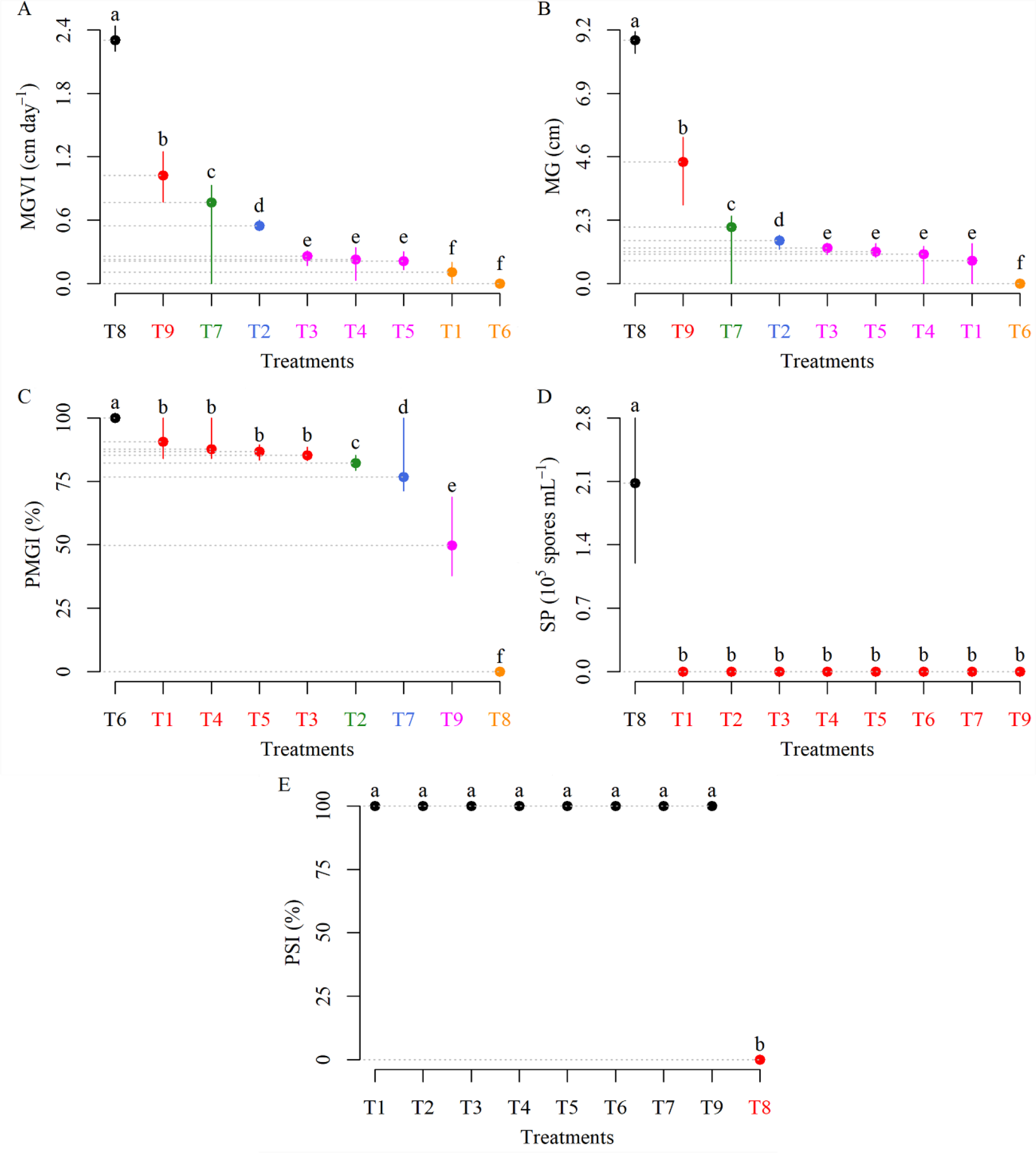
For the mycelial growth velocity index (MGVI) of A. alternata f. sp. citri (Figure 1A), all the biological treatments analyzed showed lower values compared to the control, differing statistically. Treatments T1 (Quartzo®) and T6 (Ecotrich®) promoted a slower growth velocity, differing from the control and the other treatments (Figure 1A).

Mycelial growth velocity index - MGVI (A), mycelial growth - MG (B), and percentage of mycelial growth inhibition - PMGI (C), spore production - SP (D) and percentage of sporulation inhibition - PSI (E) of Alternaria alternata f. sp. citri exposed to different biological products based on Trichoderma spp. and Bacillus spp. T1: Quartzo®-(3 g L-1), T2: Natucontrol®-(4.998 ml L-1), T3: Bio-imune®-(10 ml L-1), T4: Bombardeiro®-(10 ml L-1), T5: Shocker®-(3 ml L-1), T6: Ecotrich®-(2.449 g L-1), T7: Tricho-turbo®-(3 ml L-1), T8: Control composed of PDA, and T9: Fungicide (Thiabendazole - 1030 mL/100 L). Means followed by different colors indicate significant differences by the Scott-Knott test at 5% probability level.
The lowest mycelial growth (MG) was observed for Ecotrich® (T6), composed of T. harzianum (Figure 1B), with 100% inhibition of the pathogen. This performance shows the high potential of the isolate’s antagonist under in-vitro conditions, possibly associated with mechanisms described in the literature, such as competition, antibiosis, and microparasitism (TIAN et al., 2020), differing from the control and the other biological treatments (Figure 1C).
Regarding sporulation, it was found that all treatments differed from the control, reducing pathogen sporulation (Figure 1D). Similar results were observed for the percentage of sporulation inhibition, where all biological treatments and the fungicide inhibited sporulation by 100% (Figure 1E), differing only from the control. In addition, the observed antagonism may be associated with the production of metabolites, including lytic enzymes such as chitinases and β-1,3-glucanases, which act on the degradation of the pathogen’s cell wall (DINESH; SINHA; BAY, 2018). These enzymes have shown a positive effect, contributing to the reduction of sporulation.
In-vivo test
For the area under the disease progress curve, the treatment with the fungicide (T9) promoted a larger area of disease development, differing from the others, and only Ecotrich® (T6) differed from the control, showing a larger area (Figure 2).

Area under the disease progress curve (AUDPC) in ‘Dancy’ tangerine fruits inoculated with Alternaria alternata f. sp. citri (105 spores/mL) and treated with biological products based on Trichoderma spp. and Bacillus spp. T1: Quartzo®-(3 g L-1), T2: Natucontrol®-(4.998 ml L-1), T3: Bio-imune®-(10 ml L-1), T4: Bombardeiro®-(10 ml L-1), T5: Shocker®-(3 ml L-1), T6: Ecotrich®-(2.449 g L-1), T7: Tricho-turbo®-(3 ml L-1), T8: Control composed of sterile distilled water (SDW), and T9: Fungicide (Thiabendazole - 1030 mL/100 L). Means followed by different colors indicate significant differences by the Scott-Knott test at 5% probability level.
Physicochemical analyses and enzyme activity
Regarding the mass loss (ML) of the treated ‘Dancy’ tangerine fruits, there were significant differences between the treatments (Figure 3); Ecotrich® (T6) and Tricho-turbo® (T7) showed the lowest reduction in ML, with a mean value between 175 and 185 g, respectively. Slower mass loss was observed when compared to the control and the Bombardeiro® treatment (T4), due to the evaluation periods in which the loss occurs, with the continuation of the respiratory process, and consequently, water loss (Figure 3A). For the storage periods, a gradual decrease was observed along the storage days (Figure 3B). This decrease may be related to the respiration rate and evaporation of moisture (BAYOUMI et al., 2023). Fruits treated with antagonists maintained higher fruit firmness when compared to infected control.

Mass loss (ML) of ‘Dancy’ tangerine fruits treated with biological products based on Trichoderma spp. and Bacillus spp. (A), kept at 25±2 ºC, as a function of the storage period (B). T1: Quartzo®-(3 g L-1), T2: Natucontrol®-(4.998 ml L-1), T3: Bio-imune®-(10 ml L-1), T4: Bombardeiro®-(10 ml L-1), T5: Shocker®-(3 ml L-1), T6: Ecotrich®-(2.449 g L-1), T7: Tricho-turbo®-(3 ml L-1), T8: Control composed of sterile distilled water (SDW), and T9: Fungicide (Thiabendazole - 1030 mL/100 L). Means followed by the same letter do not differ from each other by the Scott-Knott test at 5% probability level.
For fruit firmness, there was a reduction throughout storage. Most treatments (Control, Quartzo®, Natucontrol®, Bio-imune®, Bombardeiro®, Shocker®, Ecotrich®) showed a decrease in firmness compared to the initial value, ranging from 6.50 N to 1.57 N, during the storage period (Table 1).
Fruit firmness, soluble solids content and hydrogen potential of ‘Dancy’ tangerine fruits treated with biological products based on
For the content of total soluble solids (°Brix), there was a difference between the treatments and the days of storage. As the fruit maturation stage is C3, which indicates a phase close to harvest, with the fruit exhibiting more sugar, acids and ideal quality for consumption, it is possible to observe value peaks in the first evaluations of some treatments. In the Natucontrol® (T2) and Bio-imune® (T3) treatments, there was an increase in these values, due to the respiratory increase of the fruits that occurs with their ripening (Table 1).
The increase in °Brix is a natural process resulting from the advance of fruit ripening because, when immature, fruits have a high content of starch that is converted into glucose. Silva et al. (2014), when evaluating mandarin fruits, cv. ‘Ponkan’, found mean SS values of 9.5%, corroborating the results obtained in the present study.
Regarding pH, a significant difference (p < 0.01) was observed in the interaction between storage periods and treatments. In general, the hydrogen potential of the fruits varied, with means ranging from 3.13 to 3.99, with a difference between the treatments on the last day of evaluation (Table 1). The low values observed are characteristic of tangerine, due to the high concentration of organic acids, especially citric acid. Treatments that kept the pH lower probably reduced respiratory activity, preserving the acids and, consequently, the acidity of the fruits
According to Silva et al. (2014), the mean pH values observed in ‘Ponkan’ mandarin fruits were 4.41, with a range between 4.39 and 4.42 in the analyzed replicates. Typically, the pH is around 2 for lemons and limes and around 4.0 to 4.5 for ripe tangerines (AGOSTINI et al., 2014).
For titratable acidity, there was a significant interaction (p < 0.01) between the treatments and the storage periods (Table 2). Titratable acidity showed means ranging from 0.75 to 2.07 g 100 g-1. On the eighth day of evaluation, a similar increase was observed between the control and Tricho-turbo®. The content decreased during the storage period, which can be explained by the effect of CO2 in inhibiting the activity of decarboxylating enzymes in the respiratory cycle, thus contributing to maintaining acidity (ZAGONEL et al., 2026).
Titratable acidity, soluble solids to titratable acidity ratio and vitamin C of ‘Dancy’ tangerine fruits treated with biological products based on Trichoderma spp. and Bacillus spp., maintained at 25 ± 2 ºC, as a function of the storage period.
For the SS/TA ratio, there was a significant interaction (p < 0.01) between the treatments and the storage period. Control (T8) and Ecotrich® (T6) differed from each other only on the last day of evaluation, ranging from 10.96 to 11.43 (Table 2). Higher values of the SS/TA ratio indicate a better balance between sweetness and acidity.
Regarding the amount of ascorbic acid, a significant interaction was observed between the days of storage and the biological treatments. The increase resulted from the maturation process, with the highest amount observed on the fourth day of evaluation (Table 2). The treatments Quartzo® (T1), Natucontrol® (T2), Bio-imune® (T3) and Bombardeiro® (T4) showed higher ascorbic acid contents, ranging from 11.59 to 14.27 mg.100 g-1.
Silva et al. (2014), when conducting studies with ‘Ponkan’ mandarin, observed that the ascorbic acid contents ranged between 27.15 and 26.89 mg.100-1g, obtaining values within the range considered adequate for the variety, with fruits showing good nutritional quality, especially in terms of Vitamin C. Demartelaere et al. (2017), when working with resistance inducers in ‘Dancy’ tangerine found values between 22.51 and 23.96 mg.100-1g. However, the results found in this study were lower, which affects sensory quality, conservation and useful life, consequently leading to commercial devaluation, in addition to indicating failures in production management.
In the quantification of peroxidase (POX) enzyme activity, a significant interaction was found between treatments and storage periods; Bio-imune® (T3) and Bombardeiro® (T4) treatments on the second and tenth days of storage, respectively, showed higher enzyme activity, indicating defense induction, differing from the control and the other treatments (Figure 4A).
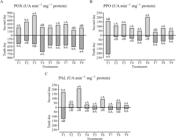
Activity of the enzymes peroxidase (POX - A), polyphenol oxidase (PPO - B) and phenylalanine ammonia-lyase (PAL - C) in ‘Dancy’ tangerine fruits treated with biological products based on Trichoderma spp. and Bacillus spp., maintained at 25 ± 2 ºC, as a function of the storage period. T1: Quartzo®-(3 g L-1), T2: Natucontrol® (4.998 ml L-1), T3: Bio-imune®-(10 ml L-1), T4: Bombardeiro®-(10 ml L-1), T5: Shocker®-(3 ml L-1), T6: Ecotrich®-(2.449 g L-1), T7: Tricho-turbo®-(3 ml L-1), T8: Control composed of sterile distilled water, and T9: Fungicide (thiabendazole - 1030 mL/100 L). Means followed by the same lowercase letters (comparing treatments) and uppercase letters (comparing storage periods) do not differ from each other by the Scott-Knott test at 5% probability level.
For polyphenol oxidase (PPO) activity, a significant effect was observed between treatments and evaluation periods (Figure 4B). Treatments Ecotrich® (T6), on the second day, and Quartzo® (T1), on the tenth day, had the highest means, differing from the control and the other treatments. In most fruit species, PPO is associated with the darkening of the pulp through the oxidation of phenolic compounds into quinones (RASTEGAR; KHANKAHDANI; RAHIMZADEH, 2020). This explains its greater activity in the second period evaluated, when the pulp was visibly identified with a darker color.
Regarding the activity of phenylalanine ammonia-lyase (PAL), there was a significant interaction between treatments and storage periods. Treatments Bio-imune® (T3) and Quartzo® (T1), on the second and tenth day of evaluation, respectively, had the highest levels, differing from the other treatments.
The increase in enzyme activity in the 2nd period may be related to the increase in respiration due to senescence and starch degradation, which causes physiological changes, increases the respiratory capacity of the fruits and favors greater enzymatic action (MENEGASSI et al., 2017) (Figure 4).
Thus, the use of biological control was an important tool in the management of Alternaria brown spot in ‘Dancy’ tangerine, under the conditions tested, reducing the action of the pathogen, maintaining the physicochemical quality of the fruits, and being an efficient alternative to synthetic fungicides.
CONCLUSION
Ecotrich® was efficient in inhibiting the growth of the pathogen and, together with Tricho-turbo®, led to the lowest mass loss (ML), suggesting a positive effect on the preservation of fruit weight during storage. Quartzo® and Ecotrich® reduced the severity of ABS in the fruits, being indicated based on the results obtained in this study. Quartzo®, Bombardeiro®, Natucontrol®, and Shocker® were most promising in maintaining fruit firmness in initial evaluations. Activation of the enzymes peroxidase, polyphenol oxidase and phenylalanine ammonia-lyase was observed, particularly in fruits treated with Bio-imune®, Quartzo®, Ecotrich® and Bombardeiro®.
ACKNOWLEDGMENTS
We would like to thank the National Council for Scientific and Technological Development (CNPq) [Process number 157128/2025-3], Coordination for the Improvement of Higher Education Personnel (CAPES) [Process number 88887.006244/2024-00] and the Federal University of Paraíba for their financial support. This study was funded by the National Council for Scientific and Technological Development (CNPq) [Process number 157918/2022-0].
Data Availability:
The data that support the findings of this study can be made available, upon reasonable request, from the corresponding author.
REFERENCES
- ABDELAZIZ, A. M. et al. Protective role of zinc oxide nanoparticles-based hydrogel against wilt disease of pepper plant. Biocatalysis and Agricultural Biotechnology, 35: 102083, 2021.
- AGOSTINI, J. S. et al. Nota científica: Conservação pós-colheita de laranjas Champagne (Citrus reticulate × Citrus sinensis). Brazilian Journal of Food Technology, 17: 177-184, 2014.
- ALFIKY, A.; WEISSKOPF, L. Deciphering Trichoderma plant pathogen interactions for better development of biocontrol applications. Journal of Fungi, 7: 61, 2021.
- AOAC - Association of Official Agricultural Chemists. Official methods of analysis 15. ed. Washington, EUA: AOAC, 1990. 1.298 p.
- BAYOUMI, Y. et al. Agentes de controle do mofo branco do feijoeiro. Journal of Fungi, 8: 626, 2023.
- BRADFORD, M. M. A rapid and sensitive method for the quantification of microgram quantities of protein utilizing the principle of protein-dye binding. Analytical Biochemistry, 72: 248-254, 1976.
- CASTELLANI, A. Viability of some pathogenic fungi in distilled water. Journal of Tropical Medicine and Hygiene, 42: 225-226, 1939.
- DEMARTELAERE, A. C. F. et al. Manejo da mancha marrom de alternaria em tangerineira ‘Dancy’ com extrato de Caesalpinia ferrea Benth (Ducke). Revista Brasileira de Plantas Medicinais, 19: 59-66, 2017.
- DINESH, K.; SINHA, B.; BAI, A. Thoyajakshi. In vitro studies on efficacy of various Trichoderma spps. against collar rot of tomato caused by Sclerotium rolfsii Sacc. in Manipur. International Journal of Chemical Studies, 6: 1654-1656, 2018.
- DÓRIA, M. S. et al. Comparative proteomics of two citrus varieties in response to infection by the fungus Alternaria alternata International Journal of Biological Macromolecules, 136: 410-423, 2019.
-
FAOSTAT - Food and Agriculture Organization of the United Nations. Mandarim: production and trade statistics Available at: < http://www.fao.org/faostat/en/#search/mandarin >. Access on: May. 10, 2021.
» http://www.fao.org/faostat/en/#search/mandarin -
IBGE - Instituto Brasileiro de Geografia e Estatística. Produção Agrícola Municipal Available at: <https://cidades.ibge.gov.br/brasil/pb/pesquisa/15/11991>. Access on: May. 23, 2025.
» https://cidades.ibge.gov.br/brasil/pb/pesquisa/15/11991 -
IBGE - Instituto Brasileiro de Geografia e Estatística. Produção Agrícola Available at: <https://www.ibge.gov.br/estatisticasnovoportal/economicas/agricultura-e-pecuaria/9201-levantamento-sistematico-daproducao-agricola.html?=&t=o-que-e:> . Access on: May. 10, 2021.
» https://www.ibge.gov.br/estatisticasnovoportal/economicas/agricultura-e-pecuaria/9201-levantamento-sistematico-daproducao-agricola.html?=&t=o-que-e - LARA, L. M. et al. Precision agriculture trends in fruit growing from 2016 to 2020. Revista Brasileira de Fruticultura, 43: 1-14, 2021.
- MENEGASSI, T. et al. Extrato de Lentinula edodes no controle da antracnose do feijoeiro. Brazilian Journal of Applied Technology for Agricultural Science, 10: 75-81, 2017.
- OLIVEIRA, J. A. Efeito do tratamento fungicida em sementes no controle de tombamento de plântulas de pepino (Cucumis sativus L.) e pimentão (Capsicum annum L.) 1991. 111 f. Dissertação (Mestrado em Fitossanidade: Área de Concentração em Fitopatologia) - Universidade Federal de Lavras, Lavras, 1991.
- POVEDA, J. Trichoderma parareesei favors the tolerance of rapeseed (Brassica napus L.) to salinity and drought due to a chorismate mutase. Agronomy, 10: 118, 2020.
-
R DEVELOPMENT CORE TEAM. R: A language and environment for statistical computing Vienna: R Foundation for Statistical Computing. 2023. Available at: <https://www.R-project.org/>. Access on: Fev. 01, 2026.
» https://www.R-project.org/ - RASTEGAR, S.; KHANKAHDANI, H. H.; RAHIMZADEH, M. Effects of melatonin treatment on the biochemical changes and antioxidant enzyme activity of mango fruit during storage. Scientia Horticulturae, 259: 108835, 2020.
- RENAUD, M. S. A. et al. Escala diagramática para avaliação da Mancha Marrom de Alternaria de citros. Summa Phytopathologica, 34: 270-271, 2008.
- SHANER, G.; FINNEY, R. E. The effect of nitrogen fertilization on the expression of slow-mildewing resistance in Knox wheat. Phytopathology, 67: 1051-1056, 1977.
- SILVA, A. P. G et al. Índices de identidade e qualidade de tangerina ‘Ponkan produzida no Estado da Paraíba. Agropecuária Técnica, 35: 143-149, 2014.
- STROHECKER, R.; HENNING. H. Análises de vitaminas: métodos comprovados 1. ed. Madrid: Paz Montalvo, 1967. 428 p.
- STUCHI, E. S.; GIRARDI, E. A.; MOREIRA, A. S. Citricultura Atual 138. ed. Cordeirópolis, SP: GCONCI, 2020. 48 p.
- TIAN, Z. et al. Biocontrol and the mechanisms of Bacillus sp. w176 against postharvest green mold in citrus. Postharvest Biology and Technology, 159: 111022, 2020.
-
USDA - Departamento de Agricultura dos Estados Unidos. Citrinos: Mercados e Comércio Mundial, 2023. Available at: <https://www.fas.usda.gov/data/citrus-world-markets-and-trade>. Access on: Jun. 16, 2025.
» https://www.fas.usda.gov/data/citrus-world-markets-and-trade - WOLTERS, P. J. et al. A rapid method to screen wild Solanum for resistance to early blight. European Journal of Plant Pathology, 154: 109-114, 2019.
- ZAGONEL, J. P. et al. Carboximetilcelulose enriquecida com óleos essenciais de cravo-da-índia e menta para conservação pós-colheita de mangas coquinho (Mangifera indica L.). Brazilian Journal of Development, 12: 1-21, 2026.
- ZHANG, S. et al. The biological control effect of Bacillus cereus on strawberry leaf spot disease caused by Neopestalotiopsis clavispora. Scientia Horticulturae, 327: 112841, 2024.
Edited by
-
Editor in Chief:
Aurélio Paes Barros Júnior
-
Section Editor:
Andreia Mitsa Paiva Negreiros