Tillage systems and cover crops on soil properties in Northeastern Brazil
ABSTRACT
Long-term experiments combining tillage systems and cover crops are essential to understand variation in soil physical and chemical properties under different environmental conditions, but data from Brazilian tropical Ultisols under conservation management remain scarce. This study evaluated the effects of conventional tillage (CT), minimum tillage (MT), and no-tillage (NT), associated with different cover crops, on the physical and chemical properties of a Typic Hapludult. The experiment, conducted since 2001 at the Rural Campus Experimental Station of Universidade Federal de Sergipe, was cropped with maize (Zea mays) under the three tillage systems, each combined with sunn hemp (Crotalaria juncea), pearl millet, pigeon pea, and cowpea. Soil samples were collected from the 0.00-0.10 and 0.10-0.20 m layers. Soil bulk density in the 0.00-0.10 m layer was significantly higher under NT than under the other tillage systems, indicating surface consolidation under the absence of soil disturbance. Conservation tillage systems, particularly MT and NT, showed higher soil organic matter contents in the surface layer, and in both layers NT resulted in significantly higher soil organic matter content than CT and significantly higher soil carbon stocks than those observed under CT and MT. Among the cover crops evaluated, sunn hemp exhibited the greatest potential for soil organic matter increase. The results suggest that conservation tillage systems, especially when integrated with leguminous cover crops, may increase soil carbon stocks and contribute to improved soil quality in tropical Ultisols under continuous maize cropping.
Keywords:
Soil quality; Conventional tillage; Minimum tillage; No-tillage; Soil carbon.
RESUMO
Experimentos de longa duração combinando sistemas de preparo e plantas de cobertura são essenciais para compreender a variação das propriedades físicas e químicas do solo sob diferentes condições ambientais, mas dados de Ultissolos tropicais brasileiros sob manejo conservacionista permanecem escassos. Este estudo avaliou os efeitos de preparo convencional (CT), preparo mínimo (MT) e plantio direto (NT), associados a diferentes plantas de cobertura, sobre propriedades físicas e químicas de um Typic Hapludult. O experimento, conduzido desde 2001 na Estação Experimental do Campus Rural da Universidade Federal de Sergipe, foi cultivado com milho (Zea mays) sob os três sistemas de preparo, cada um combinado com crotalária (Crotalaria juncea), milheto, feijão-guandu e feijão-caupi. Amostras de solo foram coletadas nas camadas de 0,00-0,10 e 0,10-0,20 m. A densidade do solo na camada de 0,00-0,10 m foi significativamente maior sob NT do que nos demais sistemas, indicando consolidação superficial sob ausência de revolvimento. Os sistemas conservacionistas, particularmente MT e NT, apresentaram maiores teores de matéria orgânica do solo na camada superficial, e em ambas as camadas o NT resultou em teor de matéria orgânica significativamente superior ao CT e em estoques de carbono significativamente maiores que os observados sob CT e MT. Entre as coberturas avaliadas, a crotalária exibiu o maior potencial para incremento de matéria orgânica. Os resultados sugerem que sistemas conservacionistas, sobretudo quando integrados a leguminosas de cobertura, podem aumentar os estoques de carbono e contribuir para a melhoria da qualidade de Ultissolos tropicais sob cultivo contínuo de milho.
Palavras-chave:
Qualidade do solo; Cultivo convencional; Cultivo mínimo; Plantio direto; Carbono do solo.
INTRODUCTION
Soil has the capacity to support plant development and, consequently, nutrient storage and cycling (ATHAR; KANWAL, 2022). However, soil can degrade rapidly, whereas regeneration and formation occur very slowly. The environments of the Northeastern Coastal Tablelands, which predominantly originated from sedimentary rocks, contain soil types that differ from those in other tropical regions and are subject to degradation through erosion and nutrient depletion because of unsustainable soil management, resulting in low organic matter content (MORAES et al., 2020).
High soil bulk density combined with high soil penetration resistance reduces soil porosity and forms compacted layers that restrict plant development, particularly root growth (KAHLON; SINGH; DHINGRA, 2020). These conditions reduce crop production andsoil water retention capacity. Soil bulk density also varies according to soil type, mineralogical composition, and clay fraction (MOSSADEGHI BJÖRKLUND et al., 2019). Clayey soils tend to be more susceptible to compaction because of their structure and lower porosity, which can increase soil bulk density and resistance to penetration and water infiltration (ZHAO et al., 2017).
Therefore, soil and water conservation practices are needed to increase soil biomass and organic matter content, improve soil physical properties, and increase crop yield capacity (SANTOS et al., 2024). Conservation tillage systems, such as Minimum tillage (MT) and No -tillage (NT), improve soil structure and increase organic matter content. Minimum Tillage system increases soil carbon retention, reduces water evaporation, improves infiltration, gradually releases nutrients, and increases soil organic carbon stocks, consequently improving soil health and contributing to climate change mitigation (PEDROTTI et al., 2026).
Crop rotation is required under no-tillage, and nutrient cycling in the soil is increased by plants used in rotation, benefiting subsequent crops (SILVA et al., 2020). Leguminous species can further increase soil organic matter and crop productivity (MUHAMMAD et al., 2019; ASSUNÇÃO et al., 2023). sunn hemp (Crotalaria juncea L.), pigeon pea (Cajanus cajan (L.) Huth), pearl millet (Pennisetum glaucum (L.) R.Br.), and cowpea (Vigna unguiculata (L.) Walp.) have high capacity for nutrient accumulation and biomass production (ASSUNÇÃO et al., 2023). In this context, this study evaluated the effects of conventional tillage, minimum tillage, and no-tillage systems with different cover crops on soil physical and chemical properties in long-term experimental plots.
MATERIALS AND METHODS
Description of the study area
The study was conducted at the Rural Campus Experimental Station of the Universidade Federal de Sergipe (UFS), in São Cristóvão, Sergipe, Brazil (10°55′24.390″ S, 37°11′57.920″ W; 22 m average altitude). The soil in the area was classified as a Typic Hapludult (Argisolo Vermelho-Amarelo Distrofico Tipico) (SOIL SURVEY STAFF, 2022). The regional climate is classified as As, tropical savanna with a dry summer, according to the Köppen classification system. The mean annual rainfall is approximately 1200 mm, and the rainy season occurs from April to September, with mean rainfall of approximately 800 mm.
Characterization of the experimental area and data collection
Experiments with different tillage systems and cover crops have been conducted in the area since 2001, using a succession of maize (Zea mays L.) crops intended for green corn and forage production. Maize was cultivated under conventional tillage (CT), minimum tillage (MT), and no-tillage (NT) systems, each combined with different cover crops, including sunn hemp (Crotalaria juncea), pigeon pea (Cajanus cajan), pearl millet (Pennisetum glaucum), and cowpea (Vigna unguiculata). Soil sampling for this study was performed in October 2022 (Figure 1).

Sketch of the long-term plots at the Rural Campus Experimental Station of the Universidade Federal de Sergipe (UFS), in São Cristóvão, Sergipe State, Brazil.
A randomized complete block experimental design was used, with a split-plot arrangement and three replicates. The experiment consisted of 12 plots, with each experimental unit measuring 60 m2 (6 m × 10 m), totaling 36 subplots. The tillage systems were defined as follows: conventional tillage (CT) consisted of primary tillage with a disk plow (30 cm depth) followed by secondary tillage with a leveling harrow (10 cm depth); minimum tillage (MT) consisted of primary and secondary tillage with aleveling harrow (10 cm depth); and No-tillage (NT) consisted of absence of soil disturbance from the second cropping year onward.
Soil fertilization consisted of applying 120 kg ha⁻1 N, 90 kg ha⁻1 P₂O₅, and 110 kg ha⁻1 K₂O. Fertilizer application and liming for soil acidity correction were performed based on the results of soil chemical analyses.
Soil samples were collected before maize sowing and after the cover crop decomposition period, between March and April 2022. Small trenches were opened within each plot, from which two disturbed samples and one undisturbed samplewere collected from the 0.00-0.10 and 0.10-0.20 m layers, totaling 36 samples per tillage system and 108 samples in the experimental area.
The samples were taken to the Erosion and Sedimentation Laboratory (LABES) at UFS, oven-dried, gently disaggregated, sieved through a 2.0 -mm mesh to obtain the air-dried fine earth, and analyzed according to the methods described in the Soil Analysis Manual (TEIXEIRA et al., 2017). Samples were sent to the Soil Remediation Laboratory (LRS) at UFS to determine Soil Organic Matter by wet oxidation using the Yeomans and Bremner (1988) method. organic matter content was calculated using soil bulk density, the thickness of each evaluated layer, and the Bremner factor of 1.724.
Statistical analysis
Analysis of variance (ANOVA) was used to examine differences in soil organic matter and soil bulk density according to tillage system and cover crop. The Kolmogorov-Smirnov and Shapiro Wilk tests were used to assess data normality, whereas homogeneity of variance was assessed using Levene’s test.
The data did not meet the assumptions of homogeneity of variance and normality; thus, bootstrapping procedures were used (1,000 resamplings; 95% BCa CI) to increase the reliability of the results, correct deviations from normality in the sample distribution, and provide 95% confidence intervals for differences between means. the bootstrap method requires fewer assumptions to estimate the parameters of the distributions of interest, generally provides more accurate estimates, and does not depend on the original data distribution.
The bootstrap confidence interval was estimated by fitting each of the 1,000 datasets resampled from the original dataset to the model. When convergence was not achieved in at least 50% of the cases, the procedure was stopped and no result was provided. Posthoc analyses and between-group comparisons were performed using Duncan’s test.
Subsequently, multiple linear regression analyses using the forward method were performed for soil organic matter content and soil bulk density under different treatments. All tests were performed using IBM SPSS software, with results considered significant at p < 0.05.
RESULTS AND DISCUSSION
Effect of Tillage Systems and cover crops on soil Bulk density
The analysis of variance (ANOVA) for soil bulk density (gcm⁻3) in the 0.00-0.10 m layer indicated that tillage systems significantly affected this variable [F(2, 96) =4.990; p = 0.009]. Mean soil bulk density values are presented in Table 1, along the contribution of cover crops to this variable.
Analysis of variance for soil bulk density (g cm⁻3) under different tillage systems associatedwith different cover crops.
The analyzed effect size For the different tillage systemsindividually was low (η2 = 0.094), indicating that the tillage method explained approximately 9.4% of the variability in the 0.00-0.10 m layer. the observed power was 0.802,indicating a high probability that the observed effect was statistically significant. However, the cover crop effect analyzed individually was not statistically significant [F (3, 96) = 1.896; p = 0.135], with η2 = 0.006 and observed power = 0.477.
Multiple comparison analysis using Duncan’s test showed that soil bulk density under No-Tillage (NT) differed significantly from that under conventional tillage (CT), with a mean difference of 0.128 g cm⁻3 (p = 0.008) (Table 2). However, no significant difference was observed between NT and MT or between CT and MT.
Post hoc test for soil bulk density (g cm⁻3) in the 0.00-0.10 m and 0.10-0.20 m layers, under Conventional tillage (CT), Minimum tillage (MT), and No-tillage (NT) associated with different cover crops.
In the 0.00-0.10 m layer, when tillage system and cover crop were analyzed together, soil bulk density varied according to the combination of factors: NT had higher values for cowpea and Pigeon Pea (1.784 g cm⁻3), MT had the highest value for pearl millet, and CT had the highest value for sunn hemp.
The higher soil bulk density observed under NT for most cover crops is attributed to lower soil disturbance under a long-term continuous no-tillage system because of soil consolidation and surface pressure caused by the heavy load exerted on the soil during planting, lime and fertilizer application, and harvesting operations. However, in a broad review, Blanco-Canqui (2022) found that no-tillage did not cause soil compaction in most evaluated systems when harvest residues contributed more soil organic matter, which increased soil aggregation. The lower soil bulk density found under minimum tillage (MT) in the present study is explained by slight soil disturbance, which contributed to the disruption of existing surface sealing.
The cover crops associated with higher soil bulk density included those with greater organic matter deposition, such as pigeon pea and cowpea (Table 2). Furthermore, NT is effective in improving soil organic carbon content and favoring soil aggregation, and its negative effects are reduced when straw addition is greater (CUI et al., 2024). This aggregation is also favored by cationic bonds, which function as bridges between clay particles and organic matter, thereby contributing to aggregate formation and improving soil structure (HAN; ZHOU; REN, 2021).
Under Minimum tillage (MT), soil bulk density in the 0.00-0.10 m layer varied more among cover crops; cowpea and pigeon pea had lower values under MT than under NT, whereas pearl Millet had a higher value (1.813 g cm⁻3) under MT than under NT. the highest values in MT are attributed to the greater soil disturbance compared to that in NT. Cowpea and pigeon pea had the lowest mean soil bulk density among the cover crops in MT, 1.473 and 1.565 g cm⁻3, respectively.
Organic matter decomposes more rapidly under conventional tillage (CT) when maize is grown in a tropical climate because of greater soil disturbance, particularly in the upper layers (0-0.10 m) (FUJII et al., 2022). In humid tropical regions, high temperatures accelerate organic matter decomposition when residues are exposed on the soil surface. This decomposition process reduces the amount of organic matter available to improve the colloidal structure of the soil (SHAHZAD et al., 2021). Thus, greatersoil exposure caused by more intensive cropping practices can lead to rapid organic matter mineralization, reducing the soil capacity to form stable aggregates. Under Conventional tillage (CT), soil bulk density in the 0.00-0.10 m layer also differed among cover crop treatments; pearl millet had the lowest mean soil bulk density (1.622 g cm⁻3), whereas sunn hemp had the highest mean value (1.829 g cm⁻3) (Table 2).
In the 0.10-0.20 m layer, No-Tillage (NT) also showedhigh soil bulk density values compared with the 0.00-0.10 m layer, particularly when associated with crops such as pearl millet, which had a mean soil bulk density of 1.822 g cm⁻3. However, unlike in the surface layer, soil bulk density under NT in the 0.10-0.20 m layer did not differ among cover crops, indicating a smaller influence of cover crops on soil compaction within this depth range.
Under Minimum tillage (MT), soil bulk density increased in the 0.10-0.20 m layer, particularly when associated with pearl millet, which had a mean soil bulk density of 1.954 g cm⁻3, followed by Cowpea, with 1.761 g cm⁻3. The slight compaction reduction in MT compared with NT is associated with minimal soil disturbance from the use of light implements over the years to a depth of 0.30 m, which reduces the disruption of soil aggregates even in the evaluated layer up to 0.20 m (PULIDO-MONCADA; MUNKHOLM; SCHJØNNING, 2019). This pattern is supported by the similarity between Minimum tillage (MT) and Conventional tillage (CT), with less pronounced variation among cover crops but with soil bulk density slightly lower than thatobserved under NT.
These results indicate that the 0.10-0.20 m layer is less susceptible to variation caused by cover crops and is more strongly influenced by tillage system. Thus, tillage systems that minimize soil disturbance tend to maintain higher soil bulk density in deeper layers, contributing to soil compaction and reduced soil porosity, which can affect water infiltration and root development (WANG et al., 2019).
Tillage systems with reduced or no soil disturbance tend to produce more cohesive surface layers. Denardin et al. (2019) observed similar results, in which NT conditioned by crop rotation had the highest soil bulk density values compared with the other systems, CT and MT. Furthermore, conservation systems such as NT reduce soil susceptibility to sealing and surface degradation and improve aggregate stability against disaggregation forces (GRANDINETTI; CANTERO MARTÍNEZ; RAMOS, 2022), which can increase soil bulk density in the surface layers (SHAHGHOLI et al., 2023).
Effects of Tillage Systems and Cover crops on Soil Organic Matter content
The analysis of variance (ANOVA) for soil organic matter (dag kg⁻1) in the 0.00-0.10 m layer indicated that tillage systems significantly affected this variable [F(2, 96) = 34.348; p < 0.001] (Table 3). the effect size analyzed individually was large for the tillage system (η2 = 0.417), which explained approximately 41.7% of the variability in the 0.00-0.10 m layer. the observed power was 1.000, indicating a very high probability of detecting a significant test effect. Cover crop effects analyzed individually were also statistically significant [F(3, 96) = 10.838; p < 0.001], with partial η2 = 0.253 and observed power = 1.000.
Analysis of variance for soil organic matter (dag kg⁻1) under Conventional tillage(CT), Minimum tillage (MT), and No-tillage (NT) associated with different cover crops.
The interaction between tillage system and cover crop was significant [F(6, 96) = 8.886; p < 0.001], with a moderate effect size (η2 = 0.357). These results indicate that the combination of tillage system and cover crop had a greater effect on Soil Organic Matter than the effects observed when these variables were analyzed individually.
Soil Organic Matter in the conservation systems-no-Tillage (NT) and Minimum tillage (MT) was higher in the 0.00-0.10 m layer and differed statistically from Conventional tillage (CT). Mean soil organic matter values for each soil tillage system and cover crop are presented in Table 4.
Distribution of soil organic matter (dag kg⁻1) under Conventional tillage (CT), Minimum tillage (MT), and No-tillage (NT) associated with different cover crops.
Under NT, cowpea and sunn hemp had the highest soil organic matter contents in the 0.00-0.10 m layer, with values of 1.402 and 1.376 dag kg⁻1, respectively, which did not differ statistically. However, these values differed from those under CT, in which the same c r o p s had values of 0.744 and 1.137 dag kg⁻1,respectively. In the 0.10-0.20 m layer, soil organic matter content was also higher under NT than under MT and CT. For example, pearl millet had a soil organic matter content of 0.953 dag kg⁻1 under NT, 0.551 dag kg⁻1 under CT, and 0.488 dag kg⁻1 under MT. Management systems that minimize soil disturbance favor greater soil organic matter accumulation because physical protection through organo-mineral interactionsallows greater C stabilization in the soil.
Under Minimum tillage (MT), soil organic matter values in the 0.00-0.10 m layer ranged from 1.132 dag kg⁻1 for sunn hemp to 1.344 dag kg⁻1 for pigeon pea, which were higher than the values found under CT. In the 0.10-0.20 m layer, the values were lower, ranging from 0.413dag kg⁻1 for cowpea to 0.589 dag kg⁻1 for pigeon pea, but they still differed from those under CT.
The results showed that long-term conservation tillage systems were effective in maintaining and increasing soil organic matter content, particularly in the surface soil layer (0.00-0.10 m), compared with CT. Similar increases in organic matter content were reported by Li et al. (2020), who observed that No-Tillage (NT) and Minimum tillage (MT) increased soil organic carbon (SOC) stocks by 11% and 6%, respectively, compared with Conventional tillage (CT), with more pronounced effects in the surface soil layer.
The greater accumulation of organic matter in the soil surface layer under No-tillage can be attributed to successive cover crop biomass deposition and crop residue retention, indicating the importance of combining conservation practices toimprove soil quality. Sun et al. (2020) demonstrated that, after eight years of conservation tillage, soil aggregation and nutrient storage improved in the surface layer, supporting the effectiveness of these practices for soil and water conservation.
Soil Organic carbon
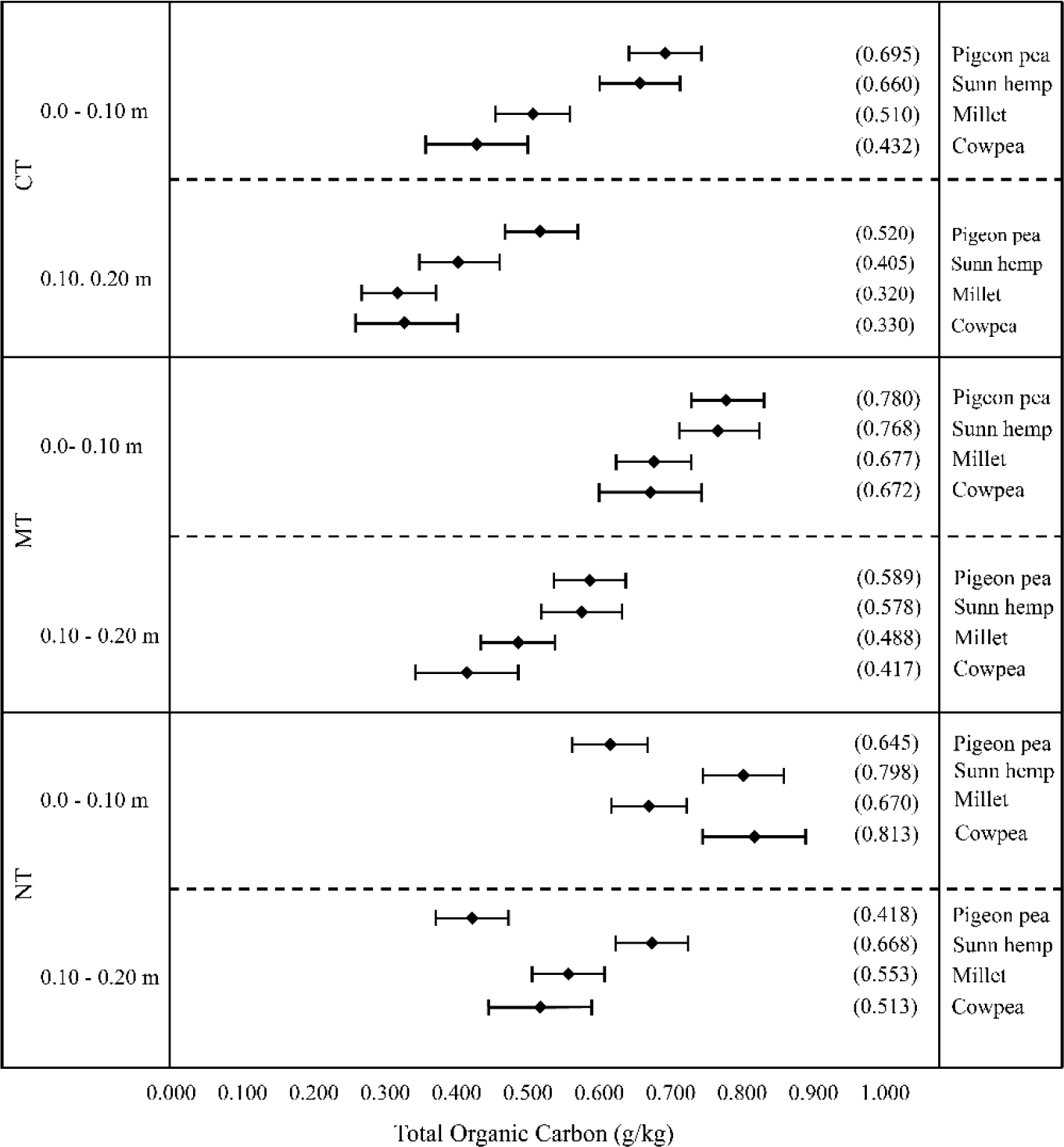
In the 0.00-0.10 and 0.10-0.20 m layers, analysis of variance showed significant effects of tillage system [ F (2, 96) = 34.348; p < 0.001] and [F (2, 96) =66.652; p < 0.001], respectively. The effect size was large, with η2 = 0.417 and η2 = 0.581 at the respective layers. The data indicate that the evaluated tillage systems explained 41.7% of the variance in soil organic carbon in the 0.00-0.10 m layer and 58.1% in the 0.10-0.20 m layer (Figure 2).

Distribution of soil organic carbon (g kg⁻1) under conventional tillage (CT),Minimum tillage (MT), and No-tillage (NT) associated with different cover crops. The sample mean value of each variable is displayed adjacent to each bar. Error barsrepresent 95% confidence intervals.
Analysis of variance showed a significant effect of cover crops on soil organic carbon in the 0.00-0.10 m layer [ F (3, 96) =10.838; p < 0.001], with η2 = 0.253, indicating that cover crops explained 25.3% of the variance in soil organic carbon in this layer. The interaction between tillage system and cover crop was also significant [F (6, 96) = 8.886; p < 0.001], with η2 = 0.357, suggesting that this interaction explained 35.7% of thevariance in soil organic carbon.
The observed data indicate that the evaluated tillage systems under maize cultivation contributed to soil organic carbon accumulation, particularly in the subsurface layer (0.10-0.20 m), explaining up to 58.1% of the observed variance. The influence of cover crops, although significant, was less pronounced, explaining 25.3% of the variance in soil organic carbon in the surface layer.
The interaction between tillage system and cover crop was also relevant, contributing to 35.7% of the variance and suggesting that the combination of management practices and crop choice can be used strategically to maximize soil carbon retention. This greater effect of tillage system in deeper layers suggests that long-term soil management practices are important for carbon retention, particularly in tropical regions (COOPER et al., 2021).
Organic matter decomposition is accelerated under high temperatures, whereas greater organic matter concentrations in the upper layers promote thermal stability in deeper layers (WANG et al., 2020). Furthermore, rapid organic matter decomposition in tropical climates is driven by high microbial activity favored by high temperatures, which increases the mineralization rate of soil organic carbon and its release as CO₂. Under these conditions, exposure of organic matter on the soil surface resulting from tillage practices promotes greater nutrient mineralization and increases the depletion of available carbon stocks (LEIZEAGA et al., 2022). Soil carbon stabilization is also influenced by geological and environmental interactions that control organic carbon dynamics, which may explain interactions unrelated to the studied variables.
Greater soil organic carbon accumulation from cover crops requires association with conservation tillage systems that minimize organic matter exposure and promote stable aggregate formation (DOETTERL et al., 2015). Among the cover crops under no-tillage, sunn hemp had the highest (0.798 g kg⁻1) mean organic carbon values in the surface layer (0.00-0.10 m), whereas pigeon pea had the lowest (0.645 g kg⁻1) (Figure 2). In the 0.10-0.20 m layer, the values were 0.426 and 0.469 g kg⁻1, respectively. Sunn hemp used in association with Poaceae species tends to release nutrients more slowly. Plant morphology, root development, and nitrogen fixation capacity are commonfactors that contribute to greater soil organic matter accumulation by sunn hemp and cowpea in the surface and subsurface layers (SIMUNJI et al., 2019).
CONCLUSION
No-tillage was an effective conservation system for increasing soil organic carbon content and particle aggregation through reduced soil disturbance and greater organic matter stability.
Under minimum tillage, soil bulk density varied significantly according to cover crop, with cowpea and pigeon pea showing lower mean soil bulk density values, whereas pearl millet had the highest values in 0.00-0.10 m layer
The contribution of cover crops to soil organic carbon varied according to tillage system and soil layer; under no-tillage, cowpea and sunn hemp had the highest values in the surface layer, whereas sunn hemp had the highest value in the subsurface layer.
These results indicate the importance of using legumes as cover crops because of their nitrogen fixation capacity and deep root development, which contribute to soil organic carbon accumulation.
Soil management systems that minimize disturbance, such as minimum tillage and no-tillage, combined with legumes as cover crops, can increase carbon retention and improvesoil quality for maize production.
Maintaining these practices over time is essential to support the sustainability and productivity of agricultural systems, particularly in tropical regions where organic matter decomposition occurs rapidly.
Data Availability:
The data that support the findings of this study can be made available, upon reasonable request, from the corresponding author.
REFERENCES
- ASSUNÇÃO, S. J. R. et al. Analysis of the green corn production costs under tillage systems in the Sergipano Coastal Tableland. Revista de Economia e Sociologia Rural, 61: 70-89, 2023.
- ATHAR, T.; KANWAL, N. Significance of soil health and soil life for sustainable food production. Emergent Life Sciences Research, 8: 1-4, 2022.
- BLANCO-CANQUI, H. Cover crops and carbon sequestration: Lessons from US studies. Soil Science Society of America Journal, 86: 501-519, 2022.
- COOPER, H. V. et al. Long term zero tillage enhances the protection of soil carbon in tropical agriculture. European Journal of Soil Science, 72: 2477-2492, 2021.
- CUI, Y. et al. Effects of no-till on upland crop yield and soil organic carbon: a global meta-analysis. Plant and Soil, 499: 363-377, 2024.
- DENARDIN, L. G. O. et al. No-tillage increases irrigated rice yield through soil quality improvement along time. Soil and Tillage Research, 186: 64-69, 2019.
- DOETTERL, S. et al. Soil carbon storage controlled by interactions between geochemistry and climate. Nature Geoscience, 8: 780-783, 2015.
- FUJII, K. et al. Continuous maize cropping accelerates loss of soil organic matter in northern Thailand as revealed by natural 13C abundance. Plant and Soil, 474: 263, 2022.
- GRANDINETTI, L.; CANTERO MARTÍNEZ, C.; RAMOS, M. C. Aggregate stability and soil surface sealing in irrigated soils under no tillage versus conventional tillage. Land Degradation & Development, 33: 2379-2389, 2022.
- HAN, Z. G.; ZHOU, Y. C.; REN, J. J. Effects of organic matter-bound multivalent cations on soil aggregate formation. Journal of Soil and Water Conservation, 76: 568-576, 2021.
- KAHLON, M. S.; SINGH, C. B.; DHINGRA, M. Effect of compaction and irrigation regimes on soil physical characteristics and productivity. Legume Research, 46: 473-481, 2020.
- LEIZEAGA, A. et al. Impact of land use intensity and forest restoration on microbial use of organic matter. Global Biogeochemical Cycles, 36: e2021GB007109, 2022.
- LI, Y. et al. Minimum tillage and residue retention increase soil microbial population size and diversity: implications for conservation tillage. Science of the Total Environment, 716: 137164, 2020.
- MORAES, M. T. et al. Soil compaction impacts soybean root growth in an Oxisol. Soil and Tillage Research, 200: 104611, 2020.
- MOSSADEGHI BJÖRKLUND, M. et al. Effects of compaction on soil hydraulic properties. Soil Use and Management, 35: 367-377, 2019.
- MUHAMMAD, I. et al. Regulation of soil CO₂ and N₂O emissions by cover crops. Soil and Tillage Research, 192: 103-112, 2019.
- PEDROTTI, A. et al. Structural quality of an Ultisol under long-term tillage systems. Soil Use and Management, 42: e70195, 2026.
- PULIDO-MONCADA, M.; MUNKHOLM, L. J.; SCHJØNNING, P. Wheel load, repeated wheeling, and traction effects on subsoil compaction in northern Europe. Soil and Tillage Research, 186: 300-309, 2019.
- SANTOS, J. A. et al. Impacts of tillage systems on green corn production. Soil Use and Management, 14: e13061, 2024.
- SHAHGHOLI, G. et al. Effect of tractor tire parameters on soil compaction. Agriculture, 13: 259, 2023.
- SHAHZAD, H. et al. Managing organic carbon in sandy clay loam soil. Arabian Journal of Geosciences, 14: 275, 2021.
- SILVA, P. C. G. et al. No-tillage and crop rotation increase crop yields. Field Crops Research, 258: 107947, 2020.
- SIMUNJI, S. et al. Evaluation of cowpea (Vigna unguiculata L. Walp.) genotypes for nitrogen fixation. Sustainable Agriculture Research, 8: 82, 2019.
- SOIL SURVEY STAFF. Keys to Soil Taxonomy 13. ed. Washington, DC: USDA, Natural Resources Conservation Service, 2022. 430 p.
- SUN, L. et al. Effects of conservation tillage on soil properties. Land Degradation & Development, 31: 2475-2489, 2020.
- TEIXEIRA, P. C. et al. Manual de métodos de análise de solo 3. ed. rev. e ampl. Brasília, DF: Embrapa, 2017. 573 p.
- WANG, S. et al. Effect of subsoiling depth on maize yield. Plant, Soil and Environment, 65: 131-137, 2019.
- WANG, X. et al. Organic manure improves soil productivity. Plos One, 15: e0238042, 2020.
- YEOMANS, J. C.; BREMNER, J. M. A rapid and precise method for routine determination of organic carbon in soil. Communications in Soil Science and Plant Analysis, 19: 1467-1476, 1988.
- ZHAO, X. et al. Crop yields under no-till farming in China. European Journal of Agronomy, 84: 67-75, 2017.
Edited by
-
Editor in Chief:
Aurélio Paes Barros Júnior
-
Section Editor:
Marcos Gervasio Pereira