Phosphorus fertilization and cropping systems on the physiological and sanitary quality of soybean seeds
ABSTRACT
Combining phosphorus fertilization and a conservationist soybean cultivation system favors the production of seeds with a high physiological and sanitary quality. Thus, this study evaluated the physiological and sanitary quality of soybean seeds from plants fertilized with different phosphorus sources and grown under different crop succession systems in the Cerrado of Maranhão, Brazil. The experiment was set up in a randomized block design and organized in a split-plot scheme with three replicates. In the plots, the presence or absence of cover with Urochloa ruziziensis (Syn. Brachiaria ruziziensis) was evaluated, and the subplots were composed of different phosphorus fertilizer sources: organomineral 1 (O1), organomineral 2 (O2), simple superphosphate (SSP), and the control (not fertilized with phosphorus). The following seed variables were analyzed: moisture content, emergence, emergence speed index, total dry phytomass, germination, accelerated aging, electrical conductivity, and seed health. The succession system with U. ruziziensis and SSP fertilization resulted in the best soybean performance in the Cerrado of Maranhão with a higher physiological and sanitary seed quality. O1 and O2 also yielded satisfactory results, positively contributing to seed vigor and health but slightly less so than SSP.
Keywords:
Organomineral; Physiological quality; Urochloa ruziziensis
RESUMO
A combinação da adubação fosfatada e de um sistema conservacionista de cultivo da soja favorece a produção de sementes com elevada qualidade fisiológica e sanitária. Assim, este estudo avaliou a qualidade fisiológica e sanitária de sementes de soja provenientes de plantas adubadas com diferentes fontes de fósforo e cultivadas sob distintos sistemas de sucessão de culturas no Cerrado maranhense, Brasil. O experimento foi conduzido em delineamento de blocos casualizados, em esquema de parcelas subdivididas, com três repetições. Nas parcelas, avaliou-se a presença ou ausência de cobertura com Urochloa ruziziensis (Syn. Brachiaria ruziziensis), enquanto as subparcelas foram compostas por diferentes fontes de fertilizantes fosfatados: organomineral 1 (O1), organomineral 2 (O2), superfosfato simples (SSP) e controle (sem adubação fosfatada). Foram analisadas as seguintes variáveis das sementes: teor de água, emergência, índice de velocidade de emergência, fitomassa seca total, germinação, envelhecimento acelerado, condutividade elétrica e sanidade das sementes. O sistema de sucessão com U. ruziziensis associado à adubação com SSP proporcionou o melhor desempenho da soja no Cerrado maranhense, resultando em maior qualidade fisiológica e sanitária das sementes. O1 e O2 também apresentaram resultados satisfatórios, contribuindo positivamente para o vigor e a sanidade das sementes, porém em menor intensidade em comparação ao SSP.
Palavras-chave:
Organomineral; Qualidade fisiológica; Urochloa ruziziensis.
INTRODUCTION
Soybean [Glycine max (L.) Merrill] is an herbaceous plant of the Fabaceae family that is a main crop of economic importance. This commodity attracts the attention of farmers because of its high market value and growing demand (SILVA et al., 2024). According to Conab (2026), Brazil is among the global players in the agricultural production and export sector with a 2025/26 harvest of 179,151.6 thousand tons, which was 4.5% higher than the 2024/25 harvest. These numbers are due to the almost constant expansion in the areas designated for agriculture, resulting in the emergence of new agricultural frontiers, and among the regions where this has occurred, the Cerrado of the north and northeast regions stands out. In these regions, a frontier known as MATOPIBA, comprising the states of Maranhão, Tocantins, Piauí, and Bahia, has emerged, representing more than 10% of Brazilian agricultural production (CONAB, 2026).
However, the natural availability of phosphorus (P), an essential and often limiting element for agricultural productivity, is low in Cerrado soils. Thus, the use of different sources and fertilizer doses is essential to meet this deficiency (GOTZ et al., 2023). In this context, organomineral fertilizers have gained attention because they combine mineral and organic sources, improving nutrient use efficiency and soil properties, such as the organic matter content and cation exchange capacity (BENTOS; DAL BEM, 2021). According to Coelho et al. (2023), fertilization with organomineral fertilizers improves the physiological quality of soybean seeds, even when it is accompanied by a higher incidence of pathogens, such as Cercospora sp., Aspergillus niger, and Rhizoctonia sp. These effects are likely related to improvements in nutrient use efficiency, gradual nutrient release, and enhanced soil biological and chemical properties promoted by organomineral fertilizers, contributing to better seed filling and physiological performance (UDDIN et al., 2025).
Another decisive factor for increasing soybean productivity is the use of cover crops, such as Urochloa ruziziensis, in rotation or succession. These species have multiple functions: protect against soil erosion; promote physical, chemical, and biological improvements; and provide nutrients for the main crop (ABRANCHES et al., 2021). Its characteristics, such as high biomass production, hardiness, and easy cultivation, make cover cropping one of the most widely adopted practices in modern agriculture.
In addition to nutrient management and soil conservation, the physiological and sanitary quality of the seeds is essential for crop success. Low-vigor seeds compromise emergence, stand establishment, and final yield (BIGOLIN et al., 2022). Due to its importance, seed production requires different types of management in relation to grain production, which is regulated by Law no. 10,711/2003 and its complementary norms. The certification process guarantees the origin and quality of the material, minimizing the risk of field failure (POLLNOW et al., 2022).
Thus, the objective of the present study was to evaluate the physiological and sanitary seed quality of soybean fertilized with different P sources and grown under different crop succession systems in the Cerrado of Maranhão.
MATERIALS AND METHODS
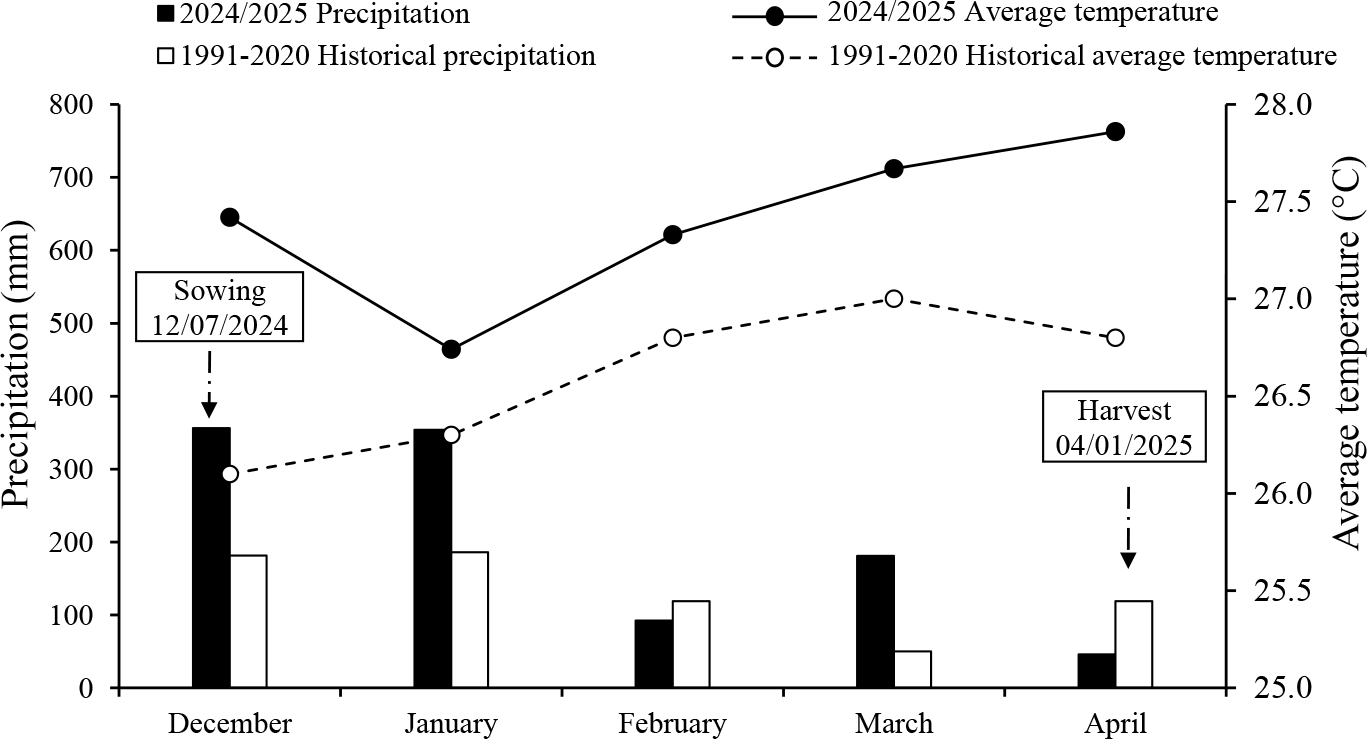
The experiment was conducted in the field at the Experimental Station of Accert Research and Agronomic Consultancy, Balsas, MA (07°31‟57” S, 46°02‟08” W, 283 m altitude), during the 2024/2025 harvest. The climate of the region is classified as Aw (tropical hot and humid) and is characterized by rainy summers and dry winters. The climate data used during the experiments and climate history are shown in Figure 1.

Monthly average rainfall and temperature during the experiment in the agricultural year of 2024/2025 and the historical averages of 1991-2020 in Balsas, Maranhão State, Brazil. Source: National Institute of Meteorology (INMET, 2025).
The soil of the experimental area was classified as yellow latosol with a sandy texture based on the Brazilian soil classification system (SANTOS et al., 2018). Before starting the experiment, the soils were sampled from the 0-20 and 20-40 cm layers. The chemical and physical properties of the soil are shown in Table 1.
A randomized block design was adopted in a split-plot scheme with three replicates. In the plots, the presence or absence of coverage with U. ruziziensis (Syn. Brachiaria ruziziensis) was evaluated, and the subplots were composed of different P sources: organomineral 1 (O1), organomineral 2 (O2), single superphosphate (SSP), and the control (no P addition). Each experimental unit consisted of 4 rows that were 3.0 m in length and spaced 0.50 m apart, totaling 6.0 m2. For the evaluations, only the 2 central rows were considered, disregarding 1 m from the ends, resulting in a useful area of 1.5 m2.
Soybean cultivar „CZ 58B23 I2X‟ was sown with a mechanized seeder on 12/07/2024 in a no-tillage system, with an average depth of 3 cm, a spacing between rows of 0.50 m, and a density of 15 seeds per linear meter. Phytosanitary management (weeds, pests, and diseases) was performed as needed, using the pesticides registered for the crop.
Harvesting was performed manually at the physiological maturity stage (R8). Threshing was performed in a stationary threshing machine. The seeds were dried in the shade until they reached 13% moisture (wet basis) according to the methods of Brasil (2009). After homogenization, physiological and sanitary quality analyses were conducted. The mass of 1000 seeds was determined according to the methods of Brasil (2009). The water content was determined in an oven, and the values were expressed as percentages (Brasil, 2009). Germination was determined using rolls of germitest paper, moistened with 2.5 times the dry mass of the paper, and placed in a biochemical oxygen demand germinator at 25°C. The germination counts were performed after 5 and 8 days (Brasil, 2009). Emergence was determined in 4 replicates of 50 seeds in trays containing sand that were kept in a greenhouse at 30°C. The final emergence percentage was recorded at 12 days, when stabilization occurred. The shoot and root lengths were measured in 10 normal seedlings from the germination test, and the shoot and root dry phytomass were determined in 10 plants per treatment that were dried at 60°C for 72 h. For the accelerated aging test, the seeds were placed in gerbox boxes with mesh and 40 mL of water and incubated at 41°C for 96 h, after which they were subjected to a germination test (MARCOS FILHO, 2020). To determine the electrical conductivity, 50 weighed seeds were immersed in 75 mL of deionized water at 25°C for 24 h, and the conductivity was measured with a conductivity meter and expressed in μS cm⁻1 g⁻1 (VIEIRA; KRZYZANOWSKI, 1999). To evaluate the seed health, a blotter test was used, with 5 replicates of 40 seeds incubated at 20°C under a 12-h photoperiod for 7 days. Fungal identification was performed under an optical microscope according to Barnett and Hunter (1998).
The data were analyzed using the following GGE biplot model: Yij - ȳj = y1 ɛi1ρj1 + y2 ɛi2ρj2 + ɛij, where Yij represents the physiological and sanitary quality of treatment i in environment j; ȳj is the overall mean of the treatments in environment j; y1 ɛi1ρj1 is the first principal component (PC1); y2 ɛi2ρj2 is the second principal component (PC2); y1 and y2 are the eigenvalues associated with the analysis of principal components PCA1 and PCA2, respectively; ɛ1 and ɛ2 are the PC1 and PC2 values, respectively, of treatment i; ρj1 and ρj2 are the values of PC1 and PC2, respectively, for environment j; and ɛij is the error associated with the i-th treatment and the j-th environment model (YAN; RAJCAN, 2002). The data were subjected to multivariate analysis to confirm the relationships among the studied factors and seed quality parameters (MINGOTI, 2005). Heatmaps were constructed using the Pearson correlations among traits. All analyses were performed using R statistical software (R CORE TEAM, 2025; v. 4.4.1).
RESULTS AND DISCUSSION
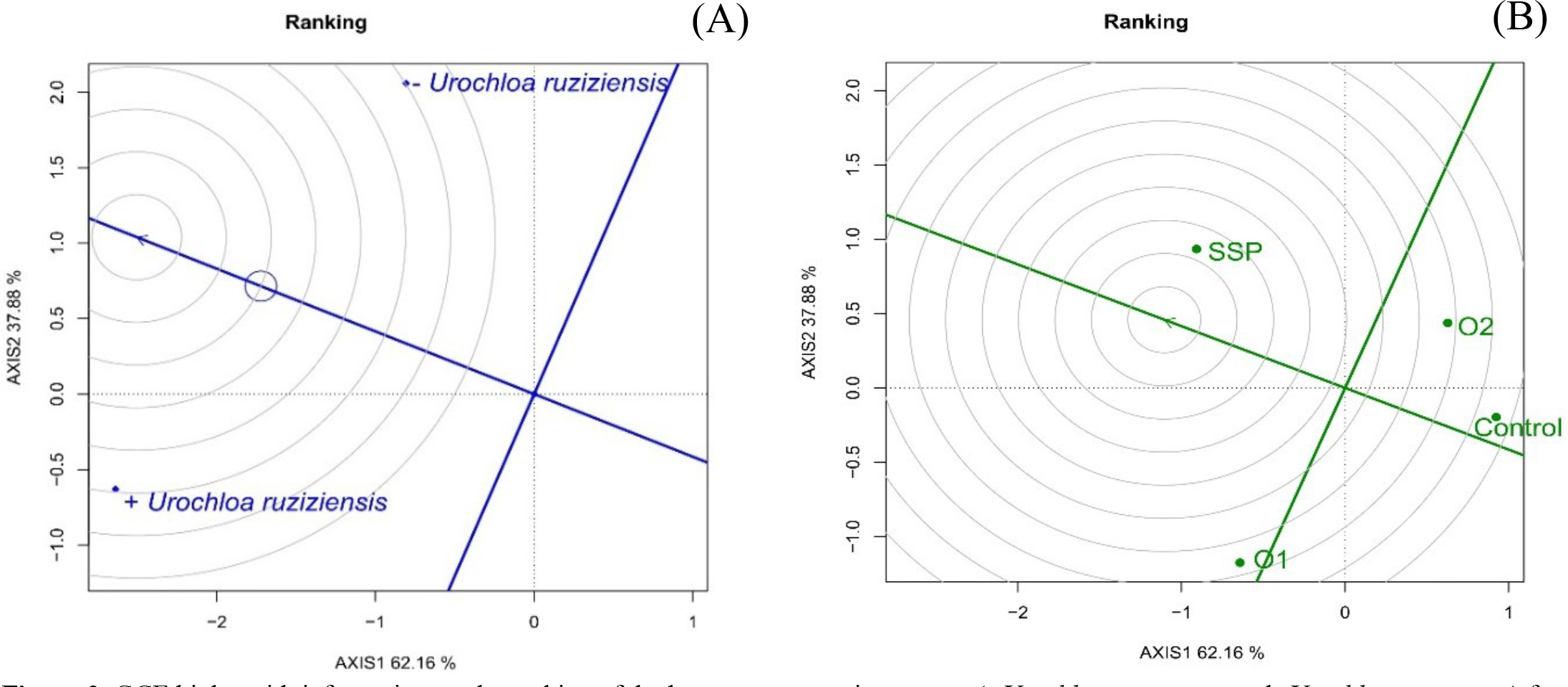
Figure 2A shows the ranking graph of the environments, indicating that compared to the fallow environment, the environment covered by U. ruziziensis had the best overall average performance. The proximity of coverage with U. ruziziensis in relation to the centroid (circle with arrow) represents the ideal mean performance. Thus, the environment with U. ruziziensis was the most favorable for all evaluated variables, and that with fallow conditions had a significantly lower performance. Studies have shown that the use of U. ruziziensis as a cover crop improves soil and soybean performance compared to fallow conditions. Balbinot Júnior et al. (2024) reported a higher grain yield and protein content. Similar results have been reported by Fernandes et al. (2025), who revealed higher carbon and nitrogen contents in the soil.

GGE biplot with information on the ranking of the best crop succession system (+Urochloa ruziziensis and -Urochloa ruziziensis) for the studied variables (A) and the ranking of the best phosphorus fertilizer sources in the soybean crop considering the analyzed variables (B). Abbreviations: O1: organomineral 1; O2: organomineral 2; SSP: single superphosphate and control: no phosphorus addition.
Figure 2B, which represents the ranking of the different fertilization treatments, shows that the SSP treatment had the best overall mean performance and was closer to the ideal vector (central circle with a green arrow), which represents the treatment with the greater average adaptability and productivity in the evaluated environments. Among the P sources, SSP consistently yielded positive results in terms of productivity and agronomic efficiency, often standing out in compared to alternative treatments (BENÍCIO, 2022). As observed in Figure 2B, SSP was positioned as the source of best adaptability and productivity, close to the ideal vector. However, studies have indicated that this superiority depends on the soil characteristics and adopted management practices (SILVA et al., 2024).
Organomineral treatments (O1 and O2) also showed satisfactory performance, but their performance was slightly lower than that of SSP. In contrast, the control treatment was lower, suggesting lower efficiency and average stability. Compared to a control, the use of organomineral fertilizers significantly increases the physiological characteristics of soybean, as observed by Ferreira et al. (2022), who also showed good performance for organomineral treatments, with values slightly lower than those for SSP. The efficiency of organomineral fertilizer remains lower than that of SSP, which is consistent with comparisons between P sources that show the superior productivity of mineral sources (GENARI et al., 2021).
Benites et al. (2022) evaluated organomineral fertilizers for a longer time period and found them to be agronomically efficient and able to maintain P levels in the soil, standing out as a viable alternative to SSP in tropical acid soils, especially in the long term. These results indicate that the use of the SSP strategy was most advantageous under the experimental conditions, especially under the cover of U. ruziziensis, which has been highlighted as providing a favorable environment.
SSP is characterized by easy solubilization and release of P in the soil, ensuring faster nutrient availability for plants. In contrast, organomineral fertilizers have a slower and more gradual release, providing a continuous P supply throughout the crop cycle (UDDIN et al., 2025). This characteristic reduces losses due to fixation and leaching, increases the nutrient use efficiency, and improves production system sustainability. In addition, organominerals improve the physiological quality of soybean seeds since they favor balanced plant development, promote greater reserve accumulation in the grains, and reduce susceptibility to biotic and abiotic stress during cultivation (COELHO et al., 2023; UDDIN et al., 2025).
Notably, the available P content in the soil was determined by chemical analysis (Table 1). According to Sousa and Lobato (2004), a P content higher than 20 mg dm⁻3 is classified as high. In the experimental area, the content was 45.71 mg dm⁻3 in the 0-20 cm layer and 30.24 mg dm⁻3 in the 20-40 cm layer, both of which are considered high available P contents. However, fertilization with different P sources promoted significant increases in crop performance, indicating that despite the high P content in the soil, P fertilization still played an important role in improving the physiological and sanitary characteristics of soybean. This reinforces the importance of replenishing and maintaining P availability in highly weathered soils, where nutrient dynamics are influenced by intense fixation and adsorption processes, reducing the fraction effectively used by plants throughout the cycle.
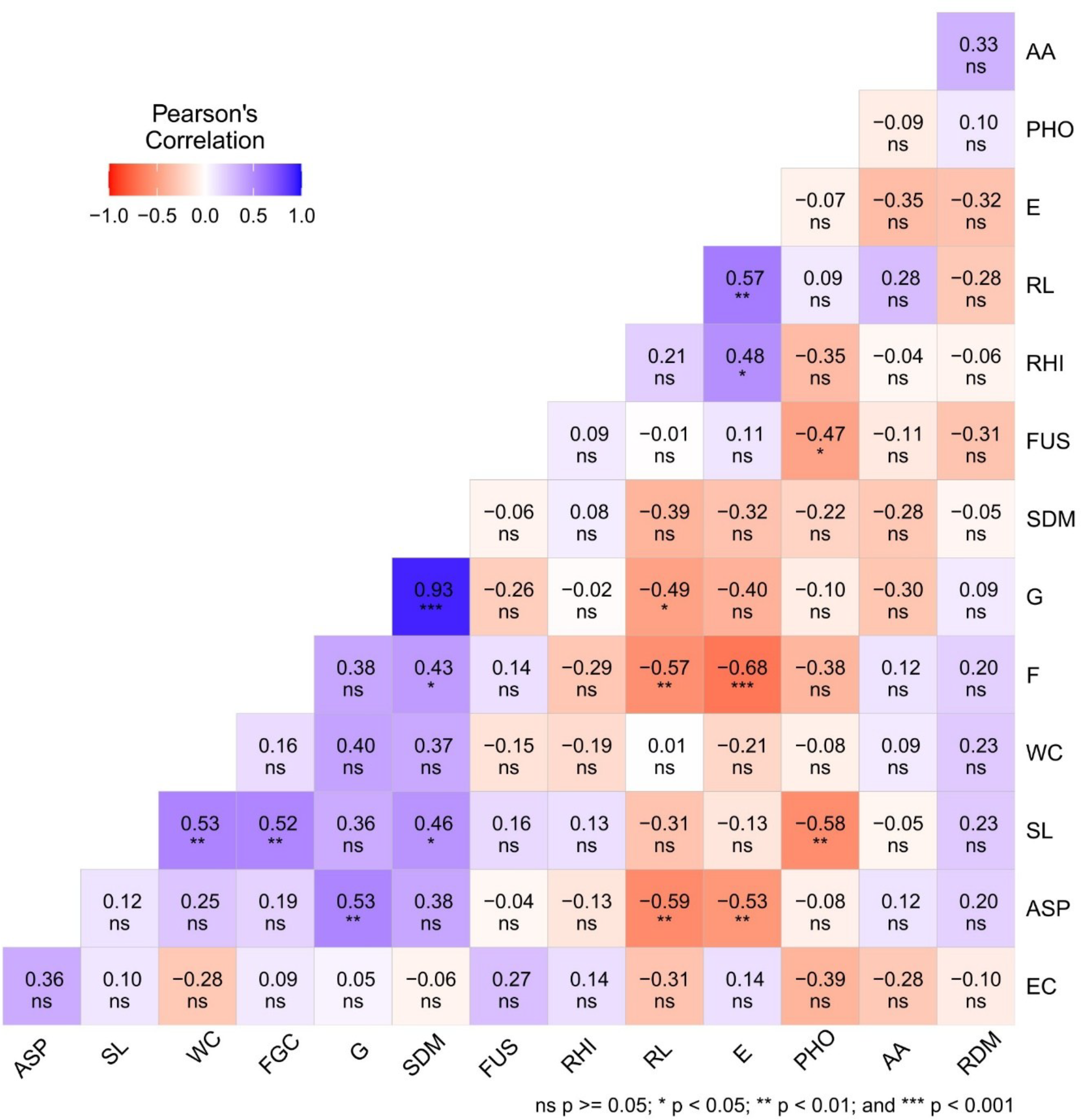
Pearson correlation analysis revealed significant relationships among the physiological and sanitary parameters of soybean seeds (Figure 3). Among the main findings, there was a strong positive correlation between germination and the first germination count (r = 0.93; p < 0.001), indicating that seeds with a greater germination percentage also presented better initial performance. Rego et al. (2023) and Sousa et al. (2024) also reported a positive and significant correlation between germination and the first count of germination in soybean, demonstrating that lots with a higher germination percentage also had better initial performance.

Heatmap containing the Pearson correlations between the evaluated variables. Abbreviations: WC: water content, E: emergence, EC: electrical conductivity, FGC: first germination count, G: germination, SL: shoot length, RC: root length, SDM: shoot dry matter, RDM: root dry matter, AA: accelerated aging, ASP: Aspergillus sp.; RHI: Rhizoctonia sp.; PHO: Phomopsis sp. and FUS: Fusarium sp.
Emergence was positively correlated with root length (r = 0.57; p < 0.01), indicating that greater emergence capacity results in greater root system growth in soybean seedlings. Considering the physiological parameters, the shoot dry phytomass was positively correlated with the SDP (r = 0.43; p < 0.05), suggesting that more vigorous seeds originate from plants with greater shoot biomass accumulation. Ducatti et al. (2022) demonstrated that the expression of genes associated with cell expansion and remodeling during germination was positively correlated with vigor tests in soybean seeds, indicating that greater vigor favors efficient seedling establishment, including root system and shoot development, which results in greater total biomass accumulation.
However, there were negative correlations between the first germination count and the variables emergence (r = -0.68; p < 0.001) and root length (r = -0.57; p < 0.05), suggesting that seeds with superior initial performance in terms of initial count generated seedlings with lower root growth and emergence, possibly because of the precocity associated with lower vigor. Ebone et al. (2020) demonstrated that seeds with high vigor, which are estimated by tests such as first germination count, do not necessarily show greater root length or emergence, and in some cases, an inverse pattern is observed, indicating a negative correlation between vigor at excessive levels and early seedling development.
In terms of health, there was a significant negative correlation between the presence of Aspergillus sp. and the physiological variables emergence (r = -0.53; p < 0.01) and root length (r = -0.57; p < 0.01), demonstrating that the presence of this pathogen directly affects initial soybean seedling development. In addition, the incidence of Phomopsis sp. was negatively correlated with root length (r = -0.53; p < 0.01), indicating that this genus compromises root growth, affecting the physiological seed quality. Evangelista et al. (2025) reported that pathogens, such as Phomopsis sojae, represent a phytosanitary risk and negatively affect soybean seedling root development.
CONCLUSION
The soybean succession system with U. ruziziensis and SSP fertilization resulted in the best soybean performance in the Cerrado of Maranhão, showing higher physiological and sanitary seed quality. Organomineral fertilizers (O1 and O2) also yielded satisfactory results, positively contributing to seed vigor and health, albeit less so than SSP.
ACKNOWLEDGEMENTS
The authors thank the Universidade Estadual do Maranhão (UEMA) for granting a scientific initiation scholarship to the first author. The authors are grateful to “Accert Pesquisa e Consultoria Agronômica” for the financial support for agricultural inputs and for providing the experimental area.
Data Availability:
The data that support the findings of this study can be made available, upon reasonable request, from the corresponding author.
REFERENCES
- ABRANCHES, M. O. et al. Contribuição da adubação verde nas características químicas, físicas e biológicas do solo e sua influência na nutrição de hortaliças. Research, Society and Development, 10: 1-17, 2021.
- BALBINOT JÚNIOR, A. A. et al. Soybean yield, seed protein and oil concentration, and soil fertility affected by off-season crops. European Journal of Agronomy, 154: 127039, 2024.
- BARNETT, H. L.; HUNTER, B. B. Illustrated genera of imperfect fungi St Paul, Minnesota: APS Press, 1998. 218 p.
- BENÍCIO, L. P. Overview of the use of phosphate fertilizers in Brazil, a review. Revista Agri-Environmental Sciences, 8: 1-12, 2022.
- BENITES, V. M. et al. Organomineral fertilizer is an agronomic efficient alternative for poultry litter phosphorus recycling in an acidic Ferralsol. Frontiers in Agronomy, 4: 1-13, 2022.
- BENTOS, S. A.; DAL BEM, E. Desempenho das culturas de soja e milho no comparativo entre adubação mineral e adubação organomineral. Revista Científica Eletrônica de Ciências aplicada da FAIT, 1: 1, 2021.
- BIGOLIN, G. et al. Influência do vigor de sementes no rendimento e qualidade fisiológica de sementes de soja. Enciclopédia Biosfera, 19: 14-22, 2022.
- BRASIL. Ministério da Agricultura e Reforma Agrária. Regras para análise de sementes Brasília, DF: Secretaria Nacional de Defesa Agropecuária, 2009. 398 p.
- COELHO, Y. P. et al. Physiological quality of soybean seeds as a function of organic-mineral fertilizers. Contribuciones a las Ciencias Sociales, 16: 23632-23650, 2023.
- CONAB - Companhia Nacional de Abastecimento. Acompanhamento da safra brasileira de grãos 2025/2026 Brasília, DF: Conab, 2026. 130 p.
- DUCATTI, K. R. et al. Transcripts Expressed during Germination Sensu Stricto Are Associated with Vigor in Soybean Seeds. Plants, 11: 1-15, 2022.
- EBONE, L. A. et al. Soybean seed vigor: uniformity and growth as key factors to improve yield. Agronomy, 10: 1-15, 2020.
- EVANGELISTA, E. A. et al. Incidência de Phomopsis sojae em sementes de soja e proposta de limites sanitários no estado de Mato Grosso. Revista de Gestão e Secretariado, 16: 1-19, 2025.
- FERNANDES, J. D. et al. Different biochar: effects on soil fertility and growth of bell pepper. Revista Caatinga, 38: e12730, 2025.
- FERREIRA, L. L. et al. Nutritional management in soybean crop for high yields using organomineral fertilizers. Agronomy Science and Biotechnology, 8: 1-15, 2022.
- GENARI, D. A. et al. Adubação fosfatada em soja: potencialidades de diferentes fontes. Research, Society and Development, 10: 1-9, 2021.
- GOTZ, L. F. et al. Phosphate management for high soybean and maize yields in expansion areas of Brazilian Cerrado. Agronomy, 13: 1-14, 2023.
-
INMET - Instituto Nacional de Meteorologia. Banco de Dados Meteorológicos Available at: <https://bdmep.inmet.gov.br>. Access on: Aug. 21, 2025.
» https://bdmep.inmet.gov.br - MARCOS FILHO, J. Teste de envelhecimento acelerado. In: KRZYZANOWSKI, F. C. et al. (Eds.). Vigor de sementes: Conceitos e testes Londrina, PR: ABRATES, 2020. v. 1, cap. 4, p. 185-246.
- MINGOTI, S. A. Análise de dados através de métodos de estatística multivariada: uma abordagem aplicada Belo Horizonte, MG: UFMG, 2005. 295 p.
- POLLNOW, H. E. et al. Aspectos legais da produção de sementes e mudas de espécies florestais. Research, Society and Development, 11: e37911325903, 2022.
- R CORE TEAM. R: A Language and environment for statistical computing Vienna: R Foundation for Statistical Computing, 2025.
- REGO, C. H. Q. et al. Primary root emission as a vigor test in soybean seeds. Revista Ciência Agronômica, 54: e20238714, 2023.
- SANTOS, H. G. et al. Sistema brasileiro de classificação de solos 5. ed. Brasília, DF: Embrapa. 2018. 356 p.
- SILVA, L. J. R. et al. Evaluating the agronomic efficiency of alternative phosphorus sources applied in Brazilian tropical soils. Scientific Reports, 14: 1-12, 2024.
- SOUSA, C. H. C. et al. Physiological and sanitary quality of soybean seeds in response to harvest delay. Revista Ciência Agronômica, 56: e202493440, 2024.
- SOUSA, D. M. G.; LOBATO, E. Cerrado: correção do solo e adubação 2. ed. Brasília, DF: Embrapa Informação Tecnológica, 2004. 416 p.
- UDDIN, M. K. et al. Organo-mineral fertilizer to sustain soil health and crop yield for reducing environmental impact: A comprehensive review. European Journal of Agronomy, 162: 127433, 2025.
- VIEIRA, R. D.; KRZYZANOWSKI, F. C. Teste de condutividade elétrica. In: KRZYZANOWSKI, F. C.; VIEIRA, R. D.; FRANÇA NETO, J. B. (Eds.). Vigor de sementes: conceitos e testes Londrina, PR: Abrates, 1999. cap. 4, p. 1-26.
- YAN, W.; RAJCAN, I. Biplot evaluation of test sites and trait relations of soybean in Ontario. Crop Science, 42: 11-20, 2002.
Edited by
-
Editor in Chief:
Aurélio Paes Barros Júnior
-
Section Editor:
Salvador Barros Torres