
 Liquid fertilizers as salt stress mitigators on growth and quality of sour passion fruit seedlings
ABSTRACT
Salt stress constitutes one of the main limitations for the expansion of passion fruit cultivation in the Northeast region, especially when it occurs during seedling formation. Liquid fertilizers offer an alternative to reduce the harmful effects of salts on agricultural crops, including on the initial growth of sour passion fruit seedlings. Thus, the objective was to evaluate the application of liquid fertilizers as salt stress mitigators on the growth and quality of sour passion fruit seedlings. The experiment was conducted in a protected environment, distributed in a randomized block design, in a 2 × 4 factorial scheme, with four replications and four plants per plot. The treatments referred to irrigation with water of low (0.18 dS m-1) and high (4.0 dS m-1) salinity and application of liquid fertilizers to mitigate salt stress (Without fertilizers, CodasalTM, Aminoagro raizTM and CodasalTM + Aminoagro raizTM). The salinity of the substrate, the biometric parameters (height, diameter, leaf area, root volume and dry matter mass and leaf area ratio) and the quality of the sour passion fruit seedlings, obtained using the Dickson quality index, were evaluated. Irrigation with water of 4.0 dS m-1 increases the salinity of the substrate, damaging the growth and quality of sour passion fruit seedlings; however, Aminoagro raizTM applied alone or associated with CodasalTM reduces the adverse effects of salts on plants, promoting increases of up to 46.9% in total dry mass. Liquid fertilizers (CodasalTM and Aminoagro raizTM) applied simultaneously are indicated as salt stress mitigators for sour passion fruit seedlings.
Keywords:
Passiflora edulis Sims; Saline water; Attenuators; Biometry; Quality index.
RESUMO
O estresse salino constitui um dos principais limitantes para a expansão da cultura do maracujazeiro-azedo na região Nordeste, principalmente, quando ocorre na formação das mudas. Os fertilizantes líquidos surgem com uma alternativa de reduzir os efeitos deletérios dos sais, nas culturas agrícolas, inclusive no crescimento inicial de mudas de maracujazeiro-azedo. Dessa forma, objetivou-se avaliar fertilizantes líquidos como mitigadores do estresse salino sobre o crescimento e qualidade de mudas de maracujazeiro-azedo. O experimento foi conduzido em ambiente protegido, distribuído no delineamento de blocos casualizados, em esquema fatorial 2 × 4, com quatro repetições e quatro plantas por parcela. Os tratamentos foram referentes a irrigação com água de baixa (0,18 dS m-1) e alta salinidade (4,0 dS m-1) e aplicação de fertilizantes líquidos como atenuantes (Sem fertilizantes, CodasalTM, Aminoagro raizTM e CodasalTM + Aminoagro raizTM). Foram avaliados a salinidade do substrato, os parâmetros biométricos (altura, diâmetro, área foliar, volume de raiz e massa da matéria seca e razão de área foliar) e a qualidade das mudas de maracujazeiroazedo através do índice de qualidade de Dickson. A irrigação com água de 4,0 dS m-1 eleva a salinidade do substrato, prejudicando o crescimento e a qualidade das mudas de maracujazeiro-azedo, no entanto, o Aminoagro raizTM aplicado de forma isolada ou associada com CodasalTM reduz os efeitos adversos dos sais nas plantas, promovendo aumentos de até 46,9% na massa seca total. Os fertilizantes líquidos (CodasalTM e Aminoagro raizTM) aplicadosa simultaneamente são indicados como mitigadores do estresse salino para mudas de maracujazeiro-azedo.
Palavras-chave:
Passiflora edulis Sims; Água salina; Atenuadores; Biometria; Índice de qualidade.
INTRODUCTION
The increase in soil salinity in agricultural areas is one of the main limitations to food production in the world, mainly because it causes losses in the quality and yields of agricultural crops (ZOU; ZHANG; TESTERINK, 2021). This is more severe in regions with arid and semi-arid climates (ZÖRB; CHRISTOPH-MARTIN; KARL-JOSEF, 2019), as occurs in a large part of the Northeast of Brazil, which has chronic limitations in the availability of water in quantity and quality to crops, mainly due to the scarcity and poor distribution of rainfall in recent years (SOUTO et al., 2016; SILVA et al., 2021).
In these regions, the water resources used to meet crop needs come from surface and/or underground dams, which often have high concentrations of toxic salts (GUEDES et al., 2023), mainly sodium (Na+) and chloride (Cl-) ions, which cause damage to plant growth and yields (CHOURASIA et al., 2022). Salt stress is a serious problem for plant growth and development, causing physiological and biochemical changes due to a reduction in the plant's ability to absorb water from the soil (osmotic effect), nutritional imbalance and the toxicity of specific ions (LIMA et al., 2020a).
The Northeast of Brazil is the main producer of sour passion fruit (Passiflora edulis Sims) and it is estimated that, by 2022, around 70% of the 698 tons of fruit produced will come from this region, especially the states of Bahia and Ceará, which together are responsible for approximately 376 tons (IBGE, 2023). In terms of salinity tolerance, sour passion fruit is considered a crop classified as sensitive or moderately sensitive to salinity, with losses in production yields from 1.3 dS m-1 of electrical conductivity (AYERS; WESTCOT, 1999), with initial growth (seedling formation) being the most sensitive phase for the crop (BEZERRA et al., 2016; LEOGRANDE; VITTI, 2019; FIGUEIREDO et al., 2020; LIMA et al., 2021b). The “Guinezinho” sour passion fruit is a local variety grown mainly in the states of Paraíba and Rio Grande do Norte, with good adaptability to the region's soil and climate, yield potential of up to 30 t ha-1 and classified as moderately sensitive to water salinity during seedling formation (LIMA et al., 2021b).
In this context, research has shown that the application of mineral or organic fertilizers can be used to mitigate salt stress in plants (BEZERRA et al., 2019; WANDERLEY et al., 2020; WANG et al., 2023). This has been verified by Guedes et al. (2023), who pointed out that the application of liquid organo-mineral fertilizers containing nitrogen (N), potassium (K), calcium (Ca) and organic substances has emerged as a promising alternative to mitigate the effects of salinity, improving the physiological aspects of sour passion fruit seedlings. The advantages of liquid fertilizers over solid (conventional) fertilizers include greater availability of nutrients in the soil, uniform distribution and rapid absorption by the plant. These elements act to mitigate salinity by regulating the osmotic balance, increasing photosynthetic efficiency, as enzyme activators, signaling stress and competing with sodium (Na+) for cell membrane entry sites (LOPEZ; SATTI, 1996; WANDERLEY et al., 2018), promoting adequate development of sour passion fruit seedlings under salt stress conditions (BEZERRA et al., 2019; SOUZA et al., 2020).
As a result, liquid fertilizers, which contain mineral and organic nutrients, may act to modulate and adjust sour passion fruit under conditions of salt stress, promoting conditions that favor the growth and quality of the seedlings. The aim of this study was to evaluate the application of liquid fertilizers as salt stress mitigators on the growth and quality of sour passion fruit seedlings.
MATERIAL AND METHODS
The experiment was carried out between October and November 2019 in a protected environment with a roof at 50% shade level in the Seedling Production Sector, located at the Center for Human, Social and Agrarian Sciences of the Federal University of Paraíba, in the municipality of Bananeiras, Paraíba, Brazil.
The municipality is georeferenced by the coordinates 06° 45' 04” S and 35° 38' 00” W, at an altitude of 552 m. The experimental site recorded an average air temperature of 22.8 °C and relative humidity of 78.9%, as shown in Figure 1. The benches used to grow the seedlings were protected at the top with a shade cloth capable of blocking 50% of the sun's rays.

The plant material evaluated in this experiment came from the 'Guinezinho' variety of passion fruit, which is widely recognized and cultivated by producers in the states of Paraíba and Rio Grande do Norte.
The experiment was conducted in a randomized block design, with a 2 × 4 factorial design, four replications and four plants per plot. The treatments referred to the combination of water electrical conductivity (ECw) (low salinity - 0.18 dS m-1 and high salinity - 4.0 dS m-1) and the application of liquid fertilizers to mitigate salt stress (without fertilizer - WF, CodasalTM - CS, Aminoagro RaizTM - AR and the mixture of CodasalTM + Aminoagro RaizTM - CS + AR in a 1:1 v/v ratio) applied to the substrate via fertigation. The salinity of the irrigation water was based on previous studies with 'Guinezinho' sour passion fruit seedlings conducted by Silva et al. (2021), who reported losses in the quality of sour passion fruit seedlings with water of 4.0 dS m-1.
The seedlings were placed in black polyethylene bags measuring 0.15 m × 0.25 m and with a volumetric capacity of 2.12 dm3, containing a substrate made up of organic soil collected in the first 0.20 m of depth in the Agricultural Sector near the experiment. The chemical properties of the substrate used, related to fertility and salinity, before the start of the experiment, are detailed in Table 1.
Chemical characterization of the substrate used in terms of fertility and salinity before the experiment.
The substrate was fertilized by applying 1.5 g dm-3 of single superphosphate (18% P2O5, 16% Ca and 10% S) and 0.3 g dm-3 of potassium sulphate (50% K2O and 15% S). This is equivalent to a dose of 300 mg dm-3 of P2O5 and150 mg dm-3 of K2O, as described by Bezerra et al. (2019). Sowing was carried out by placing five seeds equidistantly and evenly on the surface of the substrate, at a depth of 1 cm in each container. Seedlings began to emerge at 7 days after sowing (DAS) and, at 9 DAS, thinning was carried out, preserving only the most vigorous plant per container.
At 10 and 40 days after emergence (DAE), Codasal™, Aminoagro raiz™ and the mixture of Codasal™ + Aminoagro raiz™ were applied to each plant in a volume of 50 mL, supplied via irrigation water. Codasal™ and Aminoagro raiz™ were applied at a concentration of 2 mL L-1, while the Codasal™ + Aminoagro raiz™ mixture was applied at a concentration of 1 mL L-1 of each liquid fertilizer. These concentrations were prepared by dissolving the liquid fertilizers in low-salinity water (0.18 dS m-1), according to the manufacturers' instructions.
Codasal™ liquid organomineral fertilizer is a darkcolored solution containing nutrients complexed in lignosulfonate (6.0% N, 8.7% CaO, and 14.7% lignosulfonate complexing agent, with a salt index of 40.74%). Aminoagro raiz™ is characterized as a dark-colored solution, rich in nutrients and organic matter (11% N, 1% K2O, and 17% total carbon, with a salt index of 8.7%). The electrical conductivities of the preparations after dissolution were 0.40 dS m-1 for Codasal™, 1.61 dS m-1 for Aminoagro raiz™ and 1.0 dS m-1 for the Codasal™ + Aminoagro raiz™ mixture.
The low-salinity water (ECw = 0.18 dS m-1) came from an artesian well located near the experimental site in Bananeiras, Paraíba,Brazil.Thehigh-salinitywater(4.0 dS m-1) was obtained by diluting highly saline water (ECw = 117.0 dS m-1) with low-salinity water (0.18 dS m-1), and the electrical conductivity was measured using a CD-850 portable device. The highly saline water used came from a reservoir in the municipality of Casserengue, Paraíba, Brazil. The plants were irrigated daily with the respective irrigation waters using the weighing method, replenishing the volume of water corresponding to the evapotranspiration of the plants the previous day (24 h), so as to leave the moisture content of the substrate close to 90% of field capacity (FC). Before setting up the experiment, ten polyethylene bags containing substrate were randomly selected, weighed and received water gradually until all the pore spaces were filled with water and drainage began. Immediately after drainage ceased, the volume of water drained was measured in a millimeter measuring cylinder, and the polyethylene bags were weighed to determine the weight of the bags at field capacity. The volume of water to be applied corresponded to the difference between the weight of the polyethylene bag at 90% of FC and the weight on the day of irrigation. When the weight of the polyethylene bag was the same as when it was at field capacity, there was no replacement of water for the sour passion fruit seedlings.
At 45 DAE, when the seedlings were ready to be transplanted into the field (the first tendril had emerged), substrate samples were taken from the plastic containers of each treatment per block to determine salinity based on the electrical conductivity of the saturation extract (ECse), expressed in dS m-1. During the same period, biometric measurements were taken of plant height (PH), in cm, measured with a tape measure and considering the distance from the base of the stem to the insertion of the last leaf, and stem diameter (SD), in mm, measured with a digital caliper with a precision of 0.002 mm (Digimess®).
During the same period, leaf area (LA) was determined using the leaf disc weighing method, which, through the relationship between actual leaf area and estimated leaf area, generated Equation 1: ŷ = 1.7228 + 0.6933x, with R2 = 0.989; where: ŷ corresponds to the estimated area and x represents the product between leaf length and width. Root volume (RV) was measured following the methodology described in Basso (1999), by placing each root in a 1,000 mL beaker containing 500 mL of water, considering the displacement of the water in the beaker as the root volume, assuming the equivalence of units (1 mL = 1 cm3). Leaf area ratio (LAR), in cm2 g-1, was calculated according to the methodology described in Benincasa (2003), using Equation 2:
The seedlings were separated into root and aerial parts, individually placed in duly labeled paper bags and kept in an air oven at 65 °C until their weight was constant. The materials were weighed on a precision analytical scale (0.001 g) to determine the root dry matter mass (RDMM) and aerial part dry matter mass (APDMM), and the results were expressed in g plant-1. The sum of RDMM and APDMM was used to determine the total dry matter mass (TDMM) of the plants
Based on these parameters, the Dickson Quality Index (DQI) of the seedlings was calculated, according to Dickson, Leaf and Hosner (1960), as shown in Equation 3:
The data were subjected to the normal distribution test (Shapiro-Wilk test) at the 5% probability level. The data obtained were subjected to analysis of variance (p≤0.05), and the means were compared using the Tukey test (p≤0.05). The statistical software Sisvar version 5.6 was used to analyze the data (FERREIRA, 2019). Principal component analysis (PCA) was carried out using the analysis packages contained (“ggplot2” and “factoextra”) in R studio (R CORE TEAM, 2022).
RESULTS AND DISCUSSION
The water salinity × liquid fertilizer interaction had a significant effect on the electrical conductivity of the substrate, height, leaf area, total dry matter mass and root volume of the sour passion fruit seedlings (Table 2). There was an individual effect of salinity on SD, RDMM, APDMM, LAR and DQI, while the application of liquid fertilizers influenced RDMM, APDMM, and LAR.
Analysis of variance, by F-test values, for water salinity and growth of sour passion fruit seedlings at 45 days after emergence irrigated with saline water (SW) and under application of liquid fertilizers (LF) as attenuators.
Irrigation with highly saline and saline water had a significant effect on the ECse of the substrate in the treatments without fertilizer and with CodasalTM, respectively, with increases of 3.94 to 9.88 dS m-1 and 3.59 to 8.14 dS m-1 (Figure 2). Despite the increases in the ECse of the substrate irrigated with highly saline water, there was no statistical difference for the treatments with Aminoagro raizTM and CodasalTM + Aminoagro raizTM.

Electrical conductivity of the substrate saturation extract at 45 DAS with sour passion fruit seedlings irrigated with saline water and under liquid fertilizer application.
Table 1 shows that, initially, the substrate was nonsaline (ECse = 0.55 dS m-1) and after 45 days of irrigation and fertilizer application, the substrate became saline or salic in character (RIBEIRO; RIBEIRO FILHO; JACOMINE, 2016). The increase in salinity may be due to the daily accumulation of salts through irrigation, which combined with the low volume of the container and the high-water demand of the plants, led to a rapid increase in the ECse of the substrate (SOUTO et al., 2016; GUEDES et al., 2023).
When seedlings were irrigated with low-salinity water, the application of CS + AR contributed more intensely to raising the ECse of the substrate, with increases of 111.92% compared to the control treatment (without fertilizer). Meanwhile, under conditions of irrigation with highly saline water, the lowest substrate ECse values were found with the application of AR, with reductions of 40.67% compared to the substrate without fertilizer (7.99 dS m-1). This lower ECse value is related to the lower capacity of Aminoagro raizTM to salinize the soil compared to CodasalTM. Aminoagro raizTM, because it contains 17% organic carbon, helps to reduce the ECse by increasing the cation exchange capacity, by adsorbing ions, which reduces the concentration of soluble salts in the substrate solution, and by improving the structure and permeability of the substrate, favoring the leaching of salts (LEOGRANDE; VITTI, 2019; WANG et al., 2023).
Increasing the salinity of the irrigation water from 0.18 to 4.0 dS m-1 reduced the height of the seedlings in the treatments without fertilizers and Aminoagro raizTM by 27.22% and 22.16%, respectively, but there was no statistical difference in height for the treatments with CodasalTM and Aminoagro raizTM + CodasalTM (Figure 3A).

Plant height (A), leaf area (B) and root volume (C) and root dry matter mass (D) of sour passion fruit seedlings at 45 DAS, irrigated with lowand high-salinity water under liquid fertilizer application.
The excessive increase in the absorption of salts by plants, especially Na+ and Cl- ions, can reach toxic levels, promoting a reduction in leaf emergence and increasing senescence of older leaves, which, as a consequence, limits the synthesis and flow of organic compounds to the plant's growth zones (BEZERRA et al., 2016). Similar results were found by Wanderley et al. (2018) and Lima et al. (2020a), who observed reductions of 25.18% and 34.80%, respectively, in the height growth of sour passion fruit irrigated with saline water.
Under irrigation with highly saline water, there was no significant effect of fertilizer application on the height of passion fruit seedlings. However, under conditions of low salinity, AR promoted higher PH values, with increases of 23.38% compared to the CS treatment, but did not differ statistically from the treatments without liquid fertilizer and CS + AR. Aminoagro raizTM, because it contains nitrogen and potassium, stimulated the growth of sour passion fruit seedlings, since N has a structural function in the plant and participates in various compounds such as proteins, amino acids and enzymes, while K+ acts in various metabolic and physiological processes in plants, acting mainly as an activator of various enzymes in cell metabolism (TAIZ et al., 2017).
With regard to leaf area (Figure 3B), it can be seen that highly saline water had a significant effect on sour passion fruit seedlings in the treatments without fertilizer application and with CS + AR, with reductions of 27.59% and 14.30%, respectively. The fertilizers had no significant effect on the leaf area of the seedlings when irrigated with 0.18 dS m-1 water, but the application of Aminoagro raizTM promoted higher leaf area values in plants irrigated with 4.0 dS m-1 water, with increases of 26.47% compared to the control treatment.
The greater reductions in LA of the seedlings without fertilizer application and irrigation with higher conductivity water reflects the damage caused by salt stress, which, due to the reduction in the osmotic potential of the soil solution, compromises the absorption of water and nutrients, causing morphological and anatomical changes in the plants (LIMA et al., 2020b; CHOURASIA et al., 2022). However, for containing N and K in its composition, Aminoagro raizTM attenuated the damaging effects of water salinity, since these elements participate in osmoregulatory molecules, enzyme activation, regulation of stomatal closure and opening, and CO2 assimilation, which help the plant to adjust osmotically in relation to the external environment, which has a higher concentration of ions (FIGUEIREDO et al., 2020).
Irrigation with highly saline water caused a reduction in root volume in sour passion fruit seedlings, regardless of the application of liquid salt stress attenuators (Figure 3C). The results show that the increase in water conductivity from 0.18 to 4.00 dS m-1 caused a 38.51% reduction in the root volume of sour passion fruit seedlings. The reduction in the RV of the sour passion fruit seedlings is due to the halotropism mechanism that allows plants to reduce root growth in order to avoid salinity, particularly that caused by chloride and sodium ions, through a rapid change in the apparent distribution of auxin in the root apex as a way of preventing the elongation of cells (ZOU; ZHANG; TESTERINK, 2021).
In sour passion fruit seedlings irrigated with highsalinity water, the liquid fertilizers promoted an increase in root volume compared to the control treatment, with increases of 57.28%, 52% and 60%, respectively, with CS, AR and CS + AR. In the case of sour passion fruit seedlings irrigated with low-salinity water, the fertilizers CS + AR and CS promoted the highest RV values, 18% and 15.6% higher than those observed in the control plants, respectively.
As liquid fertilizers contain nutrients such as nitrogen, potassium, calcium and organic compounds, they can act as mitigators of the effects of toxic salts on the RV of sour passion fruit seedlings. This behavior is mainly attributed to the reduction in Na+ absorption by the roots to the detriment of the increase in K+ and Ca2+ ions in the substrate solution, which compete for the same transport sites as the carrier protein, which is normally used to explain the decreases in sodium uptake in the plasmalemma (LOPEZ; SATTI, 1996). In addition, N can reduce the effect of salinity because it participates in compounds with osmoregulatory and cellular osmoprotective functions in plants under water/salt stress, especially proline and glycine betaine (WANDERLEY et al., 2020; CHOURASIA et al., 2022).
Irrigation with highly saline water, regardless of the application of liquid fertilizers, reduced the TDMM of sour passion fruit seedlings (Figure 3D). The reduction in the total dry mass of sour passion fruit seedlings irrigated with highly saline water may be related to the ionic and/or osmotic components of salt stress, as a consequence of stomatal closure and CO2 assimilation in plants due to low water availability, directly affecting biomass production (LIMA et al., 2021a). Similar results were observed in passion fruit seedlings irrigated with water of 8.0 dS m-1, with a reduction of 42.1% (BEZERRA et al., 2016), and 3.1 dS m-1, with losses of 37.06% (WANDERLEY et al., 2020).
However, under these conditions of water salinity, the combined application of CS + AR managed to reduce the effect of the salts on the total dry mass of the seedlings, showing an increase of 46.9% compared to the control treatment. Under low-salinity water, the application of fertilizers had no significant effect on the total dry mass of sour passion fruit seedlings. The combined application of the two liquid fertilizers promoted an increase in nutrients in the substrate, such as nitrogen, potassiumandcalcium, which compete for the same entrysitesaschlorideand sodium ions, which reduced the effect of salt stress on the accumulation of dry mass in sour passion fruit seedlings (ZÖRB; CHRISTOPH-MARTIN; KARL-JOSEF, 2019; CHOURASIA et al., 2022). In addition, the organic compost and lignosulfonate contained in liquid fertilizers have benefits through an increase in the cation exchange capacity, solubility and availability of nutrients and an improvement in the soil's physical properties through greater infiltration and water retention capacity, which favors root absorption (LEOGRANDE; VITTI, 2019; ELSAWY et al., 2022; GUEDES et al., 2023).
Figueiredo et al. (2020) point out that the application of N and K in adequate quantities can stimulate the synthesis of photoassimilates and the accumulation of biomass in sour passion fruit seedlings irrigated with saline water. The application of Ca2+ in the form of calcium silicate stimulated the accumulation of biomass in sour passion fruit seedlings irrigated with water of 1.7 dS m-1, and this effect was attributed to the reduction in Na+ and increase in Ca2+ absorption by the plants, which contributed to membrane stability and a rapid response to the stress imposed (SOUZA et al., 2020).
Irrigation with highly saline water reduced stem diameter (Figure 4A), aerial part dry matter mass (Figure 4B) and root dry matter mass (Figure 4C) and increased leaf area ratio (Figure 4D), with negative impacts on the quality of the sour passion fruit seedlings due to the lower DQI value (Figure 4E). Compared to low-salinity water, the variables SD, APDMM, RDMM and DQI were reduced by 10.14%, 18.42%, 28.52% and 16.66%, respectively.

Stem diameter (A), root dry matter mass (B), aerial part dry matter mass (C), leaf area ratio (D) and Dickson quality index (E) of sour passion fruit seedlings at 45 DAS, irrigated with lowand high-salinity water.
The reduction in biomass accumulation of sour passion fruit seedlings irrigated with highly saline water is attributed to the reduction in water availability to plants due to the reduction in the osmotic potential of the soil solution, because in environments with high salt concentrations they induce the closure of stomata, reductions carbon assimilation rate and, consequently, in the growth and accumulation of biomass (SOUTO et al., 2016; WANDERLEY et al., 2018; LIMA et al., 2020a). Irrigation with water of 4.0 dS m-1, despite reducing the quality of the seedlings compared to irrigation with water of 0.18 dS m-1, led to DQI of 0.60, well above the minimum value considered to be suitable for planting (0.20) as recommended by Hunt (1990). The observed values are above those obtained by Bezerra et al. (2019) and Lima et al. (2021a) in sour passion fruit seedlings irrigated with water of 4.0 dS m-1 and 3.5 dS m-1, respectively.
The leaf area ratio of sour passion fruit seedlings was increased by 14.15%. LAR is a morphophysiological component that measures the efficiency of the photosynthetically active area in converting photoassimilates into dry matter (TAIZ et al., 2017). As observed by Bezerra et al. (2019) in sour passion fruit seedlings irrigated with saline water, the increase in LAR in plants under stress may indicate that the photoassimilates allocated may not be converted into biomass, demonstrating low plant efficiency.
The application of CodasalTM + Aminoagro raizTM increased the root dry matter mass of passion fruit seedlings, showing superiority over fertilizers when applied alone and over the control treatment (39.84%) (Figure 5A). In turn, for the APDMM of sour passion fruit seedlings, the application of Aminoagro raizTM had the highest values, but without statistically differing from the treatment with the combination of CodasalTM + Aminoagro raizTM (Figure 5B). The APDMM values of seedlings with the application of AR were 25.19% higher than those of plants grown in the substrate without liquid fertilizers.

Sour root dry matter mass (A), aerial part dry matter mass (B) and leaf area ratio (C) of sour passion fruit seedlings, at 45 DAS, with application of liquid fertilizers.
The increase in the dry matter mass of the roots and aerial part of sour passion fruit seedlings with the application of the mixture of CodasalTM + Aminoagro raizTM was due to the composition of elements contained in the liquid fertilizers, such as nitrogen, potassium and calcium complexed in lignosulfonate. This complexing agent reduces nutrient losses through leaching and improves the efficiency of use by the plant (ELSAWY et al., 2022). Nitrogen, as a constituent of chlorophylls and enzymes related to photosynthesis and CO2 assimilation, and potassium, as it acts in the enzymatic activation of synthesis and transport of amino acids, phosphates and carbohydrates, contributed to the increase in the dry mass of sour passion fruit seedlings (LIMA et al., 2020b; WANDERLEY et al., 2020). As observed by Guedes et al. (2023), the combined application of these liquid fertilizers stimulates the CO2 assimilation rate and carboxylation efficiency of plants.
In contrast, the LAR of sour passion fruit seedlings was reduced with the application of CS + AR compared to the treatment without fertilizers, showing a reduction of 16.03% (Figure 5C). These results demonstrate that the combined application of liquid fertilizers increased the capacity of sour passion fruit seedlings to effectively convert the light energy captured by the leaf area into dry matter. Under conditions of irrigation with saline water (4.0 dS m-1), Bezerra et al. (2019) found that the leaf area ratio in sour passion fruit seedlings was higher with the application of urea compared to treatments that did not receive the fertilizer.
Based on the variables of substrate salinity, morphological analysis and quality of sour passion fruit seedlings associated with principal component analysis (PCA), two well-defined groups are distinguished, corresponding to plants irrigated with lowand high-salinity water, with response to the variable or set of variables depending on the application or not of liquid fertilizers (Figure 6).

Principal component analysis (PCA) of the electrical conductivity of the substrate and the biometric variables of the sour passion fruit seedlings, at 45 DAS, as a function of the salinity of the irrigation water and liquid fertilizers.
The eigenvalues of PC1 and PC2 were responsible, respectively, for explaining 76.1% and 10.2% of the variances, which corresponded to the accumulation of 86.3% of the total variance of the data. By analyzing the direction of the vectors, it was found that there was a positive correlation for the variables RDMM, DQI, RV and TDMM, which were negatively correlated with LAR, while the increase in the ECse of the substrate tended to reduce the PH, SD, LA and APDMM of the sour passion fruit seedlings irrigated with saline water and under application of liquid fertilizers.
Low-salinity water and the application of CS + AR in PC1 have a greater influence on the SD and APDMM of sour passion fruit seedlings, which responded positively to the combination of liquid fertilizers, but have little influence on the ECse of the substrate (Figure 5). In turn, the application of low-salinity water and without fertilizer or Aminoagro raizTM promote higher values of root dry matter mass and root volume in PC1. The application of highly saline water in seedlings promotes an increase in the ECse of the substrate and LAR, regardless of the application of fertilizers, exerting little influence on the other variables.
CONCLUSIONS
Irrigation of sour passion fruit seedlings with 4.0 dS m-1 water impairs their quality by reducing growth and biomass accumulation. However, Aminoagro raizTM applied alone or in combination with CodasalTM increases dry mass and reduces the leaf area ratio of sour passion fruit seedlings. Liquid fertilizers (CodasalTM and Aminoagro raizTM) applied simultaneously are indicated as mitigators of salt stress for passion fruit seedlings.
Data Availability:
The data that support the findings of this study can be made available, upon reasonable request, from the corresponding author .
REFERENCES
- AYERS, R. S.; WESTCOT, D. W. A qualidade da água na agricultura. Campina Grande, PB: Universidade Federal da Paraíba, 1999. 153 p.
- BENINCASA, M. M. P. Análise de crescimento de plantas: noções básicas. 2. ed. Jaboticabal, SP: Funep, 2003, 41 p.
- BASSO, S. M. S. Caracterização morfológica e fixação biológica de nitrogênio de espécies de Adesmia DC. e Lotus L. 1999. 268 f. Tese (Doutorado em Zootecnia: Área de Concentração em Pastagens) - Universidade Federal do Rio Grande do Sul, Porto Alegre, 1999.
- BEZERRA, J. D. et al. Crescimento de dois genótipos de maracujazeiro-amarelo sob condições de salinidade. Revista Ceres, 63: 502-508, 2016.
- BEZERRA, M. A. F. et al. Nitrogen as a mitigator of salt stress in yellow passion fruit seedlings. Semina: Ciências Agrárias, 40: 611-622, 2019.
- CHOURASIA, K. N. et al. Salinity responses and tolerance mechanisms in underground vegetable crops: an integrative review. Planta, 255: 1-25, 2022.
- DICKSON, A.; LEAF, A.; HOSNER, J. F. Quality appraisal of white spruce and white pine seedling stock in nurseries. The Forest Chronicle, 36: 10-13, 1960.
- ELSAWY, H. I. A. et al. Calcium lignosulfonate can mitigate the impact of salt stress on growth, physiological, and yield characteristics of two barley cultivars (Hordeum vulgare L.). Agriculture, 12: 1-20, 2022.
- FERREIRA, D. F. Sisvar: A computer analysis system to fixed effects split plot type designs. Revista Brasileira de Biometria, 37: 529-535, 2019.
- FIGUEIREDO, F. E. A. et al. Morphophysiology of yellow passion fruit seedlings under application of nitrogen and potassium and irrigation with high salinity water. Semina: Ciências Agrárias, 41: 1897-1908, 2020.
- GUEDES, L. R. et al. Liquid fertilizers on photochemical efficiency and gas exchange in yellow passion fruit under saline stress. Revista Brasileira de Engenharia Agrícola e Ambiental, 27: 839-847, 2023.
- HUNT, G. A. Effect of styroblock design and copper treatment on morphology of conifer seedlings. In: ROSE, R.; CAMPBELL, S. J.; LANDIS, T. D (Eds.). Proceedings, western forest nursery association. Roseburg, OR: National Nursery Proceedings, 1990. v. 200, p. 13-17.
-
IBGE - Instituto Brasileiro de Geografia e Estatística. Produção Agrícola Municipal. 2023. Available at: <http://www.sidra.ibge.gov.br>. Access on: Abr. 11, 2023.
» http://www.sidra.ibge.gov.br - LEOGRANDE, R.; VITTI, C. Use of organic amendments to reclaim saline and sodic soils: a review. Arid Land Research and Management, 33: 1-21, 2019.
- LIMA, L. K. S. et al. Growth, physiological, anatomical and nutritional responses of two phenotypically distinct passion fruit species (Passiflora L.) and their hybrid under saline conditions. Scientia Horticulturae, 263: 109037, 2020a.
- LIMA, G. S. et al. Gas exchange, chloroplast pigments and growth of passion fruit cultivated with saline water and potassium fertilization. Revista Caatinga, 33: 181-194, 2020b.
- LIMA, G. S. et al. Potassium and irrigation water salinity on the formation of sour passion fruit seedlings. Revista Brasileira de Engenharia Agrícola e Ambiental, 25: 393-401, 2021a.
- LIMA, G. S. et al. Gas exchange, growth, and quality of passion fruit seedlings cultivated with saline water. Semina: Ciência Agrárias, 42: 137-154, 2021b.
- LOPEZ, M. V.; SATTI, S. M. E. Calcium and potassiumenhanced growth and yield of tomato under sodium chloride stress. Plant Science, 114: 19-27, 1996.
-
R CORE TEAM. R: A Language and Environment for Statistical Computing. R Foundation for Statistical Computing, Vienna, 2022. Available at: <https://www.R-project.org>. Access on: Mar. 17, 2024.
» https://www.R-project.org - RIBEIRO, M. R.; RIBEIRO FILHO, M. R.; JACOMINE, O. K. T. Origem e classificação dos solos afetados por sais. In: GHEYI, H. R. et al. (Eds.). Manejo da salinidade na agricultura: Estudos básicos e aplicados. Fortaleza, CE: INCTSal, 2016. v. 2, cap. 2, p. 9-16.
- SILVA, I. J. et al. Produção de mudas de maracujazeiroamarelo sob salinidade da água de irrigação. Research, Society and Development, 10: 1-10, 2021.
- SOUTO. A. G. L. et al. Biometria em plantas de noni sob irrigação com águas salinas e lixiviação dos sais do solo. Revista Ciência Agronômica, 47: 316-324, 2016.
- SOUZA, T. M. A. et al. Calcium silicate as salt stress attenuator in seedlings of yellow passion fruit cv. BRS GA1. Revista Caatinga, 33: 509-517, 2020.
- TAIZ, L. et al. Fisiologia e Desenvolvimento Vegetal. 6. ed. Porto Alegre, RS: Artmed, 2017. 888 p.
- WANDERLEY, J. A. C. et al. Nitrogen fertilization to attenuate the damages caused by salinity on yellow passion fruit seedlings. Revista Brasileira de Engenharia Agrícola e Ambiental, 22: 541-546, 2018.
- WANDERLEY, J. A. C. et al. Cell damage and biomass of yellow passion fruit under water salinity and nitrogen fertilization. Revista Caatinga, 33: 757-765, 2020.
- WANG, Y. et al. Organic Amendments promote saline-alkali soil desalinization and enhance maize growth. Frontiers in Plant Science, 14: 1177209, 2023.
- ZÖRB, C.; CHRISTOPH-MARTIN, G.; KARL-JOSEF, D. Salinity and crop yield. Plant Biology, 21: 31-38, 2019.
- ZOU, Y.; ZHANG, Y.; TESTERINK, C. Root dynamic growth strategies in response to salinity. Plant, Cell & Environment, 45: 695-704, 2021.
Edited by
-
Editor in Chief:
Aurélio Paes Barros Júnior
-
Section Editor:
João Everthon da Silva Ribeiro


 Note: CS - CodasalTM; AR - Aminoagro raizTM; CS + AR - CodasalTM + Aminoagro raizTM. Vertical bars represent the standard deviation from the mean (n=3). Bars with equal lowercase letters do not differ for the electrical conductivity of the water within each attenuator by the Tukey test (p≤0.05). Bars with equal capital letters do not differ for the liquid fertilizers within each electrical conductivity of the water by the Tukey test (p≤0.05).
 Note: CS - CodasalTM; AR - Aminoagro raizTM; CS + AR - CodasalTM + Aminoagro raizTM. Vertical bars represent the standard deviation from the mean (n=3). Bars with equal lowercase letters do not differ for the electrical conductivity of the water within each liquid fertilizer by the Tukey test (p≤0.05). Bars with equal capital letters do not differ for the liquid fertilizers within each electrical conductivity of the water by the Tukey test (p≤0.05).
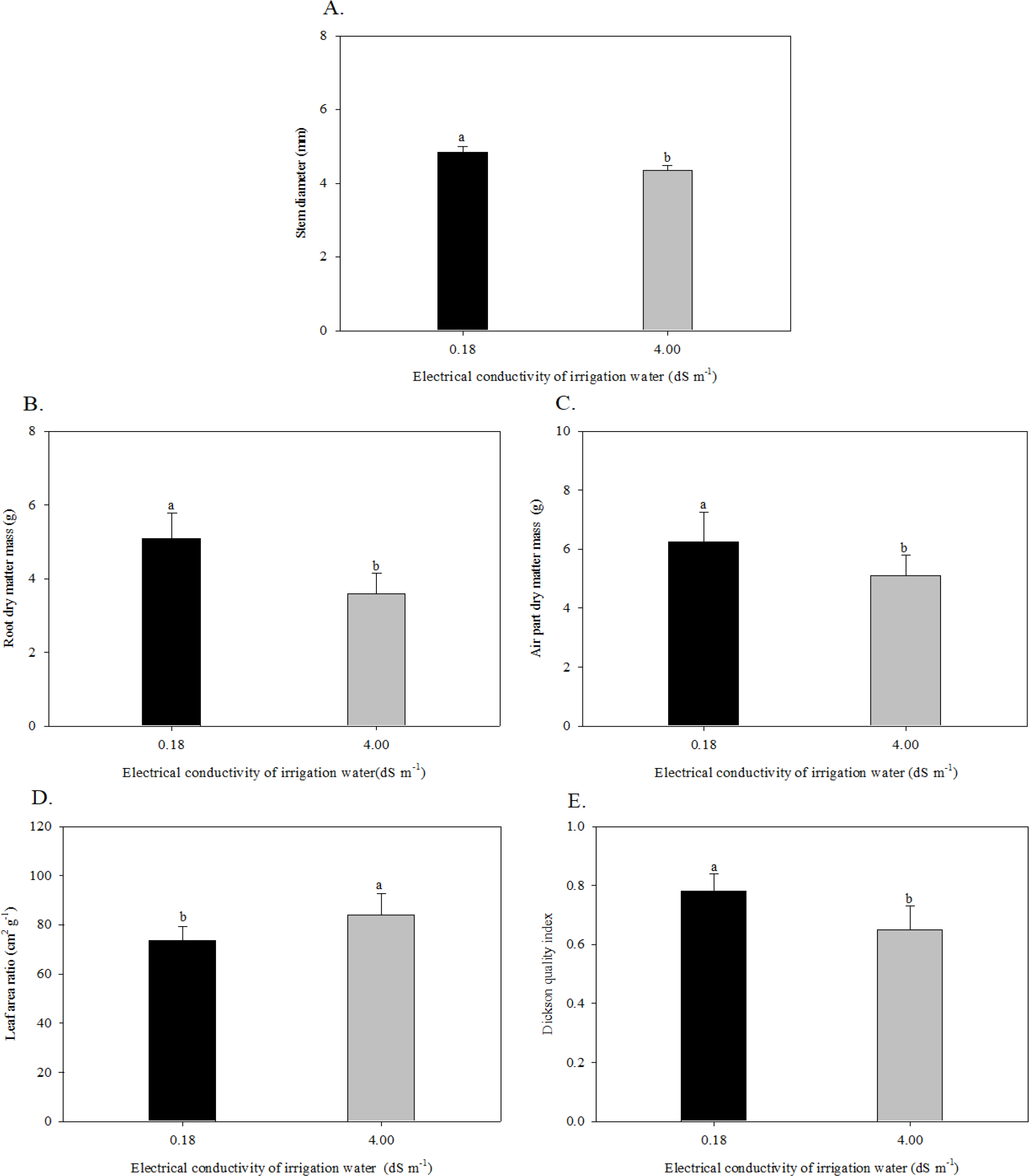 Note: Vertical bars represent the standard deviation from the mean (n=3). Bars with equal lowercase letters do not differ for the electrical conductivity of the water by the Tukey test (p≤0.05).
 Note: CS - CodasalTM; AR - Aminoagro raizTM; CS + AR - CodasalTM + Aminoagro raizTM. Vertical bars represent the standard deviation from the mean (n=3). Bars with the same capital letters do not differ from each other for fertilizers by the Tukey test (p≤0.05).
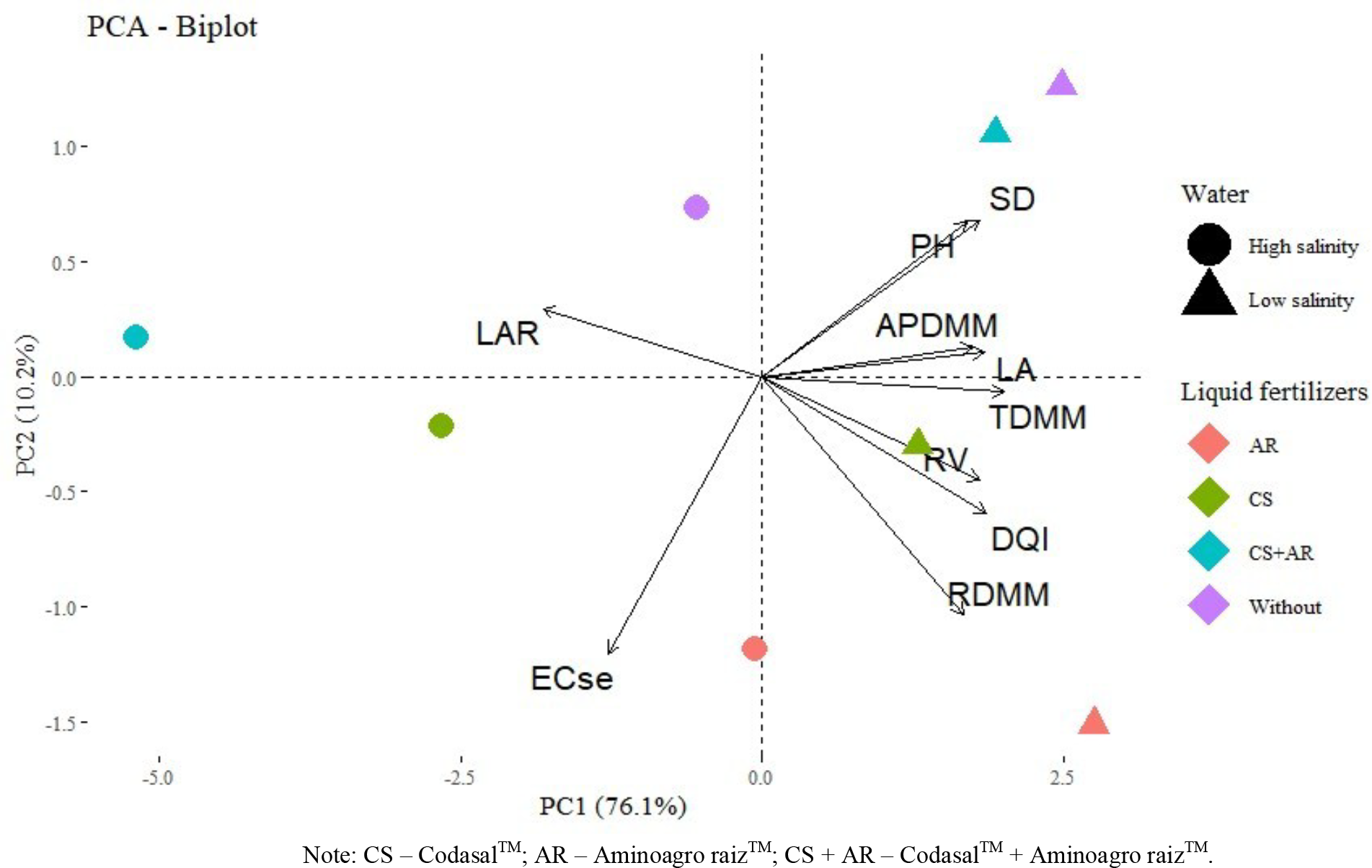 Note: CS - CodasalTM; AR - Aminoagro raizTM; CS + AR - CodasalTM + Aminoagro raizTM.