Growth of cotton irrigated with wastewater and under organic fertilization
ABSTRACT
The objective of this work was to determine the potential use of fish farming effluent associated with organic fertilization for the growth of ‘BRS 416’ cotton. The experiment was carried out in a greenhouse at the Center for Agrarian Sciences of the Federal Rural University of the Semi-Arid Region (UFERSA), Mossoró, RN, Brazil, in a randomized block design, with a 5 × 5 factorial scheme and four replicates. Treatments included mixtures of fish farming effluent and public-supply water (0, 25, 50, 75, and 100% effluent) and five concentrations of goat manure (0, 5, 10, 15, and 20% based on soil volume). Plant height, stem diameter, number of leaves, root length, leaf area, leaf dry mass, root dry mass, stem dry mass and total dry mass were evaluated. The use of substrate with 20% goat manure irrigated with dilution D4 (75% FFE and 25% PSW) favored the performance of the variables PH, SD, NL, RL, LA, LDM, RDM, SDM and TDM of ‘BRS 416’ cotton plants. Reuse of the fish farming effluent D5 (100% FFE), with electrical conductivity of 3.59 dS m-1, is an alternative that favors the growth and biomass production of ‘BRS 416’ cotton plants.
Keywords:
Gossypium hirsutum L; Water reuse; Goat manure; Fish farming; ‘BRS 416’.
RESUMO
Objetivou-se com este trabalho determinar o potencial do uso do efluente da piscicultura associado à adubação orgânica no crescimento do algodoeiro ‘BRS 416’. O trabalho foi realizado em casa de vegetação no Centro de Ciências Agrárias da Universidade Federal Rural do Semi-Árido (UFERSA), Mossoró-RN, em delineamento experimental de blocos ao acaso, com esquema fatorial 5 × 5 e quatro repetições. Os tratamentos incluíram misturas de efluente de piscicultura e água de abastecimento (0; 25; 50; 75 e 100% de efluente) e cinco concentrações de esterco caprino (0; 5; 10; 15 e 20% em base do volume de solo). Foram avaliadas altura de plantas, diâmetro de caule, número de folhas, comprimento das raízes, área foliar, fitomassa seca das folhas, fitomassa seca da raiz, fitomassa seca do caule e fitomassa seca total. A utilização de substrato com 20% de esterco caprino, irrigado com a diluição D4 (75% DEP e 25% de AAP) favoreceu o desempenho das variáveis AP, DC, NF, CR, AF, FSF, FSR, FSC e FST das plantas de algodoeiro ‘BRS 416’. O reaproveitamento do efluente da piscicultura D5 (100% DEP), com condutividade elétrica de 3,59 dS m-1, é uma alternativa que favorece o crescimento e a produção de biomassa das plantas de algodoeiro ‘BRS 416’.
Palavras-chave:
Gossypium hirsutum L; Reuso de água; Esterco caprino; Piscicultura; ‘BRS 416’.
INTRODUCTION
Water scarcity and low natural fertility of soils are limiting factors for agricultural production in the semi-arid region of northeastern Brazil (SILVA et al., 2021). Thus, the use of wastewater has emerged as an alternative for the control of environmental pollution, presenting itself as a viable option to increase water availability in arid and semi-arid regions, thus allowing the cultivation of plants, especially for the restoration of degraded areas (MELAKU; NATARAJAN, 2019; SOUZA et al., 2020). The use of this water source emerges as one of the solutions for the strengthening and development of agriculture in the semi-arid region, which suffers from droughts and high-salinity water.
Reuse of wastewater from fish farming, combined with nutrient enrichment through organic fertilization, is a promising alternative source for plant cultivation (FERREIRA et al., 2018). Cotton (Gossypium hirsutum L.) is an economically relevant and culturally important crop in the Brazilian Northeast, due to its rusticity and tolerance to salt and water stress, as well as easy management and adaptation to the region (SILVA et al., 2023). The use of wastewater from fish farming not only improves soil conditions, increasing productivity and profitability, but also makes cotton cultivation viable and sustainable (FERREIRA et al., 2018).
Cotton plays a crucial role in the economy and society. Economically, it is a relevant crop as a source of raw material for the textile industry, generating jobs throughout the production chain. Socially, it is cultivated by small farmers in rural regions, contributing to local subsistence and food security (GOMES et al., 2022).
The tolerance and rusticity of cotton make it attractive for areas with adverse conditions. Adaptable to poor soils and low water availability, its ability to adapt to different environments expands its cultivation areas and importance in world agriculture (SILVA et al., 2023).
Fish farming wastewater, rich in salts and nutrients, can be an alternative source for irrigation, promoting plant growth. The large volume and easy access to this type of wastewater in rural communities and by public and private enterprises make its use increasingly common, especially in cotton cultivation (AYERS; WESTCOT, 1999; FERREIRA et al., 2018).
Chemical fertilization is a high-cost practice in cotton cultivation, but on the other hand, when fertilization is carried out with organic compounds such as manure, it tends to reduce the expenses with mineral fertilizers and provide better crop growth and yield due to the improvement in the structural characteristics of the soil (FERREIRA et al., 2018; SOUZA et al., 2020).
In the Northeast region, goat farming stands out as one of the main sources of organic fertilization, being widely used in rural properties, especially in family farming (NASCIMENTO et al., 2022). The continuous use of this organic source in the same area increases soil fertility and improves soil physical attributes and microbial biomass activity, resulting in increased production and in profitability of agricultural species (FERREIRA et al., 2018).
The objective of this study is to determine the potential of using fish farming effluent associated with organic fertilization for cotton growth.
MATERIAL AND METHODS
The experiment was carried out in a protected environment, covered with diffuser plastic and a 50% shade net, located at the Department of Agronomic and Forestry Sciences of the Federal Rural University of the Semi-Arid Region (UFERSA), from May to June 2022, in Mossoró (5° 11’ 11’’ S; 37° 20’, 26’’ W and 18 m), Rio Grande do Norte, Brazil.
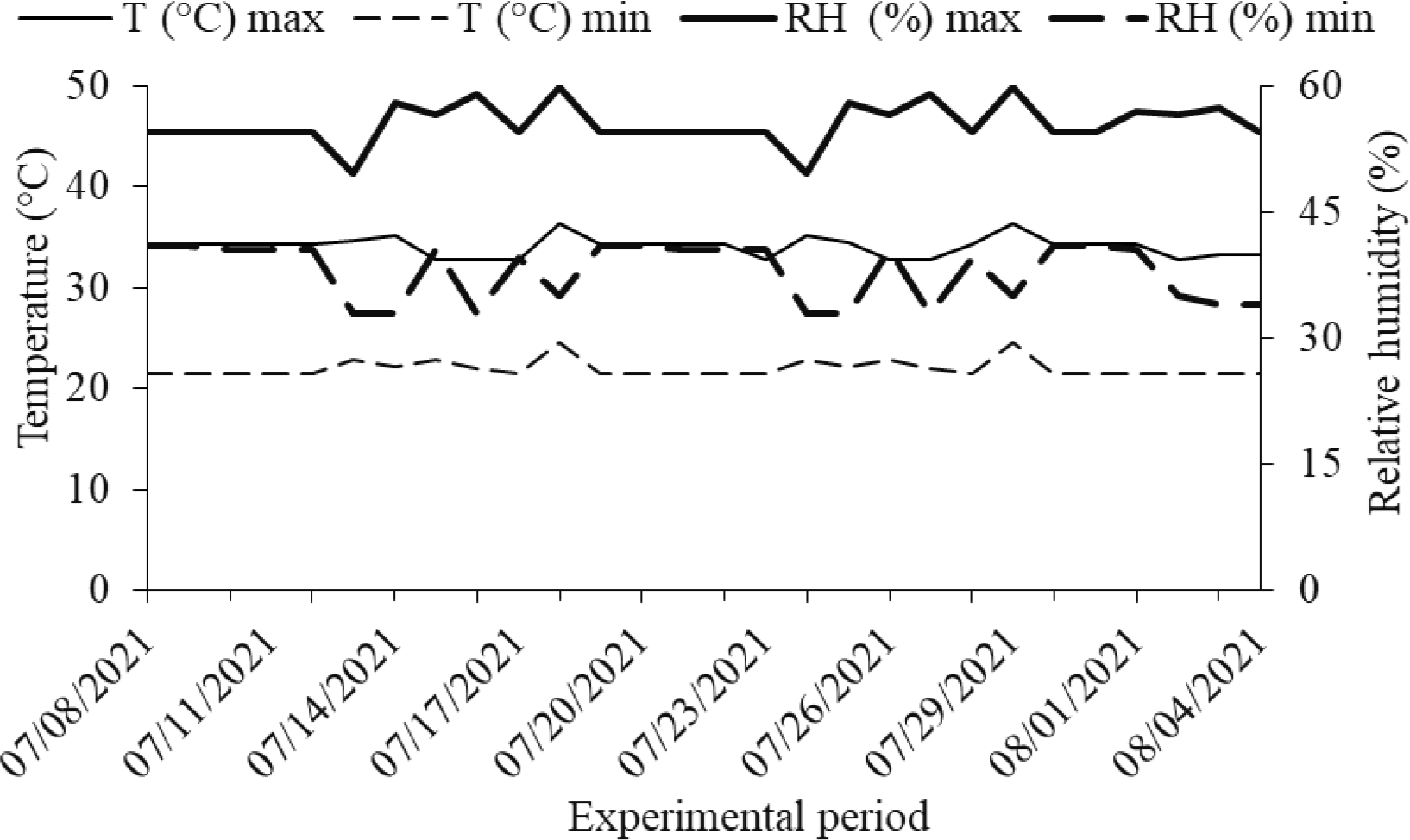
According to Köppen’s classification, the climate of the place is (hot and dry) (ALVARES et al., 2013). The maximum and minimum temperature and relative humidity data recorded within the protected environment during the experiment are presented in Figure 1.

Maximum and minimum temperature (°C) and relative humidity (%) in the greenhouse during the experimental period.
The experimental design was randomized blocks, in a 5 × 5 factorial scheme, with four replicates and one plant per plot, totaling 100 experimental units. The factors were composed of five proportions of goat manure (0, 5, 10, 15, and 20%) and five dilutions of fish farming effluent (FFE) in public-supply water (PSW): D1 - 0% FFE; D2 - 25% FFE e 75% PSW; D3 - 50% FFE e 50% PSW; D4 - 75% FFE e 25% PSW; D5: 100% FFE.
Fish farming effluent was collected in the Aquaculture sector of UFERSA, and goat manure was collected from a pen with the herd of a family farmer in the municipality of Apodi, RN, later aged for 15 days and characterized (Table 1). The plant material used was ‘BRS 416’ cotton, a conventional white cotton cultivar with early cycle, high yield, low stature and excellent level of resistance to diseases (EMBRAPA, 2022).
Physical and chemical characteristics of the soil (0-30 cm) and goat manure used in the experiment.
The soil was collected in the surface layer (0-30 cm) and subsequently sieved through a 10-mm-mesh sieve to compose the substrate for the cotton seedling bags. Chemical analyses are presented in Table 3, as described in the manual of Methods of Soil Analysis (EMBRAPA, 1997). The soil came from an area located at Sítio Laje do Meio, Chapada do Apodi, RN, Brazil. It is classified as Argissolo Vermelho Amarelo Eutrófico Abrupto (Ultisol), with sandy textural class (88% sand, 10% silt and 2% clay) (EMBRAPA, 2013).
Chemical characteristics of the public-supply water (PSW) and fish farming effluent (FFE) used in the experiment.
Hydrogen potential (pH) and electrical conductivity (EC) of dilutions of fish farming effluent in public-supply water.
Table 2 describes the physicochemical characteristics of the public-supply water and fish farming effluent (RICHARDS, 1954).
After dilution of the fish farming effluent in publicsupply water, the hydrogen potential (pH) and electrical conductivity (EC) at 25 ºC were measured using a digital pH meter (Instrutherm® PH-5000) and a benchtop conductivity meter (Tecnal®, TEC-4MP), respectively (Table 3).
Five seeds were sown in each plastic bag (2.5 dm3), using 2.0 dm3 of substrate in each bag. The plastic bags had holes in the bottom to allow free drainage and were placed on wooden boards at 0.3 m height from the ground. Until the 15th day after sowing (DAS), the seedlings were irrigated only with public-supply water, aiming at germination and emergence without adverse effects of the salinity of the fish farming effluent.
‘BRS 416’ cotton plants were irrigated with the dilutions for 30 days, up to 45 DAS. At 10 DAS, thinning was performed, leaving only the most vigorous seedling in each bag.
Irrigation was carried out once a day, applying the same volume to all plants, which varied and increased according to the water balance, and was determined by Equation 1:
Where:
VI = Volume of water to be used in the next irrigation event (mL);
Va = Volume applied in the previous irrigation event (mL); Vd = Volume drained (mL); and
LF = Leaching fraction of 0.15 (AYERS; WESTCOT, 1999). Invasive plants in the lysimeters were controlled by manual weeding during the experimental period in order to avoid interspecific competition for water and nutrients, favoring full development of the crop.
At 45 DAS, plant height (PH) was measured from the collar to the apical bud of the main branch; stem diameter (SD) was measured at 2 cm distance from the ground using a digital caliper with values in millimeters; number of leaves (NL) was obtained by counting leaves longer than 3 cm; root length (RL) was obtained by measuring the distance from the collar to the apex of the main root, using a graduated ruler with values in centimeters. Leaf area was estimated using the following expression (Equation 2), proposed by Grimes and Carter (1969):
Where: LA = Unit leaf area (cm2) and X = Midrib length of cotton leaf (cm). The individual area of each leaf was calculated and then the values were added to obtain the total leaf area.
The biomass components were expressed in grams (g) and obtained by weighing on a precision analytical scale with two decimal places. Plants were collected and divided into root, stem (from the base of the stem) and leaves, and then dried in a forced air circulation oven at 65° C until reaching constant mass. After drying, the fractions of the plant material were weighed and the values of root dry mass (RDM), stem dry mass (SDM), leaf dry mass (LDM) and total dry mass (TDM) were determined.
The data were subjected to analysis of variance by means of the F test at 5% (p<0.05) and 1% significance levels (p<0.01); in significant cases, regression analysis was applied to the goat manure factor and Tukey test was applied to the fish farming effluent factor, using the SISVAR® program (FERREIRA, 2019).
RESULTS AND DISCUSSION
There were significant effects of the interaction between the factors proportions of goat manure and dilutions of fish farming effluent on the variables plant height, stem diameter and leaf area. There was a significant effect of the single factor goat manure on the number of leaves (Table 4).
Summary of the analysis of variance and test of means for plant height (PH), stem diameter (SD), number of leaves (NL) and leaf area (LA) of cotton seedlings cultivated with goat manure and fish farming effluent, at 45 days after sowing.
The PH variable (Figure 2A) was significantly affected by the interaction between the different proportions of goat manure and dilutions of fish farming effluent. A higher PH of 33.06 cm was observed with the combination of D4 (EC = 2.80 dS m-1) with the use of 20% goat manure in the substrate for the growth of ‘BRS 416’ cotton plants. This result for PH occurs because the electrical conductivity of 2.80 dS m-1 is lower than the salinity threshold of the cotton crop, equal to 5.1 dS m-1 in the irrigation water and 7.7 dS m-1 in the soil saturation extract (AYERS; WESTCOT, 1999), thus not affecting plant growth. Thus, the cotton genotype ‘BRS 416’ can be irrigated with fish farming effluent with electrical conductivity of up to 2.80 dS m-1 without compromising its growth.

Plant height (A), stem diameter (B), number of leaves (C) and leaf area (D) of ‘BRS 416’ cotton as a function of goat manure and dilutions of fish farming effluent, at 45 DAS.
When analyzing the dilutions of fish farming effluent in cotton production, the lowest value of plant height was obtained when the fish farming effluent was not applied. However, when using the D4 dilution (75% FFE), plant height increased by 26.93 cm, differing statistically from the others (Table 4). Fish farming effluent is a viable source of essential nutrients for plant growth, such as nitrogen, phosphorus and potassium, in addition to other elements that are also beneficial, which influences the greater vegetative growth of cultivated plants ( FRUSCELLA et al., 2023).
For the SD of cotton plants (Figure 2B) subjected to different proportions of goat manure and dilutions of fish farming effluent, the highest value of 3.87 mm was observed in the combination of treatment D4 (EC = 2,80 dS m-1) with the use of 20% goat manure in the substrate. A similar result was observed in relation to both plant height and diameter of cotton plants. This is due to the fact that the electrical conductivity of 2.80 dS m-1 is below the salinity threshold for cotton cultivation, so it does not negatively affect plant development in terms of height and diameter. These results corroborate those reported by Zhang et al. (2022), who found that salinity levels below 7.7 dS m-1 do not affect the growth in diameter of cotton as the crop is tolerant to salinity. In addition, the use of 20% goat manure in the substrate contributed to improving the physical properties of the substrate, such as its water retention capacity and aeration, providing a more suitable environment for the development of cotton plants (SOUZA et al., 2020).
The stem diameter of cotton plants subjected to different dilutions of fish farming effluent showed no significant difference between the combinations used. The highest values were observed in the D4 and D5 combinations, with SD of 3.46 and 3.46 mm, respectively (Table 4). These results diverge from those reported by Zhang et al. (2022), who observed that SD is influenced by the use of fish farming effluent. Plants with a larger stem diameter have a superior tendency to survive, besides exhibiting an increased capacity for the formation of new roots and growth (TAIZ et al., 2017). For NL, an increase of 58.41% was observed when 20% goat manure was applied compared to the control (Figure 2C). The increase in NL with higher doses of goat manure may be related to nutrient contents and better soil structure due to the incorporation of goat manure to the soil (SOUZA et al., 2020), since well-nourished plants tend to increase their photosynthetic areas to assist in the physiology of their development.
The leaf area (Figure 2D) of plants subjected to different proportions of goat manure and dilutions of fish farming effluent was significantly affected by the interaction between the factors, with the highest value (225.68 cm2) found in the combination of D5 (EC = 3,59 dS m-1) with the use of 20% goat manure in the substrate for the production of cotton plants (Table 4). This is due to the fact that the electrical conductivity of the fish farming effluent of 3.59 dS m-1, under 100% FFE, is below the salinity threshold of cotton plants, so it did not negatively affect their development in terms of leaf area. These results are in agreement with Fruscella et al. (2023), who observed that the application of fish farming effluent led to a significant increase in the vegetative growth of plants, particularly in the growth of leaf area of Allium cepa plants. Similar results were reported by Rosa et al. (2018) for papaya plants (Carica papaya) irrigated with fish farming waste, which showed greater growth and better performance.
There were significant effects of the interaction between factors M and E on leaf dry mass, stem dry mass, root dry mass, total dry mass and root length (Table 5).
Summary of the analysis of variance for leaf dry mass (LDM), stem dry mass (SDM), root dry mass (RDM), total dry mass (TDM) and root length (RL) of cotton seedlings cultivated with goat manure and fish farming effluent, at 30 DAS.
The LDM of cotton increased in response to manure doses (Figure 3A). An increase of 43.18% was observed with the application of D4 (75% FFE), compared to a manure dose of 12%. However, from this dose, there was a reduction in LDM with the increase of manure doses in the substrate used. As for the effluent dilutions (25 and 50%), both showed a proportional increase with the manure doses, being 15.33 and 12.58%, respectively.

Leaf dry mass (A), stem dry mass (B), root dry mass (C) and total dry mass (D) of ‘BRS 416’ cotton as a function of goat manure and dilutions of fish farming effluent, at 45 DAS.
Plants with larger leaf area tend to have more efficient photosynthetic rates, promoting greater light assimilation, photosynthesis and dry matter accumulation, which favors a higher plant production (ALBANO et al., 2017), so this may explain the increase in plant biomass, as observed in dilutions of 0, 25, 50 and 75% as the manure doses increase.
The fertilizers and feeds used in the production process of fish farming ponds contribute significantly to increasing the concentrations of macronutrients in the water, mainly nitrogen and phosphorus (NUNES, 2002). The reduction of LDM at the manure dose of 20%, together with the effluent dilution D4 (75% FFE), may be related to the salts present in both manure and irrigation water. Excess salts can affect the development and growth of plants. However, plants use salt regulation to prevent excessive salt levels in the substrate from reaching the protoplasm of their cells or to be able to tolerate the toxic effects and osmotic disturbances associated with increased salt concentration in the protoplasm (SILVA NETA et al., 2022).
Stem dry mass (Figure 3B) showed similar behavior between the fish farming effluent dilutions of 25, 50, 75 and 100%. However, it differed when compared to D1 (0% FFE), increasing with the increase in manure doses. Under dilution D1 (0% FFE), an increase of 42.80% was observed at the highest dose of manure used in the cultivation substrate. It can be observed that dilution D5 (100% FFE) promoted greater SDM accumulation, with a value of 0.67 g. In addition, dilution D4 (75% FFE), in interaction with the 20% manure dose in the substrate, resulted in SDM accumulation of 0.43 g. According to Aquino et al. (2023), the increase in plant biomass is possibly associated with the increase in nutrient concentrations in the substrate, caused by the application of wastewater.
There is a high nutrient load in the effluent, which promotes benefits for the cotton plant, playing an essential role in photosynthesis, that is, the amount of these elements available to the plant directly influences the production of photoassimilates, which consequently affect biomass accumulation in the plant (POUR; FARAHBAKHSH; TOHIDINEJAD, 2021). This result obtained with dilution D1 (0% FFE) may be related to a lower salinity level of the public-supply water compared to the fish farming effluent, since the high EC can affect the growth and development of plants. It is important to emphasize that salt stress causes nutritional and physiological imbalance, with a direct influence on the conversion of carbon assimilated by plants, leading to reductions in crop growth and biomass accumulation (TAIZ et al., 2017).
When analyzing the dilutions of the fish farming effluent on the stem dry mass accumulation of cotton, it was observed that plants not irrigated with fish farming effluent (D1 0% FFE) had the highest value of SDM (0.60 g); as the effluent concentrations increased, SDM accumulation decreased by 15, 11.67, 23.33 and 18.33%, respectively, differing statistically from each other (Table 5). These results diverge from those reported by Nascimento et al. (2016), who observed that the treatments that used fish farming effluent promoted significant improvements in the growth of tomato plants. This result is due to the fact that the effluent is rich in organic and mineral matter, highlighting its effectiveness as a fertilizer.
The root dry mass of ‘BRS 416’ cotton plants increased gradually with the increment in manure doses, and the dose of 20%, associated with irrigation using 75% fish farming effluent, led to an average weight of 0.5425 g (42.28%) (Figure 3C). The addition of organic compounds, incorporated into plantations of crops such as cotton, is essential for biomass production, even if plants are irrigated with nutrient-rich water, such as fish farming effluent. The lowest performance in root dry mass production occurred in the control treatment with absence of doses of organic compost under irrigation with 25% fish farming effluent. Using wastewater in the irrigation of cotton plants promotes an increase in plant structures, favoring the production of biomass of shoots (ARAÚJO et al., 2022) and root system, as observed in the present study.
For RDM, when analyzing the dilutions of fish farming effluent in cotton production, it was observed that dilution D4 (75%) was statistically superior to the others, being 21.82% better than D1 (0% FFE) (Table 5). Higher RDM with the presence of effluent (D4) may occur due to the availability of nutrients in the effluent, which stimulates denser and more robust root growth, even if the length is not as evident as in soil without effluent (NASCIMENTO et al., 2016).
The interaction between the doses of goat manure and the dilutions of fish farming effluent showed promising results for the total dry mass of cotton plants. The increase in the concentration of organic material in the substrate, associated with fish farming effluent, promoted an increase in dry biomass. It can be seen that the substrate with 20% goat manure, irrigated with 75% fish farming effluent, led to an increase of 59.95% in total dry mass compared to the dose of 15% goat manure and 75% fish farming effluent; however, under 20% goat manure and 100% fish farming effluent, a decrease of 0.12 g was observed in cotton plants (Figure 3D).
The highlight in the dry mass production of cotton plants irrigated with 75 and 100% fish farming effluent is associated with the nutritional values present in it, which not only meet the water needs of plants, but also provide large amounts of nutrients for the soil solution, facilitating absorption by plants. The incorporation of goat manure into the soil complements its nutritional value, improving productivity conditions and favoring the microbiological action of the soil, helping in the growth and development of cotton plants (BARBOSA et al., 2019). The use of goat manure promoted gains of 65.09% in plant height and 65.88% in stem diameter of ‘BRS Topázio’ cotton at a dose of 15%, representing the highest value of organic treatments (BARBOSA et al., 2019).
When analyzing the different dilutions of fish farming effluent and its effect on TDM accumulation in cotton, we observed results comparable to those obtained for RDM; dilution D4 (75% FFE) proved to be statistically superior to the others. Compared to dilution D1 (0% FFE), there was an 8.72% increase in TDM (Table 5). The results obtained can be justified by the fact that dilution D4 (75% FFE) provided an adequate balance of nutrients and organic matter present in the fish farming effluent, favoring TDM accumulation in cotton plants. The combination of these nutrients favors a more fertile and nutritious soil environment, thus promoting more vigorous and robust plant growth (NASCIMENTO et al., 2016).
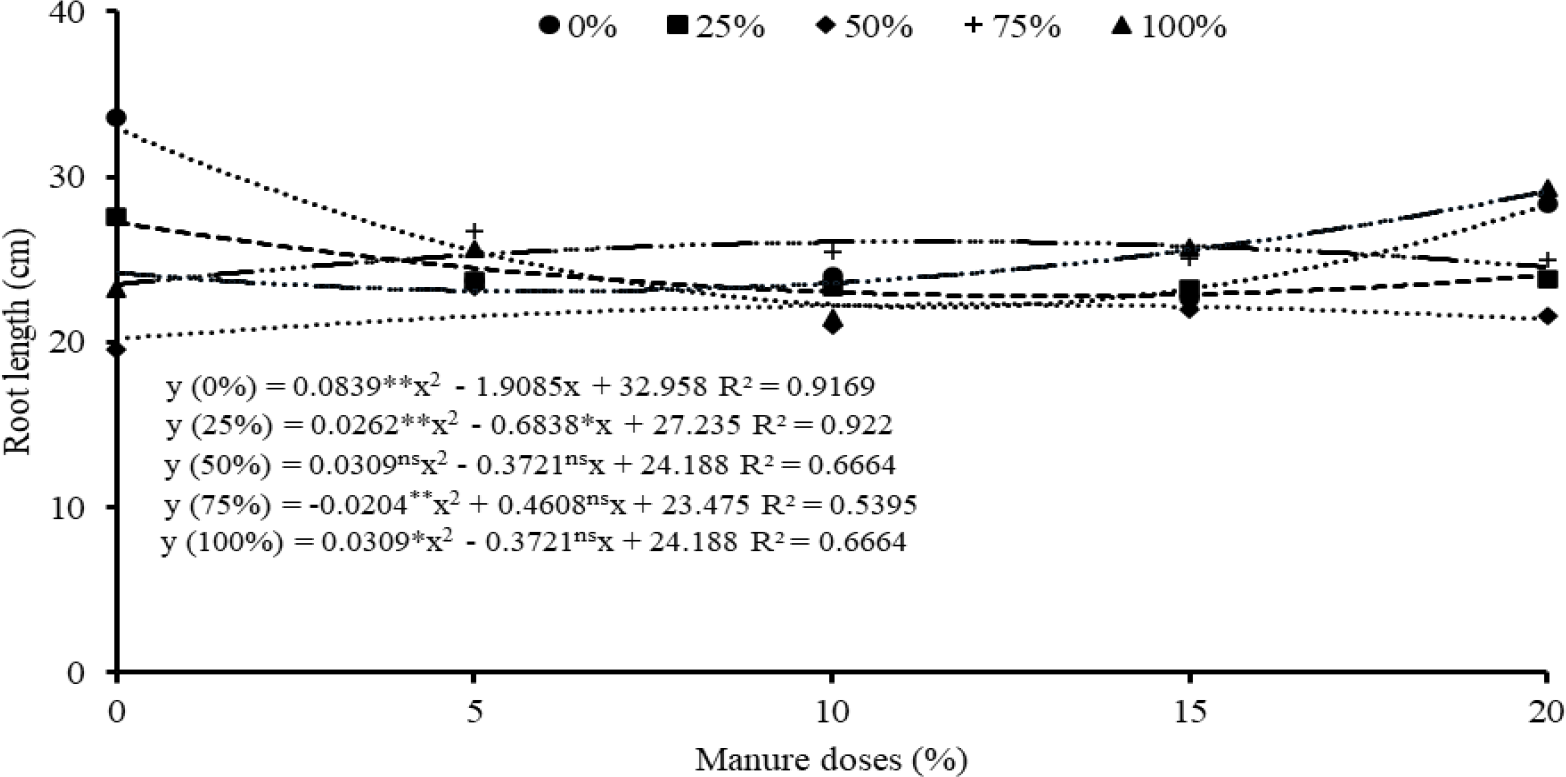
According to the equations obtained for root length (Figure 4), it was found that the different dilutions of fish farming effluent, under different doses of goat manure, led to different results in the cultivation of ‘BRS 416’ cotton up to 45 days. Dilution D5 (100% FFE) promoted an increase of 83.10% in root length with the increase in the percentage of manure. Dilution D3 (50% FFE) led to the lowest values, correlating with the manure doses of 0 and 20%, with a variation of 5.42%.

Root length of ‘BRS 416’ cotton as a function of goat manure and dilutions of fish farming effluent, at 45 DAS.
The longer root length may be related to the supply of nutrients and physical attributes with addition to the cotton substrate. According to Amorim et al. (2018), the porosity associated with the density of the substrate is able to provide a greater amount of voids, which results in a better response in the growth of seedlings when the appropriate proportion is used in the substrate. The distribution of nutrients present in the substrates is fundamental for the development of plants in the initial phase (ALMEIDA; SÁNCHEZ, 2015).
On the other hand, the application of D5 (100% FFE) may have contributed to greater root length, due to the nutritional composition of the water. Due to the feeding of fish, the effluent from fish farming tanks is known to be rich in nutrients, especially nitrogen and phosphorus.
For root length (Table 5), D1 (0% FFE) was statistically superior to the other dilutions, promoting an increase of 8.02% compared to D2 (25% FFE). In the absence of fish farming effluent (D1), it can be assumed that the essential nutrients normally present in the effluent were not available to cotton plants. As a result, the roots were stimulated to grow in search of these vital nutrients for their development and growth. According to Fernandes and Maciel (2023), this result is an adaptive response of plants to the scarcity of nutrients in the substrate used, in which their roots grow more in search of water and nutrients, to ensure survival and adequate growth.
CONCLUSION
The use of substrate with 20% goat manure irrigated with dilution D4 (75% FFE and 25% PSW) favored the performance of the variables PH, SD, NL, RL, LA, LDM, RDM, SDM and TDM of ‘BRS 416’ cotton plants.
Reusing the fish farming effluent D5 (100% FFE), with electrical conductivity of 3.59 dS m-1, is an alternative that favors the growth and biomass production of ‘BRS 416’ cotton plants.
Data Availability:
The data that support the findings of this study can be made available, upon reasonable request, from the corresponding author .
REFERENCES
- ALBANO, F. G. et al. New substrate containing agroindustrial carnauba residue for production of papaya under foliar fertilization. Revista Brasileira de Engenharia Agrícola e Ambiental, 21: 128-133, 2017.
- ALMEIDA, R. O. P. O.; SÁNCHEZ, L. E. Indicadores da Qualidade do Substrato para Monitoramento de Áreas de Mineração Revegetadas. Floresta e Ambiente, 22: 153-163, 2015.
- ALVARES, C. A. et al. Köppen’s climate classification map for Brazil. Meteorologische Zeitschrift, 22: 711-728, 2013.
- AMORIM, D. J. et al. Multidimensional analysis associated with growth analysis in the selection of organic substrates for the production of tomato seedlings. Journal of Agricultural Science, 10: 326-336, 2018.
- AQUINO, C. F. et al. Uso de água residuária da piscicultura no crescimento de mudas de maracujazeiro-amarelo. Revista de Educação, Ciência e Tecnologia de Almenara / MG, 5: 58-74, 2023.
- ARAÚJO, A. F. B. et al. Fiber Quality, Yield, and Profitability of Cotton in Response to Supplemental Irrigation with Treated Wastewater and NPK Fertilization. Agronomy, 12: 1-16, 2022.
- AYERS, R. S.; WESTCOT, D. W. A qualidade da água na agricultura. 2. ed. Campina Grande: UFBP, 1999. (Estudos da FAO. Irrigação e Drenagem, 29).
- BARBOSA, J. L. et al. Crescimento de algodoeiro colorido cv. BRS Topázio em solos com distintas salinidades e adubação orgânica. Revista de Ciências Agrárias, 42: 206-213, 2019.
- EMBRAPA - Empresa Brasileira de Pesquisa Agropecuária. Manual de métodos de análise de solo. 2. ed. Rio de Janeiro, RJ: Centro Nacional de Pesquisa de Solos, 1997. 212 p.
- EMBRAPA - Empresa Brasileira de Pesquisa Agropecuária. Sistema brasileiro de classificação de solos. 3. ed. Rio de Janeiro, RJ: Embrapa Solos, 2013. 353 p.
-
EMBRAPA - Empresa Brasileira de Pesquisa Agropecuária. Soluções tecnológicas. Available at: https://www.embrapa.br/busca-de-solucoes-tecnologicas/-/produto-servico/5492/algodao-branco---brs-416 . Access on: Aug. 13, 2022.
» https://www.embrapa.br/busca-de-solucoes-tecnologicas/-/produto-servico/5492/ algodao-branco---brs-416 - FERNANDES, M. M.; MACIEL, J. R. Potencial adaptativo de Melocactus violaceus Pfeiff (Cactaceae) para solos argilosos. Hoehnea, 50: e582021, 2023.
- FERREIRA, D. F. SISVAR: A computer analysis system to fixed effects split plot type designs. Revista Brasileira de Biometria, 37: 529-535, 2019.
- FERREIRA, M. M. et al. Crescimento e produtividade do algodoeiro herbáceo submetid à adubação orgânica. Revista Brasileira de Agropecuária Sustentável, 8: 52 - 61, 2018.
- FRUSCELLA, L. et al. Investigating the effects of fish effluents as organic fertilisers on onion (Allium cepa) yield, soil nutrients, and soil microbiome. Scientia Horticulturae, 321: 112-297, 2023.
- GOMES, I. H. et al. Selection of cotton genotypes for yield and fiber quality under water stress. Revista Brasileira de Engenharia Agrícola e Ambiental, 26: 610-617, 2022.
- GRIMES, D. W.; CARTER, L. M. A Linear rule for direct nondestructive leaf area measurements. Agronomy Journal, 61: 77-479, 1969.
- MELAKU, S.; NATARAJAN, P. Status of integrated aquaculture-Agriculture systems in Africa. International Journal of Fisheries and Aquatic Studies, 7: 263-269, 2019.
- NASCIMENTO, M. I. S. S. et al. Insights two main products from the goat wine culture in the Brasilian Northeast, Research, Society and Development, 11: 1-13, 2022.
- NASCIMENTO, T. S. et al. Irrigação com efluente de piscicultura no cultivo de mudas de tomate. Revista Brasileira de Agricultura Irrigada, 10: 866-874, 2016.
- NUNES, A. J. P. Tratamentos de efluentes e recirculação de água na engorda de camarão marinho. Revista Panorama da Aquicultura, 12: 27-39, 2002.
- POUR, A. P.; FARAHBAKHSH, H.; TOHIDINEJAD, E. Nitrogen, phosphorous and potassium levels affected growth indices, leaf gas exchange parameters and biomass production of henna (Lawsonia inermis L.) ecotypes. Industrial Crops and Products, 163: 113-297, 2021.
- RICHARDS, L. A. Diagnosis and improvement of saline and alkali soils. USDA Handbook, 60. Washington D. C. U.S. Salinity Laboratory. 1954. 160 p.
- ROSA, D. K. O. F. et al. Aproveitamento do resíduo de tanque de piscicultura na produção de mudas de mamoeiro em Rorainópolis. Ambiente: Gestão e Desenvolvimento, 11: 120-136, 2018.
- SILVA NETA, A. M. S. et al. Fitomassas e qualidade de mudas de maracujazeiro--azedo sob irrigação com águas salinas e adubação nitrogenada. Revista de Ciências Agrárias, 45: 63-73, 2022.
- SILVA, A. A. D. et al. Cherry tomato production and seed vigor under irrigation with saline effluent from fish farming. Revista Brasileira de Engenharia Agrícola e Ambiental, 25: 380-385, 2021.
- SILVA, F. A. et al. Pyruvic acid as attenuator of water deficit in cotton plants varying the phenological stage. Brazilian Journal of Biology, 83: 272-280, 2023.
- SOUZA, J. I. R. et al. Uso de água residuária da piscicultura na produção de plantas nativas da caatinga. Jornada de Iniciação Científica e Extensão, 15: 1-2, 2020.
- TAIZ, L. et al. Fisiologia e desenvolvimento vegetal. 6. ed. Porto Alegre, RS: Artmed, 2017. 858 p.
- ZHANG, J. et al. Evaluation of saline water irrigation on cotton growth and yield using the AquaCrop crop simulation model. Agricultural Water Management, 261: 107-355, 2022.
Edited by
-
Editor in Chief:
Aurélio Paes Barros Júnior
-
Section Editor:
João Everthon da Silva Ribeiro